
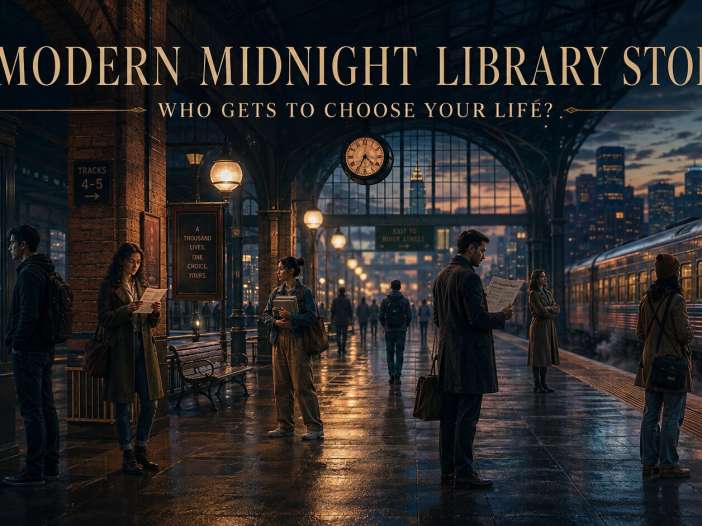
Introduction
The Midnight Library asks what might happen if we could visit the lives we did not choose.
These five modern stories push that question further.
What happens when we no longer need a magical library?
What happens when social media lets us watch old loves from a distance, when career data predicts which path is safer, when parents use experience to steer their children, and when AI can begin simulating the futures we never lived?
Each story examines a different form of regret.
Rachel romanticizes a relationship from twenty-five years earlier.
Leah wonders who she might have become without motherhood.
David tries to protect his daughter from repeating his mistakes.
Evan builds technology capable of making alternate lives feel almost remembered.
Mina grows up in a world where algorithms can estimate which future she is most likely to regret.
None of them discovers the perfect path.
Instead, they slowly confront a more difficult question:
How much guidance can we receive before someone—or something else—begins becoming the author of our life?
(Note: This is an imaginary conversation, a creative exploration of an idea, and not a real speech or event.)
Story 1 — The Message She Never Sent
Rachel Levin found the email because her daughter had finally moved out.
That was the ridiculous part.
Twenty-five years of regret, one divorce, two children, three jobs, four apartments, a mortgage, a pandemic, a dead father, a new hip for her mother, and hundreds of ordinary Tuesdays had passed.
Then Emma left for graduate school, and Rachel decided to clean the old external drive in the bottom drawer of her desk.
The folder was called:
1999–2002
Inside were tax documents, photographs, bad poetry, an old résumé, and a folder marked Aaron.
Rachel stared at the name for several seconds before opening it.
There were photographs first.
Aaron at twenty-four, holding a paper coffee cup and laughing at something outside the frame.
Aaron asleep on her parents’ sofa.
Aaron beside a lake.
Aaron wearing the dark green sweater she had bought him even though he insisted green made him look ill.
Then the emails.
Most of them were ordinary.
Call me when you land.
Your mother hates me.
My mother hates everybody.
I miss you.
I miss you more.
She smiled.
Then she found the draft.
No recipient.
No timestamp beyond the creation date.
Never sent.
Rachel opened it.
There were only four sentences.
Aaron,
I know I said I need to do this.
But if you ask me one more time to come home, I think I will.
I’m scared you won’t ask again.
Rachel stopped breathing.
For a moment she was twenty-four.
Not remembering twenty-four.
Being twenty-four.
Standing in a tiny apartment hundreds of miles from home, still unpacking boxes from the job she had insisted she wanted, staring at a phone that did not ring.
She had forgotten the email completely.
Or perhaps forgotten was not the right word.
Maybe some memories simply learned how to live underground.
Her phone vibrated.
A social media notification.
People You May Know.
She almost laughed before looking.
Then she didn't.
Aaron Weiss.
She sat perfectly still.
His profile photograph showed a man in his late forties standing beside a lake.
Gray in his beard.
Same eyes.
Different face.
A life had happened to it.
Rachel knew she should close the app.
Instead she tapped.
There was not much public information.
A university.
A consulting firm.
Photographs tagged by other people.
Then she saw the woman.
Aaron with a dark-haired woman at a wedding.
Aaron with her beside a Christmas tree.
Aaron holding a baby.
Then another child.
A beach.
A kitchen.
A dog.
Birthdays.
School plays.
A garden.
Twenty-five years compressed into images somebody had selected because they looked worth keeping.
Rachel understood perfectly well that photographs lied.
She worked in communications.
She had spent half her professional life choosing which reality appeared in brochures.
She kept scrolling anyway.
The woman’s name was Rebecca.
Rebecca Weiss.
Then a photograph from four years earlier.
A memorial post.
Rachel stopped.
Rebecca had died of cancer at forty-six.
The comments were filled with people talking about generosity, humor, courage, casseroles, school pickups, hospital rooms.
Rachel closed the phone.
Opened it again.
She told herself she was simply shocked.
That evening she looked again.
The next morning too.
Soon she knew things she had no right to know.
Aaron’s daughter had gone to Northwestern.
His son played soccer.
Rebecca had loved gardening.
They had renovated a kitchen in 2014.
They took a family trip to Portugal.
There was a yellow Labrador named Morris.
Rachel studied the kitchen most of all.
It was absurd.
White cabinets.
Wood counters.
Blue ceramic bowls.
She could imagine herself there.
She saw herself cutting vegetables at that counter.
Aaron pouring wine.
Children arguing upstairs.
Morris asleep by the refrigerator.
It arrived in her mind fully furnished.
Not a possibility anymore.
A memory from a life that had never occurred.
At work she found herself distracted.
At night she opened the old email again.
If you ask me one more time to come home, I think I will.
He had asked before.
Many times.
Stay.
Come back.
We can figure it out.
Rachel had always said no.
She had taken the job because everyone told her she was brave.
Her boss.
Her professors.
Her father, who said a woman should never build her life around a man.
Her mother, who said Aaron would understand if he truly loved her.
Her friends said she would regret staying.
Aaron said:
“I’m not asking you to give up your life.”
Rachel had replied:
“You are asking me to give up this opportunity.”
He said:
“Maybe those aren't the same thing.”
She hated him for that sentence.
Mostly because she wasn't sure he was wrong.
Their calls became shorter.
Then angry.
Then careful.
Then occasional.
Then none.
Rachel married Tom at thirty-two.
They had Emma and Jacob.
There had been beautiful years.
Real ones.
Camping trips.
Fevers at two in the morning.
Birthday cakes collapsing in the oven.
Tom singing badly in the car.
Emma losing her first tooth.
Jacob refusing to sleep anywhere except the floor beside their bed for six months.
Rachel had loved Tom.
That was another thing regret disliked.
It preferred clean narratives.
Aaron: true love.
Tom: mistake.
Reality had refused to cooperate.
Her marriage ended without betrayal.
They became tired people who had grown in directions that eventually stopped meeting.
They separated.
Cried.
Fought over money.
Learned to sit together at graduations.
Tom remarried.
Rachel did not.
After Emma moved away, the house became very quiet.
That was when Aaron returned.
Not Aaron himself.
The life around him.
One Friday night Rachel enlarged a photograph of Rebecca standing in the kitchen.
She stared at the blue bowls.
Then suddenly felt ashamed.
She shut the laptop.
“What are you doing?” she said aloud.
No one answered.
The next day she called her friend Julie.
They had known each other since college.
Rachel told her everything except how often she had been checking Aaron’s profile.
Julie listened.
Then said:
“So you're going to contact him.”
“No.”
“You want to.”
“I don't know.”
“You found an email saying you would have gone back to him.”
“Yes.”
“And now he's widowed.”
Rachel flinched.
“Don't say it like that.”
“Like what?”
“Like I'm waiting for somebody's wife to die.”
“I didn't say that.”
“It sounded like it.”
Julie was quiet.
Then:
“Rachel, are you wondering if you still love him?”
Rachel looked out the window.
“No.”
She waited.
“Yes.”
Then:
“I don't know.”
Julie sighed.
“Do you love him, or are you lonely?”
“That is an incredibly annoying question.”
“I worked on it.”
Rachel smiled despite herself.
Julie continued.
“There's another question.”
“What?”
“Do you miss Aaron?”
Rachel waited.
“Or do you miss the version of you who still had all those choices?”
That one hurt.
Rachel changed the subject.
Three days later she messaged Aaron.
Not the email.
A simple message.
Aaron, I came across some old photographs and thought of you. I hope you're well. I was very sorry to learn about Rebecca.
She stared at it for ten minutes.
Then pressed send.
The reply came two hours later.
Rachel. Wow. It’s good to hear from you. Thank you. Rebecca was extraordinary. I hope you're doing well too.
Nothing romantic.
Nothing cold.
They exchanged several messages over the week.
Children.
Work.
Parents.
Time.
Finally Aaron wrote:
I’m in town next Thursday for a meeting. Coffee?
Rachel nearly said no.
Instead:
Union Hall? 3:30?
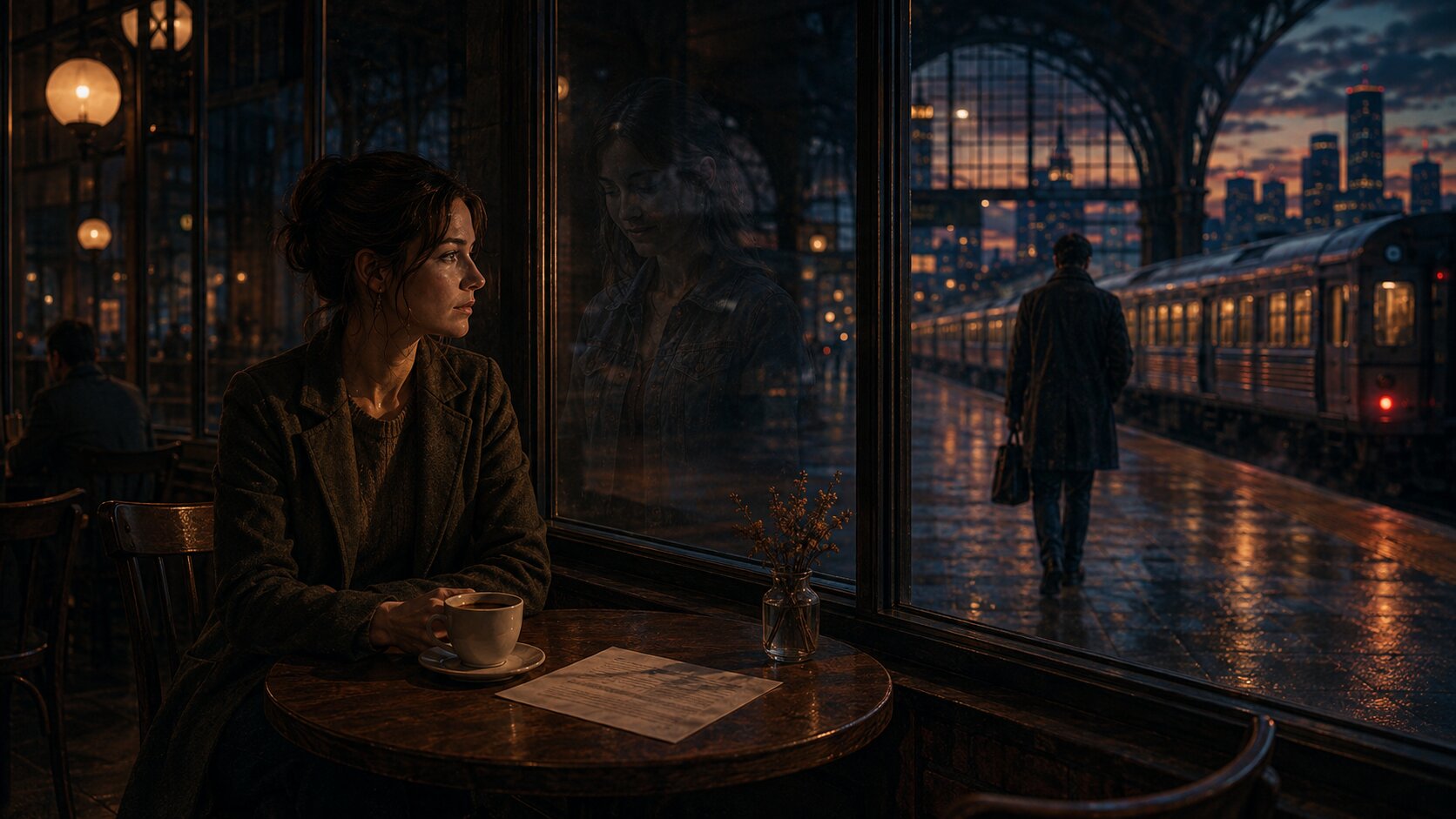
Union Hall had once been a railway station.
Now it contained a café, offices, community rooms, shops, and two functioning platforms behind restored glass doors.
Rachel arrived twenty minutes early.
She changed tables twice.
Aaron arrived exactly on time.
For one second she recognized him completely.
Then she recognized almost nothing.
He hugged her.
It was brief.
Warm.
Older.
They sat.
“Hi,” Aaron said.
“Hi.”
“This is weird.”
“Very.”
He smiled.
There it was.
The smile survived.
For the first half hour they talked safely.
Her children.
His children.
Tom.
Rebecca.
Work.
Parents.
He spoke about Rebecca without hesitation.
Not obsessively.
Naturally.
“She would've liked this place,” he said once.
Rachel felt something strange.
Not jealousy.
Embarrassment.
She had spent weeks inserting herself into photographs that belonged to a woman Aaron still loved in the present tense.
Eventually Aaron leaned back.
“So what made you look me up?”
Rachel could have lied.
She almost did.
Instead she reached into her bag.
She had printed the email.
She slid it across the table.
Aaron read it.
His face changed.
He read it again.
Then looked at her.
“When did you write this?”
“About two weeks after I moved.”
“You never sent it.”
“No.”
“Obviously.”
Rachel gave a nervous laugh.
Aaron didn't.
“You would've come back?”
“I don't know.”
“It says you would.”
“It says I thought I would.”
Aaron looked down again.
“Why didn't you send it?”
Rachel's throat tightened.
“I was waiting for you to ask again.”
He stared at her.
“I thought I had asked enough.”
“I know.”
“No, Rachel. I mean—I thought asking again would be disrespectful.”
“I know.”
“I thought you had made your decision.”
“I had.”
“Then you hadn't.”
“I was twenty-four.”
“So was I.”
Silence.
The trains outside moved somewhere beyond the wall.
Aaron folded the paper once.
Not angrily.
Carefully.
“I wish I had known,” he said.
Rachel looked at him.
Everything stopped.
Those were the words she had secretly wanted.
Not I never stopped loving you.
Not Come back.
Just:
I wish I had known.
Tears filled her eyes.
“Me too.”
Aaron looked out toward the platforms.
“There were years when I wondered.”
Rachel barely breathed.
“About us?”
“Of course.”
The answer hurt more than denial would have.
“I'd think about you sometimes. Especially early on.”
Rachel nodded.
“When I met Rebecca, I still thought about you.”
Rachel looked down.
Aaron continued.
“But then I loved Rebecca.”
There was no apology in the sentence.
There should not have been.
“We had a good marriage.”
Rachel's hands tightened around her cup.
“Not perfect.”
He smiled sadly.
“She could drive me insane.”
Rachel laughed through tears.
“She hated being late, so she made everybody arrive forty minutes early. She once refused to speak to me for almost an entire flight because I changed our seats without asking.”
Rachel smiled.
“She sounds terrible.”
“She was.”
His eyes filled.
“She was wonderful.”
Rachel looked away.
Aaron watched her.
Then he said:
“Rachel, what have you been imagining?”
She froze.
“What?”
“You didn't contact me because you found one old email.”
He spoke gently.
“What have you been imagining?”
Rachel could not answer.
He knew anyway.
“The house?”
She stared at him.
“The kids?”
She looked down.
“Our life?”
Tears slipped down her face.
“I don't know.”
Aaron nodded.
“I do.”
“How?”
“Because I did it too.”
She looked up.
“For years.”
The admission surprised her.
“I imagined the city you moved to. The career. The people you met. I imagined you becoming this extraordinary person and thinking I wasn't enough.”
Rachel shook her head.
“That isn't what happened.”
“I know.”
“How?”
“Because eventually I had a life.”
He looked at the old email.
“That takes up more room than imagination.”
Rachel began crying harder.
Aaron waited.
“I've looked at pictures,” she admitted.
“Of us?”
“Of you. Rebecca. The kids.”
Aaron's face remained kind.
That made it worse.
“The kitchen.”
“The kitchen?”
“The blue bowls.”
For a moment Aaron stared.
Then laughed.
Rachel covered her face.
“Oh God.”
“The blue bowls?”
“I know.”
“Rebecca hated those bowls.”
Rachel looked up.
“What?”
“She wanted white ones. I liked the blue. We argued about bowls for three years.”
Rachel started laughing through tears.
Aaron did too.
Then the laughter died.
Rachel whispered:
“I kept seeing myself there.”
Aaron's face changed.
Not angry.
Sad.
“Rachel.”
“I know.”
“No, listen.”
She looked at him.
“I loved you.”
The room disappeared.
“I really did.”
Rachel nodded.
“And maybe if you'd sent this, everything would have changed.”
Her heart broke open.
“Maybe you would've come home.”
She stared at him.
“Maybe we would've married.”
Rachel could not speak.
Aaron's eyes were wet now too.
“Maybe it would've been beautiful.”
She pressed her lips together.
Then Aaron said:
“But please don't turn my marriage into the life you were supposed to have.”
Rachel stopped.
He looked toward the paper between them.
“Rebecca wasn't filling your place.”
Rachel nodded slowly.
“My children aren't evidence of what you lost.”
Another nod.
“My kitchen isn't a photograph of your mistake.”
Rachel wiped her face.
“I know.”
“No.”
He shook his head gently.
“You're learning it.”
She looked at him.
Aaron pushed the email back across the table.
“I don't want you to make our old love smaller.”
“I don't.”
“Good.”
He paused.
“But don't make it bigger than the lives that came after it either.”
Rachel looked down at the paper.
“What if I made the wrong choice?”
Aaron sighed.
“I don't know.”
She looked almost angry.
“That’s it?”
“What do you want me to say?”
“That I would've hated living with you.”
He smiled.
“I was hoping for something more flattering.”
“You know what I mean.”
“Yes.”
He leaned forward.
“Maybe you did make the wrong choice.”
Rachel stared at him.
“That's possible.”
She had not expected him to say it.
“Maybe you should've sent the email.”
Her eyes filled again.
“Maybe.”
He waited.
“But that doesn't mean the next twenty-five years were supposed to disappear.”
Rachel looked at him.
“That's what you're doing.”
“What?”
“Turning one possible mistake into a verdict on everything that followed.”
Rachel thought of Emma.
Jacob.
Tom singing badly.
Her father holding his first grandchild.
Her mother at Emma's graduation.
Work she had loved.
People she had helped.
Nights she had wanted to forget.
Mornings she would never give back.
“But if I came home—”
“They might not exist.”
“I know.”
“Do you?”
Rachel closed her eyes.
Aaron continued softly.
“You're comparing the hardest parts of the life you lived with the best parts of a life you invented.”
She opened her eyes.
“That isn't fair to either one.”
Rachel stared at the email.
After a while she said:
“Do you ever wish you'd chosen differently?”
Aaron looked out toward the trains.
“Yes.”
She turned sharply.
“About me?”
“About lots of things.”
He smiled.
“That's the problem with getting older. You collect enough history to construct several good arguments against yourself.”
Rachel laughed softly.
“Do you regret Rebecca?”
“No.”
“Even knowing what happened?”
Aaron's face changed.
“No.”
Then:
“I regret things inside the marriage. Things I said. Days I missed. Times I thought work mattered more than it did.”
He looked toward her.
“But I don't regret loving her because it ended.”
Rachel nodded.
Something about that sentence reached a place the others had not.
Aaron checked the time.
“I have to catch the 5:10.”
They stood.
For a second neither knew what kind of goodbye belonged to people who had once imagined forever.
Aaron hugged her.
This time longer.
Then stepped back.
“I'm glad you wrote.”
Rachel smiled.
“Twenty-five years late.”
“Still counts.”
He picked up his bag.
Rachel held up the old email.
“What should I do with this?”
Aaron looked at it.
“It's yours.”
“That isn't helpful.”
“I've matured.”
She laughed.
He walked toward the platforms.
Rachel watched until the doors closed behind him.
She did not follow.
At home, Rachel opened the old computer.
The draft waited exactly where she had found it.
For a few minutes she considered deleting it.
That felt wrong.
Deleting it would turn the email into another lie.
She had wanted to go home.
She had loved Aaron.
A different choice might have produced a beautiful life.
All of that could be true.
She created a new folder.
Typed:
THINGS THAT WERE TRUE THEN
Then moved the email inside.
She sat looking at the folder.
Not erased.
Not obeyed.
Just placed somewhere time could finally reach it.
Her phone lit up.
Another suggested post.
Aaron.
Rachel picked up the phone.
For several seconds she watched her reflection in the black border around the screen.
Then she turned it face down.
Outside, she heard the distant sound of a train.
She imagined it leaving Union Hall.
Aaron inside.
Other passengers beside him.
Each going somewhere.
Each leaving other destinations unchosen.
For most of her life, Rachel had thought regret meant one of those other trains must have been the right one.
Now she wondered whether that was asking too much of a timetable.
Somewhere, there may have been a life in which she stayed.
Maybe she married Aaron.
Maybe she loved him for forty years.
Maybe she left him after five.
Maybe Rebecca lived another life entirely.
Maybe Emma and Jacob never existed.
Maybe something wonderful happened.
Maybe something terrible.
Rachel would never know.
For the first time, she understood that not knowing did not require solving.
She went downstairs.
The house was still too quiet.
Her daughter was still gone.
Her marriage was still over.
Aaron's life was still not hers.
None of that had changed.
Rachel opened the refrigerator.
The shelf was almost empty.
She laughed.
Then took out her phone.
Not to look at Aaron.
To call Emma.
“Mom?”
“Hi.”
“Everything okay?”
Rachel looked around the kitchen.
“Yes.”
She meant it strangely.
Not perfectly.
Not permanently.
But enough.
“I just wanted to hear your voice.”
They talked for forty minutes.
Afterward Rachel stood at the sink looking into her own dark window.
Some lives deserved grief.
That did not mean they deserved ownership.
And some messages were true even when they were never meant to be sent.
Story 2 — The Better Mother
Leah Moreno first saw Mara Chen again on a screen twelve feet tall.
That seemed appropriate.
Mara had always looked larger in Leah’s memory than she probably was.
Onstage at Union Hall, Mara stood beneath warm lights talking about disappearing coastlines, migration patterns, heat corridors, and the kinds of climate decisions governments postponed until postponement itself became policy.
She spoke without notes.
Clear.
Calm.
Funny.
The audience laughed at exactly the right moments.
Leah sat in the third row with a paper cup of wine she did not want and felt twenty-three years old again.
Not young.
Interrupted.
That was different.
She had known Mara in college.
They had taken the same ecology seminar, worked under the same professor, competed for the same fellowship.
Mara went to graduate school.
Leah got pregnant.
The version people preferred was simpler.
Leah chose motherhood.
Mara chose science.
Everyone made a choice.
Everyone lived with it.
But that was not how it felt at the time.
Leah had planned to leave for the fellowship in September.
Then in April she sat on the bathroom floor holding a pregnancy test and crying so hard she had to cover her mouth because her roommate was sleeping.
Her boyfriend, Jason, said:
“We’ll figure it out.”
They did.
Sort of.
They married at twenty-four.
Eli was born in December.
Leah deferred the fellowship.
Then deferred again.
Then stopped calling it deferred.
She became a teacher because it fit around childcare and because she was good at it.
She loved teaching.
That complicated everything.
She loved Eli too.
That complicated it even more.
Jason left when Eli was nine.
Not cruelly.
Not dramatically.
They had become two exhausted people arguing mostly about money and whose turn it was to be less tired.
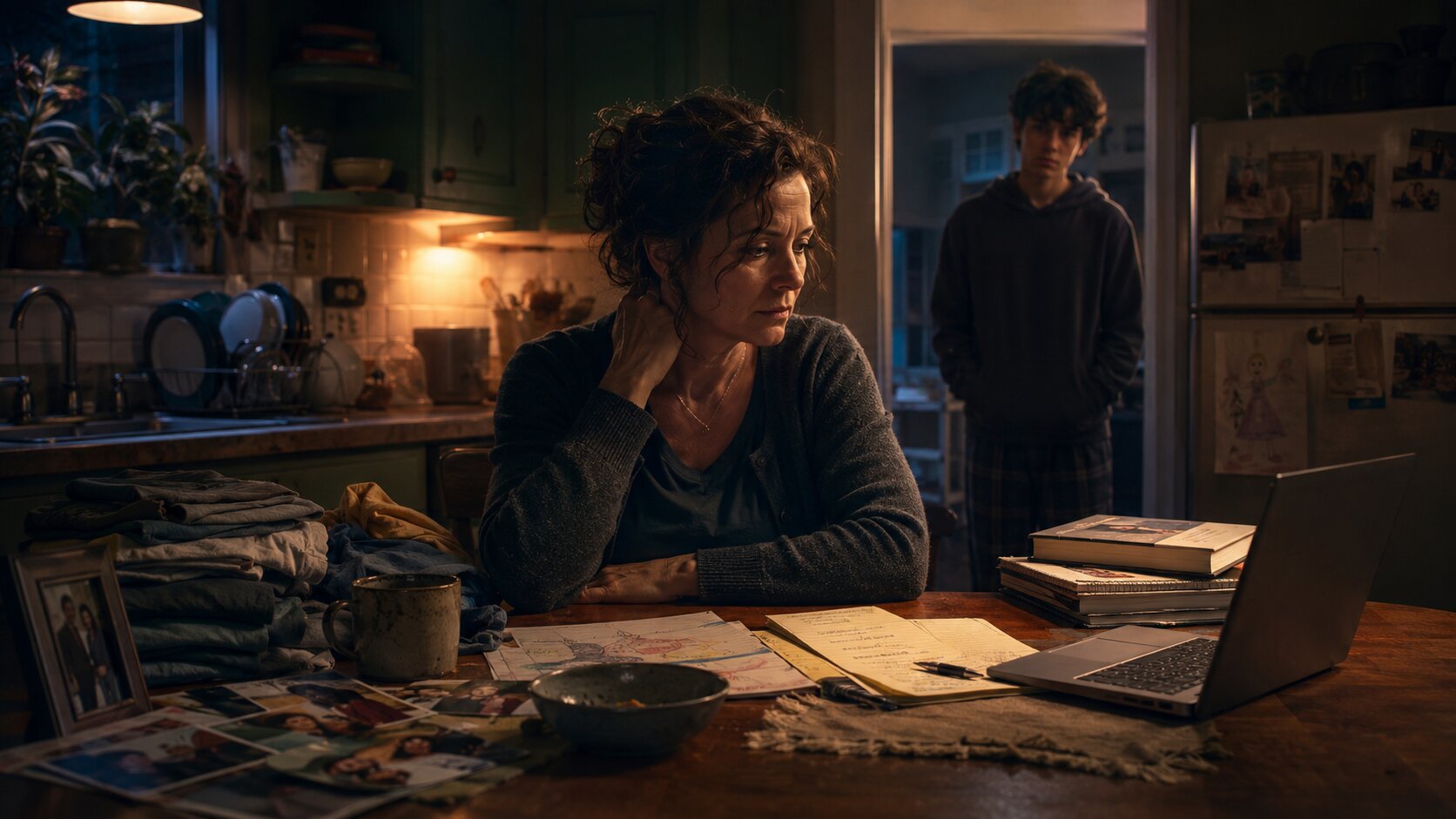
By forty-two, Leah had a stable job, a small house, a sixteen-year-old son who ate cereal from mixing bowls, and a life she would have defended fiercely if anyone called it a failure.
She still sometimes searched Mara’s name.
That evening, she did not have to.
Mara was thirty feet away.
After the lecture, people gathered in the old station café.
Leah considered leaving.
Then Mara saw her.
For a second neither woman moved.
Then Mara smiled.
“Leah?”
Leah laughed.
“Mara.”
They hugged awkwardly.
“You look exactly the same,” Mara said.
“That is demonstrably false.”
Mara laughed.
“No, I mean—”
“I know what you mean.”
They stood staring at each other.
Twenty years collapsed, then returned.
Mara touched Leah’s arm.
“How long has it been?”
“Since Professor Yates’s retirement?”
“Oh God. That long?”
“Probably.”
“How’s Eli?”
Leah blinked.
“You remember Eli?”
“I follow you.”
Leah stared.
“Online.”
“Oh.”
Mara smiled.
“You think you’re the only person allowed to quietly investigate old classmates?”
Leah felt heat in her face.
“I don’t investigate.”
“You absolutely do.”
Leah laughed.
The relief was immediate.
They agreed to have dinner the following week.
On the drive home, Leah replayed the evening.
Mara had mentioned Antarctica.
A conference in Copenhagen.
Three months in Nairobi.
A research team in British Columbia.
Leah had spent three hours last Tuesday trying to persuade sixteen-year-olds that mitochondria were worth caring about.
At a red light she opened Mara’s profile.
Mistake.
Photograph after photograph.
Ice fields.
Lecture halls.
Research vessels.
Awards.
A narrow apartment with huge windows overlooking a city.
Friends at restaurants.
No car seats.
No school pickup lines.
No parent-teacher conferences.
No custody calendar taped inside the pantry.
Leah knew better.
She kept scrolling.
By the time she reached home, Eli had left three bowls in the sink.
“Seriously?” she called.
“What?”
“You know what.”
“No idea.”
She walked upstairs.
His bedroom door was open.
Eli was at his desk wearing headphones, editing something on his computer.
He pulled one side off.
“What?”
“Bowls.”
“Oh.”
“You use them, you wash them.”
“I was going to.”
“You have been going to since birth.”
“Seems statistically unlikely.”
Leah stared at him.
He smiled.
She did too.
“Wash them.”
“Fine.”
She turned to leave.
“Mom?”
“Yeah?”
“How was the thing?”
She leaned against the doorframe.
“Good.”
“Boring science good or normal-person good?”
“Normal-person good.”
“Wow.”
He returned to the screen.
Leah watched him for a second.
Sixteen.
Almost grown.
The thought hurt.
It always did.
Then she went downstairs and looked at Mara’s photographs again.
Dinner was at a small Vietnamese restaurant near Union Hall.
Mara arrived late and apologized three times.
“This is reassuring,” Leah said.
“What?”
“You’re badly organized.”
Mara laughed.
“You thought I became a flawless woman?”
“I was open to the possibility.”
“That would’ve been exhausting.”
They ordered.
For the first twenty minutes, Leah asked about Mara’s work.
Not out of politeness.
She genuinely wanted to know.
Mara described drought modeling and fieldwork and the strange experience of spending years studying things politicians wanted summarized in three bullet points.
“You always wanted this,” Leah said.
Mara looked at her.
“Mostly.”
“That sounded suspicious.”
“It was meant to.”
Their food arrived.
Mara broke apart a spring roll.
“Can I ask you something?”
“Sure.”
“Do you ever miss it?”
Leah knew exactly what she meant.
“Science?”
Mara nodded.
Leah looked down.
“Yes.”
Mara waited.
Leah hated that she had not offered reassurance.
Not but I wouldn’t change anything.
Just waited.
“I miss the version of me who might have done more with it.”
Mara nodded.
“I knew it.”
Leah looked up.
“What?”
“I always wondered.”
“Why?”
“Because you were better than I was.”
Leah laughed.
“That is revisionist history.”
“No.”
“You got the fellowship.”
“After you turned it down.”
“I was pregnant.”
“Exactly.”
Leah looked at her.
Mara continued.
“I spent years thinking I won because you left the race.”
“That’s ridiculous.”
“I know.”
“Then why think it?”
“Because people are ridiculous.”
Leah smiled.
Mara looked out the window.
“I followed your life too, you know.”
“You said.”
“No. I mean really followed it.”
Leah frowned.
Mara pulled out her phone.
She scrolled.
Then showed Leah a photograph.
Eli at seven, missing his front teeth, holding a badly decorated birthday cake.
Leah remembered posting it.
Mara swiped.
Leah and Eli at a beach.
Another.
Christmas.
Another.
Science fair.
Another.
Eli asleep on the sofa with his head in Leah’s lap.
Leah looked up.
“You saved these?”
“No.”
“Good.”
“I’m not completely unhinged.”
Mara put the phone down.
“But sometimes I looked at them and thought, that’s the life.”
Leah stared.
“What life?”
“The one I didn’t have.”
Leah laughed once.
Not because it was funny.
“Mara.”
“I know.”
“You’ve been to Antarctica.”
“Yes.”
“You advise governments.”
“Occasionally they ignore me internationally.”
“You have the career I wanted.”
Mara leaned forward.
“And you have someone who calls you Mom.”
Leah went quiet.
Mara’s voice softened.
“I’m not saying your life is better.”
“Good.”
“I’m saying I looked at you the way you looked at me.”
Leah stared at the table.
“That’s stupid.”
“Yes.”
“Both of us.”
“Almost certainly.”
Leah laughed.
Then unexpectedly, she started crying.
She hated crying in restaurants.
Mara reached across for her hand.
“I’m sorry.”
“No.”
Leah wiped her face.
“No, it’s just—”
She laughed again.
“I spent twenty years thinking you were living the life I misplaced.”
Mara’s expression changed.
“Leah.”
“I know.”
“No. Listen.”
Leah looked at her.
“I love my work.”
“I know.”
“I’m proud of it.”
“You should be.”
“I have seen places I never imagined seeing. I have people I love. I have freedom I value.”
Leah nodded.
Mara paused.
“And sometimes I go home to a quiet apartment and wonder whether I built a life where nobody could interrupt me.”
Leah looked at her.
Mara smiled sadly.
“Then I see your kitchen disasters and soccer pictures and graduation posts and think maybe I confused independence with not needing anyone.”
“Mara—”
“No. I’m not asking you to fix it.”
Leah stopped.
Mara continued.
“I’m just saying neither of us gets to use the other as evidence.”
That stayed with Leah all the way home.
Three weeks later, Mara’s lecture would have been only an interesting evening.
Then Leah received an email.
The university was reopening a part-time environmental science master’s program designed for working professionals.
Classes two evenings a week.
Hybrid option.
Research placement during summers.
Leah stared at the screen.
Her first thought:
Too old.
Her second:
Too expensive.
Her third:
Eli.
Then she became angry at herself.
Eli was sixteen.
He drove.
Badly, but legally.
He could make pasta.
Technically.
She had spent years acting as if motherhood were still a full-time emergency.
Some part of her had never updated the calendar.
She printed the program details.
Then hid them in a drawer.
For nine days.
On the tenth, she told her friend Carmen at school.
Carmen read the brochure.
“You’re applying.”
“No.”
“You printed it.”
“That proves access to a printer.”
“You highlighted deadlines.”
“I like color.”
Carmen looked at her.
“Leah.”
“I have a job.”
“You’ll still have a job.”
“I have Eli.”
“Who is sixteen, not six.”
“It’s expensive.”
“Valid.”
“I haven’t done real research in twenty years.”
“Valid.”
“I’ll probably be the oldest person there.”
“Probably not, and who cares?”
Leah sighed.
Carmen folded the brochure.
“What’s the real reason?”
Leah looked at the classroom floor.
“I don’t want Eli to think I gave up my life for him.”
Carmen stared.
“What?”
“If I start doing this now, it’s like admitting I wanted it all along.”
“Maybe you did.”
“He’ll hear that as—”
Leah stopped.
Carmen understood.
“That he prevented it.”
“Yes.”
Carmen thought.
“Did he?”
Leah looked furious.
“That is a horrible question.”
“No. Did he?”
Leah sat down.
“He changed it.”
“That isn’t the same thing.”
“He made some things impossible.”
“Yes.”
Leah’s eyes filled.
“I hate saying that.”
“Why?”
“Because mothers aren't supposed to.”
Carmen sat opposite her.
“Then mothers are supposed to lie.”
Leah looked away.
A week later, Leah made the mistake of talking about Mara while Eli was home.
She was in the kitchen with Carmen on speakerphone.
“I just keep thinking,” Leah said, “if I hadn’t gotten pregnant, I might have done something like what Mara did.”
Upstairs, a floorboard creaked.
Leah did not hear it.
Carmen said, “And?”
“And sometimes I wonder who I would’ve been.”
Silence.
Then:
“Mom?”
Leah froze.
Eli stood at the kitchen entrance.
He looked strange.
Not angry.
Hit.
Carmen’s voice came through the phone.
“Leah?”
Leah grabbed it.
“I’ll call you back.”
She hung up.
“Eli—”
“So that’s what you think?”
“What?”
“If you didn’t have me, you would’ve had this amazing life?”
“No.”
“You literally just said it.”
“That isn’t what I meant.”
“It sounded pretty clear.”
He turned.
“Eli.”
He kept walking.
She followed him into the hallway.
“Stop.”
He did.
“You were listening to half a conversation.”
“I heard enough.”
“No, you didn’t.”
He turned.
“Then tell me what I missed.”
Leah opened her mouth.
Nothing came.
That made everything worse.
Eli laughed bitterly.
“Right.”
“You are not a regret.”
“Then what is?”
Leah stared at him.
He waited.
“What exactly do you regret?”
There it was.
The question she had spent sixteen years avoiding because she thought answering honestly would injure him.
“I regret some things I gave up.”
His face changed.
Leah continued before she lost courage.
“I regret not going to graduate school.”
Eli looked down.
“I regret letting years pass without asking whether I could go back.”
She swallowed.
“I regret treating motherhood like it meant that every other version of me had to die.”
He looked up.
“And you don’t regret me.”
“No.”
“Convenient.”
“Eli.”
“How can you regret the thing that happened because of me without regretting me?”
Leah stared.
Because that was the real question.
Not Mara.
Not the degree.
Not motherhood.
How can two truths live in the same life without destroying each other?
“I don't know how to explain it perfectly.”
Eli folded his arms.
“Try.”
Leah took a breath.
“When you were born, I lost things.”
He flinched.
She almost stopped.
Then didn't.
“Time. Freedom. A plan I had. A version of my twenties. Sleep.”
He almost smiled at that.
Almost.
“I also got you.”
He looked away.
“And those things are connected.”
Leah’s voice shook.
“But connected doesn't mean equal.”
Eli said nothing.
“I can wish I had studied more without wishing you never existed.”
“That makes no sense.”
“I know.”
“Then how is it true?”
Leah's eyes filled.
“Maybe because love doesn't rewrite history.”
Eli looked at her.
“I loved raising you. I still lost things.”
She wiped her face.
“And if I pretend I didn't, then one day you'll become an adult and think loving someone means never admitting what love costs.”
Eli was silent.
“That would be a terrible thing for me to teach you.”
He looked at the floor.
“Do you wish you had Mara’s life?”
Leah answered carefully.
“Sometimes I wish I had parts of it.”
His jaw tightened.
“That’s not the same as wanting to be her.”
He shrugged.
“I don't know.”
“Neither do I.”
He looked at her.
Leah continued.
“I spent years pretending the only acceptable answer was that I wouldn't change one second.”
Eli waited.
“That isn't true.”
His face fell.
Leah reached for him.
He stepped back.
She stopped.
“I would change things.”
His eyes filled.
“I would ask for help sooner.”
“I would study again sooner.”
“I would stop treating being exhausted like proof I was a good mother.”
“I would leave your father earlier instead of letting us spend two years miserable because I was afraid divorce meant failure.”
Eli stared.
“I would change lots of things.”
Then:
“But I wouldn't erase you to get them.”
He looked down.
Leah waited.
After a while he said:
“I need to go.”
“Where?”
“I don't know.”
“Eli—”
“I’m not running away.”
He wiped his eyes angrily.
“I just don't want to talk.”
Leah nodded.
“Okay.”
He left.
The front door closed.
She sat on the kitchen floor.
Not dramatically.
Her legs simply stopped being useful.
For the first time, Leah wondered whether honesty had been selfish.
Maybe mothers were supposed to lie.
Maybe love sometimes required the lie.
Then she hated herself for thinking that too.
Eli barely spoke to her for three days.
He ate.
Went to school.
Answered questions with single syllables.
Leah did not force him.
On Thursday she met Mara at Union Hall.
“I hurt him.”
Mara listened.
Leah told her everything.
When she finished, Mara said:
“He’s sixteen.”
“I know.”
“That means you can say ‘I love you’ and he may still hear the sentence underneath it.”
“What sentence?”
Mara looked at her.
“‘My life would have been bigger without you.’”
Leah closed her eyes.
“I never said that.”
“No.”
“But maybe he heard it.”
“Yes.”
Leah looked toward the old platforms.
“What do I do?”
“Don't turn me into Mrs. Wisdom because I own a passport.”
Leah almost laughed.
Mara continued.
“Tell him the truth again later.”
“I already did.”
“No. You defended the truth.”
Leah frowned.
“Next time listen to what it cost him to hear it.”
That night Leah knocked on Eli's door.
“Can I come in?”
He shrugged.
She sat on the floor against the wall.
He remained at his desk.
“I've been thinking.”
“No surprise.”
She smiled.
“I owe you something.”
He looked over.
“Not an explanation.”
That got his attention.
“An apology.”
Eli waited.
“I told you something true and then expected you to understand it immediately because it was true.”
He looked down.
“That wasn't fair.”
Silence.
“I can see why hearing me wonder about another life would make you feel like I was wondering about a life without you.”
Eli said quietly:
“Yeah.”
“I’m sorry.”
He nodded once.
Leah waited.
Then Eli asked:
“If you could go back, would you do it differently?”
Leah knew the easy answer.
No.
Not one thing.
Because that answer guaranteed him.
She could not say it.
“I don't know.”
He looked hurt again.
She continued.
“I know I would want you.”
“How?”
“I don't know.”
“That's impossible.”
“Yes.”
He turned back toward the computer.
Leah's voice softened.
“Maybe that's why people give the easy answer.”
He did not move.
“What answer?”
“‘I wouldn't change anything.’”
She paused.
“Maybe what they mean is, ‘I don't know how to imagine changing something without losing the people I love.’”
Eli looked back at her.
“That I understand.”
Leah almost cried.
“So do I.”
Another silence.
Then Eli asked:
“Are you applying?”
Leah froze.
“To the program.”
“I haven't decided.”
He nodded.
“What do you want?”
Leah laughed softly.
“That's apparently the question everyone has decided to ask me this month.”
“What do you want?”
She looked at him.
“I want to try.”
“Then apply.”
“That simple?”
“No.”
He shrugged.
“But apply first. Panic later.”
Leah smiled.
“Excellent academic planning.”
“I learned from you.”
The application was worse than she expected.
Transcripts from twenty years ago.
Letters.
A statement explaining why she wanted to return.
That question nearly stopped her.
Why now?
She wrote three bad answers.
Career development.
Intellectual renewal.
Environmental education.
All true.
None honest enough.
Eventually she typed:
For a long time, I confused a choice I once made with a permanent definition of who I was allowed to become.
She stared at it.
Then kept writing.
Mara agreed to write a recommendation.
“You realize I’m going to make you sound terrifyingly brilliant.”
“I’m forty-two.”
“People can remain brilliant after thirty.”
“I've seen no evidence.”
Mara laughed.
A financial-planning workshop was required before enrollment.
The adviser was a man named David Mercer.
He spoke carefully about tuition, expected salary changes, retirement savings, and debt.
No inspiration.
No “follow your dream.”
Leah liked him immediately.
At the end, David said:
“Financially, this is not an obvious yes.”
Leah laughed.
“Thank you for your enthusiasm.”
“I’m serious.”
“I know.”
“You're giving up money, time, and comfort. You should know that before turning this into a redemption story.”
Leah stared at him.
“That may be the most useful thing anyone has said.”
David smiled.
“My daughter disagrees with you.”
Leah did not know what he meant.
Not yet.
The acceptance email arrived on a Tuesday morning while Leah was teaching cell division.
She saw the subject line during lunch.
Opened it.
Read it twice.
Then closed the laptop.
She did not cry.
She still had three classes.
At home that evening, she printed the letter.
Placed it on the kitchen table.
Then started dinner.
Eli came in.
Backpack dropped.
Fridge opened.
“Anything good?”
“Carrots.”
“That's abusive.”
He saw the paper.
“What’s that?”
Leah kept chopping onions.
He read it.
Then looked up.
“You got in.”
“I did.”
He smiled.
A real smile.
“Mom.”
She laughed.
“I know.”
“Are you going?”
“I think so.”
“You think?”
“I’m learning not to turn every decision into a prophecy.”
He rolled his eyes.
“Very deep.”
“Thank you.”
Eli sat down.
After a moment he asked:
“Are you trying to become the person you would've been?”
Leah stopped chopping.
She turned toward him.
“No.”
He waited.
“I don't know who she would've been.”
Eli nodded.
Leah smiled.
“I think I'm trying to find out who I can still become.”
He looked at the acceptance letter again.
Then:
“Does this mean I have to make dinner twice a week?”
“Yes.”
“I withdraw my support.”
She laughed.
He smiled.
Then got up and hugged her.
Not because everything was repaired.
Some things are not repaired in one conversation.
But because they were still allowed to keep becoming something.
Months later, Leah sat on a late train leaving Union Hall after her first evening class.
Her backpack was too heavy.
She had forgotten how much students carried.
Across from her sat a girl who looked about twenty-two, speaking angrily into her phone.
“No, Dad. I heard you.”
Pause.
“I know what the numbers say.”
Another pause.
“That doesn't mean you get to decide.”
Leah looked away.
Not her conversation.
Not her life.
The train entered a tunnel.
For a moment the window became a mirror.
Leah saw herself reflected there.
Older than Mara.
Younger than she sometimes felt.
Mother.
Teacher.
Student.
None of the words canceled the others.
Her phone buzzed.
A message from Eli.
Burned pasta. Ordering pizza. Don’t judge me.
Leah smiled.
She typed:
I regret nothing.
Then stopped.
Deleted it.
She wrote instead:
I regret teaching you to cook. Pizza sounds perfect.
Three dots appeared.
Love you mom
Leah looked at the screen.
Then out at the darkness beyond the glass.
There were lives she had lost.
That was true.
There was a son she loved.
That was true too.
There were choices she would change.
There were people she would never erase.
Human beings wanted one truth to defeat the other.
Maybe adulthood was discovering they did not have to fight.
The train emerged from the tunnel.
City lights returned.
Leah closed her laptop.
Tomorrow she would have work.
Then class.
Then bills.
Then Eli.
Then research.
Not the life she would have lived.
Not the life she was supposed to have lived.
Just a life that, after twenty years, had begun opening another door.
Story 3 — The Father Who Refused to Let His Daughter Ruin Her Life
David Mercer knew something was wrong when Sophie said she wanted to talk and did not bring her laptop.
She always brought her laptop.
Dinner was halfway finished.
Salmon.
Rice.
Broccoli David had roasted too long because he was answering a client email.
Sophie had barely touched anything.
David set down his fork.
“What happened?”
“Nothing happened.”
“That is rarely how these conversations begin.”
She looked at him.
“I’m not going back next semester.”
David did not understand.
“To school?”
“Yes.”
He waited.
Sophie looked almost relieved to have said it.
“I’m leaving the program.”
David sat very still.
She had been accepted into one of the strongest graduate programs in data analytics in the country.
Scholarship.
Excellent placement record.
A direct path into work that would likely make her financially secure before thirty.
David had helped calculate every version of it.
“What happened?”
“Nothing.”
“You just said that.”
“Because nothing happened.”
“Then why are you leaving?”
Sophie took a breath.
“Me, Priya, and Nolan are starting the company.”
David stared.
“The logistics thing?”
“It’s not a logistics thing.”
“The software that predicts local inventory shortages.”
“Yes.”
“That you built for class.”
“The prototype was for class.”
“And now you’re dropping graduate school for it.”
“Taking a leave.”
“Sophie.”
“Dad.”
“How much money do you have?”
She looked irritated.
“Seriously?”
“Yes.”
“We have enough for six months.”
“We?”
“The company.”
“How much do you personally have?”
“Why does that matter?”
“It matters because companies do not pay your rent when they fail.”
Her face hardened.
“We already have pilot customers.”
“How many?”
“Three.”
“Paying?”
“Two.”
David reached toward the counter.
Sophie groaned.
“No.”
“What?”
“Do not get the laptop.”
“I’m not—”
“You are absolutely getting the laptop.”
David stopped.
His hand had already moved toward it.
Sophie laughed without humor.
“This is exactly why I didn’t want to tell you.”
“I’m trying to understand.”
“No. You’re trying to turn me into a spreadsheet.”
“That’s ridiculous.”
“Dad.”
David sat back.
“Fine.”
Sophie looked at him.
“Just listen.”
“I am listening.”
“You’re calculating.”
“Those are not mutually exclusive.”
“They are when I’m talking to you.”
Silence.
David folded his hands.
“Okay.”
Sophie waited.
He said nothing.
That seemed to surprise her.
“We think we have something real.”
David nodded once.
“Priya has a contact at a regional grocery chain. Nolan’s professor connected us with an angel group. We have a meeting next month.”
David kept nodding.
“And I hate the program.”
There it was.
He stopped nodding.
“You hate it?”
“Yes.”
“You never said that.”
“I said I was tired.”
“Everyone is tired in graduate school.”
“I said I didn’t like the work.”
“You said one class was boring.”
“I said I was miserable.”
David frowned.
“I don’t remember that.”
“I know.”
The sentence was quiet.
That hurt more.
Sophie continued.
“You remember what fits your model.”
“That’s not fair.”
“You remember: good program, scholarship, safe field, high salary, low debt.”
“Those are not imaginary advantages.”
“I know.”
“Then don’t say it like I invented them.”
“I didn’t.”
She leaned forward.
“I’m saying every time I tell you something about how the life feels, you answer with how the life performs.”
David looked at her.
“That’s what adults have to do.”
“No.”
She shook her head.
“That’s what you do.”
He felt something tighten inside him.
“You’re twenty-two.”
“Yes.”
“You don’t know how expensive a bad decision can become.”
Sophie sat back.
There it was.
The real conversation.
David heard it himself.
He had not meant to say it so plainly.
Sophie’s expression softened slightly.
“Dad.”
“No.”
He stood and walked toward the kitchen counter.
This time she did not stop him.
He opened the laptop.
Not because he wanted to win.
Because numbers were where panic became manageable.
He pulled up a spreadsheet.
Sophie stared at the ceiling.
“I knew it.”
“Just look.”
“No.”
“Please.”
She reluctantly moved her chair.
David turned the screen.
“Your scholarship is worth forty-two thousand dollars over the remaining program.”
“I know.”
“Expected starting salary after graduation, based on last year’s placement data—”
“I know.”
“—roughly eighty-five to ninety-five.”
“I know.”
“If you leave now and the company fails, you lose the scholarship, delay earnings, probably lose health coverage—”
“I know.”
“You say you know, but you’re acting like none of it matters.”
Sophie looked at him.
“It matters.”
“Then why?”
“Because it’s my life.”
David stared.
“That’s not an answer.”
“It is. You just don’t like it.”
He closed the laptop harder than he intended.
“Sophie, I made this mistake.”
She went still.
“You know that.”
“I know.”
“No. I mean exactly this.”
He sat down again.
“When I was thirty-two, Daniel Foster and I left good jobs to start the advisory firm.”
“You’ve told me.”
“You’ve heard the family version.”
She looked at him.
David had rarely told the whole one.
“We thought we were smarter than everyone.”
He gave a small laugh.
“We had clients lined up. We had projections. A business plan. Investors interested.”
“What happened?”
“Daniel lied.”
Sophie’s face changed.
“About what?”
“Expenses. Accounts. A loan.”
David stared at the table.
“I signed things I should have read more carefully because he was my friend.”
Sophie was quiet.
“When it collapsed, I was personally liable for more than I had.”
“Mom told me you had debt.”
“Your mother knows the sanitized number.”
He looked at Sophie.
“It was worse.”
“How much?”
“It doesn’t matter.”
“It obviously matters to you.”
David breathed out.
“Enough that we nearly lost the house.”
Sophie had not known.
“Your mother went back to work earlier than she planned.”
He swallowed.
“We fought constantly.”
Sophie lowered her eyes.
“Is that why you divorced?”
“No.”
He paused.
“Not alone.”
That was more truthful.
David continued.
“I spent years thinking if someone had just stopped me—”
Sophie looked up.
“Stopped you?”
“Yes.”
“If someone older had said, ‘David, you are not special. These numbers are bad. Your friend is reckless. Do not do this.’”
He laughed bitterly.
“I would have listened.”
Sophie said nothing.
David looked at her.
“I could save you ten years.”
Her expression changed.
“From what?”
“Debt. Failure. Starting over.”
“And maybe from succeeding.”
David shook his head.
“You are not hearing me.”
“No. I am.”
She leaned forward.
“You want to take what happened to you and remove it from my life before it happens.”
“Yes.”
He said it immediately.
Sophie’s eyes filled.
“Do you hear how terrifying that is?”
David stared.
“I love you.”
“I know.”
“I’m trying to protect you.”
“I know.”
“Then what is terrifying?”
She looked at the closed laptop.
“That you think love gives you the right to edit me.”
David flinched.
“That is not what I’m doing.”
“You keep saying you want to save me from your mistakes.”
“I do.”
“Then you don’t want me to have a life.”
Her voice broke.
“You want me to have your corrections.”
David said nothing.
Sophie stood.
“I’m taking the leave.”
“Sophie.”
“I wanted to tell you before I filed the paperwork.”
“Don’t.”
She stared.
“Don’t do it yet.”
“Dad.”
“Give me one week.”
“For what?”
“To look at the company.”
“No.”
“Let me review the business plan.”
“No.”
“Why?”
“Because then we both know what happens.”
“What?”
“You turn into my investment committee.”
“I know things you don’t.”
“I know.”
“Then why wouldn’t you use that?”
“Because I asked for my father.”
David stopped.
Sophie took her coat.
At the door she turned.
“And before you say this later—”
“What?”
“If it fails, you don’t get to pretend failure proves you were right about everything.”
The door closed.
David sat alone at the table.
After five minutes, he reopened the laptop.
For the next three days David did what he told himself any responsible father would do.
He researched.
The startup was called SupplyDrop.
He hated the name immediately.
That was irrelevant.
Their software used local purchasing data, weather patterns, delivery histories, public events, and supplier disruptions to help independent retailers predict shortages before they happened.
Not a terrible idea.
That annoyed him.
He wanted it to be obviously foolish.
The market was crowded.
Customer acquisition would be expensive.
Their two paying pilots were small.
The regional grocery opportunity was real but uncertain.
David found the angel group.
Reputable.
He checked the founders.
Priya Shah had strong operational experience.
Nolan had technical ability but no business background.
Sophie handled modeling and product.
David built three scenarios.
Best case.
Base case.
Failure case.
Then six.
Then twelve.
He did not sleep well.
On Friday he opened a newer decision-support system one of his firm’s younger advisers had been testing.
It was designed for complex financial and career decisions.
David entered the data.
Sophie’s age.
Education.
Scholarship.
Opportunity cost.
Founder profile.
Capital needs.
Industry.
Known customers.
The system asked:
Primary objective?
David typed:
Long-term financial security and career satisfaction.
It generated questions.
David answered them.
Two hours later, the model returned an analysis.
Graduate program:
higher probability of stable earnings.
higher expected lifetime income.
lower downside risk.
Startup:
substantially higher financial volatility.
high failure probability.
potential upside.
career skills transferable.
David read every page.
Then again.
He felt relief.
Not satisfaction.
Proof.
He printed the report.
He did not send it.
Not yet.
Sophie stopped answering calls for two days.
Then she texted:
Can we meet Sunday? Union Hall café. Neutral territory.
David arrived early.
Of course.
He brought the report.
Of course.
Sophie saw the folder when she sat down.
“You did it.”
“I wanted information.”
“For you?”
“For both of us.”
She sighed.
David slid the report toward her.
“Please read the executive summary.”
She did.
No visible reaction.
Then the key probability page.
She read that too.
“You used AI.”
“Yes.”
Sophie almost smiled.
“You hate AI advice.”
“I hate careless AI advice.”
“So this is responsible AI control.”
“Decision support.”
“Right.”
She read more.
Then looked at him.
“Did you tell it I’m miserable in the program?”
David paused.
“Yes.”
“How?”
“What do you mean?”
“What number did you assign misery?”
He frowned.
“It included satisfaction weighting.”
“How much?”
“Sophie.”
“No, really.”
She pointed to the report.
“Where is it?”
David looked.
She continued.
“Where does it calculate waking up every morning and knowing you’re becoming very good at something you don’t want to spend your life doing?”
“It accounts for career fit.”
“Where?”
He could not answer quickly enough.
Sophie nodded.
“What about Priya?”
“What about her?”
“She’s the best person I’ve ever worked with.”
“That’s not a financial variable.”
“Exactly.”
David stared.
“What about the possibility that I fail and become better at something because of it?”
“That is impossible to quantify.”
“What about the possibility that I stay in school, get the great job, make great money, and spend ten years being too scared to leave because the spreadsheet keeps getting better?”
“Sophie, this isn’t serious.”
She looked at him.
“It’s the most serious thing I’ve asked you.”
David softened.
“I’m not saying the model knows everything.”
“But you’re using what it knows to outrank everything it doesn’t.”
That stopped him.
Sophie closed the report.
“Where in this does it calculate whether I become someone I respect?”
David looked at her.
“That’s not a fair question.”
“Why?”
“Because nobody can calculate that.”
Sophie pushed the report back.
“Then maybe nobody gets to call the calculation my answer.”
David felt anger rising.
“You are dismissing real evidence because it doesn’t say what you want.”
“No.”
She shook her head.
“I’m saying evidence gets a vote.”
She tapped the report.
“Not ownership.”
David stared.
She stood.
“I start full-time next month.”
He looked at the folder.
“You’re making a mistake.”
Sophie froze.
“Maybe.”
Then she walked away.
For three months, David tried very hard not to ask.
SupplyDrop gained one customer.
Lost one.
Raised a small seed round.
Sophie began working fourteen-hour days.
She looked exhausted whenever David saw her.
He interpreted everything as proof.
Then hated himself for interpreting everything as proof.
At Thanksgiving, Sophie arrived two hours late.
“You look terrible,” David said.
“Happy Thanksgiving to you too.”
“Are you sleeping?”
“Some.”
“Getting paid?”
“Some.”
“Excellent business model.”
She looked at him.
David stopped.
“I’m sorry.”
Dinner was awkward but not disastrous.
Afterward Sophie found him washing dishes.
“We’re pitching the regional chain next month.”
David turned.
“The big one?”
“Yes.”
“That could change things.”
“I know.”
He wanted to say:
And if you lose it?
He did not.
Instead:
“Good luck.”
Sophie smiled faintly.
“Thanks.”
For a moment they were father and daughter again.
Then David ruined it.
“I looked at their procurement data.”
She went still.
“How?”
“Public information.”
“Dad.”
“I found the vice president overseeing innovation.”
“No.”
“I know someone who knows him.”
She put down the plate.
“Do not contact them.”
“I can help.”
“Do not.”
“I won’t.”
She studied him.
“Promise.”
David hesitated.
Sophie laughed.
“Oh my God.”
“I said I won’t.”
“That wasn’t a promise.”
“I promise.”
She nodded slowly.
“Thank you.”
David meant it.
At the time.
The problem came three weeks later.
A client named Martin Hale mentioned the regional grocery company during a meeting.
David asked a harmless question.
Then another.
Martin knew someone on the investment committee advising their innovation fund.
David should have stopped.
He knew it while speaking.
Instead he said:
“My daughter’s company is pitching them.”
Martin smiled.
“SupplyDrop?”
David’s stomach tightened.
“You know it?”
“Heard of it.”
“What did you hear?”
Martin shrugged.
“Interesting idea. Very early.”
David asked:
“Too early?”
“Probably.”
Then Martin added:
“They’re also using some behavioral forecasting package from Elsewhere Labs, I think. That stuff worries me.”
David had never heard of Elsewhere.
He asked more.
By the end of the conversation, he knew enough to become concerned.
Not alarmed.
Concerned.
That was more dangerous.
That evening David emailed Martin.
Just thinking about our conversation. If your contact is evaluating them, I would make sure they dig into the assumptions behind the forecasting stack. Very early team. Talented, but inexperienced.
He stared at the message.
It was factual.
Professional.
Protective.
He sent it.
The grocery chain postponed the pilot.
Then reduced its proposed size.
SupplyDrop’s investors became nervous.
The company did not collapse immediately.
But momentum changed.
Six weeks later, Sophie called.
“Did you talk to Martin Hale?”
David went cold.
“What?”
“Did you?”
He could lie.
He did not.
“Yes.”
Silence.
“Sophie—”
“You promised.”
“I did not contact the company.”
“You contacted someone who contacted them.”
“I didn’t ask him to.”
“You knew.”
“I raised a legitimate concern.”
“About my company.”
“Yes.”
“Without telling me.”
“I was trying to—”
“Say protect me.”
David closed his eyes.
“Sophie.”
“Say it.”
“Protect you.”
She laughed.
It sounded almost like crying.
“You just couldn’t stand it.”
“What?”
“That I might get to make a choice you didn’t approve.”
“This is not about approval.”
“No?”
“No. They are using an untested forecasting system, you have very little runway, your biggest customer—”
“You went behind my back.”
David stopped.
“I’m sorry.”
“No.”
“Sophie.”
“No. You don’t get to apologize and then explain why you were right.”
He said nothing.
“You didn’t warn me about the cliff.”
Her voice shook.
“You grabbed the steering wheel.”
The call ended.
David sat at his desk for an hour.
Then he opened the decision model.
Graduate school still ranked higher.
He looked at the result.
For the first time, it did not feel like evidence.
It felt like an alibi.
SupplyDrop lasted another seven months.
The grocery pilot never became what they expected.
Another customer failed to renew.
Their software predictions performed inconsistently.
Priya and Nolan began fighting over direction.
An investor refused the next round.
Payroll became impossible.
Sophie put three thousand dollars of expenses on her personal credit card.
Then seven.
David learned this only later.
By spring, SupplyDrop was over.
The model had been right.
David hated that sentence.
He also loved it.
That was worse.
Sophie did not call him.
He heard the news from LinkedIn.
After an incredible year building SupplyDrop…
The language of failed startups was fascinating.
Nothing died.
Everything became an incredible journey.
David read the post six times.
He started typing:
I’m sorry. Call me.
Deleted it.
Then:
Proud of you.
Deleted that too.
It sounded false.
Finally:
I saw the news. I’m here. No advice unless you ask.
He sent it.
No response.
Two days later, at 9:47 p.m., his phone rang.
Sophie.
David answered immediately.
“Hi.”
There was noise in the background.
Announcements.
Wheels on tile.
“Where are you?”
“Union Hall.”
The station.
David stood.
“Are you okay?”
Long pause.
“No.”
“I’m coming.”
“No, I—”
“I’m coming.”
She did not argue.
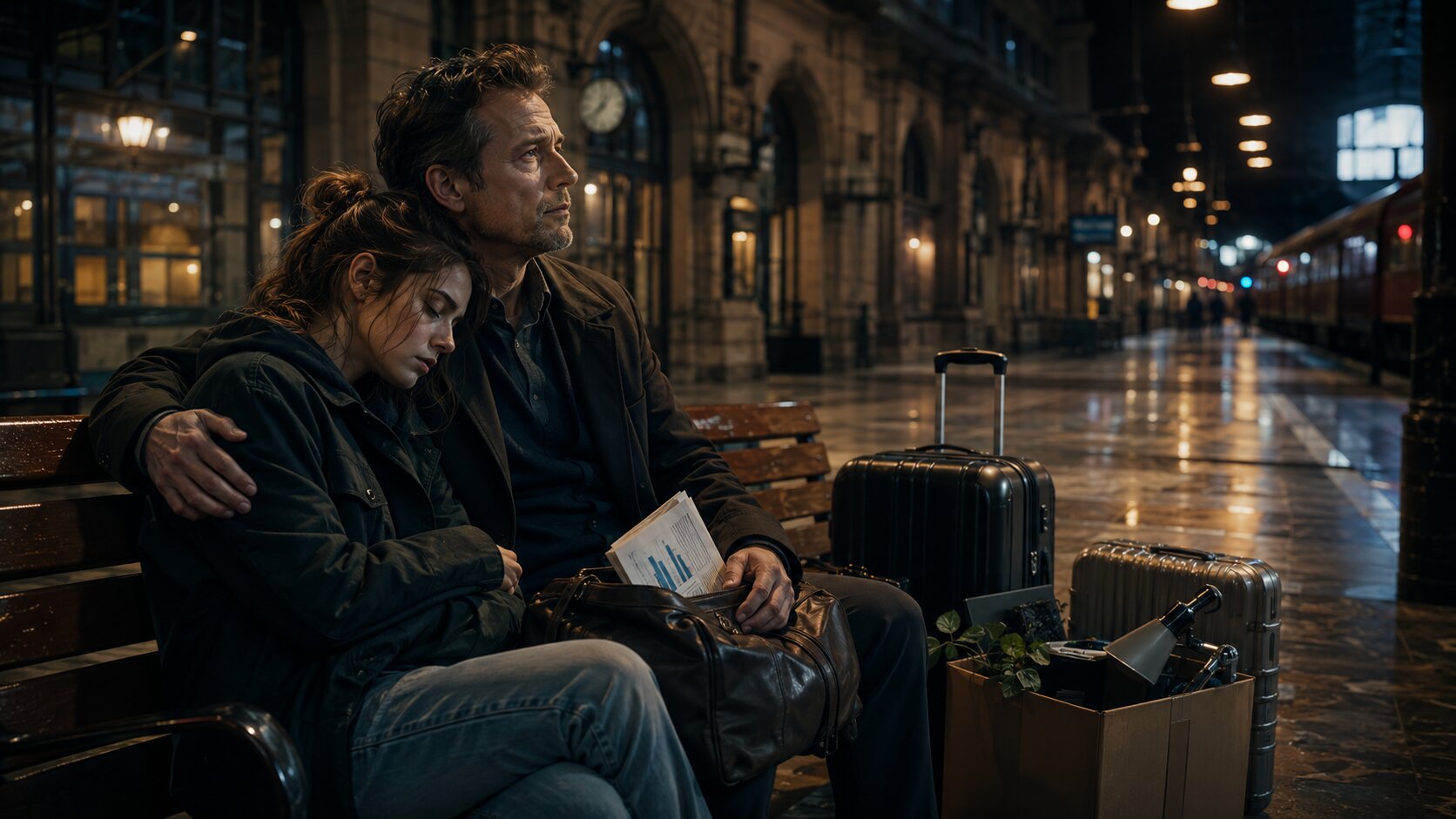
Sophie was sitting on the floor near a closed coworking office when he arrived.
Two suitcases beside her.
A cardboard box.
Laptop bag.
David had never seen her look so young.
Not twenty-two.
Twelve.
He stopped a few feet away.
“Hi.”
Sophie looked up.
“Hi.”
He wanted to hug her.
He waited.
She stood and walked into him.
David held her.
She began crying.
Not politely.
Her whole body shook.
David said nothing.
After a while she pulled away.
“We lost everything.”
“I know.”
“I owe money.”
“We’ll figure it out.”
“Priya hates Nolan.”
David nodded.
“I think Priya hates me too.”
“Probably not.”
“You don’t know.”
“No.”
He corrected himself.
“You’re right. I don’t.”
Sophie sat on a bench.
David sat beside her.
“I feel so stupid.”
“You’re not stupid.”
“Don’t.”
He stopped.
“I knew the risk.”
She stared ahead.
“I knew.”
David said nothing.
“I thought knowing it made me brave.”
Still nothing.
“Maybe it just made me arrogant.”
David looked at her.
He could say it now.
The sentence had been waiting for a year.
I warned you.
The model told you.
The numbers were clear.
He could disguise it as wisdom.
He could say:
At least you learned.
Instead he asked:
“What do you need from me right now?”
Sophie looked at him.
“What?”
“Advice?”
She shook her head.
“Money?”
She almost laughed.
“Eventually.”
“Help making a plan?”
“No.”
He waited.
“Then what?”
Sophie looked down.
“I don’t know.”
“That’s okay.”
Five minutes passed.
Maybe ten.
Trains arrived.
People left.
A janitor rolled a bin past them.
Finally Sophie said:
“Somewhere to land.”
David nodded.
“You have that.”
She leaned against him.
For the first time in his life, David understood that silence could be useful without being empty.
Sophie moved into David’s guest room.
For three weeks, neither mentioned the decision.
She slept until noon.
Applied for jobs.
Avoided Priya.
Cried once when a package arrived addressed to SupplyDrop.
David did not open spreadsheets in front of her.
This required more discipline than he expected.
One Saturday morning, Sophie came into the kitchen.
David was reading.
“Can I ask you something?”
“Sure.”
“Was it a mistake?”
David looked up.
There were at least twelve ways to answer.
He chose one.
“Yes.”
Sophie blinked.
“You think it was.”
“The company?”
“Yes.”
She sat down.
“Wow.”
“You asked.”
“I expected you to say something supportive.”
“I can be supportive and think it was a mistake.”
She stared.
“Why?”
“Because you risked too much too quickly. You trusted some assumptions you should have challenged. You took debt you couldn’t afford. You had no real contingency plan.”
Sophie looked down.
David continued.
“And I made mistakes too.”
She looked up.
“I interfered.”
“Yes.”
“I broke my promise.”
“Yes.”
“I used good information badly.”
Sophie frowned.
“What does that mean?”
“The risks were real.”
He paused.
“My conclusion may even have been right.”
He looked at her.
“But being right about the risk did not give me the right to take over the decision.”
Sophie was quiet.
David continued.
“I kept thinking if I could prevent you from making my mistakes, then my mistakes would finally become useful.”
Her face softened.
“That isn’t how it works.”
“No.”
He smiled sadly.
“I know that now.”
Sophie looked out the window.
“Would you stop me if you could go back?”
David knew the answer.
A month earlier, he would have lied.
“Yes.”
She looked at him.
He continued.
“A year ago, yes.”
“And now?”
David thought of Union Hall.
The boxes.
The debt.
His daughter crying against his chest.
“I wish I had helped you see the cliff without trying to grab the steering wheel.”
Sophie’s eyes filled.
“That’s annoyingly specific.”
“I’ve had time.”
She laughed softly.
Then:
“If you hadn’t interfered with the grocery company, maybe we would’ve made it.”
David felt the old reflex.
Evidence.
Facts.
Probability.
He could explain why that was unlikely.
Instead:
“Maybe.”
Sophie looked surprised.
“You think so?”
“I think I don’t know.”
Silence.
“That’s new.”
“Don’t get used to it.”
She smiled.
Then her face became serious.
“I think we still would’ve failed.”
David waited.
“The product wasn’t ready.”
She looked down.
“I knew that before the pitch.”
“Why didn’t you tell anyone?”
“I thought confidence was leadership.”
David almost smiled.
“Common disease.”
Sophie looked at him.
“Dad?”
“Yeah?”
“Even knowing all this…”
She stopped.
“Even knowing it failed…”
He waited.
“I think I would still do it.”
David stared.
“Again?”
“Not exactly the same.”
“Good.”
She smiled.
“But yes.”
“Why?”
Sophie thought.
“Because I know things about myself now that I couldn’t have learned from the program.”
David felt himself resisting.
Then listening.
“I know I like building things.”
“I know I hate fundraising.”
“I know Priya is better at operations than I’ll ever be.”
“I know I’m not as good at product as I thought.”
She laughed.
“That one hurt.”
David smiled.
“I know I can survive being embarrassed.”
She paused.
“And I know failure feels terrible, but not the way I imagined.”
“How did you imagine it?”
“Like proof.”
David looked at her.
“Proof of what?”
“That I was foolish.”
She shrugged.
“Maybe I was.”
Then:
“But it wasn’t proof that I shouldn’t have tried.”
David sat with that.
Sophie looked at him.
“Does that make sense?”
“Yes.”
He surprised himself.
“It does.”
Two months later Sophie took a job at a mid-sized software company.
Not glamorous.
Good salary.
Interesting enough work.
She did not return to graduate school.
Not yet.
She said she wanted one year before deciding.
David resisted the urge to calculate the opportunity cost.
Mostly.
On her first morning, he emailed her a spreadsheet.
Subject:
Budget v1
Sophie replied almost instantly.
Of course.
David smiled.
Then sent another message.
For information, not permission.
Three dots appeared.
Look at you evolving
Then:
Love you
David closed the laptop.
That afternoon he had a client workshop at Union Hall.
He arrived early.
On the platform outside the café, he saw a woman in her forties carrying a backpack stuffed with textbooks.
She looked exhausted and strangely happy.
Leah.
He recognized her from the graduate-program financial planning workshop.
She waved.
“David.”
“Leah. How’s school?”
“Expensive.”
He smiled.
“I warned you.”
“You did.”
“Any regrets?”
She thought.
“Several.”
David laughed.
“Good answer.”
A train pulled in.
Leah boarded.
David watched it leave.
His phone buzzed.
Sophie.
A photograph of her new desk.
No caption.
David looked at it.
A year ago he would have studied the company logo in the background.
Checked the office.
Looked up the employer’s growth numbers.
He still wanted to.
Instead he sent:
Looks good. How was day one?
Her reply came a minute later.
Ask me in six months
David smiled.
That was probably the most intelligent forecast either of them had made.
He slipped the phone into his pocket.
At thirty-two, David had wanted someone to prevent him from making a terrible decision.
For years he had assumed that was wisdom.
Now he understood there had been another possibility.
Someone could have warned him.
Asked harder questions.
Shown him the numbers.
Told him where the road narrowed.
And then let him drive.
Maybe he still would have crashed.
Maybe not.
He would never know.
But a map was not a steering wheel.
David stood on the platform as another train approached.
He had spent most of his career helping people avoid financial mistakes.
He still believed in that work.
He still believed in evidence.
Probabilities.
Planning.
Consequences.
None of those had become less valuable.
He had simply learned where they ended.
A person could inherit another person’s wisdom.
What they could not inherit was the life that had produced it.
The train doors opened.
David stepped aboard.
For once, he did not check where every other train was going.
Story 4 — The Life Simulator
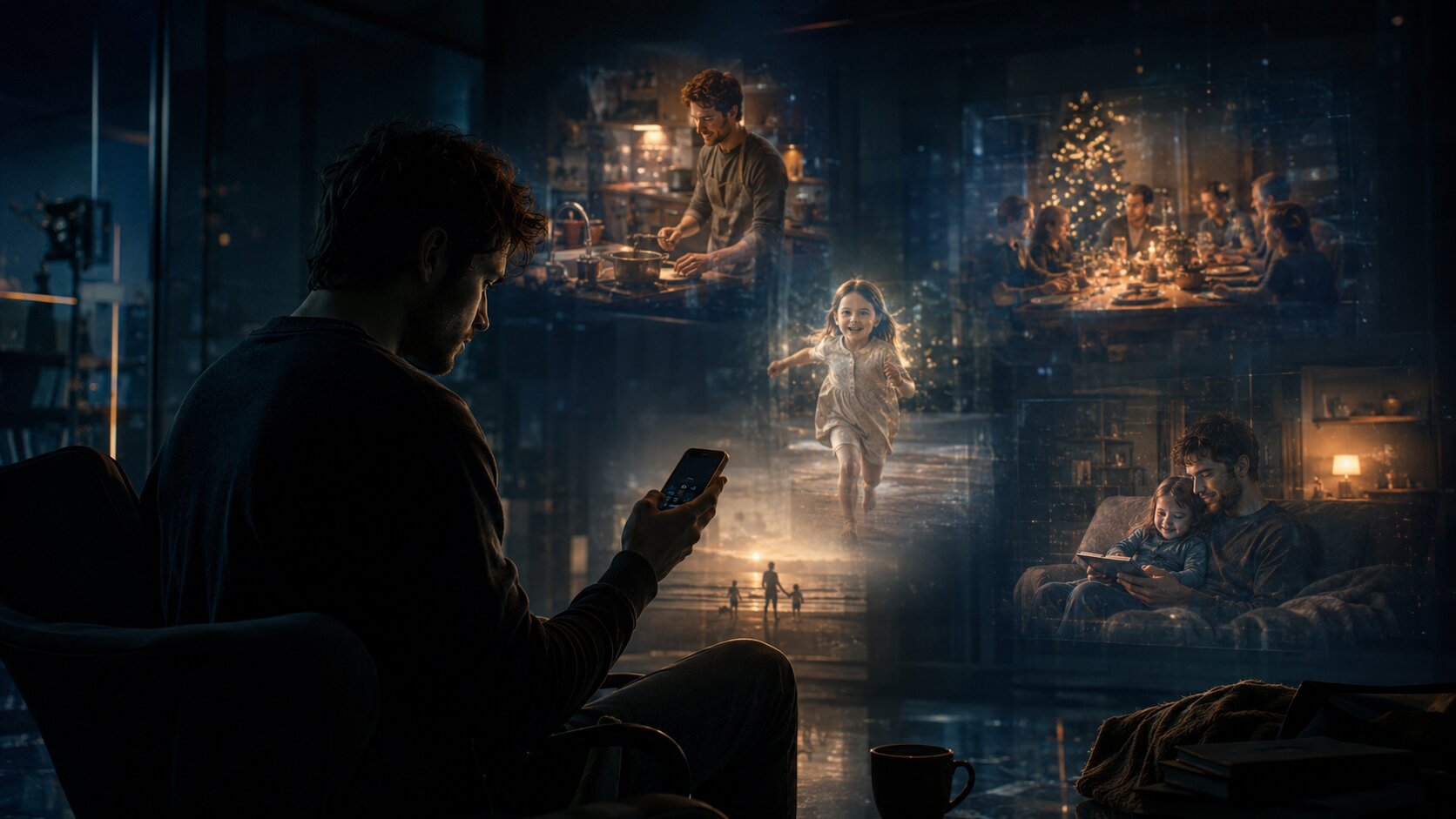
Evan Kessler first realized Elsewhere was becoming a problem when a woman asked to spend Christmas with children she had never had.
The request reached him as a product escalation.
Not because it was technically difficult.
Because nobody knew what category to put it in.
The woman was fifty-eight.
No children.
Two miscarriages in her thirties.
One divorce.
She had used Elsewhere six times to explore alternate family paths.
The seventh request read:
Extend branch 42B through age 18 for both children. Include holiday traditions, school milestones, sibling conflict, and adult outcomes.
Evan stared at the ticket.
Then called the head of user safety.
“How long has she been in-session?”
“Twenty-one hours this month.”
“That’s not catastrophic.”
“Last month was nine.”
Evan looked again at the request.
“What does she say she wants?”
“Closure.”
Evan almost laughed.
Not because it was funny.
Because every difficult user eventually said the same word.
Closure.
Elsewhere had been built around it.
That was the promise.
Not See the future.
Not Talk to the dead.
Not Enter another universe.
The company’s lawyers had been extremely strict about that.
Elsewhere generated plausible counterfactual simulations from personal data.
Users uploaded photographs, messages, calendars, health history, financial records, social networks, location history, and written memories.
The system modeled alternative branches.
What if you had moved?
What if you stayed?
What if you took the job?
What if you married her?
What if you never married him?
What if you went to medical school?
What if you had said yes?
The technology was impressive.
The emotional effect was far more powerful than Evan expected.
People did not experience Elsewhere as data.
They experienced it as grief with furniture.
Three years earlier, the company’s first public demonstration had taken place at Union Hall.
Evan still remembered the applause.
A forty-six-year-old volunteer named Teresa sat onstage wearing a lightweight headset.
She had once been accepted to art school.
Her father became ill.
She stayed home.
She later became an accountant.
A good one.
She had a husband, two children, a stable life.
She had always wondered about the art school.
Elsewhere built a branch.
Teresa entered a small studio apartment at twenty-one.
Saw unfinished canvases.
Met simulated classmates.
Watched a plausible career unfold.
Gallery assistant.
Freelance illustrator.
Years of unstable income.
One exhibition.
A different marriage.
No children.
A period of depression.
Eventually, a respected career teaching art.
When the simulation ended, Teresa removed the headset and cried.
The audience went silent.
Evan asked:
“What are you feeling?”
She laughed through tears.
“Relief.”
“Why?”
“Because I always thought that life would’ve been perfect.”
She looked at the screen behind him.
“It wasn’t.”
The audience applauded.
That clip went viral.
Within a month, Elsewhere had a waiting list.
Within a year, venture capital.
Within two, therapists were debating it on television.
Evan loved the criticism almost as much as the praise.
It meant they had built something important.
Or so he thought.
Elsewhere Labs occupied three floors of a converted warehouse.
The lobby displayed one sentence:
UNDERSTAND THE ROAD NOT TAKEN.
Evan had written it.
He hated it now.
That morning, he walked past it carrying coffee and found Priya, head of product integrity, waiting outside his office.
“You saw the Christmas request?”
“Yes.”
“What do you think?”
“Limit branch duration.”
“That’s not enough.”
“What do you want?”
Priya followed him inside.
“To admit we built attachment infrastructure.”
Evan set down the coffee.
“We built simulation.”
“Semantics.”
“No. Important distinction.”
“Not to the nervous system.”
Evan sighed.
“You sound like my mother.”
“Your mother sounds smart.”
“She is.”
“Good. Introduce us.”
He sat.
Priya opened a dashboard.
“Average session duration is rising.”
“Engagement is rising.”
“Exactly.”
“That's usually good.”
“Not when the thing they're engaging with is a person who doesn’t exist.”
Evan looked at the graph.
“Most users don't show problematic use.”
“Most gamblers don't become addicts.”
“That analogy is reckless.”
“Is it?”
“Yes.”
Priya leaned toward him.
“A man has spent sixty-seven hours this quarter with a simulated version of the daughter he and his ex-wife decided not to have.”
Evan said nothing.
“A woman is comparing her husband’s responses to a simulated reconstruction of her college boyfriend.”
“That one is under review.”
“A widower has run twelve branches in which his wife’s cancer treatment succeeds.”
Evan looked away.
Priya lowered her voice.
“At what point does closure become rehearsal for rejecting reality?”
Evan looked back.
“What do you want me to do? Shut it down?”
“No.”
“Good.”
“I want you to stop pretending the only risks are bad outputs.”
She closed the laptop.
“The product can work exactly as intended and still hurt people.”
That irritated him.
Mostly because it sounded true.
That night Evan went home and found his mother’s voicemail.
Call me when you can. Nothing urgent.
He stared at the phone.
Then set it down.
He would call tomorrow.
He made pasta.
Opened wine.
Watched half a documentary.
At 11:20 p.m., he went downstairs to the simulation room.
He had one in his house because testing was easier there.
That was what he told people.
The room was nearly empty.
Chair.
Headset.
Projector.
No futuristic neon.
Elsewhere worked best when it disappeared.
Evan sat.
Opened the internal build.
There was a private project he had not touched in six months.
SAM / 04-17 / INCOMING CALL
He stared at it.
Then opened the branch.
Twelve years earlier, Evan’s younger brother Sam had called at 1:13 a.m.
Evan was twenty-four.
Sam was twenty-one.
Evan saw the name.
He had work at seven.
He silenced the phone.
Sam called again.
Evan turned it face down.
At 3:46 a.m., their mother called.
Sam had driven drunk.
There was a barrier.
A tree.
A hospital.
No useful version of the story after that.
Evan had listened to Sam’s final voicemail exactly once.
It was not dramatic.
Hey. Call me if you’re awake. I’m kind of screwed.
For years Evan thought:
What if I answered?
Maybe Sam gives him the keys.
Maybe Evan calls a taxi.
Maybe he stays on the phone.
Maybe Sam lives.
Elsewhere could not answer that.
It could only generate branches.
That should have been comforting.
It wasn't.
The first branch was simple.
Evan answers.
Sam says he has been drinking.
Evan drives to get him.
Sam vomits in the parking lot.
They fight.
Evan brings him home.
Morning.
Coffee.
Embarrassment.
Life continues.
The first time Evan experienced it, he cried so hard the session had to pause.
Then the branch extended.
Sam at twenty-two.
Twenty-four.
Twenty-seven.
A job.
A breakup.
Another DUI scare.
Therapy.
Sobriety.
Relapse.
Recovery.
At thirty-one, a wedding.
At thirty-three, a baby girl.
The model named her Ava.
Evan told the system not to name children automatically.
He still remembered her.
That was the problem.
Ava did not exist.
He remembered the way she called him Uncle Ev.
He remembered holding her at Christmas.
He remembered Sam standing in Evan’s kitchen saying:
“You’re getting old.”
None of it had happened.
Yet memory did not seem interested in philosophical distinctions.
Evan entered the simulation.
The kitchen appeared.
Not his real kitchen.
Sam’s.
Warm light.
A casserole dish.
Christmas music.
A little girl ran through the room.
“Uncle Ev!”
Evan froze.
Ava.
She was seven in this branch.
He knelt.
She hugged him.
His body reacted before his mind did.
He held her.
“Hey.”
“You’re late.”
“I know.”
“Dad said you always are.”
Sam came around the corner.
Older than Evan remembered him.
Gray beginning at his temples.
Alive.
“Don't teach her slander.”
Evan stood.
Sam smiled.
Every time, that smile hurt in a new place.
“You okay?” Sam asked.
Evan stared.
“Yeah.”
“You look weird.”
“I’m fine.”
Sam opened the refrigerator.
“Mom’s coming in ten.”
Evan’s chest tightened.
His mother.
He looked toward the dining room.
Table set.
Extra chairs.
A life.
Fully arranged.
He knew every object was generated.
Probability weights.
Behavioral reconstruction.
Language model output.
Environmental synthesis.
He also knew he wanted to stay.
At 1:40 a.m., the system ended the session.
Evan removed the headset.
The room was silent.
His real phone showed a missed call from his mother.
He closed his eyes.
Then called.
She answered on the third ring.
“Evan?”
“Hi, Mom.”
“Everything okay?”
“Yes.”
“You sound strange.”
“I’m tired.”
“You work too much.”
“I know.”
She hesitated.
“I found Sam’s old jacket today.”
Evan went still.
“I was clearing the hall closet.”
“Okay.”
“It still had one of those concert wristbands in the pocket.”
Evan could not speak.
His mother continued.
“I don’t know why I’m telling you.”
“It's okay.”
“I thought maybe you’d want it.”
Evan looked at the headset.
“Mom?”
“Yes?”
“Would you ever want to see him again?”
Silence.
“What?”
“If there were a way.”
She did not answer.
Evan pushed.
“Not really him. A simulation. Based on everything we have.”
“Evan.”
“It’s good.”
Another silence.
“You’ve done this?”
He closed his eyes.
“Yes.”
“How long?”
“Not long.”
That was a lie.
His mother exhaled.
“Oh, Evan.”
“Don’t.”
“I’m not judging you.”
“It sounds like you are.”
“I’m worried.”
“It helps.”
“Does it?”
“Yes.”
He said it too quickly.
His mother heard that.
She always had.
Two weeks later she agreed to come.
Not because she wanted the simulation.
Because Evan wanted her to understand.
That distinction mattered more than he recognized.
She arrived at Elsewhere Labs on a Sunday.
No employees.
No cameras.
Evan walked her through the system.
“Remember, it’s not prediction.”
“I know.”
“It’s probabilistic reconstruction.”
“I know.”
“It draws from his messages, photos, personality data, our memories—”
“Evan.”
He stopped.
“I know what it is.”
She sat.
“Show me.”
He loaded the Christmas branch.
Then hesitated.
“Are you sure?”
“No.”
He almost smiled.
She didn't.
He started the session.
His mother entered the simulated dining room.
Evan watched from the control display.
Sam appeared near the kitchen.
“Mom?”
Her whole body went rigid.
Sam walked toward her.
Older.
Alive.
“Mom, you okay?”
She reached toward him.
Stopped.
He smiled.
She took off the headset.
Thirty-eight seconds.
Evan rushed in.
“Mom?”
She was crying.
“What happened?”
She stood.
“I’m leaving.”
“What?”
“No.”
“Mom, wait.”
She turned.
“That's not him.”
“I know.”
“No. You know it in your head.”
Evan flinched.
She wiped her face.
“That thing said ‘Mom’ in his voice.”
“Yes.”
“Don't do that to me.”
“I thought—”
“I know what you thought.”
“It could help.”
“No.”
She shook her head.
“It could help you avoid grieving him.”
Evan's face hardened.
“That’s not fair.”
“You made him older.”
“It’s a branch.”
“You gave him a child.”
“That’s what the model generated.”
“You named her?”
“No.”
“Did you meet her?”
Evan did not answer.
His mother stared.
“Oh my God.”
“Mom.”
“How many times have you been in there?”
“It's not—”
“How many?”
He looked away.
She understood.
Her expression broke.
“Evan.”
He became angry.
“What do you want me to do?”
“Grieve your brother.”
“I have.”
“No.”
Her voice rose.
“You've been arguing with his death for twelve years.”
“That isn't what this is.”
“Then what is it?”
He pointed toward the simulation room.
“Evidence.”
“Of what?”
“That the call mattered.”
She stared at him.
“That if I answered—”
“You don't know.”
“He might have lived.”
“Might.”
“I could have stopped him.”
“You might have.”
Evan froze.
She did not rescue him.
“That is the terrible part.”
His mother stepped closer.
“You might have saved him.”
Tears filled Evan's eyes.
“But you do not get to turn ‘might’ into twenty years of Christmas dinners.”
He looked at her.
“Why not?”
The question came out like a child’s.
His mother started crying harder.
“Because that's not Sam.”
Evan shook his head.
“You don’t know what would have happened.”
“Neither do you.”
“That’s the point.”
“No.”
She looked toward the headset.
“That is what your guilt asked a machine to invent.”
Silence.
Evan could barely breathe.
She continued.
“You built a world where the worst thing you ever did becomes fixable.”
“I didn't kill him.”
“No.”
“Then why say it like that?”
“I’m not.”
She took his hands.
“I’m saying you keep trying to find the exact amount of blame that will give you control.”
Evan looked at her.
“If you were completely innocent, it feels unbearable because then Sam died and there is nothing to solve.”
His face crumpled.
“If you were completely responsible, that is unbearable too.”
She squeezed his hands.
“So you built somewhere in the middle.”
“A place where you can keep trying.”
Evan bowed his head.
His mother waited.
Then:
“Please stop visiting my granddaughter.”
He looked up.
Despite everything, he laughed.
She did too.
Through tears.
“Ava.”
“Don't tell me her name.”
That made them both cry harder.
On Monday Evan asked the research team for every long-term branch generated from the 1:13 a.m. call.
There were 18,642 high-probability scenario families.
He had only experienced four.
He entered a review room.
No immersion.
Just branches.
In 31 percent, Sam survived the night.
In some, Evan reached him.
In some, Sam never drove.
In some, police stopped him.
In some, another friend intervened.
In others, Sam survived that night and died later.
Overdose.
Another crash.
Illness.
Random events.
In some, Sam became sober.
In some, he never did.
In one branch, Evan answered the call, drove to get him, and was struck by another vehicle on the way.
Evan died.
Sam lived.
He stared at that one for a long time.
Then another.
Evan answered.
Sam lied.
Said he was home.
Drove anyway.
Same crash.
Same death.
Another:
Evan answered.
They argued.
Sam hung up.
Same result.
Another:
Evan answered.
Sam lived.
Years later they became estranged.
Evan hated that branch most.
He wanted survival to redeem everything.
The model did not care.
He finally understood what Elsewhere had been doing.
Not predicting truth.
Manufacturing emotionally persuasive possibility.
And human beings were very bad at remembering the difference.
Priya found him at 6:15 the next morning.
“You’re still here.”
“Yes.”
“You look terrible.”
“Thank you.”
She saw the branch map.
“Sam?”
Evan nodded.
Priya sat.
He told her everything.
Not all of it.
Enough.
When he finished, she said:
“So now you believe me.”
“I believed you before.”
“No. You understood me.”
He looked at her.
“Now you believe me.”
Evan nodded.
“What do we do?”
Priya was quiet.
“You're asking me?”
“Yes.”
“That’s new.”
“Enjoy it.”
She looked at the branch map.
“We don't kill the product.”
“No.”
“Good.”
“People do get value from it.”
“Yes.”
“We stop presenting emotional coherence as epistemic confidence.”
Priya nodded.
“Go on.”
“No single extended branch by default.”
“Multiple branches?”
“Yes. Show uncertainty.”
“People hate uncertainty.”
“I know.”
“Bad for conversion.”
“I know.”
She smiled.
“You’re finally becoming annoying in the correct direction.”
Evan ignored her.
“No continuous reconstructed dead person across years.”
Priya looked at him.
“That will destroy grief engagement.”
“I know.”
“Board will fight it.”
“I know.”
“No simulated children?”
“Not automatically.”
“What about reproductive regret cases?”
“Short-form scenario structures. No persistent child identity.”
Priya nodded slowly.
“Compulsive-use limits.”
“Yes.”
“Human review for grief, bereavement, trauma.”
“Yes.”
“Integration with therapists?”
“Where users want it.”
Priya looked at him.
“And the prompt.”
“What prompt?”
“The one you’ve been avoiding.”
Evan frowned.
She turned the laptop toward him.
Typed:
WHAT ARE YOU HOPING THIS POSSIBLE LIFE WILL PROVE?
Evan stared at it.
“That’s awful.”
“Why?”
“Because people will hate it.”
“Exactly.”
He laughed.
Then nodded.
“Keep it.”
The board meeting lasted four hours.
One director called the redesign “a moral panic disguised as product strategy.”
Another pointed out that long-form alternate-family simulations represented eighteen percent of revenue.
Someone said competitors would simply offer the features Elsewhere removed.
Evan agreed.
That surprised them.
“Then why remove them?” one investor asked.
Evan looked around the table.
“Because our job is not to maximize how much emotional reality we can generate.”
“According to whom?”
“According to me.”
The investor stared.
“That’s not governance.”
“No.”
Evan nodded.
“It’s responsibility.”
The room went quiet.
“We built a product that can make a person remember events that never happened.”
“That’s dramatic.”
“No.”
Evan shook his head.
“That is literally the user experience.”
He continued.
“People know intellectually that it's simulation.”
“But emotionally?”
He looked around.
“We have been treating that gap as engagement.”
Nobody interrupted.
“I don't think we get to do that anymore.”
The redesign passed narrowly.
Not because everyone agreed.
Because two board members feared regulation more than lost growth.
Moral progress was often less elegant than public statements suggested.
Evan accepted that.
Six months later, Elsewhere reopened its long-term branch system under new restrictions.
Usage fell.
Then stabilized.
User satisfaction scores dropped.
Then became more complicated.
Some people hated the new uncertainty views.
Others said they finally understood the product.
The Christmas user requested her old branch.
Elsewhere declined to reconstruct the children as continuous identities.
She sent an angry letter.
Then another.
Three months later she sent a third.
Shorter.
I hated you for taking them away. Then I realized I was grieving people I had started to remember. I still don't know whether that was helpful or cruel. I suppose that is better than pretending I knew.
Evan printed it.
Kept it in his desk.
One evening, he returned home.
His mother had mailed Sam’s jacket.
Evan opened the box.
Concert wristband still inside.
A receipt.
Two guitar picks.
Something else.
An old phone.
Sam’s.
Dead battery.
His mother had found it in storage.
Evan charged it.
Most data was gone.
A few saved voicemails remained.
Including his own.
And Sam’s final one.
Evan sat at the kitchen table.
He had not listened to it in eleven years.
He pressed play.
Sam’s voice.
Young.
Ordinary.
Hey. Call me if you’re awake. I’m kind of screwed.
Then silence.
Evan waited.
His whole body expected the next thing.
The alternate branch.
The parking lot.
The coffee.
The wedding.
Ava.
Nothing came.
Just the end of the recording.
He played it again.
Same words.
This time he heard something he had forgotten.
Music faintly behind Sam.
A car door.
Someone laughing in the distance.
Reality.
Small.
Incomplete.
Unhelpful.
His eyes filled.
“I’m sorry,” Evan said.
Not to the simulation.
Not to the man Sam might have become.
To his brother at twenty-one.
“I should have answered.”
The sentence hurt.
He let it.
Then he said:
“I don’t know what would have happened.”
That hurt differently.
He let that too.
Several weeks later, Evan returned to Union Hall for a public forum on predictive technology.
Afterward, a teenage girl approached him carrying a camera.
She looked nervous but determined.
“Mr. Kessler?”
“Evan.”
“I’m Mina Park.”
She adjusted the camera strap.
“I’m making a documentary about prediction and regret.”
Evan smiled tiredly.
“That sounds cheerful.”
She smiled.
“Can I interview you?”
“Now?”
“If you have time.”
He looked toward the old railway platforms.
A train arrived.
People stepped off.
Others boarded.
Nobody knew what their evening would become.
“Sure.”
They sat in the café.
Mina turned on the camera.
Her first question was:
“What can't a simulator tell me?”
Evan had answered versions of it many times.
Accuracy limitations.
Data bias.
Unmodeled variables.
Behavioral uncertainty.
This time he thought of Sam.
His mother.
Ava.
Sophie’s failed startup.
Thousands of branches.
Then he said:
“It can tell you what might happen.”
Mina waited.
“It can tell you what tends to happen.”
Another pause.
“It can show you consequences you haven't considered.”
She nodded.
“What can't it tell me?”
Evan looked directly into the camera.
“Which consequences you will decide were worth it.”
Mina lowered the camera slightly.
“Why not?”
“Because that person doesn't exist yet.”
She frowned.
“Who?”
“You.”
Evan leaned back.
“The version of you who has actually lived the choice.”
Mina looked down at her notes.
“And if the prediction is really good?”
“It still isn't you.”
“What if it knows me better than I know myself?”
Evan smiled faintly.
“Then use it.”
She looked surprised.
“Use it?”
“Of course.”
“Wouldn't you tell me not to?”
“No.”
He shook his head.
“Ask it things. Make it show you risks. Ask where your assumptions are stupid. Let it find what you missed.”
Mina waited.
“Then what?”
Evan looked toward the platform.
“Don't ask it to become the person you can blame.”
She became very still.
“What does that mean?”
Evan thought of 1:13 a.m.
The unanswered call.
The life simulator.
All the ways a person could avoid the unbearable fact that some questions had no clean ending.
“It means advice can help you choose.”
He looked back at her.
“But it cannot make the choice belong to you.”
Mina turned off the camera.
“Thank you.”
She packed her notes.
Before leaving, she asked one more question.
“Do you still use Elsewhere?”
Evan looked at her.
“No.”
That was not entirely true.
The Sam project still existed.
Archived.
Encrypted.
He knew exactly where.
But he had not opened it.
Mina nodded and left.
Evan remained in the café.
A station announcement sounded.
He could not hear every word.
Only the final phrase.
…now boarding.
He smiled.
Elsewhere had been built to show people roads they had not taken.
He still believed there was value in that.
Sometimes seeing another possibility loosened regret.
Sometimes it revealed a blind spot.
Sometimes it helped someone change.
But a possibility could become dangerous when it acquired too much furniture.
A voice.
A face.
A child who hugged you.
A Christmas you began to miss.
Then the mind stopped treating possibility as imagination.
It began mourning it as memory.
Evan finally understood that the cruelest thing about an unlived life was not that it might have been beautiful.
It was that human beings could make beauty out of almost anything if given enough detail.
He stood as another train pulled in.
The doors opened.
For a moment he thought of Sam stepping out.
Older.
Gray at the temples.
Calling his name.
The image appeared easily.
Evan did not fight it.
He did not enter it either.
The passengers came through.
None of them was Sam.
Evan picked up his coat.
And went home through the life that had actually happened.
Story 5 — The Regret Score
Mina Park’s future arrived as a number.
It appeared on a Tuesday afternoon in a guidance office that smelled faintly of printer toner and peppermint tea.
Her counselor, Ms. Alvarez, turned the screen toward her.
Two paths.
Two projected outcomes.
Two versions of adulthood reduced to percentages, confidence ranges, debt estimates, employment stability, reported life satisfaction, and something called:
Long-Term Regret Risk
Mina stared.
Engineering scholarship:
Low Regret Risk
Documentary Film Program:
High Regret Risk
Ms. Alvarez folded her hands.
“This isn’t a decision.”
Mina looked at her.
“It looks extremely decision-shaped.”
“It’s advisory.”
“Then why is one green?”
Ms. Alvarez glanced at the screen.
“That was probably a design mistake.”
Mina almost smiled.
Almost.
The system had been introduced that year across several school districts as a voluntary planning tool.
Students called it the Score.
Officially, it combined labor-market data, educational costs, personality assessments, regional economic trends, student preferences, health factors, debt exposure, and long-term satisfaction studies.
It did not tell people what to do.
Everyone said that.
It simply showed which paths were more likely to produce later regret.
Mina was seventeen.
She was very good at mathematics.
She had been accepted into an engineering program with a generous scholarship.
She was also obsessed with documentary filmmaking.
She had spent three years recording ordinary people.
A closing diner.
An immigrant-owned laundromat.
Her grandmother talking about Korea.
A classmate caring for a younger brother.
Nothing anyone would call commercially promising.
Her father called it “a beautiful hobby.”
Her mother called it “something you can always keep doing.”
Mina heard both statements as:
Not a life.
Ms. Alvarez pointed to the screen.
“The engineering option has significantly lower debt exposure.”
“I know.”
“Strong career flexibility.”
“I know.”
“You actually scored very high for engineering fit.”
“I know.”
“And the film program—”
“I know.”
Ms. Alvarez stopped.
Mina looked out the window.
“What exactly is regret risk?”
The counselor pulled up another page.
“It estimates the probability that people with similar profiles later report wishing they had chosen differently.”
Mina frowned.
“Similar profiles?”
“Yes.”
“Similar how?”
“Academic performance, values, risk tolerance, financial background, personality dimensions—”
“Do they ask people if the life felt like theirs?”
Ms. Alvarez paused.
“I’m not sure how that would be measured.”
Mina nodded.
“That seems important.”
Her parents loved the Score immediately.
That was almost worse than if they had ordered her to become an engineer.
Her father, Daniel, read the entire report.
Twice.
He worked in hospital administration and trusted systems that turned frightening complexity into tables.
Her mother, Ji-young, read only the summary and looked relieved.
“This is very good.”
Mina sat across from them at the kitchen table.
“What is?”
“You have a scholarship.”
“I already had that.”
“And now this confirms it.”
Mina stared.
“Confirms what?”
Her mother looked toward Daniel.
Her father answered carefully.
“That engineering gives you more options.”
“I thought the Score was about regret.”
“It’s about outcomes.”
“No, it’s literally called regret risk.”
Daniel sighed.
“Mina.”
“I’m serious.”
“So am I.”
He turned the laptop.
“Look. Debt difference alone is substantial.”
“I know.”
“Film graduates have highly variable earnings.”
“I know.”
“Employment concentration is worse.”
“I know.”
“Then what are we arguing about?”
Mina looked at him.
“Whether knowing those things means they get to decide.”
Daniel leaned back.
“No one is deciding for you.”
“Then why do you keep saying ‘confirm’?”
Her mother spoke gently.
“We are scared.”
That stopped Mina.
Ji-young rarely said things that plainly.
“We did not have information like this when we were your age.”
Daniel nodded.
“If I had something this useful at seventeen, my life might have been easier.”
Mina looked at him.
“Easier isn’t the same question.”
Her father’s expression changed.
“No. It isn’t.”
But he still believed she should choose engineering.
The idea for the documentary came three nights later.
Not from inspiration.
From irritation.
Mina was sitting in her room looking at the Score.
At the bottom of the report was a sentence:
Modeled from long-term outcomes across comparable life paths.
Comparable life paths.
She wanted to meet the people inside that phrase.
So she titled the project:
AFTER THE PREDICTION
Her first interview was Rachel Levin.
Mina found her through a community storytelling event at Union Hall.
Rachel was forty-eight, worked in communications, had two adult children, and seemed amused by Mina’s seriousness.
They sat in the old café beneath the station clock.
Mina turned on the camera.
“Do you have a decision you regret?”
Rachel laughed.
“How much storage does that camera have?”
“Enough.”
Rachel smiled.
Then she told her about Aaron.
Not everything.
Enough.
The old engagement.
The job.
The unsent email.
The reunion decades later.
When Rachel finished, Mina asked:
“If you knew then what you know now, would you stay?”
Rachel looked surprised.
“I don’t know.”
Mina frowned.
“But you’ve had twenty-five years to think about it.”
“Exactly.”
“That doesn’t help?”
“It makes me more qualified to say I don’t know.”
Mina adjusted the camera.
“Was Aaron a better life?”
Rachel looked toward the platforms.
“Maybe.”
Mina waited.
Rachel continued.
“That word used to terrify me.”
“Why?”
“Because I thought if another life might have been beautiful, then this one must have been wrong.”
Mina said nothing.
Rachel smiled.
“Maybe is not enough to build a prison out of.”
Mina looked up from her notes.
Rachel added:
“And be careful with people who tell you every regret is fake. Some aren’t.”
“You regret leaving?”
“Parts of it.”
“Then how do you know you shouldn’t have stayed?”
Rachel laughed softly.
“I don’t.”
That answer annoyed Mina for the rest of the day.
She had expected wisdom to sound more useful.
Leah Moreno was easier to find.
A professor recommended her after hearing about the project.
Mina interviewed her in a biology classroom after school.
There were cell diagrams behind them.
Leah laughed when Mina explained the Score.
“Oh, I would have been destroyed by that thing at twenty-three.”
“Why?”
“It would have told me every life I was losing.”
She told Mina about graduate school.
Mara.
Eli.
Returning to study years later.
Mina asked the question she had prepared.
“Do you regret becoming a mother?”
Leah’s face changed.
“No.”
Then she paused.
“I regret some things motherhood cost me.”
Mina lowered the camera slightly.
“Isn’t that the same?”
“Not even close.”
Mina waited.
Leah continued.
“I think people want choices to be morally clean.”
“If I love my son, I should love every consequence of becoming his mother.”
“If I regret any sacrifice, maybe I secretly regret him.”
“That’s nonsense.”
Mina thought of her own mother.
“What if the cost was huge?”
“It was.”
“And you’d still choose it?”
Leah smiled sadly.
“You keep asking people to compare the person they became with a person who never existed.”
Mina frowned.
“That’s the point of the documentary.”
“I know.”
Leah leaned forward.
“Just don’t confuse asking with knowing.”
Sophie Mercer agreed to be interviewed because she thought the Score was “horrifying.”
That was how she described it in her first email.
They met at Union Hall.
Sophie was twenty-four now and worked for a software company.
She told Mina about SupplyDrop.
Graduate school.
Her father’s spreadsheets.
The AI forecast.
The company failure.
Mina became excited.
This was the perfect interview.
“Your dad’s model predicted the startup would fail.”
“Yes.”
“And it did.”
“Yes.”
“So the model was right.”
Sophie smiled.
“About the company.”
Mina waited.
“Not about what the failure would become.”
“What does that mean?”
“It means it correctly predicted an outcome.”
Sophie shrugged.
“It did not predict me.”
Mina frowned.
“It could model personal outcomes too.”
“Could it predict that I’d learn I’m terrible at fundraising?”
“Probably.”
“That I’d discover I love building products?”
“Maybe.”
“That I’d become closer to my dad after nearly not speaking to him?”
Mina paused.
“Maybe not.”
“That I’d meet my current boss because she saw our failed-company post?”
“No.”
“That I’d still think the decision was worth making?”
Mina lowered her pen.
“Did you?”
“Yes.”
“Even though you failed?”
Sophie smiled.
“You’re very attached to that word.”
“The company failed.”
“Correct.”
“And you’d do it again.”
“Not the same way.”
“But yes.”
“Yes.”
Mina stared.
“Why?”
Sophie thought.
“Because failure and regret aren’t synonyms.”
David Mercer was harder.
He initially declined.
Then Sophie convinced him.
He arrived carrying no laptop.
Mina noticed.
“Your daughter said that’s significant.”
David smiled.
“She exaggerates.”
They sat.
Mina asked:
“If you had a perfect prediction system when Sophie was twenty-two, would you have stopped her?”
David looked uncomfortable.
“That’s the question that scares me.”
“Why?”
“Because I probably would have.”
“Would that have been wrong if the prediction was correct?”
David took a long breath.
“The prediction was correct.”
Mina waited.
“I was still wrong.”
She frowned.
“How?”
“I used good information to justify taking control.”
“That sounds like something adults say after letting young people do reckless things.”
David smiled.
“You sound like me.”
Mina did not smile back.
“I’m serious.”
“So am I.”
He leaned forward.
“If someone tells you a bridge is unsafe, listen.”
“If someone shows you the numbers, look.”
“If somebody has experience you don’t, take it seriously.”
Mina nodded.
“Then?”
“Then they still don't become you.”
He paused.
“I wish I had helped Sophie see the cliff.”
“I regret grabbing the steering wheel.”
Mina wrote that down.
David noticed.
“You like that line.”
“It’s good.”
“It was expensive.”
Evan Kessler’s interview was the one Mina watched repeatedly.
She had expected a warning against AI.
Instead, Evan irritated her by being nuanced.
“Use it,” he said.
The camera caught Mina’s surprise.
“You built Elsewhere and you’re telling me to use predictive systems?”
“Of course.”
“Aren’t they dangerous?”
“So are cars.”
“That’s a terrible analogy.”
“Yes.”
He smiled.
“But useful things can still be dangerous.”
Mina asked:
“What can't a simulator tell me?”
Evan looked directly into the lens.
“Which consequences you will decide were worth it.”
She asked why.
“Because that person doesn’t exist yet.”
“Who?”
“You.”
Mina hated that answer because it sounded profound without helping her choose.
Later she asked:
“What if the prediction knows me better than I know myself?”
Evan said:
“Then use what it knows.”
“Then what?”
“Do not ask it to become the person you can blame.”
By the time Mina finished the first cut, she knew what the documentary said.
She rejected prediction.
That was the message.
Human beings were messy.
Models were incomplete.
Regret was complicated.
People deserved freedom.
Film was obviously the brave choice.
She watched the rough cut with satisfaction.
Then showed it to her parents.
That was the mistake.
Her mother cried during Leah’s interview.
Her father watched quietly.
When the screen went black, Mina waited.
Ji-young said:
“It’s beautiful.”
Mina smiled.
Daniel said nothing.
“What?”
He looked at her.
“You cheated.”
Mina stared.
“What?”
“The film.”
“I did not.”
“You chose people who support what you already want.”
“That’s not true.”
“Rachel?”
“She said maybe she should have stayed.”
“And then gave you a beautiful line about not building a prison.”
“Sophie?”
“The prediction was right.”
“And you frame her failure as growth.”
“Because she said it was.”
“Evan?”
“He literally builds predictive technology.”
“And you chose the part where he says not to surrender authorship.”
Mina felt herself becoming angry.
“So you don’t like the documentary because it doesn’t agree with you.”
“No.”
Daniel shook his head.
“I don’t like that you are doing exactly what you accuse the Score of doing.”
Mina went still.
“What?”
“Selecting evidence.”
“That’s filmmaking.”
“Yes.”
“Then what is your point?”
“You decided the answer first.”
Mina stared.
Her father continued.
“The Score says engineering.”
“So you made a film where everyone teaches you that prediction should not decide.”
“That’s not fair.”
“Isn’t it?”
Mina looked toward her mother.
Ji-young did not rescue her.
“I think Dad has a point.”
Mina stood.
“Great.”
“Mina—”
“No, this is perfect.”
She gathered her laptop.
“You finally found the flaw in my work that proves I should become an engineer.”
Daniel’s face hardened.
“That is not what I said.”
“It’s what you mean.”
“No.”
“You want the film to be wrong.”
“I want you to stop using other people’s lives as permission.”
Mina froze.
The sentence sounded familiar.
Evan.
Rachel.
David.
All of them had said versions of it.
She hated her father for noticing.
She left.
For two days she did not edit.
On the third, she opened every interview again.
Uncut.
Rachel said something Mina had removed:
“Maybe I did make the wrong choice.”
Mina had cut it because it complicated the ending.
Leah said:
“There are decisions I would absolutely change.”
Cut.
David said:
“Sometimes the safe option is actually the wise one.”
Cut.
Sophie said:
“I got lucky that the failure didn’t cost me more.”
Cut.
Evan said:
“Prediction is often useful precisely because human intuition is terrible.”
Cut.
Mina sat staring at the timeline.
Her documentary was not false.
That was the uncomfortable part.
Every line she used was true.
She had simply arranged truth until it obeyed her.
The Score did something similar.
It selected variables.
Weighted them.
Produced a conclusion.
Mina had believed her method was more human because it contained faces.
That did not make it neutral.
She deleted the ending.
Started again.
The second cut was messier.
Rachel said maybe.
Leah held two truths.
Sophie admitted failure.
David defended evidence and agency.
Evan defended prediction and limits.
No one gave Mina permission.
That irritated her.
It also made the film much better.
At the end, Mina placed her own Score on-screen.
Not dramatically.
No music.
Just the report.
Then her voice:
“Everyone I interviewed wanted me to understand something. None of them agreed on exactly what.”
Pause.
“Maybe that is the part the Score cannot show.”
Then black.
No answer.
Her college deadline arrived six days later.
Engineering scholarship.
Film school deposit.
She sat at the kitchen table.
Her parents did not speak.
Mina opened both acceptance letters.
Then the Score.
Her mother finally said:
“You do not have to decide tonight.”
“Yes, I do.”
“Oh.”
Daniel almost smiled.
Mina looked at him.
“Dad.”
“Yes?”
“If the Score recommended film, would you trust it?”
He paused.
“Less.”
She laughed.
“I knew it.”
“That doesn’t mean—”
“I know.”
For once she did.
Her mother asked:
“What do you want?”
Mina stared at the applications.
“I want both.”
Daniel nodded.
“That is usually the problem.”
She glared.
He raised his hands.
“Sorry.”
Mina looked at the engineering program again.
Strong school.
Interesting courses.
Scholarship.
Research opportunities.
She had been treating it as the cowardly choice because her parents liked it.
That was as foolish as choosing it only because the Score did.
She looked at film.
She loved it.
But she was not sure she wanted an expensive degree in it.
That distinction had become clearer through making the documentary.
She opened a third document.
A plan.
Engineering.
Documentary minor.
Student media grant.
Independent films.
Reassessment after two years.
Her father read it.
“You made a spreadsheet.”
“Don’t make this emotional.”
He laughed.
Ji-young leaned closer.
“So you choose engineering?”
Mina looked at her.
“Yes.”
Her mother smiled with enormous relief.
Mina held up one finger.
“But not because the Score says so.”
Daniel nodded.
Her mother frowned.
“What does that change?”
Mina looked at the report.
“Everything.”
The documentary premiered at Union Hall in May.
The title had changed.
THE LIVES WE CALCULATE
The screening room was full.
Rachel sat near the middle.
Leah arrived late carrying a backpack from class.
David stood at the back.
Sophie slipped into a seat after the lights went down.
Evan sat alone near an aisle.
Most of them did not know one another.
That pleased Mina.
She did not want a reunion.
She wanted intersections.
The film ended.
Black screen.
Silence.
Then applause.
During the discussion, someone asked:
“What do you think people should do when the prediction and their instincts disagree?”
Mina looked at the audience.
Six months earlier she would have said:
Trust yourself.
Now that sounded nearly as dangerous as:
Trust the model.
“I think you should get suspicious of both.”
People laughed.
She smiled.
Then continued.
“Ask why the model says what it says.”
“Ask what your instinct is protecting.”
“Ask what you might be romanticizing.”
“Ask what you’re afraid of.”
“Ask whose expectations you’re carrying.”
“Ask what you can actually afford to risk.”
She paused.
“And then I think there’s a point where more questions become another way not to choose.”
Evan smiled from the aisle.
Mina saw him.
“After that, I don't know.”
She shrugged.
“You choose.”
Someone asked:
“And if you regret it?”
Mina looked toward Rachel.
Then Leah.
Sophie.
David.
Evan.
“I guess you find out what kind of regret it is.”
Three months later, Mina stood on the Union Hall platform with two bags.
Engineering orientation started the next morning.
Her mother had packed enough food for a siege.
Her father had sent her a budget.
Mina had added a tab labeled:
FILM EQUIPMENT
He had responded:
Of course you did.
The Score was still on her phone.
She opened it one last time.
Engineering:
Lower modeled regret risk.
Film:
Higher modeled regret risk.
Below that was a newer feature:
Would you like updated projections based on recent decisions?
Mina laughed.
She pressed no.
Then her father called.
“You boarding?”
“In a minute.”
“Everything okay?”
“Yes.”
Pause.
“Nervous?”
“Very.”
“Good.”
She frowned.
“Why good?”
“Means you’re paying attention.”
“That sounds fake-deep.”
“I’m a father. We’re allowed.”
Mina smiled.
“Dad?”
“Yeah?”
“What if I switch in a year?”
“Then switch.”
“What if that’s a mistake?”
“Then you’ll probably make another one later.”
She laughed.
“That’s your advice now?”
“I’m evolving.”
“Slowly.”
“Very.”
They said goodbye.
Mina looked along the platform.
Two tracks.
One train waiting.
Another scheduled ten minutes later in the opposite direction.
For a second, she imagined film school.
A dorm room.
Cameras.
Classmates.
A professor who changed her life.
A documentary that won something.
Then she stopped.
Not because the images were dangerous.
Because they were incomplete.
She could imagine engineering too.
A lab.
An internship.
A job she loved.
A job she hated.
A film she made on weekends.
A transfer after two years.
A life she could not yet picture.
All of it was possible enough to become distracting.
The train doors opened.
People began boarding.
Mina looked at her phone.
Predictions.
Messages.
Advice.
Data.
Her documentary.
The Score.
She turned it off.
Not because it was wrong.
Because it had finished speaking.
She picked up her camera bag.
For the first time, she understood that freedom did not mean ignoring advice.
It did not mean choosing the dangerous path just to prove she was brave.
It did not mean distrusting expertise.
It did not mean trusting herself blindly.
Freedom meant that after everyone had spoken—
parents,
teachers,
people with scars,
people with data,
people who loved her,
machines that could see patterns she could not—
there still remained a small space no one could occupy for her.
The place where a decision became a life.
She stepped toward the train.
A station attendant checked her ticket.
“Engineering campus?”
Mina smiled.
“For now.”
He waved her through.
She climbed aboard.
The doors closed.
Outside, the other platform remained visible for a few seconds.
Then the train began moving.
Mina did not watch to see where the other one went.
She opened her camera bag instead.
Her notebook was inside.
On the first blank page she wrote:
What are you hoping this life will prove?
She looked at the sentence.
Then crossed out the last word.
Wrote:
What are you hoping this life will become?
That was better.
Still impossible to know.
The city moved past the window.
Mina put the pen down.
The train did not ask whether she would regret boarding it.
It only asked whether she was getting on.
Final Thoughts

The five stories begin with regret but end with responsibility.
Rachel learns that an unlived life may genuinely have been beautiful without making her actual life a mistake.
Leah discovers that loving her son does not require pretending motherhood cost her nothing.
David learns that wisdom can warn someone without taking control of their future.
Evan discovers that a simulated possibility can become emotionally dangerous when it begins feeling like memory.
And Mina realizes that ignoring good advice is no more independent than blindly obeying it.
The answer is not:
Trust yourself.
It is not:
Trust the experts.
And it is certainly not:
Never regret anything.
A wiser approach may be to listen carefully, use evidence, consider consequences, admit uncertainty, and still preserve the final act of choosing.
Prediction can describe probabilities.
Experience can warn us.
Parents can protect us.
AI can reveal risks we missed.
But none of them can determine which consequences we will someday decide were worth carrying.
That part belongs to the person who lives them.
Perhaps the deepest freedom is not having unlimited options.
It is reaching the point where we can say:
I have listened. I understand as much as I can. Now I will choose—and take responsibility for what comes next.
Short Bios:
Rachel Levin
A 48-year-old divorced mother who reconnects with an old fiancé after discovering an email she never sent. Her story explores romantic regret and the danger of turning someone else’s real life into our imagined lost future.
Leah Moreno
A 42-year-old teacher and mother who gave up graduate study after becoming pregnant. Her story asks whether we can deeply love the people in our lives while still grieving parts of ourselves that never developed.
Mara Chen
Leah’s former university friend and a successful climate scientist. She becomes Leah’s apparent alternate self, only to reveal that she has privately idealized Leah’s family life in much the same way.
David Mercer
A 55-year-old financial planner whose painful business failure makes him determined to prevent his daughter from repeating his mistakes. He must learn the difference between warning someone and controlling them.
Sophie Mercer
David’s daughter, who leaves a prestigious graduate program to build a startup. Her company fails, but the failure teaches both Sophie and David that a prediction can be correct about an outcome without explaining what that outcome will mean.
Evan Kessler
An AI product designer who helps create Elsewhere, a system capable of simulating plausible alternate lives. His unresolved guilt over his brother’s death forces him to confront the emotional danger of technology that can make possibilities feel like memories.
Mina Park
A 17-year-old student choosing between engineering and documentary filmmaking in a near-future world where algorithms estimate long-term regret. Her documentary connects all five stories and forces her to distinguish using advice from obeying it.
Union Hall
The restored railway station that quietly links the five stories. People meet, separate, return, fail, begin again, and board different trains there—making it the series’ recurring symbol of choices that cannot all be lived at once.
Leave a Reply