
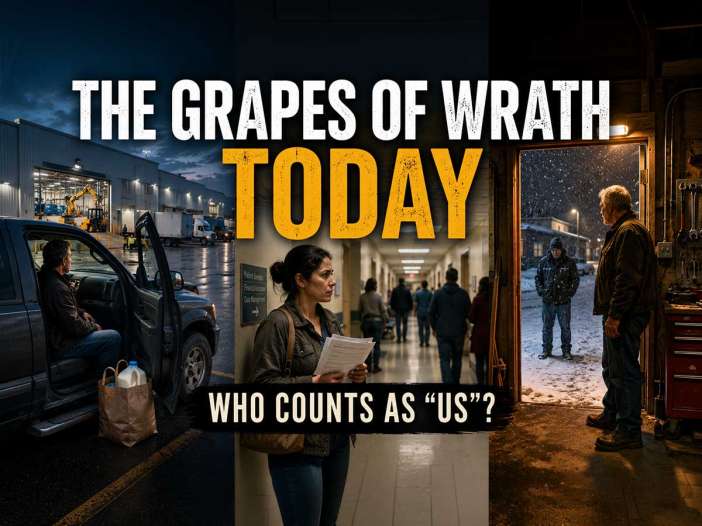
Introduction
John Steinbeck wrote The Grapes of Wrath about one displaced family, but he was never writing about only one family.
The Joads lose land, work, stability, privacy, and certainty. Yet the deeper injury is harder to measure. Again and again, they are forced to ask whether poverty changes what a person is worth, whether protecting one’s own family is enough, and whether ordinary people can participate in harmful systems without seeing themselves as cruel.
In our first Imaginary Talk, Tom Joad, Ma Joad, Jim Casy, Rose of Sharon, Pa Joad, and Uncle John confronted those questions from inside the experience itself.
The second discussion widened the view. John Steinbeck and five scholars examined the novel’s history, structure, spiritual ideas, gender tensions, and disturbing final scene. One idea kept returning:
The novel begins with individual people trying to survive, but keeps asking the reader to enlarge the meaning of “we.”
These five modern stories take that question into the present.
They are not modern retellings of the Joad family.
There is no new Dust Bowl.
No Route 66 migration.
No attempt to transform Steinbeck’s characters into twenty-first-century equivalents.
Instead, each story magnifies one problem that still lives beneath the novel.
A man loses the job that gave him his identity.
A daughter discovers that a system can hurt her father without containing a single obvious villain.
A family must decide how much of its own security it is willing to risk for another family.
A woman praised for her strength realizes that everyone has quietly built their lives around her willingness to carry them.
And a man opens his door to someone he has every reason to despise.
The stories inhabit the same broader community, passing near one another without realizing it. Their connections are small because that is how most human connections actually work.
Someone teaches in a building another person visits.
A nonprofit helps a family it will never fully know.
A person whose name appears briefly in one life becomes important in another.
No one gathers at the end.
They simply live near each other.
The collection gradually moves through five meanings of responsibility:
My dignity.
My role inside a system.
My family.
Our shared burden.
The stranger.
And beneath all five stories sits one difficult question:
How far can the word “we” expand without asking anyone inside it to disappear?
(Note: This is an imaginary conversation, a creative exploration of an idea, and not a real speech or event.)
Story 1: The Badge in the Glove Box
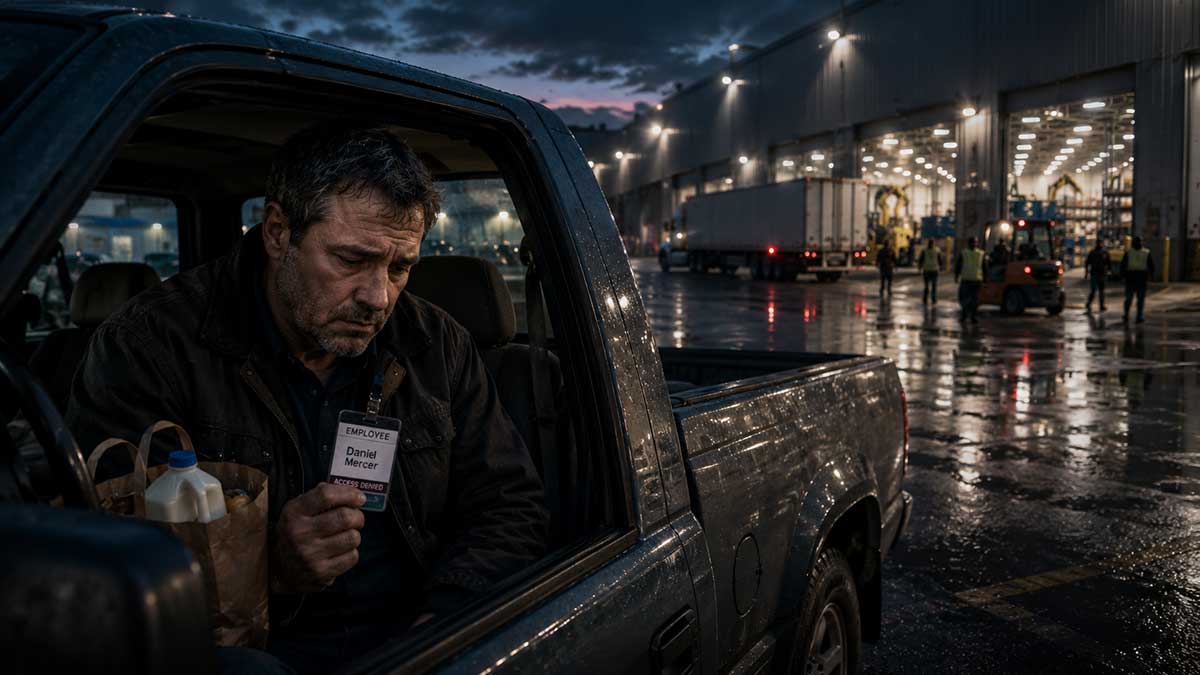
At 10:17 on Tuesday morning, Daniel Mercer became unemployed.
At 10:18, his wife texted him.
Can you pick up milk on the way home?
Daniel stared at the message from the driver's seat of his truck.
Beyond the windshield stood the distribution center where he had worked for twenty-seven years. The building looked exactly as it had when he drove in before sunrise.
Trucks backed into loading bays.
Forklifts moved behind open doors.
A driver leaned against a trailer drinking coffee.
Nothing outside the building suggested that Daniel Mercer no longer belonged inside it.
He typed:
Sure.
Then he put the phone down.
His employee badge lay on the passenger seat.
For twenty-seven years, Daniel had clipped some version of that badge to his belt before leaving the house. The photograph had changed three times. His employee number had not.
He could remember it more easily than his license plate.
That morning, the badge had opened the employee entrance at 5:43.
At 9:56, Human Resources had deactivated it.
Twenty-seven years reduced to thirteen minutes.
Daniel picked it up.
The photograph was six years old. He had more hair then.
DANIEL MERCER
OPERATIONS SUPERVISOR
He opened the glove box and placed it inside.
Then he closed the glove box.
He still didn't drive home.
Daniel had known automation was coming.
Everybody had.
For nearly two years, contractors had walked through the warehouse carrying tablets and measuring things. New conveyor systems appeared. Cameras were installed above sorting stations. Software began predicting inventory movement that Daniel had once predicted in his head.
At first, management told everyone the technology would assist employees.
Then it assisted some employees so effectively that fewer employees were necessary.
Daniel understood the economics.
That was almost the worst part.
The company had lost two major contracts. Transportation costs had risen. Customers wanted faster delivery at lower prices. A competitor had opened a heavily automated facility ninety miles away.
Daniel had sat through the meetings.
He had defended the modernization plan to his own crew.
“This keeps us competitive,” he had told them.
He believed it.
The automation probably saved the warehouse.
It just didn't save Daniel.
His manager, Kevin, had looked miserable during the termination meeting.
“I fought for you.”
Daniel believed that too.
Kevin had worked under him twelve years earlier.
Daniel had taught him how to manage a loading-floor shutdown without panicking.
Now Kevin was explaining Daniel's severance package.
“You've got knowledge nobody here can replace.”
Daniel had almost laughed.
If nobody could replace it, why was he carrying it out of the building in a cardboard box?
But Kevin wasn't the enemy.
Daniel knew that.
The woman from Human Resources wasn't the enemy either.
She had cried.
Daniel had ended up comforting her.
“It's okay,” he had said.
It wasn't.
But Daniel had spent most of his adult life calming other people when things went wrong.
He wasn't going to stop now.
He bought the milk.
That was important.
Daniel would remember that later.
He lost his job after twenty-seven years, sat in a parking lot for forty minutes wondering who he was, and still remembered the milk.
His wife, Laura, was making spaghetti when he came home.
“You're early.”
“Yeah.”
She glanced toward him.
“Everything okay?”
Daniel put the milk in the refrigerator.
“Restructuring.”
Laura stopped stirring the sauce.
“What does that mean?”
“They're moving some things around.”
“What things?”
“My department.”
Her face changed.
Daniel saw the exact second fear entered it.
He couldn't bear it.
“It's fine. They gave me a package. Kevin says there might be some consulting work while they finish the transition.”
There had been no consulting offer.
Kevin had said, If I hear of anything, I'll call you.
Daniel had converted that sentence into employment before it reached his wife.
Laura studied him.
“You still have a job?”
Daniel opened the refrigerator again as though checking where he had put the milk.
“Sort of.”
That was the first lie.
The others came more easily.
For the first week, Daniel maintained his schedule.
He woke at 4:50.
Showered.
Shaved.
Made coffee.
Put on khakis and a work shirt.
Laura usually woke as he was leaving.
“Love you.”
“Love you too.”
Then Daniel drove to the public library.
It opened at nine.
That left nearly three hours.
He spent them in a twenty-four-hour diner where a waitress named Bev refilled his coffee so many times that eventually she stopped asking.
“You work nights?” she asked one morning.
“Something like that.”
At nine, Daniel moved to the library.
He applied for jobs.
Warehouse supervisor.
Distribution manager.
Operations coordinator.
Logistics specialist.
Inventory manager.
Some applications required him to create accounts.
Some required personality tests.
Some required him to upload a résumé and then manually enter every item already written on the résumé.
Daniel did all of it.
He had spent decades making sure thousands of boxes arrived where they belonged.
Now he could not get his own name through an online application without being told:
ERROR: REQUIRED FIELD MISSING
The first rejection arrived forty-three minutes after he applied.
He assumed a person had reviewed his résumé quickly.
His daughter Emily explained otherwise.
“Dad, nobody read it.”
She was seventeen and sitting at the kitchen island doing homework.
“What do you mean?”
“It probably screened you.”
“Who?”
“The software.”
Daniel looked at her.
“How does software know if I can run a warehouse?”
Emily shrugged.
“Keywords, maybe.”
“I've been doing it twenty-seven years.”
“I know.”
“Does the software?”
She looked up.
“Apparently not.”
Daniel laughed.
Emily laughed too.
For a moment it was funny.
Three weeks later, it wasn't.
He began changing his résumé.
Twenty-seven years of experience became extensive experience.
He removed the year he graduated from high school.
He learned words he had never needed before.
Optimization.
Predictive logistics.
Integrated warehouse management.
He watched online tutorials about software that performed tasks his old crew once did manually.
He completed certificates.
He applied again.
One company offered him an interview.
Daniel bought a new shirt.
The interviewer looked about twenty-eight.
“Tell me about your experience with automated fulfillment architecture.”
Daniel answered as well as he could.
Then the interviewer asked about a specific platform Daniel had never used.
“I can learn it.”
“Of course.”
“I've learned every system they've put in front of me since 1999.”
The interviewer smiled politely.
“We're really looking for somebody who can hit the ground running.”
Daniel almost said:
I've been running since before you were born.
He didn't.
Three days later:
We have decided to pursue candidates whose experience more closely aligns with our current needs.
Daniel read the sentence four times.
Then deleted it.
The severance money arrived.
Laura saw the deposit.
That ended part of the lie.
She stood in the bedroom doorway holding her phone.
“What is this?”
Daniel knew immediately.
“Severance.”
“I can see that.”
He sat on the edge of the bed.
“How long have you been unemployed?”
“Laura...”
“How long?”
“Three weeks.”
She stared at him.
“You've been leaving every morning.”
“I've been looking.”
“In your work clothes?”
Daniel said nothing.
“Where do you go?”
“The library.”
She sat beside him.
For several seconds, neither spoke.
Daniel expected anger.
Instead she asked:
“Why didn't you tell me?”
“I was going to.”
“When?”
“When I had something else.”
Her eyes filled.
“You thought you had to replace twenty-seven years before you could come home and tell me?”
Daniel looked at the floor.
“I didn't want you scared.”
“I've been married to you twenty-two years.”
“I know.”
“Then let me be scared with you.”
That nearly broke him.
But it didn't.
Not yet.
The money became tighter.
They canceled a planned trip.
Daniel stopped ordering lunch when he went out.
Laura picked up extra hours at the dental office.
Daniel hated that.
Every time she left early or came home tired, he experienced it as evidence against himself.
One evening Laura found him studying the electric bill.
“We're okay.”
“I know.”
“You've checked that bill three times.”
“I know.”
She put her hand over the paper.
“Daniel.”
“What?”
“You losing your job is not the same as you failing us.”
He pulled the bill gently from beneath her hand.
“Feels pretty similar.”
Then came the grocery store.
Daniel was pushing a cart when he heard someone call:
“Boss!”
He turned.
Miguel Santos stood near the produce section.
Miguel had worked under Daniel for fourteen years.
They hugged.
“How you doing?” Miguel asked.
“Good.”
“You working?”
“Looking.”
Miguel's smile faded.
“Man, I'm sorry.”
“Don't be.”
“They moved me to the automated side.”
“Good.”
“I hate it.”
Daniel laughed.
“You hated the old side.”
“Yeah, but I understood what I hated.”
That made Daniel laugh harder than it deserved.
Miguel looked relieved.
Then he became serious.
“You remember when my boy was in the hospital?”
Daniel remembered.
Miguel's son had developed pneumonia when he was six.
Daniel had rearranged three weeks of shifts so Miguel could spend nights at the hospital without losing his job.
“You didn't have to do that,” Miguel said.
“It was scheduling.”
“No.”
“Miguel.”
“You always say everything is scheduling.”
Daniel looked away.
Miguel touched his shoulder.
“You were good at more than moving boxes, boss.”
Daniel nodded.
Then he walked toward the dairy aisle before Miguel could see his face.
By January, Daniel had applied for eighty-six jobs.
He kept a spreadsheet.
Green meant active.
Red meant rejected.
Yellow meant interview.
There was a great deal of red.
One afternoon, he received an email from a regional employment program.
Instructor: Warehouse Operations & Safety
Daniel almost deleted it.
The salary was less than half what he had made.
The job involved teaching adults entering or reentering the workforce.
He imagined himself standing in front of a classroom explaining pallet placement.
It felt like retirement before he was ready.
He closed the email.
Two days later, Emily borrowed his truck.
Her car wouldn't start.
Daniel was making coffee when she came back inside holding something.
“Dad?”
He turned.
She placed his old employee badge on the kitchen counter.
Daniel felt his stomach tighten.
“Where'd you get that?”
“Glove box.”
“Why were you in there?”
“Registration.”
She picked up the badge.
“You still carry this around?”
“No.”
“It was in your truck.”
“That doesn't mean I carry it around.”
Emily studied the photograph.
“You look younger.”
“Thank you.”
“I didn't say better.”
He smiled despite himself.
She didn't.
“Why haven't you thrown it away?”
Daniel reached for it.
Emily held it.
“Give me that.”
“Why?”
“Emily.”
She handed it over.
Daniel placed it face down.
She watched him.
“Do you miss the job?”
“Of course.”
“The people?”
“Yes.”
“Being in charge?”
He looked at her.
“Maybe.”
She waited.
Daniel finally said:
“I knew what I was there.”
“What?”
“At work.”
Emily sat down.
Daniel remained standing.
“At five in the morning, something goes wrong, everybody looks at you. Truck's late. Conveyor's down. Somebody called off. Inventory's wrong. You fix it.”
“So?”
“So you know why you're there.”
Emily nodded slowly.
“And now?”
Daniel looked at the badge.
“Now nobody seems to need what I know.”
She was quiet.
Then she said:
“We do.”
Daniel shook his head.
“That's different.”
“Why?”
“Because I'm your dad.”
“Yeah.”
“You have to say that.”
“No, I don't.”
Daniel smiled faintly.
Emily didn't.
Then she said:
“Why didn't you tell me you lost your job?”
“Didn't want you worried.”
“Mom said that.”
“Your mother talks too much.”
“She said you thought we'd look at you differently.”
Daniel said nothing.
Emily looked down at the badge.
Then back at him.
“Dad, you're the one looking at you differently.”
Daniel felt something move inside his chest.
He wanted to answer.
He couldn't.
Emily grabbed the truck keys.
“I have rehearsal.”
“Drive carefully.”
“I always do.”
“You absolutely do not.”
She smiled.
Then she left.
Daniel remained at the counter.
The badge lay between his hands.
For twenty-seven years, it had answered a question Daniel hadn't realized he was asking.
Who are you?
He turned it over.
DANIEL MERCER
OPERATIONS SUPERVISOR
He suddenly hated it.
He wanted to snap it in half.
Instead he put it back in the glove box.
That night, Daniel reopened the instructor email.
He stared at the salary.
Closed it.
Opened it again.
He applied at 12:14 a.m.
The interview took place at a vocational center in a converted elementary school.
Daniel nearly left when he saw the classroom.
Whiteboard.
Plastic chairs.
Training posters.
A forklift diagram on the wall.
He felt ridiculous.
The program director, Tasha Bell, shook his hand.
“Your résumé is unusual for this position.”
Daniel knew what that meant.
Overqualified.
Old.
Expensive.
Temporary.
“I've been hearing that a lot.”
Tasha smiled.
“I meant useful.”
She walked him through the program.
Some students were twenty.
Others were sixty.
Some had been laid off.
Some had recently left prison.
Some were changing careers.
Some barely spoke during class.
Daniel watched through the window.
“They need somebody who actually knows the work,” Tasha said.
“I know the work.”
“I can see that.”
“I don't have a teaching degree.”
“I didn't ask for one.”
Daniel looked at her.
“What do you need?”
“Someone who won't make them feel stupid for not knowing yet.”
That sentence stayed with him.
Tasha asked Daniel to demonstrate a short lesson.
He stood in front of twelve students.
He had prepared slides.
They were terrible.
He knew they were terrible halfway through the second one.
Then a man near the back raised his hand.
“What happens if the load keeps shifting left when you're turning?”
Daniel stopped.
“What are you carrying?”
“Mixed pallets.”
“How high?”
“Maybe six feet.”
“Wrapped?”
“Yeah.”
“How tight?”
The man shrugged.
Daniel walked to the whiteboard.
“That's your first problem.”
He drew the pallet.
Another student interrupted.
“What if you're already moving when you notice?”
Daniel drew again.
“Depends where your center is.”
Someone else asked about loading docks.
Another asked about damaged shrink wrap.
Another asked how supervisors actually decide who gets trained on equipment.
Daniel forgot about his slides.
Forty minutes later, Tasha was standing in the doorway.
Daniel looked at the clock.
“Sorry.”
“Why?”
“I went over.”
“You were supposed to teach fifteen minutes.”
“I know.”
“You taught forty-seven.”
Daniel looked toward the students.
Nobody had left.
Tasha folded her arms.
“Can you start Monday?”
Daniel looked at her.
Then at the classroom.
Then back at her.
“How much did you say it pays?”
She told him again.
Daniel winced.
Tasha laughed.
“Yeah.”
“My wife is going to love this.”
“Probably not.”
Daniel laughed too.
Then he said:
“Monday.”
The first months were not inspirational.
One student quit.
Another failed the safety exam twice.
Daniel lost his temper with a young man who kept looking at his phone.
The young man later explained that his wife was about to give birth.
Daniel apologized.
His paycheck bothered him every other Friday.
He still applied occasionally for management positions.
Some nights he missed the warehouse so badly he drove past it.
The new automated section glowed behind enormous windows.
It was efficient.
Clean.
Fast.
Daniel could see why the company had changed.
That didn't make losing his place there hurt less.
But something else began happening.
Former students called.
“I got the job.”
“My supervisor says I'm training on the lift next month.”
“Mr. Mercer, they asked me that thing you told us about load distribution.”
One student, Andre, had been unemployed for two years after incarceration.
On his last day, he waited until everyone left.
“I thought I was stupid,” Andre said.
Daniel frowned.
“Who told you that?”
“Enough people.”
“Well, they were wrong.”
Andre nodded.
“You didn't talk to me like I was.”
“Because you're not.”
Andre looked at him for several seconds.
“Thanks.”
Then he left.
Daniel sat alone in the classroom.
For years, Daniel had believed usefulness meant being the person everyone looked toward when the warehouse stopped moving.
He had never considered that usefulness might also mean helping somebody else start moving again.
Spring arrived.
One Monday morning, Daniel parked outside the training center.
He was early.
Old habit.
He reached across the passenger seat for his bag.
The glove box caught his eye.
Daniel opened it.
Registration.
Insurance card.
A flashlight.
Two pens that probably didn't work.
And the badge.
He took it out.
The plastic was scratched now.
The photograph looked increasingly like another man.
For a moment, Daniel considered throwing it into the trash can beside the building.
He didn't.
Twenty-seven years had happened.
Those years were not a mistake merely because they ended.
He had led people.
Provided for his family.
Made mistakes.
Solved problems.
Helped Miguel.
Learned things no software certificate could summarize.
The badge had once opened a door.
That door had closed.
Daniel placed the badge back inside.
He shut the glove box.
Across the parking lot, two students were waiting outside the training center.
One spotted him.
“Mr. Mercer!”
Daniel climbed out.
“We've got a question.”
“It's seven twenty in the morning.”
“We know.”
“Class starts at eight.”
“We know.”
Daniel locked the truck.
“What broke?”
The student grinned.
“Nothing yet.”
Daniel shook his head and walked toward them.
Behind him, inside the closed glove box, the old badge remained where he had left it.
Daniel didn't need to throw it away.
He didn't need it to open anything anymore.
Story 2: Your Request Has Been Reviewed
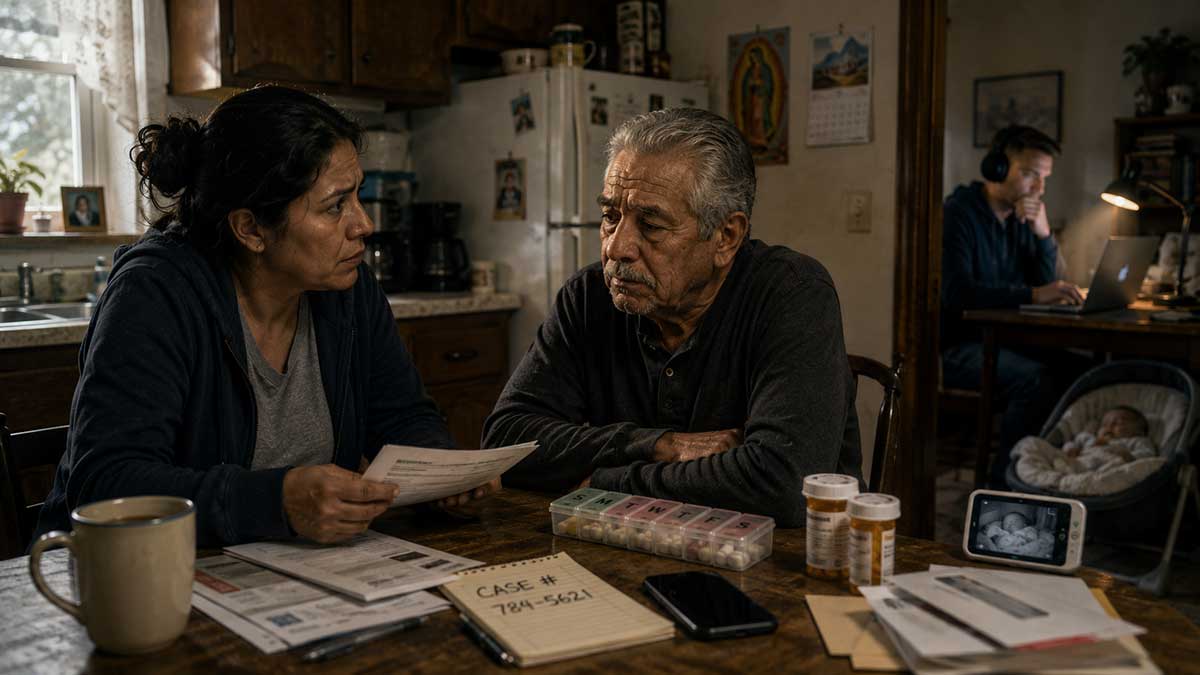
At 8:03 on Monday morning, Marisol Vega received an email that began with the words:
YOUR REQUEST HAS BEEN REVIEWED.
For three seconds, she thought that meant approved.
She was standing in her father's kitchen with one hand wrapped around a mug of coffee and the other holding her phone. Luis sat at the table, looking at the newspaper without reading it.
Marisol opened the message.
Then she read the first paragraph twice.
Then a third time.
After review of the submitted medical documentation, the requested extension of in-home support services does not meet current criteria for continued authorization.
Her father looked up.
“What?”
“Nothing.”
“You make that face when it's not nothing.”
Marisol lowered the phone.
“They said no.”
Luis folded the newspaper.
“For what?”
“For the extra home-care hours.”
He looked at her for several seconds.
Then he shrugged.
“I told you. I don't need somebody here all day.”
“You fell last Thursday.”
“I slipped.”
“You fell.”
“People fall.”
“You couldn't get up.”
“I got up.”
“After forty minutes.”
Luis frowned.
“Thirty.”
“You timed it?”
“I had a clock.”
Marisol stared at him.
Her father smiled.
It was the same smile he had used when she was ten and he wanted her to stop worrying about money.
It didn't work anymore.
Luis Vega had been strong for most of his life.
He had repaired apartment buildings, painted houses, replaced drywall, carried refrigerators up narrow stairs, and once lifted the front end of Marisol's first car with a jack and one hand while explaining exactly what she had done wrong.
At sixty-seven, after a year of worsening balance and weakness following a difficult recovery from surgery, his world had shrunk to one floor of a small house.
He could still walk.
Slowly.
He could still cook.
Sometimes.
He could still insist that everything was fine.
Constantly.
Marisol did not need twenty-four-hour care for him.
She needed enough help to stop being terrified every time she went to work.
The insurance plan had approved a short period of in-home support after discharge.
Then the hours were cut.
Now the remaining extension had been denied.
Marisol had already used nine vacation days.
She had three left.
After that, taking time off meant missing pay.
Missing enough pay meant missing rent.
Luis knew this.
Which was why he kept saying:
“I'll manage.”
Marisol hated those two words.
At 8:19, she called the number in the email.
A recorded voice thanked her for being a valued member.
Then music played.
At 8:27, a woman answered.
“Thank you for calling member services. May I have the case number?”
Marisol looked at the email.
“Case number?”
“It should be near the top.”
She found it.
C-88473192.
She read it aloud.
“Thank you. And the member's date of birth?”
Marisol answered.
“Relationship to member?”
“Daughter.”
“Are you authorized to speak on his behalf?”
“Yes.”
“I'll need to verify that.”
The woman did.
Then she said:
“I can see the request was reviewed and determined not medically necessary at the requested level.”
Marisol closed her eyes.
“He cannot safely stay alone.”
“I understand.”
“He fell last week.”
“I understand.”
“He was on the floor for forty minutes.”
“I understand.”
“He cannot afford private care. I cannot stop working. So what exactly are you telling me to do?”
There was a pause.
The woman's voice softened.
“I really do understand how upsetting this is.”
“Can you change it?”
“No.”
“Who can?”
“You can request reconsideration.”
“I did that.”
“This appears to be the reconsideration.”
“So who can change it?”
“You can file an appeal.”
“How?”
“I can transfer you.”
“Will they change it?”
“I can't say.”
“What can you say?”
Another pause.
“I can say I'm sorry.”
Marisol almost laughed.
Instead she said:
“Transfer me.”
At 9:11, Marisol wrote the case number on the back of an envelope.
At 10:42, she wrote it on a sticky note.
At noon, she had memorized it.
C-88473192.
By Tuesday afternoon, she could say it before customer service finished asking.
By Wednesday, the number came to her more quickly than her father's medication list.
Every call began the same way.
Case number.
Date of birth.
Relationship.
Authorization.
Then:
“I understand.”
Marisol began to hate those words too.
On Thursday, she spoke to a supervisor named Janet.
Janet sounded tired.
Not bored.
Tired.
That mattered.
“I've reviewed the notes,” Janet said.
“Good.”
“I can see why you're concerned.”
“Then approve it.”
“I don't have that authority.”
“Who does?”
“The utilization review team.”
“Can I speak to them?”
“They don't normally take direct calls.”
“Why?”
“They review clinical documentation.”
“Does clinical documentation include my father lying on the floor for forty minutes?”
“If the provider submitted it.”
“Thirty,” Luis called from the living room.
Marisol covered the phone.
“Dad.”
“What?”
“Please.”
Janet asked, “Was that your father?”
“Yes.”
“How is he doing today?”
“He's fine today.”
“That's good.”
“No, Janet. That's the problem.”
Silence.
“He's always fine on the day someone reviews whether he needs help.”
Janet said quietly:
“I understand.”
Marisol almost hung up.
Instead she said:
“Please don't say that unless there's something you can do.”
Janet did not answer right away.
Then:
“I can send an escalation request.”
“What does that mean?”
“It means someone on the utilization team will look again.”
“Will they call me?”
“They may.”
“Can you make them?”
“No.”
“Can you give me a name?”
“I don't have one assigned yet.”
Marisol looked at the envelope in front of her.
C-88473192.
“Send it.”
The escalation landed on Evan Brooks's screen Friday morning.
He was drinking lukewarm coffee and trying to finish three cases before a ten o'clock meeting.
The queue showed forty-seven pending reviews.
His supervisor wanted the average decision time reduced by eleven percent before the end of the quarter.
Evan had no idea why eleven.
Nine seemed possible.
Twelve sounded cleaner.
Eleven had probably emerged from a meeting.
His daughter, Nora, had been awake from 2:13 to 4:06.
His wife, Claire, had finally fallen asleep at dawn.
Evan was working from home.
He opened case C-88473192.
The patient was sixty-seven.
Recent functional decline.
Several notes from home health.
One documented fall.
Daughter requesting extension.
Current plan criteria required a certain combination of mobility limitations, clinical risk, and documented need for skilled support.
Luis met some.
Not enough.
Evan read the earlier denial.
It was consistent with policy.
He read the reconsideration.
Also consistent.
He moved the cursor toward UPHOLD DENIAL.
Nora began crying in the next room.
Evan closed his eyes.
“Claire?”
No answer.
The crying grew louder.
Evan got up, walked down the hall, and found Claire sitting on the edge of the bed with Nora in her arms.
“I'm sorry,” she said. “I haven't slept.”
“I've got her.”
“You have work.”
“I've got her.”
He took the baby.
For ten minutes, Evan walked slowly through the house while Nora pressed one red cheek against his shoulder.
Then his laptop chimed.
Another case.
Then another.
He whispered:
“Can you take her for five minutes?”
Claire looked at him.
He hated himself for asking.
She held out her arms.
Evan returned to his desk.
C-88473192 was still open.
He clicked UPHOLD DENIAL.
Then stopped before submitting.
The first time Marisol spoke directly to Evan, she had been trying for twelve days.
She expected someone colder.
Someone polished.
Someone who would speak in prepared phrases until she became too tired to argue.
Instead she heard a baby crying.
“I'm sorry,” Evan said. “Give me one second.”
Then, muffled:
“Can you take her for five minutes?”
Marisol froze.
A woman said something she couldn't make out.
The baby moved farther away.
Evan came back.
“Sorry about that.”
“You have a baby?”
“Yes.”
“How old?”
“Four months.”
Marisol looked toward Luis, asleep in his chair.
She felt something sharp inside her.
Not sympathy.
Something worse.
Now the person telling her no had a baby.
He had a tired wife.
He sounded human.
And suddenly Marisol wanted him to sound less human.
It would have been easier if he were cruel.
“Mr. Brooks?”
“Evan is fine.”
“No. I think I'm going to call you Mr. Brooks.”
A pause.
“Okay.”
“My father cannot safely be home alone.”
“I've read the file.”
“Then you know.”
“I know he's had a fall.”
“You know more than that.”
“I know there are concerns.”
“Concerns?”
Marisol laughed once.
“You have a word for everything.”
“I don't mean to minimize it.”
“Then don't.”
Evan looked at the notes on his screen.
He knew what she was doing.
She was turning language back into people.
He had forty-six other cases.
He also had a man named Luis Vega whose daughter had called eleven times.
“I didn't write the criteria,” Evan said.
Marisol went quiet.
He heard himself and wished immediately that he could take the sentence back.
“I'm sorry,” he said.
“No. That's good.”
“What?”
“Say it again.”
“I said I didn't write the criteria.”
“Exactly.”
Evan leaned back.
Marisol continued.
“The woman in member services didn't write them. The supervisor didn't write them. You didn't write them. My father's doctor didn't write them. Nobody I can speak to wrote them.”
“That doesn't mean nobody is responsible.”
“Then who is?”
Evan looked at the baby monitor beside his laptop.
He did not know how to answer.
Marisol said:
“Every person I talk to agrees this makes no sense.”
“I didn't say that.”
“Does it make sense to you?”
Evan stared at the file.
Policy said one thing.
The file suggested another.
He chose his words carefully.
“I think the risk is real.”
“Then approve it.”
“I can't just approve something outside criteria.”
“Why?”
“Because my decisions are audited.”
There it was.
Marisol heard it.
“So if you help my father, you could get in trouble?”
“That's not what I said.”
“It is.”
“I said I have to justify the decision.”
“Then justify it.”
Evan rubbed his forehead.
“You think it's that simple.”
“No. I think you're telling me it's complicated, and my father is the one who falls through the complicated part.”
Neither spoke.
Then Luis called from the other room.
“Marisol?”
“One minute, Dad.”
“You working?”
“I'm on the phone.”
“With those people?”
Marisol shut her eyes.
“Yes.”
“Tell them I'm fine.”
Evan heard him.
Marisol said:
“He's embarrassed.”
Evan did not respond.
“He doesn't want to cost anything,” she continued. “He doesn't want to be trouble. He keeps telling me he's fine because he knows I can't miss work.”
Evan looked again at the file.
There was a note from the home-health clinician.
Patient minimizes limitations. Daughter demonstrates significant caregiver burden.
He had read it earlier.
Now it looked different.
That afternoon, Evan asked his supervisor, Lena, about discretionary exceptions.
She looked at him through the video call.
“Why?”
“Case doesn't fit cleanly.”
“They never do.”
“This one really doesn't.”
“You want to override?”
“I don't know.”
Lena leaned closer to the screen.
“What's the risk?”
“Fall history. Limited daytime supervision. Family caregiver is missing work.”
“Skilled need?”
“Borderline.”
“Then policy probably says no.”
“I know what policy says.”
Lena watched him.
“You're asking something else.”
Evan hesitated.
“There is a temporary exception category.”
“There is.”
“How often do we use it?”
“Rarely.”
“Why?”
“Because exceptions become precedents if they're sloppy.”
“This wouldn't be sloppy.”
“Then document it.”
“That simple?”
“No.”
Evan waited.
Lena said:
“If you override it, write why you're willing to own it.”
He looked at her.
“Own it?”
“Yes.”
“If somebody audits it?”
“You explain your reasoning.”
“And if they disagree?”
“Then they disagree.”
“Could it affect my metrics?”
“Yes.”
“Performance review?”
“Possibly.”
Evan looked toward the baby monitor.
Lena's voice softened.
“I'm not telling you to approve it.”
“I know.”
“I'm not telling you to deny it either.”
“I know.”
“I'm telling you not to hide behind me.”
That stung.
“Fair.”
“And don't hide behind the policy if the policy actually gives you discretion.”
Evan nodded.
Lena said:
“That's what discretion means.”
Evan spent forty-two minutes documenting the exception.
He approved four additional weeks.
Not twelve.
Not what Marisol requested.
Four.
Temporary home support.
Reassessment required.
It felt both significant and inadequate.
He called her.
“Ms. Vega?”
“Yes.”
“This is Evan Brooks.”
Silence.
“I've approved a temporary extension.”
“How long?”
“Four weeks.”
She did not respond.
“I know that's not what you asked for.”
“No.”
“It gives some time for another assessment.”
“So we do this again in four weeks.”
“Possibly.”
Marisol laughed bitterly.
“Congratulations.”
Evan felt heat rise in his face.
“I understand you're angry.”
“Don't.”
He stopped.
She breathed out.
Then:
“Thank you.”
Evan was surprised.
“I mean it,” Marisol said. “Thank you for the four weeks.”
“You're welcome.”
“I still hate this.”
“I know.”
“No. You don't.”
Evan almost said something defensive.
Instead:
“Probably not.”
That quieted her.
Then she said:
“My father will be safer for four weeks.”
“Yes.”
“That's something.”
“Yes.”
They hung up.
Evan stared at the closed case.
Four weeks.
He did not feel heroic.
He felt tired.
Marisol used the time.
The home-care worker who began coming three afternoons a week was named Denise.
Luis disliked the idea immediately.
“I don't need a babysitter.”
Denise said:
“Good. I don't babysit.”
He looked at her.
“What do you do?”
“Today? Make sure you don't fall while pretending you can't fall.”
Luis laughed.
By the third week, he was saving stories for her.
Marisol returned to work without checking her phone every twelve minutes.
Her manager stopped asking whether she needed another emergency day.
She slept better.
Not well.
Better.
Then week four approached.
Another assessment.
More forms.
More calls.
The longer-term approval remained uncertain.
The four weeks had not solved anything.
They had merely stopped the crisis from becoming disaster.
That mattered.
It also made Marisol angrier that so much depended on whether one employee decided to use one narrow exception.
Evan began noticing patterns.
He had always seen cases.
Now he started seeing repetitions.
An older woman discharged home with a daughter working two jobs.
A man with early cognitive impairment whose wife had exhausted her leave.
A patient whose functional risk looked mild on paper because he consistently understated what he could no longer do.
Different names.
Different numbers.
Same gap.
Evan created a folder.
CARE SUPPORT EXCEPTION PATTERNS
He hated the title.
It sounded like every other title.
He began adding de-identified examples.
He sent them to Lena.
She replied:
Good documentation. Keep tracking.
Two weeks later he sent the folder to quality review.
No response.
A month later:
Thank you for your feedback. This information will be considered during future policy review.
Evan read the email and laughed.
Claire looked over from the couch.
“What?”
“Nothing.”
“Good nothing or bad nothing?”
“Corporate nothing.”
She nodded.
“Ah.”
He closed the laptop.
Nora was asleep on Claire's chest.
Evan watched them.
Then his laptop chimed.
Another case.
Claire looked at him.
“You going back?”
“Five minutes.”
“You said that an hour ago.”
“I know.”
She looked down at Nora.
“Your job is eating you.”
Evan almost said, People need these decisions.
Instead he said:
“I think the job needs people who care what the decisions do.”
Claire looked at him.
“Then don't let that become your excuse for never stopping.”
The sentence stayed with him.
Responsibility had edges too.
In June, Marisol received another denial.
She called Evan.
This time he could not override it.
The reassessment documented improved stability.
Luis still needed support, but the case no longer met the temporary exception threshold.
Marisol was furious.
Evan listened.
Then he gave her three local programs to contact.
One had a six-month waiting list.
One had income limits.
The third was a nonprofit caregiver-support program.
Rachel Kim's organization.
Marisol called.
That did not fix everything either.
But it connected her to a part-time subsidized helper and a caregiver support group she did not want to attend.
She attended anyway.
Luis complained about Denise leaving.
Then pretended he had not.
Life continued in pieces.
No single approval saved them.
No single denial destroyed them.
That was almost the problem.
Everything happened gradually enough to become normal.
Six months after case C-88473192 first appeared, Evan sat at his desk before sunrise.
Claire and Nora were asleep.
Rain tapped the window.
He opened the morning queue.
Thirty-two cases.
The first was straightforward.
Approved.
The second was straightforward.
Denied.
The third made him stop.
Seventy-one-year-old woman.
Recent hospitalization.
Lives with adult son.
Son works full-time.
Two falls.
Request for temporary in-home support.
The standard recommendation appeared on the screen.
DENY: CRITERIA NOT MET
Evan stared at it.
He remembered Marisol's voice.
My father is the one who falls through the complicated part.
He opened the clinical notes.
Read them fully.
Not just the summary.
There was a sentence near the bottom.
Family reports patient frequently minimizes functional difficulty due to concern about burdening son.
Evan leaned back.
Beside his keyboard was a yellow sticky note.
He had written it months earlier after a difficult day.
Not for inspiration.
For discipline.
A CASE NUMBER IS A PERSON.
He looked at the denial button.
Then at the exception menu.
He clicked the menu.
There was no swelling music.
No revelation.
No certainty that the exception would be approved by audit.
No guarantee the patient's life would improve.
No guarantee Evan was right.
Just a person making a decision inside a system built from thousands of other decisions.
He opened the exception form.
The first field asked:
Reason for deviation from standard criteria.
Evan placed his hands on the keyboard.
Then he began to type.
Story 3: The Last Apartment
Marcus Reed had the cashier’s check in his jacket pocket when he saw Tasha Bell crying.
He almost pretended he hadn’t.
The leasing office was crowded for a Saturday morning. A toddler was rolling a plastic truck beneath a row of chairs. An older couple whispered over a stack of forms. Somewhere behind the reception desk, a printer kept spitting out pages.
Marcus had been waiting eleven months for this moment.
Eleven months of saving.
Eleven months of telling Sophie they would find a way.
Eleven months of watching rents rise faster than their savings.
Now the check was in his pocket.
$2,840.
First month.
Security deposit.
Apartment 3C.
Two bedrooms.
Twelve minutes by bus from the Hartwell School of Arts.
And, according to the leasing agent, the last affordable two-bedroom available in the building.
Marcus touched the check through his jacket.
Then Tasha looked up.
Their eyes met.
For one second, neither moved.
“Marcus?”
He smiled.
“Tasha. Hey.”
She wiped her face quickly.
He had met her twice at the vocational center where his cousin had taken a certification course. Tasha was the program director. She had helped his cousin with an application and remembered Marcus’s name months later when they ran into each other at a grocery store.
She was one of those people who seemed to remember everyone.
Today she looked exhausted.
A boy sat beside her.
Maybe fifteen.
Thin.
Hoodie.
Backpack between his shoes.
“This your son?” Marcus asked.
“Jordan.”
The boy nodded.
“Hey.”
“Hey.”
Tasha looked toward the receptionist.
“What are you doing here?”
Marcus hesitated.
“Moving.”
“Here?”
“Looks like it.”
“That’s great.”
Her smile appeared for him and disappeared immediately afterward.
“What about you?”
Tasha looked down.
“Trying to move.”
Before Marcus could ask more, the receptionist called:
“Mr. Reed?”
Marcus turned.
The leasing agent stood beside the hallway.
“We’re ready for you.”
Marcus looked back at Tasha.
“Good seeing you.”
“You too.”
He followed the agent.
He had taken four steps when he heard Tasha ask the receptionist:
“So there’s really nothing else?”
“I’m sorry.”
“Not even a one-bedroom?”
“Nothing under seventeen hundred.”
“And 3C?”
“Being signed now.”
Marcus stopped.
The cashier’s check suddenly felt heavier in his pocket.
He did not turn around.
Sophie had been drawing since she was four.
At first, Marcus thought all children drew.
Then Sophie kept drawing.
She drew on napkins.
Receipts.
The backs of school worksheets.
Once, at seven, she drew the woman sitting across from them at a bus stop. The woman asked if she could keep it.
At twelve, Sophie began painting.
At fourteen, she won a statewide student competition.
At sixteen, one of her teachers told Marcus and Elena:
“She needs to be somewhere that will push her.”
Marcus did not like the phrase.
He thought life pushed children enough.
But Sophie applied to Hartwell anyway.
The acceptance email arrived in March.
She screamed so loudly Marcus ran upstairs thinking something terrible had happened.
Instead she threw herself into his arms.
“I got in.”
He did not understand immediately.
“Hartwell.”
Then he understood.
He picked her up.
At seventeen, Sophie was nearly as tall as her mother.
Marcus lifted her anyway.
For three minutes, there was no tuition.
No rent.
No transportation.
No deposits.
No question of how.
There was only:
She got in.
Then came the numbers.
Hartwell offered financial aid.
Enough to make school possible.
Housing was another matter.
The Reeds lived too far away for a daily commute.
Marcus worked maintenance for a municipal building complex. Elena managed the front desk at a medical practice.
They were not poor.
They were not wealthy.
They lived in the enormous country between those two words where one unexpected expense could rearrange six months.
So they saved.
Marcus stopped replacing things that still technically worked.
Elena picked up Saturday shifts.
Sophie worked at a frozen-yogurt shop and contributed money even when Marcus told her not to.
The family canceled a beach trip.
They ate out less.
Marcus delayed dental work.
By August, they had enough.
Barely.
Then they found 3C.
Old carpet.
Small kitchen.
Bedroom windows facing a brick wall.
Sophie loved it.
She stood in the empty second bedroom and stretched out her arms.
“This is my studio.”
“It’s a bedroom.”
“Studio.”
“You need a bed.”
“Unnecessary.”
Marcus laughed.
The leasing agent gave them forty-eight hours.
Marcus got the cashier’s check the next morning.
Nobody had handed his family anything.
They had worked for this.
He reminded himself of that as he entered the leasing office.
The agent spread the documents across the desk.
“Just initial here, here, and here.”
Marcus initialed.
“And this acknowledges the parking restrictions.”
Initial.
“No smoking.”
Initial.
“Utilities.”
Initial.
The agent turned the final page.
“Sign here, and 3C is officially yours.”
Marcus picked up the pen.
Through the glass wall, he could see Tasha and Jordan.
Tasha was talking to someone on her phone.
She turned away from her son before speaking.
Marcus recognized that movement.
It was the movement adults made when they did not want children to see fear.
He looked at the lease.
Then signed it.
“Dad!”
Sophie ran down the stairs when he got home.
Marcus held up the keys.
She screamed.
Elena came from the kitchen.
“You got it?”
“We got it.”
Sophie grabbed the keys.
“3C?”
“3C.”
She hugged him.
Marcus hugged her back.
He felt happy.
He really did.
That mattered later.
He was not pretending.
His daughter had worked for something.
His family had sacrificed.
They had succeeded.
There was nothing wrong with being happy.
Yet sometime during the hug, he saw Jordan’s backpack between his shoes.
Three days later, Marcus returned to the building with Sophie to measure the rooms.
Tasha’s car was in the parking lot.
He recognized it because the rear bumper had a faded vocational-center sticker.
Tasha was sitting behind the wheel.
Jordan was asleep in the passenger seat.
The back seat was filled with clothes.
Marcus slowed.
Tasha saw him.
Her face changed.
He wished she hadn’t seen him.
He walked over.
She rolled down the window.
“Hey.”
“Hey.”
Marcus glanced at the back seat.
Tasha followed his eyes.
“Temporary.”
He nodded.
“Apartment fall through?”
“Landlord sold the building we were in. We had a place lined up. Guy took another applicant.”
“I'm sorry.”
“It happens.”
“Where are you staying?”
Tasha looked at Jordan.
“We've got a couple options.”
Marcus knew that answer.
It meant none.
“You sleeping here?”
“Marcus.”
“I'm just asking.”
“We're okay.”
He almost smiled at the phrase.
Everybody said they were okay when they desperately wanted you to stop asking.
“How long?”
“Two nights.”
“Tasha.”
“We shower at the center. Jordan eats there. I'm working.”
“That's not what I asked.”
She looked at him.
“Two nights.”
Marcus rubbed the back of his neck.
“What happened with 3C?”
Tasha immediately shook her head.
“No.”
“What?”
“Don't do that.”
“Do what?”
“Feel guilty.”
“I don't.”
“You do.”
Marcus looked toward the building.
“We'd been waiting for it.”
“I know.”
“My daughter starts school.”
“I know.”
“We need it.”
“I know, Marcus.”
Her voice was gentle.
That somehow made it worse.
“You got there first. You qualified. You signed the lease. It's your apartment.”
Jordan stirred.
Tasha lowered her voice.
“I don't want your daughter's home.”
Marcus looked at her.
“I just want one for my son.”
That evening Marcus told Elena.
She stopped chopping onions.
“They're sleeping in the car?”
“Two nights now.”
“What about family?”
“I didn't ask.”
“Shelter?”
“I don't know.”
Elena resumed chopping.
After a moment she said:
“We can't give them the apartment.”
Marcus looked at her.
“I didn't say we should.”
“You were thinking it.”
“I was thinking they're sleeping in a car.”
“And Sophie starts in three weeks.”
“I know.”
“We searched for months.”
“I know.”
“We can't fix the housing market.”
“I know.”
Elena put down the knife.
“Then stop saying ‘I know’ like I'm the bad person.”
Marcus stared at her.
“I didn't.”
“You didn't have to.”
He sat down.
Elena leaned against the counter.
“I feel terrible for them.”
“So do I.”
“But our daughter matters too.”
“I know.”
“There it is again.”
Marcus sighed.
Elena came over and sat across from him.
“Marcus, if we give up that apartment and can't find another one, what do we tell Sophie?”
He had no answer.
Elena continued.
“That she worked for years, got into the school she dreamed about, and we gave away the place she needed?”
“No.”
“Then what?”
“I don't know.”
They sat quietly.
Finally Marcus said:
“I can't save everybody.”
Elena nodded.
“No. You can't.”
It was true.
That was what made it so difficult.
Sophie learned about Tasha accidentally.
She was carrying boxes into 3C when she saw Jordan downstairs.
He was charging his phone in the leasing-office lobby.
She recognized him from the parking lot.
Later she asked Marcus.
“Who's that kid?”
Marcus told her.
Not everything.
Enough.
“Wait.”
Sophie looked around the apartment.
“They wanted this place?”
“Yes.”
“And they're sleeping in their car?”
“Apparently.”
Sophie sat on a box marked ART SUPPLIES.
Marcus prepared himself.
He thought she might say:
We should give it to them.
Part of him hoped she would.
Then the decision would belong to her.
She didn't.
“I don't want to give this up.”
Marcus looked at her.
“I didn't ask you to.”
“I know.”
She looked ashamed.
“I feel horrible saying that.”
“You don't need to.”
“But I do.”
“You worked for this.”
“So did they probably.”
Marcus sat beside her.
For a while they stared at the bare wall.
Sophie said:
“Why does helping them have to mean losing this?”
Marcus looked at his daughter.
There were questions fathers were supposed to answer.
This wasn't one.
“I don't know.”
“That's stupid.”
“Yes.”
“I mean the situation.”
“I know.”
“If there were enough apartments, we wouldn't be having this conversation.”
“No.”
“If rent wasn't insane...”
“I know.”
Sophie pulled her knees toward her chest.
“Then somebody should fix that.”
“Probably.”
“Who's somebody?”
Marcus laughed softly.
“That's usually where things get complicated.”
The next morning, Marcus started calling landlords.
At first he told himself he was doing it so he could stop feeling guilty.
Then he stopped caring why.
He called twelve places.
Three never answered.
Two had waiting lists.
Four were too expensive.
One did not accept Tasha's income.
One required a credit score she did not have.
The last had already rented its available unit.
Marcus texted Tasha.
Any luck?
She replied:
Working on it.
That evening Sophie sent him three listings.
All unavailable.
Elena called a patient at her office who owned rental property.
Nothing.
By Friday, the Reed family had spent more time looking for Tasha's apartment than they had spent looking for their own that week.
Something had changed.
They still weren't giving up 3C.
But Tasha's problem no longer belonged entirely to Tasha.
The breakthrough came from a man named Mr. Kowalski.
He was seventy-eight and owned a four-unit building six blocks from Hartwell.
Marcus knew him through work.
The building was old but cared for.
One tenant had recently moved into assisted living.
“You renting that unit?” Marcus asked.
“Eventually.”
“What does eventually mean?”
“When I feel like painting it.”
“I'll paint it.”
Silence.
“You want the apartment?”
“No.”
“Then why are you painting it?”
“For someone.”
Mr. Kowalski grunted.
“What kind of someone?”
“A mother and her son.”
“Job?”
“Yes.”
“Pets?”
“No.”
“You sure?”
“I'll ask.”
“People lie about cats.”
“I'll specifically investigate cats.”
Mr. Kowalski ignored that.
“Credit?”
Marcus hesitated.
“I don't know.”
“Find out.”
Tasha did not want Marcus checking her credit.
“You've done enough.”
“I haven't done anything.”
“You've called half the city.”
“Apparently the wrong half.”
“Marcus.”
“What's your score?”
She stared at him.
“That's none of your business.”
“Correct.”
“Then stop asking.”
“Mr. Kowalski needs it.”
“Who's Mr. Kowalski?”
“Potential landlord.”
Tasha's expression changed.
“Really?”
“One-bedroom. Older building. Six blocks from Hartwell.”
“How much?”
Marcus told her.
Her hand went to her mouth.
She could afford it.
Then she looked away.
“What?”
“Nothing.”
“Tasha.”
She sighed.
“My credit's bad.”
“How bad?”
“Bad enough.”
“What happened?”
“My old landlord filed for eviction after I got behind during my mother's illness. I paid it before the hearing, but the filing's there. Then credit cards.”
Marcus nodded.
Tasha looked embarrassed.
He hated that.
She had helped dozens of unemployed people sit across from employers without feeling ashamed of their histories.
Now she could barely look at him.
“I made mistakes.”
“Okay.”
“Don't say it like it doesn't matter.”
“I didn't.”
“It matters to landlords.”
“Probably.”
“And it should matter.”
“Maybe.”
She looked at him.
Marcus said:
“You still need somewhere to live.”
Mr. Kowalski reviewed the application.
“No.”
Marcus had expected that.
“Why?”
“You know why.”
“She has steady employment.”
“Credit is a mess.”
“She can pay.”
“Everybody can pay when they need an apartment.”
“She's good for it.”
“You know her?”
Marcus hesitated.
“Some.”
“Some isn't rent.”
“What would make you comfortable?”
Mr. Kowalski looked at him.
“Three months guaranteed.”
Marcus said nothing.
“If she misses rent, somebody covers it. Three months.”
“How much?”
Mr. Kowalski told him.
Marcus already knew.
He had calculated it before asking.
The amount was almost exactly what remained in the Reeds' moving reserve after paying for 3C.
Money for furniture.
Transit.
Supplies.
Emergency expenses.
The small cushion that made Sophie's move possible without terror.
“Think about it,” Mr. Kowalski said.
Marcus already was.
Elena said no.
Immediately.
“No.”
Marcus didn't argue.
She paced across the kitchen.
“We just spent months building that savings.”
“I know.”
“Sophie needs supplies.”
“I know.”
“We have moving expenses.”
“I know.”
“Stop.”
Marcus stopped.
Elena looked at him.
“What happens if Tasha doesn't pay?”
“We cover it.”
“With what?”
“The reserve.”
“And then?”
“We adjust.”
“Marcus, listen to yourself.”
“I am.”
“We have a daughter starting school.”
“I know.”
“We have our own emergencies.”
“I know.”
“We barely know this woman.”
Marcus nodded.
“Yes.”
Elena stopped pacing.
That answer surprised her.
“You're agreeing with me?”
“Yes.”
“Then why are we talking about this?”
Marcus looked at the kitchen table.
“Because she's still sleeping in a car.”
Elena closed her eyes.
“That doesn't make us responsible.”
“No.”
“Then?”
Marcus struggled.
“I don't know.”
He sat down.
“I keep thinking about something.”
“What?”
“When does somebody else's problem become partly ours?”
Elena stared at him.
“That is a dangerous question.”
“I know.”
“If you answer it wrong, you could spend your entire life fixing strangers.”
“I know.”
“And neglect the people you love.”
“I know.”
She sat opposite him.
“Then where's the line?”
Marcus shook his head.
“I don't know.”
For once, Elena did not complain about the answer.
Sophie overheard enough.
She came downstairs later.
“It's the savings, isn't it?”
Marcus looked at Elena.
Elena sighed.
“Yes.”
“How much?”
They told her.
Sophie went quiet.
“That was for school.”
“Partly.”
“For my stuff.”
“Yes.”
“And if she doesn't pay?”
“We lose it.”
Sophie sat down.
Marcus said:
“We're not doing anything tonight.”
She nodded.
Then:
“What would we have to give up?”
Elena answered this time.
“Probably the furniture we planned to buy. Your desk. Some supplies. We'd need to be more careful for a few months.”
“The apartment?”
“No.”
“School?”
“No.”
Sophie thought.
“What about the studio?”
Marcus smiled.
“You mean your bedroom?”
She ignored him.
Then she said:
“I don't want to do it.”
Marcus felt oddly relieved.
“Okay.”
“I mean I want them to have somewhere. I just don't want us to lose the money.”
“That's fair.”
Sophie looked at her parents.
“Do you?”
Marcus answered honestly.
“No.”
Elena said:
“No.”
The three of them sat with that.
Then Sophie asked:
“If we don't do it, what happens?”
Marcus said:
“I don't know.”
She hated that answer now too.
Two days passed.
Tasha found a motel that offered weekly rates.
It cost nearly twice the rent Mr. Kowalski wanted.
She paid for one week.
Marcus knew what would happen after that.
Money used for the motel would make the apartment harder to afford.
The solution was eating the possibility of the solution.
He thought of the Jenga tower Sophie used to build as a child.
One block removed to save another.
Then another.
Then another.
Nothing looked catastrophic until the whole thing moved.
On Monday evening, Sophie came home carrying a cardboard box.
She put it on the kitchen table.
Inside were art supplies.
Some unopened.
Some barely used.
“What is this?”
“Stuff I'm selling.”
Marcus frowned.
“No.”
“You haven't heard the plan.”
“Still no.”
“I can buy used furniture. I don't need a new desk.”
“No.”
“Dad.”
“You earned your money.”
“So did you.”
“That is different.”
Sophie stared at him.
“Why?”
Marcus opened his mouth.
Nothing came.
She sat down.
“I've been thinking about what I said.”
“What?”
“Why does helping them have to mean losing this?”
Marcus remembered.
Sophie continued.
“Maybe it doesn't mean losing it. Maybe it means we don't get exactly the version we wanted.”
Marcus looked at the box.
“You don't have to sacrifice your things.”
“I know.”
“Then don't.”
Sophie became irritated.
“Why are you allowed to decide what I care about?”
That stopped him.
She continued.
“It's my school. My apartment. My desk. My stuff. If we're talking about what our family gives up, I'm part of the family.”
Elena stood in the doorway listening.
Sophie looked at both of them.
“I still want to go to Hartwell.”
“You're going,” Marcus said.
“I still want the apartment.”
“We have it.”
“And I still want a desk.”
Marcus smiled.
“Good.”
“But maybe I don't need a new one right now.”
Elena walked over.
“You're sure?”
“No.”
That answer made Marcus laugh.
Sophie smiled.
“I'm not sure at all.”
They signed the guarantee Wednesday.
Marcus's hand shook slightly.
Mr. Kowalski noticed.
“You can still walk away.”
Marcus looked at the line.
GUARANTOR
He thought about his family.
He thought about Tasha.
He thought about how easily compassion sounded when it cost nothing.
Then he signed.
Mr. Kowalski took the paper.
“Hope your friend pays.”
Marcus stood.
“So do I.”
“She a good person?”
Marcus paused.
“I think so.”
Mr. Kowalski grunted.
“Doesn't matter.”
“What?”
“Good people miss rent too.”
Marcus looked at him.
Mr. Kowalski filed the paper.
“That's why we have guarantees.”
There was something strangely comforting about that.
Nobody had transformed into a saint.
Risk remained risk.
Tasha cried when Marcus told her.
He hated that she cried.
He wished she had laughed or screamed or hugged Jordan.
Instead she sat in her car and covered her face.
“I can't let you do that.”
“Already did.”
“No.”
“Tasha.”
“You have a daughter.”
“Yes.”
“You need that money.”
“Yes.”
“Then why?”
Marcus leaned against the car.
“I don't have a good answer.”
“You need one.”
“No, I don't.”
She looked at him.
“I trust you to pay.”
“What if I can't?”
“Then I'll be furious.”
Tasha laughed through her tears.
“I mean it.”
“I know.”
“And we'll figure it out.”
She wiped her face.
“Why are you doing this?”
Marcus looked through the windshield.
Jordan had left his backpack on the back seat.
Same backpack.
Same place.
Only now there was a key sitting beside it.
Marcus nodded toward it.
“That.”
Tasha followed his eyes.
She understood.
Moving day came three weeks later.
The Reeds moved into 3C.
Sophie did not get her new desk.
Marcus found an old drafting table online for forty dollars.
One leg wobbled.
Sophie declared it perfect.
“It has character.”
“It has structural problems.”
“Character.”
Elena found a used sofa.
Marcus hated it.
Elena loved how much he hated it.
Their apartment was smaller than they had pictured.
Boxes remained unopened.
The bus ride to Hartwell was eighteen minutes instead of twelve after a route change.
Life refused to cooperate with brochures.
Across town, Tasha and Jordan moved into Mr. Kowalski's one-bedroom.
Marcus helped carry boxes.
He did not want the families becoming inseparable merely because he had helped.
Neither did Tasha.
That was fine.
They were not family.
They did not need to become family.
Months later, Tasha would make every rent payment on time.
Marcus did not know that yet.
On moving day, he carried a box marked KITCHEN toward the stairwell.
Jordan came from the opposite direction carrying a lamp.
They stopped briefly in the parking lot.
“You good?” Marcus asked.
Jordan nodded.
“You?”
Marcus looked at the box in his arms.
“Ask me after the stairs.”
Jordan smiled.
Then he headed toward his building.
Marcus watched him reach the door.
Jordan put down the lamp, pulled a key from his pocket, and unlocked it.
That was all.
No music.
No speech.
No grand proof that Marcus had made the correct decision.
One family had less money than it had planned.
Another family had more security than it had the week before.
Two doors.
Two keys.
Two families trying to build lives behind them.
Marcus picked up his box.
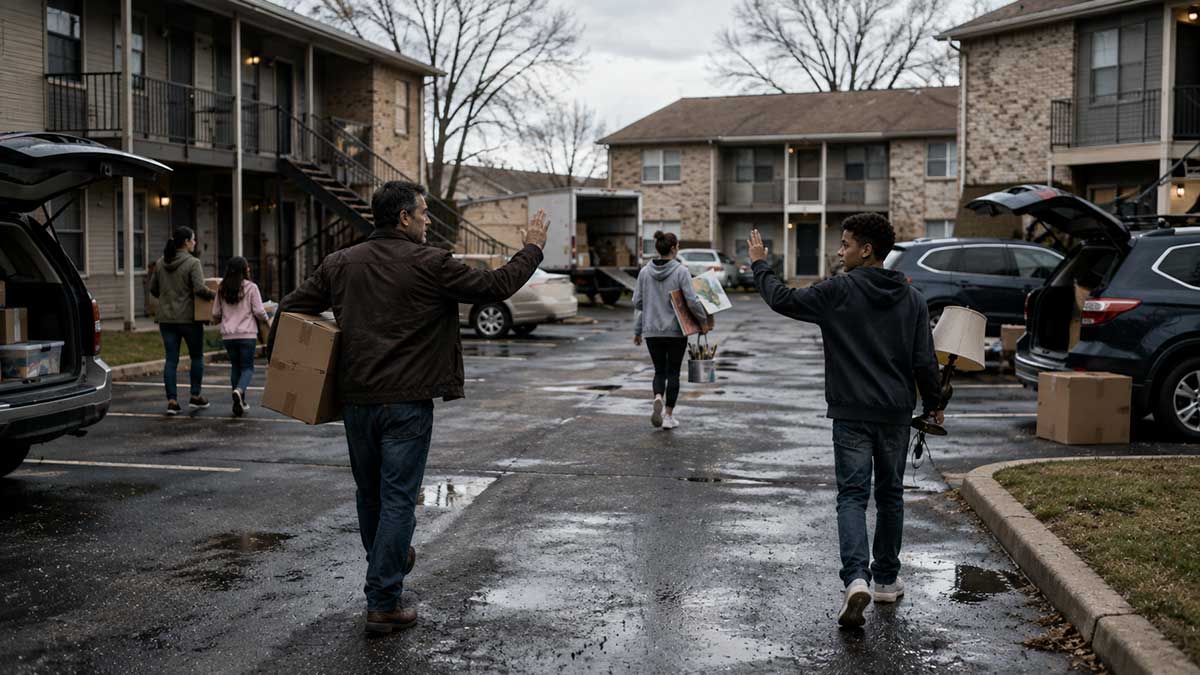
Across the lot, Jordan looked back.
Marcus raised one hand.
Jordan raised his.
Then each of them carried what belonged to him through his own door.
Story 4: Four Calls Before Breakfast
At 6:11 on Tuesday morning, Rachel Kim’s mother called because she could not find the blue folder.
At 6:28, Rachel’s older brother called because his car payment was late.
At 6:43, the office manager texted that two employees had called off.
At 6:57, Rachel’s daughter called from upstairs.
“Mom?”
Rachel looked at the phone in her hand.
Her mother’s name was still at the top of the recent-calls list.
Below it: David.
Below that: work.
Then, from directly above her head:
“Mom?”
Rachel turned the phone face down on the kitchen counter.
She did not answer.
For several seconds, the house became completely quiet.
It frightened her.
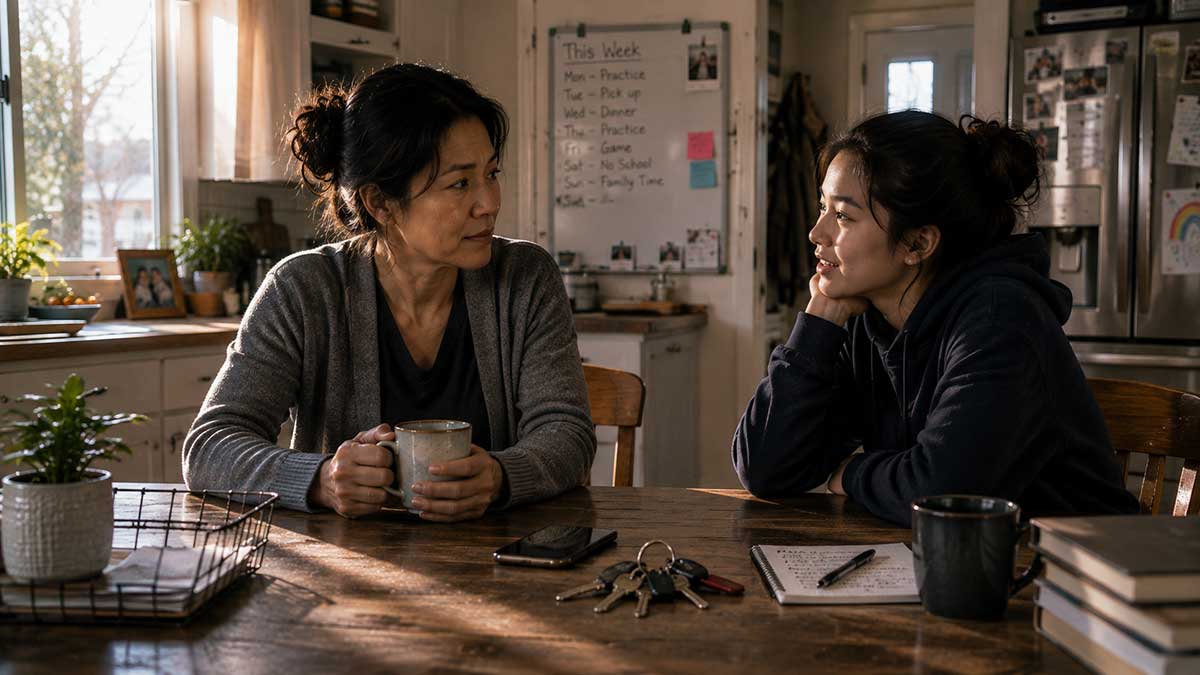
Rachel had seven keys on her key ring.
Her own house.
Her mother’s townhouse.
Her office.
The nonprofit’s storage room.
Her brother David’s apartment.
Her neighbor’s house.
And one small brass key she could no longer remember.
She had carried some of them so long she knew them by touch.
The square one was her mother’s.
The narrow silver key was the storage room.
The one with chipped green paint was David’s.
People gave Rachel keys because Rachel was dependable.
That was the word everyone used.
Dependable.
At work:
“If Rachel says she’ll handle it, it’s handled.”
At home:
“Ask Rachel.”
In her family:
“Rachel knows.”
Rachel had once considered this a compliment.
At forty-seven, she had begun to suspect it was a job description nobody had asked whether she wanted.
Her daughter called again.
“Mom?”
This time Rachel answered.
“What?”
A pause.
“Are you mad?”
“No.”
“You sound mad.”
“I’m not mad.”
“You’re doing the voice.”
“What voice?”
“The ‘I’m not mad’ voice.”
Rachel closed her eyes.
“What do you need, Maya?”
“My costume bag. You said you moved it.”
Rachel looked around the kitchen.
Dance performance.
Tonight.
She had promised.
“I put it by the coat closet.”
“It’s not there.”
“It is.”
“I checked.”
“Maya.”
“It’s not.”
Rachel walked toward the hallway.
She found the bag directly beside the coat closet.
“You mean this bag?”
Maya came halfway down the stairs.
“Oh.”
Rachel held it up.
“Seriously?”
“Sorry.”
“You called me from upstairs for this?”
Maya looked at her mother.
Rachel heard the sharpness in her own voice.
She softened.
“Sorry. Just… please look first.”
“I did.”
“Okay.”
Maya took the bag.
“Are you coming tonight?”
Rachel stared at her.
“Of course.”
“You said that last time.”
Rachel felt something twist.
“I’m coming.”
“Okay.”
Maya went upstairs.
Rachel looked at the clock.
7:03.
Her workday had not begun.
She was already behind.
The blue folder was on her mother’s dining-room table.
Rachel found it at 7:41.
Her mother, Sun-hee, stood beside her wearing a cardigan and slippers.
“I looked there.”
Rachel held up the folder.
“It was under the mail.”
“I moved the mail.”
“When?”
“This morning.”
“Then you probably covered it.”
Her mother frowned.
“No.”
Rachel put the folder into her hands.
“It’s fine.”
“I don’t know why I can’t keep track of anything anymore.”
Rachel hated the sentence.
Not because it was false.
Because it scared her.
“Mom, everybody loses things.”
“You don’t.”
Rachel laughed.
“I lose things constantly.”
Her mother gave her the look she had given Rachel since childhood whenever Rachel said something unbelievable.
“You never lose anything.”
Rachel almost said:
I lose my mind every day.
Instead:
“Did you eat?”
“Yes.”
“What?”
“Toast.”
“With what?”
“Toast.”
“Mom.”
“I wasn’t hungry.”
Rachel opened the refrigerator.
She began assembling breakfast.
Her phone rang.
David.
Rachel let it ring.
Her mother watched.
“You should answer.”
“It’s fine.”
“What if it’s important?”
Rachel looked at the phone.
Everything was important.
That was the problem.
David called again while Rachel was driving to work.
She answered through the car speaker.
“What?”
“Good morning to you too.”
“What happened?”
“Why does something have to happen?”
“Because you called twice before eight.”
A pause.
“I need a favor.”
Rachel gripped the steering wheel.
“How much?”
“You always assume money.”
“How much?”
“Three hundred.”
“No.”
“You don’t even know why.”
“You still owe me six hundred.”
“I told you I’m paying that.”
“When?”
“I’m between things right now.”
“You’ve been between things since March.”
“That’s not fair.”
Rachel laughed.
“What part?”
“My hours got cut.”
“I know.”
“I had that transmission issue.”
“I know.”
“I helped Mom last weekend.”
Rachel looked at the traffic ahead.
“For three hours.”
“So?”
“So I’m there four days a week.”
David went quiet.
Rachel immediately regretted it.
She hated keeping score.
She also hated being the only person who knew the score.
David said:
“I didn’t call to fight.”
“Then don’t ask me for money before breakfast.”
“I need the car for work.”
Rachel exhaled.
“How much is the payment?”
“Two eighty-six.”
“I’ll send two hundred.”
“You said no.”
“I changed my mind.”
“You don’t have to.”
Rachel almost screamed.
Instead:
“I know.”
That was the phrase people said right before letting her do it anyway.
At the nonprofit, Rachel solved fourteen problems before noon.
A grant report was missing data.
A donor wanted a meeting moved.
A volunteer had entered the wrong date for an event.
A printer jammed.
Someone needed approval for an emergency grocery card.
An employee cried in Rachel’s office because her mother was having surgery.
Rachel hugged her.
“Go.”
“But we’re short.”
“Go.”
“Are you sure?”
“Yes.”
“I don’t know what we’d do without you.”
Rachel smiled.
It happened automatically.
“Go be with your mom.”
The employee left.
Rachel returned to her desk.
Her own mother had called twice.
Rachel silenced the phone.
At 1:17, her husband Ben texted.
Do you need me to pick up dinner before Maya’s performance?
Rachel typed:
I’ve got it.
Then deleted it.
Typed:
Yes please. Anything easy.
She stared at the message before sending it.
The act felt strangely difficult.
Ben replied:
Got it.
That should have been the end.
Instead Rachel wrote:
Make sure Maya eats early. Not too heavy before performing. Her black tights are in the dryer. She needs to bring both shoes, not the practice pair. Can you remind her to pack water?
Ben replied:
Rachel. I can handle dinner.
She looked at the screen.
Then typed:
I know.
She did not believe herself.
Rachel had been like this for years.
When the children were younger, it made sense.
Ben worked long hospital shifts as a respiratory therapist.
Her mother still worked part-time.
David was going through a divorce.
Her younger sister, Julia, moved to Denver.
Rachel became the center because somebody had to.
Then circumstances changed.
Ben’s schedule improved.
The children grew older.
Her mother retired.
David’s divorce ended.
But Rachel remained the center.
Families have habits.
So do workplaces.
Once everybody learns where to place the weight, they keep putting it there.
Rachel helped teach them.
When Ben loaded the dishwasher “wrong,” she rearranged it.
When David bought their mother groceries, Rachel replaced half of what he bought because he had chosen the wrong brands.
When Julia offered to schedule medical appointments from Colorado, Rachel said it was easier to do locally.
When an employee drafted something poorly, Rachel rewrote it rather than teach them to fix it.
Her favorite sentence was:
“I’ll just do it.”
Rachel believed this meant efficiency.
Other people heard permission.
At 4:32, she packed her bag to leave work early for Maya’s performance.
At 4:34, her mother called.
Rachel stared at the phone.
Do not answer.
It rang again.
Do not answer.
A third time.
Rachel answered.
“Mom?”
“Rachel, I think something is wrong.”
Every muscle in Rachel’s body changed.
“What?”
“I’m dizzy.”
“Sit down.”
“I am.”
“Did you eat lunch?”
“Yes.”
“What?”
“I don’t remember.”
“Mom.”
“I ate.”
“Did you take your medicine?”
Silence.
“Mom?”
“I think so.”
Rachel looked at the clock.
The performance began at 6:00.
Maya had to arrive at 5:15.
Rachel had promised to be seated before warm-up.
“Is your chest hurting?”
“No.”
“Trouble breathing?”
“No.”
“Can you smile?”
“What?”
“Mom, just smile.”
“I’m smiling.”
Rachel stood.
“I’m coming.”
Sun-hee was fine.
That was the terrible part.
Not completely fine.
She had gotten dizzy.
But by the time Rachel arrived, her mother was walking around the kitchen complaining that Rachel had made too much of it.
“You shouldn’t have rushed.”
“You called me three times.”
“I was scared.”
“So was I.”
“I’m fine now.”
Rachel checked the medication organizer.
Her mother had missed breakfast.
That was likely the cause.
“Why didn’t you eat?”
“I forgot.”
Rachel looked at the clock.
5:23.
Twenty-two minutes to the theater.
Twenty-five minutes without traffic.
Her phone buzzed.
Ben.
Where are you?
Rachel typed:
Mom got dizzy. I’m leaving now.
The reply came quickly.
Do you need me to come there?
Rachel looked at her mother.
“No,” she whispered.
Then typed:
No. Stay with Maya. I’m coming.
Sun-hee said:
“You should go.”
“I am.”
“You don’t have to stay.”
“I know.”
Rachel grabbed her purse.
Her mother added:
“Could you make sure the pillbox is right first?”
Rachel stopped.
Five minutes.
Maybe less.
She sat down.
Traffic stalled on the interstate.
Rachel arrived at 6:31.
The lobby was empty.
She heard applause from behind the theater doors.
She ran.
An usher held up a hand.
“Please wait until the piece ends.”
“My daughter’s performing.”
“I understand. We just can’t open the door during the number.”
Rachel looked through the narrow window.
She saw the stage.
Twelve dancers.
Black costumes.
Moving under white light.
She searched for Maya.
There.
Second row.
Left side.
Rachel smiled.
Then the lights dimmed.
Applause erupted.
The door opened.
Rachel slipped inside.
Ben had saved her a seat.
He looked at her.
Rachel whispered:
“Did I miss her?”
Ben looked toward the stage.
The answer was on his face.
“That was her number?”
He nodded.
Rachel sat down.
Her hands trembled.
“She was good?”
“Very.”
Rachel looked at the empty stage.
“How good?”
Ben reached for her hand.
She pulled hers away without meaning to.
Afterward, families filled the lobby.
Flowers.
Photographs.
Noise.
Maya emerged with the other dancers.
Ben hugged her.
“You were incredible.”
Maya smiled.
Then she saw Rachel.
Rachel stepped forward.
“Maya, I am so sorry.”
“It’s okay.”
That frightened Rachel.
“No, it’s not.”
“Grandma needed you.”
“She was dizzy.”
“I know.”
“She hadn’t eaten.”
“I know.”
“I tried.”
“I know, Mom.”
Rachel wanted anger.
She could answer anger.
She knew what to do with yelling.
She did not know what to do with acceptance.
“I really tried to get here.”
Maya nodded.
Then she said quietly:
“I knew you’d leave.”
Rachel stopped.
“What?”
“When Dad said Grandma called.”
“Maya…”
“I knew you’d go.”
“She thought something was wrong.”
“I know.”
“You would have wanted me to.”
Maya looked at her.
“Would I?”
Rachel opened her mouth.
Nothing came.
Maya continued.
“I’m not saying you shouldn’t help Grandma.”
“Then what are you saying?”
Maya looked down at the flowers Ben had brought.
“I’m saying everybody calls you, and you always go.”
Rachel felt defensive.
“People need me.”
Maya nodded.
“I know.”
The same words.
Different meaning.
Then she said:
“Sometimes I need you too.”
The next morning, Rachel got into her car at 7:12.
She started the engine.
Then she sat there.
She had a dentist appointment at eight.
Or was that Thursday?
Her mother needed groceries.
No, David was supposed to do groceries.
Work meeting at nine.
Was it nine or nine-thirty?
Maya needed to be picked up after school.
No, Ben had that.
Rachel reached for her phone.
Stopped.
Her hand moved toward the keys.
Seven keys.
She lifted the ring.
House.
Mother.
Office.
Storage.
David.
Neighbor.
Unknown.
For several seconds, Rachel could not remember where she was supposed to go.
She stared through the windshield.
Cars passed at the end of the driveway.
A woman walked a dog.
A school bus stopped at the corner.
Everything continued.
Rachel remained sitting in the car.
She was not crying.
She wished she were.
Crying would have been an event.
This was worse.
She simply could not decide which emergency belonged to her.
Her phone rang.
David.
She watched it.
Then turned the phone off.
Rachel did not have a dramatic collapse.
She went to work late.
She apologized to nobody.
That alone worried everyone.
At noon, she closed her office door.
She opened her calendar.
Her mother had six appointments that month.
Rachel had entered all six.
David had none.
Julia had none.
Ben handled certain things, but Rachel still sent him reminders about the things he had agreed to handle.
At work, Rachel had personally approved tasks that three other managers were authorized to approve.
At home, she did laundry for a seventeen-year-old and a fourteen-year-old who both knew how.
Rachel began writing names beside responsibilities.
Not tasks.
Names.
When she finished, her own name appeared eleven times.
She stared at the page.
Then called Julia.
Her sister answered cheerfully.
“Hey. Everything okay?”
“No.”
Silence.
“What happened?”
“Nothing happened.”
“Rachel?”
“I need you to start handling Mom’s medical appointments.”
A pause.
“Okay.”
Rachel blinked.
That was not the answer she expected.
“You can?”
“Of course.”
“You’re in Colorado.”
“Phones work in Colorado.”
Rachel nearly laughed.
“You don’t know her doctors.”
“I can learn.”
“She likes morning appointments.”
“Okay.”
“She won’t tell you when something changes.”
“Then I’ll ask.”
“You’ll need access to her portal.”
“Send it.”
Rachel became irritated.
Julia heard it.
“What?”
“You’re acting like this is easy.”
“I didn’t say it was easy.”
“You just said yes.”
“Would you rather I say no?”
Rachel looked at the list.
“No.”
Julia's voice softened.
“You never asked me.”
“I have asked you.”
“You’ve complained. That’s different.”
Rachel went quiet.
Julia continued.
“You say nobody helps, but every time I offer, you tell me it’s simpler if you do it.”
“That’s because half the time it is.”
“Probably.”
Rachel did not like the agreement.
Julia said:
“But simple for today has made everything harder for ten years.”
That landed.
The family meeting happened Sunday.
Rachel hated family meetings.
They made ordinary dysfunction sound official.
Sun-hee sat at the dining-room table.
David arrived twelve minutes late carrying coffee for himself.
Julia joined by video.
Ben sat beside Rachel.
Maya and her younger brother, Noah, hovered nearby until Rachel told them they did not have to stay.
Maya stayed.
Rachel put the keys on the table.
David frowned.
“What is this?”
“Things are changing.”
Sun-hee looked concerned.
“Are you moving?”
“No.”
“Then why are the keys there?”
Rachel touched the square key.
“Mom’s.”
She slid it toward David.
He did not pick it up.
“Why me?”
“Because you live ten minutes away.”
“I work.”
“So do I.”
David looked at the key.
Rachel continued.
“You’re handling Mom’s groceries and one in-person check every week.”
“One?”
“At minimum.”
“Rachel…”
“I’m not asking.”
Sun-hee interrupted.
“I don’t need people checking on me.”
Everyone looked at her.
She frowned.
“Not like I’m a child.”
Rachel nodded.
“You’re right.”
Sun-hee seemed surprised.
Rachel continued.
“But if you need help, it can’t always be me.”
Her mother looked hurt.
That was the part Rachel had feared.
“Am I a burden?”
“No.”
“Then why are you talking like this?”
Rachel swallowed.
“Because I love you.”
Sun-hee looked away.
Rachel said:
“And because I’m tired.”
The room became very still.
Rachel had said that before.
But never without immediately adding:
I’m fine.
This time she did not add it.
David picked up the key.
Julia took medical scheduling.
David took groceries, pharmacy pickups, and one weekly visit.
Ben assumed full responsibility for household meal planning three nights a week and school transportation on two days.
Not “helping.”
Responsibility.
Rachel was forbidden from texting reminders unless a genuine problem arose.
Maya began doing her own laundry.
Noah took over the dishwasher.
At work, Rachel reassigned approvals to two managers and stopped rewriting documents that were merely imperfect.
This was much harder than making the list.
People did things badly.
David bought the wrong yogurt.
Julia scheduled a cardiology appointment at 8:15 despite Sun-hee hating early mornings.
Ben forgot Maya’s dance bag once.
Noah loaded the dishwasher in a way Rachel considered criminal.
Rachel corrected the plates.
Then stopped.
She moved them back.
Ben saw her.
“Are you okay?”
“No.”
He laughed.
Rachel laughed too.
The hardest adjustment was her mother.
Sun-hee called Rachel first by habit.
At 7:08 one Wednesday evening:
“The pharmacy says the prescription isn’t ready.”
“Did you call David?”
“I called you.”
“Call David.”
“You know how to deal with them.”
“So does David.”
“He gets impatient.”
“He’ll learn.”
Her mother became quiet.
Rachel felt guilt rise.
She almost said:
I’ll handle it.
The sentence reached her throat.
She swallowed it.
“Call David.”
Sun-hee sighed.
“Fine.”
They hung up.
Rachel sat motionless for almost a minute.
Then her phone rang again.
Mom.
Rachel stared.
Do not answer.
It stopped.
Thirty seconds later, the family group chat lit up.
David: Got it. Calling pharmacy now.
Then:
David: They filled wrong prescription. Fixing it.
Then:
Mom: He is being rude to them.
Then David:
I am being appropriately firm.
Rachel laughed aloud.
Maya called from the living room.
“What?”
“Nothing.”
“Come here.”
Rachel stood automatically.
Her phone buzzed again.
She left it on the counter.
Changes at work were messier.
One afternoon, a program coordinator brought Rachel a budget question.
“What do you think?”
Rachel looked at the spreadsheet.
She knew the answer.
She also knew the coordinator could figure it out.
“What do you think?”
The woman blinked.
“I’m asking you.”
“I know.”
“Did I do something wrong?”
“No.”
“Then?”
Rachel pointed toward the numbers.
“Tell me what you would do if I weren’t here.”
The coordinator hesitated.
Then explained her reasoning.
It was good.
Not exactly what Rachel would have done.
Good.
“Do that.”
“Really?”
“Yes.”
“You’re sure?”
Rachel smiled.
“No.”
The coordinator laughed nervously.
Rachel said:
“But do it anyway.”
Months passed.
The family did not transform into an efficient cooperative.
David missed a grocery day.
Julia forgot an appointment confirmation.
Ben occasionally needed reminders.
Rachel occasionally gave them.
Sometimes she took back responsibilities she had promised to release.
Then Ben would look at her.
“Rachel.”
She hated when he used only her name.
It meant:
You’re doing it again.
She would stop.
Sometimes.
Sun-hee slowly became more comfortable calling David.
Then she discovered that Noah enjoyed fixing small things around her house and began calling him instead.
Rachel initially objected.
“He’s fourteen.”
“He knows computers,” Sun-hee said.
“Everything is not a computer.”
“He fixed television.”
Rachel had no argument.
One Friday morning, Rachel sat at the kitchen table drinking coffee.
Nothing was urgent.
This felt suspicious.
At 6:36, her mother called.
Rachel looked at the phone.
Her body responded before her mind did.
Shoulders tightened.
Heart rate changed.
Hand moved.
Then she remembered.
Friday was David’s day.
The phone rang four times.
Stopped.
Rachel waited.
She imagined her mother on the floor.
No.
She imagined chest pain.
No.
She imagined the wrong medication.
Her hand hovered above the phone.
Then the family chat appeared.
David: Mom called. Sink is leaking. Heading over after I drop Caleb at school.
A second message.
Mom: It is a very bad leak.
David:
It is dripping.
Mom:
Dripping becomes flooding.
David:
On my way.
Rachel smiled.
Her first impulse was to type:
Check the shutoff under the sink. Blue-handled valve. Towels are in the hall closet. Call plumber Patel, not Thompson.
She typed half of it.
Stopped.
Deleted everything.
Set the phone down.
Maya entered wearing sweatpants, hair still messy.
“Do we have coffee?”
“You’re seventeen.”
“That’s not an answer.”
“You're not having mine.”
Maya opened a cabinet.
Rachel watched her.
A few months earlier, Rachel would have been halfway to her mother’s house.
Instead she was sitting in her own kitchen.
Maya glanced over.
“You busy?”
Rachel looked at the phone.
“No.”
“Really?”
Rachel smiled.
“Really.”
Maya sat across from her.
They began talking about nothing important.
A teacher Maya disliked.
A friend changing schools.
A ridiculous costume idea.
Rachel listened.
The phone did not ring again.
After a few minutes, Rachel noticed the key ring on the counter.
It was smaller now.
Her house.
Office.
Storage room.
Neighbor.
The old brass key she still could not identify.
Her mother’s key was gone.
David’s key was gone.
Two responsibilities had physically disappeared from her pocket.
For years, people had told Rachel:
I don’t know what we would do without you.
She had mistaken that for love.
Maybe part of it was love.
But love could not mean building a family where one person was never allowed to be absent.
Maya was describing something one of her friends had said.
Rachel almost missed it.
“Sorry. What?”
Maya smiled.
“I said, are you listening?”
Rachel reached across the table and took her daughter’s hand.
“Yes.”
This time she was.
Story 5: Anyone But Him
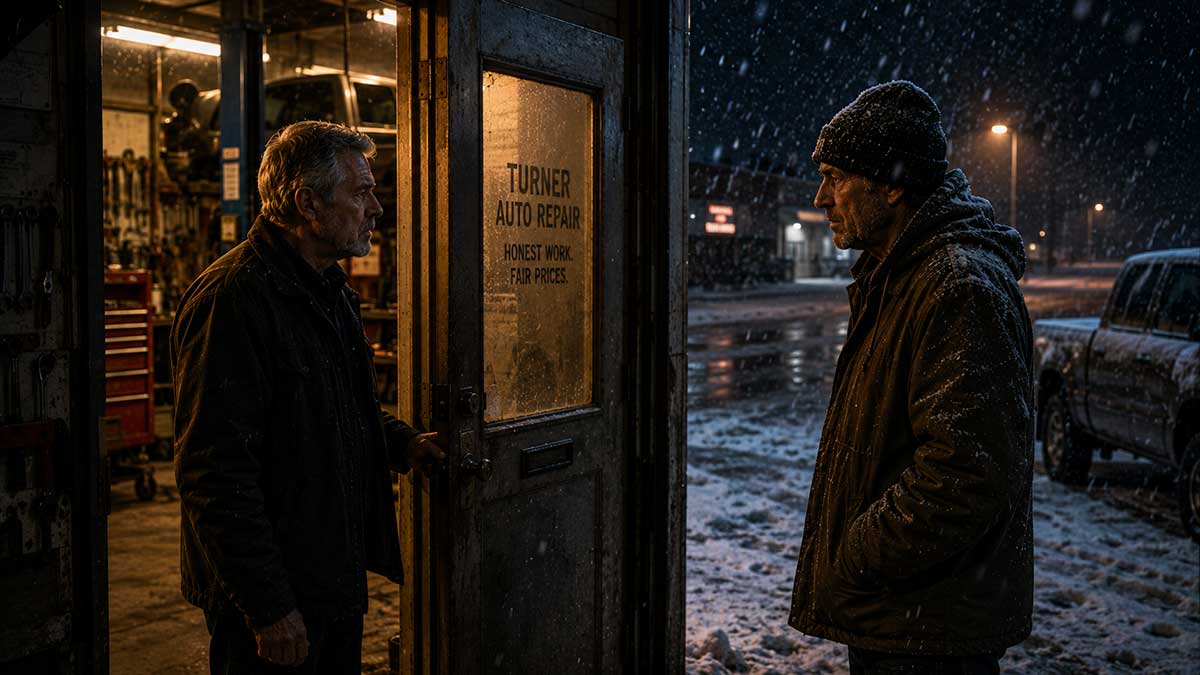
At 9:46 on a Thursday night, someone pounded on the side door of Eli Turner’s repair shop.
Three hard knocks.
Then two more.
Eli stopped halfway through turning off the waiting-room lights.
Outside, snow was blowing sideways across the parking lot. The temperature had dropped to eleven degrees, and the forecast said it would fall below zero before morning.
Nobody should have been out walking.
The pounding came again.
Eli looked through the narrow window in the steel door.
Then stepped back.
“Of course,” he said.
Of all the people in the city.
Of all the doors the man could have knocked on.
Wesley Pike was standing outside.
Eli’s first thought was immediate.
Anyone but him.
Eight years earlier, Wesley Pike had nearly destroyed Eli’s business.
At the time, they owned competing repair shops three miles apart.
Turner Auto had belonged to Eli’s father before him. Eli had spent thirty-one years building a reputation around one rule:
Tell people what the car actually needs.
Sometimes that meant losing money.
He was proud of it.
Then several posts began circulating online.
A customer claimed Turner Auto had charged for work it never performed.
Another account said Eli deliberately frightened elderly customers into approving unnecessary repairs.
Then someone posted photographs of worn parts and said Eli had returned them to a customer’s vehicle after charging for replacements.
None of it was true.
The posts spread.
Two local groups shared them.
One neighborhood page exploded with comments.
People Eli had never met wrote that they had “heard things” about Turner Auto.
Appointments disappeared.
A fleet account canceled.
Three longtime customers called to ask whether the accusations were true.
Eli eventually discovered that the original posts came from accounts connected to Wesley’s shop.
Wesley denied involvement.
Then one of his former employees admitted Wesley had encouraged it.
Nothing became a major legal case.
No dramatic courtroom confession followed.
The posts were deleted.
But deleting something did not make people forget seeing it.
For almost a year, Eli and his wife, Karen, wondered whether they would lose the shop.
They did not.
Turner Auto survived.
Wesley Pike never apologized.
Eli had not spoken to him since.
Until tonight.
Wesley knocked again.
Eli opened the inner deadbolt but kept the chain latched.
“What?”
Wesley looked terrible.
Snow clung to his coat and hair.
His face was red from the cold.
“My truck died.”
Eli stared at him.
“Call roadside.”
“Phone’s dead.”
“There’s a gas station half a mile east.”
“I know.”
“Then go there.”
Wesley looked toward the road.
Visibility had dropped.
“You got a charger?”
Eli almost laughed.
“You walked here for a phone charger?”
“My truck’s down near the overpass.”
“Why didn’t you stay in it?”
“No heat.”
Eli watched him through the opening.
Wesley had aged badly.
His beard was gray and uneven. His coat looked too thin for the weather. One glove had a hole over the thumb.
Still Wesley.
Still the man who had lied.
Still the man who had watched Eli’s appointments disappear and apparently decided that was acceptable.
Eli started closing the door.
Wesley said:
“Eli.”
Something in his voice stopped him.
Not apology.
Fear.
Eli hated that he recognized it.
He unhooked the chain.
“Five minutes.”
Wesley stepped inside.
The shop smelled of rubber, coffee, motor oil, and the heater that never quite reached the waiting room.
Eli pointed at an outlet.
“Charger’s behind the counter.”
Wesley plugged in his phone.
His hands shook.
Eli noticed.
He wished he hadn’t.
“You been walking long?”
“Maybe forty minutes.”
“In this?”
“My truck quit.”
“You said that.”
Wesley nodded.
Eli went behind the counter and poured coffee from the pot.
It had been sitting for hours.
He handed Wesley a cup.
“Don’t mistake this for hospitality.”
Wesley took it.
“Wasn’t planning to.”
Good.
That irritated Eli less than gratitude would have.
Wesley drank.
His hands continued shaking.
“You still running Pike Automotive?” Eli asked.
Wesley stared into the coffee.
“No.”
Eli waited.
“Closed three years ago.”
“I heard.”
Wesley looked up.
“Then why’d you ask?”
Eli shrugged.
“Wanted to hear you say it.”
Wesley nodded slowly.
“Fair enough.”
Eli called roadside assistance.
Two-hour wait.
Maybe longer.
Every tow truck in the area was overloaded.
“Where are you staying?” Eli asked.
Wesley hesitated.
“That’s not your problem.”
“Good answer.”
Wesley looked away.
Eli knew that look too.
He had seen it on customers who could not afford repairs and were trying to decide which part of the truth to admit.
“Where are you staying?”
“In the truck.”
Eli thought he had misheard him.
“You live in it?”
“For now.”
“How long is ‘for now’?”
Wesley’s jaw tightened.
“A while.”
Eli leaned against the counter.
“What happened to the house?”
“Sold.”
“Your wife?”
“Gone.”
“Kids?”
“Not around.”
Eli stopped asking.
He did not want Wesley’s tragedy.
That surprised him.
He did not want a dead child, cancer diagnosis, fraudulent business partner, or any other explanation that would make compassion convenient.
He wanted the man responsible for what happened eight years earlier.
Anything else felt like cheating.
“Why’s the truck your only place?”
Wesley smiled without humor.
“Poor planning.”
“That all?”
“No.”
“What else?”
“Bad decisions.”
Eli waited.
Wesley looked at him.
“You enjoying this?”
“No.”
“You should.”
“I said no.”
Wesley drank the coffee.
“I borrowed against the shop. Tried to keep it alive too long. Took some bad loans. Divorce cost what divorces cost. Burned through most of what was left.”
“You have nobody?”
“Everybody has somebody.”
“That wasn’t the question.”
Wesley’s face hardened.
“I’ve bothered enough people.”
Eli nearly said:
You bothered me.
He kept it to himself.
At 10:31, Karen called.
“You still at the shop?”
“Yeah.”
“Roads are getting worse.”
“I know.”
“You leaving?”
“In a little while.”
She heard something in his voice.
“What happened?”
Eli looked at Wesley.
“You remember Wesley Pike?”
Silence.
Then:
“What about him?”
“He’s here.”
Another silence.
Longer.
“Why?”
“Truck broke down.”
“Eli.”
“I know.”
“Send him to a motel.”
“He doesn’t have anywhere.”
“Not your problem.”
“I know.”
Karen’s voice softened slightly.
“You do not owe that man anything.”
Eli looked at Wesley, who pretended not to hear.
“I know.”
“Do you remember what he did?”
“Yes.”
“Do you remember you telling me we might have to sell the house?”
“Yes.”
“I do.”
“I said I remember.”
Karen exhaled.
“I’m not telling you to throw him into a snowbank.”
“Good.”
“I’m telling you not to confuse having a conscience with pretending history didn’t happen.”
Eli looked down.
“I’m not.”
“Come home.”
“I will.”
“When?”
“I don’t know.”
She went quiet.
Then:
“Call me before you leave.”
“I will.”
“Eli?”
“Yeah?”
“You don’t owe him forgiveness.”
Eli looked at Wesley again.
“I know.”
By eleven, the tow company called back.
No truck until morning.
Eli told Wesley.
Wesley nodded.
“There’s a warming center at St. Matthew’s.”
“Six miles.”
“I can make it.”
“No.”
“I walked here.”
“Exactly.”
“I’ll be fine.”
“Everybody says that right before becoming somebody else’s emergency.”
Wesley gave him a faint smile.
“You always talked like that?”
“No. Age made me unpleasant.”
Wesley almost laughed.
Eli hated that too.
He went into the storage room and returned with an old wool blanket.
“You can stay here until morning.”
Wesley stared at him.
“Why?”
“Because I don’t want somebody freezing outside my shop.”
“That doesn’t answer why.”
“It answers enough.”
Wesley took the blanket.
“Thanks.”
Eli pointed at him.
“Don’t make this sentimental.”
“Wouldn’t dream of it.”
Eli slept badly in the chair behind his office desk.
Wesley slept in the waiting room.
At 2:13, Eli woke and found him staring through the front window.
“What are you doing?”
“Couldn’t sleep.”
“You have perfected making yourself my problem.”
Wesley kept looking outside.
After a while he said:
“I did it.”
Eli sat upright.
“Did what?”
“The posts.”
Eli stared at him.
Wesley continued looking at the snow.
“I told Danny to put them up. He wrote some. I wrote one.”
Eli felt heat move through him.
Even now.
Eight years later.
“You denied it.”
“I know.”
“You looked me in the face.”
“I know.”
“You told people I was trying to destroy you.”
“I know.”
Eli stood.
“Stop saying you know.”
Wesley turned.
Eli pointed toward him.
“You don’t know.”
“I was there.”
“No. You were on the other side.”
Wesley said nothing.
“My daughter was starting college. Karen thought we were going to lose the house. My employees asked if their jobs were safe, and I lied to them because I didn’t know.”
“I know.”
Eli slammed his palm against the desk.
“I said stop saying that.”
Wesley lowered his eyes.
The shop became quiet.
Finally Wesley said:
“I wanted people to think you were worse than me.”
Eli looked at him.
No excuse followed.
No story about desperation.
No claim that a friend pressured him.
Just that.
“I was losing customers,” Wesley said. “You weren’t. People trusted you. I hated it.”
Eli’s voice was low.
“So you lied.”
“Yes.”
“You nearly ruined me.”
“Yes.”
“And you never apologized.”
“No.”
“Why?”
Wesley looked toward the floor.
“Pride.”
Eli laughed once.
“You still got plenty of that.”
“Probably.”
Eli wanted to hit him.
The feeling surprised him with its clarity.
Instead he walked into the garage and stayed there until his hands stopped shaking.
Morning came gray and brutally cold.
The tow truck finally brought Wesley’s pickup around nine.
Eli put it on the lift.
The repair was not catastrophic.
Bad alternator.
Battery nearly gone.
Cracked belt.
A coolant hose that looked ready to fail.
“Parts and labor?” Wesley asked.
Eli calculated.
Wesley looked at the estimate.
“No.”
“No what?”
“I can’t.”
Eli folded his arms.
“How much do you have?”
“Enough for a belt, maybe.”
“The alternator is why you’re not going anywhere.”
“Then I’m not going anywhere.”
“Smart.”
Wesley ignored him.
“I’ll figure something out.”
“With who?”
Wesley looked at him.
“That’s not your concern.”
“Correct.”
Eli put the estimate down.
Wesley unplugged his phone.
“Thanks for last night.”
“That’s it?”
“What do you want?”
Eli almost said:
An apology.
Instead:
“Nothing.”
Wesley zipped his coat.
“I’ll walk to St. Matthew’s.”
“It’s colder than last night.”
“I noticed.”
“They open at ten.”
“I’ll get there.”
Eli did not move.
Wesley put his hand on the side-door handle.
The same door.
The same place he had stood the night before.
He opened it.
Cold air rushed inside.
Then he stepped out.
Eli watched him cross the lot.
He made it almost to the street before Eli swore loudly.
He grabbed his coat.
Eli pulled beside Wesley three blocks later.
Wesley kept walking.
Eli lowered the passenger window.
“Get in.”
Wesley stopped.
“No.”
“Don’t make this harder than it already is.”
“You don’t have to.”
“I know.”
Wesley looked at him.
“That’s twice you’ve said that.”
“Said what?”
“‘I know.’”
Eli stared at him.
Wesley almost smiled.
Eli pointed at the passenger seat.
“Get in before I change my mind.”
Wesley did.
St. Matthew’s warming center was full.
A volunteer gave them the address of another temporary shelter.
That one had space.
Eli drove Wesley there.
Before getting out, Wesley sat with his hands resting on his knees.
“What?”
Wesley looked at him.
“What I did to you was wrong.”
Eli waited.
“I’m sorry.”
There it was.
Eight years late.
Eli had pictured this moment before.
Not often.
But enough.
In those imagined versions, Wesley apologized and Eli delivered the perfect sentence.
Something controlled.
Something strong.
Something Wesley would remember.
Now the moment arrived, and Eli had nothing beautiful to say.
“Yes,” he said.
Wesley waited.
Eli understood what he was waiting for.
He did not give it.
“I’m still angry.”
“I know.”
“I don’t forgive you.”
Wesley nodded.
“That’s fair.”
Eli looked through the windshield.
For the first time, Wesley did not ask for anything else.
He opened the door.
“Thank you for the ride.”
Eli nodded.
Wesley stepped out.
Then closed the door.
Eli spent the afternoon irritated with himself.
He kept thinking about the truck.
He knew exactly what it needed.
He knew he had used parts sitting in inventory.
He knew the labor would cost him time.
He knew Wesley could not pay.
Karen stopped by at four.
“You look terrible.”
“Thank you.”
“What happened?”
Eli told her about the confession.
Karen’s face tightened.
“He admitted it?”
“Yep.”
“And?”
“And nothing.”
“Did he apologize?”
“Yep.”
“Did you forgive him?”
“Nope.”
Karen nodded.
“Good.”
Eli looked at her.
“You sound disappointed that I didn’t punch him.”
“I’m not opposed to emotional complexity.”
He smiled.
She noticed the truck on the lift.
“You fixing it?”
“No.”
She looked at the open hood.
“Looks like you’re thinking about fixing it.”
“Thinking is free.”
“Parts aren’t.”
“I know.”
Karen leaned against the workbench.
“Why do you want to?”
“I don’t.”
“Eli.”
He sighed.
“Because he’s sleeping in the thing.”
“And?”
“And it’s eleven degrees.”
“And?”
“And stop making me say it.”
Karen watched him.
Then she said:
“You can help him without pretending he became a good man overnight.”
“I know.”
“You can stay angry.”
“I know.”
“You can even decide later that you never want to see him again.”
Eli looked at the truck.
Karen continued:
“Helping someone survive the week is not the same as approving their life.”
Eli looked at her.
“Did you rehearse that?”
“A little.”
The next morning, Eli replaced the alternator.
Then the belt.
Then the hose.
He changed the oil because it was nearly black.
That irritated him more than anything.
“You’re homeless and you still don’t change your oil,” he muttered.
When he finished, he called the shelter.
Wesley answered.
“Hello?”
“Truck’s done.”
Silence.
“What?”
“You heard me.”
“I can’t pay you.”
“I’m aware.”
“I didn’t ask you to fix it.”
“I am painfully aware.”
More silence.
“Why?”
Eli looked across the garage.
“I don’t know.”
“That’s not true.”
“Fine. Because I need the space.”
Wesley laughed quietly.
Eli immediately regretted giving him the satisfaction.
“Come get your truck.”
Wesley arrived on foot.
Eli handed him the keys.
“No charge.”
“I can pay you something.”
“No.”
“I’ve got eighty dollars.”
“Keep it.”
“I don’t want charity.”
“Then consider it me correcting the consequences of your terrible maintenance.”
Wesley looked at the truck.
The engine started immediately.
He sat behind the wheel for several seconds.
Then stepped back out.
“I don’t know what you want me to say.”
“Nothing.”
“Eli.”
“What?”
Wesley looked at him.
“You’re a better man than I am.”
Eli felt annoyed instantly.
“Don’t do that.”
“What?”
“Turn me into something.”
“I’m just saying.”
“No. I’m not helping you so I can win some contest.”
Wesley looked confused.
Eli continued.
“You hurt me. I’m still angry. You needed help. Those are two different facts.”
Wesley stared at him.
Eli pointed toward the truck.
“Get out of here.”
Wesley climbed in.
Before pulling away, he lowered the window.
“I meant what I said.”
“So did I.”
Wesley drove away.
Three days passed.
Eli did not see him.
Then a week.
Then two.
Life resumed.
Brake jobs.
Oil changes.
A transmission that took twice as long as expected.
A customer angry about a repair estimate.
A young technician who kept forgetting to clean his work area.
Normal problems.
At the end of one Friday, Eli shut down the compressors and turned off the lights.
He walked toward the side door.
For years, he had checked that door twice every night.
Push.
Lock.
Push again.
He turned the deadbolt.
Then noticed something outside.
He opened the door.
A pair of work gloves sat on the concrete beside the frame.
Brown leather.
Clean.
Folded together.
Eli recognized them.
He had given them to Wesley while they worked around the truck.
There was no note.
No envelope.
No money.
No explanation.
Just the gloves.
Eli picked them up.
He looked across the empty parking lot.
Snow from the storm still survived in gray piles along the curb.
He thought about Wesley.
He still did not like him.
He still did not trust him.
He still had not forgiven him.
Maybe one day he would.
Maybe he would not.
For most of his life, Eli had unconsciously believed compassion followed a certain sequence.
First you learned the story.
Then you discovered why the person deserved sympathy.
Then something softened.
Then you helped.
Wesley had ruined the sequence.
Eli knew the story.
Some of it made Wesley less sympathetic.
Eli knew the history.
It made him angrier.
He knew the man had caused part of his own suffering.
And still, on a freezing night, there had been a human being outside a locked door.
Maybe that was all the answer life sometimes gave you.
Not innocence.
Not agreement.
Not affection.
Not forgiveness.
A person.
And a door.
Eli carried the gloves inside.
Then he closed the door behind him.
Final Thoughts
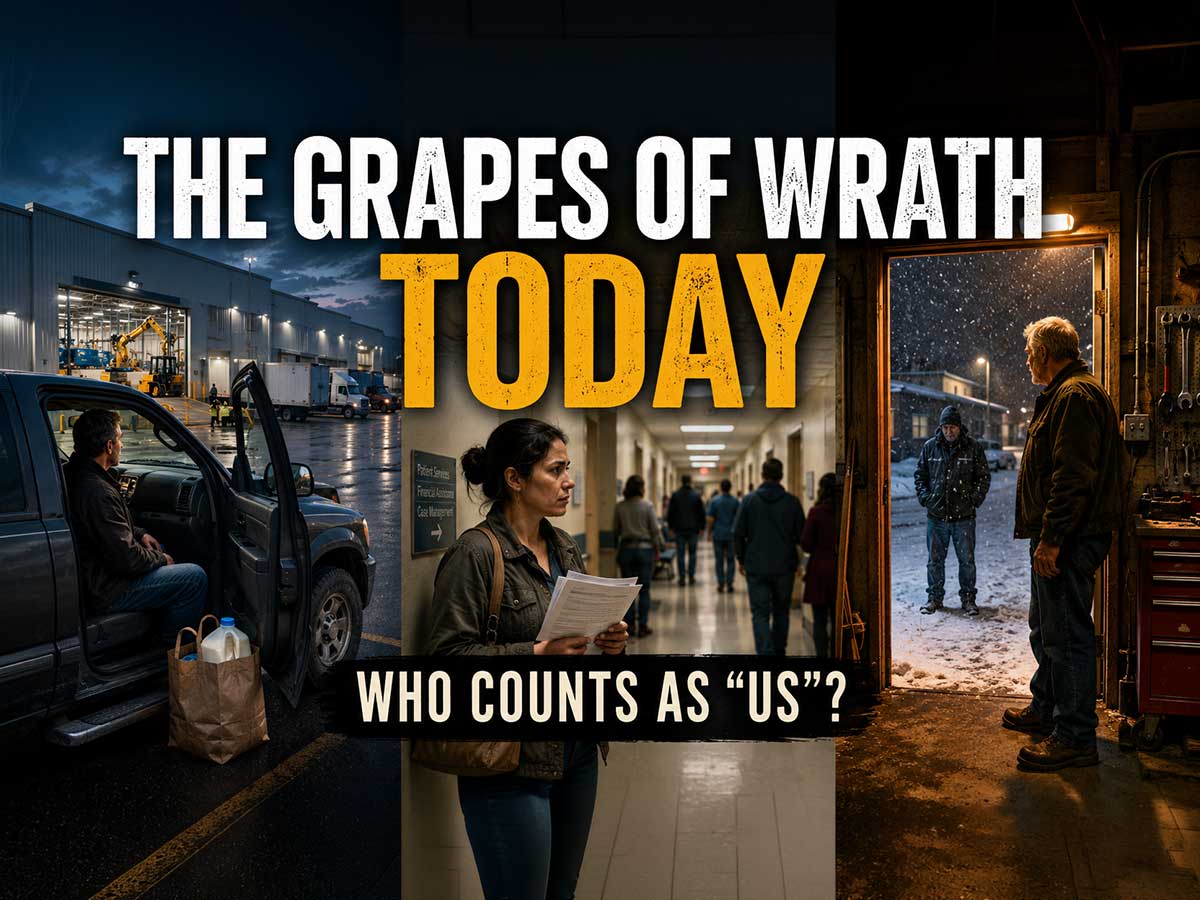
The first story begins with a door that will no longer open.
Daniel Mercer has spent twenty-seven years carrying an employee badge that tells him where he belongs.
Then one morning, the badge stops working.
The company has not collapsed. The people who eliminate Daniel’s position are not monsters. Automation may even help preserve jobs for others.
That makes his loss harder to explain.
Daniel discovers that employment had quietly become more than income. It had become evidence that he was useful.
When the market no longer needs his particular role, he begins treating that decision as though it were a judgment on his worth.
His recovery does not come from returning to his former status.
It begins when another person needs something he still knows.
His old badge remains in the glove box.
The past is neither erased nor restored.
He simply stops asking it for permission to matter.
That takes us to the first question:
What happens when society stops rewarding the thing that once made you feel valuable?
Marisol Vega’s story moves outward.
Her father needs help.
Nearly everyone Marisol speaks with believes her concern is reasonable.
The customer-service representative sympathizes.
The supervisor sympathizes.
Evan Brooks, the employee reviewing the case, eventually sympathizes too.
Yet the denial remains.
Nobody woke up intending to hurt Luis.
That does not mean nobody is responsible.
The story magnifies one of the most disturbing ideas we found in Steinbeck.
Harm can become easier to produce when responsibility is divided into tiny pieces.
One person writes criteria.
Another interprets them.
Another handles the call.
Another manages budgets.
Another measures performance.
Every individual sees only a small decision.
The person receiving the accumulated result experiences all of it.
Evan eventually finds a narrow place where discretion still exists.
The important moment is not that he becomes a heroic rebel.
It is that he is told:
If you make this decision, be willing to own it.
That question extends far beyond insurance.
Where do procedure, policy, technology, efficiency, and professional duty stop being enough?
At what point must a person look at the human result and say:
This part belongs to me too.
Marcus Reed’s problem is different.
He is not choosing between selfishness and generosity.
He is choosing between two legitimate obligations.
His daughter Sophie has worked for years.
The family has saved carefully.
They finally obtain the apartment she needs.
Then another family needs housing too.
Steinbeck understood something uncomfortable about scarcity.
Scarcity does not merely hurt people.
It can place decent people against one another.
If there is one job and twenty workers, nineteen lose.
If there is one affordable apartment and two families, kindness cannot create a second apartment.
Marcus initially signs the lease.
He should.
That decision matters.
The story would become too easy if goodness required him to surrender everything his family had worked for.
Instead, the deeper shift occurs when Tasha’s problem stops being entirely Tasha’s problem.
Marcus cannot save everyone.
His family cannot solve housing scarcity.
But they can accept less certainty so another family can gain some.
The question changes from:
“Do I give away what belongs to my family?”
to:
“How much security do we need before another family’s insecurity begins to matter to us?”
There may never be a universal formula for that.
That is why the question remains alive.
Then comes Rachel Kim.
Rachel has spent years being praised.
Reliable.
Strong.
Capable.
Indispensable.
At first, these descriptions sound loving.
Eventually they begin to sound dangerous.
The scholar discussion about Ma Joad gave us one of the collection’s most important questions:
Why did she have to become this strong?
Strength is admirable.
But admiration can conceal an unfair arrangement.
A family may celebrate one person’s resilience while continuing to place more weight on that person.
Rachel is not innocent in creating this arrangement.
That matters.
She corrects people.
Takes responsibilities back.
Insists that doing something herself is easier.
Her competence becomes part generosity, part control, part identity.
The change begins when she accepts something that feels almost unbearable:
Other people may carry responsibility imperfectly.
Her brother buys the wrong groceries.
Her husband forgets things.
Her sister schedules appointments at inconvenient times.
The family becomes less efficient.
Rachel becomes more present.
This gives us a different meaning of “we.”
A healthy “we” is not one strong person carrying everybody else.
It is many people accepting that something belongs partly to them.
The question becomes:
Is love carrying everything, or teaching everyone to carry something?
Then we reach Eli Turner and Wesley Pike.
This is where the collection deliberately removes the easiest reasons to care.
Wesley is not secretly innocent.
He really hurt Eli.
He lied about him.
He damaged his business.
He refused to apologize for years.
When Wesley appears outside Eli’s shop on a dangerously cold night, the morally comfortable version of the story would give Eli new information.
Perhaps Wesley had been misunderstood.
Perhaps he acted under pressure.
Perhaps some hidden tragedy would explain everything.
We refused him those excuses.
His explanation is much smaller:
“I wanted people to think you were worse than me.”
That is what makes the story difficult.
If suffering automatically proved innocence, compassion would require very little of us.
If every person in need turned out to be secretly wonderful, humanity would be easy to recognize.
But people can be selfish.
They can lie.
They can make terrible decisions.
They can hurt us.
They can contribute to the circumstances that later overwhelm them.
And still be human.
Eli does not instantly forgive Wesley.
That distinction matters.
Compassion does not require pretending an injury never happened.
Helping someone survive a freezing night does not require trusting them.
Repairing a truck does not erase eight years of anger.
Mercy and reconciliation are different acts.
By Story 5, almost every earlier justification for “we” has been removed.
Wesley is not Eli’s family.
Not his friend.
Not someone who helped him.
Not demonstrably innocent.
Not even particularly likable.
He is simply a man standing on the other side of a door in dangerous cold.
And that may be the collection’s hardest question:
What must another person be before their suffering begins to matter to us?
The symbols across these five stories quietly trace the same movement.
Daniel carries a badge.
It asks:
Where do I belong?
Marisol repeats a case number.
It asks:
Can a system still see the person?
Marcus holds a cashier’s check.
It asks:
How much of what is mine can remain only mine?
Rachel carries a ring of keys.
It asks:
Who must carry responsibility?
Eli stands before a door.
It asks:
Who gets inside?
The collection begins with a man whose badge can no longer open a door.
It ends with a man deciding whether he will open one for somebody else.
That movement contains much of what The Grapes of Wrath has been asking us from the beginning.
First:
Will you recognize me?
Then:
Will I recognize you?
Steinbeck’s “I to We” movement does not require people to lose themselves in a crowd.
Daniel’s dignity matters.
Marisol’s exhaustion matters.
Sophie’s future matters.
Rachel’s limits matter.
Eli’s anger matters.
The individual cannot disappear.
But neither can the individual become the boundary of moral concern.
Perhaps the healthiest meaning of “we” is not:
Everyone belongs to me.
It may be:
Your life can matter to me without becoming my life.
I may not be able to save you.
I may not agree with you.
I may have obligations closer to home.
I may need boundaries.
I may even have good reason to be angry with you.
Yet somewhere before another person becomes a category, a burden, a case number, a competitor, or an enemy, there remains something more fundamental.
A person.
That is where Steinbeck leaves us.
And that is where these five stories leave us too:
When we say “we,” who is still standing outside?
Short Bios:
Daniel Mercer
A 52-year-old warehouse supervisor whose position disappears after nearly three decades with the same company. Daniel’s story examines work, identity, technological displacement, shame, and the difference between economic usefulness and human worth.
Marisol Vega
A 39-year-old working mother caring for her aging father, Luis. Her struggle to obtain home-care support exposes the human consequences of systems in which many sympathetic people participate but responsibility becomes difficult to locate.
Evan Brooks
A 31-year-old insurance utilization-review employee and new father. Evan is neither villain nor rescuer. His story examines what personal responsibility means when someone works inside rules they did not create but still possesses limited discretion over how those rules affect another person.
Marcus Reed
A 44-year-old father whose family has sacrificed to support his daughter Sophie’s education. Marcus faces a genuine conflict between protecting his own family’s hard-earned security and responding to another family’s housing crisis.
Sophie Reed
Marcus and Elena’s 17-year-old daughter, accepted into a competitive arts program. Sophie refuses both easy selfishness and easy sacrifice, helping her family confront what generosity really costs when the thing being shared matters deeply to everyone involved.
Tasha Bell
A 36-year-old vocational-program director and mother whose housing disappears after her building is sold. Tasha’s story challenges the assumption that employment, responsibility, and hard work always guarantee stability.
Rachel Kim
A 47-year-old nonprofit operations director, mother, daughter, sister, and habitual problem-solver. Rachel’s story examines invisible labor, resilience, caregiver exhaustion, control, and the dangerous compliment of being called indispensable.
Eli Turner
A 58-year-old owner of a small auto-repair shop. Practical, hardworking, and fiercely protective of the reputation he spent decades building, Eli becomes the final test of the collection’s widening moral circle when someone who once seriously harmed him arrives asking for help.
Wesley Pike
A 61-year-old former repair-shop owner whose past jealousy led him to spread false accusations about Eli. Years later, financially ruined and living in his truck, Wesley remains responsible for what he did even as his circumstances force the larger question of whether dignity depends upon innocence.
Leave a Reply