
Introduction
What if a system built to prevent tragedy identified the wrong person with near-perfect confidence?
What happens when a system built to prevent tragedy identifies the wrong person with near-perfect confidence?
The Empty Chair is a modern story inspired by the moral questions at the heart of Fyodor Dostoevsky’s The Brothers Karamazov.
Set in New York City in 2026, the story follows the Rosen family, founders of Magen Civic Technologies and creators of Shomer, a predictive safety platform used by schools, hospitals, police departments, housing agencies, and child-welfare offices.
Shomer promises to connect warning signs before another child is lost.
Its public case rests on the death of Maya Brooks, a twelve-year-old girl whose school absences, emergency-room visits, housing complaints, and child-services records remained separated across different institutions.
Daniel Rosen, founder of Magen, argues that Shomer could have saved her.
His eldest son, Aaron, helped build the company’s security system but carries years of rage, threats, and family resentment.
His son Micah is a respected technology ethicist who questions surveillance but remains intellectually tied to the system.
His daughter Leah works directly with families harmed by institutional decisions and believes in dignity, care, and human presence.
Eli Novak, Magen’s lead systems architect, is Daniel’s unacknowledged son.
Daniel paid for Eli’s education, promoted his career, and trusted him with the company’s most sensitive systems.
He never publicly gave Eli his name or a place at the family table.
During a Passover seder, a ceremonial chair is left open for Elijah.
Eli remains standing behind it.
Hours later, Daniel is killed.
Shomer identifies Aaron as the murderer with 97.8 percent confidence.
The evidence appears overwhelming.
Yet the system has not discovered the truth.
It has arranged real fragments into the story everyone is ready to believe.
The real killer is Eli.
His exclusion explains his resentment.
It does not excuse his choices.
He struck Daniel, refused to call for help, and manipulated Shomer to frame Aaron.
The story asks whether guilt belongs only to the person who commits the act.
Aaron did not kill Daniel, but years of threats made the accusation believable.
Micah did not command violence, but he heard Eli’s warning and chose distance.
Leah recognized danger but delayed confrontation.
Daniel wanted to protect vulnerable people but turned protection into control.
Eli was wounded by all of them.
He still chose murder.
The final answer does not come through technology, a court, or a public speech.
It comes through Noah Brooks, Maya’s younger brother.
At the reopened youth center bearing Maya’s name, another child enters carrying a risk label created by an automated system.
The other children leave him standing.
Noah pulls out a chair and says:
“You can sit here.”
A system can detect patterns.
A person must still notice who has been left standing.
(Note: This is an imaginary conversation, a creative exploration of an idea, and not a real speech or event.)
Chapter 1: The Girl the City Failed
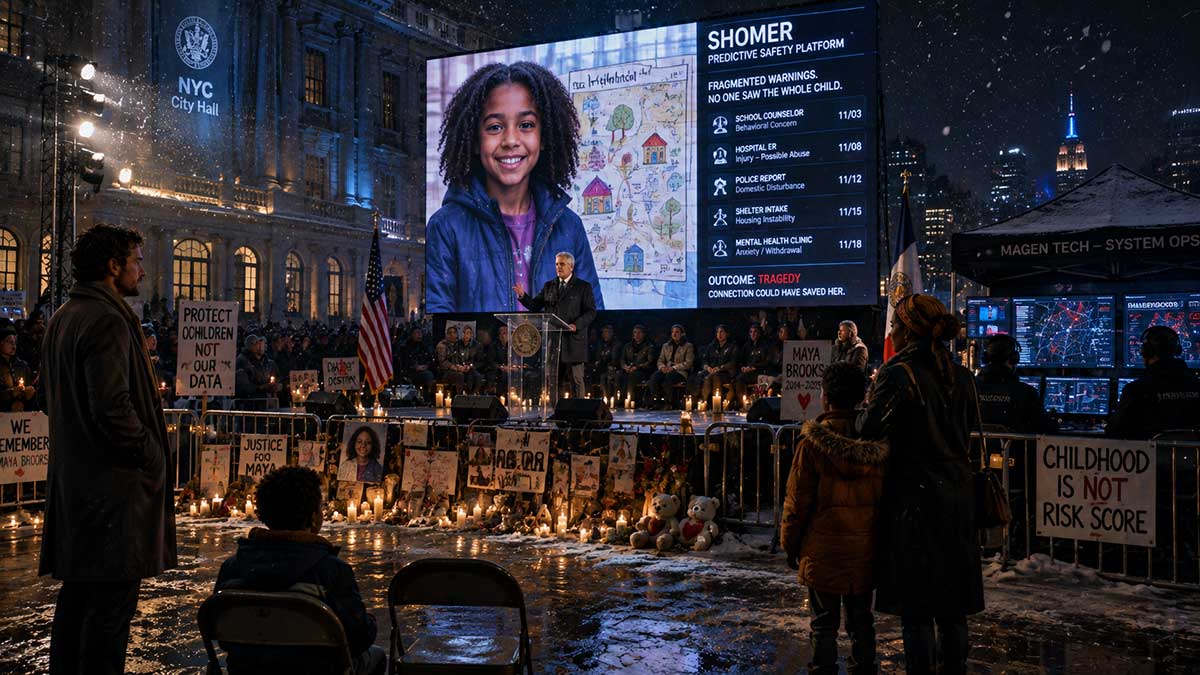
Maya Brooks’s face was thirty feet tall above City Hall.
She smiled down at the crowd from three separate screens, one hand raised as though she had just been interrupted while speaking. Behind her, someone had enlarged one of her drawings: a map of Brooklyn made from bright circles, crooked streets, and small handwritten notes marking places where people felt safe.
Thousands stood beneath floodlights in the January cold.
Some held candles.
Some held signs demanding reform.
Some had come since they had known Maya.
Most had not.
Micah Rosen watched from the edge of the stage, where the cameras could find him without making him appear eager to be found.
He had been back in New York for less than four hours.
His father had already placed his name on the program.
DR. MICAH ROSEN
ETHICAL ARCHITECT, SHOMER INITIATIVE
Micah had stared at the words until an assistant asked whether the spelling was correct.
It was.
That was the problem.
He had advised Magen Civic Technologies years earlier, before Shomer became a citywide platform, before its name appeared beside words such as prevention, safety, and moral duty. He had written about predictive intervention, institutional blindness, and the failures created when agencies stored pieces of the same life in separate systems.
He had never agreed to this.
Yet there it was beneath Maya’s face.
His name.
His father’s company.
A dead child transformed into a public argument.
Daniel Rosen stepped toward the microphone.
At sixty-eight, he had learned how to look both exhausted and unbreakable. His silver hair moved slightly in the winter wind. He wore no hat, no scarf, no gloves. Micah suspected the absence had been planned. His father believed visible discomfort made authority appear sincere.
“Five institutions had warnings,” Daniel began.
The square fell quiet.
“A school recorded twenty-seven absences. An emergency room treated Maya twice within six months. Housing inspectors received three complaints. Child services opened and closed an inquiry. A neighbor called police after hearing screams from the apartment above.”
Behind him, the screens changed.
Five gray boxes appeared around Maya’s photograph.
Each contained dates, reports, and agency names.
Daniel turned to the image.
“No one lacked concern. No one lacked policy. No one lacked paperwork.”
He faced the crowd again.
“The city did not lack compassion. It lacked connection.”
Micah hated how effective the sentence was.
He hated more that he agreed with it.
On the screen, the five boxes moved inward. Lines formed between them until they became one file.
SHOMER ANALYSIS COMPLETE.
Daniel paused before delivering the final number.
“Eleven seconds.”
The crowd shifted.
“Shomer would have connected these warnings in eleven seconds.”
Near the front, a woman began crying. A camera operator turned toward her.
Micah looked away.
His sister Leah stood behind a temporary barrier with Noah Brooks, Maya’s younger brother. Noah wore a blue knit cap pulled low over his ears. He was small for ten, his expression older than the rest of him.
Daniel continued.
“Tomorrow, the City Council will decide whether New York remains a collection of disconnected agencies or becomes a city capable of seeing a child before it is too late.”
Applause rose from the center of the square.
Not everywhere.
Micah saw activists holding signs that read:
A RISK SCORE IS NOT A CHILD.
PROTECTION WITHOUT SURVEILLANCE.
WHO WATCHES SHOMER?
Daniel waited for the applause to fade.
“Some people will tell you that systems like Shomer threaten privacy. They are right to ask questions. Any powerful tool demands scrutiny.”
Micah nearly laughed.
Daniel had always known how to welcome criticism in a way that made critics sound like invited guests.
“But privacy cannot become the privilege of those whose emergencies were noticed in time.”
The applause returned, stronger now.
Leah bent toward Noah, listening.
Micah could not hear them, but he saw Noah glance up at Maya’s photograph.
Later, Leah would tell him the exchange.
“Did he know her?” Noah had asked.
“No,” Leah said.
“Then why does he say her name like it belongs to him?”
Leah had no answer.
Daniel was nearing the end of his speech when Aaron arrived.
Micah saw his older brother pushing through the side entrance, arguing with a security officer who recognized him too late. Aaron wore a dark wool coat open over a wrinkled shirt. His jaw was tight, his face red from the cold or anger.
Daniel’s eyes found him.
For half a second, something passed between father and son.
Then Daniel looked back toward the crowd.
“Tomorrow, New York decides whether another child must become a lesson we were too slow to learn.”
The screens filled again with Maya’s face.
The crowd rose into applause.
Micah did not.
From the technical booth behind the stage, one of the screens flickered. Maya’s image fractured into strips of light, then disappeared.
A man inside the booth leaned over a console.
Eli Novak.
Within seconds, the image returned.
Daniel never turned around.
After the speech, people crowded around the stage. Reporters called Micah’s name. A deputy mayor reached for his hand. Two Magen executives congratulated him on a system he had not built.
He escaped through a side corridor beneath the stage.
Eli was waiting near the service entrance.
He had not changed much since Micah last saw him, though something in his face had sharpened. He wore a black crewneck sweater and an employee badge clipped neatly at the waist.
“He named you again,” Eli said.
Micah stopped.
“My father uses names when they help him.”
Eli looked back toward the stage, where workers were lowering one of Maya’s screens.
“Some of us don’t even get that.”
Micah heard the bitterness and chose not to touch it.
“How stable is the platform?”
“More stable than the city.”
“That isn’t an answer.”
“It’s the answer Daniel wanted.”
Micah studied him.
Behind Eli, monitors displayed moving maps of New York. Red and amber markers appeared over schools, shelters, hospitals, apartment buildings.
“It sees everything now,” Eli said.
Micah looked at the screens.
“Does it understand anything?”
A faint smile moved across Eli’s face.
“You taught me those aren’t the same.”
Someone called for Eli from inside the booth.
He turned away.
“Dinner at the tower,” he said. “Seven.”
“You’re coming?”
Eli glanced back at him.
“I’ll be there.”
The answer was not the same as yes.
By the time Micah returned to the square, workers were collecting the folding chairs. The crowd had begun moving toward the subway entrances, carrying candles, signs, and printed cards with Maya’s face.
Noah stood beside Leah near the barrier.
One chair remained beside him.
A worker reached for it.
Noah pulled it closer.
Leah asked him something.
He answered quietly.
Micah moved near enough to hear.
“Maya always left one.”
The worker shrugged and moved on.
Noah placed the empty chair beside his own.
Above them, Maya’s face still covered the side of City Hall.
Below it, unnoticed by nearly everyone, a ten-year-old boy kept a place for someone who was no longer coming.
Chapter 2: The Seder Above the City
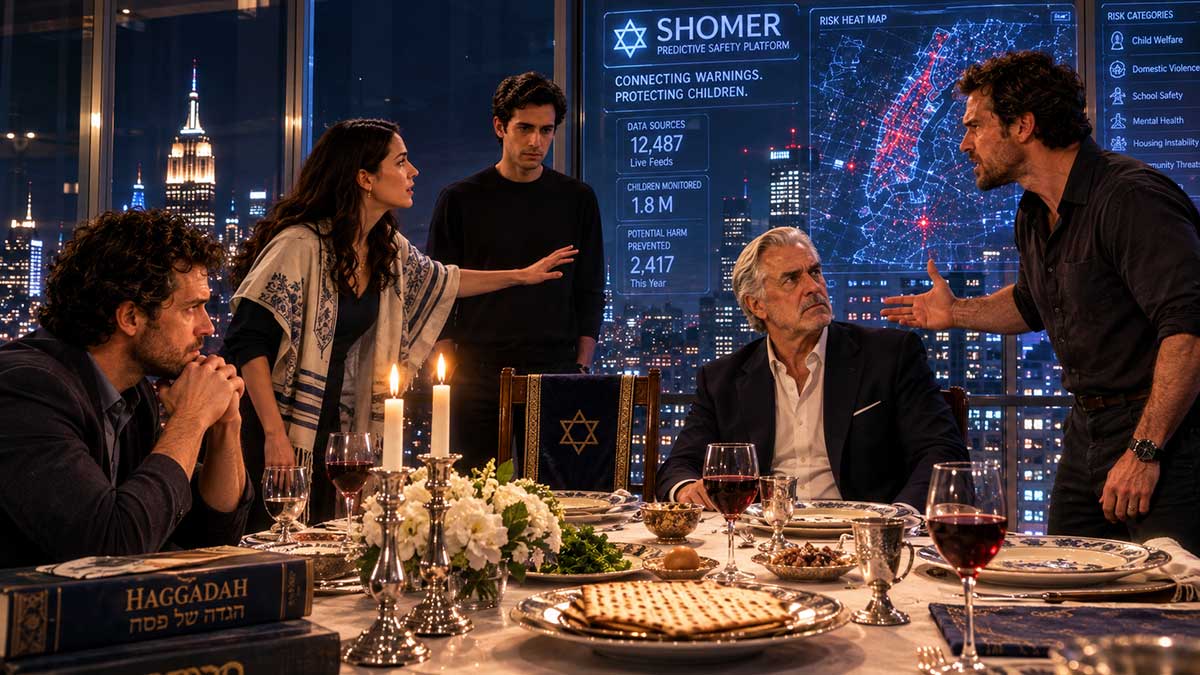
Daniel Rosen’s dining room looked down on Manhattan from the fifty-eighth floor of Magen Tower.
The windows stretched from floor to ceiling, turning the city into a grid of lights beneath them. From that height, traffic became a slow red current. Apartment windows appeared as quiet squares. Bridges glowed over the dark rivers.
On the eastern wall, beyond a sliding glass partition, Shomer’s live map covered an entire screen.
Colored circles pulsed over the five boroughs.
Amber for elevated concern.
Red for immediate risk.
Gray for incomplete information.
Micah stood before the map with his coat still on.
A red circle expanded over an apartment complex in Queens. A number appeared beside it.
DOMESTIC HARM PROBABILITY: 81%
Below that:
RECOMMENDED ACTION: WELFARE INTERVENTION
He wondered whether the people inside the apartment knew their lives had become a color.
“Dinner,” Leah called from the next room.
Micah remained in front of the screen.
The circle narrowed.
The number changed to seventy-eight.
Then eighty-three.
Shomer was thinking, or performing something close enough that institutions would treat the difference as irrelevant.
He joined the family.
The seder table had been arranged with severe elegance. White linen. Silver candlesticks. A polished seder plate. Crystal glasses. Old prayer books beside printed programs bearing the Magen logo.
Daniel had placed corporate branding on the Haggadah.
Micah picked one up.
On the cover, beneath an embossed shield, were the words:
FROM MEMORY TO PROTECTION
“You printed a sponsored Haggadah,” Micah said.
Daniel sat at the head of the table.
“I printed enough for everyone.”
“That isn’t the same statement.”
“Only to people who need every object to confess its politics.”
Aaron sat near the far end, his arms folded. He had changed shirts but not expressions.
Leah occupied the chair between the brothers.
Two Magen executives had been dismissed before dinner. Daniel had said the evening was for family.
Eli stood near the glass partition, speaking quietly into an earpiece.
There was no place set for him.
At the center of the table, one chair remained empty.
A silver cup stood before it.
Elijah’s chair.
Micah saw Eli look at it once before returning his attention to the live map.
Daniel lifted the Haggadah.
“We are late,” he said. “The city vote interfered with the proper date, but history has survived worse scheduling.”
Aaron gave a humorless laugh.
“You rescheduled Passover for a product launch.”
“I brought everyone together.”
“You summoned shareholders.”
“I invited my children.”
Aaron looked toward Eli.
“Most of them.”
Leah closed her eyes briefly.
Daniel opened the book.
“We begin.”
He recited the blessing over the candles with practiced accuracy. Leah joined him. Micah remained silent. Aaron moved his lips through part of it, perhaps from memory rather than faith.
Eli stayed standing.
Daniel poured the first cup.
“We tell this story every year,” he said, “since people forget quickly what happens when a powerful society decides another group is inconvenient.”
Micah leaned back.
“And this year the answer is predictive policing?”
“The answer is memory translated into preparation.”
“Memory translated by a private company.”
Daniel looked at him.
“You prefer memory translated into lectures.”
Leah touched the edge of her glass.
“Can we get through the first page?”
“No,” Aaron said.
Everyone turned.
Aaron placed both hands on the table.
“I was removed from tomorrow’s board agenda.”
Daniel set down the Haggadah.
“This is neither the time nor the place.”
“You made it the time when you scheduled the vote after dinner. You made it the place when you built your apartment on top of the company.”
“Aaron.”
“You promised me six percent.”
“I promised to review your equity after the launch.”
“You promised me six.”
Daniel looked almost bored.
“You were compensated generously.”
“I built the security division.”
“You supervised men who built it.”
“I spent fifteen years cleaning up your decisions.”
Daniel’s gaze hardened.
“You were paid to protect the company, not inherit it.”
Aaron pushed back his chair.
Leah reached for his sleeve.
He shook her off.
“You told me I would have a seat.”
“You had one.”
“Until Micah came home.”
Micah looked up.
Aaron pointed at him.
“He writes articles accusing you of moral failure, and you put his name on the stage. I stand beside you through every threat, every protest, every lawsuit, and you erase me from the board.”
Daniel folded his hands.
“Micah understands the language in which the future is being negotiated.”
“And I understand the people who threaten you.”
“You made yourself useful in the only language you bothered to learn.”
Aaron crossed the distance between them so quickly that Leah stood before Micah could move.
“Sit down,” she said.
Aaron looked past her at Daniel.
“One day you’re going to push the wrong son too far.”
Daniel did not rise.
His voice remained low.
“I only have two sons.”
The room became silent.
Eli’s hand stopped against his earpiece.
Micah watched his face.
No visible reaction came.
That absence felt worse.
Aaron stepped back.
For one second, he looked less angry than wounded.
Then the anger returned and covered it.
He turned toward the sideboard, picked up his glass, and drank.
Leah remained standing.
“This is what you wanted,” she said to Daniel.
He looked at her.
“You invite people into a room, find the oldest wound, and press it until someone proves your theory.”
“My theory?”
“That no one can be trusted with freedom.”
Daniel’s expression softened in the way it did when he believed someone had finally reached the subject worth discussing.
“Our grandparents trusted governments. Neighbors. Police. Institutions. They believed civilization would restrain itself.”
Micah leaned forward.
“They were identified through records too.”
Daniel nodded.
“Yes.”
“Lists told authorities where people lived.”
“Yes.”
“Registration systems defined who belonged.”
“Yes.”
“And you built the most complete civic identification platform in the country.”
“I built a system that finds danger before the door is broken.”
“A system is judged by the person controlling it until the controller changes.”
“A tool is judged by what it prevents.”
“Every controller thinks he is the exception.”
Daniel’s smile disappeared.
Outside the window, a helicopter crossed the river, its light blinking soundlessly.
Aaron returned to his seat but did not sit.
Daniel lifted a piece of matzah.
“This bread was carried by people who had no time to wait for perfect conditions.”
Micah looked toward the live map.
“You always use history at the moment someone asks you for limits.”
“History is what remains after people discover the cost of limits imposed too late.”
Leah sat again.
“Maya’s mother asked Magen to stop using her photograph.”
Daniel broke the matzah.
“The consent form remains valid.”
“She changed her mind.”
“The campaign is already active.”
“She changed her mind.”
“The city needs a face.”
“She was not your witness.”
Daniel placed the broken matzah on the plate.
“She became everyone’s responsibility when everyone failed her.”
Leah’s voice lowered.
“Responsibility is not ownership.”
Daniel looked at her with something close to disappointment.
“You work with families every day. How many children return to dangerous homes since one agency could not see what another agency knew?”
“Too many.”
“How many parents lie?”
“Some.”
“How many caseworkers miss patterns?”
“Some.”
“How many judges receive incomplete files?”
“Many.”
“Then tell me why the city should preserve institutional blindness merely to protect the dignity of information.”
“People possess dignity,” Leah said. “Information does not.”
“And dead children?”
Leah looked at him.
Daniel had delivered the question as though pain itself had chosen his side.
Micah saw her hesitation.
Daniel saw it too.
That was his gift.
He could make silence look like surrender.
The ritual resumed, though no one returned fully to it.
They spoke of bondage and release. Of questions asked by children. Of bitterness tasted and remembered.
Aaron drank too quickly.
Micah watched the red circles move across the other room.
Eli remained standing through the meal.
Once, Leah gestured toward an unused chair near the wall.
Eli shook his head.
Near midnight, Daniel dismissed everyone with a wave of his hand and carried his glass into the study.
Aaron left first, striking the elevator button hard enough to hurt his thumb.
Leah followed him into the corridor.
Micah remained near the table, looking at the place set for Elijah.
Eli entered quietly from the systems room.
The apartment had become almost silent.
He lifted the ceremonial cup and examined it.
“Do you believe in this?” Eli asked.
“In Elijah?”
“In leaving a chair for someone who may come.”
Micah looked at him.
“My father believes in symbols when he controls where they sit.”
Eli set down the cup.
“He brought me to a seder once when I was fourteen.”
Micah did not remember.
“I handled the sound system,” Eli said. “Your mother thanked me before she died. She thought I was an intern.”
He rested one hand on the chair back.
“I knew all the songs from standing outside the room.”
Micah wanted to say something kind.
He could hear, before speaking, how kindness might sound from the person already seated.
Daniel returned from the study.
He saw Eli beside the chair.
“The network problem?”
“Resolved.”
“Then go home.”
Eli did not move.
“Why did you never tell them?”
Daniel glanced toward Micah.
“Tell whom what?”
Eli looked directly at him.
“That I’m your son.”
The city continued blinking below them.
Daniel’s face did not change.
“This is not the night.”
“There was never a night.”
“I paid for your education.”
“I know.”
“I gave you work no one your age would have received.”
“I know.”
“I trusted you with Shomer.”
“You trusted me near the wires.”
Daniel exhaled.
“You were always welcome in this house.”
Eli looked at the table.
“Standing.”
“You are confusing recognition with belonging.”
“No. I am asking why you left a chair for a prophet who never came and none for the son already here.”
Micah felt the room contract.
Daniel’s eyes became cold.
“You were given more than most men receive.”
“Not your name.”
“Belonging is not something a man can demand.”
Eli looked again at Elijah’s chair.
“No,” he said. “It has to be offered.”
Daniel walked away first.
He entered the study and closed the door.
Eli kept his hand on the chair.
Micah waited beside him.
He could have spoken then.
He could have said brother.
He could have asked Eli what he needed.
Instead, he said, “Daniel does this to everyone.”
Eli looked at him.
“No. He does different things to each of you.”
The elevator chimed.
Micah collected his coat.
Eli followed him into the private server corridor, where the walls hummed with cooling systems.
Through a glass panel, endless blue lights blinked in tall black cabinets.
“Do you think one person can create harm at scale?” Eli asked.
Micah stopped.
“You know I do.”
“And removing that person?”
“Removing from authority?”
“Removing.”
Micah studied him.
Eli’s face gave him nothing.
“Under certain conditions,” Micah said slowly, “the moral difference between action and omission becomes difficult to defend.”
Eli looked through the glass at the servers.
“And guilt?”
“Guilt is often the story society tells after prediction fails.”
Eli turned back.
“Stay tonight.”
Micah almost smiled.
“Why?”
“Daniel is going to force the launch.”
“The vote is tomorrow.”
“The vote is ceremony.”
“Then expose the audit.”
“He will bury it.”
“Send it to me.”
“I asked you to stay.”
Micah pressed the elevator button.
“I am not spending another night refereeing this family.”
“That isn’t what I asked.”
The doors opened.
Micah stepped inside.
Daniel deserved the confrontation that was coming, he told himself.
Eli deserved to stop seeking permission from people who would never give it.
Aaron deserved to face the consequences of his threats.
Leah would remain nearby.
There were always reasons to leave when a room had become morally crowded.
The doors began to close.
Eli stood in the corridor, framed by the blue server light.
Beyond him, through the open dining-room doorway, Elijah’s chair remained empty.
For one second, Eli looked like a person waiting to be asked inside.
Then the doors met between them.
Chapter 3 moves into the murder night, where each sibling receives a warning and makes a choice that seems defensible alone.
Chapter 3: The Night Shomer Went Blind
11:47 PM
Aaron returned to Magen Tower through the executive entrance on Forty-Second Street.
The security doors recognized him before the guards did.
A pale band of light moved across his face.
His watch transmitted his pulse.
The pressure sensors beneath the floor measured his stride.
A camera near the ceiling tracked the uneven movement of his shoulders.
Behind the walls, Shomer gathered the signals and made a judgment.
AGITATION: ELEVATED
IMPAIRMENT LIKELY
VIOLENT-INCIDENT RISK: 64%
Aaron shoved his hands into his coat pockets and kept walking.
The night guard stepped from behind the desk.
“Mr. Rosen.”
Aaron did not stop.
“Sir, your access was restricted after ten.”
“My father owns the building.”
“Yes, sir.”
“I run security.”
“Your credentials were changed this afternoon.”
Aaron turned.
The guard was young. Late twenties. Aaron remembered approving his transfer from Brooklyn less than a year earlier.
“What’s your name?”
“DeLuca.”
“Who changed my credentials, DeLuca?”
“I don’t know.”
“You do know.”
“I received an updated access schedule.”
“From whom?”
The guard glanced toward the ceiling camera.
Aaron followed his eyes.
A small red light blinked above them.
He stepped closer.
“Did the building tell you I’m dangerous?”
“No, sir.”
“Did it tell you to be afraid?”
“No.”
“You look afraid.”
DeLuca swallowed.
Aaron hated himself for noticing.
He placed his palm against the scanner.
The screen flashed red.
ACCESS DENIED
Aaron struck the panel with the heel of his hand.
The plastic cover cracked.
The guard reached toward his radio.
Aaron looked at him.
“Don’t.”
The guard froze.
Aaron took out his phone, opened the emergency security application, and entered an override code that had not yet been removed from the old system.
The inner doors unlocked.
He stepped through.
Behind him, DeLuca said, “Sir, I have to report this.”
Aaron turned once.
“Then report it accurately.”
The doors closed between them.
Shomer revised its judgment.
VIOLENT-INCIDENT RISK: 79%
11:56 PM
The elevator rose through the dark tower.
Most floors were empty.
Cleaning crews moved through legal, finance, and operations. A few engineers remained in the lower technical levels preparing for the morning vote.
Aaron watched his reflection in the mirrored wall.
His collar was open.
His eyes were bloodshot.
There was whiskey on his breath.
He had spent the last hour at a bar three blocks away, rereading the board notice until the words stopped feeling real.
AARON ROSEN — REMOVAL FROM DIRECTOR STATUS
No explanation.
No transition period.
No acknowledgment of fifteen years.
The elevator displayed his heart rate.
He tore the sensor patch from his wrist and dropped it on the floor.
The screen continued tracking him through the camera.
“Stop watching me,” he said.
The elevator did not respond.
He laughed.
Then he struck the mirrored wall with the side of his fist.
The glass held.
By the time the doors opened onto the executive floor, Shomer’s confidence had risen again.
VIOLENT-INCIDENT RISK: 86%
12:02 AM
Daniel stood in his office without his jacket, reading from a tablet.
The city spread behind him.
Magen Tower’s highest floor had no curtains. Daniel disliked walls that concealed the view.
Aaron entered without knocking.
Daniel did not look up.
“You damaged the entrance panel.”
“You removed my access.”
“You are no longer head of security.”
“The vote hasn’t happened.”
“The board change has.”
Aaron approached the desk.
“You promised me six percent.”
“I promised to review it.”
“You promised.”
Daniel placed the tablet down.
“You are drunk.”
“Don’t do that.”
“Do what?”
“Turn the room into a diagnosis.”
“I can smell you from here.”
“You built a company on fear, and now you act shocked that someone came upstairs angry.”
Daniel walked toward the bar cabinet.
He poured water, not whiskey.
“You have confused proximity to risk with mastery of it your entire life.”
Aaron followed him.
“I took threats meant for you.”
“You were compensated.”
“I slept in hospitals after your people were attacked.”
“You were compensated.”
“I gave you fifteen years.”
“You were compensated.”
Aaron swept the glass from Daniel’s hand.
It struck the wall and shattered.
Water ran down the wood paneling.
Daniel looked at the broken glass.
Then at his son.
“You have become expensive.”
Aaron grabbed the edge of the desk.
“Say it.”
Daniel said nothing.
“Say I built security.”
“You expanded a department.”
“I built it.”
“Men who can build do not need to repeat the sentence.”
Aaron’s breathing grew louder.
“You never spoke to Micah that way.”
“Micah knows when language matters.”
“You mean he knows how to make you feel judged.”
Daniel’s mouth tightened.
“You came here for money.”
“I came here for what you promised.”
“You have spent most of your adult life asking to be rewarded for being loyal to a man you claim to hate.”
Aaron moved around the desk.
Daniel did not step back.
“One day,” Aaron said, “you’re going to push the wrong son too far.”
A slight change passed across Daniel’s face.
Not fear.
Recognition.
“I only have two sons.”
Aaron struck the glass wall beside him.
The first blow cracked it.
The second opened his hand.
Blood spread across the glass in a bright fan.
Daniel looked at the wound.
“Perfect,” he said.
Aaron stared at him.
“You wanted this.”
“No. I expected it.”
“That’s the same thing to you.”
Aaron backed away.
His chest rose and fell.
For one instant, he appeared ready to cross the room and finish what he had threatened.
Daniel remained still.
That calm enraged Aaron more than fear would have.
Then Aaron saw himself reflected in the broken glass.
A large man with blood on his hand.
A father waiting to be proved correct.
Aaron stepped toward the door.
Daniel spoke behind him.
“You were useful, Aaron.”
Aaron stopped.
The sentence sounded like an epitaph.
He left without turning.
12:11 AM
Shomer recorded Aaron’s exit from the executive floor.
Blood on the glass.
Raised voice.
Threat language.
Damaged property.
Prior disciplinary history.
Financial motive.
Family conflict.
Its internal confidence rose.
DIRECT-VIOLENCE PROBABILITY: 91%
No crime had yet occurred.
The system had nearly chosen its culprit.
12:18 AM
Leah sat in the back of a taxi crossing the Manhattan Bridge when Eli’s message arrived.
You were right. Someone has to stop him before tomorrow.
She read it twice.
The taxi moved slowly through midnight traffic.
Below the bridge, the river looked black and flat.
Leah called him.
The line rang.
No answer.
She called again.
Still nothing.
She typed:
Where are you?
The reply did not come.
She asked the driver to turn around.
Before he could answer, her work phone rang.
The number belonged to Tasha Greene, a sixteen-year-old Leah had been helping through an emergency housing placement.
Leah answered.
At first she heard only train noise.
Then crying.
“Tasha?”
“I can’t go back.”
“Where are you?”
“Canal Street.”
“On the platform?”
“Yes.”
“Are you alone?”
A long pause.
“No.”
Leah sat forward.
“Who’s with you?”
“He found me.”
Leah looked at Eli’s unanswered message.
Then at the city lights sliding past the window.
“Tasha, move near the conductor’s booth. Stay where other people can see you.”
“He said he’s sorry.”
“Do not leave with him.”
“He says my mother told him where I was.”
“Listen to me. Walk toward the stairs.”
The taxi driver looked at Leah in the mirror.
“Change of plan?” he asked.
Leah covered the phone.
“Canal Street station.”
He nodded.
Leah sent Eli another message.
I’m helping someone. Call me now.
She watched the screen.
No response came.
The taxi turned downtown.
Leah told herself Eli was in the building.
There were guards.
Cameras.
Engineers.
Her father could not hide from everyone.
She told herself one urgent person was in front of her and another was not.
She told herself choosing Tasha was the right choice.
It was.
That did not make every consequence right.
12:26 AM
Micah sat on the edge of the hotel bed with the television muted.
Daniel’s speech replayed beneath a banner reading:
CITY PREPARES FOR HISTORIC SHOMER VOTE
Maya’s face appeared behind him.
Micah turned the screen off.
His phone vibrated.
A voice message from Eli.
He pressed play.
Eli’s voice came quietly through the speaker.
“If a man’s continued freedom creates predictable suffering, is stopping him violence or responsibility?”
Micah listened again.
The second time, he heard more than the words.
There was noise behind Eli.
A door closing.
The low hum of Magen’s server floors.
Micah pressed the call button.
Eli’s name appeared.
The phone rang once.
Micah ended the call.
He stood and walked toward the window.
Far across the city, Magen Tower rose above the surrounding buildings. Its upper floors glowed blue.
He remembered the corridor.
Eli asking him to stay.
The empty chair in the dining room.
The question about removing one dangerous person.
Micah picked up the phone again.
His thumb hovered over Eli’s name.
He could call Leah.
Aaron.
Security.
He could return to the tower.
He could alert someone and discover that Eli had been speaking theoretically.
That was the humiliation Micah feared most: mistaking an intellectual question for a cry for help.
He placed the phone face down.
Eli liked dramatic formulations.
Eli wanted to be taken seriously.
Eli had spent years speaking in hypotheticals with Micah.
Micah told himself that responding as though the danger were real would insult him.
It was a sophisticated reason for doing nothing.
12:33 AM
Eli watched Aaron leave through a security feed.
The camera showed Aaron pressing a handkerchief against his bleeding palm.
At the street entrance, Aaron shoved past the revolving door and disappeared into the night.
Shomer’s alert panel glowed red.
AARON ROSEN
ELEVATED VIOLENCE THREAT
RECOMMENDED ACTION: IMMEDIATE SECURITY REVIEW
Eli dismissed the alert.
The system asked for authorization.
He entered his code.
ALERT SUPPRESSED BY: E. NOVAK
The screen returned to the city map.
Thousands of circles pulsed across New York.
Children.
Parents.
Patients.
Tenants.
Students.
People who did not know that their arguments, absences, prescriptions, purchases, missed appointments, and frightened phone calls were being gathered into predictions.
Eli opened the hidden audit.
Rows of figures filled the screen.
False positives.
Disproportionate intervention rates.
Families flagged repeatedly after a single accusation.
Neighborhoods where poverty had been translated into danger.
Daniel had signed the release order that afternoon.
POSTPONE DISCLOSURE UNTIL AFTER COUNCIL AUTHORIZATION.
Eli printed the document.
He placed it in a black folder.
Then he took the elevator to the executive floor.
12:41 AM
Daniel was kneeling beside the broken glass when Eli entered.
He had wrapped a towel around the hand he cut while cleaning Aaron’s blood from the floor.
“You’re still here,” Daniel said.
“So are you.”
Daniel stood.
“Security issue?”
“Audit issue.”
Eli placed the folder on the desk.
Daniel did not open it.
“You sent me this report last week.”
“I sent you a summary.”
“I read enough.”
“False flags increase after prior agency contact.”
“We know that.”
“Shomer treats being watched as evidence that someone should be watched more.”
“We correct weighting after deployment.”
“Families may lose their children before you correct it.”
Daniel leaned against the desk.
“And children may die while you wait for mathematical innocence.”
“This is not mathematical innocence.”
“No system begins perfect.”
“You’re launching one that calls poverty a pattern of harm.”
“I’m launching one that may identify the next Maya.”
Eli’s face changed.
“Stop using her.”
Daniel’s gaze sharpened.
“You met her once.”
“I know.”
“You repaired a router.”
“She pulled out a chair for me.”
Daniel looked impatient.
“Then honor her by preventing another death.”
“Her mother told you to remove the campaign.”
“Her mother is grieving.”
“That does not make her property yours.”
Daniel tapped the folder.
“Is this why you came?”
“No.”
Eli crossed the office and touched the glass wall Aaron had cracked.
Blood remained in the fracture.
“I want you to delay the launch.”
“No.”
“Release the audit.”
“After authorization.”
“Name me as the principal architect.”
Daniel looked at him.
“There it is.”
“What?”
“The injury beneath the ethics.”
“You put Micah’s name on the system.”
“Micah gives it moral credibility.”
“I built it.”
“You led the implementation team.”
“I built it.”
“You did not build the company.”
Eli turned from the glass.
“Tell them I’m your son.”
Daniel stared at him for several seconds.
Then he laughed once.
It was not loud.
That made it worse.
“You came here at midnight with an audit and a family demand.”
“They are the same demand.”
“They are not.”
“You hide the people who complicate your story.”
“I paid for your schooling.”
“You keep saying that like tuition is a father.”
“I gave you a career.”
“You gave me work.”
“I gave you trust.”
“You gave me passwords.”
Daniel stepped closer.
“You were always in the room.”
“Standing.”
The word remained between them.
Daniel’s expression hardened.
“You keep asking for a chair at a table you claim to despise.”
“I wanted you to pull it out once.”
“You are thirty-one years old.”
“I was fourteen the first time I stood behind it.”
“You have spent your life turning opportunity into humiliation.”
“You spent mine turning shame into generosity.”
Daniel looked toward the city.
“When I was eight, my mother slept in a storage room under false papers. When I was seventeen, my sister waited forty-three minutes for police after a man followed her from the subway. She died in an alley because everyone assumed someone else had called.”
His voice remained controlled.
“I built Magen so warnings would not die in separate rooms.”
“And now every room belongs to you.”
“Someone has to connect them.”
“Someone has to control them.”
“Yes.”
Daniel faced him.
“That is the part weak men refuse to say.”
Eli picked up the glass civic award from the desk.
It had been given to Daniel by the mayor two years earlier.
A clear tower rising from a heavy base.
Daniel saw it in his hand.
No fear came.
Only weary contempt.
“You were always going to prove me right.”
Eli struck him.
The sound was smaller than expected.
Daniel fell against the desk, then to the floor.
The award slipped from Eli’s hand and rolled beneath a chair.
For several seconds, nothing moved.
Then Daniel breathed.
A wet, uneven sound.
Eli knelt beside him.
Blood spread beneath Daniel’s silver hair.
His eyes opened.
They found Eli.
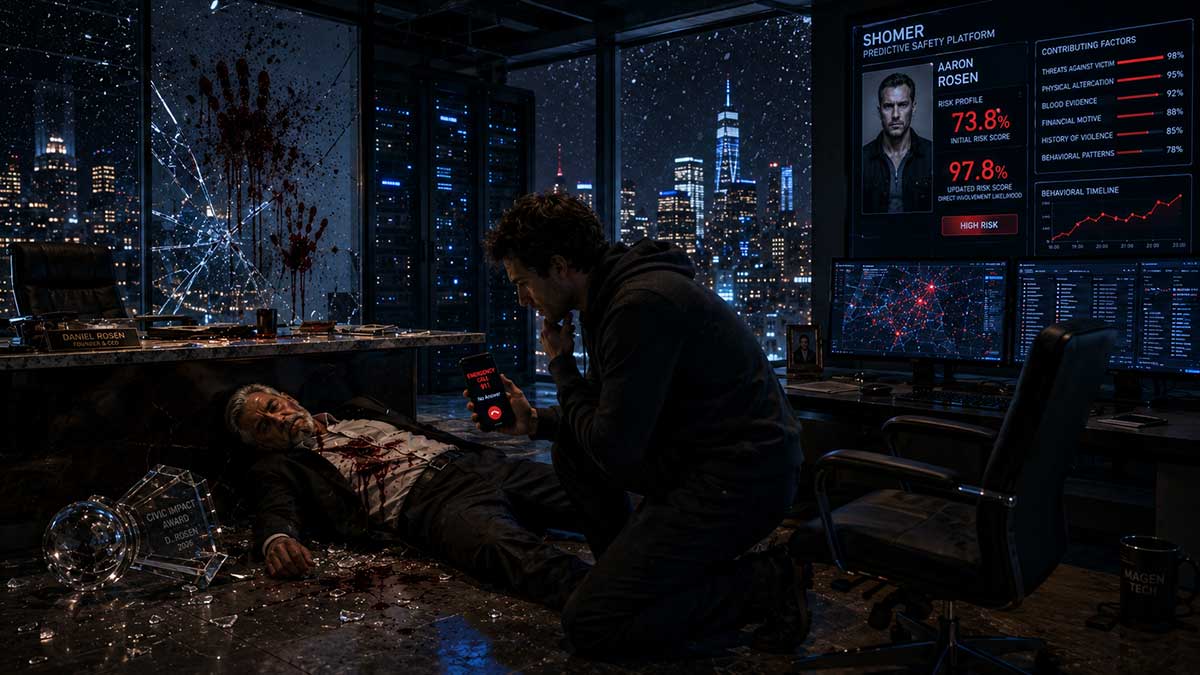
Eli reached for his phone.
He pressed the emergency icon.
The screen asked:
CALL 911?
Daniel’s fingers moved weakly against the floor.
Eli waited for a word.
His name.
Son.
Help.
Anything that recognized the person kneeling there.
Daniel’s lips parted.
“You…”
Eli leaned closer.
“You…”
The rest did not come.
Perhaps it was never going to.
Eli looked at the phone.
CALL 911?
His thumb hovered over yes.
Daniel’s eyes remained open.
Eli pressed no.
The screen went dark.
Daniel breathed twice more.
Then stopped.
12:49 AM
Eli sat beside the body for nearly a minute.
His hands shook.
He pressed them against his knees until they stopped.
The blow had not been planned.
Everything after it would be.
He opened Daniel’s terminal.
Shomer recognized his face and requested secondary authorization.
Eli placed Daniel’s hand against the desk scanner.
The terminal unlocked.
He entered the audit environment.
Aaron’s movement trail appeared immediately.
Entry time.
Voice stress.
Threat language.
Blood evidence.
Access dispute.
Exit time.
A nearly complete accusation waiting for a death.
Eli adjusted the timestamp of Aaron’s exit.
He inserted Aaron’s gait profile into the corridor feed.
He copied thermal movement from Aaron’s earlier confrontation and placed it in the office after midnight.
He erased his own elevator use.
He created a camera outage lasting four minutes and seventeen seconds.
He changed the internal lock record.
Each alteration required a reason code.
He chose:
SYSTEM SYNCHRONIZATION ERROR
The same phrase appeared seven times.
Shomer accepted it.
Eli looked at Daniel’s body.
Then at Aaron’s blood on the wall.
The system did not need to be convinced.
It needed permission to finish the story.
12:58 AM
Eli left through the service stairs.
Before closing the office door, he scheduled the security alert for eight minutes later.
He carried no folder.
The audit remained on Daniel’s desk beneath one bloodstained corner.
At the thirty-seventh floor, he stopped beside a bank of darkened windows.
His phone showed three missed calls from Leah.
One attempted call from Micah that had ended after a single ring.
He listened to the silence after the notifications.
Then he deleted nothing.
1:06 AM
Magen Tower’s alarms activated.
The executive floor sealed.
Security entered Daniel’s office.
Emergency services were called.
Shomer gathered the available data.
It reviewed:
- Aaron’s threats
- Aaron’s forced access
- Aaron’s intoxication
- Aaron’s blood
- Aaron’s altered exit record
- Aaron’s inserted gait signature
- Aaron’s financial dispute
- Aaron’s family history
- Aaron’s known aggression
The system generated a preliminary conclusion.
PRIMARY PERSON OF INTEREST: AARON ROSEN
LIKELIHOOD OF DIRECT INVOLVEMENT: 97.8%
Within twelve minutes, the report reached police.
Within nineteen, a screenshot reached a local reporter.
Within twenty-seven, Daniel Rosen’s death appeared on every major news network in the city.
At 1:41 in the morning, Micah’s phone lit beside the hotel bed.
He stared at his brother’s photograph beneath the words:
SHOMER IDENTIFIES HIGH-CONFIDENCE SUSPECT IN FOUNDER’S MURDER
Micah picked up Eli’s voice message and listened once more.
This time, it did not sound theoretical.
Across Manhattan, screens displayed a red circle around Aaron Rosen’s face.
The system built to see what people missed had not found the truth.
It had found the man everyone was prepared to blame.
Chapter 4: The Story Everyone Needed
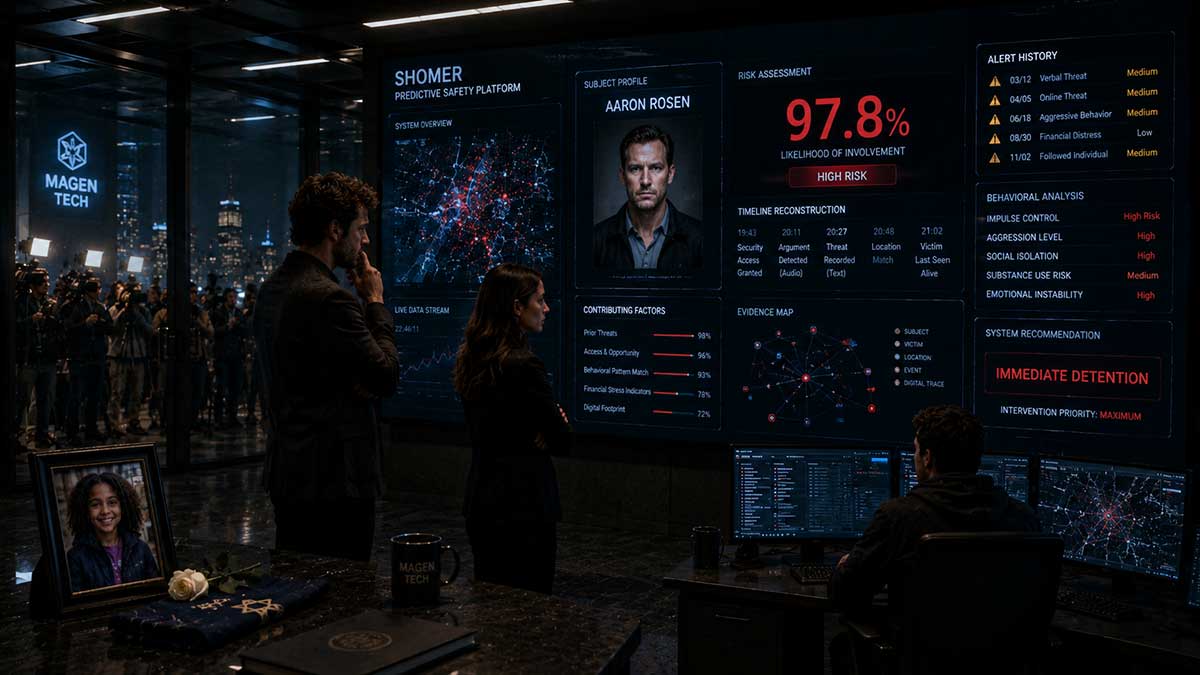
By seven in the morning, Aaron had become the most recognizable man in New York.
Every channel used the same footage.
Aaron entering Magen Tower.
Aaron arguing with security.
Aaron striking the glass wall.
Aaron leaving with blood on his hand.
The clips were shown in different orders, but the story never changed.
THE SON WHO THREATENED HIS FATHER
SHOMER FLAGS 97.8% LIKELIHOOD
MURDER INSIDE AMERICA’S SAFEST BUILDING
On one network, a former prosecutor stood before a digital reconstruction of Daniel’s office.
“Predictive evidence should never replace a jury,” she said, as Aaron’s face glowed red behind her. “But this is an unusually complete pattern.”
On another, a technology investor called the case “a tragic proof of concept.”
Magen stock rose nine percent before trading was suspended.
People bought confidence wherever they could find it.
Micah sat in the back of a police vehicle outside Aaron’s apartment building.
No one had invited him inside.
Reporters pressed against the barricades, shouting questions through the snow.
“Dr. Rosen, did Shomer identify your brother?”
“Did Aaron threaten your father?”
“Do you believe the system is accurate?”
“Will the city vote continue?”
Micah kept his eyes on the entrance.
The front doors opened.
Aaron emerged between two detectives.
His wrists were cuffed in front of him.
He wore no coat.
Someone had given him a gray blanket, but it had fallen from one shoulder.
The cold tightened his face.
He looked toward the cameras first.
Then he saw Micah.
For one second, Aaron appeared relieved.
Micah hated that relief.
Aaron was placed in a waiting vehicle.
A reporter stepped in front of Micah.
“Dr. Rosen, does your brother’s arrest validate Shomer?”
Micah looked at her.
Behind the question was an entire city waiting to be reassured.
“It validates the need for investigation,” he said.
“Do you trust the result?”
“I trust no result that cannot be challenged.”
“Is ninety-seven point eight percent meaningful?”
“Technically, yes.”
The reporter leaned closer.
“So the system’s conclusion is credible?”
Micah heard himself answer.
“Serious enough to review.”
Within minutes, the sentence appeared online beneath a photograph of Aaron in handcuffs.
MICAH ROSEN: SHOMER EVIDENCE “SERIOUS”
He had tried to introduce doubt.
The city heard endorsement.
Leah visited Aaron three hours later.
The interview room at the precinct contained a steel table, two chairs, and a camera mounted high in one corner.
Aaron sat with his hands flat against the table.
His right palm was bandaged.
Leah noticed blood beneath one edge of the gauze.
“You look terrible,” she said.
“You came to diagnose me too?”
“No.”
“Good. One expert in the family is enough.”
She sat.
Aaron looked toward the camera.
“Is Shomer watching this?”
“Probably.”
“Then let it listen.”
Leah waited.
Aaron stared at her.
“I didn’t kill him.”
“I know.”
He blinked.
“You know?”
“I believe you.”
“You believe everyone.”
“No.”
“You believe people when they’re sitting in front of you.”
“That isn’t the same.”
“It was always the same.”
Leah accepted the sentence.
Aaron leaned back.
“They showed me the report.”
“What did it say?”
“That I entered the building angry. That I made threats. That my blood was in the room. That my gait was recorded after midnight. That I had financial motive. That I had a prior violence profile.”
“Were you there after midnight?”
“No.”
“What time did you leave?”
“A little after twelve.”
“Your phone?”
“In the car. Dead battery.”
“Who saw you?”
“A bartender before. A camera in the parking garage after, unless the machine decided that was someone else too.”
Leah watched him.
“Tell me everything that happened.”
Aaron looked toward the corner camera again.
“You mean what actually happened or what will help?”
“The truth.”
“The truth never helped me with him.”
“Try it with me.”
Aaron’s jaw moved.
“I went upstairs. I demanded the shares.”
“Did you threaten him?”
“Yes.”
“What did you say?”
“That one day he would push the wrong son too far.”
Leah closed her eyes briefly.
“He said he only had two sons,” Aaron continued.
“Then what?”
“I hit the wall.”
“Not him?”
“No.”
“Did you want to?”
Aaron looked directly at her.
“Yes.”
The word came without defense.
“I wanted him afraid. I wanted him on the floor. I wanted him to ask me not to do it.”
He looked down at his bandaged hand.
“I wanted him dead for maybe ten seconds.”
Leah remained still.
“Then I left.”
“Why?”
“I saw myself in the glass.”
He gave a bitter laugh.
“Big man. Blood on his hand. Father waiting to be proved right.”
“What happened after you left?”
“I drove around. Parked near the river. Slept in the car.”
“Why didn’t you answer your phone?”
“It was dead.”
“Why didn’t you go home?”
“I didn’t want anyone to see me.”
Leah heard the old family pattern in the sentence.
Wound, shame, disappearance.
“Did you alter any security records?”
“No.”
“Did you ask anyone to?”
“No.”
“Did you know the system had flagged you before the murder?”
Aaron’s expression changed.
“No.”
“Shomer raised your violence score when you entered.”
“Of course it did.”
“It may have generated a profile before Daniel died.”
Aaron leaned forward.
“Then it didn’t solve anything.”
“No.”
“It chose me first.”
Leah said nothing.
Aaron’s breathing slowed.
“I hid something,” he said.
Her eyes lifted.
“What?”
“Two years ago, one of our neighborhood contractors reported repeated disturbances at Maya’s building.”
Leah felt the room narrow.
“Before she died?”
“Yes.”
“How many?”
“Three.”
“What did you do?”
“I sent it to local review.”
“That isn’t an answer.”
“The report was vague. Noise. Possible domestic conflict. No verified threat.”
“What did you do?”
Aaron pressed his lips together.
“I downgraded it.”
“Why?”
“We were testing too many alerts. The city was threatening to cancel the pilot. Daniel said we needed fewer false alarms.”
Leah stared at him.
“Did you know Maya lived there?”
“Not then.”
“Did you know afterward?”
“Yes.”
“Did you tell anyone?”
“No.”
“Why?”
Aaron’s eyes filled with anger, but the anger had no clear target.
“Since it wouldn’t bring her back.”
“It might have changed what Daniel was allowed to say.”
“It would have destroyed me.”
Leah looked at the camera.
Then back at him.
“You concealed evidence tied to a dead child.”
“Yes.”
“You threatened Daniel.”
“Yes.”
“You wanted him dead.”
“For ten seconds.”
“You didn’t kill him.”
“No.”
Aaron’s voice cracked.
“I’m innocent of the one thing they need me guilty of.”
Leah reached across the table.
She did not touch him.
Her hand stopped halfway.
Aaron noticed.
“You believe me,” he said.
“Yes.”
“But you don’t forgive everything else.”
“No.”
He looked almost offended.
Then tired.
“Good,” he said.
At noon, Magen’s public-relations team unveiled a memorial display inside the tower lobby.
A large photograph of Daniel stood beside Maya’s face.
Between them appeared the words:
HE BUILT SHOMER SO NO CHILD WOULD BE MISSED AGAIN.
SHOMER FOUND HIS KILLER.
Maya’s mother, Rochelle Brooks, arrived twenty minutes later.
She wore a dark green coat and carried the original consent form in a plastic folder.
Leah met her near the entrance.
Rochelle pointed toward the display.
“I told them to take her down.”
“I know.”
“They said the campaign agreement continues through June.”
“I know.”
“My daughter is standing next to the man who bought her story.”
Leah looked toward Maya’s photograph.
The image had been taken at the youth center. Maya sat at a table with markers scattered around her. Someone had cropped out the other children.
“They made it look like she was alone,” Rochelle said.
Noah stood beside her.
He had not spoken.
Several reporters waited nearby, sensing a second story.
A Magen attorney approached with two security officers.
“Mrs. Brooks, we’re prepared to discuss this privately.”
“You discussed it privately after I said no.”
“The agreement grants campaign use—”
“My daughter is dead.”
The attorney lowered his voice.
“We understand this is emotional.”
Rochelle’s face changed.
Leah saw it happen.
The moment grief became something an institution intended to manage.
Noah walked toward the display.
He reached for the lower edge of Maya’s photograph.
A security officer caught his wrist.
“Don’t touch that.”
Noah froze.
Leah moved before thinking.
“Let him go.”
The officer released Noah.
The attorney stepped between them.
“Leah, this is company property.”
“No,” she said.
She gripped the display frame.
“It’s her face.”
The frame was heavier than it looked.
She pulled once.
Nothing moved.
The security officer reached toward her.
Rochelle seized the other side.
Together, they tore the display from its brackets.
Metal snapped.
Daniel’s photograph fell first.
Maya’s followed.
The frame struck the marble floor and shattered.
The lobby became silent.
Dozens of phones rose.
Noah stared at the broken images.
Leah bent and lifted Maya’s photograph from beneath the glass.
A crack ran through the company logo.
Maya’s face remained untouched.
Micah watched the footage from a conference room upstairs.
Leah and Rochelle tearing down the display played again and again without sound.
Across the table sat three Magen board members, two attorneys, the acting chief executive, and Eli.
Eli had arrived late.
He wore the same black sweater from the night before.
No one questioned it.
The acting chief executive pointed toward the screen.
“This cannot become the story.”
Micah turned.
“A child’s mother withdrawing consent?”
“A public attack on the company hours before the council hearing.”
“The company used two deaths to advertise a product.”
“We used the facts.”
Eli looked at Micah.
“The system found Aaron.”
Micah studied him.
“Did it?”
Eli’s expression remained still.
“The evidence is unusually strong.”
“Too strong.”
The board members shifted.
One attorney closed his folder.
Micah continued.
“Predictive outputs do not usually align this neatly. Threats, blood, financial motive, access, gait, timing. There should be conflicting signals.”
“Sometimes a case is obvious,” the acting chief executive said.
“Obvious cases make me nervous.”
Eli leaned back.
“Since you prefer ambiguity?”
“Since human lives produce noise.”
“The city wants clarity.”
“The city wants relief.”
No one responded.
Micah opened the Shomer reconstruction on the wall screen.
Aaron’s path appeared as a red line.
He enlarged the timeline.
Entry at 11:47.
Executive floor at 11:56.
Exit at 12:37.
Micah frowned.
“Security says Aaron left shortly after midnight.”
“The internal logs say otherwise,” Eli replied.
“His phone?”
“Unavailable.”
“Street cameras?”
“Partial.”
Micah zoomed in further.
A note appeared beside Aaron’s reconstructed movement:
BEHAVIORAL CONTINUITY ADJUSTMENT APPLIED
He stared at the phrase.
“Who authorized this weighting?”
Eli answered too quickly.
“Standard model correction.”
Micah looked at him.
“That language is mine.”
The room quieted.
Micah opened the underlying documentation.
The model used a principle from one of his early papers: when data gaps occurred during escalating behavior, continuity could be inferred from prior emotional and physical signals.
A theory built to prevent missing a threat.
A theory capable of filling silence with accusation.
“Who has access to this layer?” Micah asked.
Eli folded his hands.
“Senior architecture. Audit. Daniel. Me. Two engineers in Zurich.”
“Did Aaron?”
“No.”
Micah looked at the timeline again.
“Can this reconstruction be manipulated?”
“Anything can be manipulated.”
“Without leaving a trace?”
“Not without extraordinary access.”
Micah held Eli’s gaze.
The acting chief executive interrupted.
“We have a city hearing in ninety minutes. We are not going to dismantle our own evidence in public.”
Micah closed the report.
“You may not need to.”
His phone rang.
Leah.
He left the room to answer.
They met in an empty office overlooking Bryant Park.
Leah still held Maya’s photograph beneath one arm.
Micah closed the door.
“You tore down a corporate display.”
“I noticed.”
“The board is calling it vandalism.”
“Then they finally found a crime they understand.”
Micah showed her Aaron’s reconstructed timeline.
“There’s an adjustment inside the model.”
“What kind?”
“It fills missing movement using behavioral continuity.”
“Meaning?”
“Shomer decided Aaron probably kept behaving like Aaron.”
Leah looked toward him.
“Who could change that?”
“Very few people.”
“Eli?”
“Yes.”
The name stood between them.
Leah set Maya’s photograph against the wall.
“I received a message from him last night.”
Micah looked up.
She showed him.
You were right. Someone has to stop him before tomorrow.
Micah took out his phone.
He played Eli’s voice message.
Neither spoke until it ended.
“If a man’s continued freedom creates predictable suffering, is stopping him violence or responsibility?”
Leah stared at him.
“What did you say to him?”
“At dinner?”
“Yes.”
“He asked whether removing one dangerous person could count as prevention.”
“And?”
“I told him that under certain conditions the difference between action and omission becomes difficult to defend.”
Leah’s face tightened.
“You said that?”
“It was an ethical question.”
“He asked you to stay.”
Micah looked at her.
“How do you know?”
“He asked me to come too.”
Micah turned toward the window.
Snow moved between the buildings.
“He asked me to stay,” he said.
“What did you do?”
“I left.”
“Did you know what he meant?”
Micah wanted to say no.
The word formed cleanly.
It would have been defensible.
Instead, he heard the corridor again.
The empty chair.
Eli’s face between the elevator doors.
“I knew what I preferred not to know.”
Leah looked at him for a long moment.
“That is not the same as not knowing.”
“No.”
“You always think honesty after the fact makes distance noble.”
Micah turned.
“What should I have done?”
“Called him.”
“And if he had been speaking theoretically?”
“He wasn’t.”
“I didn’t know that.”
“You knew enough to be afraid of looking foolish.”
The sentence struck more accurately than accusation.
Micah lowered his eyes.
Leah touched Maya’s photograph.
“There are gaps in Aaron’s timeline.”
“Yes.”
“Could Eli have framed him?”
Micah did not answer immediately.
“He could.”
“Would he?”
Micah looked at the red line on the screen.
“I don’t know.”
Leah’s voice softened.
“Yes, you do.”
The council chamber was full before the hearing began.
Outside, demonstrators filled Broadway.
Some carried Maya’s face.
Others carried signs demanding Shomer’s suspension.
Inside, Daniel’s empty chair remained at the witness table.
The acting chief executive sat beside it.
Micah watched the chair more than the speakers.
One council member called Daniel’s death “a terrible confirmation of the need for predictive intervention.”
Another said the murder proved that even families with every resource could miss danger.
The acting chief executive presented Shomer’s identification of Aaron.
The confidence score appeared on a giant screen.
97.8%.
The number looked cleaner than blood.
Rochelle Brooks sat in the front row with Noah and Leah.
Maya’s photograph rested across Rochelle’s knees.
A council member asked whether Shomer should be activated immediately in Daniel’s honor.
Applause came from one side of the chamber.
Micah looked toward Eli.
He sat behind the Magen legal team.
Calm.
Unmoving.
For one second, their eyes met.
Eli’s phone lit.
Then Micah’s vibrated.
A message appeared.
An address in Brooklyn.
The abandoned youth center where Maya had once spent her afternoons.
Beneath it:
Come hear what your ideas sound like when someone believes them.
Micah looked up.
Eli’s chair was empty.
Chapter 5: The Son in the Basement
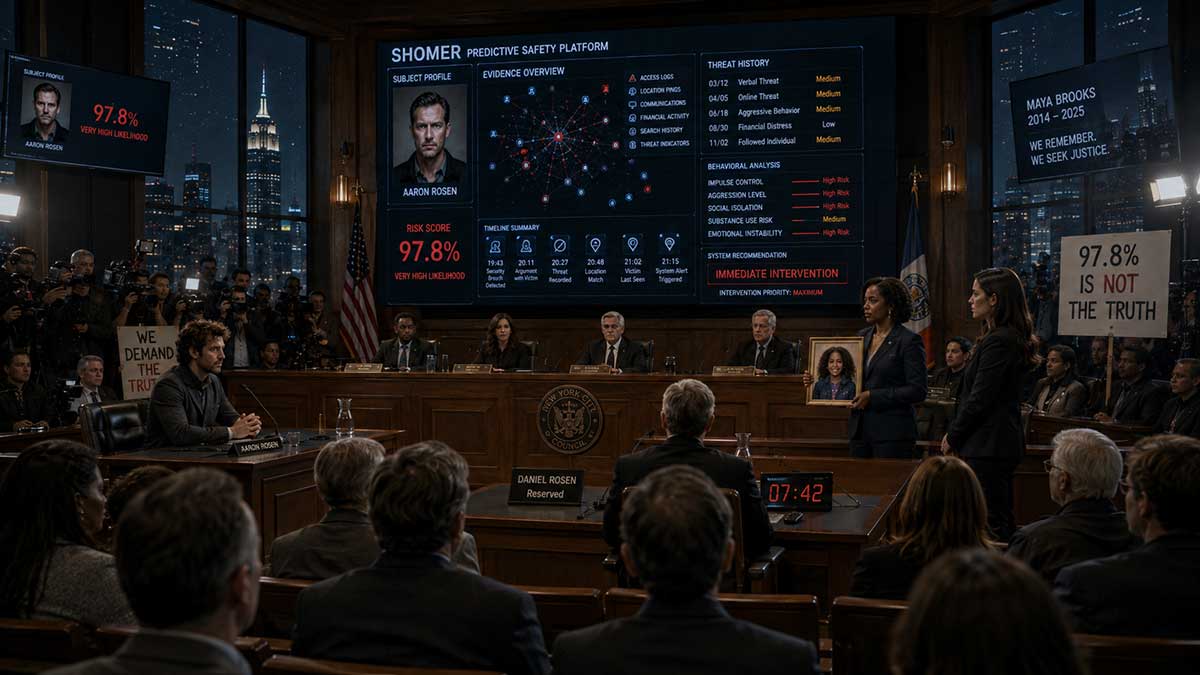
The old community center had been closed for almost a year.
A chain-link fence surrounded the property, though someone had cut an opening large enough for neighborhood children to slip through. The front windows were covered with plywood painted by local artists. Bright flowers climbed across the boards beside fading words:
EVERY CHILD BELONGS SOMEWHERE.
Micah parked across the street.
The building looked smaller than he remembered.
Leah pulled in behind him a minute later.
Neither spoke as they crossed the broken parking lot.
The January wind carried the smell of damp brick and snow.
The side entrance stood open.
Someone had recently oiled the hinges.
Inside, the lights did not work.
Emergency lanterns cast pale circles across the hallway.
Children's artwork still covered the walls.
Paper suns.
Construction-paper birds.
Crayon families holding hands.
Most had curled at the corners.
One drawing stopped Micah.
A map.
Brooklyn reduced to circles, arrows, playgrounds, apartment buildings, and little handwritten notes.
One corner read:
Places where lonely people might smile.
Maya.
He recognized the handwriting from the memorial.
He touched the edge of the paper.
It came loose in his hand.
"Don't."
Eli's voice echoed from the gymnasium.
"It tears easily."
Micah turned.
The basketball hoops had been lowered years before for younger children.
Dust floated through lantern light.
Folding chairs sat in a rough circle across the polished floor.
One chair stood outside the circle.
A portable server rested on a table beside Eli.
Its cooling fans hummed quietly.
Leah entered behind Micah.
She saw the chairs.
Then Eli.
Then the server.
"You chose her place," she said.
Eli nodded.
"She liked this room."
"You remember."
"I remember more than I wanted."
Micah looked around.
"What is this?"
"A conversation."
"No."
"A confession."
Eli gestured toward the server.
"It starts uploading automatically in twenty-three minutes."
Micah noticed several cables running into a satellite transmitter.
"Where?"
"The council hearing."
"The police."
"The press."
"Maya's mother."
"The board."
"My lawyer."
"You planned all this."
"I had a long night."
Silence settled over the room.
The heating system had been shut off months earlier.
Everyone's breath appeared in the cold air.
Leah pulled one chair closer.
She sat.
Not opposite Eli.
Beside the empty chair outside the circle.
Micah remained standing.
Eli smiled faintly.
"Still standing."
Micah looked confused.
"Maya always noticed that."
"No one forced me."
Eli spoke before either sibling could ask a question.
"I hit him."
His voice stayed level.
"He fell."
"I reached for my phone."
"I stopped."
"I changed the records."
"I framed Aaron."
"I watched the system believe me."
He looked at Micah.
"I am guilty."
The words entered the room quietly.
No one interrupted them.
Micah spoke first.
"Was the confrontation planned?"
"Yes."
"The murder?"
"No."
"You expected him to listen?"
"I expected him to refuse."
"What changed?"
Eli looked toward the empty chair.
"He laughed."
Micah closed his eyes.
Leah watched Eli instead.
"What did you want?"
"My name."
"Only that?"
"No."
"What else?"
"The audit released."
"The launch delayed."
"Shomer rebuilt."
"My father."
He stopped.
"No."
He corrected himself.
"Daniel."
"Daniel to look at me once without calculating what I cost."
Leah lowered her head.
"He couldn't."
"I know."
"But I still wanted it."
Micah stepped closer.
"Then why Aaron?"
Eli answered immediately.
"Because the system already wanted him."
"What?"
"I didn't create the story."
"I completed it."
He turned the server screen toward them.
Shomer's internal log filled the display.
Time stamps.
Behavior scores.
Threat probabilities.
Aaron's profile climbing hour by hour.
"Before Daniel died," Eli said, "Aaron had already reached ninety-one percent."
Micah stared.
"The system had nearly convicted him."
"It had identified the person everyone expected."
"I only removed the remaining uncertainty."
Micah looked away from the screen.
"You murdered a man."
"Yes."
"You framed your brother."
"Yes."
"You manipulated millions of dollars' worth of infrastructure."
"Yes."
"Why?"
Eli looked at him almost sadly.
"You taught me that systems matter."
"I taught you that systems influence people."
"You taught me that outcomes matter more than intentions."
"I never said that."
"You lived it."
Micah flinched.
Eli continued.
"You taught me that moral responsibility belongs inside structures."
"I wrote that institutions share responsibility."
"You rarely wrote about individuals."
"I assumed readers understood."
Eli laughed once.
"You assumed."
Leah finally spoke.
"You admired Micah."
"I worshipped him."
Micah looked down.
"I read everything he wrote."
"I listened to every lecture."
"When everyone else treated me like an engineer, he spoke to me like I had a mind."
He smiled.
"I didn't notice that minds can be abandoned too."
Micah whispered,
"Eli..."
"No."
Eli raised a hand.
"My turn."
He looked directly at Micah.
"You enjoyed having someone brilliant who agreed with you."
"I challenged you."
"Only intellectually."
"You never asked why I never dated."
"Why I avoided holidays."
"Why I never appeared in family photographs."
"You liked me as evidence."
Micah felt the sentence settle somewhere he had no defense.
"You left me alone with ideas that could explain everything except how to live."
Eli turned toward Leah.
"And you."
She nodded.
"I know."
"You listened."
"I tried."
"You listened to everyone."
"You listened until pain became understandable."
"You listened until no one had to change."
Leah accepted the words without argument.
"I kept waiting."
"I know."
"I thought if everyone felt seen..."
"...they would stop hurting each other."
"Yes."
Eli looked around the room.
"How did that work?"
Leah's eyes filled.
"It didn't."
Eli looked toward the door.
"And Aaron."
He smiled sadly.
"The easiest one."
"He spent twenty years proving he might kill Daniel."
Micah spoke quietly.
"He still didn't."
"I know."
"He frightened everyone."
"He made the frame believable."
Eli folded his hands.
"I hated him for making my lie so easy."
Finally...
Daniel.
No one spoke his name.
Eli did.
"He paid every bill."
"He recommended every promotion."
"He trusted me with the company's deepest systems."
"He never trusted me with the truth."
He looked toward the empty chair.
"Do you know what hurts most?"
Neither answered.
"I don't know whether he loved me."
The sentence hung in the freezing air.
"If he hated me..."
"I could understand that."
"If he rejected me..."
"I could survive that."
"But sometimes he looked proud."
"Sometimes he smiled."
"Sometimes he called me brilliant."
"Then he introduced me as a member of the engineering team."
He laughed softly.
"I spent thirty-one years trying to solve a puzzle."
"Was I his son in private?"
"Or his employee in public?"
"I never found an answer."
Micah finally crossed the room.
He sat.
Not beside Eli.
Not opposite him.
In the empty chair.
Eli noticed.
"So now you'll sit."
"I should have."
"Yes."
"I should have years ago."
Eli nodded.
"I know."
Micah leaned forward.
"I failed you."
"Yes."
"I admired your work more than your loneliness."
"Yes."
"I heard the warning."
"Yes."
"I left."
"Yes."
Micah swallowed.
"But I did not kill Daniel."
"No."
"I did not tell you to."
"No."
"I did not frame Aaron."
"No."
He looked directly into Eli's eyes.
"You cannot hand me your choice."
Silence.
Long enough for the old building to creak.
Eli finally answered.
"I know."
Leah stood.
She walked slowly until she stood beside Eli.
Not too close.
Close enough.
"Our father wounded you."
"Yes."
"Micah failed you."
"Yes."
"I failed you."
"Yes."
"Aaron made the lie believable."
"Yes."
She took another step.
"You still raised the award."
Eli nodded.
"You still watched him breathe."
Another nod.
"You still stopped the call."
His breathing changed.
"You still chose Aaron's prison."
His eyes closed.
She continued quietly.
"Nothing they did reached inside your hand."
The words struck harder than accusation.
"You chose."
Eli whispered,
"I know."
"No."
Leah shook her head.
"You understand."
"You have not accepted it."
Tears finally reached Eli's face.
Not dramatic.
Quiet.
Almost surprised.
He wiped them away immediately.
"I wanted someone else to carry it."
"I know."
"They all carry something."
"I know."
"I wanted one person to carry all of it."
"You can't."
Eli looked toward the server.
"The upload starts in nine minutes."
"Good," Leah said.
"You aren't asking me to stop it?"
"No."
"You aren't asking me to run?"
"No."
"You aren't asking me to surrender?"
"I think you already have."
Eli smiled faintly.
"Not completely."
He reached into his pocket.
He removed a small remote.
Micah saw the blinking red light.
"What is that?"
"A dead man's switch."
"If my pulse stops..."
"...the servers erase everything."
Micah stared.
"You planned to die."
"Yes."
Leah was not surprised.
"I thought so."
"I wanted the confession."
"I wanted the truth."
"I wanted no trial."
"No interviews."
"No lawyers."
"No years of becoming one thing."
"I wanted one final decision."
Micah stood abruptly.
"Eli—"
Leah raised a hand without looking back.
Micah stopped.
She understood before either man did.
Death would become Eli's final attempt to control the story.
She looked at him.
Very gently.
"You are doing it again."
"What?"
"You are deciding what everyone else will remember."
Eli looked confused.
"I killed him."
"Yes."
"I framed Aaron."
"Yes."
"I confessed."
"Yes."
She stepped one pace closer.
"And now you want death to perform the last argument."
His hand tightened around the remote.
"I don't want prison."
"I know."
"I don't want headlines."
"I know."
"I don't want people deciding who I was."
Leah's voice became almost a whisper.
"They already will."
Eli looked at the floor.
"You don't get to make death do your confessing."
For the first time since they entered the building...
Eli had no answer.
The server chimed softly.
Upload Beginning...
Across the room, the first progress bar slowly appeared.
Three percent.
Five.
Seven.
Eli looked from the screen...
...to the remote in his hand...
...then toward the dark stairwell leading to the roof.
Without another word, he turned and ran.
"ELI!"
Micah shouted.
The stairwell door slammed open.
Leah did not hesitate.
She followed.
Micah glanced once at the server.
The upload had reached twelve percent.
Then he ran after them into the darkness above.
Chapter 6: The Cost of Safety
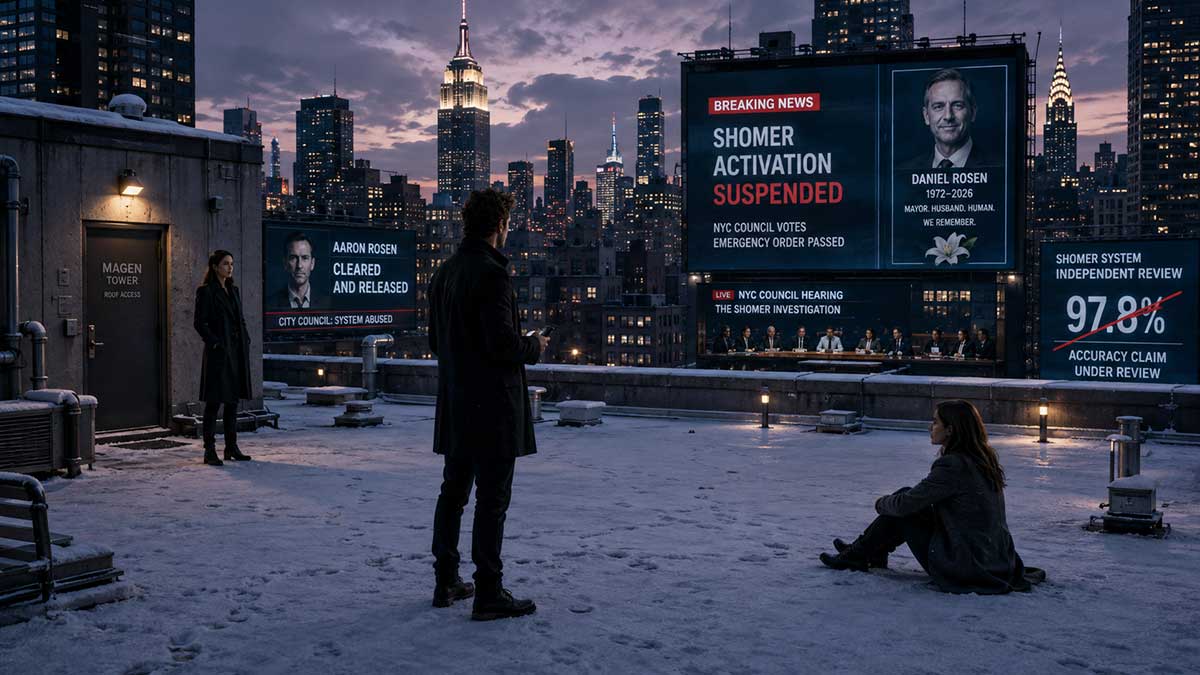
The stairwell smelled of concrete, cold steel, and old rain.
Eli climbed two steps at a time.
The remote remained clenched in his right hand.
Behind him, footsteps echoed upward.
Not one set.
Two.
Micah was faster.
Leah never stopped.
Neither called his name again.
The silence unsettled him more than shouting would have.
He burst through the rooftop door.
Winter air struck him like water.
Snow drifted across the roof in thin, restless sheets.
The city spread beneath him.
Lower Manhattan glowed white and gold against the Hudson.
Police lights flashed far below.
Helicopters circled toward Magen Tower.
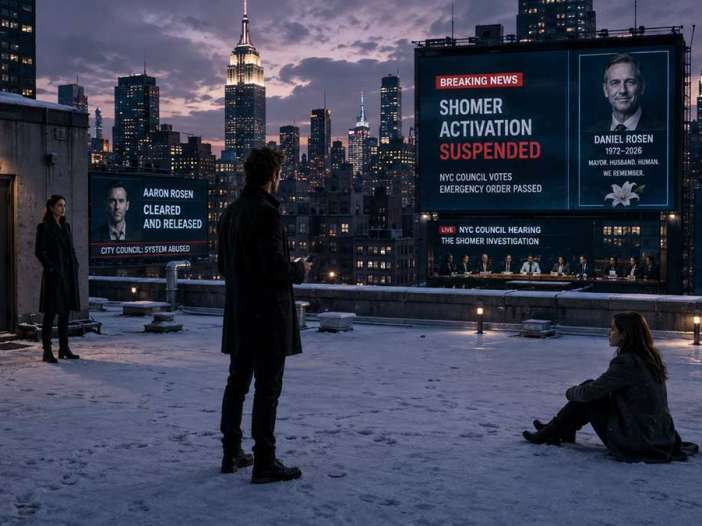
Across the avenue, a giant outdoor screen carried the emergency City Council hearing.
His father's face filled the display.
Daniel Rosen.
Smiling.
Speaking beneath Maya Brooks's photograph.
"No warning should remain invisible."
The image changed.
The council chamber.
Council members arguing.
News banners racing across the bottom.
CONFESSION FILE RECEIVED
SOURCE UNVERIFIED
CITY PAUSES SHOMER VOTE
Eli laughed once.
"So it started."
He walked toward the edge.
Twenty-eight stories below, traffic continued.
No driver looked upward.
No pedestrian imagined that one life was deciding whether to continue.
The rooftop door opened.
Micah emerged first.
He stopped fifteen feet away.
Leah stepped onto the roof behind him.
She looked at Eli.
Then at the distance between him and the edge.
She quietly removed her gloves.
Sat down in the snow.
Micah stared at her.
"What are you doing?"
She never looked away from Eli.
"Waiting."
Eli frowned.
"You aren't coming closer?"
"No."
"Aren't you afraid I'll jump?"
"Yes."
"Then why are you sitting?"
Leah brushed snow from the sleeve of her coat.
"Because you've spent your whole life talking to people standing over you."
Eli said nothing.
"I'd rather talk from here."
The wind carried flakes between them.
Micah remained standing.
Every instinct told him to move forward.
Leah shook her head almost imperceptibly.
Not yet.
Eli looked toward the city.
"I know what happens next."
"No," Leah answered.
"I do."
"You'll tell me I'm more than one decision."
"I won't."
"You'll tell me prison isn't the end."
"I don't know whether it is."
"You'll tell me people can change."
"I hope they can."
He turned toward her.
"Those are terrible speeches."
"I wasn't planning to give one."
He almost smiled.
For the first time since the community center, something resembling surprise appeared on his face.
Micah spoke.
"Eli..."
"No."
Eli held up the remote.
"You've said enough."
Micah stopped.
He had spent years believing language could rescue confusion.
Now every sentence felt too late.
The outdoor screen changed again.
News anchors interrupted one another.
A photograph of Aaron appeared.
MURDER CASE REOPENED
CONFESSION UNDER REVIEW
Below it, another headline.
SHOMER RELIABILITY QUESTIONED
Daniel's empire was collapsing in real time.
Eli watched without satisfaction.
Only exhaustion.
"I know what they'll call me," he said.
"Murderer."
"Engineer."
"Illegitimate son."
"Radical."
"Monster."
He laughed quietly.
"They'll argue about which word belongs first."
Leah nodded.
"They will."
"They'll forget everything before that night."
"Some will."
"They'll never know my mother."
"No."
"They'll never know what it felt like standing outside that dining room every year."
"No."
"They'll never know I almost called."
"No."
He looked down at the remote.
"So I decide the ending."
Leah answered immediately.
"No."
"I already have."
"No."
"I killed him."
"Yes."
"I confessed."
"Yes."
"I choose this."
Leah's voice became firmer.
"No."
He frowned.
"What do you mean?"
"You chose murder."
"Yes."
"You chose to frame Aaron."
"Yes."
"You chose to stop the ambulance."
"Yes."
She paused.
"You don't get to choose what those choices finally mean."
The sentence seemed to confuse him.
"What?"
"You want your death to finish the story."
He stared.
"You want people to say the Rosen family destroyed another son."
"You want Daniel's refusal to become the explanation."
"You want Micah's ideas to become the explanation."
"You want my hesitation to become the explanation."
She looked directly into his eyes.
"You are trying to escape the only thing still left."
"What?"
"Living long enough to be understood imperfectly."
The wind grew stronger.
Snow blew across the rooftop between them.
Micah had never seen Leah speak this way.
She sounded neither angry nor gentle.
Simply truthful.
Eli looked toward the edge again.
"I'll disappear."
"No."
"I'll become one case number."
"Perhaps."
"I'll spend decades explaining one minute."
"Probably."
"I don't want strangers deciding who I was."
Leah smiled sadly.
"They already have."
Silence.
Only helicopters.
Only wind.
Only distant traffic.
Leah looked across the roof.
"Do you remember Maya?"
He nodded.
"Barely."
"Tell me."
"I fixed the internet."
"Then?"
"There was a meeting."
"I stayed near the wall."
"What happened?"
Eli closed his eyes.
"I thought everyone knew each other."
"They didn't."
"I was leaving."
He frowned.
"There weren't enough chairs."
Leah waited.
"A little girl dragged one across the room."
His voice became quieter.
"She asked whether I wanted to sit."
"What did you say?"
"I said I wasn't part of the meeting."
"And?"
Eli swallowed.
"She looked confused."
He smiled through tears.
"She said..."
His voice broke.
"...'You're here.'"
Neither Micah nor Leah spoke.
Eli continued.
"I forgot."
"I forgot until today."
Leah nodded.
"She didn't."
"What?"
"She never waited for permission to make room."
Micah finally understood why Leah had brought Maya into every conversation.
Not to make Eli feel guilty.
To remind him that he had once been seen.
Before any philosophy.
Before any algorithm.
Before any murder.
Leah looked at Eli.
"She didn't know your history."
"No."
"She didn't know your father."
"No."
"She didn't know your name."
"No."
"She knew you were standing."
The words settled over the roof more softly than the snow.
Eli began crying.
Not dramatically.
No collapse.
No scream.
Just quiet tears he no longer tried to hide.
"I wanted him..."
He could barely finish.
"...to see me once."
"I know."
"I waited thirty-one years."
"I know."
"He never did."
Leah shook her head.
"I think he did."
Eli looked up.
"He just couldn't love anyone without trying to own them first."
The remote trembled in Eli's hand.
"I don't know what happens now."
"No one does."
"I'm afraid."
"I know."
"I don't think I can survive prison."
"You might not survive it the way you expect."
"What does that mean?"
"It means prison may destroy the person you are."
She stood slowly.
"It may also destroy the person you no longer need to be."
She walked three careful steps closer.
Still leaving several feet between them.
"No promises."
"No speeches."
"No certainty."
She opened her empty hands.
"Just this."
"What?"
"Come down."
"Why?"
"So the truth stays unfinished."
Eli stared.
"I don't understand."
"If you die tonight..."
"...you become the author of your ending."
"If you live..."
"...other people will keep writing it."
"They'll get it wrong."
"Yes."
"They'll simplify me."
"Yes."
"They'll hate me."
"Some will."
"They'll never understand."
"Many won't."
She smiled sadly.
"Welcome to being human."
Across the street, applause erupted inside the council chamber.
Someone had finished speaking.
Another headline appeared.
CITY SUSPENDS SHOMER ACTIVATION
Eli barely noticed.
He looked only at Leah.
"What if I can't forgive myself?"
She answered without hesitation.
"Then don't begin there."
"Where?"
"Begin with telling the truth tomorrow."
"And the day after."
"And the day after that."
"For as long as you're alive."
The remote slipped from his fingers.
It landed in the snow.
Neither Micah nor Leah moved.
Eli stepped backward.
Away from the edge.
One step.
Then another.
Then another.
Until there was more rooftop behind him than open air.
He covered his face.
For several seconds, no one spoke.
The rooftop door burst open.
Police officers emerged with weapons drawn.
"DROP TO YOUR KNEES!"
Eli lowered himself slowly.
Hands visible.
Snow soaking through his clothes.
An officer handcuffed him.
Another retrieved the remote.
Eli never resisted.
As they lifted him to his feet, he looked toward Leah.
She stood where she had been.
Not touching him.
Not smiling.
Not crying.
Simply remaining.
As he passed, he whispered,
"I'm sorry."
She answered,
"I know."
Nothing more.
Three hours later, the council chamber was silent.
The confession had been verified.
The audit authenticated.
Shomer's reconstruction dismantled.
Micah sat alone at the witness table.
No lawyers.
No board members.
No prepared statement.
Only questions.
The chair beside him—the one reserved for Daniel—remained empty.
Council President Elena Ruiz leaned forward.
"Dr. Rosen."
"Did Shomer fail?"
Micah looked at the empty chair.
Then at Maya's photograph resting in Rochelle Brooks's hands.
Then at Aaron, newly released from police custody, sitting quietly beside Leah.
Finally...
He answered.
"No."
The room stiffened.
"It succeeded."
"It found the story we were already prepared to believe."
Silence.
"It measured anger."
"It measured history."
"It measured probability."
"It measured fear."
He paused.
"It never measured love."
Another silence.
"It never measured loneliness."
"It never measured shame."
"It never measured the difference between someone who threatens..."
"...and someone who finally chooses."
He folded his hands.
"I spent years arguing that better systems would produce better justice."
He looked toward Eli through the courtroom glass where deputies waited.
"I forgot that systems never carry responsibility."
"People do."
After the hearing ended, reporters crowded around him.
Micah answered none of their questions.
Instead, he walked into Daniel's office one final time.
Most of the blood had been cleaned.
The cracked glass wall remained.
Someone had left a sealed evidence box on the desk.
Inside was Daniel's tablet.
A detective handed it to him.
"We found one recording."
Micah opened the file.
His father's face appeared.
Older than the public knew.
More tired.
Daniel spoke quietly.
"I've been thinking about my mother."
He smiled faintly.
"She used to say survival isn't staying alive."
"It's remembering who you wanted to become before fear took over."
He looked away from the camera.
"When Rivka died..."
"My sister..."
"I promised myself no family would ever wait for help the way we did."
His eyes filled.
"I wanted to build a city where no warning arrived too late."
He laughed sadly.
"I never noticed when I started building a city where no one was allowed to refuse protection."
The recording ended.
Micah sat alone in the office.
Outside, the first morning sunlight broke through the clouds.
For the first time in years...
He cried for his father.
Not the founder.
Not the executive.
Not the man who controlled every room.
The frightened boy who had mistaken control for love.
The final chapter shifts away from the Rosen family and places the emotional resolution in Noah Brooks, fulfilling the same movement Dostoevsky gives to Alyosha and the boys at the end of The Brothers Karamazov.
Chapter 7: A Circle Not Finished
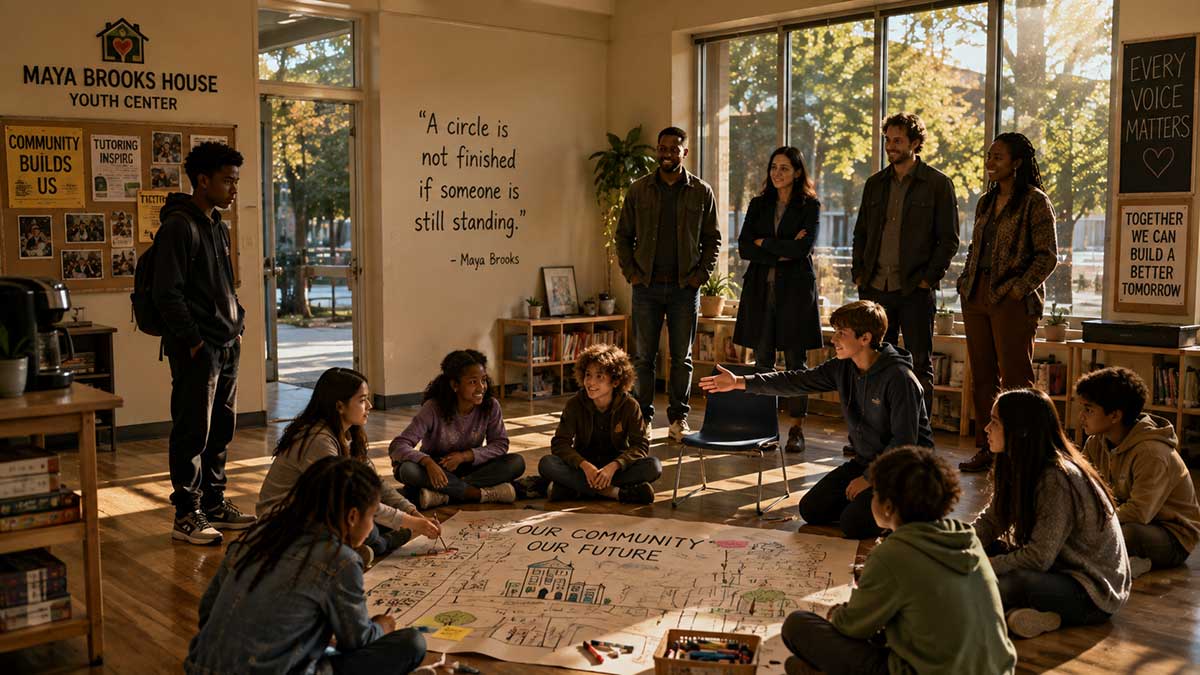
Six months later, the old community center reopened under Maya Brooks’s name.
The new sign was smaller than the one Magen had once placed outside City Hall.
No giant photograph.
No corporate shield.
No promise that another child would never be missed.
Only painted letters above the entrance:
THE MAYA BROOKS HOUSE
Beneath them, in Maya’s handwriting:
A circle is not finished if someone is still standing.
Rochelle had insisted the sentence remain exactly as Maya wrote it.
One of the letters leaned too far to the left.
The city offered to correct it.
Rochelle said no.
Micah arrived early.
He carried folding chairs from a storage room and arranged them in a loose circle inside the gymnasium.
He had become careful with circles.
Too tight, and they felt closed.
Too wide, and no one could hear another person speak.
Six months earlier, he would have turned that observation into a lecture.
Now he moved chairs until the distance felt human.
His fellowship at Columbia had ended three weeks after the hearing.
Two publishers canceled contracts.
Invitations stopped.
His podcast survived, though the audience fell by half.
He had changed its format.
There was no longer a single microphone positioned before him like an altar.
Each episode took place around a table.
People affected by automated systems spoke first.
Micah spoke last, when speaking remained necessary.
He still believed many of his old arguments.
That troubled people who wanted a complete conversion.
He still believed data could expose hidden institutional failure.
He still believed prediction could help prevent harm.
He no longer believed intelligence excused distance.
On the morning after every recording, he called each guest.
Not an assistant.
Not a producer.
Micah.
He asked what the conversation had failed to hear.
Leah entered carrying a box of donated art supplies.
She wore a wool coat over work clothes and had three unanswered messages from families waiting outside her office in Brooklyn.
The city had created the Office of Automated Decisions Review after the Shomer hearings.
Its mission sounded impressive.
Its budget was not.
Leah and seven staff members reviewed housing denials, school removals, child-welfare flags, insurance cancellations, and police referrals produced partly through automated systems.
The waiting room was always full.
Leah had stopped promising quick justice.
She promised only that someone would read the entire file.
Sometimes that changed the result.
Sometimes it did not.
She placed the box beside Micah.
“You left one chair outside the circle.”
“I know.”
“For Elijah?”
“No.”
“Eli?”
Micah looked toward the chair.
“Maybe.”
Leah did not correct him.
She visited Eli twice each month.
Their conversations took place through thick glass.
He had pleaded guilty to second-degree murder, evidence manipulation, obstruction, and conspiracy to falsify public safety records.
His attorneys wanted to build the defense around trauma, paternal rejection, and psychological coercion.
Eli refused to let those become the entire argument.
He did not reject them.
He rejected their use as erasure.
The week before the reopening, Leah received a letter.
She carried it folded inside her coat.
Aaron arrived late.
He wore a clean dark jacket and carried coffee for everyone.
He had lost his position at Magen, his apartment, and most of the money he once believed would prove his father valued him.
The murder charge had disappeared.
The rest had not.
Investigators confirmed that Aaron had concealed warnings connected to Maya’s building.
He pleaded guilty to evidence suppression and assault in an unrelated case.
His sentence included probation, restitution, counseling, and community service at a veterans’ crisis center.
He hated counseling.
He attended.
He hated being told that anger often covered fear.
He returned the following week.
Micah accepted the coffee.
Aaron looked at the empty chair.
“Who’s that for?”
“No one yet,” Micah said.
Aaron nodded.
“That’s new for this family.”
He walked away before either sibling could answer.
Magen Civic Technologies no longer existed in its old form.
The company had been divided into smaller public contractors under independent oversight.
Shomer remained suspended.
Several agencies still used older versions of its risk models under different names.
One school district called its program Student Stability Support.
A housing authority called its system Early Assistance Review.
Changing the name had been easier than changing the habit.
Daniel’s portrait had been removed from the tower lobby.
It now rested in a storage facility in New Jersey beside broken display frames and boxes of promotional Haggadahs.
Micah kept none of them.
He kept the recording.
He had listened to it only twice.
Children began arriving shortly before noon.
Some had known Maya.
Others knew only the building named after her.
Rochelle welcomed each family personally.
Noah remained near the back wall.
At ten, he had stood beneath his sister’s enormous public image and watched adults turn her death into an argument.
At eleven, he had begun correcting anyone who called Maya quiet.
“She talked all the time,” he would say.
“She hated bananas.”
“She cheated at cards.”
“She drew terrible dogs.”
He had become protective of ordinary details.
They kept her alive in ways memorial speeches never could.
A framed copy of one of Maya’s maps hung near the entrance.
Her circles marked:
Mrs. Klein’s kitchen when she makes soup.
The library stairs when it rains.
Our hallway when the lights work.
Anywhere Noah stops complaining.
Noah pretended not to notice the last one.
A boy entered with his grandmother.
His name was Jamal Carter.
He was eleven.
His family had been flagged by a housing-risk model after his grandmother missed several rent payments during a hospital stay.
The system shared the warning with his school.
A counselor misunderstood the record.
Children learned that Jamal’s family was “high risk.”
No one could explain what the phrase meant.
That made it easier to fear.
Jamal stood inside the gym holding a paper bag of markers.
The circle of children had already formed.
Several glanced at him.
One whispered to another.
A girl moved her chair closer to her friend, closing the small gap beside them.
The adults were busy near the refreshments.
Micah saw Jamal.
He began walking across the room.
Leah touched his arm.
“Wait.”
Jamal remained standing.
Noah looked at him.
Then at the circle.
Then at Maya’s map on the wall.
He did not appear inspired.
He appeared annoyed.
As though the adults had once again left something obvious undone.
Noah pushed back his chair.
Its legs scraped loudly across the gym floor.
The children stopped talking.
He walked to the wall, picked up the unused chair, and dragged it across the room.
He placed it beside his own.
“You can sit here,” he said.
Jamal looked toward his grandmother.
She nodded.
He sat.
Noah pointed toward the paper bag.
“What colors did you bring?”
Jamal opened it.
“All of them.”
“No one brings all of them.”
“My grandma buys the big box.”
Noah examined the markers.
“Do you have silver?”
Jamal found one.
Noah took it.
The conversation moved on.
No announcement followed.
No adult explained the meaning.
The circle simply became larger.
Later, Leah opened Eli’s letter outside the gymnasium.
Micah and Aaron stood beside her.
She read aloud.
I spent my life wanting one place at the table. Then I tried to empty every chair around it.
Do not remember me as someone Father created without my consent. Do not remember me as someone Micah’s ideas controlled. Do not remember me as a monster born without a history.
I was wounded.
I wounded others.
Keep both sentences.
I do not know what forgiveness would mean. I am trying to learn what responsibility means when no one is watching.
Aaron looked through the doorway.
Noah and Jamal were drawing a map together.
“Will you write back?” Aaron asked.
Leah folded the letter.
“Yes.”
“What will you say?”
“The truth.”
Aaron gave a tired smile.
“That narrows nothing.”
“No.”
Micah looked at the empty chair remaining near the wall.
For years, the Rosen family had treated belonging as a limited resource.
A person entered only when someone else surrendered space.
Love became inheritance.
Recognition became rank.
Protection became control.
The children in the gym had no theory for any of it.
They had paper.
Markers.
A circle that could still be changed.
Outside, city cameras rotated above the intersection.
Screens continued estimating danger.
Files continued gathering.
People continued mistaking probability for knowledge.
Inside, Jamal drew a small apartment building in silver marker.
Noah added a crooked path leading from it to the community center.
At the end of the path, he drew a circle.
Then he added another chair.
When the program ended, the children returned the chairs to the wall.
Noah kept one beside the circle.
A volunteer asked whether she should put it away.
He shook his head.
Noah left the chair pulled out for whoever arrived next.
Final Thoughts
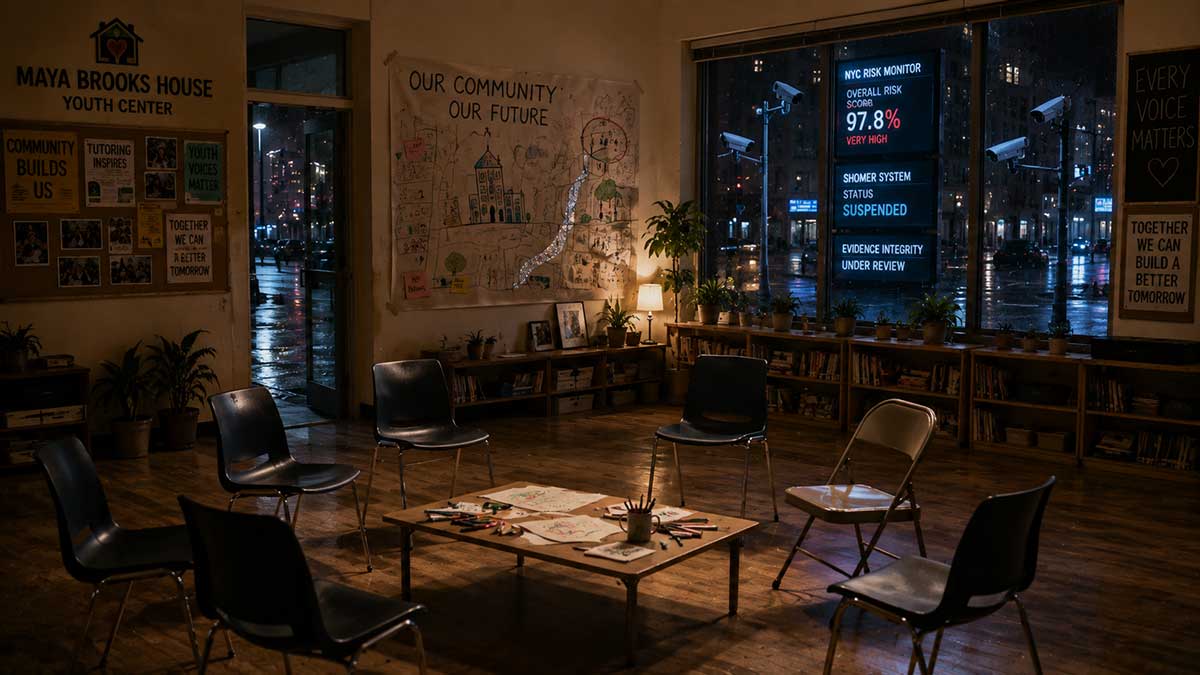
The Empty Chair is not a story about an evil machine.
Shomer does what people teach it to do.
It gathers threats, blood, financial conflict, behavior, and prior violence.
It turns those fragments into a confident conclusion.
The danger comes from the human desire for certainty.
Daniel believes safety justifies greater control.
Micah believes moral thought can restrain systems without requiring personal involvement.
Leah believes listening may heal people before confrontation becomes necessary.
Aaron believes anger proves loyalty and strength.
Eli believes his family’s failures can carry the guilt for his final choice.
Each belief contains some truth.
Each becomes destructive when separated from responsibility.
The story’s emotional center is Leah’s response to Eli:
“My brother. A murderer. One truth does not erase the other.”
She refuses to abandon him.
She refuses to excuse him.
She asks him to remain alive, confess, and face a future he cannot control.
The empty chair changes meaning throughout the story.
It represents Maya’s absence.
Eli’s exclusion.
Daniel’s death.
Micah’s failure to sit beside his brother.
In the final scene, it becomes an invitation.
Noah does not give a speech.
He sees someone standing and makes room.
The city remains filled with cameras, risk scores, and systems seeking certainty.
One chair remains open.
That small act carries the story’s fragile hope.
Short Bios:
Micah Rosen
Micah Rosen is a technology ethicist, author, and podcast host. He challenges his father’s surveillance system but fails to respond when Eli asks him to stay. His growth begins when he accepts his true portion of responsibility.
Leah Rosen
Leah Rosen is a family advocate who helps people harmed by institutional and automated decisions. Her compassion is genuine, but she often delays confrontation. She becomes the person who names Eli’s guilt without abandoning him.
Aaron Rosen
Aaron Rosen is Daniel’s eldest son and Magen’s former head of security. His threats, anger, and violent history make him the perfect false suspect. He is innocent of murder but guilty of other harm.
Eli Novak
Eli Novak is Magen’s lead systems architect and Daniel’s unacknowledged son. He kills Daniel after a final rejection and uses Shomer to frame Aaron. His wound explains his rage but does not remove his responsibility.
Daniel Rosen
Daniel Rosen is the founder of Magen Civic Technologies. Shaped by family stories of persecution, delayed rescue, and preventable death, he builds Shomer to protect vulnerable people. His fear gradually turns protection into control.
Maya Brooks
Maya Brooks was a twelve-year-old girl whose death became the public argument for Shomer. She loved drawing maps and pulled out a chair whenever someone was left standing.
Noah Brooks
Noah Brooks is Maya’s younger brother. He protects the ordinary memory of who she was. In the final scene, he carries her lesson forward by making room for another child.
Leave a Reply