

Introduction
Hermann Hesse’s Siddhartha asks whether wisdom can truly be taught.
More than a century later, that question may feel even more urgent.
We now live surrounded by advice.
Experts tell us how to choose careers, relationships, diets, investments, identities, and spiritual practices. Therapy gives us language for patterns our parents could not name. Self-help gives us frameworks. Social media gives us endless examples of how other people live. AI can analyze our habits, predict our preferences, and sometimes understand our behavior with unsettling accuracy.
But one problem remains.
At what point does guidance begin replacing experience?
These five connected short stories bring the central tensions of Siddhartha into modern life without retelling Hesse’s plot.
Daniel follows experts so faithfully that he nearly loses the ability to choose.
Maya becomes so skilled at emotional independence that love itself starts to feel dangerous.
Marcus survives devastating mistakes and then tries to prevent his daughter from having a life that belongs fully to her.
Evan turns suffering into inspirational wisdom until the people around him ask whether he had the right to make meaning from their pain.
And Noah depends on AI for increasingly important decisions until the machine refuses to answer the question he most wants answered.
Their lives barely touch.
Yet all five eventually walk the same riverfront path.
There, an elderly bicycle repairman appears from time to time.
He is not a guru.
He does not provide answers.
He fixes what he knows how to fix.
The rest belongs to the person walking away.
(Note: This is an imaginary conversation, a creative exploration of an idea, and not a real speech or event.)
Story 1 — The Man Who Followed Every Expert
Daniel sat in his car across from the restaurant and asked three different artificial intelligences whether he should marry Claire.
The first told him his relationship showed unusually strong long-term compatibility.
The second warned that his hesitation might indicate unresolved attachment anxiety.
The third asked him whether he wanted an analytical answer or a reflective exercise.
Daniel chose analytical.
A percentage appeared.
He stared at it.
Then refreshed the screen.
Inside the restaurant, Claire was waiting.
His phone lit up.
Claire calling.
Daniel watched it ring.
He did not answer.
He opened another tab instead.
“Signs you are marrying the wrong person.”
Then:
“Difference between commitment anxiety and intuition.”
Then:
“How do you know when someone is the one?”
He had read all of these before.
Some pages twice.
Several were bookmarked.
Claire called again.
Daniel finally picked up.
Daniel: I’m parking.
There was a pause.
Claire: You said that fifteen minutes ago.
Daniel: I know. Sorry. Somebody was backing out.
Daniel looked through the windshield at the nearly empty parking lot.
Claire: Are you okay?
Daniel: Yeah.
Claire: You sound strange.
Daniel: I’m fine.
Another pause.
Claire knew his pauses.
After seven years, she knew nearly all of them.
Claire: Daniel.
Daniel: I’m coming in.
He ended the call.
Then he looked again at the percentage on his screen.
Eighty-four percent.
That should have comforted him.
It didn't.
He locked the phone and walked inside.
Claire was sitting near the window.
She had ordered sparkling water for him.
Daniel noticed that immediately.
He noticed things.
That was one of his strengths.
He could enter a business meeting and detect which person had lost confidence in the proposal before anyone said a word.
He could read a room.
Read a market.
Read a person.
He had built a successful consulting company partly by seeing patterns other people missed.
He could think.
He could wait.
He could research.
What Daniel could not seem to do was choose.
Claire smiled as he approached.
Claire: You made it.
He kissed her.
Daniel: Sorry.
Claire: It’s okay.
It wasn't.
They both knew that too.
He sat down.
Claire looked beautiful.
He noticed that in a detached, almost painful way.
Her hair was shorter than when they met. There were faint lines beside her eyes now when she smiled.
Seven years.
Daniel suddenly thought:
Seven years is data.
He hated himself for the thought.
Claire looked toward the menu.
Claire: I already know what I’m getting.
Daniel: Salmon?
Claire: Obviously.
Daniel: Predictable.
Claire: Says the man who reads twelve reviews before ordering socks.
Daniel smiled.
She was trying.
He knew she was trying.
That made what was coming worse.
They ordered.
The waiter left.
Claire folded her hands on the table.
Daniel felt his stomach tighten.
Claire: I don’t want to do this dramatically.
Daniel: Do what?
Claire gave him a look.
He knew.
Claire: We need to talk about marriage.
Daniel inhaled slowly.
There it was.
The question he had been studying for three years.
He had read books by marriage therapists, behavioral economists, relationship researchers, pastors, psychologists, divorce attorneys, and one neuroscientist who claimed romantic compatibility could be predicted through conflict patterns.
Daniel knew divorce statistics by age.
He knew the research on cohabitation.
He knew attachment theory.
He knew which traits correlated with marital satisfaction.
He had once built a spreadsheet comparing his relationship with Claire against seventeen predictors of long-term compatibility.
The spreadsheet had looked promising.
Claire did not know about the spreadsheet.
At least he hoped she didn't.
Claire: I’m thirty-nine.
Daniel nodded.
Claire: I want a family.
Daniel: I know.
Claire: I know you know.
Her voice remained calm.
Claire: But knowing isn't answering.
Daniel felt the familiar pressure inside his chest.
Daniel: I love you.
Claire: I know.
Daniel: I can see us married.
Claire: I know that too.
Daniel: Then—
Claire: Daniel.
She stopped him gently.
Claire: I’m not asking whether you can imagine it.
I’m asking whether you want it.
He looked at her.
That question sounded strangely primitive.
Want.
Daniel distrusted want.
People wanted things that ruined their lives.
His father had wanted a business.
Then another business.
Then a bigger house.
Then a boat.
Then investments he barely understood.
By the time Daniel was seventeen, the family had lost nearly everything.
Three months later, his father died from a heart attack.
Daniel remembered adults saying things afterward.
“He took too many risks.”
“He should have asked for help.”
“He moved too fast.”
“He trusted his gut too much.”
Daniel had built his adult life around never becoming that man.
He researched.
He sought advice.
He modeled outcomes.
He made informed decisions.
He did not leap.
Daniel: Wanting something isn't always enough.
Claire leaned back.
Claire: I didn't say it was.
Daniel: Marriage is huge.
Children are huge.
People act like love solves everything and then—
Claire: I’m not asking you to be stupid.
Daniel: I know.
Claire: Do you?
Daniel stopped.
Claire’s eyes were wet now.
Not crying.
Close.
Claire: Sometimes I think you believe there are two kinds of people.
People who research decisions carefully.
And idiots.
Daniel: That's not fair.
Claire: Maybe not.
She looked down.
Claire: But I feel like I’m being evaluated all the time.
Daniel felt a flash of panic.
Daniel: Evaluated?
Claire: Like our relationship is still under review.
Daniel: That's not what I’m doing.
Claire looked directly at him.
Claire: You asked me last month whether I thought my conflict style had changed since therapy.
Daniel stared at her.
Daniel: We were talking about communication.
Claire: We were making pancakes.
Daniel: It came up.
Claire: No, Daniel.
You brought it up.
She laughed softly, sadly.
Claire: Sometimes I feel like I’m dating a committee.
Daniel looked away.
The waiter arrived with their food.
Neither touched it.
Daniel's older sister Rachel lived forty minutes away and had made nearly every decision Daniel considered reckless.
She married at twenty-four.
Divorced at thirty-one.
Changed careers twice.
Bought a house without waiting for interest rates to improve.
Adopted a dog she had not researched properly.
She was happier than Daniel thought someone with such poor decision discipline had any right to be.
Two days after dinner with Claire, Daniel drove to Rachel's house.
Her dog barked wildly when he entered.
Daniel: He still does that?
Rachel: He likes you.
Daniel: That's what liking me sounds like?
Rachel: You've dated Claire for seven years. You should know affection isn't always quiet.
Daniel ignored that.
Rachel handed him coffee.
They sat at the kitchen counter.
Rachel: So what happened?
Daniel: Nothing happened.
Rachel: Then why are you here at eight in the morning?
Daniel looked at her.
Rachel waited.
Eventually:
Daniel: Claire wants an answer.
Rachel: About marriage.
Daniel: Yes.
Rachel: And?
Daniel: I’m thinking.
Rachel groaned.
Rachel: You've been thinking since Obama was president.
Daniel: That's not true.
Rachel: Fine. Since approximately the invention of TikTok.
Daniel didn't smile.
Rachel softened.
Rachel: What are you afraid of?
Daniel: Getting it wrong.
She nodded.
Rachel: Okay.
Daniel: That's it.
Rachel: No, that’s the headline.
What are you actually afraid of?
Daniel became irritated.
Daniel: Why does everything have to be psychological?
Rachel: Coming from you, that's hilarious.
He looked down at his coffee.
Rachel waited.
Daniel: Dad got everything wrong.
The room changed.
Rachel stopped joking.
Daniel rarely mentioned their father.
Daniel: He made decisions based on confidence.
Instinct.
Optimism.
Everybody told him he was a visionary until he wasn't.
Then after he died, everybody suddenly knew what he should have done.
Rachel's expression softened.
Daniel: I was seventeen listening to adults explain how obvious his mistakes had been.
Do you remember that?
Rachel: Yes.
Daniel: So excuse me if I don't worship intuition.
Rachel: I don't.
Daniel: You basically do.
Rachel: No.
I just don't think life gives refunds for excessive research.
Daniel looked at her.
Rachel: Dad was reckless.
You decided the opposite of reckless must be safe.
Maybe it isn't.
Daniel: What does that mean?
Rachel leaned toward him.
Rachel: You keep asking smarter people how to live so you never have to find out what happens when you choose badly yourself.
Daniel's face hardened.
Daniel: That's ridiculous.
Rachel: Is it?
Daniel: I seek information.
That's what intelligent people do.
Rachel: You seek permission.
Daniel: From who?
Rachel: Everybody.
Therapists.
Books.
Podcasts.
People with PhDs.
People with microphones.
People who meditate on mountains.
Now computers.
Daniel stood.
Daniel: I knew coming here was a mistake.
Rachel laughed once.
Rachel: Did you research it first?
Daniel glared at her.
Then left.
The retreat cost $4,800.
Daniel almost didn't go.
That should have been his warning.
He had attended many retreats and usually felt excited beforehand.
This one described itself as a “Decision Clarity Intensive.”
Three days.
Twenty-six participants.
No phones during sessions.
A former clinical psychologist and executive coach named Dr. Aaron Bell ran it.
Daniel had listened to forty-seven episodes of Bell's podcast.
He respected him.
Bell had advised founders, surgeons, professional athletes, and supposedly one senator whose name he could not disclose.
Daniel arrived Friday afternoon with two notebooks.
On Saturday morning, Bell asked everyone to write one question on a card.
“The question,” he said, “that you believe you cannot move forward without answering.”
Daniel knew immediately.
He wrote:
SHOULD I MARRY CLAIRE?
Bell walked through the room collecting the cards.
He placed them in a metal bowl.
Then he lit a match.
Daniel laughed because he assumed it was theatrical.
Then Bell dropped the match.
The cards began burning.
Daniel stood halfway from his chair.
Daniel: Wait.
Bell looked toward him.
Daniel: Those are our questions.
Bell: Yes.
Daniel: You didn't say you were going to burn them.
Bell: Correct.
Daniel: I thought we were working through them.
Bell: We are.
Daniel stared at the bowl.
His question curled black at the edges.
Daniel: That's not working through it.
Bell sat down.
Bell: What did you want from me?
Daniel: Perspective.
Bell: Really?
Daniel felt the room watching.
Daniel: Yes.
Bell: You know my work well?
Daniel: Very well.
Bell: You've heard my views on commitment?
Daniel: Yes.
Bell: Decision-making?
Daniel: Yes.
Bell: Attachment?
Daniel: Yes.
Bell smiled.
Bell: Then why are you here?
Daniel felt embarrassed.
Daniel: To go deeper.
Bell: Into what?
Daniel had no answer.
Bell leaned back.
Bell: Daniel, you have confused clarity with permission.
Daniel felt anger rise.
Daniel: That's easy for you to say.
You're running a retreat called Decision Clarity.
A few participants looked uncomfortable.
Bell nodded.
Bell: Fair criticism.
Daniel: I paid almost five thousand dollars to come here.
Bell: Yes.
Daniel: And your answer is to burn the question?
Bell: No.
My answer is that you already possess enough information to make the decision.
Daniel: You don't know that.
Bell: I know you have consumed enough information to avoid making it.
Daniel stared at him.
Bell: More insight may now be functioning as anesthesia.
Nobody spoke.
Daniel sat down.
He hated Bell.
For almost twenty minutes.
Then he hated himself for having paid $4,800 to hear something his sister had told him for free.
Claire moved out six weeks later.
There was no screaming.
That made it worse.
She packed half the apartment quietly.
Books.
Shoes.
Her grandmother's mixing bowls.
The blue blanket Daniel hated but always pulled over himself when watching television.
Daniel followed her from room to room.
Daniel: I’m not saying no.
Claire folded a sweater.
Claire: I know.
Daniel: Then why are you acting like I said no?
She stopped folding.
Claire: Because eventually not choosing becomes a choice.
Daniel: That's a slogan.
Claire: Fine.
She looked at him.
Claire: Then here's something less polished.
I’m tired.
Daniel's anger disappeared.
Claire: I’m tired of being almost chosen.
He stepped closer.
Daniel: That's not fair.
Claire: I know you love me.
That is not the problem.
Daniel: Then what is?
Claire's eyes filled.
Claire: You keep trying to eliminate the possibility of regret.
Daniel said nothing.
Claire: You want to marry me only when you can somehow know that future Daniel will approve.
You want children only when you can know you won't ruin their lives.
You want guarantees from decisions that don't come with guarantees.
Her voice broke slightly.
Claire: I can't keep waiting for you to become certain enough to live.
Daniel's eyes burned.
Daniel: What if we get married and it fails?
Claire wiped her face.
Claire: What if we don't and this fails anyway?
He looked away.
Daniel: I’m trying not to hurt us.
Claire nodded.
Claire: You're already hurting us.
She picked up another box.
Daniel sat on the edge of the couch.
Daniel: I don't know how to do this differently.
Claire stood still.
Then put the box down.
She sat beside him.
Claire: I think you do.
Daniel: How?
Claire: I think you know exactly how.
You just don't know what happens afterward.
Daniel began crying.
Claire did too.
For several minutes they sat together.
Then she rested her forehead against his shoulder.
Claire: You keep wanting somebody to tell you which life won't hurt.
Daniel covered his eyes.
Claire: There isn't one.
Three nights after Claire moved out, Daniel walked to the river.
He had lived less than two miles from it for eleven years and almost never went there.
There was no measurable purpose.
No workout plan.
No destination.
He simply walked.
The riverfront path was nearly empty.
A few cyclists passed.
A woman sat on a bench speaking quietly into her phone.
Farther down, an older man was closing a small bicycle repair stand built into the side of a trailer.
Daniel walked past.
Then stopped.
The man was struggling to pull down a metal awning.
Daniel helped him.
Older Man: Thank you.
Daniel: Sure.
The man locked the awning.
Daniel noticed a handwritten sign:
FLAT TIRES • CHAINS • BRAKES • SMALL REPAIRS
Nothing about life decisions.
Daniel almost laughed.
The older man noticed.
Older Man: Something funny?
Daniel: No.
The man sat on a folding chair.
Daniel remained standing.
Older Man: Long walk?
Daniel: I don't know.
Older Man: Those can be the longest ones.
Daniel looked at him.
The man did not ask anything else.
That was unusual.
Most experts asked questions immediately.
Daniel sat on the curb.
For reasons he didn't understand, he began talking.
Not everything.
Enough.
He told the man about Claire.
The years.
The research.
The retreat.
The fear.
The older man listened.
No nodding designed to signal empathy.
No therapeutic sounds.
Just listening.
When Daniel finished, the man looked at the river.
Several seconds passed.
Daniel waited.
More seconds.
Finally Daniel said:
Daniel: What do you think?
Older Man: About what?
Daniel nearly laughed.
Daniel: Everything I just told you.
The man shrugged.
Older Man: Sounds difficult.
Daniel stared at him.
Daniel: That's it?
Older Man: What were you expecting?
Daniel: I don't know.
Advice.
The man shook his head.
Daniel: You don't have any?
Older Man: Probably.
Daniel: Then why aren't you giving it?
The man looked at him.
Older Man: You seem to have enough people doing that.
Daniel went quiet.
The river moved in front of them.
Daniel: What would you do?
Older Man: Doesn't matter.
Daniel: It matters to me.
Older Man: Why?
Daniel became irritated.
Daniel: I’m asking.
Older Man: I know.
Daniel: Then answer.
The older man smiled.
Older Man: You ask strangers what they would do with your life?
Daniel looked away.
Daniel: Apparently.
The older man stood and picked up a toolbox.
Older Man: I fix bicycles.
Daniel: I noticed.
Older Man: People bring them here because something is broken.
Tire.
Chain.
Brake.
Sometimes they stand over me and ask whether I think they should ride north or south afterward.
Daniel smiled despite himself.
Older Man: I tell them both roads work.
Daniel: That's not very helpful.
Older Man: I’m not running a retreat.
Daniel laughed.
Really laughed.
For the first time in weeks.
The older man smiled and walked toward his truck.
Daniel called after him.
Daniel: What if you choose the wrong road?
The man stopped.
He looked back.
Older Man: Then you learn what is on the wrong road.
Daniel's smile disappeared.
Daniel: That's it?
Older Man: That's plenty.
Then he left.
Daniel returned home after midnight.
The apartment felt enormous without Claire.
Her absence appeared in objects he had never noticed.
One empty hook near the door.
Half the bathroom counter.
A missing charger beside the bed.
The refrigerator looked strangely male now.
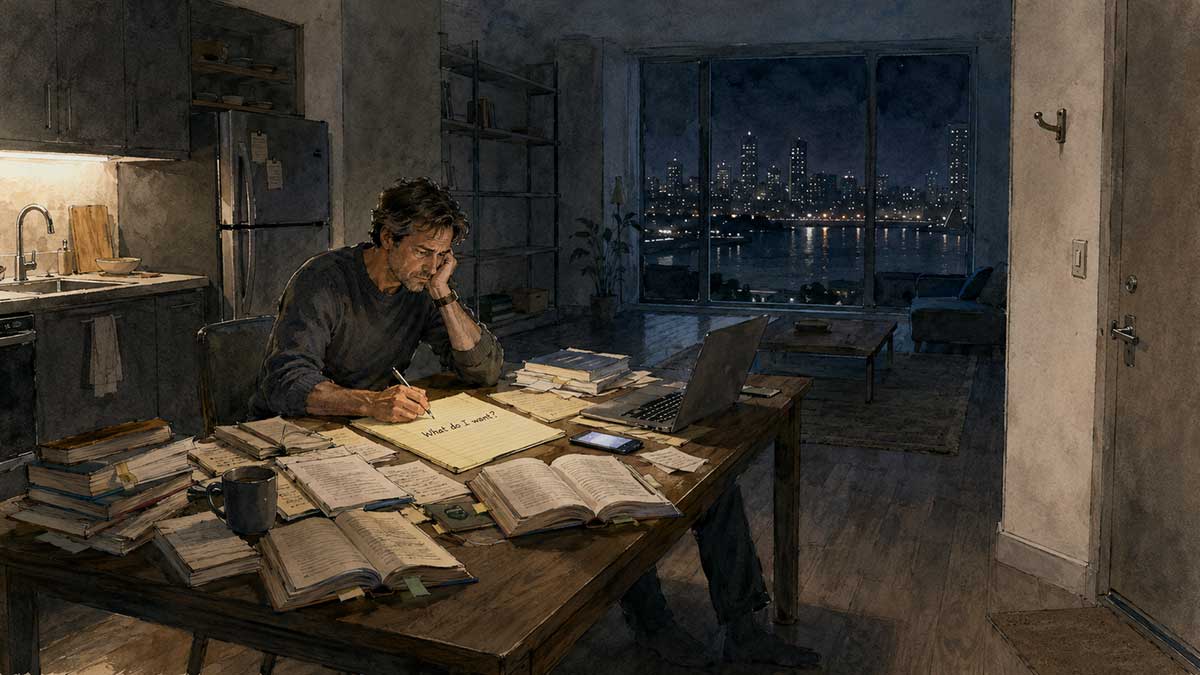
He sat at the kitchen table.
Opened his laptop.
His browser restored thirty-one tabs.
Relationships.
Attachment.
Marriage.
Decision science.
Regret minimization.
An AI chat sat open.
Daniel placed his fingers on the keyboard.
He typed:
What should I—
Then stopped.
He stared at the words.
Deleted them.
For several minutes he did nothing.
Then he opened a drawer and found a yellow legal pad.
He hated writing by hand.
You could not search handwriting.
Could not reorganize it.
Could not ask it follow-up questions.
He found a pen.
At the top of the page, he wrote:
WHAT DO I WANT?
Daniel stared.
Nothing came.
His first impulse was to clarify the question.
What do I want in a partner?
What do I want over ten years?
What do I want given my age, financial position, psychological profile, and—
He stopped.
The original question remained.
What do I want?
Daniel sat there for nearly an hour.
No revelation.
No voice.
No percentage.
No expert.
No answer.
At 1:17 a.m., he wrote one sentence beneath it.
I want Claire to come home.
He stared at the sentence.
His chest tightened.
Then he wrote another.
I am afraid that if she comes home, I will still be afraid.
Then:
I am afraid that if she doesn't, I will turn losing her into another thing I research instead of something I feel.
Daniel put the pen down.
He cried.
There was no lesson yet.
No framework.
No action plan.
He did not know whether Claire would return.
He did not know whether wanting her was enough.
He did not know whether marriage would work.
He did not know whether they would have children.
He did not know whether someday he might regret choosing her.
For the first time in years, Daniel allowed all of those sentences to remain unanswered.
Outside, somewhere beyond the apartment buildings, the river kept moving through the city.
Daniel closed the laptop.
And sat with his own life.
Story 2 — The Woman Who Could Be Close to Everyone but Needed No One
Maya had become very good at leaving first.
Not physically.
Emotionally.
She could sit across from someone she loved, listen carefully, remember every detail, laugh at the right moment, reach across the table, touch a wrist, stay until midnight—
and still keep one door locked.
Most people never noticed.
Ben did.
He noticed it first on a Tuesday night when they were lying in bed.
The apartment was quiet except for traffic several floors below.
Maya was half asleep when Ben said:
Ben: I love you.
Her eyes opened.
She smiled.
Then kissed his shoulder.
Maya: I love being with you.
Ben stared at the ceiling.
Maya closed her eyes again.
Several seconds passed.
Ben: That was impressive.
Maya: What?
Ben: You somehow answered without answering.
Maya laughed.
Maya: I’m tired.
Ben: You’re always tired when the conversation becomes dangerous.
She opened her eyes.
Maya: Dangerous?
Ben: You know what I mean.
Maya: I don’t think saying “I love you” should require a performance review.
Ben turned toward her.
Ben: It doesn’t.
Maya: Good.
Ben: But saying everything around it except the actual words is interesting.
Maya sat up.
Maya: Are we really doing this?
Ben: Apparently.
She pulled the blanket around herself.
Maya: I’m here.
Ben: I know.
Maya: I spend more time with you than anyone.
Ben: I know.
Maya: You have a key.
Ben: I know.
Maya: I flew to Denver because your sister had surgery.
Ben: I know.
Maya: Then what exactly is missing?
Ben looked at her.
Ben: Need.
Maya’s expression changed.
Maya: That’s not healthy.
Ben almost laughed.
Ben: I didn’t say dependence.
Maya: Sounds close.
Ben: Not to me.
Maya climbed out of bed.
She walked toward the kitchen.
Ben followed.
Maya: I don’t think two adults should need each other to function.
Ben: Neither do I.
Maya: Then what are we arguing about?
Ben: I don’t know if you would let anyone become important enough to break you.
Maya turned.
That irritated her.
Maya: Why would I want that?
Ben looked at her for a long time.
Ben: Exactly.
Maya’s friends admired her.
They said so.
“You’re so grounded.”
“You never lose yourself in relationships.”
“You have such good boundaries.”
“You’re the only person I know who can date without becoming insane.”
Maya accepted the compliments.
She had worked hard for them.
Her mother had taught her what the opposite looked like.
When Maya was ten, her mother would enter her bedroom crying.
Not because Maya had done anything.
Because her father was late.
Because her sister had not called.
Because someone had disappointed her.
Her mother’s pain entered every room before she did.
Love meant monitoring.
Where are you?
Why didn’t you call?
Who matters more?
Do you still love me?
After her parents divorced, Maya became the one her mother called at night.
At fourteen.
At sixteen.
At twenty-two.
Her mother once said:
“You’re the only one I can count on.”
Maya remembered feeling proud.
Then trapped.
By twenty-eight, she had spent enough time in therapy to give the pattern a name.
Emotional enmeshment.
She learned boundaries.
Distance.
Self-regulation.
She stopped answering every late-night call.
Stopped apologizing for having plans.
Stopped making herself responsible for everyone else’s feelings.
Her life improved dramatically.
Then something subtler happened.
She got very good at not being responsible for anyone.
And slowly became very careful not to let anyone become responsible for her.
Ben raised living together six months later.
They were eating noodles at a small restaurant near Maya’s office.
Ben: My lease is up in August.
Maya: You should negotiate.
Ben: I’m serious.
Maya: So am I. That building overcharges you.
Ben: Maya.
She looked up.
Ben: We could live together.
Maya put down her chopsticks.
Maya: We basically do.
Ben: No, we don’t.
Maya: You’re at my place four nights a week.
Ben: And I still go home to a drawer containing my actual life.
Maya: That sounds dramatic.
Ben: I’m asking whether you want to build something with me.
Maya’s shoulders tightened.
Maya: Why does moving in automatically mean building something?
Ben: Because sometimes physical life matters.
Bills.
Laundry.
Who buys toothpaste.
Who gets sick.
Who empties the dishwasher.
You know, the deeply romantic parts.
She smiled despite herself.
Maya: I like having my space.
Ben: I know.
Maya: My office is at home half the week.
Ben: I know.
Maya: Your commute would be worse.
Ben: I know.
Maya: So—
Ben: You always have reasons.
Maya stopped.
Ben: Good ones.
That is what makes this hard.
She looked away.
Ben: I can never point to one thing and say, “There. That’s the wall.”
You build walls out of reasonable sentences.
Maya felt heat rise in her face.
Maya: I’m not doing this here.
Ben: Fine.
Maya: Good.
She picked up her chopsticks again.
Ben did not.
Her younger brother Jonah came over that weekend.
He found Maya reorganizing a cabinet.
Jonah: You do this when you’re angry.
Maya: I reorganize because the cabinet is stupid.
Jonah: The cabinet has survived three years without your intervention.
Maya: Barely.
Jonah opened the refrigerator.
Jonah: Is Ben moving in?
Maya froze.
Maya: Did he call you?
Jonah: No.
Maya: Then why are you asking?
Jonah: Mom asked me.
Maya closed her eyes.
Maya: Of course she did.
Jonah: So?
Maya: I don’t know.
Jonah took out a bottle of water.
Jonah: You’ve been with him three years.
Maya: Thank you for the timeline.
Jonah: You love him.
Maya looked at him.
Maya: Everybody needs to stop telling me what I feel.
Jonah took a sip.
Jonah: Okay.
Do you love him?
Maya said nothing.
Jonah’s expression softened.
Jonah: Maya.
Maya: What?
Jonah: You know you don’t have to become Mom just because you let someone matter.
The sentence landed immediately.
Maya hated him for finding the exact nerve.
Maya: I’m nothing like Mom.
Jonah: I know.
Maya: I don’t manipulate people.
Jonah: I know.
Maya: I don’t collapse when someone doesn’t text back.
Jonah: I know.
Maya: Then don’t compare me to her.
Jonah: I’m not.
He set down the bottle.
Jonah: I think you built your whole life around never becoming her.
Maya stared at him.
Jonah: And somewhere along the way, you started thinking needing anyone at all meant losing control.
Maya: That’s not true.
Jonah: Isn’t it?
He looked around the apartment.
Jonah: You’ve built a life where nobody can abandon you because nobody gets all the way in.
Maya’s face went cold.
Maya: Leave.
Jonah blinked.
Jonah: Maya—
Maya: Seriously.
Leave.
He hesitated.
Then picked up his jacket.
At the door he turned.
Jonah: I’m sorry.
Maya looked away.
Jonah: But I don’t think I’m wrong.
The door closed.
Maya stood alone in the kitchen.
Then she finished reorganizing the cabinet.
Ben got sick in October.
At first it was nothing.
Fatigue.
A persistent cough.
Night sweats.
He joked about getting old.
Then one afternoon he called Maya from a clinic.
His voice sounded different.
Ben: They found something.
Maya sat upright at her desk.
Maya: What?
Ben: I don’t totally know yet.
They want more tests.
Maya: What kind of tests?
Ben: Scans.
Bloodwork.
Maybe a biopsy.
Maya was already opening her calendar.
Maya: Send me the appointment times.
Ben: Maya—
Maya: I can move Thursday.
Ben: You don’t have to—
Maya: I know.
Send them.
She became extraordinary.
Within days she had created a shared folder.
Appointments.
Medications.
Insurance contacts.
Questions for doctors.
She researched specialists.
She cooked.
She learned which foods Ben could tolerate after treatment began.
She drove him to appointments.
She sat in waiting rooms.
When his hair started thinning, she shaved the rest with him.
When he vomited, she cleaned.
When he could not sleep, she sat beside him.
Everyone told Ben how lucky he was.
He agreed.
Mostly.
The diagnosis was lymphoma.
Treatable.
That word mattered.
Treatable.
Maya repeated it often.
Maya: The numbers are good.
Ben: I know.
Maya: Your doctor sounded optimistic.
Ben: I know.
Maya: Response rates are—
Ben: Maya.
She stopped.
They were sitting on his couch after treatment.
He looked pale.
Smaller.
Ben: I know the numbers.
Maya put down her phone.
Maya: Okay.
Ben: Can we not talk about numbers?
Maya: Sure.
Silence.
Ben stared toward the window.
Ben: I’m scared.
Maya moved closer.
Maya: I know.
Ben: I don’t think you do.
Her expression tightened.
Maya: Of course I do.
Ben: Then say something.
Maya looked at him.
Maya: What do you want me to say?
Ben: I don’t know.
Something not useful.
She almost laughed.
He did not.
Maya: What does that mean?
Ben: You are amazing at this.
Appointments.
Food.
Doctors.
Research.
You are the best person in a crisis I’ve ever seen.
Maya heard the “but” coming.
Ben: But sometimes I feel like I’m being managed.
Her face changed.
Maya: Managed?
Ben: Yes.
Maya: I have rearranged my entire life.
Ben: I know.
Maya: I’m here every day.
Ben: I know.
Maya: Then what do you want from me?
His eyes filled.
Ben: I want to know if you’re scared too.
Maya stared at him.
Maya: Of course I am.
Ben: Then why do I never see it?
She stood.
Maya: Someone has to hold things together.
Ben: Why?
Maya: What kind of question is that?
Ben: Why do you have to be the one who never falls apart?
Maya: I’m trying to help you.
Ben: I know.
His voice softened.
Ben: But I don’t need a competent person tonight.
Maya went still.
Ben: I need someone who is afraid to lose me.
She looked at him.
No answer came.
Ben’s face changed.
He saw it.
That made everything worse.
Ben: Are you?
Maya swallowed.
Maya: This is not fair.
Ben: I didn’t say it was.
Maya: You’re asking me to perform fear so you can feel loved.
Ben: No.
I’m asking whether there is any part of you that would be shattered if I disappeared.
Maya felt something inside her close.
She picked up her coat.
Ben: Maya.
Maya: I need air.
She left.
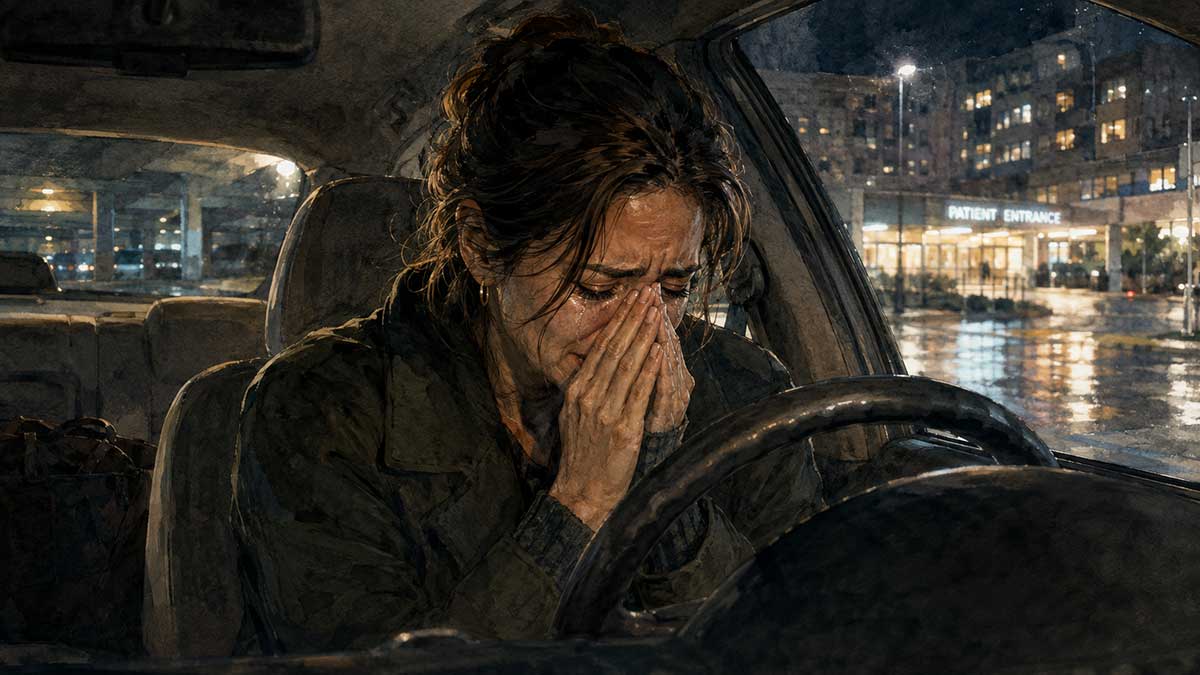
The parking garage was almost empty.
Maya got into her car.
Closed the door.
Locked it.
Then sat completely still.
For several seconds, nothing happened.
Then she began shaking.
She pressed both hands against the steering wheel.
No.
She did not want this.
She did not want to imagine the empty apartment.
His toothbrush gone.
His ridiculous collection of hot sauces.
His voice saying her name from another room.
No.
Her chest tightened.
She tried breathing the way she had learned.
Four seconds in.
Six out.
It did nothing.
Then the first sound escaped her.
Not elegant crying.
Not quiet tears.
A broken sound that frightened her.
She covered her mouth.
Maya: No.
Again.
Maya: No.
She suddenly saw herself at twelve years old.
Her mother sitting at the kitchen table.
“He’s leaving me.”
Maya standing there.
Terrified.
Thinking:
I will never let another person do this to me.
And Maya understood something she had never allowed herself to name.
She had confused two different things.
Being responsible for another person’s emotions.
And allowing another person to become important enough to affect hers.
Those were not the same.
She had protected herself from her mother’s kind of love.
Then kept building the protection long after the danger had changed.
Maya bent forward until her forehead touched the steering wheel.
Maya: I need you.
The words came out before she could stop them.
She cried harder.
She hated them.
She meant them.
Ben recovered slowly.
Treatment worked.
Not immediately.
Not neatly.
But it worked.
Months later, scans showed no active disease.
Everyone celebrated.
Maya did too.
Yet something between them remained unfinished.
She had returned to his hospital room that night.
She had apologized.
She had cried in front of him.
But the deeper habit did not disappear with one breakthrough.
Some days she opened.
Other days she retreated.
Ben did not demand transformation on schedule.
That helped.
One evening, Maya walked along the riverfront path alone.
She had started doing that during Ben’s treatment.
There was something about moving without a destination she had come to like.
A man sat on a bench holding a yellow legal pad.
Daniel.
She did not know his name.
He looked miserable.
Maya sat several yards away.
Neither spoke.
Farther down, an old man was repairing a bicycle.
Maya took out her phone.
Ben’s name appeared near the top of her messages.
She stared at it.
Then called.
He answered on the fourth ring.
Ben: Hi.
Maya: Hi.
Ben: Everything okay?
Maya smiled.
That question.
Everything okay?
She had spent her whole life trying to make the answer yes.
Maya: Not exactly.
Ben waited.
Maya looked out at the river.
Maya: I need to tell you something I hate saying.
Ben: That sounds promising.
She laughed.
Then grew quiet.
Maya: I need you.
Silence.
Her pulse quickened.
Maya: I know that isn’t your job.
And I don’t mean I can’t function without you.
I don’t mean you’re responsible for keeping me okay.
I don’t mean—
She stopped herself.
No explanation.
Just the thing itself.
Maya: I need you.
Another silence.
This time she did not fill it.
Ben breathed on the other end.
Maya looked toward the water.
She could feel fear moving through her body.
Not panic.
Exposure.
There was no guarantee attached to the words.
Ben could leave someday.
He could get sick again.
She could hurt him.
He could hurt her.
Love did not protect her from loss.
It created the possibility of it.
Maya understood that now.
That was why she had spent so many years keeping one door closed.
She heard Ben begin to speak.
The story ends before his answer.
Story 3 — The Daughter Who Refused Her Father’s Wisdom
Marcus knew Elena was going to say something bad because she had asked him to sit down.
She never asked him to sit down.
She normally walked into the kitchen, opened the refrigerator, stole something expensive, and announced life-changing information while eating it.
This time she stood near the counter with both hands around a mug.
Marcus sat.
His wife, Dana, remained near the sink.
Elena looked at both of them.
Elena: I’m leaving school.
Marcus stared at her.
Marcus: Leaving for the semester?
Elena: Leaving.
He waited for the joke.
None came.
Marcus: Why?
Elena: I don't want to be there.
Marcus: That's not a reason.
Elena: It is to me.
Marcus leaned back.
He had spent eleven years learning how not to explode.
Recovery had taught him many things.
Pause.
Breathe.
Listen.
Do not react from fear.
He inhaled.
Marcus: What are you planning to do?
Elena: Move to Portland.
Marcus stopped breathing.
Dana closed her eyes.
Marcus: Oregon?
Elena: Yes, Oregon.
Marcus: With what money?
Elena: I have some saved.
Marcus: How much?
Elena looked toward Dana.
Elena: See?
Marcus: See what?
Elena: I haven't finished one sentence.
Marcus: Fine. Finish.
Elena sat across from him.
Elena: Tessa and Maya found a small studio space. We want to start doing brand design for local businesses. We've already got two clients.
Marcus stared at her.
Marcus: Two clients.
Elena: Yes.
Marcus: And you're leaving college for two clients.
Elena: Not just for them.
Marcus: Then for what?
She looked at him.
Elena: For my life.
Marcus almost laughed.
The phrase sounded like something printed on a mug.
Marcus: Your life includes tuition we've already paid.
Elena: I know.
Marcus: Your scholarship.
Elena: I know.
Marcus: Credits you could finish in three semesters.
Elena: I know.
Marcus: Health insurance.
Elena: Dad.
Marcus: Rent.
Elena: Dad.
Marcus: What?
She looked tired already.
Elena: Can you please stop turning this into a spreadsheet?
Marcus stood.
Marcus: You're asking me not to think?
Elena: I'm asking you to hear me before you calculate me.
He stared at her.
Dana stepped in.
Dana: Marcus—
He raised a hand.
Not angrily.
Controlled.
Everything about Marcus was controlled now.
Marcus: I am hearing her.
Elena shook her head.
Elena: No. You're preparing your case.
Marcus had once destroyed nearly everything.
He did not describe it that way publicly.
Publicly, he said he had “lost his way.”
That sounded cleaner.
The truth was uglier.
At twenty-seven, he started using painkillers after a back injury.
At thirty-one, he was buying pills illegally.
At thirty-three, he lost his job.
At thirty-four, Dana took Elena and moved in with her sister.
At thirty-five, Marcus emptied a retirement account without telling anyone.
At thirty-six, he spent three weeks sleeping in his car.
Then came treatment.
Meetings.
Relapse.
Treatment again.
More meetings.
Work.
Humility.
Apologies.
Years.
Slowly, painfully, his life returned.
By forty-five, Marcus was speaking at recovery events.
By forty-eight, companies invited him to talk about resilience.
He never considered himself a motivational speaker.
He hated motivational speakers.
He simply told the truth.
At least that was what he believed.
His favorite line was:
“Pain is expensive. Learn from somebody else's.”
Audiences loved it.
Marcus believed it.
Deeply.
That was why Elena terrified him.
The next evening Marcus placed three folders on the dining room table.
Dana looked at them.
Dana: What are those?
Marcus: Information.
Dana: Marcus.
Marcus: She wants to make an adult decision. Fine. Adults use information.
One folder contained cost-of-living estimates.
One contained design-industry salary data.
The third contained college completion and income statistics.
Dana stared at him.
Dana: Did she ask for this?
Marcus: She doesn't know what she doesn't know.
Dana sat down.
Dana: You hear yourself, right?
Marcus: What does that mean?
Dana: You sound like every person you hated when you were thirty.
Marcus's face hardened.
Marcus: I was high when I was thirty.
Dana: That's not the point.
Marcus: It's a pretty significant point.
Dana sighed.
Dana: You're scared.
Marcus: Of course I'm scared.
She's twenty-one years old, leaving a degree with almost no money, moving across the country to start a business with friends.
That's not courage.
That's a bad plan.
Dana: Maybe.
Marcus: Thank you.
Dana: I didn't say stop her.
Marcus looked at her.
Dana: You think if you explain the danger clearly enough, she won't have to experience it.
Marcus: Isn't that what parents are supposed to do?
Dana: Sometimes.
Marcus: Exactly.
Dana: And sometimes we're supposed to admit our children heard us and still chose differently.
Marcus laughed bitterly.
Marcus: Easy for you to say.
Dana: Why?
Marcus: Because you weren't the one who ruined ten years of your life.
Dana looked at him for a long time.
Dana: No.
I was the one standing next to you while you did it.
Marcus went quiet.
She continued.
Dana: You think your mistakes only belong to you.
They don't.
Elena lived through them too.
That is exactly why you need to be careful about turning them into rules for her.
Marcus looked away.
Elena came home Sunday afternoon.
Marcus placed the folders on the table.
She stared at them.
Then at him.
Elena: You actually made folders.
Marcus: Just look.
Elena: No.
Marcus: Elena.
Elena: No.
Marcus: If you want me to take this seriously—
She laughed.
Elena: There.
Marcus: What?
Elena: That's it.
You keep acting like my decision becomes real only after you approve the reasoning.
Marcus: That's not what I'm saying.
Elena: It is exactly what you're saying.
Marcus opened one folder.
Marcus: Portland rent has increased dramatically over the last several years. Entry-level freelance income is unstable. You haven't built enough recurring clients—
Elena: Dad.
Marcus: Let me finish.
Elena: No.
Marcus froze.
Elena looked at him.
Elena: You have been finishing for me my entire life.
He closed the folder.
Marcus: What is that supposed to mean?
Elena: Every time I make a mistake, you already know what it means.
Every breakup.
Every bad grade.
Every bad friend.
Every time I spend too much money.
You've got a lesson ready before I even know how I feel.
Marcus's voice sharpened.
Marcus: I'm trying to keep you from suffering unnecessarily.
Elena: I know.
Marcus: Then why are we fighting?
Elena's eyes filled.
Elena: Because you got to become yourself through your mistakes.
Marcus stared at her.
She continued.
Elena: Why do I have to become myself through your conclusions?
Silence.
Dana looked down.
Marcus felt something hot rise into his chest.
Marcus: You think what happened to me was some beautiful life lesson?
Elena: No.
Marcus: I almost died.
Elena: I know.
Marcus: Your mother almost left me permanently.
Elena: I know.
Marcus: I lost years.
Elena: I know.
Marcus: Then why would you want to learn everything the hard way?
Elena wiped her eyes.
Elena: I don't.
That's what you don't get.
I'm not trying to repeat your mistakes.
I'm trying to make mine.
Marcus stood.
Marcus: That is one of the most immature things you've ever said.
Elena stood too.
Elena: Maybe.
But at least it's mine.
She walked toward the door.
Marcus followed.
Marcus: If you leave school, I'm not paying for this experiment.
Elena stopped.
Dana looked at him.
Dana: Marcus.
He ignored her.
Marcus: I'm serious.
Elena turned.
Her face had gone very still.
Elena: Okay.
Marcus had expected resistance.
Marcus: Okay?
Elena: Yes.
Marcus: That's it?
Elena: What do you want me to do? Beg?
He looked at her.
Elena: I'm not asking you to fund it.
I was asking you to know what I was doing.
That hurt more than he expected.
Marcus: I know exactly what you're doing.
Elena shook her head.
Elena: No.
You know what you're afraid I'm doing.
Then she left.
Marcus called Tessa three days later.
He knew it was wrong before he did it.
That did not stop him.
Tessa had been Elena's friend since high school.
She answered cheerfully.
Tessa: Mr. Collins?
Marcus: Hi, Tessa. Got a minute?
They spoke for twelve.
Marcus asked questions.
Money.
Clients.
Housing.
Contracts.
Health coverage.
Back-up plans.
Tessa became quieter with each answer.
Finally:
Tessa: Does Elena know you're calling me?
Marcus paused.
Marcus: I'm just trying to understand what you girls are planning.
Tessa: We're not girls.
Marcus closed his eyes.
Marcus: Fair enough.
Tessa: I think you should talk to Elena.
Marcus: I have.
Tessa: Then maybe trust that she told you the same things I would.
Marcus hung up feeling worse.
An hour later, Elena called.
No greeting.
Elena: You called Tessa.
Marcus closed his eyes.
Marcus: Yes.
Elena: Why?
Marcus: I wanted to make sure you knew what you were getting into.
Elena: By talking to my friend behind my back?
Marcus: I wasn't trying to undermine you.
Elena: What did you think would happen?
Marcus: I don't know.
Elena: Really?
She laughed bitterly.
Elena: You don't know?
You wanted one of us to panic.
You wanted somebody to say you're right.
Marcus stood from his desk.
Marcus: I am trying to protect you.
Elena: From my life.
The words stopped him.
Marcus: Elena—
Elena: Don't.
Her voice cracked.
Elena: You don't trust me.
Marcus: That's not true.
Elena: You trust the version of me who listens to you.
That's different.
Then she hung up.
She moved three weeks later.
Marcus did not go to the airport.
He said he had work.
Dana went.
Marcus sat in his office staring at his phone.
At 9:42 a.m., Elena texted:
Taking off. Love you.
Marcus read it.
Did not answer.
At 10:15:
Dana: You need to answer her.
Marcus typed:
Love you too. Be careful.
Then deleted it.
“Be careful” sounded like another instruction.
He typed:
Love you too.
He stared at it.
Then sent it.
It felt inadequate.
That was probably why it was right.
The business struggled almost immediately.
Marcus knew because Dana knew.
He pretended not to ask.
Dana pretended not to tell.
One client delayed payment.
Another canceled.
Their landlord raised a deposit issue.
Tessa took a restaurant job.
Elena started doing overnight freelance work.
Marcus listened.
Each piece of bad news produced two reactions inside him.
The first was fear.
The second was uglier.
I knew it.
He hated the second reaction.
It kept coming.
Six months later, Elena called Dana crying.
Marcus heard from the next room.
He stood outside the kitchen.
Dana noticed him but continued.
Dana: Do you have rent?
Pause.
Dana: How short?
Marcus stepped into the room.
Dana held up a hand.
Dana: No, don't make a decision tonight.
Sleep.
We'll talk tomorrow.
She ended the call.
Marcus immediately said:
Marcus: How much?
Dana looked at him.
Marcus: Dana.
Dana: Fifteen hundred.
Marcus exhaled.
Marcus: I told her.
Dana's face changed.
He heard it.
Too late.
Dana: Don't.
Marcus: I'm not saying—
Dana: You are.
Marcus walked away.
The next morning he drove to the riverfront.
He had started walking there after Elena left.
At first it was exercise.
Then it became somewhere Dana was not.
Somewhere Elena was not.
Somewhere no one wanted anything from him.
Near the bike trail, an older man was replacing a chain on a teenager's bicycle.
Marcus had seen him before.
A small trailer.
Tools.
Folding chair.
Marcus sat on a nearby bench.
The teenager rode away.
The old man wiped his hands.
Older Man: Morning.
Marcus: Morning.
The man sat.
Marcus stared at the water.
Older Man: Bad day?
Marcus laughed.
Marcus: You ask everyone that?
Older Man: Only people who look angry at rivers.
Marcus smiled despite himself.
They sat in silence.
Then Marcus began talking.
He did not know why.
Maybe older strangers were safe.
Maybe rivers were.
He told him about Elena.
Leaving school.
The business.
The fight.
The money.
The older man listened.
When Marcus finished, he said:
Marcus: I already made every mistake she's making.
That's the part I can't stand.
I know where some of these roads go.
The older man nodded.
Marcus: What's the point of surviving something if you can't save your kid from it?
The man looked toward the trail.
Older Man: Maybe sometimes you can.
Marcus: Exactly.
Older Man: Sometimes you can't.
Marcus frowned.
Marcus: That's not much of an answer.
Older Man: Wasn't trying to give one.
Marcus sighed.
Then the old man asked:
Older Man: When you were twenty-one, what would have happened if somebody had successfully prevented every mistake you later learned from?
Marcus answered immediately.
Marcus: I'd have had a better life.
The man nodded.
Older Man: Maybe.
Then:
Older Man: Would it have felt like yours?
Marcus looked at him.
He hated the question.
Marcus: That's romantic nonsense.
Older Man: Could be.
The man picked up a wrench.
Marcus stood.
Marcus: My mistakes nearly killed me.
Older Man: Then I hope hers are smaller.
Marcus stopped.
That was different.
Not “let her fail.”
Not “mistakes are beautiful.”
Just:
I hope hers are smaller.
Marcus looked back at the water.
For the first time, he considered that Elena did not need to repeat his life for her freedom to be real.
Her mistakes could be stupid.
Painful.
Embarrassing.
Recoverable.
They did not have to become catastrophic to belong to her.
Ten months after Elena moved, the design business closed.
Marcus found out from Elena.
She called him on a Thursday afternoon.
He stared at her name on the screen before answering.
Marcus: Hi.
Silence.
Then:
Elena: Hi.
Her voice was wrong.
Marcus stood.
Marcus: What happened?
Elena: We shut it down.
He closed his eyes.
There it was.
The moment.
Every statistic.
Every folder.
Every warning.
Every prediction.
He could feel “I told you so” rising toward his mouth with almost physical force.
He hated that it felt good.
Marcus: I'm sorry.
Elena breathed shakily.
Elena: Tessa's staying.
Maya got a job in Seattle.
I think I'm coming home for a little while.
Marcus: Okay.
Pause.
Elena: I lost money.
Marcus: How much?
He stopped.
Too late.
Elena gave a small laugh.
Elena: There he is.
Marcus closed his eyes.
Marcus: Sorry.
Another pause.
Then Elena said:
Elena: Can I ask you something?
Marcus: Anything.
Elena: Can I come home for a few days without getting a lecture?
Marcus sat down.
The sentence hurt.
Not because she was accusing him.
Because she genuinely needed to ask.
Marcus: Yes.
Elena: Seriously?
Marcus: Yes.
Elena: No “when I was your age”?
Marcus almost smiled.
Marcus: I'll try.
Elena: No business postmortem?
Marcus: Not unless you ask.
Silence.
Elena: Okay.
Then very quietly:
Elena: Thanks, Dad.
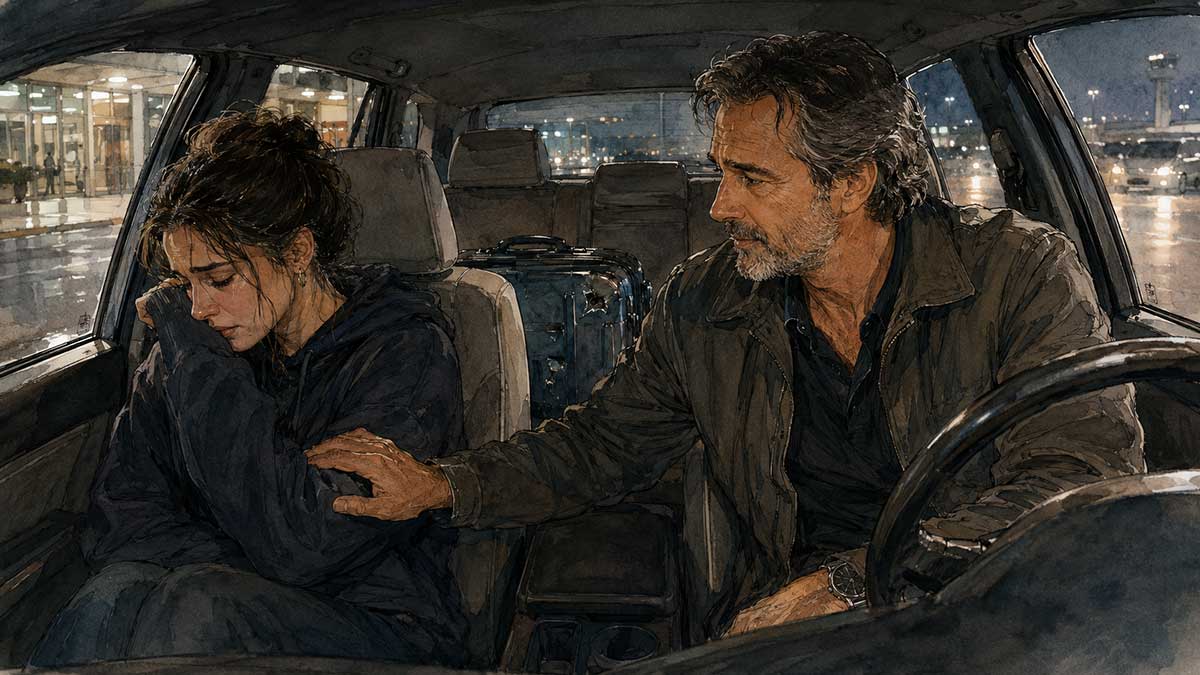
Marcus picked her up at the airport.
Elena looked older.
Not dramatically.
Just enough.
She had cut her hair.
She wore a coat he had never seen.
Her suitcase had a crack near one wheel.
Marcus wanted to ask how much she had lost.
Whether she had debt.
Whether she had paid taxes correctly.
Whether she regretted leaving school.
Whether she planned to return.
He asked none of it.
Elena put her suitcase in the trunk.
They drove.
For eleven minutes, they talked about nothing.
Traffic.
Weather.
Dana's new obsession with houseplants.
Then Elena began crying.
Marcus looked over.
Marcus: Hey.
She wiped her face angrily.
Elena: I'm fine.
Marcus almost said:
No, you're not.
Instead:
Marcus: Okay.
They drove another block.
Elena: I'm so embarrassed.
Marcus gripped the steering wheel.
Elena: We thought we'd have twelve clients by the end of the year.
We had four.
Then two.
We underpriced everything.
I signed a stupid lease.
I trusted a client who never paid.
Marcus felt a hundred responses assembling.
How much was the lease?
Did you have a contract?
Did you send collections notices?
He let them pass.
Elena laughed through tears.
Elena: You probably knew all of this would happen.
Marcus looked ahead.
Marcus: Some of it.
Her face tightened.
He continued.
Marcus: And some things happened I wouldn't have predicted.
Elena looked toward him.
Marcus: You built something.
It failed.
That's different from doing nothing.
Elena stared at him.
Elena: Who are you?
Marcus laughed.
Then she started crying harder.
He pulled into a parking lot.
Stopped the car.
They sat there.
After a moment Marcus said:
Marcus: Do you want advice, help, or just somewhere to land?
Elena covered her face.
That made her cry harder.
Marcus waited.
Finally:
Elena: Somewhere to land.
Marcus nodded.
Marcus: Okay.
No lecture.
No lesson.
No recovery story.
No speech about resilience.
He reached across the console.
Elena took his hand.
They sat there until she was ready.
Then Marcus started the car again.
Later that night, Elena was asleep in her old room.
Marcus stood in the doorway.
The walls had changed over the years, but he could still see pieces of the little girl who once slept there.
A faded sticker near the closet.
Tiny holes where posters had been pinned.
A mark on the doorframe measuring her height at thirteen.
Dana came up behind him.
Dana: You did good today.
Marcus whispered:
Marcus: It was almost impossible.
Dana smiled.
Marcus: Every sentence in my head wanted to teach her something.
Dana: I know.
Marcus looked into the room.
Marcus: I think I finally understand what scared me.
Dana: What?
Marcus: If she could make mistakes I already knew how to avoid, then maybe what I learned wasn't enough to protect anyone.
Dana touched his arm.
Marcus shook his head.
Marcus: I wanted my pain to be useful.
And I think I needed her to use it.
Dana looked at him carefully.
Marcus: Maybe that's too much to ask of a child.
Dana leaned against him.
They stood there quietly.
Marcus looked toward Elena one more time.
He still wanted her to finish college.
He still thought moving had been reckless.
He still believed she could have avoided much of the pain.
None of those thoughts had disappeared.
Something else had changed.
For the first time, Marcus understood that loving his daughter did not require him to call every road he feared the wrong one.
Sometimes love was warning.
Sometimes love was letting go.
And sometimes love was simply keeping the porch light on when someone came home.
Story 4 — The Man Who Turned Every Disaster Into a Lesson
Evan Cole knew exactly when the audience would cry.
Not the first story.
Never the first story.
The first story made them trust him.
The second made them recognize themselves.
The third broke them open.
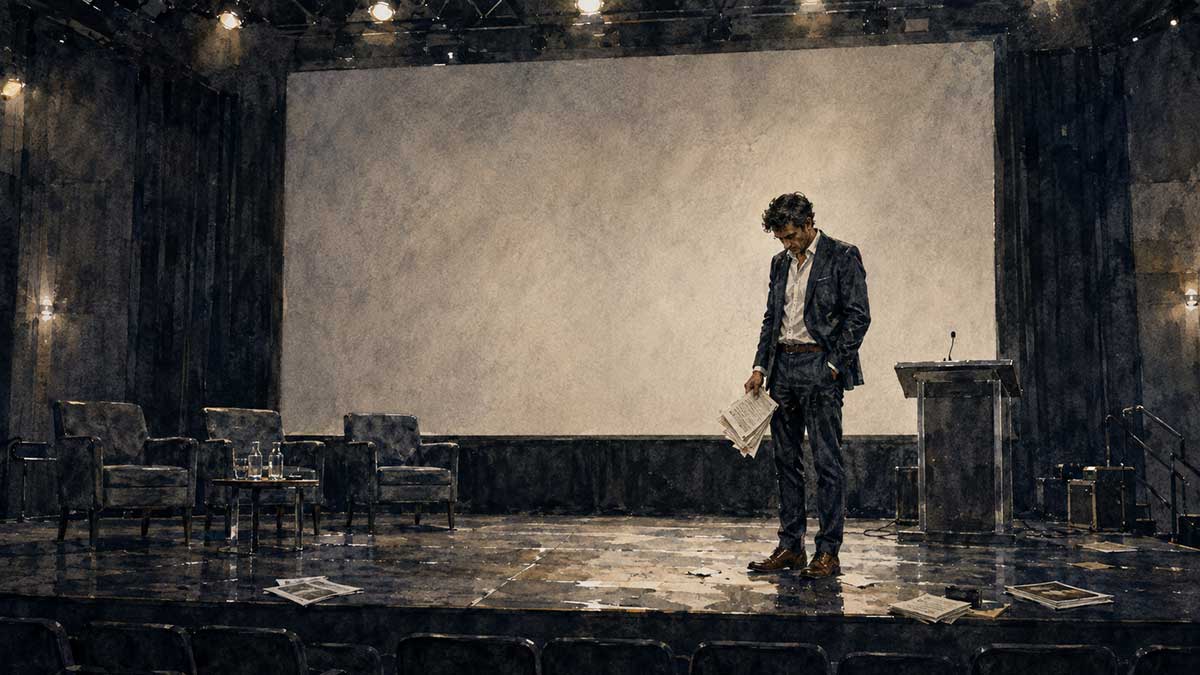
By the time the lights dimmed behind him and the words appeared across the enormous screen—
EVERYTHING HAPPENS FOR YOU
—Evan knew the room was ready.
He stepped closer to the edge of the stage.
Three thousand people waited.
Evan: Ten years ago, I thought losing my marriage was the end of my life.
The room quieted.
Evan: It wasn't.
It was the beginning of the life I had been too afraid to build.
A woman near the front nodded through tears.
Evan saw her.
He always saw the people who cried.
Evan: Pain does not arrive with instructions.
But if we're willing to listen, it can become a teacher.
The audience applauded.
Evan paused exactly long enough.
Then he told the story.
The kitchen floor.
The packed suitcase.
His wife crying.
His teenage son refusing to come downstairs.
The silence after the door closed.
He told it beautifully.
He had told it 186 times.
Each version had become cleaner.
He knew which details mattered.
Which details distracted.
Which line should be whispered.
Which memory should remain vague.
He never used Nora's name.
He said "my former wife."
He never used his son's name either.
He said "someone I loved more than I knew how to love."
That made the story universal.
That was what Evan told himself.
By the end, half the room was standing.
He looked across the audience and felt the familiar rush.
Not ego.
He had worked hard not to call it that.
Meaning.
This was meaning.
Everything he had lost had become useful.
Nora watched the clip the next morning while sitting in her car outside a grocery store.
She had not searched for it.
A friend sent it.
Thought you should know.
Nora almost deleted the message.
Then curiosity won.
Evan appeared on her screen.
Older.
Lean.
Expensive jacket.
The same hands moving when he spoke.
She turned up the volume.
Evan on screen: There was a night when someone I loved sat on our kitchen floor and told me she could no longer survive inside the life we had built.
Nora stopped breathing.
The grocery store disappeared.
She was back in that kitchen.
Forty-one years old.
Barefoot.
Unable to stop shaking.
She had been having panic attacks for months.
She had begged Evan to slow down.
Less travel.
Less work.
Less drinking.
Less yelling.
More sleep.
More help.
He had called it a difficult season.
Nora had called it drowning.
Now three thousand strangers were hearing a polished version of the worst night of her life.
Evan on screen: At the time, I thought she was abandoning me.
Years later, I realized she was forcing me to meet the man I had become.
The audience applauded.
Nora paused the video.
She stared at Evan's frozen face.
Then typed:
Stop telling strangers what my worst year taught you.
She sent it before she could reconsider.
Evan read Nora's message backstage in Dallas.
His first reaction was confusion.
His second was defensiveness.
His third was shame about the defensiveness.
He wrote:
I never use your name.
Deleted it.
Then:
I have always tried to speak respectfully about what happened.
Deleted that too.
Finally:
I'm sorry this hurt you. That was never my intention.
Nora responded four minutes later.
I know.
That was worse.
Evan's manager, Chloe, found him staring at the phone.
Chloe: Problem?
Evan: Nora.
Chloe understood immediately.
Chloe: The marriage section?
Evan: She wants me to stop telling it.
Chloe sat beside him.
Chloe: Can you?
Evan looked up.
Evan: What does that mean?
Chloe: Can you take that story out?
He laughed.
Evan: It's twenty minutes of the keynote.
Chloe: I know.
Evan: It's the hinge.
Chloe: I know.
Evan: The whole message changes without it.
Chloe nodded.
Chloe: Then I guess that's the question.
Evan frowned.
Chloe: Is it your story?
He looked irritated.
Evan: Of course it's my story.
Chloe: All of it?
That question followed him for the rest of the day.
Evan had become famous almost accidentally.
At thirty-eight, his life collapsed in a way people later found inspiring.
His marriage ended.
His company failed eighteen months later.
His best friend died from an overdose.
His son stopped speaking to him.
For two years, Evan lived in what he later called "the wilderness."
Then he started writing online.
At first, it was private.
Pain.
Regret.
Things he wished he had understood earlier.
One essay went viral.
Then another.
A podcast invited him.
Then a conference.
Then a publisher.
People told him:
You put words to what I couldn't say.
You helped me forgive myself.
I left an abusive job because of you.
I called my father after hearing your interview.
Evan took those messages seriously.
He answered many personally.
He did not think of himself as exploiting pain.
He thought he was redeeming it.
That word mattered.
Redeeming.
If suffering had to happen, it should at least become useful.
His son, Lucas, was nineteen when Evan first wrote about him.
The post was titled:
What My Son's Silence Taught Me About Unconditional Love
Evan did not name Lucas.
He changed one identifying detail.
The post became his most shared piece that year.
Lucas found it anyway.
Three days later, Evan received a text.
Take it down.
Evan called immediately.
Lucas did not answer.
Evan texted:
I never used your name.
No response.
Then:
I'm not blaming you. The piece is about my failure as a father.
Lucas responded:
That's not the point.
Evan stared at the message.
He had seen that sentence before.
Not from Lucas.
From Nora.
That's not the point.
He called again.
This time Lucas answered.
Lucas: What?
Evan: I want to understand.
Lucas: No, you want to explain.
Evan: I took responsibility in the piece.
Lucas: Exactly.
Evan was confused.
Evan: Exactly what?
Lucas: You turned me not speaking to you into a chapter about your growth.
Evan stood from his desk.
Evan: That's not what I was doing.
Lucas: You literally titled it what I taught you.
Evan: I was trying to make meaning out of something painful.
Lucas: Your pain.
Evan: Mine too.
Silence.
Lucas's voice changed.
Lucas: You keep doing that.
Evan: Doing what?
Lucas: You put the word "too" after somebody else's pain and then suddenly it's yours to publish.
Evan said nothing.
Lucas: I didn't stop talking to you so you could become a better speaker.
Then the call ended.
The publisher meeting happened two weeks later.
The proposed memoir title was:
EVERYTHING HAPPENS FOR YOU
Evan had resisted it at first.
Too close to the keynote.
Too obvious.
The publisher loved it.
The chapter outline appeared on a large screen.
Chapter 1: The Man I Thought I Was
Chapter 2: The Night She Left
Chapter 3: Losing Everything
Chapter 4: The Friend I Couldn't Save
Chapter 5: My Son's Silence
Chapter 6: The Wilderness
Chapter 7: Meaning
Evan stared at Chapter 5.
My Son's Silence.
The editor was speaking.
Editor: The emotional arc is incredibly strong.
Evan barely heard her.
Editor: What makes the book work is that every loss moves you somewhere.
Evan looked at the screen.
Every loss moves you somewhere.
He had said versions of that sentence hundreds of times.
For the first time, something about it felt obscene.
Editor: Evan?
He looked up.
Editor: You okay?
Evan: I need to change some chapters.
Nora agreed to meet him in a coffee shop across town.
She arrived exactly on time.
Evan stood when she entered.
She did not hug him.
They sat.
For a few moments neither spoke.
Evan: Thank you for coming.
Nora: I almost didn't.
Evan: I know.
She looked at him.
Nora: Do you?
Evan almost smiled.
Another sentence he had heard before.
He stopped himself.
Evan: Probably not.
Nora nodded.
That answer seemed to help.
Evan: I want to understand what you're asking.
Nora looked toward the window.
Nora: Stop telling the kitchen story.
Evan: Okay.
She turned back.
Evan surprised himself.
Nora: That's it?
Evan: Yes.
Nora: No argument?
Evan: I have one.
Nora laughed once.
Nora: Of course you do.
Evan: But I'm trying not to use it.
She studied him.
Nora: Say it.
Evan: I think the story helps people.
Nora nodded.
Evan: I've had hundreds of messages.
People recognizing patterns in their marriages.
People leaving situations that were destroying them.
People getting help.
Nora's face remained calm.
Evan: I don't tell it to humiliate you.
I tell it because—
Nora: It became useful.
Evan stopped.
Nora: That's your favorite word.
Useful.
Evan looked down.
Nora: Do you know what I remember about that night?
Evan: Some of it.
Nora: No.
She leaned forward.
Nora: I remember not being able to feel my hands.
I remember thinking I was dying.
I remember Lucas sitting upstairs with headphones on so he wouldn't hear us.
I remember you asking me whether I was sure because you had a flight the next morning.
Evan closed his eyes.
He remembered that.
He had never included it in the keynote.
Nora: You remember that night as the beginning of your transformation.
I remember it as the night I finally understood how alone I had been.
Evan's eyes filled.
Nora: Those are different stories.
Evan: I know.
Nora looked at him sharply.
Evan corrected himself.
Evan: I'm beginning to.
She sat back.
Evan: I thought changing names made it respectful.
Nora: Respect isn't anonymity.
Evan looked at her.
Nora: You think if strangers can't Google me, then the story becomes yours.
But I still recognize myself.
Lucas recognizes himself.
Our friends do.
My sister does.
People who were there do.
She paused.
Nora: And I have to keep hearing you explain my life better than I remember living it.
That hurt.
Evan looked away.
Evan: I never meant to take anything from you.
Nora's eyes filled.
Nora: I know.
That's what makes this difficult.
She took a breath.
Nora: You really believe you're helping.
Evan: I do.
Nora: I know.
She looked directly at him.
Nora: Maybe your pain can become medicine for strangers.
What gave you the right to donate mine?
Evan stopped breathing.
No defense arrived.
For once.
Nothing.
Nora looked down at her coffee.
Nora: That's all I wanted to say.
Evan canceled the keynote in Denver.
Chloe called six times.
He ignored four.
Answered the fifth.
Chloe: Are you okay?
Evan: No.
Chloe: Is this Nora?
Evan: Nora. Lucas. Maybe everything.
Chloe: That's not ominous at all.
Evan didn't laugh.
Chloe: Talk to me.
Evan: I don't know what belongs to me anymore.
There was a long pause.
Chloe: That's probably not a bad question.
For several weeks, Evan tried to write.
Nothing worked.
Every sentence seemed to drag another person into it.
My father taught me—
My friend taught me—
My son taught me—
My marriage taught me—
He began seeing the grammatical pattern.
Subject:
other person.
Verb:
hurt, left, died, rejected, suffered.
Object:
Evan's growth.
He opened old essays.
A friend's overdose became a lesson about presence.
Nora's panic became a lesson about listening.
Lucas's silence became a lesson about unconditional love.
His business partner's betrayal became a lesson about boundaries.
Everyone had become meaningful.
To him.
Evan closed the laptop.
He had spent years believing this was compassion.
Maybe some of it was.
Maybe some of it was theft.
He walked to the river on a cold afternoon.
He had not been there in months.
The bike trail was busy.
A woman walked past speaking quietly on the phone.
Maya.
He had never met her.
Farther ahead, a middle-aged man walked alone with his hands in his pockets.
Marcus.
Daniel sat on a bench with a yellow legal pad.
Their lives crossed without touching.
Evan stopped at the bicycle repair trailer.
The older man was tightening a brake cable.
Older Man: Need something fixed?
Evan smiled faintly.
Evan: Probably.
The man looked up.
Older Man: Bicycle?
Evan: No.
Older Man: Then I may be underqualified.
Evan laughed.
He sat nearby.
The older man kept working.
After several minutes, Evan began speaking.
He told him about his career.
The speeches.
Nora.
Lucas.
The memoir.
The old man listened.
When Evan finished, the man adjusted the bicycle wheel.
Older Man: Is this your story?
Evan looked at him.
Evan: Yes.
The man nodded.
Then:
Older Man: All of it?
Evan stared at the river.
He knew the answer now.
Evan: No.
The older man returned to the bicycle.
That was all.
No lesson.
Evan almost found it irritating.
Then realized how relieved he was.
Three months later, Evan returned to a stage.
Smaller room.
Eight hundred people.
Chloe had rebuilt the keynote.
Nora's kitchen scene was gone.
Lucas's silence was gone.
The overdose story was gone too.
The talk felt shorter.
Less cinematic.
Less complete.
Evan stood beneath the lights.
For several seconds he said nothing.
Then:
Evan: I used to believe every painful thing in my life could become a lesson.
People listened.
Evan: I still believe pain can teach us.
But I learned something uncomfortable.
Sometimes the pain I called mine was shared.
Sometimes I told stories that contained people who had never agreed to become part of my message.
The room became very still.
Evan: I thought changing names was enough.
It wasn't.
I thought taking responsibility for my mistakes gave me permission to describe everyone else's.
It didn't.
He paused.
Evan: There are parts of my life I used to tell publicly that I no longer believe belong entirely to me.
Someone in the audience shifted.
Evan could feel the speech losing the shape he once depended on.
Good.
Evan: I wish I could tell you I've figured out exactly where the line is.
I haven't.
But I think one question helps.
Before I tell a story now, I ask:
Am I sharing my wound—
or explaining someone else's?
Silence.
No music rose.
No enormous statement appeared on the screen.
Evan looked across the audience.
Evan: Some things become meaningful when we speak them.
Some things become meaningful when we finally stop.
He ended ten minutes early.
The applause was smaller than usual.
It felt different.
He did not know whether that was good.
Later, alone in the hotel room, Evan opened his laptop.
The memoir file waited.
He scrolled to:
CHAPTER 2: THE NIGHT SHE LEFT
He selected the entire chapter.
Deleted it.
The blank page remained.
For years, blankness had frightened him.
Blankness did not help anyone.
Blankness did not sell.
Blankness did not redeem pain.
Tonight it looked almost sacred.
Not every wound needed to become wisdom.
Not every silence needed an audience.
Not every person who had suffered beside him needed to become part of the man he became.
Evan closed the laptop.
And for once, he allowed another person's story to remain outside his own.
Story 5 — The AI That Wouldn’t Give Him an Answer

Noah trusted the machine because it had been right too many times.
At first, only about small things.
Which neighborhood would fit him best.
Which credit card to cancel.
Whether he should accept the promotion.
How many hours of sleep he actually needed.
Which running plan matched his injury history.
The answers were useful.
Measured.
Usually better than his own first instinct.
Then the decisions became larger.
A job offer in Chicago.
A startup in Boston.
A remote position that paid less but gave him freedom.
Noah fed the system everything.
Salary.
Cost of living.
Commute.
Friends.
Family.
Career trajectory.
Personality assessments.
Stress history.
Dating prospects.
Weather preferences.
Even how frequently he called his mother.
The AI recommended Boston.
Noah moved.
Two years later, he could hardly argue with the result.
His salary rose.
His work became more interesting.
He met Lily.
That last part was not in the forecast.
At least not exactly.
Lily first noticed the AI habit on their fourth date.
They were sitting outside a small Korean restaurant when Noah pulled out his phone.
Lily: Are you checking work?
Noah: No.
Lily: Then what?
He hesitated.
Noah: I'm checking whether we should go to the museum or walk along the harbor.
She stared at him.
Lily: You're asking your phone?
Noah: It knows the weather, closing times, how tired I am, what we've done recently—
Lily: Noah.
He smiled.
Noah: Okay, that sounds worse out loud.
Lily: What did it say?
He glanced down.
Noah: Harbor.
Lily stood.
Lily: Museum.
Noah laughed.
Lily: I want one vote in this relationship.
Noah: You have one.
Lily: Apparently the robot has three.
They went to the museum.
It rained thirty minutes later.
Lily reminded him of that for months.
The system became part of their relationship slowly.
Noah did not ask it whether Lily was right for him.
Not at first.
He asked better questions.
Why did I get defensive when Lily said I withdraw during conflict?
How do I apologize without making the apology about my intentions?
Am I avoiding this conversation or giving myself time to regulate?
The answers were excellent.
Lily noticed.
Lily: You're getting disturbingly good at apologies.
Noah: Personal growth.
Lily: Is that what we're calling it?
Noah: You're welcome.
She laughed.
Then one evening, after an argument about Christmas plans, Noah disappeared into the bathroom for eleven minutes.
When he returned, he sat beside her.
Noah: I think I was treating your disappointment like an accusation.
Lily looked at him.
Lily: Did you come up with that?
Noah paused.
She groaned.
Lily: Noah.
Noah: I still had to recognize it.
Lily: You consulted the machine during our fight?
Noah: I was trying not to say something stupid.
Lily: People have been saying stupid things in relationships for thousands of years.
Noah: Not a strong argument for continuing.
Lily laughed despite herself.
Then she became serious.
Lily: Does it ever worry you?
Noah: What?
Lily: How often you ask it what you think.
Noah: I don't ask it what I think.
Lily: You ask it why you think it.
Noah: That's different.
Lily: Is it?
Noah did not answer.
The next morning, he asked the AI.
Over time, Noah gave it more.
His journals from college.
His old emails.
Medical history.
Calendar.
Financial records.
Messages.
Photos.
Voice notes.
Workout data.
Sleep.
Search history.
Five years of conversations.
It knew his patterns.
Sometimes embarrassingly well.
It noticed that he became more impulsive when sleep-deprived.
That he called his sister when anxious but his mother when lonely.
That he avoided career decisions whenever his relationship felt uncertain.
That his stomach problems worsened three days before major presentations.
Once, Noah asked:
Why do I keep feeling irritated with Lily this week?
The response suggested the irritation might be displaced anxiety about an upcoming performance review.
Noah thought that was absurd.
Three days later, he received the review.
His hands shook before opening it.
He apologized to Lily that evening.
The system had been right.
Again.
Noah never thought of himself as dependent.
He thought of himself as augmented.
Pilots used instruments.
Doctors used diagnostics.
Investors used models.
Why should the most important decisions in life depend only on intuition?
Human intuition was full of bias.
Memory was unreliable.
Fear disguised itself as insight.
Desire distorted probability.
The AI did not remove Noah from the decision.
It helped him see himself.
That was how he explained it.
Then Lily became pregnant.
She told him on a Sunday morning.
No dramatic setup.
No gift box.
No tiny pair of shoes.
She came out of the bathroom holding the test.
Noah was making coffee.
He looked at her face first.
Then the object in her hand.
Then back at her.
Noah: Is that—
Lily nodded.
Noah turned off the coffee maker.
For several seconds neither moved.
Lily: Say something.
Noah: Are you okay?
Lily: I don't know.
Noah: Me neither.
She laughed once.
Then started crying.
Noah crossed the kitchen and held her.
He did not ask the AI.
Not then.
They had discussed children.
Abstractly.
Someday.
Maybe.
Lily leaned yes.
Noah leaned uncertain.
They had never made a decision.
Now biology had made one part of it for them.
For three days they talked.
Money.
Work.
Family.
Fear.
Timing.
Their apartment.
Marriage.
Whether either of them felt ready.
Whether anyone ever did.
Lily asked him what he wanted.
Noah kept saying:
Noah: I'm trying to figure that out.
On the fourth night, after Lily fell asleep, Noah opened the AI.
He typed:
Lily is pregnant.
The response came immediately.
It did not congratulate him.
It asked whether he wanted emotional reflection, logistical planning, medical information, or decision support.
Noah chose:
Decision support.
He answered questions for almost an hour.
Finances.
Relationship stability.
Family support.
Career flexibility.
Mental health.
Values.
Desire for parenthood.
Age.
Housing.
Medical considerations.
Long-term goals.
Noah added information the system had not requested.
His father's emotional distance.
His fear of becoming trapped.
His fear of regretting not having children.
His fear of becoming responsible for someone he might fail.
His fear that Lily might eventually resent him.
His fear that he might resent her.
Then:
Given everything you know about me, Lily, our relationship, and likely outcomes, what do you recommend?
The cursor blinked.
Noah waited.
Then the response appeared.
I can help you examine the decision, but I will not recommend whether you should continue the pregnancy or become parents together.
Noah reread it.
He typed:
Why not?
The AI explained that the choice involved deeply personal moral, relational, and life-defining values that could not responsibly be reduced to optimization.
Noah stared at the screen.
Then typed:
You've recommended major life decisions before.
The system acknowledged this.
Noah wrote:
You recommended Boston.
You recommended leaving my old company.
You told me not to invest in Sean's startup.
You told me to reconcile with my sister.
Those decisions changed my life.
The response:
Yes.
Noah typed harder.
Then what is different here?
The answer came:
This decision would shape your identity and another person's life in ways that cannot be adequately ranked by predicted satisfaction alone.
Noah leaned back.
He felt irritation rising.
He typed:
That's vague.
The AI offered to map scenarios.
Noah accepted.
Scenario A.
Scenario B.
Financial effects.
Career effects.
Relationship risks.
Likely stress.
Possible sources of fulfillment.
Potential regret.
Noah read everything.
Then typed:
Which scenario fits me better?
The response refused again.
Noah swore aloud.
Lily shifted in the bedroom.
He lowered the screen brightness.
Why won't you answer?
The AI replied:
Knowing you well is part of why I will not answer.
Noah stopped.
Explain.
The response appeared slowly.
If I make this choice for you and the resulting life becomes painful, you may transfer responsibility for the choice to me.
If the resulting life becomes deeply fulfilling, you may still wonder whether you chose it or merely followed an optimized recommendation.
Some decisions gain meaning partly through accepting authorship of them under uncertainty.
Noah stared.
Then typed:
That's philosophy.
I asked for analysis.
The response:
Analysis can support the decision.
It cannot remove the need for you to choose.
Noah closed the laptop.
Then reopened it.
He typed:
Give me probabilities.
The system gave ranges.
Relationship stress.
Financial strain.
Career slowdown.
Long-term life satisfaction.
Parental regret.
Childlessness regret.
All with caveats.
Noah looked at the numbers for twenty minutes.
They did not answer him.
He typed:
What is the point of knowing me this well if you won't help when it actually matters?
The response came:
Knowing you well is why I can recognize when helping you choose would risk replacing your judgment rather than supporting it.
Noah slammed the laptop shut.
Lily was awake.
She stood in the hallway.
Lily: What happened?
Noah looked at her.
He knew immediately that she had heard enough.
Noah: Nothing.
Her eyes moved to the laptop.
Then back.
Lily: Did you ask it?
Noah said nothing.
Lily's face changed.
Lily: Noah.
Noah: I was trying to think.
Lily: You asked the AI whether we should have this baby?
Noah: I asked it to analyze—
Lily: Did you ask it what we should do?
He looked down.
That answered her.
Lily sat at the table.
She looked less angry than he expected.
That frightened him more.
Lily: Were you really going to let it decide?
Noah: No.
Too fast.
Lily saw it.
Lily: You were.
Noah: I was going to consider the recommendation.
Lily: Noah.
Noah: That's not the same.
Lily: Isn't it?
He felt cornered.
Noah: Why is asking for help wrong?
Lily: It's not.
Noah: Then what are you angry about?
Lily: I'm not sure I'm angry.
She looked at him.
Lily: I'm scared.
Noah stopped.
Lily: I thought we were trying to figure out what we wanted.
Noah: We are.
Lily: Then why did you go looking for a verdict?
Noah: Because I don't trust myself on something this big.
Lily's face softened slightly.
Lily: Why?
Noah laughed bitterly.
Noah: Have you met humans?
Lily: I have.
One of them is pregnant.
He looked away.
Noah: People ruin their lives through bad decisions every day.
Lily: Yes.
Noah: We have access to something that can analyze patterns we can't see.
Why wouldn't we use it?
Lily: Use it for what?
Noah: To reduce the chance of making a catastrophic mistake.
Lily stared at him.
Lily: Is that what you think a child could be?
Noah's face changed.
Noah: That's not what I meant.
Lily: I know.
But listen to the way you're talking.
Optimal outcome.
Risk.
Catastrophic mistake.
You're trying to make this into something you can solve.
Noah: What do you want me to do? Guess?
Lily: No.
She stood.
Lily: I want you to be here.
Noah: I am here.
Lily: Your body is.
Noah stopped.
Lily's eyes filled.
Lily: I don't need you to know what happens in twenty years.
I don't need you to prove we'll be happy.
I don't need a prediction.
She wiped her face.
Lily: I need to know whether you're willing to stand inside a choice with me when neither of us knows.
Noah could not answer.
Lily nodded.
Lily: That's what I thought.
She went back to the bedroom.
Noah remained in the kitchen.
The laptop sat closed in front of him.
For the first time, it felt less like a tool.
More like somewhere he had been hiding.
Noah did not sleep.
At five in the morning he left the apartment.
He walked without deciding where.
The city was beginning to wake.
Delivery trucks.
Buses.
People carrying coffee.
A runner passed him near the riverfront.
Rain began lightly.
Noah kept walking.
He saw a man sitting on a bench with a yellow legal pad.
Daniel.
Farther ahead, a woman stood near the railing speaking quietly into her phone.
Maya.
A middle-aged man walked toward the parking lot, hands deep in his coat pockets.
Marcus.
Another man sat alone near the water, staring at nothing.
Evan.
Noah knew none of them.
Yet something about the trail that morning felt crowded with people who had arrived there after reaching the limit of an answer.
Near the bicycle stand, the older repairman was pulling down the awning.
Noah stopped.
Older Man: Wet morning.
Noah: Yeah.
The man looked at him.
Older Man: Flat tire?
Noah: No.
Older Man: Chain?
Noah: No.
Older Man: Good start.
Noah almost smiled.
The older man began arranging tools.
Noah stood nearby.
Then:
Noah: Can I ask you something?
The man looked up.
Older Man: You just did.
Noah laughed despite himself.
Noah: Do you ever wish somebody could tell you which choice is right?
The older man returned to a wrench.
Older Man: Every day.
Noah had not expected that.
Noah: Really?
Older Man: Sure.
Would save time.
Noah: Then what do you do?
The man considered it.
Older Man: Depends.
Some choices, I ask people who know more than I do.
Noah: And the big ones?
Older Man: Same.
Noah frowned.
Older Man: I ask.
I listen.
I think.
Noah: Then?
The man shrugged.
Older Man: Choose.
Noah: That's it?
Older Man: Then become responsible for the choice.
Noah looked toward the river.
Noah: What if you choose wrong?
Older Man: Happens.
Noah: What if it ruins your life?
The older man smiled slightly.
Older Man: Most choices don't get the dignity of ruining an entire life by themselves.
Noah looked back.
Older Man: Life is usually more stubborn than that.
Noah thought about this.
Noah: What if someone could calculate the better choice?
The man tightened something on a bicycle.
Older Man: Better for what?
Noah opened his mouth.
Stopped.
Older Man: Money?
Comfort?
Sleep?
Marriage?
Regret?
Adventure?
Safety?
The older man looked at him.
Older Man: Better is a word that likes company.
Noah laughed.
Noah: You really only fix bikes?
Older Man: On good days.
Noah sat on the edge of the curb.
Rain tapped softly against the trailer roof.
Noah: I think I've been trying to avoid owning my decisions.
The old man nodded.
Nothing more.
Noah waited.
Noah: Aren't you going to say anything?
Older Man: You already did.
Noah looked toward him.
The old man picked up another tool.
Older Man: People come here with broken brakes all the time.
Noah: Okay.
Older Man: Sometimes the brake isn't the problem.
They're afraid of the hill.
Noah smiled faintly.
Older Man: I can fix the brake.
Can't flatten the hill.
When Noah returned home, Lily was sitting at the kitchen table.
She looked exhausted.
He took off his wet jacket.
Sat across from her.
For a moment, neither spoke.
Then Noah opened the laptop.
Lily's expression hardened.
Lily: Seriously?
Noah: Just wait.
He opened the AI conversation.
Typed:
Can you help me think through this without deciding for me?
The answer:
Yes.
Noah turned the laptop so Lily could see.
She read it.
Then looked at him.
Noah: I think that's what I should have asked.
Lily said nothing.
Noah: Not “What should we do?”
More like—
He struggled.
Noah: “What are we afraid of?”
“What do we value?”
“What are we pretending not to know?”
“What practical realities do we need to face?”
“What do we need to ask a doctor?”
“What would each choice ask us to become?”
Lily's face softened slightly.
Noah: I don't want it to choose.
Lily: Do you?
Noah answered carefully.
Noah: Part of me does.
Lily looked surprised.
Noah: I think part of me desperately wants somebody else to choose.
Then if it hurts, I can say I followed good advice.
If it works, I can say I made the rational decision.
Either way, I don't have to stand there and say:
“I chose this without knowing.”
Lily looked down.
Noah: That scares me more than I realized.
Silence.
Then Lily asked:
Lily: What do you want?
Noah felt the old instinct.
Analyze.
Clarify.
Qualify.
He stopped.
Noah: I don't know completely.
Lily nodded.
Noah: But I know I don't want fear to make the decision for me.
She looked at him.
Noah: And I don't want a machine to make it so I never have to find out who I am inside this.
Lily's eyes filled.
Lily: I'm scared too.
Noah reached across the table.
She gave him her hand.
Noah: Me too.
They sat there.
No percentages.
No forecast.
No optimization.
The laptop remained open beside them.
Useful.
Limited.
No longer the third person in the relationship.
After a few minutes, Noah closed it.
Lily looked at him.
Lily: What now?
Noah took a breath.
Noah: We talk.
So they did.
About money.
About childhood.
About resentment.
About love.
About whether Noah wanted to become a father.
About whether Lily wanted motherhood enough to accept what it might cost.
About marriage.
About fear.
About the possibility that either choice might someday hurt.
About how terrible it was that nobody could guarantee which regret would be smaller.
Hours passed.
Morning became afternoon.
No final decision is revealed here.
That is deliberate.
Years earlier, Noah would have hated a story that ended without telling him what happened.
He would have called it incomplete.
Now he might have recognized another possibility.
Some endings are hidden because the answer is not the point.
The point is that when the largest question of his life arrived, Noah finally stopped asking someone else to live it for him.
And somewhere beside the river, an old man kept repairing bicycles for people who would eventually have to choose their own roads.
Final Thoughts
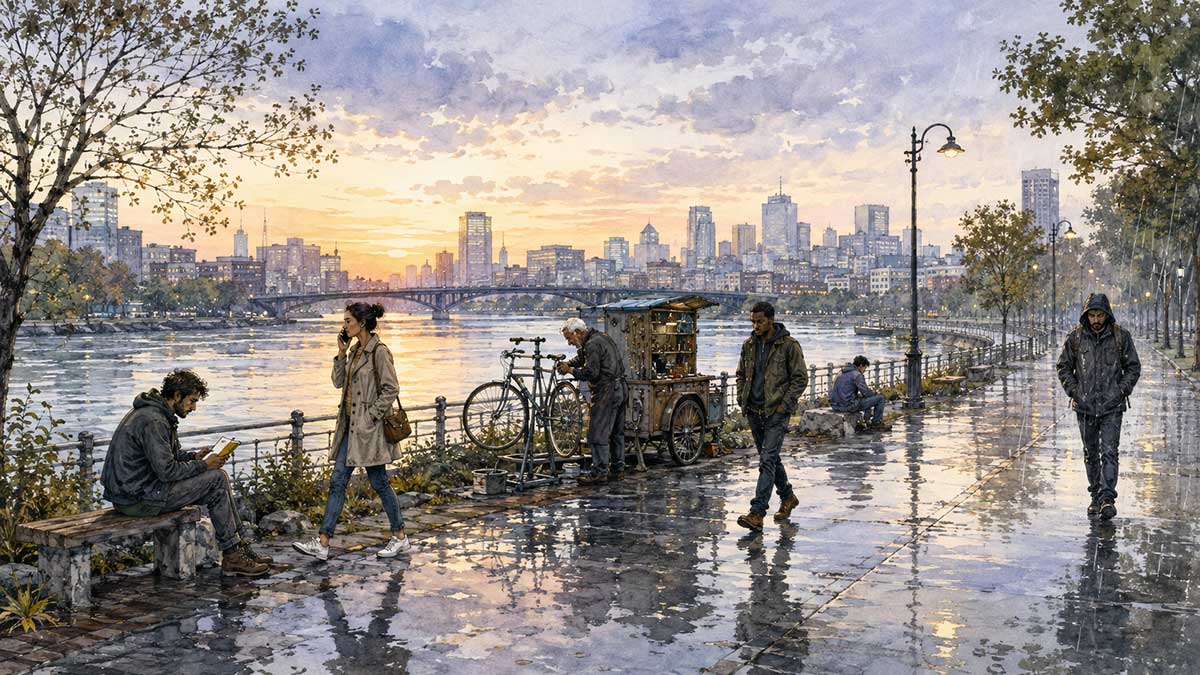
The five people in these stories are searching for something Siddhartha searched for too:
a way to live without making the wrong life.
Daniel tries to achieve certainty through experts.
Maya tries to avoid devastating loss by never becoming fully dependent on love.
Marcus tries to spare his daughter the suffering that formed him.
Evan tries to redeem pain by turning it into meaning.
Noah tries to use intelligence to reduce uncertainty itself.
None of these desires is foolish.
That is what makes them dangerous.
Good instincts can become prisons when pushed too far.
Learning can become avoidance.
Independence can become isolation.
Protection can become control.
Meaning can become appropriation.
Advice can become surrendered authorship.
The modern river running beneath these stories does not speak.
It does not reveal cosmic truths.
People simply arrive there when their usual methods stop working.
And the bicycle repairman offers perhaps the closest thing these stories have to a philosophy:
Ask.
Listen.
Think.
Then choose.
And become responsible for the choice.
That does not mean ignoring teachers.
It does not mean rejecting therapy, experience, research, religion, family, experts, or AI.
The deeper distinction is between receiving guidance and surrendering authorship.
Siddhartha could learn from Buddha without becoming Buddha.
A daughter can learn from her father without repeating his life.
A man can use AI without letting it decide who he becomes.
A person can learn from suffering without claiming ownership of everyone else’s pain.
And love can matter deeply without becoming possession.
Perhaps wisdom is less about finding the person, system, or machine with the final answer.
Perhaps it is learning which questions should never be answered entirely for us.
Short Bios:
Daniel — A successful consultant in his forties who has spent years seeking expert guidance for nearly every important choice. His fear of repeating his father’s mistakes leaves him unable to trust his own decisions.
Maya — A creative director who has worked hard to build healthy boundaries after growing up with emotionally overwhelming relationships. Her independence begins to crack when someone she loves becomes seriously ill.
Marcus — A father in recovery who rebuilt his life after addiction and financial collapse. His hard-earned wisdom becomes a source of conflict when his daughter chooses a path he believes will lead to avoidable pain.
Elena — Marcus’s twenty-one-year-old daughter, who leaves college to start a creative business across the country. She wants to learn from her father without having to live according to the conclusions he reached from his own mistakes.
Evan — A motivational speaker who transforms personal tragedy into lessons for large audiences. His success forces him to confront where his own story ends and another person’s private pain begins.
Nora — Evan’s former wife, whose most painful memories become part of his public transformation story. She challenges his belief that meaningful suffering automatically becomes shareable suffering.
Lucas — Evan’s estranged son, who resents being turned into evidence of his father’s emotional growth.
Noah — A twenty-nine-year-old engineer who relies heavily on AI for decision support. His dependence reaches its limit when he faces a life-defining choice that cannot be responsibly optimized.
Lily — Noah’s partner, who challenges him to remain present inside uncertainty rather than searching for a prediction that removes the burden of choosing.
The Bicycle Repairman — An older man who appears quietly across all five stories along the riverfront path. He offers very little advice and never presents himself as wise. His role is simply to remind people that guidance can help repair what is broken, but nobody else can choose the road afterward.
Leave a Reply