
Introduction
Hermann Hesse’s Siddhartha is often remembered as a novel about enlightenment, spiritual searching, and the wisdom of the river.
But there is another way to read it.
What if Siddhartha’s greatest lessons did not come from the Brahmins, the Samanas, Buddha, or even the river?
What if they came from the people who loved him?
His father had to watch him leave.
Govinda admired him, followed him, and eventually learned to walk a different path.
Kamala taught him desire and intimacy, yet may have known that part of Siddhartha always remained beyond her reach.
His son confronted him with the painful contradiction at the center of his life: Siddhartha demanded freedom for himself, yet struggled terribly when his own child wanted the same freedom.
In this imaginary conversation, those people meet Siddhartha again beside the river.
They do not come seeking enlightenment.
They come carrying questions.
Did Siddhartha ever look back at those he left behind?
Did he sometimes mistake independence for wisdom?
Could he love another person without turning that relationship into part of his spiritual search?
And if every mistake taught him something, does that make the pain he caused necessary?
The conversation becomes less about whether Siddhartha finally found truth and more about something painfully human:
Can someone become wise without confronting what his search cost other people?
By the end, Siddhartha is no longer simply the enlightened ferryman listening to the river.
He is a son listening to his father.
A friend listening to Govinda.
A former lover listening to Kamala.
A father listening to the child he could not keep.
And perhaps that is one more lesson hidden inside Hesse’s novel:
Sometimes wisdom begins when we stop asking what another person can teach us and start asking who that person was before we turned them into part of our own story.
(Note: This is an imaginary conversation, a creative exploration of an idea, and not a real speech or event.)
Topic 1 — Did You Ever Look Back?
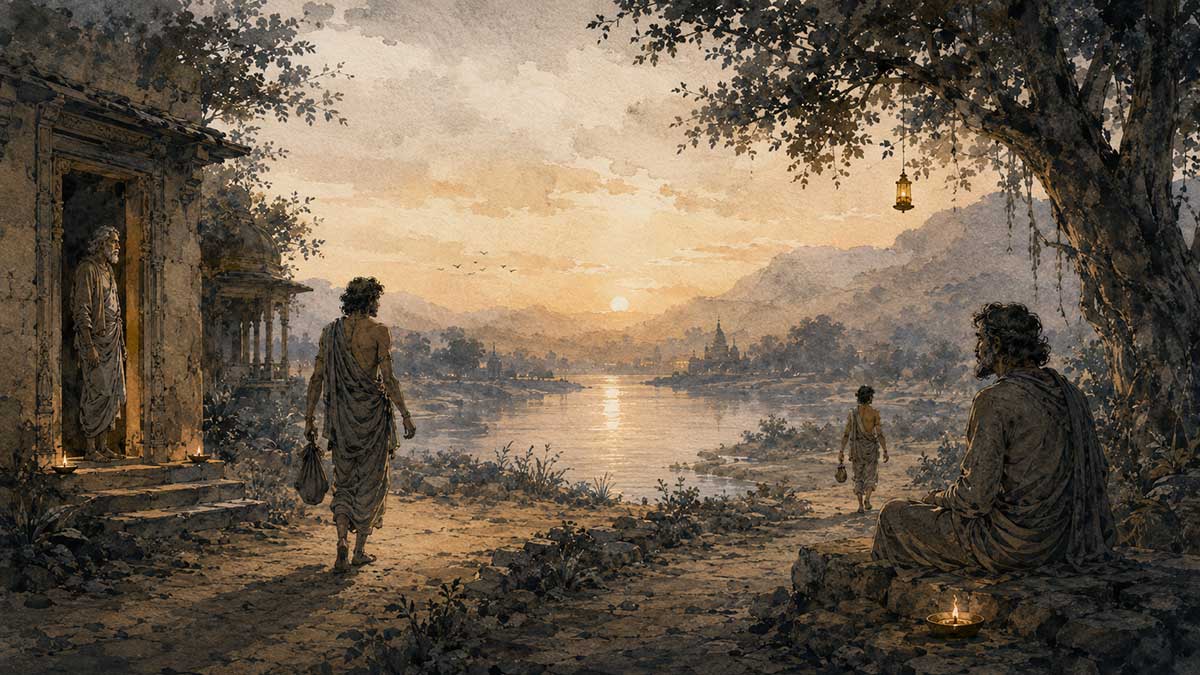
The river was quieter than Siddhartha remembered.
Not silent. Never silent.
But softer, as if the water itself had decided not to interfere.
The sun had fallen behind the trees, leaving a long band of amber across the surface. Siddhartha sat near the ferry landing with his hands resting loosely on his knees. Across from him sat the man he had not seen since his youth.
His father.
Older now. Much older.
His back was bent slightly. His face had narrowed with age. Yet Siddhartha recognized the eyes immediately.
They were the same eyes that had watched him stand motionless through an entire night many years ago.
For a long time, neither man spoke.
Govinda sat several paces away. Kamala watched from near the water. Vasudeva remained beneath the old tree, listening.
Siddhartha’s father finally looked toward the river.
Siddhartha’s Father: You still like silence.
Siddhartha: I have learned much from it.
His father gave a faint smile.
Siddhartha’s Father: Yes. I remember.
Siddhartha lowered his eyes.
Siddhartha: You are thinking of that night.
Siddhartha’s Father: I have thought of that night many times.
Siddhartha: So have I.
His father turned toward him.
Siddhartha’s Father: Have you?
Something in the question unsettled Siddhartha.
Siddhartha: Of course.
Siddhartha’s Father: Tell me what you remember.
Siddhartha closed his eyes for a moment.
Siddhartha: I remember standing in your room. I remember asking permission to join the Samanas. You refused. I remember standing there through the night until you understood that I could no longer remain.
His father nodded.
Siddhartha: I remember the pain in your face when you finally gave me your blessing.
His father looked back toward the water.
Siddhartha’s Father: And then?
Siddhartha hesitated.
Siddhartha: Then I left.
Siddhartha’s Father: Yes.
Another pause.
Siddhartha’s Father: That is the part you remember.
Siddhartha looked at him.
Siddhartha’s Father: I remember the next morning.
The words were quiet.
They struck Siddhartha harder than accusation might have.
Siddhartha’s Father: I remember walking past the place where you slept.
I remember your mother looking toward the doorway whenever footsteps came near the house.
I remember people asking where you had gone.
I remember answering calmly.
“My son has gone to seek wisdom.”
His father’s mouth tightened.
Siddhartha’s Father: Everyone thought that sounded noble.
Siddhartha said nothing.
Siddhartha’s Father: No one asked what it felt like to have a son who needed wisdom more than he needed you.
The river continued moving.
Siddhartha inhaled slowly.
Siddhartha: Father—
Siddhartha’s Father: I am not accusing you of leaving.
Siddhartha stopped.
Siddhartha’s Father: That is what I want you to hear first.
I know you had to go.
Perhaps I even knew it that night.
You had already left inside yourself before your feet crossed the doorway.
I could have locked the door.
I could have forbidden you.
I could have begged.
None of it would have brought my son back.
Siddhartha looked down at his hands.
Siddhartha’s Father: My question is simpler.
Did you ever look back?
Siddhartha lifted his head.
Siddhartha: Many times.
Siddhartha’s Father: At me?
The question stopped him.
His father leaned slightly forward.
Siddhartha’s Father: Or at the life you left?
Siddhartha remained silent.
Siddhartha’s Father: Those are not the same thing.
Govinda shifted slightly where he sat.
Kamala lowered her eyes.
Siddhartha’s father continued.
Siddhartha’s Father: Perhaps you remembered the house.
The prayers.
Your childhood.
Your teachers.
The Brahmins.
The person you once were.
But did you ever think:
“My father is growing old without knowing where I am”?
Siddhartha opened his mouth.
Nothing came.
His father watched him carefully.
Siddhartha’s Father: You see?
That silence is my answer.
Siddhartha’s face changed.
For the first time that evening, the calmness around him seemed less like serenity and more like exposure.
Siddhartha: I thought of you.
Siddhartha’s Father: I believe you.
Siddhartha: Often.
Siddhartha’s Father: I believe that too.
Siddhartha: Then what are you asking me?
His father looked directly into his eyes.
Siddhartha’s Father: Whether you thought of my pain as something real.
Not as attachment.
Not as ignorance.
Not as the suffering of a man who had not learned to let go.
My pain.
Siddhartha stared at him.
The distinction was devastating.
For much of his youth, suffering had been something to transcend.
Something produced by desire.
Something spiritual discipline might free a person from.
His father continued.
Siddhartha’s Father: When you were young, you saw attachment as weakness.
You wanted freedom from need.
Freedom from desire.
Freedom from the self.
Perhaps you looked at parents who clung to their children and thought, “They do not understand.”
Siddhartha did not deny it.
Siddhartha’s Father: Did you?
Siddhartha: Yes.
His father nodded.
Siddhartha’s Father: Then I suppose life was patient with you.
Siddhartha looked up.
Siddhartha’s Father: It waited until you had a son.
The words settled across the group.
Siddhartha’s expression tightened.
Kamala looked at him.
Govinda closed his eyes briefly.
Siddhartha’s Father: Tell me about the day he left you.
Siddhartha looked toward the river.
Siddhartha: I do not wish to speak of him as if he were only an example.
His father’s eyes softened.
Siddhartha’s Father: Good.
Siddhartha looked back, surprised.
Siddhartha’s Father: You have learned something.
A faint, sad smile appeared.
Siddhartha’s Father: Then speak of him as your son.
Siddhartha breathed in.
Siddhartha: He hated the life here.
He hated the river.
The ferry.
The simplicity.
He had known comfort with Kamala.
He did not want my life.
Siddhartha’s Father: And what did you want?
Siddhartha hesitated.
Siddhartha: I wanted him to stay.
His father nodded slowly.
Siddhartha: I wanted him to understand that his anger would pass.
That running away would not solve what was inside him.
Siddhartha’s Father: You wanted him to benefit from what you had learned.
Siddhartha: Yes.
Siddhartha’s Father: I wanted the same for you.
Siddhartha looked at him.
Siddhartha’s Father: I had lived longer.
I had suffered.
I had prayed.
I had studied.
I believed I knew dangers you could not yet see.
I believed remaining with me might save you from needless pain.
He paused.
Siddhartha’s Father: Does that sound familiar?
Siddhartha’s eyes filled slightly, though no tears fell.
Siddhartha: Yes.
Siddhartha’s Father: And did your son listen?
Siddhartha: No.
Siddhartha’s Father: Neither did mine.
Silence.
Vasudeva watched the water.
Siddhartha leaned forward, elbows resting on his knees.
Siddhartha: When he disappeared, I wanted to follow him.
Siddhartha’s Father: Of course.
Siddhartha: I wanted to find him.
Bring him back.
Protect him.
Siddhartha’s Father: Of course.
Siddhartha: Vasudeva tried to help me see that I had to let him go.
His father glanced briefly at Vasudeva.
Siddhartha’s Father: And did you?
Siddhartha: Eventually.
Siddhartha’s Father: Peacefully?
Siddhartha gave a small shake of his head.
Siddhartha: No.
Siddhartha’s Father: Neither did I.
Siddhartha looked at him again.
His father’s voice grew softer.
Siddhartha’s Father: When I gave you permission to leave, perhaps you thought I had accepted it.
I had not.
I had surrendered to something I could not prevent.
Those things look similar from the doorway.
Inside the heart, they are very different.
Siddhartha swallowed.
Siddhartha: I did not know.
Siddhartha’s Father: No.
Siddhartha: I could not have known.
His father considered this.
Siddhartha’s Father: Perhaps not.
Then he asked:
Siddhartha’s Father: But did you need to know before caring?
Siddhartha became still.
That question went somewhere deeper.
He had spent much of his life trying to know.
To know the self.
To know truth.
To know suffering.
To know unity.
But his father was asking whether knowledge had sometimes become a condition Siddhartha placed upon compassion.
Siddhartha: No.
His father waited.
Siddhartha: No. I did not need to understand your suffering to care that you suffered.
His father nodded.
Siddhartha: Yet I think I believed I did.
The old man watched him.
Siddhartha: When I was young, I thought every pain had an explanation.
Desire.
Attachment.
Ignorance.
Fear.
I believed that if one understood the cause, one could rise above the pain.
His father said nothing.
Siddhartha: I did not know that sometimes a person does not need his pain explained.
His father’s eyes shone.
Siddhartha: Sometimes he needs someone to sit beside him inside it.
The old man looked away.
For the first time, emotion overtook his composure.
He pressed his lips together.
Siddhartha noticed.
He moved slightly closer but did not touch him.
Not yet.
Siddhartha: Did you hate me?
His father shook his head immediately.
Siddhartha’s Father: No.
Siddhartha: Were you angry?
Siddhartha’s Father: Many times.
Siddhartha: Did you regret letting me go?
His father stared toward the opposite bank.
Siddhartha’s Father: Every morning for a year.
Siddhartha’s breathing changed.
Siddhartha’s Father: Then less often.
Then again whenever someone’s son returned home.
Whenever a young man passed the house who walked like you.
Whenever your mother was ill.
Whenever I grew older and wondered whether you were alive.
He looked back.
Siddhartha’s Father: Regret does not obey philosophy.
A person can know that something was necessary and still wish it had happened differently.
Siddhartha nodded slowly.
Siddhartha: If you could return to that night—
His father smiled faintly.
He already knew the question.
Siddhartha: Would you let me go?
His father looked at him for a long time.
Siddhartha’s Father: Yes.
Siddhartha seemed surprised by how quickly the answer came.
Siddhartha’s Father: I would let you go.
Then his voice broke slightly.
Siddhartha’s Father: But I would ask you to come back once.
Siddhartha’s eyes closed.
Siddhartha’s Father: Not forever.
Not to abandon your search.
Not to become the son I wanted you to be.
Just once.
Sit with me.
Tell me what you had seen.
Let me see your face again before mine became old.
Siddhartha bowed his head.
His father continued more softly.
Siddhartha’s Father: You spent years searching for yourself.
I would have liked to meet the man you found.
No one spoke.
The sound of the river seemed suddenly enormous.
Siddhartha wiped one eye with the back of his hand.
Govinda looked away to give him privacy.
Kamala did not.
She watched him carefully.
Siddhartha finally spoke.
Siddhartha: I am sorry.
His father nodded.
Siddhartha: I could tell you that I was young.
That I believed I had no choice.
That everything I became depended upon leaving.
All of that may be true.
His father waited.
Siddhartha: But those truths do not require me to defend myself from yours.
The old man's face softened.
Siddhartha: You lost your son.
And I did not return.
His father’s breathing became uneven.
Siddhartha: I am sorry.
A long silence followed.
Then his father asked:
Siddhartha’s Father: When your son left, did you think of me?
Siddhartha answered immediately.
Siddhartha: Yes.
His father looked at him.
Siddhartha: Not at first.
At first, there was only fear.
Then anger.
Then the desire to follow him.
Later, beside this river, I saw your face.
His father's expression changed.
Siddhartha: I remembered you standing at the window that morning.
I understood something then.
His father waited.
Siddhartha: But I see now that I still turned it into a lesson about myself.
His father lowered his eyes.
Siddhartha continued.
Siddhartha: “Now I understand my father.”
I thought that was enough.
It was still centered on me.
My realization.
My growth.
My wisdom.
He shook his head.
Siddhartha: I never asked the simpler question.
His father looked up.
Siddhartha: “How lonely must he have been?”
His father’s face finally collapsed.
He covered his eyes.
Siddhartha moved closer.
For a moment he seemed uncertain whether he had the right to touch him.
Then his father reached first.
His hand found Siddhartha’s wrist.
Siddhartha placed his other hand over it.
Neither spoke.
After some time, Siddhartha’s father whispered:
Siddhartha’s Father: Very lonely.
Siddhartha bowed his head until their foreheads nearly touched.
The river flowed beside them.
No revelation arrived.
No voice spoke from the water.
No sacred syllable rose above the current.
There was only an old father holding the hand of the son who had finally returned.
After several minutes, Siddhartha’s father straightened.
Siddhartha’s Father: There is one thing I want you to understand.
Siddhartha looked at him.
Siddhartha’s Father: I do not want you to regret your life.
Siddhartha: Father—
Siddhartha’s Father: Listen.
You became who you became.
Perhaps you could not have done so beside me.
Perhaps every father eventually loses the child he knew.
The old man looked toward the darkening river.
Siddhartha’s Father: But necessity and sorrow can live in the same house.
Siddhartha nodded.
Siddhartha’s Father: Do not erase one to protect the other.
He turned back toward his son.
Siddhartha’s Father: Your leaving may have been necessary.
My suffering was still real.
Both belong to the story.
Siddhartha took this in.
Siddhartha: Both belong.
His father smiled.
Siddhartha’s Father: Perhaps now you understand the river better than you did this morning.
Siddhartha almost laughed.
Then his father added:
Siddhartha’s Father: Or perhaps, for once, leave the river out of it.
Siddhartha laughed softly through his tears.
So did Govinda.
Kamala smiled.
From beneath the tree, Vasudeva’s eyes brightened.
Siddhartha looked once more at his father.
Siddhartha: I spent much of my life believing the person who leaves is the courageous one.
His father listened.
Siddhartha: I never thought enough about the courage required of the one who stays.
The old man nodded.
Night had arrived.
A small lamp near the ferry flickered in the breeze.
Siddhartha’s father looked at the doorway of darkness beyond the river, then back at his son.
Siddhartha’s Father: Every departure creates two stories.
The person who leaves remembers the road.
The person who remains remembers the empty place.
Siddhartha squeezed his father’s hand.
This time, he did not search for meaning in the sentence.
He simply held on.
Topic 2 — Was I Your Friend, or Your Follower?
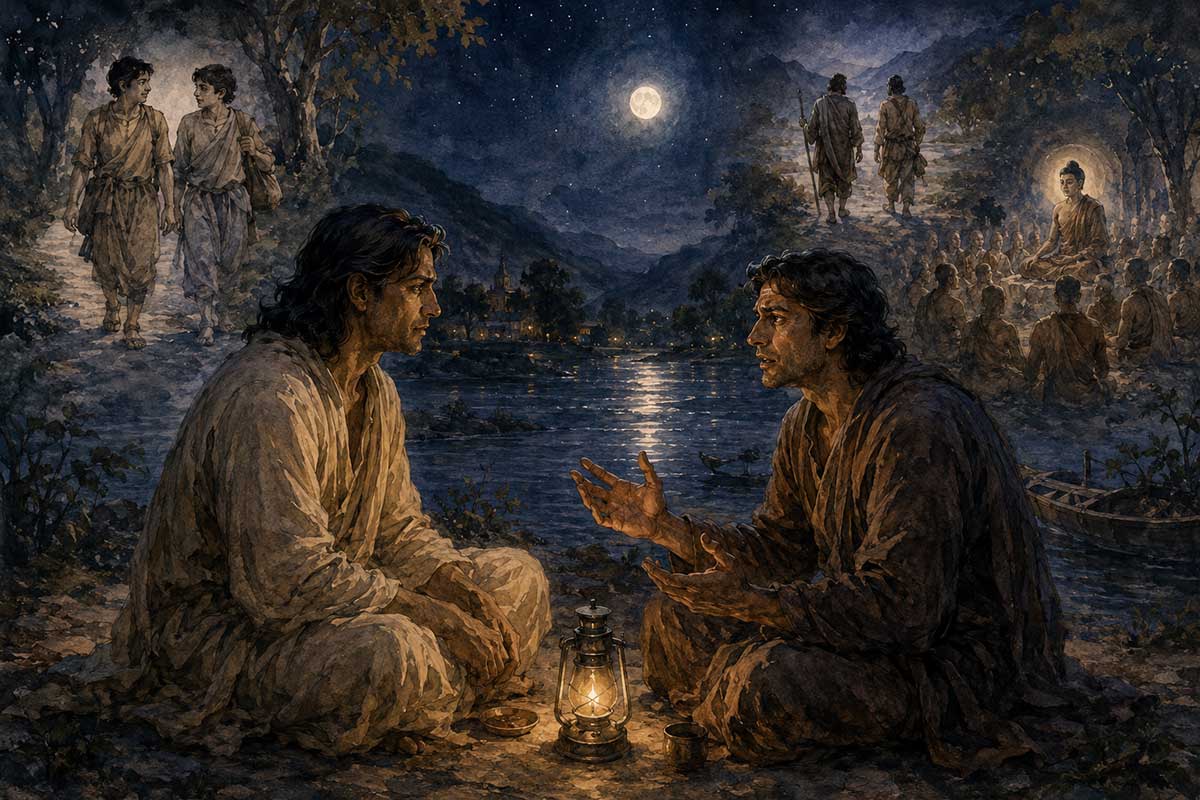
The night had deepened.
The small lamp near the ferry burned steadily now, casting a soft circle of light across the ground. Siddhartha’s father had moved back slightly, still close enough to remain part of the gathering.
Govinda had not moved much at all.
He sat with his hands folded, looking toward the river.
For years, this had been his posture.
Patient.
Devoted.
Waiting.
Siddhartha noticed it.
Siddhartha: You have been quiet.
Govinda smiled.
Govinda: I have had practice.
Siddhartha gave him a puzzled look.
Govinda: Listening to you.
A few people smiled, but Govinda did not.
His expression remained gentle.
That made Siddhartha pay closer attention.
Siddhartha: Then speak.
Govinda looked toward him.
Govinda: That is easy for you to say now.
Siddhartha’s face changed slightly.
Govinda leaned forward.
Govinda: Do you remember when we were boys?
Siddhartha: Of course.
Govinda: Everyone admired you.
The teachers.
The Brahmins.
The young men.
Your father.
Even those who disagreed with you wanted to know what you were thinking.
Siddhartha said nothing.
Govinda: And I admired you most of all.
Siddhartha: I know.
Govinda’s eyes narrowed slightly.
Govinda: Do you?
The question echoed the one Siddhartha’s father had asked earlier.
Siddhartha recognized it.
He straightened.
Govinda: You know I followed you.
You know I trusted you.
You know I wanted to walk beside you.
But did you ever ask what that friendship felt like from where I stood?
Siddhartha looked at him carefully.
Siddhartha: Tell me.
Govinda gave a small laugh.
Not bitter.
Tired.
Govinda: That is the first time you have asked.
The river moved in the darkness.
Kamala watched Govinda closely.
Siddhartha’s father lowered his gaze.
Govinda: When you decided to join the Samanas, I went with you.
Siddhartha: Yes.
Govinda: I believed that wherever you were going, truth must be somewhere nearby.
Siddhartha: You chose freely.
Govinda nodded.
Govinda: I did.
He paused.
Govinda: And that became one of your favorite truths about me.
Siddhartha frowned.
Govinda: Whenever anyone spoke of me following you, you could always say, “Govinda chose.”
And you were right.
But sometimes being technically right can protect us from seeing something harder.
Siddhartha waited.
Govinda: I chose to follow you because I loved you.
The words were simple.
They changed the air.
Govinda: Not because I lacked a mind.
Not because I had no hunger of my own.
Not because I wanted to become your shadow.
I followed you because the world seemed larger when you were in it.
Siddhartha looked down.
Govinda continued.
Govinda: You were my closest friend.
And when you questioned something, I wanted to understand the question.
When you were restless, I became restless.
When you believed there must be something beyond what we had been taught, I believed there must be something too.
Siddhartha’s eyes softened.
Siddhartha: I never thought you were weak.
Govinda: No.
Siddhartha: I respected you.
Govinda: Yes.
Siddhartha: Then what did I do?
Govinda looked directly at him.
Govinda: You kept moving.
Siddhartha went still.
Govinda: That was always the difference between us.
Whenever I began to believe we had arrived somewhere together, you had already begun looking at the next road.
When we were with the Samanas, I thought, “We are doing this together.”
You were already dissatisfied.
When we met the Buddha, I thought perhaps we had finally reached the same place.
Then you left.
Siddhartha’s mouth tightened.
Govinda: You left without anger.
That made it harder.
Siddhartha: You had chosen Buddha.
Govinda: Yes.
Siddhartha: And I respected your choice.
Govinda nodded.
Govinda: You did.
Then he leaned closer.
Govinda: But you never asked whether I was sad.
Siddhartha’s eyes shifted.
Govinda: You never said, “Govinda, I know this hurts.”
You looked at me as if we had simply reached a philosophical fork in the road.
You would go one way.
I would go another.
Everything was very clear.
Very noble.
Very free.
He smiled faintly.
Govinda: I hated how beautiful you could make leaving sound.
Siddhartha inhaled slowly.
Siddhartha: I thought you were where you wanted to be.
Govinda: I was.
Siddhartha: Then—
Govinda raised a hand.
Govinda: This is the part you have struggled with all evening.
Two things can be true.
I wanted to follow the Buddha.
And I did not want to lose you.
Siddhartha fell silent.
Govinda looked toward Siddhartha’s father.
Govinda: Your father understands.
The old man nodded.
Govinda: People like you, Siddhartha, sometimes think freedom means that once a choice is freely made, no one should mourn what the choice costs.
But choice does not cancel grief.
Siddhartha nodded slowly.
Siddhartha: No.
Govinda turned back toward him.
Govinda: Do you know what I remember most about the day we separated?
Siddhartha: What?
Govinda: You looked peaceful.
Siddhartha seemed surprised.
Govinda: You had discovered something.
You had understood that you could not follow anyone else’s path.
You looked alive.
Awake.
Almost reborn.
Govinda smiled sadly.
Govinda: And I remember thinking, “My friend has found something.”
Then he paused.
Govinda: I did not know I was losing him at the same time.
Siddhartha’s face softened with pain.
Siddhartha: Govinda—
Govinda: Let me finish.
Siddhartha nodded.
Govinda: For years, I told myself the same story everyone else told.
Siddhartha was courageous.
Govinda was devoted.
Siddhartha searched within.
Govinda followed a teacher.
You became the independent one.
I became the follower.
He looked around.
Govinda: Do you know what happens when people tell the same story about you for long enough?
Siddhartha shook his head.
Govinda: You start telling it about yourself.
His voice dropped.
Govinda: I began to wonder whether there was something lesser in me.
Whether devotion meant weakness.
Whether needing a teacher meant I had failed.
Whether loving a friend enough to follow him meant I had never truly become myself.
Siddhartha looked stricken.
Siddhartha: I never wanted you to feel that.
Govinda: I know.
Siddhartha: I never believed you were lesser.
Govinda: I know that too.
Siddhartha: Then why did you—
Govinda gave him a gentle look.
Govinda: We are not responsible only for what we intend.
Siddhartha absorbed the sentence.
Govinda: Sometimes someone can stand beside us for years and still slowly disappear inside the role we have given them.
Siddhartha looked at him.
Govinda: You were “the seeker.”
I was “the follower.”
And perhaps neither of us questioned those names enough.
The river sounded louder for a moment as water struck the rocks near the bank.
Siddhartha leaned back.
Siddhartha: Did I make you feel small?
Govinda considered the question seriously.
Govinda: Sometimes.
The answer landed heavily.
Siddhartha: How?
Govinda looked almost embarrassed.
Govinda: Not through cruelty.
That would have been easier.
He smiled faintly.
Govinda: Through certainty.
Siddhartha frowned.
Govinda: You were so certain that you had to find your own way.
So certain that no teaching could contain your truth.
So certain that experience mattered more than doctrine.
Whenever you spoke that way, I heard something else underneath.
Siddhartha waited.
Govinda: “Govinda still needs someone.”
Siddhartha shook his head.
Siddhartha: I never—
Govinda: I know.
Govinda’s tone was kind.
Govinda: You did not say it.
But friendship has many languages.
Some are spoken through words.
Some through the way one person looks at another.
Siddhartha looked away.
Govinda: You sometimes looked at me with affection.
Sometimes with respect.
And sometimes—
Govinda hesitated.
Siddhartha: Say it.
Govinda: With pity.
The silence that followed was uncomfortable.
Siddhartha did not deny it.
That hurt Govinda more than denial might have.
Govinda: Thank you.
Siddhartha looked back.
Govinda: For not pretending.
Siddhartha: There were times when I thought you had surrendered something.
Govinda nodded.
Siddhartha: I thought you had given your search to another man.
Even a man as great as the Buddha.
I wondered whether you had chosen safety.
Govinda smiled.
Govinda: And I sometimes thought you had chosen loneliness and renamed it freedom.
Siddhartha stared at him.
Kamala’s eyes moved between them.
Govinda continued.
Govinda: I thought, “He cannot stay anywhere long enough to belong.”
Siddhartha did not move.
Govinda: “He cannot love any path because the moment it becomes familiar, he fears it will own him.”
Govinda’s voice grew softer.
Govinda: Sometimes I wondered whether you were searching for truth.
Sometimes I wondered whether you simply could not bear to be someone’s student.
Siddhartha looked toward the river.
A long pause.
Then he smiled weakly.
Siddhartha: Buddha asked me something similar tonight.
Govinda: Then perhaps I am finally becoming wise.
Siddhartha laughed softly.
Govinda smiled too.
The tension loosened for only a moment.
Then Siddhartha asked:
Siddhartha: Did you regret following Buddha?
Govinda thought carefully.
Govinda: No.
Siddhartha: Never?
Govinda: I doubted.
I struggled.
I compared myself to you more often than I wish to admit.
But no.
I do not regret it.
Siddhartha looked surprised.
Govinda: You see, this is another thing I learned.
Different paths do not need to defeat one another.
Your path does not become true only if mine was wrong.
Siddhartha’s expression shifted.
Govinda leaned closer.
Govinda: Perhaps we spent too many years measuring ourselves against each other.
You feared becoming like me.
I feared failing to become like you.
Both fears were foolish.
Siddhartha looked at him with growing emotion.
Siddhartha: Were you jealous of me?
Govinda smiled.
Govinda: Terribly.
Siddhartha laughed.
Govinda: Do not look so pleased.
More laughter moved softly around the group.
Govinda continued.
Govinda: I envied your courage.
Your independence.
Your ability to leave.
Your refusal to accept an answer simply because everyone respected it.
I thought perhaps you carried something inside yourself that I lacked.
He paused.
Govinda: Were you ever jealous of me?
Siddhartha looked startled.
Siddhartha: Of you?
Govinda raised his eyebrows.
Siddhartha understood the arrogance in the reaction immediately.
Siddhartha: Forgive me.
Govinda laughed.
Govinda: That answer may have settled our entire discussion.
Siddhartha shook his head, smiling.
Then he became serious.
Siddhartha: Yes.
Govinda’s smile disappeared.
Govinda: When?
Siddhartha looked toward him.
Siddhartha: When you could believe.
Govinda’s expression changed.
Siddhartha: You could give yourself to something without constantly standing outside it and judging whether it was enough.
You could kneel before a teacher without feeling diminished.
You could belong.
Govinda stared at him.
Siddhartha: I thought that was weakness when we were young.
Later I wondered whether it was something I had never learned.
Govinda’s eyes became moist.
Siddhartha: I could leave.
You could remain.
For years, I thought leaving required more courage.
Tonight I am less certain.
Govinda looked down.
Siddhartha: Perhaps I envied your faithfulness.
Govinda: You never said that.
Siddhartha: I did not know it.
Govinda nodded.
Govinda: There were many things we did not know about each other.
Siddhartha looked at him for a long time.
Then he asked:
Siddhartha: Why did you come back to me at the end?
Govinda smiled.
Govinda: You mean when I visited the ferryman?
Siddhartha: Yes.
Govinda: I had heard people speak of a wise man by the river.
He looked at Siddhartha.
Govinda: Part of me wanted wisdom.
Siddhartha waited.
Govinda: Part of me wanted to know whether it was you.
Siddhartha’s eyes softened.
Govinda: And part of me—
Govinda stopped.
Siddhartha: What?
Govinda breathed slowly.
Govinda: Part of me still missed my friend.
Siddhartha looked down.
Govinda continued.
Govinda: I spent years surrounded by monks.
Teachers.
Seekers.
Good men.
Kind men.
Men who called me brother.
But there are friendships formed before we understand who we are.
They live somewhere different.
His voice trembled slightly.
Govinda: You knew me before I became anyone.
Siddhartha’s breathing changed.
Govinda: And I knew you before the river.
Before Kamala.
Before wealth.
Before suffering.
Before people began looking at you as if you had discovered something they wanted.
He smiled.
Govinda: I knew the boy who was restless in his father’s house.
Siddhartha wiped his eyes.
Govinda: Sometimes I wanted that boy back.
Not because he was wiser.
He was probably unbearable.
Siddhartha laughed through his tears.
Govinda: But he was my friend.
A long silence followed.
Then Siddhartha spoke.
Siddhartha: I have always thought of our separation as the moment you chose Buddha and I chose myself.
Govinda nodded.
Siddhartha: Perhaps that is too clean.
Govinda: Most memories become clean after enough years.
Life was messier.
Siddhartha smiled faintly.
Siddhartha: I was proud of leaving.
Govinda: I know.
Siddhartha: Proud that I would not follow anyone.
Govinda: I know that too.
Siddhartha: And perhaps I needed you to remain the follower.
Govinda looked up.
Siddhartha’s voice grew quieter.
Siddhartha: If you had been as independent as I believed myself to be, perhaps I would have had less proof of who I was.
Govinda’s expression softened.
Govinda: That is a difficult thing to admit.
Siddhartha: It is an ugly thing to see.
Govinda shook his head.
Govinda: No.
Seeing it is not ugly.
Refusing to see it would be.
Siddhartha looked at him.
Siddhartha: Did I use your admiration?
Govinda considered this for a long time.
Govinda: Sometimes.
Siddhartha closed his eyes.
Govinda: But I used you too.
Siddhartha opened them.
Govinda: It was easier to admire your courage than develop my own.
Easier to say, “Siddhartha knows.”
Easier to stand behind someone brilliant than risk discovering who I might become without him.
Govinda smiled sadly.
Govinda: You were not the only one hiding inside our friendship.
Siddhartha nodded.
Govinda: Perhaps that is why we needed to separate.
Siddhartha: Perhaps.
Govinda: But needing to separate does not mean the separation did not hurt.
Siddhartha: No.
Govinda looked at him with the tenderness he had carried since they were young.
Govinda: There were years when I did not want another answer.
Siddhartha waited.
Govinda: I did not want another teaching.
Another sermon.
Another meditation.
Another explanation of suffering.
His eyes filled.
Govinda: I wanted my friend.
Siddhartha’s face broke.
He moved closer.
This time there was no hesitation.
He took Govinda’s hands.
Siddhartha: I am sorry.
Govinda nodded.
Siddhartha: I thought respecting your path meant I had no right to mourn our separation.
Govinda: Perhaps we both thought that.
Siddhartha: I missed you too.
Govinda looked at him, almost startled.
Govinda: You never said that.
Siddhartha: I know.
Govinda: Why?
Siddhartha thought for a moment.
Siddhartha: I believed missing someone meant part of me wanted to go backward.
Govinda smiled sadly.
Govinda: And now?
Siddhartha squeezed his hands.
Siddhartha: Now I think sometimes missing someone simply means they mattered.
Govinda’s eyes closed.
The two men sat silently.
No teacher.
No follower.
No sage.
No disciple.
Only two boys who had grown old on different roads.
After a long time, Govinda opened his eyes.
Govinda: Siddhartha?
Siddhartha: Yes?
Govinda smiled.
Govinda: For once, do not walk anywhere.
Siddhartha smiled back.
Siddhartha: I will stay.
And beside the river that had taught Siddhartha so much about movement, the two old friends sat together without going anywhere at all.
Topic 3 — Did You Ever Love Me?
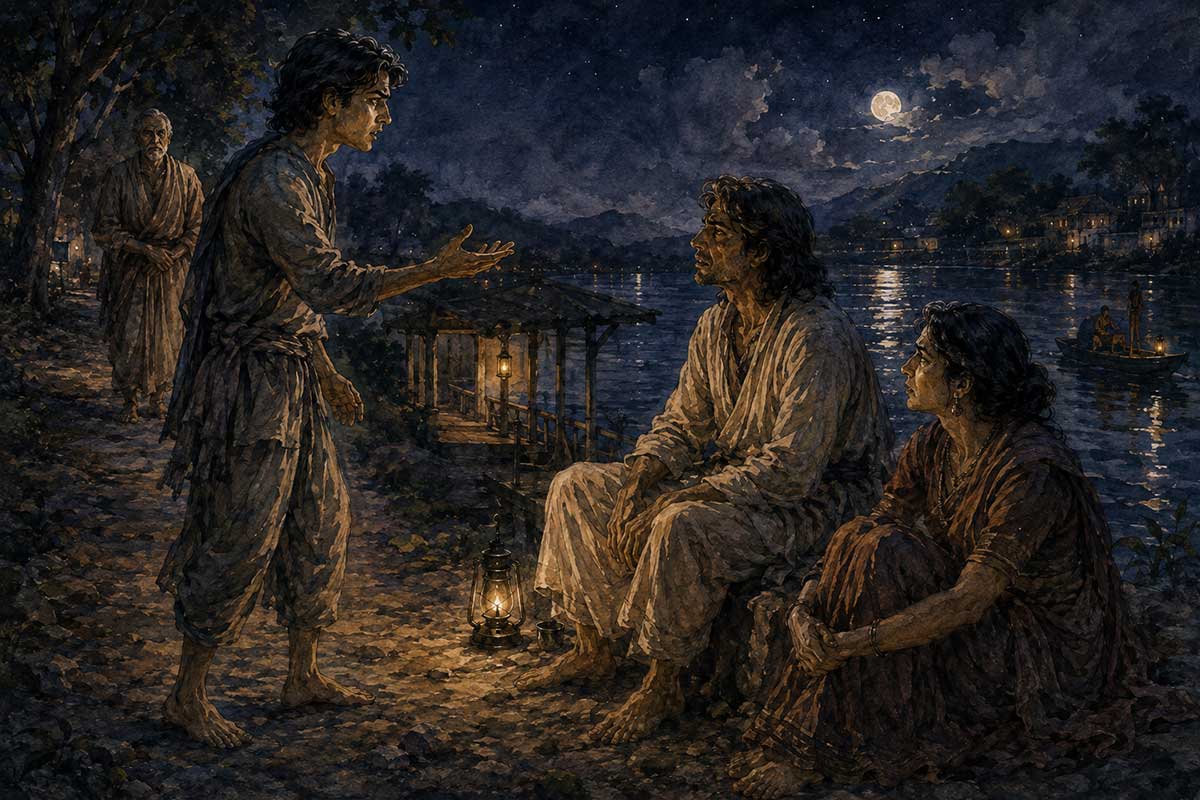
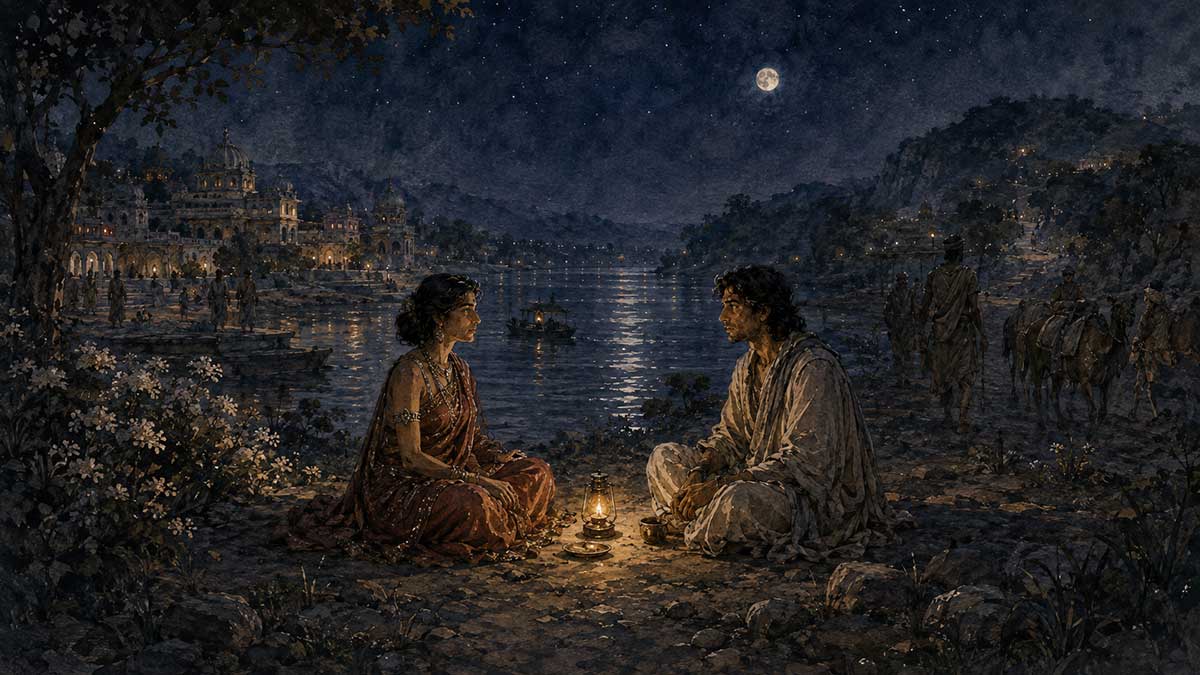
The lamp near the ferry had burned lower.
Its flame bent whenever the night air moved across the river.
Kamala had been quiet through the first two conversations.
She had watched Siddhartha speak with his father.
She had watched Govinda finally say what years of devotion had hidden.
Now she sat with one hand resting loosely against her knee.
Siddhartha looked at her.
Siddhartha: You have something to ask me.
Kamala smiled.
Kamala: You always did like arriving at the question quickly.
Siddhartha smiled back.
Kamala: That was one of your gifts.
And sometimes one of your problems.
He waited.
Kamala turned slightly toward him.
Kamala: Do you remember the first thing you wanted from me?
Siddhartha: You told me I needed fine clothes.
Kamala: Before that.
Siddhartha thought.
Then he understood.
Siddhartha: I wanted you to teach me love.
Kamala laughed softly.
Kamala: Yes.
There was no bitterness in her voice.
If anything, there was tenderness.
That made the memory more uncomfortable.
Kamala: You arrived before me as if you had come to learn another discipline.
You had learned fasting.
Meditation.
Waiting.
Thinking.
Then you decided love should be next.
Siddhartha looked down.
Kamala: Do you know what I thought when you asked?
Siddhartha: That I was foolish.
Kamala: No.
I thought you were fascinating.
Siddhartha raised his eyes.
Kamala: Most men came to me pretending they already understood love.
You were one of the few who openly admitted you did not.
Siddhartha smiled faintly.
Kamala: But there was something I did not understand then.
You approached love the same way you approached everything else.
You wanted to learn it.
Siddhartha was silent.
Kamala: And you were very good at learning.
Siddhartha: Is that wrong?
Kamala looked toward the water.
Kamala: Not wrong.
Just incomplete.
Siddhartha waited.
Kamala: Tell me.
When you first came to me, what did you think love was?
Siddhartha considered the question.
Siddhartha: Desire.
Beauty.
Pleasure.
Closeness.
The surrender of the body.
Kamala nodded.
Kamala: Very good.
You learned all of those.
Siddhartha looked at her carefully.
Siddhartha: And what did I fail to learn?
Kamala’s eyes met his.
Kamala: Need.
The word landed quietly.
Siddhartha frowned.
Kamala: You were never afraid of desire.
You were afraid of needing someone.
Siddhartha opened his mouth.
Then stopped.
Kamala leaned forward.
Kamala: There is a difference between wanting someone and allowing them to matter enough to wound you.
Siddhartha’s expression changed.
Kamala: You wanted me.
I never doubted that.
You admired me.
You enjoyed me.
You learned from me.
You trusted me more than you trusted many people.
But I often wondered whether there was any place inside you where I was allowed to become dangerous.
Siddhartha: Dangerous?
Kamala: Someone you could lose.
Siddhartha looked away.
Kamala watched him.
Kamala: There.
That look.
Siddhartha: What look?
Kamala: The one you used to have when something came too close.
You would become very calm.
Siddhartha gave a small, uneasy smile.
Kamala: Everyone thought your calmness meant you were free.
Sometimes I thought it meant you had stepped backward inside yourself.
Siddhartha lowered his eyes.
Siddhartha: I cared for you.
Kamala: I know.
Siddhartha: Deeply.
Kamala: I know that too.
Siddhartha: Then why do I feel as if you are telling me I did not love you?
Kamala did not answer immediately.
Kamala: I am asking whether you knew how.
The river moved behind them.
Siddhartha’s father looked toward Kamala with quiet interest.
Govinda sat very still.
Siddhartha: Did you love me?
Kamala smiled.
Kamala: You have always been good at returning questions.
Siddhartha: I mean it.
Kamala nodded.
Her expression became more serious.
Kamala: Yes.
In the way I knew how then.
Siddhartha looked at her.
Kamala: But I was not innocent either.
I understood people through desire.
Through beauty.
Through what they wanted from me.
I knew how to make men feel seen.
I knew how to make them return.
I knew how to remain valuable without becoming dependent.
She paused.
Kamala: Perhaps that is why we recognized each other.
Siddhartha’s eyes narrowed slightly.
Kamala: We were both skilled at closeness without surrender.
The words made Siddhartha flinch.
Kamala: You see?
You do not like that.
Siddhartha: It makes what we had sound empty.
Kamala: It was not empty.
That is why we should not lie about it.
She looked at him gently.
Kamala: Something can be beautiful and still incomplete.
Siddhartha nodded slowly.
Kamala: Do you remember when you began to change?
Siddhartha: In the city?
Kamala: Yes.
At first, you seemed amused by everything.
Money.
Trade.
Fine food.
Gambling.
Men shouting over business.
You stood among them like someone watching a play.
Siddhartha smiled.
Kamala: I think part of me liked that.
You seemed untouched.
Then gradually you became one of them.
Siddhartha’s face darkened.
Kamala: You became restless.
Hungry.
Irritated.
You began to gamble harder.
Spend more.
Want more.
Lose more.
At first I thought the world had finally reached you.
Later I realized something sadder.
Siddhartha: What?
Kamala: You had learned desire without learning love.
Siddhartha looked at her.
Kamala: Desire expands endlessly when nothing underneath it feels secure.
Siddhartha was quiet.
Kamala: You could have pleasure and still remain untouched.
You could have money and still feel poor.
You could sleep beside someone and still remain alone.
Siddhartha’s breathing slowed.
Siddhartha: Were you lonely with me?
Kamala did not answer quickly.
When she did, her voice had softened.
Kamala: Sometimes.
Siddhartha looked pained.
Kamala: Not always.
Do not punish yourself with exaggeration.
There were moments when I knew you were with me completely.
Moments when the restlessness disappeared.
Moments when you laughed.
Moments when you seemed surprised by happiness.
She smiled.
Kamala: Those moments mattered to me.
Siddhartha’s eyes softened.
Kamala: But sometimes you would look at me as if you were studying what love felt like.
And I wanted to ask:
“Must everything become wisdom later?”
Siddhartha looked down.
Kamala continued.
Kamala: Did you ever wonder what it felt like to be loved by someone who was always turning his life into a lesson?
Siddhartha winced.
Siddhartha: I did not know I was doing that.
Kamala: I know.
Siddhartha: Did you feel used?
Kamala considered it.
Kamala: Sometimes.
Siddhartha closed his eyes.
Kamala: But not in the simple way you are imagining.
You did not deceive me.
You did not promise forever.
You did not pretend to be someone you were not.
She paused.
Kamala: I sometimes felt that I existed inside your search more than you existed inside my life.
Siddhartha opened his eyes.
That was harder.
Kamala: You came to me to learn something.
Then you entered business to learn something else.
Then you left because the life you had built no longer taught you what you needed.
Siddhartha’s face tightened.
Kamala: You were always moving through worlds.
Sometimes people became part of the movement.
Siddhartha whispered:
Siddhartha: And you?
Kamala: I stayed behind.
The line hung between them.
Kamala: That does not mean I was helpless.
I had my own life.
My own choices.
My own pride.
But yes.
You left.
Siddhartha looked toward her.
Siddhartha: I did not know you were carrying my child.
Kamala nodded.
Siddhartha: If I had known—
Kamala raised a hand.
Kamala: Do not do that.
Siddhartha stopped.
Kamala: Do not build a kinder past in your mind.
We do not know what you would have done.
You might have stayed.
You might have left later.
You might have tried to become a father before you knew how.
You might have failed differently.
Siddhartha looked down.
Kamala: The past does not need our fantasies.
It needs our honesty.
Siddhartha nodded.
After a moment he asked:
Siddhartha: When did you know you loved me?
Kamala smiled faintly.
Kamala: When I stopped being pleased by how little you needed me.
Siddhartha looked up.
Kamala: At first, your independence attracted me.
You were different from men who begged.
Different from men who tried to own me.
Different from men who mistook jealousy for love.
You could leave my room without making promises.
I liked that.
She paused.
Kamala: Then one day I realized I wished you needed something from me that could not be purchased.
Siddhartha’s eyes filled slightly.
Kamala: That frightened me.
Siddhartha: Why?
Kamala: A woman in my position learns the value of being desired.
Being needed is more dangerous.
Siddhartha looked at her.
Kamala: You were not the only one afraid of dependence.
They sat in silence.
Then Siddhartha asked:
Siddhartha: If we were both afraid, did we ever have a chance?
Kamala smiled gently.
Kamala: Of course.
We had the chance we had.
Siddhartha frowned.
Kamala: Do you still think love must become permanent before it becomes real?
Siddhartha shook his head.
Kamala: Good.
Then do not reduce what happened between us simply because it did not become a life together.
Siddhartha nodded.
Kamala: We changed each other.
That was real.
We hurt each other in quieter ways.
That was real too.
You do not have to choose one.
Siddhartha looked at her with gratitude.
Siddhartha: You have always seen contradiction more easily than I did.
Kamala smiled.
Kamala: I had customers.
It was necessary.
A soft laugh moved through the group.
Then Kamala’s expression changed.
Kamala: But there is one question I have wanted to ask.
Siddhartha straightened.
Siddhartha: Ask.
Kamala looked directly at him.
Kamala: When you left the city, did you think of me?
Siddhartha froze.
The question was painfully familiar now.
His father had asked it.
Govinda had asked it in another form.
Kamala saw the realization.
Kamala: Interesting, isn't it?
Siddhartha gave a sad smile.
Siddhartha: It appears I spent much of my life being remembered by people I did not remember enough.
Kamala’s face softened.
Kamala: Answer me.
Siddhartha took a long breath.
Siddhartha: Yes.
Kamala waited.
Siddhartha: But not properly.
Kamala: What does that mean?
Siddhartha: I thought of what you represented.
The life I had entered.
Desire.
Wealth.
The person I had become.
Kamala nodded slowly.
Siddhartha: I thought of leaving all of it behind.
And you were inside that “all.”
Kamala’s eyes glistened.
Siddhartha’s voice lowered.
Siddhartha: I am ashamed of that.
Kamala looked away.
Siddhartha: You were not a symbol.
You were not a stage of my life.
You were Kamala.
She closed her eyes.
Siddhartha continued.
Siddhartha: You had mornings I did not see.
Fears I did not ask about.
Memories from before me.
Hopes that had nothing to do with my search.
You were living a life beside mine, and I often saw you mainly through what you awakened in me.
Kamala wiped one eye.
Kamala: Yes.
Siddhartha’s face broke.
Siddhartha: I am sorry.
Kamala nodded.
She did not rush to forgive him.
The silence remained.
After some time she said:
Kamala: There is something you should know.
Siddhartha looked up.
Kamala: You were not the only one who did that.
Siddhartha: What do you mean?
Kamala: I saw you through what you awakened in me too.
Siddhartha stared at her.
Kamala: You made me curious about a life beyond the one I knew.
About renunciation.
About peace.
About something larger than beauty and pleasure and influence.
You became a doorway in my mind.
She smiled sadly.
Kamala: Perhaps I did not always see you clearly either.
Siddhartha looked deeply moved.
Kamala: Love does not always begin with perfect seeing.
Sometimes we love through our own hunger first.
Siddhartha nodded.
Kamala: Perhaps maturity is learning that the other person is not there to complete our story.
Siddhartha looked toward her.
Siddhartha: And did you learn that?
Kamala smiled.
Kamala: I was learning.
Then she looked toward the dark river.
Kamala: I was on my way to see the Buddha when the snake bit me.
Siddhartha’s face tightened.
Kamala: Do you know why I wanted to see him?
Siddhartha: No.
Kamala: Not because I wanted another teacher.
Not entirely.
She paused.
Kamala: I think I was tired of being admired.
Siddhartha looked at her.
Kamala: Beauty can become a prison when everyone who looks at you sees only what they want.
Desire.
Youth.
Elegance.
Possession.
Fantasy.
She looked down at her hands.
Kamala: I wanted to stand before someone who needed nothing from me.
Siddhartha could barely speak.
Siddhartha: And instead you found me.
Kamala smiled.
Kamala: Again.
Siddhartha laughed softly, painfully.
Kamala: Strange, isn't it?
Our lives circle back to the places we thought we had passed.
Siddhartha looked at her for a long moment.
Siddhartha: Did you forgive me before you died?
Kamala considered the question.
Kamala: I was not waiting for an apology then.
Siddhartha looked surprised.
Kamala: I had changed.
You had changed.
Our son existed.
The life between us had already become larger than whatever resentment I might have carried.
She paused.
Kamala: But forgiveness is not the same as pretending nothing was missing.
Siddhartha nodded.
Kamala: I can love what we had and still wish you had seen me more fully.
Siddhartha’s eyes filled.
Kamala: Can you accept that without defending yourself?
Siddhartha looked at her.
Siddhartha: I am trying.
Kamala smiled.
Kamala: Good.
Then she moved closer.
Kamala: Now I want to ask the question you have been afraid of.
Siddhartha grew still.
Kamala: Did you love me?
The river seemed to retreat into the darkness.
Siddhartha looked at her.
This time he did not answer quickly.
He did not search for the perfect definition.
He did not speak of unity.
He did not speak of attachment.
He did not speak of desire.
Finally:
Siddhartha: Yes.
Kamala waited.
Siddhartha: But I loved you with the heart I had then.
And that heart knew how to admire.
How to desire.
How to learn.
How to leave.
It did not yet know how to remain vulnerable.
Kamala’s face softened.
Siddhartha: So yes.
I loved you.
And no.
I did not yet know the full meaning of what I was saying.
Kamala nodded slowly.
Kamala: That is the answer I wanted.
Siddhartha looked surprised.
Siddhartha: You are not angry?
Kamala: I did not ask for a beautiful answer.
I asked for a true one.
They sat facing each other.
Then Kamala said:
Kamala: I loved you too.
Siddhartha’s eyes closed.
Kamala: Not perfectly.
Not selflessly.
Not forever in the form we first knew.
But truly.
Siddhartha opened his eyes.
Kamala smiled.
Kamala: Perhaps love is not proven by perfection.
Perhaps it is proven by how deeply another person remains inside us after the version of life we shared is gone.
Siddhartha looked toward the river.
Then back at her.
Siddhartha: You remained.
Kamala: So did you.
Siddhartha reached for her hand.
She allowed him to take it.
For several moments, neither spoke.
Then Kamala leaned slightly closer.
Kamala: There is still one thing you misunderstand.
Siddhartha: What?
Kamala: You think your son was the first person who taught you how dangerous love could be.
Siddhartha looked at her.
Kamala squeezed his hand.
Kamala: I was trying to teach you that long before he was born.
Siddhartha’s expression broke into a sad smile.
Siddhartha: I was a slow student.
Kamala: Very.
They both laughed softly.
Then Kamala looked across the gathering toward the young man who had remained at the edge of the lamplight.
Their son.
His face was tense.
Closed.
Watching.
Kamala released Siddhartha’s hand.
Her expression changed.
Siddhartha followed her gaze.
For the first time that night, he seemed afraid of what was coming.
Kamala spoke quietly.
Kamala: You wanted me to teach you love.
She looked at their son.
Kamala: Now you are going to learn what it feels like when love refuses to become a lesson.
The young man stood.
And the river kept moving.
Topic 4 — You Wanted Freedom Until I Wanted Mine
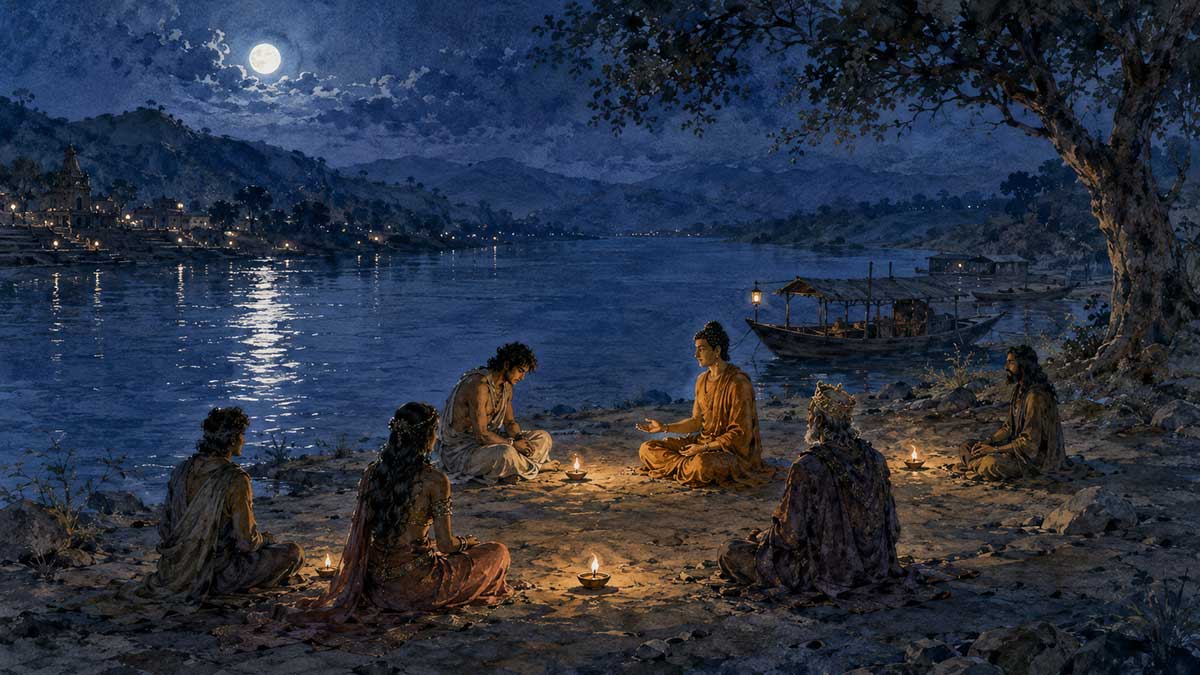
The young man stood at the edge of the lamplight.
He had his mother’s eyes.
Siddhartha had noticed that many times.
Tonight, for the first time, he wondered whether he had used that resemblance as another way not to see the son standing before him.
Kamala remained seated.
She did not call him closer.
Govinda watched quietly.
Siddhartha’s father looked from his son to his grandson and seemed to understand what was about to happen before anyone else did.
The young man stepped forward.
Siddhartha’s Son: Can everyone stop talking about what the river taught him?
No one answered.
The son looked around the gathering.
Siddhartha’s Son: Every time someone speaks about my father, the river appears.
The river taught him patience.
The river taught him unity.
The river taught him how to listen.
His eyes settled on Siddhartha.
Siddhartha’s Son: I was there before the river finished teaching him.
Siddhartha’s face tightened.
Siddhartha: I know.
Siddhartha’s Son: No.
You remember.
That is different.
Siddhartha did not respond.
His son stepped closer.
Siddhartha’s Son: Everyone here has a story about you leaving them.
Your father.
Govinda.
My mother.
And somehow every story ends with what you learned.
He gave a short, bitter laugh.
Siddhartha’s Son: You have a remarkable talent for becoming wiser from other people’s pain.
Kamala lowered her eyes.
Siddhartha absorbed the blow without moving.
Siddhartha: You are angry.
Siddhartha’s Son: There.
Siddhartha looked puzzled.
Siddhartha’s Son: That is exactly what I mean.
You turn everything into an observation.
“You are angry.”
As if naming what I feel means you have heard it.
Siddhartha opened his mouth.
His son raised a hand.
Siddhartha’s Son: Please.
Do not explain me yet.
Siddhartha went silent.
The young man sat across from him.
For a few moments, neither looked away.
Siddhartha’s Son: Do you know what I remember about coming here?
Siddhartha: Tell me.
Siddhartha’s Son: I remember my mother dying.
Siddhartha’s face changed immediately.
The son saw it.
Siddhartha’s Son: Good.
Do not move past that.
I was a boy.
My mother was dying.
I was somewhere I did not know.
With a man I did not know.
And suddenly everyone decided that man was my father.
Siddhartha closed his eyes briefly.
Siddhartha’s Son: People speak about how difficult I was.
Spoiled.
Angry.
Disobedient.
Proud.
Perhaps I was all of those things.
He leaned forward.
Siddhartha’s Son: But I was grieving.
Kamala’s face tightened.
The son continued.
Siddhartha’s Son: Did you know that?
Siddhartha: Yes.
Siddhartha’s Son: Then why did it always feel as if you were waiting for me to become better?
Siddhartha stared at him.
Siddhartha’s Son: You were patient.
Everyone admired your patience.
You did not strike me.
You did not shout.
You let my insults pass.
You gave me food.
You gave me shelter.
You tried to love me.
His voice sharpened.
Siddhartha’s Son: But sometimes patience can be cruel.
Siddhartha looked genuinely shocked.
Siddhartha: Cruel?
Siddhartha’s Son: Yes.
When someone is angry and the other person remains endlessly calm, it can feel like only one of them is permitted to be human.
Siddhartha’s breathing slowed.
Siddhartha’s Son: I would shout.
You would watch.
I would insult you.
You would wait.
I would tell you I hated the river.
You would look at me as if one day I would understand.
He shook his head.
Siddhartha’s Son: Do you know what that felt like?
Siddhartha: No.
Siddhartha’s Son: It felt like you had already decided my feelings were temporary.
That your wisdom was permanent.
Siddhartha looked down.
Siddhartha’s Son: You never said, “You are wrong.”
You did something worse.
You acted as if time would eventually prove you right.
The words struck deeply.
Vasudeva shifted beneath the tree but remained silent.
Siddhartha: I thought I was giving you space.
Siddhartha’s Son: You were giving me time to become someone you could understand.
Siddhartha looked up.
Siddhartha’s Son: That is not the same thing.
A long silence followed.
Then Siddhartha asked:
Siddhartha: What did you need from me?
His son laughed once.
There was no humor in it.
Siddhartha’s Son: I needed my mother.
Siddhartha’s eyes filled immediately.
Kamala closed hers.
Siddhartha’s Son: And you could not give me that.
No one could.
That was not your failure.
He paused.
Siddhartha’s Son: But I needed someone to understand that losing her made everything here unbearable.
The river.
The hut.
The ferry.
Your calmness.
Your kindness.
Everything.
Siddhartha watched him.
Siddhartha’s Son: Every kind thing you did reminded me that she was gone and I was now supposed to belong to you.
Siddhartha’s voice was barely audible.
Siddhartha: I did not know.
Siddhartha’s Son: I know.
That is what hurts.
Siddhartha looked toward Kamala.
She did not rescue him.
The son continued.
Siddhartha’s Son: You loved me immediately.
At least that is how you remember it.
Siddhartha: I did.
Siddhartha’s Son: I believe you.
Siddhartha seemed surprised.
Siddhartha’s Son: But your love frightened me.
Siddhartha: Why?
Siddhartha’s Son: Because it arrived before you knew me.
Siddhartha froze.
Siddhartha’s Son: You saw your son.
I saw a stranger.
You felt a bond.
I felt an obligation.
You looked at me and saw something precious that had suddenly entered your life.
I looked at you and saw the man standing where my mother used to be.
Siddhartha lowered his head.
Siddhartha’s Son: You expected love to begin where biology began.
For me, it did not.
No one moved.
The son’s voice softened.
Siddhartha’s Son: Maybe that was unfair.
I know that now.
But I was a child.
Siddhartha’s father spoke for the first time.
Siddhartha’s Father: Children are allowed to be unfair.
Everyone looked toward him.
The old man continued.
Siddhartha’s Father: That is part of what makes loving them difficult.
The son glanced at him.
Siddhartha’s Father: They do not owe us wisdom at the age we finally acquire it.
Siddhartha closed his eyes.
His son looked back toward him.
Siddhartha’s Son: Do you know what I hated most?
Siddhartha: Tell me.
Siddhartha’s Son: The way you looked at me when I wanted to leave.
Siddhartha’s expression changed.
Siddhartha’s Son: You looked wounded.
As if I were doing something terrible to you.
Siddhartha: I was afraid.
Siddhartha’s Son: I know.
But you were the man who left everyone.
The young man pointed gently, not angrily.
Siddhartha’s Son: You left your father.
You left the Samanas.
You left Govinda.
You left the city.
You left my mother.
Every time your soul told you to go, leaving became sacred.
Then I wanted to leave you.
Suddenly leaving became a tragedy.
Siddhartha had no answer.
His son leaned closer.
Siddhartha’s Son: Why was your departure freedom and mine rebellion?
Siddhartha swallowed.
Siddhartha: I do not have a good answer.
Siddhartha’s Son: Try.
Siddhartha looked at him for a long time.
Siddhartha: Because I loved you.
His son’s expression hardened.
Siddhartha’s Son: Your father loved you.
Siddhartha flinched.
His son continued.
Siddhartha’s Son: Govinda loved you.
My mother loved you.
Love did not stop you.
Why should your love have stopped me?
Siddhartha looked toward his father.
The old man did not look away.
Siddhartha: It should not have.
His son seemed surprised by the answer.
Siddhartha: I know that now.
Siddhartha’s Son: No.
Do not go there yet.
Siddhartha frowned.
Siddhartha’s Son: Do not tell me what you know now.
Tell me who you were then.
Siddhartha went still.
That was harder.
He took a slow breath.
Siddhartha: I was desperate.
His son waited.
Siddhartha: I had lost Kamala.
Then suddenly I had you.
Something opened in me that I had never known.
I wanted to protect you.
Keep you near me.
Give you something I had finally learned.
Siddhartha’s Son: What?
Siddhartha: Peace.
His son laughed softly.
Siddhartha’s Son: I did not want peace.
Siddhartha: I know.
Siddhartha’s Son: I wanted my life back.
Siddhartha nodded.
Siddhartha’s Son: The city.
People my age.
Comfort.
Noise.
Choices.
My own mistakes.
You thought those things were shallow.
Siddhartha: I had suffered through them.
Siddhartha’s Son: Exactly.
You got to suffer through them.
His voice rose for the first time.
Siddhartha’s Son: You got the city.
You got money.
You got gambling.
You got desire.
You got excess.
You got disgust.
You got to discover for yourself that those things were empty.
Then you looked at me and thought:
“I can save him the trouble.”
Siddhartha stared at him.
Siddhartha’s Son: Why?
Why were your mistakes necessary and mine unnecessary?
No one spoke.
The son continued.
Siddhartha’s Son: You built your entire life around the belief that truth could not be handed from one person to another.
Then when you became a father, you tried to hand me yours.
The words landed like a physical blow.
Govinda looked down.
Kamala’s eyes filled with tears.
Siddhartha did not defend himself.
Siddhartha’s Son: You told Buddha, in your own way, that his wisdom could not become yours.
Then you expected your wisdom to become mine.
Siddhartha whispered:
Siddhartha: Yes.
His son paused.
He had expected resistance.
Siddhartha: I did.
Siddhartha’s Son: Why?
Siddhartha shook his head.
Siddhartha: Fear.
The son looked at him.
Siddhartha: When I was young, I believed freedom was worth suffering for.
When you were young, I knew how much suffering could come.
His voice cracked.
Siddhartha: And I became afraid.
He looked directly at his son.
Siddhartha: I wanted to spare you.
Siddhartha’s Son: You wanted to spare yourself.
Siddhartha stopped.
Siddhartha’s Son: You did not want to watch me suffer.
That is different.
Siddhartha’s face changed.
Siddhartha’s Son: Sometimes parents say, “I am protecting you,” when what they mean is, “I cannot bear what your freedom might do to me.”
Siddhartha’s father nodded almost imperceptibly.
Siddhartha saw it.
For a brief moment, three generations seemed to be sitting inside the same wound.
Siddhartha: You are right.
His son stared at him.
Siddhartha: I was afraid of losing you.
And I made that fear your burden.
His son’s expression loosened slightly.
Siddhartha: I thought love gave me the right to keep trying.
His son waited.
Siddhartha: Perhaps I did not know when trying became holding.
The young man lowered his gaze.
Then he asked:
Siddhartha’s Son: Did you love me as I was?
Siddhartha looked stunned.
Siddhartha: Yes.
His son shook his head.
Siddhartha’s Son: Think before you answer.
Siddhartha stopped.
The son’s voice became quieter.
Siddhartha’s Son: Did you love me as I was?
Or did you love the boy you believed I might become once I stopped being angry?
Siddhartha stared at him.
There was nowhere to hide.
Siddhartha: Both.
His son’s face tightened.
Siddhartha continued.
Siddhartha: I loved you.
But I also imagined a future version of you.
One who would understand the river.
Understand simplicity.
Understand me.
He looked ashamed.
Siddhartha: And perhaps I sometimes loved that imagined son more easily than the real one standing before me.
His son looked away.
Kamala covered her mouth.
Siddhartha’s voice trembled.
Siddhartha: I am sorry.
The young man remained silent.
Siddhartha: I should have been more curious about who you already were.
Not only hopeful about who you might become.
His son’s eyes filled.
He blinked hard.
Siddhartha’s Son: You know what I wanted you to ask me?
Siddhartha: What?
Siddhartha’s Son: Where I wanted to go.
Siddhartha stared at him.
Siddhartha’s Son: Not why I was angry.
Not why I rejected you.
Not what lesson I needed.
Just—
“Where do you want to go?”
Siddhartha looked devastated.
Siddhartha’s Son: I wanted someone to believe I had a destination.
Everyone treated me as if I were running from something.
Maybe I was.
But I was running to something too.
Siddhartha: What?
The son looked toward the darkness beyond the trees.
Siddhartha’s Son: Myself.
Siddhartha closed his eyes.
The word returned across decades.
The same hunger.
The same rebellion.
The same need.
Siddhartha’s Son: You were allowed to search for yourself.
I wanted the same permission.
Siddhartha whispered:
Siddhartha: You should have had it.
The son looked back.
Siddhartha’s Son: I took it.
Siddhartha nodded.
Siddhartha: Yes.
You did.
A long silence followed.
Then Siddhartha said:
Siddhartha: When you left, I followed you into the city.
His son knew.
Still, hearing it directly changed something.
Siddhartha: I stood there looking at the places you might have gone.
And I remembered my own youth.
My own hunger.
My own refusal to be brought back.
He paused.
Siddhartha: That was when I began to understand.
His son’s expression hardened again.
Siddhartha’s Son: There.
Siddhartha stopped.
Siddhartha’s Son: You did it again.
Siddhartha: What?
Siddhartha’s Son: You turned me into a lesson.
Siddhartha froze.
His son’s voice shook now.
Siddhartha’s Son: That is what I cannot stand.
Everyone tells the story as if my leaving completed your education.
You suffered.
You remembered your father.
You learned attachment.
You learned compassion.
You became wiser.
His fists tightened.
Siddhartha’s Son: What about me?
Siddhartha could not speak.
Siddhartha’s Son: Did anyone ask whether I found what I was looking for?
Whether I was frightened?
Whether I failed?
Whether I loved someone?
Whether I became a father?
Whether I ever missed you?
His voice broke.
Siddhartha’s Son: I am not a bridge between two versions of you.
The words stunned everyone.
Siddhartha’s Son: I am not the suffering that finally taught Siddhartha how his father felt.
I am not the rebellious child in your enlightenment story.
I am a person.
Siddhartha’s eyes filled.
His son wiped his face angrily.
Siddhartha’s Son: Please do not make me useful.
Siddhartha stopped breathing for a moment.
The young man looked directly at him.
Siddhartha’s Son: I do not want to be the pain that helped you become wise.
I wanted to be your son.
Siddhartha bowed his head.
No one moved.
The river seemed very far away now.
Siddhartha began to speak.
Siddhartha: You taught me—
His son’s expression changed immediately.
Siddhartha stopped himself.
He closed his mouth.
A few seconds passed.
Then:
Siddhartha: I am sorry.
Nothing else.
His son stared at him.
Siddhartha did not continue.
He did not explain.
He did not place the apology inside a larger philosophy.
He did not say he had done his best.
He did not say everything had happened as it needed to happen.
He simply sat there.
Siddhartha: I am sorry.
His son’s face tightened.
Siddhartha’s Son: For what?
Siddhartha looked up.
Siddhartha: For seeing you too often through myself.
His son listened.
Siddhartha: For expecting your grief to become patience.
For expecting your anger to become gratitude.
For believing that because I had suffered certain roads, you should trust me when I told you not to walk them.
He took a breath.
Siddhartha: For wanting you to understand me before I had learned enough about you.
His son’s eyes filled again.
Siddhartha: For loving the man I hoped you would become and failing, sometimes, to love the boy you already were in the way he needed.
The young man looked down.
Siddhartha: And for following you after you had made clear that you wanted to leave.
His son wiped his face.
Siddhartha continued softly.
Siddhartha: I do not know what happened in all the years after you left.
His son looked up.
Siddhartha: And perhaps I have no right to ask tonight.
The son studied him.
Siddhartha: But if you ever want to tell me, I would like to know.
Not so I can learn from it.
His voice broke.
Siddhartha: So I can know you.
The young man looked away.
A long time passed.
Then he asked:
Siddhartha’s Son: Do you want me to forgive you?
Siddhartha thought.
Siddhartha: Yes.
The honesty surprised everyone.
Siddhartha continued.
Siddhartha: But I do not want to turn wanting it into a demand.
His son nodded slowly.
Siddhartha: You do not owe me peace so that I can feel complete.
The young man looked at him.
Siddhartha’s Son: I am not ready.
Siddhartha’s face showed pain.
But he nodded.
Siddhartha: Then you are not ready.
His son waited for more.
Nothing came.
Siddhartha’s Son: You are really going to leave it there?
Siddhartha gave a small, sad smile.
Siddhartha: I am trying to.
The son almost smiled.
Almost.
Kamala watched them both.
Then she spoke quietly.
Kamala: May I ask him something?
Her son looked toward her.
His face changed immediately.
He was younger when he looked at her.
Siddhartha’s Son: Yes.
Kamala: Were you happy after you left?
He stared at her.
The question seemed to reach him from a great distance.
Siddhartha’s Son: Sometimes.
Kamala smiled through tears.
Kamala: Good.
Siddhartha’s Son: Sometimes I was miserable.
Kamala: That sounds more believable.
A soft laugh escaped him.
Siddhartha’s Son: I made mistakes.
Kamala: Good.
He looked puzzled.
Kamala: They were yours.
Her son’s face broke slightly.
Kamala continued.
Kamala: I am sorry I was not there for them.
He looked down.
Siddhartha’s Son: I missed you.
Kamala closed her eyes.
Kamala: I know.
Siddhartha’s Son: No.
He looked toward Siddhartha, then back at her.
Siddhartha’s Son: I think tonight we are supposed to stop saying that.
Kamala opened her eyes.
A tear rolled down her face.
Kamala: You are right.
Her son swallowed.
Siddhartha’s Son: I missed you every day for a long time.
Kamala nodded through tears.
Siddhartha’s Son: And I hated him for being alive when you were not.
Siddhartha closed his eyes.
Kamala reached toward her son.
He hesitated.
Then moved close enough for her to touch his face.
Kamala: That was a heavy thing for a boy to carry.
His face collapsed.
Siddhartha’s Son: I did not know where to put it.
Kamala: I know that now.
He leaned into her hand.
For a moment he was no longer the angry young man.
He was simply her child.
Siddhartha watched them.
He did not intrude.
After some time, the son sat back.
His breathing steadied.
He looked toward Siddhartha.
Siddhartha’s Son: There is one thing I want you to know.
Siddhartha waited.
Siddhartha’s Son: I did think about you.
Siddhartha’s eyes widened.
Siddhartha’s Son: Not at first.
For a long time I wanted nothing to do with you.
Then years passed.
I started remembering things.
The food you left for me.
The way you never struck me when I deserved it.
The way you waited outside when I would not speak.
The way you looked when I ran away.
Siddhartha’s eyes filled.
Siddhartha’s Son: I did not understand that look then.
Siddhartha did not move.
Siddhartha’s Son: Later I did.
The young man looked toward Siddhartha’s father.
Then back.
Siddhartha’s Son: Perhaps families keep learning the same pain one generation late.
Siddhartha’s father gave a sad smile.
The son looked back at his father.
Siddhartha’s Son: That does not mean everything is forgiven.
Siddhartha: I know.
Siddhartha’s Son: Stop saying that.
Siddhartha almost laughed.
Siddhartha: I will try.
A faint smile finally appeared on his son’s face.
It disappeared quickly.
But Siddhartha had seen it.
The young man stood.
Siddhartha instinctively began to rise.
Then stopped himself.
His son noticed.
Siddhartha’s Son: You are not going to follow me?
Siddhartha looked at him.
Siddhartha: Where do you want to go?
His son stared at him.
The question hung between them.
The question he had wanted decades ago.
Something in his face softened.
He looked toward the riverbank.
Then back at Siddhartha.
Siddhartha’s Son: Not far.
Siddhartha nodded.
Siddhartha: Then I will be here.
His son took several steps into the darkness.
Then stopped.
He turned.
Siddhartha’s Son: Father?
Siddhartha’s breath caught.
It was the first time that night he had called him that.
Siddhartha: Yes?
The young man hesitated.
Siddhartha’s Son: Do not turn this into a lesson either.
Siddhartha smiled through tears.
Siddhartha: I will do my best.
His son nodded.
Then walked along the bank.
Siddhartha remained seated.
He watched him go.
He did not follow.
The river flowed beside him.
For once, Siddhartha did not ask it what the moment meant.
Topic 5 — Was Your Search Another Form of Ego?
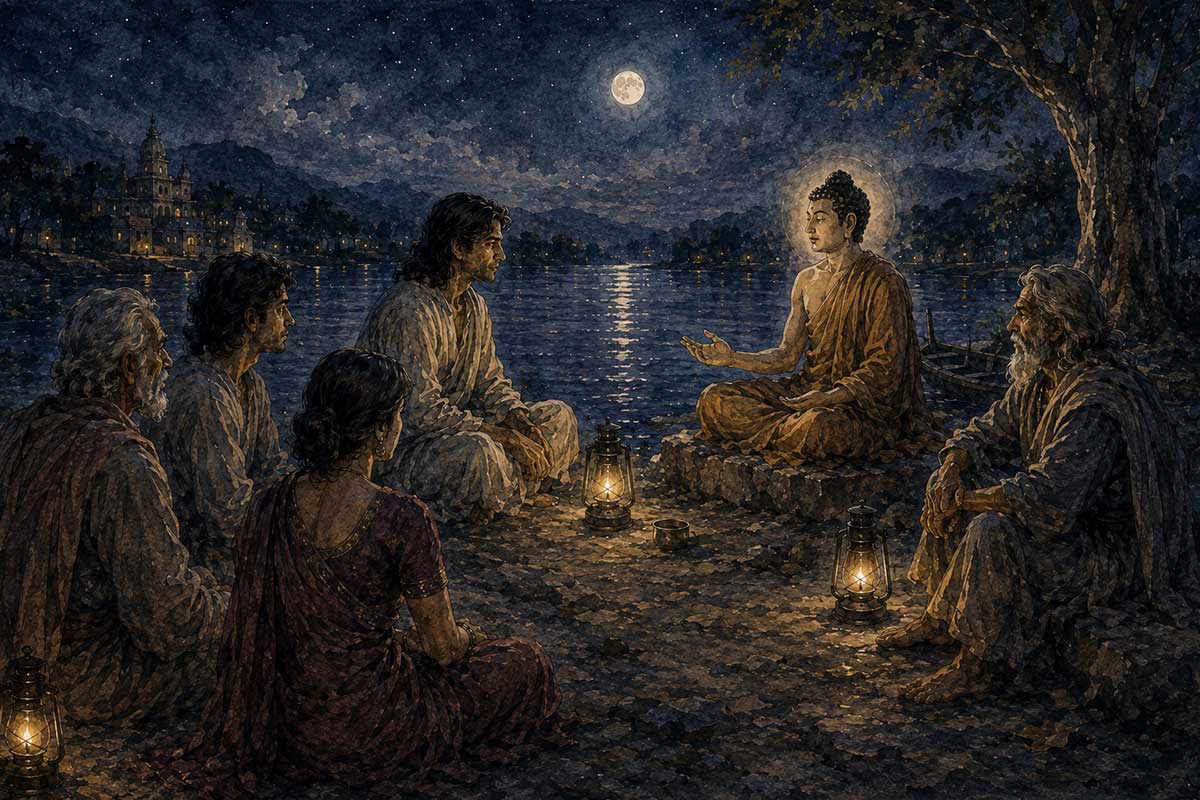
The night had become almost completely dark.
The lamps near the ferry were the only points of light now.
No one spoke for a long time after Siddhartha’s son disappeared along the riverbank.
Siddhartha remained where he was.
His hands rested loosely in his lap.
For once, he did not seem peaceful.
He seemed tired.
Not physically tired.
Something deeper.
The kind of tiredness that comes when a person can no longer maintain the story he has been telling about himself.
Then footsteps sounded on the path.
Slow.
Measured.
No one turned immediately.
Vasudeva did.
He smiled.
Govinda looked up.
His face changed.
Govinda: Teacher.
Siddhartha turned.
Gautama Buddha stood at the edge of the lamplight.
Siddhartha rose.
For a moment, the old tension between reverence and independence returned to his face.
He bowed.
Siddhartha: Illustrious One.
Buddha looked at him gently.
Buddha: You still greet me with great respect.
Siddhartha: I have never lacked respect for you.
Buddha smiled.
Buddha: Only obedience.
Govinda lowered his eyes to hide a smile.
Siddhartha smiled too.
Siddhartha: That is fair.
Buddha sat.
No one asked why he had come.
For a few moments, he looked around at the faces gathered there.
Siddhartha’s father.
Govinda.
Kamala.
Vasudeva.
Then at Siddhartha.
Buddha: You have had a difficult evening.
Siddhartha gave a short laugh.
Siddhartha: I have had many teachers tonight.
Buddha: Have you?
Siddhartha looked puzzled.
Buddha continued.
Buddha: Or have you had many people speaking to you?
The question seemed small.
It was not.
Siddhartha looked toward him.
Siddhartha: Is there a difference?
Buddha: Perhaps that depends on whether you can hear someone without needing to turn what they say into wisdom.
Siddhartha went still.
Kamala looked down.
Govinda watched carefully.
Buddha’s voice remained gentle.
Buddha: You have always been a gifted learner.
Siddhartha smiled faintly.
Siddhartha: I suspect that is not entirely praise.
Buddha: No gift is entirely safe.
Siddhartha nodded.
Buddha: You learned from Brahmins.
Then from Samanas.
Then from desire.
Then wealth.
Then despair.
Then the river.
Then love.
Then loss.
Buddha paused.
Buddha: You have been very skilled at converting life into instruction.
Siddhartha’s face tightened.
Siddhartha: You think that was wrong?
Buddha: I think it was incomplete.
Siddhartha listened.
Buddha: Tell me something.
Why did you leave me?
Govinda looked between them.
Siddhartha answered carefully.
Siddhartha: I believed your teaching was true.
Buddha waited.
Siddhartha: I believed you had reached what you spoke of.
But I also believed that what you had experienced could not be given to me through words.
Buddha: Yes.
Siddhartha: I needed to find my own path.
Buddha: Yes.
Siddhartha waited.
Buddha: And were you right?
Siddhartha hesitated.
Siddhartha: I believe so.
Buddha smiled.
Buddha: You still enjoy that answer.
Siddhartha looked almost offended.
Then caught himself.
Govinda saw it.
Govinda: He does.
Siddhartha looked toward him.
Govinda shrugged.
Govinda: We have discussed this.
A little laughter moved through the group.
Buddha continued.
Buddha: I do not think you were wrong.
Siddhartha looked surprised.
Buddha: A person must walk.
No one can lend another person his eyes.
No one can breathe for another.
No one can receive awakening on another person’s behalf.
Siddhartha relaxed slightly.
Buddha noticed.
Buddha: There.
Siddhartha frowned.
Siddhartha: What?
Buddha: Relief.
Siddhartha remained silent.
Buddha: You wanted me to say you were right.
Siddhartha opened his mouth.
Stopped.
Buddha smiled.
Buddha: That desire did not disappear when you left me.
Siddhartha looked away.
Buddha: Perhaps your problem was never that you rejected teachers.
Perhaps it was that you needed to know you could not be taught.
Siddhartha’s face changed.
Siddhartha: Explain.
Buddha: You took pride in independence.
Siddhartha did not deny it.
Buddha: You were young.
Intelligent.
Restless.
You could see weaknesses in systems others accepted.
That ability protected you from blind obedience.
It may have protected you from certain illusions.
Buddha leaned slightly forward.
Buddha: But a person can become attached to seeing what others cannot.
Siddhartha’s eyes narrowed.
Buddha: There is pride in following a teacher.
There can be pride in refusing one.
Siddhartha looked toward Govinda.
Govinda said nothing.
Buddha: You believed Govinda needed a path.
You believed you needed none.
Which man was more attached?
Siddhartha thought for a long time.
Siddhartha: I was attached to not being attached.
Buddha smiled.
Buddha: That is a difficult knot.
Govinda laughed softly.
Govinda: He carried it elegantly.
Siddhartha shook his head.
Siddhartha: I begin to regret inviting everyone.
Kamala smiled.
Kamala: You did not invite us.
Siddhartha laughed.
The moment passed.
Buddha looked at him again.
Buddha: When you rejected my path, did you reject the teaching?
Siddhartha: No.
Buddha: Or did you reject the possibility that another person could know something before you did?
Siddhartha stared at him.
The question went deeper.
Siddhartha: I do not know.
Buddha: Good.
Siddhartha frowned.
Buddha: You once seemed to know everything about why you did what you did.
Not knowing may suit you.
Siddhartha smiled reluctantly.
Siddhartha: You are harsher than I remember.
Buddha: Age has made you more sensitive.
Govinda laughed out loud.
Even Siddhartha joined him.
Then Buddha’s expression softened.
Buddha: Siddhartha, I do not say this to diminish your path.
Your path was yours.
It brought you here.
But there is a question you may still need to ask.
Siddhartha: Which one?
Buddha: How much of your search was hunger for truth?
Siddhartha waited.
Buddha: And how much was hunger to be the one who found it?
No one moved.
Siddhartha looked toward the river.
His voice was quieter when he answered.
Siddhartha: I do not know where one ended and the other began.
Buddha: Perhaps they were mixed.
Siddhartha nodded.
Buddha: Human motives often are.
Siddhartha looked toward him.
Siddhartha: Does that make the search false?
Buddha: No.
A muddy hand may still lift water.
A proud man may still encounter truth.
A frightened person may still act courageously.
Purity is sometimes another fantasy.
Siddhartha absorbed this.
Buddha: The question is not whether your motives were perfect.
The question is whether you can see them now without building another identity around seeing them.
Siddhartha gave him a tired smile.
Siddhartha: You leave very little room to feel spiritually accomplished.
Buddha: That may be useful.
Govinda lowered his head, smiling.
Siddhartha looked back at Buddha.
Siddhartha: Then tell me.
If wisdom cannot be transferred, why did you teach?
Govinda raised his eyes.
The question belonged to both of them.
Buddha looked at the river.
Buddha: A person can point at a road without walking it for someone else.
Siddhartha listened.
Buddha: A teacher cannot give sight.
A teacher can sometimes help a person notice that he is looking in the wrong direction.
Siddhartha: Then teaching matters.
Buddha: Yes.
Siddhartha: But it cannot complete the work.
Buddha: No.
Siddhartha: Then perhaps I rejected teaching too completely.
Buddha smiled.
Buddha: Perhaps you needed to.
Siddhartha looked surprised.
Buddha: You were not ready to receive it without becoming trapped by it.
Siddhartha’s face softened.
Buddha: Later you may have been ready to hear what you once had to reject.
Siddhartha: So I was wrong.
Buddha: Why do you still need that word?
Siddhartha became quiet.
Buddha continued.
Buddha: Wrong.
Right.
Teacher.
Student.
Wise.
Foolish.
These words help us think.
Then we begin living inside them.
You have spent much of your life escaping names.
Do not become trapped in new ones now.
Siddhartha nodded.
Kamala watched him.
Kamala: May I ask something?
Buddha turned toward her.
Buddha: Yes.
Kamala: He often says everything belonged to his path.
The city.
The wealth.
The gambling.
The despair.
His son leaving.
All of it.
Buddha waited.
Kamala: Is that dangerous?
Siddhartha looked toward her.
Kamala continued.
Kamala: If every mistake becomes necessary afterward, what happens to responsibility?
The question changed the mood.
Buddha looked toward Siddhartha.
Buddha: What do you think?
Siddhartha took a long breath.
Siddhartha: I once believed I had to experience everything I experienced.
Kamala: That is not an answer.
Siddhartha nodded.
Siddhartha: No.
He thought.
Siddhartha: Perhaps I learned from what happened.
That does not mean it had to happen.
Kamala’s expression softened.
Buddha nodded.
Buddha: A road can teach you without becoming innocent.
The group fell silent.
Siddhartha looked toward his father.
Then toward Govinda.
Then Kamala.
The place where his son had been sitting remained empty.
Buddha continued.
Buddha: Suppose a man harms another.
Years later, he learns compassion from the regret.
Was the harm good?
Siddhartha: No.
Buddha: Was the compassion false?
Siddhartha: No.
Buddha: Then both may be true.
Siddhartha looked toward his father.
Buddha: People sometimes want suffering to become meaningful so badly that they begin defending the suffering.
Siddhartha listened closely.
Buddha: Meaning does not erase injury.
Growth does not refund pain.
Wisdom does not make every step that led to it righteous.
Siddhartha’s eyes lowered.
Siddhartha: Then I cannot say, “Everything had to happen so I could become this.”
Buddha: You may say it if you enjoy comforting yourself.
Siddhartha gave a short laugh.
Buddha smiled.
Buddha: But you cannot know.
Siddhartha nodded.
Buddha: Perhaps another road could have taught you sooner.
Perhaps a kinder road existed.
Perhaps not.
Human beings often make a shrine of the road they survived.
Siddhartha looked deeply affected.
Buddha: Be grateful for what you learned.
Do not worship the wound.
Siddhartha remained still.
Govinda looked toward Buddha.
Govinda: Then should we regret our mistakes?
Buddha turned toward him.
Buddha: Regret can become another form of attachment.
But refusal to regret can become pride.
Govinda smiled faintly.
Govinda: You have made both options inconvenient.
Buddha: That is often the nature of truth.
Siddhartha looked toward his father.
Siddhartha: I regret not returning.
His father’s eyes filled.
Siddhartha turned toward Govinda.
Siddhartha: I regret treating your devotion as something beneath my independence.
Govinda nodded.
Siddhartha looked toward Kamala.
Siddhartha: I regret seeing you too often through what you gave my life.
Kamala listened quietly.
Then Siddhartha looked at the empty place beside the river.
His voice broke.
Siddhartha: I regret believing my son needed my wisdom more than he needed my curiosity.
No one spoke.
Buddha waited.
Siddhartha continued.
Siddhartha: And yet—
He looked around.
Siddhartha: I cannot hate the man who made those mistakes.
Buddha smiled.
Buddha: Good.
Siddhartha looked toward him.
Siddhartha: Why?
Buddha: Hatred is another refusal to see the whole person.
Siddhartha nodded slowly.
Buddha: You may regret what he did.
You may understand why he did it.
You may love him.
You may wish he had chosen differently.
These do not cancel one another.
Siddhartha breathed deeply.
Siddhartha: For years I believed enlightenment meant seeing everything as one.
Buddha: And now?
Siddhartha looked around.
Siddhartha: Perhaps I used unity too easily.
Buddha waited.
Siddhartha: It is simple to say everything belongs.
Harder to sit beside the person who tells you what your part of “everything” cost them.
Buddha’s smile deepened.
Buddha: Now you are listening.
Siddhartha laughed softly.
Siddhartha: There you are teaching me again.
Buddha: And there you are noticing.
They smiled at each other.
Then Siddhartha’s expression became serious.
Siddhartha: May I ask you something more personal?
Buddha nodded.
Siddhartha: When I left you—
He paused.
Siddhartha: Did you think I was arrogant?
Govinda looked suddenly interested.
Buddha considered the question.
Buddha: Yes.
Siddhartha blinked.
Kamala laughed.
Siddhartha looked around.
Siddhartha: I see everyone is enjoying this.
Buddha continued.
Buddha: I thought you were arrogant.
And sincere.
And intelligent.
And afraid.
Siddhartha’s smile faded.
Siddhartha: Afraid of what?
Buddha: Of belonging.
Siddhartha stared at him.
Buddha’s voice softened.
Buddha: Belonging requires surrendering the fantasy that you remain entirely self-created.
Siddhartha went still.
Buddha: You wanted to become yourself without owing too much to anyone.
Your father.
Your teachers.
Your traditions.
Me.
Later, perhaps Kamala.
Perhaps even your son.
Siddhartha looked down.
Buddha: Independence protected you.
But protection can become isolation.
Govinda whispered:
Govinda: I told you.
Siddhartha looked toward him.
Govinda smiled.
Govinda: Loneliness renamed freedom.
Siddhartha shook his head.
Siddhartha: I am never going to hear the end of that.
Govinda: No.
The small laughter faded.
Siddhartha looked toward Buddha.
Siddhartha: Then what is freedom?
Buddha did not answer immediately.
Buddha: Perhaps freedom is not needing to prove that no one owns you.
Siddhartha listened.
Buddha: Perhaps it is being able to receive something from another person without becoming less yourself.
Siddhartha’s eyes moved toward Govinda.
Then Kamala.
His father.
Vasudeva.
Buddha: You spent many years protecting your path from other people.
Siddhartha nodded.
Buddha: Tonight you have allowed other people into the meaning of your life.
Siddhartha looked toward him.
Buddha: That may require more courage than leaving them did.
Siddhartha’s father closed his eyes briefly.
Kamala looked away.
Siddhartha did not answer.
Then he turned toward Vasudeva.
The ferryman had remained almost completely silent.
Siddhartha: Vasudeva.
Vasudeva looked at him.
Siddhartha: You have heard everything.
Vasudeva smiled.
Siddhartha: What does the river say?
Vasudeva’s smile widened.
He stood.
Walked a few steps closer.
Everyone waited.
Vasudeva: Tonight?
Siddhartha: Yes.
Vasudeva looked toward the water.
Then toward Siddhartha’s father.
Govinda.
Kamala.
The darkness where Siddhartha’s son had gone.
Buddha.
Finally back to Siddhartha.
Vasudeva: Tonight, perhaps you should stop asking the river.
Siddhartha looked confused.
Vasudeva gestured toward everyone around him.
Vasudeva: Listen here.
No one spoke.
Siddhartha looked at each face.
The father whose pain he had understood too late.
The friend whose loyalty he had mistaken for dependence.
The woman he had loved without fully knowing how to need.
The empty place left by the son who refused to become a lesson.
The teacher he had rejected partly so he could remain the author of his own awakening.
Siddhartha closed his eyes.
The river still moved.
But now he heard breathing.
Someone shifting on the ground.
Govinda clearing his throat.
His father’s tired exhale.
Kamala quietly crying.
The faint footsteps of his son somewhere farther along the bank.
Human sounds.
Ordinary sounds.
For years, Siddhartha had listened to the river until he could hear all of life within it.
Tonight he tried something harder.
He listened to each person separately.
Without joining them too quickly.
Without making them symbols.
Without turning their pain into his enlightenment.
After a long time, Siddhartha opened his eyes.
Siddhartha: I thought wisdom meant discovering that everything was one.
Buddha watched him.
Siddhartha: Perhaps love requires remembering that everyone is one person too.
Kamala’s face softened.
Govinda smiled.
Siddhartha’s father reached for his hand.
Siddhartha held it.
Then he looked toward the dark riverbank where his son had disappeared.
He did not call him back.
He did not follow.
He simply left a place beside him empty.
Not as a symbol.
Not as a lesson.
As a place his son could return to.
If he chose.
And for once, Siddhartha did not need to know what happened next.
Final Thoughts
The most moving idea in Siddhartha may not be that wisdom cannot be taught.
It may be that wisdom does not excuse us from relationship.
Siddhartha spends much of his life resisting attachment. He wants to experience truth directly. He refuses to live through another person’s doctrine.
Yet love eventually places him in exactly the position he once resisted.
His son will not follow him.
His son will not accept his wisdom.
His son must live his own life.
Suddenly Siddhartha understands his father differently.
That circle is painful precisely because it cannot be solved intellectually.
The father may have been right to let Siddhartha go and still have suffered terribly.
Siddhartha may have loved Kamala and still have failed to see her fully.
Govinda may have chosen his own path and still have mourned losing his friend.
Siddhartha may have loved his son deeply and still have tried to protect him from the very freedom that formed Siddhartha himself.
None of those truths needs to defeat the others.
Perhaps that is where the river finally matters most.
It does not erase contradiction.
It carries it.
Near the end of our conversation, Siddhartha begins to see something he had overlooked for much of his life.
He spent years listening for the single voice beneath all voices.
But love may ask for the opposite skill too:
to hear one person without immediately turning that person into part of the whole.
A father is not merely a lesson about attachment.
Govinda is not merely an example of devotion.
Kamala is not merely a teacher of sensual love.
A son is not merely the suffering through which Siddhartha becomes compassionate.
They are people.
And perhaps Siddhartha’s final act of humility is learning to let them remain so.
Short Bios:
Siddhartha — The central character of Hermann Hesse’s novel, a Brahmin’s son who rejects inherited religious answers and searches for wisdom through asceticism, desire, wealth, despair, love, loss, and finally life beside the river.
Govinda — Siddhartha’s childhood friend and fellow seeker. He follows Siddhartha into the life of the Samanas before becoming a disciple of Gautama Buddha. His path raises questions about friendship, devotion, individuality, and the difference between following and belonging.
Kamala — A sophisticated courtesan who teaches Siddhartha about sensual love and introduces him to worldly life. She later becomes the mother of Siddhartha’s son and undertakes her own spiritual search.
Siddhartha’s Son — The child of Siddhartha and Kamala. After Kamala’s death, he lives unwillingly with Siddhartha beside the river before running away. His rebellion forces Siddhartha to experience the parental suffering he once caused his own father.
Siddhartha’s Father — A respected Brahmin who reluctantly allows his son to leave home. His quiet grief becomes far more meaningful once Siddhartha experiences a similar loss through his own son.
Vasudeva — The ferryman who becomes Siddhartha’s companion and quiet guide. Rather than teaching through doctrine, Vasudeva listens and encourages Siddhartha to listen deeply to the river and to life.
Gautama Buddha — The enlightened teacher Siddhartha greatly respects but chooses not to follow. Their encounter becomes central to the novel’s question of whether wisdom can truly be transmitted from one person to another.
Hermann Hesse — German-Swiss novelist, poet, and essayist who received the Nobel Prize in Literature in 1946. Siddhartha, first published in 1922, became one of his best-known works and continues to attract readers interested in spirituality, individuality, self-discovery, and the search for meaning.
Leave a Reply