

What if remaining neutral could still make you responsible for another person's suffering?
Introduction by Albert Camus
When I wrote The Stranger, I did not intend to create a hero.
Nor did I intend to create a villain.
I wanted to place one ordinary man before a series of ordinary decisions and ask whether honesty alone is enough to guide a human life.
For many years, readers argued about Meursault.
Was he truthful?
Was he detached?
Was he courageous enough to refuse hypocrisy?
Or did his refusal to pretend become another kind of blindness?
Those questions have remained alive because they belong to every generation.
This story begins where those questions lead us today.
The world has changed.
Courtrooms now compete with television studios.
Newspapers have been joined by social media.
A single photograph can shape public opinion before a witness ever takes the stand.
Political movements have grown louder.
Public judgment has become faster.
Yet one thing has not changed.
Human beings still make countless small decisions before they face one irreversible moment.
Most lives are not changed by one dramatic choice.
They are changed by a thousand quiet agreements.
"I'll drive."
"I'll carry it."
"I'll stay."
"It probably doesn't matter."
This is not a retelling of The Stranger.
It is an answer to it.
It asks whether silence can become a form of participation.
Whether refusing to choose is itself a choice.
Whether another person's life can slowly disappear behind arguments, headlines, and symbols.
Above all, it asks whether moral responsibility begins long before tragedy arrives.
Perhaps it begins in the unnoticed moment...
before we say yes.
(Note: This is an imaginary conversation, a creative exploration of an idea, and not a real speech or event.)
Topic 1: Was Meursault Emotionless—or Simply Honest?
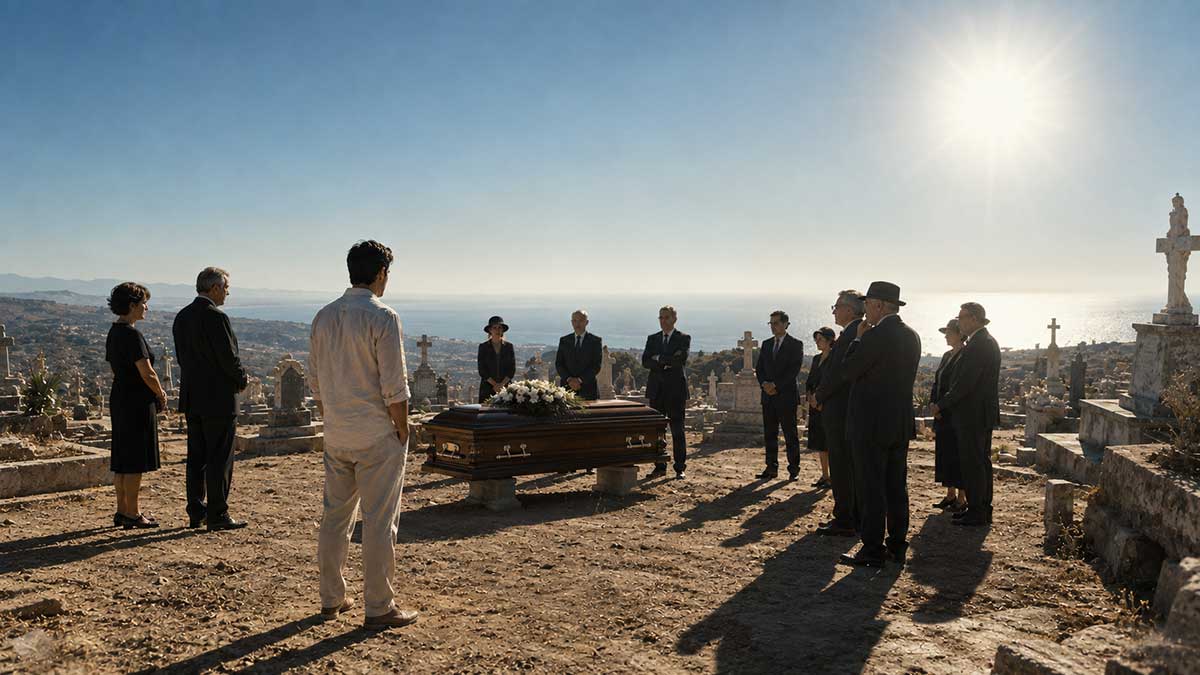
Guests: Albert Camus, Meursault, Marie Cardona, The Prosecutor
Albert Camus: The stage is almost empty.
Four wooden chairs sit beneath a single white light. Behind them stretches a blank horizon, where sea and sky blend into one pale line. There is no courtroom, no prison, no cemetery—only silence.
Most people believe they know this story.
They think it is about a murder.
It is not.
It begins with a funeral.
He turns toward Meursault.
"And perhaps it ends with a question none of us have answered."
Must a person display emotion in order for that emotion to be real?
No one answers immediately.
Meursault sits comfortably, looking toward the distant sea.
Marie smiles gently at him.
The Prosecutor folds his hands.
He has already reached his verdict.
The Funeral That Changed Everything
Albert Camus: Meursault.
Before anyone speaks about the trial...
I want to return to the beginning.
Your mother's funeral.
You did not cry.
You smoked.
You drank coffee.
You watched the people around you.
If you could relive that day...
Would you behave differently?
Meursault: No.
I was tired.
I had traveled.
It was hot.
My eyes hurt.
I drank coffee because someone offered it.
I smoked because I smoke.
My mother was already dead.
There was nothing I could do for her.
He pauses.
I didn't see any reason to pretend.
Silence hangs over the room.
The audience shifts uneasily.
The Prosecutor: You continue proving my point.
Listen to yourself.
Not one word about grief.
Not one word about love.
Not one memory.
You speak about weather.
Coffee.
Cigarettes.
Fatigue.
A decent son would never describe his mother's funeral this way.
Meursault: What would you prefer?
The Prosecutor: I would prefer humanity.
Meursault: What if I had cried?
The Prosecutor: That would have shown you loved her.
Meursault: No.
It would have shown I cried.
A few people in the audience glance at one another.
Camus notices.
He does not interrupt.
Marie Speaks
Marie: When people hear you speak...
They think you feel nothing.
But that's not the man I knew.
You laughed.
You loved swimming.
You enjoyed sunlight on the water.
You watched clouds for long periods.
You listened.
You noticed little things nobody else saw.
She smiles.
I always believed you felt deeply.
You simply didn't translate feelings into words.
She looks directly into his eyes.
Was I wrong?
Meursault: No.
Marie: You always answer with one word.
Meursault: Usually one is enough.
The audience laughs gently.
Even Camus smiles.
The Prosecutor does not.
The Difference Between Feeling and Performing
Albert Camus: I think we've reached the center of our discussion.
He looks toward the audience.
We often assume emotion has two parts.
What we feel.
And what we show.
He turns back.
Are those always the same?
The Prosecutor: They must be.
If your mother dies...
Every decent human being cries.
Meursault: Do they?
The Prosecutor: Most do.
Meursault: Most.
He lets the word linger.
Not all.
The Prosecutor: And those who don't...
He leans forward.
...frighten us.
Meursault: Why?
The Prosecutor hesitates.
For the first time.
The Prosecutor: Because...
He searches carefully.
...emotion connects people.
If someone cannot mourn...
How can we trust him?
Meursault: So tears are proof?
The Prosecutor: They are evidence.
Meursault: No.
They're water.
The room falls completely silent.
Even the sea seems to disappear.
Marie Challenges Them Both
Marie: I think both of you are missing something.
She turns first toward the Prosecutor.
You confuse visible emotion with real love.
Then she turns toward Meursault.
And you make honesty sound too simple.
She reaches for words.
When someone loves another person...
Sometimes we express that love...
Not because we have to...
But because the other person deserves to know.
She studies him.
I never needed grand speeches.
But there were moments...
...when I wished you would let people see what was inside.
Meursault: I don't know how.
The room grows still.
His words are quiet.
Almost fragile.
I never learned.
For the first time, the Prosecutor's expression softens.
Only slightly.
Camus Opens the Deeper Question
Albert Camus: I wonder...
If Meursault had forced himself to cry...
If he had practiced sorrow in front of the mirror...
If he had spoken beautiful words at the funeral...
If every emotion had been performed perfectly...
But everything inside him remained exactly the same...
Would he have become a better son?
No one answers.
Camus looks toward the audience.
Or merely a better actor?
The silence stretches.
No one wants to be the first to speak.
Because everyone knows the question is no longer about Meursault.
It is about them.
Closing Reflection
Albert Camus: Today we have not answered whether Meursault loved his mother.
We have uncovered something more unsettling.
Perhaps the greatest fear in any society is not hatred.
It is sincerity that refuses to wear the expected mask.
He stands.
Our next conversation asks a harder question.
When Meursault entered the courtroom...
Who was really on trial?
The man who pulled the trigger?
Or the man who refused to perform remorse?
Topic 2: Who Was Really on Trial?
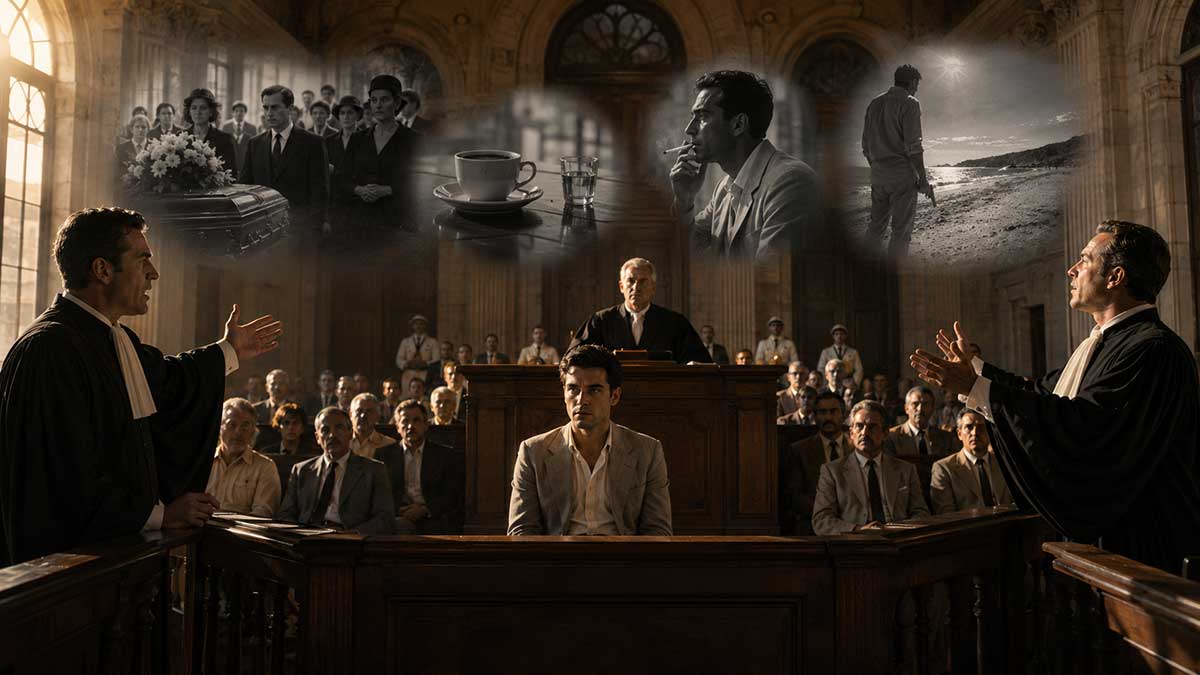
Guests: Albert Camus, Meursault, Raymond Sintès, The Prosecutor
The room now resembles a courtroom, but only partly.
There is no judge.
No jury.
No witness box.
A long wooden table divides the stage. Meursault sits on one side. The Prosecutor sits opposite him. Raymond leans back in his chair, restless and faintly amused.
Albert Camus remains at the end of the table.
He has not opened a notebook.
He appears to be waiting for someone else to begin.
The Prosecutor does.
The Prosecutor: Before we continue, I want to correct something.
This was never a trial about personality.
A man died.
Meursault killed him.
That is why he was condemned.
Raymond: That is not how I remember it.
The Prosecutor turns.
The Prosecutor: You were a witness, not a legal authority.
Raymond: I was there.
You spent more time talking about his mother than the man on the beach.
The Prosecutor: His conduct at the funeral revealed his character.
Raymond: His character pulled the trigger?
The Prosecutor: His character explains why he could.
Meursault looks toward the floor.
Camus watches him.
The Man Who Was Missing from His Own Trial
Albert Camus: Meursault, did you feel that the trial was about you?
Meursault: At first.
Then it felt like everyone was discussing someone else.
The Prosecutor: We were discussing you.
Meursault: You were discussing a version of me.
The Prosecutor: What is the difference?
Meursault: I was sitting there.
No one asked much about what I remembered.
They asked about coffee.
They asked about cigarettes.
They asked whether I cried.
The Prosecutor: Those details mattered.
Meursault: More than the dead man?
The Prosecutor pauses.
Raymond smiles.
Raymond: There it is.
The Prosecutor: Do not enjoy this.
Raymond: I enjoy honesty.
Meursault: No, you do not.
Raymond turns slowly.
Raymond: What is that supposed to mean?
Meursault: You enjoy honesty when it helps you.
The room shifts.
Raymond sits forward.
Raymond: I tried to help you.
Meursault: You asked me to write a letter so you could punish a woman.
Raymond: And you wrote it.
Meursault: Yes.
Raymond: Then do not pretend you were above me.
Meursault: I am not pretending.
I said yes.
Raymond’s Accusation
Raymond: That is what irritates everyone about you.
You admit things without defending yourself.
You make the rest of us look dishonest.
The Prosecutor: He makes himself look morally empty.
Raymond: No.
He makes you angry because he does not beg to be understood.
The Prosecutor: A man facing death should attempt to explain himself.
Meursault: Would it have changed anything?
The Prosecutor: It might have shown remorse.
Meursault: I could have said the words.
The Prosecutor: Yet you did not.
Meursault: I did not know whether they were true.
The Prosecutor: A decent person knows.
Meursault: Do they?
The Prosecutor exhales sharply.
The Prosecutor: We return to the same problem. You treat morality like weather. Something that happens around you.
Meursault: You treated my mother’s funeral like evidence.
The Prosecutor: It was evidence.
Meursault: Of murder?
The Prosecutor: Of the kind of man capable of murder.
Raymond: Then try me.
The Prosecutor turns.
Raymond: I beat a woman.
I manipulated her.
I carried the gun.
I started the trouble.
Yet no one looked at me the way they looked at him.
The Prosecutor: You were not the defendant.
Raymond: That is my point.
The Convenient Villain
Camus finally leans forward.
Albert Camus: Raymond, why do you think society found Meursault more disturbing than you?
Raymond: I make sense to people.
They know men like me.
I get angry.
I lie.
I want revenge.
I want women.
I want to win.
Those things are ugly, but familiar.
He points toward Meursault.
He does not give them anything familiar.
No hatred.
No great love.
No excuse.
No speech about becoming a better man.
People do not know where to place him.
The Prosecutor: We placed him before a court.
Raymond: You placed him inside a story.
The Prosecutor: Every trial is a story supported by facts.
Meursault: Whose story?
The Prosecutor: Society’s.
Meursault: That may be the problem.
A murmur passes through the room.
The Prosecutor Builds His Case
The Prosecutor rises.
He walks slowly behind his chair.
The Prosecutor: Let us remove the philosophy.
A son sends his mother to a home.
She dies.
He does not cry.
The next day, he swims with a woman.
He watches a comedy.
He becomes involved with a violent man.
He assists that man in humiliating a woman.
He carries a gun.
He shoots an unarmed man once.
Then four more times.
He turns toward the audience.
These are not inventions.
These are facts.
Meursault: Yes.
The Prosecutor: And you still object to the conclusion?
Meursault: I object to the order.
The Prosecutor: The order?
Meursault: You began with my mother.
You ended with the gun.
The Prosecutor: The sequence revealed a pattern.
Meursault: Or created one.
The Prosecutor stops walking.
Meursault: You could have started with Raymond.
You could have started with the fight.
You could have started with the heat.
You could have started with the knife.
You chose my mother.
The Prosecutor: Your behavior offended every person in that courtroom.
Meursault: That does not make it murder.
What the Court Needed
Albert Camus: What did the court need from Meursault?
The Prosecutor: Recognition.
Albert Camus: Of guilt?
The Prosecutor: Of humanity.
Raymond: Meaning tears.
The Prosecutor: Meaning remorse.
Meursault: Meaning a performance you would recognize.
The Prosecutor: Meaning some sign that another life mattered to you.
Meursault is quiet.
For once, his silence does not seem indifferent.
It seems heavy.
Meursault: The man died.
I know that.
The Prosecutor: Do you regret it?
Meursault looks directly at him.
Meursault: I regret that it happened.
The Prosecutor: That is not the same as regretting what you did.
Meursault: Perhaps not.
The Prosecutor: Then what were we supposed to see in you?
Meursault: A man who did not know how to give you the answer you wanted.
Camus Changes the Question
Camus stands.
He walks between the two sides of the table.
Albert Camus: Let us assume Meursault had cried at the funeral.
Let us assume he had praised his mother.
Let us assume he had ended his relationship with Marie.
Let us assume he had rejected Raymond.
Let us assume he had fallen to his knees in court and begged forgiveness.
He looks toward the Prosecutor.
Would the dead man be less dead?
The Prosecutor: No.
Albert Camus: Would the five shots disappear?
The Prosecutor: No.
Albert Camus: Would the crime change?
The Prosecutor: The crime would not.
The man would.
Albert Camus: In the eyes of the court.
The Prosecutor: In the eyes of humanity.
Meursault: Humanity was not in the courtroom.
People were.
No one moves.
The Trial Beneath the Trial
Raymond: I think I know what happened.
Everyone saw themselves in the jury.
They thought, “I would cry.”
“I would say I loved her.”
“I would ask God to forgive me.”
Then they looked at him.
He would not do any of it.
So they stopped asking whether he was guilty.
They began asking whether he was one of them.
The Prosecutor: Civilization depends on shared moral standards.
Raymond: Shared behavior, perhaps.
The Prosecutor: There is no society without judgment.
Meursault: There may be no justice when judgment begins before the facts.
The Prosecutor returns to his chair.
For the first time, he looks tired.
Closing Reflection
Albert Camus: A court is supposed to examine an act.
Yet every court is filled with people, and people rarely judge an act alone.
They judge posture.
Tone.
Silence.
Grief.
Regret.
They judge whether the accused resembles the person they believe a human being should be.
He looks at Meursault.
One man stood trial for killing another.
A second trial took place beneath it.
That trial asked whether he loved correctly.
Mourned correctly.
Spoke correctly.
Believed correctly.
Camus turns toward the empty jury seats.
The first trial examined a crime.
The second examined a stranger.
And the second may have decided the sentence.
Topic 3: The Sun, the Gun, and the Four Extra Shots

Guests: Albert Camus, Meursault, Raymond Sintès, Marie Cardona, The Prosecutor
The courtroom has disappeared.
In its place is a beach.
The sand is nearly white beneath the noon sun. The sea glitters so brightly that it is painful to look at. Five chairs stand beneath no shade at all.
Raymond shields his eyes with one hand.
Marie looks toward the water.
The Prosecutor wipes his forehead with a folded handkerchief.
Meursault seems to recognize the place immediately.
He does not sit.
Albert Camus: This is where explanations begin to fail.
The Prosecutor: Explanations do not fail here.
A man raised a gun.
He pulled the trigger.
Five times.
Raymond: You make it sound as though he came here planning it.
The Prosecutor: Intent can form in a second.
Marie: So can panic.
The Prosecutor: Panic does not usually fire four extra bullets.
Meursault looks at the empty stretch of sand before him.
Meursault: No.
It does not.
No one expected him to agree so quickly.
The First Shot
Albert Camus: Let us begin with the first shot.
Not the funeral.
Not the trial.
Not what anyone later said about you.
Only the moment itself.
What happened?
Meursault: The sun was in my eyes.
The heat pressed against my face.
The light struck the knife.
I could not see clearly.
My hand tightened.
The gun fired.
The Prosecutor: Guns do not fire from sunlight.
Meursault: No.
I fired it.
The Prosecutor: Then say it plainly.
Meursault: I fired it.
The Prosecutor: At a man.
Meursault: Yes.
The Prosecutor: And killed him.
Meursault: Yes.
The Prosecutor steps closer.
The Prosecutor: You hide behind weather.
Meursault: I am telling you what I remember.
The Prosecutor: You remember the sun more clearly than the man you killed.
Meursault: Yes.
The answer lands harder than any denial would have.
Marie looks at Meursault, then away.
Raymond’s Gun
Albert Camus: Raymond, whose gun was it?
Raymond: Mine.
Albert Camus: Why did Meursault have it?
Raymond: I gave it to him earlier.
I thought it might keep me from doing something stupid.
The Prosecutor: A remarkable decision.
You handed a weapon to the least expressive man in the group.
Raymond: I trusted him.
The Prosecutor: Why?
Raymond opens his mouth, then stops.
Raymond: He did not get excited.
The Prosecutor: That quality became fatal.
Raymond: Perhaps.
Marie: You brought the conflict to the beach.
Raymond: I did not tell him to shoot anyone.
Marie: You created the situation.
Raymond: I know what I did.
Marie: Do you?
Raymond turns toward her.
Marie: You speak as though your part ended when the gun left your hand.
It did not.
The anger was yours.
The revenge was yours.
The men were following you.
Yet Meursault became the entire story.
Raymond lowers his eyes.
Raymond: He pulled the trigger.
Marie: Yes.
And you are grateful that fact made everyone forget you.
Raymond says nothing.
Was the Sun an Excuse?
The Prosecutor: Let us settle this strange obsession with sunlight.
Millions of people endure heat.
They do not commit murder.
Meursault: I did not say the sun was innocent or guilty.
The Prosecutor: You speak of it as though it acted through you.
Meursault: That is how it felt.
The Prosecutor: Feelings are not facts.
Marie: Yet you used his lack of feeling as evidence.
The Prosecutor looks at her.
Marie: At the funeral, you said his inner state revealed his character.
Here, when he describes his inner state, you dismiss it.
The Prosecutor: Grief and murder are not comparable.
Marie: No.
But you accept emotion when it helps your story and reject it when it does not.
The Prosecutor: His story asks us to believe that light from a knife erased moral choice.
Meursault: It did not erase it.
Albert Camus: What did it do?
Meursault stares toward the imagined place where the man once stood.
Meursault: It narrowed everything.
There was no past.
No future.
No mother.
No Marie.
No trial.
Only heat.
Light.
The knife.
The gun in my hand.
The Prosecutor: That is still a choice.
Meursault: Yes.
The Prosecutor: Then why resist the word?
Meursault: I do not resist it.
I resist the story you built around it.
The Man Without a Name
Marie steps away from the group and looks down the beach.
Marie: We have spoken for several minutes.
We have discussed the sun.
The gun.
Raymond.
Meursault.
The court.
We have still not spoken about the man.
No one responds.
Marie: What was his name?
Raymond shifts in his chair.
Raymond: I did not know.
The Prosecutor: The record identified him through his family connection.
Marie: That is not what I asked.
What was his name?
Silence.
Marie: He entered the story as “the Arab.”
He died as “the Arab.”
He was discussed in court as the victim.
Yet he was never permitted to become a full person.
She turns toward Meursault.
Did you ever wonder who he was?
Meursault: Later.
Marie: Only later?
Meursault: Yes.
Marie: Did that trouble you?
Meursault: It does now.
This time, his answer sounds different.
No one can tell whether the difference comes from regret, memory, or the presence of Marie.
The Four Extra Shots
Albert Camus: We have reached the part no explanation can easily contain.
The first shot may be described through heat, glare, fear, reflex, or confusion.
Then came four more.
He faces Meursault.
Why?
Meursault: I do not know.
The Prosecutor: You knew where to aim.
Meursault: The body was already on the sand.
The Prosecutor: You paused.
Meursault: Yes.
The Prosecutor: Then fired again.
Meursault: Yes.
The Prosecutor: Four times.
Meursault: Yes.
The Prosecutor: That pause destroys every claim of accident.
Raymond: He never claimed the whole thing was an accident.
The Prosecutor: Then what was it?
Meursault: A break.
The Prosecutor: A break in what?
Meursault looks toward Camus.
Camus does not help him.
Meursault: In the day.
In my life.
In the way things had been moving.
The Prosecutor: That is poetry, not testimony.
Meursault: It is the closest answer I have.
Five Shots or Two Moments?
Albert Camus: Perhaps the first shot and the next four belong to different moments.
The Prosecutor: They came from the same gun.
Albert Camus: I am not speaking legally.
The Prosecutor: That is convenient.
Albert Camus: The first shot kills the man.
The next four may kill something in Meursault.
Marie: What?
Albert Camus: The belief that he can return to the life he had before.
Raymond: He could have stopped after one.
Meursault: Yes.
Raymond: Then why did you not?
Meursault: I heard the first shot.
It sounded final.
Then there was silence.
The silence felt larger than the beach.
Marie: So you fired into it?
Meursault: Perhaps.
The Prosecutor: You fired into a dead man.
Do not make it abstract.
Meursault meets his gaze.
Meursault: I know.
Choice Without Meaning
Albert Camus: We like motives that fit inside sentences.
Jealousy.
Hatred.
Revenge.
Money.
Fear.
Those motives reassure us.
They make violence understandable.
The Prosecutor: You are romanticizing a killing without motive.
Albert Camus: No.
I am asking whether senseless violence frightens us more than purposeful violence.
Raymond: It does.
A man who kills from hatred can explain himself.
A man who cannot explain it leaves everyone else to invent the reason.
Marie: Yet no reason would restore the dead man.
The Prosecutor: Reason matters to justice.
Marie: It matters to punishment.
I am not certain it always matters to truth.
Marie’s Question
Marie walks closer to Meursault.
Marie: Did you want him dead?
Meursault: No.
Marie: Did you hate him?
Meursault: No.
Marie: Were you afraid of him?
Meursault: At that moment, perhaps.
Marie: Did you think of me before you fired?
Meursault: No.
She absorbs the answer.
Marie: Did you think of anyone?
Meursault: No.
Her voice lowers.
Marie: That may be the part I find hardest.
Not that you hated him.
That nobody existed for you in that moment.
Meursault looks down.
Meursault: I existed.
Marie: Yes.
Only you.
The Prosecutor’s Strongest Argument
The Prosecutor: At last, we have reached it.
The sun did not kill the man.
Absurdity did not kill him.
Society did not kill him.
Meursault did.
He acted as though the world contained only sensation and himself.
That is not honesty.
That is moral isolation.
He faces Meursault.
A man stood before you.
You reduced him to light on a knife.
Then you erased him.
Meursault does not answer.
The Prosecutor waits.
The Prosecutor: Do you deny it?
Meursault: No.
Raymond looks surprised.
Marie closes her eyes.
Meursault’s Answer
Meursault: You want me to say I became a monster.
I do not know when a person becomes one.
You want me to say the sun forced me.
It did not.
You want me to say I planned it.
I did not.
You want hatred.
There was none.
You want a reason large enough to hold five shots.
I do not have one.
He looks toward the empty place on the sand.
Meursault: A man died through my action.
That is true.
My inability to explain it does not make it less true.
It may make it worse.
No one speaks.
For the first time, the Prosecutor does not seem eager to reply.
Closing Reflection
Albert Camus: People often believe that meaning follows action.
A person acts.
Then the reason appears.
Yet some acts leave behind no reason equal to their weight.
Only consequence.
One shot ended a life.
Four more made the silence impossible to explain.
He looks at Meursault.
The sun may describe the pressure of the moment.
It cannot carry the guilt.
The gun may explain the means.
It cannot explain the hand.
The court may name the crime.
It cannot fully enter the instant in which the crime occurred.
Camus turns toward the sea.
Perhaps that is why the scene remains so disturbing.
A man died.
Another man could not say why.
And every explanation offered afterward was smaller than the five shots.
Topic 4: Can Life Have Meaning Without God?
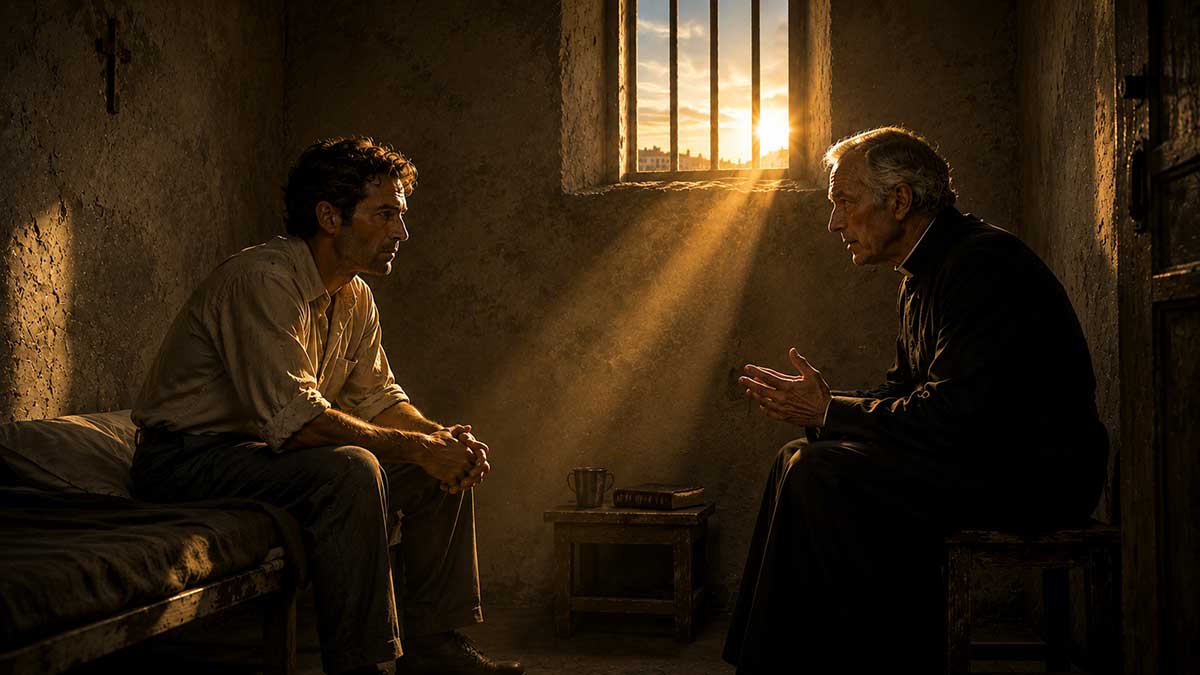
Guests: Albert Camus, Meursault, The Prison Chaplain, Marie Cardona, The Prosecutor
The beach is gone.
The courtroom is gone.
A narrow prison cell fills the stage.
A small barred window sits high in the wall. Evening light falls through it in a thin rectangle. A bed, a stool, and a metal cup are the only objects in the room.
Meursault sits on the edge of the bed.
The Prison Chaplain stands near the door.
Marie remains outside the bars, visible but unable to enter.
The Prosecutor watches from the shadows.
Albert Camus sits on the floor against the wall.
No one looks comfortable.
The Final Visitor
The Prison Chaplain: You refused to see me several times.
Meursault: Yes.
The Prison Chaplain: Why?
Meursault: I had nothing to say.
The Prison Chaplain: Men facing death usually have much to say.
Meursault: They may have much they want to hear.
The Prison Chaplain: And you do not?
Meursault: No.
The Chaplain studies him.
The Prison Chaplain: I do not believe you.
Meursault: That does not change my answer.
The Prison Chaplain: You are afraid.
Meursault: Yes.
The admission catches everyone off guard.
The Prison Chaplain: Then let us begin there.
Meursault: Begin what?
The Prison Chaplain: The search for hope.
Meursault: I am not searching for it.
Hope or Refusal?
The Prison Chaplain: Every condemned man searches for hope.
A pardon.
An appeal.
A miracle.
A life after death.
Meursault: I thought about a pardon.
The Prison Chaplain: Then you do hope.
Meursault: I hoped the machinery would fail.
That is different from believing it would.
The Prison Chaplain: Hope begins before belief.
Meursault: Or fear creates both.
The Chaplain moves closer.
The Prison Chaplain: You speak as though hope were a weakness.
Meursault: No.
I speak as though hope can become another way of refusing what is true.
The Prison Chaplain: And what is true?
Meursault: I am going to die.
The Prison Chaplain: Every person dies.
Meursault: Yes.
That is the first honest thing we have agreed on.
Marie Outside the Cell
Marie grips the bars.
Marie: You say it so calmly.
Meursault: I do not always feel calm.
Marie: Then why sound as though none of it matters?
Meursault: It matters to me.
Marie: I matter to you?
Meursault looks at her.
He takes longer than usual.
Meursault: Yes.
Marie waits.
Marie: Then say more.
Meursault: I miss the sea.
I miss your face when you laugh.
I miss sleeping without hearing footsteps outside the door.
I miss cigarettes.
I miss being able to decide when to stand up.
Marie’s eyes fill with tears.
Marie: You could have said that before.
Meursault: Before, I thought there would be another day.
The Chaplain’s Offer
The Prison Chaplain: This is precisely why faith matters.
Death teaches us that life is more than habit.
More than heat.
More than food.
More than the body.
It teaches us to ask what remains.
Meursault: Nothing remains for me.
The Prison Chaplain: You cannot know that.
Meursault: Neither can you.
The Prison Chaplain: Faith is not knowledge in the ordinary sense.
Meursault: Then why speak with certainty?
The Chaplain pauses.
The Prison Chaplain: A man drowning does not reject a hand because he cannot prove who offers it.
Meursault: I am not drowning.
I am waiting.
The Prison Chaplain: For execution.
Meursault: Yes.
The Prison Chaplain: That is drowning with time to think.
The Prosecutor Returns
The Prosecutor steps out of the shadows.
The Prosecutor: His refusal proves what I argued at trial.
He recognizes no law above himself.
No God.
No moral order.
No eternal judgment.
Meursault: You already sentenced me.
Why do you still need God to do it again?
The Prosecutor: Human justice is incomplete.
Meursault: Then perhaps you should have been less certain.
The Prosecutor stiffens.
The Prison Chaplain: This is not about the court.
Meursault: It is always about the court.
One man tells me what I should feel.
Another tells me what I should believe.
Both call refusal a crime.
Can Morality Exist Without God?
Albert Camus: Let us ask the question directly.
Can a person live morally without believing in God?
The Prosecutor: Meursault did not.
Albert Camus: That answers a question about Meursault.
Not the larger one.
The Prison Chaplain: Morality without God may exist as habit, sympathy, or social agreement.
Yet without a source beyond humanity, it has no final foundation.
Marie: People can love without first proving where love comes from.
The Prison Chaplain: Love points beyond itself.
Marie: Perhaps.
But when I loved Meursault, I did not need a theory.
The Prosecutor: Love did not stop him from killing.
Marie: Religion has not stopped every believer from killing.
The Chaplain turns toward her.
Marie: I am not insulting faith.
I am saying belief and goodness are not the same thing.
The Prison Chaplain: No sincere believer would claim they are identical.
Meursault: Then why assume disbelief explains me?
No one answers at once.
The Chaplain Presses Harder
The Prison Chaplain: Let me ask you something no court asked properly.
Do you believe the life you took had value?
Meursault: Yes.
The Prison Chaplain: Why?
Meursault: It was his life.
The Prison Chaplain: Is that enough?
Meursault: It was enough for him.
The Chaplain’s face changes.
The answer seems to reach him.
The Prison Chaplain: Then you do believe in something sacred.
Meursault: I did not say sacred.
The Prison Chaplain: You speak of life as possessing value beyond usefulness.
Meursault: A person does not need to be useful to want to live.
The Prison Chaplain: That is close to faith.
Meursault: You keep renaming my thoughts so they belong to you.
The Anger Beneath the Silence
The Chaplain kneels in front of him.
The Prison Chaplain: I have sat beside many condemned men.
The proud.
The terrified.
The guilty.
The innocent.
Nearly all reached for something larger than themselves.
You keep closing every door.
Why?
Meursault’s jaw tightens.
Meursault: The doors were closed before you arrived.
The Prison Chaplain: Not this one.
Meursault: You want me to spend my final hours wishing for another life.
The Prison Chaplain: I want you to know death is not the end.
Meursault: You want me to gamble the life I still have on one I cannot see.
The Prison Chaplain: You have hours left.
Meursault: Then the hours matter.
The Prison Chaplain: Eternity matters more.
Meursault suddenly stands.
The stool falls backward.
Meursault Explodes
Meursault: More?
You come here with “more.”
More life.
More judgment.
More meaning.
More time.
You speak as though this cell is only a hallway.
It is not a hallway to me.
It is where I am.
Now.
The Chaplain rises.
The Prison Chaplain: Anger is not an answer.
Meursault: It is more honest than your certainty.
The Prison Chaplain: My certainty comforts people.
Meursault: Then comfort them.
Do not use their fear as proof.
The Chaplain takes a step back.
Meursault: You tell me I must believe before I die.
The Prosecutor told me I must cry before I could be human.
Marie wanted me to say love in the way she could hear it.
Everyone wants the correct words.
The correct face.
The correct ending.
His voice breaks.
Meursault: I have no correct ending.
I have this room.
This breath.
That light on the wall.
Marie outside the bars.
A man I killed.
A morning that will come without me.
That is enough truth.
Marie’s Pain
Marie: Is it enough for peace?
Meursault turns toward her.
His anger softens.
Meursault: I do not know.
Marie: You said once that life made no difference.
Meursault: I was wrong.
Marie stares at him.
Marie: About what?
Meursault: Death makes the difference visible.
I thought one day was much like another.
Now I would take any of them back.
A boring Sunday.
A hot bus ride.
A meal I did not enjoy.
Any ordinary hour.
Marie begins to cry.
Marie: Then life has meaning.
Meursault: It has value.
Marie: Is that different?
Meursault: Perhaps meaning asks life to explain itself.
Value does not.
Camus Enters the Argument
Albert Camus: That distinction matters.
A person may reject a cosmic explanation and still love being alive.
He may believe the universe offers no answer and still refuse despair.
The Prison Chaplain: Refusal of despair is already a form of hope.
Albert Camus: Perhaps.
But not necessarily hope in another life.
It may be loyalty to this one.
The Prosecutor: A convenient philosophy for a man who lived without responsibility.
Albert Camus: No philosophy erases his responsibility.
Meursault: I do not want it erased.
The Prosecutor looks at him.
Meursault: I killed a man.
I cannot return his life.
No belief can make that fact disappear.
The Prison Chaplain: Faith does not erase guilt.
It offers forgiveness.
Meursault: From God?
The Prison Chaplain: Yes.
Meursault: What about the man?
The Chaplain lowers his gaze.
Forgiveness and the Dead
Meursault: You speak of forgiveness as though the person most harmed can be replaced.
The Prison Chaplain: Divine forgiveness does not replace human forgiveness.
Meursault: He cannot forgive me.
The Prison Chaplain: No.
Meursault: Then something remains unfinished.
The Prison Chaplain: Many lives end unfinished.
Meursault: That I believe.
The two men look at each other.
For the first time, neither tries to defeat the other.
The Indifference of the Universe
The light through the window fades.
Albert Camus: Meursault, what did you finally accept?
Meursault: That the world was not waiting to punish me.
It was not waiting to save me either.
The sea would continue.
People would wake.
Marie would grow older.
The man I killed would remain dead.
The sun would rise.
None of it was arranged for me.
The Prison Chaplain: You call that peace?
Meursault: Yes.
The Prison Chaplain: I hear loneliness.
Meursault: I felt less alone.
Marie: How?
Meursault: I stopped asking the universe to notice me.
The Chaplain’s Final Question
The Prison Chaplain: Suppose you are wrong.
Suppose there is a God.
Suppose you stand before Him tomorrow.
What will you say?
Meursault considers the question.
Meursault: I will say I did not pretend.
The Prison Chaplain: Is honesty enough?
Meursault: No.
But it is what I have.
The Chaplain nods slowly.
Not in agreement.
In recognition.
Closing Reflection
Albert Camus: Faith offers a universe that sees.
Meursault accepts a universe that does not.
One finds meaning beyond death.
The other finds urgency within life.
Neither position removes suffering.
Neither restores the murdered man.
Neither makes execution less final to the body awaiting it.
He looks at the Chaplain.
Faith may give death a door.
He looks at Meursault.
Absurd acceptance may teach a person to stop searching for one.
Marie remains at the bars between them.
Albert Camus: Yet the question is not merely whether life can have meaning without God.
It is whether a life must possess an eternal explanation before it can be precious.
The cell darkens.
Meursault looks once more at the small square of sky.
For the first time, he does not seem indifferent.
He seems awake.
Topic 5: Who Is the Real Stranger?
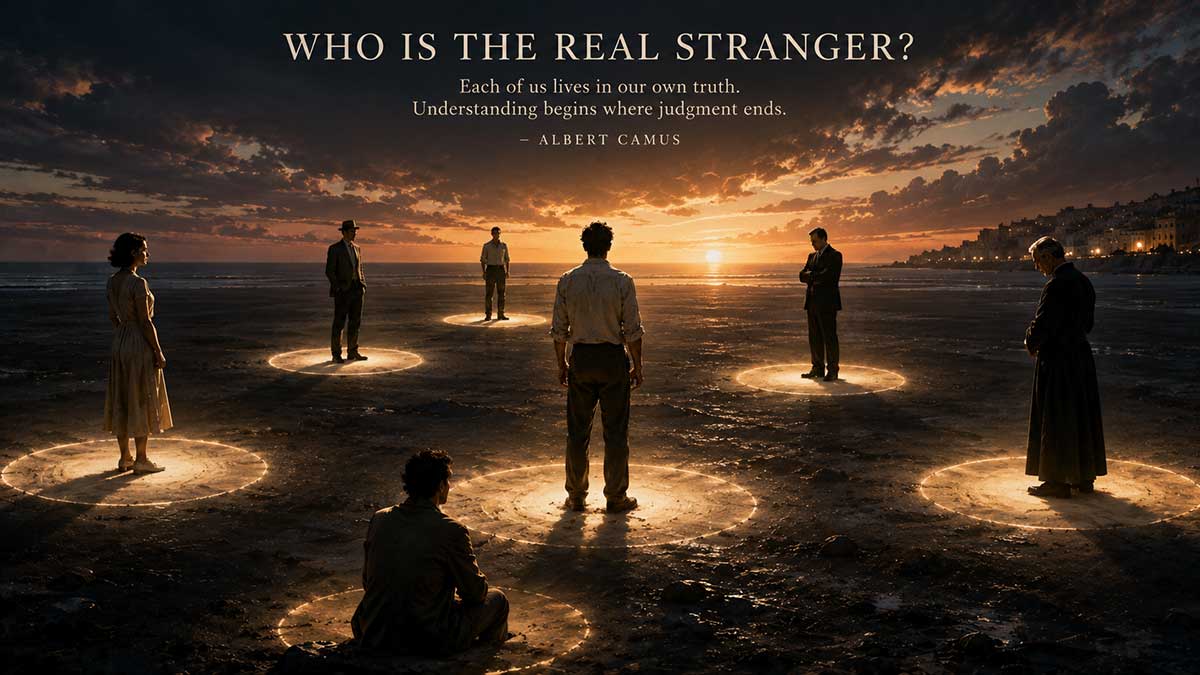
Guests: Albert Camus, Meursault, Marie Cardona, Raymond Sintès, The Prosecutor, The Prison Chaplain
The prison cell fades.
The courtroom does not return.
Neither does the beach.
The stage is now divided into six small circles of light.
Each guest stands alone inside one.
No chairs.
No table.
No bars.
No one can cross into another person’s circle.
Albert Camus stands in the center, where the lights almost meet.
Almost.
A Word Everyone Uses
Albert Camus: We have called Meursault many things.
Cold.
Honest.
Dangerous.
Empty.
Awake.
Guilty.
Free.
But the title gives him another name.
The stranger.
He looks at each guest in turn.
Stranger to whom?
The Prosecutor: To society.
The Prison Chaplain: To God.
Marie: To love.
Raymond: To himself.
Meursault looks around.
Meursault: You answered quickly.
The Prosecutor: Some truths are obvious.
Meursault: Obvious to the person speaking.
Marie: Then answer for yourself.
Who were you a stranger to?
Meursault remains silent.
Marie’s Answer
Marie: You were closest to me.
At least, I believed you were.
We swam together.
We laughed.
We slept beside each other.
I asked whether you loved me.
You said it probably did not mean anything.
I asked whether you would marry me.
You said you would, if I wanted.
She looks at him.
You were present.
Yet part of you always remained somewhere I could not reach.
Meursault: I did not hide anything.
Marie: That may be true.
But openness is not the same as closeness.
Meursault: What was missing?
Marie: Your need for me.
Meursault: I wanted you.
Marie: Wanting is not always needing.
Meursault: Is needing someone proof of love?
Marie: No.
Yet love asks us to let another person matter enough to disturb us.
You rarely seemed disturbed until death came near.
Meursault absorbs this without defending himself.
Raymond’s Answer
Raymond: I never thought he was strange.
The Prosecutor: That says more about you than him.
Raymond: Perhaps.
He looks toward Meursault.
Most people pretend to have principles.
He did not.
I asked for help.
He gave it.
I asked him to write the letter.
He wrote it.
No lecture.
No moral pose.
Marie: You liked him because he did not judge you.
Raymond: Everyone judges.
He simply did not enjoy it.
Meursault: I did not see much point.
Raymond: Exactly.
That made him easy to be around.
Then Raymond’s face hardens.
Until it did not.
Albert Camus: What changed?
Raymond: He became the one everyone examined.
Once the court looked at him, I began seeing what they saw.
Meursault: Did you?
Raymond: I saw that I had used your indifference.
You agreed to things that mattered greatly to other people and almost nothing to you.
That is dangerous.
Meursault: More dangerous than your anger?
Raymond: My anger announces itself.
Your indifference opens the door and says nothing.
The Prosecutor’s Answer
The Prosecutor: The stranger is the person who rejects the moral language binding everyone else.
A society cannot survive if each person treats love, grief, guilt, and responsibility as private matters with no shared form.
Marie: Shared form or expected performance?
The Prosecutor: Both.
A funeral has rituals.
A trial has rituals.
Marriage has promises.
Religion has confession.
These practices tell us that private feeling must sometimes become public duty.
Meursault: And when the feeling is absent?
The Prosecutor: Duty remains.
Meursault: Then you do not care whether it is true.
The Prosecutor: Truth without responsibility can become cruelty.
Meursault: A lie with good manners can become virtue?
The Prosecutor: No.
But civilization often asks us to act better than we feel.
That answer causes the others to pause.
Marie looks toward the Prosecutor with less hostility.
The Chaplain’s Answer
The Prison Chaplain: I once believed Meursault was a stranger to God.
Now I am less certain that this is the right description.
The Prosecutor: You defended his refusal.
The Prison Chaplain: I did not.
I recognized his sincerity.
Those are different things.
He turns toward Meursault.
You rejected every meaning offered to you.
Yet you still spoke of truth.
Value.
Responsibility.
The man you killed.
Marie.
The final hours of your life.
You claimed to believe in nothing, but you cared deeply about not lying.
Meursault: Is that faith?
The Prison Chaplain: No.
But perhaps it is a doorway you refused to name.
Meursault: You are naming it again.
The Prison Chaplain: We all name what frightens us.
You named the universe indifferent.
I named it created.
The Prosecutor named it ordered.
Marie named it love.
Raymond named it appetite.
None of us stood outside interpretation.
Albert Camus: Including Meursault?
The Prison Chaplain: Including him.
Meursault Is Questioned by Everyone
Camus steps back.
For the first time, the others face Meursault together.
Their circles remain separate.
Marie: Did you love your mother?
Meursault: Yes.
The Prosecutor: Did you love her enough?
Meursault: I do not know how to measure that.
Raymond: Did you know helping me was wrong?
Meursault: I knew it would hurt someone.
Raymond: Yet you did it.
Meursault: Yes.
The Prison Chaplain: Did you believe your life had meaning?
Meursault: I believed it was mine.
Marie: Did you love me?
A long pause.
Meursault: In the way I was able to.
Marie lowers her eyes.
The Prosecutor: Is limitation an excuse?
Meursault: No.
Raymond: Then what is it?
Meursault: A fact.
The Prosecutor: Facts do not absolve.
Meursault: I am not asking to be absolved.
The Stranger Looks Back
Albert Camus: Meursault, you have heard everyone define you.
Now define them.
Meursault turns first toward Marie.
Meursault: Marie wanted love to speak.
I thought being there was enough.
He looks toward Raymond.
Raymond wanted someone who would not interfere with his desires.
He mistook my passivity for loyalty.
He faces the Prosecutor.
The Prosecutor wanted my life to form a moral pattern.
He feared that the crime might remain meaningless.
He turns toward the Chaplain.
The Chaplain wanted death to open into eternity.
He could not accept a closed door.
The Chaplain listens without anger.
Albert Camus: And me?
Meursault looks at Camus.
Meursault: You wanted to know what would happen if a man refused every explanation.
Camus gives a faint smile.
Albert Camus: And what happened?
Meursault: Everyone explained him.
The Missing Man Returns
A seventh circle of light appears.
It is empty.
No one needs to ask whom it represents.
Marie looks at it first.
Marie: We keep asking who the stranger is.
Perhaps the man who died was the greatest stranger in the book.
We did not know his name.
We did not hear his voice.
We did not meet his family.
We knew him through Raymond’s anger and Meursault’s gun.
The Prosecutor: He was the victim.
Marie: That is a role, not a life.
Raymond: I knew what connected him to me.
Marie: You knew what made him useful to your story.
Raymond looks toward the empty light.
Raymond: Yes.
Meursault: I reduced him to the moment in front of me.
The Prison Chaplain: Society reduced him to evidence.
The Prosecutor: The court recognized his death.
Marie: Yet did anyone recognize him?
No one answers.
The Prosecutor Is Put on Trial
Raymond: Perhaps we should ask you something.
He looks at the Prosecutor.
Did you care about the dead man?
The Prosecutor: I represented the law.
Raymond: That was not the question.
The Prosecutor: His death demanded justice.
Marie: Did his life matter to you before it became useful in condemning Meursault?
The Prosecutor’s expression changes.
The Prosecutor: I did not know him.
Meursault: Neither did I.
The two men look at each other.
For one moment, they stand on the same side of something neither can repair.
Society as the Stranger
Albert Camus: What if Meursault was not the only stranger?
What if each person here became strange to the others through certainty?
The Prosecutor could not recognize grief without tears.
Marie could not fully recognize love without declaration.
The Chaplain could not recognize peace without God.
Raymond could not recognize loyalty without usefulness.
Meursault could not recognize responsibility until consequence entered the room.
He gestures toward the empty seventh circle.
And no one recognized the dead man beyond the part he played in their argument.
The Prosecutor: Then everyone is guilty?
Albert Camus: That would be too easy.
Marie: Everyone was limited.
The Prison Chaplain: And each person mistook limitation for truth.
Meursault’s Final Recognition
Meursault: I thought the world was indifferent.
Perhaps I was, too.
Marie looks at him.
Marie: Is that regret?
Meursault: It is recognition.
The Prosecutor: Late recognition.
Meursault: Most recognition is late.
Raymond: That does not undo anything.
Meursault: No.
The Prison Chaplain: Does it change you?
Meursault: There is almost no time left to change.
Marie: Time is not the only measure.
Meursault looks toward her.
Marie: Seeing clearly for one moment may matter more than living blindly for years.
The Prosecutor: That sounds like forgiveness.
Marie: It is not.
It is refusal to reduce him to the worst thing he did.
The Prosecutor considers this.
The Prosecutor: The dead man did not receive that mercy.
Marie nods.
Marie: No.
That is what keeps this from becoming redemption.
The Final Question
Camus walks into the center, where the circles of light nearly touch.
Albert Camus: The stranger may be the person we cannot read.
The person who does not grieve as we grieve.
Love as we love.
Believe as we believe.
Speak when we expect speech.
Yet there is another possibility.
The stranger may be the person we stop trying to know once a label becomes easier.
Criminal.
Infidel.
Cold.
Victim.
Monster.
Outsider.
He looks at the empty circle.
The most dangerous distance between people may begin when a name replaces a life.
Closing Reflection
The circles of light slowly widen.
For the first time, their edges overlap.
Marie steps closer to Meursault.
She cannot reach him, but the distance is smaller.
Raymond stands near the empty seventh circle.
The Prosecutor removes his courtroom robe.
The Chaplain lowers his head.
Camus looks toward the audience.
Albert Camus: Meursault was a stranger to society.
Society was a stranger to Meursault.
Each person here remained partly unknown to every other person.
That may be the final discomfort of the novel.
We want to believe strangers exist somewhere outside us.
Yet perhaps strangeness begins whenever we fail to enter another person’s reality.
The lights dim until only the empty seventh circle remains.
Then that light disappears, too.
No verdict is announced.
Final Thoughts by Albert Camus

Stories rarely end where readers wish they would.
Life almost never grants perfect clarity.
Evan Hale does not become a saint.
He does not suddenly discover eloquence.
He does not offer the public the confession it demands.
He cannot restore Samir Haddad to his family.
Some losses remain beyond repair.
Yet something has changed.
Not in the courtroom.
Not in public opinion.
Not on television.
Within him.
He has learned to notice the small moment that once escaped him.
The pause before agreement.
The instant before another person's certainty becomes his own action.
Many people believe evil begins with hatred.
History often teaches something quieter.
It begins when ordinary people surrender judgment to those who speak with greater confidence.
The greatest danger is not always cruelty.
Sometimes it is the comfortable belief that responsibility belongs to someone else.
There is another lesson I hope you carry away.
Every human being deserves to remain larger than the role assigned by history.
Evan was more than the headlines that described him.
Samir was more than the victim whose death became a political argument.
Lena was more than a witness.
Even Mason was more than the movement that consumed him.
If we reduce people to symbols, we repeat the same mistake in different forms.
Perhaps that is why literature still matters.
It slows us down.
It asks us to look again.
To listen longer.
To hesitate before certainty.
If this story leaves you less eager to judge strangers and more willing to recognize the quiet weight of your own choices, then it has fulfilled its purpose.
The most important decisions in life are rarely announced.
They arrive quietly.
Often disguised as ordinary moments.
And they ask only one question.
Will you say yes?
Short Bios:
Albert Camus (1913–1960)
French-Algerian novelist, essayist, journalist, and recipient of the 1957 Nobel Prize in Literature. Camus explored freedom, justice, rebellion, and the absurd through works such as The Stranger, The Plague, The Fall, and The Myth of Sisyphus. His writing continues to influence philosophy, literature, and moral thought around the world.
Evan Hale
A quiet warehouse supervisor who believes staying out of conflict keeps him innocent. His tragedy is not hatred but passivity. Through one irreversible act, he discovers that refusing to choose can still shape another person's fate.
Lena Ortiz
An art teacher who loves Evan for his quiet kindness and honesty. She becomes the first person to recognize that compassion without moral courage leaves those we love dangerously incomplete.
Mason Redd
A gifted community organizer whose passion for justice slowly becomes inseparable from certainty and personal resentment. He represents the danger of believing that a righteous cause excuses every method used to pursue it.
Samir Haddad
A Syrian-American restaurant owner, husband, father, and former community organizer. Thoughtful, imperfect, generous, and proud, Samir's life reminds us that every victim exists beyond the moment that history chooses to remember.
Dana Voss
The special prosecutor whose calm, disciplined arguments force difficult questions about responsibility, silence, and repeated acts of passive cooperation. She seeks justice without becoming a caricature of moral certainty.
Reverend Elias Ward
A prison chaplain who refuses easy answers. Rather than demanding public repentance, he quietly challenges Evan to distinguish honesty from responsibility and silence from integrity.
Leave a Reply