

What if Meursault has been misunderstood for more than eighty years?
Introduction by Albert Camus
Good evening.
When I wrote The Stranger, I did not expect readers to spend more than eighty years arguing over one quiet man.
I certainly did not expect philosophers, historians, literary critics, psychologists, lawyers, and ordinary readers to keep discovering new questions in a novel barely more than one hundred pages long.
Many books survive because people agree about them.
The Stranger survives because people do not.
Some readers believe Meursault is the most honest character in modern literature.
Others believe he is emotionally stunted.
Some see him as a victim of society.
Others see him as a dangerous example of moral passivity.
Still others ask why we spend so much time discussing Meursault while barely noticing the unnamed man he killed.
Every one of those questions deserves to be asked.
That is why tonight's conversation is different.
You have already heard from the characters themselves.
Now we move into another kind of conversation.
Not one built upon emotion...
But upon decades of careful reading.
The scholars gathered here do not always agree with one another.
Nor should they.
A great novel should never become a museum exhibit where everyone repeats the same interpretation.
It should remain a living conversation.
One scholar will emphasize philosophy.
Another will examine history.
Another will explore narrative technique.
Another will challenge assumptions that readers have carried for generations.
Together, they remind us that literature is not solved.
It is revisited.
As you listen tonight, I encourage you to resist asking a single question.
"Who is right?"
Instead ask...
"What does each perspective allow me to see that I had overlooked before?"
Reading is not a courtroom.
It is an expansion of vision.
If you leave tonight holding two ideas that seem impossible to reconcile...
Then perhaps you have begun reading The Stranger as I hoped it would be read.
(Note: This is an imaginary conversation, a creative exploration of an idea, and not a real speech or event.)
Act 1: Is Meursault Honest—or Emotionally Broken?
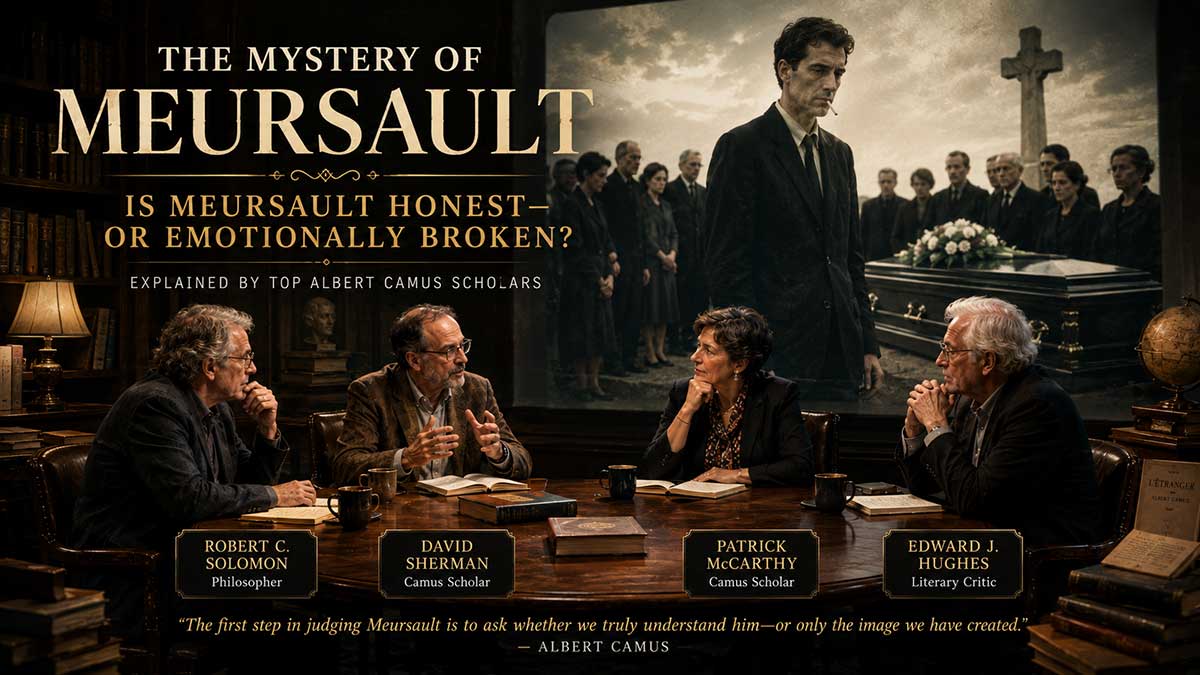
Guests: Robert C. Solomon, David Sherman, Patrick McCarthy, Edward J. Hughes
The room is spare.
Four scholars sit around a circular table beneath a white ceiling light. Behind them, a large screen shows a single image: Meursault standing beside his mother’s coffin.
No one is smiling.
On the table rests a glass of water, a pack of cigarettes, and an untouched cup of coffee.
Robert C. Solomon glances at the objects.
Robert C. Solomon: We have already made the mistake.
Patrick McCarthy: Which one?
Robert C. Solomon: We placed the coffee and cigarettes on the table.
Edward J. Hughes: They are in the novel.
Robert C. Solomon: Yes, but we know what they are doing here.
They are evidence.
David Sherman: Evidence of what?
Robert C. Solomon: That depends on who is looking.
To the caretaker, they are ordinary comforts.
To Meursault, they are sensations.
To the prosecutor, they become proof of a soul missing something.
Patrick leans back.
Patrick McCarthy: And to readers?
Robert C. Solomon: A test.
Edward J. Hughes: Of Meursault?
Robert C. Solomon: No.
Of themselves.
A brief silence follows.
On the screen, the funeral image remains frozen.
The First Judgment
David Sherman: Let us begin with the question readers ask most often.
Is Meursault emotionally empty?
Patrick McCarthy: I would object to the word “empty.”
Edward J. Hughes: So would I.
Robert C. Solomon: Yet readers feel it.
We should not dismiss that reaction too quickly.
The man’s mother dies.
He appears more troubled by the heat than by the loss.
He goes swimming the next day.
He watches a comedy.
He sleeps with Marie.
Readers are not foolish for finding that disturbing.
Patrick McCarthy: Disturbed, yes.
Certain, no.
Robert C. Solomon: Fair.
Patrick McCarthy: The novel gives us a man whose emotional language is narrow.
That is different from giving us a man with no emotions.
Edward J. Hughes: Very different.
He responds constantly.
He is affected by light, fatigue, water, touch, appetite, noise, bodily pleasure, physical discomfort.
His world is crowded with feeling.
It simply is not organized in the emotional vocabulary society expects.
David Sherman: That may be the central distinction.
Meursault is not without feeling.
He is without a conventional explanation of feeling.
Does Honesty Make Him Admirable?
Robert C. Solomon: This is where readers become too generous.
They call him honest.
Then honesty begins to sound like innocence.
Patrick McCarthy: He does refuse to lie.
Robert C. Solomon: Often.
Patrick McCarthy: Marie asks whether he loves her.
He does not flatter her.
His employer offers him a new life.
He does not pretend ambition.
The chaplain offers him consolation.
He refuses what he cannot believe.
There is something rare in that.
Robert C. Solomon: Rare does not mean good.
A child can be brutally honest.
A cruel man can be brutally honest.
Honesty is a virtue only when it lives beside other virtues.
David Sherman: Such as responsibility.
Robert C. Solomon: And care.
And the willingness to recognize that other people are not merely objects passing through one’s field of sensation.
Edward J. Hughes: Yet the novel does not ask us to canonize him.
That is a later temptation.
Readers sometimes turn Meursault into a saint of authenticity.
Camus makes that reading difficult.
Patrick McCarthy: Difficult, but not impossible.
Edward J. Hughes: No, impossible.
Patrick turns toward him.
Patrick McCarthy: Strong word.
Edward J. Hughes: He assists Raymond.
He writes the letter.
He drifts into another person’s cruelty.
He does not object.
This is not heroic honesty.
It is moral passivity.
Patrick McCarthy: Passivity, yes.
But the passivity itself may come from his refusal to impose meaning.
Robert C. Solomon: And that is precisely where philosophy becomes an excuse.
“He refuses to impose meaning” sounds far more noble than “he could not be bothered.”
Patrick smiles faintly.
Patrick McCarthy: You make him sound lazy.
Robert C. Solomon: At times, he is.
Not physically.
Morally.
Emotion Without Performance
David Sherman: Let us separate three questions.
Does Meursault feel?
Does he express what he feels?
Does he act responsibly in relation to what others feel?
Those are not the same question.
Edward J. Hughes: That helps.
David Sherman: He clearly feels.
He enjoys Marie.
He suffers in the heat.
He dislikes prison.
He misses ordinary life.
He reacts intensely to the chaplain.
The claim that he has no inner life cannot survive the ending.
Robert C. Solomon: Agreed.
David Sherman: Yet expression is another matter.
He refuses emotional performance.
That is where readers either admire him or recoil from him.
Patrick McCarthy: Society wants recognizable signs.
Tears at a funeral.
Declarations in love.
Remorse in court.
Faith before death.
Meursault gives almost none of them.
Edward J. Hughes: But society does not invent those signs for no reason.
Language, ritual, gesture—these are how private feeling enters shared life.
Without them, others cannot know where they stand.
Robert C. Solomon: Exactly.
Readers are too quick to mock emotional convention.
A funeral ritual may be imperfect.
Tears may be performative.
Words may be inadequate.
Yet human beings still need forms through which grief becomes visible.
Patrick McCarthy: Then are we saying Meursault fails morally when he fails theatrically?
Robert C. Solomon: No.
I am saying a refusal to perform can become a refusal to care whether others can understand you.
The Mother
The screen changes.
Now it shows the road to the nursing home beneath a white sky.
Edward J. Hughes: We keep saying “his mother” as though the relationship were simple.
It was not.
He had placed her in a home.
They had little left to say to one another.
Her life there had developed beyond him.
David Sherman: He recognizes that she may have found a new beginning.
Patrick McCarthy: Which suggests tenderness.
Robert C. Solomon: Or retrospective interpretation.
Patrick McCarthy: Must you distrust every softening in him?
Robert C. Solomon: I distrust the desire to redeem him too quickly.
Edward J. Hughes: Yet the mother matters at the ending.
Her willingness to begin again near death helps him accept his own condition.
That is not accidental.
David Sherman: No.
She becomes his final teacher.
Not through moral instruction.
Through the fact that life may be embraced without a guarantee.
Robert C. Solomon: Then perhaps his grief is delayed.
Patrick McCarthy: Or transformed.
Robert C. Solomon: Or absent.
We should leave the possibility open.
Is Meursault Psychologically Damaged?
David Sherman: Readers often reach for psychological diagnosis.
They ask whether he is depressed, traumatized, emotionally impaired, or incapable of attachment.
Edward J. Hughes: Modern readers bring modern categories.
That can illuminate the text.
It can distort it too.
Patrick McCarthy: The danger is turning the novel into a case file.
Robert C. Solomon: Yet emotional impairment is not an absurd question.
Meursault often seems disconnected from the consequences of his actions.
He reacts to immediate sensation more readily than to moral significance.
David Sherman: But diagnosis can create false closure.
Once we name a condition, the literary question appears solved.
Edward J. Hughes: And the novel resists being solved.
Its style creates much of the effect.
The short sentences.
The flat sequence of events.
The lack of retrospective interpretation.
We encounter the world before it has been organized into moral meaning.
Patrick McCarthy: Which makes the reader do the organizing.
Edward J. Hughes: Yes.
Then the reader becomes prosecutor.
The Reader Enters the Trial
The funeral image vanishes.
The screen now reflects the audience.
Robert C. Solomon: There.
That is the most honest image we have shown.
David Sherman: The audience?
Robert C. Solomon: The jury.
Every reader begins judging before the formal trial starts.
We notice what he notices.
Then we condemn him for noticing it.
Patrick McCarthy: We demand that grief push heat, light, coffee, and fatigue out of consciousness.
Edward J. Hughes: Yet real grief does not always behave that way.
A person at a funeral may remember the chair.
The smell of flowers.
An awkward handshake.
A fly on the window.
David Sherman: The body often continues its small demands during great sorrow.
Robert C. Solomon: True.
But Meursault never gives the reader the line that would release him.
He never says, “I was shattered beneath the surface.”
Patrick McCarthy: Perhaps that is the lie he refuses.
Robert C. Solomon: Or the truth he cannot feel.
Radical Honesty or Limited Self-Knowledge?
Edward J. Hughes: We keep calling him honest.
How certain are we that he knows himself well enough to be honest?
The others pause.
David Sherman: That is a better question.
Patrick McCarthy: Explain.
Edward J. Hughes: A man can report his immediate sensations accurately and still misunderstand his deeper motives.
Meursault says marriage makes no difference.
Love makes no difference.
Paris makes no difference.
Does that prove he has no preference?
Or only that he lacks the language to interpret preference?
Robert C. Solomon: Honesty requires self-knowledge.
Edward J. Hughes: Yes.
He may be sincere without being fully truthful.
Patrick McCarthy: That distinction changes everything.
David Sherman: It means we should stop treating his statements as final authority on his own inner life.
Robert C. Solomon: Precisely.
When he says something does not matter, perhaps it truly does not.
Perhaps he has trained himself not to ask.
Perhaps he fears commitment.
Perhaps he experiences life almost entirely through the present.
The novel does not settle it.
Patrick McCarthy: Yet society settles it for him.
Emotionless.
Heartless.
Monster.
Robert C. Solomon: Society is wrong to simplify him.
Readers are wrong to romanticize him.
Both mistakes come from the same hunger for certainty.
Honesty Without Empathy
David Sherman: Let us confront the hardest issue.
Can honesty without empathy become morally dangerous?
Patrick McCarthy: Yes.
Edward J. Hughes: Certainly.
Robert C. Solomon: It nearly always does.
Patrick looks surprised.
Patrick McCarthy: We agree faster than expected.
Robert C. Solomon: Do not celebrate yet.
The disagreement comes next.
David Sherman: Where?
Robert C. Solomon: Whether Meursault truly lacks empathy.
Edward J. Hughes: He rarely imagines the inner lives of others.
Patrick McCarthy: Yet he does not seek to dominate them.
Robert C. Solomon: Indifference can injure without domination.
Patrick McCarthy: So can false empathy.
David Sherman: That is true, but it does not rescue him.
When Raymond asks for help harming a woman, Meursault treats the request as morally neutral.
That is one of the clearest failures in the novel.
Edward J. Hughes: He does not actively choose cruelty.
He allows himself to become part of it.
Robert C. Solomon: Which is how much cruelty enters the world.
Not through passionate villains.
Through people who say it makes no difference.
The room becomes quiet.
For the first time, no one moves to answer.
The Point of Disagreement
Patrick McCarthy: Then let me defend him once more.
Not as a moral hero.
As a literary necessity.
Camus needed a man who stood outside ordinary explanations.
A man who would not arrange his life into comforting stories.
Through him, we see how quickly society confuses convention with goodness.
Robert C. Solomon: And through his failures, we see how dangerous it is to confuse authenticity with goodness.
Edward J. Hughes: Perhaps that is the balance.
David Sherman: Meursault exposes society’s dishonesty.
Society exposes Meursault’s lack of responsibility.
Patrick McCarthy: Neither side leaves clean.
Robert C. Solomon: Nor should the reader.
Closing Reflection
The objects remain on the table.
The coffee has gone cold.
No one has touched the cigarettes.
David Sherman: We began by asking whether Meursault is honest or emotionally broken.
The question may be too narrow.
Edward J. Hughes: He is emotionally alive, but morally underdeveloped.
Patrick McCarthy: Sincere, but difficult to know.
Robert C. Solomon: Honest in speech, uncertain in self-knowledge, and dangerously passive in relation to others.
Patrick McCarthy: That is almost a verdict.
Robert C. Solomon: No.
A verdict ends inquiry.
This should begin it.
The screen returns to the image of Meursault beside the coffin.
This time, the audience cannot see his face.
David Sherman: The unsettling fact is not that Meursault feels nothing.
It is that we cannot agree on what he feels.
Edward J. Hughes: And the moment we cannot read him, we begin inventing him.
Patrick McCarthy: Hero.
Monster.
Victim.
Absurd man.
Robert C. Solomon: Perhaps the first act of justice is resisting all four.
The light above the table dims.
The funeral remains.
The judgment does not.
Act 2: Was the Trial Really About Murder?
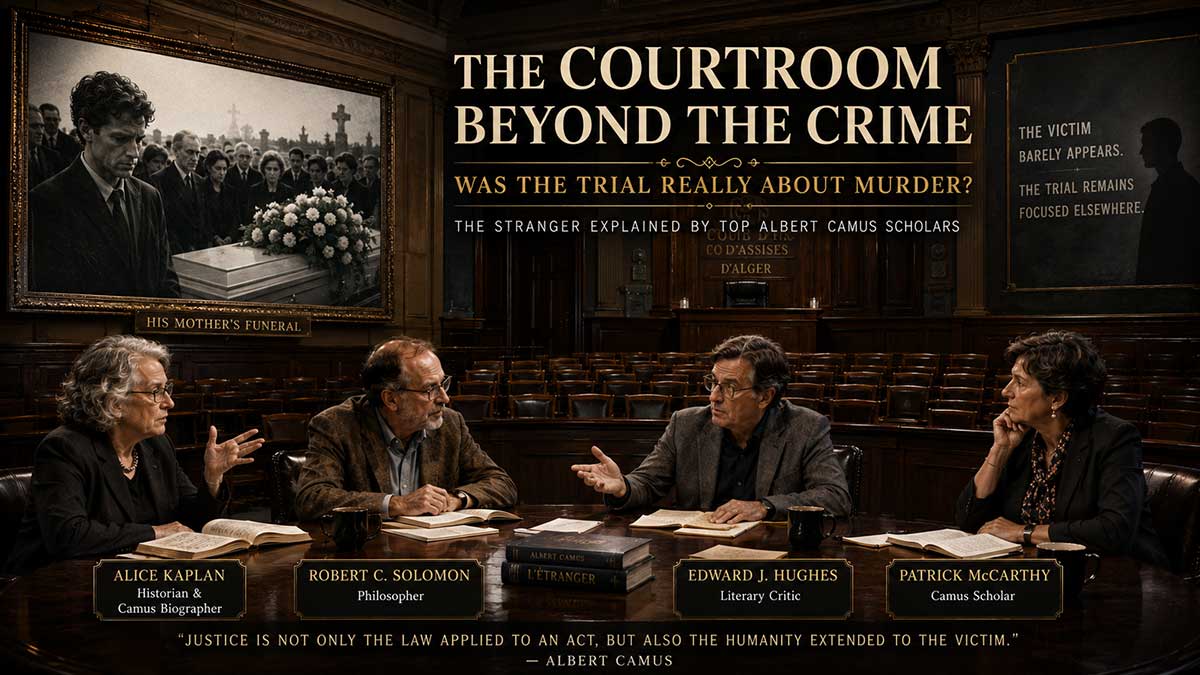
Guests: Alice Kaplan, Robert C. Solomon, Edward J. Hughes, Patrick McCarthy
The round table is gone.
The scholars now sit inside a reconstructed courtroom.
A judge’s bench rises above them, but the chair is empty. Twelve vacant jury seats face the center of the room. On one wall hangs a large photograph of Meursault at his mother’s funeral.
There is no photograph of the murdered man.
Alice Kaplan notices this first.
Alice Kaplan: Before anyone says a word, the room has already chosen its subject.
Robert C. Solomon: Meursault?
Alice Kaplan: Meursault’s face.
His mother’s funeral.
His behavior.
Everything except the man who died.
Edward J. Hughes: That is faithful to the trial.
Patrick McCarthy: Disturbingly faithful.
Alice walks toward the photograph.
Alice Kaplan: This image should not be here.
Robert C. Solomon: Legally?
Alice Kaplan: Narratively.
We have entered a murder trial, yet the first thing confronting us is a funeral.
Edward J. Hughes: Which tells us that the trial is trying to connect two deaths.
Patrick McCarthy: One death caused by Meursault.
One death followed by his failure to grieve properly.
Robert C. Solomon: And the prosecution turns the second into evidence for the first.
The Crime Before the Crime
Alice Kaplan: Let us state the prosecution’s logic clearly.
Meursault did not cry at his mother’s funeral.
He drank coffee.
He smoked.
He began a romance the next day.
From these facts, the court constructs a personality.
From that personality, it constructs a capacity for murder.
Edward J. Hughes: The trial moves backward.
It begins with the killing, then searches the past for signs that the killer had always been morally defective.
Patrick McCarthy: Which is how stories often work.
Once we know the ending, every earlier detail begins looking prophetic.
Robert C. Solomon: Yet courts must examine character at times.
Intent matters.
Remorse matters.
Patterns of behavior can matter.
We should not pretend that all moral evidence is irrelevant.
Alice Kaplan: Is grief at a funeral moral evidence?
Robert C. Solomon: It can reveal something.
Alice Kaplan: Something about murder?
Robert C. Solomon: Perhaps not directly.
Patrick McCarthy: That “perhaps” is where the entire trial takes place.
The Prosecutor’s Story
The courtroom lights dim.
A single beam illuminates the empty space where the Prosecutor would have stood.
Edward J. Hughes: The Prosecutor succeeds because he tells a better story than the defense.
Robert C. Solomon: Better or simpler?
Edward J. Hughes: In a courtroom, those may become the same thing.
He gives the jury a recognizable sequence.
A man sends his mother away.
He does not mourn her.
He pursues pleasure immediately after her death.
He associates with Raymond.
He helps humiliate a woman.
He kills a man.
Every event becomes part of one moral descent.
Alice Kaplan: Except the sequence is deceptive.
Meursault did not place his mother in the home from hatred.
He lacked the money to care for her properly.
She formed relationships there.
She may have been less lonely than she had been living with him.
Patrick McCarthy: Yet those facts have less dramatic force than a son who refuses to cry.
Alice Kaplan: Exactly.
The Prosecutor wins by translating economic reality and emotional awkwardness into moral depravity.
Robert C. Solomon: He gives the jury a villain they can recognize.
Edward J. Hughes: More than recognize.
A villain they can hate without uncertainty.
Why the Funeral Matters So Much
Patrick McCarthy: Why does the funeral disturb the court more than the killing?
Robert C. Solomon: I would not say more than the killing.
Alice Kaplan: The novel nearly does.
Robert C. Solomon: The murder creates the trial.
The funeral determines what kind of murderer the court believes it sees.
Edward J. Hughes: That distinction is useful.
The killing proves legal guilt.
The funeral creates moral guilt.
Patrick McCarthy: And moral guilt supplies the emotional permission for execution.
Alice returns to her chair.
Alice Kaplan: The court needs Meursault to become more than a man who committed a terrible act under confusing circumstances.
It needs him to become a person whose entire existence leads naturally to death.
Robert C. Solomon: Why would it need that?
Alice Kaplan: Capital punishment asks a society to do more than judge an act.
It asks society to decide that a human being may be removed permanently.
That decision becomes easier when the accused appears morally alien.
Patrick McCarthy: A stranger.
Alice Kaplan: Precisely.
The Jury’s Discomfort
The vacant jury seats slowly brighten.
Edward J. Hughes: The jurors cannot enter Meursault’s consciousness.
They receive no conventional signs from him.
He does not weep.
He does not plead.
He does not perform an awakening.
His face remains nearly unreadable.
Robert C. Solomon: Which makes him frightening.
Patrick McCarthy: Or irritating.
Robert C. Solomon: The two often overlap.
People tolerate wrongdoing more easily than emotional illegibility.
A wrongdoer who confesses, weeps, and begs can be placed inside a familiar moral structure.
Meursault gives the jury no such structure.
Alice Kaplan: He denies them the pleasure of feeling morally superior to a repentant man.
Robert C. Solomon: That may be too cynical.
Alice Kaplan: Is it?
The courtroom wants remorse.
Yet remorse does more than acknowledge suffering.
It reassures the judges that their values remain shared.
The accused says, “You are right. I have violated the moral order we both recognize.”
Meursault never gives them that sentence.
Edward J. Hughes: His silence makes the court feel judged.
Patrick McCarthy: By a man who is barely judging anyone.
Robert C. Solomon: Which may make it worse.
Was Meursault Denied a Fair Trial?
Alice Kaplan: Legally, the trial is distorted.
The funeral dominates the narrative.
The victim receives little identity.
The colonial setting structures who matters and who does not.
The court turns the defendant’s social behavior into proof of inner corruption.
Robert C. Solomon: Yet he did commit the crime.
Alice Kaplan: No one disputes that.
A fair trial does not mean pretending innocence.
It means judging the act without manufacturing a complete human monster from unrelated details.
Patrick McCarthy: But are they unrelated?
Meursault’s behavior toward his mother, Marie, Raymond, and the victim may reveal a common passivity.
Edward J. Hughes: The problem is not that the court sees a connection.
The problem is that it treats interpretation as fact.
Robert C. Solomon: Courts do that constantly.
Motive is interpretation.
Intent is interpretation.
Character testimony is interpretation.
Alice Kaplan: Which is why power matters.
Who gets to interpret?
Whose story is believed?
Whose humanity is assumed?
Whose must be proven?
The room becomes quiet.
The Victim Who Barely Appears
Alice looks at the blank wall opposite Meursault’s photograph.
Alice Kaplan: We need another image.
Patrick McCarthy: Of the murdered man?
Alice Kaplan: Yes.
Edward J. Hughes: We do not have one.
Alice Kaplan: That is the point.
The novel gives the court enough of him to confirm death, but not enough to restore life.
He remains “the Arab.”
No name.
No voice.
No history.
Robert C. Solomon: We will address that more fully in the next act.
Alice Kaplan: We cannot discuss the trial honestly without beginning now.
The court’s great moral performance occurs inside a colonial system that barely recognizes the victim as an individual.
Patrick McCarthy: So the trial is simultaneously obsessed with morality and limited in whom it recognizes morally.
Alice Kaplan: Yes.
It condemns Meursault for lacking proper human feeling.
Yet the proceedings themselves fail to grant full humanity to the dead man.
Edward J. Hughes: That contradiction is devastating.
Robert C. Solomon: And perhaps intentional.
Alice Kaplan: Whether intentional or inherited from the world Camus depicted, it remains part of the novel.
Murder as Narrative Material
Edward J. Hughes: The dead man becomes material in everyone else’s story.
For the Prosecutor, he proves Meursault’s evil.
For the defense, he becomes the tragic result of heat and confusion.
For Raymond, he is part of a personal conflict.
For Meursault, he becomes a body beneath intolerable sunlight.
Patrick McCarthy: Nobody gives him a life beyond the scene.
Alice Kaplan: Which means the trial is not truly centered on the victim.
It is centered on what Meursault’s behavior means to French society.
Robert C. Solomon: Then the murder is almost converted into a cultural test.
Alice Kaplan: Exactly.
Can this man be recognized as one of us?
Does he share our rituals?
Our grief?
Our moral language?
When the answer appears to be no, execution becomes a way of expelling him.
Justice or Social Revenge?
Patrick McCarthy: Are we calling the sentence social revenge?
Robert C. Solomon: That may go too far.
Five shots were fired.
A man was killed.
A severe sentence was foreseeable.
Alice Kaplan: The question is not whether punishment was justified.
The question is what the punishment was for.
Edward J. Hughes: The Prosecutor effectively tries two cases.
In the first, Meursault kills a man.
In the second, Meursault fails the test of acceptable humanity.
Patrick McCarthy: Which case produces the death sentence?
Robert C. Solomon: We cannot know.
Alice Kaplan: The novel wants us to suspect the second.
Robert C. Solomon: Suspect, yes.
But I resist turning Meursault into a martyr of nonconformity.
Patrick McCarthy: No one here is doing that.
Robert C. Solomon: Readers often do.
They say he was condemned merely for being honest.
That erases the victim and romanticizes passivity.
Alice Kaplan: Agreed.
Yet the opposite error is equally serious.
To say the trial simply punished murder ignores how aggressively the court transformed a funeral into an indictment.
The Defense That Cannot Defend Him
Edward J. Hughes: Meursault’s lawyer faces an impossible problem.
Patrick McCarthy: His client?
Edward J. Hughes: A client who will not participate in the expected narrative.
A defense attorney wants context.
Regret.
Humanizing memories.
A statement of love for the mother.
An explanation for the shots.
Meursault offers almost nothing usable.
Robert C. Solomon: Truth is not always persuasive.
Alice Kaplan: Nor is persuasion always truth.
Robert C. Solomon: Granted.
But law lives through language.
A person who refuses language leaves interpretation to others.
Patrick McCarthy: That may be Meursault’s practical failure.
He thinks refusal to lie protects truth.
Instead, it creates an empty space where the Prosecutor can build anything.
Edward J. Hughes: Silence is never empty in court.
It becomes evidence.
The Trial as Theater
The jury seats fade into darkness.
The courtroom begins to resemble a stage.
Edward J. Hughes: Camus structures the trial theatrically.
The audience watches.
The lawyers perform.
Witnesses enter and exit.
Every gesture is interpreted.
Meursault begins to feel like a spectator at his own proceeding.
Patrick McCarthy: He notices that people are speaking about him without seeming to include him.
Alice Kaplan: Which is one of the trial’s deepest forms of violence.
His life becomes public property.
Others take isolated events and arrange them into a coherent moral biography.
Robert C. Solomon: Yet every biography does that.
Alice Kaplan: Yes.
The difference is that this one ends at the guillotine.
Edward J. Hughes: The court does not merely discover who Meursault is.
It produces who he is.
Patrick McCarthy: The emotionless son.
The soulless lover.
The remorseless killer.
Robert C. Solomon: And once those identities merge, no single act can be judged separately.
Could Tears Have Saved Him?
Patrick McCarthy: Let us ask the uncomfortable question.
Had Meursault cried at the funeral, would he have lived?
Robert C. Solomon: We cannot know.
Alice Kaplan: He might have received a different hearing.
Edward J. Hughes: A different narrative, certainly.
Patrick McCarthy: Had he spoken of love for his mother?
Alice Kaplan: Different narrative.
Patrick McCarthy: Had he wept in court?
Robert C. Solomon: Different moral impression.
Patrick McCarthy: Had he accepted the chaplain before sentencing?
Alice Kaplan: Again, he would appear more recognizable.
Edward J. Hughes: That does not prove innocence.
It proves that justice is influenced by emotional fluency.
Robert C. Solomon: Which is true beyond this novel.
Judges, juries, and the public read faces.
They interpret tone.
They punish arrogance.
They reward remorse.
Alice Kaplan: The danger begins when those impressions outrank evidence.
What Was Society Defending?
Edward J. Hughes: Perhaps the trial is defending more than law.
Patrick McCarthy: What else?
Edward J. Hughes: A shared picture of the human being.
A person loves family.
Mourns visibly.
Seeks advancement.
Desires marriage.
Fears death.
Turns to religion.
Meursault disturbs nearly every expectation.
Robert C. Solomon: Then the court sees him as a threat to the social grammar.
Alice Kaplan: Yes.
He does not simply break a law.
He appears to live outside the emotional agreements that make society feel coherent.
Patrick McCarthy: So the trial becomes a ritual of exclusion.
Alice Kaplan: A legal ritual, a moral ritual, and in the colonial setting, a political one.
Closing Reflection
The photograph of the funeral is removed.
The wall behind it is bare.
The missing victim remains without an image.
Robert C. Solomon: We began by asking whether the trial was really about murder.
It was.
A man was dead.
Meursault had killed him.
Any interpretation that forgets that becomes dishonest.
Alice Kaplan: Yet it was never only about murder.
The court tried his grief.
His love.
His ambition.
His friendships.
His willingness to speak the moral language expected of him.
Edward J. Hughes: The killing brought him into the courtroom.
His unreadability determined what the courtroom made of him.
Patrick McCarthy: And the victim?
Alice looks at the blank wall.
Alice Kaplan: The victim gave the trial its legal purpose.
Meursault gave it its drama.
Society gave it its verdict.
The empty judge’s chair remains above them.
Robert C. Solomon: Perhaps the trial’s deepest injustice was not that it judged Meursault.
He had to be judged.
It was that judgment became certainty before anyone admitted how much of the case rested on interpretation.
Edward J. Hughes: The court believed it had discovered a monster.
Patrick McCarthy: It may have constructed one.
Alice Kaplan: And in constructing him, it left the dead man unnamed.
The courtroom lights go out.
For a moment, only the blank wall remains visible.
Then that disappears too.
Act 3: The Arab Without a Name

Guests: Alice Kaplan, David Sherman, Edward J. Hughes, Patrick McCarthy
The stage is almost empty.
Only one object occupies the center.
A courtroom evidence tag.
It reads simply:
THE ARAB
Nothing else.
No photograph.
No birth date.
No family.
No name.
The four scholars stare at it in silence.
No one begins for several seconds.
Finally, Alice Kaplan speaks.
Alice Kaplan: Every time I teach The Stranger, this is the moment students stop me.
Not the murder.
Not the trial.
This.
She points toward the tag.
"They ask, 'What was his name?'"
I have to answer...
"We don't know."
Another silence.
Patrick McCarthy: That answer always feels inadequate.
Edward J. Hughes: It should.
The Missing Name
David Sherman: Why does it disturb modern readers so deeply?
Alice Kaplan: Because names are where humanity begins.
When we know someone's name, we begin asking about parents.
Children.
Dreams.
History.
Loss.
Without a name...
A person easily becomes a role.
Patrick McCarthy: Victim.
Enemy.
Foreigner.
"The Arab."
Edward J. Hughes: Which is exactly what happens in the novel.
The dead man functions almost entirely through his relationship to Meursault.
He has almost no independent existence.
David Sherman: Yet many early readers hardly noticed.
Alice Kaplan: Exactly.
That is historically important.
The silence surrounding him says as much about French Algeria as it does about Camus.
French Algeria Enters the Conversation
The evidence tag disappears.
A large black-and-white photograph fills the screen.
European cafés.
Wide boulevards.
Palm trees.
Then another photograph appears.
Algerian neighborhoods.
Crowded streets.
Workers.
Children.
The contrast is unmistakable.
Alice Kaplan: We cannot understand this novel without remembering where it takes place.
French Algeria.
A colonial society.
One population governed.
Another population governing.
Those realities existed long before the first page.
Patrick McCarthy: Yet Camus rarely explains them.
Alice Kaplan: Because they were ordinary to many European readers of his time.
That is precisely why today's readers notice what earlier readers overlooked.
Edward J. Hughes: Literature ages.
Questions change.
A novel remains the same.
Readers do not.
Was Camus Ignoring Colonialism?
Patrick McCarthy: Here is the difficult question.
Did Camus fail?
Or are we asking him to answer questions that became central only later?
Alice smiles.
Alice Kaplan: Finally.
The right question.
David Sherman: I dislike simple verdicts.
Either "Camus was blind."
Or "Camus did nothing wrong."
Reality is almost always more complicated.
Edward J. Hughes: Camus opposed injustice throughout much of his life.
He criticized violence repeatedly.
Yet he also remained deeply attached to French Algeria.
That created tensions he never fully resolved.
Patrick McCarthy: Which means...
He could see certain injustices vividly...
And others less clearly.
Alice Kaplan: Exactly.
People often expect great writers to stand outside history.
They rarely do.
They stand inside it.
Like everyone else.
Can We Still Love the Novel?
Patrick turns toward Alice.
Patrick McCarthy: I often hear students ask...
"If the novel has this blind spot..."
"Should we still admire it?"
Alice answers immediately.
Alice Kaplan: Absolutely.
But admiration should never require blindness.
The greatest books survive criticism.
They do not fear it.
Edward J. Hughes: In fact...
The fact that readers now ask about the unnamed Arab may prove the novel remains alive.
Dead books stop generating new moral questions.
David Sherman: Every generation discovers something the previous one overlooked.
That is literature at its best.
Meursault's Blindness
The screen now shows Meursault walking alone toward the beach.
The murdered man is barely visible in the distance.
Edward J. Hughes: Notice something remarkable.
The narration describes sunlight.
Sweat.
The sea.
The knife.
The heat.
Almost everything except the inner life of the man standing opposite him.
Patrick McCarthy: Which mirrors Meursault himself.
His attention remains fixed on immediate sensation.
Not imagination.
David Sherman: That observation changes the novel.
Perhaps Meursault's greatest limitation is not emotional emptiness.
It is imaginative limitation.
He rarely enters another person's interior world.
Alice Kaplan: Which makes the unnamed Arab symbolically appropriate.
Meursault never truly knows him.
He barely tries.
Does the Novel Criticize Meursault?
Patrick McCarthy: Some readers think Camus celebrates Meursault.
Do you?
David Sherman: No.
Never completely.
Edward J. Hughes: Nor do I.
Camus admires his refusal to lie.
That does not mean he admires every consequence of that refusal.
Alice Kaplan: Exactly.
Camus invites sympathy.
He does not demand agreement.
Patrick McCarthy: Then perhaps readers sometimes become more protective of Meursault than Camus himself.
The others nod.
A Voice That Never Speaks
The room grows darker.
Only one chair remains illuminated.
It is empty.
Alice Kaplan: This chair troubles me.
David Sherman: Because no one sits in it?
Alice Kaplan: Because someone should.
The murdered man never tells his story.
His mother never speaks.
His brothers never speak.
His friends never speak.
We hear everyone except those most directly affected.
Edward J. Hughes: Which creates an ethical silence.
Patrick McCarthy: One readers are now unwilling to ignore.
The Novel's Greatest Weakness?
Patrick McCarthy: Let me ask directly.
Is this the novel's greatest weakness?
Alice thinks carefully.
Alice Kaplan: It may be.
Or...
It may be the place where history has taught us to read more carefully than earlier generations could.
Weakness and historical limitation are not always identical.
David Sherman: I agree.
The absence cannot simply be defended.
Neither should it erase everything else the novel accomplishes.
Edward J. Hughes: Great literature often contains unfinished conversations.
Readers finish them.
Then later readers begin again.
What About Camus Himself?
Patrick leans forward.
Patrick McCarthy: If Camus were sitting here today...
What would you ask him?
Alice answers first.
Alice Kaplan: I would ask...
"If you wrote The Stranger today..."
"Would you give the Arab a name?"
Silence.
David finally speaks.
David Sherman: I think he would pause for a very long time.
Edward J. Hughes: So do I.
Patrick McCarthy: And then?
David Sherman: I honestly do not know.
That uncertainty is more respectful than pretending we do.
A New Way to Read
Alice walks toward the empty chair.
She places another evidence tag on it.
This one reads:
UNKNOWN
She looks back at the others.
Alice Kaplan: I no longer teach The Stranger as a novel with one central character.
I teach it as a novel containing two silences.
One belongs to Meursault.
The other belongs to the unnamed Arab.
Students learn just as much by asking why one silence dominates the novel while the other almost disappears.
Final Exchange
Edward J. Hughes: Literature often teaches us by what it says.
Sometimes it teaches us equally by what it leaves unsaid.
Patrick McCarthy: And readers complete the conversation.
David Sherman: Carefully.
Not by rewriting the novel.
But by reading it honestly.
Alice Kaplan: Loving a book does not require defending every page.
Sometimes respect begins with difficult questions.
Closing Reflection
The lights dim until only the empty chair remains.
No one sits in it.
No one ever will.
Alice Kaplan: For decades, readers asked...
"Why didn't Meursault cry?"
Today's readers increasingly ask...
"Why don't we know the name of the man he killed?"
Both questions matter.
One reveals Meursault.
The other reveals history.
David Sherman: Great books continue changing because readers continue changing.
Edward J. Hughes: Every generation discovers a new silence.
Patrick McCarthy: And every silence asks whether we have learned to listen better than those who came before us.
The empty chair remains illuminated.
No one moves toward it.
The discussion ends with the recognition that some absences can never be filled—only acknowledged.
Act 4: The Absurd Is Often Misunderstood
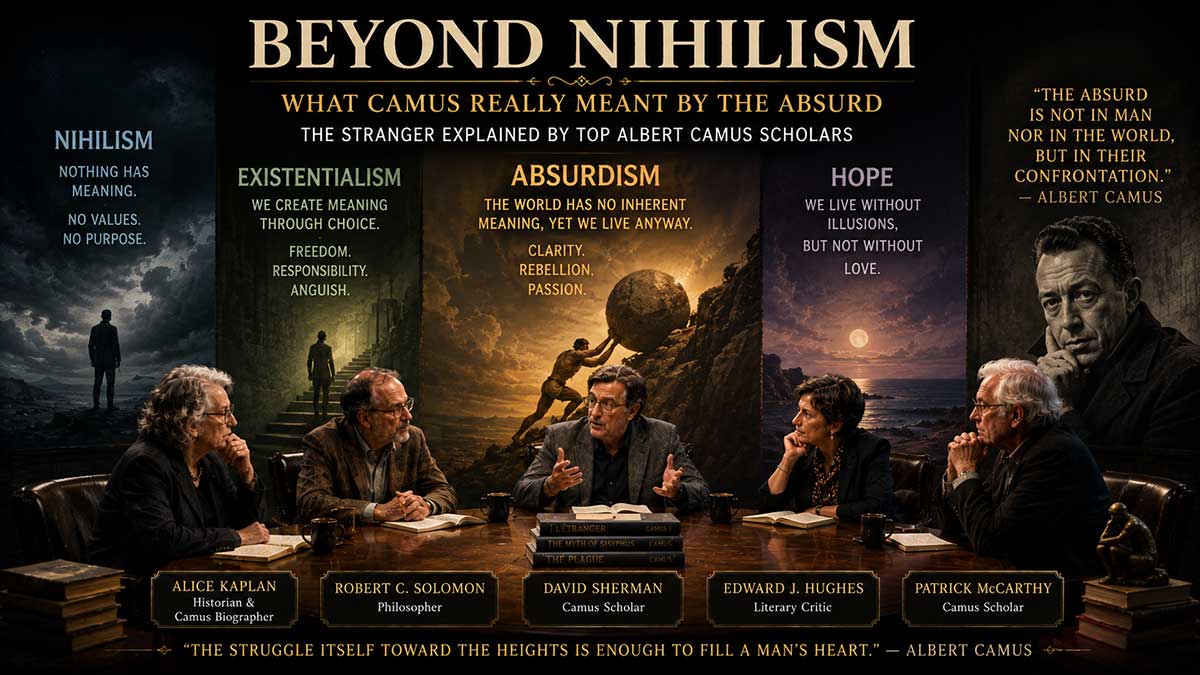
Guests: Robert C. Solomon, David Sherman, Patrick McCarthy, Edward J. Hughes
The stage is completely dark.
Then, one by one, four words appear suspended in white light.
NIHILISM
EXISTENTIALISM
ABSURDISM
HOPE
The scholars enter quietly.
No one sits.
Robert Solomon walks directly to the first word.
NIHILISM.
He crosses it out with a piece of chalk.
"This Is the First Mistake"
Robert C. Solomon: Every semester...
Someone raises a hand and says,
"So Camus believed life has no meaning."
He smiles.
"And every semester I tell them..."
"No."
Patrick McCarthy laughs.
Patrick McCarthy: Mine usually say,
"So Meursault just doesn't care about anything."
Edward J. Hughes: My students use another word.
"Numb."
David Sherman: Mine say,
"Depressed."
The four scholars laugh.
Robert C. Solomon: We have just listed four common misunderstandings.
None captures Camus.
If Life Has No Ultimate Meaning...
David walks toward the word ABSURDISM.
He does not touch it.
David Sherman: Camus begins with an observation.
Human beings desperately want the universe to answer them.
Why am I here?
Why do people suffer?
Why do children die?
Why is there injustice?
Why does love end?
Why must I die?
He pauses.
The universe remains silent.
That silence creates what Camus calls...
The absurd.
Patrick McCarthy: Notice what he did not say.
He did not say life has no value.
He did not say nothing matters.
He did not say morality is impossible.
Those are completely different claims.
Edward J. Hughes: Yet people combine them all the time.
Solomon Interrupts
Robert C. Solomon: May I challenge that?
The others smile.
They know what's coming.
Robert C. Solomon: I sometimes think scholars accidentally make Camus too comfortable.
We polish him.
We reassure readers.
We soften his challenge.
Camus is not comforting.
He begins with one of the harshest realizations imaginable.
The universe owes you nothing.
It does not love you.
It does not explain itself.
It does not promise justice.
That is terrifying.
David Sherman: It is.
But Camus refuses to stop there.
Robert C. Solomon: Exactly.
That is why nihilism is the wrong word.
The Myth of Sisyphus Appears
A massive image appears behind them.
A man pushing a stone uphill.
Patrick McCarthy: This poor man has become one of philosophy's greatest celebrities.
Laughter fills the room.
Patrick McCarthy: Most people think Sisyphus teaches endless suffering.
Camus reaches the opposite conclusion.
Edward J. Hughes: Which shocks readers every time.
Patrick McCarthy: At the end of the essay...
Camus writes,
"We must imagine Sisyphus happy."
He looks around.
Students always ask,
"How?"
Happiness Without Illusion
David Sherman: Let us answer that carefully.
Sisyphus stops demanding that reality become something else.
He stops waiting for rescue.
He stops expecting the universe to apologize.
Instead...
He fully inhabits the life actually before him.
Robert C. Solomon: Which sounds beautiful.
Until you remember...
The rock is still there.
Edward J. Hughes: Exactly.
Camus never removes suffering.
He changes the relationship to suffering.
Meursault's Awakening
The image changes.
Now Meursault sits alone inside his prison cell.
Patrick McCarthy: Readers often think the ending is hopeless.
I think it is the most joyful moment in the novel.
Robert raises an eyebrow.
Robert C. Solomon: Joyful?
He is awaiting execution.
Patrick McCarthy: Yes.
For the first time...
He completely stops lying to himself.
He no longer dreams about appeals.
Or miracles.
Or another life.
He finally lives inside the present moment.
Robert C. Solomon: That is not joy.
That is clarity.
Patrick McCarthy: Perhaps clarity becomes its own form of joy.
David nods.
David Sherman: Camus would probably like that sentence.
Is Camus an Existentialist?
Edward walks toward the glowing word.
EXISTENTIALISM
He studies it for a moment.
Edward J. Hughes: Another misunderstanding.
Camus spent much of his life denying this label.
People kept placing him beside Sartre.
He resisted.
Patrick McCarthy: Why?
Most readers hardly notice the distinction.
Edward J. Hughes: Because Sartre believed human beings create meaning.
Camus asks a different question.
How do we live once we stop demanding that the universe provide it?
Those are related questions.
Not identical ones.
Can Meaning Be Created?
Robert folds his arms.
Robert C. Solomon: I have always wondered whether the disagreement is larger than Camus admitted.
David smiles.
David Sherman: Go on.
Robert C. Solomon: Suppose I create meaning through friendship.
Teaching.
Family.
Art.
Responsibility.
Is that not enough?
Patrick McCarthy: Camus would probably answer...
"Wonderful."
"But do not mistake your meaning for the universe's."
Robert laughs.
Robert C. Solomon: Exactly.
That is where people become confused.
Camus attacks cosmic certainty.
Not ordinary human purpose.
The Most Important Sentence
David turns toward the audience.
David Sherman: If I had only one sentence to explain Camus...
It would be this.
"The universe may owe you no explanation."
"That does not excuse you from living fully."
The room becomes still.
Patrick repeats it quietly.
Patrick McCarthy: Living fully.
Not living comfortably.
Those are different.
Why Readers Misunderstand Meursault
Edward J. Hughes: We keep returning to Meursault.
Perhaps because readers mistake his personality for Camus's philosophy.
Meursault is emotionally restrained.
Camus was not.
Meursault drifts.
Camus joined the Resistance.
He fought fascism.
He wrote passionately about justice.
He defended ordinary human dignity repeatedly.
Robert C. Solomon: Exactly.
People often assume the author agrees with every feature of his protagonist.
Camus gives us Meursault.
He does not become Meursault.
The Revolt
The final glowing word remains.
HOPE
Patrick walks toward it.
Instead of crossing it out...
He writes another word beside it.
REVOLT
Patrick McCarthy: This may be Camus's favorite word.
Not political revolt alone.
Existential revolt.
Choosing to live honestly...
Without demanding guarantees.
David Sherman: Revolt says yes to life.
Without saying yes to illusion.
Edward J. Hughes: Which separates Camus from despair.
Solomon's Objection
Robert is not entirely convinced.
Robert C. Solomon: I still worry about something.
The others wait.
Robert C. Solomon: Modern readers often leave Camus inspired.
Good.
But they also leave feeling emotionally detached.
As though caring deeply somehow contradicts absurdism.
I think that reading betrays Camus.
David nods immediately.
David Sherman: I agree completely.
Camus loved intensely.
Friendship mattered.
Beauty mattered.
Justice mattered.
Human suffering mattered.
He simply refused easy explanations.
Patrick McCarthy: There it is.
Absurdism is not emotional distance.
It is intellectual honesty.
A Student's Question
Edward smiles.
Edward J. Hughes: A student once asked me...
"If life has no ultimate explanation..."
"Why get out of bed?"
Robert laughs.
Robert C. Solomon: Excellent question.
Edward J. Hughes: I answered...
Because someone you love may need you.
Because the sunrise is beautiful.
Because music exists.
Because children laugh.
Because injustice should be resisted.
Because today exists only once.
Patrick nods.
Patrick McCarthy: None of those require cosmic certainty.
Final Exchange
The words begin disappearing.
First...
NIHILISM
Then...
EXISTENTIALISM
Then...
HOPE
Only one remains.
ABSURDISM
David looks at it.
David Sherman: Perhaps the word itself has become a problem.
People hear "absurd."
They think "ridiculous."
Camus meant something much deeper.
The collision between our longing for answers...
And a universe that remains silent.
Robert finishes the thought.
Robert C. Solomon: What matters is what we do after hearing that silence.
Closing Reflection
The word ABSURDISM slowly fades.
The stage is empty once more.
Patrick McCarthy: Camus never asked us to stop loving.
He asked us to stop pretending certainty where certainty does not exist.
Edward J. Hughes: He never preached despair.
He warned against false comfort.
David Sherman: He never denied meaning in ordinary life.
He questioned whether the universe guarantees it.
Robert looks toward the audience.
Robert C. Solomon: Perhaps the greatest misunderstanding of The Stranger is this:
People think Camus wanted us to become like Meursault.
No.
He wanted us to become more awake than we were yesterday.
To see life clearly.
To love it honestly.
And to carry our own stone...
With our eyes open.
The lights go out.
Only the faint outline of the mountain remains.
Somewhere beyond the darkness, a rock begins rolling uphill once again.
Act 5: Would Camus Write The Stranger Differently Today?
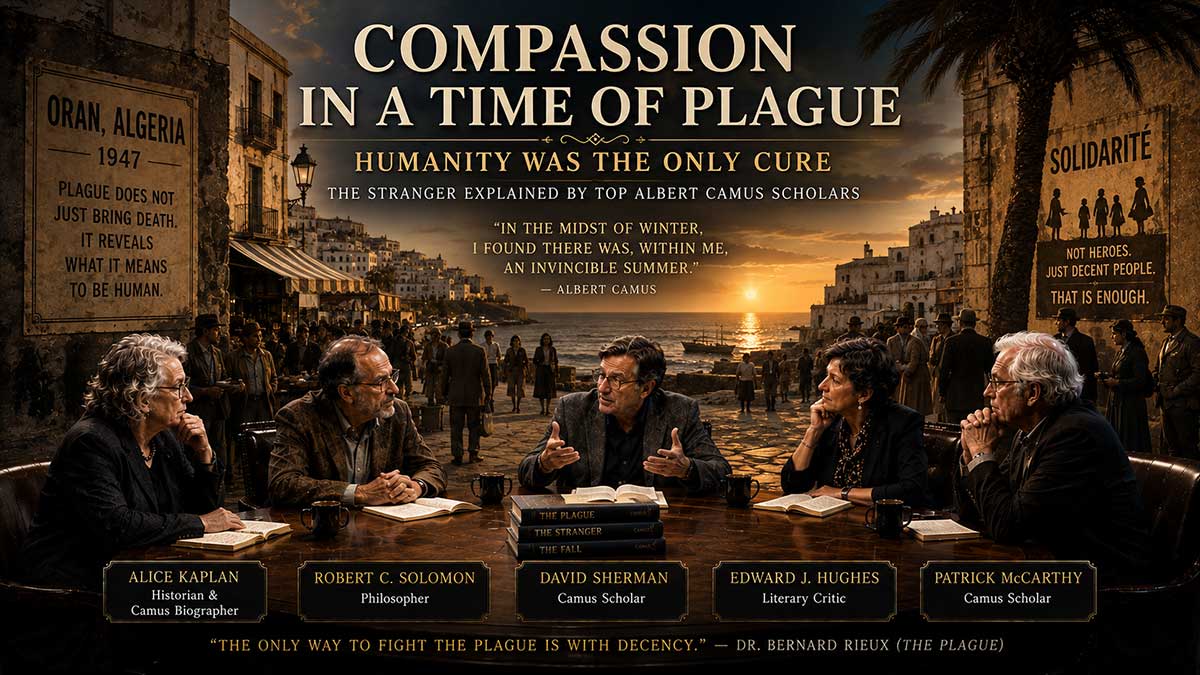
Guests: Alice Kaplan, Robert C. Solomon, David Sherman, Edward J. Hughes, Patrick McCarthy
The lights come up slowly.
The courtroom is gone.
The prison is gone.
The beach has disappeared.
Instead, a giant digital screen fills the wall.
Across it flashes an endless stream of headlines.
"MURDER SUSPECT SHOWS NO EMOTION."
"FUNERAL PHOTOS SPARK OUTRAGE."
"SOCIAL MEDIA CALLS HIM A MONSTER."
"EXCLUSIVE: PEOPLE WHO KNEW HIM SPEAK OUT."
Every few seconds another headline replaces the last.
No one speaks.
Robert Solomon finally breaks the silence.
Robert C. Solomon: Camus would hate this.
Patrick laughs.
Patrick McCarthy: Which part?
Robert points upward.
Robert C. Solomon: All of it.
The Trial Before the Trial
David Sherman: The first thing that strikes me is speed.
Meursault waited for investigators.
Lawyers.
Witnesses.
A courtroom.
Today...
The verdict arrives before breakfast.
Edward J. Hughes: Before the police report.
Alice Kaplan: Before facts.
She watches another headline appear.
"WHY DIDN'T HE CRY?"
Alice sighs.
Alice Kaplan: Some questions never disappear.
They simply move faster.
Would Meursault Survive Social Media?
Patrick looks toward the screen.
Patrick McCarthy: Imagine Meursault today.
Someone photographs him leaving the funeral.
No tears.
Coffee in his hand.
A cigarette.
The next day...
Someone posts a picture of him swimming.
Then another at the cinema.
Millions of strangers decide who he is.
Before he ever enters a courtroom.
Edward J. Hughes: The novel suddenly feels prophetic.
Robert C. Solomon: More frightening than prophetic.
Today's world rewards emotional performance.
The louder your grief...
The more believable it becomes.
The quieter your grief...
The more suspicious you appear.
Alice Challenges Everyone
Alice turns away from the screen.
Alice Kaplan: May I ask something uncomfortable?
The others nod.
Alice Kaplan: Are we certain we would defend Meursault today?
Silence.
Patrick answers first.
Patrick McCarthy: I would try.
Alice smiles gently.
Alice Kaplan: Try.
Exactly.
Then I imagine reading the headlines.
Watching the video clips.
Seeing public outrage.
Listening to grieving interviews.
I wonder...
Would I slowly begin believing the story everyone else believes?
Robert answers quietly.
Robert C. Solomon: Probably.
That is why Camus wrote the novel.
Not because juries are weak.
Because human beings are.
Has Society Changed?
David walks toward the enormous screen.
David Sherman: We like to think modern society is fairer.
In some ways...
It is.
We ask questions about colonialism that readers ignored for decades.
We pay closer attention to invisible voices.
We recognize prejudice more quickly.
Those are real advances.
Edward J. Hughes: Yet something else has happened.
Our patience has become shorter.
Our certainty has become faster.
Patrick McCarthy: We collect fragments.
Then build complete personalities from them.
Exactly as the Prosecutor did.
Solomon's Confession
Robert sits down.
For the first time in the entire series, he looks tired.
Robert C. Solomon: I have a confession.
Everyone turns.
Robert C. Solomon: I used to believe education solved this problem.
Teach people philosophy.
History.
Literature.
Critical thinking.
Then they become careful judges.
He smiles sadly.
Life taught me otherwise.
Intelligent people tell stories just as quickly as everyone else.
Sometimes...
Even faster.
The room falls silent.
The Arab Today
Alice speaks softly.
Alice Kaplan: Something else would change.
Today...
The unnamed Arab would not remain unnamed.
His family would speak.
Journalists would interview childhood friends.
Photographs would appear.
His voice would enter the public conversation.
That is progress.
David Sherman: Yes.
Although...
A new danger appears.
People might stop seeing Meursault altogether.
Patrick McCarthy: We trade one simplification for another.
Edward J. Hughes: Literature resists that.
It insists uncomfortable truths may exist together.
Cancel Culture?
Patrick raises an eyebrow.
Patrick McCarthy: We should probably say the phrase everyone is avoiding.
Robert laughs.
Robert C. Solomon: Go ahead.
Patrick McCarthy: Cancel culture.
The room grows quiet.
David Sherman: I dislike slogans.
The real issue is older.
Communities have always expelled people who violated shared values.
Athens did it.
Medieval Europe did it.
Modern democracies do it online.
Technology changes.
Human nature changes slowly.
Alice Kaplan: Public shame is ancient.
Only the audience became global.
Would Camus Rewrite the Novel?
Edward looks thoughtful.
Edward J. Hughes: Suppose Camus sat in this chair.
Someone asked,
"Would you write The Stranger differently today?"
What do you think he would answer?
Patrick smiles.
Patrick McCarthy: Probably...
"No."
Laughter spreads around the room.
Patrick McCarthy: Then after a long pause...
"Perhaps."
More laughter.
David's Answer
David speaks more slowly.
David Sherman: I think Camus would keep the central question.
Can society judge a person fairly when it first demands emotional conformity?
That question remains timeless.
But I suspect...
He would broaden the world around Meursault.
The colonial silence would not remain quite so silent.
The murdered man might become more visible.
History itself has changed the questions readers ask.
Great writers often respond to those changes.
What Makes the Novel Immortal?
Robert stands.
He walks toward the screen.
One by one...
The headlines disappear.
Soon only a blank wall remains.
Robert C. Solomon: Here is why the novel survives.
Not because every page is perfect.
Not because every reader agrees.
Not because every criticism fails.
It survives because every generation argues with it.
Books that stop being questioned...
Stop living.
The Final Question
Patrick looks around the room.
Patrick McCarthy: We have spent five conversations asking...
Who was Meursault?
Perhaps we have asked the wrong question.
Edward J. Hughes: Then what should we ask?
Patrick smiles.
Patrick McCarthy: Who are we...
When we read him?
Silence.
No one interrupts.
Alice's Last Reflection
Alice walks toward the audience.
Alice Kaplan: Every generation creates its own Meursault.
The 1940s saw an outsider.
The 1960s saw an existential hero.
The 1980s saw philosophical rebellion.
The 2000s asked psychological questions.
Today's readers ask about colonialism.
Identity.
Power.
Justice.
None of those readings completely erase the others.
They accumulate.
Like rings inside an old tree.
The Scholars Reach Agreement
For the first time in the series...
No one argues.
David Sherman: Great novels do not become smaller when new questions appear.
They become larger.
Edward J. Hughes: They refuse to remain trapped inside the century that produced them.
Patrick McCarthy: They expose each generation differently.
Alice Kaplan: Including ours.
Robert looks toward the empty wall.
Robert C. Solomon: Which means...
The real stranger may never have been Meursault.
The real stranger is always the reader...
Until the novel quietly reveals something unexpected about the person holding it.
No one speaks.
The silence feels complete.
Closing Reflection
The lights begin fading.
The scholars remain where they are.
Not looking at one another.
Looking outward.
Toward the audience.
Robert C. Solomon: Eighty years ago, Camus asked readers whether they could judge a man honestly.
Today...
The question has become more dangerous.
Can we judge anyone honestly...
After seeing only a headline?
A photograph?
A thirty-second video?
A single post?
Alice Kaplan: Literature slows us down.
That may be its greatest gift.
David Sherman: It teaches patience before judgment.
Edward J. Hughes: Curiosity before certainty.
Patrick McCarthy: Humanity before labels.
The room is nearly dark.
Only one sentence remains glowing on the giant screen.
BEFORE YOU JUDGE A STRANGER...
The sentence stops there.
No final words appear.
The audience must finish it themselves.
Final Thoughts by Albert Camus

Our conversation has ended.
The arguments have not.
Nor should they.
Some of you may still believe Meursault was primarily an honest man.
Others may think his honesty lacked compassion.
Some may now read the novel through the history of colonial Algeria.
Others may continue to focus on the philosophy of the absurd.
None of these readings completely cancels the others.
That is the privilege—and the burden—of great literature.
It grows as readers grow.
When I wrote The Stranger, I was writing about one man's encounter with the silence of the universe.
Today, readers also encounter another silence.
The silence surrounding the unnamed victim.
History has taught us to hear questions that earlier generations often ignored.
That is not a betrayal of literature.
It is evidence that literature continues to breathe.
I hope you noticed something else tonight.
The scholars disagreed often.
Yet they never stopped listening.
That may be the rarest quality in our age.
The purpose of scholarship is not to win arguments.
It is to deepen them.
Whenever someone claims there is only one correct interpretation of a novel, be cautious.
Human beings are larger than theories.
Great books are larger than summaries.
And truth often reveals itself slowly through respectful disagreement.
If there is one lesson I would leave with you, it is this.
Approach books the way you should approach people.
With curiosity before certainty.
Questions before conclusions.
Humility before judgment.
Meursault remained a stranger because so many people decided they already knew him.
May we make that mistake less often with one another.
Thank you for joining us.
May the conversation continue long after the final page is turned.
Short Bios:
Albert Camus (1913–1960)
French-Algerian novelist, philosopher, journalist, and winner of the 1957 Nobel Prize in Literature. Camus explored freedom, justice, rebellion, and the absurd through works such as The Stranger, The Plague, The Fall, and The Myth of Sisyphus. He rejected the label "existentialist," believing his work centered on living honestly in a world without guaranteed answers.
Robert C. Solomon (1942–2007)
One of America's leading philosophers, Robert C. Solomon specialized in existentialism, ethics, and the philosophy of emotions. His writings on Nietzsche, Sartre, and Camus challenged simplistic readings of existential thought, arguing that emotions and responsibility remain central to human flourishing.
David Sherman
A distinguished Camus scholar and professor of French studies, David Sherman has written extensively on Camus's philosophy, ethics, and political thought. His work places The Stranger within Camus's larger vision of rebellion, justice, and human dignity rather than treating it as an isolated philosophical novel.
Alice Kaplan
An acclaimed historian, literary scholar, and biographer of Albert Camus, Alice Kaplan is widely recognized for illuminating the historical and colonial context surrounding The Stranger. Her research has helped modern readers understand how French Algeria shaped both the novel and its continuing debates.
Edward J. Hughes
A leading scholar of modern French literature, Edward J. Hughes has devoted much of his career to studying Albert Camus, narrative form, and twentieth-century French fiction. His work highlights how Camus's literary style, structure, and narrative voice are inseparable from the novel's philosophical impact.
Patrick McCarthy
Patrick McCarthy is an internationally respected authority on Albert Camus whose scholarship bridges literature, philosophy, and ethics. His writings explore how Camus's fiction examines moral responsibility, freedom, and the complexity of human action without reducing his novels to abstract philosophical arguments.
Leave a Reply