


Richard Bach
Before a man writes words that last forever, he walks alone across sand, sky, and silence.
Antoine de Saint-Exupéry was one of those rare souls who wrote not because he wanted to be heard, but because he had to translate what he saw. He saw stars as companions, foxes as teachers, and deserts as mirrors. And when no one else could find language for loneliness or meaning, he did — gently, with ink and altitude.
He was not perfect. That’s not why we remember him. We remember him because even in his trembling moments — the letters unsent, the silences between friends, the sky that threatened to never bring him home — he kept flying. Not to escape, but to understand.
This is not just a story about his hardships. It is a story about what happens when a man listens too closely to the stars, and finds that they are whispering homeward.
(Note: This is an imaginary conversation, a creative exploration of an idea, and not a real speech or event.)
The Boy with the Paper Wings
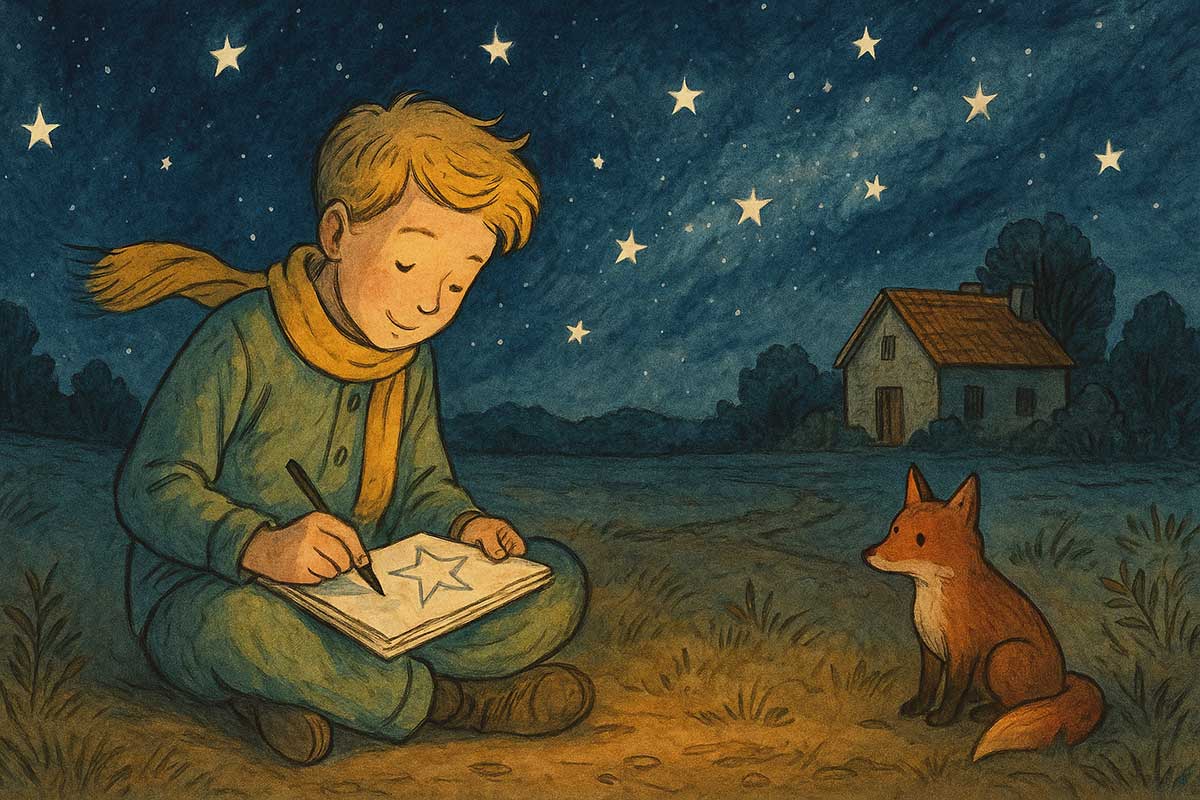
The boy did not speak the language of numbers and measurements.
He spoke wind.
And clouds.
And the quiet ache of stars brushing the rooftops of his childhood.
Antoine was often found sitting alone on the stone steps behind the family estate in Saint-Maurice-de-Rémens, a paper airplane in his lap and a sky full of questions above. His brothers laughed at their games of chess and soldiers. Antoine folded dreams into wings.
They said he was too sensitive.
Too quiet.
Too lost in his head.
But no one asked where he was flying to.
I sat beside him once, not saying anything. That’s how you learn the language of those who carry invisible burdens. Silence is sacred when spoken with someone who listens. He showed me a sketch — a clumsy drawing of a biplane with the word Espérance written underneath. Hope.
He said, “I don’t want to grow up. They forget things. Like stars. And foxes. And how a desert isn’t empty. It’s full of whispers.”
And I saw it—this child already hurt by how adults measured worth. He watched his father leave the earth too soon. He watched his mother try to sew love into silence. He began to ask if dreams had expiration dates.
One day, his teacher scolded him:
"You must learn what is useful, Antoine. Stories won’t feed you. Stop staring out the window."
He didn’t flinch. He just whispered, “But they feed something else.”
What else?
The world had no time for that question.
But I did.
I brought him scraps of wood and string. Together we built a crude glider that never flew. But when he ran with it through the fields, laughing, I swear the earth tilted just slightly — as if it too wanted to believe.
I saw in him the ache that all wanderers carry: the longing to both stay and leave. To be held and to disappear. To belong to the world and yet float just above it.
One rainy evening, he looked at me and said, “Do you think stars care if we grow up?”
I said, “No. I think they wait for us to remember who we were before we forgot.”
And he smiled.
A smile made not of triumph but of recognition.
The smile of a boy who had just decided — against the laws of logic and practicality — to become a pilot of wonder.
The boy with the paper wings would one day disappear into the clouds.
But on that day, he simply whispered, “Merci,”
and folded another dream into the sky.
The Pilot Who Fell from the Sky

The desert did not ask questions.
It waited.
Silent. Infinite. Merciless.
Just as he was when the plane went down.
Antoine awoke to the taste of sand and blood. The wreckage of his Caudron lay like a torn dream beside him, its wings twisted into the sun. Somewhere, Cairo was a memory, and death walked in circles around him and Prévot, thirsty, disoriented, half-mad.
He’d flown before. He’d fallen before. But never like this. Never where the stars were so close, and yet water was a rumor your body began to disbelieve.
I found him lying there on the third day, his lips cracked, his eyes wild with the brilliance of a man unthreaded from time. He didn’t recognize me—not at first. He whispered to the wind:
“Is this what it feels like to return to the essential?”
I knelt and gave him the only thing I had—a palmful of water and a silence he could still breathe in.
“I thought I would die,” he said, hours later, voice thin as parchment.
“Did it scare you?” I asked.
He didn’t answer right away. He looked at the sky. “No. It was beautiful. Terrifying, yes. But beautiful. You start to see the world the way the Little Prince might. No noise. Just sand. And the shape of your own soul echoing back.”
This was how Saint-Exupéry lived—between earth and spirit, in the crash between duty and wonder.
The military called him brave.
The philosophers called him poetic.
But I saw him in the quiet hours—haunted, fractured, and full of awe. A man who understood that to fall from the sky was not always a tragedy.
Sometimes it was an invitation.
“Do you know what I saw?” he asked once, sitting beside the wrecked fuselage as they awaited a miracle.
“No,” I said.
“A child,” he said. “With golden hair and a scarf that danced. He asked me why adults are so obsessed with numbers. I had no answer.”
He wept. Not from pain, but from remembering.
Even when he returned to France, even when they hailed him as the pilot who survived the impossible, something inside him remained in the desert. The part that listened to foxes. The part that knew the invisible was more important than the seen.
He carried it all—the crash, the thirst, the hallucinations—like sacred wounds. Not to boast, but to remind: We are never more human than when we are lost.
And I held his story gently, as one might carry a fragile star in cupped hands.
Because those who fall from the sky sometimes return with the maps we’ve forgotten how to draw.
The War He Couldn’t Escape
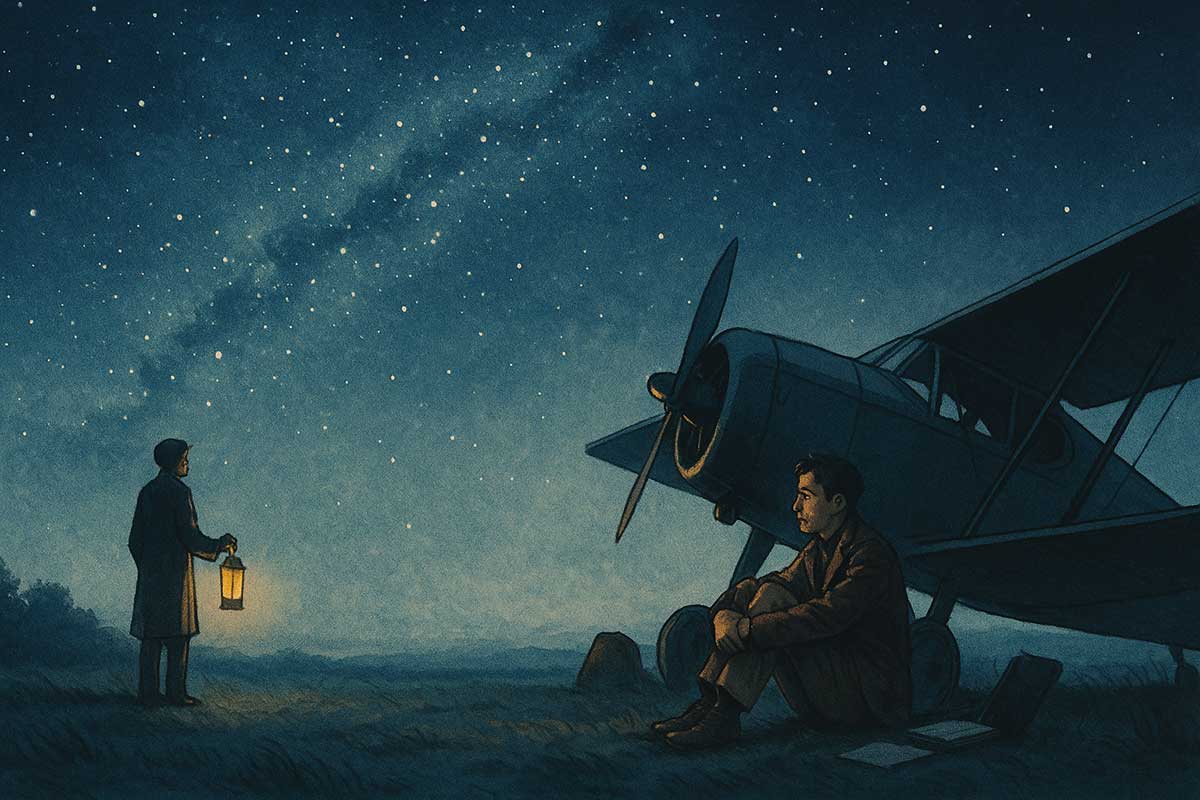
The café was quiet, save for the scratch of a pen on thin paper. Antoine sat hunched over a letter he would never send. The room smelled of ink, tobacco, and unspoken dread.
“They want me grounded,” he said without looking up. “They say I’m too old. Too injured. That my time in the sky is over.”
He folded the page, then unfolded it again, as if reluctant to let even the words take flight.
“I wasn’t made for peace,” he murmured.
I sat beside him and said nothing. Because how do you speak when a man has stitched his soul to the clouds?
The war was not just in Europe. It lived in his ribs, in the maps he couldn’t stop drawing, in the longing that gnawed at him every time he heard an engine hum. His body was worn—ankle shattered, spine aching—but his eyes still searched the horizon like a boy looking for a comet.
“They don’t understand,” he said. “This isn’t about glory. I just... need to be useful.”
He watched the dusk fall, blue and bruised.
“They’re killing each other down there, and I’m here drinking lukewarm coffee. That’s not who I am.”
He pulled out a worn photograph of his squadron, traced the faces one by one.
I asked, “Do you want to die?”
He didn’t flinch. “No. I want to matter.”
And that was the difference. Antoine was not chasing death. He was chasing meaning. In a world unraveling, he longed for the thread that still connected men to stars.
When they finally let him fly again—over occupied France, through the spitfire chaos of Luftwaffe patrols—I watched him step into his cockpit like a man stepping into church.
“This may be the last,” he said.
I nodded.
“If I don’t return, will you remember me as someone who loved the world?”
I wanted to say, “You are the world.” But I just held his scarf, wrapped it once more around his neck.
He smiled faintly. “Tell the Little Prince I didn’t forget him.”
The plane disappeared into the clouds.
He never came back.
Some say he was shot down.
Some say he simply vanished.
But I believe he flew home—home to the invisible, to the silence between stars, where he always belonged.
Because the war couldn’t claim all of him.
The part of him that mattered had already escaped long ago—into a rose’s laugh, into a fox’s farewell, into the hearts of those who still whisper: “What is essential is invisible to the eye.”
The Letter He Never Sent

The wind outside howled like it had something urgent to say. Inside the quiet study, Antoine sat motionless at his desk, a pen balanced between two fingers, the paper still blank.
It was the kind of silence that didn’t wait for words—it judged them before they came.
“I’ve tried,” he whispered, as if someone were listening. “Every time I begin, it escapes me.”
I stood behind him, watching the way his shoulders rose and fell like a kite barely catching wind.
He touched the edge of the paper again, gently, reverently—like it might burn or disappear if he pressed too hard.
“It was supposed to be for Consuelo,” he said. “But it’s not really a love letter. Not in the usual sense.”
His voice trembled slightly.
“I wanted to tell her why I kept flying. Why I left without warning. Why I could never be entirely hers, even when I was.”
The lamp flickered once, as if even the light was holding its breath.
“Do you know what it’s like,” he asked, turning to me, “to love someone and still feel yourself dissolving into something bigger—something... sky-wide?”
I nodded slowly.
“I think I needed her to anchor me,” he said. “But I was already drifting before she touched me.”
He began writing then. Not in sentences, but in breaths. Words came slowly, as if each had to be earned.
“My dear rose—
You were always more resilient than you looked. I kept thinking I needed to protect you, but maybe it was you keeping me from vanishing...”
He stopped.
Folded the paper.
Didn’t seal it.
“It’s not enough,” he said. “How could it be? Nothing I write explains what it meant to watch the stars from ten thousand feet while wondering if I’d ever see her again.”
I placed my hand on his shoulder. “Maybe she didn’t need all the words. Maybe she felt them before you even lifted the pen.”
He looked up, eyes weary but lit with something soft. “Do you think so?”
I nodded. “Some letters don’t need to be sent. They’re already received.”
Outside, the wind quieted. The sky turned a paler shade of blue, like memory softening.
He left the page on the desk. Unsent. Unfinished.
But not unread.
It would stay there, a testament to the ache between love and freedom—to the man who wanted both and never fully belonged to either.
The Sky That Took Him Home
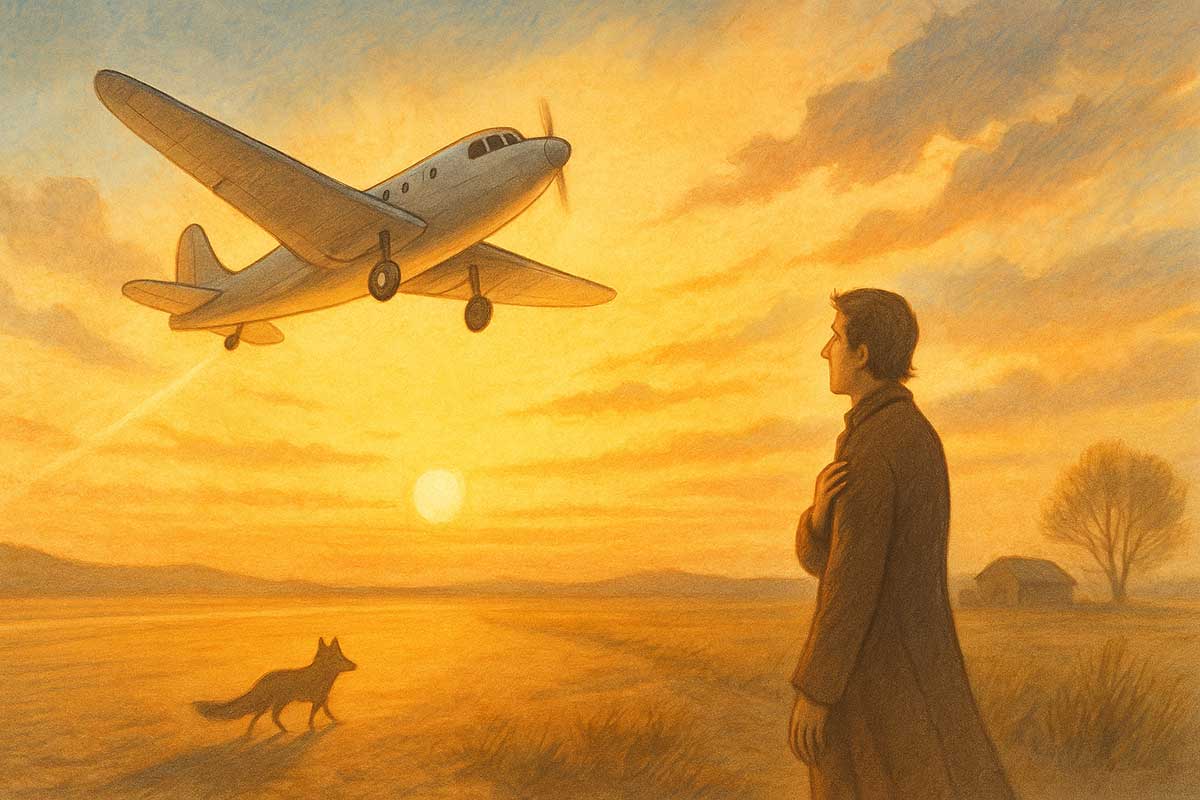
The sky was clear that morning—unnaturally so. No clouds, no hesitation. Just an endless blue that seemed to stretch beyond the edges of the world.
Antoine stood near his aircraft, hand resting on the metal like it was the shoulder of a friend. The desert wind whispered around us, filled with old voices, dry heat, and silence thick enough to swallow farewells.
He turned toward me, goggles hanging loosely from his neck.
“This may be the last,” he said. Not with fear, but with a strange, quiet certainty.
I didn’t ask why. We both knew.
“I used to think flying was escape,” he continued. “But it’s always been a return. Not to a place—but to a feeling. A truth. Something I lost and keep trying to meet again above the clouds.”
A pause.
“I have a question,” he said. “If the stars know our names, do they call them when we vanish?”
The words caught in the back of my throat. I couldn’t answer.
He smiled—boyish, bright, breaking through the lines time had drawn on his face.
“I want the sky to take me without protest,” he said. “Not because I’m finished here, but because I’ve left enough behind to be remembered gently.”
I handed him a folded note—his own words, written days ago but never sent.
He looked at it. Then folded it again, slipping it into his jacket pocket.
“I’ll carry her with me.”
Then he climbed in.
No grand departure. No dramatic wave.
Just the cough of the engine, the shaking of metal, and the rise of the wings.
He disappeared into the horizon like a breath exhaled too deeply to return.
But I saw him still—in the moment just before he vanished.
Eyes scanning the heavens.
One hand steady on the yoke.
The other resting softly over his heart.
And I knew then: the sky didn’t take him.
It received him.
Welcomed him.
Called him home by name.
Not Antoine the pilot.
Not Saint-Exupéry the writer.
But the boy who had once drawn stars on napkins and whispered to foxes and searched the desert for the echo of something eternal.
Final Thoughts By Richard Bach

What remains after the engine fails, after the last letter is written, after the wind stops carrying your name?
In Antoine’s case, it’s the invisible thread. Between a boy and his fox. Between a pilot and his purpose. Between solitude and the sacred.
He didn’t just give us a prince from another planet. He gave us the courage to love something fragile, to tame it gently, and to let it go — knowing the bond is never lost.
And maybe that's the truest kind of flight.
Because Saint-Exupéry never really disappeared. He simply became sky.
Short Bios:
Antoine de Saint-Exupéry
French writer, poet, and pioneering aviator best known for The Little Prince, Antoine blended his experiences as a pilot with a deep philosophical lens. His works explored solitude, love, and the search for meaning, earning him lasting literary acclaim and spiritual resonance.
The Friend (Narrative Presence)
An imagined supportive companion who walks quietly beside Antoine through each chapter of his life — witnessing, listening, and gently offering presence. Not a historical figure, but a symbolic representation of care and quiet understanding.
Richard Bach
American author and aviator best known for Jonathan Livingston Seagull. A spiritual kindred to Antoine, Bach’s writings celebrate freedom, flight, and the soul’s journey toward purpose. His voice provides the introduction and final thoughts with grace and reverence.
Leave a Reply