
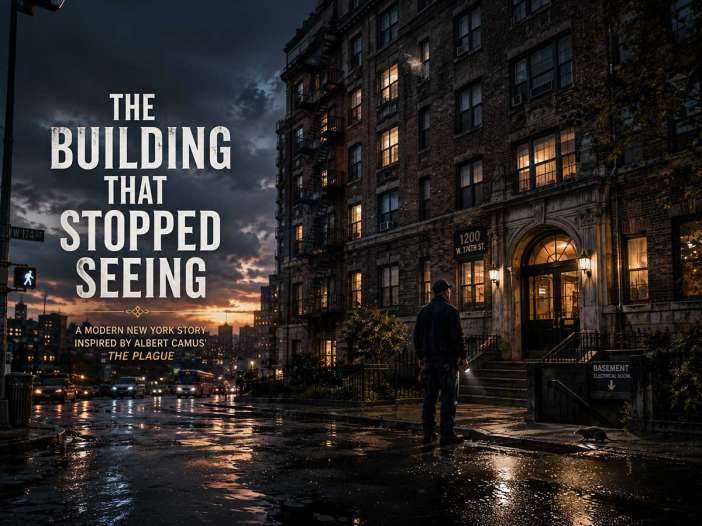
What if the rats were never the plague, but only the first sign that people had stopped paying attention?
Albert Camus began The Plague with something almost absurd.
Not a dramatic death.
Not a political crisis.
Not even the disease itself.
He began with a dead rat.
Most people dismissed it.
Then another appeared.
Then another.
Only later did everyone realize the rats had never been the story.
They were simply the first warning that something much larger had already begun.
The Building That Stopped Seeing asks what that warning might look like in modern New York City.
Not another pandemic.
Not another disaster movie.
Instead, an aging apartment building where leaking pipes, ignored maintenance reports, dead rats, flickering lights, and forgotten neighbors slowly reveal a deeper illness.
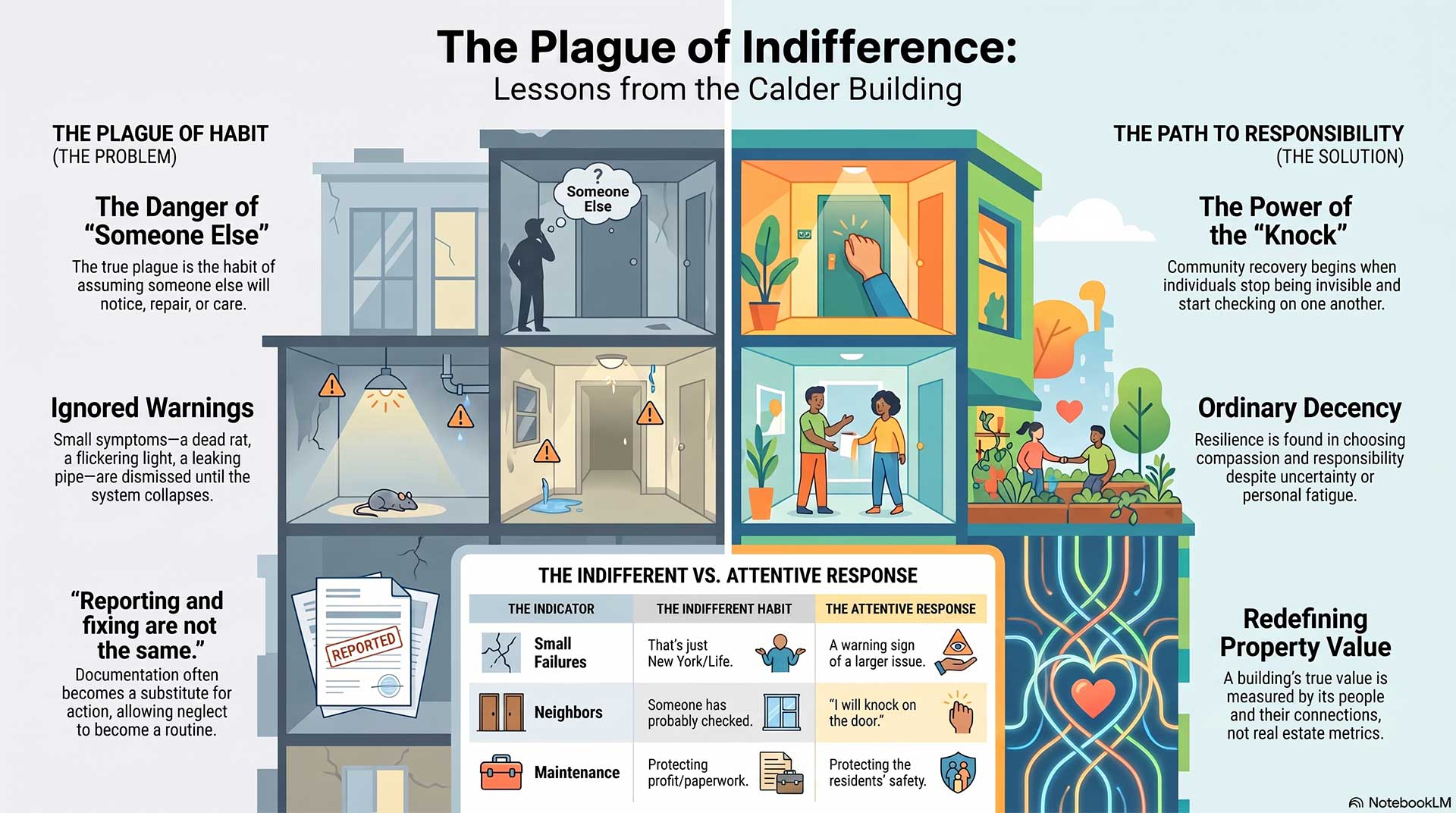
The true plague is not carried by animals.
It is carried by habit.
The habit of assuming someone else will notice.
Someone else will repair it.
Someone else will knock.
Someone else will care.
Like Camus' novel, this story is not about fear.
It is about responsibility.
Its heroes are not extraordinary people.
They are a superintendent who refuses to stop reporting problems.
A retired physician who rediscovers her calling.
A grocery delivery rider who notices the invisible.
A single mother who refuses to accept neglect as normal.
An elderly man who quietly remembers everyone else's name.
Together, they remind us that communities rarely collapse in a single moment.
They slowly stop seeing one another.
And they recover in exactly the opposite way.
One person.
One knock.
One act of responsibility at a time.
(Note: This is an imaginary conversation, a creative exploration of an idea, and not a real speech or event.)
Chapter 1 — The First Rat
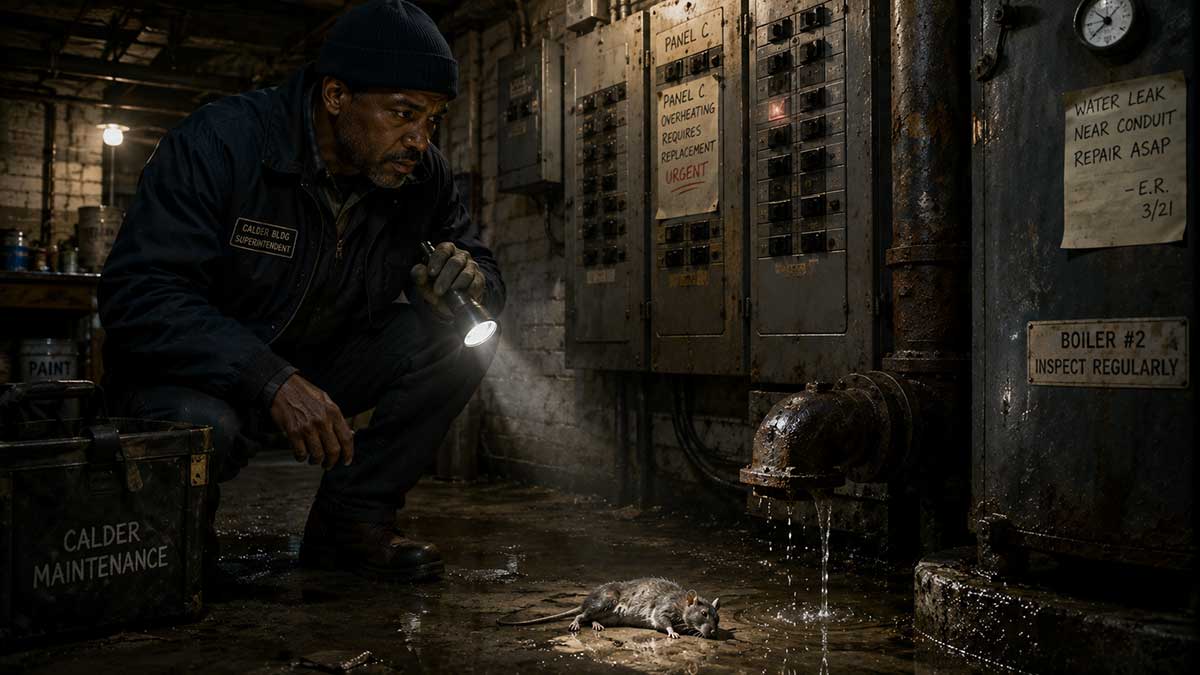
At 6:42 on a Tuesday morning, Elias Reed found the first dead rat beside the basement boiler.
It lay on its side beneath a rusted pipe, one paw curled against its chest. Its fur was wet. A thin line of water ran across the concrete floor and disappeared beneath an electrical cabinet.
Elias stood over it with his flashlight.
He had worked as the superintendent of the Calder Building for nineteen years. He had removed rats from garbage rooms, boiler closets, elevator shafts, laundry rooms, and once from the glove compartment of a tenant’s car.
In New York, a dead rat was not a warning.
It was sanitation.
He lifted it with a dustpan, dropped it into a black garbage bag, and continued his inspection.
The Calder stood on West 174th Street, twelve stories of brown brick, black fire escapes, patched stonework, and windows that looked across Upper Manhattan toward the river.
It had been built when radiators were considered modern and elevator operators still wore uniforms.
Now the lobby ceiling leaked near the mailboxes. The pipes knocked through winter nights. The elevator stopped half an inch below the floor. Tenants had learned to step up without looking.
The building contained people who had lived there for forty years and people who had arrived forty days earlier.
Rent-stabilized families lived beside market-rate tenants.
Retired teachers shared hallways with nurses, delivery riders, attorneys, home health aides, musicians, students, and people who seemed to work at every hour except the one when others saw them.
Everyone lived close enough to hear arguments through the walls.
Few knew the names of the people arguing.
At 7:14 that evening, the lights blinked.
Only once.
The television in Apartment 10D went black for half a second before returning.
A microwave clock in 4B reset itself to twelve.
The elevator stopped between the seventh and eighth floors for three uncomfortable seconds.
People looked up.
Then returned to dinner.
On the eleventh floor, Dr. Mara Levin stirred tomato soup while reading a novel she had promised herself she would finish after retirement.
The kitchen lights dimmed.
She looked toward the ceiling.
Old wiring, she thought.
She had seen the same pattern in patients.
A small symptom.
Nothing dramatic.
Nothing urgent.
Until it was.
She reached for her phone to call the management office.
Then stopped.
Someone else has probably reported it.
She returned to her book.
In the basement, Elias was already carrying his flashlight.
The steel electrical-room door resisted before opening with its familiar groan.
Dozens of aging breaker panels lined the concrete walls.
Panel C buzzed louder than usual.
Another cabinet smelled faintly of overheated plastic.
Elias rested his palm against the metal.
Warm.
Not dangerous yet.
But closer.
He pulled a small notebook from his jacket.
Every page contained the same handwriting.
November 12
Voltage fluctuation. Recommend replacement of Panel C.
No response.
January 8
Water intrusion near electrical conduit. Inspection required.
No response.
March 21
Temporary repair completed. Permanent replacement still necessary.
No response.
He turned to a clean page.
September 16
Lights flickered throughout building. Buzzing has increased. Recommend immediate shutdown and full inspection.
Near the bottom of the page, he added:
One dead rat found near boiler. Possible water displacement from wall opening.
He closed the notebook.
He already knew what management would say.
On the eighth floor, Jonah Vale adjusted his tie in the hallway mirror before leaving for a co-op board meeting.
His wife looked up from the dining table.
“Did the lights flicker?”
“For a second.”
“Should we worry?”
Jonah smiled.
“If there were a real problem, management would tell us.”
His answer comforted both of them.
Mostly since they wanted it to.
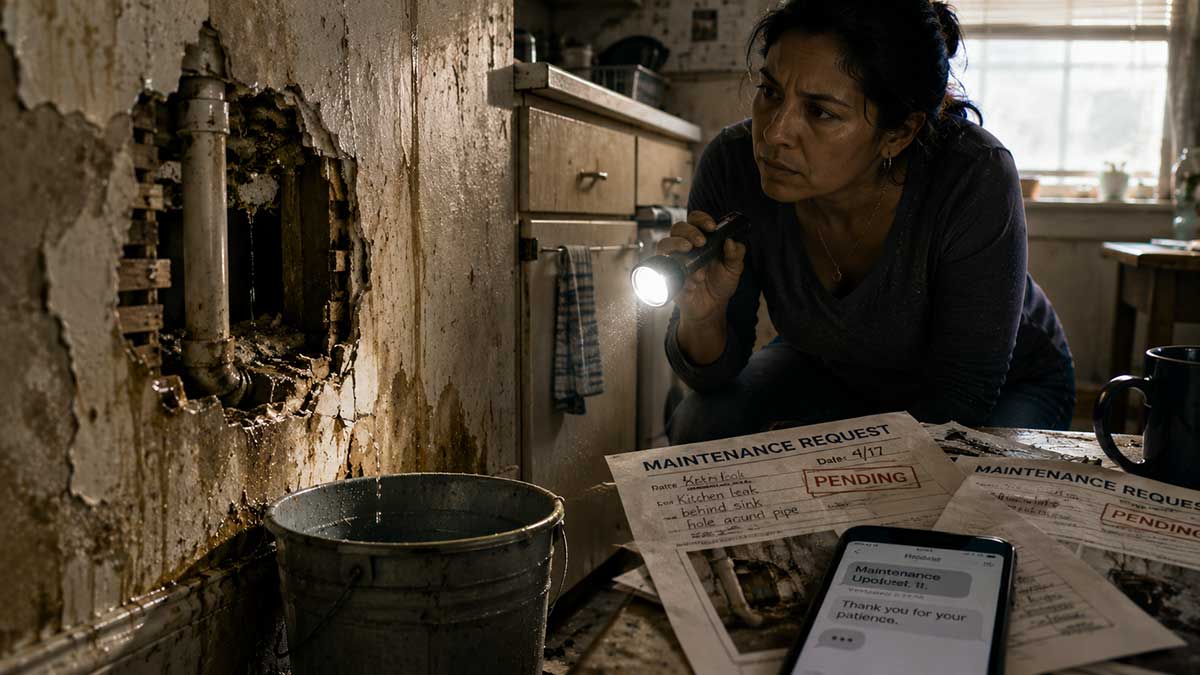
Apartment 3C smelled of damp drywall.
Lena Ortiz placed another towel beneath the kitchen window where rainwater had begun finding its way inside.
Her seven-year-old daughter, Sofia, sat at the table drawing a purple house with twelve windows.
A scratching sound came from behind the cabinets.
Sofia stopped coloring.
“Mom.”
Lena listened.
The sound came again.
Something moving inside the wall.
“It’s probably the pipes.”
“You said that yesterday.”
Lena opened the cabinet beneath the sink.
A dark opening surrounded one of the pipes. The maintenance crew had filled part of it with foam months earlier, but the material had cracked.
A rat’s nose appeared for half a second.
Lena slammed the cabinet shut.
Sofia climbed onto her chair.
“Was that a rat?”
“No.”
It came automatically.
Lena looked at her daughter.
“Yes.”
She opened the resident portal on her phone.
Ticket #417
Water leak continues.
Pending.
She created another request.
Possible rat entry behind kitchen cabinet. Hole around pipe needs permanent closure.
She attached a photograph.
The app immediately replied:
Your concern is important to us.
She laughed softly.
Not since it was funny.
Anger had become exhausting.
Every Thursday, Samuel Price carried a folding chair outside Apartment 6A.
He sat beside the hallway window for exactly one hour.
Some people nodded.
Most hurried past.
Tonight, the chair remained folded against the wall.
No one noticed.
At 7:42, Noah Chen entered the lobby carrying insulated grocery bags.
At seventeen, he knew the building better than many residents who had lived there for years.
He knew which elevator hesitated.
Which apartment doors never closed properly.
Which dogs barked before their owners reached the hallway.
Which elderly tenants preferred morning deliveries.
Which parents tipped in apologies rather than dollars.
His app displayed three deliveries:
Apartment 6A.
Apartment 3C.
Apartment 11F.
The same building.
Three separate lives.
Samuel opened his door slowly.
“You again.”
“I brought your groceries.”
“You always bring them.”
“You always order them.”
Samuel smiled.
“Fair enough.”
Noah carried the bags into the kitchen.
Only one plate sat in the drying rack.
Only one chair stood at the table.
A framed photograph showed a younger Samuel beside a woman beneath cherry blossoms.
“You miss her?”
Samuel followed his gaze.
“Every day.”
Noah nodded.
“I’ll see you next Thursday.”
Samuel watched him leave.
The apartment became silent again.
At Apartment 3C, Lena answered with a towel over one shoulder.
“You caught me cleaning.”
Noah noticed the bucket.
The dark wall.
The cracked cabinet door.
“Still leaking?”
“For six months.”
“Did anyone come?”
“They sent an exterminator.”
“Did he close the hole?”
“He left traps.”
From behind the cabinet came another soft scratch.
Noah looked toward it.
“A trap doesn’t fix the wall.”
“Tell management.”
“I’m seventeen. They’ll definitely listen.”
Lena laughed.
The laugh surprised both of them.
When Noah reached the eleventh floor, Mara accepted her groceries.
“You’ve grown.”
“I hope so.”
“You were delivering newspapers when you first came here.”
“Now it’s groceries.”
“What comes next?”
“I haven’t decided.”
“Good answer.”
As he turned to leave, the hallway lights flickered.
This time they remained dark for five seconds.
Apartment doors opened.
Someone asked whether the power had failed.
A child laughed.
The lights returned.
Everyone disappeared inside.
Mara watched the hallway empty.
Something unsettled her.
Not the darkness.
The speed with which everyone accepted that normal had returned.
Near midnight, rain began.
Not a storm.
Only steady autumn rain.
In Apartment 3C, water fell into Lena’s bucket.
Plink.
Inside the kitchen wall, something scratched.
On the sixth floor, Samuel remained awake longer than usual, looking at the empty chair across from him.
In the basement, Elias inspected the exposed pipes one final time.
Water traced the ceiling beam above Panel C.
A drop formed.
It landed beside the main conduit.
He photographed it and sent another report.
As he turned away, he heard movement behind the boiler.
Two rats emerged from a broken opening near the floor.
They stopped when the flashlight reached them.
Then disappeared into the wall.
Elias stared at the opening.
The rats were not the problem.
They were simply the part of the problem willing to show itself.
Chapter 2 — Apartment 3C
The first cold morning arrived before anyone expected it.
Summer had not ended.
It had become less reliable.
People leaving the Calder pulled jackets tighter and hurried toward the subway entrance, coffee warming their hands.
A delivery truck blocked half the street.
Buses groaned through traffic.
Scaffolding covered the building next door, though no one remembered seeing anyone work on it.
No one noticed the stain spreading across the Calder’s lobby ceiling.
The porter noticed.
Elias noticed.
The tenants had passed beneath it so many times that it had joined the architecture.
At 8:05, Elias unlocked the maintenance office and walked directly to the electrical room.
Panel C was warmer.
The paint bucket beneath the leak was half full.
Beside it lay another dead rat.
Elias looked from the animal to the ceiling.
He lifted the bucket, emptied it into the basement sink, and returned it to the same spot.
That disturbed him more than the rat.
Someone had placed the bucket there as though the leak belonged.
He wrote another report.
Maintenance Request #118
Water intrusion continues above main electrical conduit. Panel temperature rising. Rat activity indicates open wall access and moisture displacement. Immediate structural and electrical inspection required.
He attached photographs.
The automated response appeared within seconds.
Thank you for helping us maintain an exceptional residential community.
Elias stared at it.
“I’ve never met the person who writes these.”
Apartment 3C felt colder than the hallway.
Lena wrapped a blanket around Sofia before making breakfast.
The radiator clanged.
It produced sound more reliably than heat.
Sofia looked at the cereal bowl.
“Can rats climb onto the table?”
“They could.”
“Do they?”
“Not this one.”
“How do you know?”
Lena looked toward the cabinets.
“I’m choosing to believe it.”
She opened the maintenance app.
Her request had been updated.
Pest-control visit scheduled.
No repair appointment.
No plumber.
No inspection of the hole.
Only poison and traps.
At school drop-off, Lena saw another tenant from the fourth floor.
“I heard you have rats,” the woman said.
“One came through the pipe opening.”
“They’re everywhere this year.”
“The hole needs to be closed.”
The woman shrugged sympathetically.
“That’s New York.”
Lena watched her walk away.
The sentence stayed with her.
That’s New York.
It explained noise, delays, broken elevators, rent increases, garbage piles, rats, loneliness, and almost any condition people had become too tired to change.
That afternoon, the monthly co-op board meeting began in the community room.
Fresh coffee.
Store-bought cookies.
A bowl of wrapped candies no one finished.
Jonah Vale arranged the financial reports.
The board discussed holiday decorations, lobby furniture, package theft, and whether installing a digital entry system would improve resale values.
Elias arrived carrying a folder.
“Sorry to interrupt.”
Jonah looked up.
“What do you have?”
Elias placed photographs across the table.
Water stains.
Electrical cabinets.
Corroded pipes.
Rat openings.
Moisture readings.
“The main system needs immediate attention.”
One board member examined the estimate.
“How immediate?”
“I recommend shutting down sections of the building until repairs begin.”
The room changed.
Another member looked at the cost.
“That’s substantial.”
Jonah leaned back.
“Could temporary work carry us until next year’s reserve budget?”
“It has carried us for four years.”
“We haven’t had a serious failure.”
“Not yet.”
Jonah folded his hands.
“We’re discussing probabilities.”
“No.”
Elias pointed toward the photographs.
“We’re discussing warnings.”
A board member lifted the image of the broken pipe opening.
“Can’t we send another exterminator?”
“You can kill the rats that came through the hole.”
Elias pointed to the gap around the pipe.
“You still have to close the hole.”
“One problem at a time.”
“It’s the same problem.”
The room became quiet.
Jonah glanced at the financial report.
“Documented structural and pest problems could affect refinancing and property values.”
Lena, who had entered during the discussion, stopped near the doorway.
“My daughter hears rats behind her bedroom wall.”
The board members turned.
Jonah looked surprised.
“This is a closed meeting.”
“I live in 3C.”
“We know.”
“Then you know why I’m here.”
Jonah softened his voice.
“No one is dismissing your concern.”
“You sent poison.”
“We sent a licensed pest-control company.”
“The wall is still open.”
“We need another inspection before authorizing work of this size.”
Elias closed the folder.
“You’ve hired three inspectors.”
“And?”
“They all agreed.”
Jonah looked at the others.
“I think one more independent opinion would be prudent.”
Elias had expected the answer.
He gathered the photographs.
As he reached the door, Jonah called after him.
“No one here wants something bad to happen.”
Elias turned.
“I know.”
He looked at the coffee, cookies, and careful financial reports.
“That’s usually how these things begin.”
Across the street, Noah locked his e-bike beside a bodega.
He worked there three evenings each week after his delivery route.
Mr. Alvarez was stocking canned soup.
“Slow day?” Noah asked.
“Depends.”
Mr. Alvarez nodded toward the Calder.
“People buying flashlights.”
“Storm coming?”
“No.”
“Then why?”
“The lights flickered.”
“They’re preparing.”
“They’re shopping.”
Mr. Alvarez arranged the cans into a neat row.
“There isn’t always a difference.”
Samuel Price forgot what day it was.
Not for long.
Only a few minutes.
He stood beside the window waiting for something.
Someone.
Then he remembered.
Thursday.
The grocery delivery.
Still two days away.
He looked at the calendar.
Every date had been crossed out.
His handwriting had grown shakier.
He sat slowly beside his wife’s photograph.
“I almost forgot Thursday.”
The room answered with silence.
He smiled anyway.
“Don’t tell anyone.”
That evening, Mara attended a lecture at the public library.
The speaker discussed human responses to risk.
One sentence caught her attention.
“People rarely ignore danger because they fail to see it.”
He paused.
“They ignore danger because they keep seeing it without immediate consequences.”
Mara wrote the sentence in her notebook.
On the walk home, she passed overflowing trash bags near the Calder’s service entrance.
A rat stood on top of one bag, tearing at a food container.
Two pedestrians stepped around it without slowing.
Mara entered the lobby and noticed the ceiling stain.
It was larger.
She stopped.
Looked.
Walked toward the elevator.
Then returned.
She called Elias.
“It’s Dr. Levin.”
“Everything okay?”
She looked up at the stain.
“No.”
A drop fell onto the tile.
“I’d like to see the reports you’ve been writing.”
Late that night, Elias spread nineteen years of notebooks across his desk.
The pattern repeated.
Warning.
Temporary repair.
Budget delay.
Another warning.
Another delay.
He realized something more disturbing than the wiring.
The reports had become so routine that he had begun expecting them to be ignored.
Warning had become paperwork.
Responsibility had become documentation.
From the garbage room came a crash.
Elias grabbed his flashlight.
Three rats scattered when he opened the door.
One slipped through a gap beneath the wall.
Another climbed behind the bins.
The third stopped near the threshold.
Its fur was wet.
It appeared weak.
For one second, Elias remembered the dead rat beside the boiler.
Then it ran.
He photographed the wall opening.
He sent one more report.
The bucket in the electrical room continued filling.
Plink.
In Apartment 3C, Lena’s bucket answered.
Plink.
Two leaks.
One building.
The same silence.
Chapter 3 — Someone Has Probably Checked
The first person to notice was not a tenant.
It was Noah.
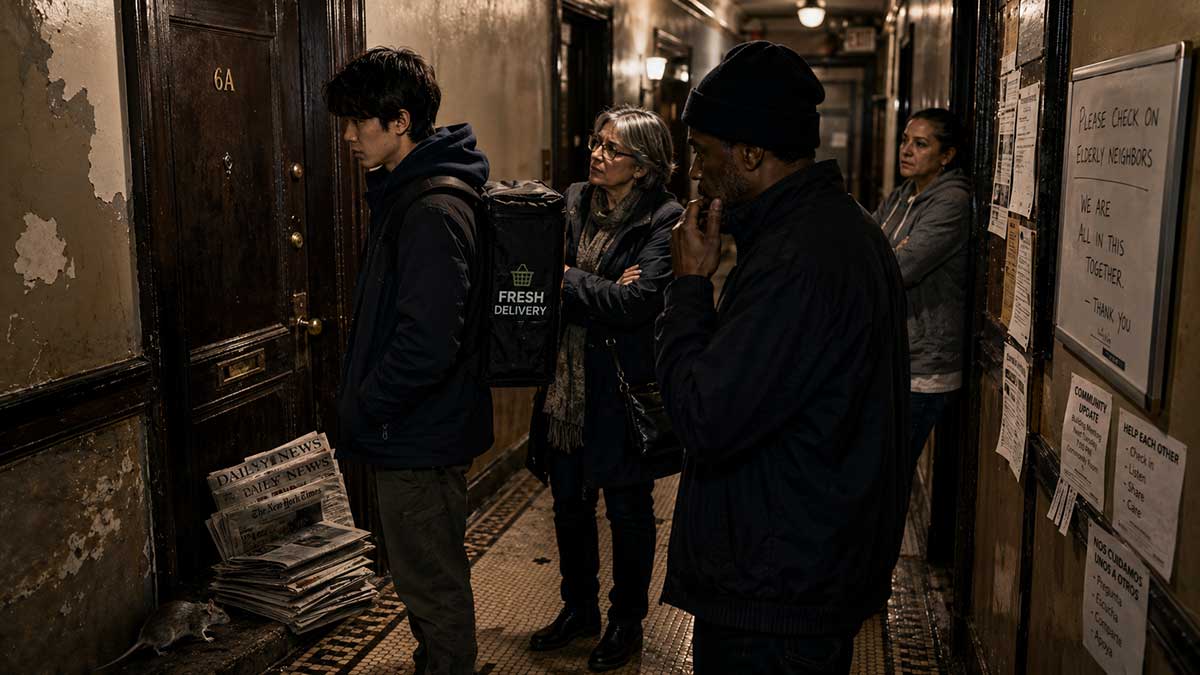
Thursday afternoon, he stood outside Apartment 6A holding two grocery bags and knocked three times.
Nothing.
“Mr. Price?”
Silence.
He waited.
Samuel normally answered slowly.
Today there was no movement.
Noah knocked again.
Still nothing.
Two newspapers rested against the door.
A grocery circular had been pushed halfway beneath them.
A rat ran along the baseboard, stopped beside the papers, and disappeared through the stairwell door.
A woman leaving the elevator gasped.
“Did you see that rat?”
“Yes.”
“Someone should call the super.”
She stepped around the newspapers and continued down the hall.
Noah looked at Samuel’s door.
Everyone noticed the rat.
No one had noticed the newspapers.
He called Mara.
“You’ve got the wrong generation,” she said.
“I think something’s wrong with Mr. Price.”
Five minutes later, Mara stood beside him.
She knocked.
“Samuel?”
Nothing.
One neighbor opened his door.
“Everything okay?”
“We haven’t seen Mr. Price.”
The man looked concerned.
“I’ve been wondering about him.”
“Did you knock?”
“I assumed someone had checked.”
A woman emerged from the apartment across the hall.
“I thought his nephew came.”
“Does he have a nephew?”
“I’m not sure.”
Another tenant joined them.
“I told management the papers were piling up.”
“What did they say?”
“They’d look into it.”
Everyone looked at the door.
No one had rung the bell.
Mara called emergency services.
Firefighters arrived twenty-three minutes later.
They opened the apartment.
Samuel lay unconscious beside the kitchen table.
Alive.
Weak.
Dehydrated.
The groceries from the previous week remained unopened.
The calendar had stopped six days earlier.
As the paramedics lifted him, Mara saw a handwritten list beside the telephone.
It contained names and apartment numbers.
Beside each, Samuel had written a few words.
Young man who delivers groceries.
Doctor upstairs.
Woman with daughter in 3C.
Super who remembers everyone.
Man in suit who holds elevator.
Samuel had remembered people who had barely remembered him.
As the stretcher reached the elevator, one firefighter pressed the button.
Nothing happened.
He pressed it again.
The doors opened after a long pause.
“That elevator needs work,” he said.
Everyone nodded.
They all knew.
Outside, the ambulance pulled into traffic.
The neighbors remained in the hallway.
No one seemed ready to return inside.
Lena looked at the newspapers.
“We watched them pile up.”
Mara spoke quietly.
“Yes.”
“I thought someone knew.”
“So did I.”
Noah picked up the papers and folded them under one arm.
“What does that even mean?”
“What?”
“Someone.”
No one answered.
That evening, management sent an email to all residents.
A tenant experienced a medical emergency today. We remind residents to contact emergency services whenever appropriate.
The message contained no name.
No explanation.
No acknowledgement that people had reported the newspapers.
At the bottom, it added:
Pest-control services will visit the sixth floor tomorrow.
Mara read the message twice.
Samuel’s disappearance had become a medical incident.
The rat had become a work order.
Everything had been assigned a department.
Nothing belonged to anyone.
The next afternoon, Mara visited Samuel at the hospital.
He appeared smaller beneath the white blanket.
“You found me?”
“Noah did.”
Samuel nodded.
“Good boy.”
“You knew our names.”
He looked confused.
“The list.”
His eyes moved toward the window.
“I didn’t know many people anymore.”
“You knew more than we knew about you.”
Samuel gave a weak smile.
“That’s one advantage of being invisible. You get to watch.”
Mara sat beside him.
“I’m sorry.”
“For what?”
She could not choose one thing.
“For not knocking sooner.”
Samuel looked at her.
“I never asked you to.”
“That doesn’t mean we had to wait.”
He closed his eyes.
“No.”
After a moment, he said:
“I kept thinking someone would notice.”
Mara took his hand.
“Someone did.”
Samuel opened his eyes again.
“Yes.”
His voice was barely audible.
“Eventually.”
Chapter 4 — The Night the Building Went Dark
Three nights later, winter arrived without permission.
Freezing rain coated the fire escapes.
Wind drove sleet between the buildings.
The city warned residents to avoid unnecessary travel.
Subway delays stretched across multiple lines.
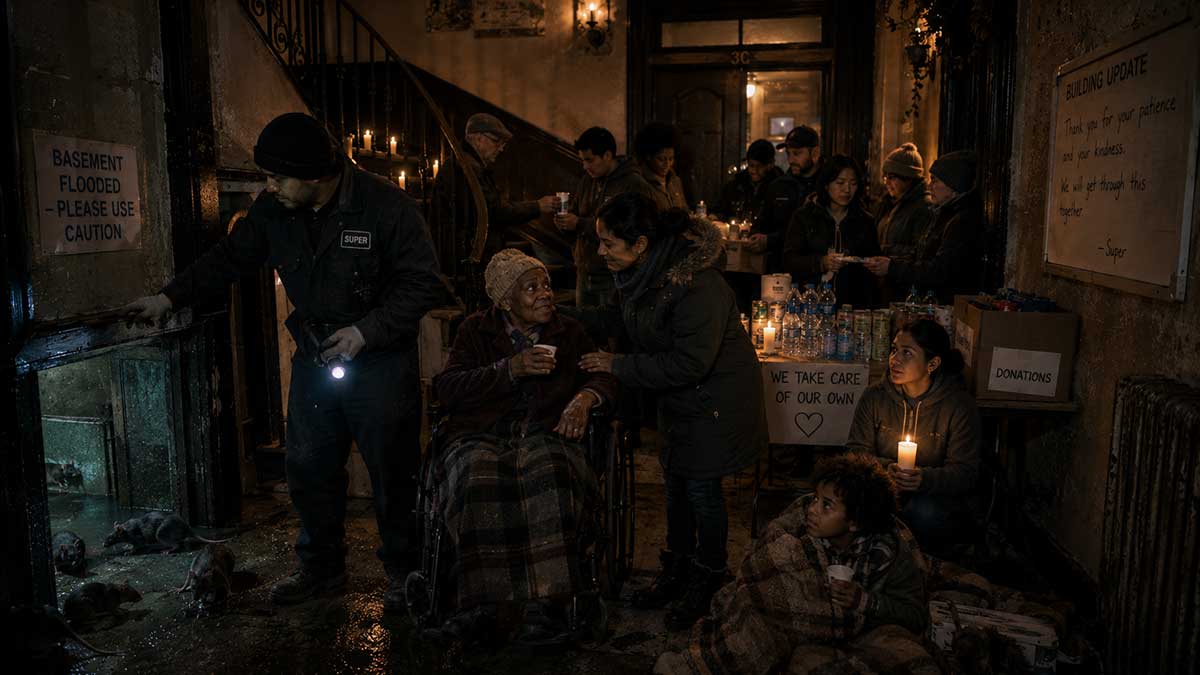
At 9:17 p.m., every light in the Calder vanished.
Not flickered.
Vanished.
The elevators stopped.
Radiators fell silent.
The emergency lights failed after ninety seconds.
Darkness moved through the building floor by floor.
Then came the voices.
A child crying.
Someone calling for a flashlight.
A distant alarm.
Apartment doors opening.
“My husband is trapped in Elevator Two!”
“My mother’s oxygen machine stopped!”
“Is anyone there?”
For years, residents had lived inside private rectangles of light.
Now the darkness joined them.
In the basement, water poured from a split pipe.
It had reached the main conduit.
Elias tried the emergency shutoff.
The handle resisted.
He pulled again.
A spark flashed behind Panel C.
He stepped back.
The system was gone.
Movement spread across the floor.
Rats emerged from the boiler room, garbage area, pipe openings, and flooded wall cavities.
At first, three.
Then ten.
Then more.
They ran past Elias toward the stairwell.
Upstairs, residents screamed as rats appeared in the lobby and lower corridors.
Someone filmed them.
Someone shouted that the building was infested.
Someone else blamed the restaurant next door.
Within minutes, a video appeared online:
RATS FLOOD UPPER MANHATTAN BUILDING DURING BLACKOUT
The rats were visible.
The failed electrical reports were not.
Elias radioed management.
No response.
He called the emergency line.
Voicemail.
He climbed toward the lobby.
Lena had brought Sofia downstairs wrapped in two blankets.
Noah arrived carrying flashlights from the bodega.
Mr. Alvarez followed with bottled water, batteries, bread, and a small generator.
Mara descended from the eleventh floor carrying an old medical bag she had not opened in years.
Jonah appeared in the lobby wearing an overcoat over his pajamas.
“What happened?”
Elias looked at him.
“The thing we discussed.”
“How long until the electricity returns?”
“Not tonight.”
A woman rushed toward Mara.
“My mother’s breathing machine isn’t working.”
“Which floor?”
“Nine.”
Noah lifted the generator.
“I’ll carry it.”
Elias grabbed his arm.
“Not in the hallway. Carbon monoxide.”
“Then what?”
“We run a safe cable from outside.”
Mr. Alvarez nodded.
“I have one.”
The building began organizing itself before anyone officially organized it.
A home health aide checked elderly residents.
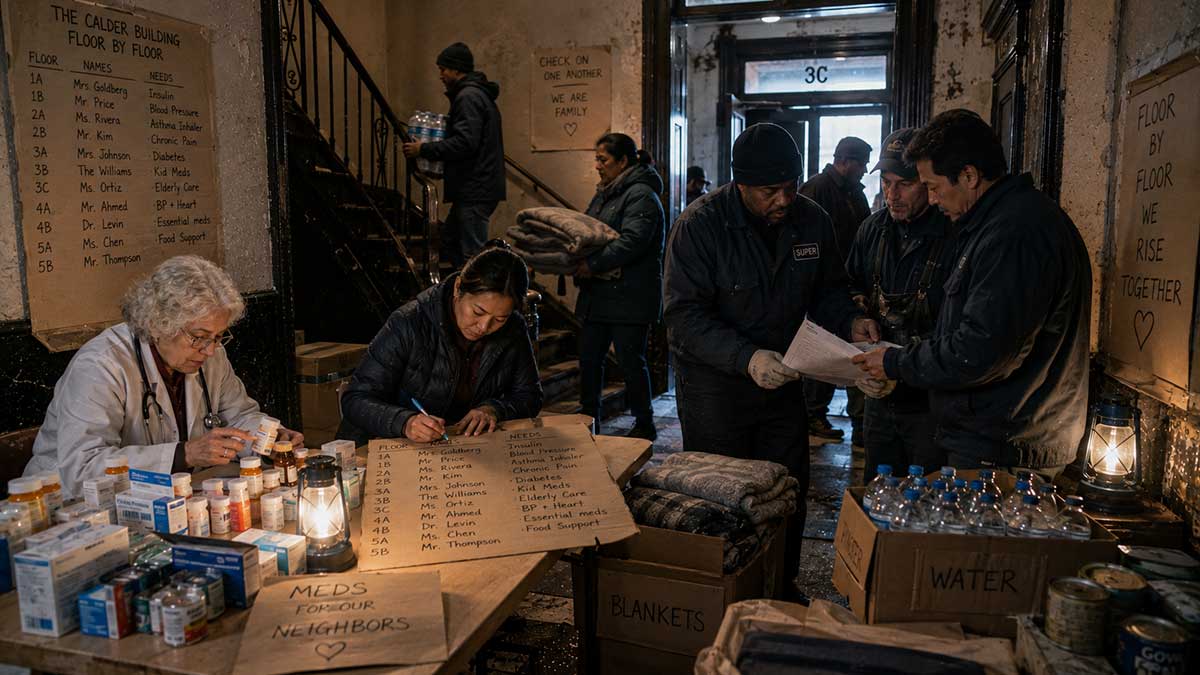
A college student wrote names on flattened cardboard boxes.
Apartment number.
Number of occupants.
Medical needs.
Medication.
Pets.
Flashlights.
Blankets.
A Dominican family brought down a pot of soup large enough to feed half the lobby.
A Korean grocer from the corner sent cases of water.
A West African taxi driver carried residents down eleven flights of stairs.
A retired teacher gathered children near the mailboxes and told stories by lantern light.
Jonah stood near the center of the lobby.
He had lived in the Calder for eleven years.
He knew almost none of these people.
A rat ran along the wall.
No one screamed this time.
Elias blocked the opening with a metal plate.
“Not poison?” Jonah asked.
“The wall first.”
Elias tightened the screws.
“The rat is telling us where the building is open.”
By midnight, the Calder had become colder.
Yet it had become less divided.
Noah climbed floor by floor, knocking on doors.
“Anyone alone?”
“Anyone need medication?”
“Anyone unable to use the stairs?”
At Apartment 8C, a man in a business suit opened the door.
“I’m fine.”
“Do you know whether your neighbors are?”
The man looked toward the door beside his.
“No.”
“Then check.”
The man hesitated.
Then knocked.
At 2:10 a.m., Noah returned to the lobby.
“Samuel’s stable,” he told Mara. “The hospital called.”
The room became quiet.
“We almost lost him,” Mara said.
Noah shook his head.
“We almost never noticed him.”
This time no one looked away.
Chapter 5 — Floor by Floor
Morning did not bring electricity.
It brought grey light through frozen windows.
City crews were overwhelmed.
The Calder’s failure was classified as a private-building emergency.
Management issued a statement from an office downtown:
We are actively coordinating with licensed contractors and relevant agencies.
No contractor had arrived.
Inside the lobby, Lena drew a new list on cardboard.
PEOPLE WHO NEED CHECK-INS
Samuel Price — hospital.
Mrs. Adeyemi — oxygen.
Mr. Klein — insulin refrigeration.
Apartment 7F — newborn.
Apartment 12A — limited mobility.
Names replaced unit numbers.
Needs replaced assumptions.
Mara organized medications.
Mr. Alvarez rotated power from the generator between medical equipment and phone charging.
Noah led teams through the stairwells.
Elias worked in the basement with two tenants who had electrical experience.
Jonah stood beside the board containing every inspection report.
He read each date.
Each warning.
Each temporary repair.
His own signatures appeared beneath several postponements.
Lena approached.
“You knew.”
Jonah did not defend himself.
“I knew there were problems.”
“That isn’t what I said.”
He looked at the reports again.
“I knew.”
“Why didn’t you act?”
“I thought we had time.”
“Based on what?”
He had no answer.
After a moment, he said:
“I told myself I was protecting people from costs they couldn’t afford.”
“Were you?”
“Partly.”
“And the rest?”
Jonah looked through the lobby.
At the blankets.
The medical station.
Children eating soup from paper cups.
“I was protecting the building’s value.”
Lena shook her head.
“No.”
She pointed around them.
“This is the building’s value.”
By afternoon, the residents had divided the Calder into zones.
Two volunteers per floor.
One person responsible for elderly tenants.
One person checking food and water.
One person carrying messages since cell service inside the stairwell had become unreliable.
The work was repetitive.
Knock.
Listen.
Write.
Carry.
Return.
No one performed a single grand act.
The building survived through dozens of small ones.
On the tenth floor, Mara found an elderly woman sitting beside a cold radiator.
“I didn’t want to bother anyone,” she said.
Mara wrapped another blanket around her.
“You’re not bothering us.”
The woman looked doubtful.
“That’s easy to say during an emergency.”
Mara stopped.
“What do you mean?”
“People are kind when the lights go out.”
The woman looked toward the dark hallway.
“It’s when the lights return that you find out what they learned.”
In the basement, Elias and the volunteer electricians traced the damaged conduit.
Water had entered through a roof drainage line, crossed a cracked beam, followed an old pipe channel, and reached Panel C.
The exact path had taken years to form.
The failure had happened in one second.
Neglect had taken much longer.
Near the rear wall, they found the main rat entry.
A broken section of masonry surrounded multiple pipes.
Nesting material filled the cavity.
Jonah stared at it.
“How long has that been there?”
Elias looked at him.
“The first report was six years ago.”
Jonah closed his eyes.
They repaired what they could.
Sealed the opening.
Cleared the drainage path.
Documented everything.
When they emerged, several residents waited near the basement door.
“What do you need?” one asked.
Elias looked at them.
For nineteen years, people had usually asked when he would finish.
No one had asked what he needed.
“Coffee,” he said.
Five people left.
He laughed.
“One would have been enough.”
Chapter 6. When the Lights Returned
Electricity returned thirty-six hours after the failure.
The lobby lights came on first.
Then hallway fixtures.
Refrigerators awakened behind apartment doors.
The elevator hummed and stopped at the lobby with a soft bell.
People applauded.
Children cheered.
Someone shouted that civilization had returned.
A local news crew arrived.
The reporter stood beneath the repaired lobby light.
“Electricity has been restored after what building management described as an unexpected equipment malfunction.”
Unexpected.
Elias heard the word from across the lobby.
He did not laugh.
The rats appeared in the report for twelve seconds.
The years of warnings received none.
Contractors replaced the damaged electrical system.
Masons sealed the basement openings.
A plumber repaired the pipe behind Lena’s cabinets.
When he removed the old foam, he found multiple gaps leading into the wall.
“This should’ve been fixed years ago,” he said.
Lena looked at him.
“It was reported years ago.”
He nodded.
“Reporting and fixing aren’t the same thing.”
Samuel returned from rehabilitation three weeks later using a cane.
Noah waited outside the building.
As the taxi stopped, residents came through the lobby doors.
Not a crowd.
Not a ceremony.
Only neighbors.
Mara carried flowers.
Lena brought soup.
Elias held the door.
Jonah carried Samuel’s small suitcase.
Samuel looked at them with suspicion.
“Did someone die?”
Mara smiled.
“No.”
“Then why is everyone here?”
Noah stepped forward.
“We wanted to make sure someone was.”
Samuel looked at him for a long moment.
Then nodded.
The next co-op board meeting began without coffee or cookies.
Jonah placed the inspection reports on the table.
Beside them lay Samuel’s handwritten list.
“I spent years protecting property values,” Jonah said.
No one interrupted.
“I told myself that was the same as protecting residents.”
He looked toward Lena.
“It wasn’t.”
The board approved public annual inspections.
An emergency fund.
A resident directory.
Voluntary wellness check-ins.
Maintenance requests would include named staff members, scheduled responses, and visible deadlines.
Every new resident would be introduced to the people living on either side.
Monthly community dinners would begin in the spring.
The meeting lasted fifty-two minutes.
It accomplished more than the previous decade.
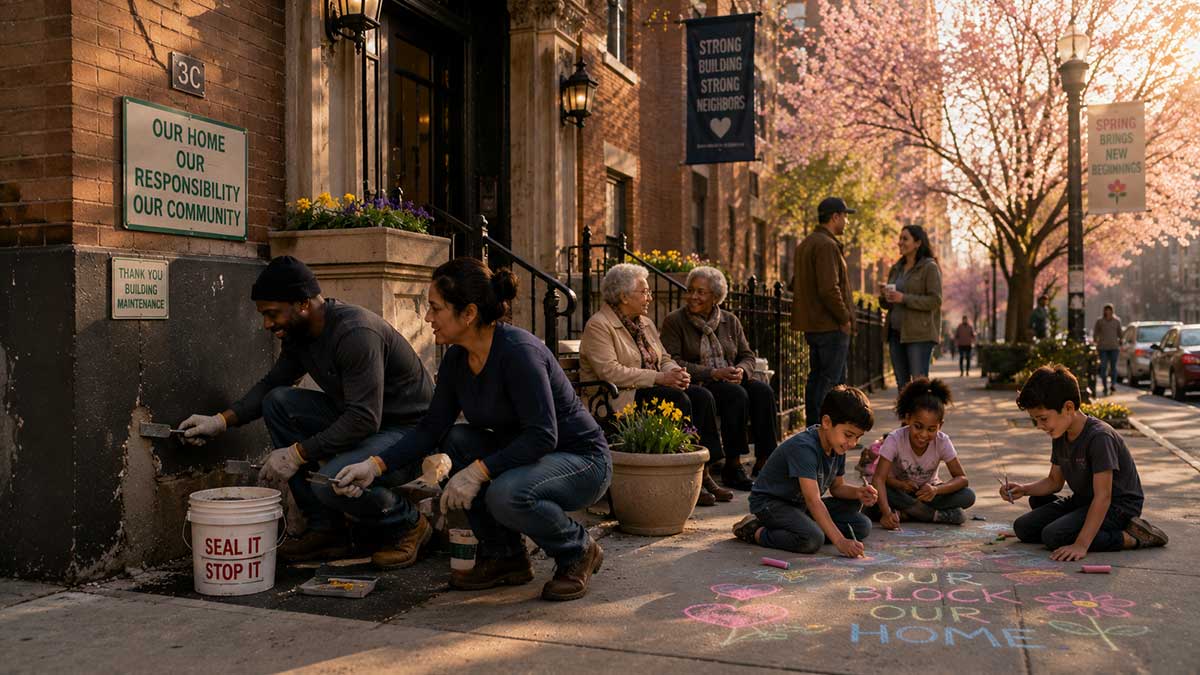
Winter passed.
Snow retreated from the curb.
Spring entered Upper Manhattan through open windows, sidewalk trees, and the first outdoor tables at the bodega.
One morning, Noah parked his e-bike near the Calder’s garbage area.
A rat appeared beneath the dumpster.
It paused in daylight.
A tenant carrying laundry stopped.
“That’s disgusting.”
Another resident approached.
“That’s New York.”
The old sentence.
Easy.
Complete.
Permission to keep walking.
The rat disappeared through a gap beneath the service door.
Noah switched on his phone flashlight.
Elias arrived with a toolbox.
Lena came outside carrying a roll of paper towels.
Jonah followed, already calling the sanitation company.
“What are we looking for?” he asked.
“The opening,” Elias said.
Three more residents joined them.
No one chased the rat.
No one argued about whose department it belonged to.
They inspected the drain.
The door seal.
The garbage schedule.
The foundation.
Behind the dumpster, Elias found a small crack in the wall.
Nothing dramatic.
Less than an hour’s work.
He sealed it before noon.
That afternoon, Samuel sat outside beneath a street tree.
Noah delivered his groceries and took the empty chair beside him.
“You look stronger.”
“So does the building.”
Across the sidewalk, children drew with chalk.
A home health aide stopped to greet an elderly tenant.
Mr. Alvarez carried coffee to Elias.
Lena laughed with the woman from the fourth floor who had once told her rats were simply part of New York.
Nothing extraordinary was happening.
Samuel looked up at the Calder.
“You know, I used to think a building was made of brick.”
“What is it made of?”
“People who remember to knock.”
Noah followed his gaze.
Warm light appeared in apartment windows.
A saxophone played somewhere above the seventh floor.
Someone argued over dinner.
Someone laughed in the stairwell.
Someone knocked on a door and asked:
“Do you need anything while I’m downstairs?”
The building had not become perfect.
Pipes would leak again.
Rats would return.
People would become tired, busy, distracted, and certain that someone else had handled things.
The plague within ordinary life had not been cured.
It had only been recognized.
That evening, Elias carried the old paint bucket from the maintenance room.
Its bottom had worn thin after years of catching water.
He placed it beside the trash.
Then stopped.
For a moment, he considered keeping it as a reminder.
He looked through the service door.
Three residents were checking the new seal around the garbage area.
Noah was helping Samuel toward the elevator.
Lena had posted the date of the next community dinner.
Jonah was reading the newest inspection report rather than merely filing it.
Elias left the bucket behind.
The reminder no longer belonged in an object.
It belonged in people.
Above him, the building settled with its familiar wooden sigh.
Old buildings made noises.
Everyone knew that.
This time, someone looked up.
Final Thoughts
When the lights returned, the Calder Building looked almost unchanged.
The elevators worked again.
The hallways were brighter.
The basement was dry.
The cracks had been sealed.
The rats disappeared into places no one could see.
That was never the true ending.
The real ending began when people stopped confusing normal with healthy.
For years, every warning had been explained away.
"It's only a leak."
"It's only one rat."
"It's only an old building."
"It's only one lonely neighbor."
Every sentence sounded reasonable.
Together, they became dangerous.
Camus believed that evil rarely announces itself.
It becomes ordinary first.
That is why The Plague remains timeless.
The enemy is not only disease.
It is indifference.
Yet Camus offered something stronger than despair.
He believed ordinary decency could resist it.
Not through grand speeches.
Not through perfect systems.
Through people who quietly decide that another person's suffering is no longer someone else's responsibility.
That is what finally changed the Calder Building.
No miracle occurred.
Only attention.
The next leak was repaired before it spread.
The next elderly resident received a visit before becoming invisible.
The next crack was sealed before rats found it.
The next warning became action instead of paperwork.
The plague never disappeared.
Neither did compassion.
Both continue waiting inside every community.
Every ordinary day asks the same question.
Which one will we allow to spread?
Short Bios:
Albert Camus (1913–1960)
French-Algerian novelist, philosopher, and Nobel Prize laureate whose works explored the human search for meaning within an indifferent universe. Through novels such as The Stranger and The Plague, Camus argued that dignity is found not in certainty, but in choosing compassion and responsibility despite uncertainty.
Elias Reed
The longtime superintendent of the Calder Building. Quiet, dependable, and almost invisible to many residents, Elias understands that neglected infrastructure mirrors neglected relationships. His persistence represents the moral courage of people who continue doing the right thing even when no one appears to listen.
Dr. Mara Levin
A retired physician who believes her years of service are behind her until the building's crisis reminds her that healing never truly ends. She becomes the emotional center of the community by helping neighbors rediscover responsibility for one another.
Lena Ortiz
A hardworking single mother living in Apartment 3C. Her leaking ceiling and repeated maintenance requests symbolize the countless ordinary warnings society learns to ignore. Lena refuses to accept neglect as simply "part of living in New York."
Jonah Vale
Attorney and president of the co-op board. Intelligent and well intentioned, Jonah postpones expensive repairs in hopes of protecting property values. His greatest transformation comes when he realizes that a building's true value has never been measured in real estate.
Samuel Price
An elderly widower whose quiet disappearance becomes the turning point of the story. Though almost forgotten by others, Samuel has carefully remembered everyone around him, proving that loneliness often hides behind familiar doors.
Noah Chen
A seventeen-year-old grocery delivery rider whose daily visits allow him to notice details everyone else overlooks. His willingness to stop, ask questions, and knock on one more door becomes the first act that breaks the cycle of indifference.
The Calder Building
More than brick, steel, pipes, and concrete, the Calder becomes a living symbol of modern society itself. Its aging walls reveal that communities fail from years of neglected responsibility, yet they can also be renewed through countless ordinary acts of care performed by people who finally begin seeing one another again.
Leave a Reply