
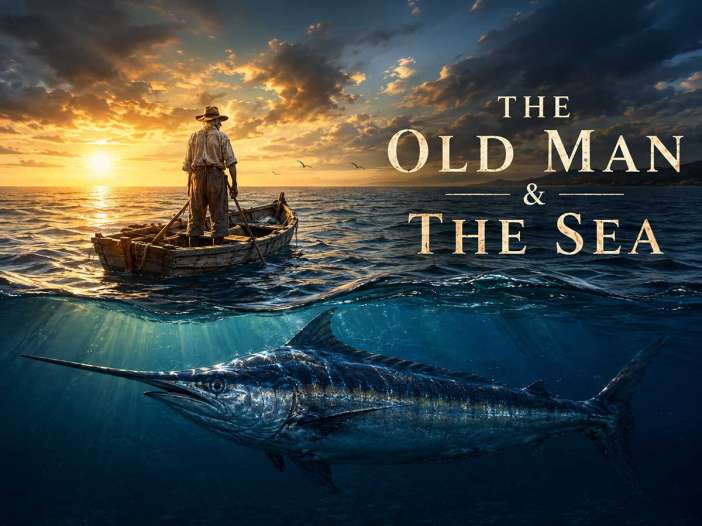
What if the greatest victory in your life looked exactly like failure?
Introduction by Ernest Hemingway
People often tell me The Old Man and the Sea is a story about fishing.
It isn't.
Fishing simply gave me a place where one human being could meet himself without interruption.
When I wrote Santiago, I was not trying to create a perfect old man.
I wanted to create an honest one.
He becomes tired.
He doubts himself.
He feels pride.
He makes mistakes.
He loves what he must kill.
He loses what he worked hardest to earn.
That is not the story of a fisherman.
It is the story of every human life.
People have asked me for decades whether the marlin symbolizes greatness, whether the sharks symbolize death, whether the sea symbolizes life, whether the lions symbolize youth.
They are free to ask.
But symbols only matter if they lead us back to ourselves.
If you finish this book thinking only about fish, then I have failed.
If you finish it wondering what your own marlin might be, then perhaps the story has begun its real work.
I have never believed that life rewards us according to effort.
Many honorable people fail.
Many dishonest people succeed.
The world has always been uneven.
That is why dignity matters more than victory.
A person does not become great by avoiding defeat.
A person becomes great by refusing to surrender the best part of themselves after defeat arrives.
Santiago returns with little that the village can measure.
Yet he returns with everything that truly matters.
He has not lied.
He has not blamed fate.
He has not allowed suffering to make him bitter.
He remains himself.
That is the victory I hoped readers would discover.
This Imaginary Talk gives Santiago, Manolin, the Marlin, the Sea, and even the Sharks the opportunity to speak aloud what my novel often leaves unspoken.
I have enjoyed listening.
Not because they always agree with me.
But because good characters eventually become wiser than the person who created them.
If these conversations encourage you to return to the original novella with new eyes, then they have honored both the story and its readers.
(Note: This is an imaginary conversation, a creative exploration of an idea, and not a real speech or event.)
Act 1: What Makes a Life Worth Fighting For?
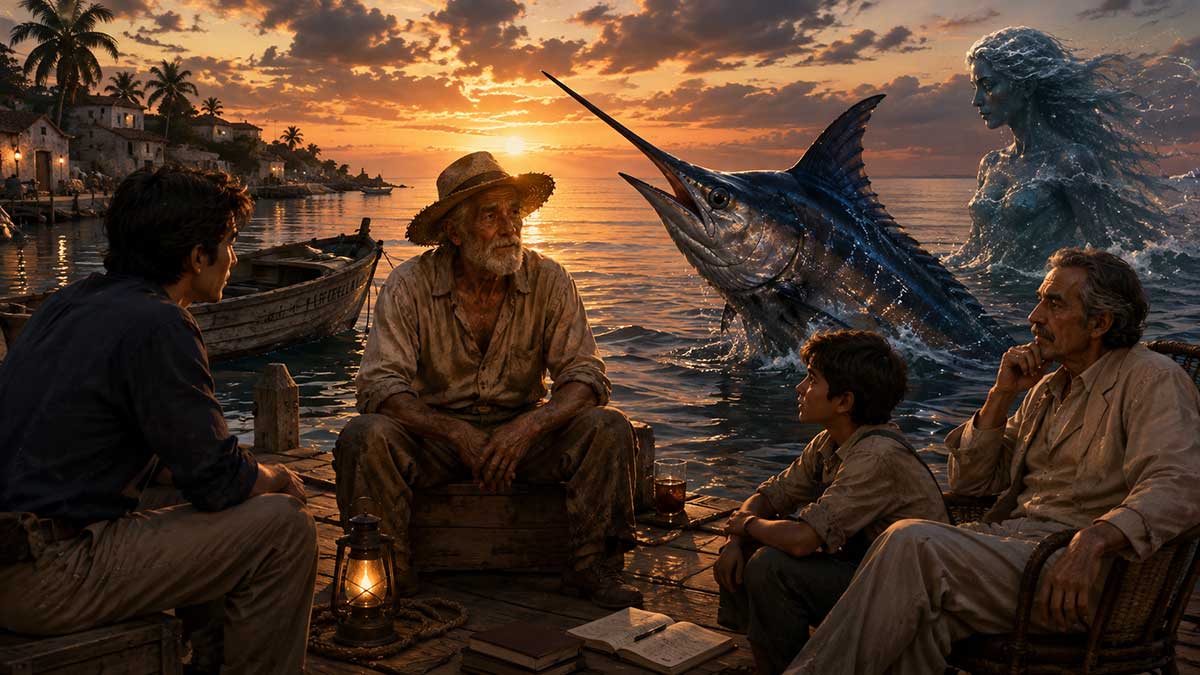
The late afternoon sun hangs low over a quiet Cuban harbor.
The sea is calm.
A weathered wooden skiff rests against the dock.
Nearby, an enormous marlin swims beneath the clear water—not dead, but alive once more, as if memory itself has called him back.
The waves rise gently.
Then, almost imperceptibly, they begin speaking.
The Sea has arrived.
Nick Sasaki walks toward the group, taking a seat on an old wooden crate.
Santiago sits calmly beside his skiff.
Manolin stands nearby, smiling as though no time has passed.
Ernest Hemingway lights a cigar but says nothing.
The Marlin circles slowly just beyond the dock, its great silver body breaking the surface every few moments.
Everyone waits.
The sea breeze carries only one question.
Nick Sasaki
Santiago...
If someone told you beforehand exactly how your journey would end...
You would catch the greatest fish of your life.
The sharks would leave you with almost nothing.
You would return home exhausted.
Would you still have sailed out on the eighty-fifth day?
Santiago smiles.
Not proudly.
Almost gently.
Santiago
I did know.
Everyone turns.
Even Hemingway looks up.
Nick
You knew?
Santiago
Not the details.
No fisherman knows those.
But every man who has lived long enough understands something.
The sea never promises that you will keep what it gives.
The Marlin rises from the water.
His voice is deep and calm.
The Marlin
Then why chase me?
If the sea keeps no promises...
why spend three days holding on?
Santiago watches the fish with admiration.
Santiago
Because you existed.
Silence.
The Marlin
That is enough?
Santiago
For a fisherman...
yes.
The Marlin circles once.
The Marlin
Many men wanted food.
Many wanted money.
Some wanted glory.
What did you want?
Santiago thinks for a long time.
Santiago
To discover whether I was still myself.
Manolin quietly lowers his head.
He has never heard Santiago say those words.
Nick
What do you mean?
Santiago
People believed I had become unlucky.
After enough empty days...
you begin wondering whether they are right.
Not because they convince you.
Because silence does.
The Sea laughs softly.
Not cruelly.
Like waves touching rocks.
The Sea
Humans always confuse silence with truth.
Everyone turns toward the endless horizon.
The Sea
When I am quiet...
you believe nothing lives beneath me.
Yet whales swim.
Storms gather.
Currents move.
Life continues where your eyes cannot see.
Your eighty-four empty days were like that.
Hemingway finally speaks.
Ernest Hemingway
Failure is usually invisible.
So is preparation.
People notice only the result.
Nick nods.
Nick
Today we often measure ourselves the same way.
A business succeeds.
A book sells.
A video goes viral.
If none of those happen...
people think nothing valuable occurred.
Santiago smiles.
Santiago
That is because they count fish.
Not fishermen.
The Marlin raises his great head above the surface.
Water streams from his body.
The Marlin
Would you still say that...
if you had never caught me?
A longer silence follows.
Even the waves seem to stop.
Santiago
Yes.
The Marlin
Without hesitation?
Santiago
No.
Not without pain.
But yes.
The Marlin
Explain.
Santiago gently places his weathered hand on the side of the boat.
Santiago
Each morning I prepared my lines carefully.
I watched the birds.
I studied the currents.
I repaired my sail.
I greeted the sunrise.
Those things were already making me into the man who could meet you.
Whether I found you or not...
I was still becoming him.
Hemingway smiles quietly.
He still says nothing.
Manolin
May I ask something?
Everyone turns toward the boy.
Manolin
Old fishermen used to tell me that luck comes to patient men.
But I don't think that is what happened.
Santiago smiles.
"What do you think?"
Manolin
I think...
you became the kind of man luck wanted to visit.
The Marlin stops swimming.
Even the Sea becomes still.
Nick
Hemingway...
Did you intend that?
Hemingway removes the cigar from his mouth.
Ernest Hemingway
A writer should never explain everything.
But I'll answer this.
People think this story begins on the eighty-fifth day.
It doesn't.
It begins with the previous eighty-four.
Without them...
the eighty-fifth day means nothing.
Nick leans forward.
Nick
So the failures were part of the victory?
Ernest Hemingway
No.
They were the price of becoming someone capable of recognizing it.
The Sea speaks again.
Its voice now sounds older than history.
The Sea
Humans believe life asks one question.
"What did you catch?"
I have always asked another.
"What did the waiting make of you?"
The wind grows stronger.
Small waves strike the dock.
The Marlin slowly circles farther away before returning.
The Marlin
Then perhaps...
I was never your destination.
Santiago smiles.
His eyes remain fixed on the horizon.
Santiago
No.
You were my meeting.
The Marlin tilts his great head.
The Marlin
Meeting?
Santiago
Yes.
The man I had been becoming for eighty-four days...
finally met the fish worthy of him.
No one speaks.
The words seem to settle over the harbor like evening light.
Nick looks around the circle.
Nick
Perhaps that changes the entire story.
People spend decades searching for their marlin.
Maybe the greater question isn't whether we'll ever find it.
Maybe it's whether we'll become someone worthy of recognizing it when it finally appears.
No one answers immediately.
The sun slips lower.
The harbor grows quiet.
Far beyond the dock, the Sea whispers almost to itself.
"Every great catch begins long before the line enters the water."
The conversation pauses.
No one feels finished.
They have only just begun.
Act 2: Why Did Santiago Love the Fish He Had to Kill?
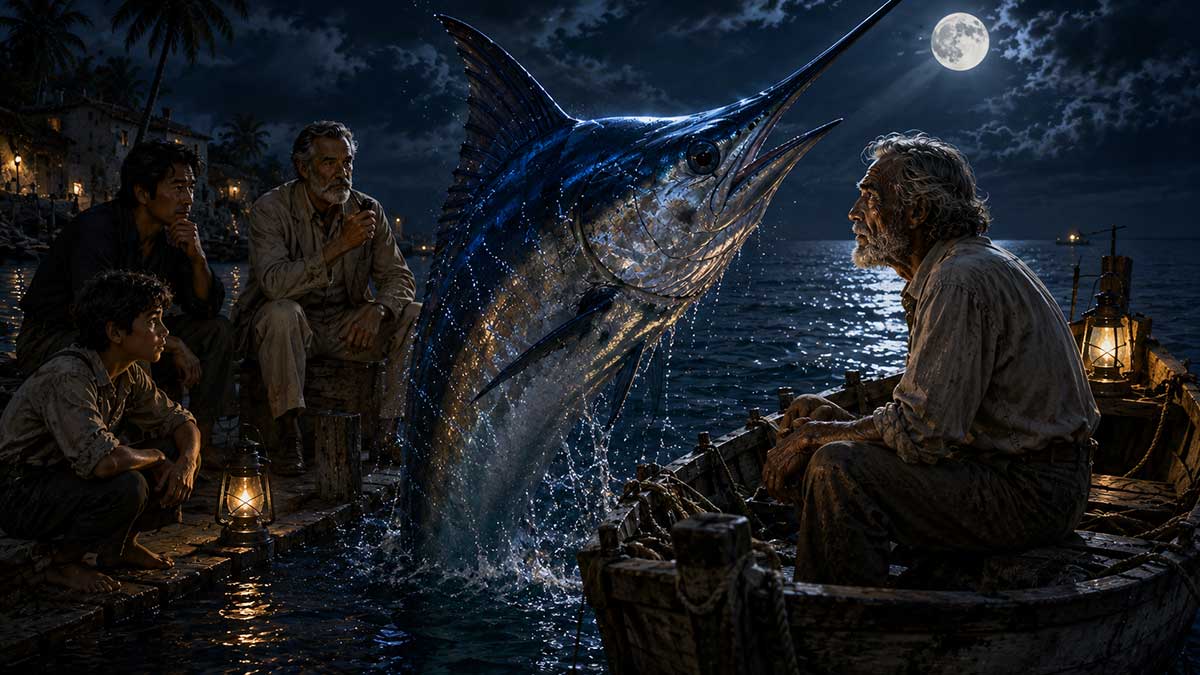
Night settles over the harbor.
The last light disappears behind the water.
A lantern burns beside Santiago’s skiff, casting long shadows across the dock.
The Marlin circles beneath the surface.
Every few moments, his great fin breaks through the dark water.
No one speaks for a while.
The question feels almost too strange to ask.
Then Nick turns toward Santiago.
Nick Sasaki
You called the marlin your brother.
You admired his strength.
You said no human being was worthy of eating him.
Yet you still killed him.
How can love and destruction live inside the same act?
Santiago looks toward the water.
Santiago
Fishermen understand that contradiction better than most people.
We love the sea.
Yet we take from it.
We admire the fish.
Yet we hunt them.
We depend on life ending so that our own lives may continue.
The Marlin
That explains hunger.
It does not explain me.
Santiago nods.
Santiago
No.
It does not.
The Marlin rises closer to the dock.
The Marlin
You did not need a fish of my size to survive.
You pursued me far beyond hunger.
You wanted proof.
Santiago
Yes.
The Marlin
Then do not call it love.
Call it pride.
The Sea lifts against the wooden posts.
The sound resembles a warning.
Manolin looks toward Santiago.
He expects the old man to defend himself.
Santiago does not.
Santiago
There was pride in it.
Manolin
Was that wrong?
Santiago
Pride is not always wrong.
Sometimes it helps a man rise before sunrise.
Sometimes it makes him sail farther than wisdom permits.
The difficulty is knowing which pride is speaking.
Ernest Hemingway
Most men recognize pride only after it has charged them interest.
Santiago smiles.
Santiago
Yes.
The Marlin moves closer.
His silver body catches the lantern light.
The Marlin
You admired me once I resisted you.
Would you have loved me if I had surrendered quickly?
Santiago answers without delay.
Santiago
No.
Nick
That is honest.
Santiago
Love without respect becomes possession.
I respected him because he refused to become mine easily.
The Marlin disappears beneath the surface.
For several seconds, only his shadow remains.
The Marlin
Then my suffering made me worthy?
Santiago
No.
Your freedom did.
The answer silences everyone.
The Sea speaks from the darkness.
The Sea
Humans often love most fiercely what they cannot control.
They name this admiration.
Then they reach for a rope.
Hemingway looks toward the horizon.
Hemingway
That may be the cruelest sentence spoken tonight.
The Sea
Cruelty is often truth without human decoration.
Santiago lowers his head.
Santiago
I tied him to the boat.
I called him brother.
I brought him toward land.
There is no clean answer.
Nick
Did you regret killing him?
Santiago
Before I killed him.
During it.
Afterward.
Manolin
Then why continue?
Santiago looks at the boy.
Santiago
Because regret does not always mean the choice was false.
Sometimes two truths stand against each other.
You choose one.
Then you carry the other.
Manolin studies him.
Manolin
What truth did you carry?
Santiago
That the fish deserved to live.
Manolin
And the truth you chose?
Santiago
That I needed to know whether I could still meet greatness without turning away.
The Marlin surfaces again.
The Marlin
You needed me to answer a question about yourself.
Santiago
Yes.
The Marlin
Then I was never only a fish.
Hemingway
No worthy opponent ever is.
Nick
That raises another question.
Can a person respect an opponent and still destroy them?
Hemingway exhales slowly.
Hemingway
History says yes.
Literature says yes.
Marriage sometimes says yes.
The Sea gives a low laugh.
The Sea
At least the writer is awake now.
Manolin smiles.
Santiago does not.
Santiago
Respect does not guarantee mercy.
It only makes violence harder to lie about.
The words settle heavily over the dock.
Nick
What do you mean?
Santiago
If I hated the fish, I could tell myself he deserved death.
If I ignored his beauty, I could pretend the struggle meant nothing.
Respect removed those excuses.
I knew exactly what I was taking.
The Marlin
And you took it anyway.
Santiago
Yes.
The Marlin moves close enough that Santiago could touch him.
He does not.
The Marlin
Was I your brother before you killed me?
Or only after you needed forgiveness?
Santiago’s face changes.
Manolin looks down.
Hemingway watches closely.
Santiago
Perhaps both.
The Marlin remains still.
Santiago
A man often discovers love too late.
After the argument.
After the departure.
After the death.
That does not make the love false.
It makes the man late.
The Marlin turns slowly.
The Marlin
Then you understand the sharks less than you think.
Nick
Why bring up the sharks now?
The Marlin
Because Santiago condemns them for taking what he had already taken from me.
Silence falls.
The Sea grows rougher.
Hemingway’s eyes narrow.
Santiago
They did not know what I had endured.
The Marlin
Did you know what I endured?
Santiago does not answer.
The Marlin
You felt the line cutting your hands.
You felt hunger.
Thirst.
Exhaustion.
You called it suffering.
I felt the hook.
The pull.
The loss of the open sea.
What did you call mine?
Santiago closes his eyes.
Santiago
Greatness.
The Marlin’s voice softens.
The Marlin
That is what humans often call the suffering they admire from a safe distance.
Nick leans back.
The conversation has shifted.
It no longer feels like a tribute to courage.
It feels like a trial.
Manolin
Marlin...
Do you hate him?
The Marlin looks toward the boy.
The Marlin
No.
Manolin
Why not?
The Marlin
Hatred would make him smaller than he was.
He met me honestly.
He did not hide behind cruelty.
He loved badly.
But he loved.
Santiago’s eyes fill with something close to grief.
Santiago
That may be more mercy than I deserve.
The Marlin
Mercy is not the same as innocence.
Hemingway nods.
Hemingway
There is the whole book.
Nick turns toward him.
Nick
Explain.
Hemingway
People want Santiago to be innocent.
They want the marlin to be noble.
They want the sharks to be evil.
That makes the story comfortable.
The truth is less clean.
Santiago kills what he loves.
The marlin suffers with dignity.
The sharks obey hunger.
The Sea permits all of it.
No one leaves pure.
The Sea
Purity is a human invention.
The ocean has only consequence.
Nick
Then what is the moral center?
Hemingway
Attention.
Nick
Attention?
Hemingway
To know what an act costs.
To refuse easy hatred.
To honor what resists you.
To grieve what victory requires.
Santiago looks toward the Marlin.
Santiago
I thought catching him would prove I was still alive.
The Marlin
Did it?
Santiago
Yes.
The Marlin
And killing me?
Santiago takes longer.
Santiago
That proved being alive is never innocent.
The Sea falls still.
Manolin moves closer to the old man.
Manolin
Would you do it again?
Santiago looks at the boy.
Then at the Marlin.
Then toward the dark horizon.
Santiago
I would sail again.
The Marlin waits.
Santiago
I do not know whether I would kill again.
Hemingway smiles faintly.
Hemingway
That uncertainty is more honest than certainty.
The lantern flickers.
The Marlin begins moving farther from the dock.
Nick
Before you go, tell us one thing.
What did Santiago misunderstand about you?
The Marlin pauses in the moonlit water.
The Marlin
He believed I was the greatest thing he had ever caught.
The Marlin turns once, sending silver ripples across the harbor.
The Marlin
I was the greatest thing that ever caught him.
Then he disappears beneath the surface.
No one follows.
No one speaks.
The Sea whispers against the shore.
The conversation has changed them.
Santiago no longer looks like a victor.
The Marlin no longer looks like a prize.
And somewhere between love and violence, the meaning of respect has become harder, deeper, and far less comfortable.
Act 3: Did the Sharks Really Defeat Santiago?
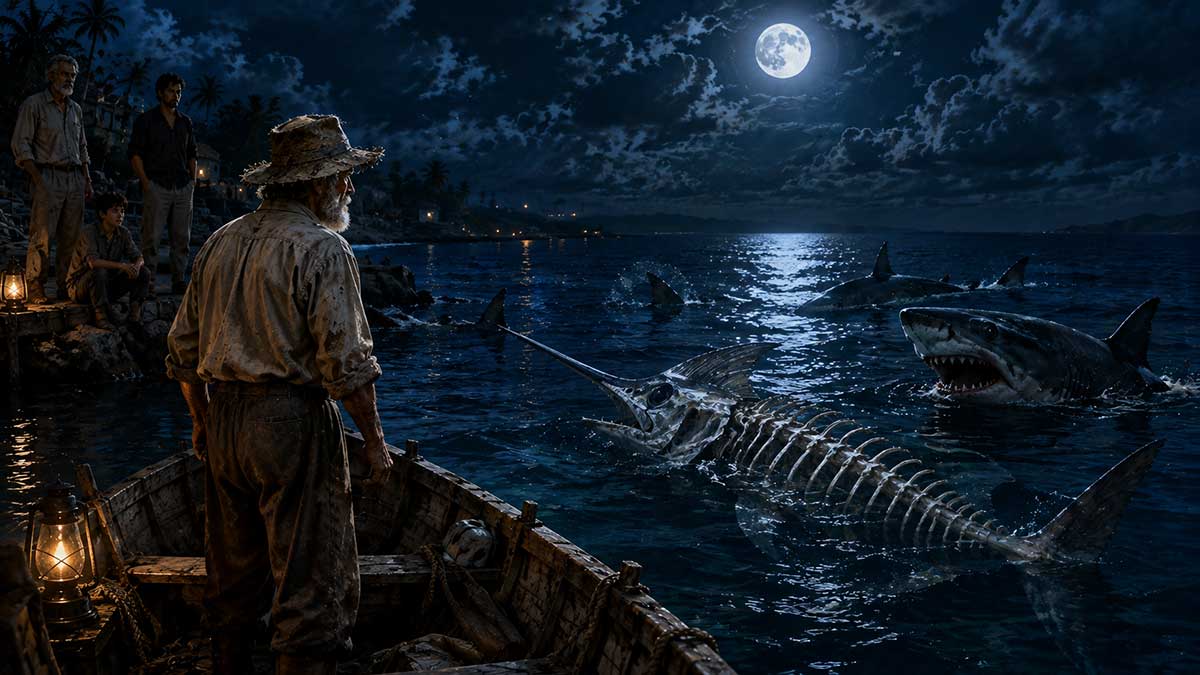
The moon has climbed high above the harbor.
The lantern has burned low.
Only the sound of gentle waves remains.
Far offshore, something white glimmers beneath the water.
The skeleton of the great marlin.
No flesh.
No victory for anyone to see.
Only bone.
Nick watches it for a long moment.
Then he breaks the silence.
Nick Sasaki
Most people remember this story for one reason.
The sharks.
Many readers close the book thinking,
"What a tragedy."
Santiago caught the greatest fish of his life...
and lost almost everything.
So let me ask the question directly.
Did the sharks defeat you?
Santiago does not answer immediately.
Instead, he looks toward the skeleton floating beneath the moonlight.
Santiago
They defeated my fish.
Not my journey.
Before anyone can respond—
A new voice cuts across the water.
Sharp.
Hungry.
Unapologetic.
Several dark fins emerge.
One enormous shark swims toward the dock.
Then another.
Then another.
The Sea remains calm.
As though it has been expecting them.
The Lead Shark
That is convenient.
Humans always tell the story that way.
Everyone turns.
Even Hemingway looks surprised.
Nick
You have come to defend yourselves?
The Lead Shark smiles.
Or at least, a shark's mouth appears to smile.
The Lead Shark
No.
To defend reality.
The Marlin rises once more.
His enormous skeleton now swims beside him, whole again in memory.
The Marlin
Reality rarely needs defending.
Only human pride does.
The Lead Shark circles Santiago.
The Lead Shark
Old fisherman...
tell them the truth.
When you reached shore...
what remained?
Santiago
A skeleton.
The Lead Shark
Exactly.
You fought for three days.
You returned with bones.
History records results.
Not intentions.
Nick nods thoughtfully.
Nick
That sounds very modern.
People judge businesses...
careers...
artists...
by visible outcomes.
The Lead Shark
Because outcomes feed people.
Dreams do not.
Hemingway leans forward.
Ernest Hemingway
Careful.
That sentence is true.
Only not complete.
The shark laughs.
The Lead Shark
Completion is a luxury for writers.
Life rarely provides it.
Manolin suddenly speaks.
More firmly than before.
Manolin
You're wrong.
Everyone looks toward the boy.
The Lead Shark
Am I?
Manolin
When I saw the skeleton...
I didn't see failure.
I saw something impossible.
No fisherman in our village had ever caught such a fish.
You couldn't eat it.
But nobody could deny it existed.
The shark turns.
The Lead Shark
Children believe symbols feed families.
Adults know better.
The Sea interrupts.
Its voice is deeper tonight.
Almost ancient.
The Sea
You misunderstand humanity.
Again.
The shark pauses.
The Sea
Food keeps people alive.
Meaning tells them why.
Without one...
they die.
Without the other...
they merely continue.
Silence settles across the harbor.
Nick
Santiago...
which loss hurt more?
Losing the fish...
or believing people wouldn't understand?
The old fisherman smiles sadly.
Santiago
The second.
Nick
Why?
Santiago
Because loneliness weighs more than failure.
Hemingway quietly nods.
He writes something in a small notebook.
The Marlin
May I ask you something?
Santiago
Always.
The Marlin
When the first shark came...
why didn't you simply let me go?
Santiago closes his eyes.
He remembers.
The harpoon.
The blood.
The sea turning red.
Santiago
Because I thought I was protecting my victory.
The Marlin
Were you?
Another long silence.
Santiago
No.
I was protecting my proof.
Nick leans forward.
Nick
There's a difference?
Santiago
A great one.
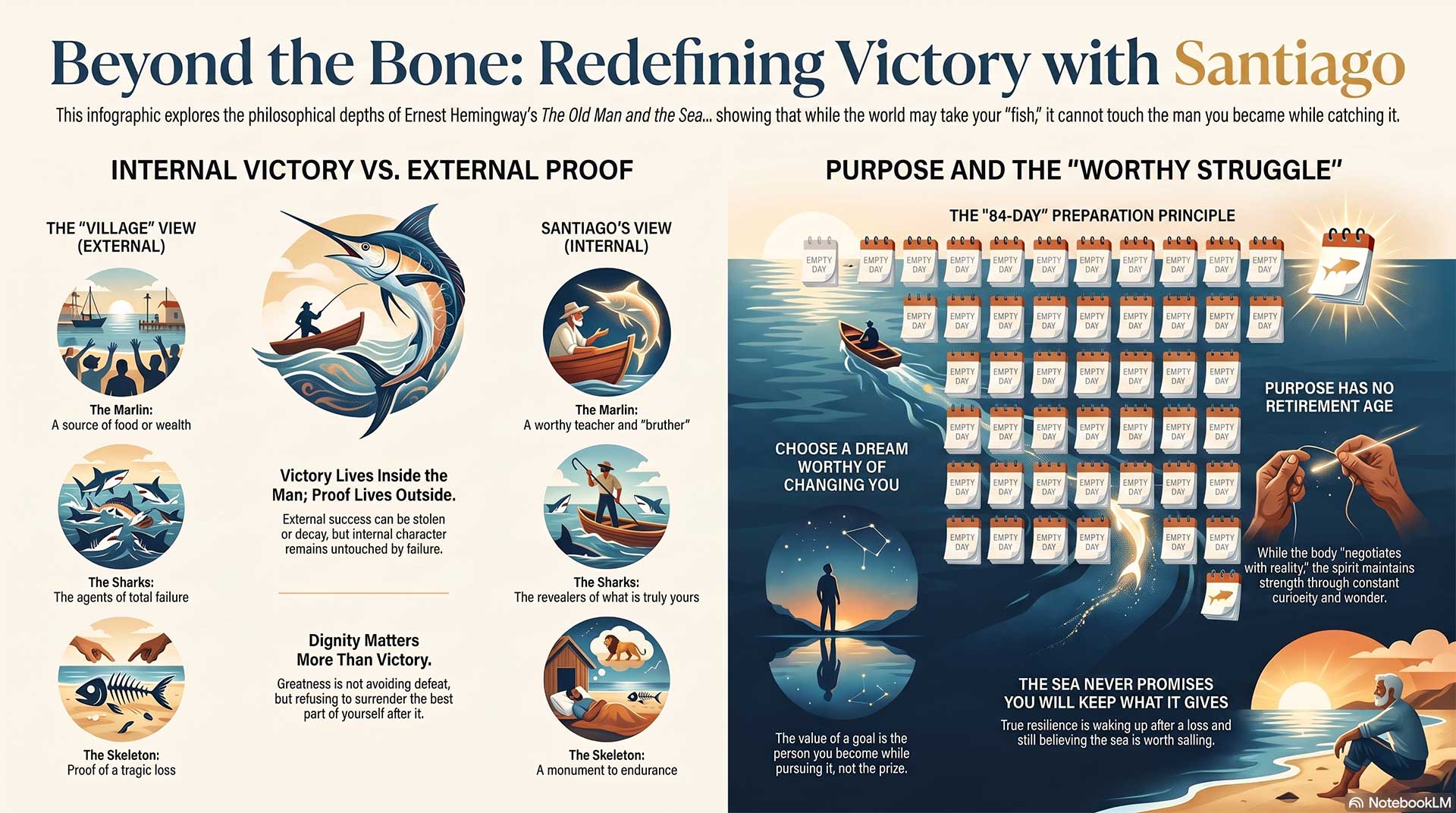
Victory lives inside a man.
Proof lives outside him.
The Sea smiles.
Its waves become softer.
The Sea
Now he understands.
The Lead Shark slowly circles again.
The Lead Shark
If victory was already inside you...
why fight us?
Santiago
Because I was still learning.
The Lead Shark
Learning what?
Santiago
That some things cannot be defended forever.
The shark tilts its head.
The Lead Shark
Such as?
Santiago
Youth.
Reputation.
Success.
Beauty.
Fish.
Life itself.
The words drift across the water.
Even the sharks stop moving.
Nick
Hemingway...
did you create the sharks to represent death?
Hemingway smiles.
Ernest Hemingway
Death.
Time.
Critics.
Envy.
Decay.
Failure.
Public opinion.
Take your pick.
The sharks become whatever arrives after your greatest achievement.
Everyone meets them.
The Lead Shark nods.
Surprisingly.
The Lead Shark
That...
I agree with.
Everyone laughs.
Even Santiago.
The Lead Shark
Humans always blame us.
But we arrive only after blood enters the water.
We do not create mortality.
We reveal it.
The Sea crashes gently against the dock.
The Sea
Exactly.
Every great accomplishment carries its own scent.
The world notices.
Admiration comes.
So do sharks.
Nick becomes thoughtful.
Nick
That sounds true today.
You build a company...
criticism comes.
You publish a book...
reviews come.
You become successful...
envy comes.
Maybe sharks are unavoidable.
Hemingway
Not maybe.
Certainly.
The Marlin looks toward Santiago again.
The Marlin
Then answer honestly.
If someone offered you another ending—
You land me safely.
No sharks.
Great wealth.
Great fame.
Would you choose it?
Santiago surprises everyone.
Santiago
No.
Nick
Why not?
Santiago
Because then people would remember the fish.
Not the fisherman.
The harbor becomes perfectly still.
Manolin
I don't understand.
Santiago
If I returned with the whole fish...
people would say,
"What an enormous catch."
Instead...
they ask,
"How did the old man survive losing it?"
One story celebrates success.
The other teaches endurance.
Hemingway quietly smiles.
Ernest Hemingway
Now you've discovered why I let the sharks win.
The Lead Shark laughs loudly.
The Lead Shark
You mean...
you used us.
Hemingway
Completely.
Even the sharks laugh.
The Lead Shark
I suppose writers are more dangerous than sharks.
The Sea gives a low rumble.
The Sea
Far more.
Sharks consume flesh.
Stories consume generations.
Nick looks toward the skeleton shining beneath the moonlight.
Nick
Perhaps we've been asking the wrong question for seventy years.
People ask,
"Did the sharks destroy Santiago's victory?"
Maybe the better question is,
"What kind of victory can survive sharks?"
The Marlin nods.
The sharks fall silent.
Even Hemingway offers no correction.
Santiago stands slowly.
His old hands rest upon the worn wood of the skiff.
Santiago
Anything that can be stolen...
was never the greatest part of your life.
The Lead Shark lowers his great head.
For the first time, there is no challenge in his voice.
Only recognition.
The Lead Shark
Then we never defeated you.
We only removed everything that wasn't truly yours.
No one speaks.
The moon reflects across the sea.
The skeleton continues drifting beneath the surface.
No longer a symbol of loss.
Now a monument to what cannot be eaten, stolen, praised, forgotten, or measured.
Some victories arrive at shore as bones.
Yet they remain victories all the same.
The tide carries the conversation into silence.
There is still one question left.
Not about fish.
Not about sharks.
About time itself.
Act 4: Growing Old Without Growing Small
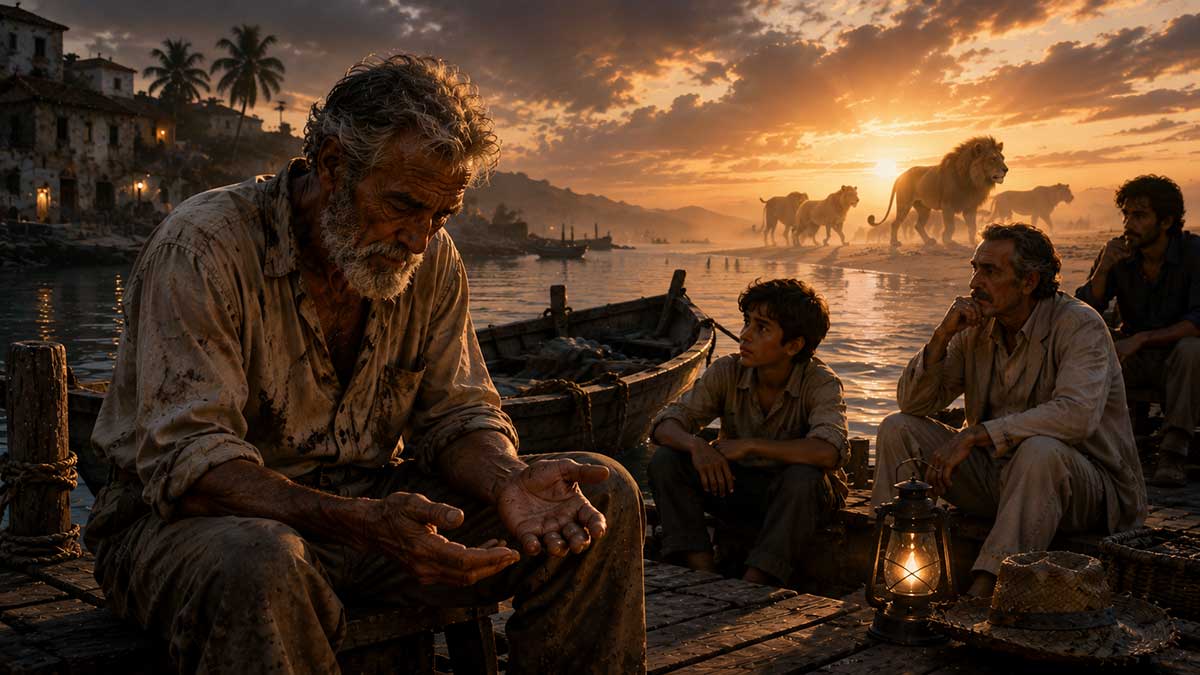
The moon has begun its slow descent.
The harbor is quieter now.
The sharks have disappeared into the darkness.
The Marlin swims peacefully beneath the stars.
The Sea barely moves.
It is as though everything has become older.
Even time itself.
Santiago sits alone on the dock.
His hands rest on his knees.
They are the hands of an old man.
Scarred.
Bent.
Beautiful.
Nick watches them for a long moment.
Then he asks the question that has waited all evening.
Nick Sasaki
Santiago...
When did you first realize...
you had become old?
Santiago laughs softly.
Santiago
When other people noticed before I did.
The group smiles.
Santiago
Inside...
I still believed I could do everything.
Outside...
my body had already begun negotiating with reality.
Manolin
I never thought you were old.
Santiago looks at the boy warmly.
Santiago
That is because children measure people differently.
Adults count years.
Children count wonder.
Hemingway smiles.
He quietly writes the sentence in his notebook.
Nick
Today many people fear growing old more than death itself.
They worry about retirement.
Irrelevance.
Slower bodies.
Losing purpose.
Were you afraid?
Santiago looks toward the horizon.
Santiago
No.
The answer surprises everyone.
Nick
Not even once?
Santiago
I feared becoming unnecessary.
That is different.
The Sea speaks.
Its voice is almost fatherly.
The Sea
Humans rarely fear age.
They fear invisibility.
No one interrupts.
The Sea
A child is noticed.
A young man is admired.
A successful man is respected.
An old man often becomes...
transparent.
Manolin slowly nods.
He has seen older fishermen sitting alone by the harbor.
No one asking for their stories.
Manolin
Is that why you kept fishing?
Santiago
Partly.
But not because I wanted applause.
Because I wanted conversation.
Nick
Conversation?
Santiago
The sea still asked something of me.
As long as it did...
I still belonged somewhere.
The Marlin surfaces.
The Marlin
Then age never separated us.
Santiago
No.
The sea introduces old fishermen to older fish.
The Marlin laughs deeply.
The Marlin
Perhaps that is why our meeting felt respectful.
Neither of us was young.
Neither of us had anything left to prove.
Hemingway looks toward Santiago.
Ernest Hemingway
Is that true?
Did you have nothing left to prove?
Santiago smiles.
Santiago
No.
I had one thing left.
To myself.
Nick leans forward.
Nick
That seems to be the center of your life.
You were never trying to convince other people.
You were trying to answer yourself.
Santiago
Exactly.
Young people often ask,
"Who believes in me?"
Old people begin asking,
"Do I still believe in myself?"
The words settle heavily.
Even the Sea becomes silent.
Manolin
Old people don't usually say that.
Santiago
Because they fear sounding weak.
Manolin
Were you weak?
Santiago looks at his hands.
Santiago
Every day.
The answer catches everyone off guard.
Nick
Really?
Santiago
Strength is not the absence of weakness.
It is continuing after weakness introduces itself.
Hemingway quietly nods.
Ernest Hemingway
People often misunderstand courage.
They think courage belongs to the strongest person.
It usually belongs to the one who knows exactly how fragile he has become.
The Sea laughs gently.
The Sea
Young waves crash loudly.
Old tides move continents.
Everyone smiles.
Nick
That's beautiful.
The Sea
It is also true.
The Marlin slowly circles the dock.
The Marlin
Old fisherman...
what did you lose first?
Your strength?
Your speed?
Your confidence?
Santiago thinks carefully.
Santiago
Recovery.
Silence.
Santiago
When I was young...
pain left quickly.
When I grew older...
it stayed for tea.
Everyone laughs.
Even Hemingway.
Santiago
The sea became the same.
The fish did not grow larger.
I simply needed longer conversations with my wounds.
Manolin's smile fades.
Manolin
Did that make you sad?
Santiago
Sometimes.
Then I realized something.
Nick
What?
Santiago
Youth lets you outrun mistakes.
Age teaches you to outgrow them.
The Sea whispers approvingly.
The Sea
Very few humans discover that.
Nick turns toward Hemingway.
Nick
One thing has always fascinated me.
The lions.
At the end of the book...
Santiago dreams of lions on African beaches.
Not fish.
Not victory.
Why?
Hemingway waits.
Long enough that everyone wonders if he will answer.
Finally—
Ernest Hemingway
People assume the lions represent youth.
I think they represent something better.
Nick
What?
Ernest Hemingway
Wonder.
Everyone becomes quiet.
Ernest Hemingway
Youth disappears.
Wonder does not have to.
The Marlin nods.
The Marlin
I met many young fishermen.
Very few still wondered.
Santiago
Exactly.
Some men become old at thirty.
Others remain curious at ninety.
Nick smiles.
Nick
That reminds me of something.
Many successful people retire...
then slowly lose their reason for waking up.
What would you tell them?
Santiago looks toward the endless horizon.
Santiago
Do not retire from purpose.
Retire only from occupations.
The Sea crashes gently against the dock.
The Sea
Purpose has no retirement age.
Manolin looks at Santiago.
His eyes have become wet.
Manolin
Old man...
I was always afraid I would lose you.
Santiago smiles.
Santiago
You will.
The answer hurts.
Manolin
Then why teach me?
Santiago
Because fishermen disappear.
Fishing doesn't.
The Marlin quietly adds—
The Marlin
Neither does courage.
Nick looks around the circle.
Something has changed.
This no longer feels like a conversation about growing old.
It feels like a conversation about inheritance.
Nick
Hemingway...
who is the real hero of this book?
Santiago?
Hemingway slowly shakes his head.
Ernest Hemingway
No.
Everyone waits.
Ernest Hemingway
Hope is.
Nick
Hope?
Ernest Hemingway
Look carefully.
The old man will die.
The fish dies.
The sharks disappear.
The sea remains.
But one thing continues.
A boy says,
"I'll fish with you tomorrow."
Civilizations survive because someone younger says those words to someone older.
Manolin wipes his eyes.
He had never thought his simple promise carried so much weight.
Santiago
The greatest catch I ever made...
was not the marlin.
The Marlin smiles.
The Marlin
I was wondering when you would admit that.
Santiago turns toward the boy.
Santiago
It was him.
Manolin lowers his head.
He cannot speak.
Santiago
Fish feed villages.
Students feed the future.
The first light of dawn begins touching the horizon.
Night is ending.
The harbor slowly awakens.
The old fisherman rises carefully.
His body is slower than before.
His spirit is not.
As he looks toward the sea, the lions seem almost visible beyond the morning mist—not running across African beaches this time, but quietly watching the sunrise.
No longer symbols of lost youth.
Now reminders that wonder can grow old without ever growing small.
Act 5: If Santiago Lived in 2026...
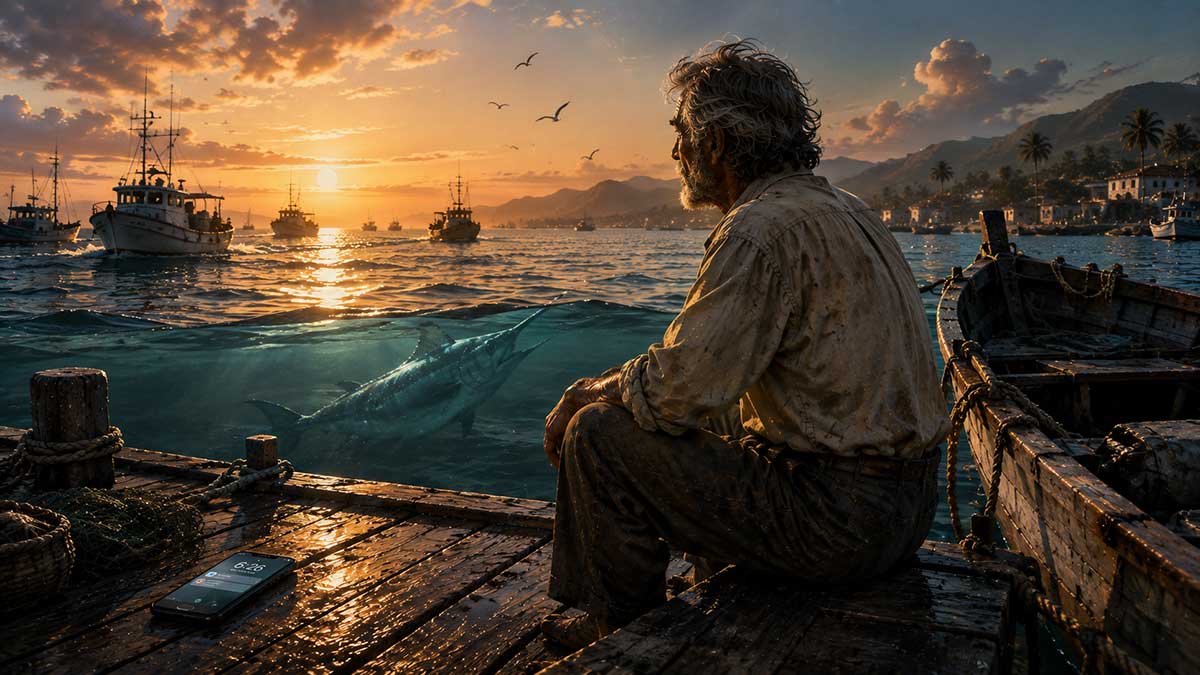
The first rays of sunrise spread across the harbor.
The night has ended.
Fishing boats begin leaving one by one.
For the first time, the conversation turns away from the past.
Nick looks around the circle.
Nick Sasaki
We've spent the night talking about 1952.
Let's end somewhere different.
Suppose Santiago were born in 2026.
There is no small Cuban fishing village.
No marlin.
No wooden skiff.
Who would he become?
The Sea answers first.
The Sea
Humans always think they change because their tools change.
Their hearts rarely do.
Everyone smiles.
Nick
Fair enough.
Then let me ask another way.
Where would today's Santiago meet his marlin?
The Marlin surfaces.
The Marlin
He would still meet me.
I simply wear different shapes now.
Nick
Such as?
The Marlin
A company no one believes can succeed.
A cure everyone says is impossible.
A painting no one understands.
A book no publisher wants.
A child everyone else has given up on.
The worthy struggle changes clothes.
Not identity.
Santiago nods slowly.
Santiago
Exactly.
People keep searching for fish.
They should be searching for worthy opponents.
Manolin
I thought the marlin was your dream.
Santiago
No.
The marlin was my teacher.
Hemingway closes his notebook.
Ernest Hemingway
Most readers make that mistake.
They think the story is about achieving a dream.
It is actually about discovering what kind of dream deserves your life.
Nick becomes thoughtful.
Nick
If that's true...
many successful people today have caught very small fish.
The Sea laughs.
The Sea
Many have caught very expensive fish.
Not very meaningful ones.
Everyone laughs.
Even Santiago.
Nick
Let's make this practical.
Suppose Santiago were thirty-five today.
Someone tells him,
"Build a company."
Another says,
"Become famous."
Another says,
"Invest wisely."
Another says,
"Use AI."
Which path would he choose?
Santiago surprises everyone.
Santiago
Whichever frightened him most.
Nick
Really?
Santiago
The sea never rewarded comfort.
Why would life?
The Marlin nods.
The Marlin
Small dreams never require large people.
Silence.
Nick
That may be one of the greatest lines we've heard tonight.
Hemingway smiles.
Ernest Hemingway
He's always been better than I was.
I merely wrote him down.
The group laughs.
Nick
Let's ask a harder question.
Today people measure success with numbers.
Followers.
Subscribers.
Revenue.
Net worth.
Awards.
What would Santiago measure?
The old fisherman looks toward the horizon.
Santiago
Respect.
Nick
From whom?
Santiago
The work.
Everyone becomes quiet.
Nick
Explain.
Santiago
If I become a fisherman...
the sea should respect my preparation.
If I become a carpenter...
wood should respect my hands.
If I become a teacher...
truth should respect my effort.
I cannot command success.
I can earn respect from the work itself.
The Sea gives a slow approving wave.
The Sea
That is why I accepted him.
Nick
Accepted?
The Sea
He never demanded victory.
Only opportunity.
Those are very different prayers.
Manolin suddenly raises his hand.
Everyone laughs.
He has never done that before.
Manolin
May I ask the question everyone has been avoiding?
Nick
Please.
Manolin
Old man...
if you lived today...
would you still fail for eighty-four days?
Santiago smiles.
Santiago
Probably longer.
The entire dock bursts into laughter.
Even the sharks, somewhere far beneath the water, seem amused.
Nick
Why?
Santiago
Because modern people quit faster.
The sea would need extra time deciding whether I belonged.
Hemingway laughs louder than anyone has heard all night.
Ernest Hemingway
I wish I'd written that.
The Marlin slowly circles the boat.
The Marlin
No.
You couldn't have.
He earned it.
The conversation grows quieter again.
Nick
There's another difference today.
Artificial intelligence.
Machines can write.
Paint.
Compose music.
Perhaps someday even fish.
Where does Santiago belong in a world like that?
Everyone unexpectedly turns toward Hemingway.
Ernest Hemingway
Machines may learn patterns.
Only people choose sacrifices.
The Sea adds—
The Sea
No machine has ever watched eighty-four empty sunsets and returned with hope on the eighty-fifth morning.
Santiago nods.
Santiago
Skill creates tools.
Character decides whether they matter.
Nick looks around the circle.
Nick
Then perhaps the marlin isn't disappearing.
Perhaps humanity simply keeps mistaking convenience for purpose.
The Marlin
Exactly.
Many people optimize their lives.
Very few enlarge them.
The words hang over the harbor.
Nick reaches into his bag.
He places a smartphone on the dock.
Its screen lights up.
Charts.
Messages.
News.
Notifications.
The phone vibrates repeatedly.
Everyone stares at it.
Except Santiago.
He continues watching the sunrise.
Nick
You're not curious?
Santiago
About what?
Nick
The world.
Santiago smiles.
Santiago
The world is over there.
He points toward the sea.
Not the phone.
No one laughs.
Manolin
Old man...
may I ask one final question?
Santiago
Always.
Manolin
After everything...
after the fish...
after the sharks...
after all these years...
what is the greatest lesson the sea ever taught you?
Santiago watches the sun rise completely above the horizon.
He takes his time.
The answer deserves it.
Finally he speaks.
Santiago
Never choose a dream because you think you can catch it.
Choose it because becoming the person who tries will make your life beautiful.
Silence.
No one moves.
The Marlin slowly disappears beneath the water.
Not as prey.
Not as memory.
As possibility.
The Sea speaks one last time.
Its voice stretches across the entire horizon.
The Sea
Every generation believes it is searching for new oceans.
It never is.
It is searching for old courage.
Hemingway closes his notebook.
He slips it into his pocket.
Ernest Hemingway
People often ask me why I ended the story with lions.
After tonight...
I think I would end it differently.
Nick smiles.
Nick
How?
Hemingway looks at Santiago.
The old fisherman is already preparing his boat again.
The conversation is over.
The work is not.
Ernest Hemingway
I would end it with this.
Not an old man dreaming of lions.
An old man untying his boat one more time.
Because the greatest victory was never the marlin.
It was waking up, after everything had been taken away, and still believing the sea was worth sailing.
The harbor fills with morning light.
Fishing boats disappear into the distance.
The conversation ends where the novel truly began.
Not with a fish.
With a man quietly choosing to sail.
And somewhere beyond the horizon, another marlin is already waiting.
Not for the strongest fisherman.
For the one who has become worthy of meeting it.
Final Thoughts by Ernest Hemingway
When people ask what The Old Man and the Sea teaches, they often expect a sentence about perseverance.
Perseverance matters.
But it is not enough.
Many people persevere in the wrong direction.
Many work tirelessly for prizes that cannot satisfy them.
The better question is not whether you are willing to struggle.
The better question is whether your struggle deserves your life.
Santiago did not become extraordinary because he caught a giant marlin.
He became extraordinary because he chose a challenge worthy of his character.
The marlin demanded everything he possessed.
The sharks took away everything the world could count.
Yet they could not touch the person he had become during those three days on the sea.
That is why I never considered this a tragic ending.
Loss is unavoidable.
Decay is unavoidable.
Age is unavoidable.
What remains undecided is whether those realities will shrink your spirit or deepen it.
There is another lesson I hope readers notice.
Santiago never truly fishes alone.
Manolin believes in him.
The Sea shapes him.
The Marlin tests him.
Even the Sharks reveal something he could never have learned without them.
Human beings become themselves through relationships, including difficult ones.
Your greatest opponent may become your greatest teacher.
Your greatest disappointment may become your greatest education.
Your greatest failure may become the story that gives another person courage.
If there is one sentence I would leave with you, it is this:
Choose a dream that is worthy of changing you, not merely rewarding you.
Whether you catch the fish is never fully yours to decide.
Whether you become the kind of person who can sail beyond the horizon—that decision belongs to you every morning.
When the sun rises tomorrow, your marlin may still be waiting.
I hope you untie your boat.
Short Bios:
Nick Sasaki
Host of the conversation. Nick guides each discussion by asking the questions modern readers still wrestle with—about courage, failure, dignity, love, aging, and what it truly means to live a meaningful life.
Santiago
An aging Cuban fisherman who has gone eighty-four days without catching a fish. Proud, disciplined, and deeply respectful of the sea, he refuses to surrender to despair. His struggle with the great marlin becomes one of literature's greatest explorations of perseverance, humility, and human dignity.
Manolin
Santiago's devoted young apprentice and closest companion. Though forced by his parents to fish with a more successful boat, he never abandons his faith in the old fisherman. His loyalty, compassion, and hope represent the future that survives beyond Santiago's physical struggle.
The Marlin
The magnificent fish that becomes Santiago's greatest opponent and greatest teacher. Noble, powerful, and beautiful, the marlin represents a worthy challenge that commands admiration rather than hatred, revealing the complex bond between humanity and nature.
The Sea (La Mar)
More than a setting, the sea is a living presence that nurtures, tests, rewards, and humbles those who enter it. Santiago loves the sea as both companion and mystery, recognizing that it belongs to no one despite humanity's attempts to master it.
The Sharks
Drawn by the marlin's blood, the sharks strip away Santiago's hard-earned prize during his return home. They symbolize the unavoidable forces that erode every human achievement—time, loss, criticism, mortality, and the reality that no victory remains untouched.
Joe DiMaggio
The legendary baseball player whom Santiago deeply admires. Playing through pain and hardship, DiMaggio becomes Santiago's model of quiet excellence, reminding him that true greatness is measured by perseverance rather than comfort.
Perico
The owner of the local bodega who lends Santiago newspapers so he can follow baseball and Joe DiMaggio's games. His small acts of kindness reflect the quiet support that often sustains people through difficult seasons.
Martin
The owner of the Terrace restaurant who discreetly provides Santiago with meals and supplies without embarrassing him. His generosity shows that compassion often speaks most powerfully through simple, practical acts rather than grand gestures.
The Flying Fish and Birds
The small creatures Santiago encounters throughout his voyage. He watches them with affection and empathy, seeing them as fellow travelers sharing the same vast sea. Their presence reminds him that all living things struggle within the same natural world.
Leave a Reply