
Introduction
David Lurie admits what he did. So why doesn’t his confession feel like enough?
What if the hardest question in Disgrace is not whether David Lurie is guilty—but what guilt requires after the damage has already been done?
J. M. Coetzee’s novel refuses the comfort of simple answers. David admits what happened with Melanie but resists the language of repentance. Lucy survives terrible violence yet refuses the future her father wants for her. Petrus embodies a changing South Africa without becoming an easy symbol of either justice or threat. And, unexpectedly, unwanted dogs become central to the novel’s final moral question.
In this Imaginary Conversation, ten leading scholars of Coetzee, post-apartheid literature, ethics, gender, violence, and animal studies confront the questions readers continue debating.
Why does Coetzee keep us so close to David’s consciousness? Why is Melanie given so little direct voice? Does David’s university hearing echo South Africa’s Truth and Reconciliation Commission? Why does Lucy stay? Are Melanie and Lucy deliberately placed in parallel? And why does the novel end with David caring for animals he cannot save?
Perhaps Disgrace is asking something harder than whether David deserves redemption:
If the past cannot be repaired and forgiveness never comes, can a person still learn to live differently?
(Note: This is an imaginary conversation, a creative exploration of an idea, and not a real speech or event.)
Topic 1 — Is David Lurie a Predator, a Disgraced Man, an Unreliable Narrator—or All Three?
The scholars had barely settled before Derek Attridge placed the problem at the center of the table.
Why Does Coetzee Make Us Spend So Much Time Inside David Lurie’s Mind?
Derek Attridge: Before deciding what David is, I think we need to confront something stranger.
Why are we allowed to know him so intimately?
Coetzee could have written Melanie’s novel.
He could have moved between perspectives.
He could have created an omniscient narrator who corrected David whenever his interpretation became morally questionable.
He does none of those things.
We remain extraordinarily close to David.
David Attwell: And that proximity is dangerous.
Readers can easily mistake access for endorsement.
We know David’s disappointments, desires, humiliations, intellectual habits, fantasies.
Melanie does not receive anything comparable.
Lucy Graham: Which means we should begin carefully.
The central problem is not simply that David may misunderstand Melanie.
The reader’s access to Melanie is itself mediated through structures that privilege David.
Dominic Head: Yet I would hesitate to call David simply an unreliable narrator.
He is not unreliable in the conventional sense.
He does not necessarily fabricate events.
Mike Marais: Exactly.
The unreliability is more profound.
David may report what happened reasonably accurately while failing to grasp what it means ethically.
Derek Attridge: Which may be much closer to ordinary human moral failure.
Most of us do not walk around inventing entirely fictional versions of our lives.
We interpret real events in ways that protect the person we believe ourselves to be.
The room became quiet.
That distinction would shape everything that followed.
Was What Happened Between David and Melanie Consensual?
Lucy Graham: We have to confront the scene directly.
There is a serious danger in describing what happens between David and Melanie merely as an affair.
He is her professor.
He is considerably older.
He occupies institutional authority.
And there are moments in the text where Melanie’s willingness is deeply compromised.
Elleke Boehmer: Yet the novel places those moments inside David’s consciousness.
That matters enormously.
He interprets.
He aestheticizes.
He transforms sexual desire into a story about passion.
Patrick Hayes: He gives himself a language inherited partly from Romanticism.
Desire becomes something elemental.
Something that happens to him rather than something for which he must take responsibility.
Lucy Graham: And that language can become morally dangerous.
The minute we say, “David was overwhelmed by desire,” we have already centered David’s experience.
What happened to Melanie?
Dominic Head: Yet there is a difficulty here.
Should criticism supply certainty where the novel itself carefully limits our access?
Lucy Graham: We need to distinguish uncertainty about Melanie’s entire interior experience from uncertainty about unequal power.
We may not know everything Melanie thinks.
We know David is her professor.
We know he pursues her.
We know she displays reluctance.
We know enough to make serious ethical judgments.
Does Calling the Encounter “Ambiguous” Accidentally Repeat David’s Defense?
Rosemary Jolly: This is where the word ambiguity becomes dangerous.
Literary critics love ambiguity.
Sometimes appropriately.
But ethical ambiguity and narrative ambiguity are not identical.
Derek Attridge: I agree, with one qualification.
Literature often prevents us from possessing another person’s experience completely.
That limitation can itself have ethical value.
Lucy Graham: Certainly.
But we cannot let respect for unknowability become an excuse for refusing judgments the text permits us to make.
Mike Marais: Perhaps there are two forms of humility competing here.
One says:
“We cannot fully know Melanie.”
The other says:
“Since we cannot fully know Melanie, we should be especially cautious about allowing David’s interpretation to fill the silence.”
Elleke Boehmer: Precisely.
The absence of Melanie’s interiority does not automatically strengthen David’s account.
It may weaken our confidence in it.
Is David a Predator?
Patrick Hayes: The word itself presents another problem.
Once we call David a predator, something psychologically satisfying happens.
We know where to put him.
Rosemary Jolly: That does not make the description wrong.
Patrick Hayes: No.
But it can make our work too easy.
David Attwell: Coetzee rarely gives readers characters who can be morally filed away.
David behaves exploitatively.
That does not mean every aspect of David becomes reducible to exploitation.
Lucy Graham: I would put it slightly differently.
Recognizing David’s humanity must never become a way of reducing the seriousness of what he does.
Derek Attridge: Yet recognizing his humanity may be precisely what makes the novel disturbing.
A monster teaches us very little.
We can simply say:
“I am not him.”
David is harder.
He reads poetry.
He loves music.
He can be witty.
He loves his daughter.
Later he becomes capable of tenderness toward animals.
And he can still behave terribly.
Alyda Faber: Which dismantles one of our favorite moral fantasies.
That harmful people will look harmful.
Why Are Readers Uncomfortable When a Wrongdoer Remains Human?
Brandi Estey-Burtt: We want moral appearance and moral reality to match.
Cruel person.
Cruel face.
Cruel thoughts.
Cruel actions.
Then judgment becomes easy.
Mike Marais: Coetzee refuses that comfort.
David’s capacity for beauty does not prevent his capacity for domination.
His appreciation of Byron does not make him ethical.
His later tenderness does not rewrite Melanie’s experience.
Dominic Head: This is one reason the novel is so resistant to conventional redemption.
If David becomes gentler later, readers immediately want to recalculate the earlier David.
Perhaps he was not so bad.
But that is precisely the calculation we should resist.
Lucy Graham: Melanie’s experience does not become less serious when David later carries dogs tenderly.
That point must remain fixed.
Why Does David Describe Desire Through Romantic Poetry?
David Attwell: David’s intellectual formation matters.
He understands himself through literary traditions that dignify desire.
Byron becomes particularly significant.
Dominic Head: David does not experience appetite merely as appetite.
He gives it aesthetic form.
Elleke Boehmer: Which is a privilege.
People with cultural authority can sometimes transform questionable behavior into beautiful language.
Patrick Hayes: And beautiful language can obscure power.
Alyda Faber: David wants desire to possess something like sovereignty.
It arrives.
It commands.
The individual submits.
That reduces responsibility.
Rosemary Jolly: Yet notice who receives the luxury of surrendering to desire.
David.
Melanie must live with the consequences.
Is David Lying to Himself?
Mike Marais: I am not sure lying is the best description.
A lie implies that somewhere beneath the performance David possesses the truth and deliberately conceals it.
What if he genuinely sees the world this way?
Derek Attridge: That is much more frightening.
Brandi Estey-Burtt: Why?
Derek Attridge: Since sincere self-deception is harder to escape than deliberate dishonesty.
If David were consciously lying, he could simply stop lying.
But if his entire moral vocabulary organizes reality around himself, something deeper must change.
David Attwell: His education does not save him from this.
In some respects, it gives him more sophisticated tools for rationalization.
Lucy Graham: Intelligence is not moral vision.
That distinction is central to David.
Why Does Melanie Receive So Little Voice?
The discussion slowed.
This was perhaps the hardest formal question.
Elleke Boehmer: Readers repeatedly want more Melanie.
That desire is understandable.
Lucy Graham: And politically significant.
A young woman subjected to unequal sexual power receives far less narrative interiority than the older male professor involved.
We should not dismiss discomfort with that structure.
Derek Attridge: Yet perhaps the discomfort is partly intentional.
Lucy Graham: Perhaps.
But “intentional” does not end criticism.
Derek Attridge: Agreed.
Mike Marais: I wonder whether Melanie’s relative absence creates an ethical boundary.
We cannot fully enter her.
We cannot make her experience complete.
Lucy Graham: That can be a valuable interpretation, provided we do not romanticize silence.
Silenced people have often been told that their silence is somehow profound.
Sometimes silence is produced by power.
Rosemary Jolly: That is particularly significant in a society emerging from institutionalized violence.
Who gets testimony?
Who is believed?
Who becomes part of the official story?
Who remains outside it?
These are never neutral questions.
Does Giving Melanie More Voice Risk Making Her Serve David Again?
Alyda Faber: There is another strange possibility.
Suppose Coetzee had given Melanie a long final monologue explaining exactly what David did to her and exactly how she felt.
Readers might feel relieved.
Now we know.
Case closed.
Mike Marais: And Melanie becomes available to us.
Completely readable.
Derek Attridge: Which is another form of possession.
Lucy Graham: Yes, though I want to retain the tension.
We must not transform the absence of a woman's voice into an ethical achievement automatically.
But neither should we assume ethical literature must grant readers complete psychological access to every injured person.
Elleke Boehmer: Perhaps Melanie’s absence should remain uncomfortable.
Not solved.
Are We Entitled to Know Exactly What Melanie Felt?
Mike Marais: That may be one of the novel’s hidden challenges.
Readers want to know:
Did she desire him?
Was she frightened?
Did she feel trapped?
How did she interpret each encounter?
Those are understandable questions.
But why do we believe answering them would determine David’s responsibility?
Lucy Graham: Exactly.
Her interior state does not erase the structural imbalance.
Mike Marais: And perhaps ethical attention begins when we accept that another person remains partly beyond us.
David’s recurring failure is his tendency to interpret other people through himself.
Readers should be careful not to repeat it.
Are Readers Supposed to Sympathize With David?
Dominic Head: We should distinguish sympathy from absolution.
Patrick Hayes: Yet readers often resist doing so.
They worry that understanding David somehow excuses him.
Derek Attridge: Literature becomes impoverished if understanding is permitted only for innocent characters.
Rosemary Jolly: But sympathy is politically uneven too.
Society has historically devoted extraordinary imaginative energy to complicated men who harm women.
We should acknowledge that.
David Attwell: True.
Yet Coetzee may be exploiting precisely that tradition.
He gives us the complicated man.
Then he makes the privilege of complication itself visible.
Lucy Graham: That is an interpretation I find much more interesting than simply saying Coetzee wants us to sympathize with David.
Does David’s Suffering Matter?
Alyda Faber: Here is a question readers sometimes fear asking.
David suffers.
Does that suffering matter?
Lucy Graham: Of course.
But suffering does not create innocence.
Alyda Faber: Exactly.
We have a tendency to treat suffering as moral purification.
Someone loses enough and we begin believing the account has been settled.
Brandi Estey-Burtt: Which becomes important with the dogs later.
David’s suffering does not purchase redemption.
Mike Marais: Nor does suffering necessarily produce knowledge.
One can suffer enormously and remain morally unchanged.
What Does David Actually Learn?
David Attwell: Perhaps very little at first.
That is important.
His disgrace does not instantly enlighten him.
Dominic Head: He loses his position before he loses his worldview.
Derek Attridge: Beautiful distinction.
Rosemary Jolly: And that may be why the university hearing becomes so important next.
David believes he has accepted responsibility since he admits the facts.
The institution thinks something remains missing.
Lucy Graham: Melanie might agree.
Is David More Honest Than the People Judging Him?
Patrick Hayes: Here we should give David his strongest argument.
He distrusts moral performance.
Perhaps rightly.
Alyda Faber: He refuses to say words he does not genuinely feel.
There is something ethically serious in refusing false repentance.
Rosemary Jolly: Yet David turns that seriousness into protection.
Derek Attridge: Both can be true.
That is where Coetzee becomes difficult.
David can correctly diagnose hypocrisy in the institution while remaining deeply wrong about himself.
David Attwell: A morally compromised person can make a valid argument.
Readers dislike that too.
Why Doesn't Coetzee Simply Tell Us What to Think?
Brandi Estey-Burtt: Perhaps since judgment made too easy does not transform the judge.
Mike Marais: Exactly.
If Coetzee told us:
David is bad.
Melanie is victim.
Lucy is victim.
Petrus represents history.
Dogs represent redemption.
We could close the book morally satisfied.
Derek Attridge: Instead, the novel implicates interpretation itself.
We keep wanting to possess the correct reading.
Elleke Boehmer: Yet we should not confuse interpretive uncertainty with moral neutrality.
Some things remain wrong.
Derek Attridge: Absolutely.
The difficulty is learning to make moral judgments without pretending those judgments make another human being completely knowable.
Is David Lurie a Predator, Then?
The scholars paused.
Patrick Hayes finally returned to the title question.
Patrick Hayes: We have avoided answering it directly.
Predator?
Disgraced man?
Unreliable narrator?
All three?
Lucy Graham: He is a man who abuses unequal sexual power.
I would not soften that.
Dominic Head: He is certainly disgraced.
Mike Marais: And ethically unreliable in his interpretation of others.
David Attwell: Yet none of those descriptions exhausts him.
Rosemary Jolly: Nor should refusing reduction become an excuse for refusing judgment.
Derek Attridge: That tension may be exactly where the novel asks us to remain.
Closing — Who Receives the Privilege of Complexity?
The discussion had begun with David.
It ended, unexpectedly, with Melanie.
Elleke Boehmer: Perhaps we should reverse the question.
Instead of asking why David is complicated, ask:
Who gets to be complicated?
Silence.
Lucy Graham: David receives extraordinary narrative space.
His desire is examined.
His humiliation is examined.
His intellectual life is examined.
His relationship with his daughter is examined.
His eventual tenderness is examined.
Melanie receives far less.
Mike Marais: And perhaps our discomfort with that imbalance should remain alive throughout the novel.
Derek Attridge: David’s narrative privilege does not mean Coetzee proves him right.
It means we are forced to inhabit the uncomfortable distance between knowing someone intimately and judging what they have done.
Rosemary Jolly: Which brings us directly to the hearing.
David has controlled much of the language through which his actions are understood.
Then an institution says:
No.
We will name this.
We will decide what accountability requires.
Alyda Faber: And suddenly the man who has interpreted everyone else discovers what it feels like to be interpreted.
No one spoke for several seconds.
Then David Attwell posed the question that would carry them into the next discussion:
David Attwell: What happens when a man admits everything he did—
but refuses to say that it means what everyone else says it means?
That is where Disgrace becomes larger than one professor and one university.
And where South Africa’s much larger struggle over confession, truth, responsibility, and reconciliation begins to enter the room.
Topic 2 — Is David’s University Hearing Really About South Africa’s Truth and Reconciliation Commission?
The scholars returned to David’s hearing.
Not to decide whether the committee was fair.
To ask why Coetzee made confession itself such a difficult problem.
What Exactly Is Missing From David’s Admission?
Rosemary Jolly: David does something unusual.
He does not deny what happened.
He does not invent an alibi.
He does not claim Melanie fabricated the complaint.
He admits the facts.
Yet the committee remains dissatisfied.
Why?
Alyda Faber: Since factual admission is not the same as moral recognition.
David Attwell: That distinction matters enormously in the South African context.
A society emerging from apartheid had to confront precisely this problem.
What does it mean when someone says:
“Yes, this happened.”
Is that enough?
Patrick Hayes: Or does justice require the person to say:
“And I now understand what I did.”
Derek Attridge: Which raises a dangerous question.
Can that second statement ever be compelled honestly?
Why Won’t David Simply Apologize?
Dominic Head: David sees the hearing as theater.
He believes the committee wants a performance.
A visible act of submission.
Rosemary Jolly: He is not entirely wrong.
Institutions often require recognizable rituals.
Confession.
Contrition.
Apology.
Reintegration.
Alyda Faber: Yet his critique of ritual does not make him innocent.
That distinction must remain intact.
Mike Marais: David is skilled at finding the imperfection in the mechanism judging him.
Then he uses that imperfection to avoid confronting what the mechanism is trying, however clumsily, to demand.
Lucy Graham: He is much more interested in whether the confession would be authentic than in whether Melanie deserves acknowledgment.
That tells us where his moral attention still rests.
Can an Institution Demand Genuine Remorse?
Derek Attridge: I would answer no.
An institution can demand conduct.
It can demand acknowledgment.
It can impose consequences.
But genuine remorse belongs to interiority.
Rosemary Jolly: Yet institutions still need public forms.
A university cannot organize accountability around private feelings no one can verify.
Patrick Hayes: That creates the contradiction.
The institution needs a visible sign of moral transformation.
The moment it requires that sign, the sign becomes performative.
Alyda Faber: Which does not make performance meaningless.
Ritual can still matter.
People sometimes perform forms of accountability before they fully feel them.
Lucy Graham: True.
But we should ask who the ritual serves.
Melanie?
The university?
David?
The public image of the institution?
Those interests may differ.
Is David’s Refusal Courageous?
Dominic Head: There is something admirable in refusing to say what one does not believe.
Lucy Graham: I would be careful with “admirable.”
Dominic Head: Fair.
Perhaps principled.
Lucy Graham: Perhaps proud.
Derek Attridge: It can be both.
That is what makes him difficult.
David Attwell: David may correctly perceive compulsory remorse as artificial.
Yet he also wants to preserve sovereignty over his conscience.
That sovereignty has already been part of the problem.
What Does Confession Mean in Post-Apartheid South Africa?
Rosemary Jolly: Here the Truth and Reconciliation Commission becomes useful as a historical resonance.
Not a one-to-one allegory.
A resonance.
South Africa faced an immense problem.
How do you create a shared future after systematic violence?
Trials alone could not answer everything.
Silence could not.
Amnesia could not.
So testimony and confession became central.
David Attwell: The TRC asked people to narrate what happened publicly.
Truth itself became part of political repair.
Patrick Hayes: Yet truth did not automatically produce remorse.
That is the key connection.
A perpetrator could disclose acts without undergoing inner transformation.
Alyda Faber: Which is very close to David’s position.
“I admit the act.”
“But I refuse your interpretation of my soul.”
Is David’s Hearing a Miniature TRC?
David Attwell: I would resist saying miniature.
That makes the novel too neat.
Rosemary Jolly: Agreed.
But Coetzee’s readers in that historical moment could hardly encounter confession, public acknowledgment, guilt, and reconciliation without hearing the national conversation behind them.
Elleke Boehmer: The personal and political are touching each other without becoming identical.
That distinction is important.
David’s hearing is about sexual misconduct in a university.
The TRC addressed political violence on an enormous scale.
Yet both involve the unstable relationship between truth and repentance.
Can Someone Tell the Truth Without Accepting Responsibility?
Mike Marais: David accepts one form of responsibility.
“I did it.”
He resists another.
“This is what it means.”
Derek Attridge: Perhaps he thinks accepting the institution’s meaning would be surrendering his personhood.
Lucy Graham: Yet people who harm others often feel their complexity is being erased once the act is named clearly.
That feeling can be real.
It does not make the naming unjust.
Alyda Faber: Perhaps responsibility begins when one allows another person’s account to alter the meaning of one’s own action.
David has not reached that point yet.
What Is the Difference Between Confession and Repentance?
Alyda Faber: Confession says:
“This happened.”
Repentance says:
“I am no longer willing to relate to what happened in the same way.”
Rosemary Jolly: That is strong.
Dominic Head: And David gives the first without the second.
Patrick Hayes: Or perhaps he refuses the language through which the second must be demonstrated.
Lucy Graham: That distinction matters, but it can become too generous to David.
There is very little evidence at the hearing that his concern is Melanie.
His concern is coercion of conscience.
Does the Committee Care About Melanie?
Silence.
Then Lucy Graham answered.
Lucy Graham: That is one of the uncomfortable questions.
The committee may genuinely care about her.
It may care about institutional liability.
Professional standards.
Public legitimacy.
Gendered power.
All at once.
Rosemary Jolly: Institutions rarely act from one motive.
Mike Marais: Which means David can detect impurity in the committee’s motives and mistake that impurity for invalidity.
Derek Attridge: An institution can be compromised and still be right.
That is one of the novel’s hardest lessons.
Is Public Shame a Form of Justice?
Patrick Hayes: Sometimes.
Elleke Boehmer: Sometimes punishment.
Alyda Faber: Sometimes theater.
Lucy Graham: Sometimes necessary naming.
David Attwell: Sometimes all four.
Derek Attridge: Which is why disgrace itself becomes unstable.
Does disgrace describe moral truth?
Social exclusion?
Loss of status?
Public humiliation?
David experiences all of them together.
Why Is David So Resistant to Moral Language?
Dominic Head: Since moral language sounds banal to him.
He prefers aesthetic language.
Erotic language.
Literary language.
Alyda Faber: Moral language places him among ordinary offenders.
That may be unbearable.
Lucy Graham: Exactly.
David prefers to think of himself as transgressive rather than exploitative.
Romantic rather than ordinary.
Patrick Hayes: Sinful rather than bureaucratically culpable.
Rosemary Jolly: Which is itself a kind of vanity.
Is He More Interested in Authenticity Than Accountability?
Mike Marais: Yes.
David wants whatever he says to be authentic to his internal state.
Derek Attridge: A value we often admire.
Lucy Graham: Until authenticity becomes:
“I feel this strongly, so I should be permitted to remain as I am.”
Alyda Faber: Authenticity without transformation can simply become fidelity to the self that caused the harm.
That silenced the room for a moment.
Can an Apology Still Matter if It Begins as Performance?
Rosemary Jolly: I think yes.
Ritual can precede feeling.
Societies function partly through forms people enter before they fully inhabit them.
Derek Attridge: Yet there is danger there.
We may begin mistaking correct performance for moral change.
Alyda Faber: Still, refusal to perform anything can become its own performance.
David performs independence.
Patrick Hayes: Precisely.
His anti-theatrical stance is itself theatrical.
The lone man refusing the script.
Dominic Head: Very Byronic.
David Attwell: Which returns us to David’s self-conception.
He may believe he is refusing hypocrisy.
He may simultaneously be staging himself as the man too honest for hypocrisy.
Does Shame Change David?
Lucy Graham: Not immediately.
That matters.
Mike Marais: Disgrace strips away social protection before it produces moral vision.
Derek Attridge: If it ever fully does.
Alyda Faber: Which may be the point.
External disgrace and internal change operate on different clocks.
Rosemary Jolly: A society can punish someone long before that person understands why the punishment was deserved.
What Would Genuine Accountability Have Looked Like?
Elleke Boehmer: Perhaps listening.
Lucy Graham: Yes.
Not merely confessing what he did.
Listening to what it meant to Melanie.
Mike Marais: Accepting that her account might alter his.
Derek Attridge: Without demanding that the alteration become total self-annihilation.
Alyda Faber: Accountability is not the destruction of the self.
It is the surrender of sole authorship over the meaning of one’s actions.
That sentence hung in the room.
Is That What the TRC Was Trying to Do?
David Attwell: In part.
To break private ownership of historical violence.
To move what had been hidden into public memory.
Rosemary Jolly: Yet memory alone does not reconcile.
Truth can coexist with resentment.
Confession can coexist with self-justification.
Forgiveness may never come.
Patrick Hayes: Which makes Disgrace very different from sentimental reconciliation narratives.
Nothing guarantees repair.
Does David Want Forgiveness?
Alyda Faber: Perhaps not yet.
Dominic Head: He wants independence from judgment.
Lucy Graham: Which is not the same thing.
Mike Marais: Later, he may become less interested in whether forgiveness arrives.
That is where the dogs become meaningful.
Derek Attridge: We are getting ahead of ourselves.
Brandi Estey-Burtt: The dogs will wait.
A few of them smiled.
Closing — What If David’s Real Problem Is That Confession Is Still About David?
Rosemary Jolly: Let me return to the hearing.
David keeps asking:
Is my confession authentic?
Are they entitled to my remorse?
Is the procedure honest?
Am I being humiliated?
All legitimate questions.
But notice the center.
David.
Lucy Graham: Melanie disappears again.
Mike Marais: Perhaps that is the deepest failure.
Confession should open the self outward.
David uses confession to preserve the boundary around himself.
Alyda Faber: He admits the act without surrendering ownership of its meaning.
Derek Attridge: And the institution tries to take that ownership from him.
Perhaps crudely.
Perhaps necessarily.
David Attwell: Which makes the hearing more than a disciplinary scene.
It becomes a struggle over who has the right to define wrongdoing after wrongdoing has occurred.
Silence settled over the table.
Then Elleke Boehmer looked ahead.
Elleke Boehmer: The irony is that David hates having his own experience interpreted by others.
And soon, when Lucy experiences something devastating, what does he do?
He interprets.
He prescribes.
He decides what justice should look like.
He tries to tell her what her suffering means.
That may be the novel’s cruelest turn.
David leaves the hearing believing others have violated the sovereignty of his conscience.
Then he discovers how little sovereignty he is prepared to grant his own daughter.
Topic 3 — Why Does Lucy Stay?

The scholars returned to the question readers often find hardest to accept.
Lucy is attacked.
She remains on the farm.
She does not respond the way David wants.
She accepts dependence on Petrus under terms many readers find deeply unsettling.
The temptation is to explain her.
The scholars began by resisting that temptation.
Why Doesn’t Lucy Leave?
Elleke Boehmer: Readers often treat leaving as the obvious rational choice.
But “obvious” depends on what one values.
Lucy values the land.
Continuity.
A future rooted in place.
That makes her decision more complicated than simple fear.
Lucy Graham: I agree, but we should be cautious about romanticizing endurance.
A woman can remain under constrained conditions and still be exercising agency.
That does not mean the conditions are acceptable.
Patrick Hayes: Which is exactly why the scene becomes politically charged.
Lucy’s personal decision sits inside a larger transformation of land, race, and authority in post-apartheid South Africa.
Derek Attridge: Yet the danger is turning Lucy into a map of South Africa.
She is still a person.
Is Lucy Surrendering—or Exercising Agency Under Terrible Conditions?
Lucy Graham: The question may be badly framed.
Surrender and agency are not always opposites.
A person can choose within conditions she did not choose.
Mike Marais: Yes.
Freedom is rarely absolute.
The ethically serious question is whether we can respect a constrained choice without pretending the constraint is benign.
Rosemary Jolly: That matters enormously in discussions of trauma.
Observers often want a recognizable script.
Report.
Leave.
Seek punishment.
Reject the place.
Lucy does not follow that script.
Elleke Boehmer: And David experiences that refusal almost as another injury.
Why Does David Need Lucy’s Decision to Make Sense to Him?
Derek Attridge: David is a reader inside the novel.
He interprets Lucy just as we do.
He wants a coherent explanation.
Patrick Hayes: And he wants one that fits his moral vocabulary.
Violation should produce departure.
Danger should produce retreat.
Injustice should produce demand for punishment.
Lucy Graham: Lucy refuses all three expectations.
That does not mean she rejects justice.
It means she does not accept David’s version of what justice must look like.
Does Lucy’s Decision Represent Survival?
Rosemary Jolly: Survival is one useful word.
But survival itself can become too flattering.
We often call a difficult accommodation “resilience” and stop asking what made the accommodation necessary.
Elleke Boehmer: Precisely.
Lucy’s position may be practical.
It may be brave.
It may be compromised.
Those categories can coexist.
Mike Marais: Perhaps Coetzee is asking us to abandon the fantasy that agency becomes morally pure simply since it is agency.
Does Lucy Believe She Is Paying a Historical Debt?
Patrick Hayes: Her language invites that reading.
She appears conscious that remaining on the land may require accepting a radically changed relation to property and authority.
David Attwell: But I would resist saying she consciously becomes payment for apartheid.
That risks flattening the novel.
Lucy Graham: It is troubling whenever criticism makes Lucy’s body symbolic currency for national history.
That repeats a familiar violence.
Women’s suffering gets recruited to explain political transformation.
Elleke Boehmer: Exactly.
The political reading matters.
But the moment Lucy becomes merely “white South Africa learning humility,” we have lost Lucy.
Is Coetzee Saying White South Africans Must Submit to Violence?
Patrick Hayes: That interpretation has understandably disturbed readers.
David Attwell: And I do not think the novel supports such a clean conclusion.
The violence remains violence.
Nothing turns it into justice.
Rosemary Jolly: Historical oppression can explain the context in which violence emerges.
Explanation is not absolution.
Lucy Graham: That distinction must remain very clear.
Lucy’s assault cannot be morally converted into historical correction.
Then Why Does Coetzee Place Her in This Position?
Derek Attridge: Perhaps since any politically comfortable resolution would be dishonest.
If Lucy simply leaves, the novel could suggest withdrawal.
If she stays triumphantly and safely, it could suggest reconciliation.
If Petrus becomes clearly benevolent, the politics become reassuring.
Coetzee gives us none of those exits.
Mike Marais: He leaves us with a relationship we cannot morally stabilize.
That may be intentional.
Is Lucy Choosing Belonging Without Domination?
Elleke Boehmer: This is one of the stronger interpretations.
Lucy appears willing to remain in South Africa without insisting on the old forms of mastery.
Patrick Hayes: Yet the terms of that belonging are deeply unequal.
That is why the interpretation cannot become celebratory.
David Attwell: Her future may involve reduced ownership and increased dependence.
To call that simply a new ethical belonging is too neat.
Is Petrus Protecting Lucy—or Consolidating Power?
Patrick Hayes: Both possibilities remain alive.
Lucy Graham: Which is another reason Lucy’s choice is troubling.
Her future security depends partly on a man whose relationship to what happened remains opaque.
Derek Attridge: Petrus resists interpretation in much the same way Lucy does.
David wants him legible.
Readers want him legible.
The novel refuses to give us full access.
Is That Ethical Uncertainty—or Narrative Frustration?
Dominic Head: Probably both.
Coetzee repeatedly creates situations where readers want explanatory closure and are denied it.
Mike Marais: That denial can become ethical if it reminds us that other people are not fully available for our possession.
Lucy Graham: Yet again, unknowability must not erase material realities.
Lucy is vulnerable.
Petrus is gaining leverage.
Those facts remain.
Why Doesn’t Lucy Fully Report the Assault?
Rosemary Jolly: Trauma can produce responses outsiders find difficult to understand.
Reporting may feel like reclaiming agency to one person and surrendering control to another.
Lucy Graham: Lucy may not want her experience turned into public property.
Derek Attridge: Which echoes our earlier discussion of Melanie.
The demand to tell can become another demand placed upon someone who has already lost control.
Elleke Boehmer: Silence is not automatically freedom either.
But neither is testimony automatically liberation.
Does Lucy’s Silence Frustrate David Since He Cannot Act Through It?
Mike Marais: Very much so.
If she reports fully, David has a role.
He can demand arrest.
Punishment.
Protection.
If she refuses, his paternal script collapses.
David Attwell: He becomes helpless.
And helplessness is something David has great difficulty tolerating.
Is Lucy’s Pregnancy the Most Difficult Part of Her Decision?
Lucy Graham: For many readers, yes.
Her decision to continue the pregnancy intensifies every prior question about agency.
Rosemary Jolly: Again, we should resist turning that decision into doctrine.
It is Lucy’s decision.
Not Coetzee’s command to women.
Not a national allegory that resolves history.
Elleke Boehmer: Yet its symbolic force cannot simply be ignored.
A future literally emerges from violence.
That is an extraordinarily disturbing image.
Does the Child Represent Reconciliation?
Patrick Hayes: I would resist that strongly.
David Attwell: So would I.
Calling the child reconciliation sanitizes too much.
Lucy Graham: The pregnancy does not magically reconcile anything.
Violence remains.
Power remains.
Memory remains.
Could the Child Represent a Future That Cannot Choose Its Own Origins?
Mike Marais: That is more interesting.
None of us chooses the history we inherit.
Lucy’s child would inherit a past neither innocent nor clean.
Derek Attridge: Which perhaps mirrors South Africa itself, though once again we should not reduce the child to allegory.
Why Does David Interpret Lucy’s Choice as Humiliation?
Elleke Boehmer: Since dignity, for David, has been tied to autonomy and control.
Patrick Hayes: Losing land.
Losing authority.
Becoming dependent.
He sees all three as diminishment.
Lucy Graham: Lucy may be working with a different hierarchy of values.
Survival may matter more than preserving the appearance of independence.
Is David’s Idea of Dignity Itself Historically Positioned?
David Attwell: Certainly.
He comes from a social order where his race, education, gender, and professional status once carried enormous authority.
Patrick Hayes: That does not invalidate his fear for Lucy.
But it shapes how he interprets loss.
Derek Attridge: What he experiences as intolerable dependence may resemble conditions many others have long lived under.
Can a Choice Be Real if All the Options Are Bad?
Mike Marais: Yes.
That may be one of the most useful ways to think about Lucy.
Choice does not require ideal freedom.
Lucy Graham: Yet we should never use that insight to beautify coercion.
A constrained choice remains constrained.
Rosemary Jolly: Respecting agency means taking both parts seriously.
The choosing.
And the constraint.
Is Lucy Stronger Than David—or Simply Different?
Elleke Boehmer: I would avoid the language of stronger.
It turns trauma into a character test.
Derek Attridge: Good point.
Lucy Graham: Lucy is not morally superior since she stays.
David is not morally superior since he wants her to leave.
They inhabit different relationships to risk, land, history, and bodily vulnerability.
Why Does David Keep Trying to Translate Her Choice Into His Own Language?
Mike Marais: Since that is what David does.
He translates other lives into narratives he can understand.
Derek Attridge: Desire became Romantic passion.
Disgrace became a struggle over authenticity.
Lucy’s survival becomes humiliation.
David Attwell: His intelligence repeatedly helps him explain other people without necessarily hearing them.
Does Lucy Resist Being Interpreted?
Lucy Graham: Very much so.
And perhaps that resistance is one of her strongest forms of agency.
She refuses to become the lesson David wants.
Elleke Boehmer: Or the lesson readers want.
Is Lucy the Novel’s Most Misread Character?
Patrick Hayes: Possibly.
Everyone wants to know what her choice “really means.”
Derek Attridge: And perhaps Coetzee wants us to notice that desire.
Mike Marais: Interpretation can become possession.
That idea keeps returning.
Closing — What If Lucy’s Refusal to Explain Herself Is Part of the Point?
The scholars paused.
David Attwell looked around the table.
David Attwell: We began with “Why does Lucy stay?”
Perhaps the better question is why we believe she owes us an answer complete enough to satisfy us.
Lucy Graham: She owes David even less.
Rosemary Jolly: Trauma does not become morally intelligible just since outsiders demand intelligibility.
Elleke Boehmer: Nor does historical consciousness transform suffering into a neat political sacrifice.
Patrick Hayes: Lucy’s choice remains politically charged.
It should.
Derek Attridge: But politically charged does not mean politically solved.
Mike Marais: Perhaps the ethical challenge is to allow her decision to remain partly hers.
Silence settled over the room.
Then Lucy Graham looked ahead to the next problem.
Lucy Graham: Yet there is one comparison readers keep making whether we want them to or not.
Melanie.
Lucy.
David’s sexual conduct.
Lucy’s assault.
The structure is there.
The danger begins when we mistake a structural echo for a moral equation.
And that may be where Disgrace becomes most difficult of all.
Topic 4 — Are Melanie and Lucy Mirrors of Each Other?
The scholars knew this would be the most dangerous comparison in the conversation.
David’s relationship with Melanie involved unequal sexual power.
Later, Lucy experiences brutal sexual violence.
The novel places these events near enough that readers naturally connect them.
The challenge is deciding what kind of connection Coetzee intends.
Is Lucy Being Punished for David’s Behavior?
Lucy Graham: We should reject that immediately.
Lucy is not a moral payment for David’s actions.
Any reading that turns her assault into punishment for her father makes Lucy an instrument in his moral development.
Rosemary Jolly: Agreed.
It would reproduce the very problem the novel keeps exposing: one person’s suffering becomes meaningful primarily through someone else.
David Attwell: Yet the structural echo is impossible to ignore.
Coetzee places David’s sexual conduct and Lucy’s assault within the same novel for a reason.
The question is not whether one causes the other.
The question is what becomes visible when they are placed beside each other.
Does David Finally Recognize Sexual Domination When It Happens to Someone He Loves?
Patrick Hayes: That is one of the strongest interpretations.
David understands violation very differently once Lucy is involved.
Lucy Graham: Yes, but we have to remain precise.
The acts are not equivalent.
David’s conduct toward Melanie and the attack on Lucy differ enormously in violence, circumstance, and form.
Mike Marais: Yet moral structures can rhyme without being identical.
Derek Attridge: That may be the better word.
Rhyme.
Not equation.
What Exactly Rhymes?
Mike Marais: The reduction of another person’s subjectivity.
In both situations, male desire risks making the woman’s separate will secondary.
Lucy Graham: That is where the comparison becomes meaningful.
David’s experience of desire occupies the foreground when he thinks about Melanie.
When Lucy is attacked, the woman’s loss of agency suddenly becomes impossible for him to ignore.
Elleke Boehmer: His moral imagination expands when the violated person is his daughter.
That is painfully human and deeply limited.
Is David Capable of Empathy Only Through Personal Proximity?
Rosemary Jolly: Perhaps at first.
He cannot fully imagine Melanie’s position.
He can imagine Lucy’s since he loves her.
Alyda Faber: Which raises a difficult ethical question.
Is empathy enough if it requires the victim to resemble someone we already love?
Derek Attridge: Precisely.
Ethics becomes fragile if compassion only begins after suffering enters our own household.
Does Coetzee Want David to See Himself in Lucy’s Attackers?
Dominic Head: I would be cautious.
There is no moment where David simply says, “I am like them.”
Lucy Graham: Nor should there be.
That would erase too much difference.
Patrick Hayes: But perhaps Coetzee wants the reader to notice a common refusal to fully encounter another person’s autonomy.
Mike Marais: Yes.
David need not be equivalent to Lucy’s attackers for the novel to expose a shared moral blindness.
Is That Comparison Fair to Melanie?
Lucy Graham: It can be, if handled carefully.
The risk is minimizing what happened to Melanie by saying, “Well, it was not as violent as Lucy’s assault.”
That would be a terrible use of comparison.
Rosemary Jolly: Harm does not need to match another harm in scale before it becomes real.
Is That Comparison Fair to Lucy?
Elleke Boehmer: Only if Lucy remains more than a mirror.
Her assault cannot exist merely to teach David something about himself.
Derek Attridge: Which is one reason Coetzee’s refusal to resolve the parallel matters.
Lucy retains opacity.
She does not become David’s lesson in a tidy moral drama.
Are Sexual Domination and Colonial Domination Being Linked?
Patrick Hayes: The political reading becomes unavoidable here.
Bodies.
Land.
Possession.
Authority.
Who gets to decide.
Who gets to remain.
Who gets to define consent.
Elleke Boehmer: Colonialism has long been narrated through metaphors of possession.
Land is taken.
Bodies are controlled.
Social authority is imposed.
The novel clearly inhabits that historical vocabulary.
Lucy Graham: But we should be wary when women’s bodies become symbols of national territory.
That has a long and troubling history in literature.
Why Is That Dangerous?
Lucy Graham: Since sexual violence can disappear beneath political meaning.
The woman becomes “the nation.”
Her suffering becomes allegory.
Her individual experience vanishes.
Rosemary Jolly: That would be especially troubling in a novel already concerned with who gets to narrate harm.
Is Lucy’s Assault an Allegory of Post-Apartheid South Africa?
David Attwell: Not in any simple sense.
Patrick Hayes: Yet the scene undeniably carries historical pressure.
Race matters.
Land matters.
Changing social authority matters.
Derek Attridge: Perhaps the better approach is to say the event participates in history without becoming reducible to history.
Mike Marais: That formulation preserves both levels.
Personal violence remains personal.
Political context remains present.
Neither consumes the other.
Is David’s Earlier Conduct Connected to Colonial Privilege?
Elleke Boehmer: His confidence in his own desire is not separate from broader structures of privilege.
Age.
Gender.
Institutional rank.
Race.
Education.
All help shape the kind of man who expects the world to remain legible to him.
Patrick Hayes: Yet again, we should resist making David a one-man allegory of apartheid.
David Attwell: Coetzee’s characters are rarely that flat.
David inhabits historical privilege.
He is not identical with the historical system itself.
Does David Experience Loss of Authority as Personal Injustice?
Derek Attridge: Repeatedly.
At the university.
With Lucy.
With Petrus.
In post-apartheid South Africa more broadly.
Mike Marais: That is one reason the Melanie-Lucy parallel extends beyond sex.
The novel keeps asking what happens when the person used to defining reality loses the ability to define it.
Is There a “Sins of the Father” Structure Here?
Alyda Faber: There is certainly a biblical and tragic resonance available to readers.
The father acts.
The daughter suffers.
The temptation is to read causality into proximity.
Lucy Graham: Which should be resisted.
Lucy is not collateral in David’s spiritual education.
Alyda Faber: Agreed.
The more interesting version is symbolic rather than punitive.
David encounters, through Lucy, a form of vulnerability he previously failed to perceive from Melanie’s position.
That is recognition, not cosmic punishment.
Does David Become Better Since He Suffers?
Brandi Estey-Burtt: No.
Suffering has no automatic moral effect.
Rosemary Jolly: Important.
People often assume suffering purifies.
It may just wound.
Mike Marais: David’s later ethical movement matters only if it changes how he relates to others.
Not merely since he has suffered enough to balance an account.
Can Pain Ever Repay Harm?
Alyda Faber: No.
That would turn morality into bookkeeping.
David’s humiliation does not pay Melanie.
Lucy’s assault certainly does not.
The dogs later do not settle any account either.
Then Why Use Parallel Suffering at All?
Dominic Head: Since literature can create recognition through structure.
Events speak to each other.
Not by becoming equal.
By revealing patterns.
Derek Attridge: A good novel often produces ethical thought through juxtaposition rather than explanation.
The reader feels the echo before deciding what it means.
What Is the Underlying Pattern?
The table went quiet.
Mike Marais answered first.
Mike Marais: Possession.
Elleke Boehmer: Authority.
Lucy Graham: Failed recognition of another person’s autonomy.
Patrick Hayes: Historical power.
Alyda Faber: The inability to love without turning the other into part of oneself.
That last answer slowed the conversation.
Does David Love Lucy Better Than He Desired Melanie?
Derek Attridge: Certainly differently.
Lucy Graham: Yet his love still contains control.
He wants Lucy to recover according to his terms.
Mike Marais: Which suggests the moral problem is larger than sexual desire.
David struggles to let other people remain other.
Is That the Novel’s Deepest Ethical Problem?
Derek Attridge: I think it is close.
David repeatedly interprets others through his own categories.
Melanie through desire.
Lucy through paternal protection.
Petrus through suspicion.
Animals initially through hierarchy.
Brandi Estey-Burtt: And perhaps the dogs matter since they finally force him to attend without interpretation doing all the work.
Are Melanie and Lucy Actually More Similar Than David Realizes?
Lucy Graham: They share one important position.
Both resist becoming fully available to David’s interpretation.
Rosemary Jolly: Melanie does not give him the story that would redeem him.
Lucy does not give him the recovery narrative he wants.
Elleke Boehmer: Both women refuse, in different ways, to complete David’s understanding of himself.
Does That Make Their Silence Powerful?
Lucy Graham: Sometimes.
But again, we should avoid romanticizing silence.
Their limited availability to David is significant.
Their lack of full narrative voice remains ethically uncomfortable.
Both truths belong together.
Is Coetzee Deliberately Making the Reader Commit David’s Error?
Derek Attridge: That may be one of the most fascinating possibilities.
We keep asking:
What does Melanie represent?
What does Lucy represent?
What does Petrus represent?
Soon we will ask what the dogs represent.
Mike Marais: Exactly.
Interpretation can become another form of appropriation.
Dominic Head: Yet criticism cannot stop interpreting.
Derek Attridge: No.
The task is to interpret without pretending interpretation exhausts the thing interpreted.
Is That Even Possible?
Mike Marais: Perhaps ethical criticism begins there.
Knowing our reading is partial.
Making judgments anyway.
Remaining open to what resists us.
Does the Novel Equate Private Sexual Power With National Political Power?
Patrick Hayes: No direct equation.
But the novel places them within the same moral atmosphere.
Elleke Boehmer: Power travels across scales.
Bedroom.
Classroom.
Farm.
Nation.
The forms differ.
The recurring question remains:
Who gets to decide?
And Who Pays When Someone Else Decides?
Lucy Graham: Often the person with less power.
That is the continuity.
What Does David Learn From Lucy That He Failed to Learn From Melanie?
Rosemary Jolly: That another person can be harmed and still refuse the meaning he assigns to that harm.
Mike Marais: That love does not grant interpretive ownership.
Derek Attridge: That another person’s inner life remains partly beyond him.
Alyda Faber: And that helplessness may be morally necessary.
David cannot fix Lucy.
He cannot rewrite what happened.
He cannot force reconciliation.
He has to remain near something he cannot master.
Closing — A Rhyme, Not an Equation
The scholars returned to the original question.
Are Melanie and Lucy mirrors?
Lucy Graham answered carefully.
Lucy Graham: Mirrors suggest equivalence.
I would rather say echoes.
David’s conduct toward Melanie and Lucy’s assault are not the same.
They should never be treated as the same.
Yet Coetzee places them in relation so that one exposes the limits of David’s moral vision in the other.
Mike Marais: The acts differ.
The failure to fully recognize another person’s subjectivity may rhyme.
Elleke Boehmer: The political histories differ.
The structures of possession may rhyme.
Rosemary Jolly: The suffering differs.
The struggle over who gets to define its meaning may rhyme.
Derek Attridge: Perhaps that is what makes the parallel so disturbing.
It never becomes an equation.
If it did, we could solve it.
Instead, Coetzee gives us resemblance without equivalence.
Enough connection to unsettle us.
Enough difference to prevent certainty.
Then Brandi Estey-Burtt looked around the table.
Brandi Estey-Burtt: Which may explain why the novel eventually turns away from human argument altogether.
After desire.
Confession.
Trauma.
Race.
History.
Land.
Possession.
Interpretation.
Coetzee gives David creatures who cannot debate him.
Cannot forgive him.
Cannot explain themselves.
Cannot restore his reputation.
Dogs.
And perhaps the final question becomes stranger than all the others:
What happens to David’s morality when there is finally no human audience left to persuade?
Topic 5 — Why Do the Dogs Become the Moral Center of Disgrace?
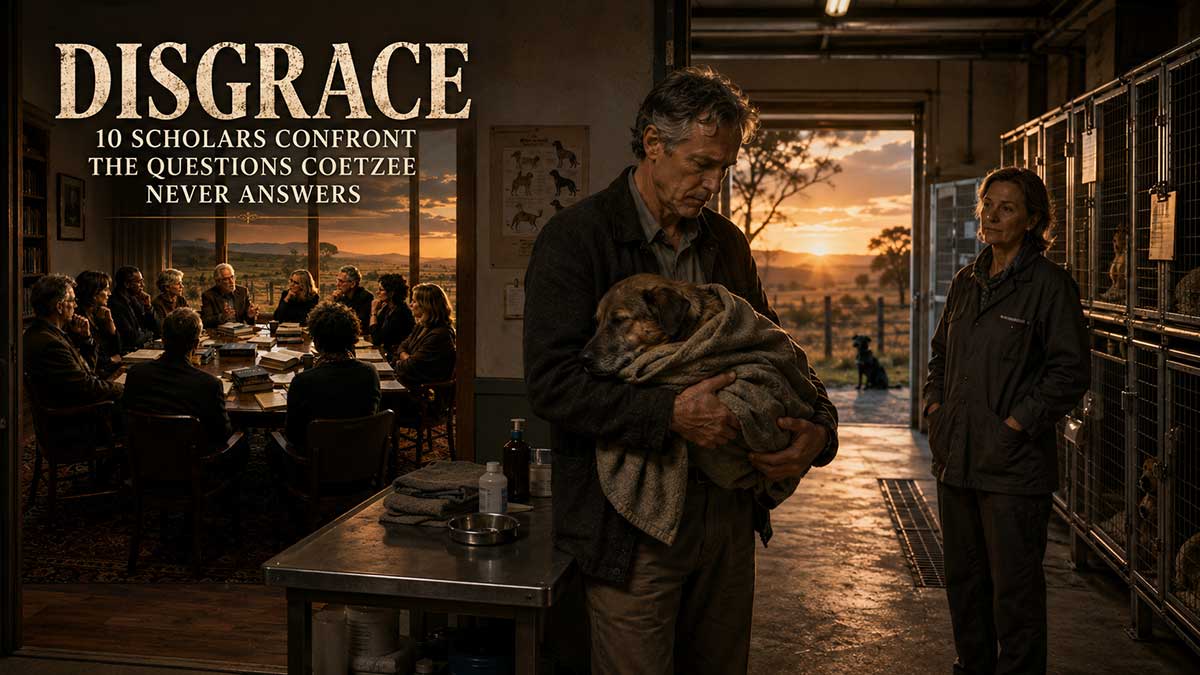
The scholars had spent four discussions circling human judgment.
Desire.
Confession.
Trauma.
Race.
History.
Land.
Now Coetzee seemed to shrink the entire novel down to an animal clinic.
The scale became smaller.
The ethical problem did not.
Why End With Dogs After Everything Else the Novel Has Asked Us to Confront?
Brandi Estey-Burtt: This is where many readers initially feel a strange shift.
They ask:
Why dogs?
Why spend so much of the ending with animals after such enormous human questions?
Mike Marais: Perhaps since human moral language has reached its limits.
Everyone has been interpreting everyone else.
David interprets Melanie.
He interprets Lucy.
He interprets Petrus.
The university interprets David.
Readers interpret all of them.
Then he encounters animals who do not enter those interpretive systems in the same way.
Derek Attridge: And perhaps that matters.
The dogs cannot argue back.
They cannot confess.
They cannot accuse.
They cannot forgive.
They cannot participate in David’s narrative about himself.
Are the Dogs Symbols?
Dominic Head: Inevitably, readers ask what they represent.
David himself?
The socially discarded?
White South Africans after apartheid?
Mortality?
Disgrace?
Brandi Estey-Burtt: And that question may already contain a problem.
What if the dogs matter partly since they are dogs?
Derek Attridge: Exactly.
If David’s ethical failure has involved turning others into extensions of his own desires and narratives, then converting the dogs immediately into symbols risks repeating the same habit.
David Attwell: Yet literary symbolism does not disappear simply since we are cautious.
The dogs clearly accumulate meaning.
Brandi Estey-Burtt: Certainly.
But their meaning should not erase their animal existence.
They suffer.
They fear.
They trust.
They die.
That reality comes before what they may symbolize for David.
Is David Identifying With the Dogs Since He Has Become Socially Discarded Too?
Patrick Hayes: That reading is tempting.
David loses his university position.
His prestige collapses.
He becomes socially diminished.
The unwanted dogs are unwanted too.
Alyda Faber: Yet we should be careful.
If David cares for the dogs mainly since he sees himself in them, his compassion remains centered on himself.
Mike Marais: Exactly.
The more meaningful movement may occur when identification stops being necessary.
He does not need them to be versions of David Lurie.
Their vulnerability can matter in its own right.
Is That a New Kind of Attention?
Derek Attridge: I think so.
David has spent much of the novel attaching meaning to others.
With the dogs, he begins attending to need before interpretation.
Brandi Estey-Burtt: Feeding.
Holding.
Carrying.
Waiting.
These are physical acts.
Very little theory is required.
Why Does That Matter for a Man Like David?
Dominic Head: His early life is saturated with interpretation.
Poetry.
Desire.
Aesthetics.
Self-description.
He knows how to make experience meaningful.
Lucy Graham: Yet that ability repeatedly fails him ethically.
Mike Marais: The dogs ask for something simpler.
Not explanation.
Care.
Why Does David Care What Happens to Their Bodies After Death?
Brandi Estey-Burtt: This may be one of the strangest and strongest details in the novel.
The dogs are already dead.
David cannot improve their experience.
They will not know whether their bodies are treated carefully.
Yet he becomes deeply concerned with their dignity after death.
Alyda Faber: Which means the act cannot be reduced to reciprocity.
There is no reward from the animal.
Derek Attridge: No recognition either.
Mike Marais: That may make it one of David’s first acts of responsibility that does not depend on being seen as responsible.
Is This About Dignity?
Brandi Estey-Burtt: Yes, though dignity is a complicated word with animals.
David seems to recognize that a being’s inability to protest does not eliminate the obligation to treat that being carefully.
Lucy Graham: That insight reaches backward through the novel in uncomfortable ways.
Someone’s silence does not grant permission.
Someone’s lack of resistance does not mean absence of value.
The room grew quiet.
No one needed to name Melanie.
The connection was already there.
Does David Finally Learn Consent From Animals?
Lucy Graham: I would phrase it carefully, but there is something significant.
Animals require attention to movement.
Fear.
Trust.
Withdrawal.
They cannot participate in David’s preferred language.
He has to observe more closely.
Brandi Estey-Burtt: Yes.
You cannot simply impose a literary interpretation on a frightened dog and call the interaction mutual.
Derek Attridge: That may be one of Coetzee’s quieter ironies.
David begins with enormous confidence in his reading of human desire.
He ends by learning how difficult it is to know what another creature wants.
Does That Mean the Dogs Redeem Him?
Mike Marais: No.
And I think the novel would become weaker if they did.
Lucy Graham: Melanie does not disappear since David becomes kind to animals.
Rosemary Jolly: Nor does Lucy’s suffering become balanced by his later tenderness.
Alyda Faber: Moral life is not bookkeeping.
Good acts do not cancel bad ones.
Then What Does Change?
David Attwell: David’s relation to himself.
Perhaps.
Derek Attridge: More precisely, his relation to others.
At the beginning, others frequently enter his world through appetite, interpretation, or hierarchy.
By the end, he is capable of caring without making the care primarily about what it gives him.
Patrick Hayes: That is a quieter transformation than redemption.
Brandi Estey-Burtt: And perhaps a more believable one.
Why Does the Final Dog Matter So Much?
Dominic Head: David becomes attached to one particular dog.
That attachment creates the possibility of possession again.
He could keep postponing the end.
Alyda Faber: Which makes the final decision so important.
He gives the dog up.
Mike Marais: The language of giving up is painful since love usually imagines holding on.
Is Giving Up the Dog an Act of Love?
Brandi Estey-Burtt: Possibly.
If keeping the dog alive becomes primarily about David’s need, then releasing the animal may involve surrendering possession.
Derek Attridge: That word—possession—returns us to the entire novel.
David’s desire.
Lucy’s land.
Petrus’s ambitions.
Historical ownership.
Now David faces something he loves and does not insist on keeping it.
Is That Too Neat?
Lucy Graham: It can become too neat if we say:
“He learns not to possess the dog, therefore he has solved his earlier failures.”
He has not.
Mike Marais: Right.
The resonance matters without becoming moral arithmetic.
Is This the First Time David Loves Without Needing to Be Loved Back?
Alyda Faber: That may be closer.
The dog cannot restore him.
Cannot absolve him.
Cannot tell anyone what kind of man he became.
Brandi Estey-Burtt: And the animal’s vulnerability does not flatter him.
The work is unpleasant.
Grief is repetitive.
Death continues.
Why Is That Different From His Earlier Desire?
Derek Attridge: Earlier, desire pulls another being into David’s story.
Later, care asks David to enter another being’s vulnerability without controlling what that vulnerability means.
That is a profound reversal.
Is the Ending About Grace?
Alyda Faber: The word is difficult, but I think the resonance is real.
The title is Disgrace.
Readers naturally hear the opposite somewhere in the background.
Grace.
David Attwell: Yet Coetzee does not hand David grace in any conventional religious sense.
Alyda Faber: No.
That is what interests me.
Grace traditionally cannot be earned.
David cannot earn innocence back.
He cannot purchase forgiveness.
He cannot undo anything.
If grace appears, it would have to appear where moral accounting has already failed.
Does David Receive Grace?
Derek Attridge: The novel refuses to tell us.
Alyda Faber: Exactly.
Perhaps he becomes capable of giving something without knowing whether anything will return.
That may be enough.
Is the Ending Really About Disgrace Instead?
Patrick Hayes: Perhaps David finally accepts a disgraced position.
He stops trying to rebuild himself into someone impressive.
Dominic Head: He moves downward socially and symbolically.
Professor to animal-clinic assistant.
Public intellectual to anonymous worker.
Mike Marais: Yet downward is not necessarily degeneration.
It may be the first place where hierarchy weakens enough for care to appear.
Is Humiliation Necessary for David?
Rosemary Jolly: I would resist making humiliation therapeutic.
People do not need to be broken before they deserve moral growth.
Alyda Faber: Agreed.
The novel does not prescribe disgrace.
It observes what David becomes after disgrace has already happened.
Why Does Coetzee Refuse a Grand Final Confession?
David Attwell: Since that would be too easy.
Imagine David ending with a long speech explaining everything he now understands.
It would give readers closure.
Lucy Graham: And Melanie would once again become part of David’s successful moral narrative.
Derek Attridge: Instead, the ending gives us action.
Small action.
Almost beneath interpretation.
Is That More Trustworthy Than Words?
Mike Marais: Perhaps.
David has always been good with words.
That is part of the problem.
Brandi Estey-Burtt: Carrying the dogs does not require eloquence.
Does Silence Become Important at the End?
Alyda Faber: Very.
Confession fails to settle things.
Explanation fails.
Political analysis fails.
The final ethical movement happens largely through bodily care.
Touch.
Weight.
Carrying.
Release.
Can Compassion Matter if It Fixes Nothing?
Brandi Estey-Burtt: This may be the heart of the ending.
The dogs still die.
David remains disgraced.
Melanie has not forgiven him.
Lucy’s future remains uncertain.
South Africa remains unresolved.
Nothing is repaired completely.
Yet care still matters.
Mike Marais: Which breaks the link between ethics and success.
We often assume an action matters if it changes the outcome.
Coetzee asks whether tenderness matters when the outcome cannot be changed.
Is That Why the Dead Dogs Matter?
Derek Attridge: Yes.
They are beyond rescue.
Only treatment remains.
How do you handle what cannot be saved?
That is a powerful ethical question.
Is David Finally Capable of Responsibility Without Reward?
Alyda Faber: Perhaps that is the closest we come to transformation.
Responsibility that does not seek absolution.
Lucy Graham: I would accept that more readily than “redemption.”
David Attwell: So would I.
Patrick Hayes: The word redemption invites completion.
The novel does not complete David.
Does Incompleteness Matter?
Mike Marais: Deeply.
An ethically serious life may remain unfinished.
No final verdict.
No purified self.
No restored identity.
Only changed habits of attention.
Closing — What If the Dogs Are Not the Answer?
The scholars had spent the entire discussion trying to decide what the dogs meant.
Derek Attridge smiled slightly.
Derek Attridge: Perhaps we should be suspicious of how badly we want the dogs to solve the novel.
Brandi Estey-Burtt: Yes.
Maybe they do not answer anything.
Maybe they simply require care.
Lucy Graham: Which may be the point.
Melanie did not exist to redeem David.
Lucy did not exist to educate him.
Petrus did not exist to explain history.
The dogs do not exist to complete his transformation.
Mike Marais: Other beings do not owe David meaning.
That may be the lesson he has taken longest to approach.
Alyda Faber: And perhaps grace begins there.
Not in being forgiven.
Not in being restored.
In finally ceasing to demand that another life complete your own.
Silence followed.
Then David Attwell returned to the novel’s final movement.
David Attwell: David begins as a man who wants.
He interprets.
Possesses.
Defends.
Explains.
At the end, he carries.
Then he gives up.
No tribunal declares him changed.
No victim absolves him.
No community welcomes him back.
Rosemary Jolly: Which leaves us with the question the novel has refused to answer from the beginning.
Patrick Hayes: Can a disgraced person still live ethically?
Lucy Graham: Yes, but without turning ethical life into a claim to innocence.
Brandi Estey-Burtt: And perhaps without demanding witnesses.
The room became very quiet.
One final question remained.
If the harm cannot be undone,
if forgiveness never comes,
if history cannot be repaired,
if reputation never returns,
if even the beings you care for cannot be saved—
would you still choose to become gentler?
Disgrace does not answer with a speech.
It gives us a man carrying a dog.
Final Thoughts
After five conversations, the scholars reach no single verdict on David Lurie.
That may be exactly right.
David’s intelligence does not excuse him. His disgrace does not purify him. His later compassion does not erase Melanie. Lucy’s suffering does not repay his wrongdoing. South Africa’s violent history does not turn present violence into justice.
Coetzee refuses moral bookkeeping.
Yet something changes.
David begins the novel believing strongly in his ability to interpret desire, other people, and himself. Gradually, that certainty collapses.
Melanie cannot be fully interpreted by him.
Lucy cannot be controlled by him.
Petrus cannot be made completely legible to him.
History cannot be organized around his comfort.
Then come the dogs.
They cannot forgive David.
They cannot restore his reputation.
They cannot tell him he has become a better man.
Many cannot even be saved.
Yet he cares for them.
Perhaps this is why Coetzee ends with such a small gesture rather than a grand confession.
David does not become innocent again.
He may never deserve the word redeemed.
He simply becomes capable of carrying another vulnerable being carefully without demanding anything in return.
The novel begins with desire:
What can I take from another life?
It ends much closer to another question:
What do I owe another life when that life owes me nothing?
Perhaps the distance between those two questions is the real distance David Lurie travels.
Short Bios:
David Attwell — A leading scholar of J. M. Coetzee and South African literature. His work examines Coetzee’s intellectual development, literary methods, historical context, and complicated relationship with apartheid and post-apartheid South Africa.
Derek Attridge — Literary scholar known for major work on Coetzee, ethics, literary form, otherness, and the experience of reading. His scholarship is especially useful for examining why Coetzee resists giving readers comfortable moral certainty.
Rosemary Jolly — Scholar of South African literature whose work addresses violence, testimony, reconciliation, gender, human rights, and the cultural aftermath of apartheid. Her perspective helps connect Disgrace with South Africa’s broader struggle over confession and reconciliation.
Elleke Boehmer — Scholar and novelist known for extensive work on colonial and postcolonial literature. Her perspective brings questions of gender, nation, race, land, belonging, and colonial inheritance into the interpretation of Disgrace.
Lucy Graham — Scholar whose research on South African literature has examined gender, sexual violence, race, and representations of rape. Her work is particularly relevant to Melanie, Lucy, and the ethical dangers of turning women’s suffering into political symbolism.
Mike Marais — Coetzee scholar whose work explores ethics, responsibility, alterity, and relationships between the self and other people. His approach helps illuminate the novel’s recurring question of whether genuine responsibility requires accepting that another person can never be completely known.
Dominic Head — Literary scholar and author of important critical work on Coetzee. His scholarship places Disgrace within Coetzee’s broader fiction and examines the connections between narrative technique, ethics, politics, and literary form.
Patrick Hayes — Literary scholar whose work on Coetzee examines politics, history, literary interpretation, and post-apartheid South Africa. His perspective is valuable when asking how far Disgrace should be read as a political novel about South Africa itself.
Alyda Faber — Scholar whose work on Coetzee engages questions of confession, vulnerability, ethics, suffering, and religious or post-secular thought. Her perspective helps explore whether the movement from disgrace toward something resembling grace is present in David’s transformation.
Brandi Estey-Burtt — Scholar whose work engages Coetzee, animals, suffering, death, ethical responsibility, and religious thought. Her perspective is especially useful for the novel’s final movement toward unwanted dogs and David’s growing capacity for care without reward.
Leave a Reply