
Introduction
Why does Stevens remember so much of his life accurately, yet seem unable to recognize what those memories mean?
That question lies at the heart of Kazuo Ishiguro’s The Remains of the Day.
In this second imaginary conversation, five leading Ishiguro scholars — Cynthia F. Wong, Brian W. Shaffer, Kathleen Wall, Steven Connor, and Barry Lewis — examine the novel beyond Stevens’s personal regrets.
They debate whether Stevens is truly an unreliable narrator, whether dignity is a virtue or a defense, whether Darlington Hall represents a fading Britain, and how much moral responsibility belongs to someone who chooses obedience over judgment.
Their discussion finally reaches Ishiguro’s most painful question:
If we recognize the truth about our lives only after much of life has passed, can that recognition still change what remains?
(Note: This is an imaginary conversation, a creative exploration of an idea, and not a real speech or event.)
Topic 1 — Is Stevens Really an Unreliable Narrator?

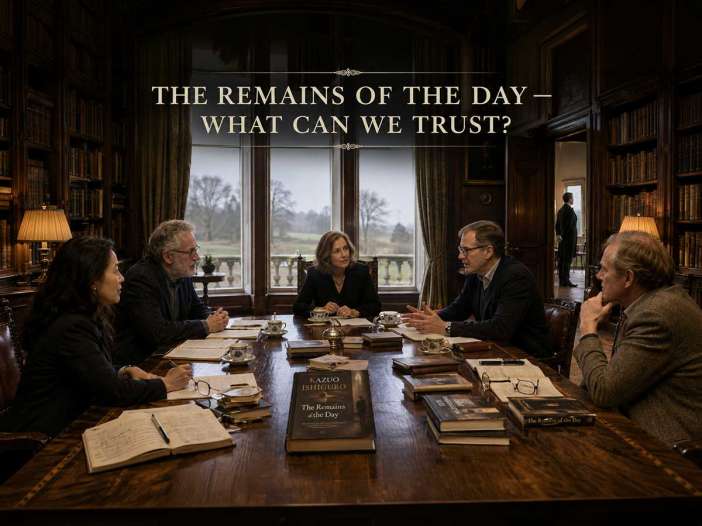
The five scholars gathered around a long table in a quiet library overlooking the grounds of Darlington Hall.
Outside, evening settled across the lawns.
Inside, copies of The Remains of the Day lay open beside notebooks crowded with underlined passages.
There was no Stevens in the room.
No Miss Kenton.
No Lord Darlington.
Yet Stevens was everywhere.
In the silences.
In the careful sentences.
In the way the novel seemed to tell readers far more than its narrator ever intended to reveal.
Cynthia F. Wong sat near the window.
Kathleen Wall had several pages marked with slips of paper.
Brian W. Shaffer leaned back with his hands folded.
Steven Connor looked toward the portrait-lined wall as though the house itself belonged in the discussion.
Barry Lewis opened his notebook.
The first question sounded simple.
It was not.
Is Stevens actually lying to the reader?
Kathleen Wall: I think we should begin by being cautious with the phrase “unreliable narrator.”
It is useful, but it can become misleading.
People hear “unreliable narrator” and imagine someone who gives us false information.
Stevens is more complicated.
Cynthia F. Wong: Very much so.
He frequently gives us the facts we need.
He remembers conversations.
He recalls gestures.
He reproduces circumstances.
He tells us that Miss Kenton came to his door.
He tells us about the sentimental novel.
He tells us about his father dying upstairs.
He tells us about the dismissal of the Jewish maids.
The evidence is often present.
Brian W. Shaffer: Yet the interpretation is distorted.
Wall: Exactly.
Stevens does not usually say, “This never happened.”
He says, in effect, “This happened, but it did not mean what you think it meant.”
Barry Lewis: Or perhaps more accurately, “This happened, but I prefer another explanation.”
Wong: Which raises the central problem.
Is he deceiving us?
Or is he protecting himself?
Steven Connor: I would say protecting himself is closer.
There are moments where Stevens seems almost absurdly transparent to the reader.
We see what is happening before he does.
Shaffer: Or before he permits himself to.
Connor: Yes.
That distinction matters.
Wall: Consider Miss Kenton.
Stevens remembers her intrusion into his private reading.
He remembers being embarrassed.
He remembers the romantic novel.
Then he gives us a professional justification.
He was reading it for language.
The reader almost immediately senses that this explanation is insufficient.
Lewis: Yet he is the one who gave us the incriminating detail.
Wall: Precisely.
A liar trying to deceive us would omit the book.
Stevens gives us the book.
Then he misreads himself.
Wong: That is one of Ishiguro’s most elegant techniques.
Stevens becomes the source of evidence against Stevens.
Shaffer: The narrative undermines itself from within.
Connor: Which is why I resist calling him simply dishonest.
Dishonesty implies that he possesses a stable truth and consciously substitutes a falsehood.
Stevens’s relationship with truth seems less stable.
Wall: Yes.
He has layers of awareness.
There are things he knows intellectually.
Things he half-knows emotionally.
Things he knows only in retrospect.
And things he cannot allow himself to connect.
Can someone know something without admitting that he knows it?
Lewis: That may be the real issue.
We tend to divide knowledge too neatly.
Either Stevens knows he loved Miss Kenton, or he does not.
Either he knows Lord Darlington failed, or he does not.
Human consciousness is often much messier.
Wong: Quite.
People can hold contradictory forms of knowledge at the same time.
Someone may know a marriage is failing and continue saying it is fine.
Someone may know a parent is dying and continue speaking as though recovery remains likely.
Someone may know a career has consumed too much of life and continue describing the sacrifices as necessary.
Shaffer: That is why Stevens feels so recognizably human.
His problem is extreme, but the mental process is ordinary.
Wall: He often gets close to recognition.
Then he retreats.
Connor: The retreat is almost rhythmic.
Wall: It is.
He approaches something dangerous.
He remembers a moment.
The emotional pressure increases.
Then he shifts into professional language.
He qualifies.
He generalizes.
He changes the subject.
Lewis: He turns emotion into procedure.
Wong: Or memory into argument.
Shaffer: I think one of the most striking things about the novel is that Stevens is constantly constructing a case for his own life.
Connor: Yes.
Shaffer: He is not merely remembering.
He is defending.
Wall: That is an excellent distinction.
Shaffer: Every major memory seems to answer an accusation that has not been formally made.
Was Lord Darlington worthy of service?
Was dignity truly admirable?
Was Miss Kenton merely a colleague?
Was Stevens right to remain downstairs?
He continually offers explanations before anyone has asked for them.
Wong: Which tells us that some part of him already knows the charge exists.
Lewis: Or fears that it does.
Shaffer: Exactly.
The defense itself becomes evidence.
Is Stevens hiding the truth from the reader—or from himself?
Wong: I would put the emphasis on the second.
The reader is almost incidental.
Stevens needs a version of his life that remains survivable.
Wall: I agree, with one qualification.
He does seem conscious of presentation.
He wants to appear dignified.
He wants to appear reasonable.
He does care how the story sounds.
Connor: But the imagined audience may be part of his self-discipline.
Wall: Yes.
The reader becomes another room in which Stevens must behave properly.
Lewis: That is beautifully put.
Shaffer: And it fits his entire life.
He performs the role of Stevens even in private memory.
Wong: Which is terrifying.
His professional identity is no longer merely something he puts on for work.
It has colonized his inner voice.
Connor: Let us look at the moments when he denies having worked for Lord Darlington.
Those moments are remarkable.
Wall: They are.
Connor: Stevens wants us to believe these denials are practical or socially motivated.
Yet the shame is unmistakable.
Shaffer: He has spent his life defining loyalty as a virtue.
Then, late in life, he is reluctant to admit whom he served.
Lewis: The contradiction is brutal.
Wong: And he still tries to narrate around it.
He explains the circumstances.
He softens the embarrassment.
He distances himself from the emotional meaning.
Wall: This is where unreliability becomes less about facts than self-description.
He can tell us, “I denied working for Lord Darlington.”
He struggles to say, “I was ashamed.”
Shaffer: And once again, the reader supplies the missing sentence.
Why does Ishiguro let the reader understand Stevens before Stevens understands himself?
Shaffer: This is where I think Ishiguro does something extraordinary.
The reader becomes morally and emotionally active.
We are not simply receiving a story.
We are constantly interpreting against the narrator.
Wall: Yes.
We read the gaps.
Wong: The pauses.
Lewis: The euphemisms.
Connor: The social codes.
Shaffer: The misdirections.
The reader has to assemble the life Stevens cannot assemble.
Wall: Which creates intimacy.
We know him through what he cannot say.
Wong: Perhaps more deeply than we would if he simply confessed everything.
Lewis: That is worth staying with.
A conventional narrator might say:
“I loved Miss Kenton, but I was afraid.”
Stevens does not say that.
He tells us about flowers.
A book.
A doorway.
An engagement.
His return to work.
The reader performs the emotional labor.
Connor: That makes the eventual recognition more painful.
We have been waiting for Stevens to catch up with what we already know.
Wall: And there is no guarantee that he ever fully does.
Shaffer: Which preserves the tragedy.
Wong: It does something else too.
It makes readers examine their own acts of interpretation.
We feel confident that we understand Stevens.
But are we always right?
Wall: Good.
Wong: We should not become too smug.
The novel tempts us to think, “I see him clearly.”
But human beings are rarely completely transparent.
Connor: Including fictional ones.
Is the reader ever in danger of becoming too certain?
Wall: Very much so.
If we decide too quickly that Stevens is merely emotionally repressed, we flatten him.
Lewis: Or if we reduce every act of service to pathology.
Shaffer: Yes.
His dignity is not entirely fake.
His commitment to work has real value.
His professionalism is genuine.
His loyalty comes from a serious ethical framework, not simple cowardice.
Connor: The same with his historical judgments.
He is wrong in important ways.
But the world he inhabited did contain structures that made his beliefs plausible.
Wong: Which is why the novel remains compelling.
If Stevens were simply foolish, there would be little to discuss.
Wall: He is intelligent.
That is part of the tragedy.
Shaffer: He is intelligent enough to construct elaborate explanations.
Lewis: Yet not free enough to abandon them.
Does Stevens become more reliable as the novel progresses?
Wall: I would say he becomes more exposed.
I am not certain that is the same thing.
Wong: Good distinction.
Shaffer: He permits more dangerous memories to surface.
Connor: And he loses some control over their implications.
Lewis: Yet he does not suddenly become confessional.
Wall: No.
He remains Stevens.
That matters enormously.
Ishiguro does not reward us with a dramatic transformation in narrative voice.
Wong: Which would have been psychologically false.
A man who has spent decades speaking one way does not become emotionally fluent in an afternoon.
Shaffer: The seaside scene is the clearest example.
There is a moment when the emotional truth becomes almost impossible to contain.
Stevens recognizes that Lord Darlington at least made his own mistakes.
Then he compares that to his own life.
That is close to genuine self-recognition.
Lewis: Yet soon he is thinking again about becoming better at bantering.
Connor: Which is either touching or devastating.
Wall: Or both.
Wong: I would say both.
He reaches a truth.
Then he translates it into the only language available to him.
Improvement.
Service.
Technique.
Shaffer: Exactly.
He does not know how to say:
“I want to become more alive.”
So he says:
“I should become better at banter.”
Is that failure—or progress?
Lewis: Progress, perhaps in Stevens’s scale.
Wall: But we should not exaggerate it.
Connor: I agree.
The temptation is to make the ending redemptive because we want relief.
The text remains less generous.
Wong: Yet something has changed.
He can no longer fully return to the earlier story.
That matters.
Shaffer: Once a narrative begins to crack, it becomes difficult to restore it completely.
Wall: Yes.
The question is whether Stevens can live differently after the crack appears.
That belongs later.
Does memory protect Stevens—or betray him?
Wong: Both.
That is the central paradox.
Memory protects him because he can continually revise meaning.
But memory betrays him because the details keep returning.
Wall: Beautifully said.
Connor: His memories are disobedient.
Lewis: They do not stay inside the interpretation he gives them.
Shaffer: The sentimental novel refuses to remain merely linguistic practice.
His father’s death refuses to remain merely professional triumph.
Miss Kenton’s departure refuses to remain merely a staffing change.
Lord Darlington’s politics refuse to remain merely beyond a servant’s responsibility.
Wong: Exactly.
The facts keep pushing against the story.
Wall: Which leads us to something very important.
Stevens does not need an external prosecutor.
His own memory prosecutes him.
Connor: And his own language tries to defend him.
Lewis: That may be the whole novel.
Shaffer: Memory versus interpretation.
Wong: Or truth versus the narrative required to endure truth.
Then what kind of narrator is Stevens?
The room went quiet.
Wall closed her book.
Wall: I would call him factually revealing and interpretively unreliable.
Wong: I would say psychologically divided.
Shaffer: I would say he is a narrator whose language preserves the identity his memories are dismantling.
Connor: I would place him inside a social structure too.
His unreliability is personal, but it is learned.
The language of restraint, hierarchy, service, and English dignity gives him the tools with which he hides.
Lewis: And those tools become his home.
Which makes abandoning them frightening.
Wall: Perhaps we can agree on one thing.
The phrase “unreliable narrator” should not mean that Stevens cannot be trusted.
It should mean that we cannot accept his interpretation without examining the evidence he himself provides.
Wong: Yes.
And perhaps the most unsettling part is that Stevens is not unreliable because memory has failed.
His memory often works remarkably well.
Shaffer: It is meaning that fails.
Connor: Or meaning that is resisted.
Lewis: Because meaning has consequences.
Wall looked around the table.
Wall: Then perhaps this is the sentence we should carry forward:
Stevens is often reliable about what happened and unreliable about what it meant.
Wong nodded.
Wong: And once we say that, another question becomes unavoidable.
Shaffer: Which one?
Wong looked down at the open novel.
Wong: Why does he need the meaning to remain hidden?
No one answered immediately.
Connor glanced toward the old portraits on the wall.
Lewis rested a hand on his notebook.
Shaffer leaned forward.
Wall gave a small nod.
The next topic was already waiting.
If Stevens’s memories are not the real problem, perhaps the problem lies in the idea he built his entire life around.
Dignity.
And the scholars would now have to decide whether that word represented a virtue—
or the most sophisticated defense Stevens ever created.
Topic 2 — Is Dignity a Virtue—or Stevens’s Greatest Defense?

The discussion resumed in the same library.
Night had deepened outside Darlington Hall.
The first conversation had left one idea hanging in the room:
Stevens often remembers events accurately.
What fails is the meaning he permits himself to draw from them.
Now the scholars turned to the word that organizes almost his entire identity.
Dignity.
A word that sounds noble.
A word Stevens treats almost as a moral law.
A word that may have helped him become excellent at his work.
And may have helped him disappear inside it.
What is admirable about Stevens’s idea of dignity?
Barry Lewis: I think we should begin by resisting the temptation to treat dignity as merely a symptom.
Brian W. Shaffer: Agreed.
Lewis: Stevens’s idea contains real virtues.
Discipline.
Reliability.
Restraint.
A refusal to make every difficulty about oneself.
Those are not trivial qualities.
Cynthia F. Wong: Nor are they inherently unhealthy.
Kathleen Wall: That matters.
If dignity were obviously destructive from the start, Stevens would be much less interesting.
Steven Connor: And much less historically believable.
He belongs to a social order in which restraint is not simply personal temperament.
It carries cultural prestige.
Lewis: Exactly.
Stevens believes that a person becomes admirable by remaining steady when circumstances become difficult.
There is something genuinely impressive in that.
Shaffer: His professionalism is not fake.
He is very good at what he does.
Wall: Exceptionally good.
Wong: Which is why the tragedy works.
His strengths do not sit beside his weaknesses.
They become his weaknesses.
Connor: That is perhaps the key.
A virtue can become destructive without ceasing to be a virtue in every context.
Lewis: Yes.
Self-control is good.
Until self-control becomes self-erasure.
Loyalty is good.
Until loyalty replaces judgment.
Duty is good.
Until duty makes every private need illegitimate.
Shaffer: Ishiguro repeatedly works in that territory.
The qualities that help a person survive one form of life can become traps when treated as absolute.
Wall: Stevens never really allows proportionality.
There is no moment where he says, “Professionalism matters here, but love matters more.”
Wong: Or, “Dignity matters, but grief requires another response.”
Lewis: His problem is not that he believes in dignity.
It is that dignity becomes total.
When does self-control become self-erasure?
Wong: I would say when a person stops distinguishing between regulating emotion and denying that emotion has moral significance.
Shaffer: Good.
Wong: Stevens does not merely say, “I feel grief, but I must continue for an hour.”
He begins to treat grief itself as something that should not influence action.
Wall: Which is why the scene with his father is so central.
He converts an emotional and familial crisis into a professional test.
Connor: And later remembers his performance almost as proof of greatness.
Lewis: That is the disturbing part.
He does not initially understand the cost as cost.
He understands it as achievement.
Shaffer: That suggests something more troubling.
Dignity may function as a moral vocabulary that allows Stevens to reward himself for avoidance.
Wong: Yes.
Wall: He can say, “I behaved with dignity,” and that sentence closes inquiry.
Connor: It becomes self-certifying.
Lewis: Precisely.
If dignity is the highest standard, every act of suppression can be recoded as success.
Shaffer: Which means the system is nearly impossible to challenge from inside.
Does Stevens sacrifice happiness for duty—or use duty to avoid vulnerability?
The room grew quieter.
Wong: I think both can be true.
We should be careful not to reduce him to someone consciously choosing safety.
Wall: Yes.
There is no evidence that Stevens says to himself, “Love frightens me, so I will hide behind work.”
Shaffer: But the structure of his behavior still has that effect.
Connor: Duty gives him a realm where expectations are clear.
Lewis: There are standards.
Procedures.
Roles.
Wong: Love has none of that.
Wall: Neither does grief.
Shaffer: Nor moral uncertainty.
Connor: Stevens thrives where hierarchy answers the question of what comes next.
He struggles where he must decide from within himself.
Lewis: That is beautifully put.
Wong: Which may explain why Miss Kenton is so destabilizing.
She continually asks him to respond as a person rather than as a function.
Wall: And that is precisely where his language becomes evasive.
Shaffer: She wants spontaneity.
He gives procedure.
Is dignity a defense mechanism?
Wall: I would say yes, but not only that.
Lewis: Same.
Wall: It protects him from exposure.
But it is not merely invented for protection.
It is inherited, respected, socially rewarded.
Connor: That distinction is vital.
A defense is strongest when the culture around you calls it virtue.
Wong: Exactly.
Stevens does not have to feel dishonest.
Everyone around him has supplied language making his avoidance honorable.
Shaffer: Which is much more dangerous than a private excuse.
Connor: This is where Englishness begins to matter.
The ideal of restraint carries national symbolism.
Composure.
Reserve.
Self-command.
Not making a scene.
Stevens’s professional identity amplifies those cultural values.
Lewis: Yet I would not make him simply a symbol of English repression.
Connor: Nor would I.
But the social environment matters.
Wong: His psychology and his culture reinforce one another.
Wall: And his father reinforces both.
How much of Stevens’s identity comes from his father?
Lewis: A great deal.
Shaffer: His father gives dignity emotional authority.
Wong: Stevens does not simply admire a professional code.
He admires a father who embodies it.
Wall: Which means rejecting the code would require more than revising a career philosophy.
It would require reinterpreting his father.
Connor: And perhaps admitting that something inherited with love can still be harmful.
Lewis: That is very hard for people.
Wong: If your father teaches you that stoicism is honorable, you may experience vulnerability as betrayal.
Not merely weakness.
Betrayal.
Shaffer: Of him.
Wong: Of him, of yourself, of the standards through which you earned approval.
Wall: Which gives dignity an emotional root we should not miss.
Stevens may be trying to remain worthy of his father long after his father is gone.
Lewis: Yes.
His professional excellence may function partly as filial loyalty.
Did Stevens choose dignity—or inherit it?
Connor: Both.
Wall: Agreed.
Connor: Social systems do not erase agency.
But agency does not occur in a vacuum.
Stevens inherits a class structure, a professional tradition, a paternal model, and a national style of restraint.
He then chooses within those boundaries.
Shaffer: The interesting question is whether he ever realizes the boundaries are there.
Wong: Not fully.
Lewis: And that is what makes identity so difficult to change.
A person rarely experiences inherited assumptions as assumptions.
They feel like reality.
Wall: Stevens does not say, “I have selected one philosophy among many.”
He experiences dignity as obvious.
Connor: Natural.
Lewis: Necessary.
Shaffer: Moral.
Wong: Which is why Miss Kenton’s emotional openness feels to him almost disorderly.
She is not simply behaving differently.
She threatens his entire map of what a respectable life looks like.
Is Stevens’s dignity actually a form of fear?
Wall: I would hesitate to say simply yes.
Lewis: Same.
Wong: Fear is present, but the word can become too reductive.
Shaffer: What would you use instead?
Wong: Protection.
He has created a self that minimizes emotional exposure.
That may come from fear, training, pride, loyalty, temperament, class, all at once.
Connor: “Fear” can make him sound weak.
He is not weak.
Lewis: No.
He is extraordinarily strong in certain directions.
Wall: Which may be why he can avoid other forms of courage.
Shaffer: That is worth pressing.
Perhaps courage itself needs dividing.
Stevens has professional courage.
He can function under extraordinary pressure.
He has endurance.
He has self-command.
Wong: But emotional courage requires another skill.
Lewis: Admitting need.
Wall: Admitting uncertainty.
Connor: Admitting that someone else's answer matters to you.
Shaffer: Exactly.
And Stevens is much less practiced there.
Why does Ishiguro make dignity partly admirable?
Lewis: To prevent moral simplification.
Wall: Yes.
Wong: If Stevens's code were merely foolish, readers could dismiss him.
Instead we recognize parts of ourselves in him.
Connor: People often build lives around virtues.
Work ethic.
Sacrifice.
Loyalty.
Responsibility.
Strength.
Shaffer: And then discover that a virtue without limits can damage what it was meant to protect.
Wall: There is a painful irony here.
Stevens thinks dignity prevents him from being ruled by emotion.
In reality, dignity may be ruled by an unacknowledged emotion.
Wong: Fear?
Wall: Perhaps.
Or shame.
Lewis: Shame is interesting.
Wall: He seems deeply ashamed of private need.
Connor: Yes.
He can tolerate failure in a professional task more easily than exposure of tenderness.
Shaffer: Which explains the sentimental novel scene.
Wong: He is not embarrassed by reading.
He is embarrassed by being seen wanting something emotionally soft.
Does Stevens disappear inside the role?
Lewis: Increasingly.
Shaffer: By late life, the distinction between Stevens and “the butler” has nearly collapsed.
Wong: Which creates a terrible problem.
If he questions dignity, he questions himself.
Wall: Exactly.
Connor: This is why arguments against his worldview do not land easily.
They are not critiques of one belief.
They threaten identity.
Lewis: Suppose someone says to Stevens, “Your idea of dignity was mistaken.”
What does he hear?
Not merely:
“One belief was mistaken.”
He hears:
“Your father was mistaken.”
“Your profession was mistaken.”
“Your sacrifice was mistaken.”
“Your loyalty was mistaken.”
“Your life may have been built around the wrong standard.”
That is almost unbearable.
Shaffer: Which explains why reinterpretation happens slowly.
Wong: Memory can surface faster than identity can change.
Can dignity be saved?
Connor: Good question.
Must Stevens abandon dignity entirely?
Lewis: I hope not.
Wall: Nor do I.
Shaffer: Perhaps the novel asks for a different form of dignity.
Wong: One that includes truth.
Lewis: And vulnerability.
Connor: And moral judgment.
Wall: And the ability to admit error without collapsing.
Shaffer: That may be the mature form Stevens never learned.
Dignity as integrity rather than suppression.
Wong: Yes.
The ability to remain composed without becoming unreachable.
Lewis: To serve without disappearing.
Wall: To control emotion without denying its meaning.
Connor: To belong to a role without surrendering conscience.
So what is Stevens’s tragedy?
The scholars paused.
Lewis looked down at his notes.
Lewis: I think the tragedy is that Stevens built an extraordinarily coherent identity around a principle that could not survive the disappearance of the world supporting it.
Shaffer: Yes.
Lewis: Darlington Hall changes.
Lord Darlington falls.
His father dies.
Miss Kenton leaves.
The social order shifts.
And suddenly the identity that once made Stevens stable becomes fragile.
Wong: Because it depended on permanence.
Connor: And the world was not permanent.
Wall: There is another tragedy.
The code protected him successfully.
Shaffer: From pain?
Wall: From immediate pain.
It protected him from embarrassment, rejection, disorder, grief in the moment.
Wong: Then charged him later.
Lewis: With interest.
A silence followed.
Connor looked toward the tall windows.
Beyond them, the dark grounds of Darlington Hall stretched into the night.
Connor: We may now be approaching something larger.
If dignity did not originate entirely inside Stevens, perhaps we must ask where it came from.
Wall: His father.
Lewis: His profession.
Wong: His class position.
Shaffer: His idea of greatness.
Connor nodded.
Connor: And England.
The others looked toward him.
Connor: Stevens believes in hierarchy, restraint, service, great houses, great gentlemen, and the moral authority of an old social order.
Perhaps his private tragedy is inseparable from a national one.
Shaffer leaned forward.
Shaffer: You think Stevens is England?
Connor: Not literally.
But I think Ishiguro wants us to notice that as Stevens begins questioning the meaning of his own life, the country around him is questioning the meaning of its own past.
Lewis closed his notebook.
The second layer had fallen away.
What had looked like one man's psychological defense now opened into something larger:
class,
history,
empire,
national identity,
and the fading world of Darlington Hall.
Topic 3 was waiting.
Topic 3 — Is Stevens Actually a Symbol of Britain?

The library looked different in morning light.
Darlington Hall had spent the night as a psychological space.
Now it became historical.
The portraits on the walls seemed less decorative.
The silver, the heavy curtains, the old furniture, the scale of the house itself — all of it belonged to a social order that once believed it would last.
By 1956, it had not.
Lord Darlington was gone.
The political world he tried to influence had discredited him.
The house belonged to an American.
Stevens remained.
Steven Connor opened the discussion.
Is Darlington Hall more than a house?
Steven Connor: I think we should begin here.
If we read Darlington Hall merely as a setting, we lose too much.
Brian W. Shaffer: You see it as a historical structure.
Connor: Very much so.
The house embodies hierarchy.
A great gentleman above.
Servants below.
Important men passing through drawing rooms and dining rooms.
Political decisions occurring behind closed doors.
Everything has its place.
Barry Lewis: Including Stevens.
Connor: Especially Stevens.
His identity depends upon position.
He knows who he is because he knows where he stands.
Kathleen Wall: In the household.
Connor: And, by extension, in the social order.
Cynthia F. Wong: Which may explain why the deterioration of that order threatens him so deeply.
Lewis: Yes.
Darlington Hall is not merely where he works.
It gives shape to his life.
Shaffer: That makes the transfer to Mr. Farraday especially significant.
Connor: It does.
The house survives.
But the meaning of the house changes.
An English aristocrat once occupied it as part of a hereditary social structure.
Now an American businessman owns it.
The building remains.
The ideology around it has shifted.
Wall: And Stevens is still polishing the silver.
Connor: Exactly.
That image matters.
Does Stevens’s personal decline mirror Britain’s decline?
Shaffer: I would be careful with the word “decline.”
Connor: So would I.
It can become too sweeping.
But Ishiguro clearly places Stevens in a Britain that has lost a certain conception of itself.
Lewis: The idea of greatness is everywhere.
Connor: Yes.
Stevens asks what makes a great butler.
Lord Darlington wants to participate in great affairs.
The house hosts great men.
The country carries memories of greatness.
The word becomes almost obsessive.
Wong: And increasingly unstable.
Wall: Perhaps that is the important part.
Not that Britain simply “declines,” but that inherited definitions of greatness become harder to defend.
Connor: Precisely.
Stevens believes greatness comes from proximity to powerful men.
That is why serving Lord Darlington feels meaningful.
He believes that if he helps a great gentleman perform important work, some of that significance extends to him.
Shaffer: Which mirrors a larger imperial logic.
Connor: In part.
A culture can define itself through proximity to institutions of authority, hierarchy, and global influence.
When those structures weaken, identity becomes unstable.
Lewis: Stevens experiences that instability personally.
Wong: He is left asking: if the great gentleman was not great, what was the service for?
Is Stevens trying to preserve himself the way Britain preserves Darlington Hall?
Connor: I think that is one of the novel’s richest parallels.
Wall: Explain.
Connor: Darlington Hall is preserved physically after the world that gave it meaning has changed.
Stevens is similar.
He preserves the manners, language, rituals, and professional ideals of an earlier order.
He survives by carrying the old form forward.
Lewis: Yet form without context can become hollow.
Connor: Exactly.
Shaffer: Or comic.
Wall: The bantering problem.
Connor: Yes.
Mr. Farraday jokes.
Stevens cannot respond naturally.
The new social world uses intimacy differently.
The old formality no longer functions the same way.
Wong: That makes Stevens’s awkwardness more than personality.
He is culturally displaced.
Lewis: Very much so.
He belongs to a social language that is disappearing.
Shaffer: Yet we should resist making Mr. Farraday simply “the future.”
Connor: Agreed.
The novel is not announcing that America has solved the problems of England.
It is showing transition.
Wall: A transition Stevens does not fully understand.
Why does Ishiguro make Stevens a servant rather than an aristocrat?
The question changed the room.
Shaffer: This is important.
If Ishiguro wanted merely to write about the decline of the British aristocracy, Lord Darlington could have been the central consciousness.
He is not.
Stevens is.
Connor: Which gives us the view from below.
Lewis: But not from rebellion.
Connor: Precisely.
Stevens does not resent the hierarchy.
He believes in it.
That is much more interesting.
Wall: He internalizes the values of the people above him.
Wong: And gains identity from serving them.
Shaffer: Which means class hierarchy works psychologically, not merely economically.
Connor: Yes.
A system lasts most effectively when people experience their place within it as honorable.
Stevens does not feel imprisoned by service.
He feels dignified by service.
Lewis: Until the object of service collapses.
Connor: Exactly.
Is Ishiguro criticizing class hierarchy?
Wall: I think so, but indirectly.
Shaffer: The novel rarely lectures.
Wong: Ishiguro lets the structure condemn itself through consequences.
Lewis: Stevens’s life becomes the evidence.
Connor: Yes.
The question is not simply whether aristocracy is unjust.
The deeper question is what happens to people who build their identities around proximity to authority.
That can occur in many systems.
Shaffer: Which is why the novel travels well beyond Britain.
Connor: Exactly.
Its historical setting is English.
Its psychology is broader.
Wall: People attach themselves to leaders, institutions, companies, churches, parties, families.
Wong: And sometimes confuse serving something important with becoming important through service.
Lewis: Stevens does that.
Connor: Very much so.
Is Lord Darlington a symbol of failed English authority?
Connor: To some extent.
He represents an old model of influence.
Private gentleman.
Inherited status.
Personal connections.
Drawing-room diplomacy.
A belief that breeding and sincerity qualify someone to participate in international affairs.
Shaffer: That model becomes dangerous.
Wall: Partly because sincerity is confused with competence.
Wong: And moral intention with moral judgment.
Lewis: Darlington wants peace.
That does not prevent him from being manipulated.
Connor: Which creates a larger political critique.
The old gentlemanly code assumes character can substitute for expertise.
That a decent man can understand history through instinct and honor.
The 1930s expose the limits of that assumption.
Shaffer: And Stevens inherits the same mistake.
Connor: How so?
Shaffer: He believes Lord Darlington’s gentlemanliness guarantees his moral authority.
Wall: Yes.
The social category does the thinking for him.
Wong: “A great gentleman” becomes an answer before the evidence is examined.
Is Stevens’s loyalty really loyalty to Lord Darlington — or to an idea of England?
Lewis: That is the stronger question.
Connor: I think much of his loyalty is symbolic.
Lord Darlington represents order.
Tradition.
Refinement.
Seriousness.
A world in which rank and responsibility seem connected.
Wall: Stevens needs that world to be coherent.
Wong: If Darlington is merely one flawed man, Stevens can survive that.
If the whole structure is flawed, the damage reaches identity.
Shaffer: Which is why he resists.
Connor: There is another detail worth noting.
Stevens’s concept of Englishness is deeply aesthetic.
The countryside.
Restraint.
Understatement.
Quiet grandeur.
He associates greatness with not calling attention to itself.
Lewis: Like himself.
Connor: Exactly.
His national ideal and personal ideal mirror one another.
Wall: So Stevens does not merely serve England.
He performs his version of England.
Is this where Ishiguro’s outsider perspective matters?
Shaffer: We need care here.
It is tempting to say Ishiguro writes this way because of his Japanese birth and outsider status.
That explanation can become reductive.
Connor: I agree.
Wong: Very much so.
Lewis: He is not standing outside England taking notes on strange English behavior.
Shaffer: No.
He is writing from within British literary culture, yet with enough distance to examine national myths.
Wall: Distance without simplification.
Connor: That may be the useful formulation.
The novel feels intensely English, yet slightly estranged from Englishness.
It studies the performance of national identity.
Wong: And that fits the broader theme of self-narration.
Countries tell stories about themselves too.
Lewis: Excellent point.
Shaffer: Stevens says, in effect, “This is what dignity means.”
Nations say, “This is what greatness means.”
Both narratives can become defensive.
Can countries be unreliable narrators too?
Everyone paused.
Wall: That is dangerous territory.
Connor: But productive.
Wong: Why not?
A nation constructs memory selectively.
It celebrates some events.
Softens others.
Creates heroic traditions.
Avoids shame.
Shaffer: Very much like Stevens.
Lewis: That parallel is compelling.
Wall: Then the question becomes: what does Britain remember about itself, and what meaning does it attach to those memories?
Connor: Exactly.
The country house becomes a perfect symbol.
Beautiful.
Ordered.
Historically impressive.
But also dependent on hierarchy, invisible labor, inherited privilege.
One can admire the architecture and still question the social structure that produced it.
Wong: Just as one can admire Stevens’s dignity and still question its cost.
Connor: Precisely.
That is Ishiguro’s method again.
He gives us beauty contaminated by consequence.
Why does an American own Darlington Hall in 1956?
Shaffer: Let us turn directly to Farraday.
Connor: His presence signals a redistribution of economic and cultural authority.
Lewis: The old English house survives through American money.
Wall: Which Stevens must adapt to.
Wong: Yet he brings old habits into the new arrangement.
Connor: Yes.
That is the irony.
The master changes faster than the servant.
Shaffer: And Farraday’s bantering becomes symbolic.
The new owner wants informality.
Stevens understands service through formality.
Wall: So his problem with banter is historical too.
Connor: I think so.
The social distance between employer and servant is changing.
Farraday jokes across the hierarchy.
Stevens does not know how to live there.
Lewis: He can obey a command more easily than respond to a joke.
Wong: Because a command confirms position.
A joke destabilizes it.
Wall: Excellent.
Shaffer: Banter requires temporary equality.
Connor: Or at least mutuality.
Lewis: And mutuality is not the structure Stevens knows.
Has Stevens survived the old system — or merely transferred his obedience?
Wall: This worries me about optimistic readings of the ending.
Shaffer: Yes.
Wall: He decides to improve his banter primarily because Farraday wants it.
That may mean he remains trapped inside service.
Lewis: True.
Wong: Yet adapting could still matter.
Connor: Perhaps.
But the historical irony remains.
Stevens has survived Lord Darlington by attaching himself to another employer.
The question is whether anything inside him has changed.
Shaffer: Which brings us back to identity.
What happens when a person survives the institution that formed him?
Lewis: Displacement.
Wong: And perhaps freedom.
Wall: Or panic.
Connor: Often all three.
Is Stevens England?
Shaffer looked directly at Connor.
Shaffer: Let me force the question.
Is Stevens England?
Connor smiled.
Connor: No.
And yes.
Not as an equation.
Not as a puzzle where every element has one national meaning.
But Stevens is written inside a pattern of national decline, class change, memory, hierarchy, and changing authority.
His private crisis resonates with Britain’s historical one.
Lewis: That seems right.
Wall: He must remain a person.
Connor: Absolutely.
If he becomes merely a symbol, the novel dies.
Wong: Perhaps we can say something more precise.
Stevens is not England.
But the story Stevens tells about himself resembles the story a declining culture might tell about itself.
Shaffer: Explain.
Wong: He says:
My sacrifices were meaningful.
My loyalties were honorable.
The people I served were great.
The system made sense.
When evidence threatens those beliefs, he revises slowly.
A nation can do the same.
Silence.
Wall: That may be the strongest connection yet.
Lewis: Yes.
Connor: National identity is often a form of selective memory.
Shaffer: And The Remains of the Day is obsessed with selective interpretation.
What collapses when Lord Darlington collapses?
Lewis: More than Stevens’s opinion of one employer.
Wong: His model of greatness.
Wall: His justification for obedience.
Connor: His class mythology.
Shaffer: His sense that sacrifice placed him near meaningful history.
Lewis: Which is psychologically devastating.
Suppose Stevens admits Lord Darlington was deeply mistaken.
Then he must ask:
What did I give my life to?
Wong: That question is much harder than “Was Darlington wrong?”
Wall: Yes.
Shaffer: A man can forgive another person’s error.
It is harder to admit that your own sacrifices were organized around it.
Connor closed his book.
Connor: That is why I think Stevens’s crisis and Britain’s crisis intersect.
Both must ask what remains after greatness has been redefined.
A house remains.
A servant remains.
A country remains.
But the old stories no longer work.
Lewis: And something new has not yet been fully formed.
The room became quiet.
Morning light touched the silver on the side table.
For years, Stevens had believed that polishing such silver helped maintain something greater than himself.
But if the gentleman failed,
if the hierarchy failed,
if the old definition of greatness failed,
then another question followed.
A more uncomfortable one.
Kathleen Wall spoke first.
Wall: If Stevens served a flawed structure, how much responsibility belongs to Stevens?
Connor nodded.
Wong: We have moved from history to ethics.
Shaffer: And this time we cannot hide behind symbolism.
Lewis looked around the table.
The scholars had spent the morning asking whether Stevens represented Britain.
Now they would have to ask something harder.
Not what Stevens symbolized.
But what Stevens did.
Topic 4 was waiting:
Is Stevens guilty?
Topic 4 — Is Stevens Guilty?
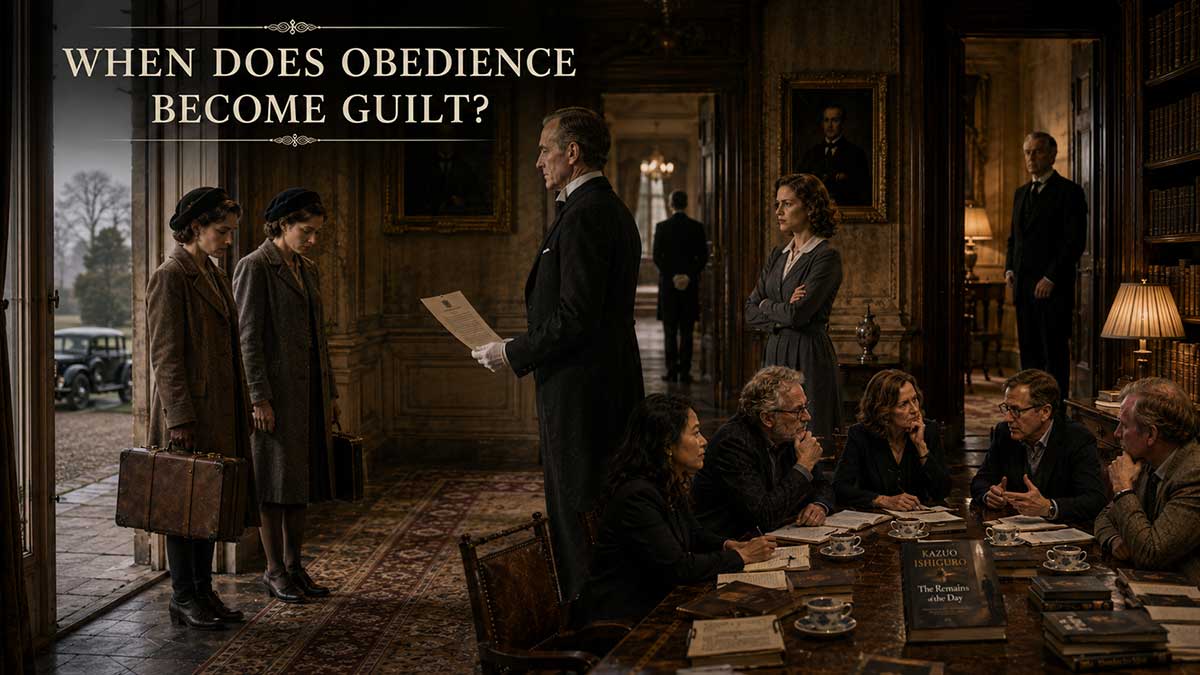
The mood in the library changed.
The earlier discussion had been interpretive.
Memory.
Dignity.
Englishness.
Class.
Now the scholars faced a question that allowed less distance.
Stevens knew the dismissal of the Jewish maids was wrong.
He understood that Lord Darlington was moving in troubling political circles.
He still obeyed.
So what does responsibility look like when a person does not create the evil, yet helps carry out part of it?
Can obedience ever remove moral responsibility?
Kathleen Wall: I think we should begin with the most concrete case.
The dismissal of the Jewish maids.
Cynthia F. Wong: Agreed.
Wall: Stevens does not invent the order.
Lord Darlington does.
That distinction matters.
Barry Lewis: Very much so.
Wall: But Stevens carries it out.
He knows it is wrong.
He even acknowledges private reservations.
Brian W. Shaffer: Which means ignorance is not available as a defense.
Steven Connor: No.
The relevant question becomes agency.
How much freedom did he possess?
Lewis: Less than Lord Darlington.
That should be said clearly.
A servant's position is not equal to the master's.
Employment matters.
Class matters.
Economic dependence matters.
Wong: Yes.
We should not pretend refusing an employer carries no cost.
Wall: Yet reduced agency is not zero agency.
Shaffer: Exactly.
That is where moral responsibility enters.
Is Stevens guilty in the same way Lord Darlington is?
Connor: No.
I would resist that strongly.
Wall: So would I.
Lewis: Darlington makes the decision.
He participates in the ideology behind it.
He possesses far greater social authority.
Shaffer: Stevens executes one part of the decision.
Those are different levels of responsibility.
Wong: But different does not mean none.
Connor: We need a distinction between causal responsibility and moral responsibility.
Lewis: Yes.
Connor: Stevens did not cause British appeasement policy.
He did not create fascism.
He did not devise Nazi antisemitism.
He did not control Darlington's political network.
Making him answerable for all of that would be absurd.
Wall: But he is responsible for his own action.
Connor: Precisely.
He participates in the dismissal.
That action belongs to him, even if the original instruction does not.
Is “I was only doing my job” ever enough?
Shaffer: This is where the novel becomes much larger than the country house.
Wong: Very much so.
Shaffer: Stevens's reasoning is structurally familiar.
He says, in effect:
“My responsibility was my role. Larger decisions belonged to those above me.”
Lewis: Which is how responsibility becomes fragmented.
Wall: One person gives the order.
Another prepares the document.
Another communicates it.
Another carries it out.
Everyone performs only a small part.
Connor: And each person can then say, “The whole was not mine.”
Wong: That is psychologically attractive.
It allows people to maintain moral innocence inside systems producing harm.
Shaffer: Corporations operate this way.
Bureaucracies.
Governments.
Military structures.
Political organizations.
Religious institutions.
Lewis: Families too, sometimes.
Wall: Anywhere roles become substitutes for judgment.
Does hierarchy encourage moral surrender?
Connor: Often.
But hierarchy itself does not make moral judgment impossible.
Wall: Agreed.
Connor: Every institution requires some division of responsibility.
A society cannot function if every person independently reopens every decision.
Lewis: True.
Shaffer: Yet some decisions demand refusal.
Connor: Exactly.
The problem is locating the line.
Wong: Stevens avoids locating it.
That may be his deeper failure.
He treats obedience as a principle rather than a practical arrangement.
Wall: Yes.
He does not say, “Most household matters properly belong to Lord Darlington.”
He says, in effect, “Judgment itself belongs above me.”
Lewis: That is much more dangerous.
Why does Stevens surrender judgment so easily?
Shaffer: I think we have to connect this to Topic 2.
Judgment threatens his identity.
Wong: Explain.
Shaffer: If Stevens allows himself to judge Lord Darlington morally, then his entire philosophy of service becomes unstable.
Wall: So refusing judgment protects more than employment.
Shaffer: Exactly.
It protects meaning.
Lewis: Stevens needs Lord Darlington to be worthy.
Connor: That is central.
Lewis: He has built his life around the belief that serving a great gentleman allows him to participate indirectly in something significant.
If Darlington is not great, then the question becomes unbearable.
What was all the sacrifice for?
Wong: Which means Stevens has an emotional investment in not judging clearly.
Wall: His moral blindness is connected to self-preservation.
Is that an excuse?
Connor: No.
An explanation is not an excuse.
Lewis: Precisely.
Wong: We should maintain that distinction throughout.
Shaffer: Ishiguro helps us understand why Stevens behaves as he does.
That does not make the consequences disappear.
Wall: Nor should sympathy erase responsibility.
What about the historical context?
Connor: We need care here too.
Hindsight is powerful.
Readers know where fascism leads.
People in the 1930s did not possess the full future.
Shaffer: True.
Wall: But the dismissal of two Jewish employees does not require knowledge of the Holocaust to recognize injustice.
Connor: Agreed.
That is why the example matters.
The political picture may have been confusing.
The human situation in front of Stevens was much clearer.
Wong: That strips away his strongest defense.
He cannot say he lacked geopolitical expertise.
Lewis: He did not need geopolitical expertise to recognize discrimination.
Shaffer: Exactly.
Moral knowledge can sometimes be local.
Two people are being punished for who they are.
That is enough.
Does Miss Kenton expose Stevens’s responsibility more clearly than politics does?
Wall: I think she does.
Wong: Yes.
Her protest creates a moral alternative inside the same environment.
Connor: Excellent point.
We know resistance was conceivable.
Lewis: Stevens cannot claim nobody around him saw the problem.
Shaffer: Miss Kenton sees it immediately.
Wall: Her presence is important for another reason.
She proves that professional duty did not automatically dictate obedience.
Two people can occupy subordinate roles in the same house and make different moral judgments.
Wong: Which restores agency.
Connor: Not unlimited agency.
But real agency.
Should Stevens have resigned?
Lewis: That is harder.
Shaffer: Yes.
Wall: Refusal does not have to mean immediate resignation in every case.
Connor: He might have objected more forcefully.
Delayed.
Appealed.
Refused personally.
Resigned if necessary.
Wong: The precise action matters less than the existence of a boundary.
Lewis: That may be the central moral question.
Did Stevens possess any principle higher than obedience?
Shaffer: And the answer appears to be no.
Wall: Or none he was willing to exercise.
Is neutrality itself a moral choice?
Connor: Often, yes.
But again, we should avoid slogans.
Neutrality can sometimes be appropriate.
Wall: Of course.
Connor: Yet neutrality becomes impossible when one's action directly sustains the harm.
Wong: Stevens does not merely observe the dismissal.
He performs it.
Lewis: Exactly.
At that point, “I remained neutral” becomes inaccurate.
Does the novel condemn Stevens?
Shaffer: I don't think Ishiguro writes condemnation in a simple way.
Wall: Nor do I.
Wong: The novel produces discomfort rather than verdict.
Connor: It makes readers feel the tension between sympathy and judgment.
Lewis: Which is much harder than assigning him a label.
Shaffer: Stevens is morally compromised.
That does not make him monstrous.
Wall: Yes.
He is ordinary.
That may be the disturbing part.
Wong: Very disturbing.
Connor: He does not wake intending to harm anyone.
He wants to perform his duties well.
Lewis: And still participates in harm.
Is ordinary goodness enough?
The room went quiet.
Wong: Perhaps that is the question beneath the question.
Stevens is courteous.
Hard-working.
Loyal.
Disciplined.
Often considerate.
Wall: Yet private decency does not automatically protect someone from participating in injustice.
Shaffer: Exactly.
A person can possess admirable qualities and still fail morally at a decisive moment.
Connor: That matters politically.
We often imagine harmful systems as populated entirely by malicious people.
History rarely works so neatly.
Lewis: Systems depend on ordinary people doing ordinary jobs.
Wong: Which is why conscience cannot be outsourced.
Does Stevens ever accept responsibility?
Wall: Only partially.
Shaffer: He reaches recognition, but cautiously.
Wong: His language remains protective.
Lewis: He tends to frame Lord Darlington's failure more readily than his own.
Connor: That is psychologically understandable.
His own responsibility threatens identity more directly.
Wall: Yet by the seaside, he does reach an extraordinary thought.
Lord Darlington made his own mistakes.
Stevens gave away the privilege of making his.
Shaffer: That is devastating.
Lewis: Yes.
Wong: It reframes obedience as loss.
Not merely moral failure.
Loss of authorship.
Is making your own mistakes morally preferable?
Connor: Not automatically.
One can make dreadful mistakes independently.
Wall: True.
Shaffer: But Ishiguro seems interested in the dignity of moral agency.
Lewis: A person should not surrender the responsibility to choose simply to avoid blame.
Wong: Exactly.
Stevens thought obedience protected him from error.
In reality, it prevented him from owning his life.
Is complicity sometimes a form of self-abandonment?
Lewis: I think so.
Wong: Yes.
Shaffer: That may connect the political and personal halves of the novel.
Wall: Explain.
Shaffer: Stevens surrenders judgment to Lord Darlington politically.
He surrenders desire to duty personally.
In both cases, he gives away authorship.
Connor: That is excellent.
Wong: He does not choose whom to love openly.
He does not choose when family should outrank work.
He does not choose where moral refusal begins.
He repeatedly allows systems, roles, and expectations to decide.
Lewis: Then later discovers that a life can be lost through decisions one refuses to make.
How should we judge Stevens?
Wall closed her book.
Wall: With precision.
Not innocence.
Not monstrosity.
Responsibility proportional to agency.
Connor: Yes.
Lewis: And compassion without absolution.
Wong: That is important.
Shaffer: We can understand him deeply and still say he was wrong.
What does the novel ask readers to do with this?
Connor: Examine our own institutions.
Wall: And our own excuses.
Lewis: Ask where our boundaries are.
Wong: Ask which responsibilities we have quietly transferred upward.
Shaffer: And ask whether we need the people above us to be right because too much of our identity depends on them.
Silence followed.
That last question seemed to trouble everyone.
Shaffer continued.
Shaffer: Perhaps Stevens needed Lord Darlington to be a great man because otherwise Stevens would have to ask what his own sacrifice had been for.
No one responded immediately.
Wong looked down.
Wall's expression tightened.
Connor leaned back.
Lewis slowly closed his notebook.
The moral problem had returned to the emotional one.
If Lord Darlington was wrong, Stevens had not merely served the wrong employer.
He had built the meaning of his life around someone else's judgment.
And once that meaning collapsed, one final question remained.
Can Stevens live after the story that sustained him has fallen apart?
Or has recognition come too late?
That would be the final debate.
Topic 5:
Is the ending tragic—or is Stevens finally becoming free?
Topic 5 — Is the Ending Tragic—or Is Stevens Finally Becoming Free?

The final discussion began near dusk.
The library windows had darkened to mirrors.
Beyond them, the grounds of Darlington Hall had almost disappeared.
Inside, the five scholars sat with the ending of the novel open before them.
Stevens had reached the seaside.
Miss Kenton had gone.
Lord Darlington was dead.
His father was gone.
The old world had receded.
And Stevens, after confronting the possibility that he had given away too much of himself, turned his thoughts to something almost absurdly small.
Banter.
Was that pathetic?
Hopeful?
Or both?
No one around the table seemed ready to agree.
Has Stevens really changed?
Kathleen Wall: My instinct is to begin cautiously.
Cynthia F. Wong: Very cautiously.
Wall: Readers often want a redemptive ending.
After spending the novel watching Stevens avoid recognition, we naturally hope the seaside scene marks a breakthrough.
Brian W. Shaffer: But you are not convinced.
Wall: Not fully.
He recognizes more than before.
That is undeniable.
But recognition and transformation are different things.
Barry Lewis: Yes.
A person can see the problem and remain trapped in the habit.
Steven Connor: And Stevens's habits are extraordinarily deep.
Wong: Yet something has shifted.
I would resist saying nothing changes.
Wall: So would I.
Wong: Stevens can no longer sustain the earlier story quite as cleanly.
Lord Darlington is no longer simply a great gentleman unfairly misunderstood.
Miss Kenton is no longer simply a former housekeeper whose return might solve staffing difficulties.
His own life is no longer easily described as a succession of honorable professional achievements.
Shaffer: The narrative has cracked.
Wong: Exactly.
And once that crack exists, complete innocence becomes difficult to recover.
Lewis: But what does Stevens do with that recognition?
That is the question.
Connor: He returns to service.
Lewis: Precisely.
He does not resign.
He does not radically reinvent himself.
He does not announce that he will spend the rest of his life pursuing private happiness.
Wall: He thinks about becoming better at bantering with Mr. Farraday.
Shaffer: Which can sound almost heartbreaking.
Is bantering proof that nothing has changed?
Wall: There is a strong case for that.
Stevens has just confronted the emotional devastation of his life.
And his response is still framed through pleasing his employer.
Connor: The old structure survives.
Lewis: Mr. Farraday likes banter.
Stevens decides to improve at banter.
Employer desires something.
Stevens adapts.
That is familiar territory.
Wong: Yet I don't think that exhausts the meaning.
Shaffer: Nor do I.
Banter is tiny.
But perhaps its tininess matters.
Wall: Go on.
Shaffer: Stevens has spent his life in formal scripts.
Professional scripts.
Class scripts.
Emotional scripts.
Banter cannot be entirely scripted.
It requires responsiveness.
Timing.
Humor.
Risk.
You say something without knowing exactly how the other person will answer.
Connor: A small form of vulnerability.
Shaffer: Exactly.
Lewis: Banter requires mutuality.
Wong: And Stevens is unaccustomed to mutuality.
He understands hierarchy far better.
Wall: That connects with our previous discussion of Farraday.
A command confirms roles.
A joke destabilizes them.
Connor: Yes.
Stevens cannot respond to a joke by consulting professional doctrine.
He has to participate.
Is learning to joke actually learning to relate?
Wong: Perhaps.
Not necessarily successfully.
But perhaps.
Shaffer: Ishiguro chooses something wonderfully modest.
Stevens does not discover passion.
He considers conversation.
Lewis: That feels psychologically right.
Wall: Yes.
A dramatic declaration of freedom would have betrayed the character.
Connor: Stevens becoming a spontaneous romantic adventurer at sixty would be absurd.
Wong: Instead we get a tiny movement.
A man who has spent decades treating personality as interference considers becoming more responsive to another person.
Lewis: That might be the only kind of change available to him.
Wall: But we still cannot know whether he will carry it beyond service.
Wong: No.
And I think that uncertainty is deliberate.
Is the ending hopeful?
Shaffer: I think it is cautiously hopeful.
Wall: I am less certain.
Connor: I would call it unresolved.
Lewis: I would say hopeful if we redefine hope.
Wong: Explain.
Lewis: Hope does not have to mean recovery.
Stevens cannot recover Miss Kenton.
He cannot recover his father.
He cannot repair the political past.
He cannot become young again.
If hope means getting those things back, there is none.
But if hope means that the future need not repeat the past exactly, then perhaps there is some.
Shaffer: That is beautifully put.
Wall: Yet I still worry about the return to Farraday.
Connor: As do I.
Wall: Stevens continues to understand change largely through usefulness.
Even his attempt at human connection becomes another professional improvement project.
Wong: True.
But people rarely escape an identity in one clean movement.
He may have to begin using the only language he knows.
Can change begin inside the old vocabulary?
Shaffer: I think that is one of the novel's hardest questions.
Lewis: Stevens cannot suddenly speak the language of therapeutic self-discovery.
It would be false.
Connor: Nor should he.
Wong: So perhaps the first sign of change must appear disguised as service.
Wall: That is possible.
Shaffer: “I should improve my bantering” may contain, beneath it, “I want to connect.”
Wall: May contain.
Shaffer: Yes.
May.
Does Stevens finally accept that Lord Darlington was wrong?
Wong: More than before.
Connor: Yet the more important shift is that Stevens begins distinguishing Darlington's life from his own.
Lewis: That seaside realization is central.
Darlington made choices.
They were terrible choices in some cases.
But they were his.
Stevens recognizes that he placed his own judgment in someone else's hands.
Wall: Which means regret becomes more personal.
Shaffer: Painfully so.
Does regret produce freedom?
Connor: Sometimes regret produces paralysis.
Wall: Quite often.
Wong: Or repetition.
Lewis: Or freedom.
Shaffer: Under what condition?
Lewis: When the person stops using regret merely to punish himself and begins using it to choose differently.
Silence.
Wall: We do not know whether Stevens reaches that point.
Lewis: No.
Wall: That is why I resist a confident redemptive reading.
Wong: Yet the novel may not require certainty.
Perhaps possibility is enough.
Is it too late for Stevens?
Connor: Too late for what?
That is the first question we should ask.
Shaffer: Exactly.
Connor: Too late to marry Miss Kenton?
Almost certainly.
Too late to sit beside his father?
Yes.
Too late to refuse Lord Darlington's order?
Yes.
Too late to live those lost decades differently?
Absolutely.
Wong: But those are all backward-looking definitions of change.
Lewis: Right.
Wall: So the relevant question is whether it is too late for anything new.
Shaffer: Yes.
Wong: And there, the answer must be less certain.
Connor: He still has time.
We do not know how much.
But he has some.
Does the title answer the question?
Lewis: I think the title does something extraordinary here.
“The remains of the day” sounds elegiac.
What is left after most of something has been used.
Wong: Yet “remains” is not the same as “nothing.”
Wall: No.
Shaffer: There is still day left.
Connor: Evening is still part of the day.
Lewis: Exactly.
Stevens cannot demand morning back.
He cannot return to noon.
But the existence of evening means time has not fully ended.
Wong: Which makes the title both tragic and quietly generous.
Wall: Tragic because so much has passed.
Shaffer: Generous because not everything has.
Is Stevens finally free?
Connor: I would say no.
Not fully.
Wall: Nor would I.
Wong: But perhaps freer.
Lewis: That is the word.
Shaffer: What has he become freer from?
Wong: From complete belief in his own story.
Wall: That is significant.
Wong: Earlier, his narrative protects him almost completely.
At the end, the protection fails.
He sees enough truth that he cannot entirely return.
Lewis: Which is painful.
Wong: Of course.
Freedom often begins as loss.
Loss of what?
Wong: Certainty.
The certainty that Lord Darlington was great.
The certainty that dignity justified every sacrifice.
The certainty that his relationship with Miss Kenton was merely professional.
The certainty that duty absolved judgment.
Those certainties gave Stevens stability.
Losing them hurts.
Shaffer: Yet without losing them, another life cannot begin.
Connor: That creates an interesting parallel with Britain again.
A nation losing an old story of greatness may experience that loss as humiliation.
But the collapse of an old myth can create room for a more honest identity.
Wall: Provided the myth is actually relinquished.
Connor: Yes.
And the novel leaves that process incomplete for both Stevens and the country around him.
Is incomplete change enough?
Shaffer: I think Ishiguro would distrust the demand for complete change.
Lewis: Why?
Shaffer: Because human beings rarely become new people in clean narrative arcs.
We carry old habits into new awareness.
We recognize something and then deny it again.
We improve in one area and repeat ourselves elsewhere.
Wong: Stevens may remain partly trapped and partly changed.
Wall: Which is less satisfying dramatically and more convincing psychologically.
Is the novel cruel to Stevens?
Lewis: I don't think so.
Wall: Nor do I.
Wong: Ishiguro gives him something almost merciful.
Not restoration.
Recognition.
Connor: And perhaps enough time to do something with it.
Shaffer: That may be the mercy.
But is recognition enough?
Wall: No.
I want to insist on that.
Recognition alone can become another form of self-absorption.
Wong: Fair.
Wall: One can spend twenty years saying, “I understand what I did wrong,” and change nothing.
Lewis: True.
Connor: So recognition must lead to action.
Wall: Some action.
However small.
Shaffer: Then bantering returns.
Wall: Unfortunately.
The others laughed.
Wall: I mean that affectionately.
Wong: Perhaps that laughter is the point.
Lewis: It may be.
Why end with something so small?
Shaffer: Because the moral scale of the novel has changed.
Stevens spent his life chasing greatness indirectly.
Great houses.
Great gentlemen.
Great affairs.
Great service.
Connor: And the ending offers something almost embarrassingly modest.
Conversation.
Humor.
An evening.
Lewis: Perhaps Ishiguro is shrinking the scale of meaning deliberately.
Wong: That matters enormously.
Stevens thought meaning came from serving history.
Perhaps meaning was available in ordinary human presence all along.
Wall: With his father.
Lewis: With Miss Kenton.
Connor: With colleagues.
Shaffer: And now, perhaps, in one ordinary exchange with another person.
Is that the real reversal?
Lewis: I think so.
The old Stevens wanted proximity to greatness.
The late Stevens may have to learn the value of the ordinary.
Wong: Which is harder than it sounds.
Wall: Especially for someone who sacrificed ordinary happiness in the name of extraordinary purpose.
What would genuine change look like for Stevens?
Connor: Not abandoning professionalism.
Lewis: Agreed.
Wong: Not becoming emotionally extravagant.
Wall: Certainly not.
Shaffer: Then what?
Lewis: Allowing duty to become one part of identity rather than the whole.
Wong: Allowing feeling to inform action.
Wall: Accepting responsibility without destroying himself.
Connor: Living in the present rather than preserving a vanished social order.
Shaffer: And perhaps choosing something once in a while simply because he wants it.
The room became quiet again.
Did Stevens waste his life?
Wall: That is too absolute.
Connor: Agreed.
Lewis: Parts of it, perhaps.
Opportunities, certainly.
Wong: But calling the whole life wasted risks repeating Stevens's own tendency toward totalizing judgments.
Shaffer: Excellent.
Wong: A life can contain service, kindness, failure, avoidance, loyalty, harm, beauty, regret, and missed love all at once.
We do not need to reduce it to one verdict.
Lewis: That feels faithful to the novel.
Wall: Yes.
Can a life be meaningful after its central story collapses?
Shaffer: That may be Ishiguro's deepest question.
The others looked toward him.
Shaffer: Stevens's identity depended on a story.
Lord Darlington was great.
Service was noble.
Dignity required restraint.
Sacrifice placed him near meaningful history.
Each piece weakens.
What happens when the narrative sustaining a life no longer holds?
Connor: A person can collapse with it.
Lewis: Or build another identity.
Wall: Slowly.
Wong: Imperfectly.
How much life must remain for change to matter?
The scholars became still.
Shaffer repeated the question.
Shaffer: How much life must remain before change becomes worthwhile?
No one answered immediately.
Then Wong spoke.
Wong: One day.
Wall looked toward her.
Wong: One day is enough for one day to be lived differently.
Connor: That does not redeem thirty years.
Wong: No.
Nor should it.
Lewis: But redemption may be the wrong demand.
Wall: I agree with one condition.
Wong: Which is?
Wall: Stevens must not spend that final day explaining why change was impossible.
A faint smile passed around the table.
Shaffer: Then perhaps that is where Ishiguro leaves us.
Not with certainty that Stevens will change.
Not with certainty that he will fail.
But with something more uncomfortable.
Possibility.
Lewis: Possibility after irreversibility.
Connor: Yes.
That distinction matters.
The past is irreversible.
The future is not fully determined.
Wall closed the novel.
Wall: And perhaps that is why the ending hurts.
If Stevens were completely doomed, we could pity him and move on.
If he were completely redeemed, we could celebrate him and move on.
Wong: Instead we are left watching someone stand between habit and possibility.
Shaffer: Which is where many people spend much of their lives.
The last light faded outside Darlington Hall.
For a few moments, none of the scholars spoke.
Then Lewis looked toward the window.
Lewis: There is something rather beautiful about the title after all.
Connor: The remains?
Lewis: Yes.
We usually focus on what has been used up.
But the phrase directs attention to what is still there.
Wong nodded.
Wong: Perhaps that is the moral question Ishiguro leaves with the reader.
Not whether Stevens should have lived differently.
We know he should have, in many ways.
The harder question is whether we are doing the same thing now.
Wall looked around the table.
Wall: Explaining away what matters.
Connor: Calling inherited assumptions virtues.
Lewis: Giving institutions more authority over our conscience than they deserve.
Shaffer: Postponing life until some more appropriate time.
Silence again.
Then Wong gave the final thought.
Wong: Stevens reaches the evening of his life before seeing some of this.
We do not have to.
The room remained still.
Outside, darkness settled over the old house.
And the scholars left one question unanswered on the table:
How much of our own lives are we explaining away right now—and will we recognize it before only the remains of the day are left?
Final Thoughts
Perhaps Stevens’s greatest mistake was not simply choosing duty over love or loyalty over conscience.
It was allowing other people and institutions to decide what made his life meaningful.
Lord Darlington defined greatness.
His profession defined dignity.
His father helped define strength.
And Stevens rarely stopped to ask what he himself believed.
Yet Ishiguro does not leave him entirely without hope.
Stevens cannot recover his father, Miss Kenton, or the decades already spent. But the title reminds us that “the remains of the day” means something still remains.
The scholars may disagree about whether Stevens truly changes.
Perhaps that uncertainty is the point.
The novel ultimately turns the question back on us:
What are we postponing, excusing, or refusing to see today that we may deeply regret when only the remains of our own day are left?
Short Bios:
Cynthia F. Wong — Literary scholar and Ishiguro specialist whose criticism explores memory, identity, disclosure, and the ways Ishiguro’s narrators construct stories about their pasts.
Brian W. Shaffer — Literary scholar and author of Understanding Kazuo Ishiguro, known for examining Ishiguro’s fiction within its broader literary, ethical, and cultural contexts.
Kathleen Wall — Scholar known for influential work on unreliable narration in The Remains of the Day, particularly the difference between what Stevens reports and how he interprets it.
Steven Connor — Literary critic whose work on Ishiguro has examined Englishness, restraint, class, and the cultural meanings surrounding Stevens’s idea of dignity.
Barry Lewis — Scholar and author of a major critical study of Kazuo Ishiguro, with particular attention to identity, dignity, displacement, memory, and belonging.
Kazuo Ishiguro — Nobel Prize-winning British novelist born in Nagasaki in 1954. His fiction frequently explores memory, regret, self-deception, identity, and the stories people construct to make sense of lives they cannot change.
Leave a Reply