
What if the real plague wasn't disease—but indifference?
Introduction by Albert Camus
When I wrote The Plague, I was never interested in writing merely about disease.
Disease was simply the visible event.
The invisible event was something far older.
I wanted to understand what happens when ordinary people suddenly discover that the world they trusted no longer exists. Some become courageous. Some become selfish. Some cling to faith. Some lose it. Some discover that heroism is nothing more dramatic than returning to work the next morning.
Readers have often asked me whether The Plague is about World War II, fascism, epidemics, or the absurd condition of human life.
My answer has always been that it is about all of these, because every generation eventually meets its own plague.
Sometimes it arrives as war.
Sometimes as disease.
Sometimes as hatred.
Sometimes as indifference.
What matters is not the name we give it, but how we respond once it appears.
The people gathered around this table are not symbols pretending to be human beings. They are human beings whose choices reveal ideas larger than themselves.
Dr. Bernard Rieux refuses to surrender his humanity even when success seems impossible.
Jean Tarrou searches for a life that does not contribute to suffering.
Raymond Rambert discovers that love can grow wider than private happiness.
Father Paneloux wrestles with faith after witnessing innocent pain.
Joseph Grand quietly proves that ordinary goodness often carries civilization.
Cottard reminds us that fear, resentment, and self-interest never disappear simply because a crisis ends.
I hope you will not spend this conversation deciding which person was correct.
Instead, ask yourself a more difficult question.
If another plague arrived tomorrow, which voice at this table would sound most like your own?
Perhaps the answer would surprise you.
(Note: This is an imaginary conversation, a creative exploration of an idea, and not a real speech or event.)
Act 1: When the First Rats Appeared
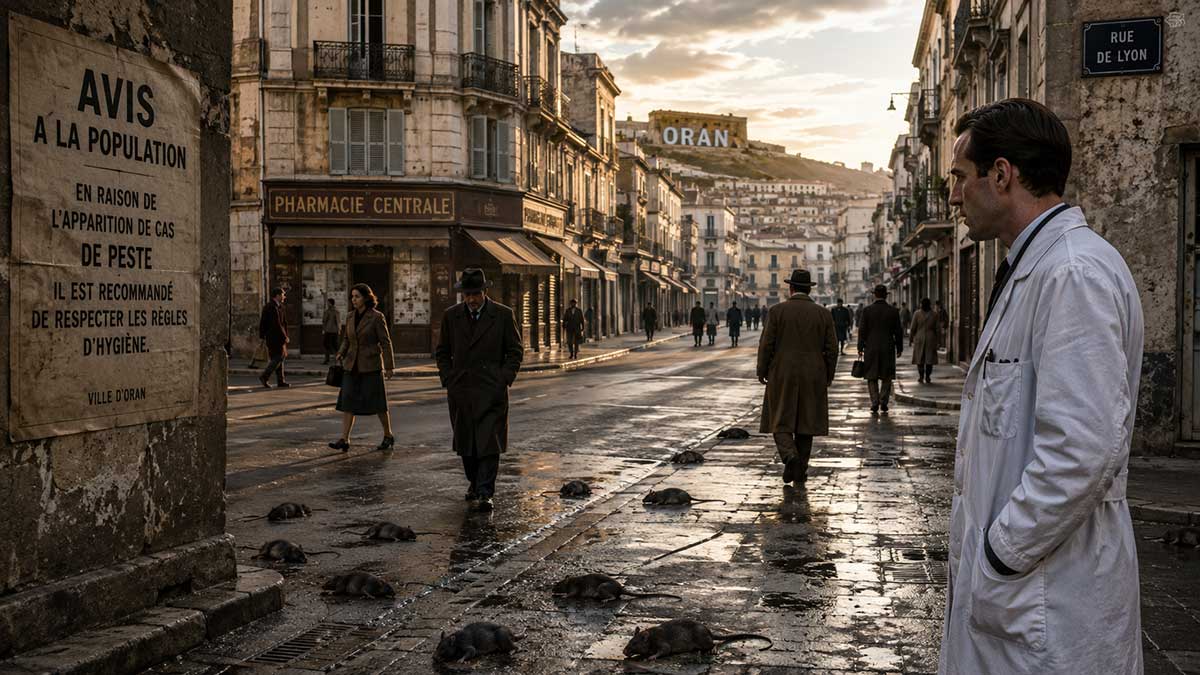
The town hall stood at the edge of an empty square in Oran.
Its windows were open, yet no breeze entered. Dust rested along the wooden frames. Outside, the streets were quiet enough for the scrape of a loose sign to carry from one building to the next.
Six people sat around a long table.
Dr. Bernard Rieux had placed his medical bag beside his chair. Jean Tarrou sat near him, a notebook closed beneath one hand. Raymond Rambert leaned forward, restless even in silence. Father Paneloux held his hat against his chest. Joseph Grand sat carefully, as though afraid to take up too much space. Cottard remained near the far end of the table, watching the others with the faint expression of someone who had arrived for a private entertainment.
For several moments, nobody spoke.
Then Rieux looked around the room.
Dr. Bernard Rieux: The plague is over. The gates are open. People are embracing in the streets again. Yet I do not think the question it asked us has ended.
Raymond Rambert: Which question?
Dr. Bernard Rieux: Why did we refuse to see it when it first arrived?
Cottard smiled.
Cottard: That is easy. People dislike bad news.
Jean Tarrou: People dislike bad news that demands something from them.
Cottard: Is there a difference?
Jean Tarrou: A great one. We hear about suffering every day. Most of it does not interrupt dinner.
Grand lowered his eyes.
Joseph Grand: The rats interrupted dinner.
A trace of uncomfortable laughter passed around the table.
Raymond Rambert: At first, they were only rats.
Dr. Bernard Rieux: No. At first, they were evidence.
Raymond Rambert: Evidence of what? No one knew.
Dr. Bernard Rieux: Evidence that something was wrong.
Cottard: Something is always wrong.
Dr. Bernard Rieux: That sentence has excused more neglect than almost any other.
Cottard leaned back.
Cottard: Doctor, you speak as though everyone should have known exactly what was coming.
Dr. Bernard Rieux: I did not say that.
Cottard: You sound as though you did.
Dr. Bernard Rieux: There is a difference between knowing what is coming and admitting what is already happening.
Tarrou studied Rieux for a moment.
Jean Tarrou: When did you know?
Rieux did not answer immediately.
Outside, a shutter struck once against a wall.
Dr. Bernard Rieux: I knew before I allowed myself to say it aloud.
Father Paneloux: Then you too resisted the truth.
Dr. Bernard Rieux: Yes.
Rambert looked surprised.
Raymond Rambert: You?
Dr. Bernard Rieux: Doctors are not protected from fear. We often name it caution.
Jean Tarrou: Or uncertainty.
Dr. Bernard Rieux: Yes. We say we require more evidence. Sometimes that is wisdom. Sometimes it is delay wearing a respectable coat.
Paneloux placed his hat on the table.
Father Paneloux: Yet a physician must be careful. A reckless warning can cause panic.
Dr. Bernard Rieux: A delayed warning can cause funerals.
The room became still.
Grand folded his hands.
Joseph Grand: I remember the first dead rat I saw. It was on the stairs of my building. I stepped around it.
Jean Tarrou: Why?
Joseph Grand: I was late for work.
Cottard: There. The whole human condition in one sentence.
Joseph Grand: I did not mean anything by it.
Cottard: That makes it better?
Grand looked hurt.
Dr. Bernard Rieux: Leave him alone.
Joseph Grand: No. He is right in one sense. I saw something strange, and I stepped around it.
Jean Tarrou: Most people did.
Joseph Grand: Yes, but I still wonder about it. I remember thinking that somebody would remove it.
Raymond Rambert: Somebody always removes things.
Jean Tarrou: Until nobody does.
Rambert turned toward him.
Raymond Rambert: That sounds wise now. At the time, it was a dead rat.
Jean Tarrou: That is how disasters enter. Not as disasters. As small inconveniences other people are expected to handle.
Father Paneloux shifted in his chair.
Father Paneloux: You speak as though ordinary life itself were a form of blindness.
Jean Tarrou: Often it is.
Father Paneloux: People must work. They must care for children. They must buy bread. They cannot live in constant readiness for catastrophe.
Jean Tarrou: I agree.
Father Paneloux: Then what are you accusing them of?
Jean Tarrou: Nothing yet. I am asking when ordinary life becomes an excuse for refusing reality.
Cottard tapped one finger against the table.
Cottard: Reality is overrated.
Rieux looked at him.
Dr. Bernard Rieux: You enjoyed the confusion from the beginning.
Cottard: I enjoyed nothing.
Jean Tarrou: You were less afraid than everyone else.
Cottard: I had already been afraid for years.
That answer changed the room.
Cottard's smile disappeared.
Cottard: Before the plague, everyone walked freely while I waited for a knock at the door. Everyone made plans while I imagined prison. Then the gates closed, and suddenly everyone understood me.
Raymond Rambert: You were pleased that the whole city became trapped?
Cottard: I was relieved not to be the only trapped man.
Father Paneloux: Relief at the suffering of others is a terrible confession.
Cottard: Is it? At least I confess it. Most people prefer prettier words.
Jean Tarrou: What words?
Cottard: Concern. Prudence. Duty. Faith. People use respectable words to hide what they want.
Paneloux stiffened.
Father Paneloux: Are you suggesting faith is merely self-interest?
Cottard: I am suggesting nothing. I am asking whether you were sad when frightened people filled your church.
Paneloux's face tightened.
Father Paneloux: They came seeking God.
Cottard: They came seeking safety.
Father Paneloux: Those are not always different.
Cottard: No. That is why religion does well during disasters.
Rieux raised a hand before Paneloux could respond.
Dr. Bernard Rieux: We are not here to settle that question yet.
Jean Tarrou: It may already be part of this one.
Rieux turned toward him.
Jean Tarrou: People did not merely refuse to see disease. They refused to see what the disease might demand of them. Acknowledging the plague meant surrendering plans, habits, comforts, assumptions. It meant admitting that private life could no longer remain private.
Raymond Rambert: You say that calmly. Some of us had reasons to resist.
Jean Tarrou: Everyone had reasons.
Raymond Rambert: I was not from Oran.
Dr. Bernard Rieux: The bacteria did not ask for your papers.
Raymond Rambert: I had someone waiting for me.
Joseph Grand: We all had someone.
Rambert looked at Grand.
Joseph Grand: Or someone who was no longer waiting.
Grand's voice had become softer.
Joseph Grand: My wife left years before. Yet when the gates closed, I began thinking of her every day. Strange, isn't it? The city became smaller, and my regrets became larger.
Jean Tarrou: Confinement removes many distractions.
Joseph Grand: I am not sure I wanted them removed.
Cottard: Nobody does.
Father Paneloux: Perhaps that is why suffering reveals the soul.
Rieux's expression hardened.
Dr. Bernard Rieux: Or perhaps suffering simply hurts.
Paneloux turned toward him.
Father Paneloux: You reject every meaning placed upon it.
Dr. Bernard Rieux: I reject meanings that are spoken too easily.
Father Paneloux: Is it wrong to search for purpose?
Dr. Bernard Rieux: It is wrong to explain another person's pain before helping them.
Tarrou opened his notebook but did not write.
Jean Tarrou: Father, when the rats first appeared, what did you think?
Paneloux took a slow breath.
Father Paneloux: I thought the city had become careless.
Raymond Rambert: Morally careless?
Father Paneloux: Spiritually asleep.
Cottard: And the rats came to wake us?
Father Paneloux: At first, I wondered whether they might be a sign.
Dr. Bernard Rieux: A sign from God?
Father Paneloux: Yes.
Dr. Bernard Rieux: And later?
Paneloux looked down at his hands.
Father Paneloux: Later, I wondered whether the need to call suffering a sign was itself a form of fear.
Nobody answered.
The clock on the wall had stopped at eleven minutes past three.
Tarrou finally opened his notebook.
Jean Tarrou: That may be the first honest thing said today.
Paneloux looked at him sharply.
Father Paneloux: You think faith and honesty are enemies?
Jean Tarrou: No. I think certainty and honesty often are.
Rambert pushed his chair back slightly.
Raymond Rambert: We keep speaking as though the city failed some moral examination the moment the rats appeared. Yet what were people meant to do? Close the gates immediately? Abandon work? Terrify children? Declare an epidemic before the doctors agreed?
Dr. Bernard Rieux: No.
Raymond Rambert: Then what?
Dr. Bernard Rieux: Look.
Raymond Rambert: Look at what?
Dr. Bernard Rieux: At what was happening without demanding that it first become undeniable.
Raymond Rambert: That sounds simple after the fact.
Dr. Bernard Rieux: It is not simple. That is why people fail.
Jean Tarrou: We often believe truth must arrive with trumpets. Usually it arrives quietly and asks to be noticed.
Cottard: And what happens to those who notice too early? They are mocked.
Joseph Grand: That is true.
The others looked toward him.
Joseph Grand: At the office, one clerk said the rats were being exaggerated by newspapers. Another said the city administration wanted extra funds. Someone else said merchants had invented the story to raise prices.
Raymond Rambert: That sounds familiar.
Joseph Grand: Each explanation allowed the speaker to return to work.
Jean Tarrou: A conspiracy can be comforting when reality requires sacrifice.
Cottard: Careful. Sometimes conspiracies are real.
Jean Tarrou: Yes. That is what makes them useful to fools.
Cottard gave a short laugh.
Cottard: You do enjoy judging people.
Jean Tarrou: I have spent most of my life trying not to.
Cottard: Poorly, I would say.
Jean Tarrou: Perhaps.
Rieux glanced at Tarrou.
Dr. Bernard Rieux: You once said that every person carries the plague within himself.
Jean Tarrou: I still believe it.
Raymond Rambert: That makes the disease sound like a moral failure.
Jean Tarrou: I do not mean illness. I mean the habit of causing harm without noticing. The willingness to let others suffer so our own life can remain undisturbed.
Joseph Grand: Then stepping around the rat was part of the plague?
Tarrou hesitated.
Jean Tarrou: Perhaps only a seed of it.
Grand looked deeply troubled.
Dr. Bernard Rieux: Do not turn every small failure into a crime.
Jean Tarrou: I am not trying to.
Dr. Bernard Rieux: You are close.
Jean Tarrou: Then correct me.
Rieux leaned forward.
Dr. Bernard Rieux: People are weak. They are distracted. They make mistakes. If you call every moment of inattention evil, you leave no room for mercy.
Jean Tarrou: And if we call every act of neglect human weakness, we leave too much room for repetition.
The two men held each other's gaze.
Rambert looked between them.
Raymond Rambert: So which is it? Are people guilty, or merely human?
Cottard: Those are often the same thing.
Father Paneloux: No.
Cottard: You sound certain again.
Paneloux ignored him.
Father Paneloux: To be human is not to be condemned. Weakness may lead us into wrong, yet weakness itself is not evil.
Jean Tarrou: Then when does weakness become guilt?
Paneloux had no quick answer.
Grand spoke quietly.
Joseph Grand: Perhaps when we see the same rat twice.
Everyone turned toward him.
He became embarrassed.
Joseph Grand: I mean, the first time, perhaps we do not grasp it. The second time, we begin to suspect. By the tenth, we are choosing not to know.
Rieux nodded.
Dr. Bernard Rieux: Yes.
Tarrou wrote something in his notebook.
Cottard: Congratulations, Grand. You have composed a better sentence than the one you have been rewriting for years.
Grand almost smiled.
Joseph Grand: I doubt that.
Raymond Rambert: Then the real question is not why people missed the first sign. It is why they kept missing the signs after they multiplied.
Dr. Bernard Rieux: They did not miss them. They adjusted to them.
Jean Tarrou: That may be worse.
Father Paneloux: Human beings can become accustomed to almost anything.
Cottard: That is one of our greatest talents.
Dr. Bernard Rieux: It keeps us alive.
Jean Tarrou: It can keep injustice alive too.
The late morning light had shifted across the floor. A pale rectangle now reached the legs of the table.
Rambert stared at it.
Raymond Rambert: I remember the day the gates closed more clearly than the day the rats appeared.
Dr. Bernard Rieux: Most people do.
Raymond Rambert: The gates made the crisis personal.
Jean Tarrou: Before that, it belonged to somebody else.
Raymond Rambert: Yes.
He looked at Rieux.
Raymond Rambert: Is that what you wanted us to admit? That we did not believe the plague was real until it took something from us?
Dr. Bernard Rieux: I wanted us to admit that suffering often becomes real only when it crosses our own doorstep.
Joseph Grand: That is not a pleasant thing to admit.
Cottard: Pleasant admissions are rarely useful.
Father Paneloux: Yet people did change.
Jean Tarrou: Some did.
Father Paneloux: Many volunteered. Families shared food. Nurses worked until they collapsed. Priests entered homes others feared to approach.
Dr. Bernard Rieux: Yes.
Father Paneloux: Then perhaps our first failure should not erase what came later.
Dr. Bernard Rieux: It should not.
Jean Tarrou: But what came later should not excuse the first failure either.
Raymond Rambert: You seem determined to keep everyone guilty.
Jean Tarrou: I am determined to keep everyone awake.
Cottard looked toward the open windows.
Cottard: People cannot stay awake forever.
Dr. Bernard Rieux: No.
Cottard: They grow tired. They stop listening. They begin to resent the warnings. They miss the life they had. Then they decide the danger must be exaggerated, since accepting it has become unbearable.
Rieux studied him with new interest.
Dr. Bernard Rieux: You understand denial better than I expected.
Cottard: I understand wanting the world to be different from what it is.
A faint sound rose from outside.
Footsteps.
Slow at first, then closer.
Everyone turned toward the doorway.
A young municipal worker appeared there, carrying a small wooden box.
He stopped when he saw the group.
Municipal Worker: Doctor Rieux?
Rieux stood.
Dr. Bernard Rieux: Yes?
The worker placed the box on a side table.
Municipal Worker: They found this in one of the old storage rooms beneath the station.
He lifted the lid.
Inside lay a stack of faded notices printed during the first weeks of the outbreak.
Instructions about sanitation.
Warnings about fever.
Requests for citizens to report dead animals.
The paper had yellowed at the edges.
The worker left without another word.
Rieux walked toward the box and lifted one of the notices.
Dr. Bernard Rieux: These were printed before the gates closed.
Rambert read over his shoulder.
Raymond Rambert: “Citizens are encouraged to remain calm.”
Cottard laughed softly.
Cottard: There it is. The official prayer of every disaster.
Paneloux rose and joined them.
Father Paneloux: Calm is not always wrong.
Dr. Bernard Rieux: No. Yet calm without truth becomes anesthesia.
Tarrou took another notice.
Jean Tarrou: Look at this line: “There is no cause for serious alarm.”
Joseph Grand: At the time, they believed that.
Dr. Bernard Rieux: Some did.
Raymond Rambert: And the others?
Rieux folded the paper once.
Dr. Bernard Rieux: The others believed the public could not bear the truth.
Jean Tarrou: People often say that when they themselves cannot bear the consequences of speaking it.
The group returned slowly to the table.
Rieux remained standing.
Dr. Bernard Rieux: Let us answer the question plainly.
He looked first at Grand.
Dr. Bernard Rieux: When the rats appeared, what were you refusing to see?
Grand swallowed.
Joseph Grand: That my ordinary life could end without asking permission.
Rieux turned to Rambert.
Raymond Rambert: That another city's suffering could become my responsibility.
Paneloux spoke before being asked.
Father Paneloux: That faith does not protect a person from confusion.
Tarrou closed his notebook.
Jean Tarrou: That knowledge alone does not make a person innocent.
Cottard looked toward the doorway, then back at the table.
Cottard: That I was pleased when everyone became afraid.
At last, they looked at Rieux.
He remained silent long enough for the stopped clock to seem louder than before.
Dr. Bernard Rieux: I was refusing to see that recognizing the plague would not give me the means to defeat it.
Raymond Rambert: You were afraid of helplessness.
Dr. Bernard Rieux: Yes.
Jean Tarrou: Yet you acted.
Dr. Bernard Rieux: Eventually.
Jean Tarrou: Perhaps that is the difference that matters.
Rieux sat down.
Dr. Bernard Rieux: Perhaps. Yet “eventually” is a dangerous word during an epidemic.
Outside, the square was no longer empty.
A woman crossed it carrying bread beneath one arm. A child followed her, hopping from one stone to the next. Neither looked toward the town hall.
Life had returned.
Inside, the six figures remained seated around the table.
Tarrou placed both hands over his notebook.
Jean Tarrou: Then perhaps the first lesson is this: the plague does not begin when people start dying.
Father Paneloux: When does it begin?
Tarrou looked toward the open window.
Jean Tarrou: When the first warning appears, and everyone decides it belongs to someone else.
The church bell rang once.
No one moved.
Act 2: Is Love for One Person More Important Than Responsibility to Everyone Else?
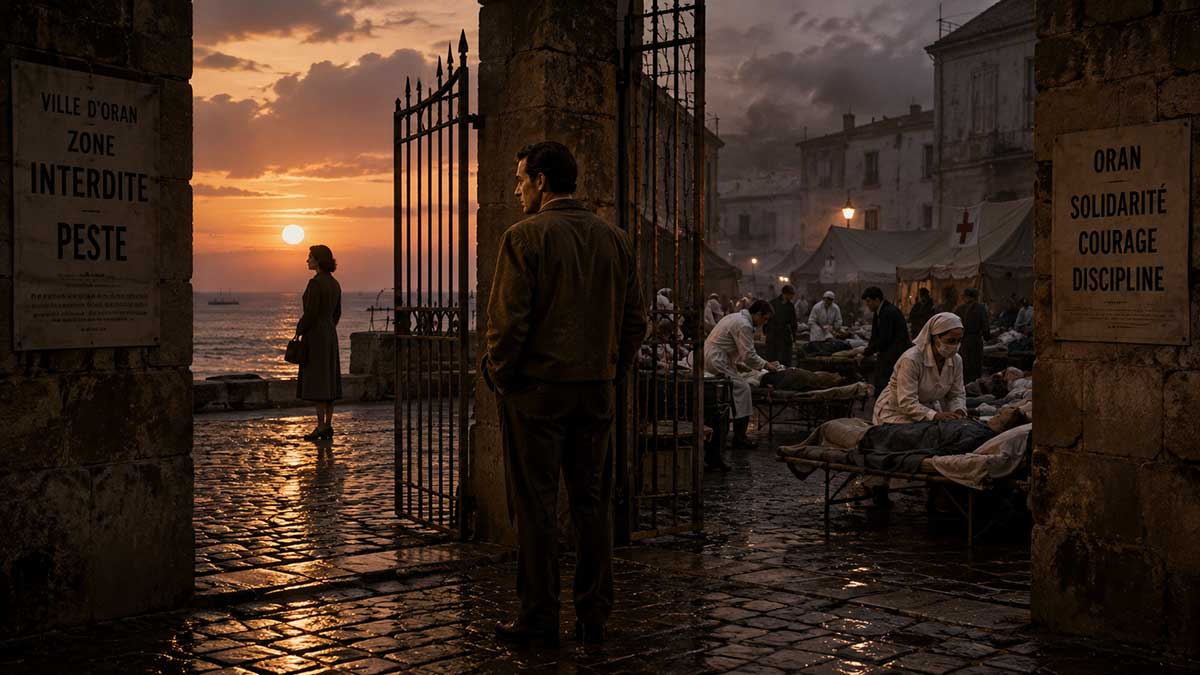
The church bell had stopped ringing.
For several minutes, the six figures remained seated around the long table, listening to the ordinary sounds returning to Oran.
A cart rolled across the square. Somewhere nearby, a shopkeeper pulled open a metal shutter. Two men greeted each other beneath the window, laughing with the exaggerated warmth of people who still found reunion miraculous.
Rambert watched them.
His face had changed since the first conversation. The defiance had not left him, but it had become quieter.
On the table before him lay one of the old notices found beneath the station.
Citizens are encouraged to remain calm.
He read the sentence once more, then folded the paper in half.
Raymond Rambert: You speak of responsibility as though it were obvious.
Rieux looked toward him.
Dr. Bernard Rieux: I do not think it is obvious.
Raymond Rambert: It sounded obvious when you said the bacteria did not care where I came from.
Dr. Bernard Rieux: The bacteria did not.
Raymond Rambert: Yet I did.
Jean Tarrou: You believed Oran was someone else’s tragedy.
Raymond Rambert: It was.
Jean Tarrou: At first.
Raymond Rambert: No. Not merely at first.
He placed both hands on the table.
Raymond Rambert: I had been sent here for work. I did not choose this city. I had no family here. No home. No history. When the gates closed, the person I loved was outside, and I was trapped among strangers.
Cottard: A perfect reason to leave.
Father Paneloux: A human reason.
Dr. Bernard Rieux: Yes.
Rambert looked at him with suspicion.
Raymond Rambert: You agree?
Dr. Bernard Rieux: I always agreed that your reason was human.
Raymond Rambert: You did not help me escape.
Dr. Bernard Rieux: That is different.
Raymond Rambert: It did not feel different.
Cottard leaned back and crossed his arms.
Cottard: Here we arrive at the heart of morality. Everyone respects your feelings until your feelings inconvenience them.
Jean Tarrou: Morality begins precisely where convenience ends.
Cottard: Spoken like a man who enjoys making life difficult.
Jean Tarrou: Life required no assistance from me.
Grand looked from Rambert to Rieux.
Joseph Grand: Doctor, did you ever believe he was wrong to want to leave?
Rieux considered the question.
Dr. Bernard Rieux: No.
Rambert’s expression tightened.
Raymond Rambert: Then why did you look at me as though I were abandoning the sick?
Dr. Bernard Rieux: I do not remember looking at you that way.
Raymond Rambert: I remember.
Dr. Bernard Rieux: Perhaps you were looking at yourself.
The answer landed heavily.
Rambert sat back.
Tarrou lowered his eyes, giving the silence room.
Raymond Rambert: I hated you for staying calm.
Dr. Bernard Rieux: I was rarely calm.
Raymond Rambert: You appeared calm.
Dr. Bernard Rieux: A doctor who looks frightened adds one more frightened person to the room.
Raymond Rambert: I thought you had no sympathy for me.
Dr. Bernard Rieux: My wife was outside Oran too.
Rambert stared at him.
Grand looked down.
Father Paneloux closed his eyes for a moment.
Raymond Rambert: I did not know.
Dr. Bernard Rieux: I did not tell you.
Raymond Rambert: Why not?
Dr. Bernard Rieux: Your pain did not become smaller because I had pain of my own.
Raymond Rambert: It might have changed what I thought of you.
Dr. Bernard Rieux: That was not the work in front of us.
Rambert turned away.
Through the window, the two men in the square had separated. One walked east, the other west. Each looked back once.
Jean Tarrou: You believed Rieux had chosen duty over love.
Raymond Rambert: Had he not?
Dr. Bernard Rieux: I had chosen the sick person in front of me.
Raymond Rambert: Again and again.
Dr. Bernard Rieux: Yes.
Raymond Rambert: At what point does a series of small choices become the abandonment of someone you love?
The room grew still.
Rieux’s gaze moved to the medical bag beside his chair.
Dr. Bernard Rieux: I asked myself that every day.
Father Paneloux: And what answer did you find?
Dr. Bernard Rieux: None that comforted me.
Cottard: Then perhaps Rambert was right. Love is real. Humanity is an abstraction.
Tarrou looked toward him.
Jean Tarrou: Humanity coughs, bleeds, calls for water, and dies in a bed. There is nothing abstract about it.
Cottard: Yet no one loves humanity.
Joseph Grand: Some people try.
Cottard: They love an idea of it. Give them one difficult neighbor and the great affection disappears.
Grand almost smiled.
Joseph Grand: That may be true.
Father Paneloux: Love often begins with one person.
Jean Tarrou: Does it end there?
Father Paneloux: It need not.
Raymond Rambert: Yet it can.
He looked around the table.
Raymond Rambert: Must every private happiness justify itself before the suffering of the city? Is a man selfish because he wants to hold the woman he loves?
Jean Tarrou: No.
Raymond Rambert: Is he selfish if he leaves sick strangers behind to do it?
Tarrou did not answer immediately.
Jean Tarrou: Perhaps.
Raymond Rambert: That is the answer I expected.
Jean Tarrou: You asked a moral question.
Raymond Rambert: I asked a human question.
Jean Tarrou: They are often the same question.
Cottard: That is the problem with moral men. They can turn an embrace into a trial.
Tarrou’s face remained calm.
Jean Tarrou: And men without morals can turn a trial into a business opportunity.
Cottard’s eyes narrowed.
Cottard: We are speaking about Rambert.
Jean Tarrou: We are speaking about everyone who decides his need is the only real need in the room.
Rambert rose from his chair.
The legs scraped sharply against the floor.
Raymond Rambert: You speak as though staying was easy for you.
Jean Tarrou: It was not.
Raymond Rambert: Whom did you leave outside the gates?
Tarrou’s expression changed.
Jean Tarrou: No one.
Raymond Rambert: Then you had less to lose.
Jean Tarrou: Perhaps.
Raymond Rambert: It is easy to preach shared duty when no one is waiting for you.
Jean Tarrou: Yes.
The simple admission stopped Rambert.
Tarrou closed his notebook.
Jean Tarrou: You are right. I cannot measure the cost of your separation. I had no right to speak as though I could.
Rambert remained standing.
Jean Tarrou: Yet the sick had no one waiting for them either. Many died among strangers. Their loneliness did not cancel yours. Yours did not cancel theirs.
Rambert slowly returned to his seat.
Raymond Rambert: That was the trap.
Joseph Grand: What was?
Raymond Rambert: Every direction contained betrayal.
He looked at Rieux.
Raymond Rambert: If I stayed, I betrayed the woman I loved.
Then at Tarrou.
Raymond Rambert: If I left, I betrayed the people fighting beside me.
Paneloux leaned forward.
Father Paneloux: Perhaps that is why suffering cannot always be divided into right and wrong.
Cottard: Convenient.
Father Paneloux: Painful.
Cottard: Priests are skilled at giving pain dignity.
Father Paneloux: And you are skilled at stripping dignity from everyone but yourself.
Cottard’s face hardened.
Cottard: I never claimed dignity.
Joseph Grand: Perhaps that is why you are so free with other people’s shame.
Cottard turned toward him.
Grand shrank slightly, yet he did not withdraw the words.
A brief smile crossed Tarrou’s face.
Raymond Rambert: I had nearly escaped.
Rieux nodded.
Dr. Bernard Rieux: I know.
Joseph Grand: How close were you?
Raymond Rambert: Close enough to taste the air beyond the gates.
His voice softened.
Raymond Rambert: The arrangements were made. The men helping me had taken risks. I had repeated the plan so many times that it began to feel like a memory.
Jean Tarrou: What changed?
Rambert looked down at his hands.
Raymond Rambert: I learned about Rieux’s wife.
Rieux’s gaze lifted.
Raymond Rambert: Until then, I believed he stayed because duty was easier for him than love. I needed to believe that.
Dr. Bernard Rieux: Why?
Raymond Rambert: So I could leave without comparing myself to you.
No one spoke.
Raymond Rambert: Once I knew you were separated too, my argument weakened. You had the same wound and chose differently.
Dr. Bernard Rieux: My choice did not make yours wrong.
Raymond Rambert: It made it harder to defend.
Jean Tarrou: Is that why you stayed?
Raymond Rambert: Partly.
He looked at each face around the table.
Raymond Rambert: I had spent weeks saying I did not belong to Oran. Then one night I realized I had already become part of it.
Joseph Grand: When?
Raymond Rambert: I cannot name the exact moment. Perhaps it was during the sanitation work. Perhaps it was when I watched Rieux finish one house and walk toward another without resting. Perhaps it was hearing people call my name from across a room.
He paused.
Raymond Rambert: Belonging had happened without my permission.
Cottard: Sentimental nonsense.
Raymond Rambert: You would think so.
Cottard: You had a way out.
Raymond Rambert: Yes.
Cottard: And you surrendered it for strangers.
Raymond Rambert: They were no longer strangers.
Cottard: That word does a lot of work.
Jean Tarrou: Every friend was once a stranger.
Cottard: Most strangers remain strangers.
Father Paneloux: Only if we insist upon it.
Cottard turned toward Rieux.
Cottard: Doctor, do you believe Rambert became a better man by staying?
Rieux frowned.
Dr. Bernard Rieux: I dislike that question.
Cottard: Why?
Dr. Bernard Rieux: It turns suffering into a ladder. It suggests one man rises morally by remaining near another man’s death.
Jean Tarrou: Yet he did change.
Dr. Bernard Rieux: Yes.
Cottard: For the better?
Dr. Bernard Rieux: He became more honest about the fact that his life was connected to other lives.
Rambert gave a faint nod.
Raymond Rambert: That is close enough.
Grand adjusted the papers before him.
Joseph Grand: I wonder whether love itself changed for you.
Raymond Rambert: How?
Joseph Grand: At first, love meant leaving Oran. Later, love may have meant staying.
Raymond Rambert: Staying was not love for the woman outside.
Joseph Grand: Perhaps not only for her.
Rambert studied him.
Joseph Grand: When you stayed, you protected the hope that people might still return to those waiting for them.
Tarrou looked toward Grand.
Jean Tarrou: That is well said.
Grand became embarrassed.
Joseph Grand: It may not be accurate.
Dr. Bernard Rieux: Accuracy is not always the enemy of beauty, Grand.
Grand looked genuinely pleased.
Cottard shook his head.
Cottard: You are dressing sacrifice in noble language. Let us make it plain. Rambert gave up happiness for people who might never know his name.
Raymond Rambert: Yes.
Cottard: And what did he receive?
Raymond Rambert: Nothing.
Cottard: There. At last.
Raymond Rambert: I received nothing that could repay the cost.
Cottard: The same thing.
Raymond Rambert: No.
He leaned closer across the table.
Raymond Rambert: Payment would have made the decision smaller.
Cottard stared at him.
Raymond Rambert: Had I stayed for admiration, gratitude, or reward, I would still have been serving myself. I stayed because one day I understood I could not be happy alone in a city where everyone else was grieving.
Cottard: People are happy beside suffering every day.
Raymond Rambert: I know.
Cottard: Then why were you different?
Raymond Rambert: I was not different. I had simply come close enough to see the faces.
Tarrou nodded.
Jean Tarrou: Distance is one of the great protections of selfishness.
Father Paneloux: Nearness can become a form of grace.
Rieux glanced at him.
Dr. Bernard Rieux: Or information.
Father Paneloux: Must you reduce everything?
Dr. Bernard Rieux: Must you sanctify everything?
Paneloux held his gaze.
Father Paneloux: No.
The answer came without anger.
Rieux looked away first.
A woman appeared at the town hall doorway.
She was elderly, dressed in black, carrying a small cloth bag.
She stopped when she saw the group.
Woman: Is this where they keep the records from the epidemic?
Grand stood.
Joseph Grand: Some records. What are you looking for?
The woman reached inside the bag and removed a photograph.
Woman: My son volunteered with the sanitation teams. I was told his name might be written somewhere.
Tarrou rose and walked toward her.
She handed him the photograph.
It showed a young man standing beside a bicycle, smiling into the sun.
Tarrou’s expression grew distant.
Jean Tarrou: I remember him.
The woman gripped the edge of the table.
Woman: You do?
Jean Tarrou: He worked in the western district. Quiet man. He carried extra water for the older volunteers.
Her eyes filled.
Woman: He never liked having his picture taken.
Jean Tarrou: He saved two men during a fire at one of the temporary wards.
The woman covered her mouth.
Woman: No one told me.
Jean Tarrou: I should have.
Tarrou opened his notebook and searched through several pages.
Near the back, he found a name.
He turned the notebook toward her.
The woman touched the handwriting with one finger.
Woman: He wrote to me the week before he died. He said the work was tiring, but he had made friends.
She looked at the six people.
Woman: Were you his friends?
Tarrou glanced at Rieux, then Rambert.
Jean Tarrou: Yes.
The woman nodded as though this was the answer she had come seeking.
She took the photograph back, thanked them, and walked from the room.
Her footsteps faded across the square.
No one sat down immediately.
Rambert remained facing the doorway.
Raymond Rambert: I do not remember him.
Jean Tarrou: There were many volunteers.
Raymond Rambert: He may have worked beside me.
Dr. Bernard Rieux: He may have.
Raymond Rambert: He died, and I cannot remember his face.
Cottard: That is what happens to strangers.
Rambert turned sharply.
Raymond Rambert: No. That is what happens when there are too many dead.
Cottard said nothing.
Rambert walked to the window.
Across the square, the elderly woman stopped beneath the clock tower and looked once more at the photograph.
Raymond Rambert: I used to believe love meant choosing one person above everyone else.
Father Paneloux: Do you no longer believe that?
Raymond Rambert: I believe love begins there.
He watched the woman continue across the square.
Raymond Rambert: I am no longer sure it has the right to end there.
Tarrou returned to his chair.
Jean Tarrou: Is that why you stayed?
Rambert turned back toward the table.
Raymond Rambert: I stayed because I became ashamed of wanting a private happiness untouched by public grief.
Rieux’s face tightened.
Dr. Bernard Rieux: Shame is a poor foundation for goodness.
Raymond Rambert: Perhaps. It was the foundation I had.
Dr. Bernard Rieux: And later?
Raymond Rambert: Later, I stayed because the men beside me would have had to carry what I abandoned.
Rieux nodded.
Joseph Grand: Then responsibility is not choosing strangers over the person you love.
Raymond Rambert: What is it?
Grand searched for the words.
Joseph Grand: It is refusing to make strangers pay the full price of your happiness.
The room fell silent again.
Tarrou wrote the sentence in his notebook.
Cottard watched him.
Cottard: Another beautiful sentence. Oran has improved Grand’s literary career.
Grand looked embarrassed.
Joseph Grand: I did not mean it as literature.
Cottard: The best ones rarely do.
Father Paneloux folded his hands.
Father Paneloux: May I ask something none of us has asked?
Rambert nodded.
Father Paneloux: When the gates finally opened, and you returned to the woman you loved, were you happy?
Rambert’s face softened.
Raymond Rambert: Yes.
Father Paneloux: Completely?
Rambert looked down.
Raymond Rambert: No.
Father Paneloux: Why?
Raymond Rambert: I had imagined that reunion would restore the person I had been before Oran.
Jean Tarrou: It did not.
Raymond Rambert: That person no longer existed.
Dr. Bernard Rieux: Did she understand?
Raymond Rambert: She tried.
His voice grew quieter.
Raymond Rambert: I held her and felt joy. At the same time, I remembered those who had no one returning. I hated myself for remembering them at that moment.
Father Paneloux: Why?
Raymond Rambert: It felt like a betrayal of her.
Jean Tarrou: Perhaps it was a larger form of love.
Cottard: Or damage.
Tarrou looked toward him.
Cottard: You do not return from a plague improved. You return infected by memory.
Dr. Bernard Rieux: Memory is not an infection.
Cottard: It spreads. It disturbs sleep. It enters ordinary happiness. It makes the living feel guilty for eating, laughing, touching someone they love.
Rieux did not answer at once.
Cottard: Tell me I am wrong.
Dr. Bernard Rieux: You are not entirely wrong.
Cottard seemed disappointed.
Dr. Bernard Rieux: Yet memory can keep the dead from being used as decoration.
Raymond Rambert: What does that mean?
Dr. Bernard Rieux: People praise sacrifice once the danger has passed. They turn the dead into symbols. Symbols ask nothing of us. Memories do.
Tarrou closed his notebook.
Jean Tarrou: What do they ask?
Dr. Bernard Rieux: That we do not return too easily to the person we were before.
The sunlight had moved beyond the table now.
A cool shadow filled the room.
Rambert unfolded the old notice once more and read the printed words.
Citizens are encouraged to remain calm.
He turned the paper over.
The reverse side was blank.
Raymond Rambert: We have spoken about my decision as though staying made me noble.
Jean Tarrou: No one here has called you noble.
Cottard: I certainly have not.
A small laugh passed through the group.
Rambert smiled briefly.
Raymond Rambert: Good.
He placed the notice in the center of the table.
Raymond Rambert: I stayed late. I argued. I arranged my escape. I resented every person who made me feel responsible. I did not suddenly fall in love with humanity.
Dr. Bernard Rieux: No one asked you to.
Raymond Rambert: Then what did staying mean?
Rieux answered quietly.
Dr. Bernard Rieux: It meant you refused to protect your happiness by pretending other people’s suffering had nothing to do with you.
Rambert looked at him.
Raymond Rambert: Was that enough?
Dr. Bernard Rieux: During the plague, enough was rarely available. We did what we could.
Jean Tarrou: And lived with what remained.
Outside, the clock tower struck noon.
Twelve slow notes crossed the square.
When the final note faded, Grand looked at Rambert.
Joseph Grand: Do you regret staying?
Rambert thought of the woman outside the gates.
He thought of the young volunteer whose mother had carried his photograph through the reopened city.
He thought of the nights spent waiting for escape, and the mornings spent carrying equipment beside men whose names he no longer remembered.
Raymond Rambert: I regret that the choice existed.
No one challenged him.
Raymond Rambert: Yet no. I do not regret staying.
Tarrou looked toward the open window.
Jean Tarrou: Then perhaps love for one person and responsibility to everyone else are not enemies.
Cottard: They make convincing enemies.
Father Paneloux: Many sacred duties do.
Rieux rested one hand on his medical bag.
Dr. Bernard Rieux: Love asks us to return to one person.
He looked toward the doorway where the elderly woman had stood.
Dr. Bernard Rieux: Responsibility asks us to notice who has no one returning.
Rambert folded the notice one final time and placed it in his coat pocket.
The square outside was filling with people now.
Some walked alone.
Some walked arm in arm.
Some carried photographs.
Inside the town hall, the six figures remained around the table, each thinking of the person they had wanted to save—and the person they had failed to.
Act 3: Can Faith Survive Innocent Suffering?
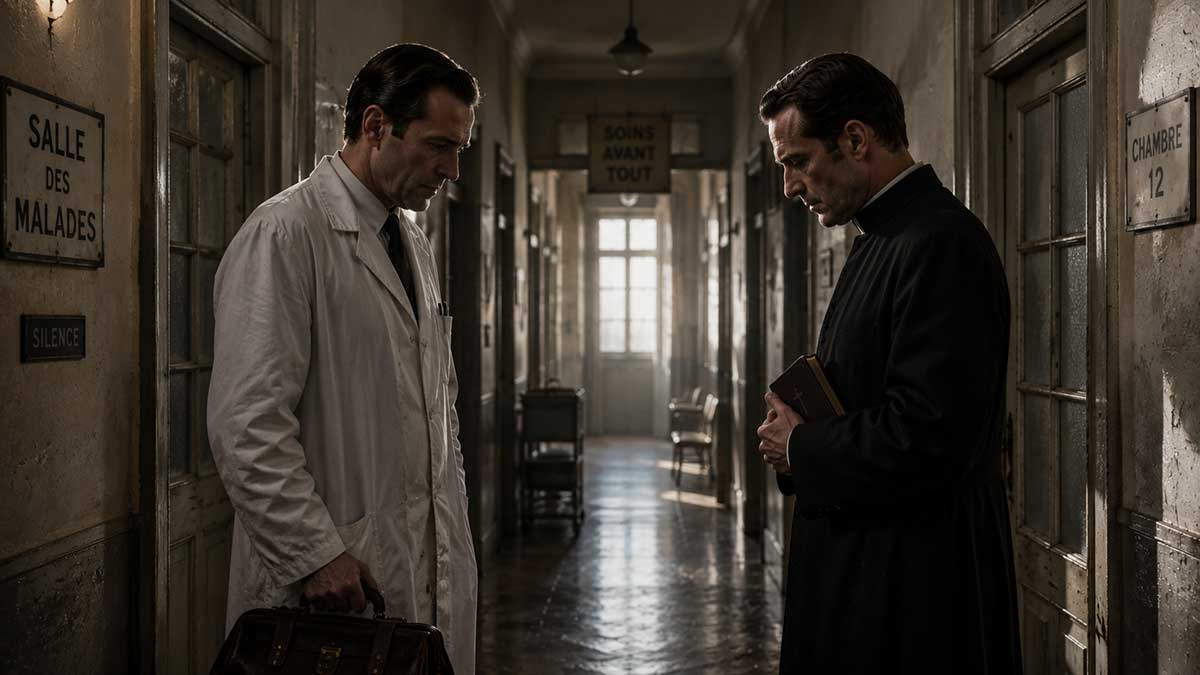
The square outside the town hall had grown crowded.
Voices drifted through the open windows. A bicycle bell rang. A vendor called out the price of oranges. Somewhere, a child laughed.
Inside, no one spoke.
The child’s laughter came again.
Father Paneloux lowered his eyes.
Rieux reached for his medical bag, then stopped before touching it.
Rambert noticed.
Raymond Rambert: You still carry it everywhere.
Dr. Bernard Rieux: Habit.
Cottard: Or penance.
Rieux looked at him.
Cottard: You could leave it at home now. The epidemic is over.
Dr. Bernard Rieux: Illness is not.
Jean Tarrou: Nor memory.
Cottard gave Tarrou a tired glance.
Cottard: You have an answer for everything.
Jean Tarrou: No. Today I have a question.
Tarrou turned toward Father Paneloux.
Jean Tarrou: Did the plague strengthen your faith or destroy it?
Paneloux did not answer.
Outside, the child’s laughter faded into the sound of passing footsteps.
Father Paneloux: Those are not the only possibilities.
Jean Tarrou: What lies between them?
Father Paneloux: A faith that has lost its certainty.
Cottard: That sounds like doubt dressed for church.
Father Paneloux: Perhaps doubt belongs in church more than we admit.
Rieux leaned back.
Dr. Bernard Rieux: You did not speak that way during your first sermon.
Paneloux’s face tightened.
Father Paneloux: No.
Raymond Rambert: You said the plague was a punishment.
Father Paneloux: I did.
Joseph Grand: You said the people of Oran had deserved it.
Paneloux looked toward Grand.
Father Paneloux: Yes.
Grand seemed uncomfortable with the direct admission.
Joseph Grand: Do you still believe that?
Paneloux placed both hands flat on the table.
Father Paneloux: I believe I spoke too quickly.
Dr. Bernard Rieux: You spoke with great confidence.
Father Paneloux: Confidence is not the same as truth.
Jean Tarrou: Yet people listened.
Father Paneloux: I know.
Jean Tarrou: Some were frightened.
Father Paneloux: I know that too.
Dr. Bernard Rieux: Fear entered your church already wounded. You gave it guilt.
Paneloux’s eyes lifted.
Father Paneloux: And what would you have given them?
Dr. Bernard Rieux: Help.
Father Paneloux: A physician’s answer.
Dr. Bernard Rieux: A human one.
Father Paneloux: You think faith is less human?
Dr. Bernard Rieux: I think blaming the sick is less human.
The room tightened around the words.
Paneloux took a slow breath.
Father Paneloux: I believed suffering could awaken the soul.
Dr. Bernard Rieux: Whose soul?
Father Paneloux: The city’s.
Dr. Bernard Rieux: A city does not cry out in a hospital bed. A person does.
Father Paneloux: I know that now.
Dr. Bernard Rieux: Do you?
Paneloux looked at him for a long moment.
Father Paneloux: You want me to say I was wrong.
Dr. Bernard Rieux: Were you?
Father Paneloux: Yes.
The answer came quietly.
No defense followed it.
Rieux’s anger did not disappear, yet it lost some of its force.
Father Paneloux: I was wrong to speak as though I could read God’s purpose in the suffering of others.
Jean Tarrou: What changed you?
No one needed to name the event.
Each person at the table remembered the same room.
The narrow bed.
The strained breathing.
The child’s body twisting beneath the sheets.
The helpless men standing around him.
The long hours in which every prayer and every medical effort seemed to meet the same closed door.
Rieux looked away.
Father Paneloux: The boy.
His voice had become barely audible.
Cottard: Many children died.
Rieux turned sharply.
Dr. Bernard Rieux: Do not.
Cottard: I am stating a fact.
Dr. Bernard Rieux: Then state it somewhere else.
Cottard fell silent.
Paneloux stared at his hands.
Father Paneloux: Before that day, I had visited the dying. I had prayed beside mothers and husbands. I had buried children.
Raymond Rambert: Then why was that child different?
Father Paneloux: I had never watched for so long.
Rieux’s jaw tightened.
Father Paneloux: I had never stood beside a doctor who refused to stop fighting after hope had become unreasonable.
Dr. Bernard Rieux: Hope had nothing to do with it.
Father Paneloux: What did?
Dr. Bernard Rieux: He was alive.
Paneloux nodded.
Father Paneloux: Yes.
He looked toward the medical bag.
Father Paneloux: You continued because he was alive.
Dr. Bernard Rieux: What else should I have done?
Father Paneloux: I prayed.
Dr. Bernard Rieux: I know.
Father Paneloux: You hated me for it.
Dr. Bernard Rieux: I hated that prayer did not make him suffer less.
Paneloux closed his eyes.
Father Paneloux: So did I.
The sounds from the square seemed to recede.
Tarrou’s notebook remained shut.
No one appeared willing to reduce this part of the conversation to a sentence.
Joseph Grand: Father, did you believe God could save him?
Father Paneloux: Yes.
Joseph Grand: Did you believe God would?
Paneloux hesitated.
Father Paneloux: I tried to believe it.
Joseph Grand: And when He did not?
Father Paneloux: I discovered that my faith had been built around answers.
Jean Tarrou: What is it built around now?
Paneloux looked toward the open window.
A strip of sunlight lay across the floor, stopping just before his shoes.
Father Paneloux: I do not know.
Cottard laughed once, without warmth.
Cottard: At last, theology becomes interesting.
Raymond Rambert: Let him speak.
Cottard raised both hands.
Cottard: I am listening.
Father Paneloux: I had preached that one must accept everything or deny everything.
Jean Tarrou: Do you still believe that?
Father Paneloux: I no longer know whether a person can accept everything without becoming cruel.
Rieux looked at him.
Father Paneloux: To accept the child’s suffering as part of a divine plan felt like standing beside his bed and agreeing to it.
Dr. Bernard Rieux: Yes.
Father Paneloux: Yet to reject God entirely felt like abandoning every prayer I had ever offered, every dying person who had trusted me, every moment in which faith had given someone courage.
Raymond Rambert: So you were trapped.
Father Paneloux: Between a God I could no longer explain and a world I could not bear to call meaningless.
Jean Tarrou: Perhaps explanation was the mistake.
Father Paneloux: Perhaps.
Dr. Bernard Rieux: That is easy to say after explaining suffering from a pulpit.
Paneloux accepted the blow.
Father Paneloux: Yes.
Rieux stood and walked toward the window.
Below, a father lifted a small girl onto his shoulders. She pointed toward the clock tower.
Rieux watched them cross the square.
Dr. Bernard Rieux: I have never understood the need to defend God.
Father Paneloux: Faith seeks coherence.
Dr. Bernard Rieux: A dying child is not a problem of coherence.
Father Paneloux: No.
Dr. Bernard Rieux: Then why must believers rush to explain?
Paneloux rose but stayed beside his chair.
Father Paneloux: Fear.
Rieux turned.
Father Paneloux: We fear that unexplained suffering will make God seem absent. We fear silence. We fear the possibility that our words may fail exactly when people need them most.
Jean Tarrou: So you fill the silence.
Father Paneloux: Yes.
Jean Tarrou: With certainty.
Father Paneloux: Too often.
Joseph Grand: Perhaps silence would be kinder.
Paneloux looked at him.
Father Paneloux: Sometimes it would.
Cottard: Then what use is a priest?
Grand looked alarmed by the question.
Paneloux did not.
Father Paneloux: Perhaps a priest is not there to explain why the wound exists.
Cottard: What is he there for?
Father Paneloux: To remain beside the wounded.
Rieux’s expression shifted.
Dr. Bernard Rieux: That I can respect.
Father Paneloux: Is respect enough?
Dr. Bernard Rieux: It is more than agreement.
Paneloux sat again.
Rambert leaned forward.
Raymond Rambert: Did the boy’s death weaken your belief in God?
Father Paneloux: It weakened my belief in the God I had described.
Raymond Rambert: What kind of God was that?
Father Paneloux: A God whose justice could always be translated into a sermon.
Jean Tarrou: And the God who remained?
Paneloux looked tired.
Father Paneloux: Silent.
Cottard: Convenient again.
Father Paneloux: No. A silent God is not convenient.
Cottard’s smile faded.
Father Paneloux: A convenient God confirms the preacher. A silent God leaves the preacher exposed.
Dr. Bernard Rieux: And the sufferer?
Father Paneloux: Still suffering.
Dr. Bernard Rieux: That is the part theology forgets.
Father Paneloux: It is the part bad theology forgets.
Rieux returned to his chair.
Dr. Bernard Rieux: You once told the congregation that they must love what they could not comprehend.
Father Paneloux: I did.
Dr. Bernard Rieux: Can you love the death of that child?
Paneloux recoiled as if struck.
Father Paneloux: No.
Dr. Bernard Rieux: Then say it plainly.
Paneloux’s hands trembled.
Father Paneloux: I cannot love it.
Dr. Bernard Rieux: Can you accept it?
Father Paneloux: No.
Dr. Bernard Rieux: Then perhaps we are closer than you think.
Paneloux stared at him.
Father Paneloux: You reject God.
Dr. Bernard Rieux: I reject the world as it is whenever it tortures the innocent.
Father Paneloux: That sounds like rebellion against creation itself.
Dr. Bernard Rieux: Call it what you like.
Jean Tarrou: Camus would call it refusal.
Rieux glanced toward him.
Jean Tarrou: Refusal to consent to suffering.
Cottard: Yet suffering continues.
Jean Tarrou: Yes.
Cottard: Then refusal changes nothing.
Dr. Bernard Rieux: It changes what we do next.
Cottard leaned closer.
Cottard: The boy died.
Dr. Bernard Rieux: Yes.
Cottard: Your medicine failed.
Dr. Bernard Rieux: Yes.
Cottard: Paneloux’s prayer failed.
Father Paneloux: Yes.
Cottard looked from one man to the other.
Cottard: Then what was the difference between you?
Rieux answered first.
Dr. Bernard Rieux: There may have been none that mattered to the child.
The honesty unsettled everyone.
Paneloux lowered his head.
Dr. Bernard Rieux: Yet I could not stop trying.
Father Paneloux: Nor could I stop praying.
Jean Tarrou: Perhaps both were forms of protest.
Rieux frowned.
Dr. Bernard Rieux: Prayer often asks someone else to act.
Father Paneloux: Not always.
Dr. Bernard Rieux: What did yours ask?
Paneloux took time before answering.
Father Paneloux: At first, I asked God to save the child.
Raymond Rambert: And later?
Father Paneloux: I asked God not to let us become accustomed to his suffering.
Tarrou opened his notebook.
Rieux shook his head.
Dr. Bernard Rieux: Do not write that down.
Tarrou stopped.
Jean Tarrou: Why?
Dr. Bernard Rieux: It is too beautiful.
Paneloux looked wounded.
Dr. Bernard Rieux: Beautiful sentences can make horror easier to bear from a distance.
Father Paneloux: I was in the room.
Dr. Bernard Rieux: I know.
Father Paneloux: I heard every cry.
Dr. Bernard Rieux: I know.
Father Paneloux: Then do not speak as though I turned him into a sermon.
Rieux’s anger rose.
Dr. Bernard Rieux: You did once.
Paneloux stood abruptly.
Father Paneloux: And I have carried the shame of it every day since.
The force of his voice stopped Rieux.
Father Paneloux: Do you think I do not hear my first sermon when I try to sleep? Do you think I do not remember telling frightened people that suffering had come to correct them?
His hand pressed against the table.
Father Paneloux: I spoke of judgment before I had stood close enough to pain.
No one moved.
Father Paneloux: Then I stood beside that child, and every sentence I had preached returned to accuse me.
Rieux’s expression softened, yet he said nothing.
Father Paneloux: You had medicine in your hands. Tarrou had his teams. Rambert had his work. Grand had his records. I had words.
He looked around the table.
Father Paneloux: And my words had become unbearable to me.
Grand’s voice was gentle.
Joseph Grand: Perhaps you did not need words.
Paneloux looked at him.
Joseph Grand: You stayed in the room.
Paneloux closed his eyes.
Joseph Grand: You did not leave when the cries became difficult to hear.
Father Paneloux: Staying did not save him.
Joseph Grand: No.
Father Paneloux: Then what good was it?
Grand thought for a moment.
Joseph Grand: Perhaps no one should die surrounded only by people searching for a reason.
The room became completely still.
Tarrou did not write the sentence down.
Paneloux sat slowly.
Father Paneloux: I wish I had known how to stand there without a reason.
Dr. Bernard Rieux: None of us knew how.
Their eyes met.
For the first time, neither man appeared to be opposing the other.
A knock sounded at the doorway.
A young woman stood there, holding the hand of a boy about eight years old.
The boy carried a small wooden boat.
Young Woman: Forgive me. They told us Doctor Rieux might be here.
Rieux stood at once.
Dr. Bernard Rieux: Is something wrong?
Young Woman: No. My son wanted to meet you.
The boy hid partly behind her coat.
Rieux approached, then crouched to his level.
Dr. Bernard Rieux: What is your name?
Boy: Étienne.
Dr. Bernard Rieux: And what have you brought?
The boy held up the boat.
Boy: My father made it in the quarantine hospital.
Rieux looked at the woman.
Young Woman: He did not survive.
The boy extended the boat.
Boy: Mama said you tried to help him.
Rieux looked at the carved piece of wood.
One side was uneven. The mast leaned slightly.
Dr. Bernard Rieux: I remember your father.
The woman’s eyes filled.
Rieux accepted the boat with both hands.
Boy: Did he know we were waiting?
Rieux’s face tightened.
Dr. Bernard Rieux: Yes.
Boy: Did he say anything?
Rieux searched his memory.
He could not be certain which words belonged to this man and which belonged to another dying patient.
He looked at the boy.
Dr. Bernard Rieux: He spoke about home.
The boy nodded, satisfied.
Boy: You can keep the boat.
Dr. Bernard Rieux: Are you sure?
Boy: He made two.
The boy smiled.
Rieux did not.
He stood and placed the boat carefully on the table.
The woman thanked him, and they left.
Paneloux watched the doorway after they were gone.
Father Paneloux: You were not certain.
Rieux remained standing.
Dr. Bernard Rieux: No.
Father Paneloux: Yet you answered.
Dr. Bernard Rieux: The boy did not need my uncertainty.
Father Paneloux: He needed comfort.
Dr. Bernard Rieux: Yes.
Father Paneloux: Then you too used words beyond what you knew.
Rieux looked at him.
No accusation appeared in Paneloux’s face.
Only recognition.
Dr. Bernard Rieux: Yes.
Tarrou leaned back.
Jean Tarrou: Perhaps none of us can live by facts alone.
Dr. Bernard Rieux: Facts matter.
Jean Tarrou: Deeply. Yet the boy asked whether his father remembered him.
Dr. Bernard Rieux: He probably did.
Cottard: Probably is not yes.
Rieux’s voice hardened.
Dr. Bernard Rieux: No.
Father Paneloux: Yet you gave him yes.
Rieux sat again.
Dr. Bernard Rieux: Would you have done differently?
Paneloux looked at the wooden boat.
Father Paneloux: No.
The answer surprised them both.
Rambert touched the edge of the boat.
Raymond Rambert: Then where does that leave faith?
Jean Tarrou: Perhaps where it began.
Raymond Rambert: Where is that?
Jean Tarrou: Beside someone who is afraid.
Paneloux looked at Tarrou.
Father Paneloux: You do not believe in God.
Jean Tarrou: No.
Father Paneloux: Yet you defend faith?
Jean Tarrou: I defend any belief that keeps a person beside the suffering rather than above them.
Cottard: And if belief becomes judgment?
Jean Tarrou: Then it joins the plague.
Paneloux accepted the words.
Father Paneloux: Yes.
Rieux looked at him.
Dr. Bernard Rieux: You agree?
Father Paneloux: Faith that makes a person less merciful has betrayed whatever it claims to serve.
Grand slowly nodded.
Joseph Grand: That seems right.
Raymond Rambert: Is mercy enough to sustain faith?
Paneloux looked again at the boat.
Father Paneloux: I no longer think faith is sustained by answers.
Raymond Rambert: What sustains it?
Father Paneloux: Sometimes nothing.
Cottard raised an eyebrow.
Father Paneloux: Sometimes it survives as a wound.
No one responded.
Outside, clouds passed over the square, dimming the room.
Dr. Bernard Rieux: A wound can become infected.
Father Paneloux: It can.
Dr. Bernard Rieux: It can kill.
Father Paneloux: Yes.
Dr. Bernard Rieux: Then why preserve it?
Paneloux turned to him.
Father Paneloux: For the same reason you carry that bag.
Rieux glanced down.
Father Paneloux: Not every wound can be cured. That does not excuse abandoning the wounded.
Rieux rested his hand on the worn leather.
The edge of his anger remained, but it no longer separated them.
Jean Tarrou: Father, answer my first question.
Paneloux looked toward him.
Jean Tarrou: Did the plague strengthen your faith or destroy it?
Paneloux stared at the wooden boat.
Father Paneloux: It destroyed the faith that allowed me to explain suffering from a distance.
He lifted his eyes.
Father Paneloux: What remained was smaller, quieter, and far less certain.
Raymond Rambert: Is that still faith?
Father Paneloux: I hope so.
Rieux looked toward the window.
The father and daughter from earlier had disappeared. The square was now partly shaded by clouds.
Dr. Bernard Rieux: I cannot believe in a God who permits children to suffer.
Paneloux nodded.
Father Paneloux: I cannot stop believing merely because I cannot defend Him.
Cottard: So neither of you has moved.
Tarrou shook his head.
Jean Tarrou: They have moved closer.
Cottard looked from Rieux to Paneloux.
Cottard: They still disagree.
Jean Tarrou: Agreement is not the only form of closeness.
Grand smiled faintly.
Joseph Grand: Sometimes two people stand beside the same bed.
Paneloux looked at Rieux.
Rieux met his gaze.
Neither offered reconciliation.
Neither withdrew.
On the table between them sat the small wooden boat, its mast leaning, its surface marked by the hands of a man who had carved it while waiting to die.
The clouds passed.
Sunlight returned through the window and fell across the boat.
Father Paneloux reached out but did not touch it.
Father Paneloux: Perhaps the question is not whether faith survives suffering.
Raymond Rambert: What is the question?
Paneloux looked at Rieux.
Father Paneloux: Whether faith can survive without betraying those who suffer.
Rieux studied him.
Dr. Bernard Rieux: And can it?
Paneloux looked around the table.
At Tarrou’s unopened notebook.
At Grand’s folded hands.
At Rambert’s tired face.
At Cottard, who had stopped smiling.
At Rieux’s medical bag.
At the child’s boat.
Father Paneloux: Only if it stops pretending to know why the child cries.
The town clock began to strike.
No one counted the bells.
Inside the room, the doctor and the priest sat on opposite sides of the same grief.
Act 4: Who Was the Real Hero of Oran?
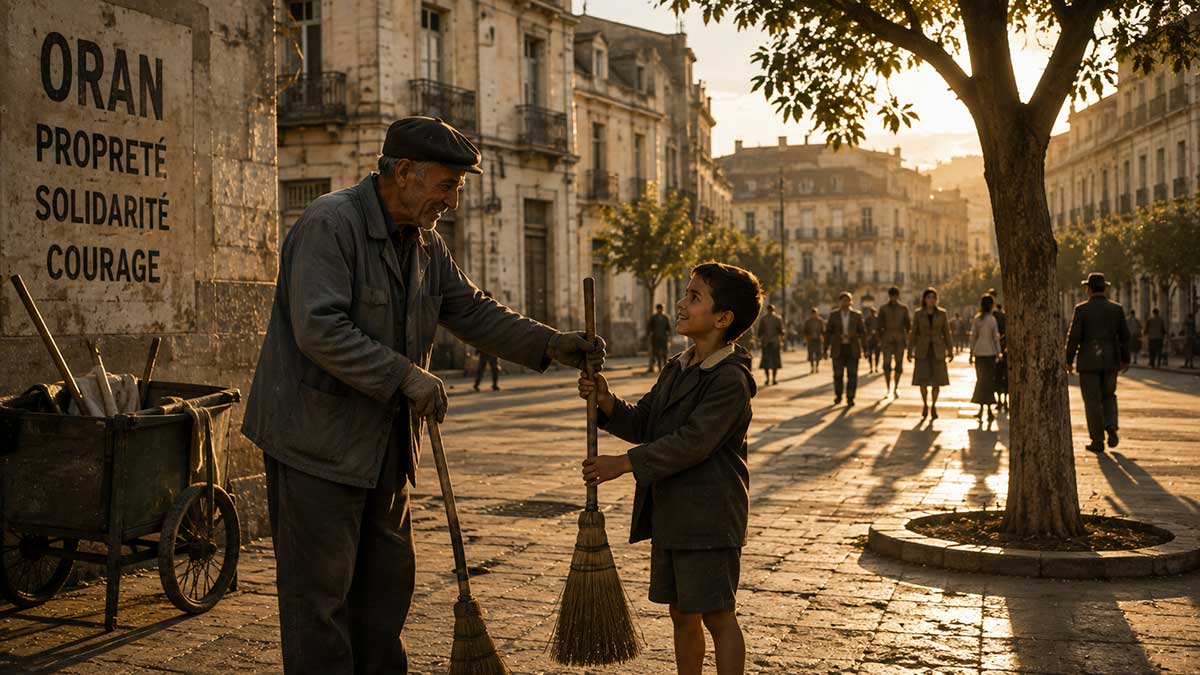
The afternoon sun settled softly across the town hall.
The wooden boat still rested in the center of the table.
No one had moved it.
Outside, Oran was alive again.
Shopkeepers argued over prices. Laundry fluttered between balconies. Children chased each other through the square as though the plague belonged to another century.
Inside, six people remained surrounded by memories no one outside could see.
Tarrou broke the silence.
Jean Tarrou: We have spoken about fear.
We have spoken about love.
We have spoken about faith.
Perhaps we should speak about something people misunderstand more than any of those.
Heroism.
Cottard smiled.
Cottard: Ah, yes.
The favorite lie people tell after every disaster.
Everyone becomes a hero once enough time has passed.
Tarrou ignored him.
He looked toward Rieux.
Jean Tarrou: Doctor...
People call you the hero of Oran.
Rieux almost looked offended.
Dr. Bernard Rieux: They should stop.
Raymond Rambert: Why?
Dr. Bernard Rieux: Because it is untrue.
Father Paneloux: You served without rest.
Dr. Bernard Rieux: So did hundreds of others.
Jean Tarrou: Yet history remembers your name.
Dr. Bernard Rieux: History remembers poorly.
Grand quietly nodded.
Joseph Grand: It usually remembers the people who wrote the reports.
A small smile passed around the table.
Even Rieux smiled.
Dr. Bernard Rieux: Grand may be correct.
Cottard leaned forward.
Cottard: You all dislike the word "hero."
Yet if a man risks his life every day to save strangers...
what else should we call him?
Dr. Bernard Rieux: A doctor.
Cottard: That answer sounds noble.
Dr. Bernard Rieux: No.
It sounds ordinary.
That is exactly the point.
Tarrou rested his elbows on the table.
Jean Tarrou: Explain.
Rieux looked toward the window.
A street sweeper slowly pushed leaves into a pile.
No one applauded him.
No one even noticed him.
Dr. Bernard Rieux: If every person doing his work honestly becomes a hero...
then heroism loses its meaning.
Jean Tarrou: Or perhaps it finally gains the right one.
Rieux turned toward him.
Tarrou continued.
Jean Tarrou: We have trained ourselves to believe heroes must be extraordinary.
Perhaps civilization survives because ordinary people quietly refuse to abandon one another.
Grand lowered his eyes.
Joseph Grand: That sounds much larger than I ever felt.
Tarrou smiled gently.
Jean Tarrou: Exactly.
You never felt heroic.
Grand looked genuinely puzzled.
Joseph Grand: Should I have?
Jean Tarrou: No.
That is why you interest me.
Rambert nodded.
Raymond Rambert: I agree.
When I first met Grand...
I barely noticed him.
Grand laughed softly.
Joseph Grand: Most people didn't.
Raymond Rambert: You worried about grammar.
You rewrote the same sentence over and over.
You looked...
forgive me...
completely average.
Grand smiled.
Joseph Grand: I probably was.
Rambert shook his head.
Raymond Rambert: Then the plague came.
And somehow...
everyone began depending on you.
Grand looked confused.
Joseph Grand: I only kept records.
Cottard: "Only."
There is the word again.
People hide remarkable lives behind the word "only."
"I only answered the telephone."
"I only cleaned the ward."
"I only carried water."
"I only buried the dead."
Tarrou looked toward him with surprise.
Jean Tarrou: That may be the wisest thing you have said.
Cottard shrugged.
Cottard: I have watched people my entire life.
Most are desperate to become important.
Few notice the people actually holding society together.
Silence followed.
It was the first time anyone had considered Cottard's words instead of resisting them.
Father Paneloux spoke quietly.
Father Paneloux: During the epidemic...
I often watched women cleaning hospital floors.
No speeches.
No recognition.
No applause.
Only another floor waiting tomorrow.
He paused.
Father Paneloux: I used to think sainthood belonged inside churches.
Now I wonder whether it spends more time holding a mop.
Grand laughed.
Then immediately looked embarrassed for laughing.
Joseph Grand: I never imagined hearing that from a priest.
Paneloux smiled.
Father Paneloux: Neither did I.
Rieux folded his hands.
Dr. Bernard Rieux: The plague taught me something uncomfortable.
Rambert looked toward him.
Raymond Rambert: What?
Dr. Bernard Rieux: Society depends almost entirely on people whose names no one knows.
The room became quiet again.
Outside, the street sweeper finished his work.
A few children immediately scattered fresh leaves across the pavement.
The old man sighed...
and began sweeping again.
Tarrou watched through the window.
Jean Tarrou: There.
That man.
He has just become today's greatest philosopher.
Grand followed his gaze.
The old man never complained.
Never stopped.
Never looked toward the children.
He simply continued.
Grand whispered almost to himself.
Joseph Grand: He knows the leaves will return tomorrow.
Jean Tarrou: Yes.
Joseph Grand: Yet he still sweeps.
Jean Tarrou: Yes.
Grand looked toward Rieux.
Joseph Grand: Is that what medicine feels like?
Rieux answered without hesitation.
Dr. Bernard Rieux: Every day.
Rambert stared at the street sweeper.
Raymond Rambert: Then victory isn't really the goal.
Dr. Bernard Rieux: Rarely.
Raymond Rambert: Then why continue?
Rieux smiled faintly.
Dr. Bernard Rieux: Because the next patient deserves the same effort as the last.
Tarrou slowly closed his eyes.
Jean Tarrou: There it is again.
Duty without illusion.
That may be the closest thing to courage I know.
Cottard frowned.
Cottard: I still don't understand you people.
Everyone here talks about duty.
No one talks about happiness.
Grand answered before anyone else.
Joseph Grand: Happiness came unexpectedly.
Cottard looked surprised.
Cottard: During the plague?
Grand nodded.
Joseph Grand: Sometimes.
Very small moments.
Sharing soup.
Someone smiling after recovering.
Watching volunteers laugh despite exhaustion.
Receiving a letter.
Finding five minutes without hearing coughing.
He smiled gently.
Joseph Grand: Those moments became enormous.
Rambert looked thoughtful.
Raymond Rambert: Strange.
Before the plague...
those same moments hardly mattered.
Father Paneloux: Suffering teaches proportion.
Rieux quietly added,
Dr. Bernard Rieux: Or removes distractions.
Tarrou reached toward the wooden boat.
He carefully turned it in his hands.
The uneven mast caught the afternoon light.
Jean Tarrou: May I ask each of you something?
Everyone nodded.
Jean Tarrou: Who was the greatest hero you met during the plague?
The question surprised them.
No one answered immediately.
Finally...
Paneloux spoke.
Father Paneloux: A young nurse.
She prayed before entering every room.
Not because she expected miracles...
but because she feared becoming indifferent.
No one ever learned her name.
Tarrou nodded.
Then looked toward Rambert.
Jean Tarrou: And you?
Rambert stared outside.
Raymond Rambert: A sanitation worker.
He had lost both parents.
Every evening...
he still joked with frightened children.
I never asked his name.
I wish I had.
Tarrou turned toward Grand.
Grand hesitated.
Then smiled.
Joseph Grand: Mine is embarrassing.
Everyone waited.
Joseph Grand: An old baker.
Every morning...
he quietly left bread outside houses where people had lost someone.
He never knocked.
He never waited for thanks.
One morning...
I saw him wipe flour from his hands...
look around to make sure no one had noticed...
then hurry away.
Grand laughed softly.
Joseph Grand: He seemed almost disappointed that kindness might be discovered.
The table smiled with him.
Tarrou looked toward Cottard.
Jean Tarrou: Your turn.
Cottard looked genuinely uncomfortable.
He avoided everyone's eyes.
Cottard: I disliked heroes.
Tarrou waited.
Cottard: They made me feel smaller.
Silence.
Then...
Cottard: But there was one man.
No one knew who he was.
He spent days carrying bodies.
Every evening...
he sat alone outside the hospital...
ate a piece of bread...
then returned the next morning.
One day I asked him...
"Why do you keep coming back?"
Cottard's voice became quieter.
Cottard: He looked confused.
As though the question itself made no sense.
Then he said...
"I'm still able to."
Cottard looked down.
Cottard: That was his entire answer.
The room remained silent.
Tarrou slowly smiled.
Jean Tarrou: That may be the finest definition of heroism yet.
"I'm still able to."
Nothing more.
Nothing less.
Finally...
everyone looked toward Rieux.
Jean Tarrou: Doctor.
Who was your hero?
Rieux didn't answer immediately.
Instead...
he slowly reached across the table.
He took Grand's stack of papers.
The attendance lists.
Supply requests.
Death records.
Volunteer schedules.
Letters.
Names.
Thousands of names.
He gently placed them in the center of the table.
Dr. Bernard Rieux: Them.
Everyone looked down.
Not one famous person.
Only ordinary citizens.
Teachers.
Shopkeepers.
Janitors.
Students.
Mothers.
Clerks.
Drivers.
Volunteers.
Neighbors.
People history would almost certainly forget.
Rieux rested one hand on the stack.
Dr. Bernard Rieux: Every epidemic creates famous names.
But it survives...
or ends...
because of people whose names never leave these pages.
Grand slowly reached forward.
His fingers rested lightly on the papers.
Almost protectively.
His voice barely rose above a whisper.
Joseph Grand: Then perhaps...
our greatest mistake is searching for heroes instead of becoming neighbors.
No one spoke.
Outside...
the street sweeper finished clearing the square.
A young boy accidentally scattered leaves across the clean pavement once again.
The old man looked up.
The boy froze...
expecting anger.
Instead...
the old sweeper smiled.
He handed the child a second broom.
The boy laughed.
Together...
they began sweeping.
Tarrou watched through the window.
A smile spread slowly across his face.
Jean Tarrou: Perhaps civilization survives exactly like that.
One broom at a time.
The afternoon sun settled over the square.
Inside the town hall...
no one argued.
For the first time since the conversation began...
they simply watched two ordinary people quietly making the world a little cleaner.
No speeches.
No applause.
No monuments.
Only work.
Only kindness.
Only another day.
This act shifts the emotional center away from famous figures and toward Camus' deepest conviction: the true heroes are ordinary people who quietly continue doing what must be done. It also prepares the final act, which asks whether humanity ever learns—or whether "the plague" simply changes its form.
Act 5: Will Humanity Ever Learn?
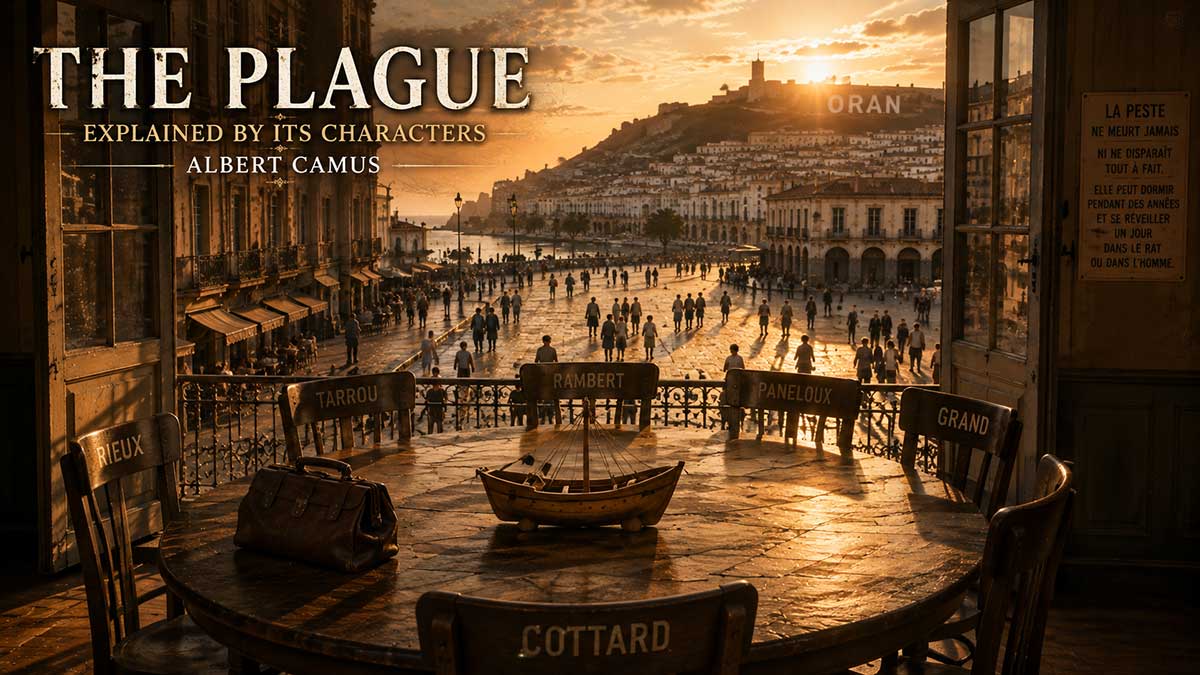
Evening settled over Oran.
The sunlight that had filled the town hall all afternoon had faded into long shadows. The square outside glowed with lanterns. Families walked home carrying bread and flowers. A violinist had taken his place near the fountain, playing quietly for those passing by.
Life had returned.
Or had it?
The six chairs around the table had not moved.
The wooden boat remained where it had rested since the young boy left it behind.
Tarrou looked through the open window.
Jean Tarrou: Listen.
Everyone became still.
Children laughing.
Glasses clinking from a nearby café.
A dog barking.
A train whistle in the distance.
The ordinary sounds of a city alive.
Tarrou smiled.
Jean Tarrou: This is what everyone fought to recover.
Rieux nodded.
Dr. Bernard Rieux: Yes.
Tarrou looked around the table.
Jean Tarrou: Then I must ask the question that has troubled me ever since the gates reopened.
He folded his hands.
Jean Tarrou: Did humanity actually learn anything?
No one answered.
It was Grand who finally broke the silence.
Joseph Grand: We always learn something.
Cottard smiled.
Cottard: And then forget it.
Grand looked at him.
Joseph Grand: Perhaps.
Cottard: Not perhaps.
Certainly.
Look outside.
People laugh exactly as they laughed before.
They hurry exactly as they hurried before.
Soon they will complain about small inconveniences again.
Someone will shout because his coffee is cold.
Someone will curse his neighbor over a fence.
Someone will believe disaster only happens to other people.
He shrugged.
Cottard: Human beings recover quickly.
Sometimes too quickly.
Rambert watched the families in the square.
Raymond Rambert: Is forgetting always wrong?
Tarrou turned toward him.
Jean Tarrou: What do you mean?
Raymond Rambert: If people remembered every funeral...
every hospital...
every scream...
could they ever live happily again?
Silence.
Paneloux answered softly.
Father Paneloux: Forgetting can be mercy.
Rieux nodded.
Dr. Bernard Rieux: But selective forgetting can become permission.
The room grew quiet.
Grand spoke almost to himself.
Joseph Grand: Perhaps memory should become wisdom...
not a prison.
Tarrou smiled.
Jean Tarrou: I wish more people thought like that.
Cottard leaned back.
Cottard: They don't.
They remember pain.
They forget responsibility.
That has always been the pattern.
Tarrou looked toward him.
Jean Tarrou: You sound certain.
Cottard: I am.
Show me one century that learned permanently from the previous one.
No one answered.
Cottard continued.
Cottard: One plague ends.
Another begins.
One war ends.
Another starts.
One hatred fades.
Another finds a different name.
He looked directly at Rieux.
Cottard: Your plague died.
Human nature did not.
Rieux remained calm.
Dr. Bernard Rieux: Human kindness did not die either.
Cottard smiled.
Cottard: True.
Which wins?
Rieux looked outside.
An elderly man stopped to help a child retrieve a dropped toy.
Neither knew the other.
The exchange lasted only seconds.
Then each continued walking.
Dr. Bernard Rieux: The wrong question.
Cottard frowned.
Cottard: Why?
Dr. Bernard Rieux: Goodness is not trying to win.
It is trying to remain alive.
Tarrou nodded slowly.
Jean Tarrou: Like a candle.
One candle does not eliminate the night.
It simply refuses to become darkness.
No one spoke.
The violin outside continued playing.
Grand looked toward the boat.
Joseph Grand: Earlier today...
we spoke about heroes.
Perhaps we should speak about successors.
Rambert looked puzzled.
Raymond Rambert: Successors?
Joseph Grand: We kept asking who saved Oran.
Perhaps the better question is...
Who teaches the next generation what happened here?
Paneloux smiled gently.
Father Paneloux: That may be the holiest work of all.
Tarrou leaned forward.
Jean Tarrou: Then let me ask each of you something.
If you could leave one sentence...
just one...
for people living many generations after us...
what would it be?
The room became completely still.
Outside...
the violin stopped.
Only the fountain remained.
Tarrou looked first toward Grand.
Grand thought for a long time.
Finally...
he spoke.
Joseph Grand: Never believe your ordinary kindness is too small to matter.
Tarrou nodded.
Then turned toward Rambert.
Rambert smiled faintly.
Raymond Rambert: Love one person deeply...
but never become blind to everyone else.
Tarrou wrote neither sentence down.
He simply listened.
Next...
he looked toward Paneloux.
The priest folded his hands.
Father Paneloux: Speak less about why people suffer...
and spend more time beside them while they do.
Rieux quietly lowered his eyes.
Tarrou turned toward Cottard.
Cottard laughed.
Cottard: Mine won't be popular.
Jean Tarrou: That has never stopped you.
Cottard looked toward the window.
His expression had lost much of its sarcasm.
Cottard: Watch yourself most carefully...
when everyone agrees with you.
The room became unexpectedly thoughtful.
Tarrou looked surprised.
Jean Tarrou: Why?
Cottard: Crowds have committed more evil than lonely men.
No one argued.
Finally...
everyone turned toward Rieux.
He looked older than he had that morning.
Not tired.
Simply older.
His hand rested lightly on the worn leather of his medical bag.
Jean Tarrou: Doctor?
Rieux looked out into the evening.
Dr. Bernard Rieux: Do not wait until suffering reaches your own home before believing it exists.
Silence.
Tarrou nodded.
Then...
everyone looked toward him.
He smiled sadly.
Jean Tarrou: Mine is simple.
He looked around the table.
Jean Tarrou: Every one of us carries the plague.
The question is whether we recognize it before it reaches someone else.
No one moved.
The words settled over the room like evening itself.
After a long silence...
Grand spoke.
Joseph Grand: Tarrou...
what exactly is "the plague"?
Tarrou looked at each face.
One by one.
Jean Tarrou: It is whatever persuades us that another person's suffering is none of our concern.
No one answered.
The definition needed nothing added.
Outside...
a young couple crossed the square holding hands.
An elderly widow sat alone feeding pigeons.
A delivery boy hurried past.
A homeless man arranged cardboard beneath a doorway.
Hundreds of lives.
Different stories.
The same city.
Rambert quietly asked,
Raymond Rambert: Then the plague never truly ended.
Tarrou looked toward him.
Jean Tarrou: No.
Only one form of it ended.
Paneloux slowly nodded.
Father Paneloux: Pride can become a plague.
Hatred.
Indifference.
Cruelty.
Greed.
Despair.
Anything that spreads from soul to soul until people stop seeing each other as neighbors.
Grand whispered,
Joseph Grand: Loneliness.
Rieux added,
Dr. Bernard Rieux: Apathy.
Rambert looked toward the homeless man outside.
Raymond Rambert: Looking away.
Cottard quietly said,
Cottard: Fear.
No one corrected anyone.
Each answer belonged.
The evening breeze carried the smell of fresh bread into the room.
Tarrou stood.
He walked slowly toward the open window.
The others remained seated.
He rested both hands on the windowsill.
The square stretched before him.
Alive.
Beautiful.
Fragile.
Without turning around, he spoke.
Jean Tarrou: We have spent all day discussing the plague.
Perhaps we should end somewhere else.
He looked at the families below.
Jean Tarrou: Tell me...
after everything we lived through...
what gives each of you hope?
For the first time...
everyone smiled before answering.
Grand answered first.
Joseph Grand: People.
Rambert looked toward the young couple.
Raymond Rambert: Reunion.
Paneloux watched the church bell.
Father Paneloux: Mercy.
Cottard surprised everyone.
He watched the old sweeper from earlier.
The man was still working.
This time...
three children were helping him.
No one had asked them to.
Cottard: Habit.
Tarrou raised an eyebrow.
Cottard: Good habits spread too.
The room laughed.
It was the first genuine laughter of the day.
Finally...
everyone looked toward Rieux.
The doctor picked up the little wooden boat.
He ran one finger gently along the uneven mast.
Then he carried it to the open window.
For a moment...
it looked as though he might place it outside.
Instead...
he returned it carefully to the center of the table.
Dr. Bernard Rieux: Hope...
is not believing another plague will never come.
He looked around the table.
Dr. Bernard Rieux: Hope is believing there will always be someone willing to carry the bag...
sweep the street...
bake the bread...
pray beside the dying...
record the forgotten names...
or choose to stay when leaving would be easier.
He looked at each of them.
Dr. Bernard Rieux: As long as those people exist...
the plague never has the final word.
No one spoke.
The church clock struck once.
The violin began again in the square.
The six figures remained seated together.
The conversation had ended.
Yet the question Camus had asked nearly eighty years earlier remained quietly alive.
Not in Oran.
Not in history.
But wherever one person stood before another and silently decided—
"Your suffering is my concern."
Outside, night settled over the city.
Inside, no one reached for the door immediately.
They sat together a little longer, listening to the ordinary sounds of life they had once feared they would never hear again.
Final Thoughts by Albert Camus
The plague did not disappear because human beings became wiser.
It disappeared because epidemics, like wars, eventually lose their immediate grip upon a city.
That is not the same thing as saying humanity has changed.
The greatest danger has never been the disease itself.
The greatest danger is believing that evil belongs only to extraordinary moments.
It rarely does.
It lives quietly inside habits of indifference, prejudice, pride, cruelty, and the comforting belief that another person's suffering has nothing to do with us.
That is why Dr. Rieux ends the novel by warning that the plague bacillus never dies completely.
He is not speaking only about illness.
He is speaking about every force that slowly persuades us to stop recognizing one another as neighbors.
Yet I did not write The Plague to leave readers in despair.
If darkness can spread from one person to another, so can compassion.
If hatred can become contagious, kindness can become contagious as well.
The future has never depended upon extraordinary heroes.
It has depended upon countless ordinary people who quietly choose honesty over deception, mercy over judgment, courage over comfort, and responsibility over indifference.
If this conversation has accomplished anything, I hope it has reminded you that the next plague may wear a different face, but the answer remains remarkably similar.
Notice suffering.
Stand beside those who carry it.
Refuse to become indifferent.
That is not a perfect cure.
It never has been.
But it is where every cure begins.
Short Bios:
Albert Camus (1913–1960)
French-Algerian novelist, essayist, journalist, and philosopher. Awarded the 1957 Nobel Prize in Literature for illuminating "the problems of the human conscience." His major works include The Stranger, The Plague, The Fall, The Myth of Sisyphus, and The Rebel. Though often associated with existentialism, Camus preferred to describe his philosophy through the idea of the absurd: a world without guaranteed meaning met by a person who refuses despair.
Dr. Bernard Rieux
A physician and the novel's central narrator. Calm, practical, and deeply compassionate, Rieux believes human decency begins with simply doing one's job faithfully. He represents moral action without the need for recognition.
Jean Tarrou
A thoughtful outsider who organizes volunteer sanitation teams during the epidemic. Tarrou seeks a way to live without contributing to violence or injustice and becomes one of the novel's deepest philosophical voices on responsibility and solidarity.
Raymond Rambert
A journalist trapped inside Oran while trying to reunite with the woman he loves. His struggle between personal happiness and shared responsibility becomes one of the novel's most moving moral transformations.
Father Paneloux
A Jesuit priest whose certainty is shaken after witnessing the suffering of innocent children. His journey explores the tension between faith, doubt, compassion, and the limits of human explanation.
Joseph Grand
A humble municipal clerk known for endlessly revising the opening sentence of a novel he dreams of writing. During the epidemic, his quiet diligence reveals that history is often sustained by ordinary people whose names are rarely remembered.
Cottard
A troubled man who initially benefits from the city's quarantine because widespread fear mirrors his own private anxieties. Cottard embodies opportunism, isolation, and the unsettling truth that crises reveal very different sides of human nature.
Leave a Reply