
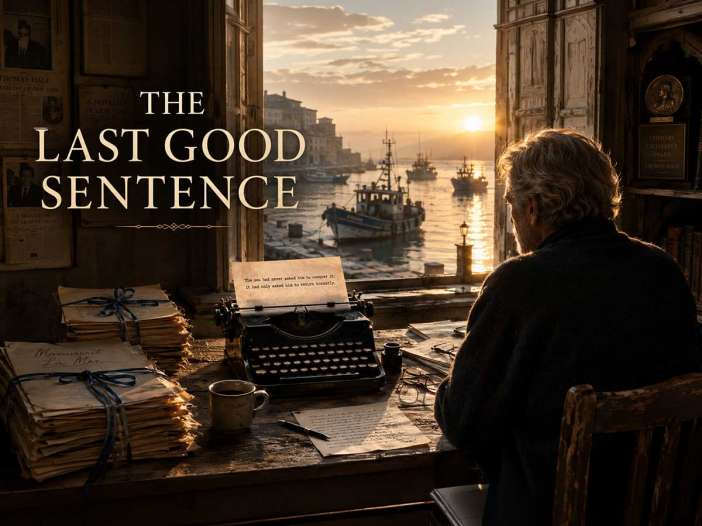
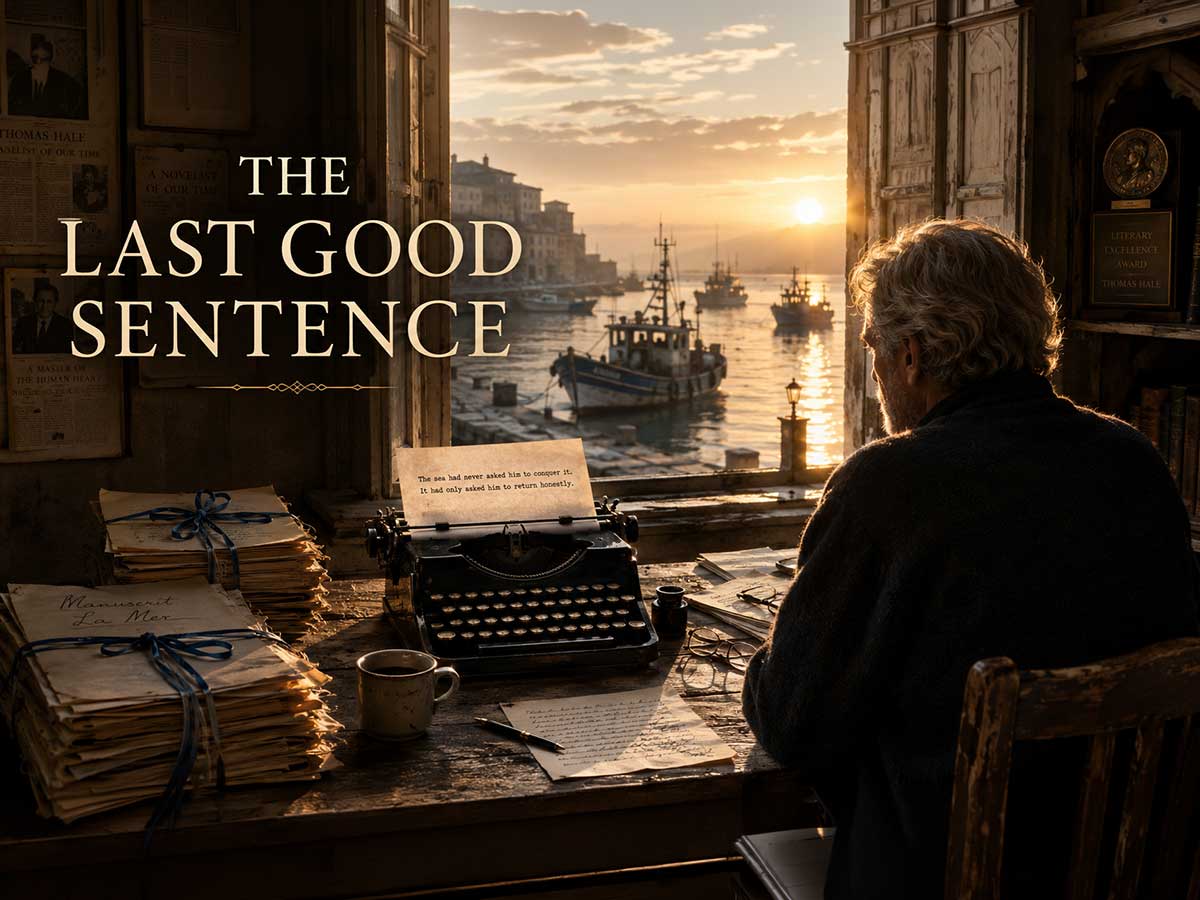
There comes a point in many lives when the greatest question is no longer, "Can I succeed?"
It becomes, "Who have I become while succeeding?"
Thomas Hale has spent a lifetime answering the first question.
His novels shaped generations. His name filled bookstores, lecture halls, and newspaper headlines. Readers admired his courage. Critics praised his discipline. Young writers copied his style. To the world, he became the image of literary greatness.
Yet somewhere between applause and achievement, he quietly misplaced the man who had wanted to tell the truth.
Now, living alone in a small fishing village in southern France, Thomas discovers that writing has become strangely impossible. The problem is not a lack of ideas. It is something far more unsettling. Every sentence sounds like someone trying to protect the famous writer he used to be.
Then a young translator named Lucie begins asking questions no interviewer ever dared ask.
Not about his books.
About his life.
At the same time, a local fisherman named Étienne unknowingly teaches him lessons no literary prize ever could. Every morning he repairs torn nets, accepts poor catches without bitterness, and returns to the sea without demanding that it reward him.
Slowly, Thomas begins writing one final novel.
At first he believes he is trying to save his reputation.
Then he realizes he is trying to recover himself.
The Last Good Sentence is not a story about literary fame.
It is a story about identity.
About the quiet cost of success.
About the loneliness hidden behind admiration.
And about the possibility that the bravest act in a person's life is not enduring alone, but allowing someone else to remain beside them.
Inspired by the enduring questions raised in Ernest Hemingway's The Old Man and the Sea, this is an original work of fiction that asks a new question:
What if the greatest masterpiece a person creates is not the work they leave behind—but the person they become before they leave?
(Note: This is an imaginary conversation, a creative exploration of an idea, and not a real speech or event.)
1. The Man Everyone Had Already Finished
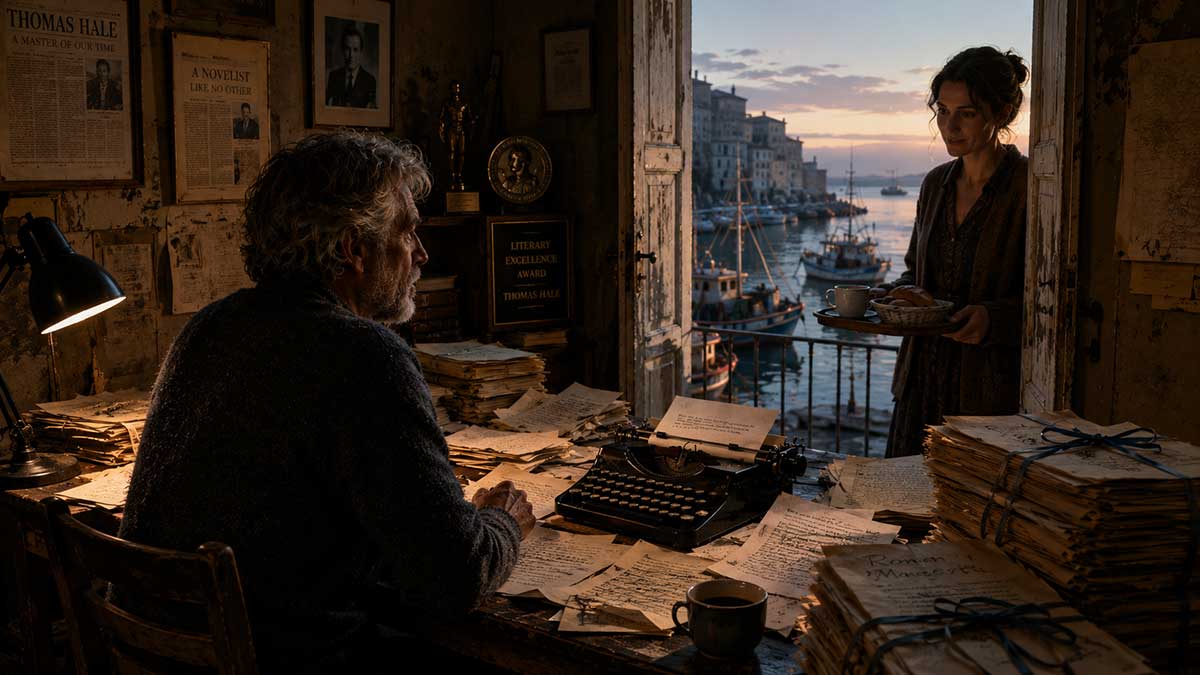
The fishing boats always left before daylight.
Thomas Hale knew this because he had stopped sleeping long before he had stopped pretending to.
At first light the harbor below his window became a procession of small yellow lamps drifting into darkness. One by one the engines started, echoed briefly against the stone buildings, then faded into the open sea until only gulls and waves remained.
Every morning he watched them leave.
Every morning he promised himself he would not.
The room above Café des Mouettes had been built for travelers who intended to stay a week.
Thomas had lived there for nearly three years.
It held only what he could no longer persuade himself to throw away.
An iron bed.
A narrow wardrobe.
A bookshelf crowded with novels whose authors had once been his friends.
An oak desk facing the harbor.
And a black typewriter whose paint had worn smooth beneath his fingertips.
Everything else had quietly disappeared.
The framed reviews had been turned toward the wall months ago.
The medals remained inside a drawer he rarely opened.
The photograph from Stockholm stayed hidden beneath a stack of unpaid electric bills.
He had discovered something unpleasant about awards.
They became heavier after no one asked about them anymore.
Outside, the village awakened without ceremony.
A baker unlocked his shop.
Someone rolled bicycles across uneven stones.
The church bell rang once, then again.
A woman opened blue shutters across the street and shook a tablecloth into the cool morning air.
None of it required applause.
Thomas envied that.
He walked stiffly toward the small stove and poured yesterday's coffee into a saucepan.
His hands trembled.
Not dramatically.
Just enough to make pouring slower than it used to be.
The doctor had given the trembling a name.
Thomas preferred not to.
Once an illness had a proper name, people began treating it like the main character.
He warmed the coffee.
Forgot about it.
Burned it.
Drank it anyway.
The bitterness suited the morning.
The typewriter waited.
A fresh sheet of paper sat inside it.
White.
Patient.
Accusing.
He lowered himself into the chair and rested both hands on the keys.
For several minutes he did nothing.
He had learned that writing and typing were not the same activity.
Typing produced pages.
Writing required the disappearance of something standing between the writer and the truth.
Lately that something refused to move.
He pulled the page from the machine.
Blank.
He folded it once and placed it beside dozens of other folded pages stacked neatly inside a wooden box.
Visitors would have mistaken them for letters.
Thomas knew better.
Each one was a morning he had been unable to cross.
He opened the desk drawer.
Inside lay several unfinished manuscripts tied together with faded blue ribbon.
Some had promising beginnings.
Others had magnificent sentences.
None possessed a living heart.
He untied the ribbon.
The first page began:
There are mornings when the sea remembers your name before you do.
He read the sentence twice.
Years earlier he would have admired it.
Now it sounded like someone trying very hard to sound like Thomas Hale.
He slipped the page underneath the others.
Another manuscript opened with war.
Another with lovers separated by snow.
Another with a famous boxer growing old.
One story ended after twenty pages.
Another after one hundred.
Each had failed at exactly the same place.
The moment they began admiring themselves.
He tied the ribbon again.
The church bell struck eight.
Someone knocked.
Without waiting for permission, the door opened.
Lucie entered carrying a tray.
Fresh coffee.
Warm bread.
Orange marmalade.
She never asked whether he wanted breakfast.
She simply behaved as though the question had already been settled.
"You burned yesterday's again."
"I like it that way."
"No, you don't."
She poured fresh coffee into a cup and quietly emptied the scorched coffee into the sink.
"You've become very confident."
"You've become very predictable."
She smiled.
"I'll take that as progress."
She set the tray on the desk.
Only then did she notice the blank page folded beside the others.
Her eyes drifted toward the wooden box.
"Another one?"
Thomas nodded.
"They're breeding."
"You should stop feeding them."
He laughed.
It surprised both of them.
She glanced toward the stack of manuscripts.
"May I?"
"You never wait for the answer."
"I asked."
"You did."
She untied the faded ribbon and opened the newest draft.
Silence.
She read only the first page before closing it.
Then another.
Then another.
Finally she returned them to the drawer exactly as she had found them.
"They're beautiful."
Thomas looked out the window.
He had heard that word too often.
Beauty had become suspicious.
She continued.
"They're just not alive."
He said nothing.
"They already know what kind of writer they're supposed to be."
Still nothing.
"They don't know what kind of man is writing them."
The words settled between them.
Neither tried to move them.
Below the window, Étienne pushed his small fishing boat away from the dock.
Thomas watched him untangle a section of net that had snagged against a piling.
The fisherman worked patiently.
No hurry.
No frustration.
No audience.
When the last knot loosened, Étienne nodded to himself, climbed aboard, and steered toward open water.
Lucie watched him too.
"He never looks around."
"For what?"
"To see whether anyone noticed."
Thomas remained silent.
After another moment she said quietly,
"Perhaps that's why he still loves it."
She picked up the empty tray.
At the door she stopped.
"When you finally begin again..."
Thomas looked up.
"...don't try to write your next great novel."
She opened the door.
"Write the truest page you can survive."
The room grew still after she left.
Outside, the sea had turned silver beneath the rising sun.
Thomas remained seated for a long time.
Not thinking.
Listening.
The harbor.
The gulls.
The typewriter.
His own breathing.
For the first time in months, he understood that the silence frightening him was not on the page.
It was inside him.
Slowly he removed another sheet of paper from the drawer.
He rolled it into the typewriter.
His fingers rested on the keys.
He resisted every clever opening that came to mind.
No beautiful weather.
No memorable quotation.
No dramatic first sentence meant to impress strangers.
Only one quiet truth.
He typed.
The old fisherman had forgotten what hope sounded like, but every morning he still walked toward the sea.
Thomas read the sentence once.
Then again.
It was plain.
Almost invisible.
He smiled.
Not because it was great.
Because, at last, it no longer sounded as though it was asking anyone to admire the man who had written it.
Outside, another fishing boat disappeared beyond the breakwater.
For reasons he could not explain, Thomas felt relieved that he did not need to follow it.
Not yet.
2. The Girl Who Read the Silence
The next morning, Thomas woke before the fishing boats.
For a moment he did not remember why.
Then he saw the page still resting in the typewriter.
The old fisherman had forgotten what hope sounded like, but every morning he still walked toward the sea.
He read it again.
The sentence had survived the night.
That did not happen often.
Usually, whatever seemed honest in darkness looked theatrical by morning.
This one remained quiet.
He touched the paper lightly, almost expecting it to disappear.
Instead, another sentence arrived.
Not fully.
Only the shape of one.
He pulled a fresh sheet from the drawer.
Rolled it into the machine.
Then stopped.
He had made this mistake before.
One good sentence had often tempted him into twenty unnecessary ones.
He stood instead.
Opened the window.
The harbor still belonged to fishermen.
Étienne was already at the dock.
One section of his net had twisted around itself during yesterday's return.
Thomas watched him work.
There was no frustration.
No dramatic sigh.
No muttered complaint against fate.
The fisherman simply followed one knot at a time until each surrendered.
When the final loop loosened, he smiled almost imperceptibly.
Then he folded the net and carried it aboard.
Nothing about the moment asked to be remembered.
Thomas suspected that was precisely why he would remember it.
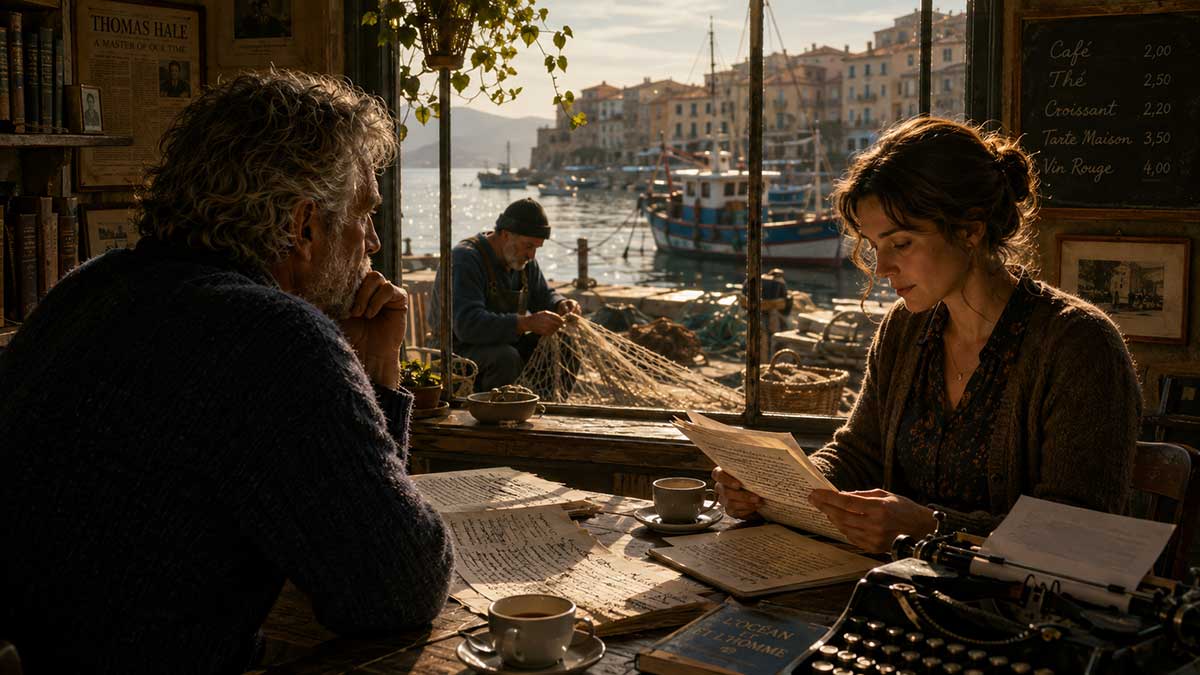
The café smelled of butter and coffee.
Lucie was arranging fresh croissants behind the counter.
She looked up.
"You slept."
"Apparently."
"You look less angry."
"I wasn't aware I looked angry."
"You've looked angry since the day you arrived."
She placed a cup in front of him.
"This morning you're merely suspicious."
He accepted the coffee.
"I brought something."
She looked toward the folded pages in his hand.
"The fisherman?"
He nodded.
"Will you read it?"
She smiled.
"You asked this time."
They sat at a small table facing the harbor.
Morning customers spoke softly around them.
Someone read a newspaper.
Two cyclists studied a map.
A child pressed his face against the bakery window next door.
Lucie unfolded the pages.
Thomas watched the sea instead of her expression.
She read once.
Then again.
The silence stretched long enough for him to regret asking.
Finally she folded the papers carefully.
"The first sentence is true."
He exhaled.
"The second paragraph isn't."
"I thought it worked."
"It works."
She paused.
"That's different."
He frowned.
"I don't follow."
"You became aware you were writing."
She pointed gently to one paragraph.
"Here."
He read it silently.
The language flowed beautifully.
Every image landed perfectly.
Every rhythm echoed the voice readers expected from Thomas Hale.
He had been pleased with it.
Now something inside it embarrassed him.
"It sounds polished," he said.
"It sounds protected."
She waited.
"The old fisherman disappears."
Thomas looked up.
"What do you mean?"
"You stop trusting him."
She tapped the page.
"You begin explaining him."
Outside, a fishing boat crossed the harbor entrance.
Étienne stood alone at the stern.
Tiny against the sea.
Lucie watched him.
"He doesn't explain the sea."
"He fishes."
She turned back toward Thomas.
"You don't trust your fisherman to live without your reputation standing behind him."
The words landed harder than she intended.
Or perhaps exactly as she intended.
Thomas folded the pages.
For several minutes neither of them spoke.
Finally he asked,
"Do you know what the hardest part of becoming known is?"
Lucie shook her head.
"You begin hearing readers while you're still writing."
She listened.
"They're always in the room."
"The critics?"
"The admirers."
He smiled sadly.
"The critics arrive later."
He looked toward the harbor.
"People spend years encouraging you to sound like yourself."
He laughed quietly.
"One day you realize they're asking you to imitate a younger man who no longer exists."
Lucie stirred her coffee.
"What if he isn't supposed to exist anymore?"
Thomas looked at her.
She continued.
"My grandmother used to keep every birthday card my grandfather ever wrote."
He waited.
"The oldest ones were full of poetry."
"And the later ones?"
"They became shorter every year."
She smiled.
"The last card only said, 'I'm still glad it's you.'"
Thomas smiled despite himself.
"Romantic."
"No."
She looked out the window.
"Honest."
That afternoon they walked along the harbor.
Étienne was sitting on an overturned crate repairing lobster traps.
Thomas stopped beside him.
"You spend more time fixing things than catching fish."
Étienne shrugged.
"That is fishing."
Thomas sat beside him.
"How do you know when a net is no longer worth repairing?"
The fisherman continued threading new rope through the old mesh.
"When it catches nothing."
Thomas nodded.
"How do you know when that happens?"
Étienne smiled.
"The fish tell me."
Thomas laughed.
"You make it sound simple."
"It is simple."
The fisherman looked up.
"Simple isn't easy."
For a while they worked together in silence.
Thomas's fingers had forgotten the rhythm.
Étienne never corrected him.
He simply untangled whatever knots Thomas accidentally created.
Eventually Thomas asked,
"When do you cut the line?"
Étienne tied another knot.
"When the fish is teaching me nothing."
Thomas frowned.
"I thought every fish teaches something."
"They do."
The fisherman looked toward the sea.
"But eventually you're no longer chasing the fish."
"What are you chasing?"
"The version of yourself that needs to catch it."
The words remained suspended between them.
Neither man touched them.
That evening Thomas returned to his room.
The manuscript waited.
He reread the morning's pages.
Then he reached for a pencil.
One sentence disappeared.
Then another.
An entire paragraph.
A page.
Two pages.
The story became smaller.
The fisherman became larger.
Near sunset there were only three pages left.
He read them slowly.
For the first time in years he felt something unusual.
Not pride.
Relief.
As though someone had finally stopped talking loudly enough for him to hear another voice.
A knock came at the door.
Lucie entered carrying supper.
She noticed the stack of discarded pages on the floor.
"You cut them."
"I did."
"Do you miss them?"
Thomas looked at the pages.
He realized he did not.
"They were beautiful."
Lucie nodded.
"I know."
He looked back toward the manuscript.
"They just weren't true."
Neither of them spoke.
The evening light stretched across the desk.
Outside, the last fishing boats returned one by one.
Some carried full nets.
Others almost none.
Yet every fisherman tied his boat to the same weathered dock.
No one appeared ashamed.
No one appeared victorious.
They simply came home.
Thomas watched them until darkness settled across the harbor.
Then he rolled another sheet of paper into the typewriter.
This time he did not wonder whether the next sentence would be worthy of Thomas Hale.
He wondered only whether it belonged to the old fisherman.
It arrived quietly.
Without asking permission.
Without trying to impress anyone.
For the first time in many years, Thomas wrote until he forgot who was writing.
3. The Weight of Becoming Famous
For the next twelve mornings, the old fisherman came before Thomas did.
He woke thinking about him.
Not the way a writer thinks about a character.
More like the way one remembers someone waiting patiently downstairs.
The fisherman had become quieter.
He no longer asked Thomas to invent dramatic scenes or unforgettable speeches.
He simply wanted the sea.
Thomas found that strangely comforting.
The less he tried to impress the page, the more willingly the page spoke.
Each morning he wrote until the church bell rang nine.
Each afternoon he crossed out nearly half of what he had written.
Each evening he walked to the harbor without carrying a notebook.
The story was growing.
Slowly.
Like a boat disappearing into fog—not because it was lost, but because it knew where it was going before he did.
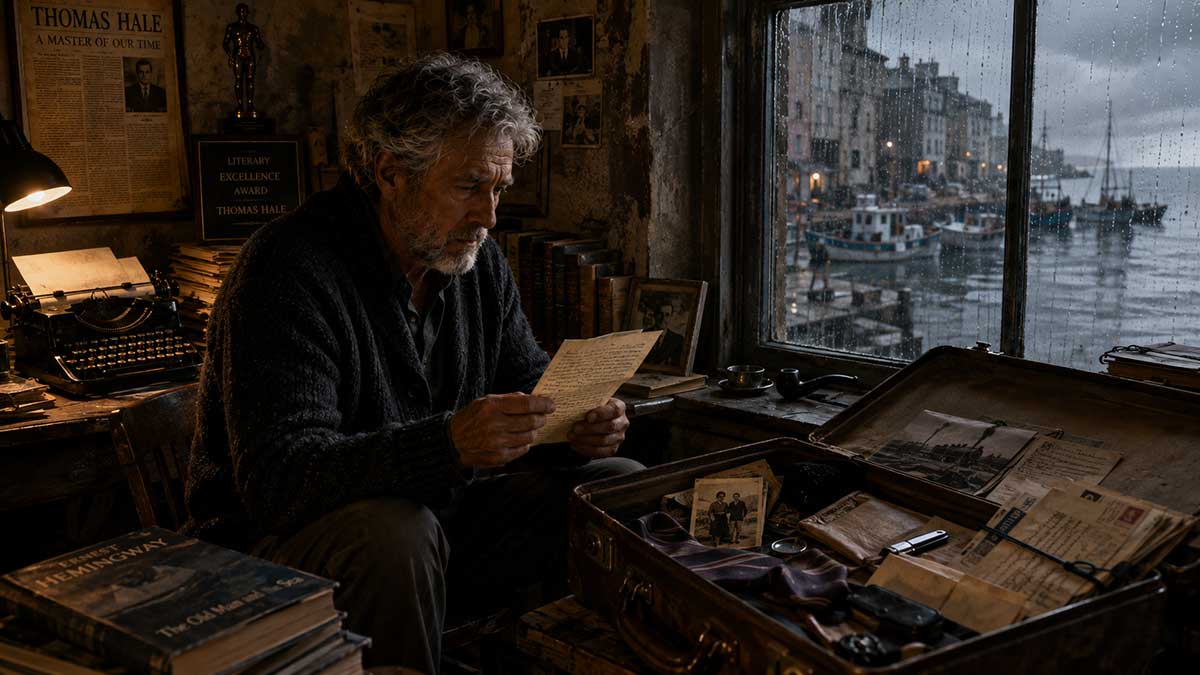
One rainy afternoon, the electricity failed.
The typewriter sat silent on the desk.
Thomas lit a candle and wandered around the room looking for something to occupy his hands.
His fingers stopped on an old leather suitcase beneath the bed.
He had not opened it in over a year.
Dust coated the brass clasps.
When he lifted the lid, the smell of old paper and tobacco drifted into the room.
Inside were objects that had once seemed too important to throw away.
Now they simply waited.
A faded train ticket.
Paris.
October, thirty-four years earlier.
He smiled.
He could no longer remember the journey itself.
Only the feeling that everything was still possible.
Beneath it lay a folded café receipt.
Two coffees.
One croissant.
A name scribbled across the bottom.
Julien.
Thomas closed his eyes.
Julien had once believed Thomas would become the greatest novelist of his generation.
Thomas had believed Julien would become an even greater one.
Instead, Julien married, became a schoolteacher, wrote quietly at night, and eventually stopped publishing altogether.
The last letter Thomas received from him ended with one sentence.
I miss the man who used to care more about stories than success.
Thomas had never answered.
He folded the letter and placed it back into the suitcase.
Not quickly.
Carefully.
Some regrets deserved gentleness.
Another object waited beneath it.
A pocketknife with a broken handle.
He remembered buying it in Spain.
Not the shop.
Only the afternoon.
The heat.
The dust.
The certainty that courage meant never stepping backward.
He smiled bitterly.
How many foolish things had he admired because they looked brave?
The knife returned to the suitcase.
Then came a hotel key.
A faded photograph.
An old pipe.
A fishing lure.
Every object carried the same question.
Not:
"What happened?"
But:
"What did it cost?"
The room had grown darker before he noticed.
Rain tapped softly against the window.
Thomas closed the suitcase.
He suddenly understood why he had stopped opening it.
It contained no memories of becoming famous.
Only memories of becoming someone fame slowly replaced.
The next morning Lucie found him sitting beside the closed suitcase.
"You've been traveling."
He looked up.
"Apparently."
She sat opposite him.
"Good trip?"
"I met someone."
"Oh?"
"My younger self."
She smiled.
"Did you like him?"
Thomas considered the question longer than expected.
"I admired him."
"That's different."
He nodded.
"Yes."
She poured coffee.
"What did he want?"
"Everything."
"And what did he get?"
Thomas looked toward the harbor.
"The wrong parts."
Lucie waited.
He continued.
"I thought success would buy freedom."
"It didn't?"
"It bought obligations."
He laughed quietly.
"The strange thing about becoming well known..."
He searched for the sentence.
"...is that eventually your reputation begins arriving everywhere before you do."
Lucie watched him.
"Does that become lonely?"
"No."
He paused.
"It becomes crowded."
That afternoon they walked along the seawall.
The wind was stronger than usual.
White waves broke against the rocks below.
Étienne stood repairing an engine outside his small shed.
Thomas waved.
The fisherman waved back with an oil-covered hand.
Nothing more.
No questions.
No admiration.
No discussion of literature.
Thomas envied that friendship.
It expected nothing.
As they continued walking, Lucie asked quietly,
"When was the last time someone visited you..."
She hesitated.
"...without wanting something?"
Thomas kept walking.
"The publisher wants another bestseller."
She nodded.
"The university wants lectures."
Another step.
"Journalists want memories."
He looked toward the sea.
"Readers want the man they already know."
Lucie said nothing.
"And you?"
She smiled.
"I wanted breakfast."
He laughed.
"No."
She stopped walking.
"I wanted to know whether the stories were true."
He looked at her.
"Were they?"
She held his eyes.
"I'm beginning to think they were."
He frowned.
"But?"
"They stopped."
That evening Thomas reread the manuscript.
The old fisherman now occupied nearly forty pages.
He had become real.
His hands.
His silence.
His habits.
His loneliness.
Thomas recognized something unsettling.
The fisherman never once thought about whether anyone would admire him.
He simply worried about tomorrow's sea.
Thomas closed the pages.
He walked to the mirror above the washbasin.
For several seconds he stared at his own reflection.
The face was older than he remembered.
Not weaker.
Simply quieter.
He realized something that unsettled him more than the wrinkles.
He could not remember the last time he had looked at himself without wondering how others saw him.
He covered the mirror with a towel.
Not out of shame.
Out of fatigue.
Three days later a thick envelope arrived.
His publisher.
The letter overflowed with excitement.
The rumors were spreading.
Thomas Hale was writing again.
Booksellers were already asking questions.
Foreign publishers wanted advance rights.
Would Thomas consider interviews?
Photographs?
A return to New York?
Perhaps a documentary?
Perhaps a farewell lecture tour?
Thomas folded the letter once.
Then again.
He walked downstairs.
The café stove was still warm.
He fed the letter into the fire.
Lucie looked up from polishing glasses.
"You didn't even finish reading it."
"I finished before I opened it."
She watched the envelope curl into ash.
"Do you ever miss it?"
"What?"
"Being famous."
Thomas looked through the café window toward the harbor.
A boy no older than twelve was helping Étienne untangle another fishing net.
The fisherman never raised his voice.
The boy never appeared afraid of making mistakes.
Thomas smiled.
"I miss believing fame and love were the same thing."
Lucie followed his gaze.
"They're not."
"No."
He watched the boy laugh after dropping the rope into the water.
Étienne simply handed him another.
"They're almost opposites."
That night the manuscript waited on the desk.
Thomas reread the newest pages.
They felt cleaner than anything he had written in years.
Yet something still resisted.
Not in the story.
Inside himself.
He realized he had been writing as though every page might become his last.
That thought had made every sentence heavier than it needed to be.
He pulled a fresh sheet from the drawer.
Instead of typing, he wrote one line by hand.
Not for the novel.
For himself.
A man becomes old the day he starts writing to protect his reputation instead of telling the truth.
He read it once.
Folded the paper.
Placed it inside the leather suitcase.
Then he returned to the typewriter.
The old fisherman was waiting.
For the first time, Thomas felt ready to follow him farther out to sea.
4. The Book That Began Writing Him
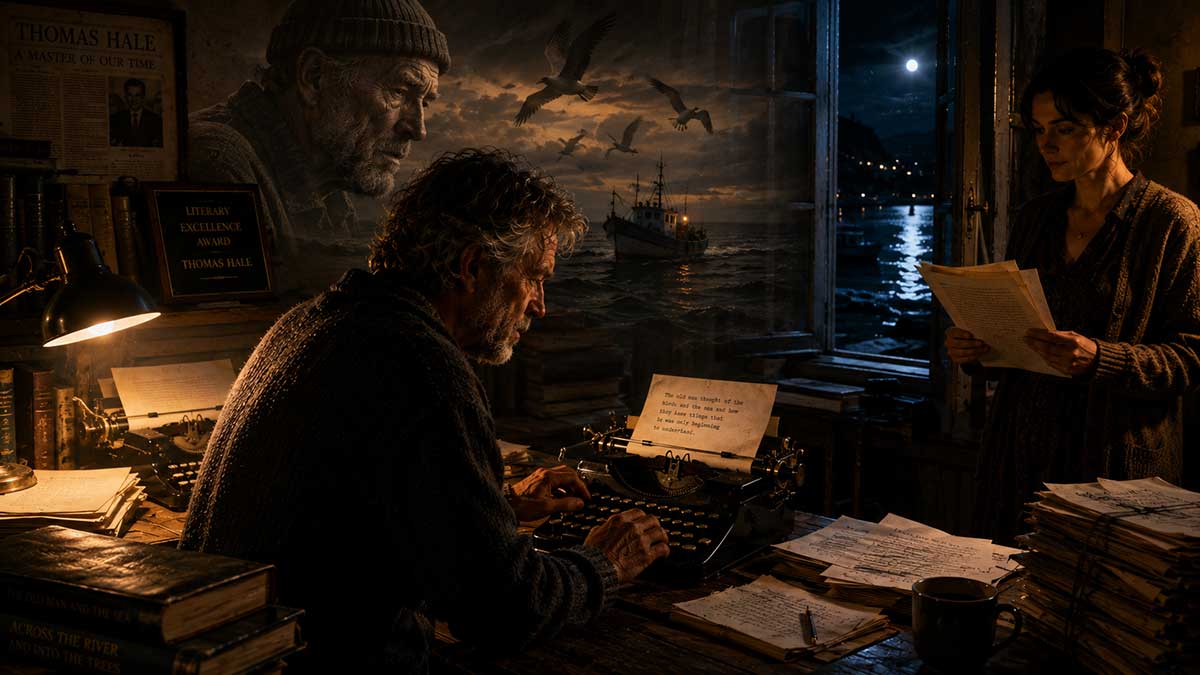
The fisherman reached the open water before Thomas understood why.
For nearly three weeks he had followed the old man across the sea without asking where the journey would end. Each morning the story unfolded with the quiet certainty of tides. The fisherman repaired his lines. He greeted the birds. He spoke softly to the sea as though it were an old companion rather than an opponent.
Thomas had planned almost none of it.
The story seemed to prefer discovery over design.
He found that frightening.
For most of his life he had believed a writer should command the page.
Now the page appeared to possess its own patience.
It waited for honesty.
Nothing else.
Lucie arrived just after breakfast.
She found Thomas standing at the window instead of writing.
"You've been staring at the harbor for fifteen minutes."
"I know."
"Research?"
He smiled.
"No."
"What then?"
"I think the fisherman is waiting for me."
She looked toward the sea.
"I don't see him."
"You aren't supposed to."
She laughed softly.
"I've spent forty years telling stories where I always knew more than the characters."
"And now?"
"I know less."
She seemed pleased.
"That's usually a good sign."
By the end of the week the manuscript had doubled.
The old fisherman had become inseparable from the sea.
He no longer fought it.
He listened to it.
Thomas found himself writing sentences he had never intended.
The sea had never promised justice. Only another morning.
He stopped.
Read it again.
He did not remember composing it.
The sentence felt less like invention than recognition.
He crossed out two adjectives.
The sentence became stronger.
He smiled.
Perhaps writing had always been less about finding words than removing the unnecessary ones.
Rain fell through most of Thursday.
Unable to walk, Thomas remained in his room.
He continued writing until late afternoon.
When Lucie brought supper, she found dozens of discarded pages scattered across the floor.
"You've been fighting."
"With whom?"
He looked around.
"Myself, apparently."
She noticed the newest pages resting separately.
"May I?"
He nodded.
She read quietly.
Five pages.
Then ten.
Finally she placed them on the desk.
"They're different."
Thomas waited.
"You've stopped performing."
He felt relief.
Then she added,
"But something else has started."
His expression changed.
"What?"
She searched for the words.
"Confession."
He frowned.
"I don't write confession."
"No."
She looked at him gently.
"I think you just did."
Thomas reached for the pages.
The old fisherman spoke less than ever.
Yet somehow every silence carried the weight of someone who had spent a lifetime proving things no longer worth proving.
Thomas suddenly recognized the feeling.
He closed the manuscript.
That evening he walked farther along the coast than usual.
The village disappeared behind him.
The road narrowed until only sea and stone remained.
He sat on a weathered bench overlooking the water.
The wind carried the smell of salt and wet rope.
For years he had believed his greatest books were about war.
Or courage.
Or loss.
Perhaps they had always been about something else.
The terrible loneliness of becoming the person everyone expected.
The thought unsettled him.
He had blamed publishers.
Reviewers.
Readers.
The literary world.
But perhaps they had merely accepted the version of Thomas Hale he himself had built.
A fortress made from praise.
Strong enough to keep criticism out.
Strong enough to keep everyone else out as well.
Including himself.
When he returned, a message waited beneath his door.
The publisher.
Please call.
Important.
Thomas placed the note beneath a stack of newspapers.
He did not call.
The following morning another message arrived.
Then another.
Finally the telephone downstairs rang.
Madame Fournier climbed the stairs.
"It sounds important."
"It always does."
"They say they will keep calling."
"They're very determined."
"So are fishermen."
She laughed.
"You'll answer one of them eventually."
"I hope it's the fisherman."
Three days later curiosity defeated him.
He telephoned.
The publisher answered immediately.
"Thomas! Wonderful news!"
Thomas held the receiver away from his ear.
"We've heard from booksellers in London, New York, Tokyo, Buenos Aires—everyone's asking the same question."
Thomas said nothing.
"They've heard you're writing again."
Silence.
"This is exactly what readers have been waiting for."
Thomas looked through the window.
Étienne was repairing another torn net.
Patiently.
Quietly.
The publisher continued.
"We should announce it soon."
"I haven't finished."
"That's perfect."
Thomas blinked.
"Perfect?"
"The mystery creates excitement."
"I don't want excitement."
A pause.
The publisher laughed politely.
"You've always said things like that."
"No."
Thomas's voice remained calm.
"I've only recently begun meaning them."
The line fell silent.
Finally the publisher asked,
"When can I see pages?"
Thomas looked toward the typewriter upstairs.
"When they're true."
He gently replaced the receiver.
Lucie arrived later that afternoon.
"You sound lighter."
"I refused something."
"What?"
"I don't know."
She smiled.
"Good answer."
She picked up the latest chapter.
Halfway through she stopped reading.
Thomas immediately noticed.
"What?"
She looked at him.
"This isn't your best writing."
His face fell.
For several seconds he could not speak.
She continued before the silence hardened.
"It's your first honest writing."
He stared at her.
She tapped one paragraph.
"The old fisherman isn't trying to become unforgettable."
"No."
"Neither are you."
Thomas looked at the manuscript.
For years he had chased unforgettable sentences.
Now the simplest ones seemed impossible to improve.
The realization frightened him more than failure ever had.
If honesty required becoming smaller, what had all those years of greatness been chasing?
That night he dreamed of standing alone inside a vast library.
Every shelf contained his own books.
Thousands of copies.
Every language.
Every edition.
Readers filled the room.
Yet no one looked at him.
They all stared toward the shelves.
He tried speaking.
No one heard him.
Then he noticed an old fisherman walking quietly between the rows.
The man carried no books.
Only a coil of fishing line over one shoulder.
He passed every shelf without slowing.
When he reached Thomas, he said only one sentence.
"You've been catching readers."
He looked toward the distant sea visible through the library windows.
"When did you stop catching truth?"
Thomas woke before dawn.
His pillow was damp.
He could not remember whether the sea in the dream had been outside the library—
or waiting somewhere inside him.
He walked to the typewriter without making coffee.
Rolled in a fresh sheet.
This time he did not ask what should happen next.
He asked only one question.
What truth has the fisherman not yet admitted?
The answer did not come immediately.
It waited.
Like a fish beneath deep water.
Thomas rested his hands quietly on the keys.
For the first time in decades, he understood that patience was not the absence of progress.
Sometimes it was progress itself.
5. The Sharks
Thomas did not notice when the mornings became shorter.
The light still entered through the same window.
The fishing boats still departed before sunrise.
The church bell still divided the hours with patient certainty.
Only the days themselves had begun disappearing.
He would begin writing just after dawn.
Then suddenly Lucie would be standing in the doorway carrying supper.
Entire afternoons vanished without leaving footprints.
At first he welcomed it.
For years time had moved too slowly.
Now it hurried.
Surely that meant the work was alive.
Then the mistakes began.
He found two nearly identical pages lying side by side on his desk.
The same conversation.
The same description of the sea.
Almost the same sentences.
One written three days earlier.
The other written yesterday.
He stared at them for a long time.
He had no memory of writing either.
He searched the manuscript.
The duplication happened again.
And again.
Sometimes only a paragraph.
Sometimes an entire page.
The old fisherman seemed to walk the same stretch of shoreline twice.
Thomas quietly removed the repeated passages.
He told himself every writer repeated things.
Nothing more.
That evening he reached for the bottle above the cupboard.
His hand stopped halfway.
For several seconds he could not remember why he had opened the cupboard.
The bottle waited.
So did his hand.
Finally he closed the door.
He was no longer certain whether refusing the drink had been discipline—
or forgetfulness.
Neither possibility comforted him.
The following morning Lucie arrived unusually early.
Thomas was still asleep in the chair.
The typewriter remained uncovered.
The lamp still burned.
She placed the breakfast tray quietly on the table.
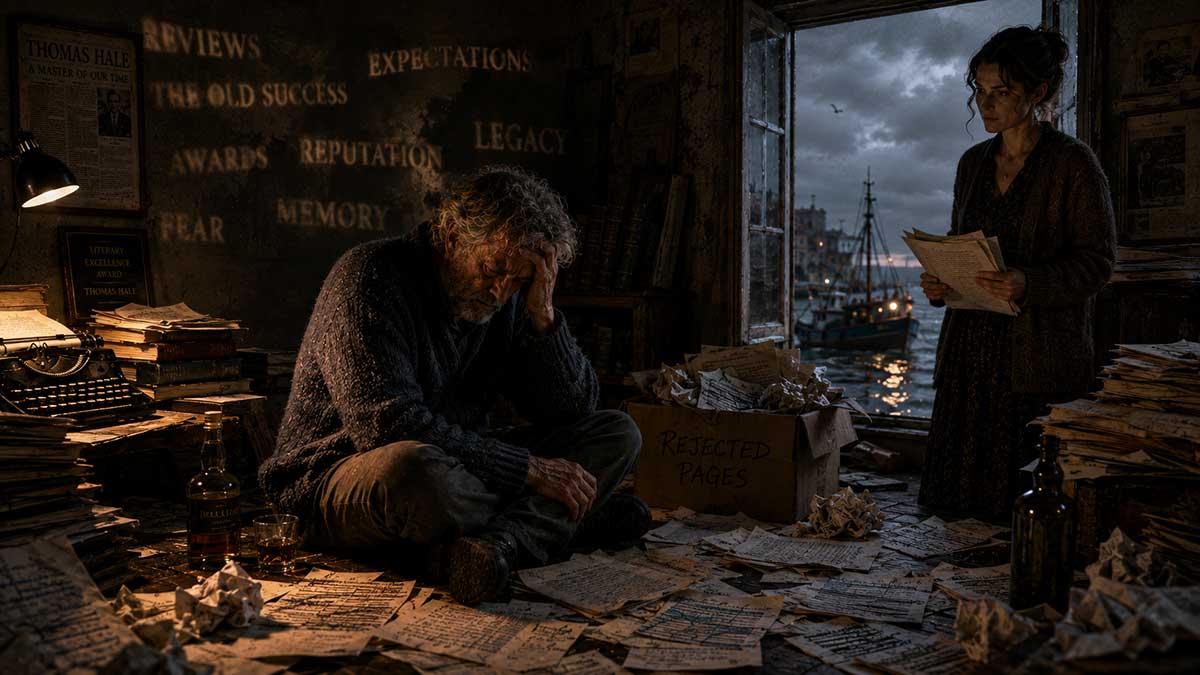
Then she noticed the floor.
Pages.
Hundreds of them.
Some neatly stacked.
Others torn.
Many covered with penciled notes crossing out entire sections.
Thomas opened his eyes.
"I wasn't sleeping."
"I know."
She knelt and gathered several pages.
"Which version is newest?"
He looked around the room.
"I honestly don't know."
The words frightened him more than they frightened her.
Together they sorted the manuscript.
Three piles became five.
Five became eight.
Some chapters existed twice.
One chapter had disappeared completely.
Thomas searched every drawer.
Every shelf.
The suitcase beneath the bed.
Nothing.
"I remember writing it."
He rubbed his forehead.
"I remember the feeling."
Lucie said nothing.
"I just can't remember where it went."
She placed one hand gently on the stack.
"We'll find it."
"What if we don't?"
"We'll write it again."
He laughed without humor.
"It won't be the same."
"No."
She met his eyes.
"It may be truer."
The telephone rang downstairs.
Madame Fournier called up the staircase.
"It's your publisher."
Thomas remained seated.
"It keeps ringing."
"I hear it."
Lucie waited.
Finally she asked,
"Aren't you going to answer?"
He shook his head.
"I already know what he wants."
"What?"
"A finished book."
He looked around the room.
"I need a finished man first."
The sentence surprised them both.
Neither spoke.
That afternoon Thomas walked alone to the harbor.
The tide was low.
Étienne was unloading only three small fish.
It was the poorest catch Thomas had seen all month.
Yet the fisherman hummed softly while washing the deck.
"No luck?" Thomas asked.
Étienne looked into the basket.
"I caught enough."
Thomas smiled.
"You've become modest."
"I've become hungry."
Thomas laughed.
"I meant the fishing."
"So did I."
They stood quietly beside the boat.
Finally Thomas asked,
"Does it ever frighten you?"
"What?"
"That one day you'll stop being the fisherman everyone believes you are."
Étienne rinsed his hands.
"My wife has never married a fisherman."
Thomas frowned.
"No?"
"She married me."
The fisherman coiled the rope carefully.
"If I come home with fish, she's happy."
Another loop.
"If I come home without fish, she's still waiting."
He looked at Thomas.
"The sea decides the catch."
A small smile.
"I decide whether I go home."
Thomas remained on the pier long after Étienne left.
The words settled heavily inside him.
For years he had gone home only after catching something worthy.
A prize.
A review.
An award.
A finished novel.
He had mistaken achievement for permission to belong.
The realization hurt.
Not sharply.
Slowly.
Like cold entering old bones.
When he returned, Lucie was waiting outside his door.
She held the missing chapter.
"I found it."
He stared.
"Where?"
She smiled sadly.
"Inside the wastebasket."
Thomas looked away.
"I don't remember throwing it out."
"I know."
She hesitated.
"Thomas..."
He waited.
"I think it's time."
"For what?"
"To stop pretending this is only about writing."
The hallway became very quiet.
A door closed somewhere below.
A bicycle passed outside.
The evening bell rang from the church.
Thomas leaned against the wall.
For the first time in many years, he looked tired enough to stop hiding it.
"I've been afraid."
Lucie nodded gently.
"I know."
"No."
He shook his head.
"You don't."
She waited.
His voice became almost a whisper.
"I'm not afraid the readers won't love the book."
Another silence.
"I'm afraid they'll discover the man they admired no longer exists."
Lucie looked at him for a long moment.
Then she stepped closer.
"Thomas."
He could not raise his eyes.
"What if..."
She spoke very softly.
"...they've been waiting all these years to finally meet him?"
He closed his eyes.
Something inside him, held tightly for decades, loosened.
Not all at once.
Just enough.
His shoulders began to shake.
No dramatic sobs.
No collapse.
Only the quiet grief of someone who had spent too many years defending a version of himself that had long since become impossible to carry.
Lucie did not speak.
She did not comfort him with explanations.
She simply remained.
When the shaking finally stopped, Thomas wiped his face with the back of his hand.
"I don't think I know how to finish the book."
Lucie smiled.
"I don't think that's the real sentence."
He looked at her.
She waited.
At last he said the words he had never imagined speaking to another person.
"I don't know how to finish this part of my life."
The harbor bells echoed faintly through the open window.
Lucie reached into her apron pocket and placed the recovered chapter in his hands.
"We'll work on one page tomorrow."
She smiled.
"Not the whole life."
Thomas looked down at the manuscript.
Then back at her.
For the first time since arriving in the village, he realized the greatest danger had never been forgetting the next sentence.
It had been believing he had to remember it alone.
6. The Last Good Sentence
The next morning, Lucie arrived carrying two things.
Fresh coffee.
And a cardboard box.
Thomas looked at it curiously.
"What is that?"
She placed it beside the desk.
"Everything you've crossed out."
He stared.
"You kept it?"
"I couldn't decide whether you were editing..."
She smiled.
"...or grieving."
Thomas opened the box.
Inside were hundreds of pages.
Beautiful pages.
Award-winning pages.
Pages that would have impressed critics.
He recognized nearly every one.
Then he quietly closed the lid again.
"I don't need them."
Lucie nodded.
"I thought so."
Without another word, she carried the box downstairs and placed it in the café cellar.
Neither of them mentioned it again.
Their mornings settled into an unexpected rhythm.
Thomas wrote.
Lucie arrived just before noon.
She never corrected his style.
Never suggested better metaphors.
Never offered clever dialogue.
Instead she asked questions.
Only questions.
"Why does the fisherman stay silent here?"
"What is he afraid of admitting?"
"Does this sentence belong to him...
"...or to the writer trying to protect himself?"
Thomas noticed something remarkable.
The answers never appeared while defending himself.
They appeared only after surrendering the defense.
One afternoon they spent nearly an hour discussing a single paragraph.
It described the fisherman watching birds circle above the water.
Originally it filled two pages.
The sea glittered.
The clouds shimmered.
Every sentence displayed the confidence of a celebrated novelist.
Lucie finished reading.
Then quietly asked,
"What are the birds doing?"
Thomas blinked.
"They're looking for fish."
She nodded.
"So why are we looking at your vocabulary?"
He laughed so suddenly that coffee spilled across the desk.
For several minutes neither could stop laughing.
When the laughter faded, Thomas crossed out nearly the entire passage.
Only one sentence remained.
The birds knew before the fishermen where life was moving.
He read it aloud.
Lucie smiled.
"The birds finally arrived."
The manuscript became thinner.
Oddly, it also became deeper.
Thomas noticed that each deleted paragraph seemed to reveal another layer beneath it.
It reminded him of restoring an old painting.
Removing dirt did not create beauty.
It uncovered beauty that had waited beneath years of accumulation.
One evening he looked across the room.
The wastebasket was nearly empty.
That had never happened before.
He was finally throwing away fewer pages because he was pretending less.
Late one afternoon the telephone rang again.
Thomas answered before it stopped.
The publisher sounded almost relieved.
"There you are."
"I've been here."
"We have an extraordinary proposal."
Thomas listened.
Major newspapers.
International release.
Television interviews.
A documentary crew.
A farewell literary tour.
The publisher's excitement grew with every sentence.
"We'll present it as the triumphant return of the greatest living novelist."
Thomas remained silent.
"You deserve this."
Thomas looked toward the window.
Étienne and the young boy were repairing nets together below.
The older man never took the rope away.
He simply waited whenever the boy struggled.
Eventually the knot loosened.
The boy smiled.
Étienne smiled back.
Nothing more.
Thomas spoke quietly into the telephone.
"What if the book doesn't need triumph?"
The publisher laughed.
"Every great comeback needs triumph."
Thomas shook his head.
"No."
Silence.
"It needs truth."
Another silence.
"Readers expect something larger than life."
Thomas looked at the harbor.
"I've spent too much of my life giving them that."
He thanked the publisher for believing in the manuscript.
Then he declined the campaign.
When he replaced the receiver, the room felt strangely spacious.
As though someone had opened a window he had forgotten existed.
That evening Thomas reread the final chapter.
The fisherman was returning home.
Not victorious.
Not defeated.
Simply changed.
Thomas reached the last paragraph.
He knew immediately it was wrong.
Not false.
Too complete.
It explained what should remain mysterious.
He removed the final page.
Rolled another sheet into the typewriter.
Nothing came.
Minutes passed.
Then an hour.
Outside, darkness settled over the harbor.
The fishing boats returned.
Lights reflected across the water.
Thomas looked at the empty page.
For the first time in weeks he was not afraid.
He simply waited.
Lucie quietly entered.
She carried no tray.
Only a blanket.
She placed it over his shoulders.
"I can't find the ending."
She looked at the blank page.
"Maybe you're looking for the last event."
He turned.
"What do you mean?"
She smiled.
"Perhaps you're supposed to find the last truth."
She left without another word.
Near midnight Thomas stood by the window.
The village had become silent.
Only waves remained.
He suddenly understood something that had escaped him for years.
His best books had never been remembered because of what happened.
They were remembered because of what changed.
Not battles.
Not romances.
Not endings.
People.
The fisherman had already changed.
The ending had happened long before the final page.
He hurried back to the typewriter.
His hands trembled.
This time not from age.
From clarity.
He typed slowly.
Not searching.
Listening.
The final paragraph arrived almost without effort.
No speeches.
No grand declaration.
Only an old fisherman returning to shore carrying less than he had hoped and more than he had known he needed.
Thomas reached the final sentence.
He stopped.
Read everything once more.
One line still remained unwritten.
He looked toward the door.
"Lucie."
She appeared almost immediately.
As though she had been waiting downstairs.
"I think..."
He smiled.
"...I've found it."
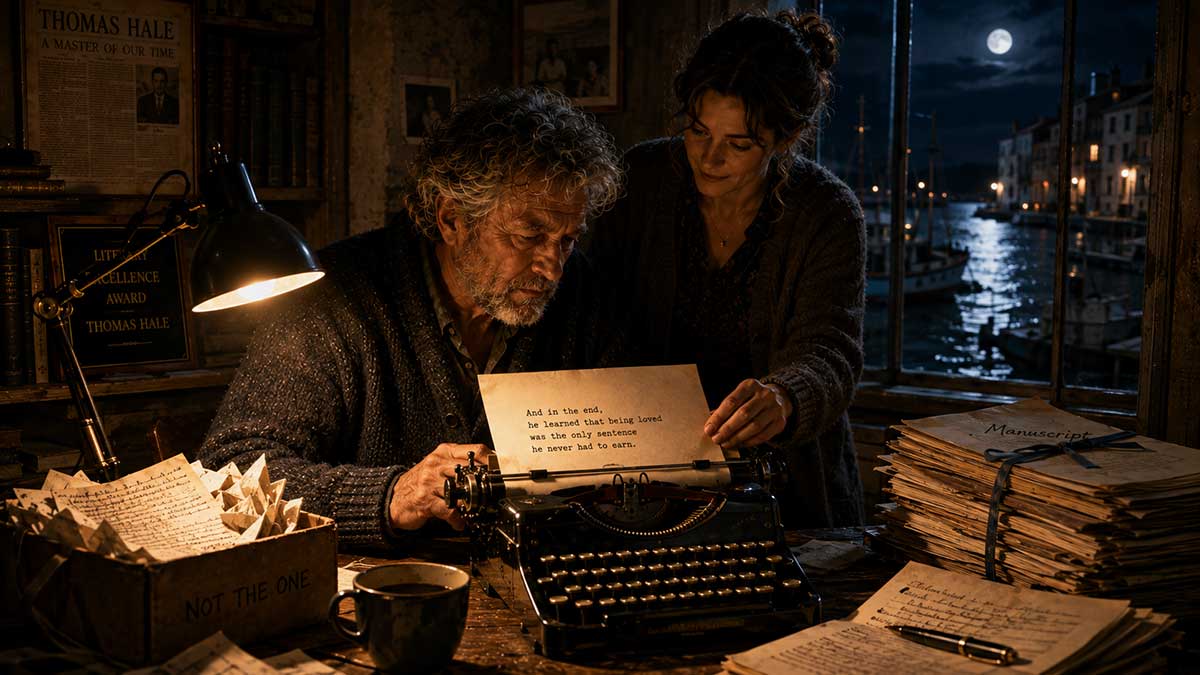
She stood beside him.
He rested his fingers on the keys.
Then withdrew them.
"Would you..."
She looked surprised.
"...put the paper in properly?"
She adjusted it gently.
The gesture lasted only seconds.
Yet Thomas knew he had never before asked another person to touch the final page of one of his books.
She stepped back.
He began typing.
The sea had never asked him to conquer it. It had only asked him to return honestly.
The carriage reached the end of the line.
A soft bell rang.
Thomas removed the page.
Read it once.
Folded it carefully.
Then, instead of placing it alone on the desk, he handed it to Lucie.
She read the last sentence.
When she finished, she looked at him.
"Is this your greatest book?"
Thomas considered the question.
Then he shook his head gently.
"No."
She waited.
"It is..."
He searched for the words.
"...the first one that no longer needed me to be a great man."
Neither of them spoke.
Outside, somewhere beyond the darkness, the tide began turning.
For the first time in many years, Thomas realized he did not feel relieved because the manuscript was finished.
He felt relieved because the man who had written it no longer needed the book to explain why his life had mattered.
7. The Morning That Was Enough
Thomas did not sleep.
Not because excitement kept him awake.
Quite the opposite.
For the first time in years, there was nothing left to wrestle.
The manuscript rested on the desk.
No pages scattered across the floor.
No penciled arguments in the margins.
No stack of discarded openings accusing him from the corner of the room.
The silence felt unfamiliar.
It no longer demanded anything.
Just before dawn, he rose quietly.
He placed the finished manuscript inside a plain brown envelope.
No title.
No note to the publisher.
No dramatic farewell.
He simply laid it on the desk and covered it with a smooth stone he had picked up months earlier on the beach.
As if to tell the wind,
"You may have the room.
Not this."
The village was still asleep when he stepped outside.
The air carried the coolness that disappeared by midmorning.
The harbor lights floated softly on the water.
Far out in the darkness, the first fishing boat had already begun moving toward open sea.
Thomas breathed deeply.
For months he had walked these streets searching for sentences.
This morning he noticed the smell of bread before he noticed words.
The baker was already working.
Somewhere nearby, someone was sweeping a stone doorway.
A cat crossed the empty street as though it owned the village.
Thomas smiled.
He realized he had never actually seen the cat before.
How many mornings had he walked here without seeing anything except himself?
Étienne was already at the dock.
One corner of a large net had become tangled around a wooden piling.
The fisherman was patiently loosening one knot after another.
He looked up.
"Good morning."
"Good morning."
Neither man mentioned the manuscript.
Thomas removed his jacket.
"May I?"
Étienne handed him the rope.
No ceremony.
No gratitude.
Just another pair of hands joining the work.
For nearly half an hour they worked side by side.
Sometimes Thomas pulled too hard.
Étienne quietly loosened the knot instead.
Sometimes Étienne asked him to hold the rope steady.
Neither corrected the other.
Neither hurried.
When the final knot slipped free, the net fell open almost by itself.
Étienne smiled.
"There."
Thomas nodded.
"There."
The fisherman folded the net.
"I'll be back this afternoon."
"I know."
"You'll still be here?"
Thomas looked toward the sea.
"I think so."
Étienne climbed aboard the boat.
A few moments later the engine started.
The boat drifted slowly toward the horizon.
Thomas watched until the light became only another small star upon the water.
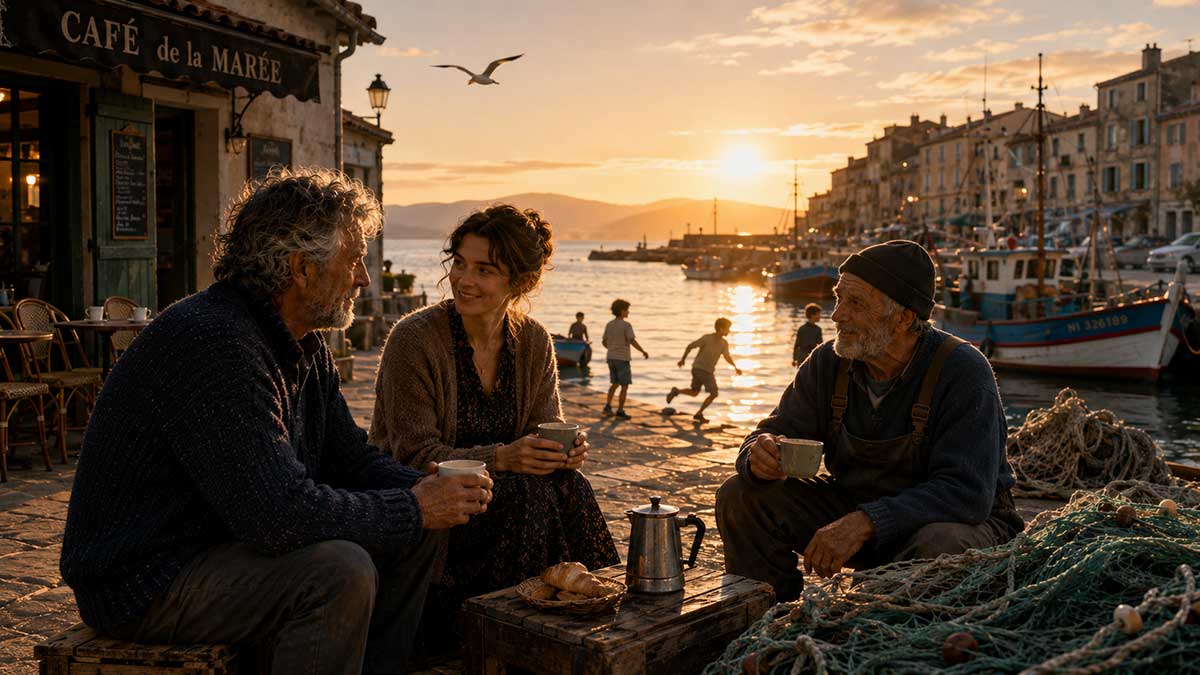
When he returned to the café, Lucie was waiting outside with two cups of coffee.
"I thought you might forget breakfast."
"I almost did."
They sat together facing the harbor.
For a long time neither spoke.
It was no longer uncomfortable.
The silence had changed.
It had become something shared.
Eventually Lucie asked,
"Will you send it today?"
Thomas looked toward the envelope resting upstairs.
"Yes."
"Were you afraid of finishing?"
"No."
He smiled gently.
"I was afraid of needing it."
She nodded.
"And now?"
He watched a little boy running along the pier carrying a loaf of bread almost as large as himself.
The boy stumbled.
Laughed.
Picked it up.
Kept running.
Thomas answered without taking his eyes from the harbor.
"I thought my books were carrying me."
He paused.
"It was always people."
The church bell rang.
The village awakened.
Cyclists appeared.
Tourists unfolded maps.
Madame Fournier opened the café windows.
The smell of fresh butter drifted into the street.
Everything looked exactly as it had the morning Thomas first arrived.
Only he had changed.
He suddenly remembered something his father had once told him while teaching him to fish.
"You'll spend half your life trying to catch something."
"And the other half?" Thomas had asked.
His father smiled.
"Learning what to keep."
At the time Thomas thought he meant fish.
Now he wondered whether his father had understood far more than either of them realized.
Near noon the publisher arrived unexpectedly.
A polished car stopped beside the harbor.
The publisher hurried across the street carrying excitement in every step.
"Thomas!"
He embraced him warmly.
"I knew we'd find you working."
Thomas smiled.
"I finished yesterday."
"Wonderful!"
The publisher reached toward the envelope.
Then hesitated.
"You've written the title?"
Thomas looked at the brown paper.
"No."
"No?"
"I'll think of one later."
The publisher laughed.
"You always leave the easy part until the end."
Thomas almost answered.
Instead he looked toward Lucie.
She was watching quietly from the café doorway.
The title had been there all along.
Not on the manuscript.
Inside him.
The publisher left with the envelope.
The car disappeared beyond the hill.
Thomas remained standing beside the harbor.
For the first time in many decades, nothing waited to be written.
He expected relief.
Instead he felt strangely empty.
Lucie walked over.
"What is it?"
"I've spent fifty years waking every morning believing I had to become someone."
"And today?"
He looked out across the sea.
"I woke up."
That evening the village gathered on the seawall to watch the sunset.
Children chased gulls.
Old fishermen repaired nets.
Couples shared bottles of wine.
Someone played an accordion badly.
Nobody seemed to mind.
Thomas sat on a weathered bench beside Lucie.
Neither of them spoke.
The sun lowered slowly into the Mediterranean.
The sky turned from gold to amber, then from amber to the quiet blue that belonged only to evening.
Lucie finally broke the silence.
"Was it worth it?"
Thomas understood she was not asking about the book.
He took a long time before answering.
"The writing?"
She nodded.
"It gave me a life."
Another silence.
"The fame?"
He smiled faintly.
"It gave me a career."
She waited.
"The loneliness?"
Thomas watched a young father lift his daughter onto his shoulders so she could see the sunset above the crowd.
His eyes followed them until they disappeared.
Then he answered.
"No."
Only that.
No speech.
No explanation.
The single word carried the weight of everything he had learned too late.
Lucie reached over and quietly placed her hand on his.
He did not move it away.
Months passed.
The novel appeared quietly.
No grand campaign.
No triumphant interviews.
Only a simple release.
The reviews arrived one after another.
"Thomas Hale's finest work in decades."
"A masterpiece of restraint."
"The wisdom of a writer finally at peace with himself."
One reviewer wrote:
"It is astonishing how completely alone this book feels."
Lucie folded the newspaper.
She smiled sadly.
If only they knew.
The manuscript had not been written by one person.
It had been rescued by two.
Not because two people wrote the sentences.
But because one finally stayed long enough for the other to stop writing alone.
The following spring, Thomas and Lucie walked to the harbor before sunrise.
The fishing boats slipped into the darkness exactly as they always had.
Étienne waved from his boat.
Thomas waved back.
Nothing needed to be said.
As the first light spread across the sea, Thomas spoke almost to himself.
"I used to believe the purpose of life was to leave behind a great book."
Lucie listened.
He watched the fishermen disappear beyond the breakwater.
"Now I think..."
He smiled.
"...the purpose is to leave behind fewer lonely people."
The wind carried away the words.
Neither of them tried to hold onto them.
The sea had heard enough.
It answered in the only way it ever had.
By welcoming another ordinary morning.
And for the first time in his life, Thomas understood that an ordinary morning, shared with another human being, was never ordinary at all.
Final Thoughts
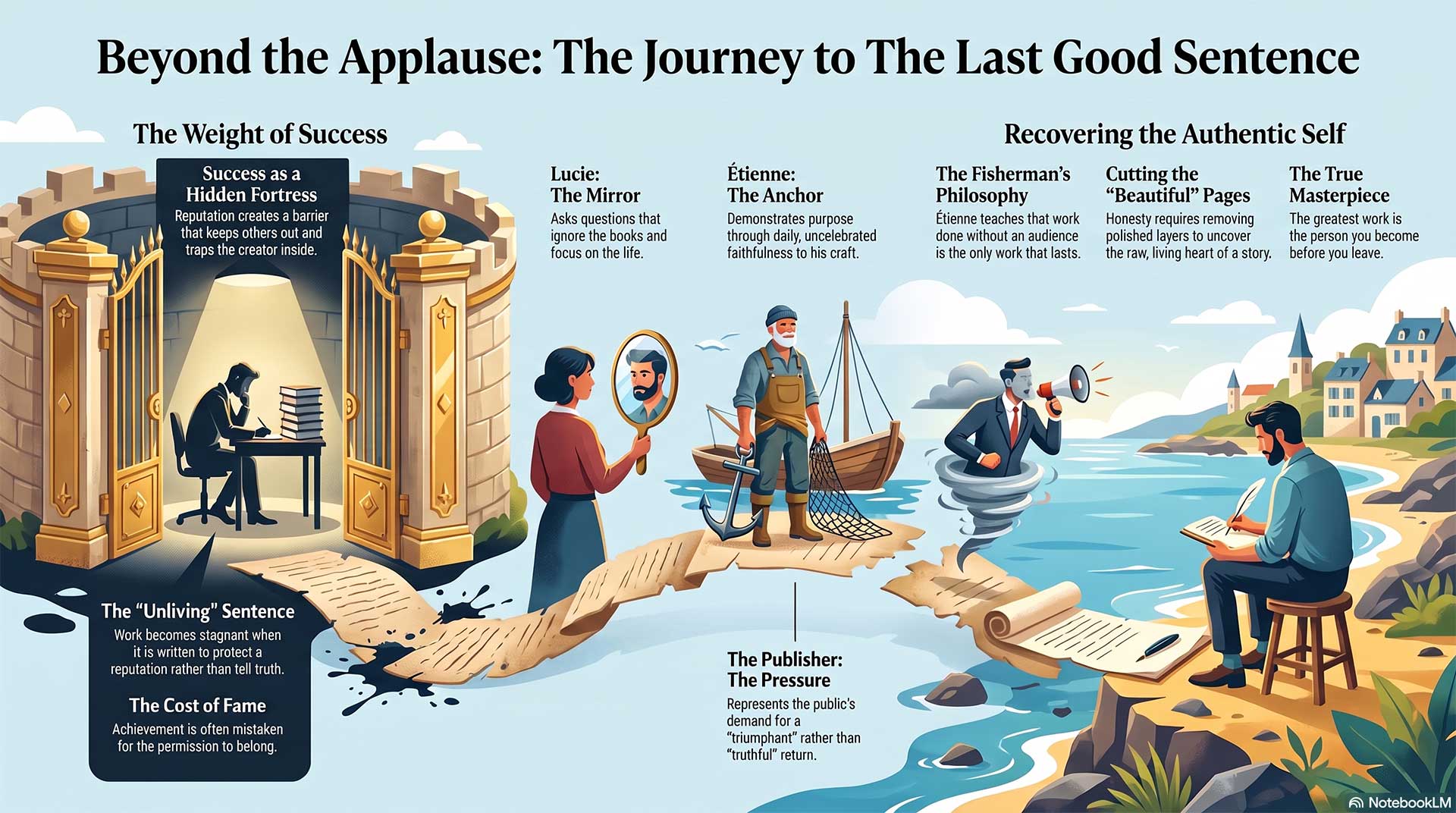
When Thomas first arrived in the village, he believed he had only one task left.
Write one last great book.
By the end, he discovered he had misunderstood the assignment.
Books can preserve words.
They cannot replace conversations left unfinished.
Awards can honor achievement.
They cannot embrace someone who has become lonely.
Reputation can survive for generations.
It cannot sit beside you at sunrise.
Thomas finished his manuscript.
Yet that was never his greatest accomplishment.
His greatest accomplishment was learning that asking for help did not diminish his dignity.
It completed it.
The old fisherman inside his story returned from the sea carrying less than he had hoped for.
Thomas returned from a lifetime of ambition carrying something similar.
Not proof of greatness.
Perspective.
He discovered that the finest sentence he ever wrote was not necessarily the most beautiful one.
It was the first sentence that no longer needed to prove he was worthy of being loved.
If this story leaves you with one question, let it be this:
What are you still trying to prove—and to whom?
And perhaps an even gentler one:
Who has quietly remained beside you while you were busy proving it?
We often spend years chasing the next achievement, believing fulfillment waits just beyond the horizon.
Yet life has a quieter wisdom.
Sometimes the greatest victory is not reaching farther out to sea.
Sometimes it is discovering that the people waiting on shore were the true destination all along.
Short Bios:
Thomas Hale is a fictional American novelist in his early seventies whose spare prose and powerful early novels made him one of the most celebrated writers of his generation. After decades of literary success, he finds himself trapped by the reputation he spent a lifetime building. Living alone above a small café in a French fishing village, he struggles to write honestly again and slowly discovers that his greatest unfinished work is not another novel, but his own life.
Lucie Moreau is a twenty-five-year-old French waitress, translator, and aspiring novelist. Having admired Thomas's books since childhood, she arrives expecting to meet a literary legend but chooses instead to speak honestly to the lonely man behind the reputation. Her quiet courage, thoughtful questions, and refusal to flatter become the catalyst for Thomas's transformation. She represents the next generation of writers—one that values truth over mythology.
Étienne Laurent is a lifelong fisherman in the small Mediterranean harbor where Thomas now lives. He has little interest in literary fame and never treats Thomas differently from anyone else. Through his patient work, quiet humility, and daily return to the sea, Étienne becomes the living embodiment of the wisdom that Thomas has spent decades trying to write about. He teaches not through speeches, but through ordinary faithfulness.
Madame Fournier owns Café des Mouettes and rents the modest room above it to Thomas. Warm, practical, and quietly observant, she looks after him with gentle dignity, never intruding and never making him feel pitied. She represents the quiet kindness that often goes unnoticed but sustains lonely lives.
The Publisher. Thomas's longtime publisher represents the literary world that helped build his reputation. Intelligent and well-meaning, he genuinely believes readers want one last triumphant masterpiece. Throughout the story he symbolizes the pressure of legacy, public expectation, and commercial success, forcing Thomas to choose between preserving his image and telling the truth.
Leave a Reply