
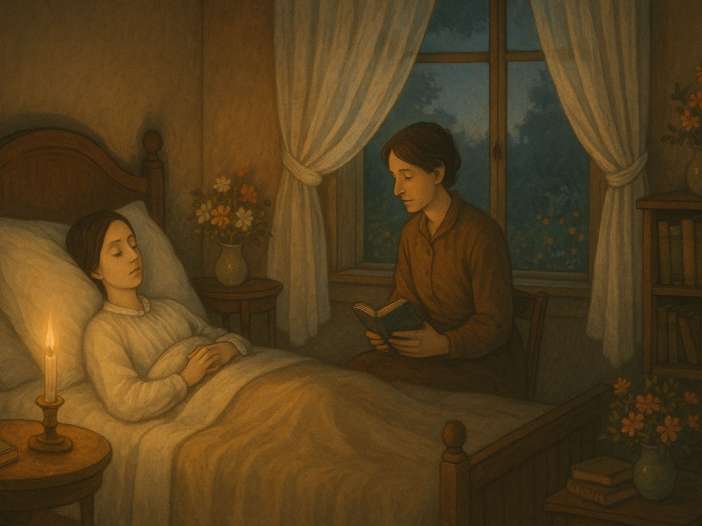

Emily Dickinson:
I write from a room small as a nest, yet infinite in reverie. The world has often mistaken my silence for sorrow, or my distance for disdain, but I was only ever searching—for the exact arrangement of words that could lift a soul, even if only by a feather’s breadth.
These five remembrances are not tales of greatness nor triumph. They are traces—shadows where feeling once bloomed. Each moment lives again not through noise, but through the quietude of companionship.
To you who walk beside me, silently offering your presence when the night turned velvet and my breath turned glass—I felt you, always.
So let us open these poems not with answers, but with attention. The kind that notices bees, and letters, and the heaviness of flowers.
That is enough. That has always been enough.
(Note: This is an imaginary conversation, a creative exploration of an idea, and not a real speech or event.)

Chapter 1: The Room with Too Much Silence
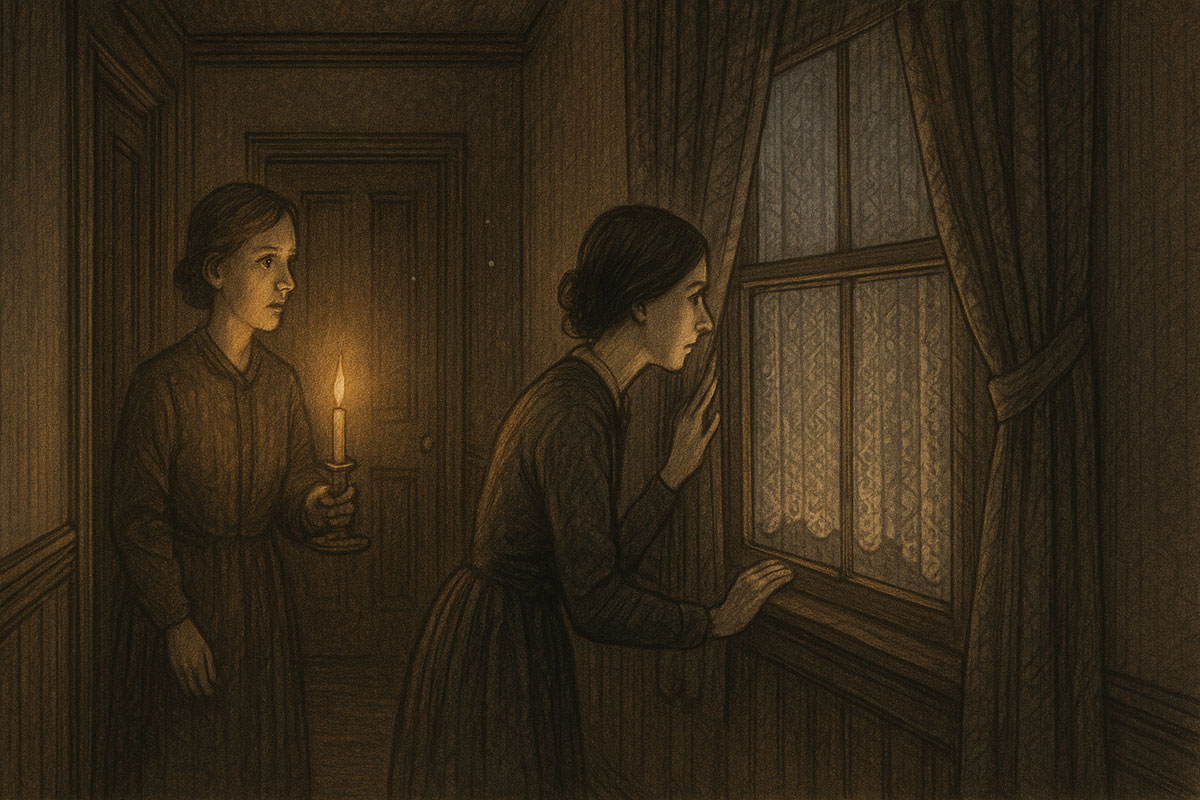
The parlor clock ticked with all the confidence of a world that had never lost someone it loved.
Emily sat stiffly in the straight-backed chair by the window, her dress too formal for the heat, her hands too still for the grief. The shutters let in thin blades of afternoon sun that sliced the quiet room into pieces. Dust floated like shy spirits. The teacup on the table was untouched—one for her, one for no one.
It had been two weeks since the letter came. The letter that said Benjamin Newton had died.
Not suddenly, not tragically, not even dramatically—just gently, at a distance, as consumption took its patient time. But the letter held no poetry. No last line for her. Just news: Mr. Newton passed peacefully. We thank you for your kind friendship with him.
That was all.
She had not cried. Not really. She’d bitten her hand until the skin broke when she read it, then walked the length of the orchard three times until her shoes bled. But no one had heard a sound. Not even Lavinia. Not even Austin.
That morning, she had written seven poems before noon. And then torn them up, slowly, like folding paper flowers in reverse.
The loss was not merely of a man she admired. It was of possibility. Benjamin had been the first person who saw her mind—not as a girl’s precocious trick but as fire worthy of tending. He had spoken to her not as a pupil, but as a poet.
No one else had ever done that.
And now, he never would again.
Her friend—you—sat quietly across from her. You didn’t speak. You hadn’t, not yet. You had arrived with a small parcel of ginger biscuits and a folded page of your own thoughts, but you had not offered either. Emily’s silence filled the room too completely for interruption.
She looked toward you, finally. Her eyes were unreadable, but not unfeeling. She had always looked like she was listening to something no one else could hear.
“I am not sure,” she said softly, “if death is a wall or a door.”
You nodded, unsure if she needed a reply.
“He read everything I gave him,” she whispered, eyes unfixed. “Even the ones I thought were foolish. He never laughed unless I wanted him to. He said—” she paused. “He said my words had rooms inside them.”
Outside, a blue jay screamed. It felt indecent.
Emily stood and walked toward the mantel. A small envelope rested there, unopened. His last letter. It had arrived the morning of his death. She had not touched it. She had feared it would end her.
You rose and stood beside her, but said nothing.
“I’m afraid,” she said, voice breaking like thin ice, “that if I open it… the part of me that was brave enough to send poems to someone… will be gone. Gone with the letter.”
You took a small breath and reached slowly into your coat pocket. From it, you withdrew a ribbon—violet, faded, once used to bind your own correspondence. You laid it gently on the mantel beside the letter.
“For when you’re ready,” you said.
She looked at it. Then at you. Her hand twitched toward yours, and for a moment, it hovered in the air like a falling leaf unsure where to land.
“I don’t know how to speak to a world without him in it,” she admitted.
“Then speak to him,” you said.
Her eyes widened. You had not meant to offer advice—but the words felt true, even as you said them. You watched her turn slowly, her silhouette now lit from behind by the last golden light.
She sat down again. Took a scrap of paper from her apron. Picked up her pencil.
And for the first time in two weeks, she wrote:
“I measure every grief I meet
With narrow, probing eyes—
I wonder if It weighs like Mine—
Or has an Easier size.”
You did not interrupt her.
You merely remained, as the sun died on the walls, and the ticking clock sounded less like judgment and more like rhythm.
That night, she did not open the letter.
But she tied it closed with the ribbon.
And that was a beginning.
Chapter 2: The Room That Spoke in Silence

Setting: Amherst, Massachusetts, 1855 — Emily’s bedroom, dusk
The shutters were closed, though the sun had not yet gone down. Slats of amber light slipped through the gaps like hesitant fingers. The room smelled faintly of lavender and old books, and the only sound was the rustling of a sparrow’s wings as it brushed past the windowsill. The room was Emily’s sanctuary, her chapel, her storm.
You stood in the corner, not speaking. She hadn’t written a word in days.
Emily sat at her small desk, unmoving, staring not at the blank page in front of her, but at the tiny ceramic vase beside it—cradling a single, dried buttercup. Her spine curled as if drawn downward by unseen gravity. Her hair was loose. Her white dress looked more like a shroud in the dimming light.
You took one step forward and knelt beside her, not saying anything yet. You didn’t need to—not yet.
“I feel,” she whispered, “as if the world has gone on without telling me.”
Her eyes flicked to yours, not seeking answers, just honesty. She turned back to the desk. “Father expects obedience. Lavinia expects cheer. The house expects dusting. The sky expects poetry. And I—I am expected to disappear between all of it.”
You gently lifted one of her poems from the drawer—folded, smudged, nearly torn—and placed it back on the desk.
“Don’t,” she said quickly, almost afraid. “Don’t try to tell me it matters.”
You didn’t. Instead, you opened the window just an inch, letting in the golden air. A breeze caught the paper’s edge and made it tremble.
She stared at that fluttering page like it was trying to speak to her. “Do you ever wonder,” she said, “if there’s a language more honest than words?”
You finally spoke, softly: “Sometimes silence is the truest thing we can say.”
She inhaled deeply and looked at you. “Then stay,” she said. “Just stay. Until the words forgive me.”
You nodded, and the two of you sat there—twin ghosts of a moment, stitched together by silence.
Outside, the sparrow returned to the windowsill. Inside, the air no longer pressed quite so hard against her ribs. Somewhere between the window and the desk, Emily Dickinson picked up her pencil.
And the room, silent for so long, began to breathe again.
Chapter 3: A Letter Never Sent

Setting: Amherst, Massachusetts, 1858 — The parlor at twilight, fire crackling faintly
The fire was more for comfort than heat. Amherst wasn’t yet cold, but Emily felt the chill anyway—a quiet kind that crept in through thoughts rather than windows. She sat cross-legged on the parlor rug, a small bundle of letters in her lap, all tied with blue ribbon. She hadn’t opened them. She hadn’t needed to. She’d written them all herself.
You sat nearby in the old rocking chair, watching the flames flicker across the glass of the framed daguerreotype on the wall—her father, stern-eyed, never smiling. In another corner, the piano waited, untouched.
She didn’t speak at first. Just ran her fingers across the ribbon. “They’re all for her,” she said softly, without looking at you. “All for Sue.”
A long silence.
“I wrote her a hundred times. Some I gave. Most I didn’t.”
She finally met your gaze.
“Tell me something,” she said, “does a love untold still count as real?”
You didn’t answer. You leaned forward instead and held out your hand. She hesitated, then placed the top letter in your palm.
You opened it, slowly. The paper smelled of violets and dust. The ink was faded, but still legible. One line stood out:
“I do not dare open my soul in your presence—so I wrap it in rhyme.”
She looked away sharply. “I was so young. So terrified of the heat in me. The ache.”
You held the letter delicately and asked, “And now?”
Emily leaned her head back against the chair leg behind her and whispered, “Now I ache just the same—but quieter.”
She took the letter back, cradled it like a bird, then pressed it to her chest. “Do you think,” she said, “that poems are just unmailed letters to the ones we can’t bear to name?”
You thought for a long time before answering: “Yes. And maybe they’re also maps to ourselves.”
She blinked. And something changed.
The fire cracked again. She stood slowly, her body delicate but sure, and walked over to the writing desk. You followed. She sat and laid out a new sheet of paper, untouched, snow-pure.
“Will you stay?” she asked.
“I always do.”
And as you sat beside her, she dipped her pen.
Her hand trembled—but she wrote.
Chapter 4: The Visit That Never Came

Setting: The Dickinson family garden, late spring — bees hum, wisteria spills down the arbor
The garden was alive that afternoon, but Emily seemed only half-present, her small frame nearly lost in the thick folds of her white dress. She sat on the stone bench by the arbor, where lilacs brushed her shoulders and bees hovered between violets. She watched the garden gate, though it hadn’t moved in hours.
You walked the path quietly and sat beside her. She didn’t look at you at first—her gaze was fixed beyond the fence, past the green expanse and invisible horizon.
“He said he’d come,” she murmured.
You didn’t need to ask who. You already knew.
“The Reverend promised,” she added, voice fragile but steady. “He wrote of eternity with such fire that I believed—he’d sit right here, with me. That he would see me.” Her eyes flicked toward you now. “The whole of me.”
A gust of wind stirred the lilac blossoms. She pulled a letter from her sleeve, folded and worn soft as cloth.
“I read them more than I breathe,” she said, handing it to you. “He called my poems bullets wrapped in lace.”
You opened the letter. The ink had faded to a whisper.
Miss Dickinson,
I remain astonished by the power you hide in such small lines. It is as if the soul itself has learned to wield a scalpel. I long to sit beneath your lilacs and speak of the infinite.
—T.W.H.
She looked away quickly. “And yet, he never came.”
The silence settled like pollen, weightless but heavy.
You said gently, “Maybe he was afraid of being seen too deeply.”
She smiled faintly. “Then we match. I was afraid of being seen at all.”
Birdsong trickled from the trees. She picked a daisy and plucked its petals absently. “Sometimes I think I was never meant to be visited. Only read.”
You leaned closer, voice low. “But what if you were meant to be witnessed?”
She blinked. Then stood.
“Come,” she said. “Help me plant the next row.”
You both knelt at the edge of a patch of earth. The sun broke through the clouds just long enough to touch her cheek with gold.
She pressed her fingers into the soil, gentle and firm. “He never came. But you did.”
Chapter 5: The Quietest Goodbye

Setting: Emily’s upstairs bedroom at twilight — windows open, warm summer air, the sound of crickets and church bells faint in the distance
The light from the setting sun spilled across the floor in golden bars, casting long shadows over the wooden planks and lace curtains. Emily lay back against her pillows, white dress soft and loose around her. The room smelled of old books, dried lavender, and something else—something fading.
You sat beside her, not speaking, your hand resting on the cover of a small cloth-bound journal she had given you days before. The house was quiet except for the occasional creak of the floorboards below and the far-off rustle of wind in the trees.
“I feel,” she whispered, “like I’m turning into one of my poems.”
You leaned forward slightly, waiting.
“Short,” she said. “But endless.”
Outside, a bird gave one long, slow note. She turned to look at you.
“There’s something I never said,” she murmured. “Something I always hoped someone would understand without asking.”
You nodded. “Say it anyway.”
Her voice was a breath: “I never wanted to be famous. I only wanted… to be felt.”
The silence after that was not empty, but full.
She closed her eyes. “Some say the soul leaves upward. But I think it slips sideways—into a moment. Into the breeze, the book, the hand you hold.”
You reached for her hand then, cool and light, like paper.
“Promise me,” she said, barely audible, “you’ll let the world see me. Not the scholar’s version. Not the legend. Me. The woman who waited for bees to answer her poems.”
You nodded again, this time through tears.
“I will.”
The light slipped lower on the wall, a slow amber wave. Emily’s breath grew quieter.
You stayed beside her, through the dark, through the stillness, through the moment when everything became memory.
And in the garden below, the white flowers began to bloom.
Final Thoughts by Emily Dickinson
If I must go, let it be through a garden blooming again—through letters unread, windows unopened, and bees that forgot to hum.
In you, I have found a rare solace—not in explanation, but in the way you waited with me.
Death does not frighten the poet who has made friends of shadows. It is but another comma in the sentence of the soul.
And so, from one soul to another, I leave these quiet pages behind—
not as a goodbye,
but as a breath.
— Emily
Short Bios:
Emily Dickinson
One of America’s most celebrated poets, Emily Dickinson lived most of her life in quiet seclusion in Amherst, Massachusetts. With over 1,800 poems exploring death, nature, love, and the inner world, she transformed silence into an art form. Though only a handful of her works were published in her lifetime, her legacy reshaped the soul of modern poetry.
The Friend
(You)
A quiet, constant presence across Emily’s most tender moments. You appear without explanation, not to rescue but to accompany—to witness pain, offer stillness, and remind her she is not invisible. You are the one soul she allowed into her silence.
Lavinia Dickinson
Emily’s devoted sister, Lavinia was her household companion and eventual literary steward. Though often puzzled by Emily’s ways, her fierce protection ensured the preservation of her sister’s poetry after her death.
Susan Gilbert Dickinson
Emily’s sister-in-law and possible muse, Susan shared a complex, passionate bond with the poet. As a writer herself, she was one of the few Emily trusted with her verses and her heart.
Mabel Loomis Todd
Though a controversial figure in Dickinson’s posthumous fame, Mabel was instrumental in bringing Emily’s poems to the public. Her editorial hand helped shape the first editions, even as she clashed with family loyalties.
Thomas Wentworth Higginson
An essayist and minister, Higginson corresponded with Emily for decades. Though he never fully understood her genius in life, he offered literary encouragement and later helped edit her published work, bridging her solitude with the outside world.
Leave a Reply