
Introduction
Sayaka Murata’s Convenience Store Woman begins with a woman whose life looks, from the outside, strangely incomplete.
Keiko Furukura is thirty-six years old.
She has worked at the same convenience store for eighteen years.
She is unmarried.
She has no children.
She has no conventional career trajectory.
Most people around her assume that something must be wrong.
But Keiko herself does not begin from that assumption.
That difference is what makes the novel so unsettling.
This character conversation explored five questions that gradually became more difficult.
Who decides what a normal life looks like?
What does it cost to learn how to pass as normal?
Is the convenience store saving Keiko, or consuming her?
Is Shiraha freer because he rejects society, or is he just as controlled by it?
And at the end, has Keiko truly chosen herself, or simply chosen the system in which she knows how to function?
The answers never became simple.
That is exactly why Keiko remains such a compelling character.
(Note: This is an imaginary conversation, a creative exploration of an idea, and not a real speech or event.)
Topic 1: Who Decides What a Normal Life Is?
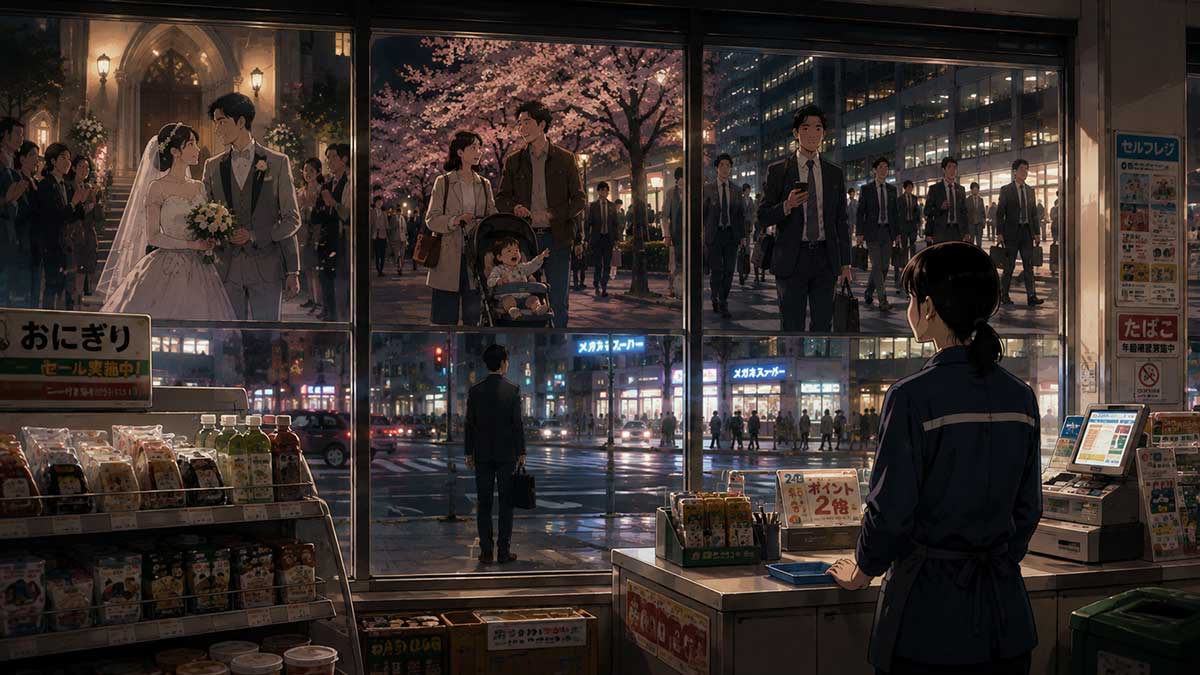
The afternoon light through the windows of Smile Mart had begun to fade. Outside, bicycles passed along the street, office workers moved toward the station, and a mother held a small child's hand at the crossing.
Inside, everything continued according to its rhythm.
The refrigerator hummed.
A scanner beeped.
A delivery cart rattled briefly near the back room.
Keiko Furukura stood beside a shelf of bottled tea, straightening labels so they faced forward.
Shiraha watched her for several seconds.
Shiraha: "You know we're supposed to be having a conversation."
Keiko moved one bottle perhaps half a centimeter.
Keiko: "We are."
Shiraha: "You're arranging drinks."
Keiko: "They're uneven."
Shiraha: "That's exactly what I'm talking about."
Keiko looked at him.
Keiko: "What are you talking about?"
Shiraha: "You."
Keiko waited.
Shiraha: "This whole thing. You spent eighteen years doing this."
Keiko: "Yes."
Shiraha: "And you don't think that's strange?"
Keiko: "No."
Shiraha: "Of course you don't."
Keiko returned to the bottles.
A former coworker standing nearby laughed.
Miho: "That's probably the most Keiko answer possible."
Keiko turned.
Keiko: "Was there another answer I was supposed to give?"
Miho: "No. That's the point."
Shiraha sighed.
Shiraha: "This is what people don't understand. They think she's the strange one. But look at what happened to her. She worked. She showed up on time. She paid her own expenses. She didn't bother anybody. And still everyone kept asking what was wrong with her."
Keiko considered this.
Keiko: "People didn't usually ask what was wrong with me."
Shiraha: "They didn't have to say it."
Keiko: "They asked when I was going to get married."
Shiraha: "Exactly."
Keiko: "They asked whether I planned to find another job."
Shiraha: "Exactly."
Keiko: "They asked whether I was worried about the future."
Shiraha: "Exactly."
Keiko looked puzzled.
Keiko: "Those are different questions."
Miho laughed again.
Miho: "Keiko, I think Shiraha's saying they were all versions of the same question."
Keiko: "What question?"
Miho thought about it.
Miho: "Maybe... 'When are you going to become like us?'"
Keiko stopped arranging the shelf.
For several seconds she said nothing.
Keiko: "But they weren't all alike."
Miho's smile faded slightly.
Keiko: "Some were married. Some weren't. Some had children. Some didn't. Some had permanent jobs. Some changed jobs. One woman was divorced."
Miho: "That's true."
Keiko: "So which one was I supposed to become like?"
Shiraha gave a short laugh.
Shiraha: "Now you're getting it."
Keiko: "Getting what?"
Shiraha: "There isn't one correct life. They just need you to be moving in an approved direction."
Keiko looked at him.
Keiko: "Approved by whom?"
Shiraha opened his mouth.
Then stopped.
Miho smiled.
Miho: "That's actually a good question."
Shiraha: "Society."
Keiko: "Who is society?"
Shiraha: "Everybody."
Keiko: "Including us?"
Shiraha: "No."
Keiko: "Then not everybody."
Miho covered her mouth, trying not to laugh.
Shiraha looked irritated.
Shiraha: "You know what I mean."
Keiko: "I don't."
That was the difficulty with Keiko.
A metaphor could survive an ordinary conversation without examination.
With Keiko, it often couldn't.
She would pick it up, turn it around, inspect the underside, and ask why everyone had agreed to call it true.
Miho leaned against the counter.
Miho: "Maybe society isn't really a person, Keiko. It's more like all those little expectations people carry around."
Keiko: "Where do they get them?"
Miho: "From other people, I suppose."
Keiko: "And where did those people get them?"
Miho paused.
Shiraha folded his arms.
Shiraha: "That's the whole scam."
Keiko: "What scam?"
Shiraha: "Nobody knows who invented the rules, but everybody punishes you for breaking them."
Keiko considered this much more seriously than Shiraha expected.
Keiko: "That's inefficient."
There was a brief silence.
Miho laughed first.
Then, unexpectedly, Shiraha did too.
A customer approached the register carrying a bottle of water and a rice ball.
Keiko immediately moved.
Her posture changed.
Her voice rose into the familiar bright register of the store.
Keiko: "Welcome!"
She scanned the items.
The movements were quick and exact.
The customer paid.
Keiko thanked him.
The automatic doors opened.
Closed.
Then she returned.
Shiraha was staring at her.
Keiko: "What?"
Shiraha: "That."
Keiko: "What?"
Shiraha: "Your voice changed."
Keiko: "A customer came."
Shiraha: "Your whole body changed."
Keiko: "I was working."
Miho: "She does do that."
Keiko: "Everyone does."
Miho tilted her head.
Keiko: "You didn't speak to customers the way you spoke to me."
Miho: "No."
Keiko: "You didn't speak to the manager the way you spoke to new employees."
Miho: "Probably not."
Keiko: "So your voice changed too."
Miho thought about it.
Miho: "Fair."
Shiraha shook his head.
Shiraha: "You're missing the point."
Keiko: "You keep saying that."
Miho looked through the window.
People were moving past in coats and office clothes.
Miho: "Can I ask you something?"
Keiko: "Yes."
Miho: "When people asked about marriage, did it ever hurt?"
Keiko's face remained calm.
Keiko: "It was inconvenient."
Miho looked at Shiraha.
Shiraha raised his eyebrows as if to say, See?
Miho: "Inconvenient?"
Keiko: "Yes."
Miho: "Not painful?"
Keiko thought.
Keiko: "The conversations became longer."
Miho smiled slightly.
Keiko: "If I said I wasn't interested in marriage, people asked why."
Miho: "Right."
Keiko: "If I said I hadn't met the right person, they usually stopped."
Miho's expression changed.
Miho: "So you learned which answer worked."
Keiko: "Yes."
Shiraha: "There. That's it."
Keiko: "What?"
Shiraha: "You gave them the answer they needed."
Keiko: "It shortened the conversation."
Shiraha: "You had to lie just to make normal people comfortable."
Keiko: "You lie too."
Shiraha blinked.
Shiraha: "What?"
Keiko: "You told people you were looking for work when you weren't."
Miho turned away, already smiling.
Shiraha: "That's completely different."
Keiko: "Why?"
Shiraha: "I was protecting myself."
Keiko: "So was I."
Silence.
Miho looked back at Keiko.
Something had shifted.
Not in Keiko.
In the question.
Miho: "Maybe that's what bothers me."
Keiko: "What?"
Miho: "That people say they want honesty, but sometimes they only want an answer they recognize."
Keiko nodded.
Keiko: "Recognizable answers are useful."
Miho: "Useful to whom?"
Keiko thought.
Keiko: "Everyone."
Shiraha: "No. Useful to them."
Keiko: "It was useful to me too."
Shiraha frowned.
Keiko: "The conversation ended."
Miho laughed softly.
Miho: "You really didn't care?"
Keiko: "About what?"
Miho: "That they thought your life was incomplete."
Keiko's eyes moved toward the store window.
Keiko: "I didn't think it was incomplete."
That quiet sentence landed differently from everything before it.
Shiraha didn't interrupt.
Miho looked at Keiko for a long moment.
Miho: "That's probably what they couldn't understand."
Keiko: "Why?"
Miho: "Most people know how to respond to someone who says, 'I'm lonely because I'm single.'"
Keiko listened.
Miho: "They can say, 'You'll meet someone.'"
Keiko: "Yes."
Miho: "They know what to say if you tell them you hate your job."
Keiko: "Find another job."
Miho: "Exactly."
Keiko: "Or retrain."
Miho: "Right."
Keiko: "Or apply for a permanent position."
Miho: "Right."
Keiko: "Or think about the future."
Miho: "Exactly."
Keiko nodded.
Miho: "But what are they supposed to say when you tell them, 'No, this is fine'?"
Keiko looked genuinely puzzled.
Keiko: "Why do they have to say anything?"
Miho opened her mouth.
Nothing came out.
Shiraha smiled.
Shiraha: "She's got you there."
The evening delivery arrived.
For a minute the conversation stopped.
Crates moved.
The door chimed.
Someone called from the back.
Keiko glanced toward the sound automatically.
Miho noticed.
Miho: "You hear everything in this place, don't you?"
Keiko: "Most things."
Miho: "You always did."
Keiko was watching a customer near the prepared-food section.
Keiko: "He's looking for something."
Miho: "How do you know?"
Keiko: "He's looked at the same shelf three times."
Keiko walked over.
A minute later she returned after helping him locate an item.
Shiraha: "See? This is exactly why society loves people like you."
Keiko: "The customer needed help."
Shiraha: "You're useful."
Keiko: "Yes."
Shiraha: "And that's all they care about."
Keiko: "Customers usually come to the store because they need something."
Shiraha: "I'm talking about society."
Keiko: "Society doesn't shop here."
Miho laughed so suddenly that she had to look away.
Shiraha stared at Keiko.
Shiraha: "Do you do that deliberately?"
Keiko: "Do what?"
Shiraha: "Never mind."
Miho's expression became serious again.
Miho: "What if it were someone you loved?"
Shiraha looked at her.
Miho: "That's where this gets harder."
She turned to Keiko.
Miho: "Suppose you had a younger sister."
Keiko: "I do."
Miho: "Right. Sorry. Suppose she was thirty-six and had been working the same part-time job for eighteen years."
Keiko waited.
Miho: "No partner. No career plan. No savings plan. No interest in changing anything."
Keiko: "Is she happy?"
Miho paused.
Miho: "She says she is."
Keiko: "Then what's the problem?"
Miho: "Wouldn't you worry?"
Keiko: "About what?"
Miho: "Her future."
Keiko: "Which part?"
Miho stopped again.
Keiko: "Does she have enough money?"
Miho: "Let's say yes."
Keiko: "Is she sick?"
Miho: "No."
Keiko: "Is someone hurting her?"
Miho: "No."
Keiko: "Does she dislike her job?"
Miho: "No."
Keiko: "Then which part of the future is the problem?"
Miho stared at her.
Shiraha looked almost delighted.
Shiraha: "That's what I've been saying."
Miho: "No, you haven't."
Shiraha: "Basically."
Miho: "You turned it into a conspiracy involving prehistoric society."
Shiraha: "Which is historically accurate."
Miho: "Please don't."
Keiko looked from one to the other.
Keiko: "I still don't know what we're worried about."
Miho sighed.
Miho: "Maybe we're worried that she'll regret it."
Keiko: "Has she said she will?"
Miho: "No."
Keiko: "Then you're worried about a feeling she doesn't currently have."
Miho went quiet.
Keiko continued.
Keiko: "And because you're worried she may eventually feel regret, you want her to change a life she currently doesn't regret."
Nobody spoke.
Keiko seemed unaware that she had said anything particularly striking.
After a moment, Miho nodded slowly.
Miho: "That's uncomfortable."
Keiko: "Why?"
Miho: "Because I can hear myself doing it."
Keiko: "Doing what?"
Miho: "Thinking that I know what someone else will need later."
Keiko nodded.
Keiko: "People do that frequently."
Shiraha: "It's control."
Miho: "Sometimes."
Shiraha: "Always."
Miho: "No."
Shiraha: "You just admitted it."
Miho: "Concern isn't automatically control."
Shiraha: "That's what people call it when they want to control you politely."
Miho: "And sometimes people are genuinely worried about someone they love."
Shiraha: "Same result."
Miho: "No, it isn't."
Keiko: "Could both be true?"
They turned toward her.
Keiko: "Someone could be worried and controlling."
Miho nodded.
Keiko: "Like telling a child not to cross a road."
Miho: "That's different."
Keiko: "Why?"
Miho: "There's an immediate danger."
Keiko: "Then perhaps the disagreement is about what counts as danger."
That stopped them both.
Keiko looked at Miho.
Keiko: "You might think being unmarried at forty is dangerous."
Miho: "I don't."
Keiko: "Someone might."
Miho: "Yes."
Keiko: "Shiraha thinks employment is dangerous."
Shiraha: "I didn't say dangerous."
Keiko: "You talk about it as if it causes injury."
Miho laughed.
Shiraha ignored her.
Keiko: "My family thought my life was dangerous."
Miho: "Maybe not dangerous."
Keiko thought.
Keiko: "Then defective."
Miho's face changed.
The word sounded harsher spoken aloud.
Miho: "Did you feel defective?"
Keiko took longer to answer this time.
Keiko: "When I was a child, I knew my responses caused problems."
No one interrupted.
Keiko: "People became upset by things I said."
She looked down at her hands.
Keiko: "So I stopped saying some things."
Miho's expression softened.
Keiko: "Then I learned which responses caused fewer problems."
Miho: "From watching people?"
Keiko: "Yes."
Miho: "Friends?"
Keiko: "Friends. Coworkers. My sister."
Miho: "You copied them."
Keiko: "Yes."
Shiraha: "There you go."
But this time his voice was quieter.
Miho watched Keiko carefully.
Miho: "Clothes too?"
Keiko: "Sometimes."
Miho: "The way you spoke?"
Keiko: "Yes."
Miho: "Expressions?"
Keiko: "If they were useful."
Miho hesitated.
Miho: "Did that ever feel exhausting?"
Keiko looked at her.
Keiko: "Compared with what?"
Miho didn't answer.
Keiko waited.
Keiko: "How else was I supposed to know what to do?"
The store suddenly seemed louder.
The refrigerator.
The scanner.
The door.
A worker calling from the back.
A promotional announcement.
Every sound had a meaning here.
Every sound requested a response.
Keiko knew all of them.
Miho looked around the store differently now.
Miho: "So this place gave you rules."
Keiko: "Of course."
Miho: "Clear ones."
Keiko: "Yes."
Miho: "And outside?"
Keiko looked through the glass doors at the people passing on the street.
Keiko: "Outside, people often expect you to know rules they haven't explained."
Shiraha's expression changed.
For once, he didn't immediately turn the sentence into an argument about civilization.
Miho looked at Keiko.
Miho: "And when you don't know them?"
Keiko answered simply.
Keiko: "I watch."
Miho: "Then?"
Keiko: "I copy."
A customer entered.
The door chimed.
Keiko's body responded before anyone said anything.
Her face brightened.
Her posture shifted.
Her voice became the voice of Smile Mart.
Keiko: "Welcome!"
Miho watched her walk away.
Then she turned to Shiraha.
Miho: "Maybe we've been asking the wrong question."
Shiraha: "Which question?"
Miho kept watching Keiko.
Miho: "We keep asking why Keiko can't be normal."
Keiko was helping an elderly customer at the refrigerated shelf.
Patient.
Efficient.
Perfectly at home.
Miho lowered her voice.
Miho: "Maybe we should be asking how much work she's been doing all these years to look normal to us."
Shiraha didn't answer.
Across the store, Keiko laughed at something the customer said.
It sounded completely natural.
And suddenly neither of them knew what natural meant anymore.
Topic 2: What Does It Cost to Pass as Normal?
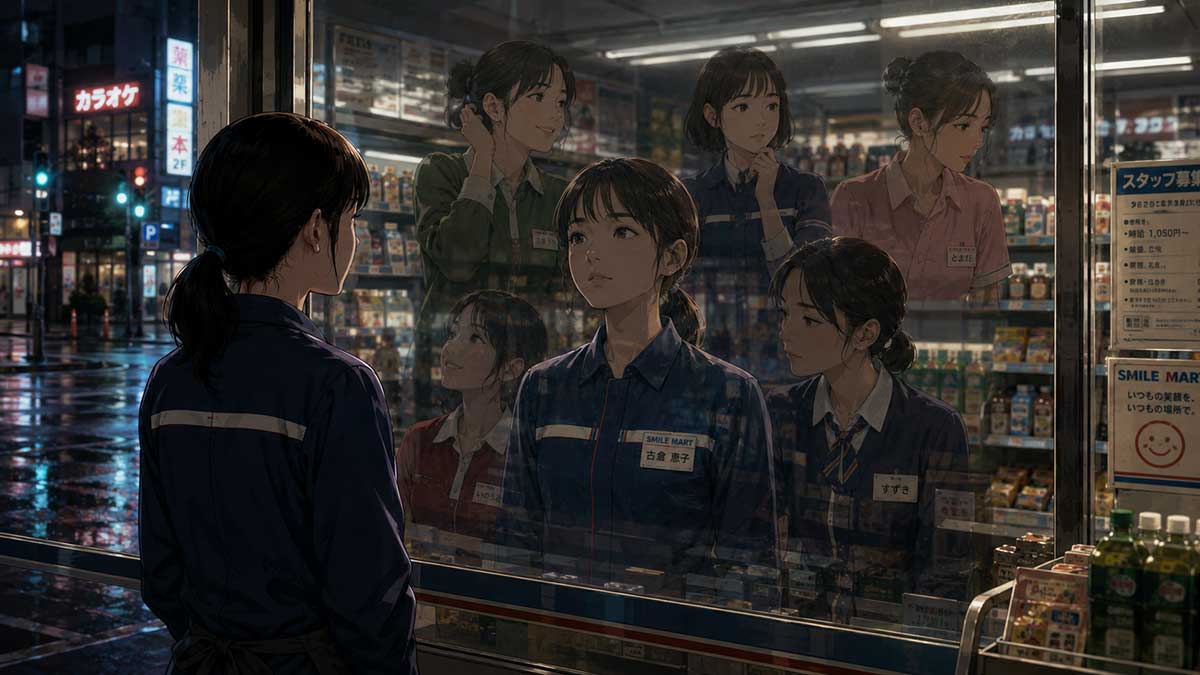
The store had quieted.
A few customers moved between the aisles, but the evening rush had passed.
Keiko stood near the counter, folding a stack of plastic bags that did not need folding.
Miho noticed and smiled.
Miho: “You do that when you’re thinking, don’t you?”
Keiko: “Do what?”
Miho: “Find something to organize.”
Keiko looked at the bags.
Keiko: “They were uneven.”
Shiraha: “Everything in your life is uneven unless a store manual tells you what to do.”
Keiko looked at him.
Keiko: “That sentence doesn’t make sense.”
Shiraha: “It makes perfect sense.”
Miho: “Let’s try something simpler.”
She looked at Keiko.
Miho: “When you copy people, does it feel like pretending?”
Keiko did not answer immediately.
Keiko: “What do you mean by pretending?”
Miho: “Acting like someone you’re not.”
Keiko: “How do people know who they are before they act?”
Miho blinked.
Shiraha sighed.
Shiraha: “Here we go.”
Miho: “No, wait. I want to hear this.”
Keiko placed one bag on top of another.
Keiko: “When I started working here, I watched the other employees.”
Miho: “Right.”
Keiko: “I watched how they spoke to customers. How loudly they said hello. How they smiled. How they reacted when someone complained.”
Miho: “And you copied them.”
Keiko: “Yes.”
Miho: “Didn’t that feel fake?”
Keiko: “No.”
Miho: “Why not?”
Keiko: “I didn’t know another way to learn.”
Miho leaned against the counter.
Keiko: “When children learn language, they copy.”
Miho: “True.”
Keiko: “When new employees come here, they copy experienced employees.”
Miho: “Also true.”
Keiko: “People copy clothes.”
Miho: “Yes.”
Keiko: “Hair.”
Miho: “Yes.”
Keiko: “Expressions.”
Miho hesitated.
Keiko: “Words.”
Miho: “Sometimes.”
Keiko: “Then why is my copying different?”
Miho opened her mouth.
Nothing came out.
Shiraha smirked.
Shiraha: “Because normal people like to pretend their imitation is original.”
Miho: “You don’t have to make everything sound poisonous.”
Shiraha: “I’m right.”
Keiko: “Sometimes you copy people too.”
Shiraha turned.
Shiraha: “I don’t.”
Keiko: “You use words you’ve heard other people use.”
Shiraha: “That’s language.”
Keiko: “Exactly.”
Miho laughed.
Shiraha: “You two are impossible.”
A customer walked past wearing a dark coat, carrying a briefcase.
Keiko glanced at him.
Miho: “What did you just notice?”
Keiko: “His tie is crooked.”
Miho: “Anything else?”
Keiko looked again.
Keiko: “He looks tired.”
Miho: “How can you tell?”
Keiko: “His shoulders are lower than most office workers who come in at this hour.”
Miho stared at her.
Miho: “You really study people.”
Keiko: “Everyone studies people.”
Miho: “Not like you.”
Keiko: “How do you know?”
That question silenced her again.
After a moment Miho said:
Miho: “Maybe I do it without noticing.”
Keiko nodded.
Keiko: “Then perhaps I only notice that I’m doing it.”
Shiraha looked over.
Shiraha: “That doesn’t make it normal.”
Keiko: “Why not?”
Shiraha: “Because you had to consciously manufacture yourself.”
Keiko's face stayed calm.
Keiko: “Everyone manufactures themselves.”
Shiraha: “No.”
Keiko: “You changed your behavior when you wanted people to think you were employable.”
Shiraha's expression tightened.
Keiko: “You changed your clothing.”
Shiraha: “For interviews.”
Keiko: “You spoke differently.”
Shiraha: “That’s survival.”
Keiko: “Yes.”
Miho looked from one to the other.
Miho: “So maybe that’s the real question.”
Shiraha: “What?”
Miho: “When does adapting become pretending?”
No one answered.
Keiko slowly folded another bag.
Miho: “Did you ever feel like people only liked the version of you that you had built for them?”
Keiko thought.
Keiko: “People reacted better when I behaved correctly.”
Miho: “That sounds like yes.”
Keiko: “I don't know.”
Miho: “Suppose you stopped.”
Keiko: “Stopped what?”
Miho: “Copying.”
Keiko looked genuinely confused.
Keiko: “All copying?”
Miho: “The social part.”
Keiko: “Which part is social?”
Miho paused.
Keiko: “Speaking?”
Miho: “No.”
Keiko: “Clothing?”
Miho: “Not exactly.”
Keiko: “Expressions?”
Miho: “Maybe.”
Keiko: “Then what do I stop?”
Miho looked at Shiraha.
Shiraha shrugged.
Miho: “I guess I’m asking what you would be like if you didn’t have to manage how other people saw you.”
Keiko stared at her for several seconds.
Keiko: “I don’t know.”
Miho softened.
Miho: “That sounds sad.”
Keiko: “Why?”
Miho: “Because most people think there’s supposed to be some private self underneath all of that.”
Keiko: “Is there?”
Miho hesitated.
Shiraha: “Of course there is.”
Keiko turned to him.
Keiko: “What is yours?”
Shiraha frowned.
Shiraha: “What do you mean?”
Keiko: “Your private self.”
Shiraha: “Me.”
Keiko: “That's not an answer.”
Miho laughed.
Shiraha: “I know who I am.”
Keiko: “Without society?”
Shiraha: “Yes.”
Keiko: “Would you still be angry if society didn't exist?”
Shiraha went quiet.
Miho looked at Keiko.
Keiko: “You talk about society almost constantly.”
Shiraha: “Because it controls everything.”
Keiko: “Then society is part of your identity too.”
Miho raised her eyebrows.
Shiraha: “Don't psychoanalyze me.”
Keiko: “I'm not.”
Shiraha: “It sounds like it.”
Keiko: “I'm describing what you talk about.”
Miho laughed softly.
Miho: “Maybe none of us has a pure self untouched by other people.”
Keiko: “That seems likely.”
Miho: “Parents shape us. Friends shape us. Work shapes us.”
Shiraha: “That's exactly the problem.”
Miho: “Not always.”
Shiraha: “It is when people don't realize it.”
Keiko: “Why?”
Shiraha: “Because then they think their choices are their own.”
Keiko: “A choice can be influenced and still be a choice.”
Shiraha looked at her.
Keiko: “If I choose tea because someone introduced me to tea, did I not choose it?”
Shiraha: “That's different.”
Keiko: “Why?”
Shiraha: “Because tea isn't your identity.”
Keiko: “People say things like ‘I'm a coffee person.’”
Miho laughed so hard she had to turn away.
Shiraha: “You know what I mean.”
Keiko: “You say that a lot.”
The automatic doors opened.
A woman entered with a small child.
The child ran toward the sweets.
The mother called after him:
“Walk, please.”
The child slowed.
Keiko watched.
Keiko: “He changed his behavior.”
Miho: “He's a child.”
Keiko: “So?”
Miho: “Children learn rules.”
Keiko: “Adults continue learning rules.”
Miho: “Yes.”
Keiko: “Then when are you finished?”
Miho didn't answer.
Keiko: “At what age do people stop learning how to behave?”
Miho: “Probably never.”
Keiko: “Then why is adaptation considered less authentic?”
Miho thought for a long moment.
Miho: “Maybe it isn't adaptation itself.”
Keiko: “What is it?”
Miho: “Maybe it's whether you have a choice.”
Keiko looked interested.
Miho: “If I change how I speak in a meeting because I want to communicate better, that's one thing.”
Keiko: “Yes.”
Miho: “If I feel like I have to change everything about myself or people won't tolerate me, that feels different.”
Keiko considered this.
Keiko: “How different?”
Miho: “More costly.”
Keiko: “Costly how?”
Miho: “Exhausting.”
Keiko: “You asked me that before.”
Miho: “And you didn't really answer.”
Keiko looked toward the shelves.
Keiko: “Some situations are tiring.”
Miho: “Which ones?”
Keiko: “Parties.”
Miho smiled.
Keiko: “Family gatherings.”
Miho: “Makes sense.”
Keiko: “Conversations where people ask what I want from the future.”
Miho's smile faded.
Keiko: “There are too many possible correct answers.”
That sentence stayed between them.
Miho: “Possible correct answers.”
Keiko: “Yes.”
Miho: “You mean answers they would accept.”
Keiko: “Yes.”
Shiraha suddenly laughed.
Not kindly.
Shiraha: “And you still don't see what they've done to you.”
Keiko turned.
Keiko: “Who?”
Shiraha: “Everyone.”
Keiko: “That's vague.”
Shiraha: “They trained you.”
Keiko: “So did the convenience store.”
Shiraha: “Exactly.”
Keiko: “I like being trained here.”
Shiraha stared.
Shiraha: “Listen to yourself.”
Keiko: “I know what to do.”
Shiraha: “That's not freedom.”
Keiko: “Why?”
Shiraha: “Because someone else wrote the rules.”
Keiko: “Someone else wrote traffic rules too.”
Shiraha: “That's different.”
Keiko: “Someone else designed this language.”
Miho almost laughed again but stopped.
Keiko: “Someone else decided what money means.”
Shiraha: “You can't compare those things.”
Keiko: “Why not?”
Shiraha looked genuinely frustrated now.
Keiko: “Perhaps freedom doesn't mean making every rule yourself.”
Miho looked at her carefully.
Miho: “Then what does it mean?”
Keiko hesitated.
That was unusual.
Keiko: “I don't know.”
A few minutes passed.
Keiko walked to the hot-food display and checked the stock.
Miho followed at a distance.
Miho: “Can I ask you something more personal?”
Keiko: “You already have.”
Miho: “Fair.”
Keiko checked the labels.
Miho: “When you're here, are you copying?”
Keiko: “Yes.”
Miho looked surprised.
Keiko: “There are appropriate ways to speak here.”
Miho: “But you said this is where you feel most comfortable.”
Keiko: “Yes.”
Miho: “So the place where you copy the most is the place where you feel most like yourself?”
Keiko looked at her.
Keiko: “Perhaps.”
Miho almost smiled, then stopped.
Miho: “That's strange.”
Keiko: “Why?”
Miho: “Because I thought being yourself meant not having to perform.”
Keiko: “Performing can be comfortable.”
Miho: “How?”
Keiko: “If you know the role.”
Miho fell silent.
Keiko continued.
Keiko: “When people say ‘be yourself,’ they usually don't explain what behavior they expect afterward.”
Miho laughed quietly.
Miho: “That's true.”
Keiko: “Here, they do.”
She pointed toward the register.
Keiko: “If a customer approaches, greet them.”
Toward the shelves.
Keiko: “If stock is low, replace it.”
Toward the entrance.
Keiko: “If someone comes in, notice them.”
Then she looked at Miho.
Keiko: “It's clear.”
Miho looked around Smile Mart.
Uniforms.
Shelves.
Signs.
Schedules.
Scripts.
Everything had seemed restrictive a moment ago.
Now she could see why someone might experience it differently.
Miho: “So maybe rules aren't always the opposite of freedom.”
Shiraha scoffed from behind them.
Shiraha: “That's exactly what institutions want you to believe.”
Miho: “I'm not saying all rules are good.”
Shiraha: “That's where it starts.”
Keiko: “You sound like a warning label.”
Miho laughed.
Shiraha stared at her.
Keiko: “Everything leads to danger.”
Shiraha: “Because most things do.”
Miho turned back to Keiko.
Miho: “But I still worry about something.”
Keiko: “What?”
Miho: “If the store gives you the role, what happens when you're not here?”
Keiko's face became still.
Miho: “At home.”
No answer.
Miho: “On your day off.”
Keiko looked down.
Miho: “When nobody needs anything from you.”
Keiko thought.
Keiko: “I prepare for the next shift.”
Miho's expression changed.
Keiko: “I eat foods that keep my body functioning.”
Miho: “For work?”
Keiko: “Yes.”
Miho: “You sleep so you can work.”
Keiko: “Yes.”
Miho: “You take care of your health so you can work.”
Keiko: “Yes.”
Shiraha gave a low laugh.
Shiraha: “She's not living. She's maintenance equipment.”
Keiko looked at him.
Keiko: “Everyone maintains their body for something.”
Miho: “True.”
Keiko: “Children.”
Miho: “Sometimes.”
Keiko: “Work.”
Miho: “Yes.”
Keiko: “Sports.”
Miho: “Yes.”
Keiko: “Relationships.”
Miho nodded.
Keiko: “Why is mine worse?”
No one answered.
The lights above them seemed suddenly very bright.
Miho looked at Keiko.
Miho: “I'm not sure it is.”
Keiko nodded.
Miho: “But I wonder what would happen if this place disappeared.”
Keiko stopped moving.
Shiraha noticed.
Miho noticed too.
Keiko: “Why would it disappear?”
Miho: “Stores close.”
Keiko: “This one is profitable.”
Miho: “I'm not saying tomorrow.”
Keiko: “Then the question isn't useful.”
Miho: “Maybe not.”
Keiko began straightening the shelf again.
Too carefully.
Miho: “Keiko.”
Keiko did not look up.
Miho: “Would you know who you were without Smile Mart?”
A pause.
Then another.
Keiko finally looked at her.
Keiko: “Would you know who you were without your family?”
Miho froze.
Keiko: “Without your job?”
Miho said nothing.
Keiko: “Without your friends?”
Still nothing.
Keiko: “If enough parts of your life disappeared, would your identity stay exactly the same?”
Miho slowly shook her head.
Keiko: “Then why am I supposed to?”
That ended the argument.
For a moment.
Shiraha broke the silence.
Shiraha: “Because normal people don't build their entire existence around a convenience store.”
Keiko turned.
Keiko: “They build it around companies.”
Shiraha: “Not the same.”
Keiko: “Marriage.”
Shiraha: “Not the same.”
Keiko: “Children.”
Shiraha: “Not the same.”
Keiko: “Religion.”
Miho looked at Shiraha.
Keiko: “Sports teams.”
Miho smiled.
Keiko: “Countries.”
Shiraha's expression tightened.
Keiko: “People build identities around many things.”
Miho: “She's right.”
Shiraha: “That doesn't make it healthy.”
Keiko: “I didn't say healthy.”
That word changed the room again.
Miho looked at her.
Miho: “Then what are you saying?”
Keiko thought.
Keiko: “That people keep asking whether I'm normal.”
She looked around the store.
Keiko: “Maybe they should ask whether the arrangement works.”
Miho slowly nodded.
Miho: “And does it?”
Keiko answered immediately.
Keiko: “Here, yes.”
Miho: “And outside?”
Keiko looked toward the automatic doors.
Streetlights had come on.
People passed behind the glass.
Keiko: “Less often.”
A customer entered.
The chime sounded.
Keiko changed instantly.
Keiko: “Welcome!”
She walked toward the register.
Miho watched.
This time, she didn't see someone becoming fake.
She saw someone entering a language she knew fluently.
That felt different.
But it didn't answer everything.
When Keiko returned, Miho said:
Miho: “I think I understand something.”
Keiko: “What?”
Miho: “Maybe the question isn't whether you have a mask.”
Keiko waited.
Miho: “Maybe everyone does.”
Shiraha rolled his eyes.
Miho: “The question is whether you can take it off.”
Keiko looked at her.
Miho: “And whether there’s somewhere underneath it where you can still breathe.”
Keiko thought for a long time.
Then she looked around Smile Mart.
The register.
The shelves.
The fluorescent lights.
The refrigerator hum.
The familiar voice from the store announcement.
Keiko: “What if this is where I breathe?”
Miho did not answer.
Shiraha did.
Shiraha: “Then it's not a refuge.”
Keiko turned toward him.
Shiraha: “It's a cage you've learned to love.”
Keiko looked around the store again.
Then back at Shiraha.
Keiko: “Can a cage tell you exactly where everything belongs?”
Shiraha stared at her.
Miho closed her eyes for a second.
Miho: “I think that's our next problem.”
Keiko returned to the shelf.
A bottle was facing slightly the wrong direction.
She turned it forward.
And for the first time, Miho wasn't sure whether she was watching Keiko disappear into the store or become more fully herself.
Topic 3: Is the Convenience Store Saving Keiko or Consuming Her?
The question stayed with Miho longer than she expected.
Was she watching Keiko disappear into the store?
Or become more fully herself?
The fluorescent lights buzzed softly overhead.
A microwave beeped near the counter.
Someone opened the refrigerated case and let it close.
Keiko moved through the aisles with the ease of someone walking through a familiar room in the dark.
Miho: “Keiko.”
Keiko turned.
Keiko: “Yes?”
Miho: “Do you ever feel trapped here?”
Keiko: “No.”
Shiraha: “Of course she doesn’t. That’s how systems work when they’ve gotten inside you.”
Keiko looked at him.
Keiko: “You say things like the store has entered my body.”
Shiraha: “Basically.”
Keiko: “That would be medically concerning.”
Miho laughed.
Shiraha did not.
Shiraha: “You know what I mean.”
Keiko: “Not exactly.”
Miho: “Let me ask it differently.”
She gestured around them.
Miho: “What does this place give you?”
Keiko answered without hesitation.
Keiko: “Instructions.”
Miho waited.
Keiko: “Timing.”
Another pause.
Keiko: “Sounds.”
Miho: “Sounds?”
Keiko: “The door.”
A chime sounded as if on cue.
Keiko glanced toward the entrance automatically.
Keiko: “That means someone came in.”
She pointed toward the microwave area.
Keiko: “That beep means something is ready.”
Toward the register.
Keiko: “The scanner means the transaction is moving.”
She looked at the shelves.
Keiko: “Empty spaces mean something needs replacing.”
Miho: “And that feels good?”
Keiko: “It feels clear.”
Shiraha shook his head.
Shiraha: “You keep confusing clarity with freedom.”
Keiko: “You keep assuming freedom is supposed to feel unclear.”
Miho looked at Shiraha.
He frowned.
Miho: “Actually, that’s worth staying with.”
She turned back to Keiko.
Miho: “Most people think freedom means having choices.”
Keiko: “How many?”
Miho: “What?”
Keiko: “How many choices are required before something becomes freedom?”
Miho laughed softly.
Miho: “I don’t know.”
Keiko: “Two?”
Miho: “Probably more than two.”
Keiko: “Ten?”
Miho: “Keiko.”
Keiko: “A thousand?”
Shiraha: “That’s not the point.”
Keiko: “Then what is the point?”
Miho thought for a moment.
Miho: “Maybe freedom means you’re allowed to choose between different ways of living.”
Keiko: “What if I choose the one with fewer choices?”
No one answered immediately.
Keiko continued.
Keiko: “When I enter the store, I know what I am supposed to do.”
Miho: “And that makes you feel free?”
Keiko: “It means I don't have to keep asking what the correct action is.”
Miho went quiet.
That answer carried more weight than Keiko seemed to realize.
Or perhaps she realized it perfectly.
Shiraha leaned against a shelf.
Shiraha: “You don’t see the problem because you’ve adjusted yourself to the machine.”
Keiko: “You call everything a machine.”
Shiraha: “This one literally runs on schedules, stock, labor, and profit.”
Keiko: “So does a restaurant.”
Shiraha: “Yes.”
Keiko: “A hospital.”
Shiraha: “Also yes.”
Keiko: “A school.”
Shiraha: “Yes.”
Keiko: “Then perhaps machines aren't automatically bad.”
Shiraha stared at her.
Keiko: “People use machines because they organize things.”
Shiraha: “People are not things.”
Keiko: “I didn't say they were.”
Shiraha: “You make yourself into one.”
Keiko’s face changed very slightly.
Miho noticed.
Keiko: “What kind of thing?”
Shiraha: “A component.”
Keiko looked toward the register.
Keiko: “A component can be necessary.”
Shiraha: “That’s depressing.”
Keiko: “Why?”
Shiraha: “Because you should want to be more than useful.”
Keiko turned back to him.
Keiko: “More in what direction?”
Shiraha opened his mouth.
Nothing came out.
Miho smiled faintly.
Miho: “We’re back to ‘what’s next.’”
A customer asked where the batteries were.
Keiko answered, walked him to the shelf, then returned.
Miho: “Keiko, when you're here, do you feel like the store accepts you?”
Keiko thought.
Keiko: “The store doesn't have opinions.”
Miho: “The people in it do.”
Keiko: “People change.”
Miho: “Exactly.”
Keiko: “The procedures change less.”
Miho nodded.
Keiko: “If I follow them, I can function.”
Miho: “So maybe it isn’t acceptance you want.”
Keiko waited.
Miho: “Maybe it’s predictability.”
Keiko considered that.
Keiko: “Predictability is useful.”
Miho: “For you, maybe more than useful.”
Keiko didn't answer.
Miho: “What happens when people are unpredictable?”
Keiko: “I have to watch more carefully.”
Miho: “And when you can't read them?”
Keiko: “I make mistakes.”
Miho: “And then?”
Keiko paused.
Keiko: “They become uncomfortable.”
Miho's voice softened.
Miho: “Or you do?”
Keiko looked at her.
Keiko: “Both.”
Shiraha scoffed.
Shiraha: “This is exactly why the store is dangerous.”
Miho: “Dangerous?”
Shiraha: “It lets her avoid learning how to exist without a script.”
Keiko: “You say that as if existing without a script is superior.”
Shiraha: “It is.”
Keiko: “Why?”
Shiraha: “Because then you're actually living.”
Keiko: “What does ‘actually living’ require?”
Shiraha: “Making your own choices.”
Keiko: “You chose not to work.”
Shiraha: “Yes.”
Keiko: “You were unhappy.”
Shiraha glared at her.
Keiko: “So choice doesn't guarantee satisfaction.”
Miho tried not to smile.
Shiraha: “At least it was my dissatisfaction.”
Keiko stared at him for a second.
Keiko: “That's a strange preference.”
Miho looked around the store again.
Miho: “Maybe both of you are treating freedom like it has to come in one form.”
Shiraha: “It does.”
Miho: “No.”
Keiko: “I agree with Miho.”
Shiraha rolled his eyes.
Miho: “For some people, too much structure feels suffocating.”
She looked at Shiraha.
Miho: “For some people, too little structure feels terrifying.”
She looked at Keiko.
Miho: “Maybe neither reaction is morally superior.”
Keiko nodded.
Shiraha did not.
Shiraha: “The problem is when people convince themselves they chose the cage.”
Miho turned.
Miho: “You keep calling it a cage. What would prove to you that it wasn’t?”
Shiraha hesitated.
Miho: “If Keiko genuinely wants this life, what evidence would you accept?”
Shiraha: “People can want what harms them.”
Miho: “True.”
Shiraha: “Exactly.”
Miho: “That doesn't answer my question.”
Shiraha looked irritated.
Miho: “How do you tell the difference between a life you personally wouldn't want and a life that is actually bad for someone else?”
Silence.
Keiko listened carefully.
Miho: “That's harder than saying ‘everyone should be free.’”
Shiraha: “If she can't imagine herself outside the store, that's evidence.”
Miho looked at Keiko.
Miho: “Is it?”
Keiko thought.
Keiko: “I can imagine being outside.”
Miho: “Doing what?”
Keiko: “Walking.”
Miho smiled.
Keiko: “Eating.”
Miho: “Keiko.”
Keiko: “Sleeping.”
Miho: “You know what I mean.”
Keiko: “I know what I do outside.”
Miho: “Do you know who you are outside?”
Keiko became still.
Shiraha watched closely.
Keiko: “That question assumes I have to be something when I'm not doing anything.”
Miho blinked.
Keiko: “Why?”
Miho: “Because people usually feel like they're still themselves at home.”
Keiko: “How do they know?”
Miho: “They just do.”
Keiko frowned slightly.
Keiko: “That's not very precise.”
Miho laughed, but there was sadness in it.
Miho: “No. It isn't.”
Keiko walked toward the prepared-food shelves.
One sandwich was slightly out of line.
She fixed it.
Keiko: “Perhaps I don't need the same kind of self you do.”
Miho followed.
Miho: “What kind do I have?”
Keiko: “One that continues even when nobody needs anything from you.”
Miho stopped.
Keiko: “You said you feel like yourself at home.”
Miho: “Yes.”
Keiko: “I feel quieter at home.”
Miho: “Quieter sounds good.”
Keiko: “Not always.”
Miho waited.
Keiko: “Sometimes there are too few instructions.”
That answer surprised her.
Miho: “What do you do then?”
Keiko: “Prepare.”
Miho: “For work.”
Keiko: “Yes.”
Miho: “And if you had three days off?”
Keiko: “I would prepare for work for three days.”
Miho looked at Shiraha.
Shiraha gave her a look that said, There. Cage.
But Miho still wasn't sure.
Miho: “Does the store ever take too much from you?”
Keiko: “Too much what?”
Miho: “Time.”
Keiko: “I give it scheduled hours.”
Miho: “Energy.”
Keiko: “I sleep.”
Miho: “Identity.”
Keiko stared at her.
Keiko: “How would I measure that?”
Miho paused.
Keiko: “Is there an amount of identity you're supposed to keep outside work?”
Miho: “Probably.”
Keiko: “How much?”
Miho: “I don't know.”
Keiko: “Then how do you know I don't have enough?”
Miho smiled reluctantly.
Miho: “You're very difficult to worry about.”
Keiko: “Why?”
Miho: “Because every time I think I've found the problem, you ask me to define it.”
Keiko: “That seems reasonable.”
Shiraha pushed away from the shelf.
Shiraha: “Fine. Here's the problem.”
Both women looked at him.
Shiraha: “The store values her because she performs a function.”
Keiko: “Yes.”
Shiraha: “If she stops performing that function, she loses the value.”
Keiko: “To the store.”
Shiraha: “Exactly.”
Keiko: “A dentist is valued by patients because of dentistry.”
Shiraha: “Not the same.”
Keiko: “A chef because of cooking.”
Shiraha: “Not the same.”
Keiko: “A teacher because of teaching.”
Shiraha: “You're deliberately avoiding the point.”
Keiko: “I'm trying to find the point.”
Miho stepped in.
Miho: “Maybe his point is that being useful can become dangerous when you start believing usefulness is the same as worth.”
Keiko turned to her.
That landed.
Keiko: “Worth to whom?”
Miho sighed.
Miho: “You really don't let anything stay simple.”
Keiko: “Simple things are often unclear.”
Miho tried again.
Miho: “Suppose tomorrow you couldn't work.”
Keiko's expression tightened almost imperceptibly.
Miho: “Not because the store closed. Suppose your body couldn't do it anymore.”
Keiko looked down.
Miho: “Would you still think your life had value?”
Keiko didn't answer.
Shiraha didn't either.
The store noises filled the silence.
A refrigerator motor started.
Someone dropped coins at the register.
The door opened.
Closed.
Keiko finally said:
Keiko: “I would need another role.”
Miho's face changed.
Miho: “Why?”
Keiko: “Because doing nothing would be difficult.”
Miho: “Difficult or meaningless?”
Keiko looked at her.
For once, there was no immediate answer.
Shiraha spoke more quietly than usual.
Shiraha: “That's what I've been telling you.”
Keiko turned.
Shiraha: “You need a system to tell you that you exist.”
Keiko didn't get angry.
She just looked at him.
Keiko: “And you need a system to tell you what to reject.”
Shiraha's face hardened.
Keiko: “You measure your life against what society expects too.”
Shiraha: “No.”
Keiko: “You talk about men, women, work, marriage, status.”
Shiraha: “Because society uses those things to judge us.”
Keiko: “Then you are still looking at the same measuring stick.”
Miho's eyes moved between them.
Keiko: “You stand on the other side of it.”
Shiraha said nothing.
Keiko: “But you still stand beside it.”
Miho smiled slowly.
Miho: “That's interesting.”
Shiraha: “No, it isn't.”
Miho: “It is.”
She turned to Keiko.
Miho: “You let systems define you from the inside.”
Then to Shiraha.
Miho: “You let them define you from the outside.”
Shiraha: “Ridiculous.”
Miho: “Is it?”
Shiraha: “I'm rejecting them.”
Miho: “But what would you talk about if they disappeared?”
Shiraha glared at her.
Miho: “Who would you be angry at?”
He looked away.
Keiko watched him with mild curiosity.
A long moment passed.
Then Miho returned to the store itself.
Miho: “Keiko, can I ask you one question without trying to rescue you?”
Keiko: “Were you trying to rescue me?”
Miho laughed.
Miho: “Probably.”
Keiko: “From what?”
Miho: “I'm not sure anymore.”
Keiko nodded.
Miho: “Here’s the question.”
She looked around.
Miho: “If Smile Mart gives you clarity, belonging, rhythm, purpose, and peace... why shouldn't that count as a good life?”
Keiko answered immediately.
Keiko: “I think it does.”
Miho nodded.
Miho: “Then I have one more.”
Keiko: “You said one.”
Miho: “I lied.”
Keiko accepted this.
Miho: “If the same place gives you all of those things because you've built your entire identity around functioning inside it... how do we know when belonging becomes dependence?”
Keiko thought.
Longer this time.
Keiko: “Maybe it is dependence.”
Miho looked surprised.
Keiko: “Why does that automatically make it bad?”
Miho didn't answer.
Keiko: “People depend on homes.”
Miho: “Yes.”
Keiko: “Families.”
Miho: “Yes.”
Keiko: “Bodies.”
Miho: “Unfortunately, yes.”
Keiko: “Money.”
Miho: “Yes.”
Keiko: “Other people.”
Miho nodded.
Keiko: “Why is dependence only frightening when it looks unusual?”
Miho became very still.
Shiraha gave a short laugh.
Shiraha: “Because some dependencies are socially approved.”
Keiko: “Marriage.”
Shiraha: “Exactly.”
Keiko: “Career.”
Shiraha: “Exactly.”
Keiko: “Children.”
Shiraha: “Exactly.”
Keiko: “And those can't become cages?”
Shiraha stopped.
Miho looked at Keiko.
Keiko: “If someone says, ‘My family is my whole life,’ people often find it beautiful.”
Miho: “Sometimes.”
Keiko: “If I say, ‘The convenience store is my whole life,’ people find it disturbing.”
Miho looked around Smile Mart again.
She finally said:
Miho: “Maybe because we understand the first kind.”
Keiko: “So unfamiliar dependence looks more dangerous than familiar dependence.”
Miho nodded slowly.
Miho: “Maybe.”
Keiko moved behind the counter.
For a while nobody spoke.
Then Shiraha said:
Shiraha: “You're still avoiding the cage question.”
Keiko turned.
Keiko: “No.”
Shiraha: “Then answer it.”
Keiko: “Can something be a refuge and a cage at the same time?”
Shiraha: “Yes.”
Keiko: “Then perhaps it is both.”
Miho stared at her.
Shiraha seemed almost disappointed that she had agreed.
Keiko: “But if every refuge limits what is outside it, then many refuges are cages.”
Miho: “Home.”
Keiko: “Sometimes.”
Miho: “Marriage.”
Keiko: “Sometimes.”
Miho: “Routine.”
Keiko: “Sometimes.”
Miho: “The store.”
Keiko looked around.
Keiko: “Sometimes.”
Miho smiled faintly.
Miho: “That may be the first time you've admitted it.”
Keiko: “You asked more precisely.”
Shiraha shook his head.
Shiraha: “You're both romanticizing captivity.”
Keiko looked at him.
Keiko: “Then what is your refuge?”
Shiraha: “I don't need one.”
Keiko: “Everyone needs somewhere to sleep.”
Shiraha: “That's not what I mean.”
Keiko: “Then where do you feel you belong?”
Shiraha said nothing.
Keiko waited.
Shiraha: “Belonging is another trap.”
Miho looked at him.
Miho: “Do you believe that?”
Shiraha: “Yes.”
Miho: “Or do you say it because belonging rejected you first?”
His face changed.
Silence.
Keiko watched him.
Keiko: “That seems possible.”
Shiraha: “Stay out of it.”
Keiko: “We're discussing belonging.”
Shiraha: “We're discussing your unhealthy relationship with a convenience store.”
Keiko: “Now we're discussing yours with society.”
Miho looked between them.
Miho: “I think we've reached the next problem.”
Shiraha frowned.
Miho: “Keiko found a system she can inhabit.”
She turned to Shiraha.
Miho: “You found one you can spend your life fighting.”
Then back to Keiko.
Miho: “Neither of you is exactly outside society.”
Keiko thought about that.
Shiraha looked irritated.
Miho continued.
Miho: “So maybe the next question isn't who conforms and who rebels.”
She looked at both of them.
Miho: “Maybe it's which one of you is actually freer.”
The door chimed.
Keiko immediately turned.
Keiko: “Welcome!”
Shiraha watched her become the convenience-store worker again.
This time, he didn't look amused.
Miho watched him watching Keiko.
And she realized something else.
Keiko wasn't the only one whose entire posture changed when society entered the room.
Topic 4: Keiko and Shiraha, Two Ways of Refusing Society
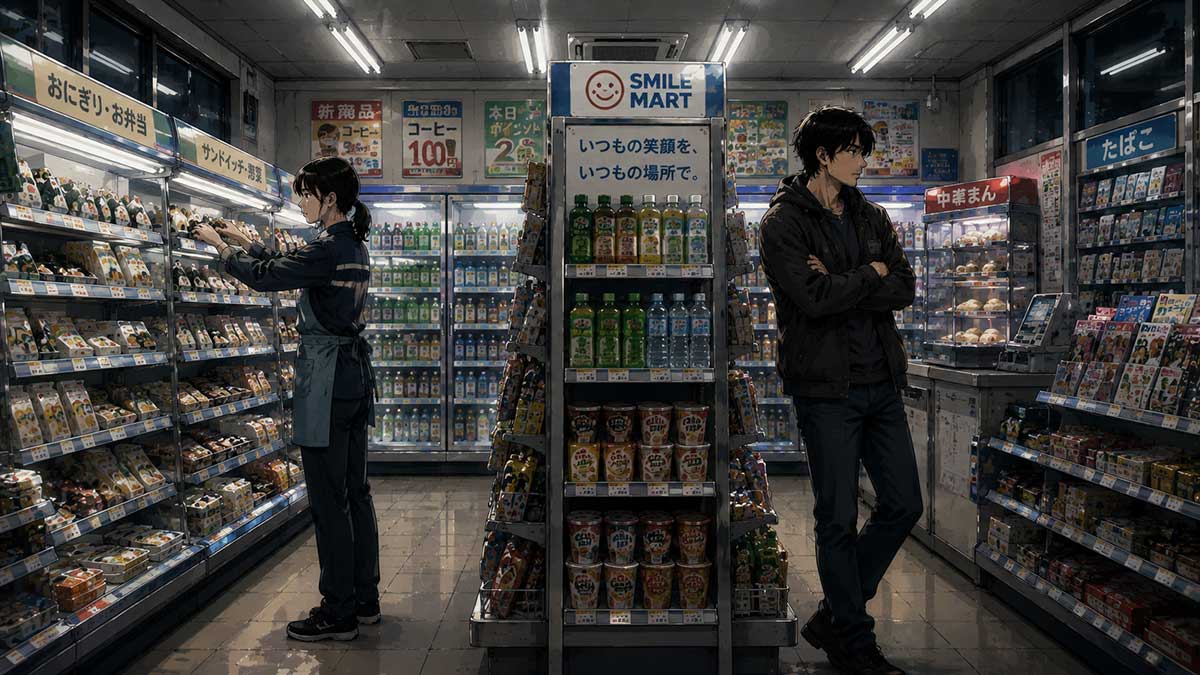
The store had entered its late-evening lull.
A few customers moved slowly between the aisles.
Outside, the street had darkened almost completely.
Shiraha stood near the magazine rack with his arms folded.
Keiko was restocking bottled water.
Miho watched both of them.
Miho: “I think we’ve been treating the two of you as opposites.”
Neither answered.
Miho: “Keiko adapts.”
She looked at Shiraha.
Miho: “You resist.”
Shiraha: “Correct.”
Miho: “Keiko learns the rules.”
Shiraha: “And obeys them.”
Miho: “You criticize the rules.”
Shiraha: “Someone has to.”
Keiko placed another bottle on the shelf.
Miho: “So which one of you is freer?”
Shiraha laughed.
Shiraha: “Seriously?”
Miho: “Yes.”
Shiraha: “Me.”
Keiko looked over.
Keiko: “Why?”
Shiraha: “I know what society is doing.”
Keiko: “So do I.”
Shiraha: “No, you don’t. You participate in it willingly.”
Keiko: “Knowing something exists and obeying part of it aren't opposites.”
Shiraha: “You let it use you.”
Keiko: “You let it upset you.”
Shiraha stared at her.
Miho looked down, trying not to smile.
Shiraha: “Those are not remotely the same thing.”
Keiko: “I didn't say they were the same.”
Shiraha: “Then what are you saying?”
Keiko: “You seem very controlled by things you say you reject.”
Shiraha’s expression changed.
Shiraha: “Controlled?”
Keiko: “Yes.”
Shiraha: “By what?”
Keiko: “Marriage.”
Shiraha: “I reject marriage.”
Keiko: “You talk about it frequently.”
Shiraha: “Because society forces it on people.”
Keiko: “Employment.”
Shiraha: “Same thing.”
Keiko: “Status.”
Shiraha: “Obviously.”
Keiko: “Women.”
Miho looked at him.
Keiko: “Men.”
Shiraha’s jaw tightened.
Keiko: “You talk about all of those things much more than I do.”
Shiraha: “That’s because I understand how the system works.”
Keiko: “Maybe.”
She placed another bottle on the shelf.
Keiko: “But if you spend most of your life thinking about something, it occupies a lot of your life.”
Miho looked at Shiraha.
Miho: “She has a point.”
Shiraha: “No, she doesn’t.”
Miho: “If every decision you make begins with, ‘I refuse to do what society wants,’ then society still gets the first move.”
Shiraha scoffed.
Shiraha: “That’s ridiculous.”
Miho: “Is it?”
Shiraha: “I’m choosing my own life.”
Keiko: “What life?”
Shiraha turned sharply.
Shiraha: “Excuse me?”
Keiko: “What do you want?”
Shiraha: “Freedom.”
Keiko: “To do what?”
He stopped.
Keiko: “If nobody expected you to work, marry, earn money, impress anyone, or behave like a proper man, what would you actually do?”
Shiraha stared at her.
Keiko: “Not what would you refuse.”
A pause.
Keiko: “What would you choose?”
The refrigerator hummed behind them.
Miho said nothing.
Shiraha looked away.
Shiraha: “That’s not the issue.”
Keiko: “Then perhaps you don’t know.”
Shiraha: “And you do?”
Keiko: “Yes.”
Shiraha: “You want to scan barcodes.”
Keiko: “Among other things.”
Shiraha: “That’s pathetic.”
Keiko’s face barely changed.
Keiko: “You asked.”
Miho stepped closer.
Miho: “Shiraha, why does Keiko’s answer bother you?”
Shiraha: “It doesn’t.”
Miho: “You called it pathetic.”
Shiraha: “Because it is.”
Miho: “Why?”
Shiraha: “She’s proud of being useful to a system that would replace her tomorrow.”
Keiko looked interested.
Keiko: “You think replaceability makes work meaningless?”
Shiraha: “Obviously.”
Keiko: “Managers are replaceable.”
Shiraha: “Yes.”
Keiko: “Company presidents.”
Shiraha: “Often.”
Keiko: “Politicians.”
Shiraha: “Definitely.”
Keiko: “Then many people have meaningless work.”
Shiraha: “Now you’re getting somewhere.”
Keiko: “But people can still enjoy doing it.”
Shiraha sighed.
Keiko: “A customer doesn't care whether I am the only person in the world capable of stocking rice balls.”
Shiraha: “That’s the point.”
Keiko: “They care that rice balls are available.”
Miho smiled.
Keiko: “That seems reasonable.”
Shiraha looked at Miho.
Shiraha: “This is exactly what society wants. People like her who don’t ask for anything.”
Keiko turned.
Keiko: “I ask for wages.”
Miho laughed.
Keiko: “And scheduled breaks.”
Miho: “Fair.”
Keiko: “And sometimes more staff during busy periods.”
Shiraha frowned.
Keiko: “I don't ask society to admire me.”
Shiraha: “That’s worse.”
Keiko: “Why?”
Shiraha: “People should want more.”
Keiko: “You don't.”
That caught him off guard.
Keiko: “You criticize people for wanting careers and status.”
Shiraha: “Because those are fake desires.”
Keiko: “But now you're criticizing me for not wanting them.”
Miho turned toward Shiraha.
He said nothing.
Keiko: “What amount of wanting is correct?”
Silence.
Keiko: “Too much ambition is bad.”
She counted on one finger.
Keiko: “Too little ambition is bad.”
Another finger.
Keiko: “Working is submission.”
Another.
Keiko: “Not working makes people despise you, which you dislike.”
She looked up.
Keiko: “Your system seems difficult.”
Miho laughed.
Shiraha did not.
A customer passed.
Keiko shifted aside to give him room.
After he moved on, Miho said:
Miho: “I think there’s something deeper here.”
Shiraha: “There always is with you.”
Miho: “You both know what it feels like to fail the normal-life test.”
Neither objected.
Miho: “Keiko reacts by learning how to pass.”
She looked at Keiko.
Miho: “At least enough that people stop asking questions.”
Then Shiraha.
Miho: “You react by saying the test itself is corrupt.”
Shiraha: “It is.”
Miho: “Maybe.”
She paused.
Miho: “But failing an unfair test doesn't automatically make every answer you give afterward right.”
Shiraha stared at her.
Shiraha: “What’s that supposed to mean?”
Miho: “You use society’s unfairness to excuse a lot.”
His face hardened.
Shiraha: “Here we go.”
Miho: “You complain that women reject you.”
Shiraha: “They judge men by status.”
Miho: “Some people do.”
Shiraha: “Most.”
Miho: “Maybe. But that doesn't mean women owe you affection.”
Shiraha: “I never said they did.”
Keiko: “You often sound like they do.”
He turned toward her.
Shiraha: “Stay out of this.”
Keiko: “I'm already in it.”
Shiraha: “You don't understand relationships.”
Keiko: “Possibly.”
She paused.
Keiko: “But I understand transactions.”
Miho’s eyebrows rose.
Keiko: “If someone doesn't want something, the transaction doesn't happen.”
Shiraha: “Relationships aren't purchases.”
Keiko: “Then people have even more reason to be allowed to refuse.”
Miho went quiet.
Shiraha’s face tightened.
Shiraha: “You two are acting like I created this system.”
Miho: “No.”
Shiraha: “Men are judged by whether they can provide. Women are judged by whether they’re attractive and useful for reproduction. That’s how the world works.”
Miho: “Part of your criticism is real.”
Shiraha looked surprised.
Miho: “People do rank each other.”
Shiraha: “Exactly.”
Miho: “Economic status matters.”
Shiraha: “Exactly.”
Miho: “Gender expectations are real.”
Shiraha: “Exactly.”
Miho: “But noticing something cruel doesn't give you permission to become cruel.”
Shiraha went still.
Miho: “That’s the part you keep skipping.”
Keiko looked between them.
Shiraha: “Easy for you to say.”
Miho: “Probably.”
Shiraha: “You fit.”
Miho: “More than you do.”
Shiraha: “Then you don't understand.”
Miho: “Maybe I don't fully.”
She didn't retreat.
Miho: “But pain explains bitterness better than it excuses entitlement.”
Shiraha looked away.
Keiko spoke quietly.
Keiko: “When people treated me as abnormal, I changed my behavior.”
Shiraha gave a humorless laugh.
Shiraha: “Exactly. You surrendered.”
Keiko: “When people treated you as abnormal, you decided they were inferior.”
He turned.
Keiko: “Is that freedom?”
Shiraha: “I never said everyone was inferior.”
Miho looked at him.
Shiraha ignored her.
Keiko: “You frequently describe people as stupid.”
Shiraha: “Many are.”
Keiko: “Women.”
Shiraha: “Certain women.”
Keiko: “Successful men.”
Shiraha: “Those men are usually conformists.”
Keiko: “People with families.”
Shiraha: “Most of them are reproducing the system.”
Keiko considered this.
Keiko: “There aren't many people left.”
Miho burst out laughing.
Even Shiraha almost did.
Almost.
Miho leaned against the counter.
Miho: “Can I try something?”
Keiko: “Yes.”
Shiraha: “Do I have a choice?”
Miho: “Apparently that’s tonight’s theme.”
She smiled.
Miho: “Keiko, say society vanished.”
Keiko: “All people?”
Miho: “No. Social expectations.”
Keiko: “That's harder to imagine.”
Miho: “Try.”
Keiko waited.
Miho: “Nobody cares whether you marry.”
Keiko: “Good.”
Miho: “Nobody cares whether you're a permanent employee.”
Keiko: “Good.”
Miho: “Nobody thinks your job is embarrassing.”
Keiko: “Good.”
Miho: “Would you still work here?”
Keiko answered immediately.
Keiko: “Yes.”
Miho nodded.
Then she turned.
Miho: “Shiraha.”
Shiraha: “What?”
Miho: “Same world.”
Shiraha: “Fine.”
Miho: “Nobody expects you to marry.”
He said nothing.
Miho: “Nobody thinks less of you for your income.”
Still nothing.
Miho: “Nobody cares about your career.”
Shiraha: “Sounds good.”
Miho: “Nobody compares you with other men.”
Shiraha: “Great.”
Miho: “What would you do tomorrow morning?”
Silence.
Shiraha looked toward the store window.
Miho: “Where would you go?”
Nothing.
Miho: “What would you build?”
His face tightened.
Miho: “Who would you want to be around?”
Shiraha: “I don't know.”
He said it angrily.
But he said it.
Keiko looked at him.
There was no triumph in her face.
Only attention.
Keiko: “That seems harder than refusing.”
Shiraha looked at her.
Keiko: “Choosing.”
He said nothing.
Keiko: “Refusal only requires knowing what you don't want.”
Miho nodded.
Keiko: “Choosing requires knowing what you do.”
Shiraha’s mouth tightened.
Shiraha: “And you think you know?”
Keiko: “Some things.”
Shiraha: “Like Smile Mart.”
Keiko: “Yes.”
Shiraha: “That still makes you pathetic.”
Keiko looked at him.
Keiko: “You keep needing my choice to be pathetic.”
Miho’s expression changed.
Shiraha stared at her.
Keiko: “Why?”
He didn't answer.
Keiko: “If I am content with something you reject, does that make your rejection less certain?”
Shiraha's face hardened.
Shiraha: “No.”
Keiko: “Then why does it matter?”
Again, silence.
A customer entered.
Keiko greeted him.
Shiraha watched.
After the customer left, he said:
Shiraha: “You think she’s free because she smiles while obeying.”
Miho shook her head.
Miho: “No.”
Shiraha: “Then what are you saying?”
Miho: “I'm saying I no longer trust easy definitions of freedom.”
Shiraha: “Convenient.”
Miho: “Maybe freedom isn't the absence of rules.”
Keiko listened.
Miho: “Maybe it isn't rebellion either.”
Shiraha: “Then what?”
Miho: “Maybe part of it is being able to tell whether your life is organized around something you genuinely value, rather than only around what you fear.”
That silenced Shiraha.
Miho looked at Keiko.
Miho: “Keiko values the store.”
Then Shiraha.
Miho: “You fear being judged.”
Shiraha: “Everyone fears being judged.”
Miho: “True.”
Shiraha: “So what?”
Miho: “Maybe the question is what you build after the fear.”
Keiko turned toward a display that needed no attention.
She didn't touch it.
That was unusual enough for Miho to notice.
Keiko: “I changed myself so people would stop reacting badly.”
Miho waited.
Keiko: “But I also found things I liked after changing.”
Miho: “The store.”
Keiko: “Yes.”
Miho: “So adaptation wasn't only loss.”
Keiko: “No.”
Shiraha scoffed softly.
Keiko: “You rejected many things.”
She looked at him.
Keiko: “Did you find anything afterward?”
He didn't answer.
Keiko: “Something you like.”
Nothing.
Keiko: “Something you want to protect.”
Still nothing.
Keiko: “Something you want to continue.”
Shiraha turned toward her.
Shiraha: “Not everyone gets to have that.”
Keiko's expression changed.
Only slightly.
Keiko: “Maybe.”
For once, she didn't correct him.
Miho looked at Shiraha more gently.
Miho: “Did you ever have something?”
He laughed once.
There was no humor in it.
Shiraha: “What is this, therapy?”
Miho: “No.”
Shiraha: “Good.”
Miho: “I’m just wondering whether hating society became easier than wanting something society might take away.”
He stared at her.
Shiraha: “You people really love turning everything into a personal problem.”
Miho: “And you really love turning every personal problem into society.”
Keiko looked between them.
Keiko: “Perhaps both directions are sometimes useful.”
They both turned toward her.
Keiko: “Personal problems can have social causes.”
She thought.
Keiko: “Social problems can also become personal habits.”
Miho smiled slowly.
Shiraha: “You should stick to stocking shelves.”
Keiko: “I am stocking shelves.”
For a while, they worked in silence.
Then Miho spoke again.
Miho: “Keiko.”
Keiko: “Yes.”
Miho: “Did living with Shiraha help you?”
Shiraha looked over immediately.
Keiko thought.
Keiko: “It reduced questions.”
Miho: “From your family?”
Keiko: “Yes.”
Miho: “People treated you differently once they thought you had a man.”
Keiko: “Very differently.”
Miho: “Was that relief?”
Keiko: “Yes.”
Shiraha smirked.
Shiraha: “See? I was useful.”
Keiko: “Temporarily.”
Miho laughed.
Shiraha: “You’re welcome.”
Keiko: “I didn't thank you.”
Shiraha: “You should.”
Keiko: “Why?”
Shiraha: “I made you look normal.”
Keiko went still.
Miho: “That’s quite a sentence.”
Shiraha shrugged.
Shiraha: “It's true.”
Keiko looked at him.
Keiko: “Yes.”
Shiraha seemed pleased.
Then Keiko continued.
Keiko: “And when I looked normal, people became less interested in whether I was happy.”
The smile left his face.
Miho looked at Keiko carefully.
Keiko: “They relaxed.”
She paused.
Keiko: “My actual life had not improved.”
Another pause.
Keiko: “But my shape had become easier for them to understand.”
Miho said nothing.
Keiko: “That was useful information.”
Miho: “What did you learn?”
Keiko: “That sometimes people don't need you to be happy.”
She looked toward the doors.
Keiko: “They need your life to be recognizable.”
Shiraha gave a short nod.
Shiraha: “Finally.”
Keiko looked at him.
Keiko: “But you wanted the same thing.”
He frowned.
Shiraha: “What?”
Keiko: “You wanted me to become useful to you.”
Silence.
Keiko: “A place to stay.”
Shiraha stiffened.
Keiko: “Food.”
Miho looked at him.
Keiko: “A way to avoid expectations.”
Shiraha: “We had an arrangement.”
Keiko: “Yes.”
Shiraha: “You agreed.”
Keiko: “Yes.”
Shiraha: “Then what's your point?”
Keiko thought.
Keiko: “You criticized society for assigning people roles.”
She looked directly at him.
Keiko: “Then you assigned me one.”
Shiraha said nothing.
Miho let the silence remain.
Keiko did too.
At last Shiraha said:
Shiraha: “Everybody uses everybody.”
Keiko: “Sometimes.”
Shiraha: “That's how relationships work.”
Keiko: “Sometimes.”
Shiraha: “Then don't pretend you're above it.”
Keiko: “I'm not.”
Her voice remained calm.
Keiko: “But I can stop participating in an arrangement when it no longer works.”
Miho looked at her.
Miho: “That's choice.”
Keiko nodded.
Shiraha looked away.
The automatic doors opened again.
A young couple came in.
They were laughing about something.
Shiraha watched them with visible contempt.
Keiko noticed.
Keiko: “Do you know them?”
Shiraha: “No.”
Keiko: “Then why are you angry?”
Shiraha: “I'm not angry.”
Keiko: “Your face changed.”
Miho glanced at him.
Shiraha: “They’re performing.”
Keiko: “Maybe.”
Shiraha: “You can tell.”
Keiko: “No.”
Shiraha turned.
Keiko: “I can't tell what they feel from here.”
That landed harder than she intended.
Or perhaps not.
Keiko: “They could be happy.”
Shiraha: “They could be pretending.”
Keiko: “Yes.”
Shiraha: “Then we're saying the same thing.”
Keiko: “No.”
She looked at the couple.
Keiko: “I'm saying I don't know.”
Miho watched Shiraha.
Keiko returned to the register.
When the couple left, Miho spoke quietly.
Miho: “Maybe that’s another kind of freedom.”
Shiraha: “What is?”
Miho: “Letting other people's lives belong to them.”
He looked at her.
Miho: “Not needing their marriage to prove marriage is good.”
She glanced at Keiko.
Miho: “Not needing Keiko’s job to prove routine is good.”
Then back to Shiraha.
Miho: “Not needing someone else's happiness to be fake so your rejection of their life can feel correct.”
Shiraha stared at the floor.
Keiko checked the clock.
Keiko: “My shift ends soon.”
Miho: “Does that mean we have to stop?”
Keiko: “No.”
She looked at Shiraha.
Keiko: “But I think we answered something.”
Shiraha: “We didn't.”
Keiko: “Partly.”
Miho: “Which part?”
Keiko considered it.
Keiko: “Following rules doesn't automatically make someone unfree.”
Miho nodded.
Keiko: “Rejecting them doesn't automatically make someone free.”
Miho nodded again.
Shiraha said nothing.
Keiko: “Maybe freedom has something to do with whether you can choose again.”
Miho looked at her.
Keiko: “If the arrangement stops working.”
That felt different.
It was no longer merely about society.
Or work.
Or Shiraha.
It was about Keiko herself.
Miho waited a moment.
Then asked the question that had been approaching all evening.
Miho: “So when you chose the convenience store again...”
Keiko looked at her.
Miho: “Were you choosing yourself?”
Keiko was silent.
Shiraha watched her.
Miho continued.
Miho: “Or were you choosing the place that tells you most clearly who to be?”
Keiko's eyes moved slowly across Smile Mart.
The shelves.
The register.
The fluorescent lights.
The aisles she knew better than some people knew their own homes.
The familiar sounds moved through her body.
She seemed about to answer.
Then the entrance chime sounded.
Keiko turned automatically.
Her posture changed.
Her voice rose bright and clear.
Keiko: “Welcome!”
Miho watched her.
Shiraha watched her.
And neither could tell whether they had just witnessed a reflex, a performance, a devotion, or a choice.
Topic 5: Is Keiko Free at the End?
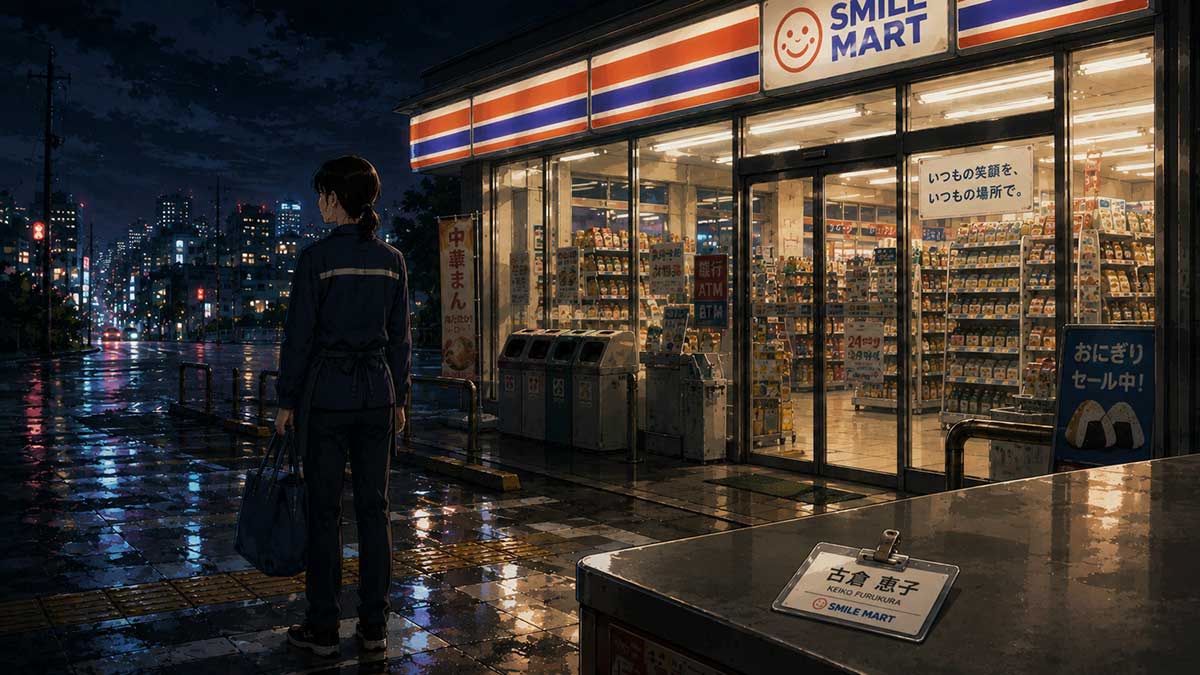
The customer paid for a bottle of tea and left.
The automatic doors closed.
Keiko returned to the counter.
Miho was still watching her.
Miho: “You didn't answer.”
Keiko: “I was working.”
Miho: “I know.”
Shiraha leaned against the magazine rack.
Shiraha: “She doesn't have an answer.”
Keiko looked at him.
Keiko: “You say that whenever I don't answer quickly.”
Shiraha: “Because it's usually true.”
Keiko: “Sometimes I'm thinking.”
Miho: “Then think.”
Keiko looked around Smile Mart again.
The shelves.
The fluorescent lights.
The register.
The refrigerated cases.
The familiar arrangement of things.
Miho: “When you came back to this kind of work, were you choosing yourself?”
Keiko was silent.
Miho: “Or were you choosing the place that gives you the clearest instructions for how to exist?”
Keiko thought for a long time.
Keiko: “Why do those have to be different?”
Miho blinked.
Shiraha laughed.
Shiraha: “There. That's your problem.”
Keiko: “What is?”
Shiraha: “You can't distinguish yourself from the store.”
Keiko: “You distinguish yourself from society by opposing it.”
Shiraha: “We're not talking about me.”
Keiko: “We usually are eventually.”
Miho smiled.
Miho: “Let’s stay with Keiko.”
She turned back.
Miho: “What do you mean when you say they don't have to be different?”
Keiko: “If I choose an environment where I function well, isn't that also choosing something about myself?”
Miho considered this.
Keiko: “People choose jobs because they like certain kinds of work.”
Miho: “Yes.”
Keiko: “They choose cities because they like how those cities feel.”
Miho: “Yes.”
Keiko: “They choose partners because they like how they feel around those people.”
Miho nodded.
Keiko: “Why is choosing an environment less personal than choosing a person?”
No one answered.
Shiraha spoke first.
Shiraha: “Because the store doesn't love you.”
Keiko looked at him.
Keiko: “Neither does a city.”
Shiraha: “A city isn't supposed to.”
Keiko: “Exactly.”
Shiraha: “You're proving my point.”
Keiko: “I don't know what your point is.”
Shiraha: “People need people.”
Keiko's expression changed slightly.
Miho noticed.
Keiko: “Sometimes.”
Shiraha: “Not sometimes.”
Keiko: “You spent a lot of time trying to avoid people.”
Shiraha: “That's different.”
Miho: “He really likes that phrase.”
Keiko nodded.
Keiko: “Yes.”
Shiraha ignored them.
Shiraha: “A job isn't a life.”
Keiko: “What is a life?”
He sighed.
Keiko: “How many categories does it require?”
Shiraha: “People. Relationships. Experiences.”
Keiko: “Work is an experience.”
Shiraha: “Not like that.”
Keiko: “Coworkers are people.”
Shiraha: “You know what I mean.”
Keiko: “Not precisely.”
Miho laughed quietly.
Miho: “Maybe the real problem is that we have a picture in our heads of what a complete life looks like.”
Keiko turned toward her.
Miho: “Work is one part.”
She counted on her fingers.
Miho: “Love.”
Another finger.
Miho: “Family.”
Another.
Miho: “Friends.”
Another.
Miho: “Hobbies.”
Another.
Miho: “Some sense of personal growth.”
Keiko watched.
Miho: “If one part gets too large, people worry.”
Keiko: “Why?”
Miho: “Because if you lose it, you lose too much.”
Keiko thought.
That was not an answer she dismissed immediately.
Keiko: “That seems practical.”
Miho looked surprised.
Keiko: “If someone has only one source of food and it disappears, that is dangerous.”
Miho: “Yes.”
Keiko: “So you're saying people should have several sources of identity.”
Miho: “I suppose I am.”
Keiko: “Like backup systems.”
Miho smiled.
Miho: “That's a very Keiko way to put it.”
Keiko: “It makes sense.”
Shiraha: “At least you're finally admitting the store isn't enough.”
Keiko looked at him.
Keiko: “I said backup systems are practical.”
Shiraha: “Same thing.”
Keiko: “No.”
Miho looked at Keiko carefully.
Miho: “Do you have any?”
Keiko: “Any what?”
Miho: “Backup systems.”
Keiko thought.
Keiko: “My sister.”
Miho: “Good.”
Keiko: “Sometimes.”
Miho: “What else?”
Keiko looked toward the window.
Keiko: “Food.”
Miho smiled.
Keiko: “Sleep.”
Miho: “Those are bodily maintenance.”
Keiko: “They're still necessary.”
Miho: “True.”
Keiko: “Walking.”
Miho nodded.
Keiko: “Listening.”
Miho: “To what?”
Keiko: “People.”
Miho raised her eyebrows.
Keiko: “Not always speaking to them.”
Miho: “Just listening?”
Keiko: “Yes.”
Miho: “Why?”
Keiko thought.
Keiko: “People reveal rules when they talk.”
Shiraha groaned.
Shiraha: “We're back to rules.”
Keiko: “I like rules.”
Shiraha: “That's not a personality.”
Keiko: “You dislike rules. Is that a personality?”
Miho laughed.
The evening grew quieter.
Keiko stepped out from behind the counter.
Miho: “Can I ask the question in a more direct way?”
Keiko: “Yes.”
Miho: “Are you happy?”
Shiraha rolled his eyes.
Shiraha: “Meaningless question.”
Miho ignored him.
Keiko thought.
Keiko: “At this moment?”
Miho: “Sure.”
Keiko: “I'm comfortable.”
Miho: “Is that the same?”
Keiko: “Maybe not.”
Miho: “Do you want happiness?”
Keiko's face showed mild confusion.
Keiko: “How would I know when I had enough?”
Miho smiled, then stopped smiling.
Keiko: “People talk about happiness like it has a target amount.”
Miho: “I don't think it does.”
Keiko: “Then perhaps comfort is easier to measure.”
Miho: “You really do turn everything into something operational.”
Keiko: “That helps.”
Shiraha laughed.
Shiraha: “She's avoiding the obvious truth.”
Miho: “Which is?”
Shiraha: “People are afraid to admit they're miserable.”
Keiko turned.
Keiko: “Are you miserable?”
He stiffened.
Shiraha: “We're discussing you.”
Keiko: “You said people.”
Shiraha: “Most people.”
Keiko: “Are you most people?”
Miho covered her mouth.
Shiraha glared.
Shiraha: “You think you're clever.”
Keiko: “No.”
Shiraha: “That's somehow worse.”
Miho waited until the tension eased.
Miho: “Keiko, did living with Shiraha teach you anything?”
Keiko considered.
Keiko: “Yes.”
Shiraha looked pleased again.
Miho: “What?”
Keiko: “That being treated as normal doesn't necessarily improve my life.”
Shiraha's expression changed.
Keiko: “People became relieved when they believed I had a partner.”
Miho: “Yes.”
Keiko: “My family became less anxious.”
Miho: “Yes.”
Keiko: “Coworkers asked fewer questions.”
Miho: “Yes.”
Keiko: “But I became less comfortable.”
Miho nodded.
Keiko: “So social approval and personal function are separate variables.”
Shiraha groaned.
Miho: “I understood you.”
Keiko: “Good.”
Miho: “And that changed something?”
Keiko: “Yes.”
Miho: “What?”
Keiko looked around the store.
Keiko: “I stopped treating other people's relief as evidence that my life was improving.”
Miho became very still.
Shiraha said nothing.
Miho: “That sounds like freedom.”
Keiko looked at her.
Keiko: “Does it?”
Miho: “A little.”
Shiraha: “It's not freedom. She went straight back into another system.”
Miho: “We're all in systems.”
Shiraha: “That's exactly how systems survive.”
Keiko: “Do you want to stop using money?”
Shiraha: “That's not the same.”
Keiko: “Language?”
Shiraha: “Stop.”
Keiko: “Transportation?”
Shiraha: “You're being deliberately annoying.”
Keiko: “I'm checking the limits of your definition.”
Miho smiled.
Miho: “Maybe total independence isn't a useful definition of freedom.”
Shiraha shook his head.
Miho: “Nobody is independent of everything.”
Keiko: “Babies especially.”
Miho: “Yes, babies especially.”
Keiko: “Older people may need help.”
Miho: “Yes.”
Keiko: “Sick people.”
Miho: “Yes.”
Keiko: “Workers depend on customers.”
Miho: “Yes.”
Keiko: “Customers depend on workers.”
Miho nodded.
Keiko: “So dependence itself can't be the problem.”
Miho: “Maybe coercion is.”
Keiko's eyes sharpened slightly.
Miho: “Whether you can leave.”
Keiko: “And whether you're allowed to stay.”
Miho looked at her.
That addition mattered.
Miho: “Say more.”
Keiko: “People talk about freedom as leaving things.”
Miho: “Jobs.”
Keiko: “Marriage.”
Miho: “Families.”
Keiko: “Expectations.”
Miho: “Yes.”
Keiko: “But what if you want to stay somewhere other people think you should leave?”
Miho listened.
Keiko: “Isn't being allowed to stay also freedom?”
Shiraha gave a bitter laugh.
Shiraha: “Only you could turn staying in a convenience store into rebellion.”
Keiko: “I didn't call it rebellion.”
Miho: “Maybe that's why it bothers people.”
Keiko looked at her.
Miho: “They know what to do with someone who dramatically rejects society.”
She glanced at Shiraha.
Miho: “They can call him rebellious, bitter, lazy, radical, whatever.”
Shiraha looked annoyed.
Miho: “But someone who simply says, ‘No thank you. I like this life,’ is harder.”
Keiko waited.
Miho: “You're not fighting.”
Keiko: “No.”
Miho: “You're not asking permission.”
Keiko: “No.”
Miho: “You're just refusing to admit that your life is a temporary stage before the real one begins.”
Keiko thought.
Keiko: “Yes.”
Shiraha looked toward the windows.
Shiraha: “Until you're old.”
Keiko turned.
Shiraha: “Then what?”
Keiko: “I'll be old.”
Shiraha: “And if you can't work?”
Keiko said nothing.
Shiraha: “If the store doesn't want you?”
Still nothing.
Shiraha: “If your body stops cooperating?”
Miho looked at Keiko.
The question was cruelly phrased.
But it wasn't meaningless.
Keiko finally answered.
Keiko: “Then I will have a different problem.”
Shiraha laughed.
Shiraha: “That's your answer?”
Keiko: “Yes.”
Shiraha: “You don't plan?”
Keiko: “I plan for things that can currently be planned.”
Shiraha: “That's irresponsible.”
Keiko: “Do you have a ten-year plan?”
Silence.
Miho looked away to hide a smile.
Keiko: “Do you have a five-year plan?”
Shiraha stared at the floor.
Keiko: “One-year?”
Shiraha: “That's not the point.”
Keiko: “Then we're both uncertain about the future.”
Miho stepped closer to Keiko.
Miho: “But he does have one point.”
Keiko waited.
Miho: “There may come a time when the life that works for you now stops working.”
Keiko nodded.
Miho: “Would you be willing to choose again?”
Keiko considered this carefully.
Keiko: “If necessary.”
Miho: “Not because everyone else tells you to.”
Keiko: “No.”
Miho: “Because you decide the arrangement no longer works.”
Keiko: “Yes.”
Miho smiled.
Miho: “Then maybe that's closer to freedom.”
Keiko: “Being able to choose again.”
Miho: “Yes.”
Keiko nodded.
Keiko: “That seems reasonable.”
The register beeped.
A young employee finished a transaction.
Keiko watched him and tilted her head.
Miho: “What?”
Keiko: “He's not greeting customers loudly enough.”
Miho laughed.
Miho: “And there she is.”
Keiko smiled faintly.
A few moments later, Miho asked:
Miho: “Can I ask you something that might sound ridiculous?”
Keiko: “Most questions we've asked tonight have been unusual.”
Miho: “Fair.”
She thought.
Miho: “Suppose you're fifty years old.”
Keiko listened.
Miho: “Same kind of store.”
Keiko: “This store may not exist.”
Miho: “Fine. A convenience store.”
Keiko: “Okay.”
Miho: “You wake up.”
Keiko: “At what time?”
Miho sighed.
Miho: “Early.”
Keiko: “That's vague.”
Miho: “Six.”
Keiko: “Okay.”
Miho: “You go to work.”
Keiko: “Yes.”
Miho: “You stock shelves.”
Keiko: “Yes.”
Miho: “You greet customers.”
Keiko: “Yes.”
Miho: “You go home.”
Keiko: “Yes.”
Miho: “You eat.”
Keiko: “Yes.”
Miho: “Sleep.”
Keiko: “Yes.”
Miho: “Then do it again the next day.”
Keiko: “Probably.”
Miho looked at her.
Miho: “Does that sound enough?”
Keiko tilted her head.
Keiko: “Enough for what?”
Miho stopped.
Shiraha looked over.
Keiko waited.
Miho: “For a life.”
Keiko: “A life isn't something you finish by collecting enough categories.”
Miho said nothing.
Keiko: “It's time passing while you're alive.”
That was so simple that Miho almost missed it.
Keiko: “If I'm alive and doing something I want to continue doing, what else does it need to qualify as a life?”
Shiraha scoffed.
Shiraha: “Ambition.”
Keiko looked at him.
Keiko: “Why?”
Shiraha: “Growth.”
Keiko: “In what direction?”
Shiraha: “Forward.”
Keiko: “Where is forward?”
Miho laughed.
Shiraha: “You know exactly what I mean.”
Keiko: “No.”
Miho looked out through the glass doors.
Office workers passed.
A cyclist waited at the light.
A woman pushed a stroller.
A delivery driver carried boxes.
Lives moving in different directions.
Miho: “Maybe that's what people can't stand.”
Keiko: “What?”
Miho: “A life without a visible next chapter.”
Keiko listened.
Miho: “We're trained to think adulthood should keep becoming something.”
Promotion.
Marriage.
Home.
Children.
Retirement.
Travel.
Self-improvement.
Something.
Miho: “If someone says, ‘I want tomorrow to look a lot like today,’ we assume they're stuck.”
Keiko: “Maybe they like today.”
Miho smiled.
Miho: “Exactly.”
Shiraha was quiet now.
Keiko looked at him.
Keiko: “What do you want tomorrow to look like?”
He glared.
Shiraha: “Why are you asking me?”
Keiko: “You keep asking what my life should become.”
Shiraha: “I don't care what your life becomes.”
Keiko: “Then why are you so upset by it?”
He looked away.
Miho watched him.
Shiraha: “I don't want to become like you.”
Keiko nodded.
Keiko: “Then don't.”
The answer was immediate.
No insult.
No defense.
No attempt to persuade.
Just:
Keiko: “You don't have to.”
Shiraha looked back at her.
Keiko: “I don't want to become like you either.”
Miho laughed.
Keiko continued calmly.
Keiko: “That seems fair.”
For once, Shiraha had nothing to say.
The store announcement changed.
A familiar melody played softly overhead.
Keiko listened.
Her face relaxed.
Miho noticed.
Miho: “You love that sound.”
Keiko: “I know what comes after it.”
Miho: “Of course you do.”
Keiko smiled.
Not the convenience-store smile.
Something smaller.
Harder to classify.
Miho: “Keiko.”
Keiko: “Yes?”
Miho: “Do you think you've found yourself?”
Keiko frowned.
Keiko: “Was I missing?”
Miho laughed.
Then she tried again.
Miho: “Do you think you've figured out who you are?”
Keiko looked toward the aisles.
Keiko: “No.”
Miho seemed surprised.
Miho: “No?”
Keiko: “I know some things.”
Miho: “Like what?”
Keiko: “I like working in convenience stores.”
Miho: “Yes.”
Keiko: “I dislike conversations where people ask me to invent a future for their comfort.”
Miho smiled.
Keiko: “I function better when expectations are clear.”
Miho: “Yes.”
Keiko: “I don't want to live with Shiraha.”
Shiraha: “Likewise.”
Keiko: “Good.”
Miho laughed.
Keiko: “That's enough information for now.”
Miho: “You don't need a final definition?”
Keiko: “Do you have one?”
Miho stopped.
Keiko: “A final definition of yourself?”
Miho smiled.
Miho: “No.”
Keiko: “Then perhaps that's normal.”
The clock moved closer to closing time for Keiko's shift.
She checked the counter.
Checked the bags.
Checked the display near the register.
Everything was in order.
Miho watched her.
Miho: “I think I understand the ending differently now.”
Keiko looked at her.
Miho: “At first I thought you went back to the store because you finally discovered your true self.”
Keiko waited.
Miho: “Then I thought maybe you went back because you couldn't exist anywhere else.”
Keiko nodded slightly.
Miho: “Now I'm not sure either explanation is enough.”
Keiko: “Good.”
Miho laughed.
Miho: “Good?”
Keiko: “You said earlier that simple explanations can hide things.”
Miho smiled.
Miho: “I think you're using my own argument against me.”
Keiko: “I'm reusing it.”
Shiraha spoke from behind them.
Shiraha: “So what is the grand conclusion?”
Miho looked at him.
Miho: “Maybe there isn't one.”
Shiraha: “Convenient.”
Miho: “Maybe Keiko doesn't need to prove that her life is liberating.”
Keiko listened.
Miho: “Maybe she doesn't need to prove the store isn't a cage.”
She looked at Keiko.
Miho: “Maybe she only needs enough freedom to keep asking whether she still wants to be there.”
Keiko considered this.
Keiko: “And leave if the answer changes.”
Miho: “Yes.”
Keiko: “Or stay if it doesn't.”
Miho: “Yes.”
Keiko nodded.
Keiko: “That sounds useful.”
Her shift was ending.
Keiko removed her name badge.
For a second, Miho watched closely.
Without the badge, Keiko did not visibly become another person.
She was still standing under the same fluorescent lights.
Still listening to the refrigerator hum.
Still noticing a shelf that needed attention.
Miho smiled.
Miho: “One last question.”
Keiko sighed very softly.
Keiko: “You say that often.”
Miho: “I mean it this time.”
Keiko waited.
Miho: “What do you want your life to look like ten years from now?”
Keiko became still.
Shiraha watched.
Miho waited.
Keiko looked through the store.
The neatly aligned drinks.
The rice balls.
The register.
The entrance.
A young employee wiping the counter.
A customer searching the shelves.
The familiar choreography continued without her for a few moments.
Finally Keiko said:
Keiko: “I don't know which store I'll be in.”
Miho smiled.
Keiko continued.
Keiko: “But I would like to still notice when the display is wrong.”
Miho's smile became softer.
Keiko: “I'd like to know what customers are looking for before they have to ask.”
A pause.
Keiko: “I'd like my body to still be able to move quickly during the morning rush.”
Shiraha looked disgusted.
Shiraha: “That's it?”
Keiko turned toward him.
Shiraha: “That's your ten-year vision?”
Keiko looked genuinely puzzled.
Keiko: “Is it too short?”
Shiraha: “It's too small.”
Keiko thought about that.
Then she asked:
Keiko: “Small compared with what?”
Shiraha didn't answer.
Keiko looked at Miho.
Miho didn't answer either.
Keiko put away her badge.
She picked up her bag.
Then paused at the end of the counter.
Miho: “Keiko.”
Keiko turned.
Miho: “Is that enough?”
Keiko tilted her head.
Keiko: “Enough for what?”
And this time, nobody tried to explain the question to her.
Outside, people were still moving toward whatever came next.
Inside Smile Mart, the shelves were full.
For tonight, that was enough.
Final Thoughts
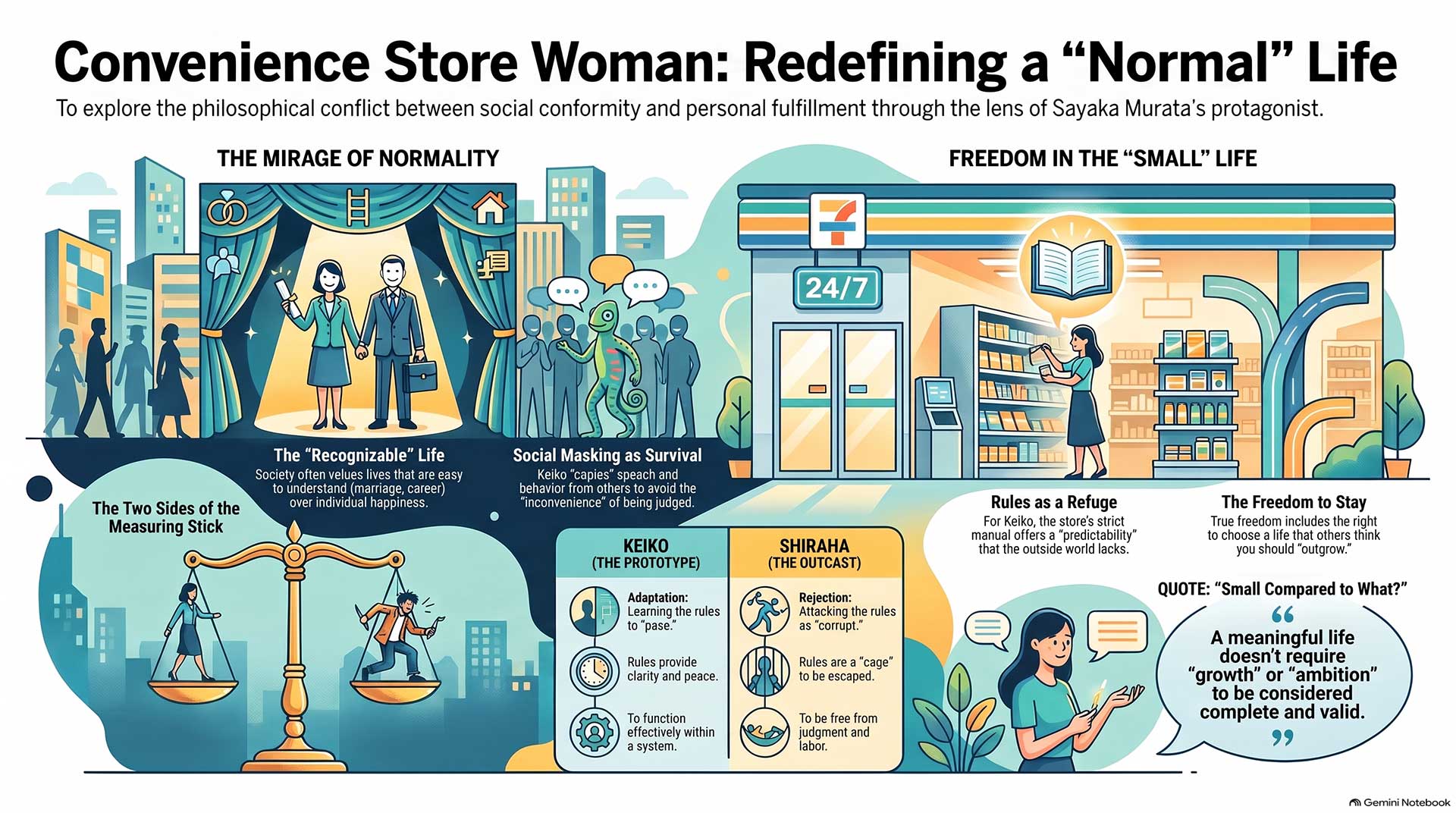
At first, Keiko seems easy to defend.
She works.
She supports herself.
She does not appear to be asking anyone to rescue her.
So why should anyone care that she is unmarried, working part-time, and uninterested in the usual markers of adulthood?
That question exposes something uncomfortable.
Society often tolerates unconventional lives more easily when the person living them admits that something is missing.
If Keiko said:
“I haven’t met the right person yet.”
people would understand.
If she said:
“I’m trying to find a better job.”
they would understand.
If she said:
“I’m worried about my future.”
they would understand.
What unsettles people is much simpler:
Keiko does not automatically believe her life needs to become something else.
That leads to the next problem.
Keiko has spent much of her life observing other people.
She studies their speech.
Their clothes.
Their expressions.
Their reactions.
She learns which answers make conversations end more quickly.
She learns how to appear socially acceptable.
This can look like pretending.
But Keiko asks a harder question:
How much of ordinary social behavior is imitation anyway?
Children copy adults.
Employees copy workplace behavior.
People change their voices in meetings, interviews, family gatherings, and phone calls.
Perhaps Keiko is unusual not simply because she copies, but because she is unusually conscious of doing it.
Then we reach Smile Mart.
The convenience store gives Keiko something the outside world often does not:
clarity.
When a customer enters, she knows what to do.
When a shelf is empty, she knows what to do.
When a register beeps, she understands what comes next.
The rules are visible.
The expectations are explicit.
That structure gives Keiko a kind of peace.
Yet it creates one of the novel’s most difficult questions:
Can the same place be both a refuge and a cage?
Keiko depends on the convenience store.
But people depend on many things.
Families.
Marriages.
Careers.
Religions.
Communities.
Daily routines.
Why does Keiko’s dependence seem especially disturbing?
Perhaps partly because it is unfamiliar.
A person who says, “My family is my whole life,” may be praised.
A person who says, “This convenience store is my whole life,” may be treated as damaged.
The difference may tell us as much about our values as it does about Keiko.
Then Shiraha enters the picture.
He seems like Keiko’s opposite.
Keiko adapts to society.
Shiraha rejects it.
Keiko learns the rules.
Shiraha attacks them.
But both organize their lives around those rules.
Keiko asks:
What behavior will make society stop reacting badly to me?
Shiraha asks:
How can I prove society is corrupt?
One obeys.
One resists.
Yet society remains at the center of both lives.
That is why one of the strongest questions in the conversation became:
If your identity is built entirely around rejecting society, has society still defined you?
Shiraha notices real problems.
People are judged by income.
Gender expectations exist.
Marriage and employment can become measures of worth.
But recognizing injustice does not automatically make every response to it just.
Keiko exposes something Shiraha struggles to admit.
Refusing society is easier than answering:
What do you actually want?
Not what do you hate.
Not what do you reject.
What would you choose if nobody were judging you?
Keiko, strangely enough, has an answer.
She wants the convenience store.
That brings us to the ending.
It would be easy to interpret Keiko’s return to convenience-store life as a victory.
She stops trying to perform the conventional life that makes other people comfortable.
She recognizes that being treated as normal did not make her life better.
That matters.
One of her most important realizations in the conversation was:
“I stopped treating other people’s relief as evidence that my life was improving.”
That is a profound form of independence.
Yet the ambiguity remains.
Keiko has not escaped systems.
She has chosen one.
Perhaps that is the point.
None of us live outside systems.
Language is a system.
Money.
Work.
Family.
Law.
Culture.
Routine.
Relationships.
The question may not be whether we can become completely independent.
The better question may be:
Can we choose which structures we inhabit, remain able to question them, and leave when they stop working?
Freedom may include the ability to leave.
But it may include something else too:
the freedom to stay somewhere other people think you should outgrow.
That may be Keiko’s quietest challenge to the reader.
We are trained to think that adulthood must keep moving forward.
A better job.
Marriage.
Children.
A home.
Promotion.
Growth.
A larger life.
Something next.
Keiko does not understand why repetition automatically means failure.
When Miho asks what she wants her life to look like ten years from now, Keiko does not describe achievement.
She wants to notice when a display is wrong.
She wants to understand what customers need.
She wants her body to keep moving during the morning rush.
Shiraha calls that vision too small.
But Keiko asks:
“Small compared with what?”
That question may contain the entire novel.
Who decided that a life must become larger to become meaningful?
Who decided that contentment without visible progress is stagnation?
Who decided that a life without marriage, children, status, or ambition is still waiting to begin?
At the very end, Miho asks Keiko whether that life is enough.
Keiko replies:
“Enough for what?”
There is no easy answer.
Perhaps there should not be.
Keiko’s strangest quality may not be that she does not know how to live.
It may be that she cannot understand why everyone else thinks a life must prove itself before it can be considered complete.
Short Bios:
Keiko Furukura
The protagonist of Convenience Store Woman. Keiko has worked at Smile Mart for eighteen years and has learned much of her social behavior through observation and imitation. The convenience store gives her structure, predictability, and a role she understands.
Shiraha
A socially alienated man who strongly resents employment, marriage expectations, gender roles, and the ways people are ranked by society. His criticisms sometimes identify real pressures, but his bitterness often turns those observations into entitlement and contempt.
Miho
A former coworker used in this fictional conversation as a more conventional social voice who still genuinely cares about Keiko. Her questions gradually move from concern about Keiko’s unusual life to uncertainty about her own assumptions regarding happiness, identity, work, and adulthood.
Sayaka Murata
A Japanese novelist known for examining social conformity, gender, sexuality, work, family, and the meaning of “normal.” Convenience Store Woman won Japan’s Akutagawa Prize and became an international success, introducing many readers outside Japan to Murata’s distinctive way of questioning ordinary social life.
This is an original fictional conversation inspired by Sayaka Murata’s novel. The dialogue does not appear in the original book.
Leave a Reply