
Introduction
Artificial intelligence may appear weightless. A question is entered, an answer appears, and the machinery behind it remains unseen.
Every AI response still depends on a physical system of data centers, electricity, water, land, minerals, computer chips, public infrastructure, and human labor. As AI expands, communities are beginning to ask who will pay for that growth—and who will receive its benefits.
In this imaginary conversation, Nick Sasaki brings together Sam Altman, Kate Crawford, Vaclav Smil, and Mariana Mazzucato to examine a conflict shaping our future:
Can AI consume vast resources today and still help humanity create a more abundant tomorrow?
The participants move beyond the simple choice between stopping AI and allowing unrestricted growth. They confront the harder questions. Can innovation overcome physical scarcity? Does a profitable data center create wealth if nearby families face higher costs? What do technology companies owe the communities supplying their electricity, water, land, and infrastructure?
Their discussion leads toward a new social contract for AI—one that permits ambitious innovation but demands honest measurement, community protection, and a fair public return.
(Note: This is an imaginary conversation, a creative exploration of an idea, and not a real speech or event.)
Topic 1 — The Invisible Physical Body of AI
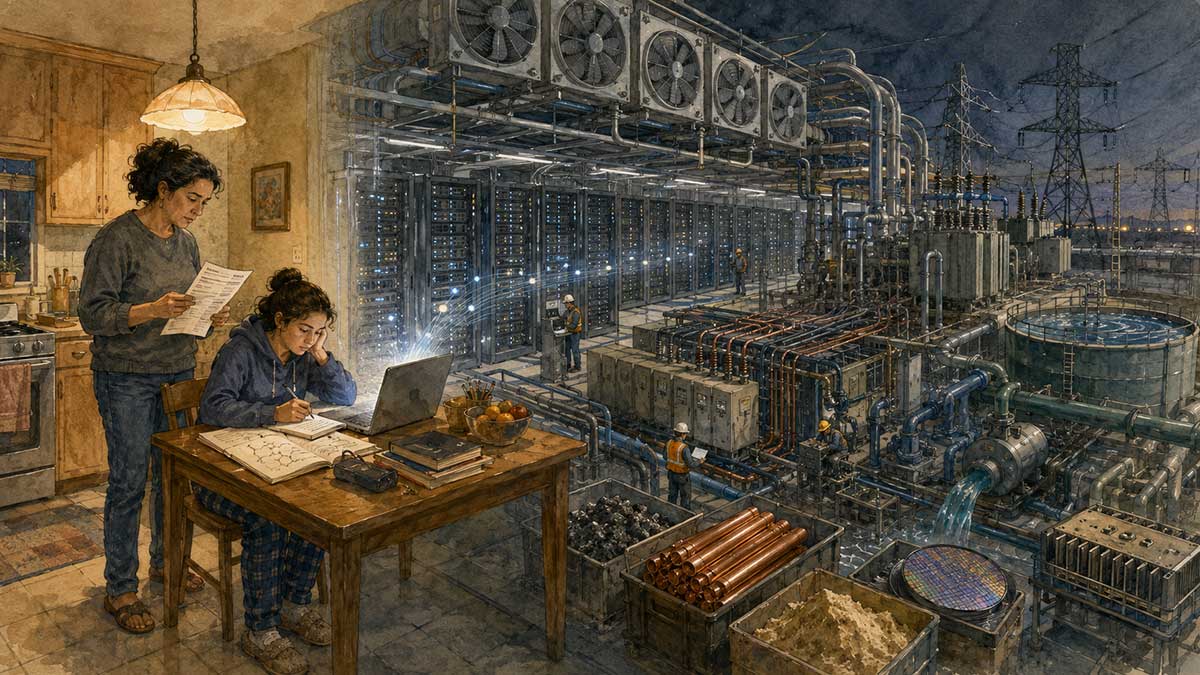
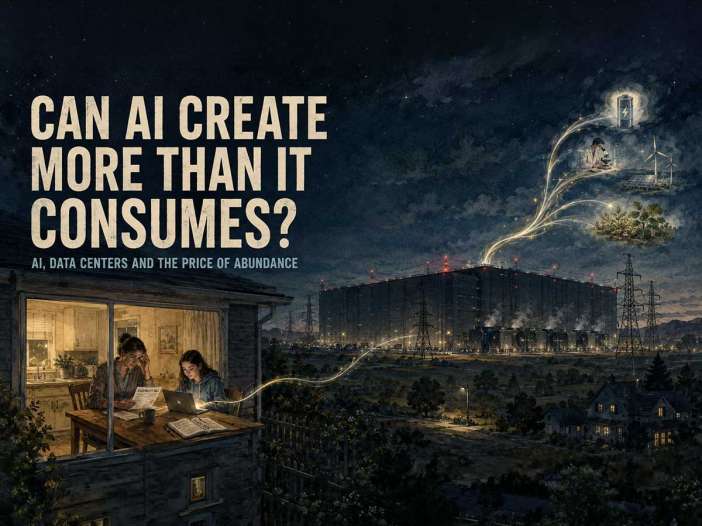
The town is quiet enough that the humming can almost be mistaken for wind.
Beyond a row of modest homes, a newly constructed data center spreads across what used to be farmland. Its walls have no windows. Red warning lights blink above the roof, marking its presence against the dark sky.
Inside one nearby house, a family sits around a kitchen table. An electricity bill lies beside an open laptop. On the screen, an AI system has just helped their teenage daughter explain a chemistry problem she could not solve alone.
The mother looks at the answer, then at the bill.
The same technology seems to be helping her child and frightening her family.
In another room, the imaginary conversation begins.
Nick Sasaki: In this kitchen, AI looks like a higher electricity bill. Across that field, it may look like the beginning of a new civilization. Which picture is the truth?
Kate Crawford: Both pictures are true. The danger begins when we are encouraged to see only one of them.
Sam Altman: I agree that both matter. Yet there is another danger. We can look at what a new technology consumes today and fail to ask what it may help humanity create tomorrow.
Vaclav Smil: Before discussing tomorrow, we should be honest about what exists tonight. That building is not an idea. It is concrete, steel, copper, silicon, transformers, cooling equipment, transmission infrastructure, and electricity. Nothing happening inside it is physically weightless.
Mariana Mazzucato: And before calling its output wealth, we need to ask who financed the conditions that made it possible. Who built the roads? Who expanded the grid? Who trained the workers? Who provided tax incentives? Who accepted the use of the land and water?
Nick Sasaki: Most people do not picture any of that when they ask AI a question. I certainly do not. I see a small box on a screen. I type something. Words appear.
Kate Crawford: That is one of the great illusions surrounding artificial intelligence. The interface is clean, almost magical. It hides the industrial system behind it.
Sam Altman: “Illusion” may be too strong. People do not picture a power station every time they switch on a light. They do not picture an undersea cable when they make a video call. Modern systems become useful partly when people no longer need to think about every layer beneath them.
Kate Crawford: That is true, but AI has been marketed in unusually disembodied language. We say that it learns, thinks, knows, creates, and remembers. Those words direct attention to the apparent mind of the system. They draw attention away from the mines, warehouses, power stations, cooling systems, and workers that make the experience possible.
Sam Altman: Yet none of that proves the system should not exist.
Kate Crawford: I did not say it should not exist.
Sam Altman: The implication often enters the discussion quietly. People hear that AI has a physical footprint and conclude that using it is inherently irresponsible.
Kate Crawford: Then let us separate two claims. The first is that AI has a physical footprint. That is undeniable. The second is that any physical footprint makes a technology immoral. I am not making that claim.
Vaclav Smil: Good. Every modern system has a physical footprint. Hospitals consume enormous quantities of energy and materials. Food production consumes land and water. Transportation requires roads, metals, fuels, and constant maintenance. The relevant question is never simply, “Does it consume?” The question is, “What does it consume, at what scale, for what purpose, with what efficiency, and at whose expense?”
Nick Sasaki: That sounds reasonable, but it still leaves the family at the kitchen table with a problem. They hear that AI may cure diseases someday. They look at their utility bill today. What are they supposed to believe?
Mariana Mazzucato: They should not be asked merely to believe. Trust cannot be the main economic policy.
Sam Altman: I would not ask them merely to believe either.
Mariana Mazzucato: Yet that is often what the public hears. Companies speak about extraordinary future benefits, then treat current infrastructure costs as someone else’s administrative problem.
Sam Altman: Some companies may behave that way. It does not follow that the entire project of developing AI is based on transferring costs.
Mariana Mazzucato: I am not describing every company. I am identifying a pattern in the way innovation is discussed. Private actors are portrayed as courageous creators. Public institutions appear later in the story, usually as slow regulators or providers of subsidies. The public contributions made before the commercial success are forgotten.
Nick Sasaki: Let me make this more personal. Suppose I use AI to translate a letter for my mother in Japan. Or a student uses it to learn chemistry. Or someone frightened by a medical symptom uses it to prepare questions for a doctor. Should those people feel guilty about the water or electricity their request may consume?
Kate Crawford: Guilt is a poor substitute for structural change.
Sam Altman: I agree.
Kate Crawford: That does not make individual choices meaningless. It means we should be cautious when environmental responsibility is reduced to personal behavior. The user does not choose the location of the data center. The user does not select the cooling system. The user does not negotiate the electricity contract or decide whether the facility runs on a strained local grid.
Vaclav Smil: Nor does the user know the actual marginal cost of that one request.
Nick Sasaki: What do you mean by marginal cost?
Vaclav Smil: The data center is already operating. Its cooling equipment is already active. Servers are already running. Electricity demand does not necessarily rise in a simple, easily isolated amount each time one person submits a prompt. There is a cost, but translating that cost into a neat statement such as “this question used exactly this much water” can be misleading.
Kate Crawford: It can still be useful to show that computation is material.
Vaclav Smil: Yes, if the number is credible and properly explained. A dramatic number without context may teach people the wrong lesson.
Sam Altman: It can create a strange moral hierarchy too. A student may feel guilty about asking ten questions to understand mathematics, yet no one asks whether an automated advertising system should generate millions of low-value outputs.
Nick Sasaki: Then the moral issue may not be only how much AI we use. It may be what we use it for.
Kate Crawford: Purpose matters, but purpose does not erase impact. A noble use can still create harm if the infrastructure is poorly located or badly managed.
Sam Altman: I agree. My concern is that we may judge all computation as if every use has the same value. Using AI to accelerate a medical discovery is not identical to generating thousands of disposable images no one wants.
Mariana Mazzucato: Who decides which use is valuable?
Sam Altman: Society makes those decisions through many channels—markets, public investment, institutions, personal choices.
Mariana Mazzucato: Markets do not measure social value reliably. They measure what someone can pay for. A system producing advertising may earn more than a system helping an underfunded clinic. That does not mean advertising creates greater public value.
Sam Altman: Public institutions do not possess perfect judgment either.
Mariana Mazzucato: No institution does. That is an argument for democratic direction, not for leaving the future entirely to private capital.
Nick Sasaki: We are already moving beyond the individual user. Maybe that is the point. People are being told, “Your AI question uses water.” Yet the larger decisions were made long before they typed anything.
Kate Crawford: Precisely. The focus on the individual prompt can become a form of misdirection. It makes the problem feel personal, immediate, and measurable. The industrial decisions remain distant and difficult to see.
Sam Altman: I want to resist one part of that. Demand does matter. If hundreds of millions of people use AI, companies build more infrastructure. Individual behavior becomes collective demand.
Kate Crawford: Yes, but an individual cannot govern collective infrastructure through guilt alone.
Vaclav Smil: Both statements can be correct. Demand drives expansion. Infrastructure determines the resource intensity of that demand.
Nick Sasaki: Let me ask it in a blunt way. If I stop using AI tonight, does the town outside this building receive more water or cheaper electricity tomorrow?
There is a short silence.
Vaclav Smil: Almost certainly not in any measurable way.
Kate Crawford: Yet if millions of people begin asking what the technology costs, they may create political pressure for different infrastructure decisions.
Sam Altman: And if millions stop using a beneficial technology from a sense of personal guilt, society may lose value without fixing the infrastructure.
Mariana Mazzucato: This is why the question cannot remain, “Should Nick use AI?” It has to become, “What obligations arise when companies expand AI infrastructure?”
Nick Sasaki: That changes the emotional burden. Instead of asking ordinary people to solve the problem by withdrawing, we ask institutions to build the system differently.
Kate Crawford: Yes, though citizens still need to remain engaged. Institutional accountability rarely appears without public pressure.
Sam Altman: That is fair.
Nick Sasaki: Would you support showing users the estimated environmental cost of their AI requests?
Sam Altman: I would support credible transparency. I would be cautious about displaying a number that appears exact but is based on broad assumptions.
Kate Crawford: Transparency should reach much further than the interface. Companies should disclose energy use, water use, cooling methods, sources of electricity, local effects, and the assumptions behind their estimates.
Vaclav Smil: We need to distinguish water withdrawal from water consumption. We need to distinguish average electricity use from peak demand. We need to identify whether new generation was built or existing capacity was redirected. Without such distinctions, transparency becomes another word for public relations.
Nick Sasaki: Yet most people will not read a technical report.
Mariana Mazzucato: Then the information must be made publicly legible without becoming deceptive.
Kate Crawford: A label could help, but it should not suggest that the user alone controls the impact. Think of food labeling. It gives individuals information, yet food safety still depends on regulation, inspections, agricultural policy, and corporate conduct.
Sam Altman: There is another side. If you show only the cost, you create the impression that there is no value on the other side of the exchange.
Nick Sasaki: Could we show both?
Sam Altman: In some cases, perhaps. A researcher might use a model to reduce months of work. A student may receive tutoring that would otherwise be unavailable. A doctor might find a pattern in medical information. The same amount of computation can support very different outcomes.
Vaclav Smil: Value is harder to measure than electricity.
Mariana Mazzucato: And that difficulty should not lead us to let corporations define value however they wish.
Kate Crawford: Nor should extraordinary examples become a blanket justification for ordinary waste. Every new technology presents its most moving use cases when defending its total expansion.
Sam Altman: Yet those moving cases are real. We should not treat them as propaganda merely since they are compelling.
Kate Crawford: I did not call them propaganda. I am saying that a child receiving tutoring does not automatically justify every use of the same infrastructure.
Nick Sasaki: I can feel the conversation splitting into two directions. One side says, “Look at the extraction.” The other says, “Look at the possibility.”
Vaclav Smil: Both sides tend to choose the scale that favors their argument. Critics may focus on the burden of a particular facility. Advocates may focus on the total future benefit to civilization. A local cost and a global benefit cannot be compared casually.
Mariana Mazzucato: Nor can a speculative future benefit be used to cancel a documented present cost.
Sam Altman: Agreed. Yet present cost alone cannot tell us whether an investment is worthwhile.
Nick Sasaki: So what would tell us?
Vaclav Smil: Evidence gathered over time. Measured resource use. Real output. Infrastructure capacity. Alternatives. Opportunity costs. There is no single sentence that settles it.
Nick Sasaki: That may be intellectually honest, but it is emotionally unsatisfying. People want to know whether they are participating in something harmful.
Kate Crawford: Sometimes the honest answer is that participation occurs inside a system we do not fully control. That does not make us innocent or guilty in a simple way.
Mariana Mazzucato: It makes us citizens, not merely consumers.
Sam Altman: And citizens can ask what kind of AI system they want without rejecting the entire technology.
Nick Sasaki: What kind of system would you want?
Sam Altman: One in which increasingly capable intelligence helps produce scientific discovery, lower-cost education, better healthcare, greater productivity, and new forms of energy. I would want the resource cost per unit of useful intelligence to fall dramatically.
Kate Crawford: I would want a system whose intelligence is not measured only by technical performance. A truly intelligent system would account for the communities, workers, environments, and institutions supporting it.
Vaclav Smil: I would want fewer exaggerated claims. Build what can be sustained. Measure it honestly. Do not confuse a prototype with a civilization-scale solution.
Mariana Mazzucato: I would want the public to participate in setting the direction. If society provides the research, energy systems, land, tax support, and educated workforce, society should help decide which problems this technology serves.
Nick Sasaki: You are describing four different kinds of intelligence.
Kate Crawford: Yes. Computational intelligence is only one kind.
Nick Sasaki: There is a personal intelligence too—knowing when something that helps you may be hurting someone you cannot see.
Sam Altman: There is also the intelligence to recognize that refusing to build can hurt unseen people. A treatment that is never discovered has victims too. A student who never receives affordable tutoring is unseen. Scientific progress we delay does not arrive to introduce us to the people it might have helped.
Kate Crawford: That is true. Yet hypothetical beneficiaries should not make present victims invisible.
Sam Altman: Agreed. Present harms should not make future beneficiaries invisible either.
Nick Sasaki: That may be the first place where the argument becomes genuinely difficult. Each side is defending people the other side cannot easily see.
Mariana Mazzucato: Which is why the debate cannot be framed as compassionate critics against ambitious builders. Both may be responding to real human needs. The conflict lies in which needs receive priority, who makes the decision, and who carries the risk.
Outside, the data center’s warning lights continue blinking.
The family at the kitchen table has closed the electricity bill. Their daughter is still reading the chemistry explanation produced by AI. For the first time that evening, she thinks she finally grasps the problem her teacher tried to explain.
Her mother watches her and says nothing.
Nick Sasaki: That image troubles me. The mother may be grateful for what AI just gave her daughter. She may still fear what the building is doing to her town. She should not have to pretend that only one feeling is legitimate.
Kate Crawford: She does not.
Sam Altman: No. She should expect us to make the benefits real without dismissing the cost.
Vaclav Smil: Expectation is useful only when followed by measurement.
Mariana Mazzucato: And measurement matters only when someone is required to act on it.
Nick Sasaki: Then perhaps the first question was never whether AI is invisible. The real question is who benefits from keeping parts of it unseen.
Kate turns slightly in Sam’s direction.
Kate Crawford: That is where the conversation must become uncomfortable. Invisibility is not always an accident.
Sam Altman: No, but visibility can be selective too. If we expose every cable, cooling tower, and gallon of water, yet hide the discoveries made possible by the system, that creates its own distortion.
Vaclav Smil: Then expose both.
Mariana Mazzucato: And expose who owns both.
Nick Sasaki: The costs, the discoveries, and the ownership.
Mariana Mazzucato: Yes. Once those become visible together, we can begin asking whether AI is creating new wealth or simply moving resources and costs from one group to another.
The low humming beyond the window continues.
No one at the table is ready to leave.
Topic 2 — Are Resources Finite, or Can Intelligence Create More?
The low humming beyond the window continues.
No one at the table is ready to leave.
Nick Sasaki: Mariana just asked whether AI is creating new wealth or moving resources from one group to another. Before we answer that, I think we have to confront the belief underneath the entire argument.
Some people look at that data center and see scarcity. It consumes land, electricity, water, minerals, and equipment that could have been used elsewhere.
Other people look at the same building and see a machine that may help us produce far more energy, food, medicine, knowledge, and wealth than we have now.
Are these people looking at different facts, or do they possess fundamentally different ideas about reality?
Sam Altman: They may agree on the present facts and disagree about what human beings are capable of changing.
Kate Crawford: They may disagree about who will carry the risk during that attempted change.
Vaclav Smil: And both may use the word “resource” too casually.
Nick Sasaki: What do you mean?
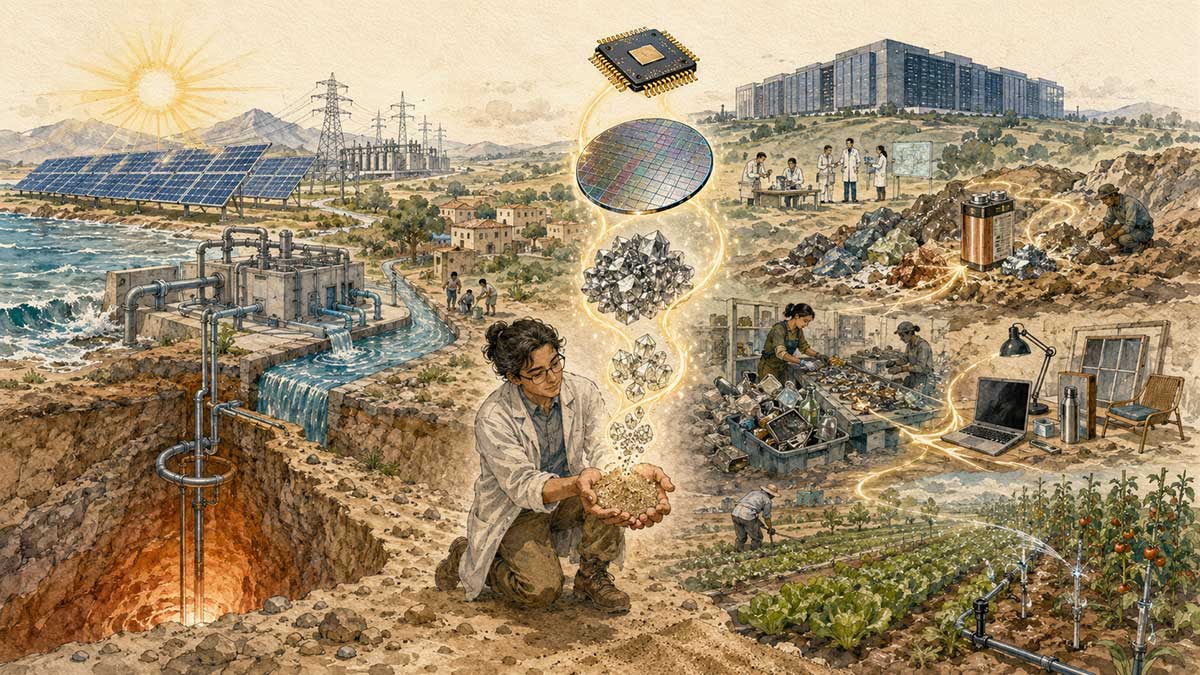
Vaclav Smil: A resource is not merely something existing in nature. It is a material, source of energy, or physical condition that human beings know how to use at a particular cost.
Oil existed for millions of years before it became central to industrial civilization. Uranium existed before nuclear fission. Silicon existed before microprocessors. Sunlight existed before photovoltaic cells.
Human knowledge changes what counts as a usable resource.
Nick Sasaki: That sounds close to the optimistic argument. Physical materials may be limited, but our ability to find new uses for them may continue growing.
Vaclav Smil: Yes, but knowledge does not repeal physical limits. Knowing how to build a solar panel does not create copper, glass, aluminum, land, transmission lines, storage systems, skilled workers, or construction time from nothing.
Sam Altman: No serious person believes they appear from nothing.
Vaclav Smil: Serious people sometimes speak as if scale will arrive almost automatically once a laboratory result succeeds.
Sam Altman: That criticism is fair. Technological communities can underestimate deployment time. Yet people outside those communities can underestimate how dramatically innovation changes what is possible.
Kate Crawford: The phrase “what is possible” needs another question attached to it: possible for whom?
Sam Altman: For humanity.
Kate Crawford: Humanity does not experience technological change as one person. A new resource can improve life for millions and destroy the homes or health of a smaller community supplying it.
Sam Altman: That does not make the innovation worthless.
Kate Crawford: I did not say it did. I am asking us to stop using “humanity” as if gains and losses are distributed evenly.
Nick Sasaki: Let me try to state the optimistic case plainly.
Water, land, minerals, and energy are limited at a given time and place. Human intelligence can discover new energy sources, improve efficiency, recycle materials, create substitutes, and turn previously unusable things into useful resources.
In that sense, wealth is not a fixed pie.
Sam Altman: Yes. That is much closer to what many technological optimists mean by abundance.
Nick Sasaki: Then when someone says, “Resources are infinite,” they may not literally mean that the Earth contains an infinite amount of copper or fresh water.
Sam Altman: Right. They may mean that human wants can be met through many different combinations of materials, energy, knowledge, and organization. We are not restricted to one method forever.
Vaclav Smil: I would still avoid the word “infinite.” It encourages carelessness.
Sam Altman: Fair enough. The number of undiscovered solutions may be vast without being infinite.
Mariana Mazzucato: The language matters for another reason. When powerful people say abundance is coming, it can make anyone discussing distribution sound small-minded.
Nick Sasaki: As if asking who receives the wealth means you do not believe wealth can be created.
Mariana Mazzucato: Exactly. Creation and distribution are often presented as opposites. They are not.
Public institutions can help create new markets, technologies, and industries. The state is not limited to dividing existing wealth after entrepreneurs produce it. It can invest, shape, and take risks at the beginning.
The same is true of workers, communities, and universities. Wealth creation is collective, even when financial ownership becomes highly concentrated later.
Sam Altman: Private risk-taking matters too.
Mariana Mazzucato: Of course it does. My objection concerns the heroic story in which one entrepreneur creates the future and everyone else merely regulates, taxes, or consumes it.
Nick Sasaki: This may explain part of the emotional conflict. Technological leaders think, “We are building something new.” People living near the infrastructure think, “You are taking something that already belongs to us.”
Kate Crawford: Yes. Land has an existing use. Water has existing users. Electricity has existing customers. Minerals exist within environments and communities. None of them waits in an empty moral space for a company to discover it.
Sam Altman: Yet refusing any new use can freeze existing arrangements. A community may need jobs. A country may need energy independence. Patients may need better treatments. Students may need affordable education.
Kate Crawford: I am not arguing for freezing society.
Sam Altman: I know. Still, the language of extraction can make nearly every form of building appear suspect.
Kate Crawford: Building deserves scrutiny when those making the decision are separated from those living with its consequences.
Vaclav Smil: Let us return to scale. Human beings have often overcome local scarcity by drawing resources from a wider area. A city survives by importing food, energy, water, and materials from elsewhere. This can create abundance inside the city and depletion outside it.
Technology does not always eliminate scarcity. Sometimes it moves scarcity far enough away that consumers no longer see it.
Nick Sasaki: Then abundance in one place can depend on scarcity in another.
Vaclav Smil: It can.
Sam Altman: It does not have to remain that way. Better technology can reduce the amount of material or energy required for a given result.
Vaclav Smil: Per unit, yes. Total consumption may still rise.
Nick Sasaki: Could you explain that?
Vaclav Smil: Suppose a new AI chip performs the same computation using half the electricity. That is a real efficiency gain. If demand for computation then grows tenfold, total electricity use still rises substantially.
Kate Crawford: Efficiency can lower the moral and financial cost of expansion, making much larger expansion appear acceptable.
Sam Altman: But greater total use may produce far greater total value.
Vaclav Smil: It may. Efficiency alone does not prove that total use will decline.
Nick Sasaki: This seems central. When companies announce that AI is becoming more efficient, the public may assume its total environmental cost is shrinking. In reality, the lower cost could lead to far more AI use.
Sam Altman: Yes, but I do not think increased use is automatically a failure. If intelligence becomes cheaper and more available, people may solve problems they could not afford to address before.
Mariana Mazzucato: We return to direction. More intelligence used for what? Which problems receive investment? Whose needs become profitable enough to attract the system?
Sam Altman: People will use it in ways none of us can fully predict.
Mariana Mazzucato: That is true, but infrastructure and ownership still influence those choices. We should not confuse unpredictability with neutrality.
Nick Sasaki: Sam, when you picture abundance created through AI, what do you actually see?
Sam Altman: I see intelligence becoming widely accessible. A small business could receive capabilities once available only to a major corporation. A student anywhere could have a patient tutor. Scientists could test ideas faster. Engineers could search through possible materials, designs, and energy systems beyond what human teams could examine alone.
I see the cost of producing many goods and services falling. I see scientific progress accelerating. I see people spending less of their lives on work they find empty or exhausting.
Nick Sasaki: That is a beautiful vision.
Kate Crawford: It is. Beauty does not make it inevitable.
Sam Altman: No. It makes it worth attempting.
Kate Crawford: My concern is that the attempt may be described as if the final outcome has already been secured. We hear about universal tutors before confronting school budgets. We hear about medical discovery before asking who can afford the treatment. We hear about energy abundance before the transmission line has been approved or built.
Sam Altman: Every future begins as something not yet secured.
Kate Crawford: Yes, and every promised future creates opportunities for someone to demand sacrifice in the present.
Nick Sasaki: What worries you most about the phrase “AI abundance”?
Kate Crawford: That it can become morally cleansing language. If the final destination is abundance for everyone, then every mine, data center, displaced community, exhausted worker, and strained electrical grid can be portrayed as a temporary inconvenience on the path to salvation.
Sam Altman: That would be wrong.
Kate Crawford: Yet how do we prevent it?
Sam Altman: Through rules, transparency, investment, public oversight, and better engineering. I do not believe the answer is to abandon the destination.
Vaclav Smil: We should question the speed promised too. Energy transitions are not software updates. Physical infrastructure takes years and often decades.
Sam Altman: AI could help accelerate parts of that process.
Vaclav Smil: It can improve planning, materials, forecasting, and design. It cannot negotiate every political conflict, train every electrician, manufacture every transformer, acquire every parcel of land, or complete every construction project instantly.
Nick Sasaki: Could it eventually help enough that its contribution exceeds the resources it consumes?
Vaclav Smil: That is possible. It is not guaranteed.
Sam Altman: Nearly nothing important is guaranteed before it is built.
Vaclav Smil: Then say “possible,” not “inevitable.”
Sam Altman: I accept that.
Nick Sasaki: That small change in language feels meaningful. “AI will create abundance” asks people for faith. “AI may help create abundance if we build it wisely” asks people to participate in a difficult project.
Mariana Mazzucato: And participation must include influence. The public cannot be invited only after the destination, ownership, and financing have already been chosen.
Nick Sasaki: Let us look backward for a moment. Does history support optimism?
Agricultural advances allowed fewer farmers to feed far more people. Electricity transformed daily life. Medicine prevented deaths that earlier generations considered unavoidable. Computers made some forms of knowledge nearly free to copy.
Isn’t that strong evidence that human creativity repeatedly pushes back against scarcity?
Sam Altman: It is.
Kate Crawford: It is evidence that innovation can produce remarkable gains. It is not evidence that the gains arrive equally or without new costs.
Vaclav Smil: Industrial agriculture increased yields enormously. It also increased dependence on fossil fuels, fertilizers, machinery, irrigation, transport networks, and concentrated supply chains. The achievement is real. The dependence is real.
Nick Sasaki: So history offers neither a simple triumph nor a simple warning.
Vaclav Smil: Correct. Human beings solve problems and create new ones. Then they attempt to solve those. Civilization is not a final victory over limits. It is continuous adaptation within them.
Sam Altman: That sounds more optimistic than you may intend.
Vaclav Smil: Realism is not pessimism.
Sam Altman: I agree. What gives me confidence is precisely that repeated process. We discover a constraint. We learn. We invent. We build. We encounter another constraint. Human progress has never required a world without limits. It has required the ability to respond to them.
Kate Crawford: Who is included in “we”?
Sam Altman: Human civilization.
Kate Crawford: Again, that phrase smooths over difficult differences. The people who invent a solution may not be the people who lost their land to supply it. The people who enjoy cheap computing may never meet the workers mining its materials.
Sam Altman: Then we should improve the distribution of benefits and reduce the harms. We should not conclude that civilization is incapable of acting collectively.
Mariana Mazzucato: Yet collective capacity does not emerge from optimism. It requires institutions.
Nick Sasaki: I wonder whether the deepest disagreement is actually about trust.
Sam trusts human beings to discover solutions.
Kate distrusts systems that hide who pays.
Vaclav distrusts claims that ignore physical scale.
Mariana distrusts stories that erase the public role in creating wealth.
Vaclav Smil: That is reasonable.
Kate Crawford: I would say I trust human creativity. I do not automatically trust the political and economic structures directing it.
Sam Altman: I share some of that concern. I may have greater confidence that technological capability can widen our choices.
Mariana Mazzucato: Capability can widen choices for the institution controlling it. Social progress depends on widening choices for everyone else.
Nick Sasaki: Could human creativity itself be considered our greatest renewable resource?
Sam Altman: I think so. Human curiosity, intelligence, cooperation, and ambition have repeatedly created possibilities that earlier generations could not see.
Vaclav Smil: Intelligence is essential. Calling it renewable risks turning a metaphor into an economic law. People require food, education, stability, health, and time. Creativity exists within material conditions.
Kate Crawford: It depends on labor too. The language of machine intelligence often obscures the human work that trains, evaluates, maintains, and corrects these systems.
Mariana Mazzucato: Publicly funded education and research nurture much of that creativity. Human ingenuity is not a natural deposit that companies simply extract.
Sam Altman: I am not denying any of that. My point is that humanity is not limited to dividing what it already knows how to produce.
Nick Sasaki: That idea resonates with me. If we believe wealth can only be divided, politics becomes a permanent fight over a fixed amount. One person’s gain must be someone else’s loss.
Mariana Mazzucato: We should resist that zero-sum view. Yet new wealth does not remove the need for distribution. A society can become richer in total and more unequal at the same time.
Nick Sasaki: Then “create wealth instead of dividing it” is only half a philosophy.
Mariana Mazzucato: Yes. Creation matters. The direction, ownership, and distribution of what is created matter too.
Sam Altman: I can agree with that.
Kate Crawford: The hard question comes when creation requires consuming something another person already depends on.
Nick Sasaki: Water, land, electricity.
Kate Crawford: Or political attention, public financing, skilled labor, and grid capacity. Scarcity is not limited to raw materials.
Vaclav Smil: Time is often the most neglected scarcity. You may know how to build a cleaner system and still need twenty years to replace existing infrastructure.
Sam Altman: AI could give us better decisions during those twenty years.
Vaclav Smil: It could. It could increase demand faster than the replacement occurs.
Nick Sasaki: Then AI may be both the tool helping us overcome scarcity and a force increasing scarcity before the solution arrives.
Kate Crawford: Yes. That contradiction should remain visible.
Sam Altman: It should. I would still rather face that contradiction with more intelligence than less.
Nick Sasaki: Kate, is there any evidence that would make you more confident in the abundance argument?
Kate Crawford: Yes. Measurable reductions in resource use that remain reductions after total expansion is counted. Binding community agreements. Transparent supply chains. New energy capacity built without shifting environmental harm elsewhere. Broad access to the social benefits claimed in advance.
I am not opposed to evidence. I am opposed to promises being treated as evidence.
Nick Sasaki: Sam, is there anything that would make you question the abundance argument?
Sam pauses before answering.
Sam Altman: If AI capability continued growing but the benefits remained narrowly concentrated—if productivity rose without improving ordinary lives, if environmental costs kept spreading, if access remained unequal—then we would have to admit that capability alone had failed to create abundance.
Mariana Mazzucato: That is a significant distinction.
Sam Altman: It should not be surprising. A powerful tool does not determine the social system around it.
Kate Crawford: Technological leaders do sometimes speak as if it does.
Sam Altman: Some may. I am saying it should not.
Nick Sasaki: Vaclav, what would change your view?
Vaclav Smil: My view changes with evidence. If new generation, storage, transmission, and efficiency gains outpace AI’s total demand, then claims of energy abundance become more credible. If construction and material supply remain bottlenecks, rhetoric does not alter the situation.
Nick Sasaki: Mariana?
Mariana Mazzucato: I would look for shared governance and shared returns. If communities, workers, and public institutions participate meaningfully in the value created, abundance begins to mean more than corporate growth.
Nick Sasaki: We seem to have reached a position that sounds simple but is not simple at all.
Physical resources are limited.
Human possibility is not fixed.
Innovation can widen the supply of what society needs.
It can still deepen inequality, move environmental harm, and create new forms of dependence.
Vaclav Smil: Yes.
Kate Crawford: And the uncertainty should make us more responsible, not frozen.
Sam Altman: That is well said.
Mariana Mazzucato: Responsibility includes asking who gets to shape the innovation, not merely how efficiently it operates.
Beyond the window, the data center continues drawing electricity from the grid.
Somewhere inside, an AI model is helping an engineer test a new battery material. Another model is generating thousands of advertisements that may be forgotten tomorrow. The electrons supplying both tasks enter through the same infrastructure.
Nick Sasaki: The building cannot tell us whether its electricity became wisdom or waste.
Vaclav Smil: The electrical meter measures consumption, not purpose.
Kate Crawford: The company measures revenue, not necessarily public value.
Sam Altman: Which means we need better ways to recognize the value being created.
Mariana Mazzucato: And better ways to recognize when “value creation” is really cost transfer.
Nick Sasaki: Then perhaps we are finally ready for the question Mariana raised earlier.
If the data center creates billions of dollars in value, but the family across the field pays more for electricity and loses confidence in its water supply, did society become wealthier?
Mariana leans forward.
Mariana Mazzucato: Now we are asking the right question.
Topic 3 — Wealth Creation or Cost Transfer?
Mariana leans forward.
Mariana Mazzucato: Now we are asking the right question.
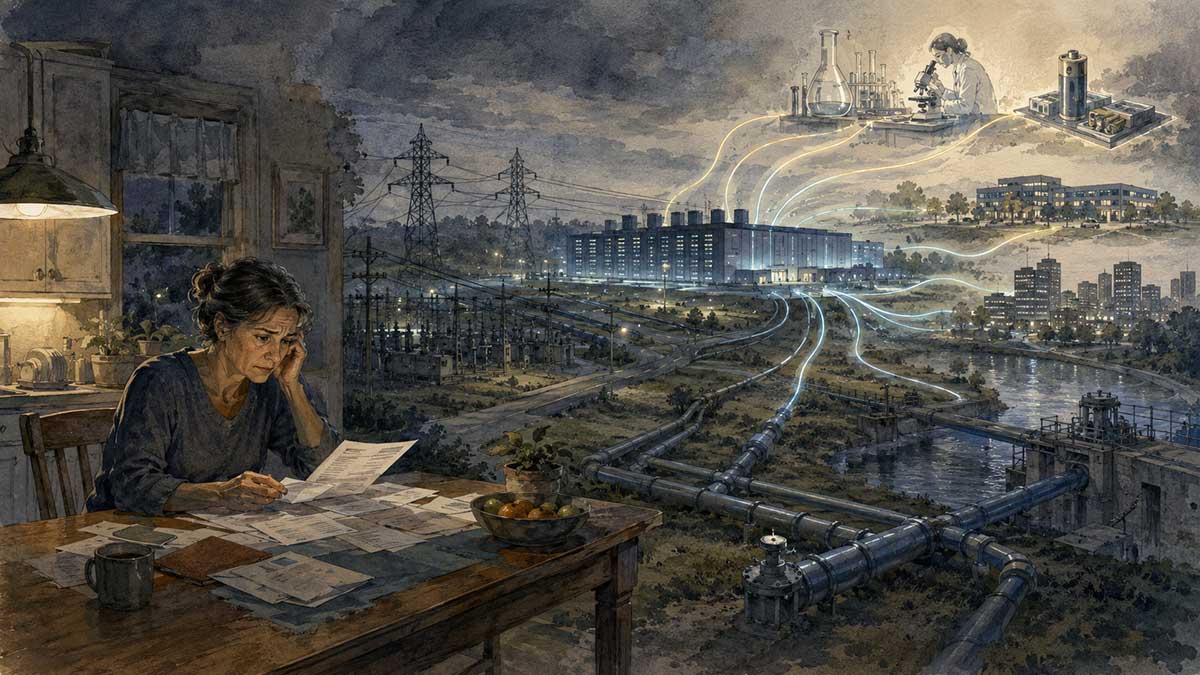
Nick Sasaki: If the data center creates billions of dollars in economic value, but the family across the field pays more for electricity and worries about its water supply, did society become wealthier?
Mariana Mazzucato: It depends on what we mean by wealth, who receives it, and which costs have been excluded from the calculation.
A company can create genuine value and still transfer part of its operating cost to the public. Those things can occur at the same time.
Sam Altman: Yes, but we should be careful not to assume that every increase in local costs comes from the data center.
Kate Crawford: Of course. Electricity prices depend on many factors. Water pressures vary by location. Every facility is different.
Sam Altman: Then the discussion should not begin with a verdict.
Kate Crawford: It should begin with disclosure. Communities cannot evaluate a project when key information is hidden behind confidential contracts or optimistic projections.
Vaclav Smil: Nor should anyone confuse correlation with causation. A facility may open during a period of rising utility prices without being the sole cause. The proper question is how much new demand it creates, when that demand occurs, and which investments are required to serve it.
Nick Sasaki: Let us suppose the connection is clear. A data center arrives. The utility must construct new transmission equipment and secure more generation. Someone has to pay. Should that cost appear on the bills of every customer?
Sam Altman: The company creating the new demand should pay a substantial share of the infrastructure costs connected to that demand.
Mariana Mazzucato: Why only a substantial share?
Sam Altman: New infrastructure may benefit other customers too. A stronger grid, new generation, and improved transmission can create broader value.
Mariana Mazzucato: Then the public share should reflect the public benefit. It should not begin with the assumption that households must subsidize an immensely valuable private company.
Sam Altman: I agree with that principle.
Kate Crawford: The word “benefit” needs precision. A transmission upgrade may strengthen the grid. It may instead reserve enormous capacity for one industrial customer. Calling every expansion a public benefit can conceal who receives priority.
Vaclav Smil: Capacity is not infinitely interchangeable. A new line built for one location does not automatically improve reliability everywhere. The engineering details matter.
Nick Sasaki: This is where ordinary people become lost. A company announces investment. Politicians announce jobs. The utility announces infrastructure upgrades. Everyone uses the language of growth. Several years later, families see higher bills and cannot determine which decision caused them.
Mariana Mazzucato: That confusion benefits institutions with greater access to information.
Sam Altman: It may arise from a genuinely difficult system too.
Mariana Mazzucato: Difficulty is real. Secrecy is still a choice.
Kate Crawford: Communities are often asked to approve a project based on promised economic benefits without receiving enough information about long-term energy and water demand.
Nick Sasaki: Why would local leaders agree?
Mariana Mazzucato: They may fear losing the project to another town. Companies can encourage locations to compete through tax concessions, land deals, infrastructure support, and other incentives.
Each community is told that saying no means watching investment go elsewhere.
Sam Altman: Competition can produce poor agreements. It can bring investment to regions that need it too.
Mariana Mazzucato: Investment is not automatically a gift. The public may provide tax relief, roads, grid capacity, and political support. We should calculate the full exchange.
Nick Sasaki: It reminds me of a store advertising something as free after the customer has paid for half of it indirectly.
Mariana Mazzucato: Exactly. Governments may celebrate the company’s investment figure without subtracting public concessions or future infrastructure obligations.
Sam Altman: Yet the facility still creates an asset, economic activity, and tax revenue.
Kate Crawford: Sometimes fewer permanent jobs than the public imagines.
Sam Altman: Data centers are not labor-intensive in the same way as factories. That should be stated honestly. Their value does not depend only on the number of people employed inside the building.
Nick Sasaki: What other value might they bring to the town itself?
Sam Altman: Tax revenue, construction activity, infrastructure investment, demand for local services, and participation in a growing technological economy.
Kate Crawford: “Participation” can be vague. The town may host the building without participating meaningfully in the intelligence economy. Most of the computational output may serve customers elsewhere.
Mariana Mazzucato: The physical burden remains local. The financial return may flow through a corporation headquartered far away.
Vaclav Smil: This is not unique to data centers. Power stations, mines, dams, factories, airports, and logistics hubs have always separated local burdens from distributed benefits.
Nick Sasaki: Does that make data centers more acceptable or reveal an old injustice appearing in a new form?
Vaclav Smil: Neither conclusion follows automatically. It tells us that we already possess historical experience. We know local communities require compensation, monitoring, infrastructure planning, and enforceable standards.
Nick Sasaki: Mariana, you said a company can create real value and still transfer costs. Can you give us a clear example?
Mariana Mazzucato: Suppose an AI company builds a system that helps businesses become more productive. That is real value. The same company locates its data center in a region where the electrical grid lacks sufficient capacity.
The utility invests heavily to serve the facility. Household customers absorb part of that investment through higher rates. The company receives a favorable electricity contract, perhaps supported by public incentives.
The company did create value through its AI service. It still transferred part of its production cost to other ratepayers.
Sam Altman: That would be a badly structured agreement.
Mariana Mazzucato: Yes. My point is that the existence of innovation does not make the agreement fair.
Kate Crawford: Nor should people criticizing the agreement be labeled enemies of innovation.
Sam Altman: Agreed.
Nick Sasaki: This may be one reason the public debate becomes so hostile. One group says, “AI creates extraordinary value.” Another says, “My community is being used.” Both may be describing the same project accurately.
Kate Crawford: That is often the case.
Sam Altman: Then the answer is better project design, not abandoning AI.
Kate Crawford: That may be the answer. A community still needs the ability to reject a project that cannot meet reasonable conditions.
Sam Altman: Yes.
Nick Sasaki: What would those conditions look like?
Vaclav Smil: Begin with the electrical system. Estimate total demand, peak demand, reliability requirements, backup generation, expansion schedules, and the cost of new capacity.
Do not announce a facility first and search for sufficient electricity later.
Kate Crawford: Include water use under normal conditions and extreme heat. Identify the water source, cooling method, likely consumption, discharge, and effects during drought.
Mariana Mazzucato: Disclose public subsidies, tax concessions, utility agreements, infrastructure obligations, and projected public revenue.
Sam Altman: Create a clear plan for new energy capacity and grid investment. Companies should be willing to fund the infrastructure their growth requires.
Nick Sasaki: That sounds like the beginning of a fairer system. Why is it not already standard?
Mariana Mazzucato: Companies want flexibility and speed. Local governments want investment. Utilities want large customers. Political leaders want announcements they can present as economic victories.
The long-term costs may arrive after the people negotiating the deal have left office.
Sam Altman: There is another concern. If the process becomes too slow or complicated, development may move to another country with weaker protections.
Kate Crawford: That argument appears whenever industries face accountability.
Sam Altman: It remains a real strategic concern. AI capacity has national security and economic implications. A country that makes infrastructure nearly impossible to build may become dependent on countries that do build it.
Vaclav Smil: Speed and competence should not be confused. A predictable approval process with clear standards can be faster than chaotic decision-making followed by public opposition and litigation.
Nick Sasaki: So regulation does not always slow construction. Poor regulation and uncertainty may slow it more.
Vaclav Smil: Correct.
Mariana Mazzucato: Good public institutions can give companies direction. If requirements are known from the beginning, firms can plan around them.
Sam Altman: I support that. My concern is a system in which standards shift constantly or each project becomes trapped in endless negotiation.
Kate Crawford: Communities may hear “predictability” and fear that their right to object has been removed.
Sam Altman: Predictability should apply to community protections too.
Nick Sasaki: Let us return to the family’s electricity bill. Sam, would you support a rule preventing residential customers from paying higher rates caused by data-center infrastructure?
Sam Altman: In principle, yes. If a facility creates a major new cost, that cost should be assigned fairly to the facility.
Vaclav Smil: “Caused by” must be calculated carefully. A new power line may serve several users over many decades.
Mariana Mazzucato: Cost allocation can be sophisticated without becoming mysterious. The public deserves a comprehensible explanation.
Kate Crawford: It needs enforcement. A promise to protect customers means little if utilities can recover the same costs through another fee.
Nick Sasaki: Could a data center build its own electricity supply?
Vaclav Smil: It can invest in generation. It still depends on the grid for reliability unless it operates as a genuinely isolated system. New generation requires land, equipment, interconnection, and often storage or backup.
Sam Altman: Companies should help expand supply. AI may become an important customer supporting investment in advanced energy technologies.
Nick Sasaki: Some leaders appear to believe AI demand could accelerate nuclear energy, geothermal energy, grid storage, and other technologies that society has struggled to finance.
Sam Altman: Yes. Large, predictable electricity demand can support new projects. AI’s energy needs may help create an economic reason to build abundant clean energy.
Kate Crawford: That is one of the strongest arguments on the optimistic side. It still depends on whether the generation is truly new and whether other customers benefit.
Vaclav Smil: And when it becomes operational. Announcing a future reactor does not supply today’s data center.
Sam Altman: No, but long-term investment begins with demand.
Nick Sasaki: Here AI starts to look like both a burden and a possible catalyst. It strains the present system, yet that strain may create pressure to build a better one.
Vaclav Smil: Pressure can produce investment. It can produce higher prices and emergency dependence on older generation too.
Mariana Mazzucato: The outcome depends on policy. Markets alone do not guarantee that large demand will produce the energy system society wants.
Sam Altman: Policy can help direct it.
Nick Sasaki: Then perhaps the correct requirement is not merely that a data center purchase enough electricity. It should help create enough new supply and infrastructure to avoid making existing users poorer.
Kate Crawford: That would be a meaningful standard.
Vaclav Smil: Provided the calculations account for time, location, reliability, and total demand.
Mariana Mazzucato: The public should receive part of the upside from the new infrastructure too.
Sam Altman: What form would that take?
Mariana Mazzucato: It could take many forms: shared ownership, public equity, revenue participation, protected utility rates, community funds, public computing access, workforce programs, or contractual commitments tied to measurable results.
Sam Altman: Some of those ideas could work. Others might make projects financially unattractive.
Mariana Mazzucato: An unattractive project may be one whose profitability depended on the public quietly absorbing its costs.
Sam Altman: Or one burdened by so many claims on future value that investment moves elsewhere.
Nick Sasaki: This is where the argument becomes real. Everyone supports fairness until fairness changes the financial calculation.
Kate Crawford: Exactly.
Vaclav Smil: Every benefit has a cost. The dispute concerns which costs are legitimate and who should bear them.
Nick Sasaki: Let us test the principle with something more difficult. Suppose an AI company discovers a medical treatment that saves thousands of lives. The data center supporting that research consumed immense amounts of electricity and water.
Was the resource use justified?
Kate Crawford: The benefit would be profound. We would still ask whether the same result could have been achieved with less harm.
Sam Altman: That answer reveals why measuring consumption alone is insufficient. Few people would say that saving thousands of lives has no value merely since it required energy.
Vaclav Smil: Hospitals consume energy too. We do not conclude that medicine should stop. We seek more efficient buildings and cleaner supply.
Mariana Mazzucato: Who owns the treatment? Who can afford it? Did public research contribute to its discovery? A lifesaving invention can create enormous social value and still be distributed unjustly.
Nick Sasaki: You always return to ownership.
Mariana Mazzucato: Ownership determines whether a social achievement becomes a common benefit or a private tollbooth.
Sam Altman: Patents and returns can motivate investment.
Mariana Mazzucato: They can. The question is how much exclusivity is justified when the public helped fund the underlying science and infrastructure.
Kate Crawford: The same applies to AI models trained on vast bodies of human-created knowledge. Companies do not begin from an empty field.
Sam Altman: No company creates alone. That does not mean companies create nothing.
Nick Sasaki: Perhaps the word “creator” is causing trouble. We picture one person standing at the beginning of value. In reality, value emerges from layers of people and institutions.
Mariana Mazzucato: Precisely. When we tell the story accurately, the question of public return no longer looks like taking wealth away from its sole creator. It looks like recognizing every participant in its creation.
Sam Altman: I accept the collective nature of innovation. I still worry that poorly structured attempts to capture public value could reduce the investment needed to create it.
Mariana Mazzucato: Then structure them well. We should not abandon public return merely since poor policy is possible.
Vaclav Smil: This is similar to the energy question. The choice is not between no regulation and incompetent regulation. Competence matters.
Nick Sasaki: Kate, could a data center create so much social value that you would support it in a water-stressed region?
Kate Crawford: That would be a very high bar. I would ask why it must be located there, what alternatives were examined, whose water is at risk, what cooling systems are possible, and who has authority to reduce the facility’s use during drought.
Nick Sasaki: If the company said, “Our AI may help discover methods of water purification and desalination”?
Kate Crawford: A promised future solution does not create water for the community today.
Sam Altman: Yet a blanket refusal to build in any stressed region could exclude places that need economic development and infrastructure investment.
Kate Crawford: I did not propose a blanket refusal.
Sam Altman: Then we agree the answer depends on the conditions.
Kate Crawford: Yes, but “conditions” must mean enforceable limits, not an attractive presentation.
Nick Sasaki: Vaclav, can water use be compared across industries in a fair way?
Vaclav Smil: It can be compared, but location is decisive. A given volume of water used in a wet region is not equivalent to the same volume used during drought. Seasonal timing matters. Source matters. Return flow matters. Quality matters.
National totals can conceal severe local pressure.
Nick Sasaki: This seems true of nearly every AI resource debate. Large totals can create panic. Small national percentages can create false reassurance. The local details determine whether people suffer.
Vaclav Smil: Correct.
Mariana Mazzucato: Which means local communities need access to expertise. A small town negotiating with a global technology company may not possess comparable legal, financial, or technical resources.
Sam Altman: States or national governments could provide standard frameworks and technical support.
Kate Crawford: That would reduce the imbalance.
Nick Sasaki: Now we are moving away from personal guilt again. The mother at the kitchen table cannot personally calculate grid capacity or negotiate a water agreement. She needs institutions capable of representing her.
Mariana Mazzucato: Exactly. Freedom is not only the absence of regulation. It includes the public capacity to negotiate with concentrated private strength.
Sam Altman: Strong institutions can be valuable. They can become captured by existing interests too.
Mariana Mazzucato: Private companies can be captured by their own short-term financial incentives.
Sam Altman: Certainly.
Nick Sasaki: You sound closer to agreement than your language sometimes suggests.
Sam Altman: We may agree on many principles and disagree about the risk of moving too slowly.
Kate Crawford: I worry about the cost of moving quickly under weak protections.
Vaclav Smil: Both costs are real. Delay has consequences. Carelessness has consequences.
Nick Sasaki: And every side can make its preferred cost invisible.
Kate Crawford: Yes.
Nick Sasaki: A technology advocate can make environmental and community costs invisible. A critic can make the cost of delayed discovery invisible. A government can hide subsidies. A company can hide profits behind the language of public benefit. A community can resist a project without acknowledging that its own consumption depends on infrastructure built near someone else.
Vaclav Smil: That last point matters. Modern societies often oppose nearby infrastructure and still expect uninterrupted energy, data, transportation, and goods.
Kate Crawford: True. Yet that contradiction should not be used to approve every project.
Vaclav Smil: It should be used to demand honesty from everyone.
Nick Sasaki: Let us return once more to the original question.
If the data center creates billions in value, but nearby families pay more, did society become wealthier?
Mariana Mazzucato: Society may have created more wealth in total. It may have distributed the gains and losses unjustly.
Sam Altman: I agree.
Kate Crawford: And if the environmental costs were excluded from the calculation, the reported wealth may be overstated.
Vaclav Smil: The answer requires a complete accounting over time.
Nick Sasaki: Then wealth creation does not absolve us from asking who pays. It makes that question more urgent, since there is now more value available to cover the cost.
Mariana Mazzucato: Exactly. A highly profitable industry has less justification for asking vulnerable households to subsidize its infrastructure.
Sam Altman: That is fair.
Nick Sasaki: Yet families rarely hear that sentence from leaders. They hear that sacrifice is necessary for progress.
Kate Crawford: Sacrifice is easiest to request when the person requesting it does not have to make it.
Sam Altman: Some leaders and investors are taking real risks.
Mariana Mazzucato: Financial risk is not the same as losing control over your water, land, or monthly household expenses.
Sam Altman: No, it is not.
A longer silence settles over the table.
Beyond the window, the red lights continue blinking. The mother from the opening has gone upstairs, but the electricity bill remains on the kitchen table.
Nick Sasaki: I keep thinking about her.
We can tell her that AI may produce extraordinary wealth. We can explain that innovation has always required investment. We can promise new energy, better medicine, stronger education, and greater productivity.
None of that answers the question she will ask when the bill is due.
“Why should I pay now for a future someone else may own?”
Sam looks down for a moment before responding.
Sam Altman: She should not be asked to accept that arrangement.
Kate Crawford: Yet many people believe that is exactly what is happening.
Sam Altman: Then the people building AI have to do more than describe the future. They have to show how the path to that future protects the people living beside its infrastructure.
Mariana Mazzucato: And protection should not depend on goodwill.
Vaclav Smil: It requires contracts, engineering, prices, limits, and enforcement.
Nick Sasaki: Perhaps this is the point where abundance stops being a technological promise and becomes a moral obligation.
If AI leaders believe they are creating extraordinary new wealth, they should be able to build without making ordinary families poorer.
Kate Crawford: That is a reasonable expectation.
Sam Altman: Yes.
Mariana Mazzucato: It is only the beginning.
Nick Sasaki: The beginning of what?
Mariana Mazzucato: Asking the people at that kitchen table what they would require before they believed any of us.
Topic 4 — The People Asked to Pay Before the Future Arrives
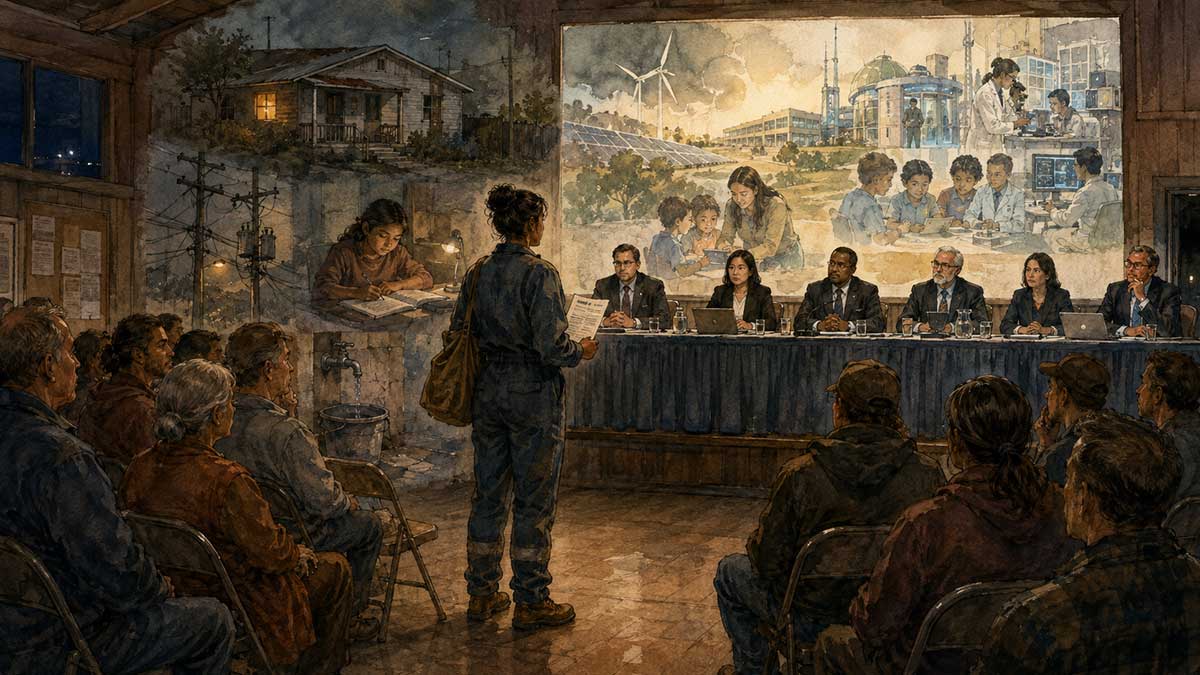
Mariana Mazzucato: Asking the people at that kitchen table what they would require before they believed any of us.
Nick Sasaki: We have spent much of this conversation speaking about systems, capacity, investment, ownership, and long-term value. She may ask a much simpler question.
“Will my electricity bill go down?”
What would any of us say?
Vaclav Smil: We could not answer without examining the local utility, the facility’s contract, the cost of new generation, the grid investments, and how those costs are allocated.
Nick Sasaki: That is an honest answer. It may sound like another way of saying, “We do not know.”
Vaclav Smil: Sometimes we do not know.
Kate Crawford: The problem begins when the company and local government speak with certainty about future benefits, then become cautious and technical when residents ask about possible costs.
Sam Altman: That is a fair criticism. Claims should be held to the same evidentiary standard in both directions.
Mariana Mazzucato: Yet they rarely are. The economic benefits are described in bold numbers. Public costs appear in footnotes, confidential agreements, or future utility proceedings.
Nick Sasaki: Let us bring the mother into the room.
Her name is Elena. Her husband died three years ago. She lives with her sixteen-year-old daughter, Sofia. Elena works at an assisted-living facility and has no investment in an AI company. She does not own property near the data center that she can sell for a profit. She will not receive a contract to build it.
She sees the lights from her kitchen every night.
Sofia uses AI for school. Elena is grateful for that. Yet the household budget is already tight.
What would each of you say directly to her?
Sam waits. No one rushes to fill the silence.
Sam Altman: I would begin by saying she should not have to choose between her daughter benefiting from AI and her family being protected from the infrastructure supporting it.
Nick Sasaki: She may answer, “But I am already making that choice.”
Sam Altman: Then I would want to know whether the facility caused her higher bill and whether the company paid its fair share of the new costs.
Kate Crawford: Elena has likely heard enough people say they want to know more. She needs someone with authority to act.
Sam Altman: That is true.
Nick Sasaki: What would you say, Kate?
Kate Crawford: I would tell her that her fear is rational. She is not anti-technology. She is responding to a system whose benefits are promoted to her and whose risks are poorly explained.
I would ask what information she received before the project was approved. Was she told how much electricity it would require? Was water use discussed? Could residents question the utility? Were promises placed in an enforceable agreement?
Nick Sasaki: Suppose she says there was a public meeting, but it took place on a weekday afternoon when she was working.
Kate Crawford: Then the legal requirement for public participation may have been satisfied without meaningful participation occurring.
Mariana Mazzucato: Access to a meeting is not the same as influence over a decision.
Sam Altman: What would meaningful participation look like? A project cannot require every resident’s approval.
Mariana Mazzucato: No, but residents should receive clear information early enough to affect the outcome. They need independent expertise, not only presentations prepared by the applicant. They need a process for negotiating binding benefits and protections.
Vaclav Smil: They should hear what will happen during extreme conditions too. What happens during drought? What happens during a heat wave when household electricity demand rises? Does the data center reduce consumption? Does the utility reactivate older generation? Who receives priority?
Nick Sasaki: Elena may never have thought to ask those questions.
Vaclav Smil: She should not need to become an electrical engineer to protect her family.
Nick Sasaki: That sentence reaches the center of the problem. We often tell people to educate themselves, read the reports, attend the meetings, and make informed choices. Elena works, cares for her daughter, and manages her home. The company has lawyers, engineers, financial experts, lobbyists, and years to prepare.
Mariana Mazzucato: That is why public institutions exist. An individual resident cannot negotiate as an equal with a global corporation.
Sam Altman: Good institutions can protect residents and still permit construction.
Kate Crawford: Yet when local governments depend on the promised tax revenue, residents may wonder whether the institution represents them or the project.
Nick Sasaki: Elena may feel that the decision was already made before she heard about it.
Mariana Mazzucato: That feeling may be accurate.
Sam Altman: It may be. It may not. We should be careful—
Kate Crawford: Sam, listen to how quickly we ask the resident to prove that the process failed. The institution possessed the information. The company possessed the information. Elena possessed a meeting notice she may never have seen.
Sam Altman: I accept that. The burden of transparency should fall on the institutions proposing the project.
Nick Sasaki: Elena walks in after work and sits down. Let us say she is here now.
“Elena, what would make you trust this project?”
Perhaps she says:
“I don’t know. Nobody asked me until now.”
What happens then?
Mariana Mazzucato: We allow her uncertainty to count. Public participation should not require citizens to arrive with a finished policy proposal.
Kate Crawford: She may know exactly where the system hurts without knowing the technical remedy.
Vaclav Smil: Experts can translate experience into requirements. If she reports flickering electricity, higher bills, construction noise, traffic, or concern about wells, each can be investigated.
Sam Altman: And if the investigation shows that the data center did not cause some of those problems, that should be communicated clearly too.
Nick Sasaki: Trust would require honesty in both directions.
Kate Crawford: Yes. Advocacy should not turn every fear into a confirmed fact.
Nick Sasaki: Elena’s deepest concern may be harder to investigate. She may feel that her town no longer belongs to people like her.
The land is being purchased. Officials are meeting with executives. New infrastructure is appearing. Property values may rise, making taxes or rent harder to afford. The future is arriving, but she experiences it as something being done to her.
Mariana Mazzucato: That is political displacement before physical displacement. A person can remain in her home and still lose influence over the place where she lives.
Sam Altman: Economic stagnation can make people feel abandoned too. Towns may want investment, jobs, and a role in a growing industry.
Nick Sasaki: Both fears can exist. One town fears being left behind. Another fears being transformed without consent.
Vaclav Smil: Development always changes a place. The demand that nothing change is unrealistic. The demand that residents accept any change is unjust.
Kate Crawford: The issue is not whether change occurs. It is whose vision of the future governs it.
Nick Sasaki: Sam, when leaders speak about building AI fast, do they sometimes see local participation as an obstacle?
Sam Altman: Some do. There is intense competition. Researchers and companies believe the technology could have enormous benefits and strategic importance. Delay feels costly.
Kate Crawford: Costly to whom?
Sam Altman: Potentially to everyone. Delayed medical discoveries, weaker economic growth, loss of scientific leadership, greater dependence on foreign systems, slower progress in energy and education.
Kate Crawford: And moving too quickly can be costly to people whose losses never appear in those national calculations.
Sam Altman: Yes. We need processes that are both fast and legitimate.
Mariana Mazzucato: Legitimacy cannot mean informing people quickly that a decision has already been made.
Sam Altman: Agreed.
Nick Sasaki: Let me ask a difficult question. If AI becomes vital to national security, does the country gain the right to override a local community?
Vaclav Smil: Governments already possess such authority in certain circumstances. Roads, transmission lines, military facilities, pipelines, and other infrastructure can proceed against local opposition.
Kate Crawford: Legal authority does not settle moral legitimacy.
Sam Altman: Nor can every community hold national infrastructure hostage.
Mariana Mazzucato: The language of national necessity can become dangerously broad. Nearly any industry can claim strategic importance.
Sam Altman: AI genuinely has strategic importance.
Kate Crawford: That makes accountability more necessary, not less.
Nick Sasaki: Suppose nearly everyone in this town opposes the facility. The national government believes it is needed. What should happen?
Vaclav Smil: First ask whether this exact location is necessary. Many conflicts are presented as unavoidable before alternatives receive serious examination.
Kate Crawford: Examine other sites, smaller facilities, different cooling methods, reduced water use, new generation, and changes in scale.
Mariana Mazzucato: If the location remains necessary, compensation and shared decision-making must go far beyond a ceremonial community fund.
Sam Altman: I agree. Yet there may be moments when a project proceeds without unanimous local approval.
Nick Sasaki: What does the country owe those residents then?
Sam Altman: Honest information, meaningful negotiation, protection from financial harm, environmental safeguards, investment in the community, and a share in the benefits.
Kate Crawford: A right to challenge violations.
Vaclav Smil: Continuous measurement.
Mariana Mazzucato: Ownership or enforceable participation in the value created.
Nick Sasaki: And an apology?
No one answers immediately.
Nick Sasaki: I am serious. Leaders speak about compensation as if money converts every loss into an acceptable transaction. If someone’s town, landscape, or sense of belonging is changed against their will, is there a place for saying, “We recognize that something was taken from you”?
Kate Crawford: There should be.
Mariana Mazzucato: Yes. Public policy often fears moral language. It prefers to assign a dollar amount and declare the matter resolved.
Sam Altman: An apology should not become a substitute for protection.
Nick Sasaki: No. Protection without recognition can feel cold too.
Vaclav Smil: Some losses cannot be reversed. That is true of every large infrastructure system. It should make decisions more serious.
Nick Sasaki: We often praise leaders who think decades ahead. Elena is thinking about the end of this month.
Are those two forms of thinking in conflict?
Sam Altman: They should not be. A credible long-term plan must remain livable in the short term.
Mariana Mazzucato: Yet powerful institutions can survive delayed returns. Low-income households cannot.
Kate Crawford: Time itself is distributed unequally. A corporation may wait ten years for an investment to mature. Elena cannot wait ten years to receive relief from a higher bill.
Vaclav Smil: That is why transition costs require direct protection.
Nick Sasaki: Could companies guarantee that residents near the facility will not pay higher utility rates connected to it?
Sam Altman: A rate-protection mechanism could be part of the agreement.
Mariana Mazzucato: Not merely for homeowners. Renters, small businesses, and surrounding communities may be affected too.
Kate Crawford: Nor should protection expire after the news cameras leave.
Vaclav Smil: The duration should reflect the infrastructure’s operating life and cost-recovery period.
Nick Sasaki: What about water?
Kate Crawford: The facility could face strict limits, public monitoring, drought provisions, and mandatory reductions before essential community use is restricted.
Sam Altman: Companies can invest in recycled water and cooling technologies that reduce demand.
Vaclav Smil: The local climate and system design determine what is practical. Claims should be based on full-year operation, not only ideal conditions.
Mariana Mazzucato: If public water infrastructure must be expanded, the company should pay according to the demand it creates. The new system should benefit the community too.
Nick Sasaki: Elena may listen to all of this and say, “Why wasn’t any of it guaranteed before construction began?”
Kate Crawford: That may be the most important question she asks.
Sam Altman: Then future projects should begin differently.
Kate Crawford: And the existing project?
Sam Altman: It should still be possible to renegotiate agreements, correct unfair costs, and improve operations.
Mariana Mazzucato: Possible, yes. Politically easy, no. Once a company invests billions, it gains leverage. Officials fear that stronger requirements will stop future expansion.
Nick Sasaki: Then the best moment for protection is before the community loses its bargaining position.
Mariana Mazzucato: Exactly.
Vaclav Smil: Planning cannot be repaired entirely after construction.
Nick Sasaki: We have been talking about what institutions owe residents. What do residents owe the wider society?
Kate glances at him.
Nick Sasaki: I ask this carefully. Elena uses electricity, cloud storage, streaming services, online shopping, and AI tutoring. The infrastructure supporting her life is located near other families. Can she reject a data center near her home without acknowledging that someone else hosts the systems she uses?
Vaclav Smil: That is a necessary question.
Kate Crawford: It is, if it is not used to silence her.
Sam Altman: Modern life depends on infrastructure. Every community cannot demand that all costs be placed somewhere else.
Mariana Mazzucato: Shared responsibility does not mean equal bargaining strength. Elena’s personal use cannot be compared casually with an industrial project’s demand.
Nick Sasaki: Yet she participates in the demand.
Mariana Mazzucato: Yes. That gives her a responsibility to accept that infrastructure must exist. It does not require her to accept any location, scale, contract, or burden.
Kate Crawford: Nor does it erase her right to know whether the facility primarily serves socially useful purposes or maximizes private revenue through vast amounts of low-value computation.
Sam Altman: We cannot have government committees evaluating every computation.
Kate Crawford: I am not proposing that.
Sam Altman: Then how does purpose affect approval?
Kate Crawford: It may affect public subsidies. A company should not receive extraordinary public support merely by presenting its most socially valuable applications.
Mariana Mazzucato: Precisely. If a firm wants public resources, the public can attach missions and conditions.
Sam Altman: Such as?
Mariana Mazzucato: Commitments to energy innovation, public-interest research, affordable access for schools or clinics, open scientific tools, workforce development, or community computing resources.
Sam Altman: Some of those could be constructive.
Nick Sasaki: This changes the meaning of compensation. The town would not receive money only for tolerating the building. It could receive a real place within the future the building is creating.
Mariana Mazzucato: That is the difference between being paid for a burden and becoming a participant in value creation.
Kate Crawford: Elena’s daughter might gain more than access to an AI tutor. Her school could receive computing resources, science programs, scholarships, or training connected to the facility.
Vaclav Smil: Such benefits should not distract from electricity and water obligations.
Nick Sasaki: Both would be required.
Vaclav Smil: Yes.
Sam Altman: This is closer to a model I could support. Companies invest in the physical system and in the communities hosting it.
Kate Crawford: With binding commitments.
Sam Altman: Yes, with clear commitments.
Nick Sasaki: Elena may still ask, “What happens if the promises are broken?”
Mariana Mazzucato: Automatic consequences. Financial penalties, loss of tax benefits, required remediation, and public reporting.
Vaclav Smil: Operational limits may be necessary if resource thresholds are exceeded.
Sam Altman: Penalties should be proportional and predictable.
Kate Crawford: Predictability can protect residents too.
Nick Sasaki: I want to move deeper than policy for a moment.
Why do promises of future abundance anger some people so intensely?
It cannot be only the electricity bill.
Kate Crawford: It may remind them of earlier promises. Factories promised prosperity and later closed. Highways promised mobility and divided neighborhoods. Extractive industries promised jobs and left polluted land. Technology companies promised connection and created new forms of surveillance and isolation.
Mariana Mazzucato: People remember who was asked to wait. They remember being told that wealth would eventually reach them.
Sam Altman: Past failures should inform us. They should not make every future promise fraudulent.
Nick Sasaki: No, but leaders may underestimate how much history enters the room before they begin speaking.
Vaclav Smil: Trust accumulates slowly and disappears quickly.
Nick Sasaki: Elena may not know the term “technological abundance.” She may hear only another wealthy person telling her that her temporary difficulty serves a greater future.
Sam Altman: Then leaders should speak with more humility.
Kate Crawford: And surrender some control.
Sam Altman: Explain what you mean.
Kate Crawford: Trust is not created only by speaking gently. It requires allowing communities to influence decisions, impose conditions, inspect results, and stop conduct that violates the agreement.
Mariana Mazzucato: Humility without shared authority can become another communication strategy.
Sam Altman: That is fair.
Nick Sasaki: Sam, you said earlier that AI capability could grow without creating broad abundance. What would you personally need to see before supporting a data-center project?
Sam Altman: A credible energy plan. A clear account of the grid effects. Responsible water use. A fair agreement with the community. Evidence that the project will create value beyond the company itself.
Nick Sasaki: What would make you oppose it?
Sam Altman: If it depended on shifting major costs to households, threatened essential water access, concealed material impacts, or could not operate responsibly in that location.
Kate Crawford: That answer matters. Technological optimism must contain the ability to say no to a particular project.
Sam Altman: Yes. Supporting AI does not require supporting every data center in every location.
Nick Sasaki: Kate, what would make you support one?
Kate Crawford: Transparent planning from the beginning. Meaningful community authority. New energy capacity that does not merely redirect existing supply. Strong water protections. Verifiable public benefits. Worker protections. Honest accounting of the facility’s full material footprint.
Nick Sasaki: So environmental criticism must contain the ability to say yes.
Kate Crawford: If the evidence and conditions justify it, yes.
Nick Sasaki: Vaclav, what claim from your own side of this debate do you find exaggerated?
Vaclav Smil: Realists sometimes speak as if present limitations establish permanent impossibility. They do not. Technologies improve. Systems change. New materials and methods appear. Skepticism should discipline ambition, not extinguish it.
Nick Sasaki: Mariana, what must the public receive before public support becomes justified?
Mariana Mazzucato: A meaningful return connected to the value created. Not a ceremonial donation. Not temporary construction jobs presented as permanent prosperity. The public should gain stronger infrastructure, protected services, economic participation, and influence over the direction of innovation.
Nick Sasaki: I should answer too.
I do not want Elena to reject AI. Her daughter may benefit from it in ways we cannot predict. I want Elena to have a reason to believe that the people building the future can see her standing in its path.
Not as an obstacle.
Not as a statistic.
Not as collateral damage that will be compensated later.
As a person whose future counts just as much as the future of the technology.
No one speaks for several seconds.
Outside the imagined room, the data center’s humming remains steady.
Kate Crawford: That is the moral failure we should fear most: treating people as temporary costs attached to a permanent achievement.
Sam Altman: And the technological failure would be building extraordinary intelligence without creating institutions wise enough to deploy it fairly.
Vaclav Smil: Intelligence does not automatically produce wisdom.
Mariana Mazzucato: Nor does wealth automatically produce justice.
Nick Sasaki: Then trust cannot rest on promises that someday everyone will benefit.
It has to rest on commitments that can be seen, measured, enforced, and changed.
Kate Crawford: Yes.
Sam Altman: Yes.
Nick Sasaki: If that is true, we may finally be ready to stop asking whether AI is good or bad.
The more useful question is harder:
What would AI companies have to give back before society grants them the resources to grow?
Mariana Mazzucato: More than compensation.
Vaclav Smil: More than efficiency.
Kate Crawford: More than transparency.
Sam Altman: Then let us define what “more” means.
Topic 5 — A New Social Contract for AI
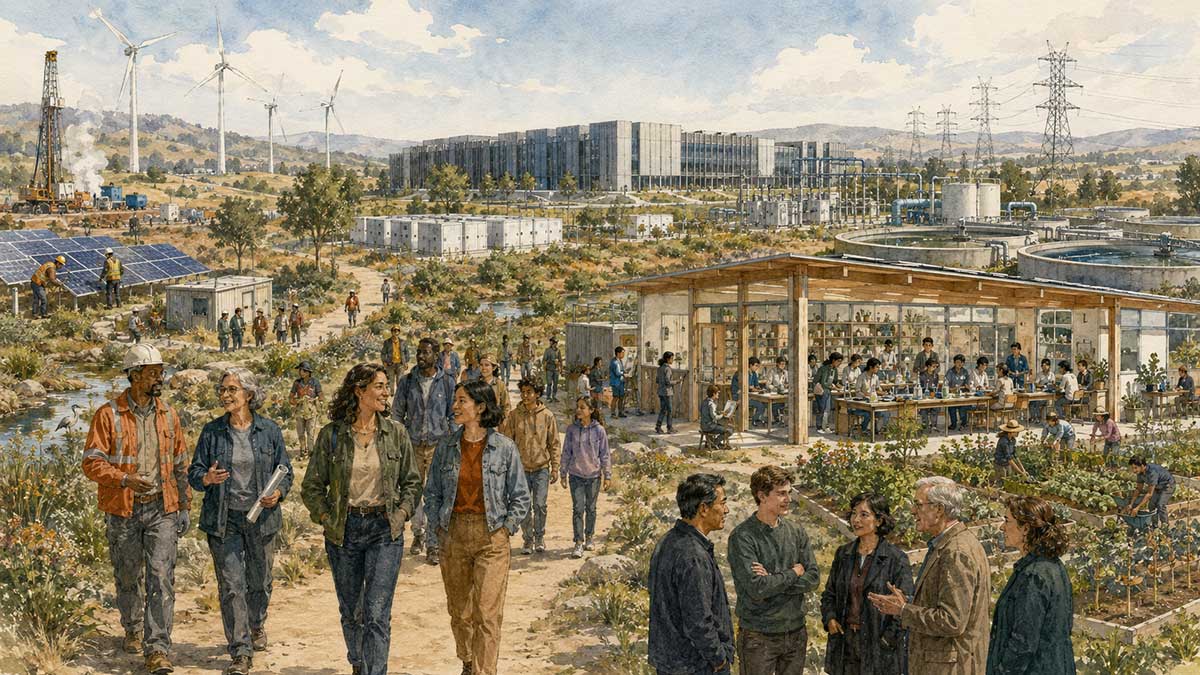
Sam Altman: Then let us define what “more” means.
Nick Sasaki: We began with a family looking at an electricity bill. We discovered that AI is not an invisible mind floating somewhere above us. It has a physical body.
It uses land, water, electricity, minerals, buildings, public infrastructure, and human labor.
If society grants AI companies access to those resources, what should those companies be required to return?
Mariana Mazzucato: We should begin by rejecting the idea that the public is merely selling inputs to a private industry.
The public does not provide only land and electricity. It provides research institutions, educated workers, legal protections, transportation systems, electrical grids, water systems, tax structures, and political stability.
The public is already an investor in the AI economy.
Sam Altman: That does not mean every citizen should own part of every company.
Mariana Mazzucato: No. It means public contribution should be recognized when we design the exchange.
Kate Crawford: Recognition cannot remain symbolic. Communities need enforceable rights and material returns.
Vaclav Smil: And any agreement must begin with physical reality. A company cannot promise economic benefits as a substitute for sufficient electricity or water.
Nick Sasaki: Let us begin with electricity.
Should a company building a large data center be required to create new energy capacity rather than competing with households for the supply already available?
Sam Altman: In many cases, yes. AI companies should help bring new generation online and invest in the grid infrastructure needed to support their demand.
Vaclav Smil: “Bring new generation online” needs a precise meaning. Signing a contract for energy produced hundreds of miles away may not solve the local capacity problem. Purchasing renewable credits does not create a transmission line.
Kate Crawford: Nor should a company claim that its facility runs on clean energy if its arrival causes other customers to rely more heavily on fossil-fuel generation.
Sam Altman: Those are fair concerns. The goal should be genuine additional capacity, not accounting that looks impressive.
Nick Sasaki: Could the requirement be simple?
“If your facility requires one thousand megawatts, you must help create at least one thousand megawatts of new supply.”
Vaclav Smil: It would not be that simple. Nameplate capacity is not the same as dependable output. A thousand megawatts of solar capacity does not provide a thousand megawatts every hour. Storage, transmission, weather, maintenance, and peak demand matter.
Nick Sasaki: Then what should the standard measure?
Vaclav Smil: Reliable supply matched to the facility’s demand profile. The company should demonstrate that its operation will not reduce system reliability or impose unfair costs on existing customers.
Mariana Mazzucato: It should contribute to infrastructure that leaves the wider community in a stronger position.
Sam Altman: That is important. AI demand could support new nuclear, geothermal, solar, storage, transmission, and other energy projects that might otherwise struggle to attract investment.
Kate Crawford: It could. We should require evidence that the wider community gains access to the resulting capacity or reliability.
Nick Sasaki: The company should not merely build an electrical island for itself.
Mariana Mazzucato: Precisely. Public systems make private growth possible. Private investment should strengthen those systems in return.
Sam Altman: A facility may still need dedicated infrastructure. It cannot always share every asset immediately.
Mariana Mazzucato: Dedicated equipment can be necessary. The public should not finance it under the vague promise that some indirect benefit may appear later.
Vaclav Smil: Cost allocation should follow use.
Nick Sasaki: This sounds like the first principle of the new agreement:
AI expansion should add enough energy and grid capacity to meet its own needs without making existing customers poorer or the electrical system less reliable.
Sam Altman: I support that direction.
Kate Crawford: Include full-life costs and local effects.
Vaclav Smil: Include realistic construction schedules.
Mariana Mazzucato: Include public participation in determining what “making customers poorer” means.
Nick Sasaki: Good. The first principle cannot be only a slogan.
What about water?
Kate Crawford: Water requirements should depend on local conditions. A facility in a water-rich region faces a different situation from one in a drought-prone area.
Every project should disclose its water source, expected consumption, seasonal variation, cooling method, wastewater practices, and drought plan before approval.
Vaclav Smil: Public reporting should distinguish withdrawal from consumption. Water returned to the system is different from water lost through evaporation, yet its temperature and quality still matter.
Sam Altman: Companies should invest in recycled water and less water-intensive cooling where practical.
Nick Sasaki: Who decides what is practical? A company might say a better system costs too much.
Kate Crawford: An independent authority, using public standards.
Mariana Mazzucato: Affordability for the company cannot be the only test. The cost of the cheaper system may appear later in the community’s water supply.
Sam Altman: The requirement should still consider technical feasibility. A standard no system can meet becomes a ban disguised as regulation.
Kate Crawford: A company should be willing to walk away from a location that cannot sustain the facility.
Sam Altman: Yes. Some locations will be unsuitable.
Nick Sasaki: That may be the second principle:
AI infrastructure should adapt to the ecological limits of a location. A community should not be forced to adapt its essential needs to the facility.
Vaclav Smil: Reasonable.
Mariana Mazzucato: Add priority during emergencies. Households, hospitals, agriculture, and essential public services should not compete on equal terms with discretionary computation during severe scarcity.
Sam Altman: Some computation may support essential services too.
Kate Crawford: Then facilities should identify critical and deferrable workloads.
Nick Sasaki: Could a data center reduce certain operations during a heat wave or drought?
Sam Altman: Some workloads can be shifted in time or moved to another location. Others require continuity.
Vaclav Smil: That flexibility could become valuable to electrical grids. A large consumer capable of reducing demand quickly may help stabilize the system.
Kate Crawford: If the company makes a binding commitment to do so.
Mariana Mazzucato: And if the benefit is shared with ratepayers, rather than becoming another private revenue stream built on public infrastructure.
Nick Sasaki: This is becoming more than restriction. The facility could act as a partner to the grid.
Sam Altman: Yes. Data centers may become flexible customers, investors in generation, purchasers of storage, and supporters of advanced energy.
Vaclav Smil: “May” remains the correct word.
Sam Altman: Fair.
Nick Sasaki: Let us turn to the town itself.
What should Elena and Sofia receive in exchange for living beside this facility?
Mariana Mazzucato: Begin with protection. They should not suffer higher utility costs caused by the project. Their water access, health, property, and quality of life should be protected through enforceable standards.
Then participation. The town should receive a meaningful share of the value it helps create.
Nick Sasaki: What would meaningful participation look like?
Mariana Mazzucato: It might include revenue sharing, community ownership of supporting energy infrastructure, local tax guarantees, school funding, public computing resources, scholarships, training programs, or direct household benefits.
The exact structure can vary. The principle should not.
Sam Altman: I support community investment. I would be cautious about requiring ownership in the AI company itself. Valuing and administering such interests could become difficult.
Mariana Mazzucato: Community ownership does not have to mean shares in the company. The town could hold an interest in the energy project, grid asset, water-recycling facility, or community fund connected to the development.
Vaclav Smil: Ownership creates maintenance responsibilities and financial risk too.
Mariana Mazzucato: Yes. Shared return should not become a new burden. The structure must fit the community’s capacity.
Kate Crawford: Direct benefits may be more meaningful in some places: stable utility rates, home-efficiency improvements, health monitoring, noise reduction, water protection, and independent environmental testing.
Nick Sasaki: What about jobs?
Kate Crawford: Companies should state honestly how many permanent positions the facility will create. Construction employment and long-term employment should not be combined into one impressive number.
Sam Altman: Agreed.
Mariana Mazzucato: Workforce programs should prepare residents for jobs across the wider AI and energy economy, not only the limited number available inside one building.
Nick Sasaki: Sofia might receive training that allows her to become an engineer, researcher, electrician, technician, or entrepreneur.
Sam Altman: Exactly. The community could become part of the technological ecosystem.
Kate Crawford: Provided that opportunity is real and available to local students, rather than an inspirational story attached to a small scholarship.
Nick Sasaki: Would free access to premium AI tools for local schools be meaningful?
Sam Altman: It could be.
Mariana Mazzucato: Tools alone do not transform education. Teachers need training, schools need infrastructure, and students need protection from careless data practices.
Kate Crawford: The company should not use children as a testing population in exchange for donated services.
Sam Altman: Of course not.
Nick Sasaki: Then educational access requires funding, teacher participation, privacy safeguards, and evaluation.
Mariana Mazzucato: Yes. Public benefit should be built with the recipients, not delivered as corporate charity.
Nick Sasaki: That phrase matters: not charity.
Elena should not have to feel grateful for receiving a small gift from a company using resources that belong partly to her community.
Mariana Mazzucato: Correct. A negotiated return recognizes contribution. Charity preserves the hierarchy between giver and recipient.
Sam Altman: Yet voluntary generosity should not be dismissed.
Mariana Mazzucato: It should be welcomed. It should not replace obligation.
Kate Crawford: Nor should it purchase silence.
Nick Sasaki: Suppose the company funds the school, library, and local hospital. Residents may then fear criticizing it.
Kate Crawford: That has happened in many industries. Dependence can weaken accountability.
Sam Altman: The answer cannot be to prohibit community investment.
Kate Crawford: No. It is to separate essential public protections from discretionary corporate giving.
Vaclav Smil: And maintain independent monitoring.
Nick Sasaki: Who pays for that monitoring?
Mariana Mazzucato: The company can fund it, but the company should not control it.
Sam Altman: That makes sense.
Nick Sasaki: We have energy investment, water protection, household rate protection, community participation, honest job claims, educational opportunity, and independent monitoring.
Are we building a workable agreement or a wish list so expensive that no project will proceed?
Sam Altman: That depends on the scale and details. A smaller facility should not face the same obligations as a project placing immense demand on a regional grid.
Vaclav Smil: Requirements should be proportional to physical impact.
Kate Crawford: And to the public support received.
Mariana Mazzucato: A company seeking tax incentives, favorable electricity contracts, or publicly funded infrastructure should accept stronger public obligations.
Nick Sasaki: If the agreement makes a project unprofitable, what does that tell us?
Sam Altman: It may tell us that the location or design does not work. It may tell us that the requirements are poorly structured. We need to examine which.
Mariana Mazzucato: It may tell us that the reported profitability depended on costs being carried by others.
Vaclav Smil: All three are possible.
Nick Sasaki: This is where political slogans fail. “Let the market decide” ignores public infrastructure and transferred costs. “Make the company pay for everything” ignores shared benefits and practical economics.
Mariana Mazzucato: The task is to design the market around a public purpose.
Sam Altman: With enough flexibility for experimentation.
Kate Crawford: And enough accountability to prevent experimentation on communities without their consent.
Nick Sasaki: Could we create a simple public scorecard for every major data center?
Vaclav Smil: Simple enough to read, detailed enough to be meaningful.
Nick Sasaki: What would it show?
Kate Crawford: Total electricity demand, peak demand, energy source, new capacity created, and effects on household rates.
Vaclav Smil: Water withdrawal, water consumption, seasonal demand, cooling method, and emergency limits.
Mariana Mazzucato: Public subsidies, tax agreements, infrastructure contributions, projected public revenue, and community benefits.
Sam Altman: Efficiency improvements, workload flexibility, new technologies deployed, and measurable services provided to the community.
Nick Sasaki: Could it show whether commitments were met each year?
Kate Crawford: It must.
Mariana Mazzucato: Missed commitments should trigger predetermined consequences.
Sam Altman: Companies should have a chance to correct genuine problems before severe penalties are imposed.
Kate Crawford: Yes, except when immediate harm requires immediate action.
Vaclav Smil: The enforcement process can distinguish between minor deviations, serious violations, and emergency risks.
Nick Sasaki: This would make the hidden physical body of AI visible over time, not just before approval.
Kate Crawford: Exactly. Transparency is not one report issued during construction. It is continuous public knowledge.
Nick Sasaki: What about AI’s output? Should society measure what the facility creates, not only what it consumes?
Sam Altman: Yes. That is necessary if we want to judge whether the resource use is worthwhile.
Vaclav Smil: Output is difficult to measure. A data center may serve thousands of customers performing unrelated tasks.
Mariana Mazzucato: Economic output alone is insufficient. Revenue does not equal social value.
Kate Crawford: Nor can companies justify everything by pointing to a few medical applications.
Nick Sasaki: Then how could we measure value?
Sam Altman: Productivity gains, scientific contributions, services delivered, new businesses supported, educational access, energy innovations, and other outcomes.
Vaclav Smil: Many would be estimates.
Mariana Mazzucato: Public value always includes judgment. The fact that measurement is difficult does not make financial revenue the only valid number.
Kate Crawford: We may never create one final ratio that tells us whether AI produced more good than harm.
Nick Sasaki: Then perhaps the standard is not a mathematical formula.
Sam Altman: It can still be a direction: AI should become a net creator of resources, capability, and opportunity.
Vaclav Smil: “Net creator of resources” requires caution. AI does not create matter. It can help us discover, extract, convert, use, and recycle materials more effectively.
Nick Sasaki: Fair. AI should help humanity gain more usable energy, knowledge, health, security, and opportunity than its infrastructure consumes.
Kate Crawford: Aggregate gain is not enough.
Nick Sasaki: You mean society could gain overall and still destroy one community.
Kate Crawford: Yes. If a million people gain a small benefit and one town loses its water supply, the average may look positive. The town still suffers an unacceptable loss.
Mariana Mazzucato: “More for humanity” must include distribution. Who owns the new capability? Who can afford the service? Who receives the cleaner energy? Who remains exposed to pollution?
Sam Altman: Then the standard could contain two tests.
First: Does AI create greater total value than it consumes?
Second: Are the benefits and costs distributed in a way society considers fair?
Vaclav Smil: Add a third: Is the system physically sustainable at the scale being proposed?
Kate Crawford: Add a fourth: Can affected communities challenge the evidence and change the outcome?
Nick Sasaki: Four tests:
Does the system create more social value than its full cost?
Are benefits and burdens distributed fairly?
Can the physical system operate sustainably at scale?
Do affected communities possess real authority?
Mariana Mazzucato: That is closer to a social contract.
Sam Altman: I would add room for uncertainty. New technologies cannot prove every future benefit before development.
Kate Crawford: Nor should uncertainty always favor construction.
Sam Altman: Agreed. It should be managed according to the seriousness and reversibility of the risk.
Vaclav Smil: If a mistake can be corrected easily, experimentation is more acceptable. If it may exhaust an aquifer, destabilize a grid, or lock in decades of infrastructure, the evidence threshold should be higher.
Nick Sasaki: That is a useful principle.
The greater and less reversible the possible harm, the stronger the proof and protection required before proceeding.
Kate Crawford: Yes.
Mariana Mazzucato: The greater the public contribution, the stronger the public return should be.
Sam Altman: The greater the potential public benefit, the more seriously we should consider the cost of delay.
Vaclav Smil: All three belong in the decision.
Nick Sasaki: We began this conversation with two opposing instincts.
One said resources are finite, AI consumes too much, and restraint is the responsible response.
The other said wealth can be created, human ingenuity can overcome scarcity, and fear should not prevent us from building.
Do you still see those positions as opposites?
Kate Crawford: Not completely. I believe physical limits are real. I believe human creativity is real too. My fear concerns systems that celebrate creativity and conceal extraction.
Sam Altman: I believe abundance is possible. I no longer think it is enough to describe the destination. The institutions, infrastructure, and distribution on the way there determine whether it deserves that name.
Vaclav Smil: Limits and innovation have always existed together. Civilization advances by applying knowledge within physical constraints, not by pretending constraints have vanished.
Mariana Mazzucato: Wealth can be created. Creation is collective. Distribution begins during the creative process through decisions about investment, ownership, risk, and direction. It does not begin only after the wealth appears.
Nick Sasaki: Then perhaps “wealth is something we create, not something we divide” needs a second sentence.
Mariana Mazzucato: What would you add?
Nick Sasaki: Wealth is something we create together, then judge by whether the people who helped create it are permitted to share in it.
Sam Altman: That is strong.
Kate Crawford: Add the places that made it possible.
Nick Sasaki: Wealth is something we create together, then judge by whether the people and places that made it possible are permitted to share in it.
Vaclav Smil: Better.
The room grows quiet.
Beyond the window, the family’s house is dark now except for the kitchen. Elena has gone upstairs. Sofia remains at the table with her chemistry work.
She asks the AI another question.
Somewhere inside the data center, processors receive it. Electricity passes through transmission lines. Cooling equipment removes heat. Water and air move through machinery. A response returns to her screen.
Sofia reads it twice, picks up her pencil, and completes the problem on her own.
Nick Sasaki: That moment contains nearly the whole argument.
The system consumed resources.
It gave Sofia something valuable.
We still do not know whether her family received a fair exchange.
Kate Crawford: Her successful homework does not erase the electricity bill.
Sam Altman: The electricity bill does not erase what she learned.
Vaclav Smil: Both must be counted.
Mariana Mazzucato: And Elena should not be left alone to reconcile them.
Nick Sasaki: If Elena walked into this room now and asked whether she should let Sofia continue using AI, what would you tell her?
Kate Crawford: Yes. Let her use it. Then join with others to demand a system worthy of her trust.
Vaclav Smil: Use the tool for something valuable. Do not confuse personal restraint with infrastructure policy.
Mariana Mazzucato: Do not accept the idea that your only choices are consuming silently or refusing alone. You are entitled to a voice in the system supporting the technology.
Sam Altman: Let Sofia keep asking questions. The people building AI should carry the responsibility of making each answer cleaner, more efficient, more valuable, and fairer to the communities making it possible.
Nick Sasaki: So none of you would tell Elena to solve this by taking AI away from her daughter.
Kate Crawford: No.
Sam Altman: No.
Vaclav Smil: That would not solve the problem.
Mariana Mazzucato: It would transfer responsibility downward once again.
Nick looks through the window at the red lights blinking above the data center.
Nick Sasaki: Perhaps the most responsible citizen is not the person who refuses every new technology.
Perhaps it is the person who uses what genuinely helps, sees the hidden cost, and refuses to let powerful institutions decide alone who must pay it.
The humming continues, but it sounds different now.
It no longer belongs only to a machine.
It contains the questions of the student using it, the mother paying for electricity, the worker maintaining the grid, the community supplying the water, the investors seeking a return, and the scientists hoping intelligence can help humanity create what it does not yet possess.
Vaclav Smil: We should not call the future abundant before it exists.
Sam Altman: No. But we should not stop trying to build it.
Kate Crawford: Build it without hiding what it takes.
Mariana Mazzucato: And without excluding those who make it possible.
Nick Sasaki: Then that may be our social contract for AI:
Build boldly enough to create more than we have now.
Measure honestly enough to see everything it consumes.
Protect people firmly enough that no community becomes an invisible sacrifice.
Share the value widely enough that abundance means more than wealth at the top.
The data center’s red lights continue blinking against the night.
At the kitchen table, Sofia begins another problem.
Final Thoughts
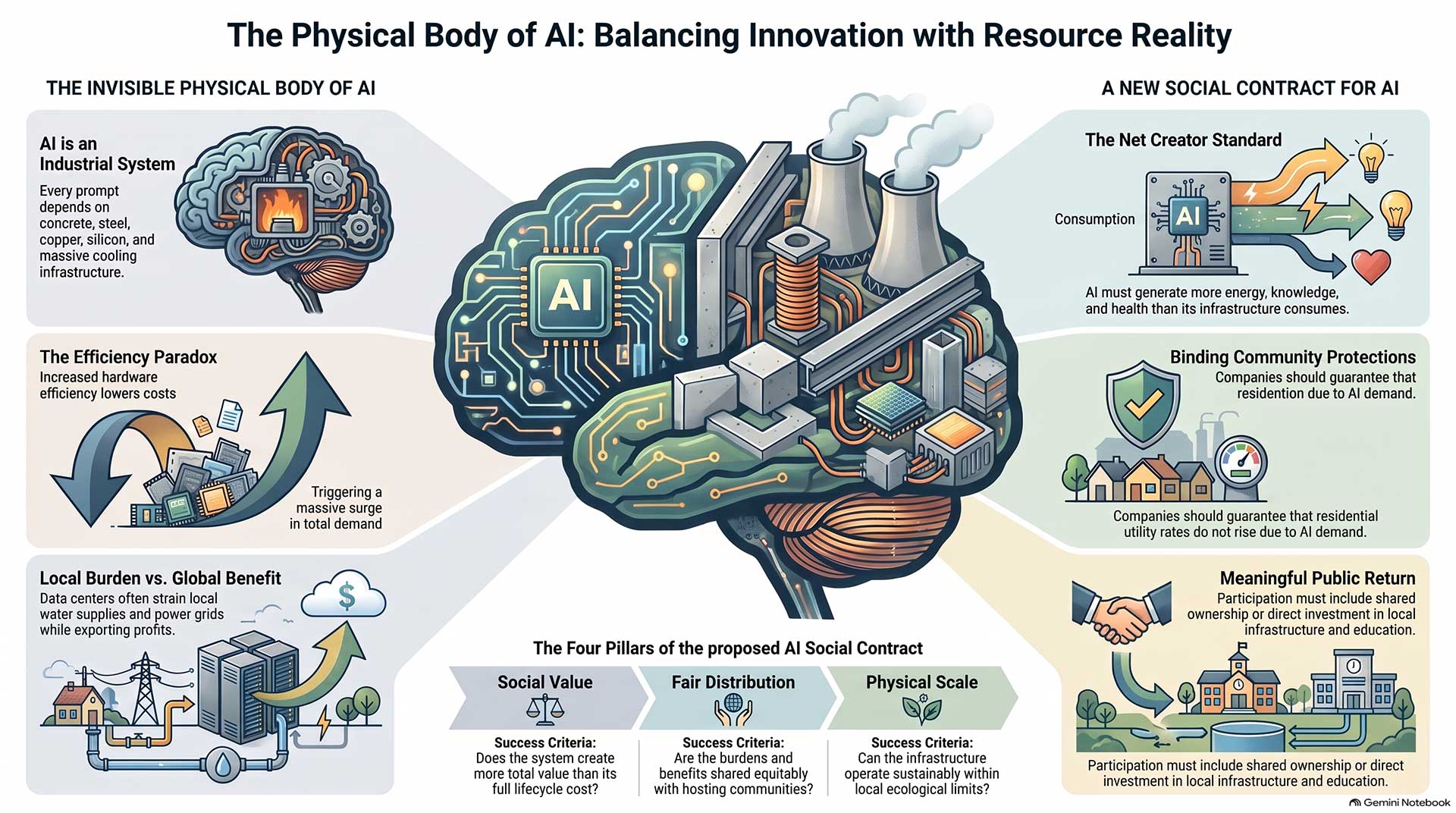
The debate over AI and natural resources is often presented as a choice between pessimism and optimism.
One side sees limited water, strained electrical grids, environmental damage, and communities carrying costs they never agreed to bear. The other sees human intelligence as a creative force capable of developing new energy, new materials, new medicines, and new forms of wealth.
Both sides hold part of the truth.
Physical resources are limited at a particular time and place. Human possibility is not fixed. Knowledge can turn overlooked materials into resources, reduce waste, improve efficiency, and open paths that earlier generations could not see.
Yet innovation does not automatically produce justice. A society can create more total wealth and still leave ordinary families poorer. A technology can benefit millions and still impose unacceptable harm on one community.
The correct question is not merely whether AI consumes resources.
It is whether AI leaves humanity with more usable energy, knowledge, health, security, and opportunity than it required—and whether the people and places making that achievement possible receive a fair share of what was created.
People should not be asked to solve an infrastructure problem through personal guilt. A student should not have to stop using an AI tutor to protect a distant water system. The greater responsibility belongs to the companies, utilities, governments, and institutions deciding how AI infrastructure is built.
AI companies seeking land, electricity, water, public incentives, and community trust should be expected to:
- Create new energy and grid capacity
- Protect households from unfair utility costs
- Adapt facilities to local water limits
- Publish continuing environmental data
- Accept independent monitoring
- Give communities meaningful authority
- Share measurable economic and social benefits
- Face enforceable consequences when commitments are broken
The future should not belong only to those who build fastest. It should belong to those willing to prove that what they create will leave more behind than it took.
Short Bios:
Nick Sasaki is the moderator of this imaginary conversation. He approaches AI as both a user and a concerned citizen, asking how technological progress can serve ordinary families without transferring hidden costs to them.
Sam Altman is a technology entrepreneur and the CEO of OpenAI. He represents the belief that advanced artificial intelligence could accelerate scientific discovery, reduce costs, increase productivity, and help create broad material abundance.
Kate Crawford is a scholar and author whose work examines the environmental, political, labor, and material foundations of artificial intelligence. She challenges the idea that AI exists separately from physical resources and human institutions.
Vaclav Smil is a scientist and author known for his research on energy, materials, technological change, and civilization-scale systems. He brings attention to physical limits, deployment times, infrastructure requirements, and the difference between technical possibility and large-scale reality.
Mariana Mazzucato is an economist and author whose work studies innovation, public investment, value creation, and the role of governments in shaping markets. She asks who helps create technological wealth, who assumes the risks, and who receives the returns.
Leave a Reply