
Introduction
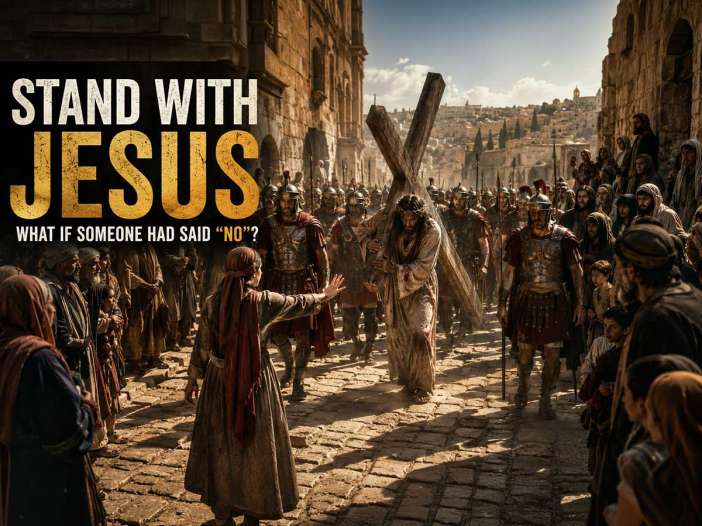
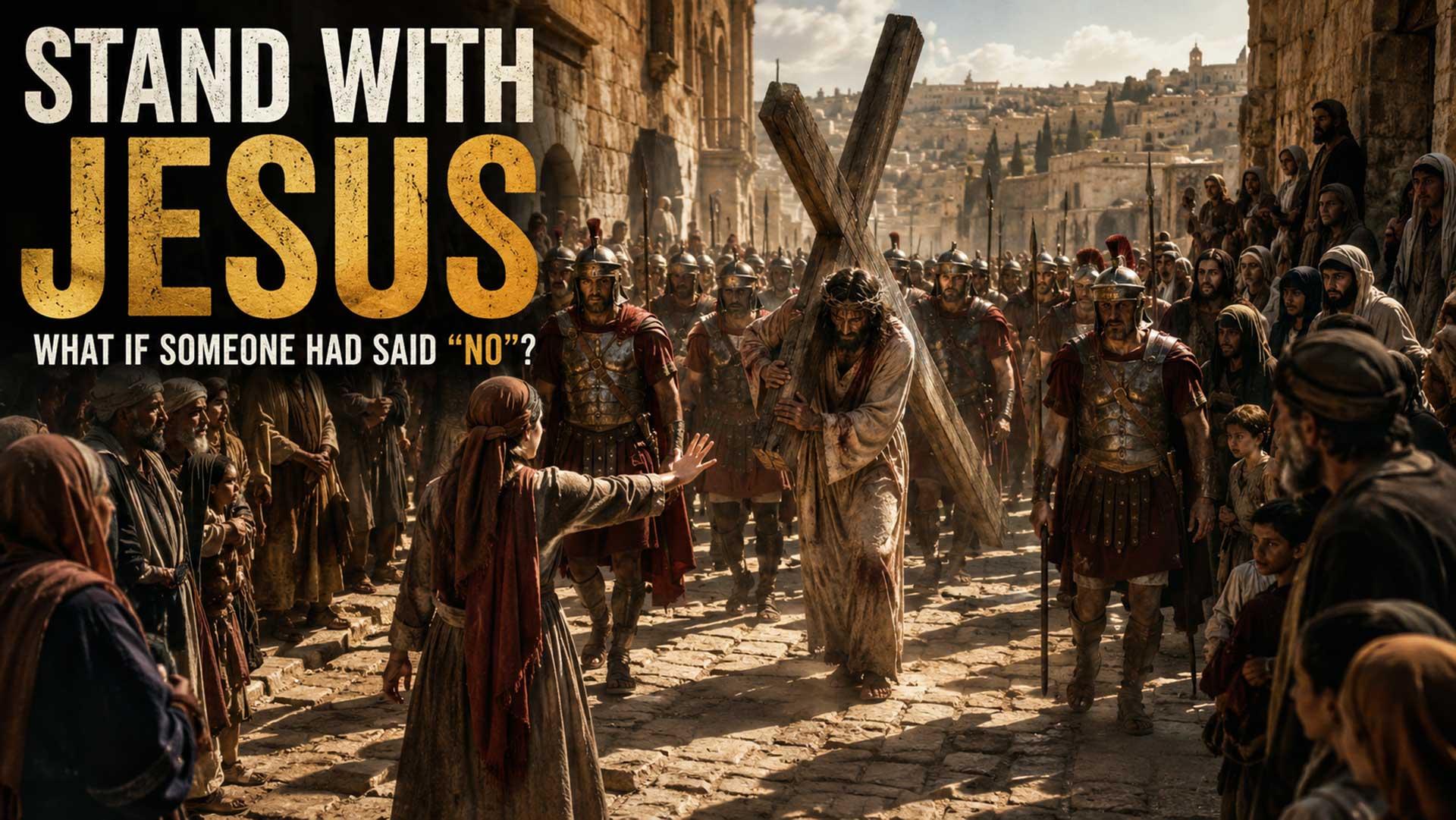
What would you have done if you had been standing on that road?
It is easy to answer from two thousand years away.
We know the name Jesus Christ. We know what happened at Golgotha. We know that the crucifixion became one of the defining events in human history.
But the people standing along the streets of Jerusalem did not possess our view of history.
They saw soldiers.
They saw Roman authority.
They saw a condemned man who had been beaten and was being taken away to die.
Some mourned. Some followed. Some watched.
And perhaps many were afraid.
The Gospel of Luke tells us that a large number of people followed Jesus, including women who mourned and lamented for him. The Gospel accounts tell us that Simon of Cyrene was compelled to carry the cross. They give us extraordinary glimpses of the people surrounding Jesus during his final hours.
But Stand With Jesus is not presented as another Gospel account.
Mara, Eliab, Tobias, Nathan, and the events involving this imagined group are fictional. Joanna shares a biblical name, but the Joanna portrayed in this story is a fictionalized character rather than a claim about the biblical Joanna.
The central act of the story, ordinary people organizing themselves to block the road and attempt to prevent Jesus' crucifixion, is fictional.
It is a thought experiment.
What if somebody had stepped forward?
What if one frightened woman had looked at what was happening and said:
No.
What if another person joined her?
And another?
What if five people became twenty?
What if twenty became fifty?
Would Rome have stopped?
Probably not.
Would those people have been frightened?
Certainly.
Could they have been arrested, beaten, or killed?
Possibly.
Yet there is another question hidden beneath all of those questions:
Would trying still have mattered?
That is the question at the heart of Stand With Jesus.
This is not primarily a story about changing the crucifixion.
It is a story about refusing to become a spectator to suffering.
Mara believes courage means stopping what is happening.
By the end of the story, she discovers something harder.
Sometimes we cannot stop it.
Sometimes there is no victory available to us.
Sometimes love cannot rescue the person we love.
Sometimes justice does not arrive when we demand it.
Sometimes all we can choose is whether we disappear or remain beside the person who suffers.
Jesus tells the five:
"Walk with me."
And the meaning of their protest changes.
They cannot prevent the road to Golgotha.
But they can refuse to let Jesus walk it alone.
That fictional moment gives the story its title.
Stand With Jesus.
Not because standing guarantees victory.
Because sometimes where we stand reveals who we are.
(Note: This is an imaginary conversation, a creative exploration of an idea, and not a real speech or event.)
The first person to step into the road was a woman named Mara.
No one followed her.
Not at first.
Jerusalem was already awake beneath the hard morning light. The streets were crowded with people who had heard that the Romans were taking three condemned men outside the city for execution. Some came out of curiosity. Some stood in doorways. Others watched from rooftops.
Then the soldiers appeared.
And between them walked Jesus.
Mara had seen beaten men before. Roman punishment was meant to be seen. It taught lessons without requiring words.
But when she saw Jesus, she covered her mouth.
His face was swollen. Blood ran from wounds around his head. His clothing was stained. His steps were uneven.
A heavy wooden beam had been placed upon him.
People moved aside.
That was what people did when Roman soldiers came.
Make room.
Lower your eyes.
Do not attract attention.
Go home afterward.
Tell your family what you saw.
Live another day.
Mara did none of those things.
She stepped into the road.
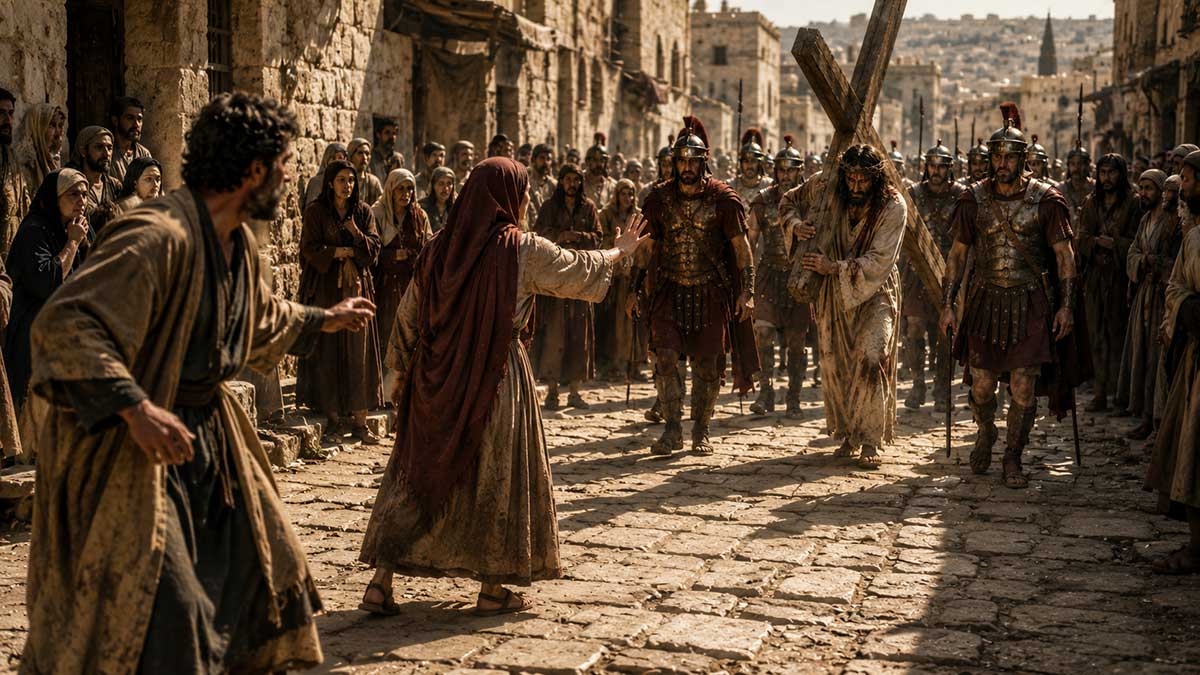
"Stop."
The soldier nearest her stared at her.
"What?"
"Stop."
His expression changed from surprise to amusement.
"Move, woman."
Mara's legs were trembling so badly that she thought she might collapse.
She was not a warrior.
She sold bread with her husband near the eastern market. She had three children. Her youngest still crawled into her bed after nightmares.
She had every reason to move.
Instead, she looked past the soldier at Jesus.
"He's innocent."
The street became strangely quiet.
The soldier walked closer.
"Move."
"No."
A hand grabbed Mara's arm.
It belonged to Eliab, a potter who lived two streets from her.
"Mara, have you lost your mind?"
"Look at him."
"I am looking."
"Then do something."
Eliab glanced at the soldiers.
"Do what?"
"Anything."
"You have children."
"So do you."
"Exactly."
"Then what are we teaching them?"
Eliab froze.
Mara pulled her arm free.
"That when powerful men hurt someone, good people make room for them?"
The soldier shoved her.
Mara fell.
Several people gasped.
Nobody moved.
Jesus stopped walking.
For one brief moment, Mara looked up from the stones and met his eyes.
There was pain in them.
But there was something else.
Not panic.
Not desperation.
Almost tenderness.
The soldier shouted at Jesus to keep moving.
Mara pushed herself up.
Then Eliab stepped beside her.
"She's right."
Mara stared at him.
Eliab looked terrified.
He raised his voice.
"He's innocent!"
Someone in the crowd hissed at him to be quiet.
Then another voice came.
"He's done nothing deserving this!"
It belonged to Joanna, a widow who had once traveled to hear Jesus teach.
She came forward from the crowd.
Now there were three.
The soldiers began shouting.
"Clear the road!"
Most people did.
Mara, Eliab, and Joanna remained.
Then a fourth person joined them.
His name was Tobias.
He was seventeen.
His father caught his clothing as he passed.
"Where are you going?"
"With them."
"You are going nowhere."
"Father."
"I said no."
"They're going to kill him."
"You cannot stop Rome."
Tobias looked at the three people standing in the road.
"Maybe."
"Maybe what?"
"Maybe stopping them isn't the only reason to stand there."
His father tightened his grip.
"You'll get yourself killed."
Tobias looked at Jesus.
"If everybody thinks that way, he walks alone."
His father slowly released him.
Tobias stepped into the road.
Four people.
A soldier laughed.
"Is this your rebellion?"
Nobody answered.
Then came the fifth.
Nathan, a wealthy cloth merchant.
Of all the people watching, perhaps he had the most to lose.
Nathan had contracts with Roman officials. His family lived comfortably. His business depended upon remaining acceptable to people with authority.
He had spent his entire adult life learning when to speak and when to remain silent.
This was clearly a time to remain silent.
Nathan told himself that repeatedly.
Then he saw Tobias.
Seventeen years old.
Standing there shaking.
And Nathan felt ashamed.
He stepped forward.
Five people now blocked the road.
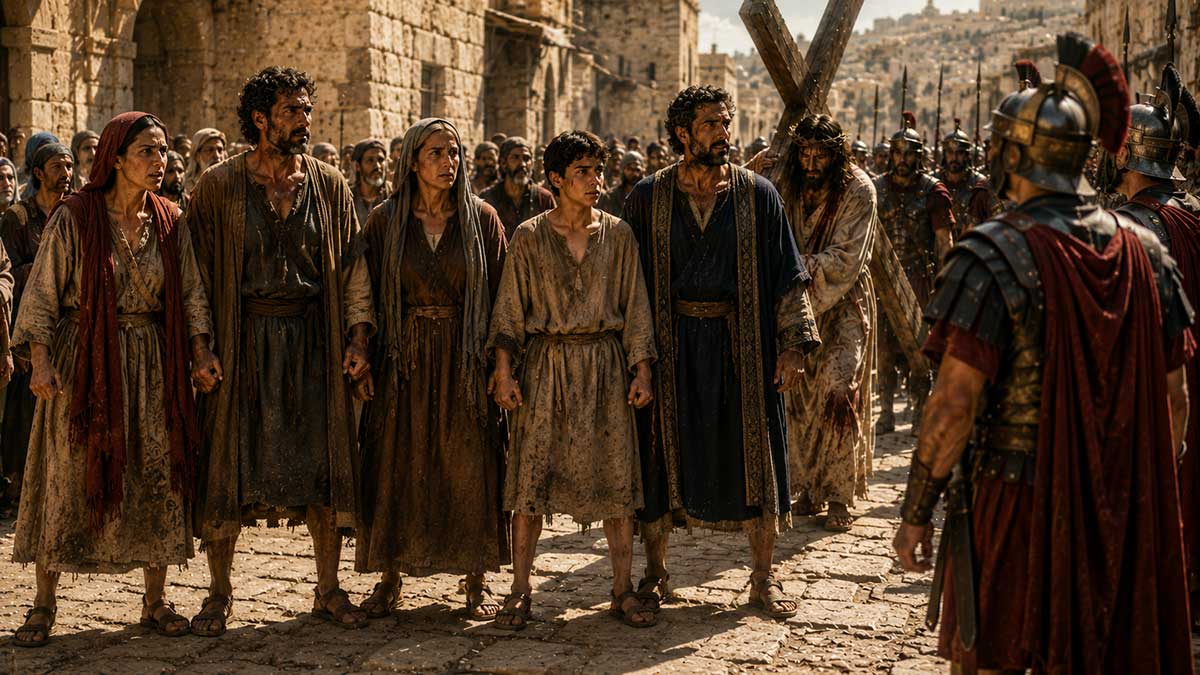
Mara.
Eliab.
Joanna.
Tobias.
Nathan.
Five ordinary people against Rome.
It was absurd.
People along the street began murmuring.
Some called them fools.
One man shouted, "Move before you get us all punished!"
Another said, "The judgment has already been made!"
Nathan turned toward them.
"Then it was a bad judgment!"
A soldier struck him across the face.
Nathan stumbled.
Blood appeared at his lip.
The crowd recoiled.
That should have ended it.
Instead, something happened that none of the soldiers expected.
An old man stepped forward.
Then a young woman.
Then two brothers.
Then another woman carrying a basket.
Nine.
Twelve.
Fifteen.
The centurion shouted for everyone to clear the road.
Nobody did.
A voice somewhere behind Mara cried:
"LET HIM GO!"
Another answered:
"LET HIM GO!"
Then dozens began shouting it.
"LET HIM GO!"
"LET HIM GO!"
"LET HIM GO!"
The sound traveled down the narrow street.
People leaned from windows.
Shopkeepers came outside.
Children ran to see what was happening.
Some joined the shouting without knowing how it had begun.
"LET HIM GO!"
Mara turned.
There were perhaps fifty people now.
Maybe more.
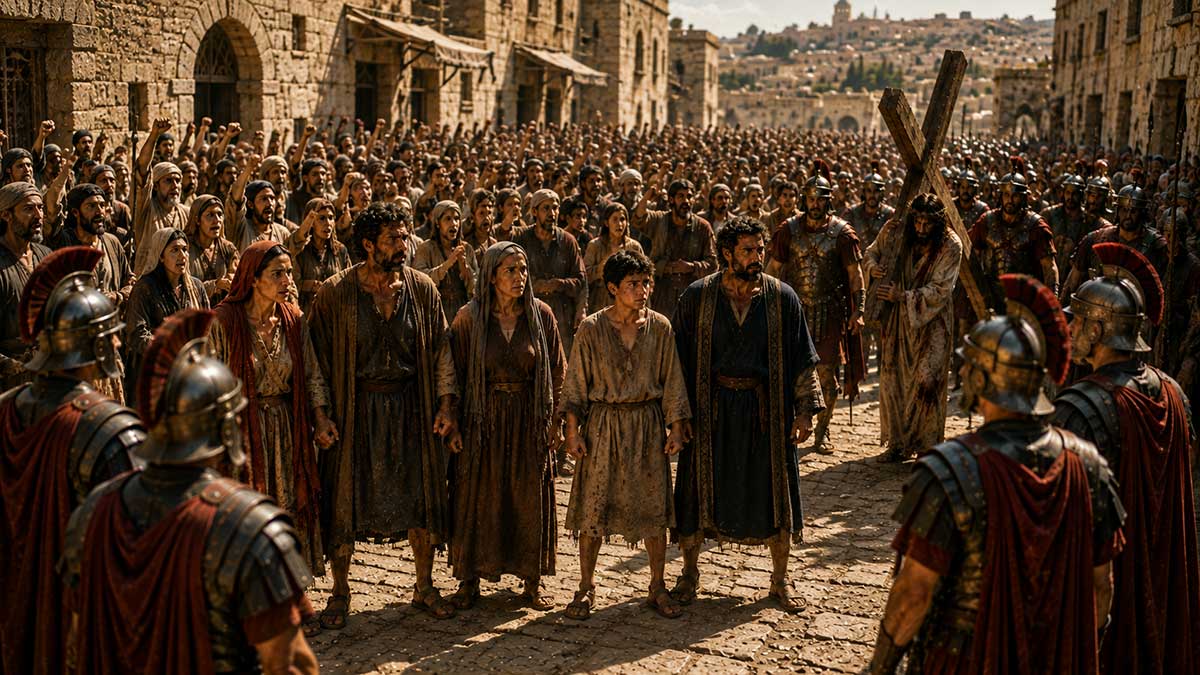
For the first time that morning, the soldiers looked uncertain.
Not frightened.
But uncertain.
Rome knew how to punish individuals.
Crowds were different.
Crowds could become riots.
And Jerusalem was already tense.
The centurion raised his hand.
"Anyone remaining in this road will be arrested!"
Several people immediately left.
Mara watched them go.
She did not blame them.
Then more left.
Fifty became forty.
Forty became thirty.
Nathan leaned toward Mara.
"This is when it becomes real."
"What?"
"Everyone is brave until there is a price."
Mara looked at him.
"Are you leaving?"
Nathan touched the blood on his lip.
"No."
Neither was Eliab.
Neither was Joanna.
Neither was Tobias.
The five remained.
And around them remained perhaps twenty others.
The soldiers advanced.
One struck Eliab in the stomach.
He fell to his knees.
Another dragged Tobias aside.
His father screamed from the crowd.
Joanna was pushed against a wall.
Nathan was struck again.
Mara heard people crying.
She heard soldiers shouting.
She heard someone calling for everyone to run.
Yet through all of it, she kept looking at Jesus.
He was still there.
Watching them.
Then Jesus spoke.
"Enough."
The word was quiet.
Yet somehow Mara heard it.
She stepped closer.
"We can stop them."
Jesus looked at her.
"No."
"More people will come."
He said nothing.
"We can call the whole city."
Jesus' eyes moved across the people who had been struck, shoved, and threatened on his behalf.
Tobias had returned to the road.
Blood ran from his eyebrow.
"We won't let them take you," the boy said.
Jesus looked at him for a long moment.
Then he asked:
"What is your name?"
"Tobias."
"How old are you?"
"Seventeen."
"Your father is afraid for you."
Tobias glanced backward.
His father stood among the crowd, weeping.
"I know."
"Go to him."
Tobias shook his head.
"I'm staying with you."
The words broke something inside Mara.
Joanna began crying.
Eliab struggled back to his feet.
Nathan lowered his head.
Jesus looked at the five of them.
"You wish to stand with me?"
"Yes," Mara said.
"Then stand with what I taught."
Nobody spoke.
Jesus looked at Eliab.
"When you see the hungry?"
"Feed them."
He looked at Joanna.
"When someone is forgotten?"
"Remember them."
He looked at Nathan.
"When truth costs you something?"
Nathan wiped the blood from his mouth.
"Speak it."
Jesus looked at Tobias.
"When everyone tells you to hate?"
Tobias swallowed.
"Love."
Finally Jesus looked at Mara.
"And when the world makes room for cruelty?"
Mara could barely speak.
"Don't move aside."
Jesus' expression softened.
Mara suddenly realized that she had been thinking only about this road.
This morning.
These soldiers.
This execution.
Jesus was speaking about every road that would come afterward.
Every generation would have its roads.
Every generation would have its crowds.
Every generation would have people being pushed somewhere they did not deserve to go.
And every generation would contain spectators telling themselves there was nothing they could do.
Mara shook her head.
"I still don't want you to go."
"I know."
"Then let us stop them."
Jesus looked toward the road ahead.
"No."
She began to cry.
"Why?"
He did not answer her in the way she wanted.
Instead, he said:
"Walk with me."
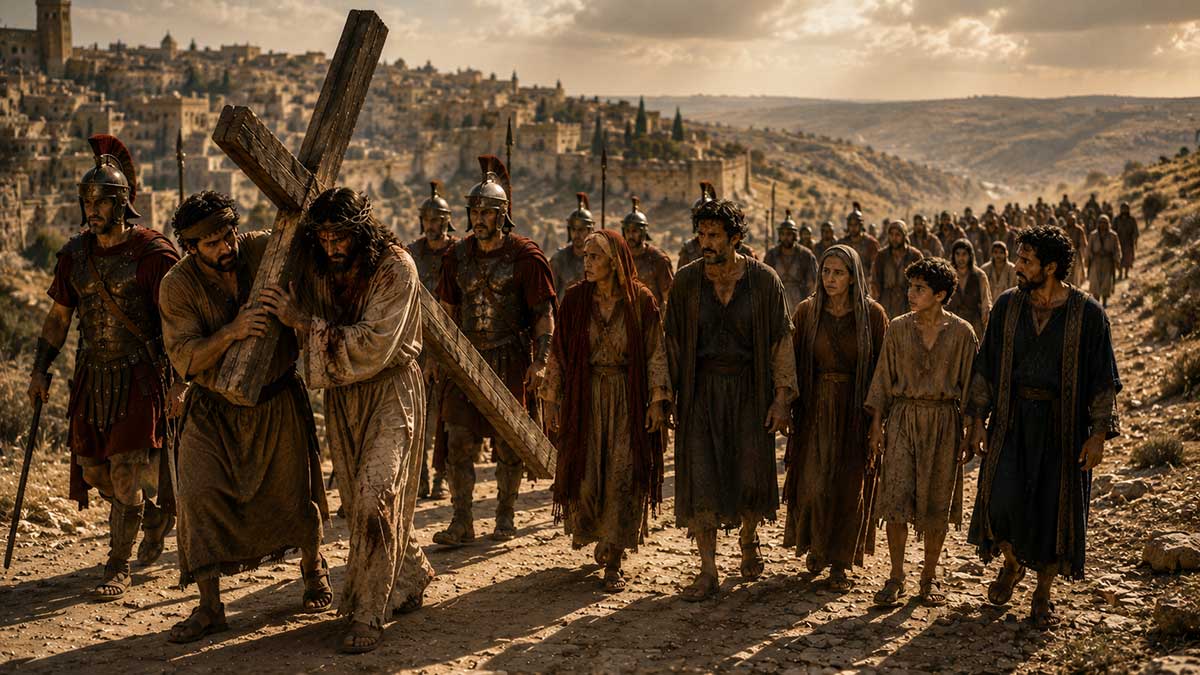
The soldiers ordered everyone away.
Mara stepped aside.
It felt like defeat.
Eliab stood beside her.
Joanna beside him.
Nathan beside Joanna.
Tobias beside Nathan.
The soldiers began moving again.
Jesus took another step.
Then another.
Mara followed.
The soldiers turned.
"Go home!"
"No," Mara said.
"You cannot interfere."
"We won't."
"Then leave."
Mara shook her head.
"We're walking."
The five began following.
Others followed them.
Twenty became thirty.
Thirty became fifty again.
Nobody blocked the road now.
Nobody attacked the soldiers.
They simply walked.
Some wept.
Some prayed.
Some cried out against what was happening.
People along the route watched this strange procession pass.
A condemned man.
Roman soldiers.
And behind them ordinary people who had tried and failed to stop his execution, yet refused to disappear when stopping it became impossible.
At one point Jesus could no longer carry the burden.
The soldiers seized a man from the crowd, Simon of Cyrene, and compelled him to carry it.
Mara watched Simon take the weight.
She would remember that image for the rest of her life.
Another person carrying what Jesus could no longer carry alone.
The road continued.
Eventually the place of execution came into view.
Tobias stopped.
His courage disappeared.
"I can't watch."
Joanna took his hand.
"You don't have to pretend you're strong."
"I'm scared."
"So am I."
Nathan stood behind them.
"I thought courage meant not being afraid."
Eliab shook his head.
"Apparently we've all been wrong."
They continued.
At Golgotha, the five could do nothing.
That was the hardest part.
There are moments when action gives human beings relief. We can run. Fight. Carry. Shout. Rescue.
But there are other moments when love has no weapon.
No strategy.
No miracle we can command.
Only presence.
They watched the soldiers crucify him.
Tobias turned away at the sound.
Nathan fell to his knees.
Eliab wept openly.
Joanna prayed.
Mara stood.
She remembered what Jesus had told her.
When the world makes room for cruelty?
Don't move aside.
So she stayed.
Hours passed.
At one point Tobias whispered:
"We failed."
Mara looked at him.
"What?"
"We tried to stop them."
His voice cracked.
"And we failed."
Mara looked at Jesus.
Then at the people gathered nearby.
Then at the road behind them.
"No."
Tobias stared at her.
"He's dying."
"I know."
"Then how did we not fail?"
Mara took the boy's hand.
"We failed to stop the crucifixion."
She looked again at Jesus.
"But we did not fail to stand with him."
Years passed.
Jerusalem changed.
Empires continued doing what empires do.
Mara's children grew older.
Eliab returned to making pottery.
Joanna cared for widows who had nobody else.
Nathan lost several Roman contracts after what happened that morning. He became poorer and strangely happier.
Tobias grew into a man.
People occasionally asked about that morning.
They wanted to know whether the crowd had really tried to stop the soldiers.
Tobias always corrected them.
"It wasn't a crowd."
"What do you mean?"
"It became one. But it didn't begin as one."
"How did it begin?"
"One woman."
He would tell them about Mara stepping into the road.
Then Eliab.
Then Joanna.
Then himself.
Then Nathan.
Five people who had almost no chance of changing what Rome intended to do.
Five frightened people who looked foolish to nearly everyone watching.
Five people who discovered that courage can spread.
Sometimes Tobias would meet people who had been somewhere along that road.
They would say:
"I saw you."
And Tobias would ask:
"Why didn't you join us?"
Their answers were always reasonable.
"I had children."
"I was afraid."
"The soldiers were armed."
"I thought someone else would do something."
"I didn't think it would matter."
"I didn't know what was really happening."
"I thought it was already too late."
Tobias never condemned them.
He understood every answer.
He had felt every one of those fears himself.
But he never forgot the lesson of that morning.
History often looks obvious after it happens.
Courage does not.
When you are standing inside the moment, courage can look reckless.
It can look embarrassing.
It can look pointless.
It can look like five frightened people blocking a road against an empire.
Years later, Tobias took his own son through Jerusalem.
They reached the street where it had happened.
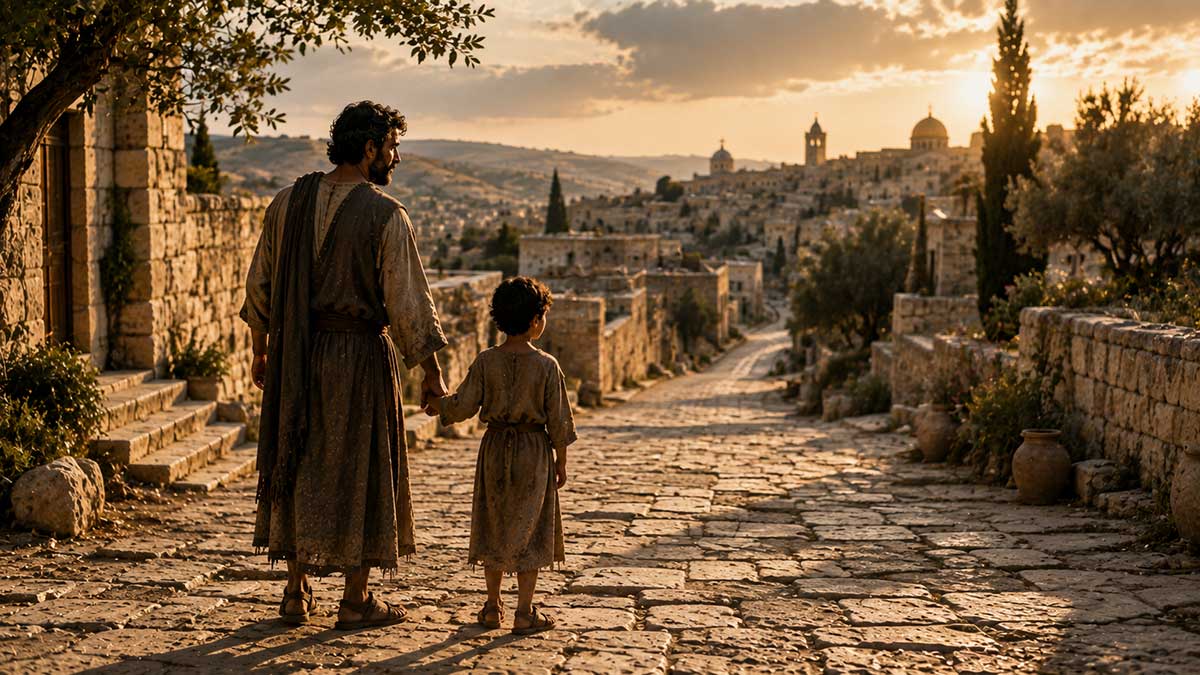
His son had heard the story many times.
"This is where you tried to save Jesus?"
Tobias smiled sadly.
"Yes."
"But you couldn't."
"No."
His son thought about that.
"Then why did you do it?"
Tobias looked down the old road.
For an instant he could almost see them again.
Mara standing alone.
Eliab joining her.
Joanna stepping from the crowd.
Nathan bleeding from the mouth.
His own seventeen-year-old hands trembling.
And Jesus looking at them.
Tobias knelt beside his son.
"One day," he said, "you may see something wrong happening in front of you."
The boy listened.
"Everyone around you may remain quiet. Some will tell you that powerful people have already decided what will happen. Others will tell you that speaking will accomplish nothing. Good people may tell you to protect yourself."
"What should I do?"
Tobias looked into his son's eyes.
"You must decide that yourself."
Then he pointed at the road.
"But never think that the person standing there first knows everyone else will eventually join him."
His son looked confused.
"What does he know?"
"Nothing."
Tobias smiled.
"He is probably terrified."
They began walking home.
After several steps, the boy asked one final question.
"Father?"
"Yes?"
"If you could live that morning again, knowing you couldn't save him, would you still step into the road?"
Tobias stopped.
He thought of Roman swords.
His father's terrified face.
The blood running into his eye.
Golgotha.
The cross.
And the man who, in the middle of his own suffering, had taught five frightened strangers how to live.
Tobias answered without hesitation.
"Yes."
"Why?"
He looked back one last time.
"Because there are moments when you cannot choose what happens."
He took his son's hand.
"But you can always choose where you stand."
Final Thoughts
Years later, Tobias' son asks the question that quietly judges the entire story.
If Tobias knew beforehand that he would fail, would he still step into the road?
Tobias says yes.
That answer may be more significant than the protest itself.
We tend to associate courage with results.
The person saves someone.
The movement changes a law.
The protest stops an injustice.
The whistleblower exposes wrongdoing.
The rescuer reaches the victim in time.
Those stories are easier to celebrate.
But history contains another kind of courage.
People who spoke and were ignored.
People who resisted and lost.
People who defended someone and suffered beside them.
People who stood in front of something much larger than themselves knowing they might accomplish almost nothing.
Their actions force us to ask whether goodness has value only when it wins.
Stand With Jesus answers no.
Mara does not know that other people will join her when she enters the road.
That is why her first step matters.
If fifty people were already standing there, joining them would require considerably less courage.
Instead, she sees everyone moving aside.
And she does the opposite.
Eliab then faces his own decision.
Joanna faces hers.
Tobias faces his.
Nathan faces his.
None of them knows what the next person will do.
That may be how moral courage often begins.
Not with certainty.
Not with a crowd.
With one human being deciding:
I will not pretend I did not see this.
There is another dimension to the story that makes the imagined encounter with Jesus especially difficult.
The five want to save him.
Yet within the Gospel narratives, Jesus does not approach his death simply as a helpless prisoner searching for escape. When violence is used during his arrest, he rejects that response. Christian tradition sees his death as inseparable from his mission.
The five therefore confront a painful realization.
Standing with someone does not always mean controlling what happens to that person.
Sometimes it means respecting the road they must walk and refusing to abandon them upon it.
That lesson extends far beyond this fictional morning in Jerusalem.
There will always be roads.
A child being bullied while classmates watch.
A lonely elderly person everyone has forgotten.
A coworker being humiliated while colleagues remain silent.
A family member suffering when nobody knows what to say.
A stranger being treated as though his dignity matters less.
A person grieving when everyone else has returned to ordinary life.
Most of these moments will never appear in history books.
There will be no monuments.
No paintings.
No crowds remembering who stood where.
Yet the same question remains.
Where will you stand?
Perhaps that is why the final conversation between Tobias and his son matters so much.
His son asks whether Tobias would do it again knowing he could not save Jesus.
Tobias remembers the soldiers.
He remembers his fear.
He remembers his father's face.
He remembers Golgotha.
And still he says yes.
He has learned something that his younger self did not yet know.
We cannot always choose the outcome.
We cannot always rescue.
We cannot always win.
We cannot always make suffering disappear.
But when another human being is walking a terrible road, there remains one choice that belongs to us.
We can choose whether they walk it alone.
And sometimes, long after the shouting stops and the crowd disappears, that may be the choice that matters most.
You cannot always choose what happens.
But you can always choose where you stand.
Short Bios:
Mara
A fictional Jerusalem bread seller and mother of three who becomes the first person to step into the road. She represents the frightening first act of moral courage, acting before knowing whether anyone will follow.
Eliab
A fictional potter who initially tries to persuade Mara to protect herself. Her question about what their silence teaches their children changes him. He represents the struggle between self-preservation and conscience.
Joanna
A fictional widow who had previously heard Jesus teach. She joins Mara and Eliab from compassion rather than confidence. She represents the courage to remain present with another person's suffering.
Tobias
A fictional seventeen-year-old whose father desperately wants him to stay out of danger. Tobias becomes the story's bridge between generations. Years later, he passes what he learned that morning to his own son.
Nathan
A fictional prosperous cloth merchant whose livelihood depends partly upon good relationships with Roman officials. Joining the others could cost him status, money, and security. He represents the moment when conscience becomes more valuable than comfort.
Jesus
Jesus of Nazareth is the historical and religious figure at the center of Christianity. The story draws inspiration from Gospel accounts of his journey to crucifixion, yet the conversations between Jesus and the five fictional characters are literary inventions created for Stand With Jesus.
Simon of Cyrene
A figure named in the Gospel accounts who was compelled to carry Jesus' cross. In Stand With Jesus, his appearance becomes another expression of the story's central theme: when someone can no longer carry a burden alone, another human being can step forward and help carry it.
Leave a Reply