
Introduction
Few American novels have been praised, attacked, banned, taught, argued over, and reinterpreted as intensely as John Steinbeck’s The Grapes of Wrath.
It is easy to see why.
On the surface, the novel follows the Joad family as they leave Oklahoma during the Great Depression and travel west in search of work. Their farm is gone. Their security disappears. Family members die, leave, or are forced away. California, which appears at first to promise abundance, becomes another place where hunger, low wages, prejudice, and fear shape daily life.
But the book becomes much harder to explain once we begin asking the questions readers have been asking since 1939.
Did Steinbeck accurately portray migrant America, or did his anger lead him to exaggerate?
Why does he repeatedly abandon the Joad family to tell us about tractors, diners, used-car dealers, anonymous workers, starving children, and even a turtle?
Is Jim Casy really a Christ figure?
What kind of religion remains after Casy loses faith in conventional preaching?
Does Tom Joad inherit Casy’s moral vision, or does Tom’s violence reveal how incomplete that transformation remains?
Why does Ma Joad become increasingly powerful at the very moment the traditional family is disintegrating?
And then there is the question almost every reader eventually reaches:
Why would Steinbeck end the entire novel with Rose of Sharon breastfeeding a starving stranger?
These questions led us to bring Steinbeck himself into an imagined discussion with scholars and experts who know the novel from very different directions.
Susan Shillinglaw helps connect Steinbeck’s fiction with the writer’s life, California, and the migrant world that influenced the novel.
Robert DeMott examines the unusual architecture of the book, including its intercalary chapters, biblical language, symbolism, and shifting scale.
Mimi Reisel Gladstein asks some of the most difficult questions about Ma Joad and Rose of Sharon, especially whether Steinbeck’s admiration for women sometimes places extraordinary burdens of endurance and sacrifice upon them.
Richard Astro explores Steinbeck’s philosophical ideas about the individual, community, Casy’s spiritual development, and the movement from “I” toward “we.”
Historian James N. Gregory keeps returning the discussion to a question literary interpretation can sometimes forget:
What really happened?
And Steinbeck himself is not treated as the unquestioned authority on his own novel.
He is asked to defend his choices.
At times, he admits their limitations.
That matters.
An author can explain what he hoped to create.
The reader and the scholar can still ask whether the work accomplished something different.
Across five discussions, one larger pattern slowly emerged.
At first, we thought we were investigating The Grapes of Wrath.
By the end, we realized Steinbeck may have been investigating us.
What kind of suffering do we recognize?
Whose suffering counts?
How much do we need to know about someone before we care?
Must another person belong to our family, our group, our nation, our beliefs, or our idea of a deserving person before their life matters?
Those questions become especially difficult when resources are scarce.
It is easy to speak generously when generosity costs almost nothing.
Steinbeck is interested in what happens when food is short, jobs are scarce, fear is growing, and another family may be competing for exactly what your own family needs.
That is where the meaning of “we” becomes difficult.
And that is where this discussion begins.
(Note: This is an imaginary conversation, a creative exploration of an idea, and not a real speech or event.)
Topic 1: Did Steinbeck Tell the Truth About America?
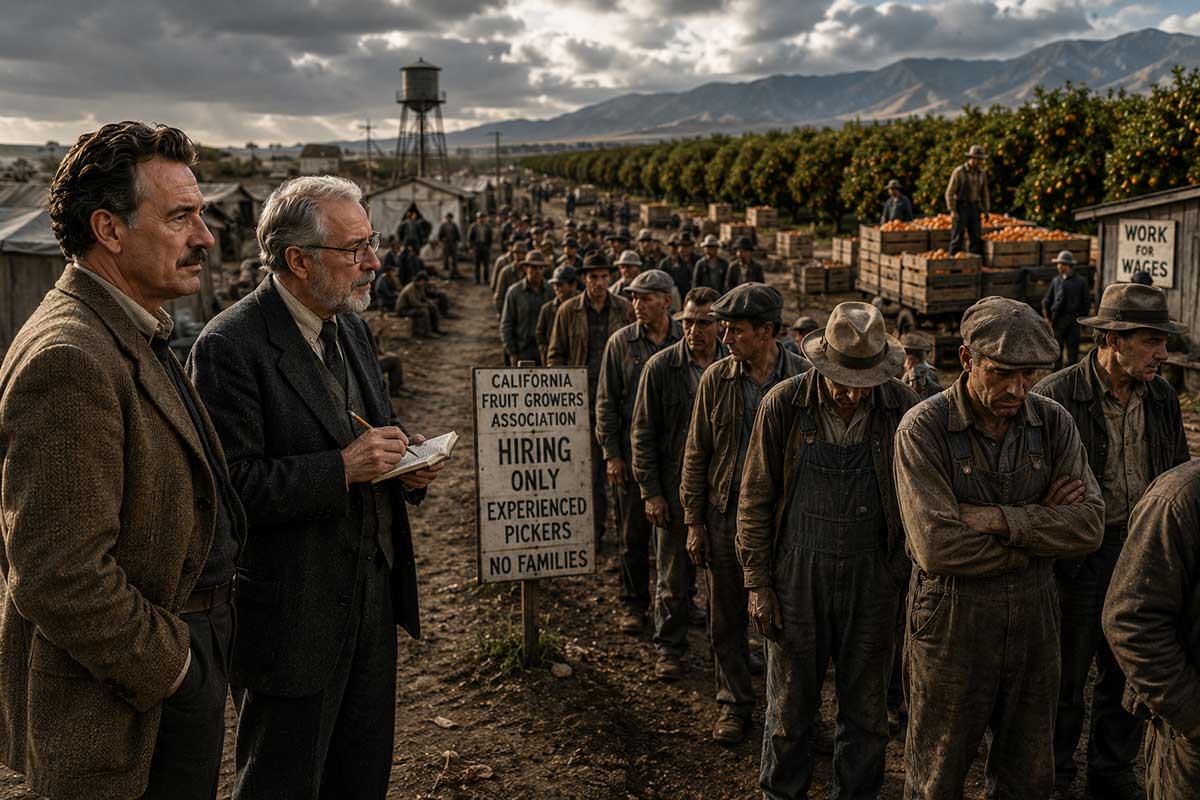
The room had grown quiet before John Steinbeck finally spoke.
John Steinbeck: I suppose I know what everyone wants to ask first.
Susan Shillinglaw: I'm not sure you're going to like the way we ask it.
Steinbeck smiled faintly.
John Steinbeck: Then you're probably asking the right question.
James N. Gregory: All right, John. Let's begin without protecting the book.
You wrote families being driven from their land. You wrote men desperate for work. You wrote wages pushed downward by an oversupply of labor. You wrote children going hungry while food existed nearby. You wrote banks and large landholders almost as forces beyond ordinary human control.
Millions of readers encountered that America through you.
So tell us plainly.
Were you documenting what you saw?
Or were you building the strongest possible case for what you believed?
Steinbeck looked down for a moment.
John Steinbeck: Both.
Gregory: That's an uncomfortable answer for a historian.
Steinbeck: It ought to be.
I wasn't writing a government report. I wasn't counting families and placing them into columns.
I wanted people who were comfortable to feel what it meant when comfort disappeared.
Gregory: But there's the problem.
The moment you say, "I wanted them to feel," you've admitted that you're shaping the evidence.
Steinbeck: Of course I shaped it. Every writer shapes what he sees.
Robert DeMott: Every historian does too.
Gregory turned toward him.
Gregory: Certainly. But historians are supposed to tell you where the evidence ends.
Novelists can make you cry before you remember to ask whether the scene was representative.
Steinbeck: Maybe people needed to cry before they would look.
Gregory: That's precisely what worries me.
There was a brief silence.
Susan Shillinglaw: John had already been writing about migrant labor before The Grapes of Wrath. He had visited camps. He had talked with families. He had seen conditions that genuinely horrified him.
We shouldn't create a false choice between "Steinbeck invented everything" and "every scene happened exactly as written."
Gregory: I agree.
The migration was real.
The displacement was real.
The agricultural labor crisis was real.
The hostility toward migrants was real.
The camps were real.
But the Joads are not a statistical average.
Steinbeck: I never said they were.
Gregory: No. But readers sometimes treat them that way.
And that's where literary truth and historical truth start rubbing against each other.
Richard Astro: Perhaps that's exactly where the novel lives.
Gregory: Explain.
Astro: A historian asks, "How many people experienced this?"
A novelist can ask, "What did this experience mean to a human being?"
Those aren't competing questions unless one pretends to answer the other.
Gregory: Fair.
But then I want to push John harder.
Steinbeck leaned back.
Steinbeck: Go ahead.
Gregory: You make suffering extraordinarily visible.
But you also make responsibility strangely difficult to locate.
Take the tractor.
The family sees the machine destroying the old order. Yet the man driving it isn't some wealthy monster.
He needs a wage too.
Steinbeck: Yes.
Gregory: The bank representative can say he doesn't personally want the tenant family removed.
The tractor driver can say he needs to feed his children.
The landowner can say the farm has to make money.
Everybody has an explanation.
Yet somebody still loses the house.
Steinbeck: Now you're getting closer to what frightened me.
Astro: Which is?
Steinbeck: What happens when nobody feels responsible for what everybody is doing.
DeMott nodded.
DeMott: That's one reason the bank becomes almost monstrous in the novel. Not because Steinbeck thinks a building has a soul, but because responsibility has become dispersed.
Gregory: But isn't that rhetorically convenient?
If the enemy becomes "the system," then the system can't sit here and defend itself.
Steinbeck: Neither can hunger.
Gregory: That's a good line, John.
It isn't an answer.
Steinbeck laughed.
Steinbeck: Fair enough.
Gregory: There were growers operating under economic pressures too. There were farmers trying to survive. There were businesses trying to remain viable. Markets aren't simply machines designed to hurt poor people.
Does your novel give enough room to that reality?
Steinbeck waited longer this time.
Steinbeck: Probably not.
The answer seemed to surprise everyone.
Shillinglaw: That's important.
Steinbeck: Why should I pretend otherwise?
I wrote from anger.
I saw people who had very little being treated as though having very little proved they were inferior.
I saw children suffering.
I wasn't neutral about it.
Mimi Reisel Gladstein: But there's a difference between having a moral position and falsifying reality.
Steinbeck: Yes.
Gladstein: So perhaps the question isn't whether you were biased.
Of course you were biased.
Every novelist chooses where to stand.
The question is whether your moral anger caused you to stop seeing the humanity of people on the other side.
Steinbeck looked at her.
Steinbeck: Sometimes it probably did.
DeMott: Yet the novel itself occasionally resists that simplification.
The tractor driver matters for exactly that reason.
He's participating in something destructive, but he isn't presented as a cartoon villain.
Astro: Which gives us a much harder moral problem.
Suppose I do something harmful because I have no reasonable alternative.
Suppose the next person does the same.
And the next.
Eventually thousands of individually understandable choices produce something collectively terrible.
Who is guilty?
Gregory: Historians have versions of that problem constantly.
Gladstein: Families do too.
Shillinglaw: Societies certainly do.
Steinbeck: That's closer to what I was trying to get at than "rich people bad, poor people good."
Gregory: Then let's deal with that too.
Were the Joads good people simply because they were poor?
Steinbeck: No.
Gregory: Tom kills.
Steinbeck: Yes.
Gregory: Uncle John drinks and disappears into guilt.
Connie abandons his pregnant wife.
Migrants sometimes compete against other migrants for jobs.
Fear makes people selfish.
Steinbeck: That's all in the book.
Gregory: Which matters.
If poor people automatically become morally pure, they're no longer people. They're symbols.
Gladstein: The same thing happens when suffering women automatically become saints.
Steinbeck glanced toward her.
Steinbeck: I suspect you're saving something for me.
Gladstein: I am.
Steinbeck: I thought so.
There was a little laughter, then Gregory returned to the question.
Gregory: But there's another historical issue we shouldn't avoid.
When people think about Depression-era California agricultural labor today, The Grapes of Wrath can become the image.
White families from Oklahoma.
Old trucks.
Dust.
Route 66.
California camps.
But agricultural labor in California had a much longer and more racially varied history.
Mexican workers.
Filipino workers.
Chinese workers before them.
Japanese workers.
Other migrant communities.
Their experiences don't occupy the center of your novel.
Why did the suffering of the Joads become representative of American suffering?
And whose suffering disappeared when that happened?
Steinbeck's expression changed.
Steinbeck: That's a fair question.
Gregory: I don't mean it as an accusation that you had to write every American story in one novel.
No writer can.
I'm asking something more difficult.
When a novelist chooses one group to represent suffering, what happens to the people outside the frame?
Steinbeck: They remain outside the frame.
Gregory: Exactly.
Shillinglaw: But that doesn't necessarily invalidate the frame.
Gregory: No.
It tells us to remember that there is one.
DeMott: That's an important distinction.
A novel can open our eyes and still leave blind spots.
Gladstein: Perhaps every novel does.
Astro: Every human perspective does.
Gregory: Which means we shouldn't ask whether Steinbeck gave us all of America.
He couldn't.
The better question is whether he gave us something true about America.
Steinbeck: That I can live with.
Shillinglaw: But we haven't touched the political accusation yet.
Steinbeck: I knew we wouldn't escape that.
DeMott: Communist propaganda.
Gregory: Socialist propaganda.
Gladstein: Anti-capitalist propaganda.
Astro: Humanist protest.
Shillinglaw: Christian social conscience.
Steinbeck shook his head.
Steinbeck: That's a lot to fit on a book jacket.
Gregory: Which one is it?
Steinbeck: Why does it have to be one?
Gregory: It doesn't.
But your novel attacks the concentration of economic power. It condemns starvation beside abundance. It sympathizes with organized workers. It depicts employers using desperate labor to suppress wages.
Those aren't politically empty choices.
Steinbeck: I didn't intend them to be empty.
Astro: But the deepest question may not be whether Steinbeck favors one economic ideology.
Look at what repeatedly outrages the novel.
It isn't simply that one person has more money than another.
It's that human beings become abstractions.
Labor.
Units.
Hands.
Okies.
Customers.
Strikers.
Troublemakers.
Gladstein: Categories instead of people.
Astro: Exactly.
Once someone becomes a category, suffering becomes easier to tolerate.
Gregory: And yet categories are necessary for institutions to function.
Governments categorize.
Businesses categorize.
Historians categorize.
Economists categorize.
Astro: Certainly.
The moral danger begins when the category replaces the person.
Steinbeck: That's it.
Gregory: Is it?
Or are we making your argument more sophisticated eighty years later?
Steinbeck smiled.
Steinbeck: Maybe you are.
Gregory: That possibility matters too.
We shouldn't make authors omniscient interpreters of their own work.
DeMott: No serious literary scholar should.
An author can tell us what he intended.
He cannot dictate everything the work means.
Steinbeck: I'm quite happy to surrender that responsibility.
Gladstein: We'll see whether you still feel that way when we reach Rose of Sharon.
Steinbeck laughed again.
Then Shillinglaw returned to the beginning.
Shillinglaw: Perhaps we've been asking the wrong version of the question.
Not:
"Did Steinbeck tell the truth?"
But:
What kind of truth does a novel owe us?
Gregory: Historical honesty.
DeMott: Artistic coherence.
Gladstein: Human complexity.
Astro: Moral seriousness.
They looked toward Steinbeck.
He waited.
Steinbeck: Recognition.
Shillinglaw: Recognition of what?
Steinbeck: Of the person you had learned not to see.
Nobody answered immediately.
Gregory finally broke the silence.
Gregory: I like that answer.
But recognition can still be manipulated.
Steinbeck: Yes.
Gregory: Sympathy can be manipulated.
Steinbeck: Yes.
Gregory: Anger can be manipulated.
Steinbeck: Certainly.
Gregory: Then how does the reader know when a novelist is revealing injustice and when he's manufacturing outrage?
Steinbeck stared across the room.
Steinbeck: Maybe the reader shouldn't trust me enough to stop asking.
That answer changed the room.
DeMott leaned forward.
DeMott: And perhaps that's where we should leave this question.
The Grapes of Wrath doesn't have to be an unbiased account of America to matter.
But neither should its moral force excuse it from examination.
We can accept that the suffering Steinbeck witnessed was real while still questioning what he selected, intensified, omitted and interpreted.
Gladstein: We can admire the novel and interrogate it.
Gregory: We should.
Astro: Perhaps that's a better form of respect than agreement.
Shillinglaw looked toward Steinbeck.
Shillinglaw: And now we have a different problem.
If you weren't simply documenting what happened, John, then you deliberately built a particular kind of novel to make readers experience it.
Steinbeck: Yes.
DeMott: Which raises something readers have complained about for generations.
Steinbeck smiled.
Steinbeck: The turtle?
DeMott: Among other things.
Gregory: Every time we finally care about the Joads, you abandon them.
Gladstein: Sometimes for people we never see again.
Astro: Sometimes for a machine.
Shillinglaw: Sometimes for a roadside diner.
DeMott: And sometimes...
He paused.
DeMott: ...for a turtle trying to cross a highway.
Steinbeck leaned back in his chair.
Steinbeck: All right.
Ask me why.
And for the first time, the question was no longer whether Steinbeck had told America the truth.
It was why he had chosen such a strange way to tell it.
Topic 2: Why Does Steinbeck Keep Interrupting His Own Story?
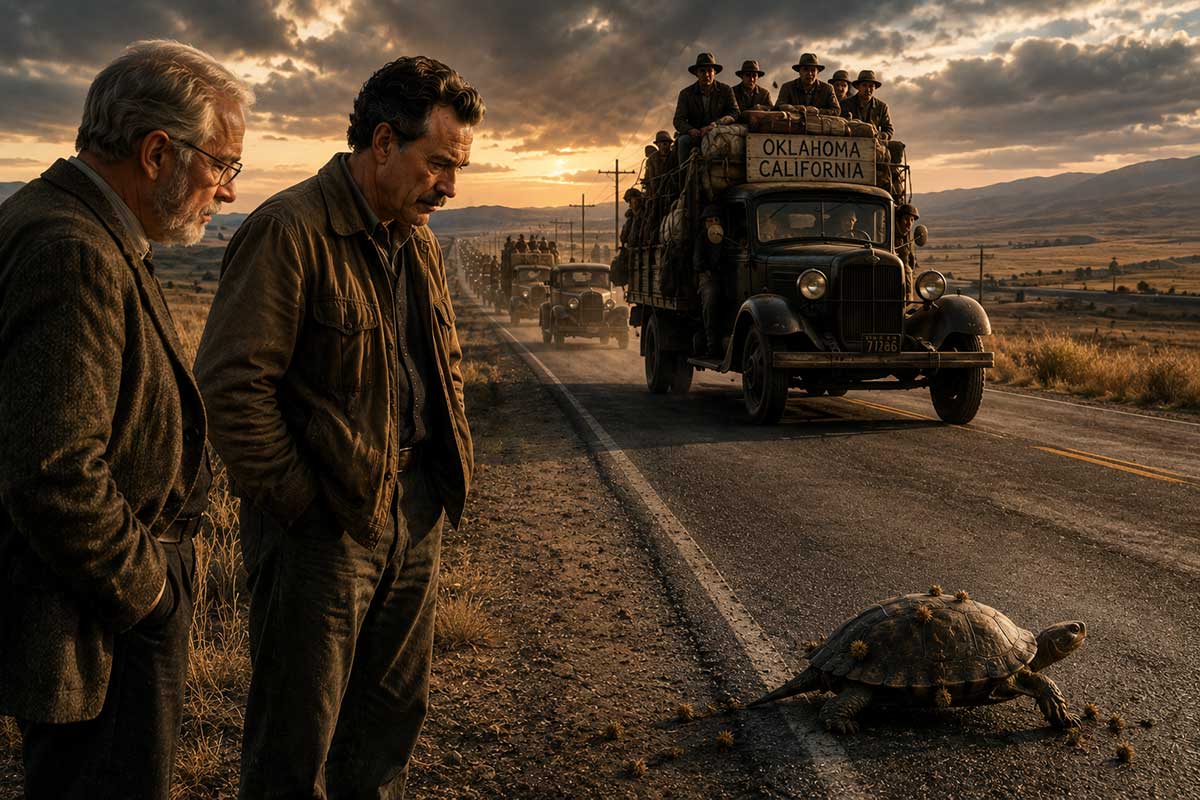
The discussion resumed after a short break.
A copy of The Grapes of Wrath lay open on the table.
Robert DeMott: John, let me begin with a complaint.
John Steinbeck: Yours?
DeMott: Mine, every student's, and probably half the people who first read the novel.
Just when we become absorbed in the Joads, you leave them.
Steinbeck: I do.
DeMott: We want Tom.
We want Ma.
We want to know what happens next.
Instead, suddenly we're watching a turtle cross a road.
Or we're listening to used-car salesmen.
Or we're sitting in a diner.
Or we're watching tractors.
Or anonymous migrants.
Or fruit being destroyed.
Why?
Steinbeck: Because the Joads weren't enough.
Susan Shillinglaw: That's a remarkably concise answer.
Steinbeck: It may be the simplest one.
James N. Gregory: But why weren't they enough?
They're already a large family. We see unemployment, displacement, migration, hunger, prejudice, labor exploitation, family breakdown.
You could have shown almost everything through them.
Steinbeck: Almost.
Richard Astro: What's missing?
Steinbeck looked around the table.
Steinbeck: Everybody else.
That answer hung there for a moment.
Mimi Reisel Gladstein: So the interruption is intentional frustration.
Steinbeck: Yes.
Gladstein: You make us care about one family and then refuse to let us remain there.
Steinbeck: That's closer.
DeMott: Which means the chapters aren't really interruptions at all.
Gregory: Structurally they certainly feel like interruptions.
DeMott: Narratively, yes.
Morally, perhaps they're the spine.
Gregory leaned forward.
Gregory: Explain that.
DeMott: The Joad chapters give us intimacy.
Names.
Faces.
Private fears.
Family history.
We know who Tom is.
We know Ma.
We understand Pa's humiliation.
We watch Rose of Sharon imagine her future.
Then Steinbeck repeatedly pulls the camera backward.
One family becomes dozens.
Dozens become thousands.
Astro: Almost like breathing.
Inward.
Outward.
Individual.
Collective.
DeMott: Exactly.
The form alternates between:
This person matters.
and
This person is not the only one.
Steinbeck: That's very close to what I wanted.
Gregory: But there is a danger in that movement.
Once you widen the frame enough, individual people can disappear into "the migrants."
Gladstein: Which would reproduce the very problem the novel criticizes.
Astro: Yes.
The novel argues against turning people into categories.
Yet its collective chapters sometimes do exactly that.
Men.
Women.
Families.
Hungry children.
Workers.
Owners.
Steinbeck: I don't think that's a contradiction.
Gregory: Why not?
Steinbeck: Because you need both scales.
If I gave you only anonymous crowds, you might pity them and forget them.
If I gave you only the Joads, you might believe the tragedy belonged to one unlucky family.
DeMott: That may be the novel's central structural achievement.
The Joads prevent the collective from becoming abstract.
The collective chapters prevent the Joads from becoming exceptional.
Shillinglaw: And that's important historically too.
The family gives the migration an emotional center without claiming that every migrant family followed the exact same path.
Gregory: Which returns us to Topic 1.
The Joads are representative without being statistically representative.
Steinbeck: Yes.
Gladstein: But let me ask the reader's question more bluntly.
Why should I care about an anonymous truck driver or roadside waitress when I'm desperate to know whether Ma's family survives?
Steinbeck: Because that's the question.
Gladstein: What question?
Steinbeck: Why should you care?
She smiled slightly.
Gladstein: That's clever.
Steinbeck: It's not meant to be clever.
If you only care about suffering after I've given you a name and a family history, what happens to the person whose story you never learn?
There was a pause.
Astro: That's interesting.
The structure may be testing the reader's moral habits.
We naturally attach ourselves to protagonists.
Once we care about the Joads, we begin dividing the novel into two categories:
people who matter to the story
and
people who interrupt the story.
DeMott: Exactly.
Astro: And Steinbeck keeps attacking that distinction.
Gregory: That's a strong interpretation.
But I wonder whether we're making the structure too morally elegant.
Sometimes a writer also experiments because he likes form.
Steinbeck: Of course.
DeMott: And Steinbeck was drawing from several traditions.
Biblical language.
Documentary writing.
Journalism.
Political rhetoric.
Folk speech.
Natural description.
Allegory.
The novel is deliberately hybrid.
Shillinglaw: Which may help explain why some readers experience it almost as two books braided together.
Gregory: One book is the Joad family novel.
The other is something closer to social epic.
DeMott: Yes.
And the tension between the two is productive.
Gladstein: Unless you're the reader waiting to find out what happens to Tom.
Steinbeck laughed.
Steinbeck: I make no apology for impatience.
Gladstein: You should.
Steinbeck: Maybe a little.
They laughed.
Then DeMott turned the open book around.
DeMott: All right.
Let's deal with the most famous interruption.
The turtle.
Steinbeck: I knew you'd come back to him.
Gregory: A turtle crossing a highway has become one of the most analyzed animals in American literature.
Steinbeck: Poor turtle.
Gladstein: He's survived worse.
DeMott: The usual school answer is obvious.
The turtle represents perseverance.
It moves slowly.
It encounters obstacles.
It's nearly killed.
It keeps going.
Very Joad-like.
Steinbeck: True enough.
DeMott: But that's not enough.
The turtle also carries seeds.
They get caught on him.
Dropped.
Dragged into new ground.
Something may grow there later.
Was that deliberate?
Steinbeck: Yes.
Astro: Then the turtle doesn't simply survive.
It transmits.
DeMott: Exactly.
Astro: Which makes it remarkably close to what happens between Casy and Tom.
Casy carries an idea.
He doesn't live to see where it leads.
Tom picks it up.
Steinbeck: That's one way to see it.
Gregory: And now you're going to tell us the turtle anticipated the entire philosophical argument.
Steinbeck: I wasn't going to say that.
You were.
Gregory: Fair enough.
Shillinglaw: There's another important element.
The turtle has no grand understanding of what it's doing.
It doesn't say, "I will now symbolically represent the human condition."
It simply moves.
Gladstein: Thank God.
Shillinglaw: Yet its movement affects the world around it.
That makes the image less sentimental.
Human beings often don't know what they leave behind either.
Astro: Which gives us a profound question.
Must we know the consequences of our actions for our lives to matter?
DeMott: Or can we plant something we never see?
Steinbeck: I think that's closer to the turtle than simple perseverance.
Gregory: But we should be careful.
Sometimes a turtle is still a turtle.
Gladstein: Thank you.
Gregory: Literature classes have probably made that creature carry more symbolic weight than its shell was designed for.
Steinbeck laughed.
Steinbeck: That's the best defense the turtle has received in years.
DeMott: Point taken.
But there is another question.
Who is actually the protagonist of The Grapes of Wrath?
Tom?
The Joad family?
The migrants?
America?
Steinbeck: Why does a novel need only one?
DeMott: It doesn't.
But readers tend to search for the center.
Astro: Tom feels like the protagonist because he gives us movement and consciousness.
Gladstein: Ma sometimes feels like the deeper center.
Shillinglaw: The Joad family gives the novel continuity.
Gregory: Historically, though, the collective migration is larger than any of them.
DeMott: Which is why I would say the protagonist gradually changes.
At first, we think it is Tom.
Then the Joads.
Then perhaps something larger begins to emerge.
Astro: A collective consciousness.
Gregory: That phrase makes historians nervous.
Astro: As it should.
But look at the grammar of the novel.
The perspective repeatedly moves from "he" and "she" toward "they."
And Casy's philosophy later pushes toward "we."
Steinbeck: Yes.
Gladstein: But let me challenge that.
Whenever we say "the collective," I want to ask what happens to Rose of Sharon.
What happens to Ma.
What happens to Pa.
What happens to one specific person with a body and grief and desire.
Astro: That's the danger.
Gladstein: Exactly.
"We" can become humane.
It can also become a way of swallowing "I."
Steinbeck: I never wanted the person swallowed.
Gladstein: Yet some readers could argue that Rose of Sharon eventually is.
Steinbeck looked at her.
Steinbeck: You're still saving that.
Gladstein: I told you I was.
DeMott: Which suggests that the Joad chapters do something very important.
They keep pulling us back from abstraction.
The collective chapters say:
There are thousands.
The family chapters answer:
Yes, but each one is somebody.
Gregory: That's much stronger than saying the Joads represent all migrants.
Shillinglaw: And perhaps that is why the novel needs its strange double structure.
Too much intimacy and we mistake the crisis for private tragedy.
Too much social scale and we stop seeing human beings.
Astro: So Steinbeck keeps moving us between the two.
Steinbeck: That's the motion.
Gregory: But why make the transitions so abrupt?
Why not integrate the broader material more smoothly?
Steinbeck: Because life wasn't smooth.
People were eating breakfast while another family was being evicted.
Fruit was growing while children were hungry.
A man could be thinking about his own family while thousands of other families were moving down the same road.
Those realities existed beside one another.
I wanted the book to do that too.
DeMott: That's important.
The structure doesn't merely widen perspective.
It creates simultaneity.
Astro: One family experiences itself as the center of its universe.
Every other family does too.
Gregory: That's almost impossible for a human being to hold emotionally.
Gladstein: Which is why we simplify.
My family.
My problem.
My grief.
My child.
Astro: And perhaps Steinbeck's structure keeps interrupting that simplification.
Steinbeck: Yes.
Gregory: Then let me turn this against you.
If the point is to make us care about people beyond the Joads, why do we still remember the Joads so much more vividly?
Why do most readers know Tom Joad's name but not the anonymous migrant families in the intercalary chapters?
Steinbeck was quiet.
Steinbeck: Because stories need faces.
Gregory: Then doesn't that prove the limits of your own experiment?
Steinbeck: Maybe.
Shillinglaw: Or perhaps it proves why he needed both.
We remember Tom.
Then Tom becomes the doorway.
Gregory: Into what?
Shillinglaw: Into people whose names we never learn.
Gladstein: That only works if readers actually walk through the doorway.
DeMott: Which a novel cannot guarantee.
Steinbeck: Nothing can.
Astro: That's an important point.
A work of art can invite moral enlargement.
It cannot force it.
Gregory: And readers can turn even The Grapes of Wrath into a school assignment about symbolism.
Gladstein: Poor turtle again.
Steinbeck: He's suffered enough.
The laughter faded.
DeMott closed the book.
DeMott: I think we've arrived at the deeper reason these chapters matter.
Steinbeck does something almost irritatingly simple.
He makes us love particular people.
Then he asks us to notice people we don't love.
Astro: People without names.
Shillinglaw: People without biographies.
Gregory: People who may not resemble us.
Gladstein: People who may never become protagonists.
DeMott: And that may explain why the novel keeps leaving the Joads.
If Steinbeck allowed us to stay entirely inside one beloved family, we could finish the book believing we had learned compassion.
When perhaps we had learned only attachment.
That sentence quieted the table.
Steinbeck looked at DeMott.
Steinbeck: I wish I'd said that.
DeMott: Too late.
Steinbeck: Scholars.
Gregory: Occupational hazard.
Astro: But now the structure points toward another person.
Someone inside the novel is learning this same lesson.
Shillinglaw: Jim Casy.
Gladstein: A preacher who stops preaching.
Gregory: A religious man who starts doubting religion.
DeMott: A man with the initials J.C.
Steinbeck sighed.
Steinbeck: Here we go.
Astro: Yes, John.
Here we go.
You create a former preacher named Jim Casy.
You surround him with obvious Christ associations.
You let him question sin, holiness, individuality and the human soul.
Then you kill him.
And Tom carries something of him forward.
Astro leaned toward Steinbeck.
Astro: So now we have to ask the question almost everybody eventually asks.
Was Jim Casy supposed to be Jesus?
And if he was...
what exactly were you trying to do with Christianity?
Topic 3: Is Jim Casy Jesus, and Does Tom Become His Disciple?
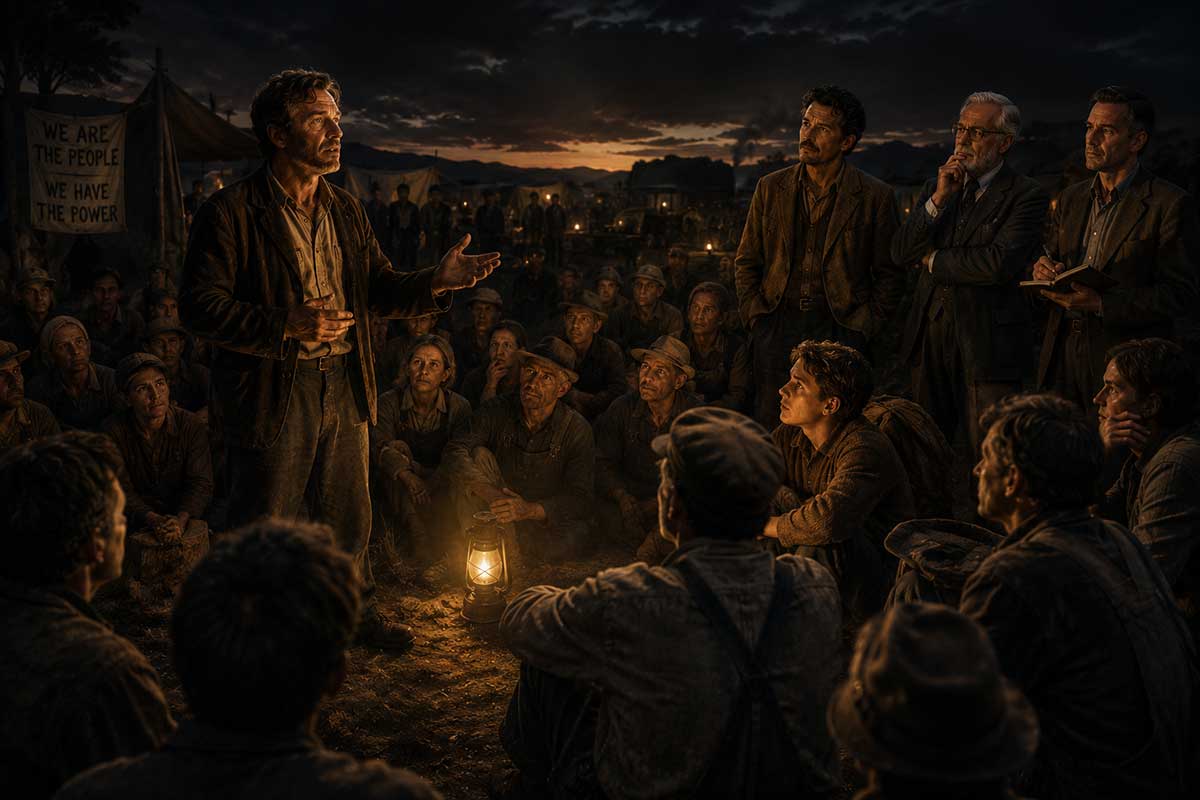
The room felt different after the discussion of structure.
The question had moved from how Steinbeck built the novel to something much more personal.
Richard Astro: John, let's stop circling it.
Jim Casy.
Initials J.C.
Former preacher.
Retreats into the wilderness.
Questions sin.
Speaks about a larger human spirit.
Sacrifices himself.
Is killed.
Then Tom carries his ideas forward.
How much of that was deliberate?
Steinbeck gave him a tired smile.
John Steinbeck: Enough that I can't pretend you imagined it.
Robert DeMott: So Casy is a Christ figure.
Steinbeck: He has Christ associations.
DeMott: That's a cautious answer.
Steinbeck: Because "Casy equals Jesus" is too tidy.
Susan Shillinglaw: And Casy himself would probably hate being turned into a religious diagram.
Mimi Reisel Gladstein: Especially since he begins the novel after losing confidence in the religion he used to preach.
Astro: Which is exactly why he's interesting.
John, why make your Christ-like figure someone who no longer believes in his old way of preaching?
Steinbeck leaned back.
Steinbeck: Because Casy had begun to suspect that he had been asking the wrong questions.
Astro: Which questions?
Steinbeck: Who sinned.
Who was pure.
Who wasn't.
Who needed saving.
He begins to wonder whether those divisions mean what he thought they meant.
DeMott: His crisis isn't really the loss of spirituality.
It may be the collapse of a certain kind of spirituality.
Shillinglaw: Yes.
He stops trusting the neat division between sacred people and sinful people.
Gladstein: Which is uncomfortable, because religion can give people a very satisfying map.
Good here.
Bad there.
Saved here.
Lost there.
Steinbeck: Casy's map stopped working.
Astro: And what replaced it?
Steinbeck: People.
There was a pause.
Astro: That's where I want to press you.
Did Casy move from Christianity into humanism?
Or did he discover a different Christianity?
Steinbeck: I don't know that he would have cared what label we gave it.
Astro: But you did.
You're the author.
Steinbeck: Authors are less organized than scholars like to believe.
DeMott: Convenient defense.
Steinbeck: Useful too.
Astro: Let me sharpen it.
Casy increasingly speaks as though there is one human spirit shared across people.
That has clear religious echoes, but it also resembles American transcendental ideas, especially the notion that the individual participates in something larger.
Are you saying the sacred is no longer located primarily in doctrine, church, or private salvation?
Is the sacred moving into human connectedness itself?
Steinbeck became quiet.
Steinbeck: I think Casy begins to feel that if there is anything holy, it cannot belong to one person alone.
Gladstein: That sounds beautiful.
It can also become dangerous.
Astro: How?
Gladstein: Once you say the individual belongs to something larger, the larger thing can start demanding everything.
Family.
Church.
Nation.
Class.
Movement.
Humanity.
People have done terrible things in the name of "we."
Steinbeck: Yes.
Gladstein: Then Casy's movement from "I" toward "we" cannot simply be treated as moral progress.
Astro: I agree.
The question becomes what kind of "we."
DeMott: And whether the individual disappears inside it.
Shillinglaw: Which may be why Steinbeck never stops returning to individual bodies, hunger, grief, fear.
The collective matters, but it is experienced through particular people.
Astro: John, did you worry about that?
Steinbeck: I worried about anything that allowed people to stop seeing one another.
Individualism can do it.
Collectivism can do it too.
Gladstein: That's important.
The opposite of selfishness isn't necessarily self-erasure.
Steinbeck: No.
DeMott: Then perhaps Casy's revelation is not simply "the group matters more than the individual."
Astro: It may be something closer to:
the individual is not complete in isolation.
Steinbeck: That's nearer.
Shillinglaw: Which makes his religious development more complicated than rejecting Christianity.
He doesn't necessarily reject the moral intuition beneath it.
He rejects some of the boundaries around it.
Astro: So I'll ask the hardest version.
Did you remove God from Christianity and leave behind human brotherhood?
Steinbeck smiled slightly.
Steinbeck: That's the sort of question that gets a writer in trouble whether he answers yes or no.
Astro: Then get in trouble.
A few people laughed.
Steinbeck didn't.
Steinbeck: I wasn't trying to write theology.
I was trying to write about people who were suffering.
If a religious idea cannot survive contact with suffering, I don't have much use for it.
DeMott: That's not quite an answer either.
Steinbeck: No.
Maybe Casy asks whether God is less interested in our categories than we are.
Shillinglaw: Sin included?
Steinbeck: Especially sin.
Gladstein: That connects to his past.
Casy had relationships with women he preached to, then felt ashamed.
At first his response is moral guilt.
Later he starts questioning whether the old language of sin actually helped him understand what happened.
Astro: Which can be interpreted generously or dangerously.
If he is saying, "I shouldn't automatically treat desire as proof of corruption," that is one thing.
If he is saying, "There is no such thing as moral responsibility," that's another.
Steinbeck: Casy never arrives at the second.
DeMott: No.
In fact, he becomes more responsible, not less.
Shillinglaw: That's an important paradox.
He loses confidence in conventional sin language but becomes increasingly willing to suffer for other people.
Astro: Exactly.
His spirituality becomes less concerned with personal purity and more concerned with responsibility.
Gladstein: Which raises a provocative question.
What if obsessing over your own moral purity can itself become a form of selfishness?
Steinbeck looked at her.
Steinbeck: Casy might agree.
DeMott: A person can spend all day asking, "Am I good?"
Meanwhile someone beside him is starving.
Astro: And Casy's question gradually changes from:
"Am I saved?"
to:
"What happens to us?"
Shillinglaw: That's the move.
Gladstein: But I want to resist making him a saint.
Casy also spends a lot of time figuring himself out.
He's confused.
He talks.
He doubts.
He doesn't arrive fully formed.
Steinbeck: Good.
I wouldn't trust him if he did.
DeMott: Then we reach his death.
Casy moves from wandering thinker to labor organizer.
He begins to understand wage suppression collectively rather than individually.
Then he is killed.
How intentionally Christ-like is that sacrifice?
Steinbeck: Very.
Astro: More direct answer.
Steinbeck: You kept asking.
DeMott: But his death is not simply religious martyrdom.
He's killed in a labor conflict.
So the Christ pattern and the social argument become fused.
Astro: Which creates another difficult interpretation.
Is Steinbeck sacralizing labor organization?
Shillinglaw: Or showing sacrifice through a form recognizable to readers steeped in Christian imagery?
Gladstein: Those are not necessarily the same thing.
Astro: John?
Steinbeck: Casy discovers that ideas don't mean much if you won't pay anything for them.
Gladstein: That's a dangerous sentence too.
Steinbeck: Most serious ideas become dangerous when people turn them into slogans.
Gladstein: Fair.
DeMott: What does Casy die for, then?
Steinbeck: Other people having some chance to stand together.
Astro: And Tom witnesses the result.
Now we come to the second half of the question.
Does Tom become Casy's disciple?
Steinbeck: In part.
Astro: In what part?
Steinbeck: Tom starts the book thinking in very short distances.
Today.
Food.
Parole.
Family.
Don't get caught.
Don't get hurt.
Don't let anybody hurt yours.
Shillinglaw: Practical survival.
Steinbeck: Exactly.
Casy keeps widening the distance Tom can see.
DeMott: Until Tom begins imagining people he doesn't personally know.
Astro: So Casy gives him a larger moral field.
Steinbeck: Yes.
Gladstein: But then Tom kills the man who killed Casy.
Astro: Which is the problem.
If Casy's moral development involves seeing a shared humanity, Tom responds to Casy's murder by killing.
Doesn't that undercut the idea that Tom has inherited Casy's vision?
Steinbeck: It complicates it.
Gladstein: That's a polite word.
Steinbeck: Tom isn't converted into Casy.
DeMott: Good.
That's an important distinction.
Astro: Then what does he inherit?
Steinbeck: A question.
Astro: Which question?
Steinbeck: Whether his life stops at the edge of his family.
The room went quiet again.
Shillinglaw: That may be more important than saying Tom inherits Casy's beliefs.
DeMott: Yes.
Casy gives Tom a way of seeing.
Tom still has to decide what to do with it.
Gladstein: And Tom's violence shows that seeing more does not automatically make a person morally complete.
Astro: Precisely.
This is why I dislike calling Tom simply Casy's disciple.
A disciple implies someone following a teacher's path.
Tom takes Casy's idea into a very different temperament.
Steinbeck: Tom has always known how to use his hands before he knows how to use an idea.
DeMott: And now he has both.
Which is potentially hopeful.
Potentially dangerous.
Gladstein: Especially if he believes a noble cause gives him permission to hurt people.
Steinbeck: It doesn't.
Astro: Does Tom know that?
Steinbeck did not answer immediately.
Steinbeck: Not completely.
Shillinglaw: That's important.
Tom's famous farewell to Ma often gets treated as though he has reached some final state of enlightenment.
But perhaps he hasn't.
Astro: Exactly.
He's moving.
He has enlarged his identification.
He is imagining himself wherever people are hungry, beaten, struggling.
But that does not mean he has solved the moral problem of how to act.
Gladstein: Which makes him more human.
DeMott: And more interesting.
Astro: So perhaps Casy does not give Tom commandments.
He gives him a larger definition of responsibility.
Shillinglaw: And Tom carries that definition beyond the Joad family.
Steinbeck: Yes.
Gladstein: But there is still something troubling me.
If Casy sees something sacred in shared humanity, how does he deal with people who behave terribly?
Does "we" include the guard who kills him?
Does it include exploitative growers?
Does it include the person who breaks the strike?
Astro: Excellent.
If shared humanity applies only to the people whose suffering we sympathize with, then it isn't really shared humanity.
DeMott: And now the idea becomes much harder.
Steinbeck: It should.
Gladstein: So does Casy believe the man who kills him is part of the same human whole?
Steinbeck looked toward Astro.
Steinbeck: Richard?
Astro: I think Casy's philosophy pushes in that direction, but I don't think the novel gives us a comfortable answer.
And I wouldn't want one.
Recognizing shared humanity does not mean approving every action.
It does not mean abandoning judgment.
It means judgment cannot depend on pretending the other person has stopped being human.
Shillinglaw: That distinction matters.
DeMott: Especially in a novel filled with anger.
Gladstein: And that may explain why Tom remains such an unresolved successor.
He understands the "we."
He hasn't fully learned what the "we" demands of his anger.
Steinbeck: Yes.
Astro: Then let me try one final question for you, John.
If Casy is your Christ-like figure, what is the resurrection?
Steinbeck raised an eyebrow.
Steinbeck: Resurrection?
Astro: Casy dies.
His body doesn't return.
So what survives?
Steinbeck thought for a long moment.
Steinbeck: Maybe the part of him that another person decides to carry.
DeMott: Tom.
Steinbeck: Tom, partly.
But not only Tom.
Shillinglaw: The workers.
Astro: The idea.
Gladstein: And possibly the reader.
Steinbeck looked at her.
Steinbeck: If we're lucky.
Astro: Then the resurrection is not a person returning from death.
It is responsibility passing from one person to another.
DeMott: Much like the turtle carrying seeds.
Steinbeck: You had to bring the turtle back.
DeMott: He earned it.
A little laughter moved around the table.
Then Shillinglaw's expression changed.
Shillinglaw: There's something else we should notice.
Casy's idea moves from the individual toward the larger human group.
Tom begins doing the same.
But another transformation is happening simultaneously.
Not in religion.
Not in politics.
Inside the Joad family.
Gladstein: Ma.
DeMott: And Pa.
Astro: The old family structure starts collapsing.
Shillinglaw: People leave.
People die.
Authority changes.
Gladstein: And strangely, as Ma loses the family she is trying desperately to hold together, she becomes more powerful within it.
She turned toward Steinbeck.
Gladstein: Which means, John, we finally arrive at the question I've been waiting to ask you.
You gave your women extraordinary strength.
But I want to know what that strength costs them.
Steinbeck nodded slowly.
Steinbeck: I knew this was coming.
Gladstein: Good.
Then let's ask it plainly.
Why does Ma Joad become the leader precisely when her family is falling apart?
And an even harder question:
Did you empower the women in this novel, or did you make them responsible for carrying everyone else's suffering?
Topic 4: Why Does Ma Become the Leader While the Family Falls Apart?
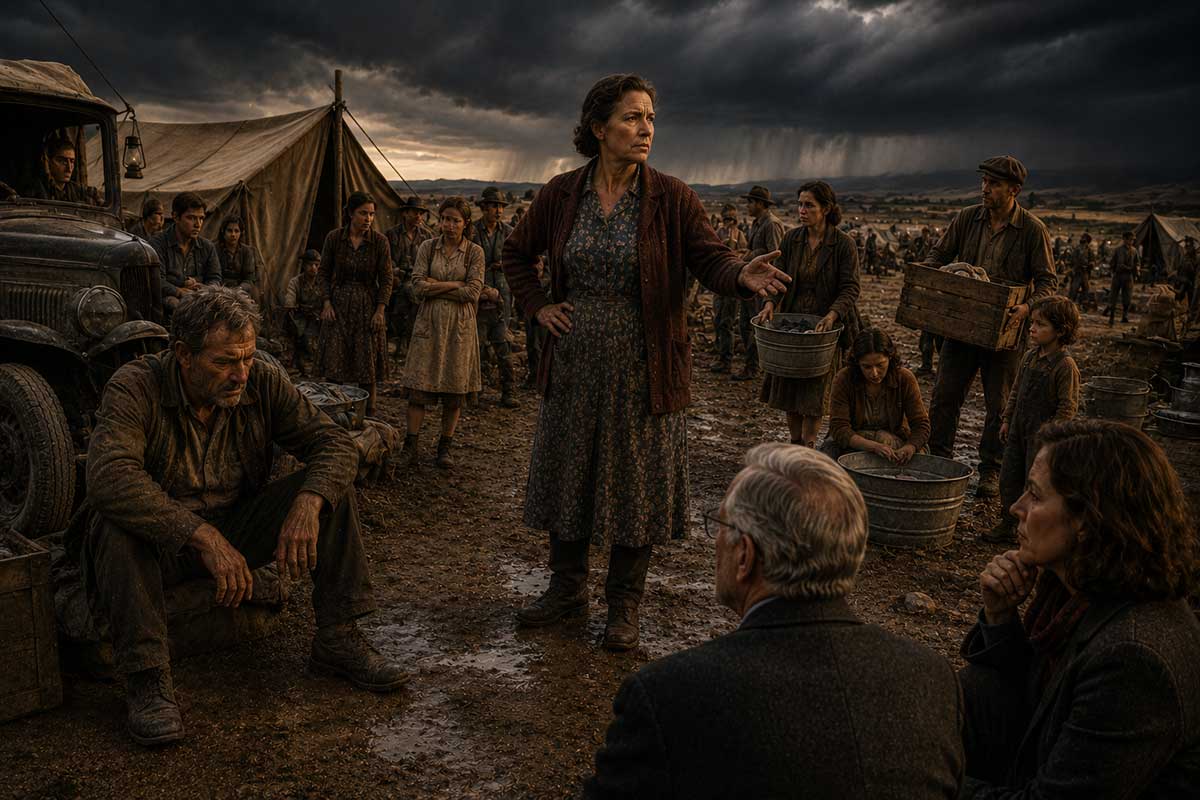
For several seconds after Gladstein's question, Steinbeck said nothing.
Mimi Reisel Gladstein: You gave your women extraordinary strength.
But I want to know what that strength costs them.
Why does Ma become the leader precisely when her family is falling apart?
And did you empower the women in this novel, or did you make them responsible for carrying everyone else's suffering?
John Steinbeck: I suppose I could say both.
Gladstein: You seem fond of that answer.
Steinbeck: Life keeps being inconvenient that way.
Susan Shillinglaw: Let's begin with Ma rather than the theory.
At the beginning, the Joad family still appears to have a recognizable hierarchy.
Pa is the father.
The men gather to make decisions.
There is land, or at least the memory of land.
There are familiar roles.
Then almost everything supporting those roles disappears.
James N. Gregory: That's historically important.
For many displaced agricultural families, losing the farm wasn't simply losing income.
The household economy itself changed.
A man's authority might have been connected to land ownership, physical labor, providing for dependents, and knowledge of farming.
Migration could strip away several of those sources of identity at once.
Richard Astro: Which means Pa doesn't simply become weaker.
The world in which his particular form of strength made sense disappears.
Gladstein: That's much more interesting than saying Ma is strong and Pa is weak.
John, did you intend that?
Steinbeck: Yes.
Pa knows how to be Pa in one world.
Then that world is gone.
Gladstein: And Ma?
Steinbeck: Ma knows how to keep looking at what is actually in front of her.
Robert DeMott: That's a crucial difference.
Pa's authority is partly positional.
Ma's authority becomes situational.
She doesn't lead because somebody formally appoints her.
She leads because decisions have to be made.
Shillinglaw: And because she understands something the others are slower to accept.
The old family cannot simply be preserved.
Steinbeck: Yes.
Gladstein: But Ma spends much of the novel trying to preserve it.
Steinbeck: Of course.
Gladstein: Then she fails.
Steinbeck looked at her.
Steinbeck: That's a hard word.
Gladstein: It's supposed to be.
Let's count.
Grampa dies.
Granma dies.
Noah leaves.
Connie leaves Rose of Sharon.
Tom eventually has to leave.
Rose of Sharon loses her baby.
The family that leaves Oklahoma does not arrive intact at some new home.
If Ma's great purpose is keeping the family together, she does not accomplish it.
Steinbeck: No.
Gladstein: Then why do readers remember her as triumphant?
Nobody answered immediately.
Astro: Perhaps because we've confused strength with victory.
Gladstein turned toward him.
Astro: Ma cannot control what happens.
She cannot prevent death.
She cannot create jobs.
She cannot make Connie stay.
She cannot keep Tom safe forever.
She cannot stop the flood.
Her strength isn't control.
It's continuing to respond after control has failed.
Gregory: That's an important distinction.
People living through economic catastrophe often retain far less control than later observers imagine.
We like stories where good decisions produce good outcomes.
Historical crises don't respect that equation.
Shillinglaw: Ma makes choices, but she makes them inside narrowing possibilities.
Gladstein: Which returns us to something we discussed with the Joads themselves.
Responsibility remains real even when freedom is constrained.
Steinbeck: Yes.
DeMott: And Ma may understand constrained freedom better than anyone in the family.
She rarely has the luxury of asking what the perfect choice is.
She asks what can be done now.
Gladstein: Give me an example.
DeMott: Granma.
Ma knows Granma has died while they are approaching the California checkpoint.
She lies beside her dead mother-in-law and conceals the death long enough to get the family through.
Gregory: In ordinary circumstances, that sounds almost grotesque.
Shillinglaw: In those circumstances, it becomes an act of protection.
Astro: Ma's morality is intensely practical.
Not abstract goodness.
Not purity.
What does this family need in the next hour?
Gladstein: Which sounds admirable.
But now I want to make it uncomfortable again.
Why is it Ma who has to do that?
Why is it so often the woman who must absorb the unbearable thing and keep everyone moving?
Steinbeck sighed softly.
Steinbeck: There it is.
Gladstein: Yes.
There it is.
Ma must be frightened without spreading fear.
Hungry without taking more food.
Grieving without collapsing.
Angry without destroying the family.
Strong when Pa cannot be.
Tender when the children need tenderness.
Hard when tenderness would endanger them.
And then Rose of Sharon eventually becomes the body through which your final act of human giving occurs.
You seem to admire women enormously.
But sometimes admiration can become another kind of demand.
Steinbeck: Meaning?
Gladstein: Meaning you can put someone on a pedestal and still imprison her there.
The room became quiet.
Shillinglaw: That's fair.
But we should distinguish between what the novel portrays and what it endorses.
Gladstein: Certainly.
Shillinglaw: Steinbeck may be observing that women in these families often carried forms of continuity that male-centered accounts overlooked.
Gladstein: I accept that.
But the literary question remains.
Does Ma get to want something for herself?
Steinbeck: She wants her family.
Gladstein: Exactly.
Listen to your own answer.
Steinbeck: I see where you're going.
Gladstein: Tom gets a moral development.
Casy gets a philosophy.
Pa gets a crisis of identity.
Tom can leave and become something beyond the family.
What does Ma get that belongs only to Ma?
Steinbeck was silent.
Astro: That's difficult.
Gladstein: It should be.
When female self-sacrifice is described as extraordinary strength, we should sometimes ask whether the woman was ever permitted another form of existence.
DeMott: Yet Ma's identification with family may itself be her chosen identity.
We shouldn't automatically assume autonomy must look like separation.
Gladstein: Agreed.
I'm not saying Ma secretly wants to abandon everyone and open a shop in San Francisco.
A few people smiled.
Gladstein: I'm asking whether we can distinguish between:
a woman choosing care
and
a culture assuming care belongs to women.
Gregory: That's a much larger historical question.
Shillinglaw: And a very modern question too.
Steinbeck: I don't think I could separate them completely.
Gladstein: Neither can I.
That's why Ma is interesting.
She isn't simply oppressed by family responsibility.
She derives identity, authority and meaning from it.
Astro: So the burden and the strength come from the same place.
Gladstein: Often, yes.
And that makes the question harder than "Was Steinbeck feminist?"
I don't care much about assigning him a modern label.
I care about what the women are allowed to become.
Steinbeck: Fair.
DeMott: Then perhaps we should look at Pa.
If Ma's authority grows, what exactly happens to him?
Gregory: I want to defend Pa a little.
He is often remembered as though he simply becomes ineffective.
But imagine what has been removed from him.
His land.
His work.
His economic independence.
His ability to provide reliably.
His knowledge of how the world works.
His status within the household.
Then he's placed into a labor market where hundreds of desperate men may compete for the same job.
That's not merely a personal failure.
Astro: His identity has been built around a role the new environment no longer allows him to perform.
Steinbeck: Exactly.
Gladstein: And that's why I don't want to make Ma's rise into a competition where she wins and Pa loses.
Shillinglaw: Good.
Gladstein: Pa's decline exposes something fragile about traditional masculinity.
If a man's dignity depends entirely on being the provider, what happens when forces outside his control prevent him from providing?
Gregory: That's one of the Depression's deepest psychological wounds.
Astro: And it gives us a question far beyond the novel:
If I can no longer perform the role that made me valuable, am I still valuable?
Steinbeck nodded.
Steinbeck: That's Pa.
DeMott: Which makes Ma's response to him important.
She doesn't stop regarding him as family when he stops functioning as the unquestioned head.
Gladstein: She adapts faster than he does.
Shillinglaw: And eventually the family itself adapts.
Authority begins moving toward whoever can respond effectively.
Gregory: Almost like an emergency government.
Steinbeck: Families are governments with worse constitutions.
That drew laughter.
Gladstein: And no elections.
Steinbeck: Usually.
The laughter faded.
Astro: But something else happens.
At first the family is organized around hierarchy.
Later it becomes increasingly organized around necessity.
Who can do what?
Who needs what?
Who can carry whom?
That's a very different social model.
DeMott: And perhaps another miniature version of the novel's larger movement.
Gregory: From fixed roles toward adaptive cooperation.
Astro: Yes.
The Joad family is becoming a small experiment in "we."
Gladstein: But that "we" is expensive for Ma.
I don't want us to lose that.
Steinbeck: Nor should we.
Gladstein: Then let me ask you directly.
Does Ma ever get permission to break?
Steinbeck: She breaks.
Gladstein: Privately.
Steinbeck: Often.
Gladstein: Exactly.
She can feel despair, but she cannot allow everyone else to see it at the wrong moment.
That's emotional labor.
Shillinglaw: Long before we had that terminology.
Gladstein: Yes.
And it is one reason Ma still feels recognizable.
Many families have one person who becomes the emotional container.
Everybody else is allowed to fall apart because that person isn't.
Astro: Until that person does.
Gladstein: Exactly.
And what happens then?
Nobody answered.
Gregory: Perhaps that's why Ma's strength can feel inspiring and frightening at the same time.
Steinbeck: It should.
Gladstein: Good.
Then I don't want readers walking away saying, "Be like Ma."
Shillinglaw: What should they say?
Gladstein: Maybe:
Why did Ma have to become this strong?
That changed the tone of the room.
Astro: That's an excellent distinction.
We often praise resilience without asking what required it.
Gregory: Or who benefited from it.
Steinbeck: Yes.
DeMott: And now we return to the family itself.
Susan raised the question earlier.
If Ma's great purpose is preserving the family, and the family physically fragments, has she failed?
Shillinglaw: Perhaps we need to define family before answering.
Gladstein: At the beginning, that's easy.
The Joads.
Astro: Blood.
Household.
Kinship.
Gregory: A group tied to land and history.
Shillinglaw: But once they leave Oklahoma, those boundaries start changing.
They travel alongside other people.
They share camps.
They depend on strangers.
They become dependent on systems of mutual assistance.
DeMott: And the family keeps losing members.
Steinbeck: Yes.
Astro: Which produces a strange inverse relationship.
The physical family contracts.
The moral family expands.
Gladstein: Let's not make that sound prettier than it is.
Grampa doesn't die so that humanity can expand.
Granma doesn't die to teach a lesson.
Rose of Sharon doesn't lose her child so Steinbeck can give us symbolism.
These are losses.
Steinbeck: Absolutely.
Gladstein: Good.
Because literature can become cruel when it explains suffering too neatly.
DeMott: Meaning?
Gladstein: "This terrible thing happened so that something beautiful could emerge."
Maybe something beautiful does emerge.
That doesn't justify the terrible thing.
Astro: That's important.
Meaning is not the same as justification.
Gregory: History certainly teaches that.
Steinbeck: I wouldn't want any death in this book explained away.
Shillinglaw: Then perhaps Ma's achievement isn't that she turns loss into something good.
It's that loss does not completely close her.
Astro: Yes.
That's different.
Suffering can make the circle smaller.
Mine.
My food.
My family.
My survival.
The Joads sometimes move in the opposite direction.
Gladstein: Sometimes.
Not always.
Astro: Right.
That's important too.
Gregory: They remain human beings under scarcity.
Sometimes generous.
Sometimes frightened.
Sometimes selfish.
Sometimes courageous.
Steinbeck: Which is why I never wanted them made into saints.
Gladstein: Yet the final chapters push generosity farther and farther.
DeMott: And that's where Rose of Sharon becomes central.
Gladstein: Before we get there, I want to ask Ma one final question through the novel.
If she could have kept every Joad together by shutting everyone else out, would that have counted as success?
Nobody spoke for several seconds.
Astro: That's the real question, isn't it?
Shillinglaw: Perhaps Ma's definition of success has to change.
Gregory: At first:
Keep this family intact.
Later:
Keep people alive.
DeMott: That's a tremendous shift.
Gladstein: But Ma doesn't announce it.
Steinbeck: She wouldn't.
Gladstein: She lives it.
Steinbeck: Yes.
Astro: Which may distinguish Ma from Casy.
Casy formulates ideas.
Ma practices them before giving them names.
DeMott: That's excellent.
Casy says "we."
Ma feeds it.
Shelters it.
Argues with it.
Protects it.
Gladstein: And occasionally threatens it with a jack handle.
Steinbeck laughed.
Steinbeck: Ma was never sentimental.
Shillinglaw: Which may be exactly why her compassion works.
She doesn't love humanity abstractly.
She deals with whoever is standing in front of her.
Astro: That returns us to our concern about collectivism.
Perhaps the healthiest "we" is not one that erases the individual.
It is one that keeps recognizing individuals beyond the original boundary.
Gladstein: Yes.
Don't love "mankind" so much that you stop seeing the hungry person.
Gregory: Or the exhausted father.
Shillinglaw: Or the frightened mother.
DeMott: Or the stranger.
The word remained in the room.
Stranger.
Gladstein looked toward Steinbeck.
Gladstein: And that's where you take us, isn't it?
Steinbeck: Eventually.
Gladstein: You spend the novel breaking apart the family we know.
Then on the final pages you place Rose of Sharon before someone who isn't family at all.
DeMott: Someone without even a name.
Astro: After her own child has died.
Gregory: After almost every promise California seemed to offer has failed.
Shillinglaw: And then you ask her to do something that has disturbed, confused, moved and sometimes repelled readers ever since.
Gladstein's eyes remained on Steinbeck.
Gladstein: This is where my earlier question becomes much harder.
You gave Rose of Sharon grief.
You gave her milk intended for a child who would never drink it.
Then you placed a starving stranger in front of her.
And you chose that moment to end one of the most important American novels ever written.
Steinbeck shifted slightly in his chair.
Steinbeck: I know.
Gladstein: So now you don't get to hide behind symbolism.
Steinbeck: I suspected I wouldn't.
Gladstein: Good.
Because I want to know why the act had to involve her body.
I want to know why the man had to be a stranger.
I want to know whether that final image represents hope, desperation, religion, motherhood, human solidarity, or something much more unsettling.
And most of all, John:
Did Rose of Sharon finally become fully herself...
Gladstein paused.
Gladstein: ...or did you turn a grieving young woman into the final symbol your novel needed?
This time Steinbeck did not answer.
And no one rescued him from the question.
Topic 5: Why Does The Grapes of Wrath End With THAT Scene?
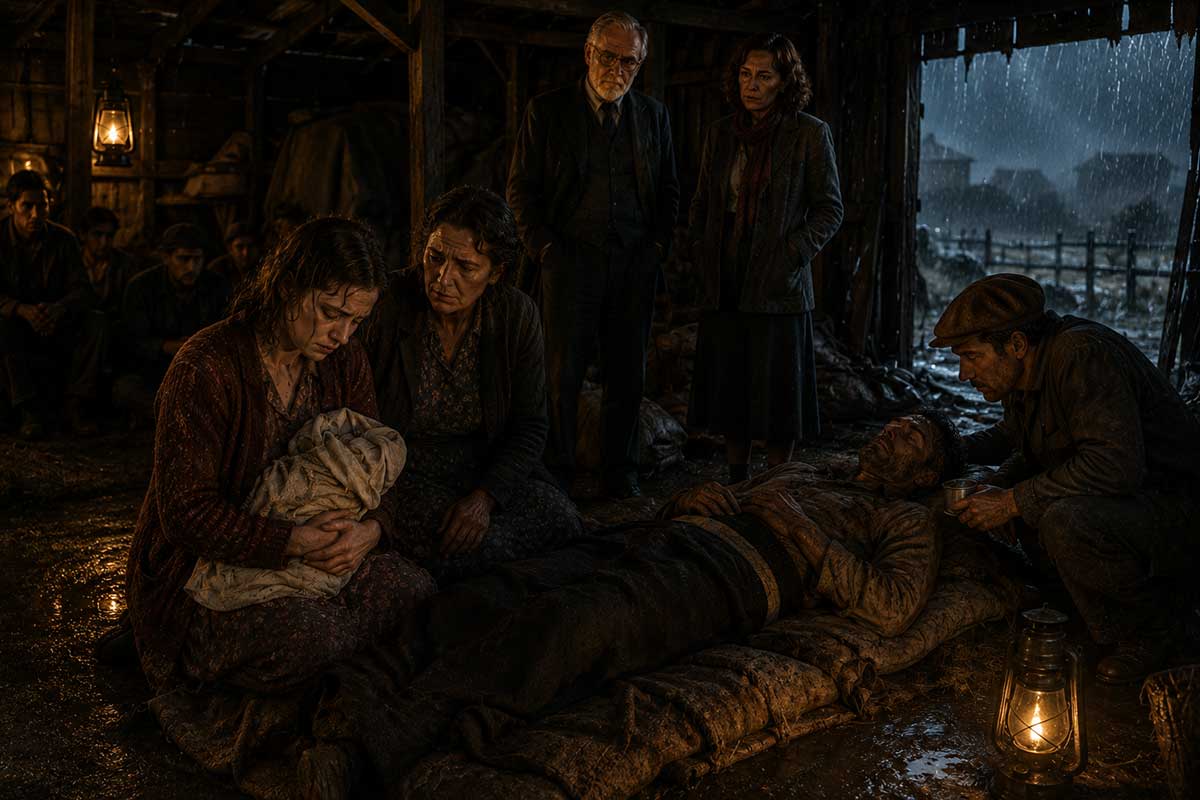
The room stayed silent.
Steinbeck looked at Gladstein, then down at the table.
Mimi Reisel Gladstein: I mean it seriously, John.
Rose of Sharon has lost her husband.
She has lost the future she imagined.
Her baby is stillborn.
Then, almost immediately, you place a starving stranger in front of her and make her body the instrument that keeps him alive.
Why?
John Steinbeck: Because I didn't want the book to end with an idea.
Robert DeMott: Meaning?
Steinbeck: I didn't want solidarity to remain something people said.
I wanted it to become physical.
Richard Astro: Embodied.
Steinbeck: Yes.
Gladstein: But why her body?
You could have ended with shared bread.
A blanket.
A place by the fire.
Tom helping another worker.
Ma feeding another family.
Why breast milk?
Steinbeck waited.
Steinbeck: Because there was something meant for one life that could no longer receive it.
And another life that might die without it.
Gladstein: That is powerful symbolically.
It is still Rose's body.
Steinbeck: I know.
Gladstein: And that is where I resist the easy reading.
Readers often say, "Rose of Sharon becomes a symbol of universal motherhood."
That sounds beautiful.
But the moment we call her "universal motherhood," we risk losing Rose of Sharon herself.
A young woman has just delivered a dead child.
She is grieving.
She is physically exhausted.
Then the novel asks her for one more act of giving.
Susan Shillinglaw: That's exactly why the scene cannot be reduced to a simple celebration of generosity.
Gladstein: Good.
Because I don't want us saying suffering purified her.
Her child did not need to die to make her morally worthy.
James N. Gregory: And historically, that matters too.
We should be careful with any interpretation that turns deprivation into a spiritual gift.
People who suffered through migration generally would have preferred food, secure work, shelter, and healthy children.
They did not need misery to become noble.
Steinbeck: I agree.
Astro: Then perhaps the stillbirth isn't a moral lesson.
It creates an unbearable fact.
Something cannot be undone.
The question is what Rose does after the fact.
Gladstein: Better.
Meaning can follow suffering without suffering having been necessary.
DeMott: That distinction is essential.
Shillinglaw: And the novel has been preparing us for it.
Again and again, the Joads lose things they cannot recover.
The farm.
Grandparents.
Family members.
Security.
Tom.
The baby.
The novel never restores those losses.
Astro: Which makes the ending strange.
It is not resurrection in the ordinary sense.
The baby does not return.
The family does not become whole again.
California does not become paradise.
DeMott: Yet something moves from death toward life.
Gladstein: Through Rose.
Steinbeck: Yes.
Gladstein: Then let's ask the next question.
Why must the man be a stranger?
Steinbeck: Because if he were family, the meaning would be smaller.
Gregory: Smaller?
Steinbeck: Not less meaningful.
Smaller.
If Tom were starving, Rose feeding him would make sense through kinship.
If Pa were dying, family duty explains it.
If she loved the man, love explains it.
But she knows almost nothing about this man.
Astro: Which removes many of the conditions we normally place on compassion.
Shillinglaw: He has no history for us.
No biography.
No proof of virtue.
Gladstein: No guarantee he deserves anything.
Gregory: That word matters.
"Deserves."
People often become more comfortable helping after deciding the recipient is worthy.
Hardworking.
Innocent.
Responsible.
Respectable.
Astro: Steinbeck strips almost all of that away.
What do we know?
A human being is starving.
Steinbeck: That's enough.
Gregory: For Rose?
Steinbeck: In that moment, yes.
Gladstein: But is it enough for us?
That may be the harder question.
The man has no name because readers cannot build attachment through personality.
We cannot say, "I like him."
We cannot say, "He reminds me of Tom."
We cannot say, "He earned my sympathy."
He simply needs help.
DeMott: Which completes something the intercalary chapters started.
Astro: Exactly.
Earlier, Steinbeck kept pulling us away from people whose names we knew toward anonymous migrants.
Now the final anonymous person enters the intimate family story itself.
Shillinglaw: The two forms finally meet.
The Joad story and the collective story become one scene.
DeMott nodded.
DeMott: That's structurally remarkable.
For most of the novel, Steinbeck alternates between the particular and the collective.
At the end, he no longer needs two separate chapter types.
One named woman and one nameless man occupy the same space.
Steinbeck: Yes.
Gladstein: That's one of the strongest defenses of the scene.
But it still doesn't settle what Rose's act means.
People call it Christian.
Do you?
Steinbeck: It carries Christian associations.
DeMott: Maternal imagery too.
Astro: And possibly Eucharistic associations.
Body giving life.
Nourishment shared.
A private substance becoming communal sustenance.
Gregory: Yet we should be careful not to force every bodily act into Christian symbolism.
DeMott: Agreed.
The biblical reading is one layer, not the only layer.
Shillinglaw: There is also the reversal of expectation.
Rose spends much of the novel imagining motherhood in private terms.
Her baby.
Her husband.
Her little future.
Then the milk meant for that private future becomes nourishment outside it.
Gladstein: That is where the scene can become very moving.
But we must say this carefully.
Her love for her baby is not replaced by love for humanity.
The stranger does not substitute for the dead child.
Steinbeck: No.
Gladstein: Good.
Because that would be unbearable.
Astro: Perhaps the stranger does not replace what she lost.
Her capacity to give simply survives the loss.
Shillinglaw: That's much better.
DeMott: And perhaps that is why the ending is neither conventionally hopeful nor conventionally hopeless.
Gregory: Let's test that.
What is hopeful?
The baby is dead.
The family is displaced.
Tom is gone.
They're sheltering from a flood.
A man is starving so severely he cannot eat solid food.
That's not exactly optimism.
Astro: No.
Hope here isn't the belief that circumstances are good.
Gladstein: Or that everything will work out.
Astro: It may be the refusal to allow terrible circumstances to determine every human response.
Steinbeck: Yes.
Gregory: So the hope lies in action rather than prediction.
Astro: Exactly.
Rose cannot promise tomorrow.
She can do something now.
Gladstein: Which sounds very much like Ma.
Shillinglaw: It does.
Ma's morality has always been immediate.
Who needs what now?
Rose finally participates in that same moral language.
Gladstein: But Rose is not Ma.
And I want to protect that difference.
For much of the novel, readers can find Rose self-absorbed.
She thinks about Connie.
The baby.
Their future.
Her anxieties.
Her body.
Steinbeck: She's young.
Gladstein: Exactly.
And I don't think she deserves contempt for that.
A young pregnant woman imagining her own future is not morally defective.
Shillinglaw: That's worth emphasizing.
Sometimes readers interpret her final action as though she has finally stopped being selfish and become good.
That seems too crude.
Gladstein: Far too crude.
She does not need to be shamed out of wanting a husband and healthy baby.
What changes is not that personal desire becomes sinful.
Her circle becomes larger without her personal grief becoming unreal.
Astro: That fits the entire "I to We" movement better.
The "I" is not destroyed.
It becomes connected.
DeMott: Which answers one of the concerns we raised about Casy.
A healthy "we" cannot require annihilation of the individual.
Gladstein: Yes.
Rose must remain Rose.
That is why I object when people turn her into "Mother Humanity."
Steinbeck: I understand.
Gladstein: Do you agree?
Steinbeck: Partly.
Gladstein: There you go again.
Steinbeck: I meant her to be herself and larger than herself.
Gladstein: Explain.
Steinbeck: Isn't that what symbols are?
They don't have to erase the thing they come from.
A tree can be a tree and mean something beyond itself.
A human action can be a human action and open into something larger.
Gladstein: Yes.
But trees are rarely asked to endure gender expectations.
A faint smile appeared around the table.
Steinbeck: Fair.
Gladstein: My concern is not symbolism itself.
It's whether the symbol is allowed to keep its human cost.
If we look at Rose nursing the man and immediately say "universal love," we may skip the fact that her breasts have milk because her child died.
Shillinglaw: The grief is inside the gift.
Gladstein: Exactly.
Do not remove the grief to make the gift beautiful.
That sentence silenced the table.
Astro: Perhaps that is the scene.
Not grief transformed into happiness.
Grief and generosity occupying the same body.
DeMott: That's much closer.
Gregory: And historically, maybe that also prevents the book from becoming sentimental about poverty.
There is no miraculous rescue.
The social crisis remains.
One person is kept alive for one moment.
Astro: Which sounds small.
Gregory: It is small.
Astro: Maybe that's why it matters.
Steinbeck: Yes.
Gregory: Really?
After hundreds of pages about national economic structures, exploitation, migration, wages, banks, land, organizing, camps...
you end with one person feeding one other person.
Doesn't that retreat from the structural problems?
Steinbeck: No.
Gregory: Why not?
Steinbeck: Because systems decide many of the conditions people live under.
But systems don't remove the moment when one person stands before another.
Gregory: That's emotionally satisfying.
Still, food charity cannot solve labor exploitation.
Steinbeck: I didn't say it could.
Gregory: Then what does the act accomplish politically?
Steinbeck: Maybe nothing.
Gregory looked surprised.
Steinbeck: Not every humane act is a political program.
Astro: That's important.
Steinbeck: The man is starving now.
You can redesign the agricultural economy tomorrow.
What do you do with him tonight?
Gregory: Fair.
Gladstein: Yet we shouldn't let that become an excuse never to redesign anything tomorrow.
Steinbeck: No.
Astro: There it is.
The novel may need both levels.
Structural justice and immediate compassion.
DeMott: Casy asks how people organize so they aren't powerless.
Rose's scene asks what one human being does when another is dying in front of her.
Neither replaces the other.
Shillinglaw: And Ma has been living between those scales throughout the novel.
Gregory: That's a much richer reading than treating the ending as "sharing is good."
Gladstein: Much richer.
Now I want to ask about the discomfort.
Did you want readers to recoil?
Steinbeck: Somewhat.
Gladstein: Why?
Steinbeck: Because comfortable compassion is cheap.
Astro: Explain.
Steinbeck: People like compassion when it doesn't ask too much.
Give a coin.
Say a kind word.
Feel sympathy.
I wanted an act intimate enough that you couldn't keep the suffering at a safe distance.
Gladstein: And that is exactly what makes the scene controversial.
The body breaks the boundary.
DeMott: The novel has been dealing with bodies all along.
Hunger.
Pregnancy.
Death.
Exhaustion.
Sex.
Work.
Violence.
Illness.
The ending refuses to become purely intellectual.
Astro: Human beings do not suffer symbolically.
They suffer bodily.
Gregory: Nor do they eat symbolically.
Steinbeck: Exactly.
Shillinglaw: There is another question readers often ask.
Why doesn't the novel end with Tom?
His farewell to Ma feels like a natural climax.
DeMott: It almost sounds like the ending of a different novel.
Tom has undergone the major ideological transformation.
He has inherited something from Casy.
He leaves.
You could stop there.
Steinbeck: That would make the book too much Tom's story.
Astro: There it is.
Steinbeck: Tom matters.
But the movement he represents cannot belong only to him.
Gladstein: So Rose has to carry the final movement?
Steinbeck: Rose carries a different one.
Tom moves toward the abstract stranger.
He speaks about people everywhere.
Rose meets one.
DeMott: That's excellent.
Tom's vision expands geographically.
Rose's action contracts back into one body.
Astro: Macro and micro again.
Shillinglaw: Tom says, in effect, "I will belong to a larger struggle."
Rose encounters a particular human being and acts.
Gregory: Which prevents Tom's political awakening from becoming the last word.
Gladstein: And prevents the "we" from staying abstract.
Steinbeck: Yes.
DeMott: So perhaps Casy, Tom, Ma, and Rose form a sequence.
Casy discovers the idea.
Tom accepts responsibility beyond himself.
Ma practices care through survival.
Rose crosses the final boundary to a stranger.
Astro: That is compelling.
But I want to challenge it.
It sounds too perfect.
Gladstein: I was about to say the same thing.
Astro: We are turning the novel into a philosophical machine where every character completes the next step.
Human beings aren't that orderly.
Steinbeck: Neither is the book.
Gladstein: Rose does not nurse the man because she has read Casy's philosophy.
Steinbeck: No.
Gladstein: She does not think, "Now I shall complete the movement from I to We."
Steinbeck: Certainly not.
Gregory: Thank God.
Gladstein: She encounters suffering.
Ma understands what is possible.
Rose makes a choice.
That is enough.
Astro: And perhaps the meaning comes afterward.
From us.
DeMott: That's what readers do.
Steinbeck: Yes.
Shillinglaw: Then maybe we should ask the question readers ask most often.
Is the ending hopeful?
Steinbeck looked at the others.
Steinbeck: What do you think?
Gregory: Historically?
No.
The conditions are still catastrophic.
DeMott: Narratively?
Partly.
Something has shifted in Rose.
Astro: Philosophically?
It offers possibility without guarantee.
Gladstein: Emotionally?
Both.
It breaks my heart and refuses despair.
Shillinglaw: That may be the answer.
Not optimism.
Not despair.
Astro: A human possibility.
Steinbeck: I'll take that.
Gladstein: Not so fast.
I have one question left.
Steinbeck nodded.
Gladstein: You said the stranger had to be anonymous.
Let us really think about what that means.
We don't know whether he's generous.
We don't know how he treated his family before becoming sick.
We don't know his politics.
We don't know whether he made good decisions.
We don't know whether he would have helped Rose if their positions were reversed.
Gregory: We don't know whether he is morally admirable at all.
Gladstein: Exactly.
So John, is that the test?
Does he have to prove his goodness before his life matters?
Steinbeck shook his head.
Steinbeck: No.
Gladstein: His innocence?
Steinbeck: No.
Gladstein: His usefulness?
Steinbeck: No.
Gladstein: His similarity to us?
Steinbeck: No.
Gladstein: Then what qualification does he possess?
Steinbeck looked around the table.
Steinbeck: He's alive.
No one spoke.
Astro finally leaned forward.
Astro: That may be the entire novel reduced to two words.
Gregory: I wouldn't go that far.
Astro: Of course you wouldn't.
A little laughter eased the tension.
Then DeMott opened the novel again.
DeMott: Consider where we began this discussion.
Topic 1 asked whether Steinbeck told the truth about people suffering during a national catastrophe.
Topic 2 asked why he would not let us stay safely attached to the Joads.
Topic 3 asked whether Casy relocates sacredness from private salvation toward shared humanity.
Topic 4 showed the Joad family physically contracting as its moral boundaries become less rigid.
And now the final human being in the book has no name.
Shillinglaw: Which means Steinbeck removes almost every reason we normally use to decide whether someone belongs to "us."
Gregory: Family.
Astro: Friendship.
Gladstein: Familiarity.
DeMott: Biography.
Shillinglaw: Even moral deservingness.
Steinbeck remained quiet.
Astro: Perhaps the final question is no longer what Rose of Sharon's act symbolizes.
Maybe it's what happens inside the reader.
Gladstein: Meaning?
Astro: We spent hundreds of pages learning to care about the Joads.
Now Steinbeck removes the name.
The family connection.
The history.
The attachment.
And leaves us with a stranger who needs something.
What happens to our concern then?
Gregory: Does it survive anonymity?
DeMott: That's the test.
Gladstein: But don't forget Rose.
Astro: I won't.
Gladstein: Good.
Because the danger of every grand philosophy is that it eventually stops seeing the person who has to perform it.
The starving man remains a person.
Rose remains a person.
Neither exists merely to illustrate our theory.
Shillinglaw: Which may be the final correction to "I to We."
"We" is not a crowd.
It is many "I"s whose lives have become connected.
Astro nodded slowly.
Astro: Yes.
Perhaps the goal was never to move from "I" to "We" by abandoning the "I."
It was to discover that the "I" was never as separate as it believed.
Steinbeck looked toward him.
Steinbeck: That's closer.
Gregory: And still dangerous.
Steinbeck: Most truths about human beings are.
Gladstein: Then let me ask you the question we began this entire scholar discussion with.
What were you trying to make us see that simply telling the story of one poor family could never have shown?
Steinbeck did not answer immediately.
Outside, evening light had begun to fade.
Steinbeck: Maybe I needed you to love one family first.
Shillinglaw: Why?
Steinbeck: So I could eventually ask whether love was the only reason another life should matter.
Gladstein watched him carefully.
Gladstein: That's better than turning Rose into a saint.
Steinbeck smiled.
Steinbeck: I'll consider that praise.
DeMott: Then perhaps there is one final question.
Not for Steinbeck.
For us.
The room became still again.
DeMott: When we say "we," how many conditions do we quietly place on admission?
Family?
Nation?
Race?
Class?
Religion?
Politics?
Character?
Usefulness?
Innocence?
Similarity?
Gregory: And how many of those conditions survive when another person is simply starving in front of us?
Astro: Perhaps that is why the stranger has no name.
Gladstein: And why Rose must still have hers.
No one added anything.
There was nothing left to explain.
The novel had begun with Tom Joad returning home to find the world he knew disappearing.
It ended in a barn, with a grieving young woman and a dying man who did not belong to her family at all.
Between those two moments, nearly every boundary had been tested.
Home.
Property.
Work.
Religion.
Family.
Identity.
Responsibility.
And finally, the smallest and largest word in the book:
we.
The scholar discussion ended with the question Steinbeck had spent hundreds of pages preparing the reader to face:
When another human being is suffering, what must they be to us before we decide they matter?
Final Thoughts
The first question sounded simple:
Did Steinbeck tell the truth?
The answer became complicated almost immediately.
The broad historical catastrophe behind The Grapes of Wrath was real.
Families were displaced.
Migration toward California was real.
Agricultural laborers faced unstable employment, terrible housing, low wages, prejudice, and enormous insecurity.
Yet Steinbeck was writing a novel, not compiling a census.
He selected.
Compressed.
Intensified.
Excluded.
Interpreted.
He wrote from anger.
He wanted readers to feel something.
That does not automatically make the novel dishonest.
It means that literary truth and historical truth cannot simply be treated as identical.
Perhaps the more useful question is:
What does a novelist owe reality?
Accuracy matters.
Context matters.
People omitted from the story matter.
The history of California agricultural labor was far broader than the white Oklahoma migration represented by the Joads.
A novel can reveal suffering and still have blind spots.
Admiring the book does not require pretending otherwise.
That realization led naturally to the second question.
Why does Steinbeck keep leaving the Joads?
Perhaps that is one of the most important decisions in the entire novel.
If Steinbeck had stayed with Tom and Ma from beginning to end, readers might have experienced the story as the tragedy of one unlucky family.
Instead, the narrative repeatedly widens.
One family becomes many.
A named person becomes an anonymous worker.
A personal eviction becomes a pattern.
A hungry child becomes thousands of hungry children.
The intercalary chapters perform a strange moral exercise.
They first teach us attachment.
Then they challenge attachment.
We want to return to the people we know.
Steinbeck keeps asking us to look at people we do not know.
That produces one of the most important distinctions that emerged from the scholar discussion:
Caring about people we love is not the same thing as caring about human beings.
Both matter.
But they are not identical.
The turtle chapter, often reduced to a lesson about perseverance, became more interesting when we noticed the seeds it carries.
The turtle moves.
It struggles.
It survives.
But it also changes the ground without knowing what may eventually grow there.
That became an unexpected bridge to Jim Casy.
Casy does not survive the novel.
His idea does.
He begins as a former preacher troubled by sin, desire, guilt, and the inadequacy of the religious language he once used.
He gradually becomes less interested in asking who is pure and who is sinful.
His attention shifts.
What happens to people together?
What do human beings owe one another?
Where is the sacred found if suffering is shared?
It became too simple to say:
Jim Casy represents Jesus Christ.
He certainly carries Christ associations.
But the deeper question is what Steinbeck does with those associations.
Casy's spirituality moves away from private salvation and toward a larger human connectedness.
That raises a question the discussion never fully resolved:
Did Steinbeck expand Christianity, or did he replace part of it with a human-centered spiritual philosophy?
There may not be one answer.
Perhaps the tension is the point.
Then Tom inherits something from Casy.
Not Casy himself.
Not a complete doctrine.
Not moral perfection.
A question.
Does my responsibility end with my own family?
Tom begins the novel thinking in short distances.
Eat.
Survive.
Avoid prison.
Protect the Joads.
By the time he leaves Ma, his field of identification has grown.
He can now imagine people he has never met.
But Tom's violence keeps the transformation from becoming too clean.
He kills the man who kills Casy.
That should trouble us.
A larger moral cause does not automatically purify every action taken in its name.
Casy's idea may have entered Tom.
Tom has not completely learned what to do with it.
Then the conversation moved to Ma.
Perhaps nobody reveals the transformation of the Joad family more clearly.
Pa begins with the authority expected of a traditional father.
But much of that authority depends upon a particular world.
Land.
Work.
Providing.
Property.
Physical usefulness.
The family loses that world.
Pa's decline can easily be misread as weakness.
A more compassionate reading sees something else.
The structure around his identity collapses.
If a man has spent his life believing that his value comes from providing for his family, what happens when economic forces make providing nearly impossible?
The question becomes much larger than Pa:
If I can no longer perform the role that made me valuable, am I still valuable?
Ma responds differently.
Her form of strength travels.
She reads people.
Adapts.
Feeds.
Decides.
Protects.
Absorbs grief.
Moves when movement is necessary.
Waits when waiting is necessary.
Yet Gladstein's challenge should remain with us.
We often praise people for resilience without asking:
Why did they have to become so resilient?
Ma's strength comes with a terrible cost.
She rarely gets the privilege of collapsing publicly.
Someone must keep functioning.
Someone must make the next decision.
Someone must carry the fear of everyone else.
And very often, that person is Ma.
That makes her strength admirable.
It should also make us uncomfortable.
The same tension becomes even sharper with Rose of Sharon.
Does Steinbeck empower his women?
Yes, in important ways.
Does he sometimes place upon them enormous expectations of endurance and sacrifice?
That question cannot simply be dismissed.
And then we reached the final scene.
Perhaps no single explanation can contain it.
Rose of Sharon has lost Connie.
Her imagined future has disappeared.
Her child is stillborn.
The family is displaced again.
Then she encounters a starving man.
He is not a Joad.
He is not her friend.
He is not someone whose history she knows.
She has no evidence that he is virtuous.
No proof that he deserves help.
No guarantee that he would have helped her.
He is simply dying.
And she possesses something that may sustain him.
This is where one of the most important distinctions in the entire discussion emerged.
Rose of Sharon's grief does not disappear.
The starving stranger does not replace her child.
Her suffering does not become good merely because something meaningful follows it.
Her loss remains loss.
Yet her capacity to respond to another person's need survives that loss.
That is different from saying suffering made her better.
And perhaps far more profound.
The act is disturbing partly because Steinbeck refuses to let compassion remain abstract.
Hunger is bodily.
Childbirth is bodily.
Death is bodily.
Work is bodily.
So his final image of giving is bodily too.
Then came the question that changed our reading of the stranger:
Why does he have no name?
At first, anonymity seems like absence.
By the end, it becomes the test.
If he were Tom, we would care.
If he were Pa, family duty would explain the act.
If Rose loved him, affection would explain it.
Steinbeck removes those conditions.
We know almost nothing about the man except this:
He is alive, and he may not remain alive without help.
That leads back through the entire novel.
Why were the anonymous migrants important?
Why did Casy move beyond individual salvation?
Why did Tom begin seeing responsibility outside his family?
Why did Ma's definition of family change?
Why did the book refuse to end with Tom?
Perhaps because Tom's expanding vision still remains partly an idea.
Rose encounters the actual stranger.
One human body before another.
And this gives us a different way to understand the movement from “I” to “We.”
It does not require destroying the individual.
Rose must remain Rose.
The starving man must remain a particular person, even if we do not know his name.
A healthy “we” is not an anonymous crowd.
It is a recognition that individual lives can become connected without becoming identical.
And perhaps that is the deepest reason The Grapes of Wrath remains difficult.
Steinbeck does not merely ask whether we believe in compassion.
Most people will say yes.
He asks something harder.
What happens when compassion costs something?
What happens when another family competes with yours for work?
When another hungry person wants food your children could eat?
When someone belongs to a group you fear?
When you do not know whether the stranger is innocent?
When you cannot fix the entire system?
When helping one person will not solve the larger injustice?
Does the person in front of you still matter?
The scholar discussion began by asking whether Steinbeck had truthfully portrayed America.
It ended with a question about us.
Perhaps that is the reason the novel refuses to become merely historical.
The Dust Bowl belongs to the 1930s.
The question does not.
When we say “we,” who do we mean?
And perhaps the harder version is the one Steinbeck leaves behind:
When another human being is suffering, what must they be to us before we decide their life matters?
Short Bios:
John Steinbeck (1902–1968)
John Steinbeck was an American novelist born in Salinas, California, whose fiction frequently explored labor, poverty, migration, land, dignity, loneliness, and human interdependence. The Grapes of Wrath, published in 1939, won the Pulitzer Prize for Fiction in 1940 and became one of the defining American novels of the Great Depression. Steinbeck received the Nobel Prize in Literature in 1962. His other major works include East of Eden, Of Mice and Men, Cannery Row, and The Pearl.
Susan Shillinglaw
Susan Shillinglaw is a leading Steinbeck scholar whose work has examined Steinbeck's life, writing, California background, and literary legacy. She has written and edited extensively on Steinbeck and has helped make the historical and cultural contexts surrounding his work accessible to modern readers. In this imagined discussion, she connects the novel's literary choices with Steinbeck's biography and the migrant world he encountered.
Robert DeMott
Robert DeMott is a major Steinbeck scholar, editor, and literary critic. His work has examined Steinbeck's manuscripts, creative process, symbolism, narrative structure, and intellectual influences. He is especially valuable for understanding the intercalary chapters of The Grapes of Wrath, the novel's biblical patterns, its unusual movement between individual and collective experience, and the ways Steinbeck's form supports his larger moral argument.
Mimi Reisel Gladstein
Mimi Reisel Gladstein is a literary scholar known for extensive work on Steinbeck and for scholarship concerning women and gender in literature. Her perspective brings particular attention to Ma Joad and Rose of Sharon. In this discussion, she asks whether Steinbeck's admiration for female strength truly expands women's agency or sometimes risks turning women into symbols of endurance, care, and sacrifice.
Richard Astro
Richard Astro is a Steinbeck scholar whose work has examined the philosophical foundations of Steinbeck's writing, including his ideas about interdependence, human groups, nature, and the relationship between individual identity and collective life. His perspective is especially useful when considering Jim Casy's spiritual development, Steinbeck's concept of human unity, and the novel's movement from “I” toward “we.”
James N. Gregory
James N. Gregory is a historian whose scholarship has examined migration, labor, politics, and the social history of the American West, including the Dust Bowl migration to California. His presence in this imagined discussion provides an important historical counterweight to literary interpretation. He helps distinguish Steinbeck's artistic representation from the broader historical experiences of migrant workers and asks whose stories became central to the American memory of the Great Depression.
Leave a Reply