
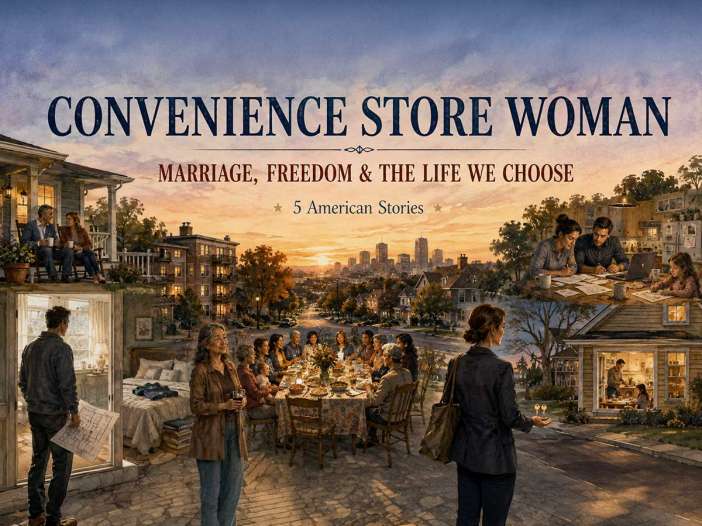
Introduction
Sayaka Murata’s Convenience Store Woman begins with a deceptively simple question: what if a person is content with a life that society considers incomplete?
Keiko Furukura does not seem to need marriage, status, ambition, or conventional adulthood in the way people expect. Her life forces readers to ask whether “normal” is really a truth, or merely a script repeated so often that it begins to feel inevitable.
In the first part of this trilogy, that question belonged to Keiko.
In the second, it became larger.
If no individual should be forced into marriage, parenthood, or any prescribed life, does that mean marriage and family no longer matter? Are married people actually happier? Can singleness be deeply fulfilling? What happens when millions of private choices become social patterns? And can a culture respect personal freedom while still valuing commitment, family, children, and future generations?
These five modern American stories move those questions out of theory and into ordinary lives.
A long-married teacher wonders whether commitment made his life smaller or deeper.
A successful unmarried man confronts the possibility that years of postponement became a choice of their own.
A single woman builds a network of belonging that challenges the assumption that marriage is the only protection against loneliness.
A young married couple discovers that wanting children and being able to afford them are not the same thing.
And a woman approaching forty faces two lives she genuinely values, knowing that choosing either one will mean losing part of the other.
None of these stories argues that marriage is required.
None argues that marriage is obsolete.
None treats singleness as failure.
None treats independence as automatically liberating.
Instead, they explore a harder truth:
There may be no adult life without sacrifice.
The question is not simply whether we are free to choose.
It is what we are willing to choose, what we are willing to give up, and what we are willing to become responsible for.
(Note: This is an imaginary conversation, a creative exploration of an idea, and not a real speech or event.)
Story 1: The Two Mugs
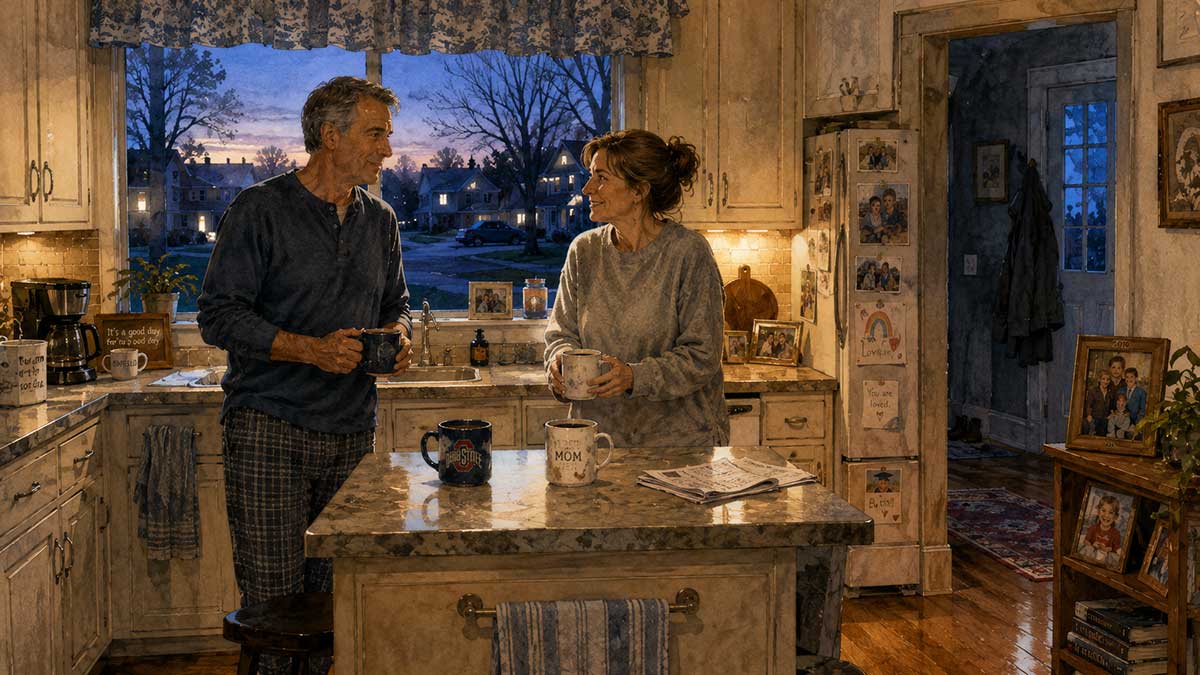
At 5:43 every morning, Daniel Reed made two cups of coffee.
He had been doing it for so many years that he no longer thought of it as something he did for Laura.
It was simply what morning meant.
He opened the cabinet above the coffee maker and reached for the same two mugs.
His was dark blue, thick-handled, with a faded Ohio State logo that had survived hundreds of trips through the dishwasher.
Laura's was white.
Or it had once been white.
A thin crack ran beneath the handle, and the words BEST MOM EVER had faded until only MOM remained clearly visible.
Their daughter had given it to her in second grade.
Their daughter was thirty now.
Daniel poured coffee into both.
A little milk in his.
More in hers.
He heard footsteps upstairs.
A minute later Laura entered the kitchen wearing an old gray sweatshirt, her hair gathered loosely behind her head.
She picked up her mug.
Looked inside.
Then looked at Daniel.
“Too much coffee.”
“You say that every morning.”
“Because every morning you put too much coffee in it.”
“I've been making your coffee for thirty-one years.”
“And you still haven't learned.”
Daniel took a sip from his own mug.
“Maybe the problem is your instructions.”
“My instructions are milk with some coffee.”
“That's not coffee.”
“It is to me.”
Laura took another sip.
Then she leaned over and kissed him on the cheek.
“Thank you.”
Daniel smiled.
“You're welcome.”
Outside the kitchen window, Ashfield was still dark.
Across the street, a porch light came on.
A garage door opened.
Somewhere down the block, a dog barked.
It was Tuesday.
Nothing important was happening.
Daniel would later remember that morning precisely for that reason.
At fifty-eight, Daniel had become the kind of man younger people occasionally described as “settled.”
He wasn't sure whether they meant it kindly.
He had taught American history at Ashfield Central High School for twenty-eight years.
Same school.
Same hallways.
Same classroom for the past eleven.
Every August, another group of seventeen-year-olds arrived believing they were the first people in history to discover that adults were hypocrites.
Every May, Daniel watched them leave.
Some returned years later.
Most didn't.
His life outside school had been similarly predictable.
Thirty-one years married to Laura.
Two children.
One house.
One mortgage, finally paid.
One church they attended more faithfully some years than others.
One neighborhood where Daniel knew who owned almost every dog but occasionally forgot the owners' names.
There had been no dramatic reinvention.
No startup.
No year living in Paris.
No motorcycle purchased at forty-five.
No secret second life.
And until that Tuesday, Daniel had rarely wondered whether this represented success or failure.
Then Mark Bell asked him a question over lunch.
Mark taught economics three classrooms down.
He was fifty-four, recently single after the end of a six-year relationship, and had spent the previous summer traveling through Portugal and Spain.
He was showing Daniel photographs on his phone.
Lisbon.
Porto.
Barcelona.
A tiny village Daniel couldn't pronounce.
“You should do this,” Mark said.
“Laura and I went to Florida last year.”
Mark stared at him.
“Florida?”
“We had a very nice time.”
“Daniel.”
“What?”
“I'm showing you Barcelona and you counter with Florida.”
Daniel laughed.
Mark scrolled to another photograph.
A stone terrace overlooking the Mediterranean.
“Look at that.”
Daniel looked.
It was beautiful.
“You know what I realized after Karen left?” Mark asked.
Daniel waited.
“I've spent most of my adult life asking permission.”
“For what?”
“Everything.”
Mark put the phone down.
“Where are we eating? Can I buy this? Can I go there? Are we visiting your parents or mine? What are we doing for Christmas?”
Daniel smiled.
“That's called being in a relationship.”
“Exactly.”
Something in Mark's expression suggested Daniel had accidentally made his point for him.
Mark leaned back.
“I booked Portugal three days before I left.”
“Okay.”
“No discussion. No negotiation. No checking anyone else's schedule.”
“Sounds terrifying.”
Mark laughed.
“It was incredible.”
Daniel took another bite of his sandwich.
Mark studied him.
“You've been married since what, twenty-six?”
“Twenty-seven.”
“Thirty-one years?”
Daniel nodded.
Mark whistled.
“Man.”
“What?”
“Nothing.”
“That's never nothing.”
Mark smiled.
“I was just thinking about how many decisions that is.”
Daniel frowned.
“What does that mean?”
“How many times you've had to compromise.”
“Probably a lot.”
“How many places you didn't go.”
Daniel shrugged.
“How many things you didn't do.”
“Mark.”
“How many women you never…”
Daniel raised his hand.
“Careful.”
Mark laughed.
“I'm not telling you to cheat.”
“Good.”
“I'm saying you picked one road really young.”
Daniel looked at him.
“And?”
Mark lifted his shoulders.
“Don't you ever wonder what was down the others?”
Daniel returned to his classroom.
For the rest of the afternoon, the question irritated him.
Not because Mark was right.
Because Daniel couldn't immediately prove he was wrong.
During sixth period, his students were discussing postwar America.
Daniel wrote dates on the board.
He listened to a student explain suburbanization.
But part of his mind wandered somewhere else.
What had been down the other roads?
At thirty-two, Daniel had been offered a teaching position in Colorado.
He had wanted it.
Laura had just given birth to their second child.
Her mother lived twenty minutes away.
They stayed in Ohio.
At thirty-eight, an old college friend invited him to help start a private school in North Carolina.
Daniel said no.
At forty-three, he had considered leaving teaching entirely.
He didn't.
There were trips postponed.
Purchases discussed.
Weekends spent at children's soccer games instead of doing whatever forty-year-old Daniel might otherwise have done.
Then there were smaller things.
Thousands of them.
What should we eat?
Where should we go?
Can you pick her up?
Can you take him?
Did you pay that bill?
Your mother called.
My father needs help.
The furnace is making that noise again.
Thirty-one years of tiny negotiations.
Daniel stared at the dates on the board.
One road.
Mark wasn't wrong about that.
That evening, Daniel drove home alone.
Laura had texted that she was meeting her sister for dinner.
The house felt unusually quiet when he entered.
He put his keys on the counter.
Opened the refrigerator.
Closed it.
Opened it again as though something better might have appeared.
Nothing.
He ordered Thai food.
Whatever he wanted.
Extra spicy.
Laura hated spicy food.
He turned on a basketball game.
Loud.
Nobody asked him to lower it.
He ate from the carton on the couch.
For about twenty minutes, Daniel enjoyed himself immensely.
Then halftime came.
He looked around the room.
The framed photographs on the bookshelf seemed suddenly excessive.
Daniel and Laura at twenty-seven.
Daniel holding their daughter outside the hospital.
Their son missing both front teeth.
A vacation in South Carolina.
Their daughter's college graduation.
Their son's wedding.
Laura laughing beside a lake.
There were thirty-one years on those shelves.
Mark's question returned.
What had been down the other roads?
Daniel tried to picture them.
Colorado.
Perhaps mountains outside his classroom window.
North Carolina.
Perhaps he would have become an administrator.
Perhaps he would have made more money.
Perhaps he would have traveled more.
Perhaps he would have met someone else.
That thought made him uncomfortable.
There could have been another woman.
Another house.
Different children.
Or no children.
A version of Daniel who had spent summers in Europe.
A version who became a principal.
A version who never married.
A version who bought a motorcycle.
He laughed aloud at that one.
Then his phone rang.
Laura.
“Hi.”
“Where are you?”
“Home.”
“Can you come get me?”
Daniel sat upright.
“What happened?”
“My car won't start.”
“Where?”
“Outside Melissa's.”
“Battery?”
“I think so.”
“I'm coming.”
“I'm sorry.”
“Why?”
“You're already home.”
Daniel looked at the television.
A commercial was playing.
“Laura.”
“What?”
“I'll be there in fifteen minutes.”
Rain had started.
Not heavy.
The thin Ohio rain that made every windshield dirty and every road reflect headlights.
Daniel drove across Ashfield.
He stopped at a red light near the high school.
A young couple crossed in front of him beneath one umbrella.
They were arguing.
He couldn't hear the words, but he could tell.
The woman walked faster.
The man hurried after her.
Daniel smiled.
Thirty-one years.
Yes, there had been arguments.
A spectacular one about money during their seventh year.
Another about Daniel's father.
One about Laura returning to work after their second child.
One that began over a dishwasher and somehow ended with both of them discussing whether they still loved each other.
There had been months when they felt less like lovers than managers of a failing small business.
There had been nights Daniel slept facing the wall.
Nights Laura cried in the bathroom because she didn't want the children to hear.
There had been a year when their son barely spoke to them.
Laura's mother developed cancer.
Daniel spent months driving her to appointments because Laura couldn't keep missing work.
Then Daniel's father began forgetting things.
Laura was the one who first noticed.
Marriage had not protected them from suffering.
It had mostly guaranteed that when suffering arrived, there would be someone else standing inside it.
The light turned green.
Daniel drove on.
Laura was standing beneath the awning when he arrived.
She ran toward the car holding her purse above her head.
Daniel unlocked the door.
She climbed inside.
Her hair was wet.
“You're my hero.”
“I drove eleven minutes.”
“Still.”
“You didn't even try jumping it?”
“I opened the hood.”
“And?”
“I looked at the engine.”
Daniel laughed.
“That usually fixes it.”
“I thought so.”
She reached over and turned down the radio.
Daniel looked at her.
“What?”
“It's loud.”
He started laughing.
“What?”
“Nothing.”
“Why are you laughing?”
Daniel shook his head.
“Nothing.”
Laura stared at him.
“You're weird tonight.”
“I know.”
They called roadside assistance.
The battery needed replacing.
By the time everything was finished, it was nearly ten.
They stopped at a diner on the way home.
Laura ordered pie.
Daniel ordered coffee.
Two mugs appeared on the table.
Plain white restaurant mugs.
Daniel looked at them.
Laura noticed.
“What?”
“Nothing.”
“You keep saying nothing.”
Daniel stirred his coffee.
“Mark asked me something today.”
“Mark from economics?”
“Yes.”
“The one who went to Spain?”
“Portugal too.”
“Of course.”
Daniel smiled.
“He asked whether I ever wondered about all the lives I didn't live.”
Laura's fork stopped halfway to her mouth.
“That sounds like Mark.”
“He said I chose one road too early.”
Laura put down the fork.
“And?”
“I've been thinking about it.”
Her face changed slightly.
Not fear exactly.
Something more cautious.
“Okay.”
Daniel realized how his words sounded.
“No, no. Not like that.”
“Like what?”
“I'm not leaving you.”
“I didn't say you were.”
“You made a face.”
“I made a listening face.”
“That was not a listening face.”
Laura smiled.
“Continue.”
Daniel looked down at his coffee.
“I did give things up.”
Laura nodded.
“So did I.”
That surprised him.
Of course she had.
Yet somehow his afternoon fantasy had contained only his roads.
“What?”
Laura laughed softly.
“You think you were the only one who had other possibilities?”
“No.”
“You looked surprised.”
“I wasn't.”
“You were.”
Daniel smiled.
“Fine.”
Laura leaned back.
“I wanted to go back to graduate school.”
“I know.”
“I almost took that job in Chicago.”
“I remember.”
“I wanted a third child.”
Daniel looked at her.
“You never told me that.”
“I did.”
“When?”
“Several times.”
Daniel searched his memory.
Maybe she had.
Maybe he had heard it as conversation rather than longing.
Laura took another bite of pie.
“We both gave things up.”
Daniel nodded.
“Do you regret it?”
Laura thought.
“Yes.”
The answer landed harder than Daniel expected.
She saw his face.
“I didn't say I regret you.”
“I know.”
“I regret things.”
She shrugged.
“Don't you?”
“Yes.”
“That's being fifty-six.”
Daniel smiled faintly.
Laura continued.
“I would have liked graduate school.”
She looked through the diner window.
“I sometimes wonder who I would have been in Chicago.”
Daniel said nothing.
“And sometimes I miss having babies so much I can physically feel it.”
She smiled.
“Then I remember not sleeping for three years and recover.”
Daniel laughed.
Laura reached across the table.
“Daniel, choosing one life doesn't make all the other possible lives disappear from your imagination.”
He looked at her hand.
“But that doesn't mean you chose wrong.”
They drove home in silence.
Not uncomfortable silence.
Thirty-one-year silence.
There was a difference.
At home, Laura went upstairs.
Daniel stayed in the kitchen.
He opened the cabinet.
Two mugs.
Blue.
White.
He took them down and placed them beside each other.
Mark had been right about something.
Daniel had closed doors.
Many of them.
But standing there, he suddenly saw the assumption hidden inside Mark's question.
That an open door represented freedom.
And a closed door represented loss.
What if sometimes closing a door was how you built a room?
Daniel looked around the kitchen.
They had renovated it twice.
The mark on the doorframe from measuring the children was still there because Laura had refused to paint over it.
Daniel, age 7.
Emma, age 9.
Daniel Jr., age 14.
Someone had once spilled grape juice beneath the refrigerator, and Daniel still suspected some molecules remained.
Laura's mother had sat at this table after chemotherapy.
Their daughter had announced her engagement here.
Their son had once screamed that he hated both of them from approximately where Daniel was standing.
Laura had told Daniel she thought she might have a lump in her breast here.
It was benign.
Daniel had cried anyway.
How many breakfasts?
How many arguments?
How many apologies?
How many ordinary Tuesdays?
One road.
Yes.
But it had become very long.
The next afternoon Mark appeared in Daniel's classroom.
“Beer tonight?”
“Can't.”
Mark smiled.
“Permission denied?”
Daniel laughed.
“No. Laura and I are having dinner with our daughter.”
“See?”
“See what?”
“Schedules.”
Daniel capped his marker.
“Can I ask you something?”
“Sure.”
“When you were in Portugal, did you wish Karen were there?”
Mark stopped smiling.
Daniel immediately regretted asking.
“Sorry.”
“No.”
Mark looked toward the empty student desks.
“Sometimes.”
Daniel waited.
Mark put his hands in his pockets.
“The first week was incredible.”
“And the second?”
“Still incredible.”
Daniel smiled.
“Very persuasive.”
Mark laughed.
“It's complicated.”
“I know.”
Mark looked at him.
“I don't regret going.”
“I didn't ask if you did.”
“No.”
Mark hesitated.
“I just sometimes wished someone knew what I was looking at.”
Daniel understood.
Not someone nearby.
Someone who knew him.
There was a difference.
Mark looked toward the door.
“Anyway. Another time.”
“Definitely.”
He started to leave.
“Mark.”
He turned.
“Portugal really did look incredible.”
Mark smiled.
“It was.”
Daniel meant it.
That Saturday, Daniel and Laura sat on their back porch.
Autumn had begun touching the trees.
Their daughter had visited earlier with her husband.
Their son had called from Virginia.
A neighbor had borrowed Daniel's ladder.
Someone from church had texted Laura about bringing dinner to a woman recovering from surgery.
Daniel looked at his wife.
“Do you think marriage made your life smaller?”
Laura lowered her book.
“You're still thinking about this?”
“Yes.”
She closed the book.
“Sometimes.”
Daniel laughed.
“That's not the answer I was hoping for.”
“You asked.”
“I did.”
Laura looked across the yard.
“It made some parts smaller.”
She thought.
“My time wasn't completely mine.”
“My money wasn't completely mine.”
“Where I lived wasn't completely my decision.”
“My weekends.”
“My body, especially when the kids were little.”
She looked at Daniel.
“So yes.”
Daniel nodded.
Then she said:
“But it made other things bigger.”
“Like what?”
Laura considered.
“My definition of myself.”
Daniel waited.
“I started as Laura.”
She pointed at him.
“Then somehow your life got mixed into mine.”
“The kids.”
“Your parents.”
“My parents.”
“Friends.”
“Neighbors.”
“People I never would have known without you.”
She looked at the trees.
“I lost some independence.”
Daniel said nothing.
“I gained belonging.”
The words settled between them.
Daniel thought about his students.
Every year they asked him some version of the same question.
What should I major in?
Where should I go?
What career should I choose?
How do I know?
They wanted him to tell them which road would leave all the other roads available.
He never knew how to explain that adulthood didn't work that way.
Maybe nobody had explained it to him either.
Daniel reached for Laura's hand.
“I think I figured something out.”
“That sounds dangerous.”
“When I was younger, I thought commitment meant choosing one person instead of all the other possibilities.”
Laura looked at him.
“And now?”
Daniel watched a leaf fall into the yard.
“I think it meant choosing what I wanted to become responsible for.”
Laura said nothing.
For a moment Daniel worried the sentence sounded better in his head.
Then she squeezed his hand.
“That sounds exhausting.”
Daniel laughed.
“It is.”
“Good.”
“Good?”
“I'd hate to think I spent thirty-one years being easy.”
Daniel laughed harder.
Laura reopened her book.
After a moment she said:
“You know what I think?”
“What?”
“You're making my coffee wrong on purpose.”
Daniel stared at her.
She turned a page.
“I've suspected it for years.”
Monday morning arrived.
5:43.
Daniel entered the kitchen.
He opened the cabinet.
Two mugs.
Blue.
White.
He poured his coffee.
Then Laura's.
He deliberately added slightly too much coffee.
A few minutes later she entered.
Picked up the mug.
Took one sip.
She looked at him.
Daniel waited.
“Too much coffee.”
“You say that every morning.”
“Because every morning you put too much coffee in it.”
Daniel smiled.
Outside, Ashfield was waking.
Garage doors opened.
Cars backed into the street.
Somewhere a baby was crying.
Someone was leaving for work.
Someone was returning from a night shift.
Someone was waking alone.
Someone beside a person they had loved for decades.
Daniel knew there were other roads.
He no longer needed to pretend otherwise.
There were countries he had never seen.
Jobs he had never taken.
People he had never met.
Versions of himself who would never exist.
He could mourn some of them.
He could wonder about them.
He could occasionally envy them.
And still love this one.
Laura reached across the counter and stole half of his toast.
“That's mine.”
“We've been married thirty-one years.”
“That doesn't make it yours.”
“I think legally it does.”
“It absolutely does not.”
She took another bite.
Daniel looked at the two mugs sitting beside each other.
One chipped.
One faded.
Neither particularly beautiful.
Tomorrow morning, he would take them down again.
Not because he had forgotten the other possibilities.
Because after thirty-one years, he finally understood something about choosing.
Some doors close.
And behind one of them, if you stay long enough and care for what is there, an entire life can grow.
Story 2: The Room He Never Used
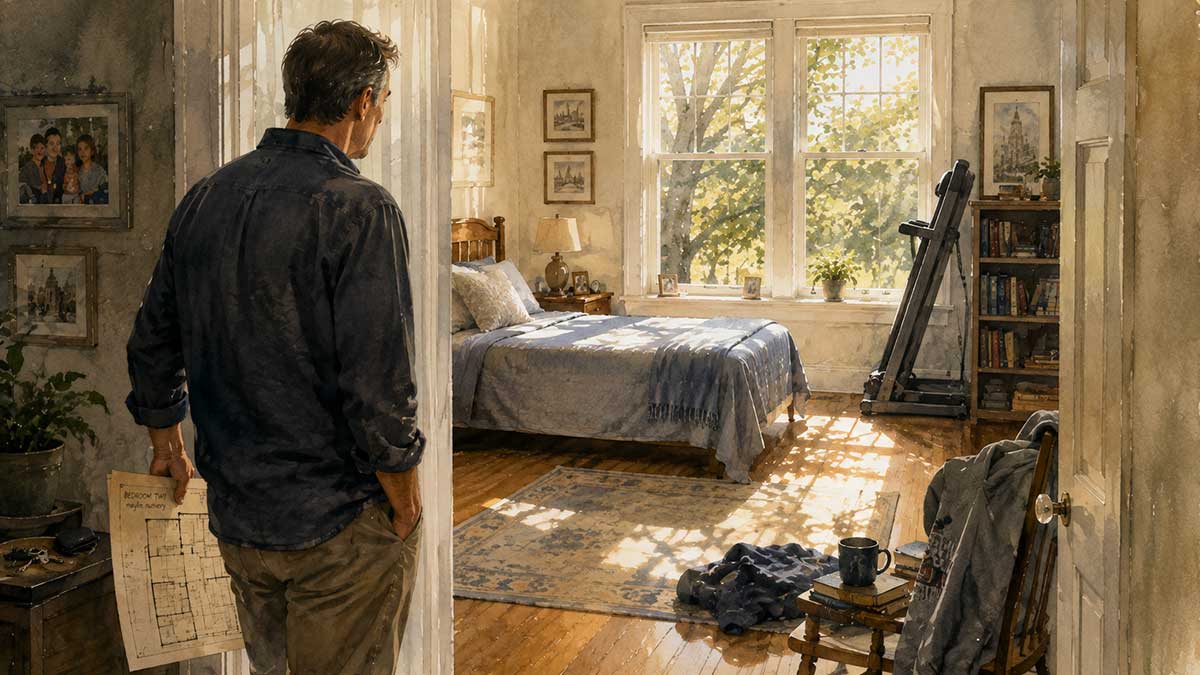
The realtor stood in the doorway of the second bedroom and looked around.
“What did you use this room for?”
Evan Cole had lived in the house for fifteen years.
He should have had an answer.
Instead, he looked at the room as though he had accidentally opened a door in someone else's house.
Three cardboard boxes sat against one wall.
A folded treadmill leaned beneath the window.
There was an old floor lamp without a bulb, two framed architectural prints he had never hung, and a suitcase he used whenever he traveled internationally.
“Storage,” Evan said.
The realtor stepped inside.
It was a beautiful room.
Morning light came through two tall windows overlooking a maple tree in the backyard. The hardwood floor was almost untouched.
“This would make a wonderful guest room.”
“Sure.”
“Or office.”
“I have an office downstairs.”
She looked around again.
“Nursery, obviously, for buyers with young children.”
Evan said nothing.
The realtor had already turned toward the hallway.
“We should probably stage it.”
“Okay.”
“Maybe a bed. Nightstand. Something to help people imagine it.”
Evan remained in the doorway.
“That makes sense.”
She walked downstairs.
Evan stayed.
He looked at the empty room.
Then at the wall beside the closet.
For reasons he could not explain, he suddenly remembered something he had not thought about in years.
There had once been writing there.
Not on the wall.
On a piece of paper.
Fifteen years earlier, when the house was still being built, Evan had stood in this exact room holding the architect's floor plan.
He had been thirty-seven.
The realtor at the time had called it Bedroom Two.
Evan had taken a pencil and written two words beside it.
Maybe nursery.
He had laughed immediately afterward.
Then folded the plan and put it away.
Someday.
That had been the idea.
Not no.
Just not yet.
At fifty-two, Evan had the kind of life people often described as enviable.
He was a partner at a successful commercial architecture firm in Columbus.
He earned more money than he had imagined earning when he was twenty-five.
He owned his house outright.
He drove a four-year-old BMW that still looked new.
He had traveled to thirty-one countries.
Kyoto twice.
Iceland.
Peru.
Italy.
Morocco.
Portugal.
South Africa.
He had friends in three states who would happily let him sleep on their couches, though he had long since reached the age when he preferred hotels.
His refrigerator contained expensive cheese and almost nothing that could be assembled into a complete meal.
His passport had been renewed three times.
His life was not empty.
This mattered.
Evan had loved women.
This mattered too.
There had been Alison in graduate school.
Dana when he was thirty.
Rachel from thirty-six to forty-one.
Then Nina.
Then shorter relationships that ended without catastrophe.
Nobody had ruined his life.
He had not spent thirty years sitting alone in a dark room afraid to love anyone.
He simply had never crossed certain lines.
Marriage.
Children.
Forever.
The lines had always seemed unnecessarily permanent.
And Evan had very good reasons for distrusting permanent things.
When Evan was eleven, he heard his mother throw a plate at his father.
He didn't see it.
He heard it.
The plate hit the kitchen wall.
Then silence.
His younger brother, Andrew, was eight.
They sat together at the top of the stairs.
Their father's voice came first.
Low.
Then their mother's.
Loud.
Then the name of a woman Evan did not know.
Years later, he learned there had been several women.
His parents remained married until Evan left for college.
Everyone congratulated them on twenty-two years.
People at church called them a strong couple.
Evan knew better.
His mother stayed because she had been out of the workforce for fifteen years.
His father stayed because divorce would have been expensive.
They occupied the same house like neighboring countries after a failed peace treaty.
When the divorce finally came, Evan's mother said something he never forgot.
“Never let another person become your only option.”
She had meant money.
Evan understood it as life.
Rachel was the closest he came.
She was thirty-five when they met.
A landscape architect.
Funny.
Impatient.
Terrible at parking.
She read novels in bed and folded page corners, which Evan considered vandalism.
They moved in together after eighteen months.
At first, Evan was surprised by how easy it felt.
Rachel did not make his life smaller.
She made the grocery store more interesting.
She knew which buildings he hated and would point at them when they drove past.
“There goes your enemy.”
“That's not architecture.”
“It's a dentist's office.”
“Exactly.”
She understood why Evan stopped walking sometimes to look at the way a roof met a wall.
Evan learned that Rachel cried at animal rescue videos.
They fought about dishes.
They fought about his work.
They fought once because Evan corrected her pronunciation of “bruschetta” in front of friends.
He never did that again.
At thirty-eight, Rachel began talking seriously about children.
Evan did not say no.
He said:
“Let's get through this year.”
The firm was making him partner.
The following year, Rachel brought up marriage.
Evan said:
“Of course. Eventually.”
She asked:
“What does eventually mean?”
He kissed her forehead.
“Not tonight.”
She laughed.
So did he.
At thirty-nine, they toured a wedding venue with her sister.
Not for themselves.
Her sister was getting married.
Driving home, Rachel said:
“I want this.”
Evan kept his eyes on the road.
“I know.”
“Do you?”
“Yes.”
“Do you want it?”
“I want you.”
“That wasn't my question.”
Evan remembered gripping the steering wheel.
“We're good, Rachel.”
“I know we're good.”
“Then why are we creating a problem?”
She turned toward the window.
“We're not creating it.”
The relationship lasted another two years.
There was no affair.
No screaming.
No betrayal.
That almost made the ending worse.
One Sunday morning Rachel sat across from him at the kitchen table.
She was forty.
Evan knew before she spoke.
“I can't keep waiting for you to decide whether you want the life I want.”
“I want you.”
“I know.”
“Then stay.”
Rachel cried.
Evan did not.
Not until later.
“I want children.”
“We can still have children.”
“When?”
Evan had no answer.
Rachel wiped her face.
“You always think time is waiting for you.”
“That isn't fair.”
“Isn't it?”
“We have time.”
“You have time.”
Evan remembered the silence afterward.
He remembered understanding what she meant and hating her for making him understand it.
She moved out six weeks later.
For almost a year, Evan believed she would come back.
She didn't.
Two years later, a mutual friend told him Rachel had married.
Evan sent her a message.
I'm happy for you.
He meant it.
Mostly.
A few years after that, he saw a photograph of Rachel holding a baby girl.
He stared at the photograph for a long time.
Then closed the app.
He booked a trip to Iceland that night.
Andrew died on a Thursday.
Heart attack.
Fifty years old.
No warning.
Evan was standing inside a conference room presenting a hospital renovation when his phone vibrated.
He ignored it.
It vibrated again.
Then again.
During a break, he looked.
Six missed calls.
His sister-in-law, Beth.
He called her.
Everything after that became fragments.
Hospital.
Drive.
Elevator.
Beth's face.
A doctor saying words Evan understood individually but could not assemble into meaning.
Andrew beneath a white sheet.
His little brother.
The eight-year-old sitting beside him at the top of the stairs.
Gone.
Three days later, Evan stood at the funeral and watched his brother's life fill a church.
Andrew had been an insurance agent.
Not famous.
Not rich.
Not particularly adventurous.
He had gone to Mexico once.
He complained about yard work.
He watched the Cleveland Browns even when doing so was clearly harmful to his emotional health.
He had married Beth at twenty-four.
They had three children.
Maya, twenty-four.
Lucas, twenty-one.
Sophie, seventeen.
All three sat beside their mother.
Maya held Beth's hand.
Lucas had one arm around Sophie.
When Beth began shaking during the final hymn, all three children leaned toward her at once.
Evan watched them.
He hated himself for what he felt next.
Envy.
At his brother's funeral.
He looked away.
This was grief.
This was terrible.
Andrew had died.
Beth had lost her husband.
Three children had lost their father.
Nothing about this scene was desirable.
Yet inside the devastation was something Evan could not stop seeing.
They belonged to one another.
Andrew was gone, but evidence of his life was sitting in the first pew.
Not just biological evidence.
Years.
Arguments.
Christmas mornings.
School pickups.
Bad jokes.
College tuition.
Family vacations.
Apologies.
Traditions.
Three people who knew exactly how Andrew sneezed.
Three people who knew which stories he repeated.
Three people carrying pieces of him Evan did not possess.
Evan felt ashamed for thinking this way.
Then he felt ashamed for feeling ashamed.
Grief had no manners.
After the funeral, people filled Beth's house.
Casseroles appeared.
Cookies.
Sandwich trays.
Flowers.
Someone brought six gallons of iced tea.
Evan moved through the rooms accepting condolences.
“You were such good brothers.”
“He talked about you all the time.”
“He was so proud of you.”
Each sentence made Andrew more absent.
Late that night, everyone left except family.
Maya sat beside Evan on the back porch.
She had Andrew's eyes.
Evan had never noticed before.
“You okay?” she asked.
He almost laughed.
“You're asking me?”
She shrugged.
“Dad would.”
That nearly broke him.
Evan looked into the yard.
“When did you get so old?”
“Twenty-four years ago, gradually.”
“Smartass.”
“Genetics.”
They sat quietly.
Maya eventually said:
“Mom doesn't know how she's going to live in this house.”
“Financially?”
“No. Just…”
She looked through the window.
“Without him.”
Evan nodded.
Then Maya asked:
“Uncle Ev?”
“Yeah?”
“Were you ever going to get married?”
The question surprised him.
“Why?”
“I don't know.”
“That's a dangerous beginning.”
She smiled.
“I was just thinking about Dad.”
Evan waited.
“You guys came from the same family.”
“Unfortunately.”
“You're so different.”
“We were.”
“Dad couldn't stand being alone.”
“He could barely go to Home Depot alone.”
Maya laughed.
Then:
“You seem good at it.”
Evan looked at her.
“At Home Depot?”
“Being alone.”
The sentence did not sound cruel.
That made it harder.
“I am.”
“Do you like it?”
Evan considered giving her the easy answer.
Most days.
Instead:
“Sometimes.”
Maya nodded.
“Did you ever want kids?”
Evan looked back toward the yard.
A swing Andrew had built when Sophie was six still hung from the maple tree.
“I think so.”
“You think?”
“I never decided.”
Maya waited.
Evan corrected himself.
“I kept deciding later.”
She looked at him.
He could see the thought forming before she said it.
“You decided every year.”
Evan turned toward her.
Maya's face changed.
“Sorry.”
“No.”
“I didn't mean…”
“No.”
He looked at the swing again.
“You're right.”
Evan returned home two days later.
He opened the front door.
Silence.
He had always liked the silence.
That night it sounded different.
He walked upstairs.
Past his bedroom.
Past the bathroom.
He stopped at the second bedroom.
Storage.
He turned on the light.
Three boxes.
Treadmill.
Suitcase.
Floor lamp.
He entered.
For the first time in years, he opened the closet.
Old tax records.
Winter coats.
A printer.
A plastic container full of papers.
Evan pulled it out.
He sat on the floor.
Insurance documents.
Closing papers.
Appliance warranties.
Then he found it.
The original floor plan.
Fifteen years old.
He unfolded it carefully.
Kitchen.
Living room.
Primary bedroom.
Bedroom Two.
Beside it, in pencil:
maybe nursery
Evan stared at the words.
He remembered writing them.
Thirty-seven.
Rachel had not moved in yet.
He had bought this house before they met.
That mattered.
The possibility had existed before Rachel.
Some part of him had imagined it.
A crib.
A child.
Someone asleep beneath those windows.
Evan pressed his thumb against the pencil marks.
He could have erased them.
He didn't.
For several weeks after Andrew's death, Evan became angry at himself.
It was an unproductive kind of anger.
He replayed Rachel.
The conversations.
The postponements.
He imagined alternate histories.
Marriage at thirty-nine.
A child at forty.
Perhaps another at forty-three.
Soccer games.
School concerts.
College applications.
Christmas.
He constructed an entire family from events that had never happened.
Then one evening he stopped himself.
He knew architecture too well to mistake drawings for buildings.
An imagined life had no plumbing problems.
No miscarriages.
No rebellious teenagers.
No divorce.
No child with addiction.
No marriage becoming bitter.
No sleepless nights.
No resentment.
No illness.
His fantasy family was perfect precisely because nobody had lived in it.
Evan understood something important.
He was not grieving the certainty of a wonderful marriage and children.
No such certainty had ever existed.
He was grieving the possibility.
That was different.
And still real.
Maya called in November.
“Can I ask you something?”
“Depends.”
“I got an interview.”
“For what?”
“A graduate program.”
“Where?”
“Ohio State.”
Evan sat up.
“I thought you were applying out west.”
“I am.”
“But?”
“If I get the interview, can I stay with you?”
“Of course.”
“Just two nights.”
“You can stay as long as you want.”
“Do you even have a guest room?”
Evan looked toward the ceiling.
“Yes.”
He paused.
“Technically.”
The next Saturday, Evan went furniture shopping.
He hated furniture shopping.
He bought a bed.
Not expensive.
A nightstand.
A lamp.
He moved the treadmill downstairs.
Threw away two boxes of things he had not touched in a decade.
The suitcase went into the closet.
He painted the room.
Not nursery yellow.
Not symbolic blue.
Just warm white.
Maya arrived three weeks later.
She stood in the doorway.
“You did all this?”
“I needed a guest room.”
“For fifteen years?”
“I've been busy.”
She dropped her bag.
“It's nice.”
“Don't get used to it.”
Maya hugged him.
Evan stiffened for half a second.
Then hugged her back.
She smelled faintly like Andrew's house.
Laundry detergent.
Something familiar.
He closed his eyes.
That night they ordered pizza.
Maya told him about graduate school.
Her boyfriend.
Her mother.
Sophie struggling with Andrew's death.
Lucas pretending not to struggle.
Evan listened.
At one point Maya said:
“Mom says you should come over more.”
“I will.”
“You always say that.”
Evan looked at her.
She froze.
“Sorry.”
“No.”
He put down his slice.
“I do.”
Maya waited.
Evan looked toward the hallway.
“I spent a lot of my life thinking freedom meant not being trapped by a decision.”
She said nothing.
“I didn't understand that not deciding becomes a decision too.”
Maya leaned back.
“Do you wish you'd married Rachel?”
Evan smiled sadly.
“That's not the right question.”
“Why?”
“Rachel isn't a road I forgot to take.”
He thought for a moment.
“She was a person. She deserved to make her own choice too.”
Maya nodded.
“I wish I had understood myself better when I was younger.”
“That's different.”
“Very.”
“Do you wish you had kids?”
Evan looked at her.
“Yes.”
He surprised himself by saying it so plainly.
Then he added:
“Some days.”
Maya smiled.
“That's allowed.”
“I hope so.”
“You'd have been an annoying dad.”
“I would have been exceptional.”
“You corrected my grammar in birthday cards.”
“You needed help.”
“I was seven.”
“Critical developmental period.”
Maya laughed.
For a moment, Evan heard Andrew.
Not literally.
Nothing supernatural.
Just something in the rhythm.
A family resemblance passing through the room.
The house did not sell.
Evan took it off the market.
The realtor was surprised.
“Changed your mind?”
“For now.”
“Something happen?”
Evan thought about it.
“Yes.”
“What?”
He smiled.
“Nothing dramatic.”
Winter came.
Then spring.
Evan began having dinner at Beth's house twice a month.
Sometimes it was awkward.
Sometimes Sophie barely spoke.
Lucas usually arrived late.
Maya was away at school.
Andrew's absence remained enormous.
Nobody replaced him.
That was not the purpose.
Evan learned that relationships could not be manufactured in a burst of late-life panic.
They accumulated.
Phone calls.
Showing up.
Remembering.
Driving someone to the airport.
Sitting through boring stories.
Asking twice when the first “I'm fine” was obviously false.
He had spent decades building buildings.
Now he began to understand that relationships required an architecture too.
Not walls.
Repetition.
One Sunday afternoon, Evan stood in the second bedroom.
Maya had visited the previous weekend.
The bed was unmade.
A sweatshirt hung over the chair.
Three books were stacked beside the lamp.
A coffee cup sat on the windowsill despite Evan having specifically told her not to put coffee on wood.
He picked it up.
There was a faint ring beneath it.
“Unbelievable,” he muttered.
He carried the mug toward the door.
Then stopped.
He looked back.
For fifteen years, the room had been perfect.
Clean floor.
Empty walls.
Nothing damaged.
Nothing misplaced.
Nothing needed.
Now there was a dent in the pillow.
A phone charger forgotten beside the bed.
A receipt on the floor.
A hair tie on the nightstand.
Evidence.
Someone had been here.
Someone would return.
Evan thought of the old floor plan.
maybe nursery
He still had it.
He would never erase those words.
There were losses that could not be repaired by changing the room.
He would not pretend otherwise.
He was fifty-two.
Some doors had closed.
Not metaphorically.
Biologically.
Historically.
Relationally.
Time had made choices that younger Evan believed could be postponed indefinitely.
He regretted that.
He could say it now.
He regretted it.
But regret did not require him to declare his entire life a mistake.
He had loved.
Worked.
Travelled.
Built beautiful things.
Helped friends.
Been a brother.
Been an uncle.
There were people who knew him.
There were still people he could know better.
Evan carried the coffee cup downstairs.
His phone buzzed.
A message from Maya.
Mom wants to know if you're coming Sunday.
Evan typed:
Yes.
Then stopped.
Old Evan might have written:
Probably.
Or:
I'll let you know.
Or:
Depends on work.
He looked at the word.
Yes.
Such a small word.
Such an enormous thing.
He sent it.
Upstairs, afternoon sunlight entered the room he had never used.
It fell across the unmade bed, the forgotten books, and the faint coffee ring on the windowsill.
For years Evan had protected that room from becoming anything because becoming one thing meant it could no longer become everything else.
He understood now what buildings had been trying to teach him his entire life.
A room becomes useful only after someone decides what it is for.
Story 3: Table for Twelve
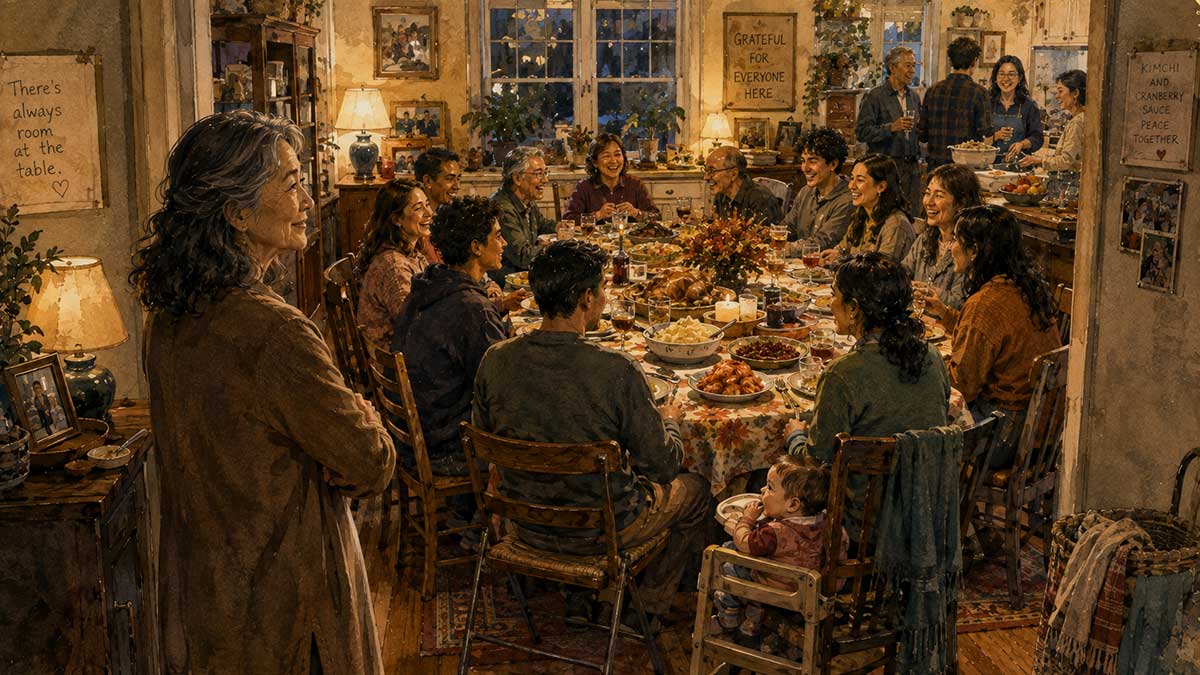
At 8:12 on Thanksgiving morning, Marianne Cho was dragging a folding table through her garage when Mr. Alvarez from next door called across the driveway.
“You need help?”
Marianne straightened slowly.
At sixty-one, she had reached the age when every object seemed to weigh slightly more than it had the year before.
“I have it.”
Mr. Alvarez looked at the table.
Then at Marianne.
Then back at the table.
“You don't have it.”
“I almost have it.”
“You're moving approximately three inches per minute.”
“That is still movement.”
He crossed the driveway.
Together they carried the table through Marianne's side door and into the dining room.
There was already one table there.
Oak.
Seats six comfortably.
Eight if everyone liked one another.
Marianne unfolded the second beside it.
Mr. Alvarez looked around.
“How many people are coming?”
“Twelve.”
“Here?”
Marianne looked at him.
“No, I'm practicing for a restaurant.”
He laughed.
“Twelve?”
“Maybe fourteen.”
He glanced toward the hallway as if expecting the people to appear.
Marianne lived alone.
She had lived alone for twenty-three years.
“That's a lot of people for one person.”
Marianne smiled.
“That's the idea.”
By ten o'clock, the house had begun changing shape.
Extra chairs came from the basement.
Two came from Mrs. Patel across the street.
One came from Marianne's upstairs storage room.
A card table became a place for desserts.
The kitchen filled with steam.
Marianne had cooked the turkey overnight at low heat because she did not trust Thanksgiving mornings.
A pot of rice sat beside mashed potatoes.
There was kimchi next to cranberry sauce.
Her brother, David, would complain that nobody needed kimchi with turkey.
Then he would eat more than anyone.
Marianne checked her phone.
Three messages.
Jenna: Do you still need rolls?
Priya: Arjun wants to know if he can bring his roommate.
David: Running late. Don't start without us.
Marianne typed back to Priya.
Of course. Tell him to come hungry.
Then she added another place.
Thirteen.
People sometimes assumed Marianne had always planned to remain unmarried.
That wasn't true.
She had planned almost nothing about it.
At twenty-six, she thought she would probably marry.
At thirty, still probably.
At thirty-four, maybe.
At thirty-nine, she stopped predicting.
She had dated.
There was Michael, who wanted children immediately.
There was Steven, who did not want them at all.
There was Eric, who was kind and funny and moved to Seattle.
There was Thomas, who was less kind than Marianne had initially believed.
There were several first dates that should have ended before appetizers.
Nothing had happened that made her declare:
I reject marriage.
Life simply moved.
Then one year she realized she had stopped thinking of herself as temporarily single.
The temporary had become a life.
She expected to be sadder about that realization.
Instead, she felt mostly relief.
Marianne had spent thirty-four years in pediatric care.
First as a nurse.
Then a nurse practitioner.
Children had vomited on her.
Kicked her.
Bit her once.
Parents had called her at night about fevers, rashes, breathing problems, strange lumps, strange noises, strange colors, and one memorable Lego piece inside a nostril.
She had watched frightened parents become competent.
She had watched healthy children become ill.
She had watched sick children become healthy.
She had watched some children die.
Those were the ones she still occasionally dreamed about.
Retirement had been harder than she expected.
Not from lack of work.
From lack of usefulness.
For decades, every day had contained people who needed something from her.
Then suddenly Tuesday morning arrived and nobody needed her before lunch.
She began volunteering twice a week at a community clinic.
Then helping with a literacy program.
Then mentoring two young nurses.
Then tutoring an international graduate student named Arjun who did not need tutoring so much as someone to tell him when his emails sounded terrifyingly formal.
Marianne's life filled again.
Not accidentally.
She filled it.
By noon, the first person arrived.
Jenna.
Forty-eight.
Divorced.
Former coworker.
She carried rolls and two bottles of sparkling cider.
“You said twelve.”
“Thirteen now.”
“Who?”
“Arjun's roommate.”
“Do we know him?”
“No.”
Jenna nodded.
“Perfect.”
Next came David and his daughter Lily.
David was sixty-four, widowed for three years, and still entered every room as though he were slightly surprised his wife was not already there.
Lily was seventeen.
She kissed Marianne on the cheek and immediately went to the kitchen.
“Can I eat something?”
“No.”
“I haven't eaten all day.”
“That's poor planning.”
“Aunt Marianne.”
“Olives.”
Lily took six.
Then Priya arrived with her husband and their baby.
Then Arjun and his roommate, Tomas.
Then Mrs. Patel.
Then Mr. Alvarez, who claimed he was only dropping off a chair but had clearly worn his good sweater.
Marianne pointed toward the table.
“You're staying.”
“I don't want to impose.”
“You carried furniture. You're trapped now.”
He smiled.
Fourteen.
At one fifteen, they sat.
No arrangement made sense.
That pleased Marianne.
Her brother beside Arjun.
Mrs. Patel beside Lily.
Jenna beside Tomas.
The baby in a high chair at the end.
Someone had to sit in a folding chair that leaned slightly to the left.
David lifted his glass.
“To Marianne.”
Marianne groaned.
“No speeches.”
“Too late.”
Everyone looked at her.
David continued.
“To the person who somehow turns every holiday into a refugee camp.”
Laughter.
Marianne pointed her fork at him.
“You're sleeping in your car.”
David smiled.
“To the family glue.”
People murmured agreement.
Marianne felt something tighten inside her.
Family glue.
She hated phrases like that.
They sounded sweet.
They were often used for women expected to do invisible work without complaint.
“Absolutely not,” she said.
David laughed.
“What?”
“Do not turn me into glue.”
“Fine. Family duct tape.”
“That is worse.”
Everyone laughed again.
Marianne smiled.
But the phrase stayed with her.
There had been years when Thanksgiving looked different.
When her parents were alive.
When David's wife, Susan, stood beside Marianne in the kitchen complaining that turkey was an overrated bird.
When cousins came.
When people brought toddlers who became teenagers who became adults who moved away.
Families changed shape.
That was not unique to unmarried people.
Married people lost spouses.
Children left.
Friends died.
People moved.
Marianne had learned not to confuse a relationship category with a guarantee.
Two years earlier, her sister-in-law Helen had said something Marianne still remembered.
They were at a wedding.
Not Marianne's.
Her cousin's daughter's wedding.
Helen had consumed two glasses of wine and become unusually sincere.
“I worry about you.”
Marianne had been watching people dance.
“Why?”
“You're always the one taking care of everyone.”
“That sounds flattering.”
“I mean later.”
“Later what?”
“When you're old.”
Marianne laughed.
“I am old.”
“You know what I mean.”
Helen lowered her voice.
“Who's going to be there for you?”
Marianne's first reaction was irritation.
Her second was embarrassment.
Her third arrived later, alone in bed.
Fear.
Who would be there?
It was a reasonable question.
Marriage did not guarantee care.
Children did not guarantee care.
Still, they created default relationships in ways Marianne did not have.
If she fell?
If she became sick?
If she developed dementia?
Who had permission to enter her life without being invited first?
For several weeks, the question followed her.
Then winter came.
Marianne slipped on ice outside the library.
Not dramatically.
No ambulance.
No cinematic fall.
One moment she was walking.
The next she was on the ground, furious.
Her wrist hurt immediately.
A stranger drove her to urgent care.
Fracture.
Nothing severe.
Brace.
No lifting.
No driving for several days.
Marianne returned home feeling unusually small.
She sat on the couch with her coat still on.
Then her phone rang.
Jenna.
“Where are you?”
“Home.”
“I heard.”
“Heard what?”
“Lily texted me.”
“Why does Lily know?”
“You texted David.”
“I told him not to tell everyone.”
“You've met David.”
Marianne closed her eyes.
“What do you need?”
“Nothing.”
“Wrong answer. Food?”
“I have food.”
“Do you have food that can be prepared with one hand?”
Marianne looked toward the kitchen.
Silence.
“I'll be there in twenty.”
Jenna arrived with soup.
Then David called.
Then Priya.
Then Arjun.
Then Mrs. Patel knocked.
By evening, someone had taken out her trash.
Someone walked her dog, Bori.
Someone changed the sheets because Marianne couldn't manage the fitted corners with one hand.
Jenna stayed overnight despite Marianne insisting she was fine.
At eleven, Marianne lay in bed listening to another person moving around downstairs.
She thought of Helen's question.
Who's going to be there for you?
For the first time, Marianne understood why the question had irritated her so much.
It assumed the answer had to be assigned by marriage or blood.
Her answer had been built another way.
Still built.
Not automatic.
That distinction mattered.
Thanksgiving dinner continued.
Arjun told a story about his first winter in Ohio.
Tomas argued that pumpkin pie was structurally inferior to cheesecake.
Mrs. Patel corrected everyone's understanding of how much butter should be used in mashed potatoes.
The baby began crying.
Nobody panicked.
Someone took him.
Someone else passed the rolls.
Lily spilled gravy.
Mr. Alvarez said grace in Spanish, then apologized.
Marianne told him not to apologize.
At some point, Jenna leaned toward her.
“You're lucky.”
Marianne looked around the table.
She knew what Jenna meant.
And part of it was true.
Luck mattered.
People moved.
People died.
People changed.
Some relationships survived because they had been given easier conditions than others.
But Marianne shook her head.
“Some of it is luck.”
Jenna raised an eyebrow.
Marianne looked at the fourteen people around her.
Then said:
“But tables don't fill themselves.”
Jenna smiled.
Marianne did too.
That sentence felt more true than anything she had said all week.
After dinner, everyone resisted helping until Marianne threatened them.
Then the kitchen became crowded.
David dried dishes incorrectly.
Arjun loaded the dishwasher with the confidence of someone who had never owned one.
Lily and Tomas argued about music.
Mrs. Patel wrapped leftovers.
Mr. Alvarez fell asleep in the living room.
The baby slept against Priya's chest.
Marianne stood in the doorway and watched.
For a moment, she imagined the scene from outside.
An unmarried woman.
No husband.
No children.
No grandchildren.
Those facts were all true.
Yet they explained almost nothing.
Later, after everyone left, Marianne walked through the house collecting abandoned glasses.
The second folding table was still open.
Crumbs everywhere.
Someone had left a scarf.
Someone else had left half a pie.
The dishwasher hummed.
Bori slept beneath a chair.
Marianne sat.
The house was quiet again.
And there it was.
The part nobody needed to pretend away.
She felt lonely.
Not devastated.
Not secretly broken.
Lonely.
The feeling moved through her like weather.
She thought about David going home with Lily.
Priya with her husband and baby.
People returning to bedrooms where someone else was waiting.
Marianne would go upstairs alone.
There were nights she loved that.
There were nights she didn't.
A good life did not erase every ache.
She had learned that too.
Her phone buzzed.
A message from Arjun.
Thank you. Tomas said this was his first real Thanksgiving.
Then Lily.
Love you. Mom would have loved tonight.
Then Jenna.
You forgot to send me home with pie. Unforgivable.
Then David.
Family duct tape.
Marianne laughed.
She put the phone down.
Family glue.
She still did not like the phrase.
But she understood something she had resisted.
She had been holding people together.
Not alone.
Not heroically.
Not by sacrificing herself until nothing remained.
She had simply kept making room.
Year after year.
A chair.
A meal.
A phone call.
A ride.
An introduction.
A place at the table.
That was a form of architecture too.
The next morning, Marianne began folding the extra table.
She stopped halfway.
Christmas was four weeks away.
There would probably be people.
There were always people.
She left it open.
Then she noticed one chair still pulled away from the table.
Nobody had pushed it back.
Marianne reached for it.
Stopped.
For no particular reason, she left that too.
Bori wandered into the dining room and looked at her.
“What?”
He sat.
“You think I'm becoming sentimental?”
Bori scratched his ear.
“That's what I thought.”
Marianne went to make coffee.
Behind her, morning light spread across the long table.
Fourteen plates had been there yesterday.
Today, none.
Next month, perhaps ten.
Or sixteen.
Years from now, fewer.
Or different.
Marianne did not know.
She had never known.
That was the truth of every family.
Blood did not freeze people in place.
Marriage did not.
Children did not.
Friendship did not.
Nothing guaranteed that the table would remain full.
The only thing Marianne knew was what she could do while she was here.
Invite.
Show up.
Call.
Return.
Remember.
Make room.
The life she had built was not the life everyone wanted.
It was not the life she had expected at twenty-six.
There were things it lacked.
There were things she mourned.
There were freedoms she treasured.
There were relationships she would not trade for another version of herself.
Marianne poured one cup of coffee.
Only one.
She carried it to the dining room and sat at the long table.
The empty chair remained across from her.
She looked at it for a moment.
Then smiled.
Someone would need it soon enough.
Story 4: The Year We Kept Waiting
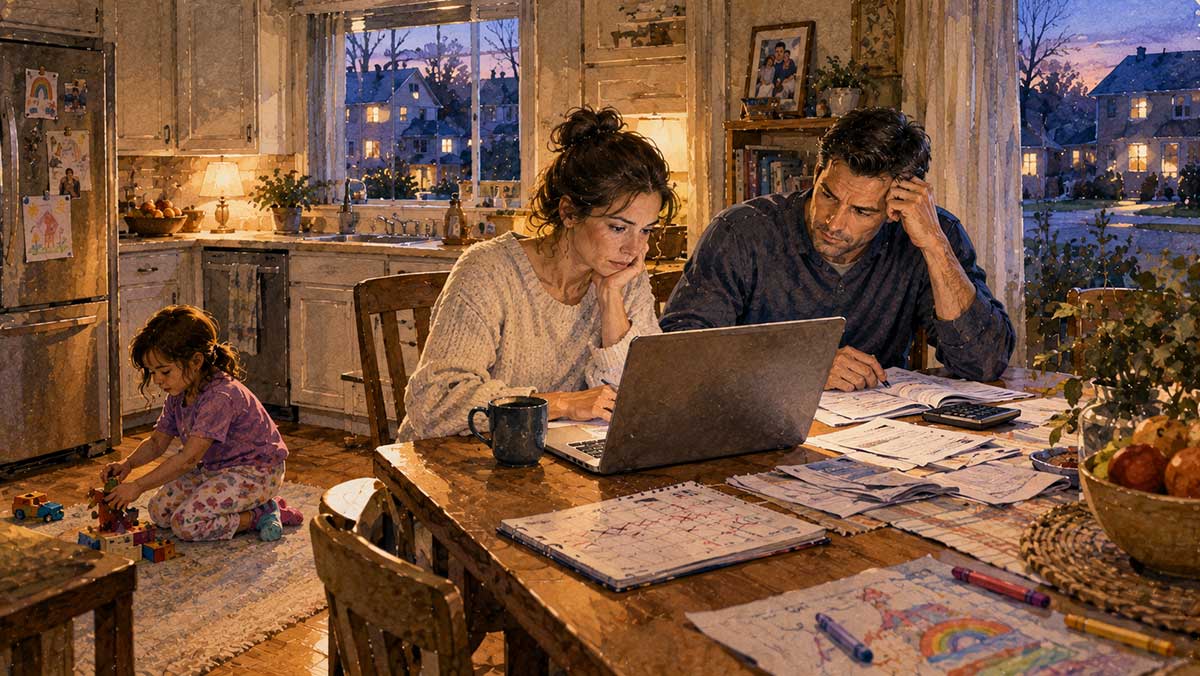
Elena Martinez knew she was ovulating because her phone told her at 6:17 on a Tuesday morning.
High fertility today.
She stared at the notification.
For several seconds, she did nothing.
Then she swiped it away.
“Mommy!”
Sofia was shouting from the kitchen.
“Mommy, there's no cereal!”
“There is cereal!”
“No, there isn't!”
Elena walked downstairs.
Her four-year-old daughter stood on a chair in front of the pantry wearing one sock and a purple T-shirt backward.
Elena pointed.
“Cheerios.”
“I don't like Cheerios.”
“You liked Cheerios yesterday.”
“That was yesterday.”
At the kitchen table, Noah sat with his laptop open.
He was not working.
He was staring at a spreadsheet.
Elena recognized it immediately.
She hated that spreadsheet.
“What are you doing?”
Noah looked up.
“Nothing.”
“You're doing the thing.”
“What thing?”
“The spreadsheet.”
“It's a budget.”
“It's the spreadsheet.”
Sofia held up the cereal box.
“Can I have the chocolate one?”
“No,” both parents said.
Sofia sighed dramatically.
Elena opened the refrigerator.
Her phone was still in her hand.
She looked at Noah.
“Today's the day.”
He knew what she meant.
His eyes moved toward Sofia.
Then back to Elena.
“I know.”
Neither said anything.
On the laptop screen, a number sat at the bottom of a column.
$2,846
Estimated monthly childcare for two children.
Elena closed the refrigerator.
Noah closed the laptop.
“Next month?” he said.
Elena looked at him.
He had said it gently.
That somehow made it worse.
When Elena married Noah six years earlier, she assumed they would have three children.
Not as a rigid plan.
Just an image.
Three.
She had grown up with two sisters.
Noah had one brother.
Family gatherings were loud, chaotic, and exhausting.
Elena loved them.
Before their wedding, she and Noah talked about children in the same easy way people talked about where they might travel.
“Two?”
“Maybe three.”
“Definitely not four.”
“Why not four?”
“Because I enjoy sleep.”
“You won't after the first one anyway.”
They laughed.
They had no spreadsheet then.
Sofia arrived two years into their marriage.
Nothing about the pregnancy happened according to plan.
Elena was sick for five months.
Noah's company changed insurance plans halfway through the year.
The hospital bill was larger than they expected.
Then childcare began.
The first daycare center they liked cost more per month than Elena's first apartment.
The second had a fourteen-month waiting list.
The third had an opening but closed at 5:30.
Elena worked until five.
Noah's commute was forty minutes on a good day.
They chose the expensive one.
“We'll figure it out,” Noah said.
They did.
Mostly.
At thirty-three, Noah earned more money than his father ever had.
At thirty-two, Elena earned more than her mother ever had.
Together they earned an amount that would have sounded wealthy to both families when they were children.
They did not feel wealthy.
They lived in a modest three-bedroom house outside Ashfield.
Their mortgage had increased after property taxes rose.
Two cars.
Student loans.
Health insurance.
Groceries.
Daycare.
Utilities.
Retirement contributions they occasionally reduced and then felt guilty about reducing.
They were not poor.
Elena knew that.
She was grateful.
That was part of what made her frustration difficult to explain.
They had done what people told them to do.
College.
Jobs.
Marriage.
House.
Savings.
One child.
Then they tried to imagine another child and the arithmetic stopped working.
The first postponement had been practical.
Sofia was eighteen months old.
“Let's wait until she's two,” Noah said.
Elena agreed.
Then daycare raised its rates.
“Maybe spring.”
Spring came.
Noah's company announced layoffs.
He survived.
They waited.
Then their air conditioner died.
Six thousand dollars.
“Fall?”
Fall came.
Elena's employer reorganized.
Her department lost two people.
She began working later.
“After the holidays.”
January.
March.
June.
September.
Each time, they found a reason.
Each reason was real.
That was the problem.
One afternoon Elena sat in the break room at work with three colleagues.
Someone had shared an article about declining birth rates.
Marcus from accounting shook his head.
“People just don't want kids anymore.”
A woman beside him laughed.
“Can you blame them?”
“Seriously,” Marcus said. “Why give up your life?”
Someone mentioned travel.
Someone mentioned climate change.
Someone mentioned how expensive children were.
Elena stared at her yogurt.
Marcus looked at her.
“You have one, right?”
“Yes.”
“You want another?”
Elena hesitated.
“Yes.”
“So have one.”
The simplicity of the sentence almost made her laugh.
Instead, something burned behind her eyes.
She looked down.
“Maybe.”
That evening she told Noah.
He was washing dishes.
“He said, ‘So have one.’”
Noah smiled.
“Problem solved.”
“I wanted to throw my yogurt at him.”
“That would be an HR issue.”
“I'm serious.”
“I know.”
Elena sat at the kitchen table.
“People keep talking like nobody wants families anymore.”
Noah rinsed a plate.
“Some people don't.”
“I know.”
“Which is fine.”
“I know.”
She looked at him.
“But we do.”
Noah turned off the faucet.
There it was.
The thing they kept circling.
“We have a family.”
“You know what I mean.”
“We have Sofia.”
“I know we have Sofia.”
“You say it like she doesn't count.”
Elena stood.
“I have never said that.”
“I didn't say you did.”
“You just did.”
“No, I didn't.”
“Yes, you did.”
Within thirty seconds they were fighting.
Not about Sofia.
Not about another baby.
Not really.
They were fighting about fear.
Elena heard Noah say:
“We can't keep pretending money doesn't matter.”
She answered:
“We can't keep pretending time doesn't matter.”
He froze.
She immediately wished she could pull the sentence back.
They both knew what it meant.
Elena was thirty-two.
Not forty-two.
There was time.
Probably.
But she had watched friends struggle.
Miscarriages.
Fertility treatments.
Years of waiting followed by years of trying.
Time did not frighten Noah in the same physical way.
“I know,” he said.
“No, you don't.”
“That isn't fair.”
“I know.”
Neither apologized.
Not then.
The calendar hung beside the refrigerator.
Paper.
Old-fashioned.
Elena's mother sent one every Christmas.
Each month had a photograph of a national park.
Yosemite.
Yellowstone.
Acadia.
Places Elena and Noah said they would visit someday.
Elena began marking months.
Not intentionally at first.
A tiny X in pencil.
January.
Not this month.
March.
Not yet.
June.
Wait.
September.
One night Noah noticed.
“What are those?”
Elena looked.
“Nothing.”
He knew.
Neither spoke about it.
Sofia began asking for a sibling because her best friend at preschool had a baby brother.
“When do I get one?”
“You don't just get babies,” Elena said.
“Why?”
“They're not toys.”
“I know.”
Sofia thought.
“Can we buy one?”
Noah nearly choked on his coffee.
“No.”
“Where do babies come from?”
Elena and Noah looked at each other.
Noah immediately stood.
“I have to leave for work.”
“You coward.”
“Love you.”
He kissed Elena.
Then Sofia.
“Ask Mommy.”
“Noah.”
The door closed.
Sofia looked at Elena.
“Where?”
Elena sighed.
“Sit down.”
For several months, Sofia forgot about it.
Then one night she heard them.
Elena and Noah were in the kitchen.
They thought Sofia was asleep.
Noah had the spreadsheet open.
Again.
“If we wait until kindergarten,” he said, “we'd only have one daycare payment.”
“Sofia starts kindergarten in almost two years.”
“I know.”
“I'll be thirty-four.”
“Elena.”
“Then nine months.”
“I know how pregnancy works.”
“Do you?”
Noah looked at her.
“Don't.”
“I'm sorry.”
“We can't keep doing this.”
“Doing what?”
“Turning every conversation into me not wanting another child.”
“Then tell me you want one.”
“I want one.”
“Now?”
Silence.
Elena looked at him.
“That's what I thought.”
A small voice came from the hallway.
“When do I get my baby brother?”
They both turned.
Sofia stood in pajamas holding her stuffed rabbit.
Elena felt her chest tighten.
“Sofia.”
“You said baby.”
Noah closed the laptop.
“Come here.”
She walked to him.
He lifted her onto his lap.
“Are we getting one?”
Noah looked at Elena.
Neither answered.
Sofia waited.
Then asked:
“Did I do something bad?”
Elena crossed the kitchen immediately.
“No.”
She knelt beside her.
“Never.”
“Then why can't I have one?”
Elena opened her mouth.
Nothing came.
How did you explain childcare ratios to a four-year-old?
Health insurance deductibles?
Lost income?
Parental leave?
Mortgage rates?
Career penalties?
The fact that two adults could work full-time, earn decent salaries, love each other, want another child, and still feel as though they were considering a luxury purchase?
Noah kissed Sofia's forehead.
“We don't know yet.”
Sofia accepted this more easily than either adult did.
“Okay.”
She climbed down.
“Can I sleep in your bed?”
“No,” Noah said.
“Yes,” Elena said.
Sofia looked between them.
Elena sighed.
“Fine.”
After Sofia fell asleep between them, Noah stared at the ceiling.
Elena was awake.
He knew.
“Elena.”
“What?”
“I hate this.”
She turned.
“What?”
“I hate that we have to make this decision like we're applying for permission.”
She said nothing.
Noah continued.
“Can we afford another human being?”
He laughed once, without humor.
“Do we have the correct number of bedrooms? Correct insurance? Correct childcare arrangement? Correct career trajectory?”
Elena whispered:
“I know.”
“I feel like I'm failing some test.”
“You're not.”
“I make good money.”
“I know.”
“We both do.”
“I know.”
“Then why does this feel impossible?”
Elena looked at Sofia sleeping between them.
“It isn't impossible.”
“No.”
“It's scary.”
“Yes.”
She reached across their daughter and touched his hand.
Noah held it.
Three people in one bed.
For a moment, the spreadsheet disappeared.
A week later, Noah was offered a promotion.
Twenty-three percent raise.
Elena almost cried when he told her.
“This fixes it.”
Noah did not answer.
“What?”
“There's travel.”
“How much?”
He looked away.
“How much?”
“Two weeks a month.”
Elena stared at him.
“For how long?”
“Probably a few years.”
The raise would cover daycare.
It might cover most of a second daycare payment.
But Noah would be gone half the month.
Elena imagined herself with Sofia and an infant.
Morning.
Daycare.
Work.
Pickup.
Dinner.
Bath.
Bed.
Night waking.
Alone.
“Take it,” she said.
Noah looked at her.
“You don't mean that.”
“Yes, I do.”
“No.”
“We need the money.”
“I don't want Sofia growing up with my suitcase by the door.”
“This is what we're talking about.”
“I know.”
“Then what are we supposed to do?”
Noah sat down.
“I don't know.”
That answer frightened Elena more than the spreadsheet.
Two days later, Noah declined the promotion.
Elena was furious.
For approximately six hours.
Then she wasn't.
“You should have talked to me first.”
“You would have told me to take it.”
“That's my decision.”
“No, it isn't.”
“What?”
“It's ours.”
Elena looked at him.
Noah continued.
“I don't want to solve the problem of having another child by becoming less present for the child we already have.”
Elena sat down.
There was nothing heroic about his decision.
No swelling music.
No guarantee another opportunity would come.
They simply gave something up.
That was becoming a theme.
Elena began looking for another job.
Not because she hated hers.
She liked it.
She had spent seven years building credibility there.
She was finally being considered for management.
Leaving felt like stepping backward.
Then she found a position at a smaller company.
Less prestigious.
Slightly lower base salary.
Remote three days a week.
Better parental leave.
Flexible hours.
She stared at the offer for two days.
Her old self would have rejected it.
Career momentum mattered.
Titles mattered.
Income mattered.
They still did.
Yet she began asking a different question.
What was the career for?
She accepted.
Her boss was shocked.
“You're on track here.”
“I know.”
“This could slow you down.”
“I know.”
“Are you sure?”
Elena thought of the calendar.
“Yes.”
Nothing suddenly became affordable.
That needs to be understood.
Their mortgage remained.
Groceries remained.
Insurance remained.
Daycare remained absurd.
They reduced retirement contributions temporarily.
They canceled a vacation.
Noah kept his old car.
Elena's parents agreed to visit for several weeks if they had another baby.
David from Noah's church knew someone who ran a small licensed childcare program from her home.
Not cheap.
Cheaper.
They ran the numbers again.
Still uncomfortable.
But no longer impossible.
One Saturday morning, Noah found Elena standing in front of the calendar.
October.
A tiny pencil X waited beside the first week.
He stood behind her.
“Are you doing it?”
“I don't know.”
Elena held the pencil.
Noah touched her shoulder.
“We could wait.”
She laughed softly.
“We're very good at that.”
He smiled.
“World-class.”
Elena looked at the calendar.
January.
March.
June.
September.
Crossed-out months.
A year measured by decisions not made.
“What if we're making a mistake?” Noah asked.
“We might.”
“What if it's harder than we think?”
“It will be.”
“What if we don't get pregnant?”
Elena swallowed.
“We might not.”
“What if…”
She turned.
“Noah.”
He stopped.
“There is no spreadsheet for the rest.”
He looked at her.
She put the pencil down.
Not on the calendar.
On the counter.
That evening they took Sofia to a school fall festival.
Children ran everywhere.
Parents stood in small exhausted clusters.
A baby screamed near the pumpkin table.
Another child had dropped an entire cup of apple cider on his father's shoes.
Noah watched him.
“Still want another?”
Elena laughed.
“Ask me after bedtime.”
They walked toward the playground.
Sofia ran ahead.
“Watch me!”
“We're watching!”
She climbed too high.
Noah immediately moved closer.
Elena watched him.
This was family too.
Not photographs.
Not announcements.
Not matching pajamas.
Watching.
Waiting.
Paying.
Worrying.
Driving.
Cleaning.
Repeating yourself twelve times.
Giving up things you had once believed were important.
Discovering other things were important too.
She understood why some people looked at all this and said no.
She respected that.
She really did.
But standing there, watching Noah beneath the climbing structure with his arms raised in case Sofia fell, Elena knew something equally true.
She wanted more of it.
Not because society expected her to.
Not because motherhood completed her.
Not because her life lacked meaning.
She wanted another person to love.
That was all.
And it was enormous.
Monday morning, Elena's phone buzzed.
She already knew what it would say.
She picked it up.
High fertility today.
For almost three years, notifications like that had felt less like information than accusation.
Not ready.
Not yet.
Next month.
Next year.
She looked toward the kitchen.
Noah was packing Sofia's lunch.
He was cutting a sandwich diagonally because Sofia had recently declared rectangular sandwiches “bad.”
Elena walked in.
Noah looked up.
She held up the phone.
He understood.
Neither smiled dramatically.
Neither cried.
Noah simply asked:
“Are we sure?”
Elena looked at him.
“No.”
He laughed.
“Good.”
“Are you?”
“No.”
Sofia entered wearing two different shoes.
“Daddy.”
“What?”
“These don't match.”
“You chose them.”
“I changed my mind.”
Noah looked at Elena.
Elena began laughing.
“What?”
“Nothing.”
She walked to the calendar.
October.
The pencil was still on the counter.
Elena picked it up.
For a moment, she held it beside the month.
Then she placed it back down.
No X.
No guarantee either.
No pregnancy.
No announcement.
No certainty that the family they imagined would ever exist.
Only a month they had finally stopped crossing out.
Outside, Ashfield was beginning another ordinary Monday.
Parents were dropping children at school.
Couples were leaving for work.
Some people were deciding they never wanted children.
Some desperately wanted them.
Some had more than they planned.
Some were discovering they couldn't have them.
Some were wondering how anyone afforded them.
Some were wondering whether the life of diapers, daycare, school pickups, college tuition, worry, sacrifice, and love was worth choosing at all.
There could never be one answer for all of them.
Elena understood that.
She only knew hers.
For years, people had talked about families like hers as statistics.
Birth rates.
Fertility decline.
Delayed parenthood.
Household formation.
Economic incentives.
They were useful words.
They explained real things.
But none of them could describe this kitchen.
A four-year-old complaining about shoes.
A father cutting a sandwich diagonally.
A woman holding a pencil above a calendar.
Two people who had wanted another child for years and had been waiting for their lives to become safe enough to say yes.
Maybe they never would.
Elena put the pencil in the drawer.
Then she closed it.
For the first time in a long time, she stopped waiting for the perfect year to begin.
Story 5: Two Keys

Michael Reyes gave Claire Bennett a key on a Wednesday night.
Not a ring.
Not a speech.
Not even a box.
He slid it across the kitchen counter beside her wineglass.
Claire looked down.
A small silver key.
“That feels suspiciously symbolic.”
Michael smiled.
“It opens the front door.”
“I know what keys do.”
“Then we're off to a strong start.”
Claire picked it up.
There was a blue rubber cover around the top.
Michael had labeled it with a tiny strip of masking tape.
HOUSE
Claire stared at him.
“You labeled it?”
“I didn't want you confusing it with your secret bank-vault key.”
“I don't have a bank-vault key.”
“That sounds exactly like what someone with a bank-vault key would say.”
Claire smiled.
Then she looked at the key again.
Michael noticed.
“You don't have to use it.”
“Then why give it to me?”
“Because you've been coming here three or four nights a week for almost a year.”
“I knock.”
“I know.”
“Very polite.”
“Extremely.”
Michael leaned against the counter.
“I thought maybe you could stop standing outside my house like a delivery driver.”
Claire laughed.
Then Grace came into the kitchen.
Nine years old.
Pajamas.
Hair wet from the shower.
She saw the key in Claire's hand.
“Oh.”
Claire looked at her.
“What does ‘oh’ mean?”
Grace shrugged.
“Nothing.”
“That is never what ‘oh’ means.”
Michael pointed at his daughter.
“Exactly.”
Grace smiled.
“Does that mean you're moving in?”
Claire looked at Michael.
Michael immediately said:
“No.”
Grace looked disappointed.
Then tried to hide it.
Claire felt something small move inside her chest.
Not guilt.
Something more dangerous.
Attachment.
Claire already had a key.
Brass.
Plain.
Her apartment.
She had carried it for eleven years.
The apartment was on the sixth floor of a brick building near downtown Columbus.
Two bedrooms.
One became an office.
Floor-to-ceiling bookshelves in the living room.
A balcony just large enough for two chairs, though Claire owned one.
The apartment represented a private history no one else fully understood.
She had moved there after her divorce.
Twenty-eight years old.
One suitcase.
Three boxes.
A coffee maker.
A bed she bought online because she could not stand sleeping in the bed she had shared with someone else.
Her marriage had lasted twenty-two months.
No abuse.
No betrayal.
No dramatic collapse.
Just two people who married too quickly and discovered that love and compatibility were not interchangeable.
The divorce was relatively civil.
That almost made it worse.
There was nobody to hate.
Claire rebuilt slowly.
New furniture.
New habits.
New friends.
New work.
Then partnership track at the law firm.
Then partnership.
Travel.
Weekends alone without apology.
Dinner whenever she wanted.
Silence whenever she wanted.
She became good at making decisions without consulting another person.
Very good.
She liked herself that way.
That mattered.
Michael was not supposed to become serious.
They met at a community fundraiser.
Claire attended because her firm sponsored the event.
Michael served on the nonprofit board.
He was forty.
Widowed.
One daughter.
Claire knew all three facts within the first ten minutes.
That should have ended her interest.
Instead, they spent forty-five minutes arguing about whether expensive restaurants actually made food better.
Michael said yes.
Claire said presentation manipulated people into believing ordinary food tasted better.
“You're saying beauty doesn't affect experience?”
“I'm saying putting one carrot on a giant plate doesn't justify forty-eight dollars.”
“It was a very good carrot.”
“You're part of the problem.”
He asked for her number.
Claire surprised herself by giving it to him.
Michael's wife, Ana, had died three years before Claire met him.
Cancer.
Grace was five.
Michael spoke about Ana without making Claire feel like an intruder.
That took skill Claire did not know existed.
He did not hide photographs.
He did not worship them either.
Ana remained part of the house.
A picture beside Grace's bed.
Another in the hallway.
A ceramic bowl she had made.
A recipe card in her handwriting taped inside a cabinet.
Claire sometimes wondered what Ana would think of her.
Then felt ridiculous.
Then wondered again.
Dating a widower meant entering a story that had not ended by choice.
Claire understood that Michael could love Ana and still love her.
Emotionally, she believed this.
On bad days, something less generous inside her did not.
Michael never punished her for that.
That mattered too.
Claire placed Michael's key on her kitchen counter when she got home.
Then she placed her apartment key beside it.
Silver.
Brass.
House.
Apartment.
She stood looking at them longer than she wanted to admit.
It was absurd.
They were keys.
Metal.
Nothing more.
Yet Claire could see two lives inside them.
One involved Michael.
Grace.
A house in Ashfield.
School calendars.
A dog Michael kept threatening to buy.
Shared groceries.
Parent-teacher conferences she did not technically have to attend but would eventually attend anyway.
More laundry.
More noise.
More negotiation.
Fewer spontaneous weekends.
Less control.
The other life looked almost exactly like the one she already had.
Work.
Friends.
Travel.
Books.
Her apartment.
Quiet.
A life she had built carefully and genuinely liked.
Neither frightened her completely.
That was the problem.
A month after Michael gave her the key, Grace called Claire directly for the first time.
Claire was in a conference room.
Her phone vibrated.
She glanced down.
Grace
Claire almost ignored it.
Then answered.
“Hi.”
“Claire?”
Grace sounded strange.
Claire sat up.
“What happened?”
“Dad isn't answering.”
“Where are you?”
“School.”
“Are you okay?”
“I feel sick.”
Claire looked toward the partners at the other end of the table.
“What kind of sick?”
“My stomach hurts.”
“Did you throw up?”
“No.”
“Fever?”
“Nurse says a little.”
Claire stood.
“Where's your dad?”
“He has a presentation.”
Claire knew.
Michael had been preparing for it for two weeks.
“Okay.”
There was a pause.
Then Grace asked:
“Can you come?”
Claire closed her eyes.
The answer should have required thought.
It didn't.
“Yes.”
Grace was sitting in the nurse's office holding a plastic bag.
She looked miserable.
Claire signed her out.
The secretary hesitated.
“Relationship?”
Claire paused.
What was she?
Not parent.
Not guardian.
Not relative.
“Family friend.”
The words felt oddly inadequate.
Grace climbed into Claire's car.
Ten minutes later she vomited into the plastic bag.
Claire pulled over.
Grace began crying.
“I'm sorry.”
“For what?”
“My puke.”
Claire handed her tissues.
“I've seen worse.”
“Really?”
“No.”
Grace laughed weakly.
Claire drove her home.
She used the silver key for the first time.
The lock turned.
Such a small sound.
Inside, the house smelled faintly like Michael's coffee and Grace's strawberry shampoo.
Claire helped Grace change clothes.
Found the thermometer.
Texted Michael.
Gave Grace water.
Then crackers.
Then nothing when the crackers were clearly a mistake.
Grace curled on the couch with her head against Claire's thigh.
At some point she fell asleep.
Claire sat very still.
She looked down.
Grace's hand had closed around a fold of Claire's sweater.
Claire felt afraid.
Not of the child.
Of what she felt.
Tenderness had weight.
Claire had spent years imagining responsibility as something imposed.
In that moment, she experienced something else.
Responsibility could arise from love before anybody assigned it.
That did not make it easy.
It made it harder to dismiss.
Michael rushed through the door two hours later.
He still wore his suit.
“How is she?”
“Asleep.”
He crouched beside the couch.
Touched Grace's forehead.
Then looked at Claire.
“Thank you.”
“She called me.”
“I know.”
Michael's eyes were wet.
Claire immediately looked away.
“Don't.”
“Don't what?”
“Make this a thing.”
Michael smiled faintly.
“What thing?”
Claire stood carefully so she would not wake Grace.
“I picked up a sick kid.”
“You left work.”
“My meeting survived.”
Michael looked at her.
“Claire.”
She knew that tone.
“I have to go.”
“Okay.”
“I have an early morning.”
“Okay.”
She grabbed her bag.
Michael did not stop her.
That kindness irritated her more than if he had.
Three days later, Claire flew to New York for work.
Her hotel room overlooked Manhattan.
Thirty-second floor.
King bed.
White sheets.
No toys.
No school forms.
No dishes.
No one asking where anything was.
Claire finished work early.
She walked through the Museum of Modern Art alone.
She ate dinner alone at the bar of a restaurant she had wanted to try for months.
No negotiation.
No one disliked oysters.
No one needed to be home by bedtime.
She ordered dessert.
Then another glass of wine.
Walking back to the hotel, Claire felt something she had not expected.
Happiness.
Real happiness.
She loved this too.
That mattered.
She entered her hotel room and removed her shoes.
Silence.
Beautiful silence.
She stood at the window looking down at the city.
Her phone buzzed.
A photograph from Michael.
Grace sitting at the kitchen table holding a bowl of soup.
Alive. Apparently dramatic recovery requires mac and cheese tomorrow.
Claire smiled.
Then Grace sent another message from Michael's phone.
WHEN ARE YOU COMING BACK
Claire stared at it.
Two lives.
Neither imaginary.
Neither empty.
The pressure did not come from Michael.
That would have made the story easier.
Michael never said:
Choose.
He never threatened to leave.
Never accused Claire of wasting his time.
He simply kept living honestly.
One evening, after Grace went to bed, they sat on the back porch.
Michael said:
“I should tell you something.”
Claire felt her body prepare for bad news.
“What?”
“I don't want to date forever.”
There it was.
Claire looked toward the yard.
“I know.”
“I don't mean tomorrow.”
“I know.”
“I don't need an answer tonight.”
Claire laughed.
“You've been saying that for a year.”
Michael smiled.
“Because I don't want you to say yes because you're afraid I'll leave.”
Claire turned toward him.
“And I don't want to say no because I'm afraid I'll disappear.”
Michael's smile faded.
“What does that mean?”
Claire hated the question.
Not him.
The question.
“It means I know what happens when I belong only to myself.”
Michael waited.
“I built that life very carefully.”
“I know.”
“I like it.”
“I know.”
“I don't want everyone to act like the fact that I love you means everything I built before you was secretly incomplete.”
“I don't.”
“But people do.”
“I know.”
“They look at a woman my age and think marriage is the ending she was supposed to get.”
Michael said nothing.
Claire looked at him.
“And I refuse to become evidence for that.”
Michael leaned forward.
“You don't have to.”
“What if marrying you changes me?”
“It will.”
Claire stared at him.
Not the answer she expected.
Michael continued.
“You'll change me too.”
“That isn't comforting.”
“I don't think commitment is supposed to mean nobody changes.”
Claire looked away.
“What if I lose myself?”
Michael was quiet for several seconds.
“Then I hope you tell me.”
“That easy?”
“No.”
He shook his head.
“But I don't want a version of you that disappears into my house.”
Claire felt her throat tighten.
Michael looked toward the dark yard.
“I already lived through losing one person I loved.”
He spoke carefully.
“I don't want to keep you by asking you to become less alive.”
Claire had no answer.
A week later, Marianne Cho asked Claire if she wanted coffee.
They knew each other through the community organization where Michael served on the board.
Marianne was sixty-one.
Never married.
The sort of person who somehow knew everyone in Ashfield.
Claire liked her precisely because Marianne never asked about marriage.
They sat outside a small café.
Claire turned her coffee cup between her hands.
“Can I ask you something personal?”
Marianne looked suspicious.
“That usually means no.”
Claire smiled.
“Did you ever worry you chose wrong?”
Marianne stopped.
For the first time, Claire saw something shift in her face.
“About not marrying?”
“Yes.”
“Of course.”
Claire blinked.
The answer came too quickly.
“Really?”
Marianne laughed.
“What did you think?”
“I don't know.”
“That I achieved permanent enlightenment at forty?”
“No.”
“Close.”
Claire smiled.
Marianne looked toward the street.
“There were people I should not have married.”
She took a sip.
“There might have been someone I could have built a good life with.”
“Do you regret it?”
“Sometimes.”
Claire waited.
Marianne continued.
“Sometimes I see an old couple at the grocery store arguing about tomatoes and think I'd like someone who's been arguing with me about tomatoes for forty years.”
Claire laughed.
“Then sometimes I go home, make exactly what I want for dinner, and think this is magnificent.”
“So how do you know?”
“You don't.”
Claire frowned.
“That is deeply unhelpful.”
“I know.”
Marianne leaned back.
“People think a good decision is one you never question.”
Claire listened.
“I think a good decision is sometimes one whose consequences you're willing to keep living with.”
Claire looked down.
That sentence followed her home.
Two weeks later, Claire attended Grace's school fundraiser.
Noah and Elena Martinez stood near the raffle table with their daughter Sofia.
Daniel Reed, one of the older teachers, was talking to another parent near the gym doors.
Marianne was helping with food.
Claire noticed none of the connections.
She only noticed how many forms of life occupied the same room.
Married couples.
Divorced parents.
Grandparents.
Single mothers.
Single fathers.
People with three children.
People with none.
People Claire could not categorize at all.
Grace ran toward her holding a paper flower.
“Claire!”
She hugged Claire before Claire could prepare.
Claire hugged her back.
Michael saw.
He did not smile meaningfully.
Thank God.
He simply said:
“She has been waiting for you for forty minutes.”
“I was working.”
Grace looked offended.
“You said six.”
“It is six-oh-seven.”
“Exactly.”
Claire looked at Michael.
“She gets that from you.”
“Absolutely not.”
For the rest of the evening, Claire helped Grace run a game booth.
She laughed.
She became irritated.
She carried a box.
She answered an email from work while hiding beside the bleachers.
She bought three raffle tickets she did not want.
It was messy.
She liked it.
She wanted to escape.
Both were true.
That night Claire returned to her apartment.
She took the two keys from her purse.
She placed them on the counter.
Brass.
Silver.
For months she had treated them as symbols of two identities.
Claire alone.
Claire with Michael and Grace.
Then she noticed the mistake.
Neither key opened a complete life.
Her apartment key did not guarantee freedom.
It could open the door to independence.
Or loneliness.
Or friendship.
Or extraordinary work.
Or aging alone.
Or a community she had not yet built.
Michael's key did not guarantee belonging.
It could open the door to love.
Or resentment.
Or family.
Or compromise.
Or tenderness.
Or loss.
There was no key marked:
CORRECT LIFE
Claire laughed softly.
She wished there were.
She thought about the lives she had watched around her.
Daniel and Laura, married for decades.
Not perfect.
Still choosing one another.
Evan Cole, whom she knew slightly through a commercial real-estate client, living alone and slowly becoming more present in his nieces' and nephew's lives after his brother's death.
Marianne, unmarried, surrounded by people who seemed to appear whenever she opened her door.
Noah and Elena, whom Claire had barely noticed at the fundraiser, carrying the ordinary exhaustion of parents trying to make family life work.
No one had escaped loss.
That was the thing.
Marriage could cost possibilities.
Singleness could cost possibilities.
Children.
No children.
Staying.
Leaving.
Every life required saying no to lives that might have been.
Claire had spent years thinking maturity meant preserving the ability to leave.
Now she wondered if maturity sometimes meant knowing what you were willing to remain for.
Michael did not propose.
Claire was grateful.
Instead, on a rainy Sunday afternoon, Grace called.
“Are you busy?”
“What do you need?”
“Dad is making chili.”
Claire paused.
“That is not an emergency.”
“It might be.”
Claire laughed.
“Why?”
“He put cinnamon in it.”
“I'm coming.”
Grace cheered.
Claire ended the call.
She looked around her apartment.
Sunday quiet.
Rain against the balcony door.
A book open on the couch.
Laundry she could do tomorrow.
No one waiting.
She loved this room.
She loved the woman who had rebuilt herself here.
Claire picked up both keys.
The drive to Ashfield took twenty-eight minutes.
She almost turned around twice.
Not from panic.
From the strange awareness that ordinary decisions sometimes contained enormous ones.
Michael's house appeared at the end of the street.
Claire parked.
She sat in the car.
Rain moved across the windshield.
Silver key.
Brass key.
She held both.
Then she got out.
She did not knock.
For the first time, Claire used the key without thinking.
The door opened.
Grace sat at the dining table doing homework.
Michael stood at the stove.
The kitchen smelled like tomatoes, cumin, and, unfortunately, cinnamon.
Grace looked up.
“You came!”
“I came to stop a crime.”
Michael turned.
“I stand by the cinnamon.”
“You shouldn't.”
Claire removed her coat.
Then she reached into her pocket.
She placed her apartment key on the kitchen counter.
Michael looked down.
Then at her.
He did not touch it.
Claire's heart was beating hard.
“I'm not giving that one up yet.”
Michael nodded.
“Okay.”
“I mean it.”
“I know.”
“I don't know if I want to sell my apartment.”
“Okay.”
“I don't know exactly what marriage would look like.”
“Okay.”
“I don't want to become Grace's replacement mother.”
From the table Grace said:
“Good. You're terrible at hair.”
Claire looked at her.
“Thank you.”
“You are.”
Michael smiled.
Claire looked back at him.
“I don't have the whole answer.”
“I know.”
She exhaled.
“But I want to stop pretending that not answering is neutral.”
Michael said nothing.
Claire looked at the key.
Then at Grace.
Then at him.
“I want to talk about what next could actually look like.”
Michael reached across the counter.
Not for the key.
For Claire's hand.
She gave it to him.
Later, Grace complained about homework.
Michael burned the cornbread.
Claire answered a work email.
Nobody made a life-changing announcement.
There was no engagement ring.
No wedding.
No swelling certainty.
Only dinner.
Three people.
One kitchen.
Two keys sitting beside each other on the counter.
Claire looked at them once during the meal.
For years she had imagined a good choice as the one that preserved the most freedom.
Now she understood that freedom itself could become another thing a person was afraid to lose.
She still valued it.
She would protect parts of it.
She would need boundaries.
Michael would too.
Grace would grow.
Everything would change.
Maybe Claire would marry him.
Maybe they would find some arrangement neither had imagined yet.
The important thing was smaller.
She had stopped demanding a life in which nothing meaningful had to be surrendered.
That life did not exist.
Outside, rain moved through Ashfield.
In houses along the street, people were choosing and unchoosing one another in a thousand different ways.
Some marriages were ending.
Some beginning.
Some single people were lonely.
Some were deeply connected.
Some parents were exhausted.
Some people wanted children.
Some did not.
Some had waited too long for something they once assumed would remain available.
Some had chosen early and occasionally wondered what they had missed.
None of them could live every possible life.
Claire finally understood that this was not a defect in adulthood.
It was adulthood.
She picked up Michael's key.
Then her own.
She put both back in her purse.
For now, she would carry them together.
Not as two lives waiting for her to declare one wrong.
As two truths.
She had built a life she did not want to erase.
She had found people she did not want to remain untouched by.
And somewhere between those truths, a door had opened.
Final Thoughts
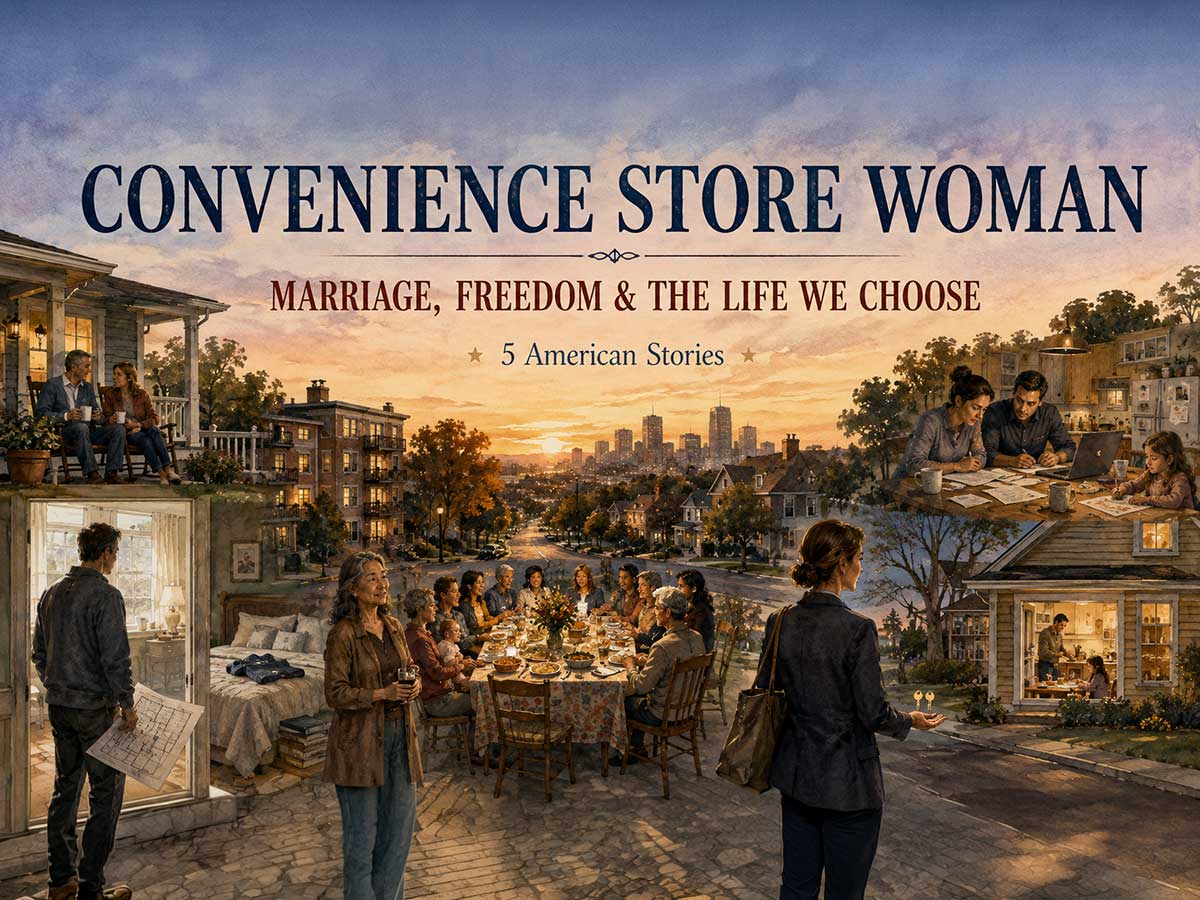
Keiko’s great act of resistance is refusing to accept a life merely to make other people comfortable.
That insight remains important.
A person does not become more human by marrying.
A woman does not become complete by becoming a mother.
A man does not become mature merely by having a family.
Yet rejecting compulsory marriage does not require us to pretend that marriage, family, children, commitment, and interdependence have no value.
Daniel’s marriage in “The Two Mugs” has closed countless possibilities. He eventually understands that closed possibilities can create depth. His life became meaningful not in spite of repetition, responsibility, and compromise, but partly through them.
Evan’s story offers the opposite warning. He did not actively reject marriage. He kept postponing the decision. Only later does he understand that time had been deciding alongside him. His regret does not make single life a mistake. It reveals that freedom can become avoidance when every door must remain open forever.
Marianne provides the essential counterweight. She never married, yet her life is full of durable relationships, responsibility, care, friendship, and contribution. Her table does not fill itself. She has spent decades building belonging. Her life demonstrates that marriage is not the only architecture capable of holding people together.
Noah and Elena complicate the demographic question further. Their problem is not that they do not value family. They want another child. Yet housing, childcare, work, healthcare, career demands, and financial insecurity repeatedly push that desire into the future. Their story asks whether a society can praise family in principle while making family formation increasingly difficult in practice.
Claire’s story brings all of these tensions together.
She is not choosing between a meaningful life and an empty one.
She already has a meaningful life.
That is precisely why the choice is difficult.
Marriage might give her love, family, responsibility, and belonging.
It may cost autonomy, privacy, flexibility, and parts of an identity she spent years rebuilding.
Remaining unmarried may preserve freedoms she genuinely treasures.
It may close other possibilities she may someday miss.
No answer removes the cost.
That may be the deepest lesson running through all five stories.
We often talk about freedom as the ability to keep possibilities open.
Yet adulthood may require something more difficult:
choosing which possibilities we are willing to close.
Marriage can be beautiful.
Singleness can be beautiful.
Either can become lonely.
Either can become deeply connected.
Parenthood can create extraordinary meaning and extraordinary exhaustion.
A childfree life can create room for forms of contribution that extend far beyond one household.
The category alone tells us surprisingly little.
What matters is the life built inside it.
The trilogy therefore ends not by replacing one definition of “normal” with another.
It ends with a question.
If no one can live every possible life, what are we willing to become responsible for, and which losses are we willing to accept in exchange for the life we choose?
Short Bios:
Sayaka Murata is a Japanese novelist best known internationally for Convenience Store Woman. Her fiction frequently examines conformity, gender expectations, work, sexuality, family, social norms, and the strange assumptions people accept as ordinary.
Keiko Furukura is the protagonist of Convenience Store Woman. Having worked for eighteen years in the same convenience store, she finds stability in its routines while resisting pressure to pursue conventional markers of adulthood such as marriage and career advancement.
Daniel Reed is a fictional American high-school history teacher whose thirty-one-year marriage becomes a meditation on commitment, sacrifice, repetition, and belonging.
Evan Cole is a fictional architect whose independent and successful life is complicated by grief and the realization that postponing major decisions can become a decision of its own.
Marianne Cho is a fictional retired pediatric nurse practitioner whose unmarried life is built around friendship, family, mentorship, community, and intentionally created belonging.
Noah and Elena Martinez are a fictional married couple who want to expand their family but confront the financial and structural pressures surrounding parenthood in contemporary America.
Claire Bennett is a fictional attorney whose relationship with a widowed father forces her to confront the tension between autonomy, love, commitment, identity, and the cost of every meaningful choice.
These modern stories are original fictional works inspired by themes explored through Sayaka Murata’s Convenience Store Woman. They are not part of Murata’s novel and do not represent her own stated views.
Leave a Reply