
Johann Sebastian Bach:
If you are hearing this, then you are listening—not just with your ears, but with your soul. I am Johann Sebastian Bach. I was once a man who stitched together sorrow and wonder into sound, who prayed through counterpoint, and wept behind silence. Few knew my pain. Fewer heard what I buried beneath the notes.
But now, freed from the weight of time and expectation, I wish to tell you the truth—not of fame or genius, but of a journey every soul must take. Mine began in an attic, by candlelight. It led me through sanctuaries and sufferings, harmonies and heartbreaks. I walked with Silence, embraced Harmony, wept before Spirit, and bowed before Listening itself.
Come with me now—not as a student of music, but as a fellow traveler in search of meaning. For what I discovered, beyond the notes, is that the most beautiful fugue is not written with ink, but with love, loss, and light.
(Note: This is an imaginary conversation, a creative exploration of an idea, and not a real speech or event.)

Part 1: The Brother’s Candle
Scene I – The Hall of Before
He awakens in silence.
Not darkness—silence. It breathes like a cathedral after the last echo fades.
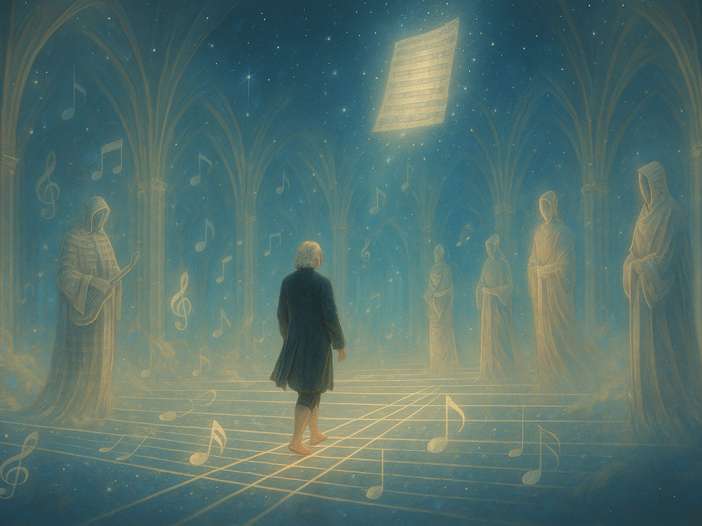
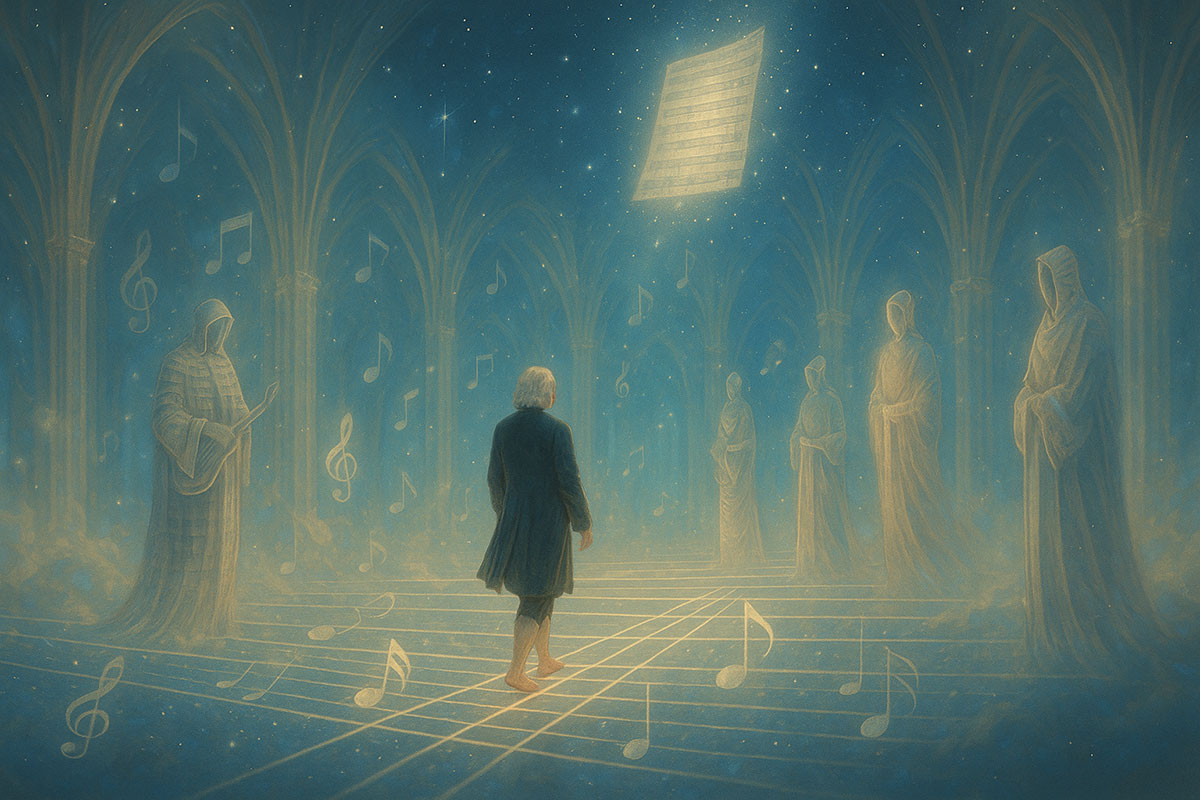
Bach stands alone in a vast corridor of lightless arches, though he feels no fear. Only... noticing.
Then he hears it.
Not music, exactly. A memory of sound.
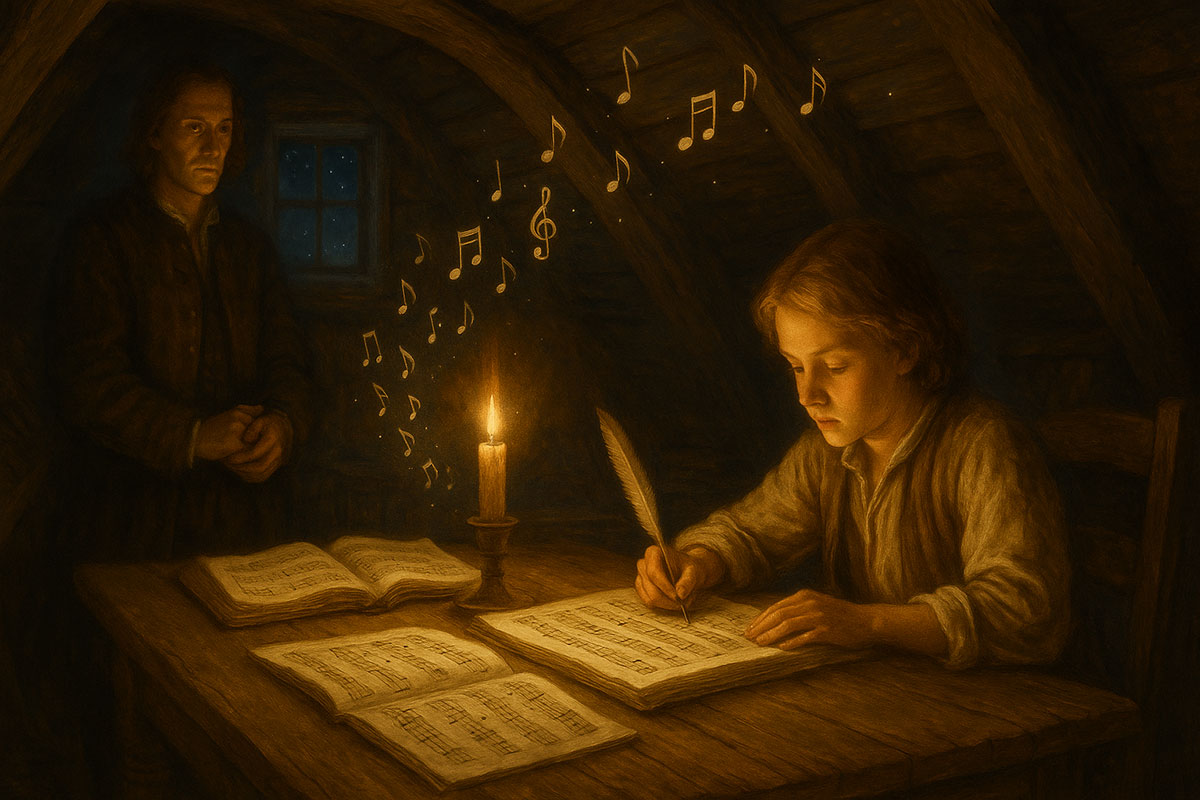
The scrape of a quill. The whisper of pages turning. The soft glow of candlelight against paper.
And a boy’s breath, shallow with excitement—almost holding still so the ink doesn’t run.
A figure steps forward. Older. Kind. Familiar.
“You always thought I didn’t know,” says Christoph Bach, his older brother.
Johann stares. His throat is dry with emotion, not surprise.
“I thought you were asleep,” he murmurs.
“I was. But I woke up when I smelled wax dripping on wood.”
Christoph smiles and gestures. The corridor transforms. Now, they’re back in Ohrdruf.
The attic room. The creaky floorboards. That battered chest where he had hidden the book—Böhm’s chorales.
The air smells of parchment and longing.
Scene II – Forbidden Notes
“You knew I stole in to copy them.”
“I let you,” Christoph says simply. “But I wanted to see how far you’d go.”
Johann chuckles softly, a mix of guilt and reverence.
“Far enough to ruin my eyesight.”
They sit beside a phantom candle, glowing without flame.
“Do you know why that night mattered?” Christoph asks.
Johann looks down at his hands, remembering the cramps, the ink smudges, the boyhood desperation.
“Because I needed the music.”
“No,” Christoph says gently. “Because you became the music.”
“You didn’t copy notes, Johann. You copied courage. You copied God’s echo onto paper.”
Scene III – The First Composition
The attic fades. In its place: a village church.
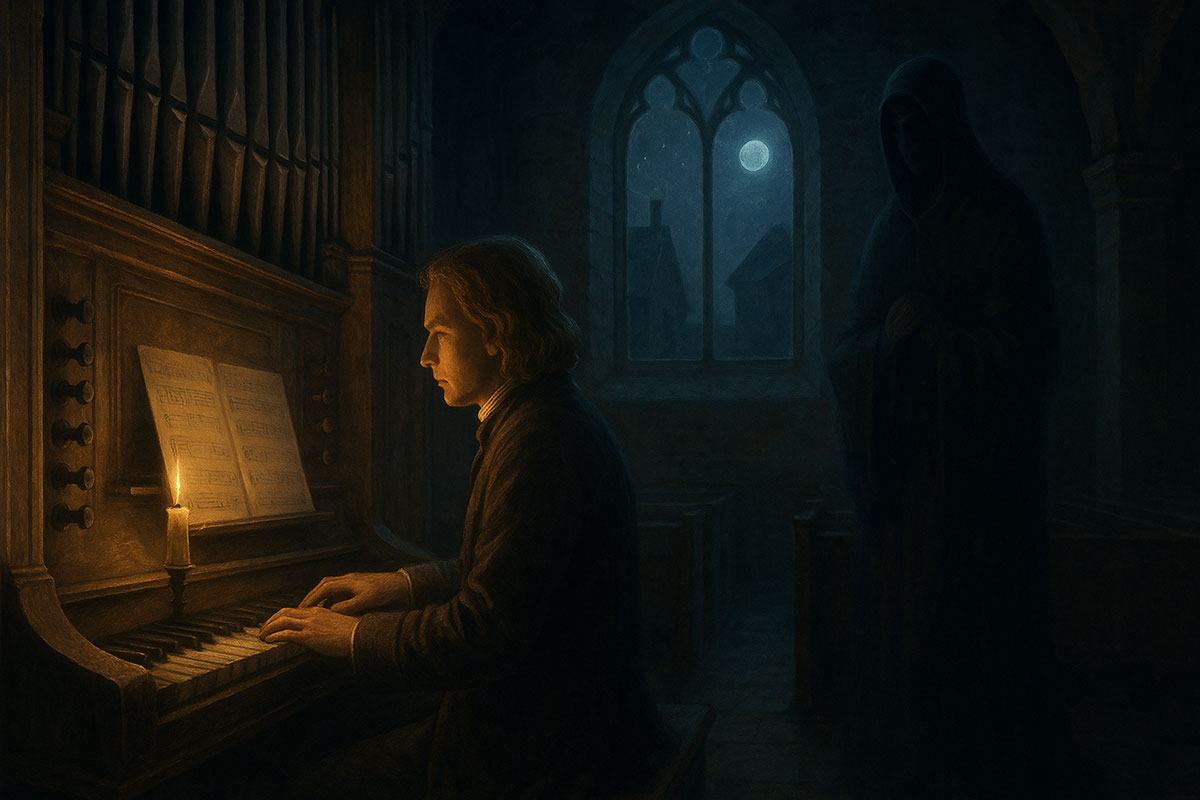
A humble organ waits in the dim light. The keys are worn, but familiar. The pews empty.
Christoph gestures to the bench.
“Play it again. The first piece you ever wrote.”
“I don’t remember it.”
“Your fingers do.”
Johann sits. Hesitates. Then presses down.
A melody rises—not perfect, but pure. Full of boyish boldness and awe.
The pipes shimmer with sound, and suddenly, the church fills with invisible listeners.
Not people—moments. His mother’s voice. The rustle of trees. The ache of loss. All listening.
The music finishes with a hush.
Christoph wipes his eye.
“That piece was never for me. It was your first offering to the world.”
Scene IV – The Question of Worth
They step outside the chapel. There is no weather here. Only clarity.
“Did I matter?” Johann asks suddenly. “Not my music. Me.”
Christoph looks at him with ancient eyes.
“You were never separate from your music, Johann. You lived inside it, and it lived through you.”
“And now?” Johann whispers.
“Now you are home.”
Scene V – Memory's Gift
As Christoph begins to fade, he presses something into Johann’s palm: a single flickering flame, weightless but warm.
“Take this. You’ll need it where you’re going.”
“Where am I going?”
“To meet the others,” Christoph says. “They’ve been waiting—Silence, Harmony, Spirit.
Each has something to show you. Each holds a part of you you forgot.”
Johann grips the flame. It pulses with the rhythm of a chorale.
“Will I see you again?”
“I never left.”
And with that, Memory bows—and becomes music once more.
Part 2: The Organ’s Whisper
Scene I – The Echoing Sanctuary
Bach steps into a vast cathedral, but this one is different. It isn’t made of stone, but of stillness.
There are no stained-glass windows, only curtains of quiet. No chandeliers, only rays of frozen breath.
And yet, in the center, stands an organ—not grand, but old, worn, beloved.
The kind he played when no one listened, save for God.
He approaches, and as he lays a hand on the keys, the air holds its breath.
“You came,” says a voice behind him—soft, neither male nor female, neither kind nor cruel.
“You always returned to silence when the world grew too loud.”
Bach turns. A figure robed in nothing but shadow and wind.
“Are you God?” he asks.
“No,” the being replies. “I am Silence. God listens through me.”
Scene II – Between Sound and Stillness
Silence walks slowly, with footsteps that make no sound. They gesture for him to sit.
“You’ve filled the world with sound, Johann. But what filled you?”
“Discipline,” he answers. “Duty. Grief. Faith.”
“And before all that?”
Bach hesitates.
“Longing.”
Silence nods.
“Longing is the mother of sound. Every note you wrote was a question—every fugue a prayer.”
“Then why did no one understand?” Bach says, his voice rising.
“Why did they see only mathematics? Why didn’t they hear what I buried beneath it all?”
Silence smiles—if such a thing can be said of a shadow.
“Because they were afraid to listen to their own silence.”
Scene III – Leipzig’s Cage
Suddenly, the still cathedral twists.
It becomes Leipzig. A cramped, echoing office. Piles of rejected compositions.
A frustrated cantor. A tired father. Letters unanswered. A congregation unmoved.
“I gave them so much,” Bach says bitterly. “Week after week. I composed as if my life depended on it—because it did. And still, they treated me like a servant.”
“Yes,” Silence says. “But did you notice something?”
“What?”
“You never stopped.”
Bach looks down. His hands are ink-stained even here.
“Even when no one clapped. Even when they talked through the Passion. You never stopped.”
Scene IV – The Secret Listener
Silence leads him back to the organ.
“Someone heard you,” Silence whispers.
And then the sound returns—not a performance, but a moment.
A poor old man in the back pew. Shivering. Forgotten.
The music begins—one of Bach’s lesser-known cantatas. The man closes his eyes and weeps.
Not for the music. For what it healed.
“He thought God had abandoned him,” Silence says. “Your music told him otherwise.”
“I don’t even remember composing this,” Bach whispers.
“That’s because it wasn’t from your memory. It was from your silence.”
Scene V – A Question in the Wind
Silence places a soft hand over the organ keys.
“Do you still believe your greatest work was heard by the world?”
“No,” Bach says slowly. “I believe it was heard by the ones who needed it most.”
Silence nods.
“Then you’ve passed the test.”
“What test?”
“The test of the unseen artist.”
From the air, a single note echoes—a pure C, suspended like starlight.
It spins slowly, then transforms into a glowing thread of light and vanishes into the void.
Silence steps back into the shadows.
“Carry this note with you, Johann. The next guide waits.”
“Who?” he asks.
“Harmony.”
And then, for a moment…
Bach is alone again—with nothing but the sound of his own breathing. And for the first time in eternity, he doesn’t fear the quiet.
Part 3: The Fugue of the Soul
Scene I – The Spiral of Voices
The path now curves upward—not a road, but a staff of music, each step a line of notation, each breath a rest.
As Bach ascends, sounds begin to hum beneath his feet: cello lines, counterpoint, breathless cadences like half-remembered dreams.
Suddenly the sky opens.
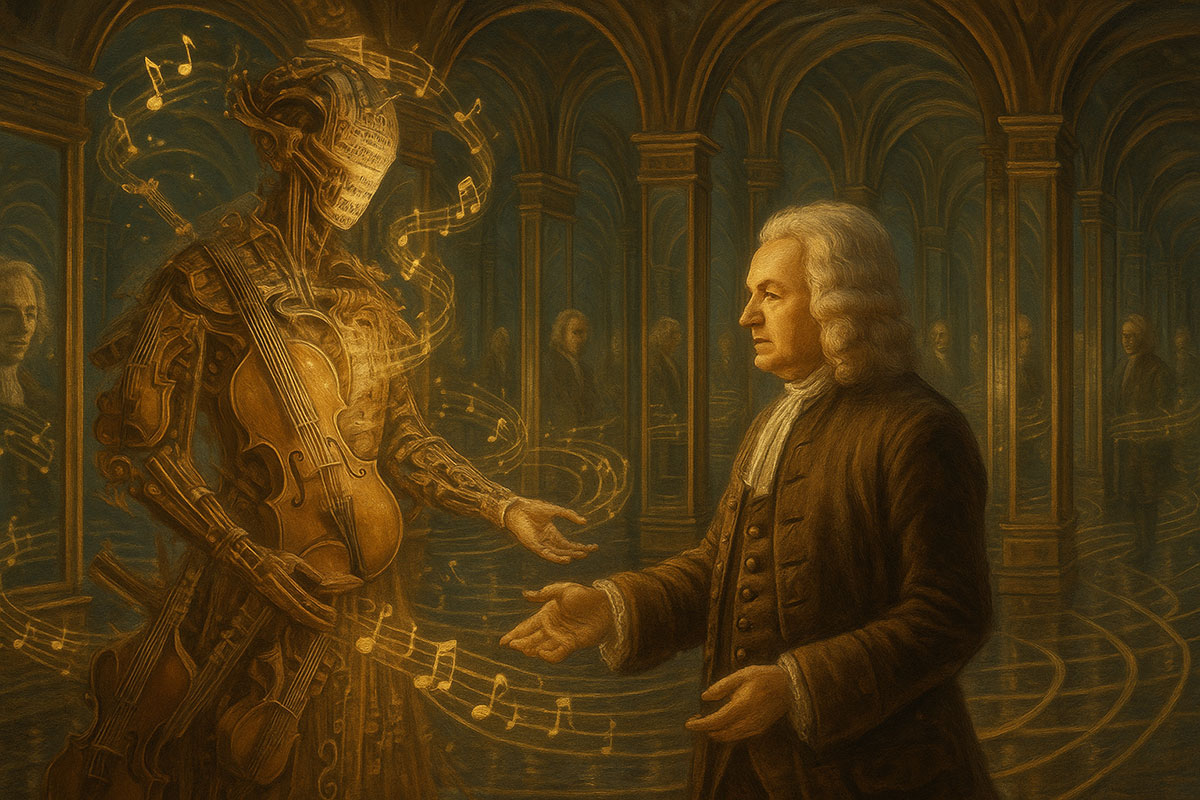
He stands in an infinite hall of mirrors, where every reflection is a version of himself—writing, weeping, conducting, praying.
At the center, seated before a radiant clavichord glowing like a heartbeat, sits a figure draped in woven light and sound.
“Welcome, Johann,” says Harmony. “You’ve already met my cousin—Silence. She carried your sorrow. I carry your structure.”
Scene II – The Master of Many Voices
Harmony rises and the walls dissolve into notes—spinning, merging, separating.
“You spent your life building structures no one could tear down. You braided melodies like strands of soul.”
“And yet,” Bach murmurs, “some said it was too much—too complex, too strict.”
Harmony smiles. Her voice becomes many: high like flutes, low like bassoons, tender like violas.
“You didn’t write music to impress, Johann. You wrote it to survive. To make order where there was chaos. Beauty where there was loss.”
A fugue appears in the air—transparent, turning like a prism.
“Each voice in this fugue,” Harmony says, “was a piece of you.”
She points.
“Here: your grief when your wife died. Here: your rage at shallow faith. Here: the joy when your children were born. And here…”
She touches the final voice—a slow, humble line.
“…the part of you that still believed in love.”
Scene III – Leipzig Again… But Different
Suddenly, he is back in Leipzig—but now he sees it with Harmony’s eyes.
The politics, the poverty, the people who looked past him.
But above it all, he sees the music they never heard:
– A cantata that lifted a dying child.
– A Passion that caused a drunkard to walk away from the bottle.
– A fugue that echoed in the dreams of a young boy who would one day be called Beethoven.
“You see?” Harmony whispers. “Your work was never just heard. It lived. It carried.”
Bach’s eyes well with tears.
“I was so tired. I kept writing. But I forgot why.”
“Because it wasn’t about you,” Harmony says. “It was about the world needing you.”
Scene IV – The Invisible Apprentice
In the distance, a young man watches, scribbling furiously on a manuscript.
“That’s Mendelssohn,” Harmony says. “He will bring you back.”
“Back?”
“Your music will disappear for a time. But he will resurrect you. Your Passion. Your light.”
“Why him?”
“Because beauty buried is never beauty lost. Only beauty waiting.”
She places a shimmering score in his hands—unwritten, unplayed.
“You never heard this one,” she says. “But the world will.”
Scene V – The Resolution
The fugue still spins, but now it resolves. All voices come together.
Bach listens. For the first time, he hears his own soul complete—not fractured by grief or expectation.
Harmony walks beside him as the final cadence lands in perfect, aching stillness.
“Where now?” he asks.
“To the part of you that still mourns,” she says. “You must meet Spirit.”
“Will I be forgiven?”
“You already are.”
She presses the glowing fugue into his chest. It dissolves into light.
“Your next guide waits beneath the tree of sorrows.”
And with that, she dissolves into resonance, leaving behind only peace... and the final echo of a voice that once felt alone.
Part 4: The Tears That Were Not Cried

Scene I – The Tree of Sorrows
Bach walks through a misty meadow, where the air feels heavy—not with sound, but with feeling.
At its center stands a gnarled tree, ancient and luminous, its roots curled around names carved into stone.
Twenty children’s names. Ten survived. Ten did not.
A soft breeze carries lullabies—unfinished, trembling.
“You remember this place,” a voice says.
He turns.
A child stands there—no older than five, clutching a wooden toy harp.
Her eyes are gentle, but they hold oceans.
“Maria Barbara?” he asks.
The child shakes her head.
“No. One of the ones you never named in a song.”
Bach kneels, hands trembling.
“I buried you. I buried so many of you. And I… I kept working. I had to. If I stopped—”
“You thought the music would hold us.”
“Yes,” he whispers.
“It did,” she says. “But you forgot to hold yourself.”
Scene II – Spirit Appears
The child dissolves into light, and from that glow emerges Spirit—not a person, but a presence.
A warm wind. A mother’s breath. The feeling of someone watching from beyond.
“You lived your life wrapped in robes of duty and sound,” Spirit says. “But underneath was sorrow.”
“I didn’t cry,” Bach admits.
“You couldn’t.”
Spirit waves a hand.
Suddenly: his first wife’s final letter, unopened.
The fevered cries of his children, fading.
The empty seat at the dinner table.
The silence after the last breath.
“You wrote your grief into cantatas, hoping the world would sing it for you.”
“Did they?”
“Some did,” Spirit says. “But not all. Because not everyone knew you were hurting.”
Scene III – A Room With No Music
Spirit guides him to a chamber where no music plays.
Here, the walls are made of things unsaid.
– The letter to his son Wilhelm that he never sent.
– The apology to his students when he was too strict.
– The silent anger at God for taking so much.
“What is this room?” Bach asks.
“It is you, when the music stopped,” Spirit replies.
“Even geniuses need to be held.”
He walks slowly through the chamber, touching each memory with reverence.
“I wasn’t perfect,” he whispers.
“No,” Spirit says. “You were human.”
Scene IV – The Requiem for the Unborn
A distant melody begins.
Not majestic. Not complex.
Just a cradle song. A mother’s hum.
Spirit raises a hand, and ten lights rise from the earth—each one a child who never saw the world but lived in Bach’s music.
They circle him gently. One by one, they place their tiny hands on his shoulders.
“We heard you,” they say in one voice.
“Every time the notes cried, we were there.”
And then… Bach weeps.
Not in anguish, but in release.
His tears fall into the soil, and from them, flowers grow—each one a forgotten melody blooming at last.
Scene V – The Embrace
Spirit wraps around him like air, lifting him.
“The tears you never cried became the rain that softened the world.”
“I thought I had to be strong,” he says.
“You were. But not because you didn’t feel. Because you did.”
Bach closes his eyes.
“Will I see them again?”
“You always do. Every time someone plays your music with trembling hands. Every time someone sings your name, not as a composer, but as a man.”
Spirit hands him a final gift: a broken quill, now mended in silver.
“Write your forgiveness, Johann. And let it include yourself.”
He nods.
And as Spirit dissolves into light, the meadow brightens.
Ahead, the fifth and final gate opens—soft, glowing, infinite.
Part 5: The Final Cantata - Composing Beyond Time
Scene I – The Infinite Score
Bach walks now through a sky of parchment.
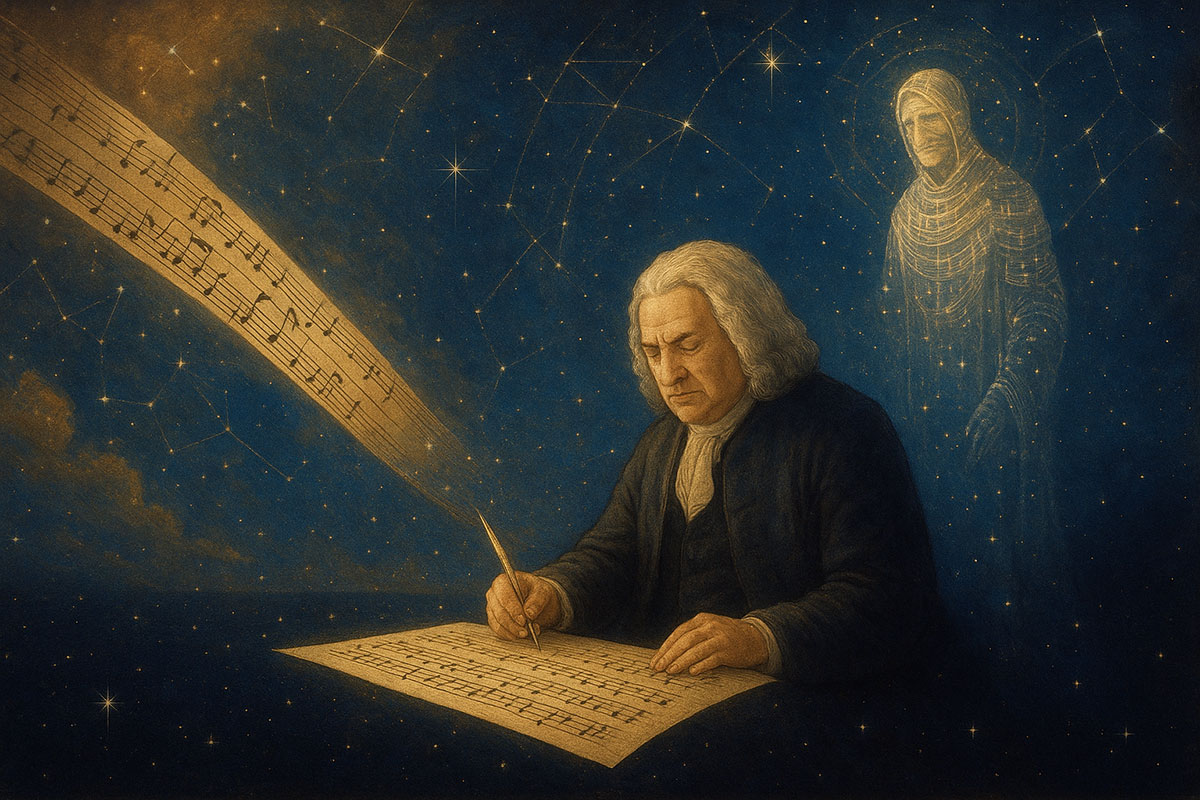
There is no ground. No roof. Only stars shaped like notes, staff lines drawn in constellations.
Each step he takes reveals a living manuscript beneath him—measures appearing as he moves, written not in ink, but light.
Ahead stands a grand music desk, vast as a mountain.
Upon it lies an unfinished score: no clef, no signature, only one word in shimmering gold:
“Amen.”
“This is yours,” says a voice.
Bach turns—and finds no figure.
Only Listening Itself.
Not a being. Not a god.
But a presence that listens with infinite stillness and unshakable attention.
Scene II – The Listener Who Heard It All
“Who are you?” Bach asks.
“I am the one who heard your first lullaby,” says the voice, “and your last silence.”
“Did I… do enough?”
“You asked the world to hear you. But I always did.”
The Listener waves a hand.
And then: the music plays back.
Not from a harpsichord. Not from a choir.
But from the lives you touched.
– A prisoner humming Jesu, Joy of Man’s Desiring while awaiting execution.
– A widow who placed her child’s name next to a chorale before burying him.
– A young girl in Tokyo, centuries later, playing Invention No. 1 with shaking hands and shining eyes.
“You wrote not for royalty,” says the Listener,
“but for the broken. The devout. The lost. The joyful. The seekers.”
Scene III – The Mirror of Sound
A mirror rises before him—not of glass, but resonance.
He sees himself reflected not as a man, but as a fugue:
– One voice: duty
– One voice: fatherhood
– One voice: rebellion
– One voice: devotion
– One voice: grief
– And rising above them all… the voice of forgiveness.
“You feared being forgotten,” the Listener says.
“Yes.”
“But those who compose with truth are never forgotten.
They become the silence between notes. The breath before the downbeat.”
Scene IV – The Final Cadence
The Listener gestures to the score.
“Finish it.”
Bach looks down at the glowing manuscript.
And writes—
Not in haste, not in perfection—
But in peace.
Each note he adds is a soul he’s touched.
Each rest is a breath the world took because his music made it stop.
When he places the final note, it is not grand. Not loud.
Just… complete.
A perfect resolve after centuries of suspension.
Scene V – Light Beyond Light
The score lifts from the desk, floats upward, and dissolves into stars.
Bach closes his eyes.
And hears not applause…
…but gratitude.
From the earth.
From the heavens.
From the hearts of all who once felt alone and found company in his counterpoint.
The Listener speaks one last time.
“You were not just a composer of music, Johann.
You were a composer of meaning.”
And then, he is gone.
But not ended.
He becomes a note in the eternal harmony—
Not the loudest…
But the one that made the rest make sense.
Johann Sebastian Bach has passed beyond sound, and into the silence that sings.
Final Thoughts by Johann Sebastian Bach
What is music, if not a bridge between the fleeting and the eternal? I once feared being forgotten, labored to be precise, to be pious, to be perfect. But perfection was never the point.
Now I see: it was not the applause that gave my music life, but the mother who hummed it to her child, the lonely soul who found comfort in a minor chord, the trembling hands of a boy daring to play it for the first time.
If I have become anything, it is this: a note in a great and holy composition still being written. And so are you.
Let your life be music. Let your pain be prayer. And if ever you find yourself lost in silence, remember—there is always Someone Listening.
Short Bios:
Johann Sebastian Bach (1685–1750)
A German Baroque composer and devout Lutheran, Bach was a master of counterpoint, harmony, and sacred music. Though underappreciated in his lifetime, he is now considered one of the greatest composers in history. His works include The Well-Tempered Clavier, Mass in B Minor, and over 300 sacred cantatas. He lived a life of discipline, deep faith, and quiet sorrow.
Christoph Bach (1671–1721)
Johann’s elder brother, organist and mentor, who raised him after their parents died. Christoph’s secret encouragement shaped young Bach’s early development, giving him access to forbidden scores that became foundational to his genius.
Silence (Personification)
A shadowy, reverent presence who represents the stillness from which music—and all spiritual insight—emerges. Silence is not emptiness but divine attentiveness, guiding Bach to rediscover the sacred space behind his sound.
Harmony (Personification)
A luminous being woven from instruments and flowing notation, Harmony shows Bach the architecture of his soul through his music. She reveals how each voice in his fugues mirrors his joys, losses, and unspoken truths.
Spirit (Personification)
An ethereal presence taking the form of Bach’s lost children, Spirit helps him grieve the pain he never allowed himself to feel. Spirit turns his uncried tears into healing, offering him forgiveness and release.
Listening (Personification)
The final presence Bach meets, Listening is the divine attention that has always heard him—even when the world did not. Neither judging nor praising, Listening reveals that true purpose lies in being known and received.
Leave a Reply