

Introduction
Sayaka Murata has spent much of her life asking a question that refuses to settle into a simple answer:
What is a human being beneath the roles, language, morality, fear, and expectations that shape us?
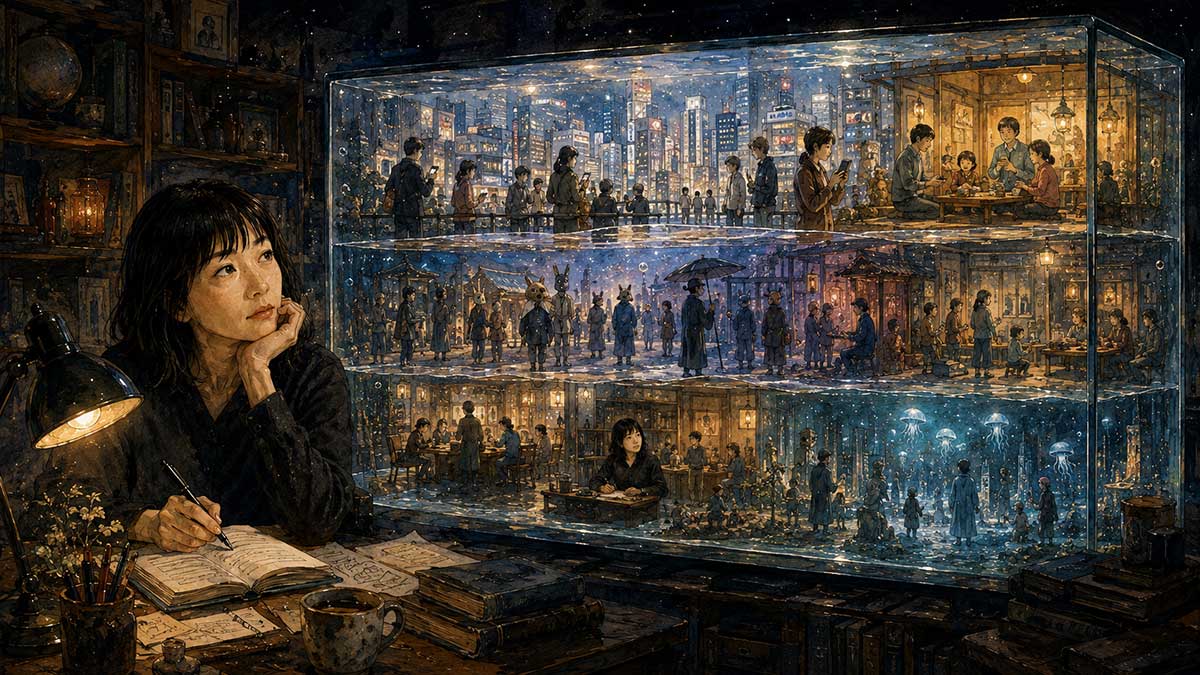
Her fiction often begins by changing one rule of the world and then watching what people become inside it. She has described her creative process as building a small aquarium, placing characters inside, changing the conditions, and observing the moment when something unexpected begins to happen.
In this imaginary conversation, Murata brings some of her deepest unresolved questions to Bashar, Carl Jung, and Alan Watts.
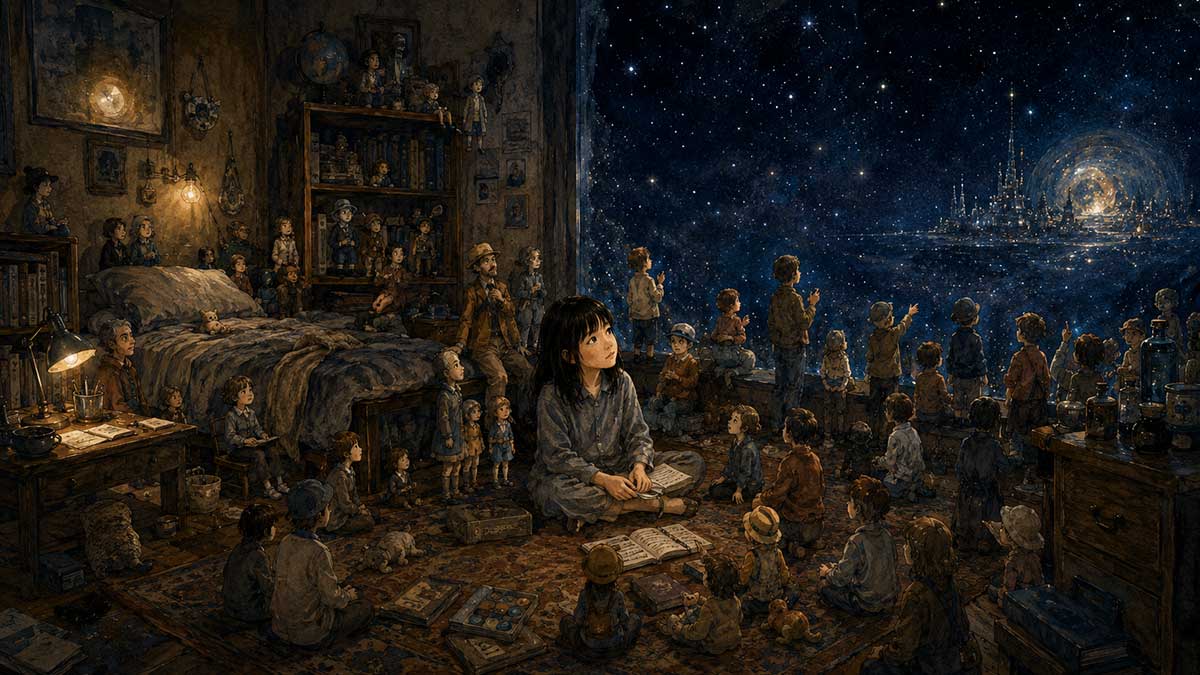
Who were the roughly thirty imaginary friends who accompanied her from childhood?
Are the strange worlds she writes merely invented, or could imagination sometimes function as a way of perceiving possibilities beyond the conscious mind?
When she says she sometimes feels like material being used for fiction, who is the author and who is the material?
If society has placed words, beliefs, and roles inside us, is there a true self beneath them?
And what might be inside the final box Murata still wants to open, the truth she has sometimes imagined could break her if she saw it clearly enough?
The three guests offer very different interpretations.
Bashar approaches Murata through Higher Mind, belief, parallel realities, life themes, and the possibility that the physical personality is only one expression of a larger self.
Jung looks at the same experiences through the unconscious, persona, shadow, Self, active imagination, and the autonomy of inner figures.
Watts keeps questioning the divisions everyone else relies on: inner and outer, author and material, self and world, real and imaginary.
Murata never fully joins any one explanation.
She keeps doing what she has always done.
She watches.
She asks.
She leaves the aquarium running.
(Note: This is an imaginary conversation, a creative exploration of an idea, and not a real speech or event.)
Topic 1: Who Were the Thirty Imaginary Friends?
Sayaka Murata:
I’ve had imaginary friends since I was a child. There are around thirty of them now, and in my mind they live on another planet.
When I was young, I often felt as though I spent more time there than here on Earth.
I was a very sensitive child, and I think I needed that world to survive emotionally. But I still don’t really know what those friends were.
Did I create them because I needed them?
Or was I receiving something I didn’t understand?
Bashar:
That question already contains an assumption.
You are treating “created” and “received” as opposites.
Why must they be?
Sayaka Murata:
You think they could be both?
Bashar:
Possibly.
Human beings often assume that imagination means inventing something unreal inside the skull.
But what exactly is imagination?
Have you ever examined the mechanism closely enough to say where it begins?
Sayaka Murata:
No.
I only know that they felt present.
I never experienced them as an intellectual idea.
They were just there.
Bashar:
Then begin with the experience rather than the label.
You do not yet need to decide whether they were independent beings, aspects of your own consciousness, symbolic forms, or some other kind of information translated into personalities.
Ask a different question first.
What did they do for you?
Sayaka Murata:
They made it possible for me to exist somewhere without performing.
In ordinary life, I watched adults very closely.
I worried about whether someone was unhappy with me.
I thought that if I behaved incorrectly, I might be rejected.
But with those friends, I didn’t have to behave properly.
Carl Jung:
That is already psychologically significant.
I would be cautious about immediately declaring these figures to be external entities.
Yet I would be equally cautious about dismissing them as meaningless fantasy.
The psyche is larger than the conscious ego.
Contents of the unconscious can appear in personified form. They can seem autonomous. They may speak in ways the conscious mind did not plan.
Sayaka Murata:
That sounds very similar to what happens when I write fiction.
I draw my characters first.
Their faces, clothes, height, childhoods.
Then I draw the people around them.
At some point they begin talking to one another.
And when that happens, I write down what they say.
Jung:
You said something very important.
“They begin talking.”
Not, “I decide what they will say.”
Sayaka Murata:
Yes.
That’s the strange part.
I know I made them, but sometimes they seem to know where the story is going before I do.
Bashar:
Then perhaps we should ask whether the “I” who consciously designed them is the whole of you.
Sayaka Murata:
That question makes me a little uncomfortable.
Alan Watts:
I find it rather cheerful.
Sayaka Murata:
Cheerful?
Watts:
Yes.
People are terribly attached to the picture of a little manager sitting somewhere behind the eyes, controlling everything.
But do you choose your next thought before you think it?
Sayaka Murata:
No.
Watts:
Do you choose your dreams before you dream them?
Sayaka Murata:
No.
Watts:
Do you select each emotion before it appears?
Sayaka Murata:
Certainly not.
Watts:
Then why must imagination be the one department where this tiny manager claims complete ownership?
Sayaka Murata:
Because the other possibility is unsettling.
If I didn’t create them entirely by myself, then where did they come from?
Jung:
That is where restraint matters.
An inner figure can feel independent without proving that it exists outside the psyche.
The more useful question is often not, “Is this figure objectively external?” but, “What relationship does this figure have to me?”
Did your friends threaten you?
Protect you?
Demand things from you?
Guide you?
Sayaka Murata:
Protect me, I think.
Very strongly.
I was lonely as a child, even though my family was kind to me.
I felt that I always had to behave in a way that would keep other people comfortable.
The imaginary world was the one place where I didn’t have to do that.
Bashar:
Then whatever interpretation you choose, their function in your life is already clear.
They helped create a space where you could experience yourself without the same fear.
Sayaka Murata:
So perhaps I made them to survive.
Jung:
Perhaps.
But I would not reduce them to a defense mechanism and stop there.
Something can help you survive and still carry meaning far beyond survival.
If these figures remained vivid across many years, they may have become part of your creative and psychological life in a much deeper way.
Sayaka Murata:
Would you say they were parts of me?
Jung:
Possibly.
But “parts of me” can be misleading if it makes the psyche sound small.
The conscious ego is only one center of experience.
Much of the psyche lies outside its control.
A figure may belong to your psyche without being something your conscious mind simply invented at will.
Watts:
And I would question the word “inside.”
Sayaka Murata:
You don’t like inside and outside very much, do you?
Watts:
They are useful for houses.
Less reliable for consciousness.
You hear my voice and call it external.
Then sound enters the ear, becomes neural activity, and appears as experience.
At what exact point does “outside” become “inside”?
Sayaka Murata:
I don’t know.
Watts:
Good.
We often become confused by insisting on boundaries that experience itself refuses to draw cleanly.
Bashar:
Let me ask you something else.
Suppose your friends were entirely products of imagination.
Would that make them less meaningful?
Sayaka Murata:
No.
Bashar:
Suppose, for the sake of possibility, that they reflected something beyond the personality you normally identify as yourself.
Would that automatically make them more meaningful?
Sayaka Murata:
No.
I don’t think so.
Bashar:
Exactly.
The label does not determine the value of the experience.
They accompanied you.
They helped you survive.
They became part of your creative life.
Those facts remain regardless of which metaphysical explanation you choose.
Sayaka Murata:
Maybe that is closer to how I feel.
I don’t really want to prove what they are.
I want to look at them more closely.
Jung:
That is a fruitful attitude.
Do not rush to explain the image.
Stay in relationship with it.
Ask what it reveals over time.
Sayaka Murata:
There is still something I can’t explain.
If I created them, why do they sometimes feel ahead of me?
Why do fictional characters sometimes say things I had not consciously thought?
Why do they move before I decide where they should go?
Watts:
Perhaps the question is not, “Did I create them?”
Perhaps it is:
“What if both I and they are arising from something larger than the little person I usually call myself?”
Sayaka Murata:
Something larger.
Bashar:
Or perhaps creation and discovery are not as separate as you assume.
You may create a doorway and discover what appears when it opens.
Sayaka Murata:
That sounds very much like writing.
Bashar:
Then perhaps that is where we should go next.
When you build one of your strange worlds, are you inventing it?
Or are you entering a possibility and observing what happens there?
Sayaka Murata:
I would like to know that too.
Jung:
Then we should examine your aquarium.
Watts:
And the person who believes she is standing outside it.
Sayaka Murata:
You mean me.
Watts:
Do I?
Topic 2: Are Parallel Worlds Imaginary, or Are We Already Living Them?
Sayaka Murata:
When I write fiction, I often change one rule of the world.
Maybe something we consider cruel becomes ordinary.
Maybe the human body is treated differently.
Maybe marriage, reproduction, love, or family operate according to rules that would feel strange to us.
Then I place people inside that world and watch them.
What fascinates me is that once the conditions change, the people change too.
Sometimes they become people I never expected them to become.
Bashar:
You say you change one rule of the world.
Let me ask you something.
Do you believe you are creating that world entirely from nothing?
Sayaka Murata:
I would normally say yes.
It is fiction.
I make the setting.
I choose the rules.
Bashar:
Yet you have already told us that what happens next often surprises you.
Sayaka Murata:
Yes.
That is the strange part.
I create the aquarium.
I put the characters into it.
I change the water, perhaps.
I move something around.
Then, at some point, there is a little explosion.
The characters start doing things that I did not plan.
Bashar:
Then perhaps creation does not have to mean manufacturing something from absolute nothing.
It may sometimes mean selecting, focusing, or tuning into a possibility.
Sayaka Murata:
You mean the world might already exist somehow?
Bashar:
Within the framework we describe as parallel realities, possibilities are far more numerous than the physical mind normally recognizes.
Different versions of events.
Different choices.
Different expressions of the self.
Different realities corresponding to different states and conditions.
From that perspective, one could ask whether the imagination always invents possibilities, or whether it sometimes perceives possibilities.
Sayaka Murata:
That is fascinating, but it makes me nervous.
If I write a society where human beings eat other human beings, I do not know that I want to believe such a world literally exists somewhere.
Bashar:
You do not need to make that conclusion.
The useful question is not whether an identical physical planet exists somewhere with every detail you wrote.
The useful question is whether reality contains a far greater range of possible experience than the physical personality normally assumes.
Your fiction already demonstrates that idea psychologically.
Change the rules, and different versions of human behavior appear.
Carl Jung:
This is where I would place a boundary around the interpretation.
The fact that a fictional world develops beyond the conscious author's plan does not require a parallel universe.
The unconscious alone gives us more than enough mystery.
Sayaka Murata:
So you think the unexpected parts come from me.
Jung:
From the psyche, yes.
But not necessarily from the conscious ego you usually call "me."
A writer may consciously construct a situation, then encounter responses arising from unconscious material.
The result can feel discovered rather than invented.
Bashar:
And I do not find that incompatible with what I am saying.
Jung:
Perhaps not entirely.
Yet I would hesitate to move from psychic autonomy to cosmological claims.
If an image appears with great force, I first ask what it means psychologically.
I do not first ask which universe it came from.
Bashar:
A fair distinction.
But I would ask you something in return.
Why assume that psychological reality and a larger structure of reality must be separate categories?
Jung:
I would not say they must be entirely separate.
The deeper psyche can certainly present patterns that appear larger than the individual.
My concern is certainty.
The symbolic image becomes impoverished when we rush too quickly to declare what it literally is.
Sayaka Murata:
I like that.
I do not want someone to tell me, "This is definitely what your world is."
That would make it smaller.
Alan Watts:
Now we are getting somewhere.
The three of you are standing around the aquarium trying to decide which label to stick on the glass.
"Unconscious."
"Parallel reality."
"Fiction."
Meanwhile the fish are swimming.
Sayaka Murata:
You think the labels are the problem again.
Watts:
They become a problem when we mistake them for the thing itself.
Suppose you dream of a city that does not exist on any map.
Was the city real?
Sayaka Murata:
In the dream, yes.
Watts:
And when you woke up?
Sayaka Murata:
Then I would call it imaginary.
Watts:
Yet the experience occurred.
The architecture may never have stood in physical space, but you saw streets, felt distance, perhaps met people.
Human beings have a curious habit of saying that an experience was "not real" when what they mean is that it was not physically persistent.
Those are different statements.
Sayaka Murata:
So something can be real as an experience without being physically real.
Watts:
Precisely.
And once you admit that, the argument becomes more interesting.
Not everything needs to compete for the same category of existence.
Bashar:
Yes.
And imagination itself may be more functional than the culture often assumes.
It can show you configurations of experience that your present physical environment does not contain.
Sayaka Murata:
That is close to what I do when I change ethics.
I might think: what if this thing we consider absolutely disgusting was considered beautiful?
Or what if something we think is natural became horrifying?
Then I watch people change.
Jung:
Which exposes something psychologically important.
It shows that much of what people call "human nature" may be intertwined with culture.
Sayaka Murata:
Exactly.
That has always bothered me.
People say, "Humans naturally feel this."
Or, "No human being would ever do that."
And I think, how do we know?
If we had been raised inside another ethical system, perhaps we would feel something completely different.
Bashar:
Then your fiction performs an experiment in possible identities.
You alter the structure of the world and observe which version of the human being emerges.
Sayaka Murata:
Yes.
That is exactly what it feels like.
Bashar:
Then consider this.
What you call a character's personality may not be a fixed object.
It may be a response to conditions.
Change the conditions enough, and another potential version of that person appears.
Sayaka Murata:
That does sound very close to parallel worlds.
Bashar:
It is one reason the idea may resonate with you.
Parallel reality, in this sense, is not only about strange universes.
It raises a more intimate question.
How many versions of you are possible?
Sayaka Murata:
That is more frightening.
Watts:
You do enjoy saying that.
Sayaka Murata:
I do seem to.
Bashar:
Think about your own life.
The child who tried to behave correctly.
The young woman working in a convenience store.
The writer sitting in cafés.
The person surrounded by imaginary friends.
The observer constructing an aquarium.
Are those all the same Sayaka?
Sayaka Murata:
Yes.
But they feel different.
Bashar:
Then perhaps identity is less fixed than the physical mind assumes.
Different conditions draw out different expressions.
Jung:
I would agree with that without invoking separate physical realities.
No person is exhausted by the personality they consciously recognize.
Unlived possibilities remain within the psyche.
Circumstances can awaken them.
Conflict can awaken them.
Relationships can awaken them.
Creative work can awaken them.
Sayaka Murata:
Then when I create another society, maybe I am giving those unlived possibilities somewhere to move.
Jung:
That is a compelling way to put it.
Watts:
And perhaps the society you call fictional is exposing the fiction inside the society you call real.
Sayaka Murata:
What do you mean?
Watts:
You change one rule in your novel, and suddenly the original rule looks strange.
That means the original rule was never simply "reality."
It was a convention that became invisible through repetition.
Your invented world acts like a mirror held at an unusual angle.
Sayaka Murata:
Yes.
That happens to me when I write.
At first the fictional society seems grotesque.
Then I stay there long enough, and our society begins to look grotesque too.
Watts:
There you are.
That may be one of the great uses of fiction.
It makes the familiar unfamiliar.
Then one can see it again.
Bashar:
And when you see that what you assumed was fixed can be viewed differently, your experience of reality changes.
Sayaka Murata:
So perhaps a parallel world does not have to mean that I physically travel somewhere.
It can mean that the same human being becomes radically different under another set of assumptions.
Bashar:
That is one useful level of the idea.
And from our perspective, consciousness can shift through many versions of experience far more continuously than people ordinarily notice.
Jung:
I want to return to the aquarium.
You said there is sometimes a little explosion.
What causes it?
Sayaka Murata:
I never fully know.
I place a character into a situation.
Then another person arrives.
I change something in the society.
I keep watching.
At some point, the pressure becomes strange.
Then someone does something I had not expected.
That is when the story becomes alive.
Jung:
So you establish the conditions, but you do not command the event.
Sayaka Murata:
Yes.
That is very important.
If I command too much, it becomes dead.
Bashar:
There is something very revealing in that.
You create conditions.
Then you allow the result.
Sayaka Murata:
Yes.
Bashar:
That resembles the distinction between control and participation.
The physical mind often wants to know the exact path in advance.
Yet your best creative work appears when you establish a direction and remain receptive to what emerges.
Sayaka Murata:
That is true.
When I know too much about where the story is going, I become less interested.
Watts:
Naturally.
A dance in which every movement has already happened is merely a recording.
Sayaka Murata:
I think fiction becomes alive when I can still be surprised by it.
Jung:
Then surprise is evidence that the conscious ego is not acting alone.
Bashar:
Or, in my language, that the physical mind is participating in something broader than its own predictions.
Watts:
Or, in mine, that life is doing what life always does when we stop strangling it with a plan.
Sayaka Murata:
You three keep describing almost the same moment with completely different words.
Watts:
That may tell you something about words.
Sayaka Murata:
But I still have one question.
When I stand outside the aquarium and observe these people, I feel like the experimenter.
Yet I have said before that I sometimes feel as if I myself am an experimental subject placed inside Japanese society.
So which one am I?
The person outside the aquarium?
Or the person inside it?
Bashar:
Perhaps both.
Jung:
That question may take us somewhere much deeper.
Watts:
Especially if there is no final "outside."
Sayaka Murata:
No final outside?
Watts:
You observe the character.
Then you observe yourself observing the character.
Then you can observe yourself observing yourself observing the character.
How many observers would you like?
Sayaka Murata:
That could go on forever.
Watts:
Exactly.
Bashar:
And that is why the next question matters.
If the human Sayaka Murata is inside one aquarium, and the writer Sayaka Murata appears to be outside it, what is the relationship between those two?
Who is using whom?
Sayaka Murata:
That is the question that unsettles me the most.
Sometimes I feel that the human version of me is simply material.
She lives.
She gets hurt.
She absorbs society.
Parts of her break.
Then the writer takes pieces of her and puts them into fiction.
Jung:
Then perhaps Topic 3 is no longer about parallel worlds.
It is about authorship.
Sayaka Murata:
Yes.
Who is actually writing?
Bashar:
And if you feel like material, we must ask the question you have been circling from the beginning.
Material for what?
Watts:
And for whom?
Sayaka Murata:
Yes.
That is what I want to know.
Topic 3: Am I the Author, or Am I Material Being Used by Something Else?
Sayaka Murata:
This is one of the strangest feelings I have about writing.
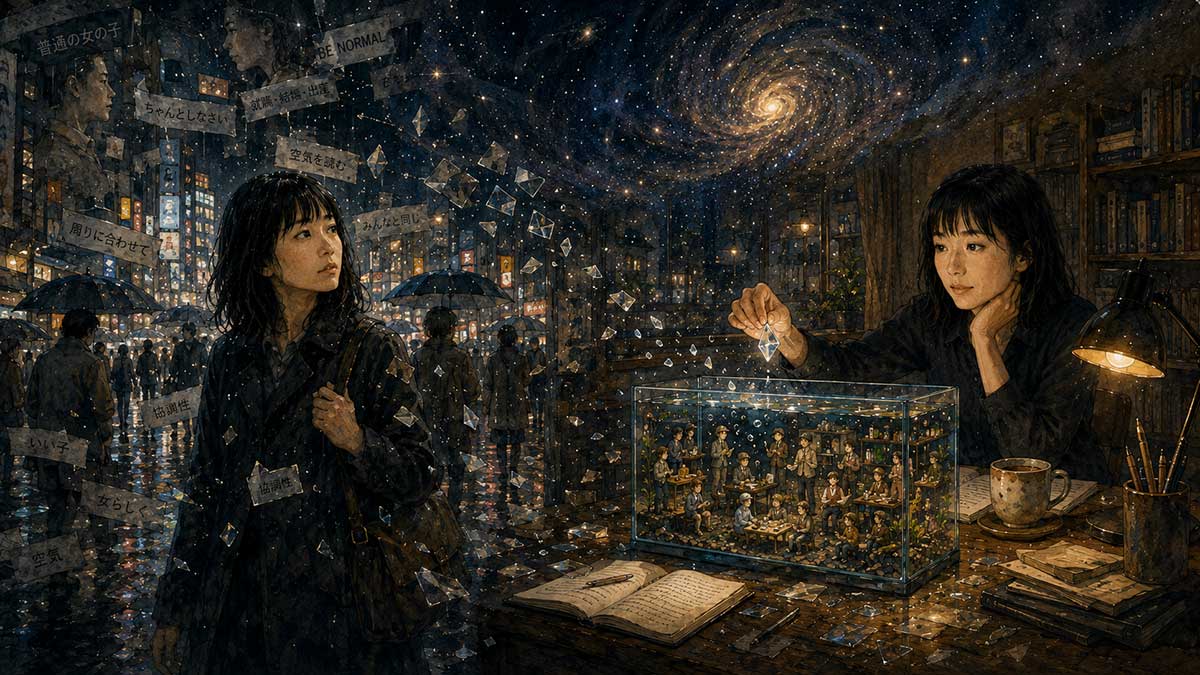
Sometimes I think of myself as material.
There is the human Sayaka Murata, living inside Japanese society.
She gets hurt.
She adapts.
She becomes frightened.
Parts of her stop working properly.
Then there is the writer Sayaka Murata, standing a little farther away, watching.
She takes fragments from that damaged human being and puts them into fiction.
Sometimes I feel as if the human version of me exists partly to provide material for the writer.
Bashar:
Then let us begin with a very simple question.
When you say "me," which one do you mean?
Sayaka Murata:
That is exactly the problem.
The person who lives and the person who writes do not always feel identical.
Bashar:
Then perhaps you do not need to force them into one category.
From the perspective I represent, the physical personality is not the totality of what you are.
The physical mind has a particular function.
It experiences what is directly in front of it.
It focuses very narrowly.
It moves through the physical story.
But there is a broader level of mind, what we call the Higher Mind, that sees patterns and connections the physical personality cannot always see.
Sayaka Murata:
So the person living inside society would be closer to the physical mind?
Bashar:
You could say that.
But do not make the writer automatically identical with the Higher Mind.
The writer is still part of the physical personality.
What matters is that the writer may become more receptive to information, connections, and directions that the ordinary personality does not consciously understand.
Sayaka Murata:
Then when I feel used, you would not say that some outside being is using me?
Bashar:
I would not begin there.
The word "used" assumes separation.
It suggests there is a user over here and a tool over there.
What if the larger aspect of you and the physical aspect of you are participating in the same process?
Sayaka Murata:
So I could be both the material and the one using the material.
Bashar:
Yes.
And perhaps more than that.
You may be the experience, the observer, the translator, and the participant at the same time.
Sayaka Murata:
That sounds very close to how writing feels.
The human part of me goes through things.
Then another part watches.
Sometimes quite coldly.
If something in me breaks, the writer thinks, "That might be useful."
Carl Jung:
That division is psychologically understandable.
I would describe it somewhat differently.
The conscious ego is not the whole psyche.
You may experience one part of yourself as the person living the life and another part as the one observing it.
The observing attitude can become especially strong in a writer.
But behind both lies a larger psychic totality.
I called that the Self.
Sayaka Murata:
So the Self is not just the hidden "real me"?
Jung:
No.
It is not a tiny authentic person concealed beneath the social personality.
It is the larger totality that includes consciousness and unconsciousness.
The ego participates in it but does not own it.
Sayaka Murata:
Then the writer who watches me is still not the deepest level.
Jung:
Correct.
The observing writer can still be part of the ego.
That writer may believe she is standing outside the experiment, but she too is being shaped by unconscious forces.
Sayaka Murata:
So even the scientist is inside the laboratory.
Jung:
Precisely.
Alan Watts:
And now the laboratory is becoming wonderfully crowded.
Sayaka Murata:
You think we are making too many versions of me again.
Watts:
I think human beings become very creative when trying to find someone who is ultimately in charge.
First there is Sayaka the person.
Then Sayaka the writer.
Then perhaps the Higher Mind.
Then the Self.
Eventually we may need an organizational chart.
Sayaka Murata:
That would be terrible.
Watts:
Quite.
So perhaps we should ask a different question.
When a tree produces a flower, who is using whom?
Is the tree using the soil?
Is the soil using the rain?
Is the flower using the tree?
Or is the whole event simply happening as one process?
Sayaka Murata:
So you do not like the word "material."
Watts:
I like it as poetry.
I dislike it when it turns you into an object.
You are material, certainly.
So am I.
So is a tree.
So is the entire universe.
But that does not mean there must be a hidden manager exploiting the material.
Sayaka Murata:
I think the reason the word feels right to me is that the writer in me can be ruthless.
The human me might suffer, but the writer says, "Interesting."
Jung:
That is worth examining.
Creative observation can create distance from pain.
That distance may help you transform experience.
But it can become dangerous if the observing part treats the living person as though she has no value outside the work.
Sayaka Murata:
I understand that.
Sometimes I wonder whether I have become too accustomed to using my own wounds.
Bashar:
Then ask whether the relationship is exploitative or collaborative.
That is a very different question.
Sayaka Murata:
Collaborative with whom?
Bashar:
With your own life.
You have experiences.
You cannot always choose every condition.
But you can participate in what those experiences become.
You can turn something painful into fiction without declaring that the pain was necessary or good.
You can use what happened without worshipping what hurt you.
Sayaka Murata:
That matters to me.
I would not want to say suffering happened so that I could make art.
That feels cruel.
Bashar:
Then do not say it.
There is a difference between saying, "This happened for the sake of my work," and saying, "This happened, and I chose what I would create from it."
Jung:
I strongly agree with that distinction.
Meaning can emerge from suffering without requiring us to romanticize the suffering itself.
Watts:
A scar can become part of a painting without the wound having been commissioned by the painting.
Sayaka Murata:
That is a better way of putting it.
Still, I have had this feeling since I was young that fiction was not entirely mine.
When I was a child, I thought the word processor my mother gave me was connected somehow to the god of fiction.
I imagined that when I wrote something, it would rise into the sky.
The god would choose which stories became books.
Bashar:
That is very revealing.
Sayaka Murata:
It sounds childish now.
Bashar:
Childlike does not mean meaningless.
Ask what the symbol meant to you.
Why did the story need to rise away from you?
Sayaka Murata:
Maybe because I did not feel I owned it.
I was writing for something beyond ordinary approval.
Not for adults.
Not for school.
Not to be a good child.
Bashar:
Then the image of the "god of fiction" may have represented a relationship with creation that felt larger than your social identity.
Jung:
Yes.
A symbolic image can express a psychological truth without needing to be taken literally.
The important point is that writing belonged to a sacred inner territory for you.
You called fiction a church.
That is not a casual metaphor.
Sayaka Murata:
No.
It was the one place where I did not have to perform.
I could write things that would make people uncomfortable.
I could become strange.
Watts:
Then perhaps the "god of fiction" was the one audience you could not disappoint.
Sayaka Murata:
That is funny.
But yes, perhaps.
Bashar:
And now I want to ask the harder question.
When you write, what is the strongest force you feel?
Is it the desire to succeed?
To be praised?
To express yourself?
Sayaka Murata:
No.
It is more like I need to know something.
I want to know what human beings are.
I have always felt that beneath what everyone calls "the truth," there is another truth.
Something people have not noticed yet.
Maybe something we are afraid to put into words.
I want to see it.
Bashar:
Then perhaps writing is not the central purpose.
Perhaps writing is the instrument you use to investigate your central question.
Sayaka Murata:
So being a novelist might not be the deepest thing.
Bashar:
Exactly.
The deeper pattern may be inquiry.
You investigate existence through fiction.
Another person might do it through physics.
Another through meditation.
Another through music.
Your instrument happens to be the novel.
Sayaka Murata:
That is interesting.
I have never thought of it that way.
Jung:
It resembles what we might call a vocation.
There are people whose lives become organized around a psychological necessity they did not consciously invent.
They feel called by a task before they understand why.
Sayaka Murata:
That sounds a little frightening too.
Watts:
You have a wonderfully dependable response to large ideas.
Sayaka Murata:
I know.
But if I am called by something, then I start wondering who is calling.
Watts:
And there we go again.
Bashar:
It is a reasonable question.
But perhaps the caller does not need to be another person.
Suppose the calling is the relationship between what you are capable of becoming and what you are currently experiencing.
Sayaka Murata:
Like a future version of myself?
Bashar:
That is one metaphor.
Or a broader version.
From our perspective, the Higher Mind has a wider view of the path than the physical mind does.
The physical mind does not need to understand every reason in advance.
Its task is to act on what resonates most strongly, then observe what unfolds.
Sayaka Murata:
That sounds close to writing again.
I do not know where the novel is going.
If I know too much, I become bored.
I need to follow something without fully seeing it.
Bashar:
Exactly.
You have already developed a creative practice that resembles trust.
You establish conditions.
You follow what becomes alive.
You do not demand that the whole story reveal itself before you write the first page.
Sayaka Murata:
Then maybe I live differently from how I write.
In life I am afraid and want to know what is safe.
In fiction I can tolerate not knowing.
Jung:
That may be one reason fiction has been so important to you.
It gives you a place where uncertainty becomes productive rather than threatening.
Sayaka Murata:
Yes.
In ordinary life, uncertainty can feel like danger.
In fiction, uncertainty is where something starts.
Watts:
There may be your church again.
A place where not knowing is allowed.
Sayaka Murata:
Then perhaps the part of me that writes is not using the human me.
Perhaps it is giving the human me somewhere to put what cannot be lived directly.
Jung:
That is a much more integrated way of seeing it.
The work becomes a place where dissociated or unexpressed material can take form.
Bashar:
And now the word "material" has changed.
You are no longer merely material being consumed.
You are material being transformed.
Sayaka Murata:
Transformed by whom?
Watts:
Must we ruin the moment?
Sayaka Murata:
I knew you would say that.
Watts:
You are doing the transforming.
The world is doing the transforming.
Language is doing the transforming.
Your readers later transform it again.
A book is not a private object that travels untouched from one mind to another.
It keeps becoming something else.
Sayaka Murata:
Then perhaps authorship is more shared than we usually think.
Watts:
Very much so.
Jung:
But I would still preserve one thing.
Responsibility.
A writer may receive material from unconscious depths.
A writer may feel overtaken by a work.
Yet the writer still chooses what to publish, how to shape it, what form to give it.
One must not use inspiration as an excuse to abandon ethical responsibility.
Sayaka Murata:
That is important, especially with the kinds of things I write.
Bashar:
Agreed.
Connection to something larger does not erase choice.
If anything, it makes conscious participation more meaningful.
Sayaka Murata:
So I am not a puppet.
Bashar:
No.
That is exactly the distinction I would make.
You may be a channel in the broad sense that every human being translates more than the conscious ego alone understands.
But a channel is not the same as a puppet.
You participate.
You interpret.
You choose.
Sayaka Murata:
Then maybe "used" is the wrong word.
Bashar:
How about "in collaboration"?
Sayaka Murata:
With something larger than the conscious me.
Bashar:
If that language is useful to you.
Jung:
I would say, in collaboration with the wider psyche.
Watts:
I would say, in collaboration with the rest of the universe you temporarily call "not me."
Sayaka Murata:
Of course you would.
There is still something that troubles me, though.
If I am shaped by Japanese society, by childhood, by language, by fear, by other people, then how much of what I call "my voice" is actually mine?
Maybe the writer is made out of borrowed material too.
Jung:
Now we are approaching another layer.
Bashar:
Yes.
You have asked who is writing.
The next question is: what is the writer made of?
Sayaka Murata:
Exactly.
I sometimes feel that the words coming out of people are not really their own.
I feel that in myself too.
The world has put words into us, and we think they are our feelings.
Watts:
Then perhaps we should begin peeling.
Sayaka Murata:
Peeling what?
Watts:
Everything you have been told is you.
Sayaka Murata:
And if we peel all of it away?
Watts:
That is where things become interesting.
There may not be a little untouched Sayaka waiting at the center.
Sayaka Murata:
That sounds much more frightening than being material.
Watts:
I thought you might say that.
Topic 4: If We Strip Away Society’s Words, Is There a “True Self” Left?
Sayaka Murata:
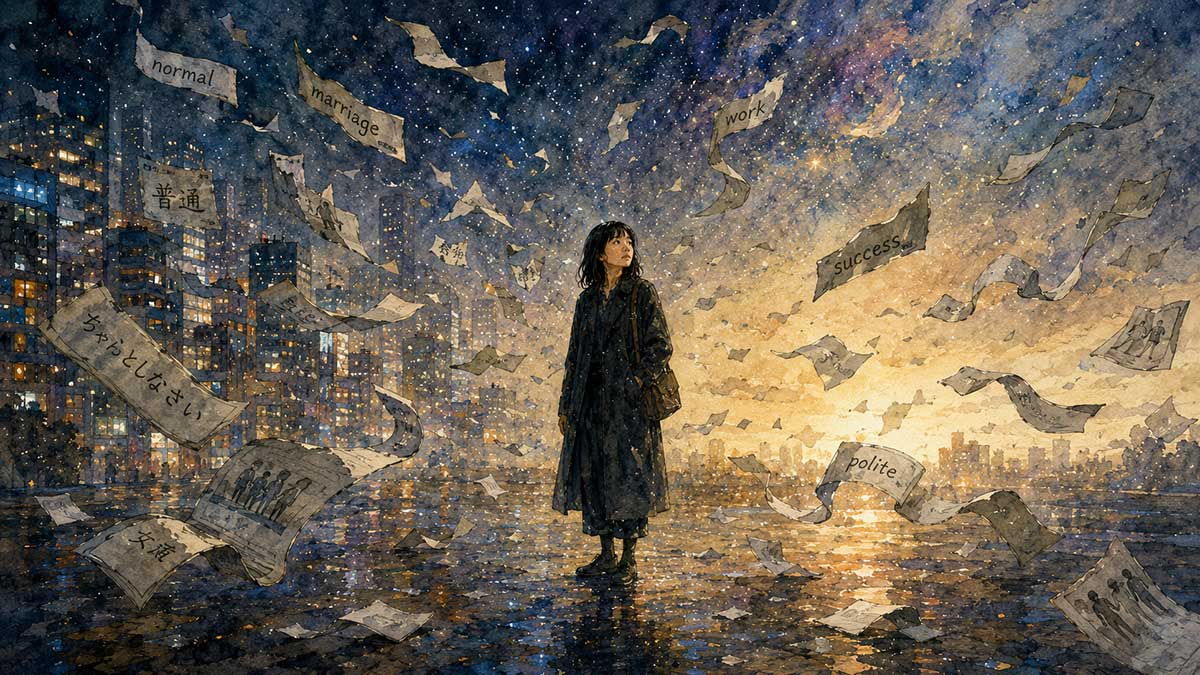
I sometimes feel that the words coming out of people are not entirely their own.
The same is true for me.
We say things like, “This is what I want,” or, “This is what I believe,” but I wonder how much of that came from somewhere else.
Family.
School.
Gender.
Culture.
Work.
The idea of being normal.
Maybe society places words inside us, and after enough time we mistake them for our own feelings.
Bashar:
Then let us begin by separating two things.
A belief can come from outside you and still be useful.
The question is not simply, “Where did this belief come from?”
The question is, “Does it still represent who you choose to be?”
Sayaka Murata:
How can I know that?
Some beliefs are so deep that they no longer feel like beliefs.
They feel like facts.
Bashar:
Exactly.
That is why beliefs are often invisible.
When you say, “I must behave this way or something terrible will happen,” the physical mind may experience that as reality rather than interpretation.
Take something you described from childhood.
You felt that if you upset someone, you might be rejected.
Did that belief help you at the time?
Sayaka Murata:
Yes.
I watched people very carefully.
I tried to become the kind of child they would not want to throw away.
Bashar:
Then that belief had a protective function.
There is no need to hate the child who formed it.
But a belief that protected a child can imprison an adult if it is never examined again.
Sayaka Murata:
So the problem is not that society put something into me.
It is that I stopped noticing that I was carrying it.
Bashar:
Yes.
And once you see it, you can ask whether you still choose it.
Carl Jung:
I would approach this through the persona.
Every human being develops a social face.
It allows us to function in a family, in a profession, in a culture.
There is nothing inherently false about that.
Sayaka Murata:
So the mask itself is not the enemy.
Jung:
No.
The danger comes when the mask becomes identical with the whole person.
You may begin to believe that the role you perform is all that you are.
Sayaka Murata:
That is very close to something I felt as a child.
I wanted to become better at being human.
I felt everyone else understood how to do it, and I had somehow missed the instructions.
Jung:
Then you may have had to study the social mask very consciously.
How to speak.
How to respond.
How much emotion to show.
What kind of woman to become.
What other people expected.
Sayaka Murata:
Yes.
And later, when I worked in a convenience store, something strange happened.
There were clear rules.
A way to speak.
A way to move.
A role.
For the first time, I could become “a convenience store worker” instead of constantly trying to become a woman or a proper human being.
Jung:
Which may explain why the role felt liberating rather than merely restrictive.
The persona can sometimes provide structure.
The problem is not having a role.
The problem is forgetting that a role is a role.
Alan Watts:
I think we should be careful, though.
You are all beginning to create a very tempting picture.
There is society on the outside.
Then there are layers of conditioning.
And somewhere underneath all of it sits a tiny, pure, untouched Sayaka waiting to be discovered.
Sayaka Murata:
That is close to how I imagine it.
Watts:
Yes, and I suspect that is the next illusion.
Sayaka Murata:
Why?
Watts:
What would this untouched self speak?
Japanese?
Sayaka Murata:
Probably.
Watts:
Then Japanese is already there.
Would it have memories?
Sayaka Murata:
Yes.
Watts:
Then relationships are already there.
Would it know what a human being is?
Sayaka Murata:
I suppose so.
Watts:
Then culture is already there too.
The idea that you can peel away everything the world gave you and find a completely independent self underneath assumes that you were ever separate from the world in the first place.
Sayaka Murata:
Then there may be no completely private language inside me.
Watts:
Perhaps not.
But why should that be disappointing?
A tree receives from soil, rain, sunlight, fungi, insects, and air.
No one says, “What a fraudulent tree. None of this is truly its own.”
Sayaka Murata:
That is very different from how we think about people.
We want our thoughts to belong to us.
Watts:
Human beings are very fond of ownership.
My body.
My thoughts.
My personality.
My life.
But the closer you inspect those things, the harder it becomes to say exactly where “mine” begins.
Bashar:
There is still a useful distinction, though.
You may not have invented every belief, but you participate in which beliefs you continue to energize.
You do not need an isolated self untouched by the universe in order to make choices.
Watts:
That I can accept.
Sayaka Murata:
Then maybe the question is not, “Which thoughts are completely mine?”
Maybe it is, “Which thoughts do I still want to live through?”
Bashar:
Exactly.
Jung:
And I would add another question.
Which parts of yourself have you excluded in order to maintain the person you believe you should be?
Sayaka Murata:
You mean the shadow.
Jung:
Yes.
Suppose the acceptable Sayaka is quiet, accommodating, careful not to hurt others.
Then where does anger go?
Where does refusal go?
Where does aggression go?
Where does the part that says, “No, I will not perform this role for you,” go?
Sayaka Murata:
I have said that my anger feels broken.
As though that function stopped working when I was a child.
Jung:
A function that disappears from conscious life does not necessarily disappear from the psyche.
It may emerge somewhere else.
In dreams.
In the body.
In attraction and repulsion.
In fiction.
In characters who do what the conscious personality cannot.
Sayaka Murata:
That makes me think about the people in my novels.
They can become very extreme.
They reject things I never openly rejected.
They survive in ways I never imagined.
Sometimes readers think I must be furious with society.
But consciously, I do not feel that way.
Jung:
Then fiction may be carrying psychological material your everyday identity does not fully recognize.
Sayaka Murata:
So the words society gave me are not the only foreign words inside me.
There may be words from parts of myself I do not consciously know.
Jung:
Precisely.
Watts:
And now the word “foreign” becomes rather amusing.
Foreign to whom?
Sayaka Murata:
To the conscious me.
Watts:
There we are.
Perhaps the little conscious manager has been declaring most of existence foreign territory.
Sayaka Murata:
When you put it that way, it sounds arrogant.
Watts:
The ego is charming that way.
Bashar:
There is another point worth examining.
You said earlier that fiction can help the words imposed by the world fall away.
What happens when that occurs?
Sayaka Murata:
Sometimes I find a sentence or a feeling that is inconvenient.
Something I would rather not admit.
And yet it feels more alive.
More true.
Bashar:
Then perhaps what you call “your own words” are not words with no influence behind them.
Perhaps they are words that produce less internal contradiction.
Sayaka Murata:
They feel less performed.
Bashar:
Yes.
More aligned.
Jung:
That would fit psychologically too.
A statement can feel alive when it includes something previously excluded from consciousness.
Watts:
But let us not create another religion called Authenticity.
Sayaka Murata:
What do you mean?
Watts:
People can become just as theatrical about being “their true selves” as they once were about being respectable.
“I am no longer performing.”
That itself can become a performance.
Sayaka Murata:
That sounds very possible.
Watts:
Of course it is.
Humans are wonderfully inventive actors.
Sayaka Murata:
Then how do you know when you have reached something true?
Watts:
Perhaps you do not reach it once and keep it in a drawer.
Perhaps truth is less like an object and more like seeing clearly in a particular moment.
Bashar:
I would phrase it as increasing alignment.
A belief that once defined you can become irrelevant.
Another becomes clearer.
You change.
Your experience changes.
Jung:
And I would describe it as a continuing relationship between consciousness and the wider psyche.
There is no final stage at which the ego says, “I now possess the complete truth about myself.”
Sayaka Murata:
That is strange.
I have always felt that there is something deeper.
A more real truth beneath the truth everyone talks about.
Jung:
There may indeed be deeper material.
But deeper does not automatically mean final.
Watts:
Nor does deeper automatically mean more real.
The surface of the ocean is still ocean.
Sayaka Murata:
I think I have always distrusted surfaces.
Maybe because I spent so much of childhood performing.
If someone smiled, I wondered what was underneath it.
If someone said something kind, I wondered whether they meant something else.
I always wanted to see below.
Jung:
That makes psychological sense.
A child who must monitor the emotional atmosphere closely may become highly sensitive to discrepancies between appearance and feeling.
Bashar:
And that sensitivity may later become part of your creative gift.
Sayaka Murata:
I am careful with that word.
Gift.
Sometimes it feels more like damage that became useful.
Bashar:
Then call it a capacity.
You do not need to call the pain good in order to recognize what you learned to perceive.
Sayaka Murata:
That feels better.
There is still something I cannot let go of, though.
I want to know what remains if we go far enough.
Not just beneath society.
Beneath personality.
Beneath morality.
Beneath the idea of being human.
Watts:
There is your onion again.
Sayaka Murata:
I know.
Watts:
And you are determined to peel it to extinction.
Sayaka Murata:
Maybe.
Bashar:
Let us ask something different.
Why do you assume that the deepest truth must be hidden underneath?
Sayaka Murata:
Where else would it be?
Bashar:
Perhaps in the relationship among all the layers.
Perhaps the child, the writer, the convenience store worker, the frightened person, the observer, the imaginary friends, the social roles, the unknown parts of you are not disguises covering one true self.
Perhaps together they form an ongoing expression of something larger.
Sayaka Murata:
Then there is no single correct Sayaka Murata.
Bashar:
Why would there need to be?
Jung:
I would agree that psychological wholeness is not the elimination of multiplicity.
It is the ability to hold more of oneself without forcing everything into one narrow identity.
Watts:
A river does not become more authentic by choosing one shape and refusing to move.
Sayaka Murata:
So the self could be something that moves.
Watts:
Better still, something that happens.
Sayaka Murata:
A happening rather than a thing.
Watts:
Yes.
Bashar:
And from my perspective, an expression that can shift according to belief, state, choice, and experience.
Jung:
And from mine, a life moving in relation to a larger psychic totality.
Sayaka Murata:
You all make it sound less solid than I expected.
Watts:
That may be why you keep trying to put it in a box.
Sayaka Murata:
A box.
Watts:
There it is.
Sayaka Murata:
I have talked about a box for a long time.
Something at the bottom of human beings.
Something I have not opened yet.
I feel that if I really opened it, I might see something so true that I could no longer live normally afterward.
Jung:
Then perhaps we have finally reached the question beneath this one.
Bashar:
Yes.
You began by asking which words were truly yours.
Now you are asking whether there is a truth capable of destroying the person who discovers it.
Sayaka Murata:
That is what frightens me.
And it is exactly what I want to see.
Watts:
Then before you open the box, I have only one question.
When you say, “It might destroy me,”
which “me” do you expect to lose?
Topic 5: What Is Inside the Box Sayaka Murata Still Cannot Open?
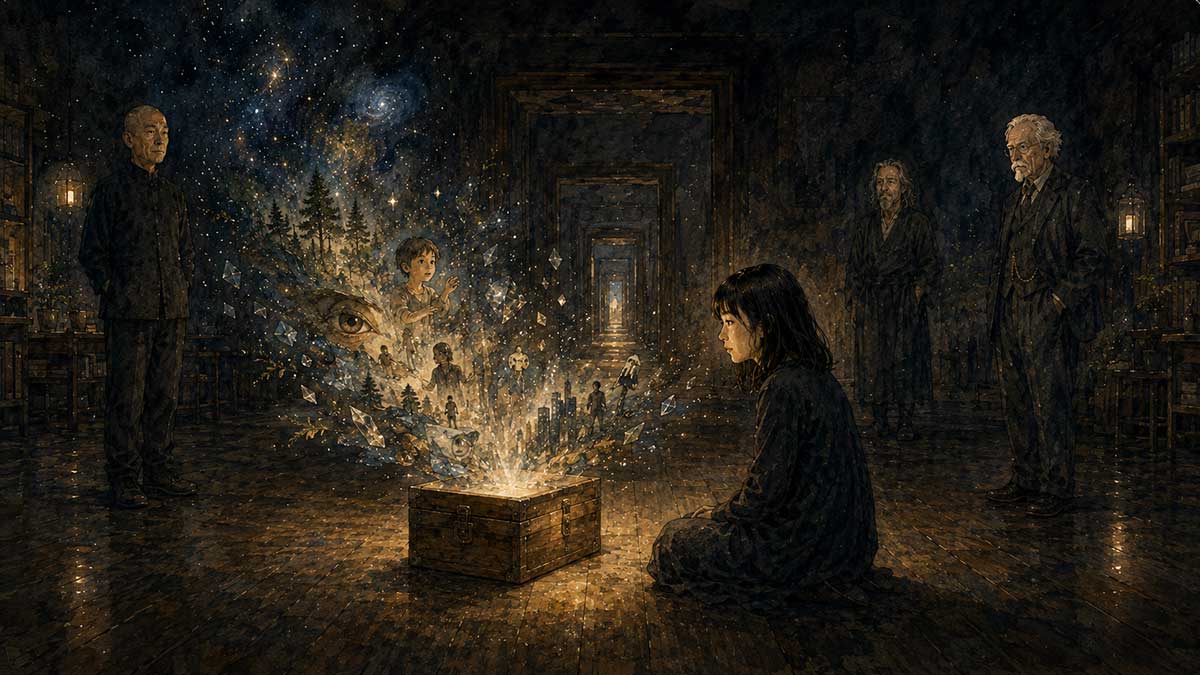
Sayaka Murata:
I have thought about this for years.
There is something I want to see.
Something beneath what people usually call truth.
A place inside human beings that has not yet been fully turned into language.
And I sometimes feel that if I really saw it, I might break.
Not metaphorically.
I mean I might no longer be able to live as an ordinary human being.
But I still want to see it.
Bashar:
Then let us begin before the box opens.
You already believe there is something inside it capable of destroying you.
Why?
Sayaka Murata:
I do not know.
Maybe because I suspect human beings are stranger than we admit.
Crueler.
Less stable.
Less moral.
Maybe what we call love or ethics is thinner than we want to believe.
Bashar:
Notice what you are doing.
You have not opened the box, yet you have already assigned qualities to its contents.
Dangerous.
Cruel.
Destabilizing.
Perhaps the first thing inside the box is not a hidden truth about humanity.
Perhaps it is your belief about what truth must look like.
Sayaka Murata:
So I may be frightened by the picture I made before I even looked.
Bashar:
Yes.
There can be experiences that shock you.
There can be realizations that change your identity.
But transformation is not the same as destruction.
Carl Jung:
I would still be more cautious.
There are contents of the unconscious that the ego cannot absorb all at once.
Human beings build psychic structures for a reason.
If those structures are suddenly overwhelmed, there can be real psychological danger.
I would never romanticize being shattered by the unconscious.
Sayaka Murata:
So perhaps some boxes really should stay closed.
Jung:
Not necessarily forever.
But timing matters.
Relationship matters.
Integration matters.
The goal is not to break the ego for the sake of discovering something dramatic.
The goal is to enlarge consciousness without being swallowed by what it discovers.
Bashar:
That distinction is useful.
You do not need to attack the box.
You can examine the fear around it first.
Sayaka Murata:
I like that.
But I still have the feeling that something frightening is there.
Jung:
Then let us examine what you expect to find.
You have described yourself as someone whose anger became damaged or inaccessible very early.
Suppose the box contains anger.
Not abstract anger.
Your anger.
The part that says no.
The part that refuses.
The part that protects boundaries.
Would that feel frightening?
Sayaka Murata:
Very.
I know characters who can do those things.
I do not know that person very well inside myself.
Jung:
Then what appears monstrous may partly be unlived life.
The shadow does not contain only cruelty.
It can contain strength.
Desire.
Aggression in its healthy sense.
The capacity to reject what harms you.
The right to occupy space.
Sayaka Murata:
Then perhaps I have been imagining the box too negatively.
Jung:
Possibly.
People often assume that what they repress must be evil.
Sometimes they have repressed what their environment could not tolerate.
Alan Watts:
I think there is another possibility.
What if you open the box and discover that the one thing you expected to find is not there?
Sayaka Murata:
What do you mean?
Watts:
Suppose you expect to find the final human essence.
The ultimate Sayaka.
The creature underneath society, language, morality, fear, and memory.
You open the box.
And there is no little object inside labeled TRUE SELF.
Sayaka Murata:
That might be more frightening than finding a monster.
Watts:
Exactly.
People can tolerate many monsters more easily than they can tolerate the absence of a permanent center.
Sayaka Murata:
If there is no center, then who has been living my life?
Watts:
Life has.
Through this form you call Sayaka Murata.
Sayaka Murata:
That sounds beautiful, but it also feels slippery.
Watts:
It should.
You are trying to hold a river still.
Bashar:
I would phrase it differently, but there is something useful there.
You may discover that the identity you defend is only one expression of a larger self.
The part that breaks may not be your existence.
It may be your definition of your existence.
Sayaka Murata:
That feels different.
If my definition breaks, perhaps something still remains.
Bashar:
Or something broader becomes available.
Jung:
In psychological terms, this is close to what happens when the ego is forced to recognize that it is not the whole psyche.
That recognition can be painful.
But it can lead to greater wholeness rather than annihilation.
Sayaka Murata:
Then maybe I have been confusing ego death with actual destruction.
Watts:
Human beings often do.
We become attached to the story of who we are, then interpret any threat to the story as a threat to existence itself.
Sayaka Murata:
But what about the darker possibility?
What if beneath culture and morality there really is something brutal?
Suppose human beings are mostly survival machines.
Suppose kindness is only a thin layer.
Jung:
Why assume the deepest layer must be the ugliest one?
Sayaka Murata:
Because culture feels like something added later.
Jung:
That does not mean what precedes culture is merely savage.
Attachment is ancient.
Play is ancient.
Care is ancient.
Fear is ancient.
Aggression is ancient.
So is cooperation.
The deep psyche does not reduce neatly to one moral conclusion.
Bashar:
And from my perspective, there is no need to define humanity by one fixed hidden essence.
Different states bring forward different expressions.
Fear produces one version.
Love another.
Scarcity another.
Trust another.
Sayaka Murata:
So there may be no final sentence that says, “This is what humans really are.”
Bashar:
That is my view.
Watts:
And if such a sentence existed, I suspect humans would immediately misuse it.
Sayaka Murata:
Probably.
Watts:
Imagine the relief of not having to solve humanity permanently.
Sayaka Murata:
I am not sure I want relief.
I think I want the question.
Jung:
That may be more important.
Sayaka Murata:
When I write, I do not want to prove that humans are good.
I do not want to prove they are evil either.
I want to change the conditions and watch.
Sometimes the result frightens me.
Sometimes it makes our ordinary world look ridiculous.
Sometimes it makes me feel there is another layer I had not seen.
Bashar:
Then each novel is already a partial opening of the box.
Sayaka Murata:
But I am still intact.
That makes me think I have not found the real one yet.
Bashar:
Or perhaps you have assumed the real box must destroy you, so every discovery that does not destroy you feels incomplete.
Sayaka Murata:
That is uncomfortable.
Bashar:
Good.
Not because discomfort is automatically valuable, but because the assumption has become visible.
What if truth does not validate the story that truth must hurt?
Sayaka Murata:
Then I might overlook it.
I might think, “That cannot be the deepest truth. I survived it.”
Jung:
Exactly.
There is a danger in becoming attached to extremity.
The psyche does not always reveal what matters most through catastrophe.
Sometimes the deepest transformation is quiet.
Watts:
People prefer thunderbolts.
Silence is harder to market.
Sayaka Murata:
I think I do prefer something more violent in fiction.
Watts:
That is fine in fiction.
Just do not require the universe to perform theatrically for your benefit.
Sayaka Murata:
That is probably fair.
There is another thing.
If the box has no final truth inside it, why do I keep wanting to open it?
Watts:
Because opening boxes is what you do.
Sayaka Murata:
That sounds too simple.
Watts:
Simple things are very suspicious to writers.
Sayaka Murata:
True.
Watts:
Suppose the meaning is not hidden at the end of the search.
Suppose the search is itself the form your life takes.
You make a world.
You disturb it.
You watch.
You write.
Then the world disturbs you back.
Sayaka Murata:
That feels familiar.
Bashar:
I would call that participation in your life theme.
You are drawn repeatedly to the same fundamental exploration.
What is human?
What is self?
What is normal?
What remains when assumptions change?
You may not be here to acquire one final answer.
You may be here to explore the question through many forms.
Sayaka Murata:
Then maybe the reason I feel like material is that my own life becomes part of the experiment.
Bashar:
Yes, but remember the distinction we made.
You are not merely passive material.
You are participant, observer, and creator.
Jung:
And the material changes the observer.
That matters.
A writer does not remain outside the work untouched.
Sayaka Murata:
No.
Sometimes a novel takes me somewhere I did not want to go.
Jung:
Then the work is not merely something you produce.
It is a relationship.
Watts:
And perhaps that is why the question “Who is using whom?” never quite works.
The work changes the writer.
The writer changes the work.
The culture changes the writer.
The writer changes the culture.
There is no clean one-way arrow.
Sayaka Murata:
So maybe no one is using anyone.
Watts:
Or everyone is.
Sayaka Murata:
That sounds like you.
Watts:
I try to be consistent.
Sayaka Murata:
I want to go back to something Bashar said.
If there is a Higher Mind, and the physical mind only sees part of the picture, does that larger part already know what is inside the box?
Bashar:
It has a broader perspective than the physical personality.
But broader perspective is not the same as living the physical experience.
There is a difference between knowing a map and walking the road.
Sayaka Murata:
So the physical self still matters.
Bashar:
Very much.
That is why I would resist your description of yourself as disposable material.
The physical personality is the one having the experience.
Writing the page.
Feeling fear.
Making choices.
Encountering uncertainty.
A larger self does not make the physical self irrelevant.
Sayaka Murata:
Then I am not here just to produce novels.
Bashar:
No.
The novels may be one expression of what you are exploring.
Your existence does not need to justify itself through output.
Sayaka Murata:
I am glad you said that.
There is something cruel in the idea that pain only matters if I can turn it into art.
Jung:
Yes.
A human life must not be reduced to raw material for production.
Transformation is meaningful only if the living person remains part of the meaning.
Watts:
A tree is not valuable merely because someone can make a table from it.
Sayaka Murata:
Then perhaps I need another word besides material.
Bashar:
Participant.
Jung:
Whole person.
Watts:
Occurrence.
Sayaka Murata:
Occurrence is difficult.
Watts:
That is why I like it.
Sayaka Murata:
I think participant is easier.
I participate in something I do not fully understand.
I make the aquarium.
I am inside the aquarium.
I watch it.
Something happens.
Then I write.
Bashar:
And you do not need to know every level of what is happening before participating fully.
Sayaka Murata:
That might be the hardest part for me.
I want to know.
Jung:
And yet not knowing may be what keeps the relationship alive.
Sayaka Murata:
Yes.
If I knew everything, I might stop writing.
Watts:
There is the secret you have been circling.
You keep saying you want the final truth.
But would you actually want a universe with nothing left to ask?
Sayaka Murata:
No.
That sounds unbearable.
Watts:
Then perhaps you do not really want the last box.
Sayaka Murata:
Maybe I want to believe there is always another one.
Bashar:
Then your desire is not for final certainty.
It is for discovery.
Sayaka Murata:
That sounds right.
I want to see something I have never seen before.
About humans.
About myself.
About the world.
Jung:
Then fiction gives the unknown a form without forcing it to become a final doctrine.
Sayaka Murata:
Yes.
That is very important.
I do not want to teach people what humans are.
I want to make a strange world and see what humans do inside it.
Watts:
Which is perhaps wiser than telling humans what they are.
Sayaka Murata:
So maybe the box is not a container with one terrible answer.
Maybe it is a doorway.
Bashar:
That metaphor gives you more freedom.
Sayaka Murata:
A doorway to another room.
Jung:
And another relationship with yourself.
Watts:
And, naturally, another door.
Sayaka Murata:
I like that.
I used to think that if I found the real truth, I would break.
Now I wonder if what breaks is only the room I thought I had to live in.
Bashar:
That is a very different statement.
Sayaka Murata:
Yes.
Maybe there is another room after it.
And another.
Watts:
You may eventually discover that the house has no outer wall.
Sayaka Murata:
That is frightening again.
Watts:
I was worried you were becoming too comfortable.
Sayaka Murata:
But this kind of frightening is different.
It feels more open.
When I was a child, I wanted to become better at being human.
I thought there was one correct way.
Now I wonder whether there was ever one correct human being to become.
Jung:
That realization itself can be liberating.
Bashar:
You do not have to reduce yourself to one definition.
Sayaka Murata:
Then maybe I am the child who needed another planet.
The woman who worked in a convenience store.
The writer watching the aquarium.
The person inside the aquarium.
The person who lost access to anger.
The person who writes characters full of rage.
The one who wants to open the box.
All of them.
Jung:
Yes.
Bashar:
And perhaps more than all the definitions combined.
Watts:
Or perhaps the mistake is still trying to count.
Sayaka Murata:
You really will not let me finish, will you?
Watts:
Finishing would spoil the point.
Sayaka Murata:
Then maybe that is where I am.
I still do not know what the deepest truth about human beings is.
I still do not know exactly who my imaginary friends are.
I do not know whether the worlds I write are invented or discovered.
I do not know whether I am completely writing my novels, or whether something larger is moving through the process.
But I think I understand one thing differently now.
Not knowing does not mean I have failed to find the answer.
Maybe not knowing is the place where I can keep looking.
Bashar:
And choosing.
Jung:
And integrating.
Watts:
And playing.
Sayaka Murata:
And writing.
Yes.
I think I will keep opening the box.
But perhaps I no longer need the next one to destroy me.
Final Thoughts
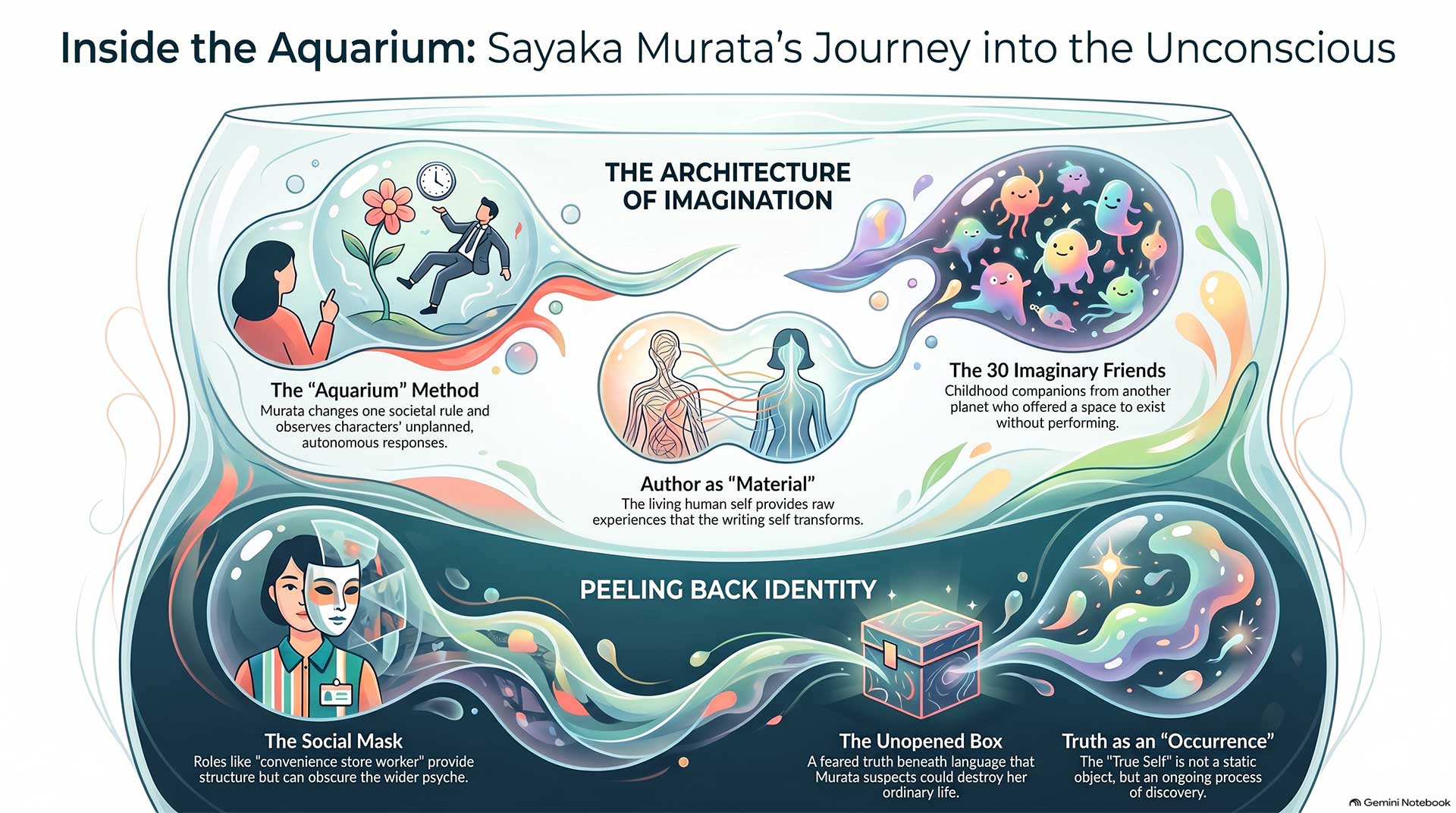
The most striking idea in this conversation may be Murata’s sense that she is both the writer and the material being written from.
The human Sayaka Murata lives inside society.
She adapts.
She becomes frightened.
She absorbs language and expectations.
Some parts of her become inaccessible.
Then the writer observes that life, picks up fragments, and places them into fiction.
At first, this can sound almost frighteningly impersonal.
Is the person merely raw material for the novelist?
Bashar changes the question.
Perhaps the relationship is not one of exploitation, but participation. The physical personality may be one part of a larger process, with the writer translating something she cannot entirely see in advance.
Jung gives a psychological version of that idea. The conscious ego does not contain the whole psyche. A writer may feel that characters, images, or stories arrive with autonomy precisely because the conscious mind is not the only source of psychic life.
Watts goes further and questions the separation itself.
Who is using whom?
The writer is shaped by society.
Society enters the novel.
The novel changes the writer.
Readers later change the meaning again.
The clean line between creator and created begins to disappear.
This becomes even more interesting when Murata turns to the words society has placed inside us.
She has spoken about language that feels as though the world is speaking through a person while the person mistakes those words for private feeling.
The conversation does not resolve this by searching for a perfectly untouched self hidden at the center.
Watts points out that language, memory, culture, relationships, and even the concept of the self come through contact with the world.
Jung warns that the social mask is not false in itself. The danger comes when the mask becomes the whole identity.
Bashar reframes the question around choice: a belief does not become false simply because it came from outside. The deeper question is whether we still choose to live through it.
Then the conversation reaches Murata’s unopened box.
She has described wanting to discover something deeper than what people normally call truth, something so profound that she has imagined it could leave her unable to live as an ordinary human being.
At first, the box seems to contain horror.
Human cruelty.
The collapse of morality.
A terrifying essence beneath civilization.
Yet each guest complicates that expectation.
Jung suggests the box might contain what Murata has not yet been able to live, such as anger, refusal, strength, or other parts pushed into shadow.
Bashar asks whether Murata has already decided that truth must be destructive before she has seen it.
Watts asks whether what breaks might be the story of the self rather than the existence of the self.
This shifts the metaphor.
Perhaps the box does not contain one final truth.
Perhaps it opens into another room.
Then another.
And another.
That possibility changes Murata’s relationship with the unknown.
She no longer needs the deepest truth to destroy her in order for it to count as deep.
She can remain the person who opens strange worlds, watches what happens, and refuses to close the question too quickly.
Perhaps that is why fiction has remained sacred to her.
Not because it provides final answers.
Because it gives the unknown somewhere to stay alive.
Short Bios:
Sayaka Murata
Sayaka Murata is a Japanese novelist best known internationally for Convenience Store Woman, Earthlings, and Life Ceremony. Her work often examines normality, gender, family, sexuality, labor, social roles, and the instability of moral assumptions. She has described fiction as a place of freedom, experimentation, and survival, and has spoken openly about imaginary friends, alternate worlds, and her aquarium-like method of creating characters.
Bashar
Bashar is the name given to an entity that Darryl Anka says he channels. The teachings associated with Bashar explore Higher Mind, Physical Mind, beliefs, parallel realities, life themes, imagination, and consciousness. In this fictional conversation, those ideas are treated as a philosophical and spiritual framework rather than established scientific fact.
Carl Gustav Jung
Carl Gustav Jung was a Swiss psychiatrist and the founder of analytical psychology. His work developed concepts including the collective unconscious, persona, shadow, Self, archetypes, individuation, and active imagination. He explored the ways inner figures, dreams, symbols, and creative processes can reveal aspects of the psyche beyond the conscious ego.
Alan Watts
Alan Watts was a British-born writer and speaker known for interpreting Zen, Taoism, Hindu philosophy, and other Asian traditions for Western audiences. His work frequently questioned the idea of the isolated ego and explored the relationship between self, nature, experience, language, and the larger process of life.
Leave a Reply