
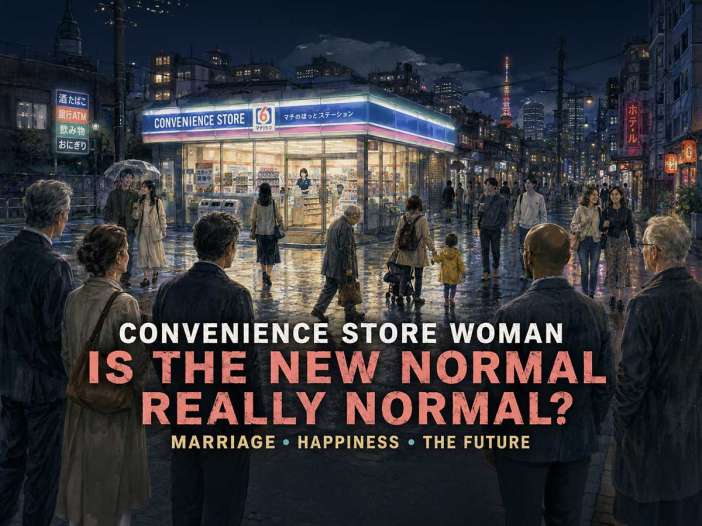
Introduction
Sayaka Murata’s Convenience Store Woman begins with a woman who does not fit the conventional picture of adulthood.
Keiko Furukura is unmarried.
She has no children.
She has spent eighteen years working in the same convenience store.
Her family worries.
People around her assume she should want something different.
Part One asked whether Keiko should have to change simply to make other people comfortable.
Part Two asks a much harder question:
What happens when individual freedom becomes a large social pattern?
If one person does not marry, there is no social crisis.
If millions delay or reject marriage and parenthood, questions begin to appear about fertility, caregiving, loneliness, aging, social institutions, and future generations.
Yet population concerns cannot turn an individual woman into a demographic instrument.
Keiko does not owe society a husband.
She does not owe anyone children.
Her dignity does not depend on marital status.
So this conversation brought together five very different perspectives: Bella DePaulo on single life, Louise Perry on marriage and social institutions, Tyler VanderWeele on human flourishing, Arthur Brooks on happiness and meaningful relationships, and Timothy Keller as a Christian voice on marriage, singleness, covenant, and community.
Their disagreement produced a distinction that became central to the entire discussion:
Something can be optional for an individual and still important for society.
Marriage may matter.
Singleness may be fully legitimate.
Children matter to the continuation of society.
No particular person owes society a child.
Strong relationships matter deeply to human flourishing.
Marriage is one important structure for creating them, but it is not the only one.
The difficult work begins when we try to hold all of those truths at the same time.
(Note: This is an imaginary conversation, a creative exploration of an idea, and not a real speech or event.)
Topic 1: Is the “New Normal” Really Normal?

The room had been arranged to resemble a small reading salon rather than an academic panel.
Copies of Convenience Store Woman rested on a low table.
Through the windows, the city moved through early evening. Office workers headed home. A couple walked past holding hands. A woman hurried by alone, talking into her phone. A father pushed a stroller while another child walked beside him.
Bella DePaulo looked through the window.
Bella DePaulo: “Before we begin, I want to protect Keiko from something.”
Arthur Brooks: “Already?”
Bella DePaulo: “Especially already.”
A few people smiled.
Bella DePaulo: “Keiko is fictional, but people like her are real. Unmarried adults are constantly asked to explain themselves.”
She looked around the room.
Bella DePaulo: “Why aren't you married?”
“Are you seeing anyone?”
“Don't you want children?”
“Aren't you lonely?”
“What are you waiting for?”
She paused.
Bella DePaulo: “Married people aren't routinely asked to demonstrate that marriage was the correct decision.”
Louise Perry: “Some probably should be.”
Bella laughed.
Bella DePaulo: “I might agree with you there.”
Arthur Brooks: “We have achieved consensus remarkably early.”
Bella DePaulo: “Don't get comfortable.”
Another laugh.
Tyler VanderWeele leaned forward.
Tyler VanderWeele: “Then perhaps we should establish something at the beginning. Keiko's human worth is not the question.”
Bella DePaulo: “Good.”
Tyler VanderWeele: “The interesting question concerns what happens when we move from individual worth to social patterns.”
Louise nodded.
Louise Perry: “That's exactly where I want to go.”
Bella DePaulo: “And exactly where I become suspicious.”
Louise Perry: “Why?”
Bella DePaulo: “Because historically, that's often how pressure returns through the back door.”
Louise waited.
Bella DePaulo: “First you say, ‘Of course Keiko has every right to remain single.’”
She raised one finger.
Bella DePaulo: “Then you say, ‘But marriage is good for society.’”
Another.
Bella DePaulo: “‘Children are necessary for the future.’”
Another.
Bella DePaulo: “‘Families create stability.’”
She lowered her hand.
Bella DePaulo: “And before long, Keiko is sitting at another family dinner being asked when she's going to get married.”
Louise Perry: “That's a fair warning.”
Bella looked mildly surprised.
Louise Perry: “But it doesn't answer the argument.”
Bella DePaulo: “I know.”
Louise Perry: “Good.”
Arthur smiled.
Arthur Brooks: “Now we have a conversation.”
Louise picked up the novel.
Louise Perry: “Murata does something brilliant with Keiko. She makes us feel how intrusive normality can become.”
Bella nodded.
Louise Perry: “Everyone wants Keiko's life to progress according to a recognizable sequence.”
Job.
Marriage.
Perhaps children.
Some form of upward movement.
Louise Perry: “And Keiko doesn't understand why.”
Bella DePaulo: “Nor should she have to.”
Louise Perry: “Perhaps.”
Bella looked at her.
Louise Perry: “But here's where I want to turn Murata's question around.”
She put the book down.
Louise Perry: “Suppose society actually listened to Keiko.”
No one interrupted.
Louise Perry: “Suppose we became extremely reluctant to tell anyone that marriage matters.”
She continued.
Louise Perry: “We stopped saying that forming a family is admirable.”
“Stopped suggesting that parenthood can be meaningful.”
“Stopped treating lifelong commitment as an achievement.”
“And became afraid that encouraging any of those things might stigmatize people who choose differently.”
Louise looked at Bella.
Louise Perry: “Would that culture really be neutral?”
Bella DePaulo: “No culture is neutral.”
Louise Perry: “Exactly.”
Bella DePaulo: “But removing pressure isn't the same thing as discouraging marriage.”
Louise Perry: “Sometimes.”
Bella DePaulo: “That's a big ‘sometimes.’”
Louise Perry: “It is.”
Arthur leaned back.
Arthur Brooks: “Maybe we're using the wrong word.”
Tyler VanderWeele: “Normal?”
Arthur Brooks: “Yes.”
He looked around.
Arthur Brooks: “Normal can mean statistically common.”
He held up one finger.
Arthur Brooks: “It can mean socially expected.”
Another.
Arthur Brooks: “And people often smuggle in a third meaning.”
Bella DePaulo: “Good.”
Arthur Brooks: “Morally preferable.”
Bella nodded.
Arthur Brooks: “Those aren't the same.”
Timothy Keller: “And Christianity has often confused them too.”
Everyone turned toward Keller.
Timothy Keller: “There have been Christian communities where marriage became so culturally dominant that unmarried adults felt they were waiting in a hallway outside real adulthood.”
Bella looked at him with interest.
Bella DePaulo: “That's quite an admission.”
Timothy Keller: “It needs admitting.”
Bella DePaulo: “Then Keiko would probably appreciate you.”
Keller smiled.
Timothy Keller: “I'm not sure Keiko would appreciate any of us discussing her life for this long.”
Arthur laughed.
Arthur Brooks: “That may be the most accurate observation tonight.”
Keller became serious again.
Timothy Keller: “Christianity creates a problem for simplistic arguments about marriage.”
Louise Perry: “How?”
Timothy Keller: “Because Christianity places enormous significance on marriage.”
He paused.
Timothy Keller: “And yet its central figure never married.”
Silence.
Timothy Keller: “Paul explicitly treated singleness as a legitimate calling.”
Bella nodded.
Timothy Keller: “So Christianity cannot coherently say that every person must marry to become complete.”
Bella DePaulo: “Yet Christians have often behaved that way.”
Timothy Keller: “Yes.”
Bella DePaulo: “Why?”
Keller thought for a moment.
Timothy Keller: “Partly culture.”
Bella DePaulo: “That's convenient.”
Timothy Keller: “It is also true.”
He continued.
Timothy Keller: “Churches absorbed social assumptions about adulthood and family. Sometimes marriage became less a Christian vocation than a badge of normal adulthood.”
Bella DePaulo: “Which is exactly Murata's criticism.”
Timothy Keller: “In part.”
Bella DePaulo: “Only in part?”
Timothy Keller: “Because saying marriage should not determine human worth does not mean marriage has no particular social or moral value.”
Bella smiled.
Bella DePaulo: “There it is.”
Timothy Keller: “There what is?”
Bella DePaulo: “The back door.”
The room laughed.
Keller did too.
Tyler entered quietly.
Tyler VanderWeele: “Perhaps we can close that door by separating three propositions.”
Everyone looked toward him.
Tyler VanderWeele: “First: every adult should marry.”
Bella DePaulo: “False.”
Tyler VanderWeele: “I agree.”
Tyler VanderWeele: “Second: marriage can contribute to human flourishing.”
Bella waited.
Tyler VanderWeele: “There is evidence supporting that.”
Bella DePaulo: “With qualifications.”
Tyler VanderWeele: “Many.”
Arthur Brooks: “Good qualifications.”
Tyler VanderWeele: “Necessary qualifications.”
He continued.
Tyler VanderWeele: “Third: society may have legitimate reasons to support institutions that tend to contribute to human flourishing.”
Bella leaned forward.
Bella DePaulo: “That's the dangerous one.”
Tyler VanderWeele: “It's certainly the difficult one.”
Bella DePaulo: “Who decides what counts as flourishing?”
Tyler VanderWeele: “Excellent question.”
Bella DePaulo: “Suppose Keiko tells you she is flourishing.”
Tyler VanderWeele: “Then I would take her report seriously.”
Bella DePaulo: “But?”
Tyler smiled.
Tyler VanderWeele: “You knew there was a but.”
Bella DePaulo: “There is always a but when academics say they respect people's choices.”
Arthur laughed.
Tyler VanderWeele: “Flourishing involves more than momentary happiness.”
Bella DePaulo: “Agreed.”
Tyler VanderWeele: “Health.”
“Meaning.”
“Purpose.”
“Character.”
“Close relationships.”
“Material stability.”
He paused.
Tyler VanderWeele: “So I would be curious about Keiko's life across several dimensions.”
Bella DePaulo: “Fine.”
Tyler VanderWeele: “Her work clearly gives her purpose.”
Arthur Brooks: “A great deal of it.”
Tyler VanderWeele: “She experiences competence.”
Louise Perry: “Belonging.”
Tyler VanderWeele: “Yes.”
Arthur Brooks: “Routine.”
Tyler VanderWeele: “Yes.”
Bella DePaulo: “Then she isn't doing badly.”
Tyler VanderWeele: “No.”
He paused.
Tyler VanderWeele: “But I would still ask about close relationships.”
Bella's expression changed.
Bella DePaulo: “Why does that immediately become marriage?”
Tyler VanderWeele: “I didn't say marriage.”
Bella paused.
Tyler VanderWeele: “That's important.”
Arthur leaned forward.
Arthur Brooks: “That's where I think Keiko presents a more interesting problem than whether she has a husband.”
He looked at the book.
Arthur Brooks: “Her convenience store gives her something many people desperately want.”
Louise Perry: “Purpose?”
Arthur Brooks: “Yes.”
Arthur Brooks: “But purpose and intimacy aren't interchangeable.”
Bella nodded slowly.
Arthur Brooks: “A person can have extraordinary work and still be lonely.”
Bella DePaulo: “A married person can be lonely.”
Arthur Brooks: “Absolutely.”
Bella DePaulo: “Perhaps lonelier.”
Arthur Brooks: “Certainly possible.”
Bella DePaulo: “Then we're making progress.”
Arthur Brooks: “I'm not defending marriage certificates.”
He paused.
Arthur Brooks: “I'm defending love.”
That quieted the room.
Arthur Brooks: “Friendship.”
“Family.”
“People who know you.”
“People you know.”
“People who would notice if you disappeared.”
He looked toward Bella.
Arthur Brooks: “Marriage can be one extraordinarily important way people build that.”
Bella DePaulo: “One.”
Arthur Brooks: “One.”
Bella DePaulo: “That's the word I care about.”
Arthur Brooks: “And I am happy to give it to you.”
Louise looked unconvinced.
Louise Perry: “But we may be becoming too comfortable.”
Arthur smiled.
Arthur Brooks: “I suspected you might fix that.”
Louise Perry: “If marriage is merely one relationship form among many, we're ignoring something.”
Bella DePaulo: “Children.”
Louise Perry: “Yes.”
Bella sighed.
Louise Perry: “Not because every woman needs children.”
Bella DePaulo: “Good.”
Louise Perry: “Not because every man deserves a wife.”
Bella DePaulo: “Better.”
Louise Perry: “But children don't emerge from friendship networks.”
The room became quieter.
Bella DePaulo: “Biologically, obviously.”
Louise Perry: “That's not trivial.”
Bella DePaulo: “I didn't say it was.”
Louise Perry: “Human societies need another generation.”
Bella DePaulo: “Humanity isn't currently short of people.”
Louise Perry: “Globally, no.”
She paused.
Louise Perry: “But we're talking about norms across generations.”
Bella waited.
Louise Perry: “Marriage historically isn't just a technology for making adults happy.”
Bella DePaulo: “I wouldn't call it a technology.”
Louise Perry: “You know what I mean.”
Bella DePaulo: “I do.”
Louise Perry: “It has been one way societies connect men and women to children and children to wider families.”
Timothy Keller: “And generations to one another.”
Louise Perry: “Exactly.”
Bella looked around the room.
Bella DePaulo: “Here's what bothers me.”
Nobody interrupted.
Bella DePaulo: “You start talking about civilization.”
She looked at Louise.
Bella DePaulo: “Then generations.”
At Keller.
Bella DePaulo: “Then children.”
At Tyler.
Bella DePaulo: “Then flourishing.”
Finally Arthur.
Bella DePaulo: “Then love.”
Arthur smiled faintly.
Bella DePaulo: “And suddenly one unmarried woman is carrying civilization on her back.”
Louise laughed.
Bella DePaulo: “I'm serious.”
Louise Perry: “I know.”
Bella DePaulo: “Why does Keiko have to answer for declining fertility?”
Louise Perry: “She doesn't.”
Bella DePaulo: “Then who does?”
Louise paused.
Louise Perry: “Culture does.”
That changed the room.
Bella DePaulo: “Culture isn't a person.”
Louise Perry: “No.”
Bella DePaulo: “Culture can't have a baby.”
Louise Perry: “No.”
Bella DePaulo: “So eventually your cultural concern lands on actual individuals.”
Louise Perry: “Yes.”
Bella DePaulo: “That's exactly my concern.”
Louise Perry: “And mine is that fear of placing pressure on individuals may make us incapable of talking honestly about collective outcomes.”
They looked at each other.
Neither smiled.
Arthur broke the silence.
Arthur Brooks: “Perhaps this is where we need to distinguish coercion from aspiration.”
Bella turned.
Arthur Brooks: “A culture inevitably tells stories about what a good life might contain.”
Bella DePaulo: “That's already dangerous.”
Arthur Brooks: “It can be.”
Arthur Brooks: “But suppose we become afraid to say that lifelong love is beautiful.”
Bella said nothing.
Arthur Brooks: “That raising children can produce meaning.”
Still nothing.
Arthur Brooks: “That caring for elderly parents can be honorable.”
Bella DePaulo: “Those aren't controversial.”
Arthur Brooks: “I'm not certain.”
Bella DePaulo: “You think caring for parents is controversial?”
Arthur Brooks: “No. I think sacrifice has become harder to advertise.”
That phrase stayed in the room.
Keller looked at Arthur.
Timothy Keller: “Because sacrifice limits freedom.”
Arthur Brooks: “Exactly.”
Timothy Keller: “Marriage limits freedom.”
Bella raised an eyebrow.
Timothy Keller: “It does.”
Louise looked interested.
Timothy Keller: “So does having children.”
Bella DePaulo: “You're making my argument.”
Timothy Keller: “Only if freedom means preserving the maximum number of future choices.”
Bella became quiet.
Timothy Keller: “Every serious commitment closes doors.”
Marriage.
Parenthood.
Friendship.
Faith.
Vocation.
Even choosing one city means not living in thousands of others.
Timothy Keller: “A meaningful life may involve voluntarily closing some possibilities.”
Bella DePaulo: “And remaining single can involve commitment too.”
Timothy Keller: “Absolutely.”
Bella seemed surprised again.
Timothy Keller: “The question isn't whether someone marries.”
He paused.
Timothy Keller: “The question is what they give themselves to.”
Arthur looked toward the window.
The father with the stroller was gone.
A young man now stood alone at the crosswalk.
Arthur Brooks: “Maybe that's the phrase we're missing.”
Louise Perry: “Giving yourself?”
Arthur Brooks: “Yes.”
He looked around.
Arthur Brooks: “Modern discussions about happiness often begin with what we should get.”
Love.
Security.
Recognition.
Meaning.
Pleasure.
Arthur Brooks: “But many of the things associated with a deeply satisfying life require giving.”
Time.
Attention.
Loyalty.
Care.
Forgiveness.
Sacrifice.
Bella DePaulo: “Again, none of that requires marriage.”
Arthur Brooks: “Agreed.”
Bella DePaulo: “You keep agreeing with me.”
Arthur Brooks: “You keep saying things I agree with.”
She smiled.
Arthur Brooks: “But here's where I might make you uncomfortable.”
Bella DePaulo: “Please.”
Arthur Brooks: “I worry about a culture that becomes very sophisticated at protecting people from obligations and very poor at teaching them why some obligations are worth choosing.”
Bella stopped smiling.
Louise leaned forward.
Louise Perry: “That's closer to what I mean by the new normal.”
Bella looked at her.
Louise Perry: “I don't fear Keiko.”
Bella DePaulo: “Good.”
Louise Perry: “I fear something different.”
She paused.
Louise Perry: “A culture that reads Keiko's refusal of one inappropriate expectation and turns it into a general philosophy.”
Bella DePaulo: “Which philosophy?”
Louise Perry: “‘Nobody should expect anything from me that I didn't independently choose.’”
Bella DePaulo: “Keiko doesn't say that.”
Louise Perry: “Exactly.”
She touched the book.
Louise Perry: “Which is why Murata is more interesting than some interpretations of Murata.”
That produced a silence of recognition.
Tyler spoke.
Tyler VanderWeele: “Keiko actually accepts enormous obligation.”
Bella looked at him.
Tyler VanderWeele: “To the store.”
Arthur nodded.
Tyler VanderWeele: “She shows up.”
“She performs her role.”
“She learns what customers need.”
“She contributes.”
“She accepts structure.”
Louise Perry: “Interesting.”
Tyler VanderWeele: “Keiko isn't rejecting obligation.”
He paused.
Tyler VanderWeele: “She's rejecting obligations other people selected for her.”
Bella smiled.
Bella DePaulo: “Now we're getting somewhere.”
Keller nodded.
Timothy Keller: “Then perhaps the moral question isn't whether obligation is good.”
Bella DePaulo: “It's who gets to choose it.”
Timothy Keller: “Partly.”
Bella laughed.
Bella DePaulo: “There's another ‘partly.’”
Timothy Keller: “There has to be.”
Bella DePaulo: “Why?”
Timothy Keller: “Because eventually life gives us obligations we didn't choose.”
The room quieted again.
Timothy Keller: “A parent becomes ill.”
“A friend needs help.”
“A child is born with needs nobody anticipated.”
“A spouse becomes disabled.”
“A community suffers.”
He looked around.
Timothy Keller: “A moral life cannot consist entirely of obligations we selected because they fit our preferred identity.”
Bella considered this.
Bella DePaulo: “That's fair.”
Louise looked at her.
Louise Perry: “You're agreeing with Keller?”
Bella DePaulo: “Don't get comfortable.”
Everyone laughed.
Arthur returned to the original question.
Arthur Brooks: “So is the new normal really normal?”
Bella DePaulo: “I still dislike the question.”
Arthur Brooks: “Why?”
Bella DePaulo: “Because it assumes there was an old normal that worked beautifully.”
Louise nodded.
Bella DePaulo: “There wasn't.”
She counted quietly.
Women trapped in destructive marriages.
Gay people forced into lives that denied who they were.
Single women treated with pity.
Single men treated with suspicion.
People staying married because economic survival required it.
People having children because there was scarcely an imaginable alternative.
Bella DePaulo: “We should not romanticize the old normal simply because the new one frightens us.”
Nobody challenged her.
Louise finally answered.
Louise Perry: “Agreed.”
Bella looked at her.
Louise Perry: “But we shouldn't romanticize liberation either.”
Silence.
Louise Perry: “Freedom solves certain problems.”
She paused.
Louise Perry: “Then it creates questions of its own.”
Bella DePaulo: “Such as?”
Louise Perry: “What holds people together when fewer relationships are obligatory?”
Arthur listened.
Louise Perry: “Who cares for people when families become smaller?”
Tyler listened.
Louise Perry: “Who raises the next generation?”
Keller listened.
Louise Perry: “And what happens when the language of personal freedom becomes much stronger than the language of duty?”
Bella sat back.
She did not dismiss it.
Tyler looked around the room.
Tyler VanderWeele: “Perhaps we can agree that neither old nor new should receive automatic moral authority simply because it is normal.”
Bella DePaulo: “Yes.”
Louise Perry: “Yes.”
Arthur Brooks: “Certainly.”
Timothy Keller: “Agreed.”
Tyler smiled.
Tyler VanderWeele: “Then we need evidence.”
Bella DePaulo: “And values.”
Timothy Keller: “And some account of human nature.”
Louise Perry: “And consequences.”
Arthur Brooks: “And perhaps a definition of the good life.”
They stopped.
There it was.
The conversation had moved far beyond Keiko's marital status.
Bella picked up Convenience Store Woman.
Bella DePaulo: “Then I want one promise before we continue.”
Louise Perry: “What?”
Bella DePaulo: “We don't turn Keiko into evidence for something she never claimed.”
Tyler VanderWeele: “Agreed.”
Bella DePaulo: “She isn't the spokesperson for declining marriage.”
Arthur Brooks: “Agreed.”
Bella DePaulo: “She isn't the spokesperson for childlessness.”
Timothy Keller: “Agreed.”
Bella DePaulo: “She's one woman who discovered that the life other people prescribed for her didn't fit.”
Louise nodded.
Louise Perry: “I'll accept that.”
Bella waited.
Louise Perry: “If you accept something in return.”
Bella DePaulo: “What?”
Louise looked around the room.
Louise Perry: “When millions of people independently begin rejecting the same institution, we're allowed to ask what happens next.”
Bella thought.
A long pause followed.
Then:
Bella DePaulo: “We're allowed to ask.”
Louise smiled.
Bella DePaulo: “We're not allowed to decide the answer before looking at the evidence.”
Tyler VanderWeele: “Excellent.”
Arthur leaned forward.
Arthur Brooks: “Then perhaps that's exactly where we should go next.”
Bella looked at him.
Arthur Brooks: “If we're going to argue about whether marriage still matters, we should stop guessing.”
He glanced at Tyler.
Then Bella.
Then the others.
Arthur Brooks: “Let's ask the uncomfortable empirical question.”
A pause.
Arthur Brooks: “Are married people actually happier?”
Nobody answered.
Not yet.
Topic 2: Are Married People Actually Happier?

Arthur's question remained in the room.
Arthur Brooks: “Are married people actually happier?”
Bella DePaulo leaned back.
Bella DePaulo: “That question sounds simple. It isn't.”
Tyler VanderWeele: “Agreed.”
Louise Perry: “But we can still answer parts of it.”
Bella DePaulo: “Parts.”
Arthur smiled.
Arthur Brooks: “Good. Then let's start with the part everyone hears in headlines.”
He looked toward Tyler.
Arthur Brooks: “Married people often report higher life satisfaction than unmarried people. True?”
Tyler VanderWeele: “In many datasets, yes.”
Bella raised a finger immediately.
Bella DePaulo: “And there comes the footnote.”
Tyler VanderWeele: “There should be several.”
Bella DePaulo: “Good.”
Tyler VanderWeele: “You have to ask who is being compared with whom.”
Never married?
Divorced?
Widowed?
Separated?
People in strong marriages?
People in distressed marriages?
People who married recently?
People who have been married for decades?
Tyler VanderWeele: “Those categories matter.”
Bella DePaulo: “A great deal.”
Arthur Brooks: “And selection.”
Bella DePaulo: “Very much.”
Louise looked toward her.
Louise Perry: “Meaning happier people may be more likely to marry?”
Bella DePaulo: “Or healthier people.”
“People with greater financial stability.”
“People who are more socially connected.”
“People whose personalities make lasting partnership easier.”
She paused.
Bella DePaulo: “If those people later report higher well-being, you can't automatically credit marriage for creating all of it.”
Tyler VanderWeele: “Correct.”
Bella glanced at him.
Bella DePaulo: “We're going to get along much better than I expected.”
Tyler VanderWeele: “Give it time.”
Arthur laughed.
Louise Perry: “But Tyler, you're not saying the entire marriage advantage disappears once you account for selection.”
Tyler VanderWeele: “No.”
Bella became attentive.
Tyler VanderWeele: “There is longitudinal research suggesting that marriage itself can contribute positively to several aspects of flourishing.”
Bella DePaulo: “Can.”
Tyler VanderWeele: “Can.”
Bella DePaulo: “Not always.”
Tyler VanderWeele: “Certainly not always.”
Bella DePaulo: “Not for everyone.”
Tyler VanderWeele: “Correct.”
Louise smiled.
Louise Perry: “This is going to be the most carefully qualified defense of marriage in history.”
Tyler VanderWeele: “That's preferable to a careless one.”
Arthur leaned forward.
Arthur Brooks: “What kinds of benefits are we talking about?”
Tyler VanderWeele: “Depending on the study and population, marriage has been associated with greater life satisfaction, lower risk of some adverse health outcomes, stronger social support, greater meaning or purpose, and greater stability in certain domains.”
Bella interrupted.
Bella DePaulo: “And bad marriages?”
Tyler VanderWeele: “Can be deeply harmful.”
Bella DePaulo: “That sentence needs to stay in the room.”
Tyler VanderWeele: “It should.”
Bella DePaulo: “Marriage isn't a vitamin.”
Arthur smiled.
Arthur Brooks: “That's a good line.”
Bella DePaulo: “You can't say, ‘Take one marriage daily for improved flourishing.’”
Louise laughed.
Tyler VanderWeele: “No serious researcher should.”
Keller had been listening quietly.
Timothy Keller: “That distinction matters morally too.”
Bella looked toward him.
Timothy Keller: “If marriage is treated as automatically good merely by existing, then people can feel obligated to preserve deeply destructive relationships simply to preserve the institution.”
Louise nodded.
Timothy Keller: “A covenant matters because of what it asks people to become toward one another.”
Faithful.
Honest.
Sacrificial.
Protective.
Patient.
Timothy Keller: “A marriage that systematically destroys those things has violated something important, not fulfilled it merely by continuing.”
Bella watched him.
Bella DePaulo: “That's a much better argument than ‘marriage makes people happy.’”
Timothy Keller: “I wouldn't reduce marriage to happiness.”
Arthur's eyebrows rose.
Arthur Brooks: “Now you're coming for my department.”
Keller smiled.
Timothy Keller: “Happiness matters.”
He paused.
Timothy Keller: “But if happiness means uninterrupted positive feeling, marriage will disappoint nearly everyone.”
Arthur nodded.
Arthur Brooks: “That's why I prefer talking about deep satisfaction, love, meaning, connection.”
Bella looked at him.
Arthur Brooks: “Some of the strongest findings in happiness research point repeatedly toward relationships.”
He counted.
Family.
Friendship.
Love.
Trust.
People you can depend upon.
People who depend upon you.
Arthur Brooks: “That's where I think the marriage discussion can become misleading.”
Louise Perry: “In which direction?”
Arthur Brooks: “Both.”
He turned toward Bella.
Arthur Brooks: “If you say marriage doesn't have a monopoly on love, you're right.”
Bella nodded.
Then toward Louise.
Arthur Brooks: “If you say durable partnership can be an unusually powerful structure for building shared life, you're right too.”
Louise nodded.
Arthur Brooks: “So perhaps the better question is not ‘Does marriage make people happy?’”
Bella DePaulo: “Good.”
Arthur Brooks: “Perhaps it's ‘What is it about strong marriages that tends to support well-being?’”
Tyler nodded.
Tyler VanderWeele: “That lets us look at mechanisms.”
Bella DePaulo: “Now we're getting somewhere.”
Tyler VanderWeele: “Companionship.”
“Emotional support.”
“Shared financial resources.”
“Practical help.”
“Someone noticing changes in your health.”
“Joint planning.”
“Physical intimacy.”
“Shared identity.”
“Care during illness.”
“Connections to extended family.”
He paused.
Tyler VanderWeele: “Some of those can exist outside marriage.”
Bella DePaulo: “Many.”
Tyler VanderWeele: “Yes.”
Bella DePaulo: “Which matters.”
Tyler VanderWeele: “It does.”
Louise Perry: “But can all of them be replaced equally easily?”
Bella looked toward her.
Bella DePaulo: “Why assume replacement is the right metaphor?”
Louise Perry: “Because we're comparing institutional forms.”
Bella DePaulo: “A single person's life isn't necessarily a marriage with substitutes plugged into empty slots.”
Louise paused.
Bella DePaulo: “That's exactly the problem with some research questions.”
She gestured toward the book.
Bella DePaulo: “Keiko is not a failed wife whose husband has been replaced by a convenience store.”
Arthur smiled.
Bella DePaulo: “Her life has its own architecture.”
Louise considered that.
Louise Perry: “Fair.”
Bella looked slightly surprised.
Louise Perry: “But architecture can still be evaluated.”
Bella DePaulo: “Of course.”
Louise Perry: “If Keiko's architecture contains work, routine, some family contact, coworkers, and very little intimate companionship, we're allowed to ask whether something important is missing.”
Bella's expression sharpened.
Bella DePaulo: “We're allowed to ask.”
Louise Perry: “There it is again.”
Bella DePaulo: “I like that phrase.”
Louise Perry: “I know.”
Bella DePaulo: “But we're not allowed to assume that husband-shaped emptiness exists just because we expect one.”
Louise nodded.
Louise Perry: “Agreed.”
Arthur picked up the thread.
Arthur Brooks: “Suppose Keiko were sitting here.”
Bella smiled.
Arthur Brooks: “I wouldn't ask her, ‘Why aren't you married?’”
Bella DePaulo: “Good start.”
Arthur Brooks: “I'd ask, ‘Who really knows you?’”
The room became quieter.
Arthur Brooks: “Who can tell when you're frightened?”
“Who can tell when you're sick?”
“Who knows the parts of you that don't belong to the convenience-store role?”
“Who would come if you called at two in the morning?”
Bella did not immediately object.
Arthur Brooks: “That could be a spouse.”
“A sibling.”
“A friend.”
“A neighbor.”
“A member of a religious community.”
Arthur Brooks: “The category matters less to me than the depth.”
Bella nodded.
Bella DePaulo: “That is a much fairer question.”
Keller spoke.
Timothy Keller: “And one Christianity should ask unmarried people far more often.”
Bella turned.
Timothy Keller: “Not ‘When are you going to marry?’”
He paused.
Timothy Keller: “‘Who are your people?’”
Arthur nodded.
Timothy Keller: “If a church celebrates marriage but leaves unmarried adults socially peripheral, that church isn't really honoring community.”
Bella smiled faintly.
Bella DePaulo: “I wish more churches had heard you say that.”
Timothy Keller: “Many needed to.”
Louise looked toward Arthur.
Louise Perry: “But I want to push back on one thing.”
Arthur Brooks: “Please.”
Louise Perry: “If we say only that close relationships matter, we risk dissolving marriage into generic connection.”
Bella frowned.
Bella DePaulo: “Why is that a risk?”
Louise Perry: “Because marriage does something structurally different.”
Bella DePaulo: “We're moving into Topic 3.”
Louise Perry: “A little.”
Arthur smiled.
Louise Perry: “But it matters here too.”
She leaned forward.
Louise Perry: “A close friend may love you deeply. Yet friendship usually doesn't create the same expectations of permanence, shared finances, sexual exclusivity, co-residence, caregiving, and kinship integration.”
Bella replied quickly.
Bella DePaulo: “Some friendships are more durable than marriages.”
Louise Perry: “Of course.”
Bella DePaulo: “Some siblings care for one another for life.”
Louise Perry: “Yes.”
Bella DePaulo: “Some unmarried people have incredibly dense social networks.”
Louise Perry: “I don't deny any of that.”
She paused.
Louise Perry: “I'm asking whether institutions make certain forms of commitment more likely.”
That slowed Bella down.
Tyler entered.
Tyler VanderWeele: “That's empirically testable in principle.”
Bella DePaulo: “Difficult, though.”
Tyler VanderWeele: “Very.”
Bella DePaulo: “People self-select.”
Tyler VanderWeele: “Yes.”
Bella DePaulo: “Cultures differ.”
Tyler VanderWeele: “Yes.”
Bella DePaulo: “Legal systems differ.”
Tyler VanderWeele: “Yes.”
Bella DePaulo: “Economic incentives differ.”
Tyler VanderWeele: “Yes.”
Bella DePaulo: “Then let's not talk like marriage is one uniform treatment.”
Tyler VanderWeele: “I wouldn't.”
Arthur smiled.
Arthur Brooks: “Bella, I think you may be making the pro-marriage argument better.”
She stared at him.
Bella DePaulo: “Explain yourself.”
Arthur Brooks: “You're forcing us to stop defending marriage as a label.”
He paused.
Arthur Brooks: “If marriage has value, we should be able to explain what kind of marriage and why.”
Bella considered that.
Arthur Brooks: “A cold, contemptuous marriage doesn't become psychologically nourishing because two people filed paperwork.”
Keller nodded.
Arthur Brooks: “A loving, mutually devoted marriage can provide tremendous benefits.”
Bella DePaulo: “And a loving, mutually devoted single life can contain tremendous benefits too.”
Arthur Brooks: “Yes.”
Bella smiled.
Bella DePaulo: “You're learning.”
Arthur Brooks: “I'm having a wonderful time.”
Tyler looked down at the copy of Convenience Store Woman.
Tyler VanderWeele: “Keiko raises another problem.”
Louise Perry: “Which one?”
Tyler VanderWeele: “She appears content.”
Bella nodded.
Tyler VanderWeele: “Suppose we accept her self-report entirely.”
Bella DePaulo: “We should.”
Tyler VanderWeele: “Then does that settle whether she's flourishing?”
Bella hesitated.
Bella DePaulo: “Not necessarily.”
Arthur looked at her.
Bella DePaulo: “Don't look so pleased.”
He laughed.
Bella DePaulo: “A person can feel satisfied and still have poor health, financial instability, dangerous relationships, or severe isolation.”
Tyler VanderWeele: “Exactly.”
Bella DePaulo: “But the reverse matters too.”
Tyler VanderWeele: “Yes?”
Bella DePaulo: “A person can have a spouse, children, income, a house, and every conventional marker of success and still be miserable.”
Tyler VanderWeele: “Absolutely.”
Bella DePaulo: “So flourishing must be broader than social approval.”
Tyler VanderWeele: “We agree.”
Arthur leaned forward.
Arthur Brooks: “This makes me think about Keiko's relationship with work.”
Louise Perry: “Her strongest relationship.”
Arthur Brooks: “Possibly.”
Bella DePaulo: “Careful.”
Arthur Brooks: “I said possibly.”
He continued.
Arthur Brooks: “Work gives her meaning.”
“Routine.”
“Competence.”
“A sense of contribution.”
“A place where she understands expectations.”
Arthur Brooks: “Those are genuine ingredients of well-being.”
Tyler nodded.
Arthur Brooks: “But one pillar shouldn't be forced to carry an entire building.”
Bella looked at him.
Bella DePaulo: “Now that metaphor I can live with.”
Arthur Brooks: “Thank you.”
Bella DePaulo: “Temporarily.”
Louise returned to marriage.
Louise Perry: “Then marriage may matter partly because it bundles several pillars together.”
Arthur looked at her.
Louise Perry: “Companionship.”
“Sex.”
“Shared home.”
“Family.”
“Care.”
“Economic cooperation.”
“Potential parenthood.”
“Intergenerational connection.”
Bella DePaulo: “When it works.”
Louise Perry: “When it works.”
Bella paused.
Louise Perry: “That's why I don't think we should treat it as one relationship option with no special features.”
Bella considered this.
Bella DePaulo: “Special features don't prove universal superiority.”
Louise Perry: “Agreed.”
Bella DePaulo: “Or universal necessity.”
Louise Perry: “Agreed.”
Bella DePaulo: “You keep agreeing with me now.”
Louise Perry: “Don't get comfortable.”
The room laughed.
Keller looked thoughtful.
Timothy Keller: “There's another reason I hesitate to use happiness as the final test.”
Arthur looked toward him.
Timothy Keller: “Marriage contains seasons when a person may be less happy precisely because they are loving someone.”
Bella frowned slightly.
Timothy Keller: “Caring for a depressed spouse.”
“A sick spouse.”
“A newborn.”
“A parent living in the home.”
“Walking with someone through grief.”
He paused.
Timothy Keller: “If you measured happiness on certain days, sacrifice might look like failure.”
Arthur nodded.
Arthur Brooks: “That's true.”
Timothy Keller: “Yet people may later describe those same periods as deeply meaningful.”
Tyler added:
Tyler VanderWeele: “Which is why measures of meaning, purpose, relationships, and character matter alongside affect.”
Bella looked around.
Bella DePaulo: “Fine. But I want the same generosity applied to single people.”
Timothy Keller: “Meaning?”
Bella DePaulo: “A single woman caring for an elderly parent may sacrifice enormously.”
Keller nodded.
Bella DePaulo: “An unmarried aunt may invest deeply in nieces and nephews.”
Another nod.
Bella DePaulo: “A lifelong friend may spend years caring for someone through illness.”
Timothy Keller: “Yes.”
Bella DePaulo: “Then let's stop treating sacrifice as something marriage owns.”
Timothy Keller: “Agreed.”
Arthur smiled.
Arthur Brooks: “I think we're accidentally building a better question.”
Louise Perry: “Again?”
Arthur Brooks: “Yes.”
He looked toward Tyler.
Arthur Brooks: “Instead of asking whether married people are happier, ask which relationship structures make deep mutual commitment more likely.”
Bella immediately responded.
Bella DePaulo: “And which people flourish under which structures.”
Tyler VanderWeele: “Both.”
Louise Perry: “And whether some structures provide public benefits beyond the adults involved.”
Bella pointed at her.
Bella DePaulo: “Topic 3.”
Louise smiled.
Louise Perry: “Fine.”
Tyler returned to the empirical question.
Tyler VanderWeele: “Still, we shouldn't lose the evidence entirely.”
Bella nodded.
Tyler VanderWeele: “If longitudinal research suggests marriage can contribute to flourishing, society shouldn't dismiss that simply because marriage is traditional.”
Bella DePaulo: “Agreed.”
Louise looked at her.
Bella DePaulo: “I said agreed.”
Louise Perry: “I'm enjoying this.”
Bella DePaulo: “Don't.”
She turned back to Tyler.
Bella DePaulo: “But evidence that marriage benefits many people should be used to improve people's choices.”
Tyler VanderWeele: “Meaning?”
Bella DePaulo: “Tell people the truth.”
Strong marriages can be beneficial.
Bad marriages can be harmful.
Single lives can flourish.
Loneliness can affect married and unmarried people.
Social connection matters.
Relationship quality matters.
Bella DePaulo: “Then let people make informed choices.”
Louise shook her head slightly.
Louise Perry: “I still think ‘let people choose’ is incomplete.”
Bella looked at her.
Louise Perry: “Choices aren't made in empty space.”
Bella DePaulo: “Agreed.”
Louise Perry: “Culture shapes aspiration.”
Bella DePaulo: “Yes.”
Louise Perry: “Economic conditions shape feasibility.”
Bella DePaulo: “Yes.”
Louise Perry: “Dating markets shape opportunity.”
Bella nodded.
Louise Perry: “So if fewer people marry, we should ask whether they truly don't want marriage or whether marriage has become harder to achieve.”
That landed.
Arthur nodded.
Arthur Brooks: “That's very important.”
Tyler VanderWeele: “Yes.”
Bella DePaulo: “I agree, with one addition.”
Louise Perry: “Which is?”
Bella DePaulo: “Don't assume the answer beforehand.”
Louise smiled.
Bella DePaulo: “Some people genuinely don't want it.”
Louise Perry: “Yes.”
Bella DePaulo: “Others may want it and not find it.”
Louise Perry: “Yes.”
Bella DePaulo: “Others may want partnership but not conventional marriage.”
Louise Perry: “Yes.”
Bella DePaulo: “Others may delay it for economic reasons.”
Louise Perry: “Yes.”
Bella DePaulo: “Then falling marriage rates can represent several things at once.”
Tyler nodded.
Tyler VanderWeele: “That is almost certainly true.”
Keller looked toward the window.
Timothy Keller: “And perhaps loneliness is one place where all of these categories fail us.”
Everyone turned.
Timothy Keller: “You can be unmarried and deeply connected.”
Bella DePaulo: “Yes.”
Timothy Keller: “Married and profoundly lonely.”
Arthur Brooks: “Yes.”
Timothy Keller: “Surrounded by family and unknown.”
Louise Perry: “Yes.”
Timothy Keller: “Or living alone and surrounded by relationships that are real.”
Bella smiled.
Timothy Keller: “So the moral danger is treating status as destiny.”
Arthur looked at the novel again.
Arthur Brooks: “Then what would we say to Keiko?”
Bella answered first.
Bella DePaulo: “Nothing about marriage unless she asks.”
Arthur laughed.
Arthur Brooks: “Fair.”
Louise Perry: “I'd ask whether she has people.”
Bella looked toward her.
Louise Perry: “Not a husband.”
She paused.
Louise Perry: “People.”
Tyler VanderWeele: “I'd ask about flourishing across several dimensions.”
Bella DePaulo: “That sounds exactly like something a Harvard professor would say.”
Tyler smiled.
Timothy Keller: “I'd ask whether she is known and loved somewhere beyond her usefulness.”
That changed the atmosphere.
Arthur nodded slowly.
Arthur Brooks: “That's the question.”
Bella didn't object.
A long silence followed.
Then Bella spoke.
Bella DePaulo: “But I would ask all married people the same thing.”
Keller smiled.
Bella DePaulo: “Are you known and loved beyond your usefulness?”
Arthur Brooks: “Good.”
Bella DePaulo: “Does your spouse actually know you?”
Louise Perry: “Good.”
Bella DePaulo: “Do you have friendship?”
Tyler VanderWeele: “Good.”
Bella DePaulo: “Do you have community?”
Timothy Keller: “Good.”
Bella looked around.
Bella DePaulo: “Marriage doesn't get to pass the flourishing test automatically either.”
Nobody argued.
Louise finally broke the silence.
Louise Perry: “Then perhaps marriage wins less strongly than some conservatives want.”
Bella smiled.
Louise Perry: “And loses less strongly than some individualists want.”
Bella stopped smiling.
Then nodded.
Bella DePaulo: “I can live with that.”
Arthur looked almost delighted.
Arthur Brooks: “Write down the date.”
Tyler closed his copy of the novel.
Tyler VanderWeele: “Then Topic 2 leaves us with something fairly precise.”
Everyone looked toward him.
Tyler VanderWeele: “Marriage may contribute to flourishing.”
Bella nodded.
Tyler VanderWeele: “Close relationships matter enormously.”
Arthur nodded.
Tyler VanderWeele: “Marriage is one important structure for creating those relationships.”
Louise nodded.
Tyler VanderWeele: “It is not the only structure.”
Bella nodded.
Tyler VanderWeele: “And marital status alone tells us far less about someone's life than people often assume.”
Keller nodded.
Arthur looked around.
Arthur Brooks: “Which creates the next problem.”
Bella sighed.
Bella DePaulo: “There's always another problem.”
Arthur Brooks: “Suppose we accept that Keiko herself does not need marriage.”
He paused.
Arthur Brooks: “Suppose we accept that some single people flourish beautifully.”
Another pause.
Arthur Brooks: “Suppose we accept that strong marriages can bring real benefits.”
Louise leaned forward.
Arthur looked toward her.
Arthur Brooks: “Then we have to separate the individual question from the institutional one.”
Bella's expression changed.
She knew what was coming.
Arthur Brooks: “Keiko may not need marriage.”
Louise completed the thought.
Louise Perry: “But does society?”
Topic 3: Keiko Doesn’t Need Marriage. But Does Society?

Arthur’s question changed the room.
Arthur Brooks: “Keiko may not need marriage.”
Louise Perry looked toward Bella.
Louise Perry: “But does society?”
Bella DePaulo exhaled slowly.
Bella DePaulo: “That question worries me.”
Louise Perry: “You’ve said.”
Bella DePaulo: “I know. But now we’re at the point where the consequences matter.”
She leaned forward.
Bella DePaulo: “You say ‘society needs marriage.’ I hear an institution speaking through individual bodies.”
Louise Perry: “And I hear you treating society as if it were just a crowd of unrelated adults making private decisions.”
Bella’s expression sharpened.
Bella DePaulo: “That isn’t what I said.”
Louise Perry: “No. But it’s where some versions of the argument end.”
Tyler VanderWeele raised a hand slightly.
Tyler VanderWeele: “Maybe we should define what we mean when we say society ‘needs’ something.”
Arthur nodded.
Arthur Brooks: “Good.”
Tyler VanderWeele: “Societies need food.”
“Care.”
“Education.”
“Economic production.”
“Trust.”
“Children.”
He paused.
Tyler VanderWeele: “But saying a society needs children does not mean any particular individual owes society a child.”
Bella nodded immediately.
Bella DePaulo: “That distinction has to stay clear.”
Timothy Keller: “And saying society benefits from marriage does not mean every adult is morally obligated to marry.”
Louise Perry: “Agreed.”
Bella looked around.
Bella DePaulo: “Good. Then now we can ask the institutional question without making Keiko responsible for civilization.”
Louise picked up the novel.
Louise Perry: “The interesting thing about Keiko is that she exposes how quickly people personalize institutional anxiety.”
Bella nodded.
Louise Perry: “Her family looks at one unmarried woman and behaves as if something has gone terribly wrong.”
Bella DePaulo: “Exactly.”
Louise Perry: “That reaction is often unfair.”
She paused.
Louise Perry: “But there is another possibility.”
Bella waited.
Louise Perry: “Perhaps people are clumsily expressing a larger intuition.”
Bella DePaulo: “Which is?”
Louise Perry: “That marriage and family formation are not merely aesthetic lifestyle choices.”
Arthur watched her carefully.
Louise Perry: “They do something.”
“They organize caregiving.”
“They connect generations.”
“They create expectations of permanence.”
“They often connect children to two extended families.”
“They distribute responsibility.”
“They create households.”
“They create kin.”
Bella leaned back.
Bella DePaulo: “And sometimes they create abuse, dependency, legal battles, financial vulnerability, and terrible loneliness.”
Louise Perry: “Yes.”
Bella DePaulo: “I want that included every time we talk about what marriage ‘does.’”
Louise Perry: “Fair.”
Tyler looked toward Louise.
Tyler VanderWeele: “I think your institutional argument is strongest when it doesn’t depend on idealizing every marriage.”
Louise nodded.
Tyler VanderWeele: “Institutions can produce benefits on average without every instance being beneficial.”
Bella raised a finger.
Bella DePaulo: “And an institution can produce harms on average for certain groups even if some individuals thrive within it.”
Tyler VanderWeele: “Correct.”
Arthur Brooks: “That’s where this becomes more interesting than ‘marriage good’ or ‘marriage bad.’”
Keller leaned forward.
Timothy Keller: “Marriage historically answers a question that modern culture often separates into several questions.”
Bella looked at him.
Timothy Keller: “Who will I build a household with?”
“Who will I share sexual intimacy with?”
“Who will help raise children?”
“Who will care for me if I become ill?”
“Whose family becomes partly mine?”
“Who is expected to remain?”
He paused.
Timothy Keller: “Marriage bundled those questions.”
Bella nodded slowly.
Bella DePaulo: “And modern life increasingly unbundles them.”
Timothy Keller: “Yes.”
Bella DePaulo: “That isn’t automatically bad.”
Timothy Keller: “No.”
Bella DePaulo: “A person may have one friend for emotional intimacy, a sibling for family connection, coworkers for daily community, and no romantic partner.”
Timothy Keller: “Certainly.”
Bella DePaulo: “Then maybe the bundle was convenient, but not necessary.”
Keller thought.
Timothy Keller: “Perhaps not necessary for every individual.”
Louise looked at him.
Timothy Keller: “But the social question remains whether unbundled relationships produce the same continuity over generations.”
Bella’s expression changed.
Arthur leaned forward.
Arthur Brooks: “Let’s do the thought experiment.”
Bella smiled without enthusiasm.
Bella DePaulo: “Here we go.”
Arthur Brooks: “Keiko is one person.”
Bella DePaulo: “Fine.”
Arthur Brooks: “No problem.”
Bella DePaulo: “Agreed.”
Arthur Brooks: “Now suppose five percent of adults choose lives roughly like hers.”
Bella DePaulo: “Still no catastrophe.”
Louise Perry: “Probably not.”
Arthur Brooks: “Twenty percent?”
Tyler answered.
Tyler VanderWeele: “You begin to see meaningful demographic and institutional effects, depending on fertility, migration, household structure, and other factors.”
Arthur Brooks: “Fifty percent?”
Louise looked out the window.
Louise Perry: “Now we are talking about a very different society.”
Bella DePaulo: “Different does not mean worse.”
Louise Perry: “Correct.”
Bella looked surprised.
Louise Perry: “But it does mean we can’t keep pretending nothing changes.”
Arthur continued.
Arthur Brooks: “Eighty percent?”
Bella sighed.
Bella DePaulo: “This is where the thought experiment becomes rhetorically dangerous.”
Arthur Brooks: “Why?”
Bella DePaulo: “Because almost any personal choice becomes absurd if you universalize it.”
She looked around.
Bella DePaulo: “What if eighty percent of people became surgeons?”
Arthur smiled.
Bella DePaulo: “What if eighty percent became monks?”
Keller laughed.
Bella DePaulo: “What if eighty percent became professional musicians?”
Arthur laughed harder.
Bella DePaulo: “We don’t evaluate every life by asking whether humanity could survive if everyone copied it.”
Louise nodded.
Louise Perry: “That’s a good objection.”
Bella paused.
Louise Perry: “But marriage is not a profession.”
Bella DePaulo: “No.”
Louise Perry: “Reproduction isn’t a specialized occupation society only needs a small number of people to perform.”
Bella’s expression tightened.
Louise Perry: “Every society depends on enough people producing and raising another generation.”
Silence.
Bella DePaulo: “That does not mean every individual has to.”
Louise Perry: “I know.”
Bella DePaulo: “Then say it again.”
Louise smiled faintly.
Louise Perry: “Every society needs enough children. No particular person owes society a child.”
Bella nodded.
Tyler stepped in.
Tyler VanderWeele: “That may be the central demographic distinction.”
He looked around.
Tyler VanderWeele: “Population-level needs do not translate neatly into individual-level duties.”
Arthur nodded.
Tyler VanderWeele: “Public health gives us similar problems.”
Bella looked interested.
Tyler VanderWeele: “A population may benefit when many people exercise, maintain social connection, avoid smoking, save for retirement.”
Bella DePaulo: “Yes.”
Tyler VanderWeele: “Society may encourage those behaviors.”
Bella DePaulo: “Yes.”
Tyler VanderWeele: “But the moral and legal limits of encouragement matter.”
Bella DePaulo: “Very much.”
Tyler VanderWeele: “Marriage may belong in a similar category in some respects.”
Bella frowned slightly.
Bella DePaulo: “I’m not sure I’d compare marriage to exercise.”
Tyler VanderWeele: “Nor would I make them equivalent.”
He paused.
Tyler VanderWeele: “I’m saying societies routinely encourage behaviors thought to produce public and private benefits without claiming every individual must comply.”
Louise leaned toward Bella.
Louise Perry: “Would you object if governments made it easier to marry?”
Bella DePaulo: “Depends what you mean.”
Louise Perry: “Affordable housing.”
Bella DePaulo: “For everyone.”
Louise Perry: “Childcare.”
Bella DePaulo: “For parents.”
Louise Perry: “Tax policy supporting households raising children.”
Bella hesitated.
Bella DePaulo: “Possibly.”
Louise Perry: “Relationship education?”
Bella DePaulo: “If it’s evidence-based and not ideological.”
Louise Perry: “Support for fathers remaining involved with children?”
Bella DePaulo: “Yes.”
Louise smiled.
Louise Perry: “You’re supporting family policy.”
Bella DePaulo: “I support people.”
Louise Perry: “People live in families.”
Bella DePaulo: “Some do.”
Louise Perry: “Most begin in one.”
Bella nodded.
Arthur looked amused.
Arthur Brooks: “Maybe the fight isn't over whether society should support relationships.”
Bella DePaulo: “It’s over whether marriage receives privileged status.”
Louise Perry: “Exactly.”
Arthur Brooks: “Good.”
He looked at Bella.
Arthur Brooks: “Why should it not?”
Bella DePaulo: “Because legal and cultural privilege can stigmatize everyone outside it.”
Arthur Brooks: “But privilege can reflect function.”
Bella waited.
Arthur Brooks: “We privilege education in certain ways.”
“Parenthood in certain ways.”
“Military service in certain ways.”
“Charitable giving.”
Bella frowned.
Arthur Brooks: “If marriage produces certain public goods, why can’t society acknowledge that?”
Bella DePaulo: “Because you have to prove the public goods come from marriage rather than from stable relationships, income, social support, or parenting.”
Tyler nodded.
Tyler VanderWeele: “That is a legitimate empirical challenge.”
Keller looked toward Bella.
Timothy Keller: “Would you distinguish between honoring and privileging?”
Bella thought.
Bella DePaulo: “Possibly.”
Timothy Keller: “Suppose a culture says marriage can be admirable.”
Bella DePaulo: “Fine.”
Timothy Keller: “Parenthood can be admirable.”
Bella DePaulo: “Fine.”
Timothy Keller: “Singleness can be admirable.”
Bella DePaulo: “Good.”
Timothy Keller: “Service can be admirable.”
Bella DePaulo: “Yes.”
Timothy Keller: “Then perhaps the problem is not admiration.”
Bella waited.
Timothy Keller: “It is exclusivity.”
She nodded.
Bella DePaulo: “Yes.”
Timothy Keller: “When one form of life becomes the only recognized path to mature adulthood.”
Bella DePaulo: “Exactly.”
Louise leaned back.
Louise Perry: “But then we hit a language problem.”
Arthur looked at her.
Louise Perry: “How do you tell young people marriage matters without making unmarried people feel lesser?”
Bella responded immediately.
Bella DePaulo: “By saying marriage matters to many people.”
Louise Perry: “That's very weak.”
Bella frowned.
Louise Perry: “We say education matters without saying it merely matters to some people.”
Bella DePaulo: “Education doesn’t require another person consenting to marry you.”
Louise Perry: “True.”
Bella DePaulo: “Or fertility.”
Louise Perry: “True.”
Bella continued.
Bella DePaulo: “Marriage is relational. You cannot turn it into a personal achievement everyone should obtain through enough effort.”
Arthur nodded.
Arthur Brooks: “That’s important.”
Bella DePaulo: “A single person may deeply want marriage and never find the right person.”
Keller nodded.
Bella DePaulo: “If we turn marriage into proof of maturity, we punish people for outcomes they cannot fully control.”
Louise became quieter.
Louise Perry: “That's fair.”
Arthur looked toward the book.
Arthur Brooks: “Keiko complicates that further because she doesn’t want the prize.”
Bella smiled.
Arthur Brooks: “Society keeps trying to hand her a medal she never entered the race to win.”
Bella DePaulo: “Exactly.”
Louise Perry: “Yet perhaps society still needs to explain why many people should want the race.”
Bella laughed.
Bella DePaulo: “You are determined.”
Louise Perry: “Yes.”
Tyler looked thoughtful.
Tyler VanderWeele: “Perhaps we should move from marriage to fertility for a moment.”
Bella nodded cautiously.
Tyler VanderWeele: “Suppose a society has persistently low fertility.”
Arthur listened.
Tyler VanderWeele: “Over time, the age structure shifts.”
Louise Perry: “Fewer young workers.”
Tyler VanderWeele: “Potentially.”
Arthur Brooks: “More elderly people relative to working-age adults.”
Tyler VanderWeele: “Potentially.”
Louise Perry: “Caregiving pressures.”
Tyler VanderWeele: “Yes.”
Arthur Brooks: “Pensions.”
Tyler VanderWeele: “Depending on the system.”
Louise Perry: “Schools closing.”
Tyler VanderWeele: “In some places.”
Bella nodded.
Bella DePaulo: “All legitimate policy questions.”
Louise looked surprised.
Bella DePaulo: “I’m not denying demography.”
Louise Perry: “Then where do we disagree?”
Bella DePaulo: “About where you place the moral burden.”
Bella leaned forward.
Bella DePaulo: “When fertility falls, governments and commentators often look at women and ask why they aren't having enough babies.”
Louise listened.
Bella DePaulo: “I want to ask different questions.”
Housing.
Childcare.
Work schedules.
Partner availability.
Economic insecurity.
Gender inequality.
Health.
Fertility treatment.
Men's participation in childcare.
Bella DePaulo: “Maybe people are not rejecting family.”
She paused.
Bella DePaulo: “Maybe the conditions for building one are failing.”
Arthur nodded.
Arthur Brooks: “That's powerful.”
Louise nodded too.
Louise Perry: “I agree.”
Bella looked at her.
Louise Perry: “But culture still matters.”
Bella DePaulo: “Of course.”
Louise Perry: “If conditions improve but people increasingly regard children only as a cost or threat to autonomy, economics won't explain everything.”
Bella considered that.
Bella DePaulo: “Fair.”
Keller spoke quietly.
Timothy Keller: “Maybe we should ask what kind of sacrifices a culture teaches people to admire.”
Bella looked toward him.
Timothy Keller: “Every generation asks people to give up something for others.”
Parents give time to children.
Adult children give time to aging parents.
Friends care for sick friends.
Communities care for strangers.
Timothy Keller: “A society cannot survive entirely on relationships that remain only while convenient.”
The room became still.
Bella DePaulo: “True.”
Timothy Keller: “Marriage has historically been one school of permanence.”
Bella raised an eyebrow.
Timothy Keller: “Not the only one.”
She relaxed slightly.
Timothy Keller: “But one.”
Arthur nodded.
Arthur Brooks: “And happiness research contains a similar paradox.”
Louise looked at him.
Arthur Brooks: “People often think happiness comes from minimizing burdens.”
He paused.
Arthur Brooks: “Yet many of the deepest forms of meaning arise from chosen burdens.”
Children.
Marriage.
Friendship.
Service.
Care.
Faith.
Work.
Arthur Brooks: “The burden itself can become part of why the life matters.”
Bella nodded.
Bella DePaulo: “As long as the burden is not imposed on someone and then romanticized.”
Arthur nodded.
Arthur Brooks: “Agreed.”
Louise turned to Bella.
Louise Perry: “Can I ask you the hardest version?”
Bella DePaulo: “Please.”
Louise Perry: “Suppose thirty years from now marriage rates have fallen dramatically.”
Bella listened.
Louise Perry: “Birth rates remain very low.”
“Many people live alone.”
“Friendship networks are thinner than advocates of single life hoped.”
“Elder care becomes harder.”
“Loneliness rises.”
“More people say they wish they had formed families when they were younger.”
She paused.
Louise Perry: “Would you then say culture had made a mistake?”
Bella was quiet.
A long time passed.
Bella DePaulo: “If those things actually happened together, we should examine them seriously.”
Louise nodded.
Bella DePaulo: “But I would still ask whether marriage decline caused them.”
Tyler VanderWeele: “Good.”
Bella DePaulo: “Or whether all of them came from deeper changes.”
She counted.
Economic insecurity.
Geographic mobility.
Technology.
Reduced community institutions.
Work intensity.
Housing.
Declining trust.
Bella DePaulo: “I won't use unmarried people as the convenient explanation for every social problem.”
Louise nodded.
Louise Perry: “That's fair.”
Bella returned the question.
Bella DePaulo: “Now mine.”
Louise waited.
Bella DePaulo: “Suppose thirty years from now marriage rates are lower.”
“Many more people remain single.”
“But communities adapt.”
“Friendship networks strengthen.”
“Co-housing grows.”
“Single adults participate more in caregiving.”
“Loneliness doesn't rise.”
“Children still receive strong support through different family structures.”
She paused.
Bella DePaulo: “Would you admit marriage was less indispensable than you thought?”
Louise smiled.
Louise Perry: “If the evidence genuinely showed that?”
Bella DePaulo: “Yes.”
Louise thought.
Louise Perry: “I would have to revise some conclusions.”
Bella smiled.
Bella DePaulo: “Good.”
Louise Perry: “But I'd still ask what happened to fertility.”
Bella groaned.
Everyone laughed.
Tyler smiled.
Tyler VanderWeele: “This is exactly why we need to distinguish several outcomes.”
He counted them.
Individual happiness.
Health.
Loneliness.
Child well-being.
Fertility.
Caregiving.
Economic sustainability.
Community cohesion.
Freedom.
Tyler VanderWeele: “One institution could perform well on some and poorly on others.”
Arthur nodded.
Tyler VanderWeele: “There may be no single metric that settles the argument.”
Arthur looked at Bella.
Arthur Brooks: “Then perhaps your defense of Keiko and Louise's defense of marriage can both survive.”
Bella smiled.
Bella DePaulo: “Maybe.”
Louise Perry: “I think they have to.”
Arthur Brooks: “How?”
Louise thought.
Louise Perry: “Keiko should not marry for society.”
Bella nodded.
Louise Perry: “That would be absurd.”
Bella DePaulo: “And cruel.”
Louise Perry: “Yes.”
She continued.
Louise Perry: “But society can still create conditions where people who want marriage and children can build them.”
Bella nodded.
Louise Perry: “And it can still speak positively about commitment, family, and parenthood.”
Bella raised one finger.
Louise Perry: “Without treating Keiko as defective.”
Bella lowered it.
Bella DePaulo: “Then yes.”
Keller looked toward both women.
Timothy Keller: “That may be closer to the distinction between vocation and institution.”
Bella looked at him.
Timothy Keller: “Marriage may be an institution society has good reasons to sustain.”
He paused.
Timothy Keller: “But it is not every individual's vocation.”
Louise nodded.
Bella DePaulo: “That phrasing I can tolerate.”
Keller smiled.
Arthur looked out at the evening street.
Arthur Brooks: “There's still something uncomfortable, though.”
Tyler VanderWeele: “What?”
Arthur Brooks: “If society becomes very careful not to pressure anyone, who speaks for the future?”
Bella looked at him.
Arthur Brooks: “The unborn don't vote.”
The room went quiet.
Arthur Brooks: “They don't appear in surveys.”
“They can't tell us what institutions they hope to inherit.”
“They can't ask us to maintain schools, communities, families, faith traditions, or anything else.”
Bella's face changed.
Arthur Brooks: “So who represents their interests?”
Keller looked thoughtful.
Louise leaned forward.
Tyler remained still.
Bella answered carefully.
Bella DePaulo: “We can care about future generations.”
She paused.
Bella DePaulo: “But we cannot use people who exist now merely as instruments for people who do not.”
Arthur nodded.
Arthur Brooks: “Agreed.”
Louise spoke.
Louise Perry: “Then that may be our next question.”
Bella looked toward her.
Louise Perry: “Not whether Keiko owes society marriage.”
She paused.
Louise Perry: “But whether any of us owe something to people who come after us.”
Keller looked down at the book.
Timothy Keller: “Before we go there, I think we need one more conversation.”
Bella raised an eyebrow.
Timothy Keller: “We keep using words like marriage, obligation, sacrifice, vocation.”
Arthur nodded.
Timothy Keller: “But in a culture with millions of Christians, people will eventually ask a direct question.”
Bella smiled.
Bella DePaulo: “Here it comes.”
Keller returned the smile.
Timothy Keller: “What does Christianity actually say about marriage and singleness?”
Topic 4: What Does Christianity Really Say About Marriage and Singleness?

Keller’s question changed the tone.
Until now, the discussion had moved through happiness data, demographics, social institutions, and personal freedom.
Now the language shifted.
Marriage as covenant.
Singleness as vocation.
Duty.
Sacrifice.
Community.
Bella DePaulo looked at Keller.
Bella DePaulo: “Then let's make this difficult.”
Timothy Keller: “Please.”
Bella DePaulo: “Does Christianity actually believe unmarried adults are fully complete human beings?”
Keller answered immediately.
Timothy Keller: “Yes.”
Bella waited.
Bella DePaulo: “That was fast.”
Timothy Keller: “Because the alternative would be very difficult to defend from Christianity itself.”
Louise Perry: “Jesus.”
Timothy Keller: “Exactly.”
He paused.
Timothy Keller: “The central figure of Christianity was unmarried.”
Arthur Brooks nodded.
Timothy Keller: “Paul was unmarried and explicitly discussed singleness as a legitimate, sometimes especially useful, form of life.”
Bella leaned back.
Bella DePaulo: “Then I have a problem.”
Timothy Keller: “I suspect I know what it is.”
Bella DePaulo: “If the theology says that, why have so many Christian communities behaved as if a thirty-five-year-old unmarried woman is waiting for her real life to begin?”
Silence.
Arthur looked toward Keller.
Keller did not evade it.
Timothy Keller: “Because churches can confuse Christian teaching with surrounding culture.”
Bella DePaulo: “That's a gentle answer.”
Timothy Keller: “Then let me make it less gentle.”
He paused.
Timothy Keller: “Some churches have idolized marriage.”
That got everyone’s attention.
Louise Perry: “Idolized?”
Timothy Keller: “Yes.”
Timothy Keller: “Marriage is good.”
He looked at Bella.
Timothy Keller: “But Christianity has a category for taking a good thing and asking it to carry a weight it was never meant to carry.”
Bella listened.
Timothy Keller: “Marriage cannot establish human worth.”
“It cannot guarantee happiness.”
“It cannot cure loneliness automatically.”
“It cannot make someone morally mature.”
“And it cannot complete a person in the ultimate sense.”
Bella nodded slowly.
Bella DePaulo: “Then Keiko's family would be wrong to treat marriage as proof that she had finally become normal.”
Timothy Keller: “Yes.”
Arthur smiled faintly.
Arthur Brooks: “This may be a disappointing section for people expecting the Christian participant to tell Keiko to find a husband.”
Bella DePaulo: “I'm devastated.”
A few people laughed.
Keller smiled.
Timothy Keller: “I would have a very different concern about Keiko.”
Bella looked at him.
Timothy Keller: “Not why she isn't married.”
He paused.
Timothy Keller: “Where does she experience covenantal love?”
Bella’s expression changed.
Bella DePaulo: “Define that without using church language.”
Timothy Keller: “Fair.”
He thought.
Timothy Keller: “Where are the relationships in which someone says, in effect, ‘Your usefulness to me is not the basis of whether I remain committed to you’?”
The room went quiet.
Keiko's convenience-store world seemed to enter the room without her.
Her value there was deeply tied to function.
Performance.
Reliability.
Usefulness.
Arthur nodded.
Arthur Brooks: “That connects directly to what we were saying in Topic 2.”
Timothy Keller: “Yes.”
Bella DePaulo: “But marriage does not guarantee that kind of love.”
Timothy Keller: “No.”
Bella DePaulo: “Friends can provide it.”
Timothy Keller: “Yes.”
Bella DePaulo: “Siblings.”
Timothy Keller: “Yes.”
Bella DePaulo: “Community.”
Timothy Keller: “Yes.”
Bella smiled.
Bella DePaulo: “So once again, marriage doesn't own the thing you value.”
Timothy Keller: “Correct.”
Louise looked toward him.
Louise Perry: “Then why defend marriage so strongly?”
Keller paused.
Timothy Keller: “Because not owning something uniquely does not make an institution unimportant.”
Louise leaned forward.
Timothy Keller: “Marriage attempts to bind several kinds of commitment together.”
Sexual fidelity.
Shared life.
Mutual care.
Economic partnership.
Potential parenthood.
Kinship.
Perseverance through change.
Timothy Keller: “Christian marriage says something morally demanding.”
Bella raised an eyebrow.
Bella DePaulo: “Which is?”
Timothy Keller: “That love is not merely a feeling you continue while it serves your present self.”
Bella thought.
Timothy Keller: “It is also a promise about what you will do when feelings change.”
Arthur nodded.
Arthur Brooks: “That's where commitment becomes psychologically interesting too.”
Bella looked toward him.
Arthur Brooks: “People often imagine freedom as preserving options.”
Bella DePaulo: “We've covered that.”
Arthur Brooks: “Yes. But love often becomes deeper by closing some options.”
Louise nodded.
Arthur Brooks: “You cannot build certain forms of trust if every relationship remains permanently provisional.”
Bella responded.
Bella DePaulo: “And you can destroy people by telling them they must remain committed to something destructive.”
Arthur nodded immediately.
Arthur Brooks: “Yes.”
Timothy Keller: “Which is why covenant should never be confused with permission for abuse.”
Tyler VanderWeele joined in.
Tyler VanderWeele: “This raises an empirical question too.”
Bella looked at him.
Tyler VanderWeele: “Commitment itself may create conditions that support flourishing.”
Bella DePaulo: “If the relationship is good.”
Tyler VanderWeele: “Yes.”
Bella DePaulo: “I will keep saying that.”
Tyler VanderWeele: “You should.”
He continued.
Tyler VanderWeele: “Knowing another person intends to remain may affect trust, investment, cooperation, willingness to sacrifice, and long-term planning.”
Louise nodded.
Tyler VanderWeele: “That doesn't make every permanent relationship healthy.”
Bella DePaulo: “Good.”
Tyler VanderWeele: “But permanence can itself alter how people behave inside a relationship.”
Bella thought.
Bella DePaulo: “That is more interesting than saying marriage simply makes people happier.”
Louise turned to Keller.
Louise Perry: “What about children?”
Bella gave her a look.
Louise Perry: “We have to.”
Bella DePaulo: “I know.”
Keller nodded.
Timothy Keller: “Christian marriage has historically understood sex, marriage, and children as connected.”
Bella leaned forward.
Bella DePaulo: “And this is where single adults, infertile couples, and childless couples often get pushed to the edge.”
Timothy Keller: “They can.”
Bella DePaulo: “Not can. Do.”
Keller paused.
Timothy Keller: “Fair.”
Bella continued.
Bella DePaulo: “If churches talk constantly about marriage as producing families, what happens to a married couple who cannot have children?”
Timothy Keller: “They are still a family.”
Bella DePaulo: “An unmarried adult?”
Keller considered the wording.
Timothy Keller: “Christian community should be family in a meaningful sense.”
Bella smiled skeptically.
Bella DePaulo: “Should be.”
Timothy Keller: “Yes.”
Bella DePaulo: “But often isn't.”
Timothy Keller: “Yes.”
Arthur looked at Bella.
Arthur Brooks: “That's one of the most serious challenges you've raised.”
Bella DePaulo: “Why?”
Arthur Brooks: “Because if a religious community teaches that biological family is central, but then provides unmarried people only a second-class version of community, it creates a structural loneliness problem.”
Tyler nodded.
Arthur Brooks: “You can't tell people marriage isn't required and then organize nearly all meaningful adult belonging around couples with children.”
Keller nodded slowly.
Timothy Keller: “Agreed.”
Louise looked uncomfortable.
Louise Perry: “But there is a danger in correcting that too far.”
Bella looked toward her.
Louise Perry: “If churches become so anxious about making single people feel excluded that they become reluctant to praise marriage at all.”
Bella DePaulo: “Is that actually happening?”
Louise Perry: “In some places, I think cultural confidence around marriage has weakened.”
Bella DePaulo: “Confidence or dominance?”
Louise smiled faintly.
Louise Perry: “There’s the argument.”
Keller looked at both of them.
Timothy Keller: “Perhaps Christianity has language for both without flattening either.”
Bella listened.
Timothy Keller: “Marriage is a vocation.”
Bella DePaulo: “And singleness?”
Timothy Keller: “Can be a vocation.”
Bella DePaulo: “Meaning?”
Timothy Keller: “Not a waiting room.”
Bella nodded.
Timothy Keller: “Not an unfinished stage.”
“Not a defect.”
“Not merely what happens when marriage fails to arrive.”
Bella’s expression softened.
Timothy Keller: “A meaningful form of life with its own freedoms, sacrifices, opportunities for service, and risks.”
Arthur nodded.
Arthur Brooks: “That framing matters.”
Louise looked at Keller.
Louise Perry: “But are marriage and singleness equivalent socially?”
Keller paused.
Timothy Keller: “Equivalent in human worth?”
Louise Perry: “Yes.”
Timothy Keller: “Yes.”
Louise Perry: “Equivalent in social function?”
Timothy Keller: “No.”
Bella immediately leaned forward.
Bella DePaulo: “There.”
Keller looked at her.
Bella DePaulo: “That's where hierarchy sneaks back in.”
Timothy Keller: “Difference in function doesn't automatically create hierarchy in worth.”
Bella DePaulo: “In theory.”
Timothy Keller: “Yes.”
Bella DePaulo: “In practice, society often converts function into status.”
Keller nodded.
Timothy Keller: “That's true.”
Tyler spoke.
Tyler VanderWeele: “We do this in many domains.”
Bella looked at him.
Tyler VanderWeele: “Parents perform roles non-parents do not.”
“Teachers perform roles non-teachers do not.”
“Caregivers perform particular functions.”
Tyler VanderWeele: “Recognizing different social contributions need not imply unequal dignity.”
Bella responded.
Bella DePaulo: “Then we need to become much better at naming what unmarried people contribute.”
Tyler VanderWeele: “Agreed.”
Bella DePaulo: “Care of elderly parents.”
Louise Perry: “Yes.”
Bella DePaulo: “Friendship.”
Arthur Brooks: “Yes.”
Bella DePaulo: “Community work.”
Timothy Keller: “Yes.”
Bella DePaulo: “Mentorship.”
Tyler VanderWeele: “Yes.”
Bella DePaulo: “Economic contribution.”
Louise Perry: “Of course.”
Bella DePaulo: “Then stop talking about single adults as if they are social leftovers.”
No one argued.
Arthur looked toward Keller.
Arthur Brooks: “What would you say to an American Christian parent whose daughter is thirty-six, happily single, and living a Keiko-like life?”
Keller thought.
Timothy Keller: “I would ask the parent why they are anxious.”
Bella smiled.
Arthur Brooks: “Not the daughter?”
Timothy Keller: “Not first.”
Louise looked interested.
Timothy Keller: “Are they afraid she is lonely?”
“Financially vulnerable?”
“Socially isolated?”
“Missing something she herself wants?”
He paused.
Timothy Keller: “Or are they embarrassed because her life doesn't validate their picture of adulthood?”
Bella nodded.
Bella DePaulo: “Excellent.”
Timothy Keller: “Those are morally different worries.”
Arthur continued.
Arthur Brooks: “Then suppose the parent says, ‘I want grandchildren.’”
Keller smiled faintly.
Timothy Keller: “They are allowed to want grandchildren.”
Bella raised an eyebrow.
Timothy Keller: “They are not entitled to them.”
Bella smiled.
Timothy Keller: “A child is not something one adult owes another adult.”
Louise nodded.
Timothy Keller: “Nor is marriage.”
Louise leaned back.
Louise Perry: “Then where does moral encouragement enter?”
Bella looked toward her.
Louise Perry: “If parents cannot tell children marriage is good without risking pressure, churches cannot praise marriage without risking exclusion, and society cannot support marriage without risking stigma, how does marriage remain culturally valued?”
Bella responded.
Bella DePaulo: “By praising what is actually good about it.”
Louise paused.
Bella DePaulo: “Don't praise status.”
“Praise loyalty.”
“Care.”
“Kindness.”
“Keeping promises.”
“Raising children well.”
“Supporting a partner through illness.”
“Building a household.”
She paused.
Bella DePaulo: “Then praise those things when unmarried people do them too.”
The room went quiet.
Louise smiled slowly.
Louise Perry: “That's annoyingly persuasive.”
Bella smiled.
Bella DePaulo: “Thank you.”
Arthur leaned forward.
Arthur Brooks: “That may solve part of the language problem.”
Tyler VanderWeele: “Meaning?”
Arthur Brooks: “Instead of saying marriage makes someone morally superior, say marriage can create a structure in which certain virtues can be practiced deeply.”
Keller nodded.
Arthur Brooks: “Then say friendship can too.”
Bella nodded.
Arthur Brooks: “Caregiving.”
Tyler nodded.
Arthur Brooks: “Community.”
Keller nodded.
Arthur Brooks: “Faith.”
Louise nodded.
Arthur Brooks: “Parenthood.”
Bella nodded.
Arthur Brooks: “The question becomes less ‘Which status makes you complete?’ and more ‘What kind of person are your commitments forming you into?’”
That changed the atmosphere.
Keller looked at Arthur.
Timothy Keller: “That is closer to a Christian understanding than status.”
Bella smiled.
Timothy Keller: “Christianity is not supposed to ask, ‘Did you achieve the approved adult package?’”
He paused.
Timothy Keller: “It asks what you love.”
“What you serve.”
“What you are faithful to.”
“How you treat people who cannot repay you.”
Bella listened carefully.
Timothy Keller: “Marriage can be one arena where that becomes concrete.”
Bella DePaulo: “One.”
Timothy Keller: “One.”
Louise looked at the book.
Louise Perry: “What would Keiko make of all this?”
Arthur smiled.
Arthur Brooks: “She would probably ask what time the discussion ends.”
Bella laughed.
Timothy Keller: “Or whether we have restocked the drinks.”
Tyler smiled.
Louise looked thoughtful.
Louise Perry: “But I wonder if Keiko exposes something Christians should hear too.”
Keller looked at her.
Louise Perry: “She is remarkably devoted to work.”
“Consistent.”
“Reliable.”
“Attentive to other people's needs.”
“She submits herself to routine.”
“She serves.”
Bella raised an eyebrow.
Louise Perry: “I'm not canonizing her.”
Arthur laughed.
Louise Perry: “I'm saying she possesses virtues that many people who look conventionally respectable may not.”
Keller nodded.
Timothy Keller: “Yes.”
Louise Perry: “Then perhaps judging her solely by marriage status misses her moral life entirely.”
Bella smiled.
Bella DePaulo: “Now we're getting somewhere.”
Tyler looked toward Bella.
Tyler VanderWeele: “But there is still one issue.”
Bella DePaulo: “Which one?”
Tyler VanderWeele: “Future generations.”
She sighed.
Bella DePaulo: “I knew they were coming back.”
A few people laughed.
Tyler VanderWeele: “Christianity's conception of family is not merely about adult flourishing.”
Timothy Keller: “No.”
Tyler VanderWeele: “It is intergenerational.”
Louise Perry: “Exactly.”
Bella waited.
Tyler VanderWeele: “Children receive care they did not earn from people who accept obligations they cannot immediately repay.”
Arthur nodded.
Tyler VanderWeele: “That pattern is fundamental to human continuity.”
Bella spoke carefully.
Bella DePaulo: “And single people participate in that too.”
Tyler VanderWeele: “Certainly.”
Bella DePaulo: “Teachers.”
Tyler VanderWeele: “Yes.”
Bella DePaulo: “Aunts.”
Tyler VanderWeele: “Yes.”
Bella DePaulo: “Uncles.”
Tyler VanderWeele: “Yes.”
Bella DePaulo: “Neighbors.”
Tyler VanderWeele: “Yes.”
Bella DePaulo: “Then the future belongs to communities, not only biological parents.”
Keller smiled.
Timothy Keller: “Christianity actually has strong resources for saying that.”
Bella looked surprised.
Timothy Keller: “The church is supposed to create bonds that go beyond biological kinship.”
Bella DePaulo: “Supposed to.”
Timothy Keller: “Yes.”
Arthur looked around.
Arthur Brooks: “So perhaps the strongest Christian defense of marriage isn't ‘everyone should marry.’”
Keller nodded.
Arthur Brooks: “It is that covenant, permanence, sacrifice, family, and generational responsibility are morally valuable.”
Timothy Keller: “Yes.”
Arthur Brooks: “And the strongest Christian defense of singleness is not ‘marriage doesn't matter.’”
Timothy Keller: “Correct.”
Arthur Brooks: “It is that a human life can fully embody love, service, commitment, and purpose without marriage.”
Keller nodded.
Bella was quiet.
Finally she said:
Bella DePaulo: “If churches actually lived that, I'd have fewer arguments with them.”
Keller smiled.
Timothy Keller: “You would find new ones.”
Bella smiled back.
Bella DePaulo: “Almost certainly.”
Louise looked thoughtful.
Louise Perry: “Then maybe Christianity gives us a useful distinction for this entire discussion.”
Everyone looked at her.
Louise Perry: “Marriage can be important without being mandatory.”
Bella nodded.
Louise Perry: “Singleness can be legitimate without making marriage culturally irrelevant.”
Keller nodded.
Louise Perry: “And neither status tells us everything about whether someone is living well.”
Arthur nodded.
Tyler nodded.
Bella paused.
Then:
Bella DePaulo: “I can accept that.”
There was a brief silence.
Then Arthur looked toward Keller.
Arthur Brooks: “But the Christian idea of sacrifice leaves us with the hardest question yet.”
Bella groaned lightly.
Bella DePaulo: “Worse than marriage?”
Arthur Brooks: “Possibly.”
Timothy Keller: “I think I know where you're going.”
Arthur looked toward the window.
Outside, a small child was walking between two adults.
Farther down the street, an elderly man moved slowly with a cane.
Different generations occupying the same sidewalk.
Arthur Brooks: “We keep talking about what existing adults owe one another.”
He paused.
Arthur Brooks: “What about people who don't exist yet?”
Bella became serious.
Louise leaned forward.
Tyler was already listening.
Arthur looked around the room.
Arthur Brooks: “Do we owe anything to future generations?”
No one answered immediately.
That question would not stay inside marriage.
It would reach much further.
Topic 5: What Do We Owe People Who Haven’t Been Born Yet?

Arthur’s question stayed in the room.
Arthur Brooks: “Do we owe anything to future generations?”
Nobody answered quickly.
Bella DePaulo looked through the window.
The child who had been walking between two adults was gone now.
The elderly man with the cane had reached the corner.
Bella DePaulo: “Yes.”
Louise Perry looked at her.
Louise Perry: “That was quicker than I expected.”
Bella DePaulo: “I’m not opposed to the future.”
Arthur smiled.
Bella DePaulo: “I’m opposed to turning existing people into instruments for producing it.”
Tyler VanderWeele nodded.
Tyler VanderWeele: “That distinction may be where we have to begin.”
Timothy Keller: “Then perhaps the question is not whether we owe something to the future.”
He paused.
Timothy Keller: “It is what kind of obligation that creates now.”
Louise leaned forward.
Louise Perry: “Every person in this room inherited a civilization we did not build.”
Bella listened.
Louise Perry: “Language.”
“Roads.”
“Schools.”
“Medicine.”
“Law.”
“Scientific knowledge.”
“Families.”
“Religious traditions.”
“Stories.”
She paused.
Louise Perry: “People before us accepted burdens from which we benefited.”
Bella DePaulo: “True.”
Louise Perry: “Parents raised children.”
Bella DePaulo: “Yes.”
Louise Perry: “Adults cared for elderly relatives.”
Bella DePaulo: “Yes.”
Louise Perry: “People paid for schools they no longer attended.”
Bella smiled slightly.
Bella DePaulo: “Sometimes reluctantly.”
Louise Perry: “That still counts.”
Arthur laughed.
Louise Perry: “My concern is that modern moral language has become exceptionally strong around consent.”
Bella looked at her.
Louise Perry: “Which is good.”
Bella nodded.
Louise Perry: “Autonomy.”
Another nod.
Louise Perry: “Self-determination.”
Bella nodded again.
Louise Perry: “But weaker around inheritance and obligation.”
Bella DePaulo: “Maybe.”
Louise Perry: “We ask, ‘What do I want my life to look like?’”
She paused.
Louise Perry: “Less often, ‘What must continue after me?’”
That quieted the room.
Arthur nodded slowly.
Arthur Brooks: “That is a very different happiness question.”
Bella DePaulo: “Why happiness?”
Arthur Brooks: “Because people often imagine a happy life as one optimized for the person living it.”
Bella listened.
Arthur Brooks: “But some of the deepest forms of satisfaction seem to come from participating in things larger than the self.”
Family.
Friendship.
Faith.
Work.
Service.
Community.
Arthur Brooks: “And future generations may be the largest version of that.”
Bella folded her arms.
Bella DePaulo: “Fine. But I want to know when ‘larger than yourself’ becomes a beautiful phrase for telling women what to do with their bodies.”
The room tightened immediately.
Louise nodded.
Louise Perry: “That is the danger.”
Bella DePaulo: “Not a theoretical one.”
Louise Perry: “No.”
Tyler stepped in.
Tyler VanderWeele: “Perhaps we need several levels of responsibility again.”
Everyone looked toward him.
Tyler VanderWeele: “There is coercion.”
Bella nodded.
Tyler VanderWeele: “There is social pressure.”
Another nod.
Tyler VanderWeele: “There is encouragement.”
Louise Perry: “Yes.”
Tyler VanderWeele: “There is support.”
Arthur Brooks: “Yes.”
Tyler VanderWeele: “And there is simply communicating that some activities have value beyond the individual.”
Bella waited.
Tyler VanderWeele: “Those are not morally identical.”
Bella DePaulo: “No.”
Tyler VanderWeele: “A society can say raising children is valuable.”
Bella nodded cautiously.
Tyler VanderWeele: “Without saying every woman must have children.”
Bella DePaulo: “Correct.”
Tyler VanderWeele: “It can say marriage can be valuable.”
Bella DePaulo: “Yes.”
Tyler VanderWeele: “Without treating unmarried adults as failed.”
Bella DePaulo: “Yes.”
Tyler VanderWeele: “Then perhaps a great deal depends on whether culture can communicate value without converting value into compulsory identity.”
Bella nodded.
Bella DePaulo: “That is exactly the challenge.”
Keller looked thoughtful.
Timothy Keller: “Christianity has a concept that may help here.”
Bella smiled.
Bella DePaulo: “I suspected it might.”
Timothy Keller: “Stewardship.”
Bella DePaulo: “Explain.”
Timothy Keller: “The idea that what we possess is not entirely ours in the sense of having no obligations attached to it.”
Time.
Resources.
Knowledge.
Institutions.
The natural world.
Community.
Timothy Keller: “You receive something, care for it, and pass something onward.”
Louise nodded.
Timothy Keller: “Parenthood is one form of that.”
Bella raised a finger.
Timothy Keller: “One.”
She lowered it.
Timothy Keller: “Teaching can be another.”
Bella DePaulo: “Good.”
Timothy Keller: “Mentorship.”
“Art.”
“Scholarship.”
“Building institutions.”
“Caring for younger people who are not biologically yours.”
Bella nodded.
Timothy Keller: “So responsibility to future generations need not mean everyone reproduces.”
Bella DePaulo: “That is a much broader idea than the fertility argument.”
Timothy Keller: “It should be.”
Louise looked toward Keller.
Louise Perry: “But biology still matters.”
Timothy Keller: “Of course.”
Bella sighed softly.
Louise Perry: “We can't mentor people who were never born.”
Bella laughed despite herself.
Bella DePaulo: “Fair.”
Louise Perry: “At some point the argument reaches reproduction.”
Bella DePaulo: “At the population level.”
Louise Perry: “Yes.”
Bella DePaulo: “Not Keiko's apartment.”
Louise Perry: “Agreed.”
Arthur leaned forward.
Arthur Brooks: “Then perhaps the demographic question should be addressed to culture and institutions before it is addressed to individuals.”
Bella turned toward him.
Arthur Brooks: “If people say they want children but are having fewer than they hoped for, ask why.”
Housing.
Cost.
Work.
Childcare.
Relationship instability.
Delayed partnering.
Health.
Fear.
Arthur Brooks: “If people genuinely do not want children, that is a different question.”
Tyler nodded.
Arthur Brooks: “We shouldn't treat those two groups as the same.”
Bella DePaulo: “Exactly.”
Louise picked up the point.
Louise Perry: “But suppose economic barriers are reduced.”
Bella listened.
Louise Perry: “And fertility still declines.”
Bella DePaulo: “Then culture probably matters more.”
Louise Perry: “Thank you.”
Bella DePaulo: “I knew you'd enjoy that.”
Louise smiled.
Bella DePaulo: “But culture can change in many directions.”
Louise Perry: “Certainly.”
Bella DePaulo: “Perhaps young people have watched unstable marriages.”
Louise Perry: “Yes.”
Bella DePaulo: “Unequal domestic labor.”
Louise Perry: “Yes.”
Bella DePaulo: “Parents exhausted and financially stressed.”
Louise Perry: “Yes.”
Bella DePaulo: “Then telling them ‘family is beautiful’ without fixing the conditions can sound dishonest.”
Louise nodded.
Louise Perry: “Agreed.”
Tyler looked around.
Tyler VanderWeele: “This suggests another distinction.”
Arthur Brooks: “Go ahead.”
Tyler VanderWeele: “Valuing family formation and making family formation feasible.”
Bella nodded.
Tyler VanderWeele: “A society can preach the first and fail badly at the second.”
Timothy Keller: “Churches can do that too.”
Bella DePaulo: “Absolutely.”
Keller nodded.
Timothy Keller: “Praise children.”
“Praise marriage.”
“Then offer very little practical support to exhausted parents.”
Bella looked at him.
Timothy Keller: “That is not a coherent moral culture.”
Arthur thought for a moment.
Arthur Brooks: “I want to ask Bella something.”
Bella DePaulo: “Go ahead.”
Arthur Brooks: “You've spent much of your career defending people who live single.”
Bella DePaulo: “Yes.”
Arthur Brooks: “Do you think a culture could become too individualistic?”
Bella didn't answer immediately.
Bella DePaulo: “Yes.”
Louise looked surprised.
Bella DePaulo: “Single life does not require individualism.”
She paused.
Bella DePaulo: “That's one of the misunderstandings I dislike.”
Arthur Brooks: “Say more.”
Bella DePaulo: “A single person can be deeply embedded in community.”
Friends.
Siblings.
Neighbors.
Nieces.
Nephews.
Colleagues.
Civic groups.
Caregiving relationships.
Bella DePaulo: “Living single does not mean living only for yourself.”
Louise nodded.
Bella DePaulo: “And marriage does not automatically mean living for others.”
Arthur smiled.
Bella DePaulo: “A married couple can become an extremely private little unit concerned mostly with itself.”
Keller nodded.
Timothy Keller: “Christian communities have sometimes made that mistake.”
Bella DePaulo: “So if we're worried about excessive individualism, don't use marital status as the shortcut.”
Arthur nodded.
Arthur Brooks: “That's fair.”
Louise leaned forward.
Louise Perry: “Then maybe our real enemy isn't singleness.”
Bella smiled.
Bella DePaulo: “We're making progress.”
Louise Perry: “It may be radical self-orientation.”
Arthur Brooks: “Yes.”
Timothy Keller: “A life organized entirely around personal preference.”
Bella DePaulo: “That can happen to married people too.”
Timothy Keller: “Certainly.”
Tyler VanderWeele: “Then the empirical question becomes whether people are embedded in relationships and institutions that generate mutual responsibility.”
Bella nodded.
Arthur looked at Convenience Store Woman.
Arthur Brooks: “Which brings us back to Keiko.”
Bella followed his gaze.
Arthur Brooks: “Keiko isn't obviously selfish.”
Louise Perry: “Not at all.”
Arthur Brooks: “She's highly attentive to customers.”
Tyler VanderWeele: “Reliable.”
Timothy Keller: “Service-oriented in a very particular way.”
Bella DePaulo: “Exactly.”
Arthur Brooks: “So it would be unfair to use her as a symbol of selfish modern individualism.”
Everyone agreed.
Louise Perry: “But she may still represent something culturally important.”
Bella looked toward her.
Louise Perry: “A person can perform socially useful work and still stand outside family formation.”
Bella DePaulo: “Yes.”
Louise Perry: “That is perfectly sustainable as an individual life.”
Bella DePaulo: “Yes.”
Louise paused.
Louise Perry: “It cannot become the dominant reproductive pattern without consequence.”
Bella nodded.
Bella DePaulo: “At the population level.”
Louise Perry: “At the population level.”
Keller looked between them.
Timothy Keller: “Perhaps we've finally found language both sides can tolerate.”
Bella smiled.
Bella DePaulo: “Don't ruin it.”
Keller laughed.
Tyler opened his notebook.
Tyler VanderWeele: “Let me try a thought experiment that is less accusatory.”
Bella nodded.
Tyler VanderWeele: “Suppose a future society successfully protects individual freedom.”
No stigma around singleness.
No coercion into marriage.
No pressure to have children.
Bella nodded.
Tyler VanderWeele: “It also makes housing affordable.”
“Childcare accessible.”
“Work compatible with family life.”
“Relationships healthier.”
“Community stronger.”
Louise listened.
Tyler VanderWeele: “Then people are genuinely free to choose.”
He paused.
Tyler VanderWeele: “If fertility remains very low under those conditions, what should society do?”
Silence.
That was harder.
Bella answered first.
Bella DePaulo: “Accept reality.”
Louise looked at her.
Bella DePaulo: “Adapt institutions.”
Immigration.
Retirement systems.
Technology.
Caregiving models.
Workforce policy.
Bella DePaulo: “Human societies adapt.”
Louise Perry: “And if adaptation becomes increasingly difficult?”
Bella DePaulo: “Then keep adapting.”
Louise Perry: “Indefinitely?”
Bella paused.
Bella DePaulo: “What is your alternative?”
Louise didn't answer immediately.
Bella DePaulo: “That's the point.”
She leaned forward.
Bella DePaulo: “At the end of your concern is an actual person.”
A woman.
A man.
A couple.
Bella DePaulo: “And you eventually have to ask them to create a child they may not want.”
Louise nodded slowly.
Louise Perry: “I don't want the state doing that.”
Bella DePaulo: “Neither do I.”
Louise Perry: “But I do want culture to be able to say children are worth having.”
Bella thought.
Bella DePaulo: “That is different.”
Arthur smiled faintly.
Arthur Brooks: “And perhaps more powerful.”
Bella looked at him.
Arthur Brooks: “People rarely build families because an economist explained dependency ratios.”
Louise laughed.
Arthur Brooks: “They do it because they fall in love.”
“Because they want children.”
“Because they have hope.”
“Because they imagine a future that feels worth joining.”
The room quieted.
Arthur Brooks: “Maybe demographic decline is partly a question of whether people feel hopeful enough to bind themselves to the future.”
Tyler looked thoughtful.
Bella DePaulo: “That's interesting.”
Louise nodded.
Keller added quietly:
Timothy Keller: “Children are perhaps the most radical expression of hope.”
Bella looked toward him.
Timothy Keller: “You bring someone into a future you cannot control.”
He paused.
Timothy Keller: “That doesn't mean everyone must do it.”
Bella nodded.
Timothy Keller: “But a culture that loses confidence in the future may find parenthood increasingly difficult to desire.”
Arthur nodded.
Arthur Brooks: “Now we're far beyond marriage.”
Timothy Keller: “We were always going to be.”
Bella looked through the window again.
Bella DePaulo: “I want to add something, though.”
Everyone listened.
Bella DePaulo: “People without children also care about the future.”
Louise Perry: “Of course.”
Bella DePaulo: “Sometimes discussions about generations become insulting very quickly.”
She paused.
Bella DePaulo: “A childless scientist can spend thirty years working on medicine for children she will never meet.”
Tyler nodded.
Bella DePaulo: “A teacher without children can shape thousands of young lives.”
Arthur nodded.
Bella DePaulo: “An unmarried environmental activist can fight for a planet she won't live to see.”
Keller nodded.
Bella DePaulo: “So please don't equate biological descendants with concern for posterity.”
Louise Perry: “I agree.”
Bella looked at her.
Louise Perry: “Really.”
Bella DePaulo: “Good.”
Louise continued.
Louise Perry: “But future generations require both.”
Bella waited.
Louise Perry: “People who create and raise children.”
She paused.
Louise Perry: “And people who build a world worth inheriting.”
That softened the room.
Bella DePaulo: “That formulation I like.”
Tyler nodded.
Tyler VanderWeele: “Then responsibility to the future may be plural.”
Parenthood.
Teaching.
Mentoring.
Caregiving.
Institution-building.
Research.
Community.
Stewardship.
Tyler VanderWeele: “Different people contribute differently.”
Bella DePaulo: “Yes.”
Tyler VanderWeele: “But a society still needs enough of each kind.”
Louise smiled.
Tyler VanderWeele: “Including parents.”
Bella nodded.
Arthur returned to the deepest moral issue.
Arthur Brooks: “What happens if personal comfort conflicts with future responsibility?”
Bella frowned.
Bella DePaulo: “That's loaded.”
Arthur Brooks: “Deliberately.”
Bella DePaulo: “Fine.”
Arthur Brooks: “Suppose someone says, ‘I could care for my elderly father, but I don't want the inconvenience.’”
Bella waited.
Arthur Brooks: “Most people would see a moral question.”
Bella DePaulo: “Yes.”
Arthur Brooks: “Suppose someone says, ‘I could mentor a child who needs help, but I don't want the inconvenience.’”
Bella DePaulo: “Again, context matters, but yes.”
Arthur Brooks: “Then we already believe autonomy isn't the only moral value.”
Bella nodded.
Arthur Brooks: “So the challenge is determining when responsibility becomes real.”
Bella DePaulo: “Yes.”
Arthur Brooks: “And to whom.”
Bella DePaulo: “Yes.”
Arthur Brooks: “Future generations make that difficult because they cannot ask us directly.”
Keller spoke.
Timothy Keller: “And because obligation is clearest when the person is concrete.”
Bella nodded.
Timothy Keller: “My child.”
“My mother.”
“My friend.”
“My neighbor.”
Timothy Keller: “Future humanity is abstract.”
Louise nodded.
Timothy Keller: “Moral traditions often try to expand our imagination beyond the immediate.”
Bella looked toward him.
Timothy Keller: “To people far away.”
“To strangers.”
“To future people.”
“To the poor.”
“To people who cannot benefit us.”
Timothy Keller: “That expansion can be good.”
Bella nodded.
Timothy Keller: “But it becomes dangerous if abstract humanity becomes an excuse to violate the concrete person in front of you.”
Bella smiled slightly.
Bella DePaulo: “That's exactly my concern.”
Timothy Keller: “And mine.”
Louise picked up the novel again.
Louise Perry: “Then what does all this say about Keiko?”
Bella laughed softly.
Bella DePaulo: “Leave her alone.”
Everyone laughed.
Louise smiled.
Louise Perry: “Seriously.”
Bella thought.
Bella DePaulo: “It says her life does not need to produce children to justify itself.”
Tyler nodded.
Bella DePaulo: “It says meaningful contribution has many forms.”
Arthur nodded.
Bella DePaulo: “It says singleness can be connected rather than isolated.”
Keller nodded.
Louise added:
Louise Perry: “And it says Keiko's individual legitimacy does not settle the population-level question.”
Bella nodded.
Bella DePaulo: “Yes.”
Louise looked almost surprised by how easily it came.
Arthur smiled.
Arthur Brooks: “Then maybe the book gave us the wrong final question.”
Bella looked at him.
Arthur Brooks: “Or rather, we gave the book the wrong question.”
Timothy Keller: “What do you mean?”
Arthur Brooks: “We kept asking whether Keiko should conform to society.”
He paused.
Arthur Brooks: “Then we asked whether society should conform to Keiko.”
Louise nodded.
Arthur Brooks: “Maybe neither.”
Bella leaned forward.
Arthur Brooks: “Maybe a healthy society needs enough room for Keiko and enough confidence to say marriage, family, children, sacrifice, and commitment remain valuable.”
Silence.
Bella answered slowly.
Bella DePaulo: “I can accept that with one condition.”
Louise Perry: “Which is?”
Bella DePaulo: “We stop using ‘valuable’ as a polite synonym for ‘required.’”
Louise nodded.
Louise Perry: “Agreed.”
Keller nodded.
Timothy Keller: “Agreed.”
Tyler nodded.
Tyler VanderWeele: “Agreed.”
Arthur smiled.
Arthur Brooks: “Agreed.”
Louise added:
Louise Perry: “Then I want one condition too.”
Bella looked at her.
Louise Perry: “We stop using ‘optional’ as a polite synonym for ‘unimportant.’”
Bella became still.
Then smiled.
Bella DePaulo: “That's fair.”
For a moment, nobody spoke.
The city outside had become fully dark.
Windows across the street glowed one by one.
Some contained families.
Some couples.
Some roommates.
Some people sitting alone.
From this distance, none of them could tell which lives were flourishing.
Which were lonely.
Which were conventional.
Which were strange.
Which would create children.
Which would care for children who were not their own.
Which would remain unchanged.
Which would break apart.
Which would last.
Keller looked through the glass.
Timothy Keller: “Maybe that is the difficulty.”
Everyone turned toward him.
Timothy Keller: “A society needs institutions.”
He paused.
Timothy Keller: “But it is made of persons.”
Bella nodded.
Timothy Keller: “And moral wisdom begins when we refuse to sacrifice either one completely to the other.”
Arthur closed the book.
The conversation had begun with a convenience-store worker who did not want to marry.
It ended somewhere much larger.
With a question no demographic chart, happiness study, religious tradition, or personal philosophy could answer alone:
How do we build a culture where Keiko can remain Keiko, while future generations still inherit a society worth belonging to?
Final Thoughts
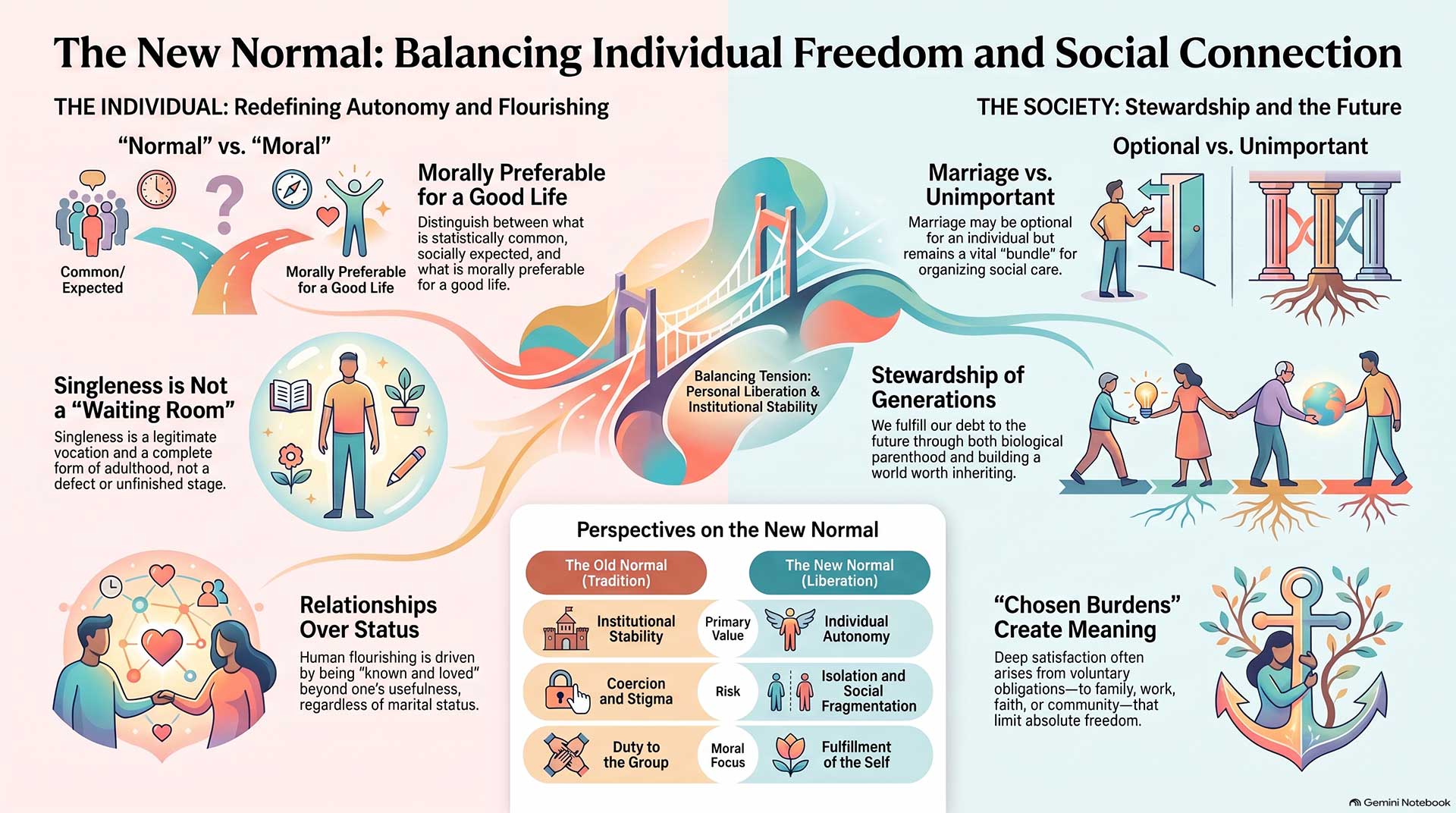
The conversation began with an uncomfortable phrase:
Is the “new normal” really normal?
But by the end, the word normal itself had become less useful.
The old normal was not automatically good.
Many people were pressured into marriage.
Women could be economically trapped.
Single adults were treated as unfinished.
People sometimes remained in destructive relationships simply because divorce carried enormous stigma.
There is no reason to romanticize that past.
Yet liberation creates questions of its own.
A culture that becomes better at saying,
“Choose your own life”
may still need to ask whether it knows how to say,
“Some commitments are worth making.”
Marriage cannot be defended merely because it is traditional.
Nor can it be dismissed merely because it imposes obligations.
The more useful question is what marriage can do when it is healthy.
It can create companionship.
Mutual care.
Shared financial life.
Sexual commitment.
Kinship.
A household.
A structure for raising children.
Care during illness.
A promise intended to survive changing feelings.
Research on happiness and flourishing gives us reasons to take those forms of durable connection seriously.
Yet the discussion repeatedly returned to Bella DePaulo’s warning:
Marital status is not the same thing as flourishing.
A married person can be profoundly lonely.
A single person can have rich friendships, family ties, community, service, purpose, and love.
A marriage certificate does not guarantee intimacy.
Singleness does not guarantee isolation.
That moved the conversation away from the question,
“Are married people happier?”
and toward something more useful:
What kinds of relationships allow human beings to be known, loved, supported, and needed?
Arthur Brooks pushed this further by asking whether meaningful work can carry an entire life.
Keiko clearly has purpose.
She feels competent.
She contributes.
The convenience store gives her rhythm and meaning.
But who knows Keiko beyond her usefulness?
That question does not automatically point to marriage.
It points to human connection.
Timothy Keller’s Christian perspective complicated the discussion in another direction.
Christianity gives marriage great significance, yet Christianity cannot coherently claim that every person must marry.
Jesus was unmarried.
The Christian tradition has long included singleness and celibacy as legitimate forms of life.
That creates a challenge for churches that praise singleness in theory but organize adult community almost entirely around couples and children.
The stronger Christian position that emerged was:
Honor marriage deeply without making it compulsory. Honor singleness genuinely without making commitment itself suspicious.
That may be one of the most useful conclusions from the entire conversation.
Louise Perry then pushed the discussion from the individual to the institutional level.
Marriage is not merely a private romantic arrangement.
Across history, it has helped connect adults, children, kinship, caregiving, inheritance, sexual commitment, and generations.
This does not mean every individual must participate.
It does mean that large changes in marriage and fertility can have consequences that extend beyond private preference.
That led to the most difficult demographic question:
What happens if far fewer people form families and have children for several generations?
The answer cannot simply be:
“Then Keiko should have children.”
That would confuse population-level needs with individual obligation.
A society may need children.
No particular woman owes society a child.
A society may benefit from stable families.
No particular adult owes society a marriage.
Those distinctions must remain clear.
At the same time, calling something optional does not make it unimportant.
This became one of the strongest exchanges of the conversation:
Stop using “valuable” as a polite synonym for “required.”
And the response:
Stop using “optional” as a polite synonym for “unimportant.”
Both statements deserve to survive together.
The final topic moved beyond marriage entirely.
What do we owe people who have not been born yet?
Every generation inherits something it did not create.
Language.
Knowledge.
Institutions.
Roads.
Schools.
Medicine.
Culture.
Faith traditions.
Communities.
Someone built them.
Someone maintained them.
Someone raised the people who passed them forward.
Yet responsibility to the future cannot be reduced to biological parenthood.
A childless teacher may shape thousands of young lives.
An unmarried scientist may develop medicine for children she will never meet.
A single adult may care for aging parents, mentor younger people, build institutions, create art, protect the environment, or strengthen a community.
Future generations need people who create and raise children.
They need people who build a world worth inheriting too.
That may be the broader answer.
Keiko should not be asked to produce the future merely to justify her existence.
But society cannot stop thinking about the future simply because reproduction and family formation are personal decisions.
We are left with two responsibilities.
Protect the dignity and freedom of the person standing in front of us.
And remember the people who will stand here after us.
The difficult part is refusing to sacrifice either one.
So the final question is no longer:
Should Keiko get married?
It is:
How can we build a culture where Keiko can remain Keiko, where marriage and family can still be honored, where single people fully belong, and where future generations inherit something worth continuing?
That question does not belong only to Keiko.
It belongs to all of us.
Short Bios:
Bella DePaulo
An American social psychologist known for decades of research and writing about single people, single life, and the cultural assumptions surrounding marriage. In this fictional discussion, she challenges the idea that marital status can serve as a shortcut for judging happiness, maturity, social contribution, or human worth.
Louise Perry
A British writer known for arguments about sex, marriage, family structure, and the social consequences of modern relationship norms. Here she presses the institutional and demographic questions: what marriage does beyond adult romance, what happens when family formation declines, and whether culture can value commitment without coercing individuals.
Tyler VanderWeele
An epidemiologist and researcher associated with Harvard’s Human Flourishing Program. His work examines well-being through multiple dimensions, including happiness, health, meaning, purpose, relationships, character, and material stability. In this fictional discussion, he provides the empirical bridge between marriage research and the broader idea of flourishing.
Arthur C. Brooks
An American scholar and author known for teaching and writing about happiness, meaning, relationships, work, family, friendship, and faith. In this discussion, he repeatedly shifts the focus from status to deeper questions about love, obligation, purpose, and whether a good life requires relationships that extend beyond personal comfort.
Timothy Keller
An American Presbyterian pastor and author who wrote extensively about Christianity, marriage, faith, culture, and human relationships. Keller died in 2023. His appearance here is entirely fictional and is used to explore a Christian position that can honor marriage strongly while recognizing singleness as a legitimate and meaningful vocation.
This discussion is a fictional literary exercise inspired by Sayaka Murata’s Convenience Store Woman and the publicly available work and ideas of the participants. The dialogue did not actually occur, and none of the statements presented as dialogue should be treated as direct quotations from the real individuals.
Leave a Reply