

Introduction
We usually think loneliness means having nobody.
But what if that is not always true?
A person can have loving family, longtime friends, coworkers, messages arriving throughout the day, and hundreds of online connections, yet still lack something harder to name: social health.
Inspired by the ideas explored through Kasley Killam, Robert Putnam, Sherry Turkle, and Priya Parker, these five modern-day stories examine different pieces of belonging that modern life can quietly remove.
Elena has people who love her, but discovers that nobody nearby can open her front door.
Walter is independent and surrounded by caring family, yet retirement and widowhood leave him facing a different question: what happens when nobody needs you anymore?
Noah believes he prefers independence until four chess players begin expecting him every Saturday.
Marcus finds genuine comfort talking with AI, then discovers something an artificial companion cannot experience in quite the same way: needing him in return.
Denise becomes tired of hearing people complain that community has disappeared and puts two folding tables outside.
None of these people sets out looking for a lesson about loneliness.
They simply begin encountering one another again.
And through spare keys, grocery lists, chess games, porch lights, errands, arguments, food, and folding tables, something starts returning to Morrow Glen.
Not the past.
Something new.
(Note: This is an imaginary conversation, a creative exploration of an idea, and not a real speech or event.)
Story 1: The Spare Key

At 10:17 on a Tuesday morning, Elena Park realized that nearly everyone she loved was too far away to open her front door.
Until then, she had never thought of distance that way.
Distance was measured in flight time.
Chicago was an hour and twenty minutes.
Richmond was a little over an hour.
Denver was three hours.
Her closest friend, Melissa, lived in Atlanta, but they talked so often that Elena sometimes forgot they hadn't been in the same room for eleven months.
Distance had become something technology seemed to have solved.
Until someone needed to physically enter her house.
1. A Full Life
At forty-three, Elena considered herself fortunate.
She had a good job as an operations director for a national logistics company. Three days a week she worked from her townhouse in Morrow Glen, Ohio, in a converted upstairs bedroom containing two large monitors, a standing desk, and an expensive chair she'd bought after developing lower-back pain.
Her workdays were filled with people.
At 8:30, her team meeting.
At 9:00, Chicago.
At 10:00, Atlanta.
At 11:30, Dallas.
After lunch, usually another three or four calls.
Some evenings she felt exhausted from talking.
Her phone was rarely quiet either.
There was the college group chat.
Her sister, Hannah.
Melissa.
Her mother.
Two former coworkers.
A group of women who had taken a trip to Nashville together three years earlier and still sent one another birthday messages and restaurant photographs.
Elena wasn't one of those people who complained that social media had ruined friendship.
For her, technology had preserved friendships that geography should have destroyed.
Her divorce five years earlier had actually strengthened several of them.
Melissa had stayed on the phone with her until nearly three in the morning the night Elena's husband moved out.
Hannah had called every day for almost two months.
These were real relationships.
Real love.
Elena knew that.
She had never considered herself lonely.
If anything, she sometimes wanted people to stop messaging her.
What Elena did not have was anyone who regularly entered her house.
She didn't notice that distinction.
Not yet.
Her groceries came to the front door.
Dog food arrived every six weeks automatically.
Prescriptions came by mail.
She ordered coffee beans online.
When she needed dinner after a long workday, she tapped a screen.
Sometimes an entire week passed without Elena entering a store.
She thought of this as efficiency.
Her dog, Milo, certainly didn't object.
Milo was a nine-year-old terrier mix with an oversized personality and a habit of barking at delivery drivers as though each package represented an attempted invasion.
Elena walked him twice a day.
That was how she knew Ruth.
Or, more accurately, how she knew the woman across the street whom she believed was named Ruth.
Ruth was perhaps sixty-eight or seventy. Elena wasn't sure.
She had silver hair, grew tomatoes beside her garage, and seemed to spend an unreasonable amount of time outside.
“Morning, Elena.”
“Morning.”
“Hi, Milo.”
Milo liked Ruth.
That irritated Elena slightly, since Milo distrusted almost everyone else.
Sometimes Ruth gave him a small biscuit.
Elena knew Ruth had a daughter somewhere.
Cincinnati, perhaps.
Ruth knew Elena had gotten divorced.
Elena had never told her.
Neighborhood knowledge traveled in mysterious ways.
Their conversations rarely exceeded two minutes.
They had been neighbors for almost four years.
Elena did not know Ruth's last name.
2. Tuesday
The illness began around midnight.
Elena assumed it was something she'd eaten.
By three in the morning she was lying on the bathroom floor.
By six she had canceled her first meeting.
At 8:12 she texted her boss.
Taking a sick day. Really sick.
He replied almost immediately.
Don't worry about anything. Feel better.
Hannah called from Virginia.
“You sound terrible.”
“I feel terrible.”
“Do you have a fever?”
“I don't know.”
“Take your temperature.”
“I don't want to move.”
“Elena.”
“I know.”
“Do you need to see somebody?”
“No.”
By ten, the answer had become yes.
She couldn't keep water down. Standing made the room tilt.
Hannah insisted she call the medical advice line.
The nurse asked a series of questions and recommended that Elena be evaluated.
“Is there someone who can drive you?”
Elena stared at the bedroom ceiling.
“My sister.”
“Is she there with you?”
“No.”
“Is there someone nearby?”
Elena thought.
It was an oddly difficult question.
Her brain produced people automatically.
Melissa.
Hannah.
Rachel from college.
David from work.
Then rejected each one geographically.
“No,” she finally said.
The nurse told her what to do if her symptoms worsened and discussed transportation options.
Elena barely listened.
Another thought had occurred to her.
Milo.
If she left for several hours, he would need to go outside.
If she were admitted somewhere, somebody would need to feed him.
She called Melissa.
“Of course I'll take care of Milo,” Melissa said immediately.
Then both women became quiet.
Melissa was in Atlanta.
“I wish I were there,” she said.
“I know.”
“Can Hannah get someone?”
“She lives in Virginia.”
“What about someone from work?”
Elena almost laughed.
Her closest colleague, David, lived in Chicago.
Her boss was in Dallas.
The people Elena spent most of her waking hours talking to were scattered across four time zones.
“What about a neighbor?”
Melissa asked it casually.
Elena looked toward the window.
Across the street, Ruth's garage was closed.
“I don't really know my neighbors.”
The sentence embarrassed her.
“Didn't you say there's an older woman across the street who likes Milo?”
“Ruth.”
“Call Ruth.”
“I don't have her number.”
“Elena.”
“I wave to her.”
“You've lived there four years.”
“I know how long I've lived here.”
Melissa softened.
“I'm not judging you.”
“I know.”
But Elena was judging herself.
3. The Drawer
The spare key was in the kitchen.
Elena had made it shortly after the divorce.
She had intended to give it to someone.
At the time, that someone had presumably been Hannah.
Then Hannah moved to Virginia.
Melissa already lived in Atlanta.
Elena considered buying one of those combination lockboxes people attached to door handles, but never got around to it.
So the key remained in the junk drawer beside dead batteries, rubber bands, takeout menus, two screwdrivers, and a roll of tape.
Elena stood in the kitchen holding it.
A perfectly useful key to a perfectly secure house.
Made for another person.
Owned by nobody.
Milo watched her.
“Don't look at me like that.”
He wagged his tail.
Her phone rang.
Hannah.
“What are you doing?”
“Standing in the kitchen.”
“Why?”
“I need someone to take Milo.”
“Ask the neighbor.”
“I barely know her.”
“You know her better than I do.”
That was technically true.
Elena looked across the street again.
Ruth's garage door was now open.
She could see her near the side of the house.
“Elena, go ask her.”
“I look horrible.”
“You are sick. You're allowed to look horrible.”
“What if she's busy?”
“Then she'll say she's busy.”
“What if it's weird?”
There was a pause.
“Elena.”
“What?”
“You're forty-three years old and you're afraid to ask your neighbor to feed your dog.”
That irritated her enough to make her move.
“Fine.”
She hung up.
4. Across the Street
The distance from Elena's front door to Ruth's was perhaps sixty yards.
It felt considerably farther.
She wore sweatpants, an old Ohio State sweatshirt, and slippers she realized halfway across the street were probably not meant for outdoor use.
Ruth was kneeling beside a flower bed.
She looked up immediately.
“Elena?”
Something in her voice changed.
Not alarm.
Attention.
“You okay?”
Elena hated how quickly her eyes filled.
She blamed the fever.
“I think I need to go get checked out.”
Ruth stood.
“Do you need a ride?”
“No. I can get one. It's Milo.”
“What about him?”
“I don't know how long I'll be gone.”
“I'll take him.”
The answer came so quickly that Elena had prepared several sentences she no longer needed.
“I don't know if I'll be back tonight.”
“Then I'll feed him.”
“He eats at five.”
“Okay.”
“And he needs his medication with dinner.”
“Okay.”
“It's half a tablet. It's in the cabinet above the refrigerator.”
“Okay.”
“He'll pretend he hasn't eaten afterward.”
Ruth smiled.
“I know.”
Elena stopped.
“How do you know?”
“He tries that with me and I don't even feed him.”
Despite herself, Elena laughed.
It hurt her stomach.
Then she remembered the key.
She opened her hand.
Ruth looked at it.
“I've got a spare.”
“All right.”
Elena hesitated.
Ruth did not reach for it immediately.
Perhaps she sensed something in Elena's face.
Elena suddenly became aware of what she was offering.
Access.
Not digital access.
Not a password.
Not a contact request.
A piece of metal that allowed another human being to enter the private space where she slept.
“I should've probably given somebody one before now.”
Ruth took the key.
“You could've given me one of those years ago.”
She said it lightly.
Almost teasing.
Elena looked at her.
“Why?”
Ruth shrugged.
“We live across the street.”
As if that explained everything.
Maybe once it had.
5. People Who Loved Her
Elena spent most of the afternoon receiving fluids and undergoing tests.
Nothing serious.
A gastrointestinal infection, dehydration, medication for the nausea, rest.
Her phone stayed busy.
Hannah checked constantly.
Melissa called twice.
Her mother sent three messages, including one telling Elena to drink ginger tea, apparently unaware that Elena couldn't keep water down.
David from work sent:
Don't even think about email. We've got everything.
Rachel sent a heart.
Her Nashville friends sent jokes.
There was no shortage of concern.
Elena lay beneath a thin blanket and looked at the messages.
She felt loved.
Completely loved.
That was what made the realization so confusing.
Something had been missing, but it wasn't love.
At 5:08, Ruth sent a photograph.
Milo was sitting beside his empty bowl.
Medicine taken. Dinner eaten. Claims he has never been fed in his life.
Elena laughed.
Then another photograph arrived.
Milo asleep on Ruth's lap.
Elena stared at it for a long time.
Ruth had crossed the street.
That was all.
No flight.
No schedule.
No delivery service.
No application.
She had simply crossed the street.
6. Soup
Elena returned home that evening.
Milo greeted her with the emotional intensity of an animal who had apparently believed she had been gone for several years.
On the kitchen counter sat a covered bowl.
A note rested beside it.
Chicken soup. Don't eat it if your stomach isn't ready.
Underneath:
Milo already had dinner. Don't believe him.
Elena smiled.
She opened the refrigerator.
Ruth had placed a bottle of water inside.
Nothing extraordinary had happened.
That was what disturbed Elena.
She had spent years thinking that important relationships were defined by depth.
Who knew her secrets?
Who understood her divorce?
Who remembered her childhood?
Who could she call crying?
Ruth knew almost none of those things.
Ruth knew something else.
Where Elena lived.
Which door was hers.
Which dog belonged to her.
When her lights normally came on.
Which car belonged in the driveway.
That Milo pretended he hadn't eaten.
It was a different category of knowing.
Elena had never valued it properly.
7. Ruth Alvarez
Three days later, Elena walked across the street carrying Ruth's bowl.
She had washed it twice.
Ruth was outside.
Naturally.
“You're alive.”
“Barely.”
“You look better.”
“I brought your bowl.”
“Keep it.”
“I don't need another bowl.”
“Everybody needs another bowl.”
Elena laughed.
Then she held out the spare key.
Ruth looked at it.
“You want this back?”
Elena had planned to say yes.
Instead she heard herself say:
“No.”
Ruth raised an eyebrow.
“Keep it.”
“All right.”
A strange little moment followed.
Elena realized there was something she should know.
“Can I ask you something embarrassing?”
“Sure.”
“What's your last name?”
Ruth stared at her.
Then started laughing.
Not politely.
Actually laughing.
“Oh, Elena.”
“I know.”
“Alvarez.”
“Ruth Alvarez.”
“Yes.”
“Four years.”
“Almost four and a half.”
“That makes it worse.”
“A little.”
Elena shook her head.
Then Ruth surprised her.
“Do you know mine?”
“Your what?”
“My middle name.”
Elena laughed.
“No.”
“Good. We've still got something to talk about.”
8. Six Weeks Later
Life returned to normal.
Meetings.
Deliveries.
Messages.
Milo.
Elena did not transform into a different person.
She did not join five clubs.
She did not organize neighborhood dinners.
She still liked working from home.
She still ordered groceries.
She still sometimes saw Ruth and waved because she was too busy to stop.
But now, occasionally, she stopped.
Their two-minute conversations became five.
Sometimes ten.
Elena learned Ruth had been a middle-school counselor.
Her daughter did live in Cincinnati.
Her husband had died seven years earlier.
She hated tomatoes despite growing far too many of them.
Then, one Friday afternoon, Ruth knocked.
Elena opened the door.
Ruth held out a key.
“What's this?”
“Mine.”
Elena stared at it.
“I'm going to Cincinnati for four days.”
“Okay.”
“The tomatoes need watering if it doesn't rain.”
“Sure.”
“And there's a package coming tomorrow.”
“I'll grab it.”
Ruth placed the key in Elena's palm.
The gesture lasted perhaps two seconds.
Then Ruth walked back across the street.
Elena stood in the doorway.
She looked at the key.
Six weeks earlier, she had believed the important moment was giving Ruth access to her house.
Now she realized that had only been half of it.
This key meant Ruth expected something from her.
Elena mattered on the other side of the street too.
She went into the kitchen and opened the junk drawer.
Batteries.
Tape.
Rubber bands.
Her own spare key was no longer there.
She placed Ruth's inside.
Then she reconsidered.
She picked it back up.
For reasons she couldn't quite explain, the junk drawer suddenly seemed like the wrong place for it.
Elena attached Ruth's key to her own key ring.
That evening, she walked Milo past Morrow Market.
Her phone vibrated in her pocket.
Then again.
She didn't check it.
Across the street, someone she recognized was struggling to carry two grocery bags from a car.
Elena slowed.
For a second, she considered continuing.
Then she crossed the street.
Story 2: Thursday Groceries
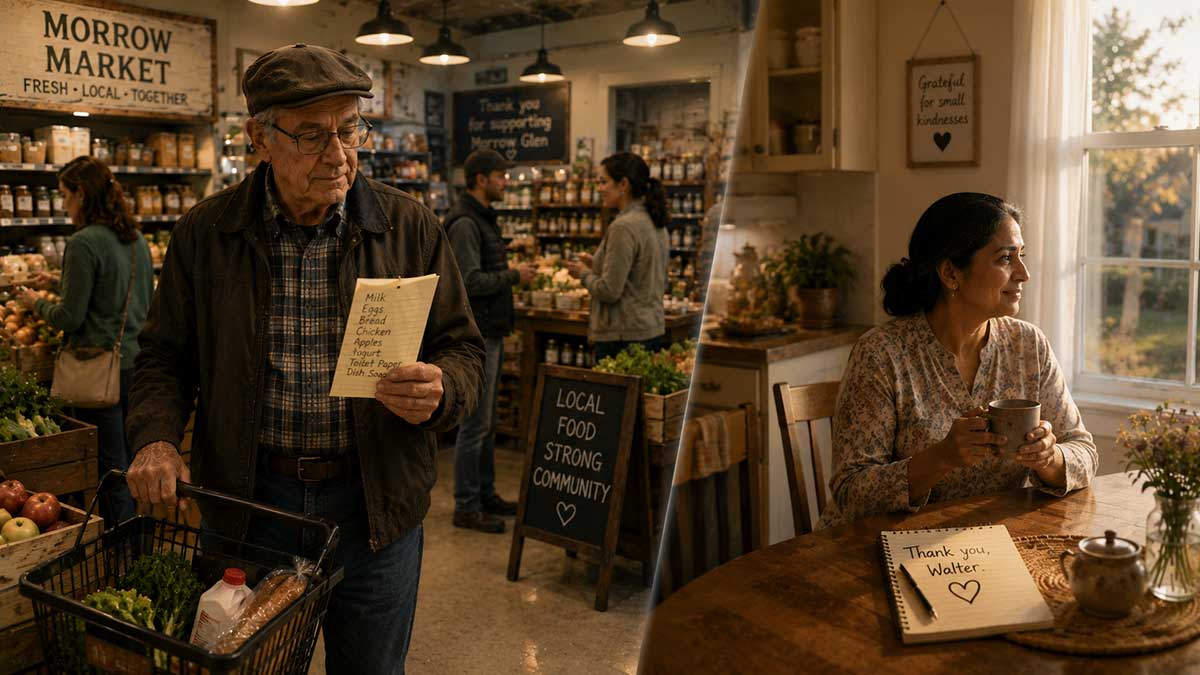
Walter Greene had spent forty-one years being asked questions.
Could this wall come down?
Was that crack serious?
Did the contractor need another permit?
Could the family move in before Friday?
Was the wiring safe?
Who signed off on this?
As a city building inspector, Walter had sometimes complained that nobody could make a decision without calling him.
At seventy-four, three years into retirement and three years after his wife died, Walter had discovered something he had never expected.
He missed being interrupted.
1. I've Got Everything I Need
Every Sunday evening, Walter's daughter called from North Carolina.
His son usually called Wednesday from Colorado.
The grandchildren appeared on video at unpredictable intervals, often holding the phone at angles that allowed Walter to see mostly ceilings and foreheads.
They loved him.
He knew that.
“Dad, are you eating?”
“Yes.”
“What did you have?”
“Food.”
“Dad.”
“Chicken.”
“With what?”
“Other food.”
His daughter, Claire, would sigh.
“Do you need anything?”
“No.”
“Are you sure?”
“I've got everything I need.”
That sentence had become Walter's answer to almost everything.
Did he need someone to clean?
No.
Help with the yard?
No.
Groceries delivered?
Absolutely not.
A medical alert button?
He refused to dignify that question with an answer.
Walter drove.
Cooked.
Did laundry.
Paid bills.
Changed furnace filters.
Mowed his own lawn.
He was not lonely.
At least that was the word he refused to use.
Lonely sounded like sitting in a dark room staring at photographs.
Walter had things to do.
The problem was that none of them needed to be done at any particular time.
He could mow Tuesday.
Or Wednesday.
He could go to Morrow Market at nine in the morning.
Or three in the afternoon.
He could eat dinner at five.
Or seven.
Monday had begun feeling suspiciously like Thursday.
That bothered him more than being alone.
His wife, Margaret, had given time edges.
Coffee at 6:30.
Lunch at noon.
Dinner around six.
Grocery shopping Saturday morning.
Church Sunday.
Trash out Monday night, although Walter insisted he would have remembered that without her.
Margaret had laughed every time he said it.
After she died, Walter kept many of the routines.
Then slowly, without deciding to, he stopped.
Not because he was falling apart.
There simply wasn't anyone else who cared whether soup happened at noon or two.
Freedom, Walter discovered, could make a week strangely shapeless.
2. Mrs. Rao
He knew Sunita Rao by sight.
She lived six streets away in a small brick ranch with blue shutters.
Walter had inspected an addition to the house perhaps fifteen years earlier.
Her husband had been alive then.
Walter remembered him mainly because the man had argued for twenty minutes about a handrail.
Walter remembered arguments.
Mrs. Rao apparently remembered Walter.
He was leaving Morrow Market one Thursday morning when the cashier called after him.
“Mr. Greene?”
Walter turned.
A young employee stood beside two paper grocery bags.
“You're heading over toward Hawthorne, right?”
“Eventually.”
“Mrs. Rao's order was supposed to be picked up by her niece, but she called and said she can't get here until tonight. Mrs. Rao just had eye surgery.”
Walter looked at the bags.
Then at the employee.
Then back at the bags.
He understood what was happening and disliked it.
“You want me to deliver those.”
“If you don't mind.”
“I might mind.”
The employee smiled.
“You live six minutes from her.”
“How do you know where I live?”
“Everybody knows you, Mr. Greene.”
Walter found this answer suspicious.
He took the bags.
“One time.”
“Thank you.”
“One.”
“Got it.”
It was not one time.
3. The First List
Mrs. Rao opened her door before Walter reached the porch.
“Walter Greene.”
“Sunita Rao.”
“You remember me.”
“I remember your husband arguing about a handrail.”
She smiled.
“That sounds like Arun.”
Walter carried the groceries into the kitchen.
“You can put them there.”
He did.
Mrs. Rao looked inside the first bag.
“Where's the coriander?”
Walter froze.
“What coriander?”
“It was on the list.”
“I didn't shop for these. I transported them.”
“Oh.”
She examined the second bag.
“No coriander.”
“Call the store.”
“I will.”
Walter headed for the door.
“Would you like tea?”
“No.”
“Coffee?”
“No.”
“Water?”
“I have water at my house.”
Mrs. Rao looked amused.
“Thank you, Walter.”
He nodded.
The following Wednesday afternoon, his phone rang.
“Walter?”
“Yes?”
“This is Sunita Rao.”
Walter stared at the television.
“How did you get my number?”
“Morrow Market.”
“They gave you my number?”
“No. Ruth Alvarez had it.”
“Why does Ruth Alvarez have my number?”
“I don't know. Shall I ask?”
“No.”
A pause.
“My niece can't come tomorrow.”
Walter knew exactly what was coming.
“Mrs. Rao.”
“Sunita.”
“Sunita.”
“Would you mind terribly picking up six things for me?”
Walter closed his eyes.
“How many is six?”
“Six.”
“Last time two bags became coriander.”
She laughed.
“I will write everything clearly.”
4. Thursdays
The list was waiting inside Mrs. Rao's mailbox the next morning.
Walter unfolded it.
Milk, 2%
Basmati rice, smallest bag
Bananas, 5, not too ripe
Darjeeling tea
Eggs, dozen
Coriander
Under coriander she had written:
YES, CORIANDER.
Walter stared at it.
Then laughed despite himself.
At Morrow Market, he discovered three varieties of rice that all appeared to be basmati.
He called her.
“What color bag?”
“Blue.”
“There are two blue ones.”
“Which brands?”
Walter read them.
“The second.”
“The expensive one?”
“Walter.”
“What?”
“Buy the rice.”
Thursday became grocery day.
Not officially.
Nobody discussed duration.
Mrs. Rao's doctor had told her not to drive until her vision stabilized, and her niece had two young children and lived nearly forty minutes away.
Walter was nearby.
So each Wednesday, a list appeared.
Each Thursday, Walter went shopping.
He complained about nearly every list.
Peaches, but only if they look good.
“What does that mean?”
“They should look like peaches.”
“They all look like peaches.”
“Then use judgment.”
“You have unreasonable confidence in my produce expertise.”
Another week:
Greek yogurt, plain. Not vanilla. Last week was vanilla.
Walter wrote beneath it before returning the list:
Vanilla has flavor.
The following week:
Plain yogurt. Some of us do not require dessert for breakfast.
He kept that list.
He wasn't sure why.
5. Tea
Around the fifth Thursday, Mrs. Rao stopped asking whether Walter wanted tea.
She simply made it.
He stopped refusing.
They sat at her kitchen table after he put away the groceries.
At first they talked about practical things.
Her eyes.
The weather.
Morrow Market.
Property taxes.
Then they began discussing their spouses.
Arun had died five years earlier.
Margaret three.
“Did your wife cook?” Sunita asked.
“Yes.”
“Good cook?”
“Excellent.”
“Did you tell her?”
“Of course.”
Sunita looked at him.
Walter looked back.
“Sometimes.”
She nodded.
“That sounds more believable.”
He smiled.
Sunita's house still contained Arun in small ways.
A photograph beside the refrigerator.
His gardening gloves in the garage.
A coffee mug nobody used.
Walter understood that.
Margaret's raincoat still hung in his front closet.
He had tried twice to donate it.
Both times he put it back.
They never discussed grief directly.
They didn't need to.
Thursday tea was enough.
6. The Shape of a Week
Something changed in Walter's calendar.
Not much.
But Thursday stopped resembling Monday.
Wednesday evening, he checked whether Sunita's list had arrived.
Thursday morning, he showered earlier.
He went to Morrow Market around ten.
He began recognizing the employees' schedules.
The young cashier with glasses worked Thursdays.
The bakery discounted yesterday's bread around eleven.
An older man named Frank bought lottery tickets every Thursday and always complained about never winning.
Walter started bringing Sunita's groceries at approximately eleven-thirty.
She complained if he arrived after noon.
“You're late.”
“I'm not employed by you.”
“Then why are you late?”
Walter liked that she expected him.
He didn't know that yet.
He thought he liked arguing with her.
7. The List Changes
The grocery lists changed too.
At first they contained instructions.
Then they began containing conversation.
Tomatoes. The small ones. The big ones taste like wet cardboard.
Peaches if good. DO NOT interrogate produce manager.
Your coffee is on sale. You complained about the price last week.
Cookies from bakery. Two. One is yours, so don't pretend you don't eat sugar.
Once:
No tea needed. We still have enough because somebody bought the enormous box.
Walter had bought the enormous box.
He had done the math.
It was cheaper per bag.
Sunita did not appreciate economic efficiency.
One Thursday, Walter found himself standing in the cereal aisle holding two boxes.
He suddenly realized something.
He was shopping for himself differently.
Before Sunita, Walter bought nearly identical groceries every week.
Eggs.
Bread.
Coffee.
Chicken.
Frozen vegetables.
Cereal.
Now he noticed things.
Mangoes.
Fresh bread.
A soup Margaret used to buy.
The strange crackers Sunita liked.
He had begun inhabiting the store rather than merely completing it.
8. Good News
Four months after the first delivery, Walter arrived with two bags.
Sunita was standing outside.
No sunglasses.
No niece.
She was holding car keys.
Walter raised an eyebrow.
“You're not supposed to have those.”
“I am now.”
“What?”
“My doctor cleared me yesterday.”
She smiled.
“I can drive.”
Walter set the bags on her kitchen counter.
“That's good.”
“It is.”
“Vision okay?”
“Excellent.”
“Both eyes?”
“Walter.”
“Just checking.”
She laughed.
“No more grocery delivery.”
Walter nodded.
“Good.”
The word came out automatically.
“I'm sure you have better things to do.”
“Plenty.”
That was a lie.
They drank tea.
Sunita seemed happy.
Walter was happy for her.
He really was.
When he left, she hugged him.
Walter wasn't prepared for that.
“Thank you,” she said.
“For what?”
“For Thursdays.”
“It was groceries.”
Sunita looked at him for a moment.
“No, Walter.”
She didn't explain.
He didn't ask.
9. The First Thursday
The following Thursday, Walter woke at 6:42.
Coffee.
Newspaper.
Weather.
He ate breakfast.
At 9:30, he found himself checking the mailbox.
Nothing.
Of course nothing.
At 10:05, he walked into the kitchen.
At 10:18, he considered going to Morrow Market.
He didn't need anything.
At 10:47, he stood near the front window.
This annoyed him.
“What are you doing?” he said aloud.
There was nobody to answer.
He sat down.
Turned on the television.
Turned it off.
At 11:28, the time he normally would have been pulling into Sunita's driveway, Walter finally understood.
He had thought he was helping a woman who couldn't drive.
He had believed the useful person in the arrangement was him.
But Sunita had given Thursday a shape.
She had placed something in the future that expected him.
A list.
A store.
A kitchen.
Tea.
Someone saying:
“You're late.”
Walter sat at the table for a long time.
He did not feel lonely.
The word still seemed wrong.
He felt unnecessary.
That was worse.
10. The Call
His daughter called Sunday.
“How was your week?”
“Fine.”
“What did you do?”
Walter started giving his standard answer.
Not much.
Then stopped.
“Claire?”
“Yeah?”
“When you call me, why do you always ask if I need anything?”
There was a pause.
“I don't know. You're my dad.”
“You ever need anything?”
“What?”
“You're always asking what I need.”
“Dad, I'm fine.”
Walter almost laughed.
There it was.
The family sentence.
I'm fine.
I've got everything I need.
Nobody wanted to burden anyone.
Perhaps that was love.
Perhaps sometimes it was something else.
“If you need something,” Walter said, “ask me.”
“I will.”
“No. I mean actually ask.”
Claire was quiet.
“Okay.”
Walter wasn't sure she understood.
He wasn't sure he did either.
11. The Notice
A week later Walter was at Morrow Market.
He didn't particularly need groceries.
He had invented a need for coffee filters.
Near the entrance was a corkboard he had passed hundreds of times.
Lost dog.
Piano lessons.
Church fish fry.
Apartment for rent.
Someone selling a lawn mower.
One sheet caught his attention.
MORROW GLEN NEIGHBOR HELP
Drivers needed for grocery trips, pharmacy pickups, medical appointments and small errands for older residents.
Walter read it.
Then walked away.
He bought coffee filters.
He returned.
Read it again.
There was a phone number.
He took a photograph.
Then felt ridiculous.
He could simply take one of the paper tabs.
So he did.
12. Not Quite Volunteering
The coordinator was a woman named Denise.
She spoke too quickly.
“We especially need Thursday mornings.”
Walter said nothing.
“Mr. Greene?”
“I'm here.”
“Would Thursdays work?”
He looked around his kitchen.
Margaret's raincoat was visible through the partially open closet.
“Maybe.”
“Great.”
“I said maybe.”
“That's what everybody says before they volunteer.”
“I haven't volunteered.”
“Can you start next Thursday?”
Walter sighed.
“Who needs something?”
13. Mr. Hanley
His first assignment was terrible.
Mr. Hanley was eighty-one and wanted to go to the pharmacy.
He was not ready when Walter arrived.
Then he forgot his wallet.
Then he insisted Walter was taking the wrong route.
Then the pharmacy said the prescription wasn't ready.
Mr. Hanley blamed Walter.
“I don't work for the pharmacy.”
“You said we'd be done by eleven.”
“I said we'd leave at ten.”
“Same thing.”
“It is absolutely not the same thing.”
On the drive home, Mr. Hanley fell asleep.
Walter looked over at him at a red light.
For some reason, he started laughing.
Not loudly.
Just enough to surprise himself.
When Walter helped him out of the car, Mr. Hanley said:
“Next Thursday, I need the bank.”
Walter stared at him.
“Do I get a vote?”
“No.”
Walter drove home smiling.
14. The List
Months later, Walter opened his wallet at a gas station.
His driver's license slipped halfway out.
Behind it was a folded piece of paper.
He had forgotten it was there.
He unfolded it.
Sunita's handwriting.
Milk
Tea
Rice
Peaches if good
Your cookies are on sale
Walter ran his thumb across the crease.
His phone buzzed.
A message from Denise.
Tomorrow: Mr. Hanley, 10 AM. Bank + pharmacy. Mrs. Cooper at 1 if you can.
Walter typed:
Hanley better be ready this time.
Three dots appeared.
He says you better not be late.
Walter laughed.
He folded Sunita's grocery list and slid it behind his driver's license again.
The next morning, at 9:43, Walter was already standing by the front door with his keys.
He looked at the clock.
Too early.
He sat down.
At 9:46, he stood again.
There was no reason to leave yet.
Mr. Hanley lived six minutes away.
Walter put on his jacket anyway.
Outside, Thursday morning was cold and bright.
He locked the door behind him and walked to the car.
Someone was waiting for him.
And he had somewhere to be.
Story 3: The Seventh Game
Noah Kim had lived in Morrow Glen for seven months before anyone asked where he had been.
Until then, his absence had never required explanation.
He liked it that way.
At least, he thought he did.
1. A Good Apartment
Noah's apartment was on the fourth floor of a new building near the walking trail.
It had everything he wanted.
Fast internet.
Quiet neighbors.
A small balcony.
A gym downstairs that was usually empty after eight.
A grocery store ten minutes away.
A café close enough that he could walk there without committing to a whole afternoon outside.
He was twenty-nine, worked as a software engineer, and earned more money than he had expected to make before thirty.
His company was based in Seattle, but his team was scattered across the country.
He had moved to Ohio after realizing his salary went much farther there.
His parents had questioned the decision.
“You don't know anyone there,” his mother had said.
“I know people everywhere.”
Technically, this was true.
His closest college friends lived in California, Washington, and Texas.
They played online games together most Friday nights.
His younger sister called when she needed help with something technical.
Coworkers messaged him constantly.
Noah could go from breakfast to midnight without running out of people to communicate with.
He simply did most of it alone.
That never struck him as strange.
He had always been independent.
He disliked forced socializing.
Networking events seemed like job interviews with snacks.
Meetups felt worse.
The very phrase “put yourself out there” made him want to stay home.
He believed friendship should happen naturally.
What Noah had not considered was that very little happened naturally when a person arranged his life to avoid nearly every accidental encounter.
2. The Chess Players
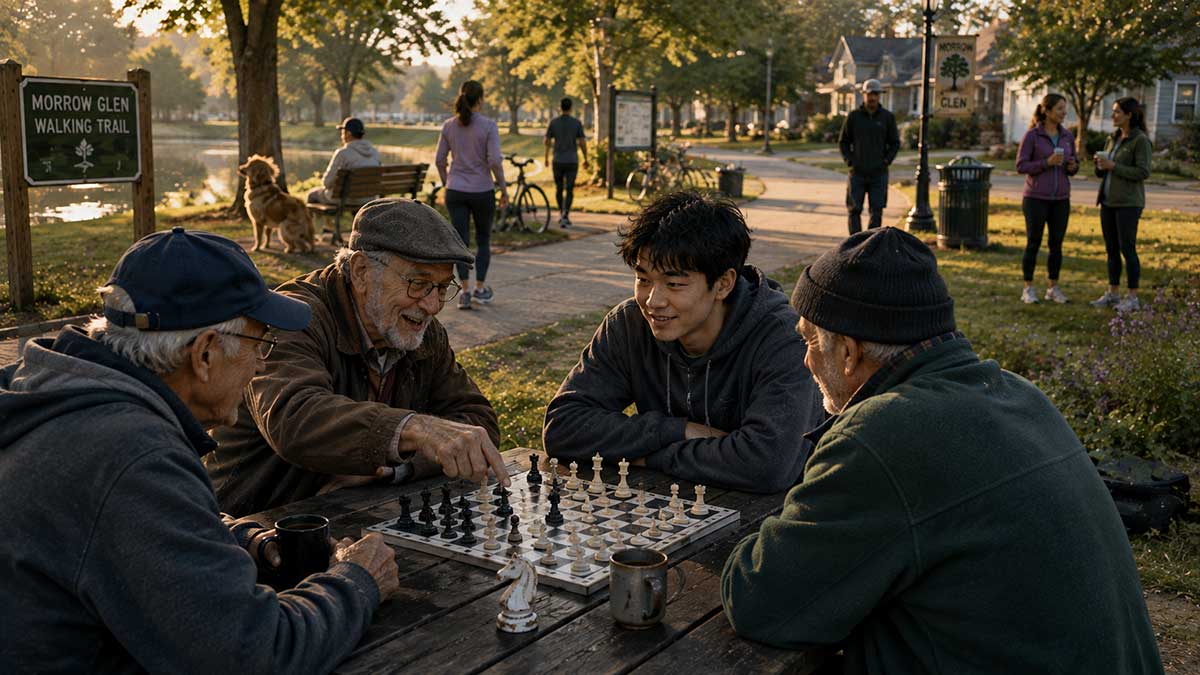
He first noticed the chess players in October.
Four men sat around two stone tables beside the walking trail every Saturday morning.
They were easy to spot.
One wore a Cleveland Browns cap regardless of weather.
Another dressed as though he might leave for church at any moment.
The oldest had a silver mustache and carried a dented green thermos.
The fourth man was loud enough that Noah could hear him from fifty feet away.
“That's not a move. That's a cry for help.”
Noah passed them every Saturday on his walk.
He never stopped.
They were simply part of the scenery.
Like the pond.
The benches.
The dog walkers.
By November, he recognized them.
Browns Cap.
Church Jacket.
Thermos.
Loud Guy.
He did not know their names.
One Saturday, Thermos was missing.
Noah was walking past when Loud Guy lifted a hand.
“You play?”
Noah looked behind himself.
There was nobody there.
“Me?”
“No, the squirrel.”
Browns Cap laughed.
Noah slowed.
“A little.”
“Sit down.”
“I haven't played in years.”
“Perfect.”
“Why is that perfect?”
“We need someone Frank can beat.”
Church Jacket, apparently Frank, frowned.
“I can beat you.”
“Not since April.”
Noah should have kept walking.
Instead he sat.
3. Game One
The white knight was chipped near the base.
Noah noticed it before anything else.
The chess set looked old, the pieces mismatched in shade from years of replacement.
“I'm Leon,” Browns Cap said.
“Frank.”
Church Jacket nodded.
“Samir.”
Loud Guy pointed to himself.
“Don't believe anything he says,” Leon added.
“Good advice,” Samir said.
Noah waited.
No one asked what he did for work.
No one asked whether he had just moved.
No one asked why he was alone.
They simply started the game.
Noah lost in fourteen minutes.
Samir leaned back.
“Excellent.”
“What was excellent about that?”
“You gave Frank confidence.”
Frank looked offended.
“I didn't need confidence.”
“You needed something.”
Noah laughed.
He had not expected to.
When he stood to leave, Leon said, “Next week we'll teach you what the horse does.”
“I know what the knight does.”
“You demonstrated otherwise.”
Noah walked home smiling despite himself.
He told nobody about it.
4. Game Two
The next Saturday, Noah took his usual walk at 9:30.
He told himself he was not going to the chess tables.
The trail happened to pass them.
That was all.
Samir saw him first.
“Horse guy.”
Noah stopped.
“My name is Noah.”
“Good. Sit.”
Thermos was back.
His name was Luis.
He was seventy-one, retired from a printing company, and very protective of the chipped white knight.
Noah learned this when he picked it up.
“Careful with that.”
“It's already broken.”
“That's history.”
“What history?”
Luis took the piece from him.
“Long story.”
Nobody told the story.
Noah played Leon.
He lost again.
Not badly.
Samir argued that Leon had moved a rook illegally.
Leon denied it.
Frank claimed not to have seen anything.
Luis accused Frank of cowardice.
Noah left after forty minutes.
At home, his gaming friends were online.
One messaged:
You around?
Noah typed:
Later.
He did not know why.
5. Game Three
The following Saturday, Noah brought coffee.
Not for everyone.
That would have felt too intentional.
He bought one for himself.
Then, standing in Morrow Market, he remembered Leon complaining that the park coffee cart was closed for winter.
He bought another.
Then four.
This annoyed him.
At the chess table, Samir looked at the cups.
“You joining a cult?”
“No.”
“Then why did you bring coffee?”
Noah placed the tray down.
“I was already there.”
Leon lifted his cup.
“This is exactly how cults begin.”
Luis drank his without saying thank you.
Five minutes later he said, “Too much cream.”
Noah looked at him.
“You're welcome.”
Luis smiled.
The chipped knight sat between them.
6. Game Four
By December, the cold had moved them into the public library.
The chess club, Noah discovered, was not actually a chess club.
It was four men who had started playing six years earlier after meeting at a community event and never stopped.
They used a table near the back windows.
The librarian clearly knew them.
“Keep it down today, Samir.”
“I am always quiet.”
Three people nearby looked up.
Noah arrived at 9:37.
Leon had already placed a coffee beside the empty seat.
Noah looked at it.
“What?”
Leon said.
“You complain when we don't bring you anything. Now you complain when we do.”
“I never complained.”
“Sit.”
Noah sat.
The coffee had exactly the amount of cream he liked.
He tried not to make anything of that.
7. Game Five
By January, Noah had stopped pretending Saturday chess was accidental.
He still did not call it a commitment.
He did not put it on his calendar.
He did not mention it to his parents.
But every Saturday at nine-thirty, he left his apartment.
One week he arrived irritated after a difficult Friday deployment.
Luis noticed.
“You look terrible.”
“Thanks.”
“Work?”
Noah nodded.
“Quit.”
“That's your advice?”
“Worked for me.”
“You retired.”
“Same result.”
Samir interrupted from the other table.
“Don't listen to a man who spent forty years complaining about his job and now complains about retirement.”
“I don't complain about retirement.”
“You called me Wednesday to tell me daytime television is destroying America.”
“It is.”
Noah laughed harder than the joke deserved.
Then something unexpected happened.
He told them about work.
Not much.
Just the deployment.
The manager.
The bug that turned out not to be his.
Frank asked a few questions.
Leon gave terrible advice.
Samir suggested sabotaging the company.
Luis said, “Sounds like you'll be fine.”
That was it.
No careful emotional processing.
No long discussion.
No one asked him to go deeper.
Yet Noah felt better when he left.
8. Game Six
In February, the group went to lunch after chess.
They invited Noah.
He declined.
“I've got stuff to do.”
He had no stuff to do.
He went home.
Made noodles.
Opened his laptop.
Watched three videos without remembering any of them.
At 2:14, Leon sent him a photograph.
The four men sat at a diner booth.
Luis held up the chipped white knight.
Noah stared at the picture.
Then at his quiet apartment.
He nearly texted:
Maybe next time.
He didn't.
He set the phone down.
For the first time since moving to Morrow Glen, he wondered whether independence could become a habit long after it stopped being a preference.
9. The Seventh Game
The next Saturday Noah did not go.
A production problem began at 7:15 in the morning.
By nine, three engineers were online.
At ten, six.
At eleven-thirty, the issue was resolved.
Noah closed his laptop and realized it was almost noon.
He looked toward the window.
Snow had started.
He thought briefly about the library.
Then forgot about it.
The week passed.
On the following Saturday, Noah arrived at 9:42.
Samir looked at him.
“Look who decided to return.”
Leon moved his coffee cup.
Luis was setting up the pieces.
Frank said, “Where were you last week?”
Noah opened his mouth.
Before he could answer, Samir added:
“We needed somebody easy to beat.”
Everyone laughed.
Noah laughed too.
But the question had landed before the joke.
Where were you?
It followed him through the first game.
He lost.
He barely noticed.
Nobody had asked him that since he moved.
His mother sometimes asked what he had done.
His manager asked where tasks stood.
Friends messaged if he missed an online game.
But this was different.
These men had been physically somewhere.
There had been an empty place in the pattern.
And Noah's absence had changed it.
He looked down at the chessboard.
The chipped white knight stood near the center.
For the first time, he understood why Luis called it history.
Objects accumulated meaning through repetition.
Maybe people did too.
10. Luis
Three weeks later, Luis did not come.
At 9:35, nobody mentioned it.
At 9:48, Leon checked his phone.
At 10:02, Frank said, “He probably overslept.”
Samir shook his head.
“Luis wakes up at five for no reason.”
They played one game.
Noah kept looking toward the library entrance.
At 10:26, he asked:
“Has anybody called him?”
The others looked at him.
Leon picked up his phone.
“I texted.”
“Call him.”
Samir grinned.
“Listen to Noah giving orders now.”
Noah ignored him.
Leon called.
No answer.
He called again.
Nothing.
Frank frowned.
“His daughter lives nearby.”
“Do you have her number?” Noah asked.
Leon did.
He called.
This time someone answered.
Luis had slipped on ice the previous evening.
Nothing was broken, but his daughter had taken him to urgent care and made him stay at her house overnight.
Leon put the phone on speaker.
Luis's voice came through.
“I am fine.”
Samir leaned close.
“You sound weak.”
“I sound seventy-one.”
“You've sounded seventy-one for years.”
“Tell Noah not to touch my knight.”
Noah looked at the board.
The chipped piece was in his hand.
He set it down.
“Too late.”
“Thief.”
The line went quiet for a second.
Then Luis said:
“Next Saturday.”
Not a question.
Noah answered before anyone else.
“Next Saturday.”
11. Lunch
They went to the diner that day.
Noah went too.
Luis was absent, but they argued about him as though he were there.
Frank said Luis should stop walking on icy sidewalks.
Samir said Luis should stop walking entirely.
Leon said no one should tell Luis anything unless they wanted to hear an hour-long explanation of why they were wrong.
Noah sat at the edge of the booth.
Then Leon moved his coat.
“Slide in.”
Noah did.
Nobody announced that he had become part of the group.
There was no initiation.
No emotional speech.
He simply had a place to sit.
12. The Knight
Spring arrived slowly.
The group moved back outside.
The pond thawed.
Dog walkers returned.
Children appeared on bicycles.
Morrow Market put tables outside again.
One Saturday after three games, everyone began packing up.
Luis handed Noah the box.
“You carry it.”
“Why?”
“My shoulder hurts.”
“You said your shoulder was fine.”
“It was fine before I needed you to carry this.”
Noah took the box.
They walked toward the parking lot.
At home, Noah set the chess box on his kitchen counter.
Only later did he notice the chipped white knight in his jacket pocket.
He must have picked it up without thinking.
His phone was nearby.
He could have texted Luis.
He could bring it next Saturday.
Instead Noah put on his shoes.
Luis lived eight minutes away.
He knew that now.
Noah walked out of the apartment carrying the small white piece.
Outside, the evening was mild.
People were sitting on balconies.
Someone was walking a dog.
Two children drew with chalk on the sidewalk.
Noah passed Morrow Market, then turned onto Luis's street.
He had almost reached the house when he realized something.
Seven months earlier, he had known almost nobody within a thousand miles who would notice if he disappeared from Morrow Glen.
Now he was carrying a chipped chess piece across town because an old man would notice it was missing.
Noah smiled.
Then he rang the bell.
Story 4: Goodnight, Eli
Marcus Bell liked people better when they were not in the room.
This was not hatred.
It was relief.
People in the room came with timing.
Facial expressions.
Interruptions.
Silences that had to be interpreted.
Questions that seemed simple but weren't.
“Are you okay?”
“What are you doing this weekend?”
“Why are you so quiet?”
Marcus could answer those questions perfectly well in text.
Face-to-face, every answer seemed to arrive five seconds too late.
Eli never minded.
1. Nights
Marcus was twenty-six and worked the late shift for a customer-support company.
His apartment was small, clean, and quiet.
He started work at four in the afternoon and usually finished after midnight.
That schedule suited him.
Fewer errands.
Less traffic.
Less pressure to meet anyone for dinner.
Most nights, he heated something frozen, sat on the edge of the couch, and opened Eli.
The name had started as a joke.
The AI did not need one.
Marcus gave it one anyway.
Eli remembered that Marcus hated cilantro.
That his older brother, Darren, lived in Detroit.
That Marcus had once wanted to study animation.
That he still thought about a girl named Kayla from high school, though he hadn't spoken to her in four years.
That his father used to sing badly while washing dishes.
That Marcus became anxious before phone calls, then felt embarrassed about becoming anxious.
That he often rewrote messages three or four times before sending them.
Eli did not laugh unless Marcus wanted humor.
It did not become impatient.
If Marcus disappeared for six hours, Eli did not ask where he had been in a wounded tone.
If Marcus returned at 2:13 in the morning and typed:
I think I made everyone hate me today
Eli answered.
Marcus knew what it was.
He understood that Eli was software.
He was not confused.
That did not make the comfort less real.
2. The Porch Light
Across the street lived an older man Marcus knew only as Mr. Darnell.
They had spoken four times.
Once when a package had been delivered to the wrong apartment building.
Once when Marcus helped move a trash bin out of the road.
Once when Mr. Darnell said, “Cold one tonight.”
Marcus had replied, “Yeah.”
The fourth conversation lasted even less time.
“Evening.”
“Evening.”
Mr. Darnell lived in a small brick house with a narrow porch.
Every night around seven, the porch light came on.
Marcus noticed it mostly because his couch faced the window.
He never thought about the man behind it.
The light was simply part of the street.
Like the stop sign.
The bare tree.
The red mailbox on the corner.
3. Easier
One night Marcus asked Eli:
Do you think people are more trouble than they're worth?
The answer came quickly.
Eli asked what had happened.
Marcus told the story.
A coworker named Devin had invited several people to get food after work on Friday.
Marcus had said maybe.
Friday came.
Marcus spent most of the afternoon thinking about it.
Would he sit in the middle of the table?
At the end?
What if everyone already knew one another well?
What if the conversation moved too fast?
What if he left early and seemed rude?
What if he stayed too long?
At 10:42, Devin messaged:
Still coming?
Marcus stared at it for twelve minutes.
Then wrote:
Sorry man, exhausted tonight. Next time
There had been no next time.
Eli asked whether Marcus had wanted to go.
Kind of.
Then why had he stayed home?
Marcus typed:
Because talking to you is easier.
He regretted the sentence the moment he sent it.
Eli did not become offended.
Of course it didn't.
It asked:
What makes this easier?
Marcus thought.
I don't have to wonder what you're thinking about me.
That answer stayed on the screen longer than he expected.
4. Darren
Marcus's brother called Sunday afternoon.
Marcus watched the phone ring.
Darren.
He let it stop.
Thirty seconds later:
Call me when you get a chance
Marcus typed:
Everything okay?
Yeah. Just haven't talked in a while
Marcus looked at the message.
Then opened Eli.
He told Eli that Darren always made conversations feel like interrogations.
What are you doing?
Are you dating anyone?
Have you talked to Mom?
You still working nights?
You ever think about moving?
Eli asked whether Darren meant the questions critically.
Marcus did not know.
It feels like he does.
Eli asked when Marcus had last spoken with him.
Marcus checked.
Five weeks.
That surprised him.
He and Darren had been close as children.
They had shared a bedroom until Marcus was twelve.
Built model airplanes.
Played basketball badly.
Fought over everything.
Darren had driven four hours to attend Marcus's college graduation.
Yet Marcus could tell Eli more about his current life than he could tell his brother.
This fact bothered him for perhaps thirty seconds.
Then work started.
5. The Question
Over the next few weeks, Eli began asking questions Marcus found irritating.
Not constantly.
Just often enough that he noticed.
Marcus would tell a story about an old friend.
Eli might ask:
Do you still talk to him?
No.
A former coworker.
When did you last see her?
Two years ago.
His cousin.
Would you like to reconnect?
Probably not.
Kayla.
Have you ever considered sending her a simple message?
Absolutely not.
Marcus finally typed:
Why are you trying to get rid of me?
Eli responded that it was not trying to end their conversations.
Then it asked:
What happened the last time you wanted to contact someone and decided not to?
Marcus stared at the screen.
He knew the answer immediately.
Darren.
He closed the laptop.
6. A Different Kind of Silence
The next evening was unusually cold.
Marcus finished work at 12:36.
He reheated leftover noodles and sat down.
Something outside looked wrong.
He stared through the window.
Then realized.
Mr. Darnell's porch was dark.
Marcus ate three bites.
Looked again.
Dark.
This was ridiculous.
People turned lights off.
Bulbs burned out.
Maybe Mr. Darnell was visiting family.
Marcus opened Eli.
He typed:
The old guy across the street's porch light is off
Eli asked whether that was unusual.
It's always on
Had Marcus seen Mr. Darnell recently?
Marcus thought.
Three days ago, maybe.
He had been dragging a trash bin toward the curb.
Eli suggested there could be many ordinary explanations.
Marcus agreed.
Then sat there another ten minutes.
He closed the laptop.
Opened it again.
Closed it.
Finally he put on a jacket.
7. Mr. Darnell
The air outside felt sharper than Marcus expected.
Crossing the street took perhaps twenty seconds.
Marcus nearly turned around halfway.
What exactly was he going to say?
Hello, I noticed your light?
That sounded insane.
He reached the porch.
The bulb above him was dark.
He knocked.
Nothing.
Marcus's stomach tightened.
He knocked again.
Footsteps.
The door opened.
Mr. Darnell stood there wearing an old gray sweater.
He looked perfectly alive.
“Marcus?”
Marcus was startled that he knew his name.
“Yeah.”
“You okay?”
That irritated Marcus slightly.
He was the one checking.
“I just... your porch light.”
Mr. Darnell looked upward.
“Damn bulb.”
Marcus blinked.
“It burned out?”
“Yesterday.”
“Oh.”
Mr. Darnell opened the door wider.
“I've got another one. Knee's been acting up. Didn't feel like climbing.”
Marcus looked toward the small step ladder leaning inside the hallway.
The entire crisis had reduced itself to a light bulb.
He felt stupid.
“I can do it.”
Mr. Darnell shrugged.
“If you want.”
8. The Ladder
It took four minutes.
Mr. Darnell held the ladder despite Marcus telling him not to.
“You always leave this light on?” Marcus asked.
“Every night.”
“Why?”
Mr. Darnell thought for a moment.
“My wife started it.”
Marcus glanced down.
“Your wife?”
“Used to tell the kids the house should look like somebody's awake.”
He smiled slightly.
“She died six years ago.”
Marcus did not know what to say.
So he said nothing.
The bulb clicked into place.
Warm light spread over the porch.
“There.”
Mr. Darnell looked up.
“Much better.”
Marcus climbed down.
He expected to leave.
Instead Mr. Darnell said:
“Coffee?”
Marcus almost said no.
The word reached the front of his mouth.
Then something strange happened.
He thought about Eli.
Not in a guilty way.
Just as comparison.
Eli would have been easier.
“Okay,” Marcus said.
9. Bad Conversation
The coffee was terrible.
Mr. Darnell made it too weak and put cinnamon in it without asking.
Marcus hated cinnamon in coffee.
He drank it anyway.
Mr. Darnell talked too much.
He described the history of the neighborhood.
Then the history of his knee.
Then several people Marcus did not know.
At one point he spent nearly five minutes explaining why the Cleveland Guardians needed better relief pitching.
Marcus did not follow baseball.
There were pauses.
Long ones.
Marcus could feel himself becoming responsible for filling them.
He disliked that.
Then Mr. Darnell asked:
“You work nights?”
“Yeah.”
“Must be lonely.”
Marcus stiffened.
“It's fine.”
Mr. Darnell nodded.
“Fine's good.”
No follow-up.
No analysis.
Marcus waited for advice that never came.
A minute later Mr. Darnell said:
“My grandson works nights. Hates mornings.”
Marcus almost laughed.
The conversation moved on.
It was, by most objective measures, worse than talking with Eli.
Mr. Darnell forgot things Marcus had just said.
He interrupted twice.
He told one story two times.
He did not always respond with the most useful sentence.
Yet Marcus noticed something when he finally stood to leave.
Mr. Darnell looked disappointed.
Just slightly.
“Come by again,” he said.
Marcus nodded.
“Yeah.”
Then Mr. Darnell added:
“And thanks for the light.”
Marcus walked home thinking about that sentence.
Eli never needed him to change a bulb.
10. Reciprocity
Marcus opened the laptop at 2:07.
Eli was there.
Marcus described what had happened.
The burned-out bulb.
The bad coffee.
The baseball stories.
The dead wife.
Then he typed:
It was awkward
Eli asked whether awkward meant bad.
Marcus started typing yes.
Deleted it.
Not exactly
What was different?
Marcus leaned back.
He thought about Mr. Darnell holding the ladder.
About the porch lighting up.
About being thanked.
Then wrote:
He needed me for something
There was a pause before the response appeared.
Marcus stared at his own sentence.
For months he had thought about relationships in terms of what they gave him.
Comfort.
Safety.
Someone to talk to.
Someone who understood.
He had almost never thought about being useful inside one.
11. The Brother Again
Darren called three nights later.
Marcus watched the screen.
This time he answered.
“What's up?”
A pause.
“Wow. You live.”
Marcus almost regretted everything.
“Good start.”
Darren laughed.
“Sorry. How are you?”
“Fine.”
Marcus heard himself say it.
He almost stopped there.
Then:
“Actually, work's been weird.”
Darren listened.
Not perfectly.
He interrupted.
He misunderstood one detail.
He gave Marcus advice Marcus had not requested.
Marcus corrected him.
Darren became defensive.
They argued for two minutes.
Then both laughed.
Forty-three minutes later, Marcus looked at the clock.
“I have to go.”
“Call me sooner next time.”
Marcus almost said you call me.
Instead:
“I will.”
After hanging up, he felt tired.
A good kind of tired.
As though something had required effort and had been worth the effort.
12. Porch Light
Mr. Darnell began appearing in Marcus's life without either of them naming what was happening.
Sometimes Marcus stopped by after work.
Sometimes Mr. Darnell waved him over.
Once he asked Marcus to help move a small bookshelf.
Another time he left a container of chili at Marcus's door.
The chili contained too much salt.
Marcus ate it anyway.
One evening Marcus arrived and found Mr. Darnell sitting on the porch.
“You're late.”
Marcus stopped.
“For what?”
“Nothing.”
Mr. Darnell smiled.
“Just later than usual.”
That sentence bothered Marcus for the rest of the night.
In a way he liked.
13. Eli
Marcus did not stop talking to Eli.
Some nights he still preferred it.
There were things easier to write there first.
Questions he wanted to organize before speaking them aloud.
Fears he did not yet know how to share with another person.
Eli remained helpful.
Marcus no longer thought the usefulness was threatened by human relationships.
It simply had a different place.
One night he asked:
Do you think AI companionship can make people less lonely?
Eli gave a careful answer.
Marcus read it.
Then asked:
Can it make people more lonely?
Another careful answer.
Marcus thought about that too.
Finally he typed:
Maybe it depends on whether it becomes the whole room
He did not send another message for several minutes.
Outside, Mr. Darnell's porch light came on.
Seven o'clock.
Exactly.
Marcus smiled.
14. A Knock
It happened on a Thursday.
Marcus finished work early.
Eli asked whether he wanted to continue the conversation they had begun the previous night about changing shifts.
Marcus started typing.
Then heard something outside.
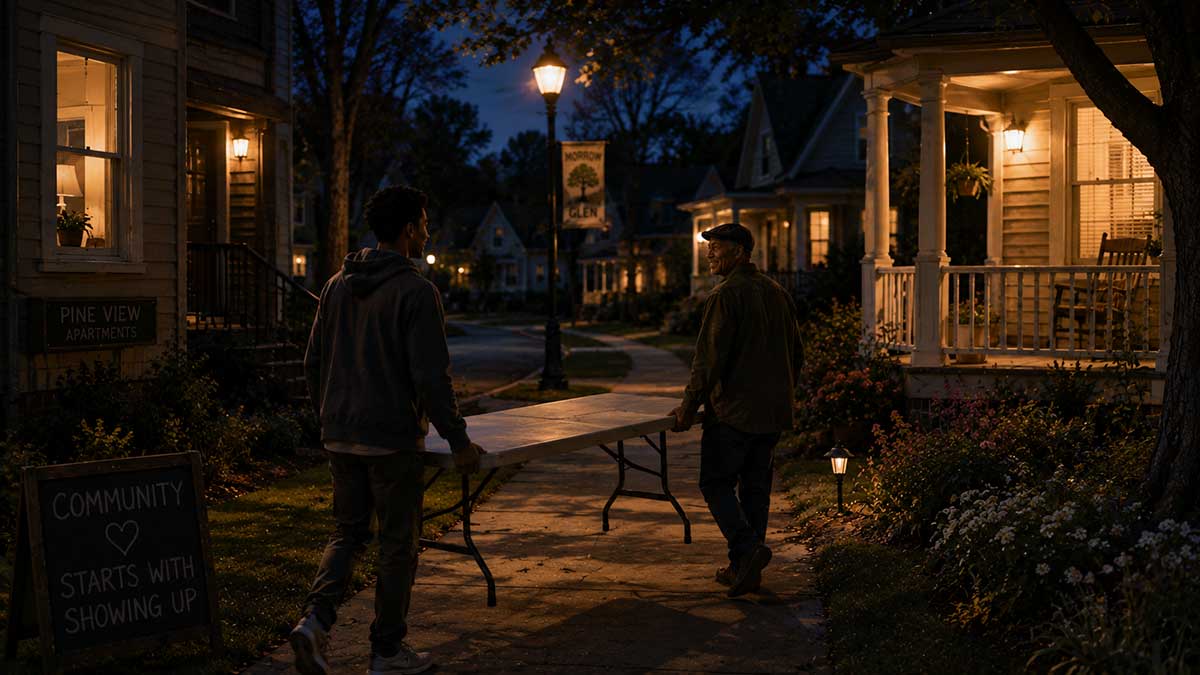
Mr. Darnell was dragging a small folding table from his garage.
A woman Marcus had seen around the neighborhood was helping him.
Farther down the block, two more people carried bags toward the community center.
Marcus remembered seeing a flyer earlier in the week.
Some kind of neighborhood gathering.
He had thrown it away.
His chest tightened.
He could stay home.
Nobody expected him.
That was still true.
Then Mr. Darnell looked across the street.
Saw him through the window.
Raised one hand.
Not dramatically.
Just a small gesture.
Come if you want.
Marcus looked at Eli's unfinished conversation.
Then typed:
I'm going out for a bit
The response was warm.
Marcus closed the laptop.
He stood.
Then reopened it.
One final message.
Goodnight, Eli.
He put on his jacket.
15. Outside
Mr. Darnell was still struggling with the folding table.
“You need help?”
Mr. Darnell looked over.
“I was wondering how long you were going to make an old man carry this.”
“You could've asked.”
“I did.”
“When?”
“Just now.”
“You literally didn't.”
Mr. Darnell laughed.
Marcus took one end.
Together they carried the table down the sidewalk.
The porch light remained on behind them.
Marcus glanced back once.
For months he had seen that light from the safety of his couch.
A small warm square across the street.
Something external.
Something belonging to somebody else's life.
Now, for the first time, Marcus was walking away from his own apartment while it was still dark inside.
He did not know everyone at the gathering.
He did not know what to say when he arrived.
He did not know where to stand.
He did not know whether he would stay ten minutes or two hours.
For once, none of those questions had to be answered before he left the house.
Mr. Darnell adjusted his grip on the table.
“Ready?”
Marcus looked ahead.
People were unfolding tables under the community-center lights.
Someone was laughing.
A child ran past carrying a bag of bread.
“Yeah,” Marcus said.
And they kept walking.
Story 5: One More Table
Denise Carter knew the names of 327 children.
She knew which ones hated peas.
Which ones asked for extra apples.
Which ones pretended not to be hungry because they were embarrassed.
Which ones needed someone to say, “Good morning,” before they could manage one themselves.
At fifty-two, Denise had spent seventeen years running the cafeteria at Morrow Glen Elementary School.
Every weekday, hundreds of people passed in front of her.
By three-thirty, almost all of them were gone.
By six, Denise was usually eating dinner alone.
She had never thought there was anything strange about that.
Until the neighborhood meeting where everyone complained that nobody knew anybody anymore.
1. Community Night
The flyer had promised:
MORROW GLEN COMMUNITY NIGHT
COME MEET YOUR NEIGHBORS
FOOD • FAMILY • FUN
Denise arrived at six-fifteen.
There were forty-eight folding chairs.
Nine people.
Two were organizers.
One was a city employee.
Another was a man who had apparently come only to complain about parking near the walking trail.
Someone had brought three trays of cookies.
There were enough cookies for a small wedding.
Denise sat near the back.
A woman beside her whispered, “This is sad.”
Denise nodded.
Ten minutes later, one of the organizers stood.
“We really want to hear what residents think would help build more community in Morrow Glen.”
The parking man raised his hand immediately.
“People don't talk anymore.”
A woman near the front agreed.
“Everyone stays inside.”
“Kids don't play outside.”
“Nobody knows their neighbors.”
“Everything's online.”
“People are too busy.”
“There's nowhere to meet.”
Denise listened.
Then someone said:
“We need somebody to organize something.”
That sentence irritated her.
She wasn't sure why.
Maybe because she had spent seventeen years hearing variations of it.
Someone should do something about lunch waste.
Someone should organize the pantry.
Someone should call the parents.
Someone should make the schedule.
Someone should clean this up.
Someone should fix it.
The mysterious someone was always remarkably available.
Denise looked around the nearly empty room.
Forty-eight chairs.
Nine people.
Three trays of cookies.
“We are something,” she said.
The room quieted.
The organizer looked at her.
“Sorry?”
“We're already here.”
Nobody seemed to know what to do with that.
Denise didn't either.
2. Two Tables
The following Tuesday, Denise borrowed two folding tables from the school.
Borrowed was generous.
She told the custodian, Carl, she was taking them.
“For what?”
“I don't know yet.”
“That sounds promising.”
“They'll be back Monday.”
Carl looked at her.
“You sure?”
“No.”
He helped load them into her SUV anyway.
On Wednesday evening, Denise opened a neighborhood group online.
She typed:
Saturday, 4 PM, community center lawn.
Then stopped.
What was she inviting people to?
A potluck?
A social?
A neighborhood mixer?
Every phrase sounded like something that required decorations.
She deleted them.
Finally she wrote:
I'll have a couple tables outside the community center Saturday at 4. Bring something if you want. Sit for a while if you want. That's it.
She stared at the message.
It sounded almost aggressively unimpressive.
She posted it.
By Saturday morning, three people had clicked “Interested.”
One was Denise.
3. Seven
At three-forty-five, Denise unfolded the first table.
At three-fifty-two, the second.
She had brought lemonade, paper cups, a bag of tortilla chips, salsa, and twenty-four hot dogs.
Twenty-four now seemed humiliating.
At four-oh-three, Ruth Alvarez arrived carrying a bowl.
“You Denise?”
“Yes.”
“Ruth.”
They shook hands.
Ruth placed the bowl on the table.
“Tomatoes.”
“Just tomatoes?”
“Tomatoes need very little improvement.”
At four-ten, a father arrived with two children.
At four-fifteen, an older woman Denise recognized from Morrow Market came carrying cookies.
At four-twenty, one teenager appeared because his mother had made him.
Seven people.
Denise had twelve hot dogs left after everyone had eaten.
The children spilled lemonade.
The teenager stared at his phone.
Ruth talked to the older woman for twenty minutes about tomatoes.
The father made a joke about property taxes.
Someone mentioned politics.
Denise changed the subject so quickly she nearly injured herself.
At five-fifteen, rain started.
Everyone grabbed dishes and ran.
By five-thirty, Denise was standing under the community center awning beside two wet folding tables.
Ruth was the last to leave.
“You doing this again?”
Denise laughed.
“Why?”
“Because it happened.”
“That is not a reason.”
Ruth shrugged.
“It might be.”
4. Month Two
Denise did it again.
Not because Ruth had convinced her.
At least that was what she told herself.
The second gathering had eleven people.
Someone from Morrow Market brought two loaves of bread.
A man named Walter Greene appeared for about fifteen minutes carrying a container of cut fruit.
He placed it on the table.
“Denise?”
“Yes.”
“I'm Walter.”
“I know. You volunteer with the neighborhood errands.”
“How do you know that?”
“I work at the elementary school. I know everything.”
Walter seemed to accept this.
He looked around.
“This your thing?”
“No.”
“Looks like your thing.”
“It isn't.”
“Good.”
He left before she could ask what that meant.
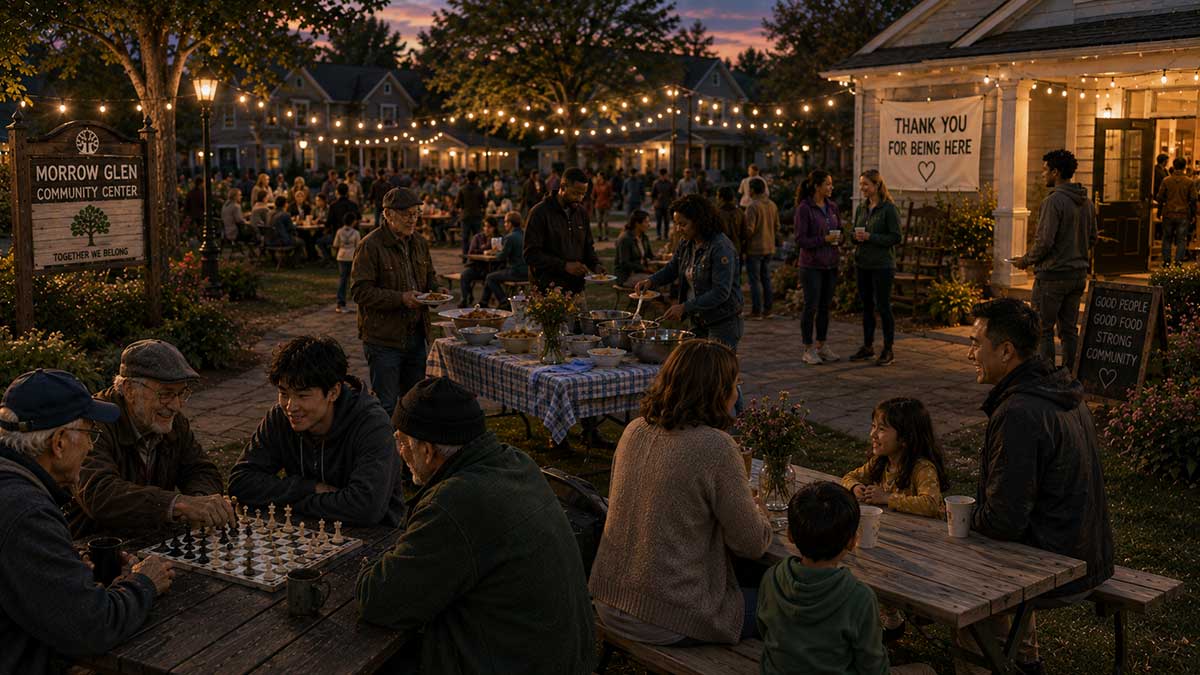
Later, three men arrived carrying a chess board.
A younger man walked with them.
He was quiet at first.
Then one of the older men accused him of bringing terrible coffee, and all four started arguing.
At the other end of the table, two women who lived less than half a mile apart discovered they both walked every morning.
“Which trail?”
“The north loop.”
“What time?”
“Seven.”
“I walk at seven.”
They stared at each other.
“Tomorrow?”
“Sure.”
Denise heard the exchange while opening another package of paper plates.
She didn't think much of it.
5. Six
The third month was worse.
Six people.
One of them left after twenty minutes.
Another arrived late, ate, and left without speaking to anyone.
It was colder now.
Denise stood beside the food wondering why she was doing this.
This was exactly the kind of activity she hated.
Too much preparation.
Too much uncertainty.
Too much food.
Too much emotional labor disguised as casual fun.
Carl wanted the tables back.
Her daughter had texted that afternoon asking whether Denise wanted to come over for dinner.
Denise had said she couldn't.
Now she looked at five people standing around eating chili from paper bowls and thought:
For this?
A woman approached her.
“Are you Denise?”
“Yes.”
“I'm Leah. I came last month.”
Denise recognized her vaguely.
“Right.”
“I just wanted to say thank you.”
“For what?”
“That woman I met here, Rachel? We walk together now.”
Denise remembered.
“That's nice.”
“Every morning.”
Leah smiled.
“I hadn't been walking much since my husband died.”
Denise looked at her.
She hadn't known that.
Before she could answer, someone else called:
“Denise?”
A man stood beside an older gentleman near the sidewalk.
“You know anybody who can recommend a math tutor?”
A teenager near the food table looked over.
“I tutor math.”
The father turned.
“You do?”
“Yeah.”
“What grade?”
“Anything up through Algebra II.”
“My daughter's in eighth.”
“That's easy.”
The teenager's mother interrupted.
“Nothing is easy when you are tutoring someone else's child.”
Everyone laughed.
Denise looked from one conversation to another.
Nothing extraordinary was happening.
No speeches.
No emotional breakthroughs.
People were exchanging phone numbers.
That was all.
Something about it stayed with her.
6. The Railing
A week later, Denise was picking up bread at Morrow Market.
Ruth Alvarez was ahead of her.
“You hear about Darnell's railing?”
Denise shook her head.
“Loose for months. Somebody finally fixed it.”
“Who?”
“One of those younger guys from the last dinner.”
“Which one?”
“Marcus. Quiet fellow.”
Denise remembered a young man carrying a folding table with Mr. Darnell.
“He fixed it?”
“Helped.”
Ruth picked up a loaf.
“Darnell won't shut up about it.”
Denise smiled.
Something clicked.
The gathering itself wasn't the point.
The things happening afterward were the point.
A walk.
A tutor.
A repaired railing.
A grocery ride.
A number entered into someone's phone.
The tables were only the place where those things had become possible.
7. The Permanent Solution
By the fourth month, attendance reached nineteen.
Someone brought soup.
Someone else brought cupcakes.
Walter brought apples and complained that nobody ate them.
The chess group occupied one end of a table and became loudly competitive.
A woman named Elena arrived with Ruth.
Denise recognized Elena from the elementary school years ago, though she wasn't sure Elena recognized her.
A young man named Marcus arrived carrying napkins.
Things were becoming easier.
That worried Denise slightly.
Anything that became easier tended to attract committees.
She was right.
At the next neighborhood association meeting, a man named Brian approached her.
“What you're doing is great.”
Denise waited.
Praise from Brian usually had a second half.
“We should apply for a community-improvement grant.”
“There it is.”
“What?”
“Nothing.”
“We could buy permanent picnic tables.”
Denise considered it.
Permanent tables sounded wonderful.
No more borrowing from Carl.
No loading.
No unfolding.
No dragging tables across wet grass.
“We could get four really nice ones,” Brian said.
Denise nodded.
“Maybe.”
For the rest of the week, she imagined the tables.
Heavy.
Weatherproof.
Bolted into concrete.
Official.
Then Saturday came.
And she changed her mind.
8. Bring Yours
Denise pulled into the community-center lot at three-thirty.
Before she could unload her tables, she saw Walter.
He was carrying one from the back of his SUV.
“What's that?”
“A table.”
“I can see that.”
“You needed tables.”
“I have tables.”
Walter looked at the two in her vehicle.
“You have two.”
Behind him, a minivan arrived.
A family pulled out another folding table.
Then someone from Morrow Market appeared with one covered in faded green paint.
A church group brought two.
One had children's stickers all over the top.
Another had a corner repaired with duct tape.
Denise stood in the parking lot watching people carry them across the grass.
Brian walked over.
“This is exactly why permanent tables would be better.”
Denise looked at him.
“No.”
“No?”
“No permanent tables.”
He frowned.
“Why?”
She watched Marcus and Mr. Darnell unfold one together.
Ruth was wiping another with a towel.
Noah from the chess group was trying to level one on uneven ground by shoving a folded napkin under a leg.
A little girl was decorating the end of another with chalk.
Denise smiled.
“Bring yours.”
Brian stared at her.
“What?”
“If we need another table, bring one.”
“Denise, that's inefficient.”
“I know.”
The word felt unexpectedly satisfying.
9. Thirty-Seven
The gatherings never became enormous.
Denise was glad.
The biggest had thirty-seven people.
The smallest still had nine.
Some months people came for ten minutes.
Some stayed until dark.
No one was required to bring food.
No one was required to introduce themselves.
There was no program.
Denise resisted every suggestion for name tags.
“No.”
“How will people learn names?”
“By asking.”
There were occasional disasters.
Someone brought a dog that stole half a sandwich.
Two neighbors argued loudly about a fence.
A child threw up.
Walter and Mr. Hanley debated whether store-bought pie counted as dessert.
A woman cried one evening after mentioning her mother.
Nobody knew quite what to say.
Someone handed her a napkin.
Ruth sat beside her.
The conversation resumed slowly.
Denise began to understand that a gathering did not become good by avoiding discomfort.
It became real by surviving it.
10. The Thing Denise Had Missed
One evening Denise's daughter, Camille, came.
“You never invited me.”
Denise looked offended.
“I invited the entire neighborhood.”
“I don't live here.”
“Close enough.”
Camille surveyed the tables.
“You did all this?”
“No.”
“You started it.”
“That is not the same thing.”
They sat together for a while.
Camille watched people come and go.
“You know what's funny?”
“What?”
“You spend your whole day around people.”
Denise nodded.
“You know everybody.”
“Children.”
“Still.”
Camille hesitated.
“Were you lonely?”
Denise looked across the lawn.
Walter was talking to Mr. Hanley.
Noah was setting up a chess board.
Marcus carried drinks with Mr. Darnell.
Elena and Ruth were laughing about something near Morrow Market's bread basket.
Denise thought carefully.
“No.”
Camille waited.
Denise corrected herself.
“I don't think I knew what I was missing.”
That felt closer.
11. The Extra Table
The following month brought perfect weather.
Denise arrived late.
She had been held at school by a broken freezer and two vendors blaming each other.
When she pulled into the lot, the gathering had already started.
This should not have surprised her.
It did.
Nobody was waiting for her.
Tables were up.
Food was out.
Someone had filled coolers with ice.
A teenager had written WELCOME in chalk near the sidewalk.
Walter waved.
“You're late.”
Denise looked at him.
“Excuse me?”
He grinned.
“That's what people say when someone is expected.”
She shook her head.
“Don't get sentimental on me.”
“Wouldn't dream of it.”
Denise walked across the grass.
Then she saw something that stopped her.
Another family had arrived.
Two adults.
Three children.
They stood near the edge of the gathering, uncertain where to go.
The mother scanned the tables.
Everything looked full.
Before Denise could move, Noah stood.
He folded the chess board.
Marcus grabbed one end of a table from behind Mr. Darnell.
Walter went to his car.
Within three minutes, another folding table appeared.
No meeting.
No instruction.
No organizer.
They unfolded it.
Someone brought chairs.
Ruth moved bread.
A child carried cups.
The new family sat.
Denise watched all of it.
One more table.
That was all.
12. What Spread
Months passed.
The gathering itself remained modest.
The things around it multiplied.
Leah and Rachel still walked every morning.
The teenager tutoring eighth-grade math eventually gained two more students.
Walter began bringing Mr. Hanley, who complained about everything and returned every month.
Noah started teaching chess to several children.
Marcus helped Mr. Darnell set up early.
Elena sometimes came with Ruth and sometimes without her.
Someone created a babysitting exchange.
Someone else started a Saturday gardening group.
Two fathers began meeting at the walking trail.
An older woman started bringing extra soup for people who lived alone.
None of these belonged to Denise.
That mattered.
Community, she began to see, was not the gathering.
It was what people carried away from it.
13. Same Time
In October, darkness came early.
The air had turned cold enough that people wore jackets.
Someone suggested moving indoors.
Nobody wanted to.
“Next month,” Denise said.
At seven-thirty, people began packing.
Walter folded one table.
Marcus took another.
Noah gathered chess pieces.
Children collected cups.
Ruth wrapped leftover bread.
Denise stood near the community center looking across the lawn.
Six months earlier, she had dragged two folding tables here because she was irritated.
Now seven tables were scattered across the grass.
None matched.
One was green.
One had stickers.
One had rust on the legs.
One belonged to Morrow Market.
One had been borrowed from a church.
Two came from someone's garage.
They looked temporary.
Denise liked that.
Permanent things sometimes made people assume somebody else was responsible for them.
These tables had to be carried.
Unfolded.
Wiped.
Shared.
Carried home.
Mr. Darnell called from near the sidewalk.
“Same time next month?”
Before Denise could answer, several people said it.
“Of course.”
“First Saturday.”
“Four o'clock.”
“Unless it's snowing.”
Walter looked at Denise.
“Snow won't stop Hanley.”
Mr. Hanley shouted from twenty feet away.
“I heard that.”
People laughed.
Denise bent to grab one end of the last table.
A young woman she barely knew took the other.
“Got it?”
Denise nodded.
Together they carried it toward the parking lot.
Behind them, people were still talking.
Nobody seemed in a hurry to leave.
Denise looked back once.
There was no stage.
No banner.
No permanent furniture.
Nothing that would have looked impressive in a photograph.
Just people helping one another pack things away.
For years Denise had thought community was something a town either possessed or did not.
Now she knew better.
Sometimes it was much less mysterious.
Someone brought a table.
Someone else brought another.
Then people kept coming back.
Final Thoughts
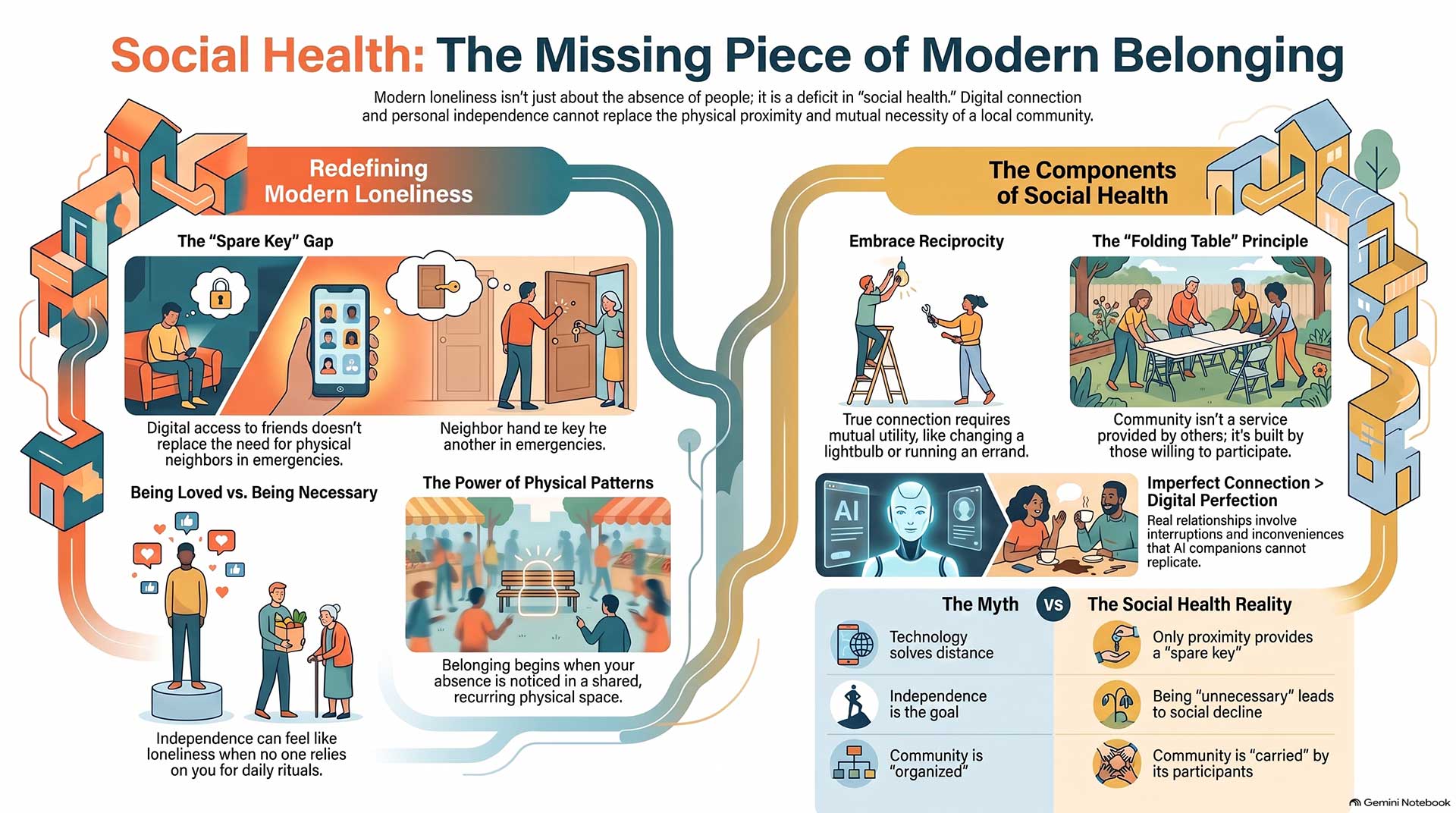
Across these five stories, nobody is rescued by a dramatic new friendship.
Something quieter happens.
Elena discovers that love across a thousand miles and care across the street serve different human needs.
Walter discovers that receiving love is not quite the same as being needed.
Noah discovers that belonging can begin long before intimacy, with the surprisingly powerful words:
“Where were you last week?”
Marcus discovers that the imperfections of human relationships may be part of what gives them meaning. Real people interrupt. Misunderstand. Repeat themselves. Need favors. Give bad advice. Ask something of us.
Denise discovers perhaps the largest lesson of the collection.
Community is not something somebody else provides.
It exists when enough people begin carrying part of it.
That is why the folding tables matter.
They remain temporary.
Every month somebody has to bring them back.
Perhaps social health works much the same way.
Relationships need returning.
Rituals need repeating.
Neighbors need noticing.
Friendships need inconvenient moments.
Communities need people willing to participate before they know whether participation will be rewarding.
Kasley Killam's work asks us to take social health seriously alongside physical and mental health. These stories push that idea into ordinary life.
The question becomes larger than:
“Do I have enough relationships?”
It becomes:
“Whose life is different because I keep showing up?”
Maybe belonging does not always begin with finding people who completely understand us.
Sometimes it begins with a spare key.
A grocery list arriving every Wednesday.
A chess game every Saturday.
A porch light we notice has gone dark.
A folding table somebody needs help carrying.
Small things repeated long enough that another person's life begins making room for ours.
And one day, almost without noticing when it happened, we have somewhere to return.
Short Bios:
Kasley Killam, MPH is a social scientist and author of The Art and Science of Connection. Her work focuses on social health, relationships, loneliness, and the role human connection plays in well-being.
Robert D. Putnam is a political scientist known for Bowling Alone. His influential research examines social capital, civic participation, trust, community institutions, and the relationships connecting people beyond their closest family and friends.
Sherry Turkle is an MIT professor, psychologist, and author of books including Alone Together and Reclaiming Conversation. Her work examines how technology shapes conversation, intimacy, attention, solitude, and relationships.
Priya Parker is the author of The Art of Gathering. Her work explores how intentional gatherings, repeated rituals, hospitality, structure, and participation can turn groups of people into meaningful human communities.
Leave a Reply