
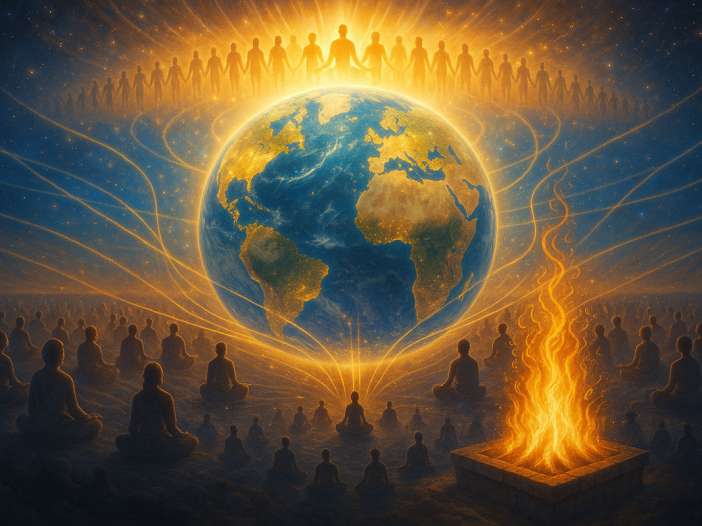

Introduction By Craig Hamilton:
Friends, welcome. For many years I’ve been blessed with visions, predictions, and insights from the spirit world, but at the heart of all my work lies one truth: the future is not fixed. Though we may look ahead and see trouble — unrest in our nations, divisions among peoples, fears for our environment and economies — these are not unchangeable prophecies carved in stone. They are possibilities, shaped by human choices, and above all, by human consciousness.
The Nadis of India remind us that ancient seers foresaw our struggles but also gave us remedies — practices that can transform our shared destiny. Meditation, Yagna, and the collective vision of peace are not abstract ideas. They are living tools, spiritual technologies, if you will, that allow us to shift the vibration of our world. When we sit in stillness, we are not merely calming our own minds but contributing to a field of harmony that ripples outward. When we join in sacred offerings, we symbolically and energetically release negativity and invite divine light. And when we dare to dream together of a world at peace, we plant seeds in the fertile soil of human imagination that may blossom into reality.
This trilogy of conversations explores these three pathways — meditation, ritual, and vision — with some of the greatest voices in history. Their wisdom shows us that change begins within, but it does not stop there. Each of us is part of a great spiritual community, and our thoughts, our prayers, our focused intentions, can make a difference.
(Note: This is an imaginary conversation, a creative exploration of an idea, and not a real speech or event)

Topic 1: Meditation as a Force for World Peace
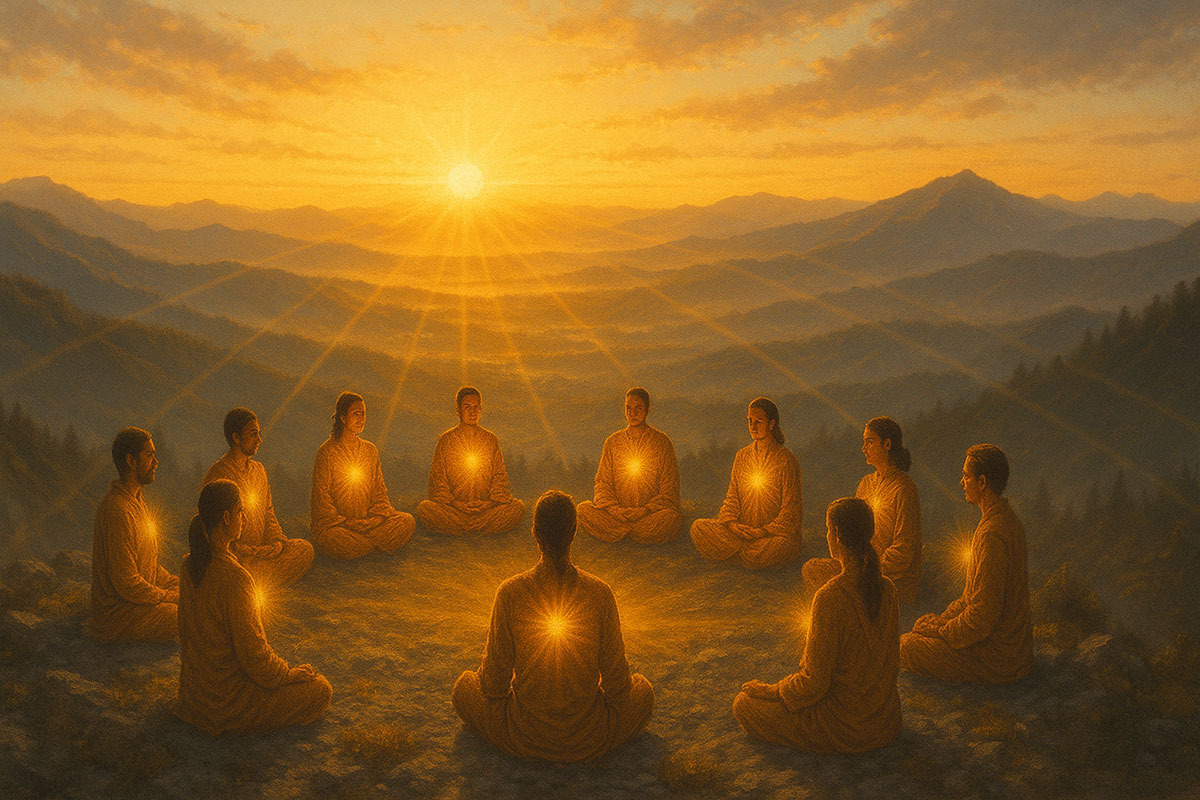
Craig Hamilton Parker (Moderator):
Welcome, friends, to this roundtable. Today we explore the first key — meditation — and how it can transform not only the individual but also the destiny of the world. Let me begin with this question:
Many people see meditation as a private, personal practice. But can meditation truly influence events in the wider world?
Dalai Lama:
Meditation begins within, yes, but the mind is not separate from the world. When we cultivate compassion and nonviolence inside, those qualities radiate outward. You see, anger is contagious, but so is kindness. A single mind at peace can influence a family; many minds at peace can influence nations. If enough people meditate, it is like a gentle breeze becoming a strong wind — it shifts the atmosphere of humanity itself.
Albert Einstein:
I must confess, I was never trained in meditation as the great Eastern masters here were. Yet, from physics, I know that energy is never lost; it changes form. Thoughts too are energy. If thousands of minds are focused in harmony, it is not unscientific to suggest that a collective resonance may alter probabilities. In quantum theory, the observer changes the observed. Meditation, I suspect, is the most disciplined form of observation.
Paramahansa Yogananda:
Indeed, meditation is not only personal but planetary. When the yogi dives deep, he uplifts the vibrations of all creation. The saints of India taught that the prayers of the few sustain the many. Even one sincere soul in samadhi can counterbalance countless restless minds. This is why group meditation is powerful: it magnifies divine currents that sweep into the world unseen, calming wars, healing hatred, and awakening love.
Mahatma Gandhi:
When I meditated, I found my strength for satyagraha. Without inner stillness, I could never have resisted the empire with peace. So yes, meditation affects the world, because it gives birth to right action. It does not replace action — it purifies it. True meditation is not escape; it is preparation for the battlefield of justice.
Sri Aurobindo:
We must remember that meditation is not only a practice but a means of evolution. Humanity is still in transition, striving toward a higher consciousness. When groups meditate, they prepare the ground for a supramental descent — a new order of being. So the question is not whether meditation influences events; it is that meditation is the event — the unfolding of divine consciousness upon Earth.
Craig Hamilton Parker:
Thank you. That’s inspiring. Let me ask the next:
If meditation does carry this transformative power, what is the best way for ordinary people — busy, perhaps doubtful — to participate meaningfully?
Einstein:
Ordinary people need not wait for perfection. Even ten minutes of stillness is worthwhile. It is like tuning an instrument: the smallest adjustment changes the music. My advice is simple — sit, breathe, and imagine the universe as friendly. Even if you do not believe in prayer, belief in possibility itself alters the field.
Gandhi:
Begin with truth. Meditation is not only sitting in silence but examining oneself with honesty. Ask: “Are my thoughts kind? Are my motives pure?” To the common person, the best meditation is to align thoughts with conscience. If each Indian who followed me had done only that, our revolution would still have succeeded.
Yogananda:
I would guide the seeker to the breath — the holy breath, which links body and soul. The Kriya Yoga technique I brought to the West is simple enough for a householder, yet it opens the infinite. Even one sincere breath offered to God carries more weight than hours of restless activity. Meditation should be regular, like brushing the teeth of the soul.
Dalai Lama:
Compassion practice is accessible to all. One may sit and imagine sending kindness first to oneself, then to a friend, then to a stranger, and finally to an enemy. This is called “metta” or loving-kindness meditation. No special temple is needed; your living room is enough. Small daily efforts accumulate into large waves of compassion.
Aurobindo:
The ordinary person is also the divine person. What matters is sincerity. Sit in stillness, offer your heart upward, and aspire for the higher light. The supramental force responds not to complexity but to aspiration. If thousands aspire sincerely, the descent accelerates.
Craig Hamilton Parker:
Beautiful. Now, let me close with a third question, perhaps the most challenging:
We live in a time of war, division, and fear. Can meditation realistically prevent violence or even shift the course of history?
Yogananda:
Yes. The vibrations of meditation are subtle, but subtlety is more powerful than brute force. Wars may rage, but beneath them the divine current is flowing. A few awakened souls can tilt the scales of destiny. Never doubt the invisible hand of God moving through stillness.
Gandhi:
I must agree, though with caution. Meditation alone is not enough. It must express itself in courageous action. In my time, fasting, prayer, and meditation gave me clarity, but then I marched. The world changes when silence becomes action, and action remains rooted in silence.
Einstein:
History shows that material forces dominate, but it also shows that a single idea can ignite revolutions. Meditation cultivates ideas beyond fear, ideas aligned with unity. Thus, while a bomb may destroy cities, meditation may prevent the building of the next bomb. It works upstream, at the level of thought itself.
Dalai Lama:
Violence cannot be stopped by more violence. But meditation can soften hearts, including those of leaders. I have met generals, presidents, even soldiers who admitted that a moment of reflection kept them from pressing the trigger. Multiply such moments across millions of minds, and yes, history bends toward peace.
Aurobindo:
Ultimately, meditation prepares humanity for its evolutionary leap. Wars and conflicts are symptoms of a consciousness still bound in ignorance. As more souls awaken, the necessity of violence will wither. Meditation may not prevent every battle, but it ensures that the final destiny is not destruction but divinization.
Craig Hamilton Parker (closing):
What a profound dialogue. You’ve all shown us that meditation is not retreat but revolution — a revolution of consciousness. From the yogi’s breath to the activist’s courage, from compassion practice to the supramental descent, we see that meditation is both personal and planetary. Perhaps if we join our stillness, we will awaken a peace greater than armies.
Topic 2: Yagna — Fire Ceremony as a World Ritual
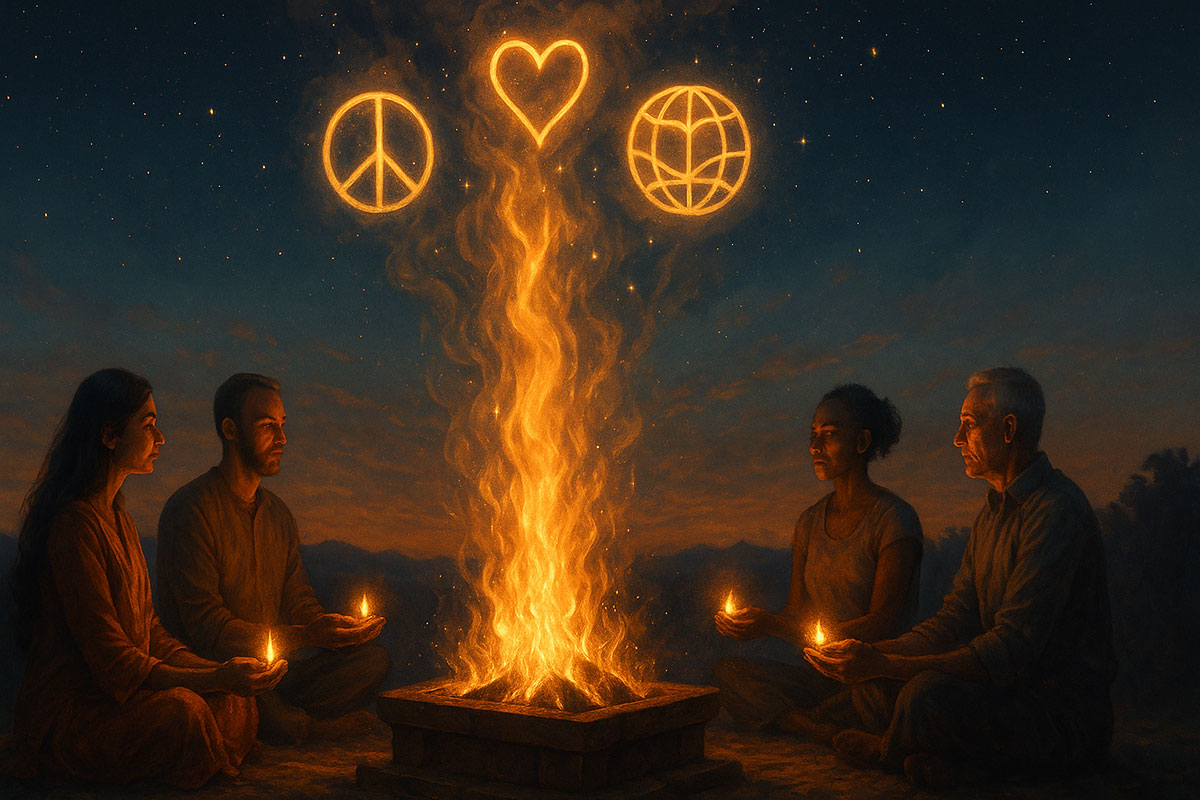
Craig Hamilton Parker (Moderator):
Thank you for joining me again. In our last session, we explored meditation as a force for global transformation. Now let’s turn to something more ancient, yet still alive today: the Yagna, or fire ceremony. These rituals have been practiced in India for thousands of years, and I’ve even participated myself. But many people wonder — is this just superstition, or does it hold genuine power?
Let me start with this question:
Why does fire, of all things, play such a central role in spiritual rituals across cultures?
Sri Aurobindo:
Fire is the primal symbol of transformation. In the Vedas, Agni, the fire god, is both messenger and purifier — carrying our offerings to the higher realms. Fire consumes the gross and releases the subtle. When we cast grains or ghee into the flame, we enact the greater truth: surrendering the lower nature so that the higher light may descend. In this sense, Yagna is not a superstition but a living alchemy.
Dalai Lama:
Even in Tibetan practice, we have fire pujas. Fire gives warmth, light, and protection. But symbolically, fire represents wisdom burning away ignorance. When people gather around fire with pure intention, it becomes more than chemistry — it becomes a mirror of inner clarity.
Mahatma Gandhi:
To me, fire represents sacrifice. A Yagna reminds us that nothing worth having comes without giving up something. In my ashram, we would light lamps daily — not as idols, but as reminders to burn away selfishness. The true Yagna is not what you throw into the flames, but what you surrender in your heart.
Albert Einstein:
From a scientific point of view, fire is transformation of matter into energy. That very process parallels consciousness. Perhaps our ancestors, without equations, intuited this connection. Ritual fire is symbolic, yes, but symbolism affects the psyche, and psyche shapes action. Thus, even “mere ritual” can influence reality.
Paramahansa Yogananda:
Indeed, and yet beyond symbolism, there is spiritual law. When mantras are chanted, when offerings are made with devotion, subtle vibrations rise with the smoke. The fire becomes a transmitter, carrying prayers to higher dimensions. In such moments, the Yagna becomes a cosmic broadcast for peace.
Craig Hamilton Parker:
Thank you. So here’s a follow-up:
If a Yagna truly carries power, how can ordinary people — who may not be in India or trained in ritual — participate in it meaningfully?
Gandhi:
Anyone can live the spirit of Yagna. Offer your time in service, your money in charity, your pride in humility. Do it as if placing those things into the sacred fire of God’s will. When the intention is pure, the whole of life becomes a Yagna.
Yogananda:
Yes. While traditional rituals are beautiful, they are not required for participation. One may simply light a candle at home, focus on the flame, and offer prayers for the world. The Divine does not measure the size of the fire but the sincerity of the heart.
Einstein:
If I may, even joining mentally can be meaningful. If thousands visualize fire consuming hatred, pollution, or violence, that imagery itself has psychological impact. Rituals are containers for collective imagination. You need not be present physically to be part of the resonance.
Aurobindo:
I would add that Yagna is also inward. The flame in the heart is the true altar. Each thought of aspiration is a stick of incense cast into that fire. So whether one joins through livestream, through visualization, or through silent inner offering, it contributes to the supramental descent.
Dalai Lama:
And never forget, joy is part of it. A fire ceremony should be approached with openness, not fear. Even children can join by offering flowers or grains. What matters is the collective goodwill. In our fractured world, even small rituals create moments of unity — and unity itself has healing power.
Craig Hamilton Parker:
Beautifully said. Let me pose one last question:
Can Yagna and similar rituals really affect world events — war, economics, climate — or are they only symbolic gestures of hope?
Einstein:
From one angle, all rituals are symbolic. Yet symbols shape reality more than we admit. A flag is only cloth, yet men die for it. Fire ceremonies may not directly alter molecules in the sky, but they alter minds and communities. And those altered minds take new action. So yes, indirectly, rituals can move history.
Yogananda:
I will go further. The vibrations of a Yagna are not merely psychological but spiritual. The smoke carries mantras into the ether, harmonizing unseen forces. Just as radio waves move invisibly yet powerfully, so do the spiritual currents released in ritual. These currents can indeed soften the impact of wars, calm storms, and guide nations.
Dalai Lama:
Perhaps the truth lies in both. Rituals inspire hope — and hope inspires new choices. But in Buddhist understanding, collective intention also carries karmic weight. When thousands sincerely wish for peace and purification, that karma shifts the future. The fire becomes both symbol and seed of change.
Aurobindo:
Yes. Consider this: humanity itself is a vast Yagna. We are burning in the fire of evolution, offering our ignorance so that truth may descend. Every ritual fire is a reminder of this cosmic process. Can it affect wars? Yes, because wars are expressions of consciousness. Shift consciousness, and the wars lose fuel.
Gandhi:
And yet, let us be cautious not to rely only on ritual. A Yagna without ethical living is empty. To me, the true measure is whether the ceremony inspires us to act with courage and compassion afterward. Only then can it claim to shape the course of history.
Craig Hamilton Parker (closing):
What a profound exchange. You have shown us that Yagna is not superstition, nor mere spectacle, but a profound symbol and spiritual force. Fire as transformation, sacrifice, transmission, unity — all these meanings converge. Whether we light a great Vedic flame in India or a small candle in a home, the act becomes part of a larger offering. Perhaps together, we can set ablaze not destruction, but the light of a new peace.
Topic 3: The Collective Vision of Peace
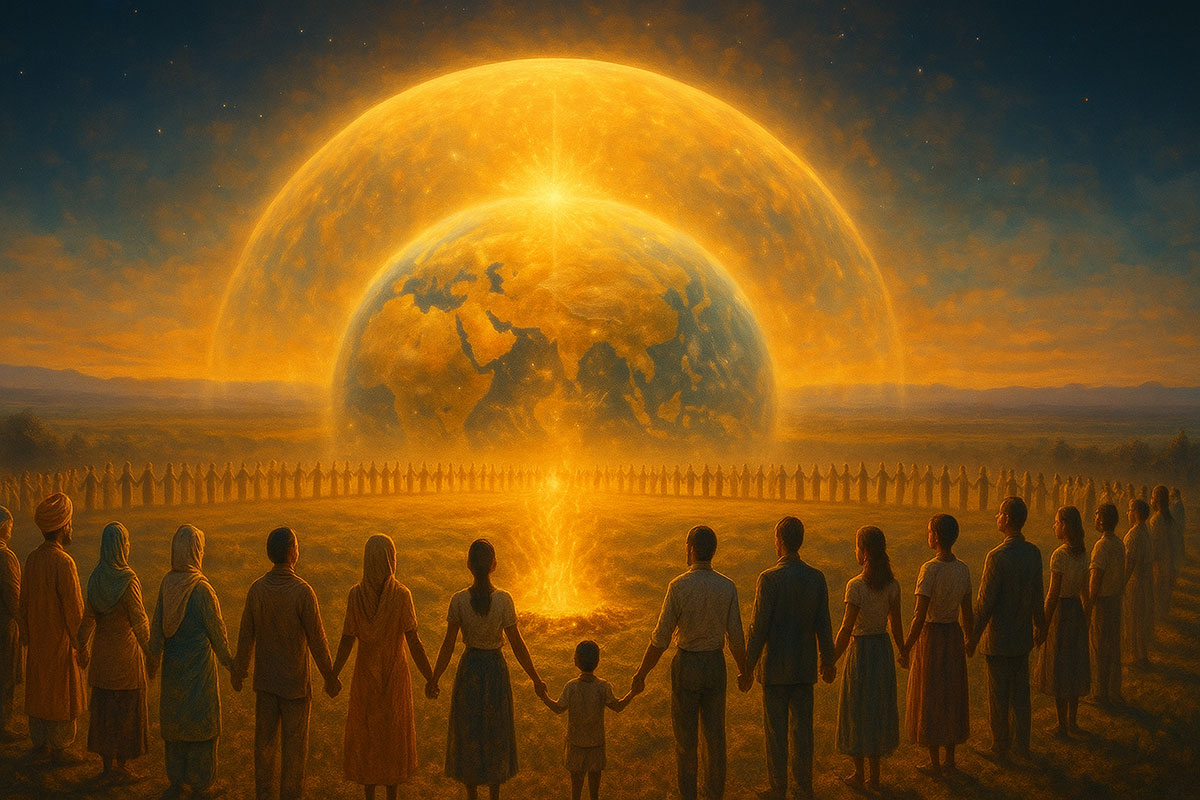
Craig Hamilton Parker (Moderator):
In our first two discussions, we spoke of meditation and Yagna — inner stillness and sacred ritual. Now we turn to the third key: the collective vision of peace.
The idea is simple yet profound: if enough people imagine a better world, reality itself may bend in that direction. But is this realistic, or just wishful thinking?
Let me start with this:
Can imagination — the shared vision of many people — truly change the course of history?
Albert Einstein:
I once said, “Imagination is more important than knowledge.” Why? Because knowledge shows us what is, while imagination shows us what could be. Every invention, every movement for freedom, began as a vision in someone’s mind. If enough minds align on the same vision, history shifts. Shared imagination is the seedbed of revolutions.
Mahatma Gandhi:
Indeed, the Indian independence movement began not with guns but with a vision — a dream of a free India. We held that vision so strongly that it became reality, though the empire seemed unbreakable. Vision gives courage to the oppressed. Without a collective picture of peace and justice, no movement endures.
Dalai Lama:
In Buddhism, we speak of “dependent origination”: everything arises from conditions. A collective vision creates new conditions. If many people cultivate compassion in their minds, society naturally grows more compassionate. A peaceful world must first be imagined — only then can it be built.
Sri Aurobindo:
Vision is not fantasy; it is the call of the future pressing upon the present. When enough souls open inwardly, they sense what is trying to be born — a divine life upon Earth. The collective imagination of humanity is an instrument for evolution itself. Through it, we summon the supramental reality into being.
Paramahansa Yogananda:
Yes, and we must remember that thought is not bound by walls. Vibrations of peace travel invisibly, just as radio waves do. If millions envision harmony, those vibrations permeate the ether and soften human hearts. The collective dream of peace becomes a magnetic power drawing humanity toward its destiny.
Craig Hamilton Parker:
Thank you. So here’s another question:
What practical steps can people take to contribute to this collective vision? How can the average person, overwhelmed by daily life, add their voice to this great chorus of peace?
Gandhi:
The first step is to live the vision. Do not wait for the world to be peaceful; be peace in your own home. Speak truth, avoid cruelty, refuse hatred. Every small act becomes part of the collective picture. Millions of small acts weave the great vision.
Einstein:
Practicality is important. Begin with simple visualization. Close your eyes, and imagine nations shaking hands, rivers running clean, children safe. Do it daily, as one would train a muscle. If millions performed such “thought experiments,” we would condition humanity toward cooperation rather than conflict.
Dalai Lama:
Yes, visualization need not be complicated. One can imagine light spreading across the globe, embracing enemies as friends. Join with others online or in communities to reinforce the vision. Even brief daily moments add to the global field of intention.
Yogananda:
I would suggest group affirmations. Chant or repeat: “We are one family of peace.” Words are powerful vehicles of thought. When repeated together, they magnetize the vision and anchor it in consciousness. Collective chanting or prayer magnifies the effect many times.
Aurobindo:
And above all, aspire. Each heart must raise its flame upward, sincerely longing for a higher world. If the aspiration is genuine, it calls the descending force. Thus, ordinary people contribute not by perfection but by sincerity. The supramental responds to even the smallest soul that aspires for the whole.
Craig Hamilton Parker:
Let me ask one last, perhaps most difficult, question:
We live in an age of cynicism. Many scoff at the idea that “imagining peace” could counter bombs, governments, and greed. How would you respond to those who doubt the power of collective vision?
Yogananda:
I would tell them: doubt itself is a vibration, as real as faith. Which vibration will you choose to amplify? The doubter strengthens the very darkness he fears. The believer, however small, radiates light that multiplies. Even a candle dispels a room of darkness.
Einstein:
Skepticism is healthy, but not if it paralyzes. Ask a cynic: did Martin Luther King’s dream change America? Did Gandhi’s dream change India? Dreams are the architecture of history. Without them, we build nothing new. The choice is between cynical realism and visionary realism. Only the latter offers progress.
Dalai Lama:
To doubters I say: experiment. Try for yourself. Spend one month visualizing peace each day. Notice your own heart become calmer, kinder. If it changes you, it can change others. Peace begins small but spreads naturally, like ripples in water.
Gandhi:
Yes. Skeptics forget that every empire falls, every injustice ends. Not because of cynicism, but because someone held a greater vision. When enough people believe, the seemingly impossible crumbles. To refuse vision is to surrender to despair. To hold vision is to invite hope.
Aurobindo:
And finally, I would say this: vision is destiny. Whether one believes or not, the divine evolution will unfold. But our conscious participation hastens it. The doubter will be carried along reluctantly; the visionary will help steer the course. It is wiser, and more joyful, to join in the vision.
Craig Hamilton Parker (closing):
What a stirring conversation. You’ve shown us that the collective vision of peace is not naive but necessary. Imagination shapes destiny, small acts feed the great dream, and even the doubter cannot escape the future that visionaries prepare.
Meditation gives us the stillness. Yagna gives us the ritual of offering. And vision gives us the dream of what might be. Perhaps if enough of us join in these three — stillness, fire, and imagination — we will discover that peace is not an impossible hope, but an inevitable destiny.
Final Thoughts By Craig Hamilton
As we close this exploration, I want to leave you with encouragement. The news may often tell us that the world is broken, that division is inevitable, that conflict is natural. But I tell you — the future is malleable, shaped by consciousness itself.
Meditation teaches us that peace begins within. Yagna teaches us that sacred action purifies and uplifts. And vision teaches us that what we imagine together can one day become real. None of these practices require extraordinary training or wealth. They require sincerity, a little time, and the willingness to believe that what you do matters.
When one person meditates, a room becomes lighter. When a community gathers around fire in symbolic offering, an entire town feels uplifted. And when millions across the world imagine peace together, history itself begins to shift course. This is not fantasy — it is the hidden truth of consciousness.
So I invite you: take a few moments each day to still your mind, to envision a better future, and, when possible, to join with others in rituals of unity. These small acts build momentum. They remind us that we are not powerless spectators, but co-creators of the world to come.
The Nadis spoke of dangers, yes — but also of remedies. We are not destined to collapse into despair. We are destined to awaken into our divine nature as one humanity. Together, through meditation, through sacred offerings, through the luminous power of shared vision, we can choose peace.
Short Bios:
Craig Hamilton Parker
British psychic medium, author, and spiritual teacher. Known for his global predictions and explorations of the afterlife, he emphasizes how meditation, prophecy, and collective intention can shape humanity’s future toward peace.
Paramahansa Yogananda
Indian spiritual master (1893–1952), author of Autobiography of a Yogi. He introduced millions in the West to Kriya Yoga meditation and taught that inner stillness can uplift global consciousness.
Sri Aurobindo
Philosopher, poet, and yogi (1872–1950) who developed Integral Yoga, merging Vedic traditions with evolutionary spirituality. He emphasized humanity’s role in ushering a higher, divine consciousness on Earth.
Dalai Lama (Tenzin Gyatso)
Born in 1935, the 14th Dalai Lama is the exiled spiritual leader of Tibet. He advocates for compassion, mindfulness, and interfaith harmony as practical foundations for world peace.
Albert Einstein
Renowned physicist (1879–1955), Nobel laureate, and pioneer of relativity. Beyond science, he reflected deeply on imagination, ethics, and the interconnectedness of humanity, often bridging science and spirituality.
Mahatma Gandhi
Indian independence leader (1869–1948) who championed nonviolent resistance (satyagraha). His philosophy of truth, simplicity, and peace continues to inspire global movements for justice and harmony.
Leave a Reply