
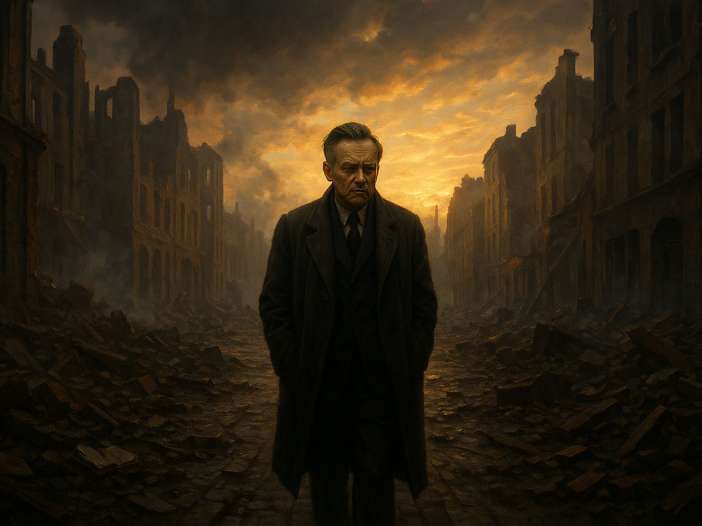

Seamus Heaney:
When we speak of Czesław Miłosz, we speak of a man whose poetry carried the weight of a century’s sorrows and yet still insisted upon beauty. He was a witness, not by choice but by fate. The ruins of Warsaw, the silence of exile, the ache of estrangement, and the trembling reach toward God — all became his companions.
What set Miłosz apart was not only his survival of history’s violence, but his refusal to let history silence the voice of conscience. He was, in the truest sense, a poet of moral imagination. His words did not aim merely to console, but to awaken — to remind us that every ruin holds memory, that every exile holds a homeland, that every question of faith is itself a gesture toward God.
In him, the poet’s task was not an escape from history but a covenant with it. To record faithfully, even when truth was unwelcome. To find clarity amid fog, and tenderness amid brutality.
This series — imagined through the voice of a best friend — does not glorify Miłosz so much as it humanizes him. We meet not only the Nobel laureate, but the man who feared meaninglessness, who longed for Poland even in California, who wondered if his words could outlast the smoke of war. And yet, like all true poets, he carried on writing, because silence would have been a deeper wound.
To walk with Miłosz in these pages is to encounter not only the story of a life but the testimony of a soul who wrestled with memory, exile, doubt, and mortality — and did not turn away.
(Note: This is an imaginary conversation, a creative exploration of an idea, and not a real speech or event.)
Chapter 1: The War-Torn Streets of Warsaw
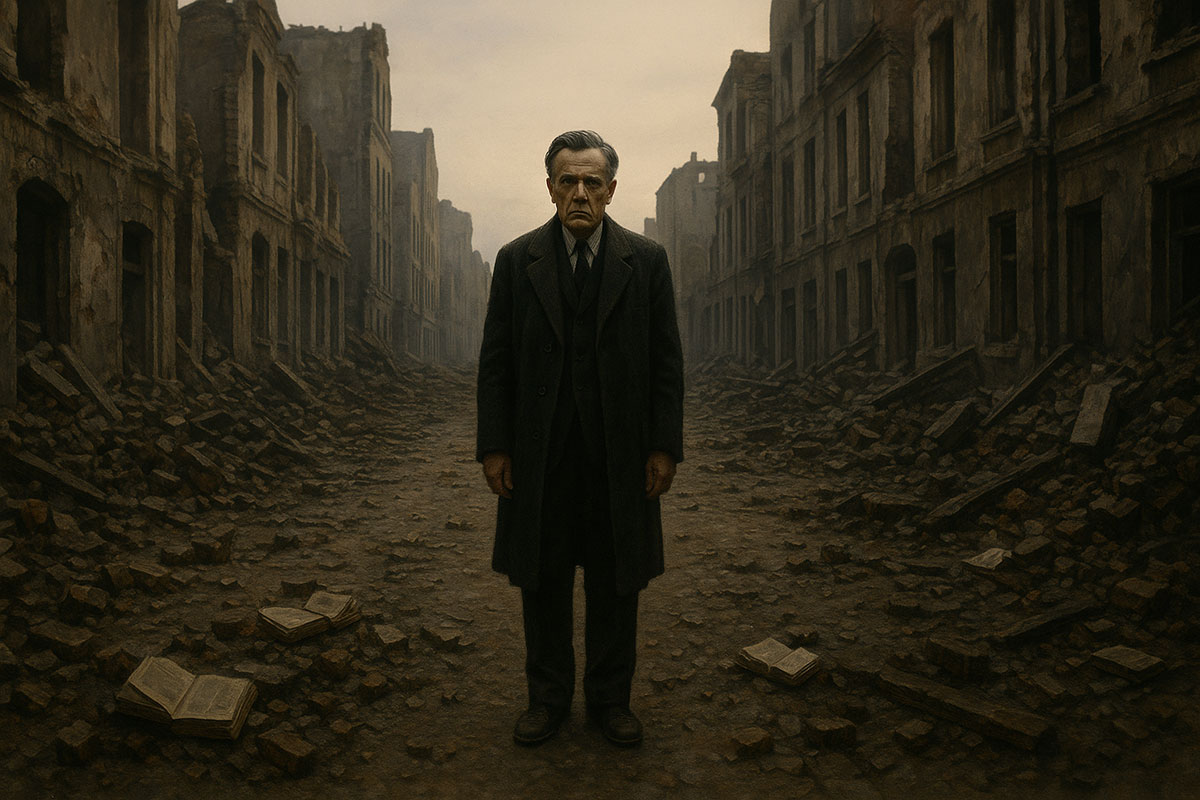
The city was breaking apart. Brick by brick, stone by stone, Warsaw seemed to collapse under the weight of fire and steel. The air smelled of burning wood and charred flesh, the acrid stench clinging to Czesław’s coat as he walked. He did not walk quickly; no one could, not when the streets themselves seemed to resist movement, piled with rubble, shattered glass, torn books, the scattered pieces of lives abruptly interrupted.
He stopped at the corner of a building that was no longer there. Once it had been a café, where laughter rose like smoke and conversations stretched far into the night. Now only a blackened doorway stood, jagged against the gray sky. He stared at it as though staring long enough might summon it back.
“Do you think memory can resurrect walls?” he asked suddenly, his voice quieter than the wind.
I stepped beside him, brushing the dust from a piece of charred wood. “Memory doesn’t rebuild walls,” I said softly. “But it preserves the people who filled them. That’s something no fire can take.”
He gave a small, bitter laugh. “And yet, they are gone. All those who sang here, who drank coffee here, who whispered poetry. I am left to remember while the world insists on forgetting.” His eyes, always so restless, searched the horizon for meaning that never came.
We walked a little farther, his boots crunching on the broken glass. Each sound seemed like a cry. I could feel his despair pressing against me like the rubble itself, threatening to bury him alive.
“You’re not only remembering,” I reminded him. “You’re writing. Every poem you craft is a rebellion against silence. Every word is a rescue.”
He turned sharply, his face shadowed by exhaustion and smoke. “But what good is poetry when children die in basements? When whole libraries burn? What arrogance, to believe words can stand against guns.”
I placed my hand on his shoulder, steadying him. “Poetry doesn’t stop the bullet. But it keeps the truth alive when everyone else tries to bury it. One day, someone who never walked these streets will read your words and smell this smoke, hear this silence. That is how words outlive war.”
For a long time he did not speak. The ruins stretched before us like a scripture too vast to read. Then, at last, he sighed, the sound trembling like the last note of a cello.
“Perhaps you are right,” he whispered. “Perhaps survival is not only living through this, but carrying it forward. If I must be a witness, then let me be a faithful one.”
We stood together in the rubble, not as survivors or poets or mourners, but as friends. And for a moment, the ruins seemed less heavy, the silence less cruel. For a moment, Czesław Miłosz did not feel alone in his remembering.
Chapter 2: The Burden of Exile (Paris and America)
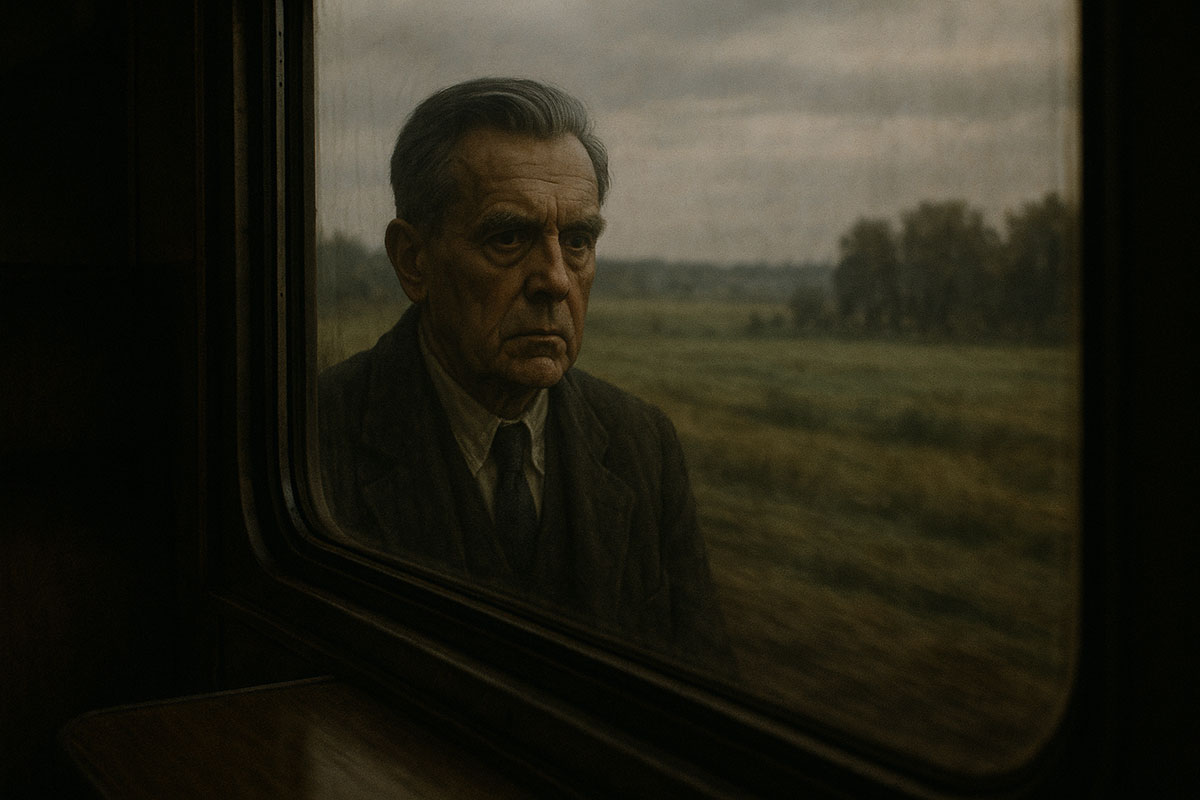
The train pulled away from Warsaw, its wheels grinding out a rhythm of departure. Each turn of the iron wheels seemed to strip away another thread tying Czesław to his homeland. He sat by the window, staring at the fields rushing past, the furrows blurring into indistinct lines, as though Poland itself refused to be fixed in his memory.
“I never thought leaving would feel like this,” he murmured, his voice heavy, as though each word cost him something irretrievable. “It is not freedom. It is betrayal. Betrayal of soil, of tongue, of those who cannot leave.”
I sat across from him, the sway of the carriage rocking us gently, like a lullaby that brought no peace. “It is not betrayal,” I said. “It is survival. You carry Poland with you, in your heart, in your words. Exile doesn’t erase your homeland. It makes you its witness.”
He looked at me sharply, almost angrily. “You speak as though words could console me. But I am condemned. In Paris, in America, I will always be a stranger. A foreigner in language, a ghost in history. My countrymen will call me traitor, and strangers will never truly know me.”
The bitterness in his voice hung in the air between us. Outside, the fields gave way to forests, then to small villages, their chimneys coughing smoke into the gray sky. He pressed his forehead against the glass, as though trying to carve Poland into his memory before it slipped away forever.
“You are not a ghost,” I said gently. “You are a bridge. You will teach strangers about your homeland, and you will remind your countrymen of truths they are too afraid to speak. Even in exile, you are not erased—you are enlarged.”
He gave a hollow laugh. “Enlarged? No, diminished. My tongue is heavy with Polish. In French, in English, I stumble. I cannot pray in exile’s language. I cannot sing.”
I leaned forward, lowering my voice. “Then write in the tongue you were given. Let the Poles call you traitor, let the French call you foreign. Your loyalty is not to reputation but to truth. Even if you write in a room where no one listens, history will one day find your voice.”
His eyes softened, though they did not lose their sorrow. “Perhaps,” he said quietly, “that is all exile allows—faith that one’s words may return home even if one never does.”
The train entered a tunnel, plunging us into darkness. For a moment, the sound of the wheels filled every space, relentless, unyielding. But when the light returned, I saw him still at the window, still watching, still remembering.
Exile had already begun its slow work, etching longing into his face. But as he sat there, I knew: Poland was not left behind. It lived in him, aching and unforgotten, waiting for his words to carry it into the wider world.
Chapter 3: The Moral Dilemma — Writing The Captive Mind?
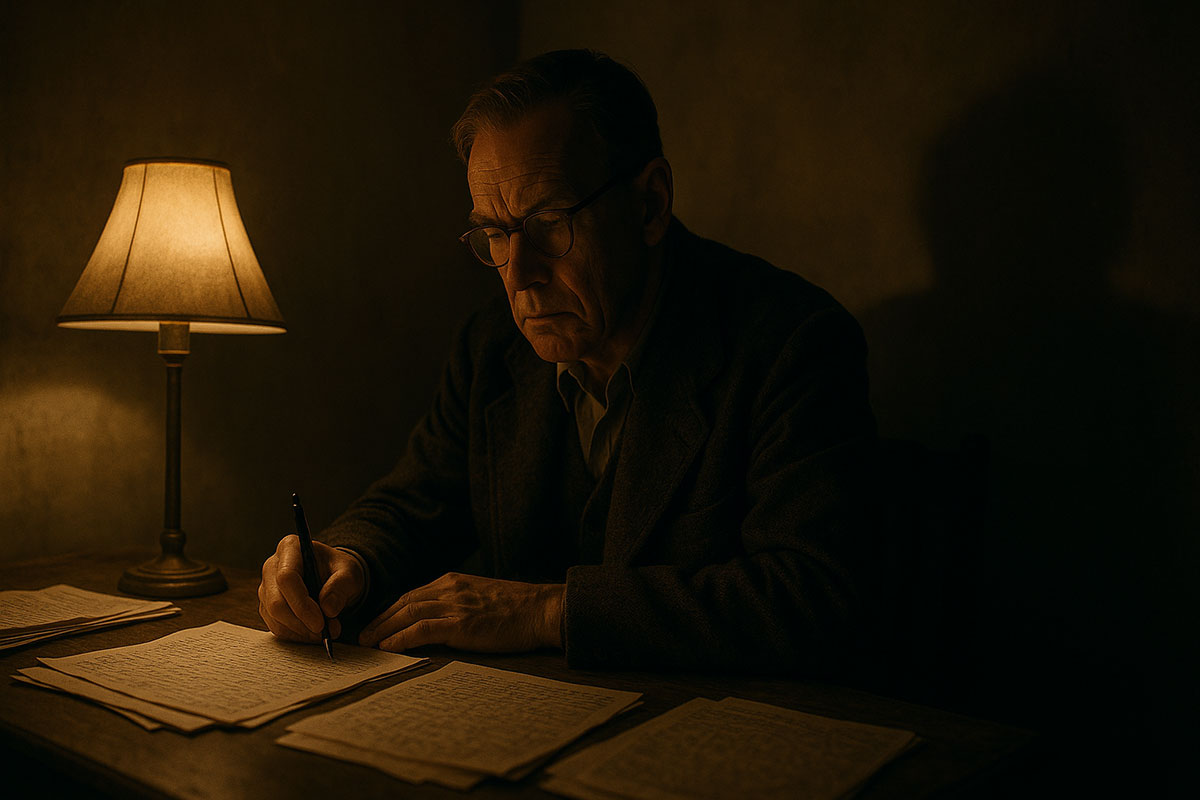
The manuscript lay open on the desk, its pages scattered like fallen leaves after a storm. Czesław leaned over them, his brow furrowed, pen trembling in his hand. The lamp cast a narrow circle of light, but beyond it, the room felt cavernous, as though shadows themselves were listening.
“I should not write this,” he muttered. His voice carried both fear and defiance. “It will condemn me in the eyes of those still living under the regime. They will call me a traitor to my people, a coward who fled. But if I stay silent… am I not complicit?”
I stood near the window, listening to the faint sounds of Paris beyond the glass—distant footsteps, the echo of a passing car. “You are not betraying your people,” I said softly. “You are exposing the prison that cages them. Your silence would be the true betrayal.”
He shook his head, running his hand through his hair. “But who am I to speak for them? I am no longer in Warsaw. I did not share their hunger, their interrogations, their daily compromises. And yet here I sit, presuming to explain their captivity to the West.” His eyes met mine, searching for absolution.
“You are not presuming,” I replied. “You are remembering. You have lived within those walls of fear. You have seen the intoxication of ideology, the slow erosion of conscience. You know its taste. That is why you must write.”
His hand tightened around the pen. “And what if they hate me for it? What if they believe I have slandered them, exaggerated their surrender?” His voice cracked with the weight of imagined accusations.
I moved closer, placing my hand on the stack of pages between us. “Then let them hate you. Hatred is temporary; truth endures. History will need your witness more than your popularity. The Captive Mind is not written to win friends. It is written to preserve human dignity against the machinery of lies.”
He closed his eyes, leaning back in his chair. For a long moment, the only sound was the ticking of the clock, each second striking like a hammer on his conscience. Then he whispered, almost to himself, “To write is to wound. And yet not to write is a deeper wound.”
I smiled faintly. “Yes. And sometimes the only way to heal is through the wound itself.”
He opened his eyes and looked down at the pages. Slowly, deliberately, he pressed his pen against the paper, words flowing again—words sharp as glass, but also luminous with clarity. He did not speak, but I could feel his resolve settling into him, steady and immovable.
Outside, Paris carried on, unaware that in this dim room, a man was chiseling freedom into sentences, shaping testimony against tyranny. Czesław Miłosz wrote, and with each line, he carried not only his own conscience but the silent cries of millions who could not speak.
And though he feared exile’s judgment, I knew: history would one day call it courage.
Chapter 4: The Lonely Poet in Berkeley
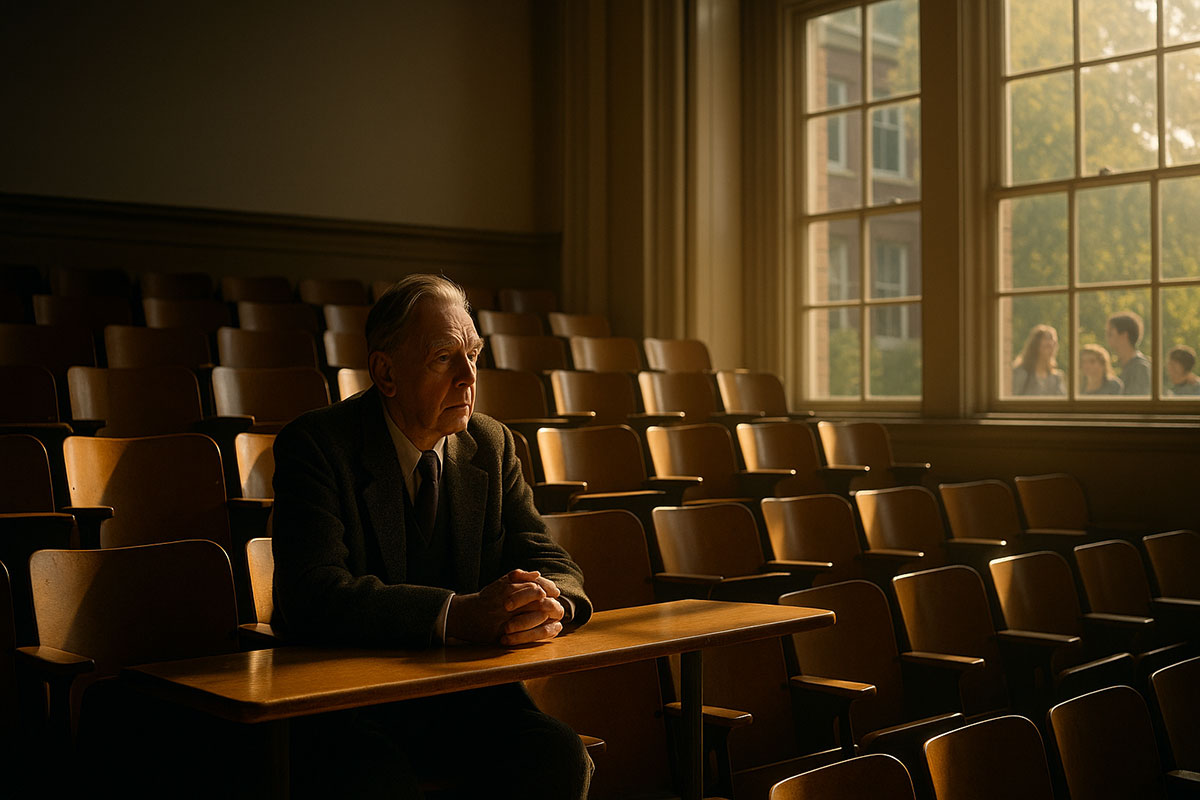
The California sun fell too generously on the campus, spilling over the eucalyptus groves and the wide lawns of Berkeley. Students hurried between buildings, their arms full of books, their laughter ringing in the air. To them, the world was bright, untroubled. But for Czesław Miłosz, each day on this foreign soil felt like living behind a pane of invisible glass—close to life, but never quite touching it.
He sat alone in his office, the window cracked open, the scent of eucalyptus drifting in, strange and alien. On the desk lay a stack of student essays, written in an English that still resisted him. He rubbed his eyes and sighed. “They look at me,” he said, his voice low, “and see only an old European relic. A curiosity, perhaps. But not one of them. Never one of them.”
I leaned against the bookshelf, watching him. “You are not a relic. You are a poet. Even here, across the ocean, your voice carries.”
He gave a tired laugh, shaking his head. “Carries where? My students speak of Vietnam protests, of rock music, of futures unburdened by memory. And I—what do I bring them? The ruins of Warsaw. The taste of exile. The stench of fear. They cannot understand, and I cannot forget. Between us there is a gulf no bridge can cross.”
I moved closer, lowering my voice. “Perhaps they do not need to understand completely. Perhaps they only need to hear. You plant seeds, Czesław. Seeds of memory, seeds of conscience. They may not grow now, but they will grow later.”
He looked at me, his eyes dark with longing. “But who comforts the sower? Do you know how it feels to stand in a lecture hall and feel like a ghost, speaking into a void? To be applauded politely, then dismissed as irrelevant?”
“Yes,” I said quietly. “I know it feels like loneliness. But I also know that loneliness can be a forge. Out of isolation, your words will gather weight. You are not irrelevant—you are the reminder of history they wish to escape. Without you, they would believe forgetting is a virtue.”
He fell silent, staring at the essays again, the edges of the pages fluttering in the breeze. “Do you think,” he asked finally, “that one day they will read me not as an exile, not as an outsider, but as a poet who belonged to the whole world?”
I smiled. “I don’t think. I know. Exile may keep you outside their circle now, but time will bring them to you. Your words will outlast their fashions. One day, they will turn to you not out of duty, but out of need.”
For a moment, he closed his eyes. The wind carried the sound of students laughing, free and careless. He listened, and though the loneliness remained, I saw something soften in him—a small acceptance, a quiet resilience.
The ghost was still there, but it was no longer alone.
Chapter 5: Facing Mortality

The years had folded into one another, like pages creased and worn. In the quiet of his Kraków home, Czesław sat by the window, the Vistula glimmering faintly in the distance. The world outside seemed unchanged, yet he knew time had left its marks—on the city, on his body, and most of all, on his soul.
He turned to me with a faint smile, his voice softer now, weighted not with bitterness but with age. “All my life I have written against forgetting. And yet I feel forgetting creeping in—from memory, from the body itself. Death approaches, and I wonder… was it all enough?”
I sat beside him, the wooden chair creaking, and looked into his lined face. “Enough? You gave words to silence, light to shadows. You showed the world that poetry could bear witness. That is more than enough.”
He gazed out the window, his eyes distant. “Still, I fear. Not the end itself, but the possibility of meaninglessness. That all I’ve written may dissolve like smoke once I am gone.”
I shook my head. “Smoke disappears, but your words are not smoke. They are stone. They will remain long after you’ve gone, not because they are flawless, but because they are true. Truth has its own immortality.”
He nodded slowly, though doubt lingered. “When I was younger, I wanted to be remembered as a great poet. Now I only wish to be remembered as a man who wrestled with God and did not turn away. But even in that—” his voice trembled, “—I fear I have been faithless, too full of questions.”
I reached for his hand, warm but fragile. “Faith is not the absence of questions, Czesław. Faith is the courage to keep asking them, even as you near the end. You have wrestled, yes—but you wrestled honestly. That is its own form of devotion.”
His eyes glistened, and he looked at me as though seeing a friend not of this world but of eternity itself. “Do you think,” he whispered, “that when I die, I will finally know? That the veil will lift, and all the contradictions will dissolve?”
I smiled gently. “I think when you die, you will not be met with answers, but with love. And in that love, all questions will find their rest.”
For a long time we sat in silence. The evening deepened, shadows lengthening on the floorboards. Outside, the river flowed steadily, as it had for centuries, indifferent yet eternal. He breathed slowly, each breath a fragile hymn.
“Then let it be so,” he murmured at last. “Let me rest in love.”
And in that moment, as dusk wrapped the city, Czesław Miłosz seemed no longer burdened by exile, by doubt, by mortality. He was simply a man at peace, his words already flowing into the river of time.
Final Thoughts By Adam Zagajewski
Czesław Miłosz has gone, yet he has not left. His presence lingers like dusk on the Vistula, soft, patient, and enduring. He taught us that exile does not erase the homeland, that poetry is not a luxury but a duty, and that even in the face of history’s cruelty, the human spirit still reaches for light.
I was among those who learned from him, not only through his poems but through his very being. He showed us how a man could live in contradiction — skeptical yet faithful, weary yet insistent on hope. He reminded us that to be a poet is to dwell at the border of despair and possibility, always carrying words like fragile lanterns through the darkness.
When we read him now, we find not only his voice but our own questions echoing back to us. Can art redeem suffering? Can memory preserve dignity? Can love survive history? Miłosz never offered easy answers, but he left us poems that accompany us as we ask.
And so, when we picture him in his final years, gazing out over the river in Kraków, we need not imagine loneliness. We can imagine peace. A man who wrestled honestly with life, and in the end, left us not certainty, but the courage to keep seeking.
For this is what his words still do: they remind us that we are never truly alone in our doubts, never abandoned in exile, never lost in mortality. His poetry remains with us, a companion on the long road.
Short Bios:
Leave a Reply