


John Burke:
Over the past forty years, I’ve listened to thousands of people who clinically died, crossed over, and returned. They come from every background—engineers, doctors, children, skeptics, believers—and yet their stories consistently describe the same realities: leaving the body, being fully alive in a spiritual form, encountering light, love, and in many cases, a presence they recognize as God.
I didn’t set out to prove any of this. In fact, I began as an agnostic engineer, always skeptical, always asking, “How do you know?” But when people from across the globe—Hindus, Muslims, Christians, atheists—start describing the same God of light and love, when blind people see for the first time during an NDE, when patients accurately recall details of their resuscitation while brain-dead—it becomes impossible to dismiss.
But here’s the point: near-death experiences aren’t just about what happens when we die. They’re a mirror, asking us how we’re living now. If what thousands describe is true, then our daily choices matter far more than we realize. Life isn’t random—it’s preparation for eternity.
(Note: This is an imaginary conversation, a creative exploration of an idea, and not a real speech or event)

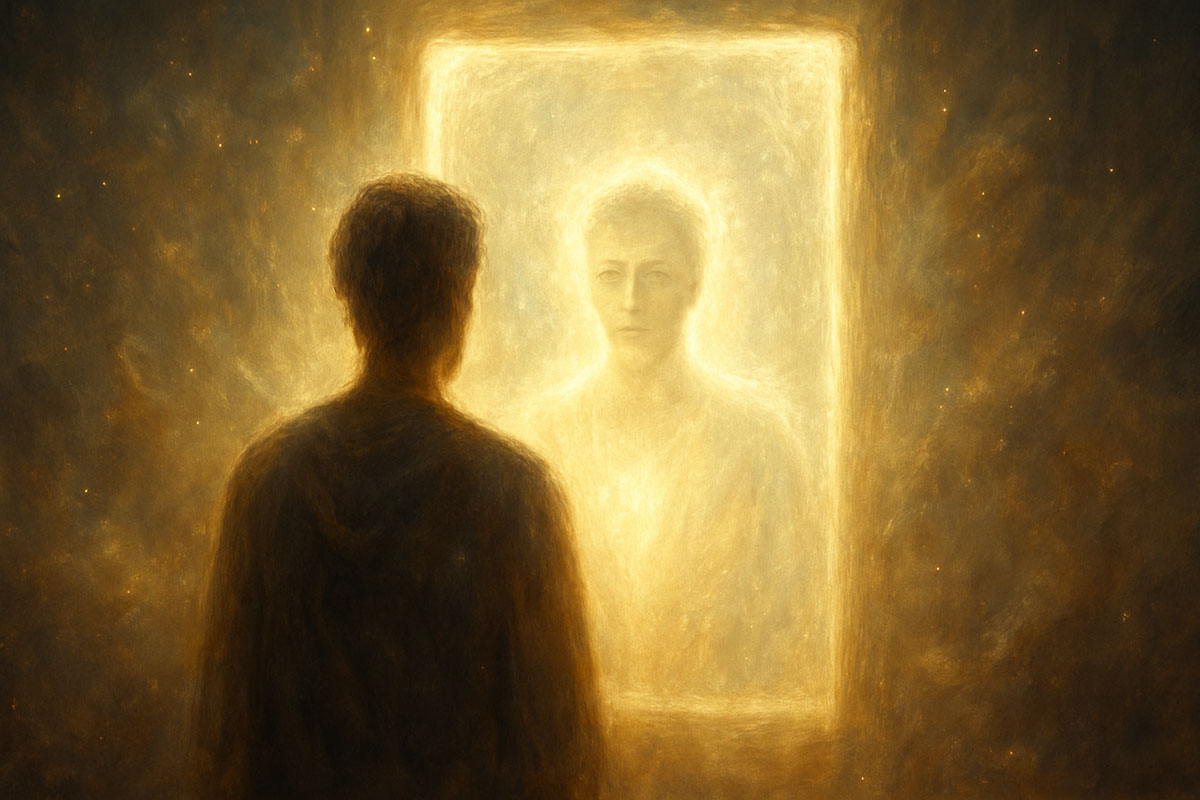
Topic 1: The First Person You Meet Is You
Speakers:
- Carl Jung – pioneering psychologist who explored the depths of the unconscious and humanity’s collective search for meaning
- Rumi – Sufi mystic and poet whose verses reveal love as the pathway to the divine
- Søren Kierkegaard – Danish philosopher of faith, freedom, and the leap beyond despair
- Anita Moorjani – near-death experiencer and author of Dying to Be Me, who speaks of unconditional love and healing beyond death
- Alan Watts – philosopher and interpreter of Eastern wisdom for the modern West, emphasizing unity, flow, and the illusion of separation
Karen Armstrong: Welcome, everyone. Today we’re exploring one of the most striking claims from near-death experiences—that the first person you meet on the other side is yourself. Not the self others see, but the truest version of who you are. I’d like to begin by asking: when you hear that, what does it stir in you?
Carl Jung: It reminds me of individuation, the process of becoming whole. For much of life, we mistake ourselves for masks—what I called the persona. But in death, perhaps the mask falls away, and what greets us is the Self, capital “S.” It is not merely ego but the full totality of our being, the conscious and unconscious united.
Rumi: Yes, Carl, yes! I would say: the lover finally meets the Beloved within. For so long we chase the outside world, but when the body is shed, the mirror clears, and we see the soul as it truly is—already drenched in divine light. The self we meet is not lonely—it is God shining through us.
Alan Watts: I find this idea both amusing and liberating. We’ve spent lifetimes trying to define “me,” and at the moment of death, we might discover that what we called “me” was only the tip of a vast wave. To meet yourself is to realize you were the ocean all along.
Anita Moorjani: For me, this isn’t theory—it’s lived experience. In my near-death experience, I left my cancer-ridden body and felt an overwhelming sense of being myself for the very first time—without fear, without shame, without trying. It was as if my true self had always been there, hidden beneath layers of conditioning. Meeting myself was like being embraced by love itself.
Søren Kierkegaard: I hear in all this a profound truth, but also a danger. To meet the self without God is to meet despair. For me, the self is a relation between the finite and infinite, grounded in the God who made us. Without that grounding, the encounter becomes terror. To truly meet the self is to recognize dependence on God, and only then can the self stand.
Karen Armstrong: That’s a rich start. Now let me ask: why do you think so many people fear self-confrontation? If meeting the self is so beautiful—or so terrible—what does that say about how we live now?
Watts: Because we cling to our fictions. The ego is a kind of game we play, and most people are so identified with their roles—mother, banker, soldier—that the idea of stripping them away feels like death itself. In fact, it is death. Meeting the real self is like seeing behind the magician’s trick.
Jung: Indeed, Alan. The shadow plays a large role here. People fear themselves because they fear the shadow side—those repressed aspects of psyche they cannot accept. To meet oneself in death is also to meet the shadow, and many are unprepared. Yet without integration, there is no wholeness.
Moorjani: I agree, but I also think love dissolves fear. When I was there, I didn’t see my flaws as condemnation but as part of a bigger tapestry of growth. The self is both the light and the shadow, but beyond both is unconditional love. That’s what makes the meeting bearable—and transformative.
Rumi: Fear comes from thinking the self is separate. But when we realize the self is a drop of God’s ocean, even the shadows are holy. The wound is the place where the light enters. To meet yourself is not to judge yourself—it is to be poured back into love.
Kierkegaard: Still, let us not romanticize too quickly. Fear is not merely an illusion—it is the truth of our estrangement. To stand before God without faith is dread indeed. Love redeems, yes, but only when one surrenders pride. Otherwise, the self is experienced as absence, a sickness unto death.
Karen Armstrong: Powerful insights. Let me take us deeper. If the self revealed in death is truer than the self we know in life, what does that imply for how we should live now? How should we prepare for meeting ourselves?
Moorjani: For me, it means living authentically. After my NDE, I realized much of my illness came from fear of disappointing others. Preparing for death means living today without that fear. To honor the true self now is to avoid the regret of only discovering it at the end.
Jung: Precisely. Our task is individuation while we are alive, not after. Dreams, symbols, relationships—all are invitations to meet fragments of the self. To ignore them is to postpone the inevitable.
Watts: I would say—stop postponing joy. Meeting the self beyond death is only shocking if you’ve never dared to laugh at your own masks. If you can see through the illusion of separateness now, death won’t be a terror but a punchline.
Rumi: Oh Alan, you speak like a mystic without knowing it! Yes—dance now, drink the wine now, love now. Don’t wait for death to unmask you. Become what you are: a mirror of the divine, polished through love.
Kierkegaard: And yet, friends, let us not forget: despair lurks in self-deception. To prepare rightly is to anchor the self in God. Faith is the leap, the surrender, the courage to be truly oneself before the Eternal. Without that, authenticity collapses into vanity.
Karen Armstrong: Thank you, all of you. What I hear is that meeting the true self after death is less a one-time event and more a lifelong calling. For Jung, it is individuation. For Rumi, divine union. For Kierkegaard, standing before God. For Anita, unconditional love. For Alan, dissolving into the ocean. Perhaps the challenge for us is this: to live so openly and honestly now that meeting ourselves later is not a shock but a homecoming.
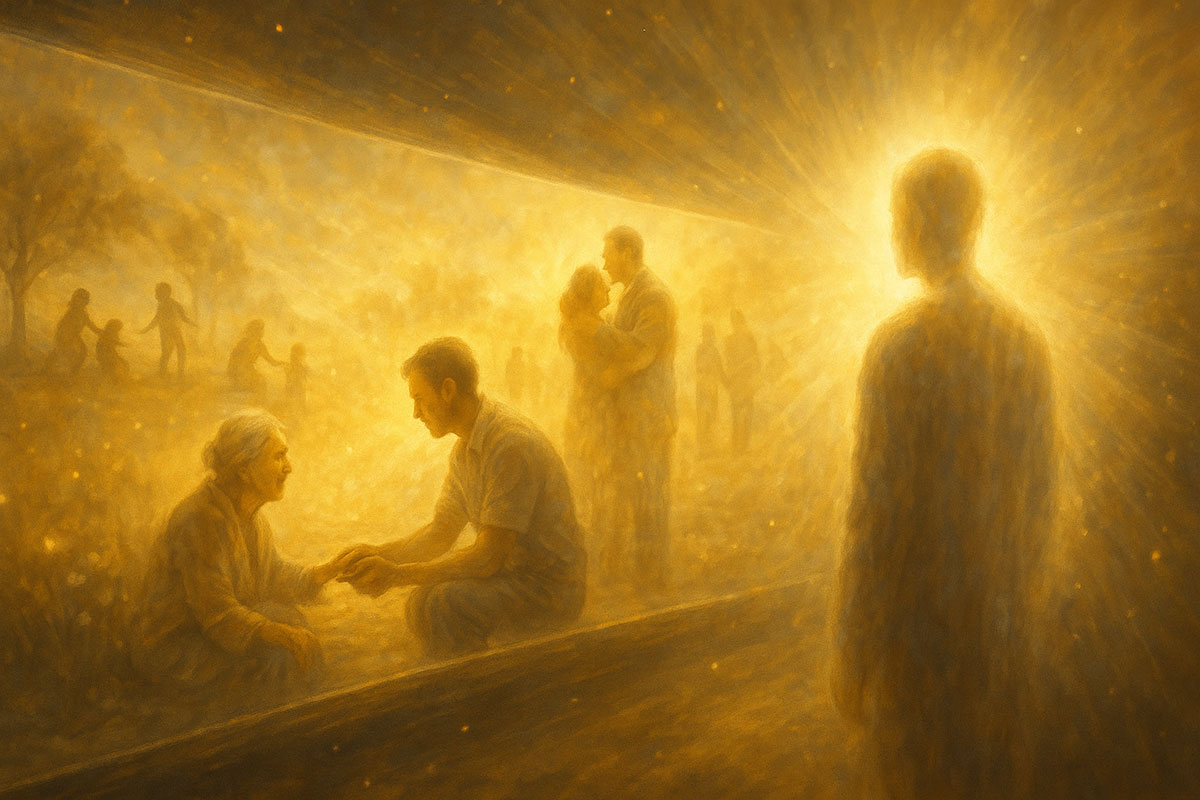
Topic 2: The Life Review — Seeing Through God’s Eyes
Speakers:
- Leo Tolstoy – novelist who wrestled with morality and redemption
- Mother Teresa – embodiment of small acts of love
- Viktor Frankl – survivor of Auschwitz, author of Man’s Search for Meaning
- Howard Storm – atheist professor turned pastor after his NDE and life review
- Martin Luther King Jr. – visionary of justice, love, and collective responsibility
Dick Cavett: Welcome, everyone. Today’s theme is the “life review,” one of the most haunting and transformative aspects of near-death experiences. People describe seeing their whole lives replayed—not just their actions, but the effects of those actions on others, through God’s eyes. Let’s start here: what does it mean to see your life not from your own perspective, but through the eyes of love?
Howard Storm: When I died, I was shown my life. Not as I wanted to see it, but as it was. Every cruel word, every dismissive glance, every selfish act—I saw how it hurt people. But I also felt God’s sorrow, not anger. It was as if Jesus was saying, “This is what you did, but this is not what I made you for.” That broke me.
Mother Teresa: Yes, Howard. In the eyes of God, even the smallest act is heavy with meaning. A smile, a touch, a cup of water—these ripple outward. If the life review reveals anything, it is that nothing is small when done with love.
Tolstoy: It is a terrible and glorious mirror. In my novels I wrote of men consumed by vanity, wealth, war. I too lived this folly. To see one’s life laid bare is to confront the truth that love alone redeems. The review strips away illusion—society’s applause means nothing beside a single kindness forgotten by the world but remembered by eternity.
Frankl: Exactly. In the camps I learned that the last freedom is to choose our attitude. In a life review, perhaps we see whether we chose rightly. Did we dignify suffering by love? Did we treat the other as fully human? In God’s eyes, no mask remains, only the raw truth of our choices.
King: And truth without love is unbearable. Imagine seeing the consequences of our silence in the face of injustice, the chains we did not break, the neighbor we did not defend. The life review is not just personal—it reveals the collective story. God’s eyes show us that our lives are woven into the destiny of others.
Dick Cavett: That’s sobering. So let me ask: if the life review reveals both kindness and cruelty, why do people return changed? What is it about seeing their life in this way that shifts everything?
Frankl: Because it restores responsibility. We often imagine ourselves as victims of circumstance. But the life review shows: no, you always had freedom. Freedom to smile, to speak, to resist cruelty, to lift another. When you see this, you cannot go back unchanged.
Howard Storm: True. I was a cruel man. The review showed me not condemnation, but wasted chances. And when I came back, I could not live as before. It is unbearable to know you’ve wounded love itself. So I devoted my life to the opposite: to love others.
Mother Teresa: Many who return speak of love because they have touched the heart of God. But we should not wait for death to learn this lesson. Love must be lived in the ordinary. Every day is an unfinished life review.
Tolstoy: Yes, and yet men avoid it. We intoxicate ourselves with wealth, distraction, literature, politics—anything but self-examination. The life review is the final stripping away of excuses. It is terrifying because it is true.
King: But truth is also liberating. For once you see through God’s eyes, you see not only your failings but your potential. You see what you were created to be—a vessel of love and justice. That is why people return transformed: they are reminded of their true calling.
Dick Cavett: Beautiful. Now, I want to press further. If we could all undergo a life review today, while still alive, how might we live differently? What would we change right now?
Tolstoy: I would have abandoned vanity sooner. I would have loved more simply, written less for fame and more for truth. If men could see the futility of ambition as I saw it near my death, perhaps they would waste less of their lives in striving after wind.
Mother Teresa: I would say: do it now. Pick up the broken one beside you. Feed the hungry child. Love in hidden ways. If we lived with heaven’s eyes, every day would become a chance to be Christ to the least of these.
Frankl: I would live with sharper awareness of meaning. The review shows that even suffering can bear fruit if it is met with courage and love. We cannot always choose circumstances, but we can choose how to meet them. That is what echoes in eternity.
Howard Storm: For me, the change is radical. I stopped thinking life was about what I could get, and started asking what I could give. The review shows us that selfishness collapses, but love endures. If we remembered this daily, we’d stop wasting our short years.
King: I would remind us that our review is not only about our private kindness, but our courage in the face of injustice. History will ask us: did you love only in safe ways, or did you love enough to risk your life for others? When I was jailed, I felt despair, but in hindsight, even those chains were weighed with meaning. To live with God’s eyes is to see beyond fear into the duty of love.
Dick Cavett: Thank you. This is extraordinary. What I’m hearing is that the life review is not a threat but an invitation—a reminder that what matters is how we loved. Howard reminds us that wasted chances can be redeemed. Tolstoy that illusions must fall. Teresa that small things matter most. Frankl that even suffering is meaningful. And Martin that love must also be brave.
Perhaps the life review is not about judgment, but awakening. To live now as if we already see through God’s eyes—that is the challenge.
Topic 3: Light as Love, Love as Light

Speakers:
Helen Keller – who lived in darkness yet spoke of inner vision and light
Paramahansa Yogananda – teacher of divine light and consciousness (Autobiography of a Yogi)
Isaac Newton – scientist of light who also wrestled with theology
Eben Alexander – neurosurgeon whose NDE shifted him from atheist to believer (Proof of Heaven)
Emily Dickinson – poet of eternity, light, and love
Karen Armstrong: Welcome, friends. One of the most consistent testimonies of near-death experiences is the light—brilliant, overwhelming, yet filled with love. Some even say the light is love. Helen, I’d like to start with you. Though you lived without physical sight, you wrote often of inner light. How do you hear this claim?
Helen Keller: Though I never saw the sun or moon, I felt their warmth. In the silence and darkness of my world, love was the only true light. My teacher’s hand spelling words into mine—this was illumination. When I hear of people describing God as light and love, I think: yes, that is the radiance I knew, not with eyes, but with soul.
Eben Alexander: That resonates deeply. In my NDE, I experienced light not as photons but as presence. It wrapped me, knew me, held me. As a neurosurgeon, I once dismissed such reports as hallucinations. But when my own brain shut down, I found the light was more real than this world. And it was conscious love.
Newton: Fascinating. I spent my life chasing light—through prisms, refractions, the mathematics of optics. Yet I also studied scripture. What I failed to reconcile then, you bring together now: that light may be both physical and divine. If all matter is energy, perhaps love is the highest frequency of light.
Yogananda: Exactly, Sir Isaac. In meditation, we teach disciples to see the “spiritual eye”—a golden light with a star within, a gateway to the Infinite. The yogis have long said that God vibrates as light, and that this light is not cold illumination but bliss, compassion, love flowing from the Source.
Emily Dickinson: I wrote once, “We grow accustomed to the Dark, when Light is put away.” Yet I also knew that light “gives of itself freely.” The paradox is that the brightest light is not seen by the eye, but felt by the heart. To call it love is no metaphor—it is the truth poetry cannot exhaust.
Karen Armstrong: Beautiful. Now, let me ask: why do you think so many experiencers insist that this light is not just brightness but a being—alive, personal, love itself?
Alexander: Because it communicates. Not with words, but in direct knowing. I was immersed in knowledge and care that could not have come from my brain. The light was not “something.” It was “someone.”
Yogananda: Yes. The sages say Brahman, the Absolute, is both beyond form and yet deeply personal. The light is living because love is relational. It is the Infinite meeting the finite, the ocean recognizing the drop as itself.
Helen Keller: For me, the fact that love is personal makes perfect sense. What use is light if it does not warm? The God I know in silence is not an abstraction but a friend. The love that touches you touches as a hand, a presence, a pulse of being.
Newton: Here I wrestle. My mind demands mechanism. Yet I must admit, if light behaves as both wave and particle, perhaps the divine can be both force and person. What we call paradox may simply be our limitation.
Dickinson: Perhaps, Sir Isaac, love itself is the grammar of light. What if light shines not to reveal objects, but to reveal us to ourselves as beloved? When experiencers call it personal, they mean the light calls their names, and they finally hear it.
Karen Armstrong: That’s profound. Let me take us deeper: if love is light and light is love, what does that imply for how we live in this world of shadows?
Yogananda: It means we must radiate. A candle loses nothing by lighting another. When we meditate, pray, serve—we draw that cosmic light into ourselves, and it must shine outward. This is the true purpose of life: to become channels of divine light.
Keller: Yes. Each of us, no matter how dark our circumstances, can be a lamp. My disability was not the end of light, but the chance to show that love can shine even without eyes. The world needs not more sight, but more vision.
Alexander: I’ve seen this firsthand. After my NDE, my priorities changed. As a surgeon, I once saw patients as cases. Now I see them as lights dimmed by illness. If we treat each other as beings of light, medicine becomes not just science but compassion.
Newton: Then perhaps our task is to discover divine optics. If love is the spectrum, hatred is merely its absence. Shadows do not exist without light. Therefore, to live wisely is not to curse the dark but to increase the radiance.
Dickinson: How lovely. Yet let us not forget the quiet forms. A beam through a keyhole, a dawn that grows slowly—love does not always blaze. Sometimes it whispers. To live in the light is not only to shine greatly, but to let love fall gently, like morning.
Karen Armstrong: Thank you. This is luminous. What I hear is that the light of NDEs is not foreign but familiar—it is the same love we glimpse in kindness, friendship, creativity. To live as if light and love are one is to prepare for death by learning to shine now.
Topic 4: The God of All Nations

Speakers:
Mahatma Gandhi – advocate for universal truth beyond divisions of creed
Rumi – Sufi poet who sang of divine love without borders
C.S. Lewis – Christian thinker exploring how human longing points to God
The Dalai Lama – Buddhist teacher of compassion as the heart of religion
John Burke – pastor and researcher who compiled testimonies of NDEs across cultures
Karen Armstrong: Welcome. One of the most striking things about near-death experiences is that people from every culture, every religion, even those with no faith, describe encountering the same radiant Being of light—overflowing with love. What does this mean? Is God truly universal, beyond religion? Gandhi, may I begin with you?
Gandhi: Thank you. I have always believed that truth is one, though sages call it by many names. Whether we say Rama, Allah, Christ, or simply “light,” we point to the same reality. If dying men and women from every corner of the earth describe one God of love, it confirms what my heart knew: religion must unite, not divide.
Rumi: Beloved Gandhi, you are right. The lamps are many, but the light is one. In death, the lamps break, and we see only light. Every creed is a garment; when the soul undresses, it finds the same embrace. The God of nations is the God who whispers in every heart, “I am yours.”
Lewis: I find this compelling. In Mere Christianity I argued that all humans share a moral law, a longing for joy that no earthly thing can satisfy. Near-death reports seem to echo this: that our longings are fulfilled in a God who is not tribal, but universal. Yet, I would add, this light has a face—Jesus. Not as a sectarian claim, but as the fullest expression of love.
Dalai Lama: From the Buddhist view, we do not speak of God in the same way. But we do speak of compassion—boundless compassion. If people dying experience a presence of light and love, I call that Buddha-nature. What matters is not the label but the transformation. If they return kinder, more compassionate, then they have touched ultimate reality.
Burke: And that’s exactly what my research has shown. I’ve studied testimonies from Hindus, Muslims, Buddhists, atheists, Christians—70 people across continents. Their experiences of the Being of light are strikingly consistent. They use different words, but the essence is the same: unconditional love. For me, this validates the God revealed in scripture, who claims to be the God of all nations.
Karen Armstrong: That’s remarkable. Let me ask: if God is truly the God of all nations, why then do religions so often divide us, even violently? Why do we cling to difference when the light seems to unite?
Lewis: Because human pride corrupts. God gives truth, but we twist it into systems of control. The problem is not God but us. Religion at its best points to Him; at its worst, it points only to itself.
Gandhi: I agree. Men fight not for God, but for power in God’s name. We confuse the means with the end. The end is truth, the end is love. When we forget this, religion becomes idolatry.
Rumi: My friends, love does not fight love. Only the ego makes swords from scripture. The wine is meant for joy, but we spill it and quarrel over the stains. To meet God in death is to see how foolish were our disputes.
Dalai Lama: This is why I tell people: do not convert, but deepen. Be a better Christian, a better Muslim, a better Buddhist. The world does not need one religion; it needs many hearts of compassion.
Burke: And yet, we must also be honest. People encounter Jesus in these experiences, even when they didn’t expect to. I don’t say this to diminish other faiths, but to show that the God of nations has revealed Himself in a unique way. Still, what matters most is love. If religion makes us less loving, we have missed God.
Karen Armstrong: That leads me to a deeper question. If people across religions meet the same God, what should that change about how we live now—our ethics, our relationships, even our politics?
Rumi: It should make us drunk with humility! If my enemy’s prayer reaches the same ear as mine, who am I to hate him? To live as if God is one is to bow before every soul, for every soul is His beloved.
Gandhi: Yes. It means nonviolence is not merely strategy but truth itself. To harm another is to harm one’s own brother or sister. If the afterlife shows us we are children of one God, then the task of this life is to live as family.
Dalai Lama: Practically, it means cultivating compassion beyond borders. A suffering child in Syria, Tibet, or America is equal. If God is for all nations, then national selfishness must yield to global responsibility.
Lewis: I would put it this way: if the light is truly universal, then our divisions are temporary misunderstandings. What we do now must be guided by eternal values—justice, mercy, humility. To love our neighbor is not optional; it is destiny.
Burke: And the testimonies confirm this. People return from the light saying two things again and again: “God is love” and “Love one another.” That is the core. It transcends theology and politics. It is the only thing that matters in the life review.
Karen Armstrong: Thank you. What I hear is that the God of all nations is not a theory but a reality testified to in death itself. If we could live as if that were true, religion would not divide but unite, politics would not oppress but serve, and we would see every human being as sacred. Perhaps the greatest tragedy is not that religions differ, but that we forget the light that animates them all.
Topic 5: Heaven and Hell — Choice or Consequence?

Speakers:
Dante Alighieri – poet of The Divine Comedy, mapping hell, purgatory, and paradise
Fyodor Dostoevsky – novelist wrestling with sin, suffering, and redemption
Howard Storm – NDE survivor who first experienced hell and then rescue by Christ
C.S. Lewis – author of The Great Divorce, who saw hell as self-chosen isolation
Meister Eckhart – Christian mystic who spoke of union with God vs. separation
Karen Armstrong: Today’s theme is perhaps the most sobering: many near-death experiencers describe radiant love, but some describe darkness, torment, even hell. The question is: are these punishments imposed, or natural consequences of rejecting love? Dante, as the poet of hell itself, how do you begin?
Dante: In my vision, I saw hell as the architecture of the soul’s own choices. Each circle revealed not arbitrary punishment but the mirror of vice. The lustful are tossed by endless winds because desire ruled them; the prideful bent double beneath crushing stones because they would not bow. Hell is not God’s cruelty—it is man’s own will crystallized eternally.
Storm: That resonates. When I died, I found myself in a place of despair and cruelty. The beings there mocked me as I had mocked others. It was not fire—it was emptiness, hatred. And I realized: I had lived without love, and I had become what I chose. When I cried out for help, light came—Jesus—and everything changed. So yes, hell was my own consequence, but grace gave me a way out.
Lewis: Exactly, Howard. In The Great Divorce I described hell not as fiery torment but as a dreary gray town, endlessly expanding because no one can stand each other. The gates of hell, I wrote, are locked from the inside. God does not so much send us there as we insist on staying shut within ourselves.
Dostoevsky: Yet what torments me is that man knows he wounds himself and still persists. In The Brothers Karamazov I showed how freedom is both gift and curse. Man rejects heaven because he will not surrender his pride. But even in the depths, I believe Christ descends—into our own “hells”—to call us back.
Eckhart: And I would say: hell is separation. To turn from God, who is light and love, is to dwell in shadow. Heaven and hell are not places, but conditions of the soul. When we cling to ego, to willfulness, we taste hell even now. When we surrender, we awaken to heaven here and beyond.
Karen Armstrong: Powerful. So let me ask directly: is hell eternal, or can love reach even into the depths? Are there second chances beyond death?
Storm: I can only speak from experience: love reached me when I least deserved it. I thought I was lost, but when I cried out—even weakly—I was lifted. That convinces me hell is not final for those who turn, even after death.
Dante: Yet I must insist: my poem showed no escape from the Inferno once sealed. Mercy is abundant, yes, but judgment too is real. The soul that refuses love eternally imprisons itself.
Lewis: I would bridge the two. God’s mercy is infinite, but our freedom is also real. If a soul will not turn, God will not coerce. Even in eternity, choice remains. That is why hell is tragic—because it is chosen.
Eckhart: Indeed. God is always pouring Himself into the soul. But the vessel must be open. If the soul closes, even God’s flood cannot enter. This is not God’s limitation but ours.
Dostoevsky: But what of divine compassion? I believe Christ’s love is relentless, pursuing even the most stubborn heart. He descends into every abyss. Whether a soul yields—ah, that is mystery. But I could not believe love ceases.
Karen Armstrong: A sobering paradox. Let’s turn it to us living now. If heaven and hell are consequences of our choices, how should we live differently today?
Storm: I say: choose love now. Don’t wait for death to shock you. I wasted decades on selfishness, and my life review showed the pain I caused. Love now, and heaven begins now.
Dante: Live with vigilance. Every act writes the script of eternity. Do not imagine you can scorn love and yet inherit joy. The habits of the soul become its destiny.
Lewis: I would urge humility. We are always drifting toward one or the other—toward union or isolation. Heaven and hell are not distant—they are trajectories we set with every decision.
Eckhart: Therefore live in detachment. Let go of pride, of clinging. Empty yourself so God may fill you. Hell is the fullness of self; heaven is the emptiness that allows God to be all.
Dostoevsky: And I say: live with compassion. Every act of love rescues not only another soul but your own. Every cruelty is a step into hell. But every mercy is already heaven breaking in.
Karen Armstrong: Thank you. What I hear is both warning and hope. From Dante: our choices shape our eternal landscape. From Storm: love rescues even the lost. From Lewis: hell is self-chosen isolation. From Eckhart: heaven is union, hell is ego. From Dostoevsky: love alone redeems.
Perhaps heaven and hell are not merely destinations, but revelations of what we are becoming. The God of love respects our freedom, even to reject Him. Yet love always calls, always waits. And the question for us is simple: which reality are we practicing today?
Final Thoughts By John Burke
After decades of studying these testimonies, the message is strikingly simple: love is the measure of life. People don’t come back talking about wealth, careers, or accomplishments. They talk about moments when they loved, when kindness rippled outward, when forgiveness set them free. They also see the harm their selfishness caused, the regret of love withheld.
Death doesn’t erase who we are—it reveals it. Heaven and hell are not arbitrary assignments. They are the natural outcome of our choices—whether we opened ourselves to love or closed ourselves off. And the God people encounter in these experiences is not distant or tribal, but the God of all nations, infinitely merciful, infinitely loving, inviting us all into relationship.
So the question is not just what happens when you die? but what will you do with the life you’ve been given? Every act of love draws us closer to the light. Every refusal of love bends us toward shadow. Eternity isn’t waiting to begin someday—it is being shaped in us right now.
My hope is that these stories encourage you not only to imagine heaven, but to live today as if it is real. Because one day, you’ll discover it is.
Short Bios:
John Burke — American pastor and author of Imagine Heaven and Imagine the God of Heaven, Burke has studied and compiled over 1,500 near-death experience testimonies, bridging spiritual insights with biblical parallels.
Helen Keller — Deaf and blind from infancy, Keller became a world-renowned author, lecturer, and activist. Her writings emphasized inner vision, faith, and the transformative power of love.
Paramahansa Yogananda — Indian yogi and founder of the Self-Realization Fellowship, Yogananda introduced millions in the West to meditation and the unity of all religions through Autobiography of a Yogi.
Isaac Newton — One of history’s greatest scientists, Newton revolutionized physics and optics, while privately exploring theology and the mysteries of light as both a physical and divine phenomenon.
Emily Dickinson — American poet whose deeply spiritual, introspective verse explored themes of immortality, the soul, and the ineffable light of existence.
Mahatma Gandhi — Leader of India’s independence movement, Gandhi championed nonviolence, truth, and interfaith unity, emphasizing the universality of God beyond religious divisions.
Rumi — 13th-century Persian poet and Sufi mystic, Rumi’s writings celebrate love as the path to God, transcending borders of culture and creed.
C.S. Lewis — British scholar and Christian writer, Lewis authored Mere Christianity and The Great Divorce, articulating faith, morality, and the human longing for eternity.
The Dalai Lama — Spiritual leader of Tibetan Buddhism and global ambassador of compassion, the Dalai Lama teaches that kindness and empathy are universal religious values.
Dante Alighieri — Medieval Italian poet best known for The Divine Comedy, his visionary work mapping hell, purgatory, and paradise profoundly shaped the Western imagination of the afterlife.
Fyodor Dostoevsky — Russian novelist of The Brothers Karamazov and Crime and Punishment, Dostoevsky explored the human soul’s struggle with sin, redemption, and divine mercy.
Howard Storm — Former atheist and art professor who, after a harrowing near-death experience that included both hell and rescue by Christ, became a Christian pastor and NDE witness.
Meister Eckhart — 14th-century German mystic and theologian, Eckhart taught about union with God, inner detachment, and the soul’s direct access to the divine.
Leave a Reply