

Dame Judi Dench:
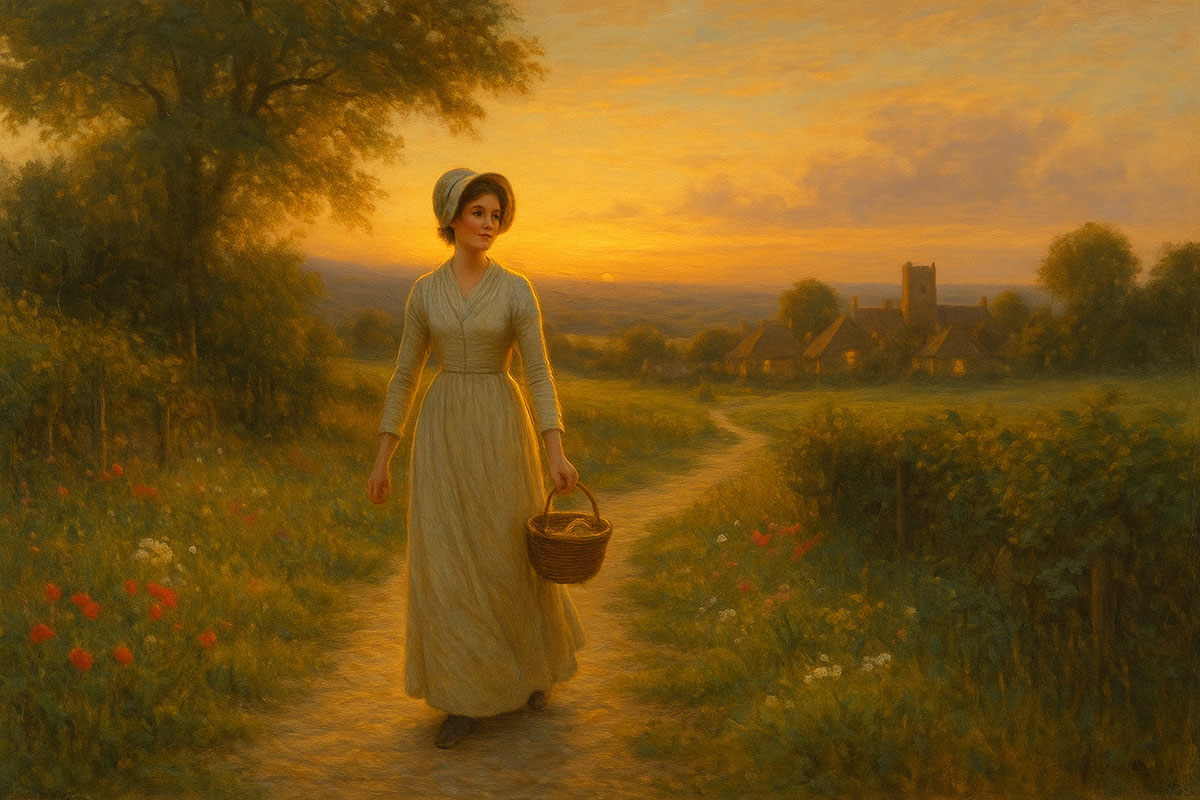
There are landscapes that seem to remember the footsteps that once walked them. In the quiet folds of the English countryside, between wildflower lanes and gentle hedgerows, one might still hear the faint scratch of a quill on paper — the breath of an idea taking form. Jane Austen’s world was not loud, nor grand, but it was profound: a place where wit wore the guise of courtesy, and love was revealed in the smallest of gestures. Today, we walk beside her — through gardens fragrant with promise, down bustling streets where stories are whispered, and into the still rooms where hearts speak without words. This is not just the story of a writer. It is the story of how an ordinary life, well observed, becomes extraordinary.
(Note: This is an imaginary conversation, a creative exploration of an idea, and not a real speech or event.)
Chapter 1: The Parlor of Unspoken Dreams
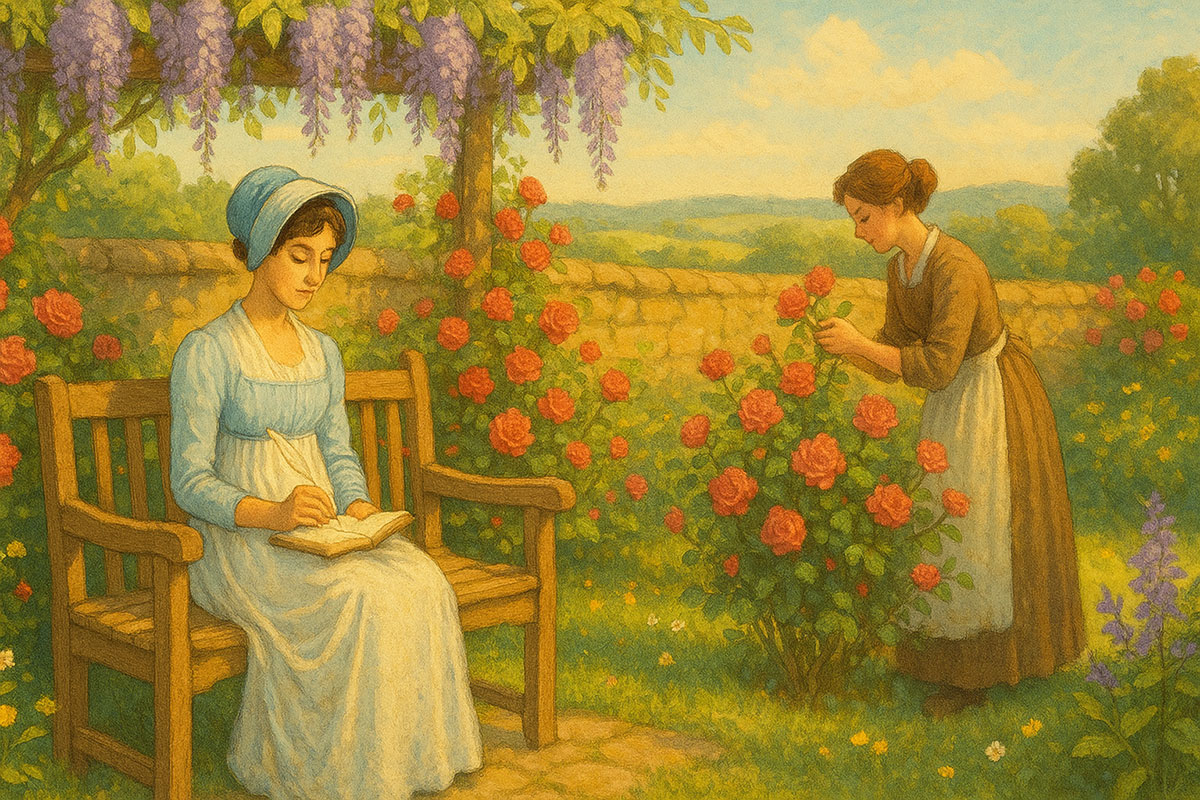
The air in the drawing room was as still as a paused breath. Afternoon light sifted through the lace curtains, casting faint patterns on the polished floorboards. The faint crackle from the fireplace was the only sound, save for the distant call of a carriage passing along the lane.
Jane sat on the floral settee, her hands folded over a notebook resting on her lap. Her lifelong friend—someone who had been beside her since the days of shared meadow walks and whispered hopes—sat in the armchair opposite, his expression carefully unreadable.
On the tea table between them, two untouched cups had long gone cold.
“I have been thinking,” Jane began, her voice soft, yet carrying the sort of conviction that always preceded her greatest works, “that there are moments in life when one does not dare to speak for fear of altering everything.”
Her friend leaned forward slightly, the firelight catching in his eyes. “And yet, Jane, the unsaid has its own weight. It presses upon the chest as surely as the truth.”
A wry smile touched her lips. “You sound as though you have lived in one of my novels.”
“Perhaps I have,” he said, “and perhaps you have been the author all along.”
She looked down at her notebook, running her fingers along the worn leather cover. So many beginnings were hidden inside—some abandoned, some perfected, some written only for herself. The ink smelled faintly of oak gall, and for a moment, she thought how strange it was that words, once committed to paper, could outlive the voice that had formed them.
“You have dreams, Jane,” he said, his tone now softer. “Dreams beyond the page, though you try to keep them here, between margins and chapter headings.”
Her reply caught in her throat. She wanted to say that her dreams were not hers alone, that they were shaped by the people she loved and the places she had walked. But she also feared the consequences of laying her heart bare.
Instead, she rose and crossed to the window. Outside, the late-afternoon sun had begun its descent, washing the garden in muted gold. The roses, heavy with bloom, nodded in the breeze as though in silent encouragement.
Behind her, he spoke again, but the words came low, almost as if he feared to disturb the air. “Perhaps the truest dreams are those we never say aloud.”
She turned then, her eyes meeting his. “Or perhaps,” she said, “they are the ones we say too late.”
A hush followed, deep and unbroken. It was the sort of silence that did not demand filling, yet was thick with everything they could not give voice to.
When she returned to her seat, the tea was cold, but the moment was warm—like the edge of a fire one does not dare step too close to, lest it burn.
Chapter 2: The Unspoken Goodbye

It was one of those mornings that felt both tender and cruel. The sky, a pale and delicate blue, seemed to offer its blessing for the day, while the faint chill in the air whispered of things ending.
Jane stood in the hallway, her bonnet ribbons loose in her fingers. The carriage that would take her away waited at the end of the gravel drive, its wheels glistening with dew. Through the open front door drifted the scent of wet earth, mingling with the faint perfume of the lilacs growing along the path.
Her friend was there, leaning casually against the doorframe, though the casualness was only a disguise. His hand rested lightly on the polished wood, the knuckles pale.
“You are certain this is best?” he asked, his voice measured, as though each word had been carefully weighed before leaving his lips.
Jane smiled—one of those small, composed smiles she used when she feared her heart might betray her. “It is not a matter of what is best, only what must be.”
He studied her face for a long moment, as if trying to memorize the exact curve of her expression, the precise shade of her eyes in the morning light. She felt the weight of it, and looked away.
“I had thought,” he began, then stopped.
She turned back to him. “You had thought what?”
“That there might be… another choice,” he said, the words slow, reluctant.
Jane’s breath caught. There had been another choice—once—but she had let it slip through her fingers, or perhaps she had never truly reached for it at all. The years had been full of polite letters and half-formed invitations, each one a thread never tied into a knot.
Her gaze fell to the floor, tracing the fine lines in the stone tiles. “I am afraid,” she said quietly, “that the other choice was lost some time ago.”
For a heartbeat, the house seemed to hold itself still, listening. The mantel clock in the drawing room ticked, a sound far too loud for such a delicate moment.
Finally, he straightened, stepping aside to let her pass. “Then I will not keep you.”
She moved past him, the swish of her skirt brushing his leg. Outside, the air was brisk and alive, carrying the distant call of a lark. The coachman touched his hat as she approached.
Before climbing inside, she turned back. He stood in the doorway, his figure framed by the shadow of the house. She wanted to say something—anything—to mark the moment. But no words came.
Instead, she simply held his gaze, letting the silence say what she could not. He nodded once, and she answered with the smallest inclination of her head.
The carriage door closed with a soft thud. As it rolled down the drive, the lilacs swayed in the breeze, scattering petals across the gravel. Jane kept her eyes forward, but the image of him standing there—still, silent, and watching—followed her all the way to the bend in the road.
Chapter 3: A Dance Remembered
The ballroom had long since emptied, but in Jane’s mind it still glowed with candlelight. She could hear the faint echo of violins and the rustle of silk skirts moving in time to the music.
It had been years ago, yet the memory lived with the vividness of a painting left out in the sun, its colors deepened by time rather than faded.
She had worn a gown of pale ivory that night, its hem brushing the polished floor with every step. Her hair had been gathered high, with a single pearl pin catching the light. Across the room, he had stood with one gloved hand resting on the back of a chair, speaking to a lady whose laughter rang like silver bells.
When their eyes met, the conversation around them seemed to dim. He crossed the floor in measured steps, each one deliberate, and when he reached her, he bowed with the kind of grace that made every movement feel like an unspoken promise.
“May I have the honor?”
She placed her hand in his, and the music swelled. They danced—slowly at first, their eyes fixed on each other, the world narrowing to the space between them. His hand was warm through the thin fabric of her glove, and she felt a strange sense of safety, as though they were no longer in the crowded room at all, but alone in some quiet corner of the world.
There had been no bold declarations that evening, no whispered confessions. And yet, something had been said in the way he looked at her, in the way his fingers tightened gently around hers during the final turn of the set.
But the moment had been brief. Another gentleman claimed her for the next dance, and he had stepped aside with the faintest nod, melting back into the crowd.
In the days that followed, the dance lived on between them—not spoken of, but carried in the quiet glances they shared in drawing rooms and gardens, in the way their paths seemed to cross at just the right moment.
And then, one morning, he was gone. Business had called him elsewhere, and there was no telling when—or if—he would return.
Years later, Jane found herself walking past a grand house on a visit to Bath. Through the open windows drifted the faint sound of music. She stopped, listening. The melody was not the same as the one they had danced to, but it carried the same gentle rise and fall, the same aching sweetness.
She closed her eyes, and for a moment, she was back in that ballroom—her hand in his, the candlelight in his eyes, the floor moving beneath them like a current they could not resist.
When she opened her eyes again, the music had ended. She walked on, the click of her boots on the cobblestone echoing like the final notes of a song.
Some dances, she thought, never truly end. They simply continue—quietly, invisibly—long after the music has faded.
Chapter 4: The Letter on the Wind

It was a blustery morning when Jane stepped into the garden, her shawl drawn tightly about her shoulders. The roses were bowing under the weight of the wind, their petals fluttering like small sighs. Somewhere beyond the hedgerow, she could hear the clatter of a postman’s cart making its way down the lane.
For a moment, she allowed herself to imagine that today might be the day. That perhaps a letter—his letter—had found its way through the winding roads, the weather, the months of silence. She imagined the envelope, warm from his hand, carrying the faintest trace of his scent, the slant of his writing unmistakable even from a distance.
Inside, on the small writing desk by the window, lay a sheet of paper she had started weeks ago. The ink had dried in uneven pools where her pen had hesitated, her thoughts too tangled to set down with confidence. She had meant to finish it—to say the words she had swallowed for years—but each time she tried, they seemed to scatter like dry leaves.
That morning, she sat once more before the letter. Outside, the wind pressed its fingers against the glass, as though urging her to hurry. She took up her pen, and the words came—haltingly at first, then with the rush of a tide breaking its hold.
She wrote of the dance they had shared, of the silences that had spoken more than any declaration, of the ache that had settled quietly into the corners of her days. She wrote not to demand anything of him, nor to plead, but simply to let him know that he had been remembered—not for a season, but for a lifetime.
By the time she signed her name, the wind had stilled. A sudden, heavy stillness filled the room, as though even the air was waiting. She folded the letter, sealed it, and carried it to the garden gate where the postman had just passed.
But as she reached the lane, a gust tore the letter from her hand. It rose into the air, twisting and spinning, sunlight flashing briefly on the seal before it was carried higher, over the hedges, past the fields, and into the pale sky.
Jane stood watching until it became no more than a small white fleck, then nothing at all. She did not run after it. She did not cry out. For reasons she could not name, it felt right that the wind should decide its course.
Perhaps it would find him. Perhaps it would fall into the sea. Or perhaps it would drift endlessly, a silent messenger carrying her words to no one and everyone at once.
She turned back toward the house. The roses were still trembling in the breeze, and she felt lighter—emptied, yet at peace.
Sometimes, she thought, it is enough to have spoken the words, even if they are carried away before they are heard.
Chapter 5: The Last Walk Home

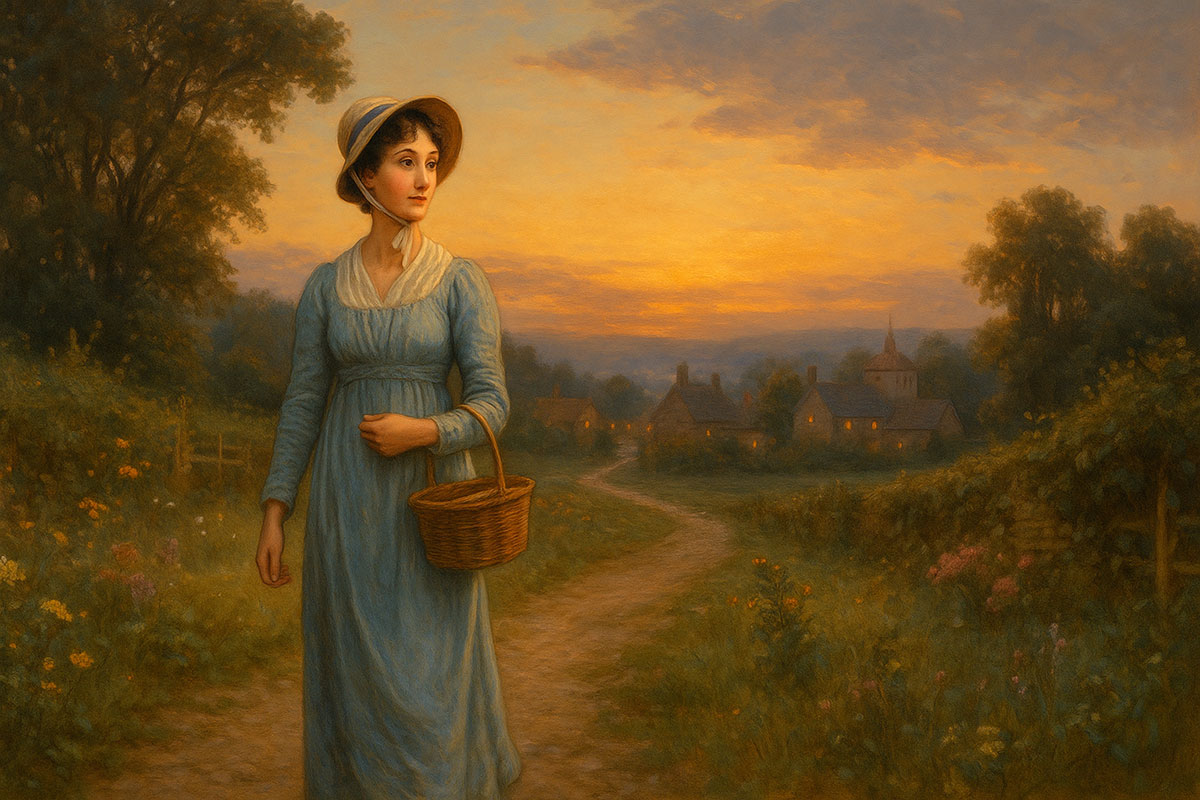
The evening light stretched long shadows across the meadow, the air holding that particular stillness that comes before nightfall. Jane walked the familiar path toward the village, her steps unhurried, the rhythm of the gravel underfoot almost meditative. In her basket lay a few sprigs of lavender, a small loaf of bread wrapped in linen, and a worn book she had been reading for the third time.
Ahead, the lane curved toward a grove of elms. She could hear the soft murmur of the stream that wound its way past the churchyard. These sounds—the trickle of water, the occasional call of a night bird—were the kind she had known all her life, as steady and faithful as a heartbeat.
Her thoughts, however, wandered to a letter she had received only days before—not from him, but from a mutual friend. There had been no grand revelations, only a quiet assurance that he was well, living far from the place where their paths had once crossed. He had married. He had children. His life, it seemed, had settled into its own order.
She paused on the bridge, leaning against the worn stone wall, and let the news settle. There was no bitterness—only the faint ache of knowing that a chapter had closed without her hand upon the final page. She thought of the words she had once sent into the wind, of the years in between, and of how life moves on, whether we are ready or not.
A breeze moved through the elms, carrying the scent of lavender from her basket. She closed her eyes and breathed it in, allowing the quiet to fill her. There was comfort in the thought that not all love is meant to be lived; some is meant to be remembered, to be kept in the still rooms of the heart where it can remain untouched by time.
As she approached the edge of the village, the church bells began to toll the hour. She could see warm light spilling from the windows of her cottage. The glow was not the light of romance or longing, but of a steady life—a life filled with small acts, familiar routines, and the quiet dignity of having loved without regret.
She stepped inside, setting her basket on the table. The kettle was soon humming, and the room filled with the scent of tea. Outside, the sky deepened to indigo, stars pressing gently through the darkness.
Jane sat by the window, her book open but unread. She thought of the garden in spring, of the friends she would see in the morning, and of the stories still waiting to be written. Love, she realized, need not end with possession; it can live in the way it shapes you, in the kindness it teaches, in the grace it leaves behind.
She took a sip of tea, the warmth steadying her, and smiled faintly at the thought. In the end, perhaps this was the truest ending of all—not a grand conclusion, but a quiet return home.
Final Thoughts by Dame Judi Dench
In the end, Jane Austen left us more than novels; she left us a mirror. In it, we see our own longings, our follies, and our courage, refracted through the grace of her prose. As we take our leave of her villages and parlours, we carry with us a reminder: that the human heart, in all its contradictions, is worth both knowing and forgiving. Perhaps that is why her stories endure — because in them, we find ourselves as we are, and as we might be, if only we dared to be kinder, braver, and more honest. And so, as the sun dips behind the rolling hills, let us close this chapter with gratitude… and the quiet certainty that Jane Austen still walks these paths, smiling at what she sees.
Short Bios:
Jane Austen – (1775–1817) English novelist whose sharp wit and keen social commentary transformed the domestic novel into a timeless art form. Her works, including Pride and Prejudice and Emma, explore love, manners, and morality in Regency England.
Dame Judi Dench – (born 1934) Celebrated British actress known for her commanding stage presence and nuanced film performances. With a career spanning over six decades, she has portrayed characters ranging from Shakespeare’s heroines to royalty, earning acclaim for her warmth, wit, and emotional depth.
Leave a Reply