
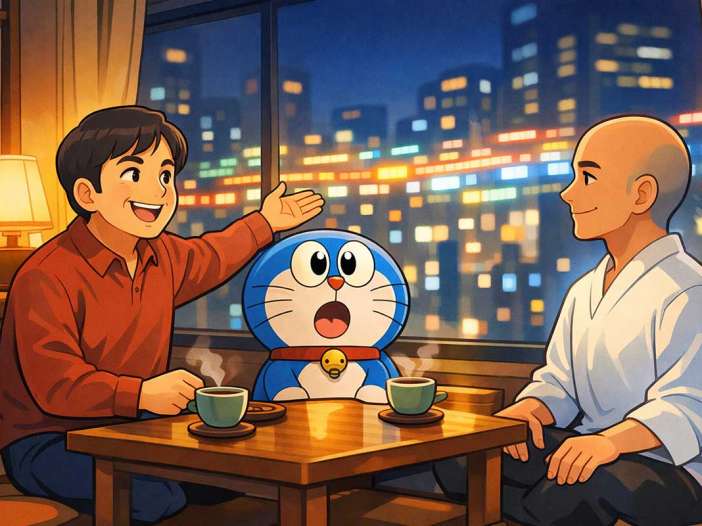
What if top “teachers” from Japan, pop culture, and channeling met—Ken Honda, Doraemon, Bashar—to decode 2026 together?
Introduction by Doraemon
Hi everyone—Doraemon here.
If you’re watching this at night with the city blinking outside your window and your mind still racing from last year, I get it. 2026 doesn’t feel like a calm year. It feels like a year that runs—fast—like a wild horse that doesn’t wait for anyone to tie their shoelaces.
So today, I invited two very unusual friends to sit at a cozy table with warm tea and even warmer honesty.
First, a kind and grounded money teacher from Japan—Ken Honda. He doesn’t shout. He doesn’t scare you. He just points at what’s true… and somehow you breathe again.
Second, a calm futuristic thinker—Bashar—who keeps reminding us that speed isn’t the enemy… panic is.
And me? I’m here for one reason: to help you turn big ideas into small tools you can actually use—especially when your stomach tightens, your bank balance drops, or the news makes your brain feel like it’s sizzling.
This is a 7-scene conversation about riding 2026 without getting trampled:
how to flip fear into excitement, how to stop treating money like your only safety, how to make doubt your bodyguard instead of your prison guard, and how to anchor the future you want with one tiny action today.
Okay—deep breath. Tea sip.
Let’s open the window to the year… and learn how to steer.
(Note: This is an imaginary conversation, a creative exploration of an idea, and not a real speech or event.)
Scene 1 — The Studio Window Looks Like a Ticker Tape
The studio is warm in that clean, Japanese way: pale wood, a low table, green tea steaming in small cups. Outside, the city glitters—cars streaming like a moving graph, billboards blinking like headlines. Somewhere, a train hums past with the soft inevitability of time.
Ken Honda sits calmly, palms resting on his knees, as if he’s already decided not to fight the year.
Doraemon is beside him, feet dangling, watching the outside world the way a kid watches a storm: equal parts fear and fascination.
Bashar sits opposite, perfectly relaxed, like someone who doesn’t need weather forecasts.
Ken taps the window lightly.
Ken Honda: 2026 is going to feel fast. Powerful. A horse year, you could say. You ride it, or it runs you over.
Doraemon’s eyes widen.
Doraemon: Run you over…? Ken, that’s not a metaphor I like very much!
Bashar: The acceleration is not the danger. Your relationship to acceleration is the danger.
Doraemon turns toward Bashar, squinting.
Doraemon: You always talk like a fortune cookie that went to graduate school.
Ken smiles, not offended—genuinely amused.
Ken Honda: He’s right, though. People will interpret speed as threat. But speed can also be opportunity.
Doraemon reaches into his pocket and pulls out a small digital thermometer labeled in neat handwriting.
Doraemon: Then we need this: the Panic Thermometer! When your internal temperature goes up, your decisions get… crunchy.
Ken laughs.
Ken Honda: Crunchy.
Doraemon: You know what I mean! Overcooked! Burnt! You buy things you don’t need, you text people you shouldn’t text, you say yes to projects you’ll resent… 2026 is a year where people will do a lot of that.
Bashar nods, as if Doraemon has just described quantum mechanics.
Bashar: Panic is a frequency that selects more reasons to panic.
Ken leans forward, voice soft but firm.
Ken Honda: So let’s make it practical: the first skill for 2026 is emotional hygiene. Not “positive thinking.” Hygiene.
Doraemon points the thermometer at Ken.
Doraemon: Okay! Everybody: if you feel like your brain is on fire, step away from the news!
Ken lifts his cup.
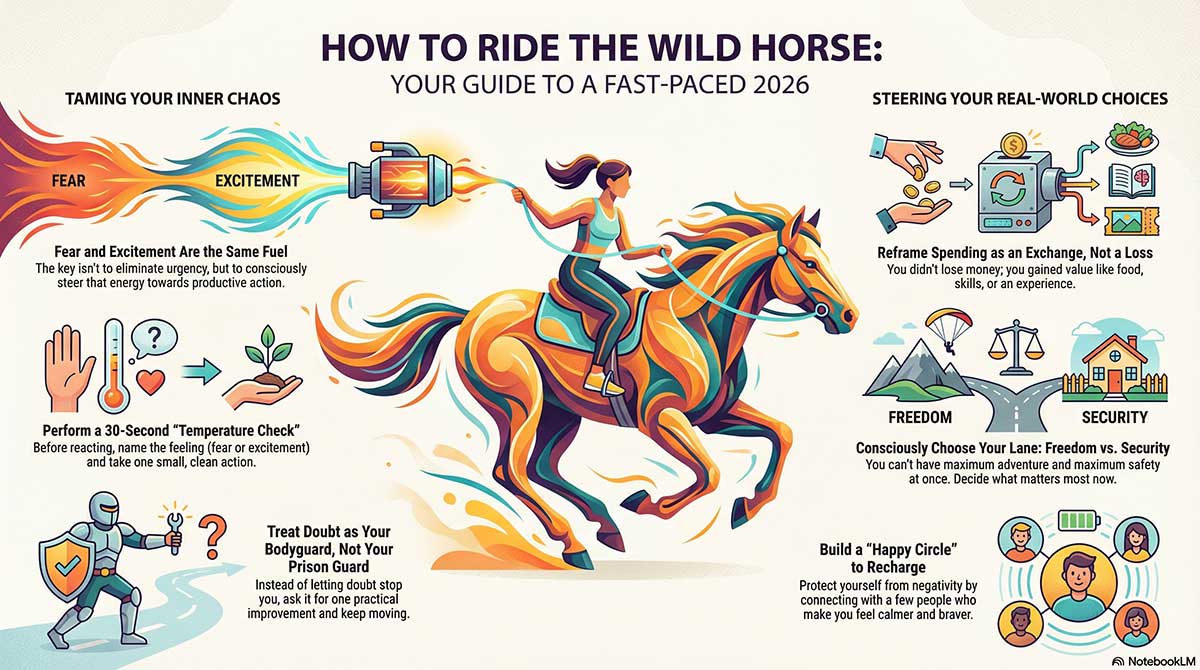
Ken Honda: Step away, breathe, and choose the other side of the same energy. Fear and excitement—same fuel. Different steering.
Practical 2026 Action Step #1: The 30-Second Temperature Check
When you notice urgency, do this before any decision:
Name it: “This is fear” or “This is excitement.”
Ask: “If this were excitement, what would I do next?”
Do one small, clean action (drink water, walk, write one sentence) before you spend money or send messages.
Scene 2 — The Money Number Goes Down (And People Panic)
Ken pulls out a notebook. He draws a simple picture: a bank balance on the left, a loaf of bread on the right.
Ken Honda: People see the number go down and they feel unsafe. But most transactions are not losses. They’re exchanges.
Doraemon leans over the notebook like it’s a mystery novel.
Doraemon: Exchange… like trading money for bread.
Ken Honda: Exactly. You didn’t lose money. You gained food. But the brain sees “down” and screams.
Bashar lifts a finger.
Bashar: The number is not safety. The number is a symbol. Safety is a state.
Doraemon flinches dramatically.
Doraemon: Wait—are you saying money doesn’t protect you?
Ken’s face stays gentle.
Ken Honda: Money solves money problems. But people try to use money to solve existential problems—fear of uncertainty, fear of mortality, fear of not being enough. That’s a heavy job for a number.
Doraemon looks down at his own pocket like it might contain “enoughness.”
Doraemon: So what do we do when 2026 makes money feel… spicy?
Ken chooses his words carefully.
Ken Honda: You prepare. You simplify. You don’t chase peaks. You study patterns. And you increase your ability to create value.
Doraemon lights up at the word “prepare” and pulls out an umbrella—tiny, neat, and absurdly sturdy.
Doraemon: Budget Umbrella! It doesn’t stop the rain, but it stops you from doing something ridiculous like trying to drink the rain.
Bashar looks delighted by the metaphor.
Bashar: Appropriate. “Rain” is conditions. Umbrella is choice.
Ken nods.
Ken Honda: In a fast year, the best money strategy is often the least exciting: reduce unnecessary spending, keep a buffer, invest in skills, and build relationships that lead to opportunity.
Doraemon holds the umbrella over his head like a serious businessman.
Doraemon: And don’t try to buy emotional safety with shopping at 2 a.m. That’s not an investment. That’s a cry for a hug.
Ken laughs again—quiet, warm.
Practical 2026 Action Step #2: The “Exchange Ritual” (Kills Money Anxiety Fast)
Whenever you spend money, do this:
Say (out loud if possible): “I exchange money for value.”
Add one sentence of gratitude: “This supports my life.”
If you feel guilt or fear, ask: “Is this essential, enriching, or an avoidance purchase?”
Essential: food, health, safety
Enriching: learning, relationships, meaningful tools
Avoidance: buying to numb anxiety
(This is not financial advice—just emotional clarity that improves money decisions.)
Scene 3 — Freedom vs Security: The Two-Lane Bridge
The studio lights dim slightly. Someone outside honks—impatient, late. It feels like the year itself is tapping its foot.
Ken draws two columns:
Security | Freedom
Ken Honda: Many people say they want freedom, but they secretly want security. So they order security, and then feel frustrated that freedom didn’t arrive.
Doraemon gasps.
Doraemon: So the universe is like… a restaurant?
Ken smiles.
Ken Honda: Yes. You get what you consistently order—especially through habits.
Bashar’s voice is calm and exact.
Bashar: Your actions are your language. Your emotions are your currency. Your beliefs are your contract.
Doraemon points at Bashar.
Doraemon: There it is again! Graduate-school fortune cookie!
Then Doraemon turns to Ken, suddenly serious.
Doraemon: But Ken… can we order both? Freedom and security?
Ken pauses. The steam from the tea curls upward like a slow answer.
Ken Honda: You can have seasons. You can have balance. But you can’t have maximum adventure and maximum safety at the same time. You decide what matters most now.
Doraemon reaches into his pocket and pulls out a little bridge model with two lanes.
Doraemon: Two-Lane Bridge! If you choose the “freedom lane,” you accept bumps. If you choose “security lane,” you accept slower speed. Either way—drive consciously!
Bashar nods.
Bashar: The suffering comes from pretending you chose one lane while emotionally demanding the benefits of the other.
Ken looks straight into the “camera” as if speaking to someone watching late at night, tired and hopeful.
Ken Honda: 2026 will reward honesty. Not perfection—honesty.
Practical 2026 Action Step #3: The Lane Choice (One Decision That Ends Inner Conflict)
Write this sentence and complete it:
“In 2026, I choose [security / freedom / balanced season] because [reason].”
Then create one policy:If Security season: “I will not gamble for excitement.”
If Freedom season: “I will not demand certainty before I move.”
If Balanced season: “I will take small risks with boundaries.”
Scene 4 — “Mrs. Doubt” Walks In (And Ken Invites Her to Tea)
A soft knock. Doraemon freezes.
Doraemon: Who’s that?!
Ken opens the door—calmly—and an invisible presence enters. The air gets a little heavier, like a cloud passing over the sun.
Ken sets out an extra cup.
Ken Honda: Ah. Mrs. Doubt.
Doraemon whispers loudly.
Doraemon: You let her in?!
Ken Honda: Of course. Doubt can be a bodyguard. But not a prison guard.
Bashar’s eyes sparkle.
Bashar: Doubt as information is guidance. Doubt as identity is limitation.
Doraemon pulls out a stuffed toy labeled “Mrs. Doubt” and squeezes it. It speaks in a cranky little voice:
Mrs. Doubt (toy): “That’s not good enough.”
Doraemon looks horrified.
Doraemon: See?! She’s rude!
Ken gently takes the toy and squeezes again.
Mrs. Doubt (toy): “Try again. Make it better.”
Ken hands it back.
Ken Honda: I negotiate with doubt. I ask it: “What’s the one improvement?” Not “Should I quit?”
Doraemon relaxes.
Doraemon: Oh! So doubt isn’t the villain. Doubt is… quality control.
Bashar nods approvingly.
Bashar: Precisely.
Ken leans in.
Ken Honda: In 2026, you will feel doubt more often, because the world will feel less stable. So you must practice leadership inside your mind.
Practical 2026 Action Step #4: The Doubt Script (Turns Self-Sabotage Into Craft)
When doubt appears, say:
“Thank you for protecting me.”
“What is one practical improvement?”
“I’ll do that—and I’m still moving.”
Scene 5 — Time Travel: Ken’s Door vs Doraemon’s Anywhere Door
Doraemon suddenly stands up, energized.
Doraemon: If we’re talking about the future, then it’s my specialty! I have the Anywhere Door!
He pulls out a pink door and sets it on the floor. The studio feels suddenly bigger, like possibility has mass.
Ken watches with affectionate curiosity.
Ken Honda: My version is simpler. I guide people to their future living room.
Bashar’s voice becomes almost tender.
Bashar: Imagining the future is not fantasy. It is tuning. You are selecting a timeline by resonance.
Doraemon opens the door a crack. Warm light spills out—like late afternoon.
Doraemon: Okay. Five years from now. Step in. What do you smell? What do you hear? Who’s there?
Ken speaks slowly, like guiding a child across a stream.
Ken Honda: You see your future self. Not just the achievements—your energy. Your posture. Your eyes. You ask: “What changed?”
Doraemon frowns.
Doraemon: Humans make one mistake. They do a beautiful visualization… and then they immediately check their phone and drop the future on the sidewalk.
Ken laughs softly.
Ken Honda: So you anchor it.
Bashar: One congruent action today locks the frequency.
Doraemon snaps his fingers and produces a tiny magnet.
Doraemon: Future Magnet! It sticks your future to one tiny action. Not a huge plan. One action.
Ken nods.
Ken Honda: If you saw yourself healthier—take a walk today. If you saw yourself writing—write one paragraph. If you saw yourself teaching—share one insight with someone.
Doraemon whispers, half to himself:
Doraemon: One millimeter. One paragraph. One kind action. That’s doable.
Practical 2026 Action Step #5: The “1mm Anchor”
After you imagine your 5-year future, do one small action within 24 hours that matches it:
Health: 10-minute walk
Money: set up a small auto-save or track spending once
Work: draft one page, call one client, publish one post
Relationships: send one honest message
Scene 6 — The Zombie Problem (And the Anti-Zombie Shot)
The room shifts tone. Ken’s face becomes kind but more serious.
Ken Honda: Momentum fades when you return to the same negative environment.
Doraemon nods vigorously.
Doraemon: Yes! Zombies!
Ken smiles at the word.
Ken Honda: People who live in frustration and bite others with it. You can’t always avoid them, but you can protect yourself.
Doraemon reaches into his pocket and produces a little spray bottle.
Doraemon: Anti-Zombie Spray! It’s called “Boundaries.”
Bashar adds calmly:
Bashar: If you allow others to define your frequency, you outsource your reality.
Ken lifts a finger, as if teaching a simple, decisive lesson.
Ken Honda: If you want 2026 to be different, you need a happy community—even a small one. A few people who remind you who you are when the world gets loud.
Doraemon looks relieved.
Doraemon: So it’s not about becoming invincible. It’s about having a place to recharge.
Ken Honda: Exactly.
Practical 2026 Action Step #6: The “Happy Circle” Rule
Choose 3 people (or 1 group) who make you feel:
calmer,
braver,
more yourself.
Schedule a recurring touchpoint:
weekly call,
monthly meetup,
or a shared challenge.
And set one boundary:
“I don’t discuss the news after 9 p.m.”
“I don’t take advice from people who don’t live the kind of life I want.”
Scene 7 — The “2026 Riding Kit” (Doraemon’s Pocket Is Not Done)
The city outside keeps moving. The studio is still. That contrast feels like the whole lesson: chaos outside, leadership inside.
Ken writes three words on a card:
Calm — Creativity — Community
Ken Honda: Calm gives you clarity. Creativity gives you income and options. Community gives you resilience.
Doraemon reaches into his pocket again—slowly—like a magician who enjoys suspense.
Doraemon: I’ve got one more gadget, but I’m not sure you’re ready.
Ken raises an eyebrow, smiling.
Ken Honda: Try us.
Doraemon pulls out… a simple blank notebook with a pencil attached by string.
Doraemon: It’s the One-Line Compass. Every morning, you write one line:
“What would make today feel meaningful and fun?”
Bashar nods.
Bashar: Meaning is a frequency. Fun is a compass. When you follow them, synchronicity increases.
Ken taps the notebook gently.
Ken Honda: If you do that, 2026 becomes a ride you can actually enjoy—without pretending it’s smooth.
Doraemon looks at the pocket again, as if something else is calling from inside.
Doraemon: And if the horse bucks you off… I have something for that too. But maybe we save it for next time.
Ken lifts his teacup.
Ken Honda: Next time.
Bashar smiles, barely.
Bashar: The conversation continues.
The city outside flickers—headlines, lights, motion—while inside the studio, the air feels cleaner, like someone opened a window in the mind.
Final Thoughts by Doraemon
Whew… okay. I’m going to say something very Doraemon-ish now:
2026 may be fast, but you don’t have to be frantic.
That’s the biggest lesson I got from sitting at this table.
Ken kept showing us that money isn’t just numbers—it’s energy and exchange. And when you stop staring at your balance like it’s your heartbeat monitor, you suddenly remember something important: real stability doesn’t live in a number. It lives in you.
Bashar kept poking us in the same place—our interpretation.
Because if you treat every headline like a prophecy, you’ll live in constant alarm. But if you treat your emotions like a steering wheel—fear on one side, excitement on the other—you can choose your lane again and again.
And me? I’m taking home the practical stuff:
Do a 30-second temperature check before decisions.
Turn “I’m losing money” into “I’m exchanging money for value.”
Let doubt sit in the room—but don’t let it drive.
Imagine your future living room… then anchor it with one tiny action.
And please—please—don’t let “zombie energy” bite you all day. Find your people.
If 2026 is a wild horse…
you don’t need perfect strength.
You need calm hands.
A clear heart.
And one small step forward.
So tonight, after you close this, do something tiny but real.
One line in a notebook. One message to a good friend. One small boundary. One brave inch.
That’s how you ride.
And if you stumble?
Well… I have a pocket full of tools.
So just come back—this conversation isn’t over yet.
Short Bios:
Ken Honda is a Japanese author and teacher known for “Happy Money,” focusing on a peaceful relationship with money, emotional clarity, and values-based wealth.
Doraemon is a beloved blue robotic cat from the future who helps people with clever pocket gadgets—mixing humor, heart, and practical problem-solving.
Bashar is a channeled futurist voice associated with teachings on beliefs, “frequency,” and how emotional states shape perception and choices.
Leave a Reply