


Amitav Ghosh:
There are rivers that run through the lives of nations, shaping not only their geography but their spirit. For Bengal, the Padma was such a river, and for Rabindranath Tagore, it was a mirror to the soul — a constant companion in his seasons of joy and grief, creation and silence.
What you will read here is not a biography in the ordinary sense. It is a series of intimate crossings — moments when the poet paused at the edge of his own life to speak with a friend. Sometimes this friend walked beside him in youth, barefoot in the rain; sometimes in grief, within a courtyard emptied by loss; sometimes in distant cities where the noise of the world threatened to drown the music of his heart.
Here are conversations that carry the hush of truth between them, the way a river carries silt from its source — quietly, inevitably, leaving traces of gold in its wake. This is the Rabindranath Tagore few are permitted to see: not the public figure draped in accolades, but the man who sought stillness in the face of change, who measured his days not in laurels, but in the depth of the silences he kept.
(Note: This is an imaginary conversation, a creative exploration of an idea, and not a real speech or event.)

Chapter 1: The River Before the Storm
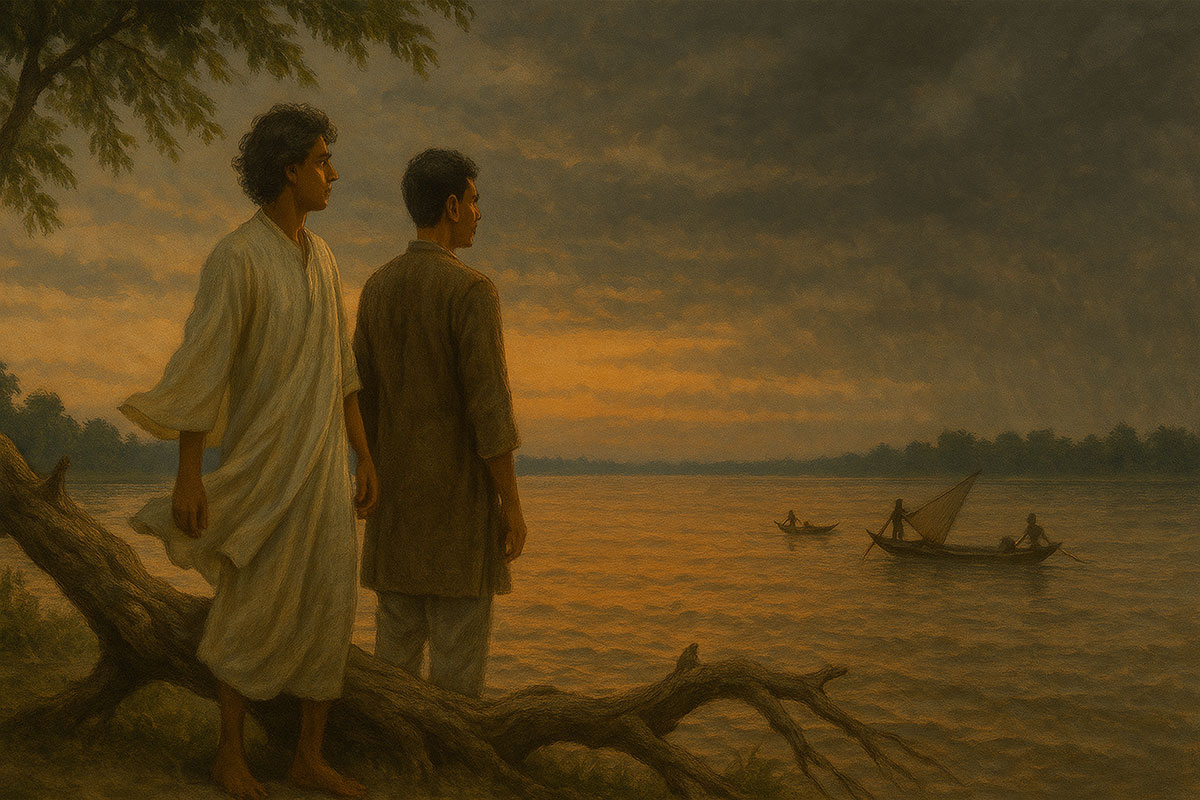
The Padma River lay before us like an unrolled scroll, each ripple a line of poetry too ancient for either of us to fully read. The evening air was soft but restless, the kind that hints at rain without yet daring to fall. We stood in silence, side by side, watching fishermen haul in their nets, their silhouettes swaying like brushstrokes against the copper dusk.
Tagore’s hair was longer than most men’s then, his robe loose, fluttering in the wind. His eyes were somewhere far beyond the river, in a land neither mapped nor conquered. I had seen him like this before—when he was on the edge of a decision that might unmoor him from everything familiar.
“I sometimes think,” he began, his voice so low it almost drowned in the rustle of reeds, “that my life will disappoint everyone who loves me.”
I turned to him. “Because you don’t want to be the man they expect?”
He shook his head slowly. “Because I want to give myself to words, and words… they are not bread. They do not build houses. They do not keep children from hunger.”
I wanted to argue, but I knew better than to rush his mind. We walked along the bank until we found a fallen tamarind tree, half-submerged in the water, and sat upon it.
“You think poetry is only a whisper in a world of shouts,” I said. “But whispers can reach the heart in ways a shout never will.”
He glanced at me, faintly smiling, but the storm in his gaze didn’t lift. “My family expects me to manage estates, to handle affairs like a proper Tagore son. They have no use for the man who stares at clouds until they become birds.”
“You were never born to be proper,” I replied. “You were born to be true.”
We sat a while longer, saying nothing, until a gust of wind swept across the water, carrying with it the smell of rain and far-off jasmine. Tagore reached down, touched the surface of the river with his fingers, and spoke almost to himself.
“When the river swells, it does not ask the land’s permission. It simply becomes what it must be.”
The first drops of rain began to fall, dotting the river in soft percussion. He didn’t move, didn’t rush for cover. Instead, he tilted his face to the sky and let the water trace his brow.
“Then perhaps,” I said gently, “you must be the river.”
He turned toward me with that look—the one that meant he had found a line worth keeping. “Yes,” he whispered. “But the river must also remember the shore.”
We walked back to the village in the rain, our robes clinging to our skin, the scent of wet earth rising around us. Somewhere behind us, the fishermen’s nets sagged heavy with their night’s catch. Somewhere ahead, a lamp was being lit in a small room where someone waited for us.
That night, he wrote his first poem about the Padma.
Chapter 2: The Empty Courtyard
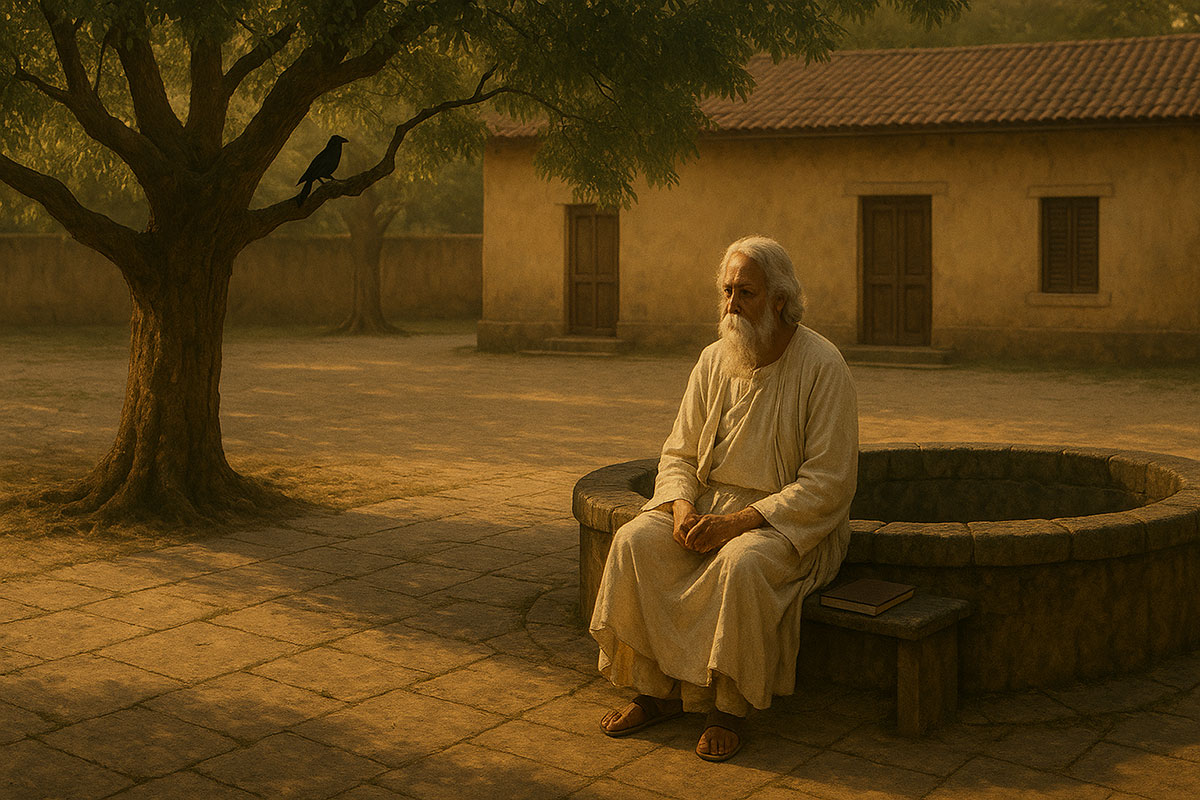
The courtyard at Shantiniketan was still. Too still.
The neem tree cast a narrow shadow across the flagstones, and the air was heavy with the dust of an afternoon that refused to turn into evening. Somewhere beyond the walls, a koel sang, but its voice seemed too far away to belong to this place.
Tagore sat alone near the old well, his white robe pooling around him like a surrender flag. His hands were folded in his lap, unmoving, as if the act of moving might disturb the fragile balance between breath and collapse.
It had been days since Mrinalini’s passing, yet the house still seemed to lean toward her absence. I had watched him stand at the threshold of her room more than once, as if some invisible cord tethered him there, preventing entry but also preventing departure.
I stepped into the courtyard quietly, but his eyes found me. They were not red from tears — he had shed them all in the first night — but dulled, as if the world had pulled its light away from him.
“Do you know,” he said, his voice without rise or fall, “how strange it is to see the sky still carrying on, the wind still touching the leaves, when she is gone?”
I sat beside him on the low stone ledge by the well. “Yes,” I said softly. “The world does not stop for our grief, but it remembers, in its own way.”
He shook his head faintly. “My pen feels like a stranger’s tool. I open my notebook, and the page stares back as if it knows I am no longer who I was when I last wrote.”
I glanced toward the garden path she used to walk, her sari brushing the hibiscus blossoms. “You don’t have to write for the world right now,” I told him. “Write for her. Just her.”
He looked at me, a flicker of something passing through his expression — perhaps resistance, perhaps longing. “What could I say that she doesn’t already know?”
“That you are still here. That her absence has not silenced you.”
The koel sang again, nearer this time. Tagore closed his eyes, and I could almost see the thought forming behind his brow. His hand reached for the notebook on the stone ledge. The first page was blank. He opened it slowly, as though afraid the act would shatter the quiet.
I said nothing, letting the sound of the wind through the neem branches fill the space between us. His pen hesitated above the paper, then touched it, leaving a single word — her name.
From there, the lines began to come, halting at first, then gathering like rain into a stream. I watched his shoulders lift and fall, not in grief now, but in the rhythm of creation.
When he finally set the pen down, the courtyard felt different — not healed, not whole, but less hollow.
“She will not read this,” he said quietly, “but perhaps she will hear it.”
“She already does,” I replied.
The first star of evening appeared above the neem tree. And though the courtyard remained empty, it no longer felt abandoned.
Chapter 3: The Weight of the World’s Praise
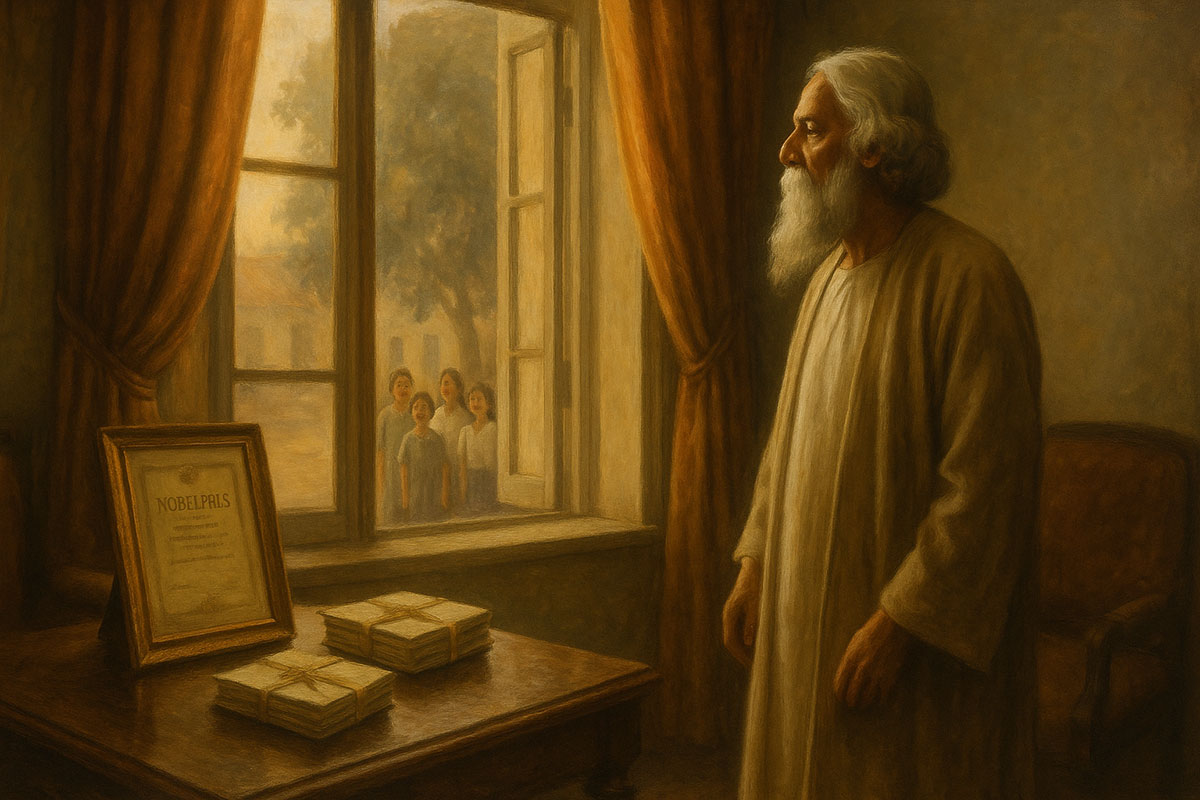
The winter wind in Calcutta carried the scent of burning charcoal and marigold garlands. The streets outside Tagore’s home were busier than ever, each passerby eager to catch sight of the man whose name had just been spoken in Stockholm. Inside, the drawing room was flooded with congratulatory letters — stacks of them, tied in silk ribbon, as though the words themselves required a ceremonial dress.
He stood at the far end of the room, half-turned toward the window, the gold-framed Nobel certificate resting on a small table behind him. Sunlight touched its surface, but he did not.
“You have not looked at it since they brought it in,” I said.
“I have looked,” he replied, his tone flat but not unkind. “And I have looked at the ocean, too, but the ocean has never belonged to me.”
I walked toward him. “This is not the ocean. This is your work, recognized. Your words carried across the world.”
He shook his head slightly, as if the world were a place too far from where he stood. “Recognition changes the air around a man. It thickens. Every breath feels watched.”
He turned fully now, his eyes tired but alert. “Do you know what they have begun to ask me? Not about the poems. Not about the Gitanjali. They ask how it feels to be the first non-European to win this prize. As if my worth lies in the novelty of my skin.”
The words fell heavy, as though the Nobel’s weight was not in the certificate but in the questions it brought.
“You fear the world will take your gift and turn it into something political,” I said.
“I fear,” he answered, “that I will begin to write for their applause rather than for the truth that once guided me.”
Outside, a group of children’s voices rose in a song — one of his songs, clumsy in their young mouths but luminous in their sincerity. He paused at the sound, his face softening, though the crease of doubt remained between his brows.
“Fame,” I said, “is like a lamp. It can light the path ahead, or it can blind you if you stare at it too long. You can choose where you place it.”
He smiled faintly at that, the kind of smile that acknowledges a truth but has yet to accept it. “Then perhaps I must learn to walk again by moonlight — soft light, not blinding.”
He moved toward the window and opened it, letting the winter air rush in. The children’s song became clearer, less a chorus and more a thread tying him to the world outside the room.
For a long moment, we both listened. And though the Nobel certificate still lay untouched behind him, something lighter had entered the room — not pride exactly, but a small, steady resolve.
Chapter 4: The Song Beneath the Noise
Tokyo, 1916.
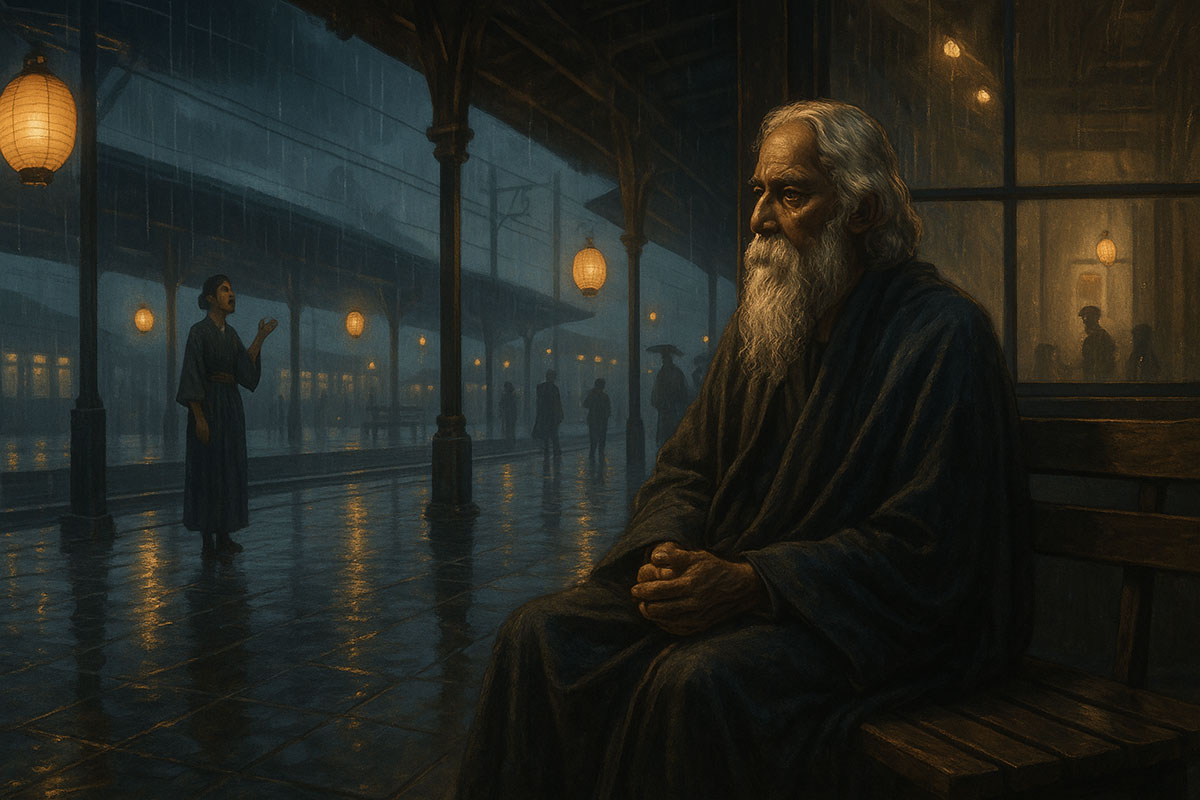
The rain had been falling since dawn, soft but relentless, turning the streets into narrow rivers of reflected lantern light. The station was crowded with travelers clutching umbrellas and bundles, their voices weaving together in a tapestry of hurried Japanese, the occasional laughter of children, and the low murmur of train announcements.
Tagore sat on a wooden bench near Platform Three, his travel cloak damp at the edges, his hat resting in his lap. His eyes wandered, not toward the arrival board or the waiting crowd, but toward the rivulets of water that streaked down the station’s high glass windows.
When I approached, he greeted me with a nod but no words. We had traveled much together these past months — across seas, through lecture halls, into receptions where men in fine suits spoke of peace with hands that still signed orders for war. I knew the look on his face. It was the same one I had seen after political debates in London, after dinners with industrialists in New York — a quiet recoil from the machinery of the modern world.
“Too much noise?” I asked.
He smiled faintly. “Too much noise that believes itself music.”
I sat beside him, watching a steam locomotive idle on the far track, its hiss and sigh almost like breathing. “The noise is temporary,” I said. “The song will still be there, underneath.”
His gaze stayed fixed on the rain outside. “In the villages of Bengal, I could hear the earth sing. The rivers carried a tune, the wind across the rice fields had its own chorus. Here, even in beauty, there is a restlessness. And in the West…” He stopped, searching for the words. “In the West, they have made an altar to progress, and at its base they have laid the quiet heart in sacrifice.”
A train roared past, pulling a rush of air that scattered drops from the eaves. I waited until the sound faded before speaking. “Then perhaps your work is not to outshout the noise, but to hum until others remember they know the tune.”
He looked at me then, and something in his eyes shifted — not quite light, but a clearing in the clouds. “You believe the world will listen to a hum?”
“I believe the world is tired, and in its tiredness it will crave something soft enough to enter without defense.”
From the far side of the platform, a young woman began to sing. Her voice was untrained but pure, carrying a traditional folk melody that rose above the rain and the station clamor. Heads turned, and for a moment, even the announcements paused between sentences.
Tagore’s lips curved into a genuine smile. “There,” he said, almost to himself. “The song beneath the noise.”
The rain kept falling, but it no longer felt heavy. We boarded our train as the woman’s voice lingered in the air, following us down the track like a blessing.
Chapter 5: The Last Light on the River
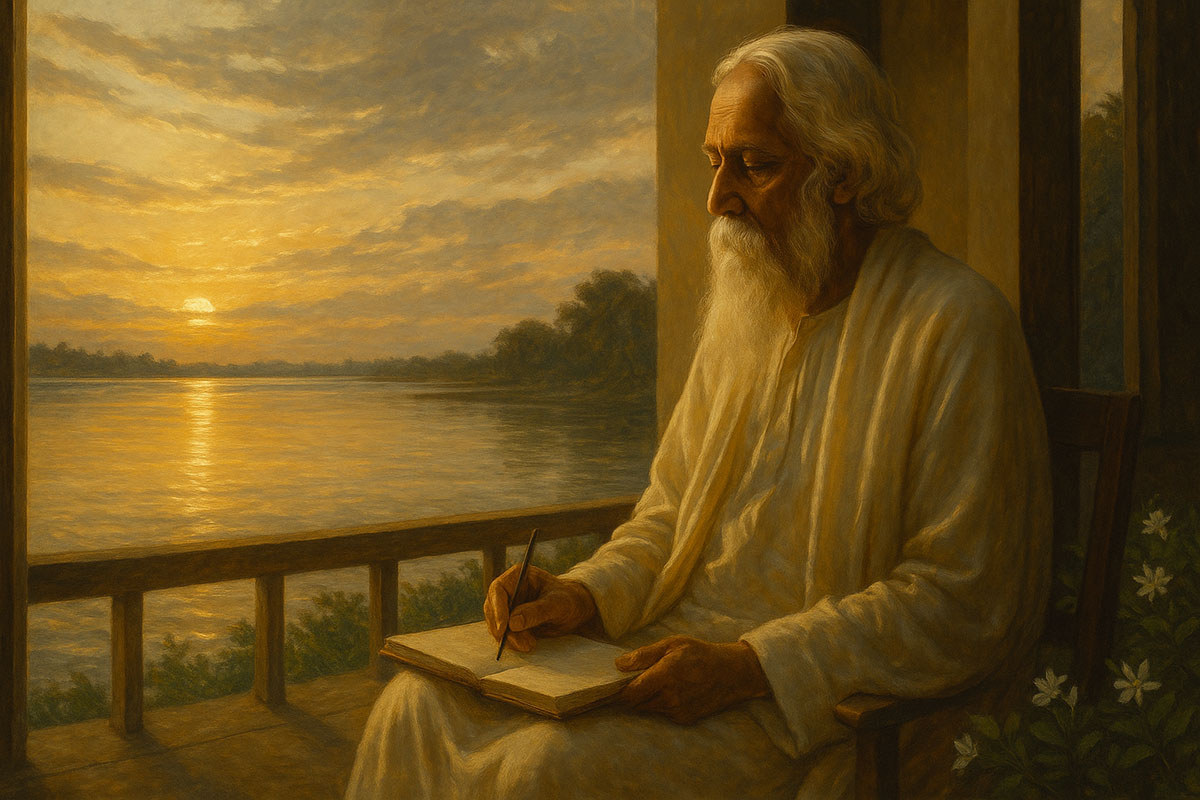
Shantiniketan, August 1941.
The monsoon had passed, leaving the earth washed and luminous. The Padma River lay wide and unhurried, its surface gathering the gold of the afternoon sun. From the veranda of his room, Tagore watched the water as if it were an old friend who had come to sit with him at the end of the road.
He was frailer now, his frame wrapped in a soft white shawl, but the sharpness in his gaze had not dimmed. The doctors spoke in low voices in the hall, but he seemed untouched by their urgency. His mind was elsewhere — in the current, in the light.
I took the chair beside him, the same one I had sat in so many times over the years, and followed his gaze to the river.
“I dreamt last night,” he said, his voice a hushed thread, “that I was a boy again. Barefoot. Running along the bank after the rain. The mud cool beneath my feet, the air so full of life I could drink it. No duties. No fame. No letters to answer. Only the river, and the sky, and the smell of wet earth.”
I smiled gently. “Sounds like freedom.”
He turned to me, the faintest glimmer of mischief in his expression. “And now I must try to say goodbye without letting the river know I am leaving.”
I waited, knowing his words were not just for me but for the page that had always been waiting for him. On the table beside his chair lay a small notebook, the cover worn thin at the edges. I opened it for him, placing it on his lap with the pen resting in the center fold.
His hands trembled slightly, but once the pen touched paper, the tremor stilled. Slowly, line by line, he began to write. Not about death — never directly — but about light on water, about the way the sun lingers just long enough for you to notice before slipping behind the horizon.
When he paused, I asked softly, “Will you read it?”
He nodded and spoke, his voice carrying the quiet weight of a final offering:
“The river does not keep my reflection,
yet it carries my shadow to the sea.
I go where it goes,
into the vastness where light
does not end.”
For a while, we said nothing. The air was thick with the scent of jasmine from the garden, and somewhere in the distance, a child’s laughter rose and fell like a memory returning home.
The sun dipped lower, and the river’s gold turned to silver. Tagore closed the notebook and handed it to me. “Keep it,” he said. “You have walked the banks with me longer than anyone.”
I took it, not trusting my voice. He leaned back in his chair, eyes half-closed, the last light of day warming his face.
And as the shadows lengthened across the veranda, the river seemed to bow to him — a silent farewell between two old companions who had known each other’s song from the beginning.
Final Thoughts By Amitav Ghosh

In the last light of day, when the Padma held the sun like a secret it could not keep, Tagore sat with his pen poised above the page. He had long ceased to believe that words could capture the fullness of the world — yet he wrote, because writing was not a duty, but an act of love.
To be near him in those moments was to feel the boundaries between past and present dissolve. You could see in his eyes the boy who ran along the muddy banks, the husband who mourned in the empty courtyard, the traveler who searched for the song beneath the noise. You could see a life lived as a long, unbroken conversation with the world.
When the final page was written, he left it not as a monument, but as a gift — a reminder that the truest legacies are not the ones carved in stone or gold, but those carried quietly in the hearts of friends.
And so the river continues, its voice unchanged, flowing toward the sea. Somewhere in its current, his words still travel.
Short Bios:
Rabindranath Tagore – Bengali poet, novelist, musician, and philosopher (1861–1941), the first non-European Nobel Prize winner in Literature (1913), known for his lyrical works, humanist vision, and deep engagement with India’s cultural renaissance.
Amitav Ghosh – Indian author celebrated for blending historical narrative, cultural depth, and lyrical prose, with acclaimed works like The Shadow Lines and The Ibis Trilogy. His writing often explores the intersections of history, identity, and environment.
Gulzar – Indian poet, lyricist, and filmmaker, renowned for his evocative Hindi-Urdu poetry and song lyrics. His work often bridges the personal and universal with delicate imagery and emotional resonance.
Leave a Reply