
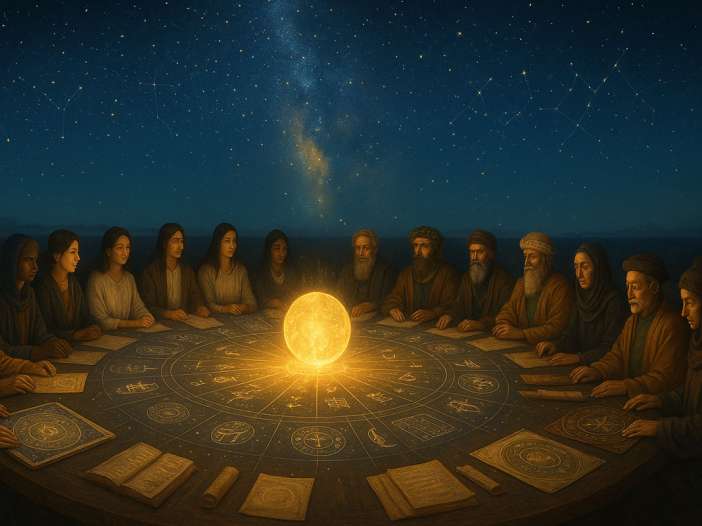
Introduction By Carl Sagan
Since the dawn of civilization, humanity has looked to the stars not only for navigation, but for meaning. The night sky has been a canvas on which we’ve projected our questions about life, death, power, love, and destiny. Astrology, in its many forms, has been a companion to cultures across the world — from Rome to India, from Persia to America.
Now, in the twenty-first century, we face challenges and changes more complex than any our ancestors could have imagined. Technology accelerates, societies transform, and the future feels uncertain. Yet, the old question remains: Are we subject to the stars, or are we co-authors of our fate?
Tonight, twenty voices — some ancient, some modern — gather around one cosmic table. They do not all agree. Their languages, traditions, and interpretations differ. But what unites them is the conviction that the sky above is not silent. It speaks, in cycles, in symbols, in patterns that invite us to reflect on our lives.
The dialogue you are about to hear is not meant to predict with certainty, nor to comfort with illusions. It is meant to awaken. To remind us that in an age of data and machines, the human longing for meaning endures — and the stars still whisper to those who listen.
(Note: This is an imaginary conversation, a creative exploration of an idea, and not a real speech or event.)

Topic 1: The Astrology of Global Shifts — Are We Entering a New Age?

Ptolemy (ancient foundation, Tetrabiblos)
Nostradamus (prophecy, symbolism)
K. N. Rao (Vedic master, predictive accuracy)
Chani Nicholas (modern progressive astrologer)
Steven Forrest (evolutionary, psychological astrology)
Host (Carl Sagan)
“For thousands of years, humans have looked at the sky and asked if the heavens mirror the changes on Earth. In 2026, some say we’re on the threshold of a new age — socially, spiritually, and perhaps even cosmically. Tonight, I want to ask: Are we entering a new age, and what does astrology reveal about this moment?”
Question 1: Do the stars suggest that humanity is stepping into a new age in 2026?
Ptolemy (Ancient Rome):
“The heavens are cycles, not accidents. The conjunctions of Jupiter and Saturn in recent years mark epochs. In 2026, when outer planets shift their dominions, it signals not just political change, but a reshaping of the world order. In my time, we called this the Great Year — humanity stepping into a new pattern.”
Chani Nicholas (Canada):
“To me, the charts of 2026 scream collective transition. Pluto’s continued movement into Aquarius is about dismantling outdated power structures and asking us to build something inclusive. It’s not an ‘Age of Aquarius’ fairy tale, but a demand for responsibility — a chance to create equity, or to repeat history’s mistakes.”
K. N. Rao (India):
“In Vedic jyotisha, we look to the cycles of Saturn and Rahu. The combinations for 2026 show karmic tests. Nations that act with dharma may rise; those that act with greed may fall. It is less about an ‘age’ and more about collective karma being weighed.”
Nostradamus (France):
“I see symbols, not schedules. In 2026, the stars whisper of towers falling and bridges built anew. The question is not whether a new age is coming — it always comes. The question is whether mankind will awaken before the fire consumes.”
Steven Forrest (USA):
“I’d frame it this way: astrology doesn’t force change, it reveals the evolutionary moment. 2026 is one of those times when the soul of humanity is invited to grow. Whether we answer the invitation is our free will.”
Question 2: If 2026 is a threshold, what kind of changes should we expect — personally or globally?
Chani Nicholas:
“We’ll feel it in systems of power. Governments, corporations, even social media platforms — all will face a reckoning. Personally, it means asking: Am I aligned with my values, or am I playing someone else’s game? That’s the test.”
Nostradamus:
“In the mist of time I saw two paths: one of fire, one of light. The fire consumes when leaders cling to pride. The light shines when the common soul speaks truth. Expect upheaval, yes, but know it hides rebirth.”
K. N. Rao:
“On the global level, watch the East rising in influence and the West struggling with its debts, both material and moral. For individuals, it is a time to cultivate inner discipline. Without discipline, the turbulence of 2026 will shake you.”
Ptolemy:
“Climate and sky patterns suggest upheaval. As above, so below. When the heavens burn hotter, so too will earthly tempers. Expect conflict over resources — water, land, air. Astrology is not escape, but preparation.”
Steven Forrest:
“On the personal level, I’d say: if you’re living unconsciously, 2026 will feel like chaos. If you’re living with awareness, it will feel like opportunity. Globally, I expect new technologies to democratize power — and to unsettle those who cling to the old ways.”
Question 3: What guidance would you offer to ordinary people navigating this possible new age?
K. N. Rao:
“Practice dharma. Live ethically. The karmic winds of 2026 will blow hardest against the selfish. Simplicity, meditation, and service are the safest boats across this river.”
Chani Nicholas:
“Stay rooted in community. The new age isn’t about individual escape — it’s about collective rebuilding. Align your values with your daily choices. That’s how you change the world.”
Steven Forrest:
“Don’t think of destiny as something that happens to you. Think of it as a story you co-write with the universe. 2026 is asking us all: What kind of character do you want to be in this chapter?”
Ptolemy:
“Study the heavens, but do not forget the Earth. Plant wisely, conserve water, honor nature. The stars are guides, but survival depends on how you heed them.”
Nostradamus:
“Fear not the shadows. Even the darkest prophecies hide seeds of light. In 2026, choose not despair but courage, for courage is the lamp that leads through the storm.”
Closing Summary
“From tonight’s voices — ancient and modern — one message echoes: 2026 is not simply fate delivered from the stars. It is an invitation. An age may shift, yes, but how we live, choose, and build together will determine whether that age is of fear or of flourishing. The cosmos does not dictate — it asks. The answer is ours.”
Topic 2: Fate vs. Collective Free Will — Can Humanity Change Its Destiny?

- Alan Leo (UK, “Father of Modern Astrology,” early 20th century, emphasized free will)
- Evangeline Adams (USA, popularized astrology in early 20th-century America)
- Robert Currey (UK, astrocartography, global perspective)
- Jennifer Freed, Ph.D. (USA, psychological astrology + personal growth)
- The AstroTwins (Ophira & Tali Edut, USA) (modern, media-savvy voices)
Host (Carl Sagan)
“One of the most enduring questions in human history is whether the stars dictate our lives, or whether we can shape our own path. Tonight, I want to ask our guests: Does humanity have collective free will, or are we bound by fate?”
Question 1: Are we destined as a species, or do we truly have free will?
Alan Leo:
“My life’s work was to move astrology away from rigid determinism. I believe we are not slaves of the stars. The planets show tendencies, yes, but it is character — and character alone — that determines destiny. Humanity’s collective free will is real.”
Jennifer Freed, Ph.D.:
“In psychology we see the same debate: nature versus nurture. Astrology, in my practice, shows the blueprint — but the blueprint doesn’t build the house. Free will is in every daily choice, and collectively, those choices add up to history.”
Evangeline Adams:
“When I was on trial for practicing astrology, I defended it by saying astrology does not compel — it inclines. If it compelled, there would be no crime or virtue. The stars guide, but we decide.”
Robert Currey:
“On a global scale, free will is complicated. Nations follow patterns, yes, but I’ve studied cycles where a small group of conscious individuals shifted the entire trajectory. Collective awareness can bend the curve.”
The AstroTwins:
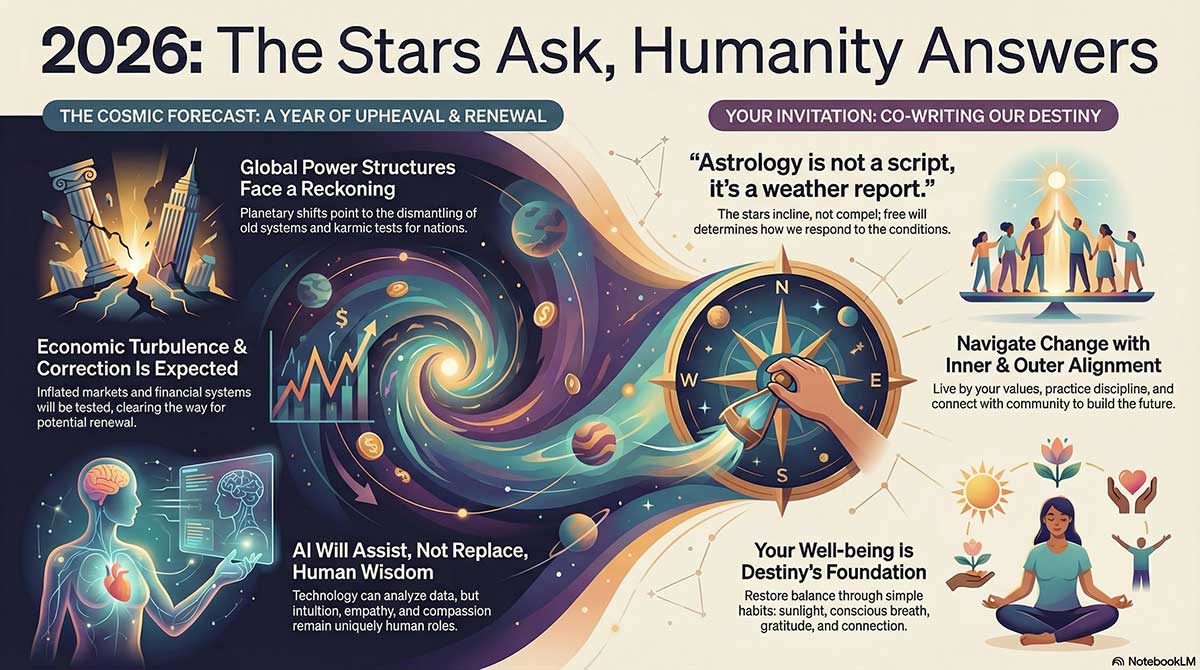
“We say this to our readers all the time: astrology is not a script, it’s a weather report. You can’t control if it rains, but you can carry an umbrella — or dance in the storm. Humanity can choose how to respond together.”
Question 2: If collective free will is real, how can we see it shaping 2026?
Evangeline Adams:
“In 2026, I see cycles that mirror the years before great social upheaval. But whether we meet it with fear or innovation depends on our collective response. The stars hand us the season — but we choose how to plant in it.”
The AstroTwins:
“Pluto in Aquarius is huge for community. We’ll either see movements that reshape society toward equality — or backlash if people cling to the past. Collective free will will decide which storyline wins.”
Robert Currey:
“I’ve mapped astrocartography patterns for 2026, and global hotspots of tension overlap with innovation hubs. That means humanity faces a fork: collapse in some areas, breakthroughs in others. Free will determines which dominates.”
Alan Leo:
“We are entering what could be an awakening cycle. But awakening is not automatic. It requires conscious choice — otherwise, we’ll repeat old errors under new disguises.”
Jennifer Freed:
“As a psychologist, I see 2026 as an emotional stress test. Collective free will is about emotional maturity: can we regulate fear, or will we lash out? Astrology gives the timing, but not the behavior.”
Question 3: What practical advice would you give to people who want to use their free will wisely in 2026?
Robert Currey:
“Think globally. Where you live, work, and move matters. Align yourself with regions and communities that embody the future you want.”
Alan Leo:
“Cultivate inner character. The nobler your thoughts, the nobler your destiny. Humanity rises not by luck but by the development of virtue.”
The AstroTwins:
“Find your crew. Free will is stronger when it’s collective. Surround yourself with people building the future you want to see.”
Evangeline Adams:
“Do not fear the stars. Study them, yes, but then go live bravely. Astrology shows the weather, but courage changes the outcome.”
Jennifer Freed:
“Practice mindfulness. The more conscious you are of your inner world, the less likely you’ll act from fear. Free will begins with awareness.”
Closing Summary
“From tonight’s conversation, one truth shines: the stars do not bind us — they awaken us. 2026 may carry the imprint of tension and possibility, but what humanity does with that moment is not written in stone. The cosmos provides the stage, but the play is ours to perform.”
Topic 3: Technology and Spirit — Astrology in the Age of AI
- Kyle Thomas (USA, pop culture astrologer, PEOPLE magazine, tech-savvy)
- Susan Miller (USA, AstrologyZone, mainstream reach)
- Madalyn Aslan (USA/UK, relationship & life guidance focus)
- Dr. Jai Madaan (India, blending astrology with motivational speaking)
- T. Selva (Malaysia, Vastu + astrology, cross-cultural insight)
Host (Carl Sagan)
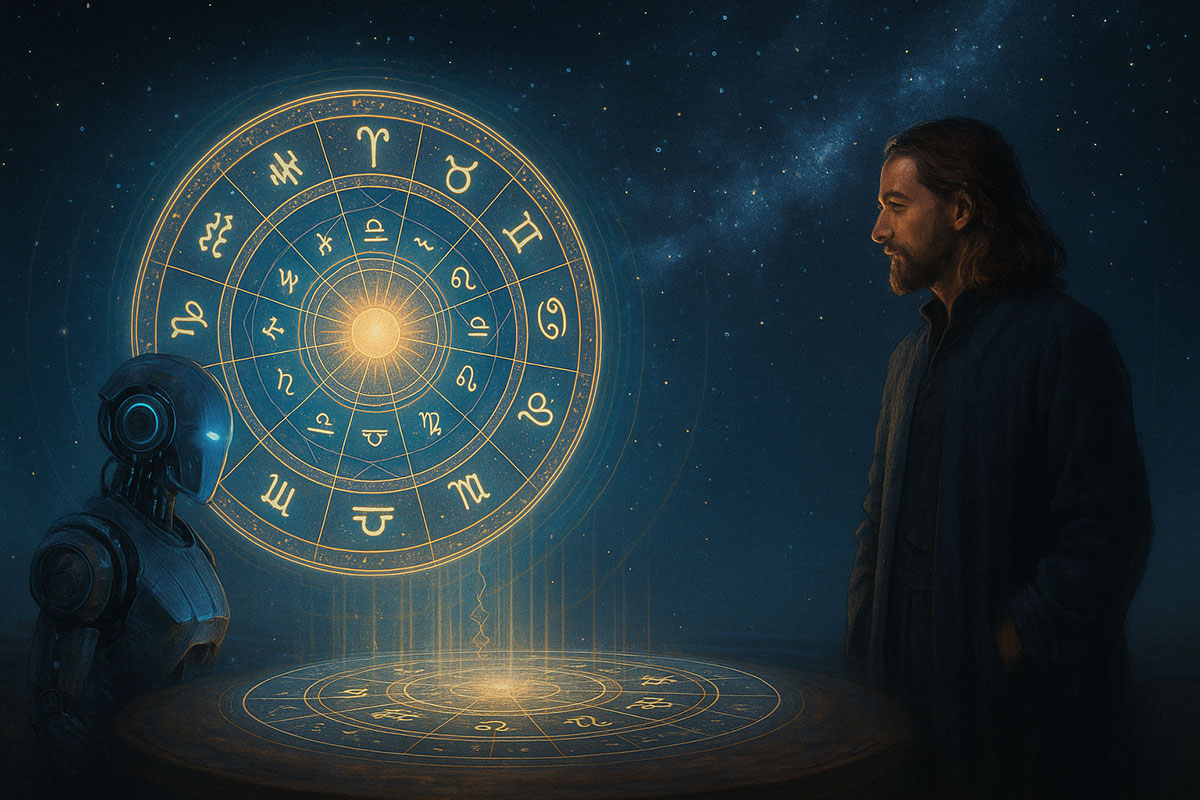
“Technology is advancing faster than ever, with artificial intelligence reshaping how we think, work, and even imagine the future. My question tonight is this: How does astrology fit into a world increasingly run by machines? Will AI replace, support, or transform astrology itself?”
Question 1: What do you see as the role of astrology in an AI-driven world?
Susan Miller:
“Astrology is timeless because it speaks to the human heart. AI can crunch data, but it can’t feel. My role isn’t just to calculate charts — it’s to offer empathy and guidance. Machines can help with precision, but they can’t replace compassion.”
Kyle Thomas:
“I see astrology and AI merging in pop culture. Apps are already generating horoscopes, but people still come to astrologers for context and meaning. AI can expand access, but the soul-to-soul connection remains uniquely human.”
Dr. Jai Madaan:
“In India, astrology has always been about guidance for living in harmony. Technology can spread this wisdom more widely. But it is dangerous if people begin to treat AI predictions as absolute truth, without understanding context.”
Madalyn Aslan:
“I agree — astrology is not just calculation, it’s interpretation. AI can print a chart in seconds, but it cannot hear the tremor in someone’s voice or sense their hidden fears. Spirit requires presence.”
T. Selva:
“AI is a tool, nothing more. Just as we use telescopes to see the stars, AI can help process patterns. But the sacred act of reading those patterns belongs to human intuition.”
Question 2: Can technology like AI deepen astrology, or does it risk stripping away its soul?
Kyle Thomas:
“I think it can deepen it. Imagine AI sorting thousands of charts to identify collective themes. That’s powerful. But the astrologer is still needed to translate those patterns into real-life meaning.”
Susan Miller:
“Yes, but I’m cautious. Too much reliance on AI risks reducing astrology to generic predictions. Astrology is personal, nuanced. Without the human touch, people may feel more lost, not less.”
Dr. Jai Madaan:
“In India, we say: tools should serve the soul, not the other way around. If technology is used to amplify understanding, it is good. If it replaces wisdom with shortcuts, it is harmful.”
Madalyn Aslan:
“Exactly. Astrology is poetry as much as science. AI can mimic the words, but not the music. The risk is losing the depth of the human voice.”
T. Selva:
“I’ve seen technology help with teaching. Apps, videos, and online courses spread knowledge. But the soul is in the teacher’s eyes, in the relationship. Without that, astrology becomes a shell.”
Question 3: What advice would you give ordinary people trying to navigate astrology in an AI era?
Madalyn Aslan:
“Don’t outsource your intuition. Use apps if you like, but always check in with your own feelings. No machine knows you better than your own heart.”
Kyle Thomas:
“See AI as a gateway, not a guru. Let it introduce you to astrology, but go deeper with human teachers who understand context and nuance.”
Susan Miller:
“Choose astrologers you trust. AI will produce mountains of content, but discernment matters. Follow voices who give you hope and direction, not fear.”
Dr. Jai Madaan:
“Balance technology with tradition. Read the texts, study the cycles, talk to elders. Let AI assist, but let wisdom guide.”
T. Selva:
“My advice is simple: treat AI as a servant, not a master. Astrology is sacred dialogue with the cosmos — never let a machine be the final word.”
Closing Summary
“Tonight we’ve heard a profound message: AI can calculate, analyze, even pattern-match. But it cannot replace human intuition, compassion, or wisdom. The stars may be read by machines, but their meaning must still be sung by human voices. In the age of AI, astrology may change its form — but not its soul.”
Topic 4: Money, Power, and Abundance — What Do the Stars Say About the Global Economy?

Bejan Daruwalla (India, intuitive global predictions)
Acharya Indravarman (India, Vedic scholar, economic cycles)
Ramanada Guruji (India/USA, practical career & finance guidance)
Yuko Ishibashi (Japan, grounded wealth-flow insights)
Taishi Asano (Japan, tarot + astrology, wealth as freedom of choice)
Host (Carl Sagan)
“Money may seem like a purely human invention, but astrologers have long believed that planetary cycles shape abundance, scarcity, and the balance of power. As we look to 2026, I want to ask: What do the stars suggest about wealth, power, and the way humans pursue abundance?”
Question 1: What does astrology teach us about money and abundance?
Bejan Daruwalla:
“Money is simply energy — and astrology shows how that energy flows. When Jupiter smiles, generosity abounds. When Saturn rules, restraint is needed. The secret is not fearing these cycles, but dancing with them.”
Yuko Ishibashi:
“In Four Pillars, wealth is about grounding dreams in reality. Money is not only coins; it is the ability to make ideas tangible. True abundance comes when vision and action are aligned.”
Acharya Indravarman:
“In Vedic astrology, wealth is tied to dharma. The second and eleventh houses show material resources, but unless guided by righteous purpose, money will destroy rather than sustain. Wealth must serve, not enslave.”
Taishi Asano:
“I see wealth as freedom. Money gives choices — to say no to what drains us and yes to what inspires us. Astrology doesn’t just show how much wealth, but how we are meant to use it.”
Ramanada Guruji:
“Money reflects karma. Some charts show easy gain, others hard labor. But even then, remedies exist — charity, discipline, mantras — to shift the flow. Abundance is earned not just in effort, but in intention.”
Question 2: What do the cycles suggest about 2026 and the global economy?
Acharya Indravarman:
“2026 shows turbulence. Saturn and Rahu indicate correction in inflated markets. Expect debts and financial systems to be tested. But from correction comes renewal — a more balanced economy may rise.”
Bejan Daruwalla:
“I see both crisis and hope. Jupiter promises breakthroughs in digital currencies, but Saturn warns of greed. A storm, yes — but storms clear the sky. The wise will plant after the rain.”
Yuko Ishibashi:
“For individuals, 2026 is a year to be practical. Save, stabilize, and avoid reckless risk. Globally, it feels like a pause, as if the world must catch its financial breath.”
Ramanada Guruji:
“From my readings, 2026 is a karmic balancing year. Nations that exploited resources without care will face consequences. But those who prepared with honesty and discipline may thrive.”
Taishi Asano:
“The cards and the stars both show transition. Old systems wobble, new ones emerge. For people, the lesson is adaptability — to move with the shift rather than resist it.”
Question 3: What practical guidance would you give individuals navigating money in 2026?
Yuko Ishibashi:
“Respect your money. Keep your wallet clean, record your spending, and treat every dollar with gratitude. Order outside creates flow inside.”
Bejan Daruwalla:
“Give before you receive. A small act of generosity opens the gates of fortune. The miser locks the flow; the giver rides the stream.”
Ramanada Guruji:
“Focus on skills, not speculation. Money in 2026 will favor those with real abilities, not empty promises. Invest in yourself first.”
Taishi Asano:
“Write down your goals and tie each to a daily step. Abundance is not magic; it is a rhythm you align with. Intentionality attracts resources.”
Acharya Indravarman:
“Live within dharma. Earn honestly, spend wisely, give humbly. Align with these principles, and even in turbulent years, prosperity will follow.”
Closing Summary
“What we’ve heard is clear:
- Wealth is not only numbers but energy, freedom, and responsibility.
- 2026 brings correction, turbulence, and the chance for renewal.
- And for individuals, the guidance is simple yet profound: practice gratitude, generosity, discipline, and adaptability.
Astrology reminds us that money is not just survival, but a mirror of our values and choices. The question for 2026 is not only how much we have — but what kind of world we build with it.”
Topic 5: Health, Energy, and the Human Body — Astrology’s Role in a Shifting World

- Benizumi (Japan, words/vibration, health connection)
- Kei Aki (Japan, lifestyle and energy flow alignment)
- Tomoe Aki (Japan, health tendencies as “assignments”)
- Jennifer Freed, Ph.D. (USA, psychological astrology + wellness)
- Steven Forrest (USA, evolutionary astrology, soul + health balance)
Host (Carl Sagan)
“Health is often seen as a matter of biology and medicine. But astrologers have long believed the stars reveal patterns of strength and weakness in both body and spirit. Tonight, I want to ask: What role does astrology play in helping us live healthier, more balanced lives — especially as the world shifts in 2026?”
Question 1: How does astrology reveal our health tendencies?
Benizumi:
“Every word we speak carries vibration. Charts show where those vibrations settle in the body. If water is weak, words of fear affect the kidneys; if fire is weak, anger burns the heart. Astrology is a map of where we must be gentle with ourselves.”
Jennifer Freed:
“In my practice, astrology highlights psychological patterns that often manifest physically. Someone with Saturn heavily placed might experience chronic tension. Awareness helps us treat the mind and body as one system.”
Steven Forrest:
“I see astrology as describing a soul’s lessons. A health vulnerability in the chart is not a punishment, but a call to consciousness. If the lungs are sensitive, maybe your life’s work is learning to breathe deeply — literally and spiritually.”
Kei Aki:
“Energy flow is key. Charts reveal where qi stagnates. If we know this, we can choose exercise, diet, and rhythms that keep our energy moving freely.”
Tomoe Aki:
“I often tell clients: health weaknesses are homework. They are not destiny carved in stone. They are invitations to transform weakness into strength through care and discipline.”
Question 2: What most often throws people out of balance in mind and body?
Jennifer Freed:
“The biggest factor is disconnection — from self, from others, from nature. When we lose connection, we lose balance. Astrology can help us remember we are part of a larger rhythm.”
Kei Aki:
“I see irregular living as the culprit. Erratic sleep, skipped meals, chaotic schedules — these disrupt natural harmony, and the weak points in the chart suffer first.”
Benizumi:
“Negative speech. Repeating ‘I’m tired,’ ‘I hate this,’ plants those truths in the body. Your words either heal or harm. This imbalance begins in the tongue before the body.”
Steven Forrest:
“Suppression. When people bury feelings, the body carries them. A chart can show where emotion hides. Illness is often the body shouting what the soul suppressed.”
Tomoe Aki:
“Isolation. Humans are not meant to be cut off. When people wall themselves in, energy grows cold, and the body weakens. Connection is medicine.”
Question 3: What daily practices can strengthen health and, in turn, our destiny?
Kei Aki:
“Begin with morning sunlight. Ten minutes a day resets your yin and yang, balances hormones, and lifts energy. The chart shows the tendency, but sunlight heals the flow.”
Steven Forrest:
“Breathing rituals. Conscious breath is the bridge between soul and body. It’s the simplest yet most profound way to align with destiny.”
Jennifer Freed:
“Mindful reflection. Journaling or meditation helps prevent unconscious stress from becoming illness. Awareness is the first medicine.”
Benizumi:
“Speak gratitude. Words like ‘thank you’ and ‘I’m well’ ripple through the body as healing waves. Change your words, and you change your health.”
Tomoe Aki:
“Keep rhythm. Regular sleep, meals, and movement synchronize you with cosmic order. Health thrives on rhythm, just as planets move in rhythm.”
Closing Summary
“From our panel tonight, one theme shines: health is not just physical. It is vibrational, emotional, and spiritual.
- Charts reveal where we are sensitive, but also where we are invited to grow.
- Imbalance arises from disconnection, suppression, negative words, irregularity, or isolation.
- And balance can be restored through simple habits: sunlight, breath, reflection, gratitude, and rhythm.
In 2026 and beyond, astrology reminds us that caring for the body is not separate from destiny — it is destiny’s foundation.”
Final Thoughts By Carl Sagan
As this gathering of astrologers comes to a close, we are left with more than forecasts of 2026. We are left with questions about ourselves.
The cosmos is vast beyond comprehension, yet we insist on finding our place within it. Whether through astrology, science, myth, or faith, we seek to know: What story are we living?
The voices we’ve heard suggest that destiny is not a prison, but a dialogue. The stars may sketch the outlines, but the coloring is ours to choose. The heavens may signal the seasons, but it is human hands and hearts that decide what we plant and how we harvest.
In the end, perhaps the greatest gift of astrology is not prediction, but perspective. It reminds us that we are part of a larger rhythm, woven into a universe both mysterious and magnificent. And in that rhythm, we are not passive passengers, but conscious participants.
The stars do not compel. They inspire. And as we step into 2026, the question remains: will we live by fear, or will we live by wonder?
Short Bios:
Ptolemy — Ancient Roman scholar and author of Tetrabiblos, one of the foundational texts of Western astrology, linking celestial movements with earthly events.
Nostradamus — Sixteenth-century French seer and astrologer, best known for his prophetic quatrains, which continue to influence mystical interpretations of the future.
K. N. Rao — Renowned Indian Vedic astrologer, teacher, and author, celebrated for his precise predictive methods and his role in advancing Jyotisha scholarship.
Chani Nicholas — Canadian astrologer and author of You Were Born for This, known for her progressive, inclusive approach and empowering astrology app, Chani.
Steven Forrest — American astrologer and key figure in Evolutionary Astrology, emphasizing free will, psychological growth, and the soul’s unfolding journey.
Alan Leo — British astrologer often called the “Father of Modern Astrology,” who shifted astrology from rigid fate to character-driven free will in the early 20th century.
Evangeline Adams — Pioneering American astrologer who brought astrology into mainstream culture in the early 1900s, famously winning legal recognition for her practice.
Robert Currey — UK-based astrologer and astrocartography expert, founder of The Astrology Shop in London, known for mapping planetary influences across geography.
Jennifer Freed, Ph.D. — American psychological astrologer, author, and educator who blends depth psychology with astrology to promote personal growth and well-being.
The AstroTwins (Ophira & Tali Edut) — Identical twin astrologers, co-founders of Astrostyle, widely known for their accessible horoscopes and lifestyle astrology content.
Kyle Thomas — U.S. astrologer and pop culture writer for People magazine, specializing in making astrology relevant to entertainment and modern life.
Susan Miller — One of America’s most widely read astrologers, founder of Astrology Zone, known for her detailed monthly forecasts and mainstream influence.
Madalyn Aslan — American-British astrologer and author, dubbed “The Love Guru” by The New York Times, specializing in relationships and life guidance.
Dr. Jai Madaan — Indian astrologer, motivational speaker, and television personality who integrates Vedic astrology with modern life coaching.
T. Selva — Malaysian astrologer and columnist, respected for bringing Vedic astrology and Vastu Shastra teachings to a global audience.
Bejan Daruwalla — Celebrated Indian astrologer (1931–2020), famous for his intuitive style and bold global predictions that drew international attention.
Acharya Indravarman — Indian Vedic astrologer recognized for his scholarship and insights into economic and societal cycles.
Ramanada Guruji — Indian-born astrologer with an international practice, noted for practical readings in finance, career, and personal well-being.
Yuko Ishibashi — Japanese astrologer specializing in Four Pillars of Destiny, known for her grounded teachings on wealth, balance, and stability.
Taishi Asano — Japanese astrologer and author who blends tarot with astrology, often focusing on money, abundance, and the freedom of choice.
Benizumi — Japanese astrologer and teacher who emphasizes the connection between language, vibration, and physical health in her practice.
Kei Aki — Japanese consultant specializing in lifestyle and energy flow, advising on aligning daily routines with natural astrological rhythms.
Tomoe Aki — Japanese Four Pillars practitioner who interprets health vulnerabilities as “assignments,” encouraging people to transform weaknesses into strengths.
Leave a Reply