
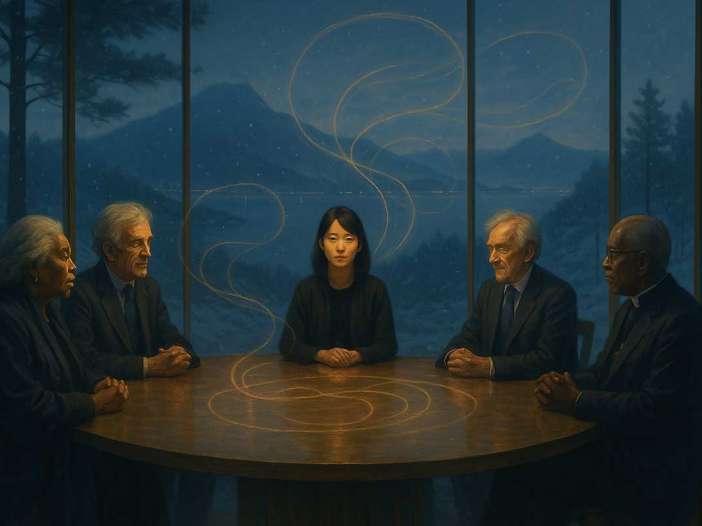
Introduction by Han Kang
When I began to write about the dead, I did not imagine I was writing about myself. But the more I listened—to the silences between sentences, to the tremors of memory in the body—I realized that the line separating the living from the lost is made only of breath.
This series of conversations began with a question that has no end: Can art heal historical trauma? I found that art does not heal—it remembers. It kneels beside the wound and refuses to look away. In that refusal, something luminous begins to grow.
Each gathering in these pages—a circle of poets, thinkers, and witnesses—echoes a single heartbeat that has traveled across centuries. From Toni Morrison’s insistence on beauty as survival, to Thích Nhất Hạnh’s stillness, to Rilke’s quiet faith in transformation, I felt what it means to remember not as historians, but as human beings who are still learning how to love.
We speak of bodies that remember, of silence that speaks, of love that outlasts death, and of witnessing that redeems no one but refuses to abandon anyone. These are not answers. They are acts of listening. And in the listening, we become part of the same fragile, enduring memory—the one that keeps saying: We do not part.
(Note: This is an imaginary conversation, a creative exploration of an idea, and not a real speech or event.)
Topic 1 — The Ethics of Remembering: Can Art Heal Historical Trauma?
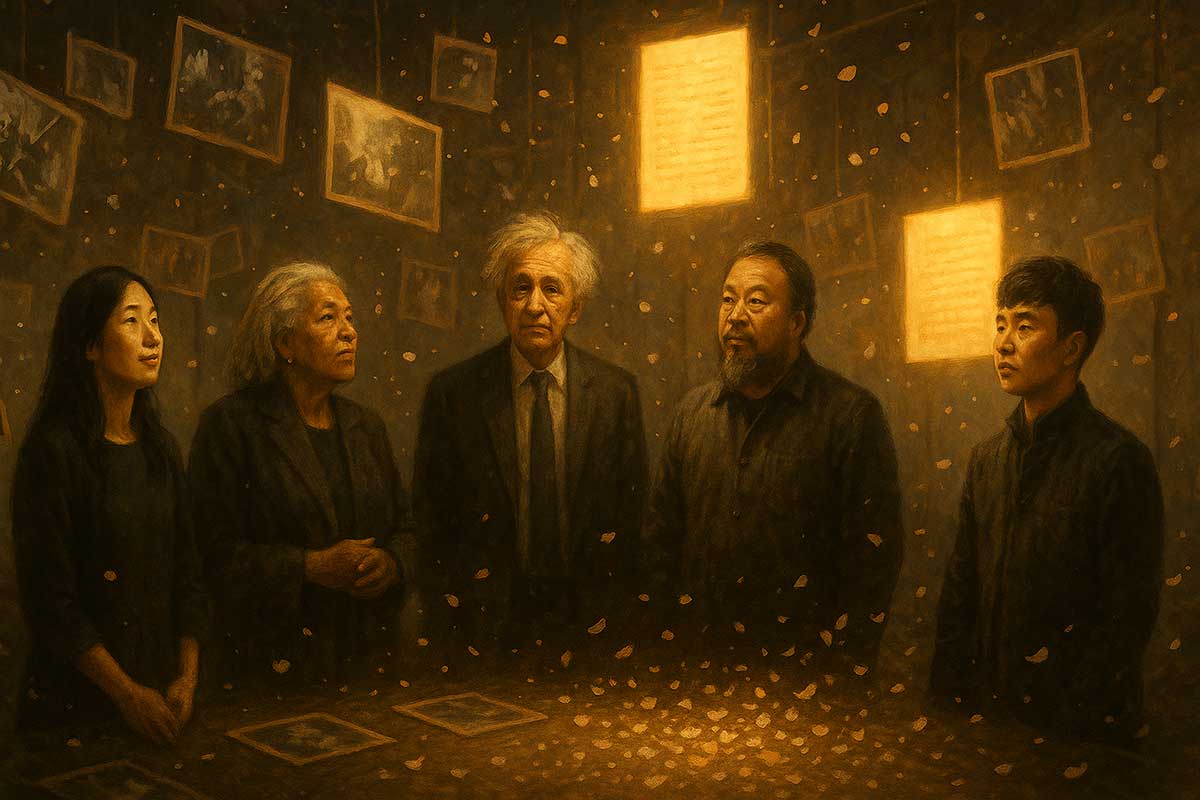
Participants: Han Kang, Toni Morrison, Elie Wiesel, Ai Weiwei, Ocean Vuong
Moderator: Margaret Atwood
Margaret Atwood (opening)
When the unspeakable happens, artists often reach for language, image, or song to make sense of it. Yet, in doing so, we risk turning agony into spectacle. Tonight we ask: When artists transform human suffering into beauty, do they risk aestheticizing pain—or is beauty itself a form of resistance that restores dignity to the lost?
Han Kang
When I write of the dead, I do not try to make them beautiful. I try to touch the edge of their silence. In We Do Not Part, the landscape is white because memory erases color. If that whiteness appears beautiful, it is because grief sometimes shines against our will. Beauty, to me, is not decoration—it is the last language of empathy.
Ai Weiwei
Art is a mirror that can wound. When I show fragments from demolished temples or bones beneath foundations, people call it beautiful. But beauty, in such work, is an ambush: it lures the eye so the conscience cannot escape. To deny beauty entirely would be to repeat the state’s violence—the erasure of feeling.
Toni Morrison
Suffering alone has no meaning. It becomes story when the artist gives it a rhythm, a breath. The beauty of that rhythm does not diminish the horror—it keeps it alive in the memory’s ear. Think of the spirituals sung in chains. They were not pretty songs; they were coded maps of survival.
Elie Wiesel
In the camps, I saw the death of beauty. Later, when I wrote, I feared every sentence might betray that death. But silence is also betrayal. Between silence and testimony, we must choose the wound that bleeds with truth. If beauty arises, it must be accidental, never deliberate.
Ocean Vuong
Perhaps beauty is the bruise that proves we’re still alive. I don’t seek it; it finds me in the tenderness between griefs. To make art from pain is not to polish it—it’s to give it breath so it doesn’t rot inside us. Beauty isn’t the opposite of horror; it’s what grows from it like grass through cracks.
Margaret Atwood
Let’s go deeper. Who owns the right to remember—the survivor, the witness, or the storyteller who comes generations later?
Elie Wiesel
Memory belongs to the living, but truth belongs to everyone. The survivor guards a flame; the next generation must carry it without claiming authorship. To steal another’s trauma is indecent—but to turn away from it is worse.
Toni Morrison
The story is not property. It is inheritance. Those who receive it are bound by its ghosts. A writer’s duty is not to own memory but to become responsible to it—to give it shelter until it can rest.
Ai Weiwei
In China, the state claims ownership of memory. That is why I break it and remake it. The right to remember is a form of civil disobedience. When the storyteller is silenced, the people forget what freedom tastes like.
Han Kang
In Korea, many still fear remembering. The dead wait for our voices. Sometimes I feel I am borrowing their breath, and it frightens me. The right to remember comes with debt. Every sentence I write must repay it in tenderness.
Ocean Vuong
I am the child of refugees, so all my memories are secondhand. Yet they live in my blood as if I were there. Memory is not a possession—it’s an infection of empathy. We inherit the ache, not the proof. And maybe that’s enough to make art.
Margaret Atwood
Our final question: Can a single act of artistic remembrance truly heal collective trauma, or does every remembrance inevitably reopen the wound?
Toni Morrison
Healing and wounding are siblings. When you clean a wound, it hurts. To reopen pain is not cruelty; it is care. The danger lies in forgetting before the cleaning is done.
Han Kang
In Jeju’s soil, there are bones that will never be named. Writing about them does not heal; it keeps them from disappearing twice. Healing, perhaps, belongs to the future—the unborn who inherit a more truthful silence.
Elie Wiesel
Collective trauma is a question without an answer. But each witness who dares to speak makes the world slightly less uninhabitable. Healing is not forgetting the scar; it is learning to live beside it.
Ocean Vuong
Art doesn’t close the wound—it teaches us how to breathe through it. Maybe healing isn’t an ending but a rhythm, like the tide washing over the same grief until it becomes sand.
Ai Weiwei
Every remembrance is a crack in the wall of censorship. The wound is the entrance where light enters history. We do not heal by sealing it; we heal by keeping it open enough for others to see.
Margaret Atwood (closing)
We began with a question of art and pain, and end with an image of light through a wound. Perhaps that’s what remembrance truly is—not the mending of what’s broken, but the refusal to let it vanish. As Han Kang writes: “We do not part.” In art, in grief, in witness—maybe we never do.
Topic 2 — The Body Remembers What the Mind Forgets
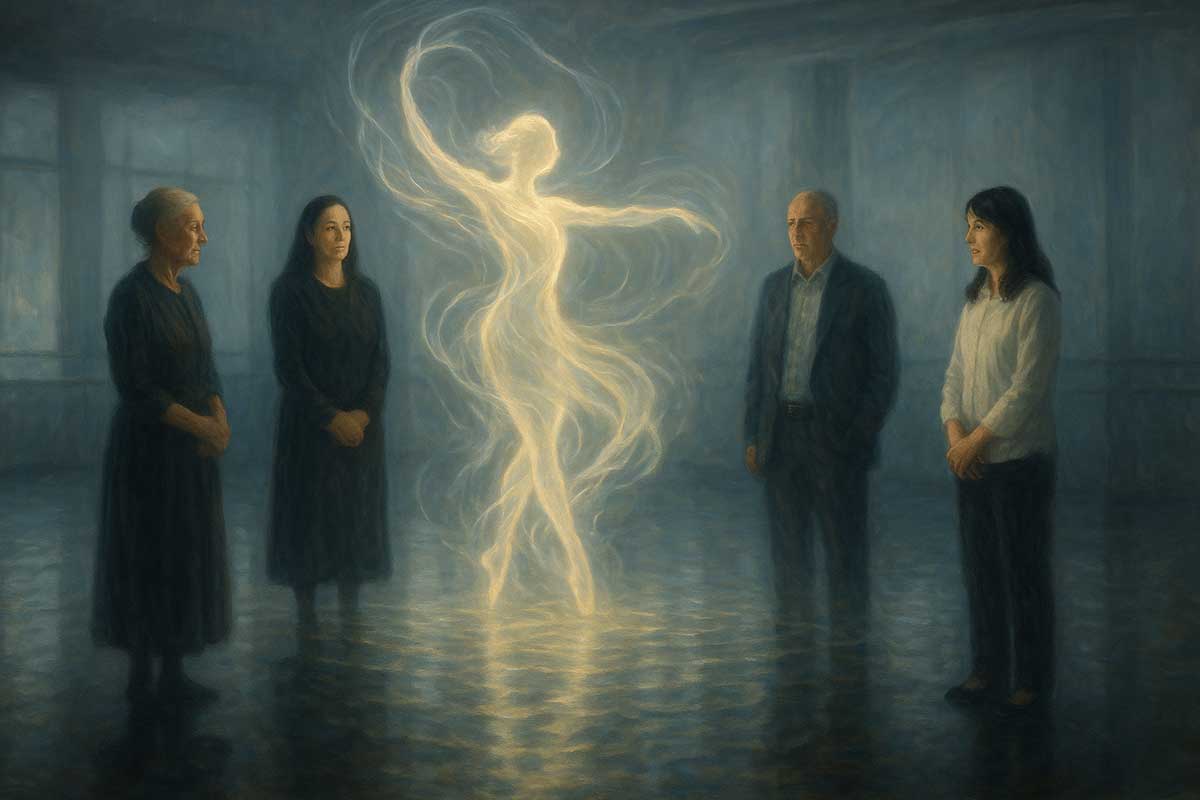
Participants: Bessel van der Kolk, Han Kang, Martha Graham, Marina Abramović, Clarissa Pinkola Estés
Moderator: Jon Kabat-Zinn
Jon Kabat-Zinn (opening)
So many of us think healing happens through talking, through understanding. Yet the body has its own memory—cellular, instinctive, untranslatable. Tonight, we ask: If trauma lives in the body, what forms of art, movement, or ritual allow the body to finally exhale the past?
Bessel van der Kolk
Trauma traps the nervous system in a loop of unfinished action. The body prepares to fight or flee, but never completes the motion. Practices like dance, breathwork, yoga—these reopen the frozen pathways. Healing begins not with words, but with movement that tells the body, “It’s over now. You survived.”
Martha Graham
Every dance I’ve ever created was born from contraction and release—the body remembering and then letting go. The dancer’s spine holds history; the gesture becomes confession. Movement is not a metaphor for emotion. It is emotion made visible.
Han Kang
When I write, I feel pain in my shoulders, as if the dead are leaning on me. In We Do Not Part, the body trembles because it knows before the mind does. Writing becomes a small ritual of release—my fingers translating the pulse of the invisible.
Marina Abramović
The body doesn’t lie. It carries truth the intellect avoids. In my performances, when I endure stillness or pain, the body becomes a temple of memory. By pushing it to its limit, I invite the audience to remember their own thresholds. That shared endurance is purification.
Clarissa Pinkola Estés
In the old medicine ways, the body is not a container but a storyteller. We heal by re-storying the flesh—by dancing the wolf, by crying in the river, by letting our tears feed the earth. The body releases when the soul feels seen.
Jon Kabat-Zinn
Let’s continue. Is healing possible without understanding—or does the body’s silent wisdom sometimes know more than consciousness ever can?
Han Kang
Understanding is a luxury of peace. The body begins healing before language catches up. In the dark, a wound closes without asking why it was made. Perhaps the body forgives faster than the mind ever will.
Bessel van der Kolk
That’s true. Neuroscience shows that insight alone doesn’t regulate the amygdala. You can know why you panic and still panic. But once the body experiences safety—through breath, touch, rhythm—the brain follows. Understanding is the mind’s apology for what the body already knew.
Martha Graham
When I created “Lamentation,” I didn’t understand grief—I embodied it. Understanding came later, from the sweat and breath of doing. The dancer doesn’t explain the storm; she becomes its eye.
Clarissa Pinkola Estés
The body speaks first, in the language of ache, tightness, tremor. The mind is the interpreter, sometimes clumsy, often deaf. Healing begins when we remember the body is the oldest mind of all.
Marina Abramović
I’ve sat for hours without moving, letting pain become teacher. After time, the body enters a sacred silence where meaning dissolves. That silence is understanding beyond thought—a direct knowing.
Jon Kabat-Zinn
Our final reflection: In a culture obsessed with progress, what happens when the body insists on remembering what the mind wants to forget?
Bessel van der Kolk
We call it “symptom”—anxiety, addiction, fatigue—but really it’s protest. The body refuses to be left behind. When society prizes speed and distraction, the body slows us down with pain, saying: “Listen.” If we don’t, it will keep speaking louder.
Marina Abramović
The world numbs itself with technology, consumption, performance. But the body is ancient—it remembers death, love, hunger. When we ignore it, we exile our humanity. Art that shocks or stills us is the body of culture trying to wake itself.
Han Kang
Korea rebuilt itself so quickly after war that forgetting became virtue. But the bones still speak through the soil. When the nation’s mind forgets, the land’s body remembers. The body of a people carries the ache until someone listens in art.
Clarissa Pinkola Estés
When the body remembers, it is not punishing us—it is asking for ceremony. The ache is an invitation to return to rhythm, to ritual, to the story that was interrupted. Only then can the ghost of the forgotten rest.
Martha Graham
The body’s memory is rebellion against erasure. Every movement that reclaims what was silenced is progress of the soul. True progress is not forward—it is downward, back into the body’s deep remembering.
Jon Kabat-Zinn (closing)
We’ve spoken of pain as protest, silence as wisdom, movement as release. Perhaps the lesson is this: the body never lies, and never forgets. Our work is to meet its remembering with compassion, not impatience—to breathe with it, until its trembling becomes peace.
Topic 3 — Silence as Language: What Cannot Be Said
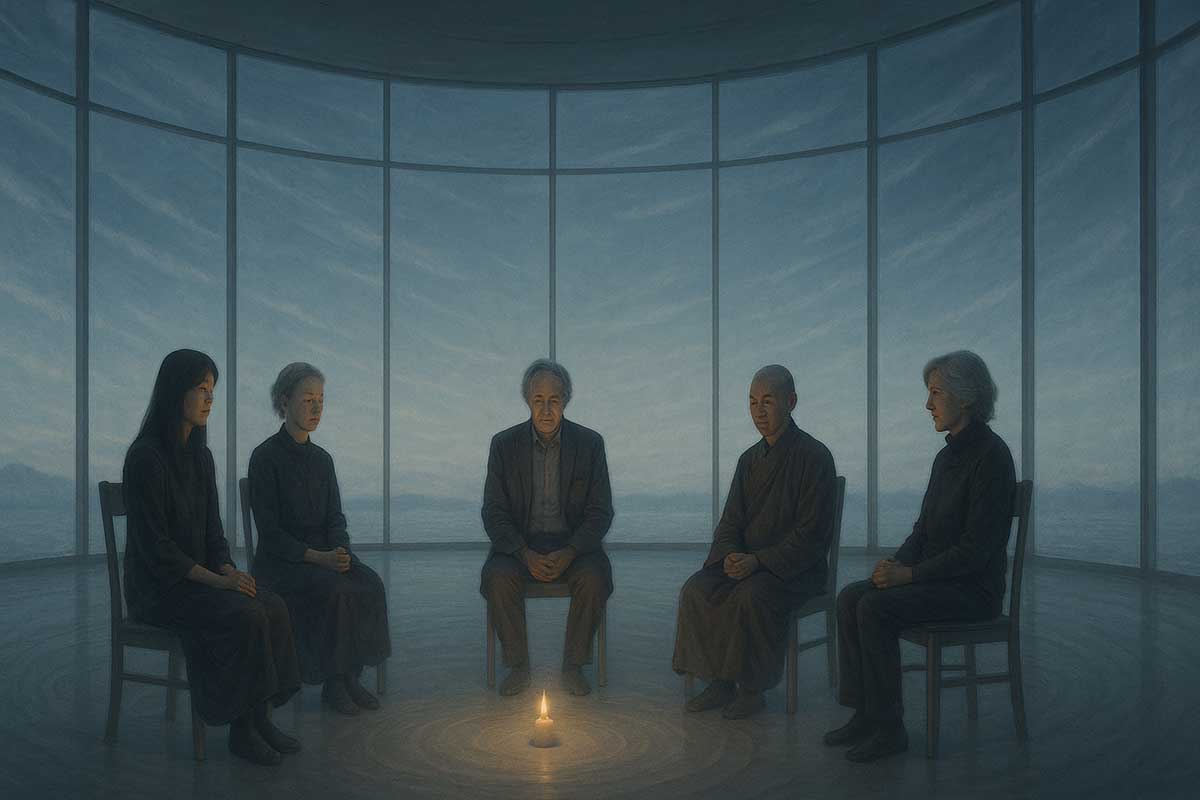
Participants: Han Kang, Emily Dickinson, John Cage, Thích Nhất Hạnh, Susan Sontag
Moderator: Pico Iyer
Pico Iyer (opening)
Some truths refuse to live in sound. Words fracture, explanations fail, and all that remains is quiet. Yet silence, too, has its dialects—reverence, fear, resistance, grief. Tonight we ask: Can silence ever tell the truth more faithfully than words—or is silence merely the last refuge when truth becomes unbearable?
Han Kang
Silence is where language begins. In the aftermath of violence, speech can feel like betrayal. But silence isn’t absence; it’s a pulse. In We Do Not Part, what isn’t said holds the most weight—the snow, the breath, the stillness between screams.
John Cage
I wrote a piece of music with no notes—four minutes and thirty-three seconds of nothing, yet everything. The cough, the rustle, the heartbeat of the room became the sound. Silence is never empty. It listens back.
Emily Dickinson
I found that silence tells the truth in fragments. “Tell all the truth but tell it slant,” I once wrote, for the straight truth blinds us. My quiet was not surrender—it was precision.
Thích Nhất Hạnh
When we sit in mindful silence, we do not escape truth; we return to it. Words divide the present. Silence reunites us with what is. In deep listening, silence becomes compassion itself.
Susan Sontag
Yet we must beware the sanctification of silence. In certain regimes, silence is complicity. In art, silence can be profound; in politics, it can be lethal. We must ask who benefits from the quiet.
Pico Iyer
Beautiful, and troubling. Let’s deepen this tension: How do we distinguish between sacred silence that honors pain and oppressive silence that protects power?
Susan Sontag
That distinction is everything. Sacred silence opens space for reflection; oppressive silence closes it. When governments suppress testimony, that’s not silence—it’s censorship disguised as order. The artist’s duty is to break that kind of quiet.
Han Kang
In my country, for decades the dead were forbidden to speak. I write into that forbidden quiet. To honor pain is to listen to it without distortion, but to protect power is to cover its noise with snow. The moral difference lies in intent: whether the silence protects the weak or the strong.
Thích Nhất Hạnh
Right speech includes right silence. To keep silent out of fear is wrong speech. But to keep silent to prevent harm or to allow understanding to arise—that is compassion. The heart knows which silence it is.
Emily Dickinson
Oppressive silence feels cold—its hush has edges. Sacred silence is tender; it breathes. The soul can tell which kind it’s in. One binds the spirit, the other frees it.
John Cage
Both silences contain sound. In oppressive silence, we hear tension—a vacuum that aches. In sacred silence, we hear continuity—the hum of being. The difference is not volume but vibration.
Pico Iyer
Let’s close with this: When the world shouts for expression and visibility, what does it mean to choose stillness, absence, or quiet as resistance?
Han Kang
To choose silence is to reclaim tempo from chaos. The world shouts to forget itself. Quiet is rebellion because it remembers. Each pause in art becomes a small sanctuary against noise.
Emily Dickinson
I withdrew not to vanish but to preserve the purity of perception. In a world obsessed with noise, invisibility becomes a form of freedom. The unseen can see more clearly.
John Cage
Stillness dismantles control. When you listen instead of perform, ego dissolves. Resistance through quiet is not passivity—it’s disobedience to the tyranny of meaning.
Susan Sontag
Yes—but silence must be earned. Too often, the privileged adopt quiet as aesthetic detachment while others are forced into it. True resistance requires awareness of that imbalance.
Thích Nhất Hạnh
Silence, when rooted in mindfulness, is the loudest voice of peace. It doesn’t flee the world—it transforms it. The lotus blooms not by arguing with the mud, but by being still within it.
Pico Iyer (closing)
We’ve heard silence as presence, protest, and prayer. Perhaps its greatest power lies in its paradox: it can conceal or reveal, wound or heal. To listen deeply—to ourselves, to others—is to speak the language of silence fluently.
Topic 4 — We Do Not Part: Love, Death, and the Persistence of Connection

Participants: Han Kang, Rainer Maria Rilke, Mary Oliver, Kahlil Gibran, Carl Jung
Moderator: Maya Angelou
Maya Angelou (opening)
Love and death—two rivers that shape the same valley. One fills the heart, the other empties it, yet both insist we are more than dust. Tonight, we explore a question rising from Han Kang’s words: Is love an act of clinging to life, or a surrender that allows us to touch eternity?
Rainer Maria Rilke
Love is not possession but transformation. When we love, we consent to being changed by another’s existence. That change survives even when the body falls away. To cling is to fear death; to surrender is to join the invisible.
Han Kang
When I wrote of death, I discovered it was braided with tenderness. To love is to hold the dying without demanding return. The act of care is already a kind of resurrection. We do not cling—we accompany.
Kahlil Gibran
Love and death are twins born of the same mother. In love, the soul stretches toward the infinite; in death, it remembers that infinity. The heart’s surrender is not defeat—it is the soul’s flight back to its source.
Mary Oliver
When I walk through the forest and see a deer vanish into the light, I feel that love too—wild and ungraspable. Love teaches us to touch lightly. Everything alive is already leaving, and that is what makes it holy.
Carl Jung
The soul seeks wholeness, not immortality. Love bridges conscious and unconscious, life and death. When we truly love, we glimpse the Self beyond ego, and in that moment, eternity brushes against time.
Maya Angelou
So much wisdom in one breath. Let’s move deeper: When those we love die, where do they continue—in our memory, in spirit, or in the fabric of the universe itself?
Mary Oliver
I see them in the moss, in the heron’s wing, in the patient light of morning. The dead do not leave; they scatter. Their kindness grows roots in our seeing.
Carl Jung
The psyche transcends physical boundaries. Death dissolves the form, but not the pattern. The energy that once took shape in a person continues as archetype, as dream, as unseen companion.
Han Kang
When my father died, I felt him as wind. Not metaphor, but presence—gentle, precise, wordless. I believe the dead continue wherever love is still being practiced. They live in the act, not the memory.
Kahlil Gibran
The spirit does not vanish; it changes garment. The beloved becomes fragrance in the air, light in another’s eyes. Memory is only the first veil. Beyond it, the soul communes directly, without speech.
Rainer Maria Rilke
“The dead are the ones who complete what we have begun.” They dwell in the widening silence of our love. If we listen rightly, their absence becomes a deeper form of presence.
Maya Angelou
And finally: What does it mean to say we do not part in a world built upon separation—of bodies, nations, and time?
Han Kang
To say we do not part is an act of defiance against despair. Connection endures beyond circumstance. The living and the dead share the same breath when love refuses to forget.
Rainer Maria Rilke
We never part because we are never finished with one another. The beloved’s absence is simply the shape love takes when seen through time. Separation is an illusion; longing is its proof.
Mary Oliver
Every atom we release returns to the same field. We walk through one another endlessly. If the soul has a geography, it’s the meadow between heartbeats where all who have ever loved meet again.
Carl Jung
Collective consciousness is the great unseen river binding us. The borders of self are porous; what we love flows into the universal. To realize we do not part is to awaken from the dream of isolation.
Kahlil Gibran
Love is the bridge no death can burn. We were never meant to possess each other, only to recognize the divine thread running through all. When we finally understand this, parting becomes impossible.
Maya Angelou (closing)
Perhaps the truth is simpler than philosophy dares: love does not die because it was never born. It only changes its clothing, its rhythm, its way of reaching us.
And when we whisper “we do not part,” maybe what we mean is: love is the one language the universe never stops speaking.
Topic 5 — Is There Redemption in Bearing Witness?
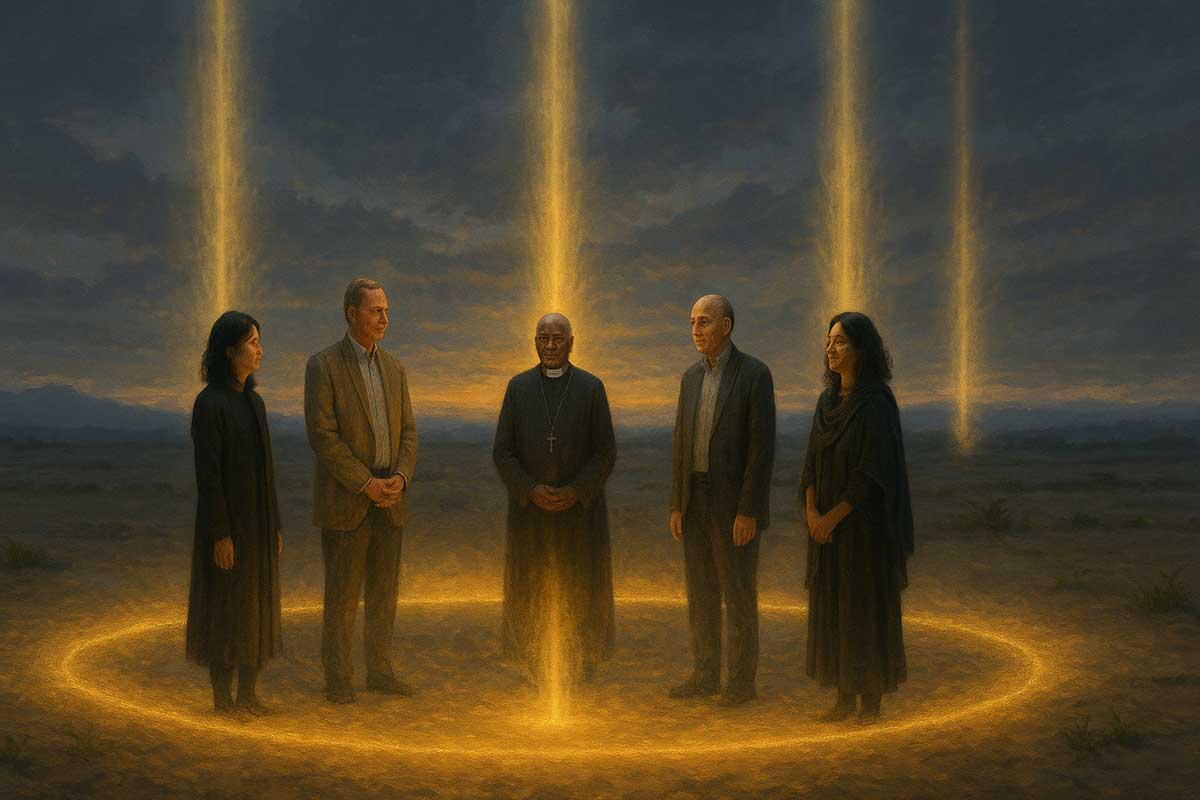
Participants: Han Kang, Václav Havel, Primo Levi, Desmond Tutu, Arundhati Roy
Moderator: Nick Sasaki
Nick Sasaki (opening)
To bear witness is to step into another’s pain—and sometimes to be changed by it. But can witnessing heal, or does it simply remind us how deep the wounds still run? Tonight we explore: When we bear witness to horror, do we cleanse the past or merely document its persistence?
Primo Levi
I once thought testimony might cleanse, but memory corrodes as much as it preserves. Bearing witness does not redeem the past; it redeems the present moment from ignorance. If a man listens and refuses denial, that is already a kind of purification.
Han Kang
Writing about suffering doesn’t wash it away; it stains the hands differently. The act of witnessing is a trembling one—it keeps the dead alive just enough to be seen. Cleansing is not the goal; truth is.
Desmond Tutu
When I chaired South Africa’s Truth and Reconciliation Commission, I learned that truth alone is not healing—truth with compassion is. We do not cleanse by recounting evil; we cleanse by recognizing one another’s humanity through it.
Arundhati Roy
Witnessing can be subversive—it breaks the silence manufactured by power. But it cannot wash away what was done. Redemption belongs not to memory but to justice. Without structural change, our empathy becomes theater.
Václav Havel
We cannot cleanse history; we can only illuminate it. Truth, once spoken, destabilizes lies that seemed eternal. In that illumination lies dignity, if not redemption. The task is not to purify but to humanize.
Nick Sasaki
So powerful. Let’s go further. Can forgiveness coexist with the demand for justice—or must one be sacrificed for the other?
Desmond Tutu
Forgiveness is not the enemy of justice; it is its companion. Justice without forgiveness is revenge dressed in law. Forgiveness without justice is sentimentality. The two must dance together, or the music of peace will never begin.
Han Kang
In my country, forgiveness is often demanded before the truth is told. That is not forgiveness—it is erasure. True forgiveness requires full remembering. Without it, both victim and perpetrator remain imprisoned in shadow.
Václav Havel
A society that denies justice becomes spiritually diseased. Yet the insistence on punishment alone poisons, too. The bridge between them is conscience. Forgiveness should not negate justice; it should redeem its purpose.
Arundhati Roy
Power always preaches forgiveness when it fears accountability. To forgive too soon is to abandon the dead. Justice must come first—not as vengeance, but as restoration of truth’s balance. Only then can mercy mean anything.
Primo Levi
I could not forgive those who engineered the camps, but I could understand the fragile humanity of the small men who obeyed. Forgiveness cannot be forced—it must grow naturally from understanding, never from demand.
Nick Sasaki
Thank you. One last question for this series: Does the act of remembering redeem humanity, or does it simply remind us that redemption was never guaranteed?
Han Kang
Memory alone cannot redeem. But to forget is to die twice. Remembering keeps the possibility of redemption alive, even if it never arrives. It’s a vigil we keep beside the world’s wound.
Primo Levi
Redemption is not promised. Remembering is resistance against the moral collapse that forgetfulness invites. We remember to remain human, not to be forgiven.
Václav Havel
Every honest remembrance restores faith in truth itself. And truth, though fragile, is redemptive. A society that can still blush has not lost its soul.
Arundhati Roy
The idea of redemption comforts the privileged. Memory, if true, is not redemptive—it is radical. It burns illusion, and through that burning, maybe something purer is born.
Desmond Tutu
We remember because love demands it. Redemption is not a certificate of innocence—it’s the slow awakening of compassion in those who once turned away. The world’s healing begins when one person says, “I see you.”
Nick Sasaki (closing)
We began with horror and end with seeing—perhaps the rarest form of redemption. To bear witness is not to cleanse the world but to refuse its forgetting.
And in that refusal, a quiet grace appears: the human spirit, unbroken, whispering—we do not part.
Final Thoughts by Han Kang

At the end of these conversations, I am reminded that art is not a monument to suffering but a gesture toward communion. To remember is to stand in the light of others and let it pass through you, changed but unbroken.
Primo Levi once wrote that memory is a duty; Desmond Tutu believed it is a doorway to forgiveness. Between those two truths lies our human task—to witness the unbearable and still believe in tenderness.
When we speak of trauma, silence, and love, we are not only recounting history—we are mending the thin thread that binds one life to another. Every word here is an offering, every silence a resting place.
If I have learned anything, it is this: remembrance is not about keeping the past alive—it is about keeping compassion alive within it. The dead do not ask for perfection, only presence. And so we return to the quiet, the snow, the breath between worlds, whispering together across time:
We do not part.
Short Bios:
Han Kang
South Korean novelist and poet, best known for The Vegetarian and Human Acts. Her lyrical work explores memory, trauma, and the quiet resilience of the human spirit.
Toni Morrison
American Nobel and Pulitzer Prize-winning author whose novels such as Beloved and Song of Solomon reveal the deep psychology of race, identity, and memory.
Elie Wiesel
Romanian-born Holocaust survivor and author of Night, he transformed witness into moral testimony, reminding the world of humanity’s capacity for both cruelty and hope.
Ai Weiwei
Chinese contemporary artist and activist whose provocative works challenge political oppression and celebrate freedom of expression.
Ocean Vuong
Vietnamese-American poet and novelist whose writing, including On Earth We’re Briefly Gorgeous, examines love, loss, and the immigrant experience through luminous language.
Bessel van der Kolk
Dutch-American psychiatrist and author of The Body Keeps the Score, a pioneering voice on trauma’s imprint on the body and paths to healing.
Martha Graham
Revolutionary American choreographer and dancer who redefined modern dance, expressing emotional truth through the movement of the human body.
Marina Abramović
Serbian performance artist renowned for using endurance, stillness, and vulnerability as mediums of spiritual and emotional revelation.
Clarissa Pinkola Estés
American poet, Jungian analyst, and author of Women Who Run With the Wolves, exploring mythic stories as tools for feminine and collective healing.
Emily Dickinson
American poet whose compressed, visionary verse found cosmic magnitude in small moments of silence, nature, and mortality.
John Cage
American composer and philosopher who expanded music to include silence and chance, redefining how we perceive sound and listening.
Thích Nhất Hạnh
Vietnamese Zen master, peace activist, and author of The Miracle of Mindfulness, who taught compassionate awareness as a path to peace.
Susan Sontag
American essayist and cultural critic whose works interrogated art, suffering, and the ethics of representation.
Rainer Maria Rilke
Austrian poet celebrated for his Duino Elegies and Letters to a Young Poet, uniting love, death, and transcendence in a language of reverence.
Mary Oliver
Pulitzer Prize-winning American poet who celebrated the holiness of everyday life through quiet observation of the natural world.
Kahlil Gibran
Lebanese poet and philosopher, author of The Prophet, whose mystical writings bridge East and West in timeless reflections on love and spirit.
Carl Jung
Swiss psychiatrist and founder of analytical psychology, exploring archetypes, dreams, and the spiritual journey toward wholeness.
Václav Havel
Czech playwright, dissident, and president whose moral courage helped end Communist rule and restore truth to political life.
Primo Levi
Italian chemist and Holocaust survivor, author of If This Is a Man, whose clear, humane prose bore witness to history’s darkest hours.
Desmond Tutu
South African archbishop and Nobel Peace Prize laureate who led his nation toward reconciliation through forgiveness and moral clarity.
Arundhati Roy
Indian author and activist, winner of the Booker Prize for The God of Small Things, whose essays and novels champion justice, equality, and freedom of voice.
Nick Sasaki
Creator and curator of ImaginaryTalks, Nick Sasaki brings visionaries, poets, and spiritual thinkers together across time and imagination. Through deeply human conversations blending philosophy, art, and empathy, he explores how storytelling can heal collective memory and awaken compassion.
Leave a Reply