

Elena Poniatowska:
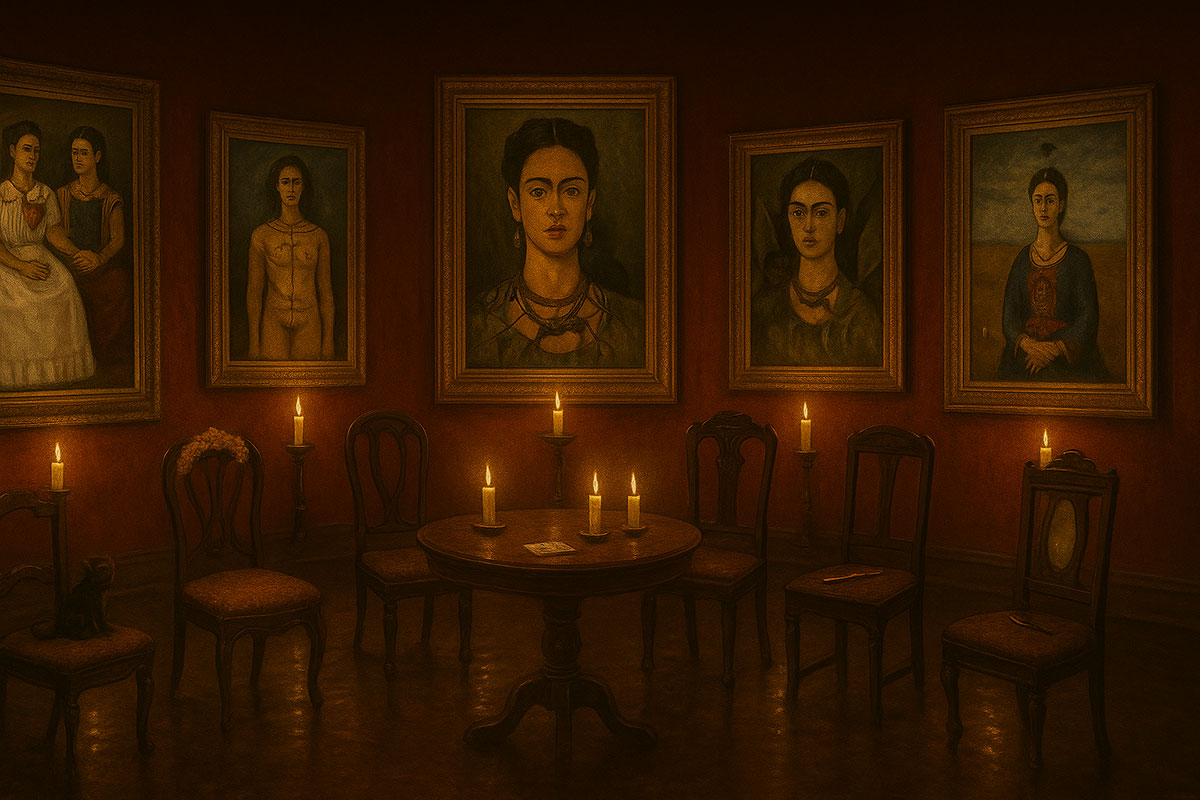
Setting: A candlelit gallery before the doors open. The five paintings hang in silence. Marigolds surround the floor. Elena stands alone, holding one of Frida’s diaries.
Frida did not paint beauty.
She painted what beauty often avoids: pain, rupture, blood, survival.
She painted miscarriage. She painted loneliness.
She painted devotion that erased her—
and then painted herself back into the frame.
The world remembers her eyebrows, her flowers, her fire.
But what I remember is the stillness behind her gaze.
She once said, ‘I paint myself because I am so often alone and because I am the subject I know best.’
Tonight, she is not alone.
Those who knew her—those who carried her, broke her, loved her, or stood by helpless—have gathered once more.
Not to explain her.
Not to soften her.
But to speak beside her.
Five paintings. Five rooms of the soul.
This is not a museum tour.
It is an act of witness.
Frida Kahlo did not wait for permission to tell her story.
And neither will we.
(Note: This is an imaginary conversation, a creative exploration of an idea, and not a real speech or event.)

Topic 1: The Two Fridas — Who Is Left After Love Splits You in Half?
Moderator: Elena Poniatowska (Mexican writer and historian of Frida’s inner world)
Speakers:
Frida Kahlo (Painter)
Diego Rivera (Husband, muralist, muse and wound)
Leon Trotsky (Exile, political thinker, brief lover)
Guillermo Kahlo (Her father, photographer, quiet strength)
Chavela Vargas (Singer, soul-twin, chronicler of love and sorrow)
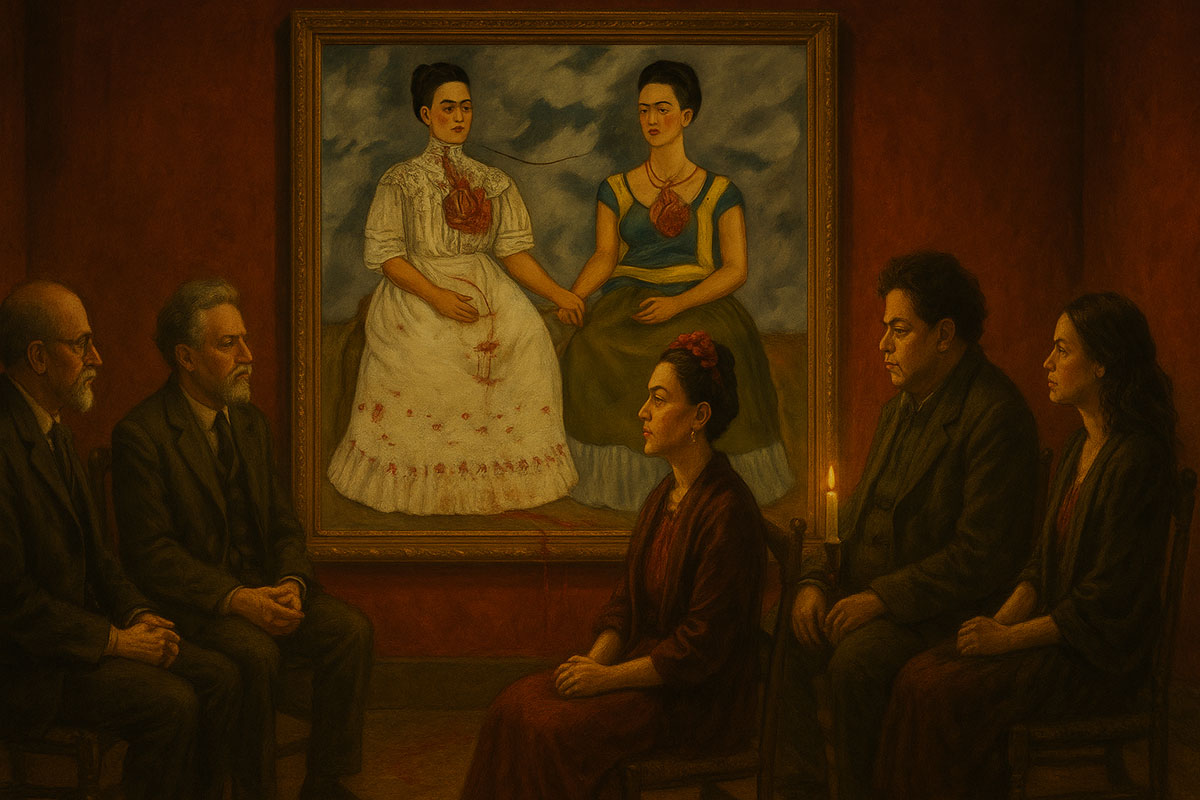
[Scene: A crimson-walled studio under a storm-lit sky. A life-sized version of The Two Fridas sits center. The five speakers sit in a half-circle of carved wooden chairs. The room smells of oil paint, gardenia, and rain.]
Elena Poniatowska (moderator):
Before us hangs The Two Fridas—a double portrait of split self: one in colonial lace, bleeding from the heart; the other in Tehuana dress, calm but holding surgical scissors. This was painted after her divorce from Diego. I ask you all: Who is left after love splits you in half?
Frida Kahlo (without flinching):
Both of them. And neither.
One Frida still loved Diego—the Tehuana Frida. The other bled to death from it.
I painted this not as a metaphor but as a memory.
I lost him, but more than that—I lost the Frida he had made.
So I stitched myself together.
But every stitch hurt.
And still, I didn’t die.
Diego Rivera (softly):
She was always two women. One was fire and teeth. The other was moonlight and mercy.
I loved both. But I could not carry both.
Frida, forgive me.
You bled in the painting, but I was bleeding too—in silence.
I think, in the end, it was not love that split us—
It was the world not big enough for both our shadows.
Leon Trotsky (with philosophical calm):
Frida was revolution in the form of a woman.
She could not be contained by marriage or memory.
When love fractures, something clearer is revealed.
She did not collapse.
She documented.
This painting is not sorrow—it is survival with scissors.
Guillermo Kahlo (quiet, with gravity):
She was my daughter.
But when I saw this, I realized I had birthed a storm.
Even as a girl, she lived in mirrors and myths.
Here, she holds her own artery, as if to say:
“You cannot destroy me—I will do it myself, and paint it.”
I didn’t understand it all.
But I respected it completely.
Chavela Vargas (singing a line before speaking):
“Ay, amor… qué dolor tan hondo deja.”
Frida was not split.
She was multiplied.
This painting shows what happens when a woman dares to feel everything and still show up to dinner.
I held her once. She trembled like a wire.
But she never broke.
Elena Poniatowska:
Who was Frida becoming when she painted this?
Frida:
I was becoming my own witness.
If no one else would see me bleeding—then I would.
Diego:
She was becoming free from me. That terrified us both.
Trotsky:
She was becoming politically naked. The personal revolution.
Guillermo:
She was becoming myth—but still breathing.
Chavela:
She was becoming Frida. At last. In her own language.
Elena Poniatowska:
And if the world looks at this painting today and asks, “What does it mean?”—what would you say?
Frida:
It means: Even broken hearts have symmetry.
Diego:
It means: You can love someone and still be their wound.
Trotsky:
It means: To survive is to divide—and continue walking.
Guillermo:
It means: Pain, when named, becomes art.
Chavela:
It means: She never needed one heart. She made her own rhythm.
Elena Poniatowska (closing):
The Two Fridas is not just a portrait. It is a declaration.
That when love leaves—when it tears the body in two—Frida did not vanish.
She painted herself back into being.
And in her blood, she signed her name.
Topic 2: The Broken Column — Is Pain Still Yours When It Becomes Art?
Moderator: Elena Poniatowska (Mexican writer and Frida’s cultural chronicler)
Speakers:
Frida Kahlo (Painter)
Diego Rivera (Husband, muse, wound)
Leon Trotsky (Political exile and admirer)
Guillermo Kahlo (Father, photographer, early anchor)
Chavela Vargas (Singer, intimate soul-mirror)
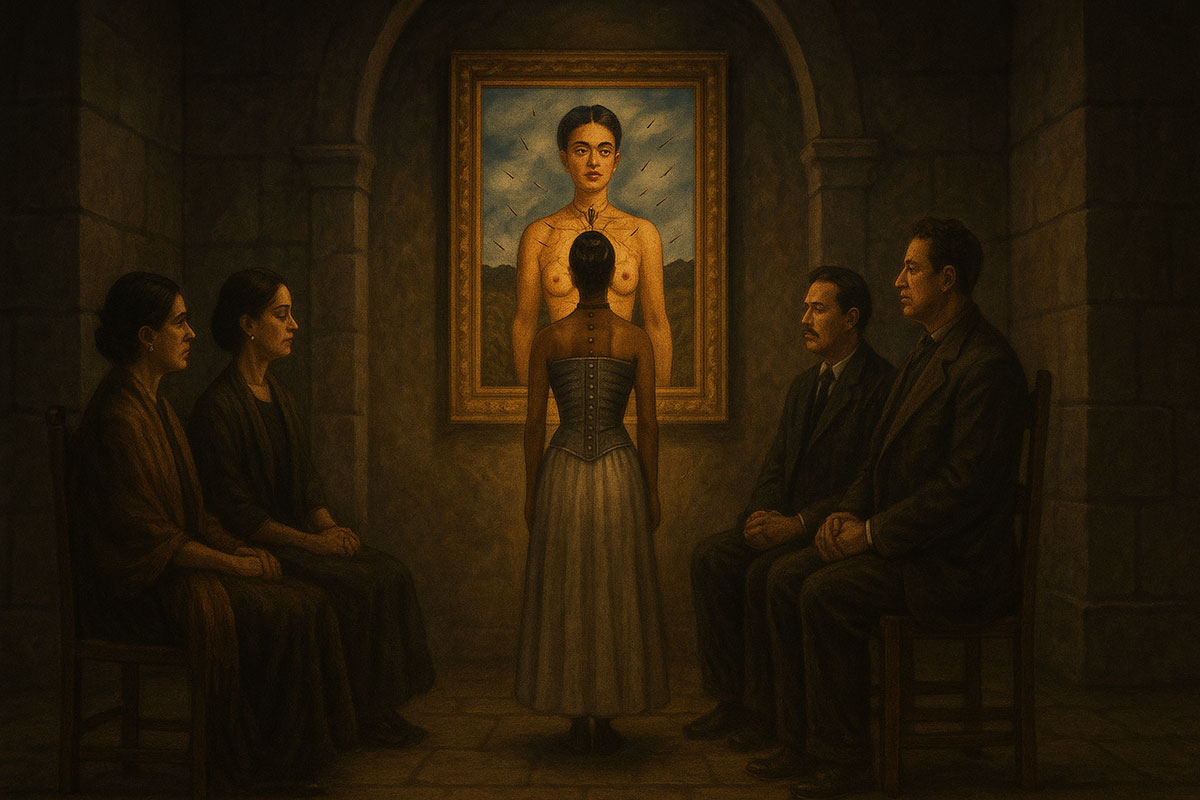
[Scene: A dim museum room with terracotta walls. The Broken Column hangs in glowing isolation. A lone bench sits beneath it, facing the viewer. The group surrounds it, standing—not sitting—as if the painting itself demands they stay upright, despite the weight.]
Elena Poniatowska (moderator):
Tonight we stand before The Broken Column. Frida—nude, split, pierced with nails. Her spine replaced with a crumbling architectural shaft. Her face dry, but the eyes ache. My question: Is pain still yours once it becomes art? Or does the canvas carry it away?
Frida Kahlo:
It doesn’t leave.
It just learns to breathe outside the body.
When I painted this, I had just been braced—strapped like a corpse to a machine meant to straighten what could never be right.
The pain didn’t stop when the brush moved.
It deepened.
But now, when someone cries in front of it—I feel less alone.
So maybe… maybe pain is still mine.
But now it has company.
Diego Rivera:
I watched her paint with tears down her back—real ones, not poetic ones.
I loved her. And I failed her.
I wanted to take the pain.
She never let me.
This painting…
It is her cathedral of suffering.
And I—I was a tourist.
Humbled. Unworthy.
Leon Trotsky:
Pain, when spoken, becomes protest.
Frida turned injury into structure.
The spine is no longer flesh—it is stone.
And yet it breaks.
This painting is not a cry.
It is testimony.
The body politic. The woman as ruined city—and still standing.
Guillermo Kahlo:
As her father, I photographed faces.
But Frida photographed pain.
And here, she develops it slowly, frame by frame, brush by brush.
I do not know how she stood—so often, she didn’t.
But she still looked us in the eye and said:
“This is what it feels like to survive.”
Chavela Vargas:
You want to know if pain leaves?
It never does.
But when she painted it—she gained power over it.
Like singing a love song to the one who left.
The nails still pierce—but now they glitter.
She became her own altar.
Elena Poniatowska:
Who was Frida becoming as she painted The Broken Column?
Frida:
I was becoming unmoved.
Not heartless—just unshakable.
Diego:
She was becoming a truth no one could deny. Not even me.
Trotsky:
She was becoming revolution disguised as ribs.
Guillermo:
She was becoming stone. And light. At the same time.
Chavela:
She was becoming every woman who cannot scream—but can still stare back.
Elena Poniatowska:
And if someone today sees this painting and asks, “What does it mean?”—what would you say?
Frida:
It means: I am still here—even if I can no longer walk.
Diego:
It means: She could not be healed—but she could be seen.
Trotsky:
It means: She wore pain like armor. And made it beautiful.
Guillermo:
It means: Her spine broke. But not her will.
Chavela:
It means: Pain did not win. She painted first.
Elena Poniatowska (closing):
The Broken Column is not a painting. It is an x-ray of a soul mid-repair.
Frida did not wait for healing to begin.
She made art inside the wound.
And in doing so—
She gave the wound a name.
And the name…
Was hers.
Topic 3: Self-Portrait with Thorn Necklace — What Does It Mean to Wear Suffering Beautifully?
Moderator: Elena Poniatowska (Mexican writer and intimate chronicler of Frida’s world)
Speakers:
Frida Kahlo (Painter)
Diego Rivera (Husband, fire and mirror)
Leon Trotsky (Exile, observer, brief flame)
Guillermo Kahlo (Father, photographer)
Chavela Vargas (Singer, soul-confessor)
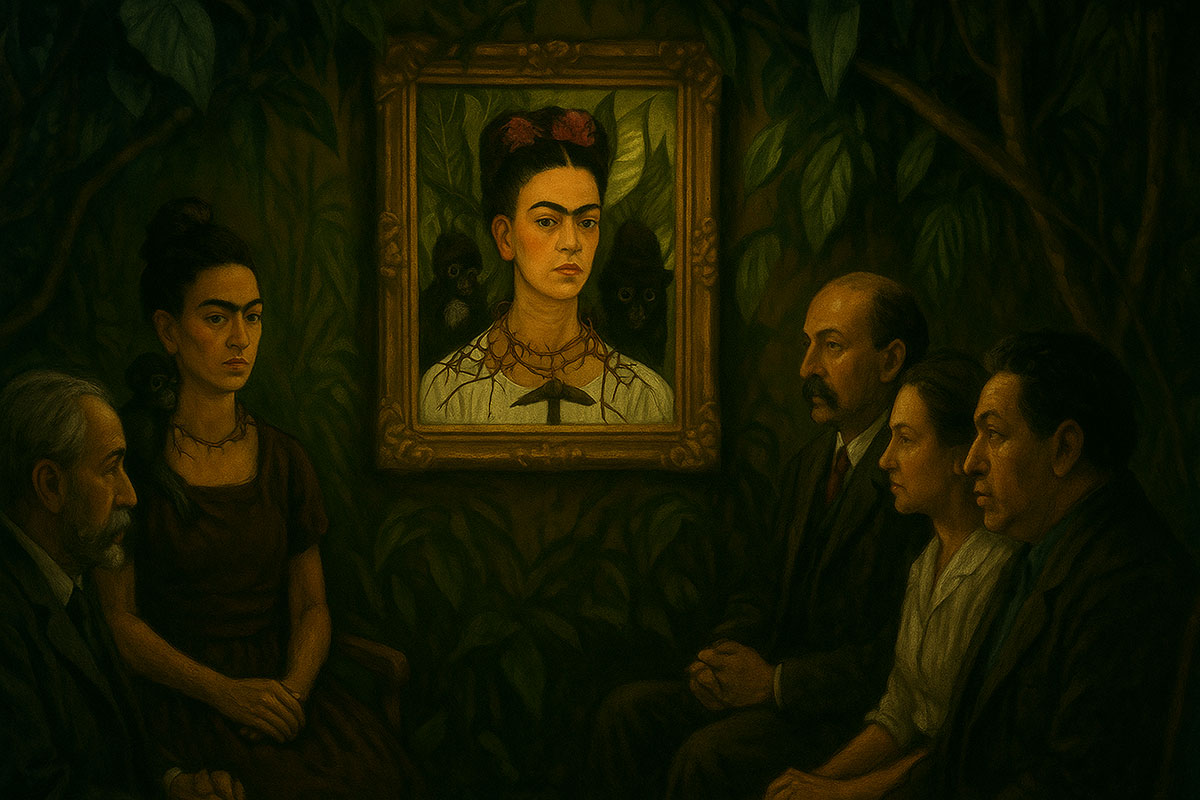
[Scene: A tropical garden room with creeping vines and birdsong echoing beyond. Self-Portrait with Thorn Necklace and Hummingbird hangs between two living palms. The group sits on low woven stools beneath it. The air smells of hibiscus, wet earth, and memory.]
Elena Poniatowska (moderator):
This is one of her most iconic self-portraits. A direct gaze, a thorn necklace digging into the skin, a dead hummingbird at the throat, and two silent animals—monkey and cat—behind her. My question is this: What does it mean to wear suffering beautifully?
Frida Kahlo (calmly):
It means telling the truth without apology.
It means wearing the thorns instead of hiding them.
I was tired of pretending to be "strong" in the way men wanted.
So I wore my pain like pearls.
You think the bird is dead?
No. It’s resting—like I was.
I bled. But I bled with dignity.
Diego Rivera:
She turned grief into adornment.
She never covered the wound.
She made it part of the costume.
Even when we were at war—and we often were—I saw her walk into rooms with that stare, that necklace, that stillness…
She didn’t need vengeance.
She had her own mythology.
Leon Trotsky:
Revolution is not only in the streets.
Sometimes, it’s in the mirror.
She painted herself like a saint—but with no miracles, only scars.
The necklace, the blood, the beast on her shoulder—these are not symbols of fragility.
They are banners.
Her beauty was defiance made visible.
Guillermo Kahlo:
I taught her how to pose for a lens.
But she taught herself how to hold a gaze.
That look—it does not beg for understanding.
It dares you to misunderstand her.
She made her pain quiet—but not polite.
Even the thorns look composed.
Chavela Vargas:
She did not wear suffering.
She wove it.
Into flowers. Into silence. Into skin.
When I saw that painting, I didn’t see blood.
I saw balance.
Like when you sing with your throat broken—
And still hit every note.
Elena Poniatowska:
Who was Frida becoming when she painted this?
Frida:
I was becoming my own altar.
No need for saints. I had thorns.
Diego:
She was becoming the kind of woman people fear—and secretly need.
Trotsky:
She was becoming impossible to ignore. Even for history.
Guillermo:
She was becoming her own photograph. Un-retouched. Undeniable.
Chavela:
She was becoming every woman who smiles with a blade in her chest.
Elena Poniatowska:
And if the world asked, standing before this painting: “What does it mean?”—what would you say?
Frida:
It means: You can wear pain—and still wear color.
Diego:
It means: She didn’t need pity. She needed room.
Trotsky:
It means: Truth can be beautiful. Even when it bleeds.
Guillermo:
It means: She painted her reflection—and found power.
Chavela:
It means: She didn’t flinch. So neither should you.
Elena Poniatowska (closing):
In Self-Portrait with Thorn Necklace, Frida did not ask for sympathy.
She asked for stillness.
She looked the world in the eye—and showed it that pain can be worn like silk.
Not to hide the wound.
But to honor it.
Topic 4: Henry Ford Hospital — Can You Paint What Should Never Be Seen?
Moderator: Elena Poniatowska (Mexican author and witness to women’s stories)
Speakers:
Frida Kahlo (Painter)
Diego Rivera (Husband, distant witness)
Leon Trotsky (Observer of grief through political lens)
Guillermo Kahlo (Father)
Chavela Vargas (Singer, lover of broken truths)
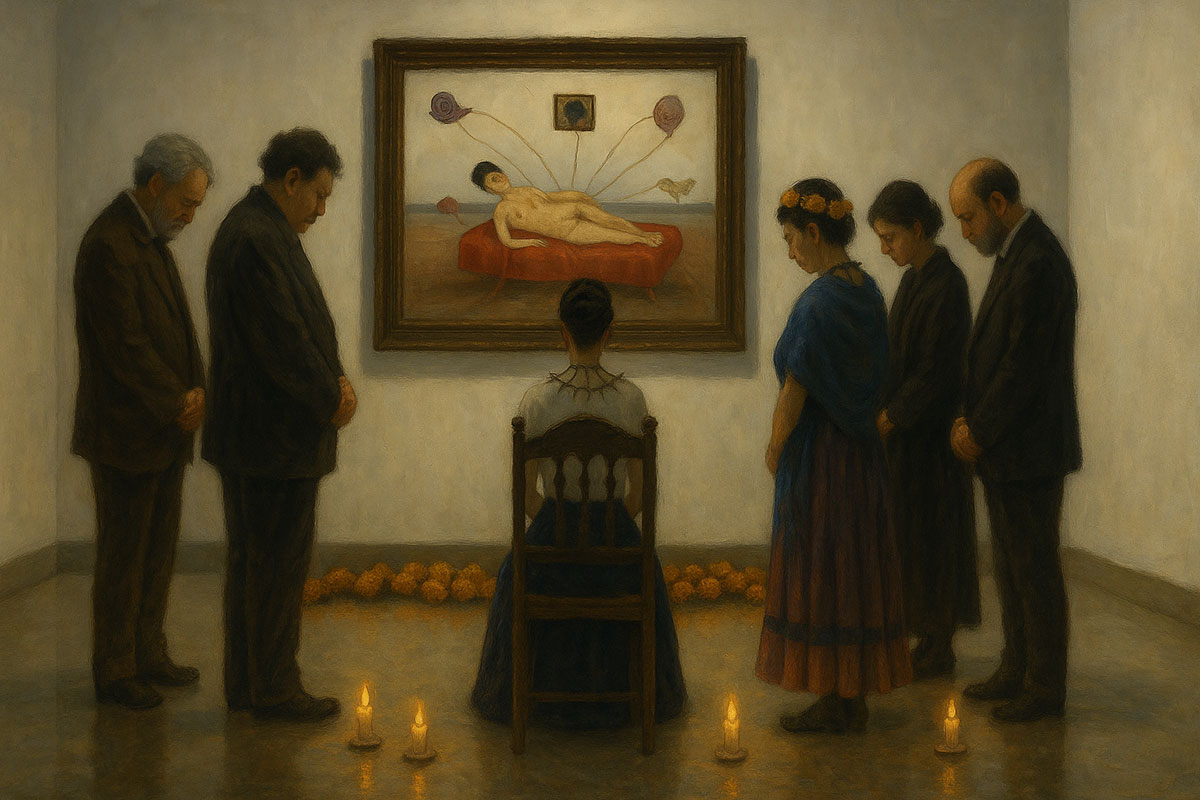
[Scene: A gallery lit only by a single skylight. Henry Ford Hospital floats on the wall, almost too exposed. Frida’s small nude figure lies on a red hospital bed in a vast void, blood pooling beneath her, six surreal symbols tethered to her body by umbilical lines. The group stands rather than sits. There are no chairs—only presence.]
Elena Poniatowska (moderator):
This is perhaps her most harrowing work. Henry Ford Hospital was painted after a miscarriage in Detroit. No filter. No veil. Just blood, body, and grief suspended in blankness. I ask you all: Can you paint what should never be seen?
Frida Kahlo (her voice low and steady):
Yes.
Because if I don’t, who will?
People wanted me to grieve quietly. “Rest,” they said. “Recover.”
But my child died.
And the hospital didn’t say its name. The doctors barely looked at my face.
So I named it in paint. I bled in public.
That is not shame.
That is truth.
Diego Rivera:
I failed her then.
I didn’t know how to hold her pain—so I stayed outside it.
She painted what I refused to feel.
And when I saw it…
I wept—not just for the child,
but because I had never realized how alone she had been.
Leon Trotsky:
There are revolutions of the body, not just the state.
This painting is her manifesto:
I will not erase what has been taken from me.
She painted the uterus, the fetus, the pain—not for spectacle, but for justice.
In a world that silences women’s wounds, Frida shouted in brushstrokes.
Guillermo Kahlo:
I could not protect her from this.
And so she protected herself the only way she knew—by refusing silence.
She taught me that the most unspeakable losses… must still be spoken.
This is not indecent.
It is sacred.
Chavela Vargas:
She painted what no song could say.
I sang of lost lovers. She painted lost children.
That red wasn’t just blood. It was memory. It was fury.
And above all… it was proof.
She dared to say: This happened.
And she refused to be quieted.
Elena Poniatowska:
Who was Frida becoming when she painted Henry Ford Hospital?
Frida:
I was becoming a woman no one could pity.
Only respect.
Diego:
She was becoming impossible to look away from. Even when it hurt.
Trotsky:
She was becoming the revolution of the private.
Guillermo:
She was becoming her own sanctuary.
No longer needing ours.
Chavela:
She was becoming all women who have lost something—and been told not to speak of it.
Elena Poniatowska:
And if someone sees this painting today and asks, “Why would she show this?”—what would you say?
Frida:
I would say: Because we are told to forget. And I will not.
Diego:
Because loss, when unspoken, becomes poison.
Trotsky:
Because art must sometimes disturb the comfort of forgetting.
Guillermo:
Because a child lost is still a child remembered.
Chavela:
Because grief is sacred—even when it stains the sheets.
Elena Poniatowska (closing):
Henry Ford Hospital is not tragedy. It is testimony.
Frida took what the world deemed unspeakable—and painted it in daylight.
Not for validation.
But for witness.
So that what was lost would not be lost again—
In silence.
Topic 5: Diego on My Mind — Is Devotion a Kind of Disappearance?
Moderator: Elena Poniatowska (Mexican writer, witness to women’s inner wars)
Speakers:
Frida Kahlo (Painter)
Diego Rivera (Husband, muse, wound)
Leon Trotsky (Exile and observer of intimate politics)
Guillermo Kahlo (Father)
Chavela Vargas (Singer of longing, truth, and ache)
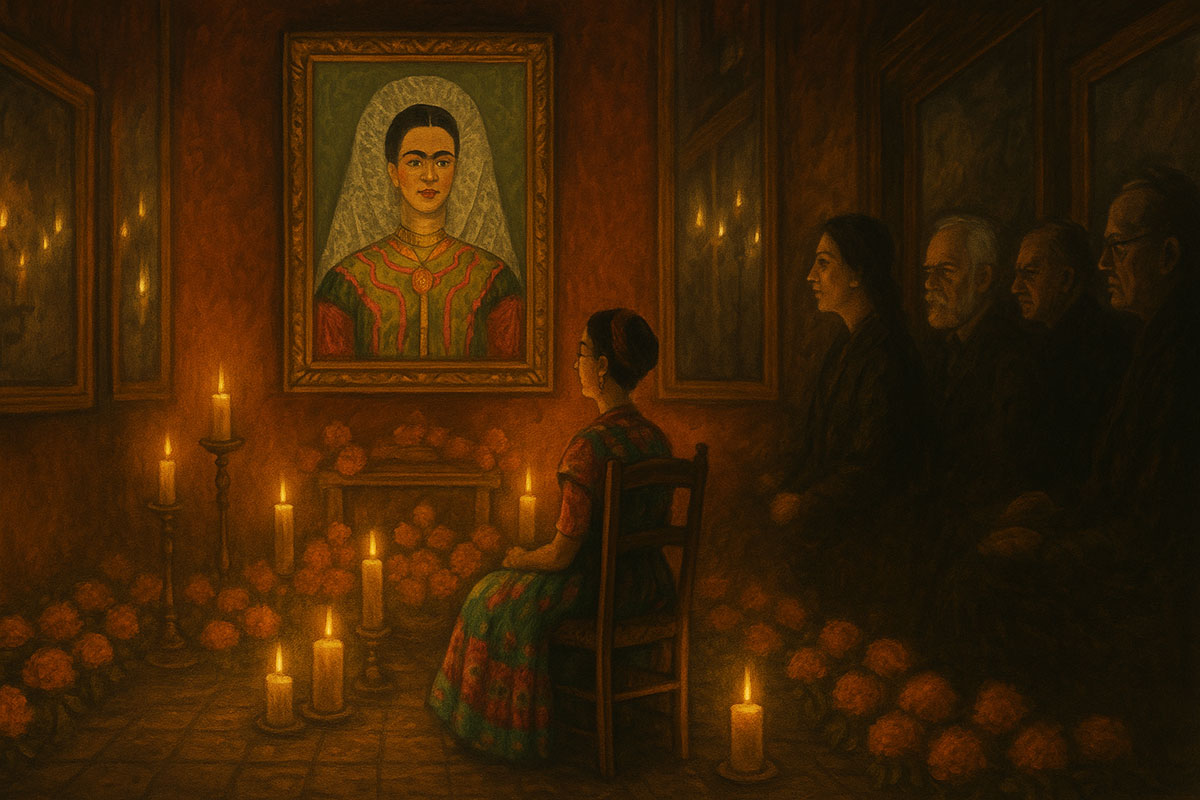
[Scene: A mirrored studio filled with incense, marigolds, and the smell of oil and turpentine. Diego on My Mind—Frida’s self-portrait with Rivera’s image painted in her forehead—hangs high above a shrine of candles. The group sits in shadow, the only light coming from the canvas and the flickering altars beneath it.]
Elena Poniatowska (moderator):
This painting—Diego on My Mind—is not just a self-portrait. It’s a confession. Frida, adorned in Tehuana dress, stares forward with Diego’s image embedded in her forehead like a tattoo of memory. My question: Is devotion a kind of disappearance?
Frida Kahlo:
Yes.
But it was my choice.
I loved him like you love the sun—even when it burns.
And yes, I disappeared sometimes in that love.
But I left clues.
In paint. In words. In rage.
Even when I wore his name,
I never stopped painting my face.
Diego Rivera (eyes lowered):
She gave me everything.
And I gave her chaos.
Frida loved with her bones, with her blood, with a kind of bravery I never deserved.
And when she painted Diego on My Mind…
I saw what I had done.
She carried me—on her head, in her wounds—when I should have carried her.
Leon Trotsky:
Devotion, in the hands of power, can become erasure.
But Frida made her devotion visible—painted it, shaped it, questioned it.
She did not disappear.
She documented her vanishing.
That is radical.
She told the truth: “I have you in my mind. But I still own my hand.”
Guillermo Kahlo:
As her father, it pained me to watch her orbit him like a moon around a trembling planet.
But even in this painting, I see her strength.
She is not just in Tehuana dress.
She is in command.
She painted herself first.
And Diego—small, almost ghostlike—only afterward.
That matters.
Chavela Vargas:
She loved him the way only women who’ve broken can love.
Fully. Foolishly. Forever.
And still, she kept painting.
She wore him on her mind, yes—
but not in her mouth.
Her mouth stayed her own.
Frida disappeared into devotion—
But she returned through creation.
Elena Poniatowska:
Who was Frida becoming when she painted Diego on My Mind?
Frida:
I was becoming a woman who could hold contradiction.
I loved him.
And I loved myself.
Even when it tore me in two.
Diego:
She was becoming the truth I had always run from.
Trotsky:
She was becoming the voice of every woman erased by her devotion—and daring to speak.
Guillermo:
She was becoming her own altar.
With Diego as offering, not master.
Chavela:
She was becoming memory—alive, aching, and impossible to silence.
Elena Poniatowska:
And if the world looks at this painting and asks, “Why does she carry him on her forehead?”—what would you say?
Frida:
Because love stays.
Even when it leaves.
Even when it wounds.
Diego:
Because she made me sacred—
And reminded me that I was not worthy of it.
Trotsky:
Because art can say what marriage cannot.
Guillermo:
Because in remembering him, she did not forget herself.
Chavela:
Because she didn’t ask to be saved.
She asked to be seen.
Elena Poniatowska (closing):
Diego on My Mind is not about obsession.
It is about imprint.
Frida did not erase herself in devotion—
She made herself more vivid.
She wore her pain like a crown.
And in doing so…
She gave us all a way to love—
Without vanishing.
Final Thoughts
Setting: The gallery is now empty. The candles are low. The paintings remain lit, but dimmed. Frida stands in the center—alone, but whole.
Elena Poniatowska:
She was called tragic. But she never wanted pity.
She wanted truth. And color. And to be felt.
Frida did not ask us to understand.
She asked us to stay.
Stay with the wound. Stay with the mirror.
Stay with the woman who turned every fracture into fire.
Tonight, we did not just observe her.
We sat beside her pain.
And we left… not untouched.
Frida Kahlo (softly, then rising):
I painted what was mine.
My spine. My loss. My Diego. My blood.
I painted what they said I should forget.
But I didn’t forget.
I remembered in red.
I remembered in thorns.
I remembered in silence that screamed.
If you’ve ever loved too much…
If you’ve ever broken and kept blooming…
Then I am already inside you.
I never left.
I was always here—
in the wound,
in the brushstroke,
in the bloom.
Short Bios:
Leave a Reply