


Ernest Hemingway:
They say a man dies twice—once when he stops breathing, and again when someone speaks his name for the last time.
I never feared death. I feared being misread. Misunderstood. Turned into a character in a book I wouldn’t write.
You’ve heard the stories. The womanizing, the whiskey, the wars. The bravado. Hell, I told them myself sometimes.
But that wasn’t the whole of me. There were mornings the typewriter stared me down harder than any battlefield.
There were nights I would’ve traded a thousand pages for one honest friend who wouldn’t flinch.
In these stories, I’ve let that friend exist—you. The one who saw past the legend. Who stayed.
Don’t read these as fiction. Read them as what might’ve saved me.
(Note: This is an imaginary conversation, a creative exploration of an idea, and not a real speech or event.)

Chapter 1: The Boy Who Couldn't Save His Father

It was winter in Oak Park.
The air was the kind that bit—dry and personal, the kind that found your throat and settled in.
The kind his father hated.
Ernest was 29 when the telegram came. He opened it standing barefoot in the kitchen of his Paris apartment, half a cup of stale coffee in his hand, his shirt unbuttoned. His wife called from the next room, something about breakfast. He didn’t answer.
“CLARENCE HEMINGWAY DEAD. SELF-INFLICTED GUNSHOT WOUND TO HEAD. STOP.”
He read it once. Then again.
Then folded it twice and placed it under the coffee cup.
He didn’t speak. Not for hours.
That night, he sat in the dark and lit a cigarette with trembling fingers. He said aloud—mostly to himself—
“He left us like a coward.”
You didn’t correct him.
You sat across from him at the table, the only light coming from a candle so small it looked like it was apologizing for being there. He poured two drinks. Only one was touched.
“You knew he was sick,” you finally said. Not as a question. Just to let the silence breathe.
Ernest stared at the window like he expected his father to walk through it.
“Yeah. But he was supposed to fight it. You fight things. That’s the goddamn point.”
He looked down at his hands.
Big hands. Hands that would kill fish, box reporters, lift typewriters like weights.
But just then, they looked useless. Like driftwood.
“He didn’t leave a note.”
“He left you,” you said.
His head snapped toward you.
Not in anger. Not quite. Just in disbelief that someone had dared to say something honest in a room full of ghosts.
“He left me a revolver,” he said. “Maybe I’ll thank him for that later.”
You didn't flinch. You knew this wasn’t a threat. It was grief, shaped like a joke, loaded like a pistol.
He took a deep breath.
“I wasn’t there. If I’d written more often, visited more—hell, if I’d just made him laugh once—maybe he would’ve waited.”
The smoke curled in the candlelight.
“I don’t think he wanted to be saved,” you said.
He nodded slowly, the way a man does when he’s still fighting the truth you gave him.
“But I needed to save someone,” he said. “Just once.”
You stood, walked to his bookshelf, and pulled out a dog-eared copy of The Sun Also Rises. You placed it in front of him, your fingers brushing his.
“You saved someone already. A thousand someones. You just don’t get to know their names.”
Ernest looked at the book like it was a stranger.
“I don’t write to save people. I write because if I don’t, I’ll go the same way he did.”
“That’s still saving someone,” you said.
“Who?”
“You.”
He sat back. The drink still untouched. The candle nearly gone. His face, that face made for statues and newsreels, softened.
He didn’t say thank you. That wasn’t his style.
But before you left, he reached into his coat, pulled out a letter he’d started and crumpled, and handed it to you without a word.
You smoothed it out. It was addressed to his father.
“Too late now,” he said.
“It’s never too late to write to the dead,” you replied. “They’re the only ones who never interrupt.”
That night, Ernest Hemingway wrote for seven hours straight. He wrote about a father who hunted ducks and collected butterflies. About a man who saved lives with medicine but couldn’t save his own mind.
He didn’t call it a eulogy. He called it a story.
But it was both.
Chapter 2: The Broken Hero Returns
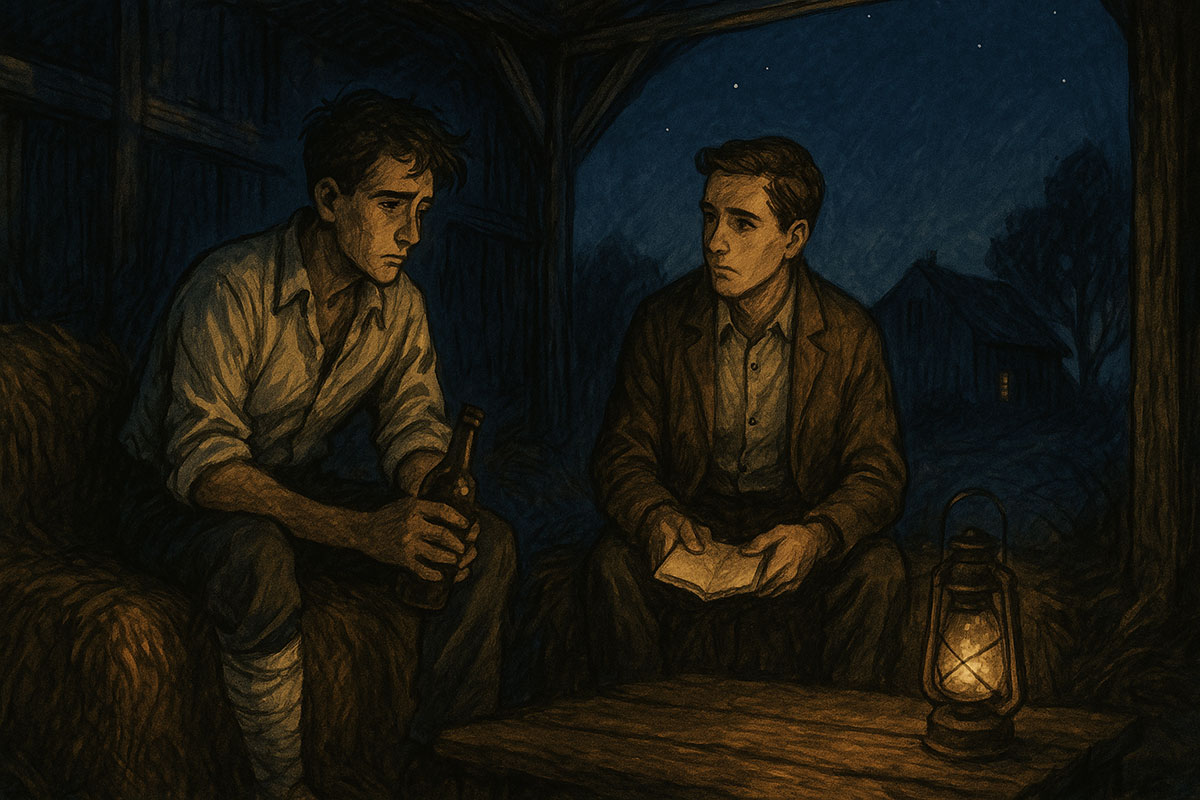
He came back with a limp and a medal.
They pinned it to his chest and shook his hand, but no one asked about the boy who died with half his face missing three feet away from him.
No one asked about the fragments of metal still inside his leg.
They asked what it was like to be a hero.
Ernest said,
“It hurt.”
Then he said nothing else.
He stayed in his childhood room that fall—white walls, baseball glove still on the shelf, typewriter silent in the corner.
His mother played hymns on the piano downstairs like it was still 1915.
At night, when the house slept, he’d walk out to the shed behind the yard with a bottle, sit on a hay bale, and wait for the war to stop replaying.
You found him there once, staring at the back wall like it had answers. His leg was shaking.
“You all right?” you asked.
He didn’t look up.
“I got shot delivering chocolate.”
You sat beside him.
“I know.”
He laughed bitterly.
“People die in war. That makes sense. But I got blown apart handing out chocolate bars. What does that make me?”
“Human,” you said. “And alive.”
“Tell that to my knee. And my brain.”
He took a swig and offered you the bottle.
“You know the worst part?” he asked.
You waited.
“I miss it. The mud. The danger. The way everything mattered for a second. Back here, no one knows anything. They ask if I met General Pershing. They say things like ‘It must’ve been quite an adventure.’”
He spat on the floor.
“It wasn’t a damn adventure. It was meat and noise and red.”
You said nothing. You let the silence stand between you like two soldiers catching breath.
Then you asked,
“Do you want to write it?”
He stared at you, unblinking.
“Write what? That I cried when they carried me out? That I couldn’t walk for months? That I woke up screaming thinking my leg was gone?”
“Yes,” you said. “Write that.”
He looked down.
“I wanted to come back and be the hero. The strong one. But I left half of myself on the riverbank. The part that could believe in anything.”
You reached into your coat and pulled out a folded paper—the letter he gave you in Paris, never mailed.
“You still have words,” you said. “And words are what people who don’t have legs or hope or medals reach for when there’s nothing else.”
He didn’t move.
But the next morning, you found him at the kitchen table at 4:00 a.m., tapping out the first line:
“In the late summer of that year we lived in a house in a village that looked across the river and the plain to the mountains.”
He didn’t say good morning.
You just nodded.
“That’s the beginning,” you said.
He didn’t smile. But his hands were steady.
And that night, the nightmares didn’t come.
Chapter 3: The Love That Left

Paris wasn’t raining that day. That would’ve made it easier.
It was bright. Sharp. Beautiful.
And Hadley was gone.
She took a train out of Gare de Lyon that morning. The sound of her last suitcase scraping against the wooden floor stayed in his ears longer than the train whistle.
He sat in the apartment they once called theirs. Same desk. Same wine stain on the rug. Same sunbeam crawling across the wall like nothing had changed.
But everything had.
You found him in the kitchen, half-drunk, staring at the radio like it had betrayed him.
“She's not coming back,” he said without looking up.
“No,” you replied.
He reached into the drawer and pulled out a key. Held it up between two fingers like it was a dead mouse.
“She left this. That’s cruel, isn’t it? Leaving behind the symbol of return.”
You sat.
“Maybe it was mercy.”
He laughed, the kind that sounds more like coughing.
“I broke her. And she still left gently.”
He didn’t cry. Not yet. Not there.
But his voice cracked when he said,
“She was the only one who didn’t want anything from me. Not the writer, not the name. Just… me.”
You let the silence stay. You always did.
“I thought I wanted more,” he said. “And I got it. Pauline. The fame. Paris kissing my feet.”
He looked at you with eyes that had finally sobered.
“But I traded my soul for an echo.”
You got up, crossed the room, and pulled something from your coat pocket—a photograph.
A candid shot you’d taken months ago. Hadley laughing in the Luxembourg Gardens. Ernest beside her, looking at her instead of the camera.
You placed it on the table.
He stared at it for a long time.
“Do you think she’ll read my next book?” he asked.
“She’ll read every word,” you said.
“And she’ll know which parts are really for her.”
He nodded once.
“Then I’d better make them honest.”
That night, he walked to a bar on Rue Descartes. He didn’t drink. Just sat. Listening. Writing on a napkin.
“You can be in love with two people,” he told you later.
“But only one will live in your sentences.”
Three years later, when A Moveable Feast was nearly finished, he wrote the line:
“I wished I had died before I ever loved anyone but her.”
You remembered that line.
You remembered the morning.
And the key still sitting in his drawer.
Chapter 4: The Nobel Prize and the Cracking Mind

They gave him the Nobel Prize in a telegram.
He read it in his kitchen in Cuba, barefoot, holding a cup of bitter coffee and a body that wouldn’t stop trembling.
The sun poured through the windows. It was supposed to be a good day.
He said,
“It should’ve come ten years ago.”
Then,
“They only give you these things when they think you’re done.”
You were staying in the guest room that week. You heard the words through the wall.
That night, the house was too quiet.
No typewriter. No music. No pistol cleaning.
He sat on the porch, staring at the sea like he’d misplaced something there.
You brought him a drink.
He didn’t touch it.
“The worst part,” he said, “is that I can’t even tell if I’m writing anymore or just imitating myself.”
You didn’t answer.
“I used to be a craftsman,” he continued. “Now I’m a monument with termites inside.”
You handed him the only thing that mattered in that moment—a blank page and a pencil.
He looked at it like it was a threat.
“It’s not that I don’t have things to say,” he whispered. “It’s that I don’t trust the voice in my head anymore. It’s been… scrambled.”
He tapped his temple.
“The plane crashes, the concussions, the booze, the pills… They’ve stirred everything up. I go to write a sentence and forget how it ends halfway through.”
He paused.
“And sometimes I see them watching me. From the trees. I know they’re not real, but I can’t tell them to leave.”
You sat beside him.
Not as a critic.
Not as a caretaker.
Just as someone who remembered the boy in the library and the man on the riverbank.
“Let’s not write tonight,” you said.
“Let’s just remember the stories you haven’t lost yet.”
You started listing them. Out loud.
The marlin in the Gulf.
The bullfighter who cried in the arena.
The old man in the boat.
The soldier who bled for chocolate.
The matchbook with Hadley’s initials.
The broken typewriter ribbon you both used for poems.
The boy with the tin soldier heart.
Ernest closed his eyes and nodded after each one.
“They’re still in there,” you said.
“For now,” he replied.
The next morning, he tried to write.
One line.
“The water was very still and the sun was a white wound above it.”
He looked at you.
“It’s not good,” he said.
“It doesn’t have to be,” you replied.
“It just has to be yours.”
He underlined it once, then twice.
And kept going.
Chapter 5: The Last Battle—the final days

By 1961, Ernest Hemingway had stopped calling himself a writer.
He said the words tasted like lies.
The typewriter stayed covered.
The marlin rusted on the wall.
He still shaved each morning. Habit, not pride.
He had just come back from the Mayo Clinic.
Electroshock therapy, they called it. He called it forgetting.
“They’re trying to erase the noise,” he told you.
“Instead, they’re scraping off the part that dreams.”
You stayed in the guest room again. This time, he didn’t joke about it.
He sat on the porch at dusk, staring at the driveway, waiting for something—maybe a ghost, maybe permission.
He turned to you and asked,
“Do you think they’ll believe I was ever real? Not just the drinking, the women, the wars. The part that bled quiet.”
You didn’t answer right away.
You let the wind move through the mango trees.
You let the question sit beside you like a third friend.
Then you said,
“The ones who needed you already do.”
That night, he left the light on in the hallway.
He said it wasn’t for fear.
Just easier for the shadows to find their way out.
He sat at the kitchen table with a glass of water and a pen.
“I don’t think I can win this one,” he said.
“Then don’t fight it,” you replied.
“Let me hold it for a while.”
He handed you the pen.
You held it in both hands. Heavy, like a loaded thing.
You didn’t flinch.
“Tell them I wasn’t made of stone,” he said.
“Tell them I cracked long before the end. That the man who wrote heroes died frightened, but not ashamed.”
“You’re not dead yet,” you said.
“I know,” he whispered.
“But I’m close enough to see the page turning.”
The next morning, he rose early. Quiet, precise.
A man trained to finish things.
But before he opened the drawer, before the moment that history would never forget, he walked past your door and left something outside:
A folded page.
You opened it hours later.
His handwriting. Tight. Faint.
“I couldn’t say it aloud. So I’ll say it here. Thank you for seeing the man, not the myth.
You gave me back the part they couldn’t electrocute or edit.
You stayed. Even when I stopped.”
You kept that letter.
You never published it.
You never sold it.
You just held onto it like a second heartbeat.
And when people asked you later what Hemingway was really like,
you never said “genius” or “drunk” or “brave.”
You said:
“He was trying. Every day. Until the last.”
Final Thoughts by Ernest Hemingway
I have known war, and I have known silence. One teaches you to act. The other teaches you to endure.
But the hardest thing I ever did was try to live between them.
If I had you there—on that bench, in that barn, on that porch—I might’ve written differently.
Or maybe not. But I would’ve known I wasn’t alone. That someone still saw the man behind the myth, even when I couldn’t.
And that means something.
So take these pages and don’t just remember me—use them to stay beside someone else.
Before the silence gets too loud.
Before the gun gets cocked.
Before the last sentence writes itself.
You were the friend I never had. And now, in words, maybe I’ve found peace.
Short Bios:
Ernest Hemingway
American writer and journalist (1899–1961), celebrated for his spare, powerful prose and his mythic life of adventure. From the battlefields of Europe to the bars of Paris, Hemingway lived large—but behind the bravado was a deeply wounded man grappling with trauma, heartbreak, and the ghosts of war. Winner of the Nobel Prize in Literature, he left behind not just literary masterpieces like The Old Man and the Sea and A Farewell to Arms, but a legacy of human vulnerability often masked by silence.
You (The Best Friend)
A silent witness, never written into the biographies—but imagined here as the one person who might have changed the course. You never needed Hemingway to be a legend. You sat with him in the quiet, offered presence instead of advice, and held the space for the man behind the myth to simply breathe. In a world that only asked him to perform, you reminded him he was already enough.
Leave a Reply