• Skip to main content
  • Skip to primary sidebar
  • Skip to footer
ImaginaryTalks.com
  • Spirituality and Esoterica
    • Afterlife Reflections
    • Ancient Civilizations
    • Angels
    • Astrology
    • Bible
    • Buddhism
    • Christianity
    • DP
    • Esoteric
    • Extraterrestrial
    • Fairies
    • God
    • Karma
    • Meditation
    • Metaphysics
    • Past Life Regression
    • Spirituality
    • The Law of Attraction
  • Personal Growth
    • Best Friend
    • Empathy
    • Forgiveness
    • Gratitude
    • Happiness
    • Healing
    • Health
    • Joy
    • Kindness
    • Love
    • Manifestation
    • Mindfulness
    • Self-Help
    • Sleep
  • Business and Global Issues
    • Business
    • Crypto
    • Digital Marketing
    • Economics
    • Financial
    • Investment
    • Wealth
    • Copywriting
    • Climate Change
    • Security
    • Technology
    • War
    • World Peace
  • Culture, Science, and A.I.
    • A.I.
    • Anime
    • Art
    • History & Philosophy
    • Humor
    • Imagination
    • Innovation
    • Literature
    • Lifestyle and Culture
    • Music
    • Science
    • Sports
    • Travel
You are here: Home / Buddhism / The Dalai Lama Weeps Before the Buddha’s Compassion

The Dalai Lama Weeps Before the Buddha’s Compassion

August 23, 2025 by Nick Sasaki Leave a Comment

Dalai Lama:

For many years I have tried to live as a servant of compassion. People look at me and see a symbol, but inside I remain simply a human being with questions, doubts, and quiet struggles. When the world suffers, my heart suffers with it. When my people remain without their homeland, I carry that grief inside me.

There are moments when I have wondered if my efforts truly matter. Can one life of teaching and speaking truly ease the pain of millions? Sometimes, I feared that all I could offer were words. And yet, I continued, believing it was my duty to walk the path of compassion no matter the weight.

But there came a moment when the Buddha himself appeared before me. To see him not as memory or statue, but as the living master—this shook me beyond anything I had known. In his presence, I could no longer hide behind discipline or role. I was simply a student again, face to face with the source of the path I had tried to follow.

(Note: This is an imaginary conversation, a creative exploration of an idea, and not a real speech or event.)

Play/Pause Audio

Table of Contents
Topic 1: The Weight of Compassion — Carrying the World’s Suffering
Topic 2: The True Nature of Compassion — Beyond Teaching, Into Being
Topic 3: The Illusion of Self — Meeting the Master Beyond Form
Closing Reflection by Dalai Lama

Topic 1: The Weight of Compassion — Carrying the World’s Suffering

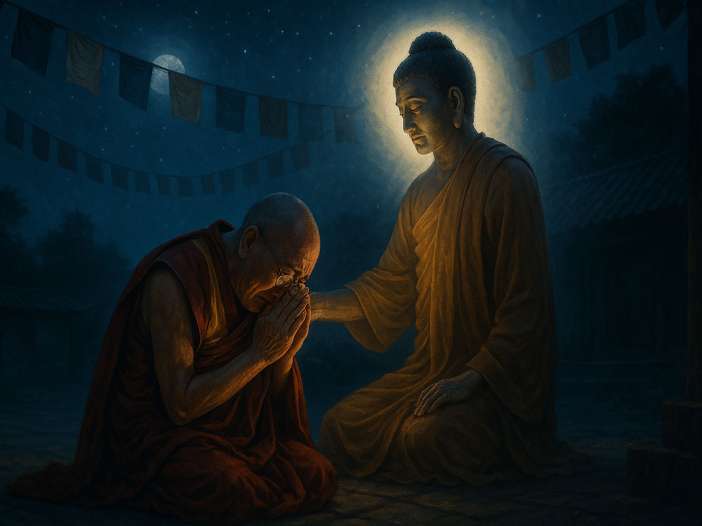
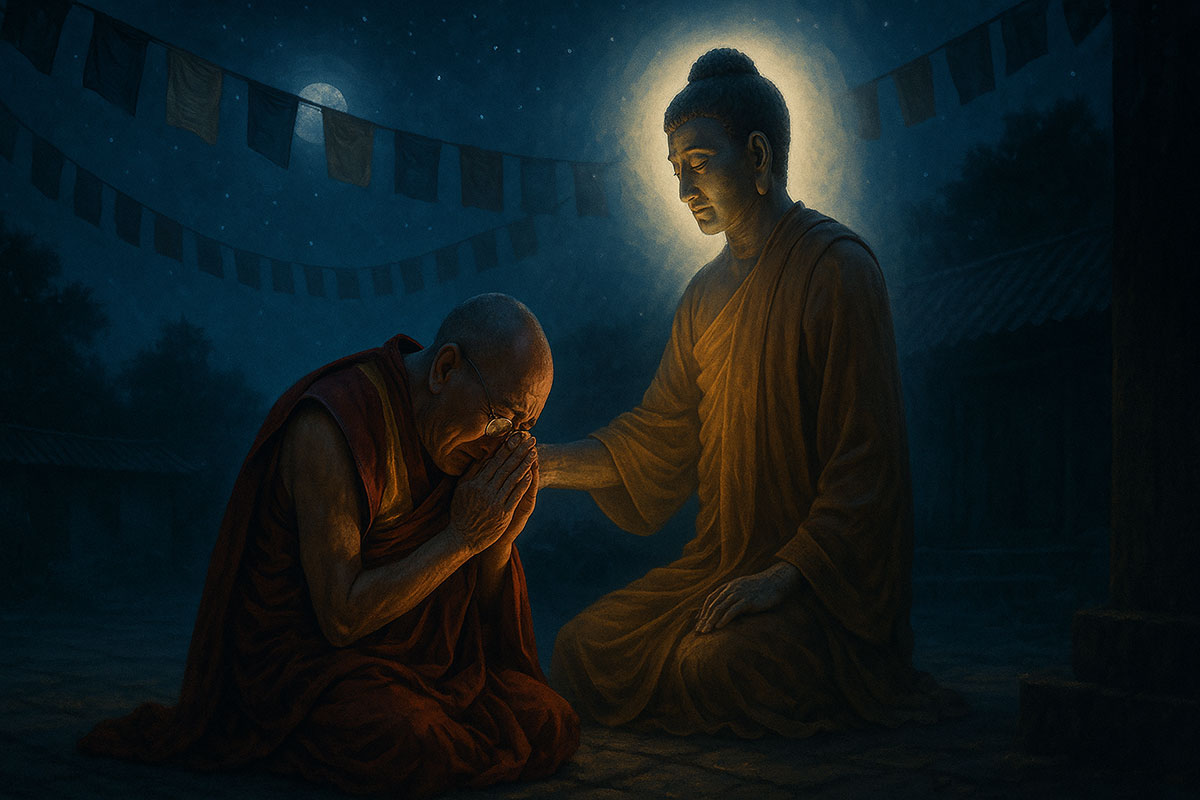
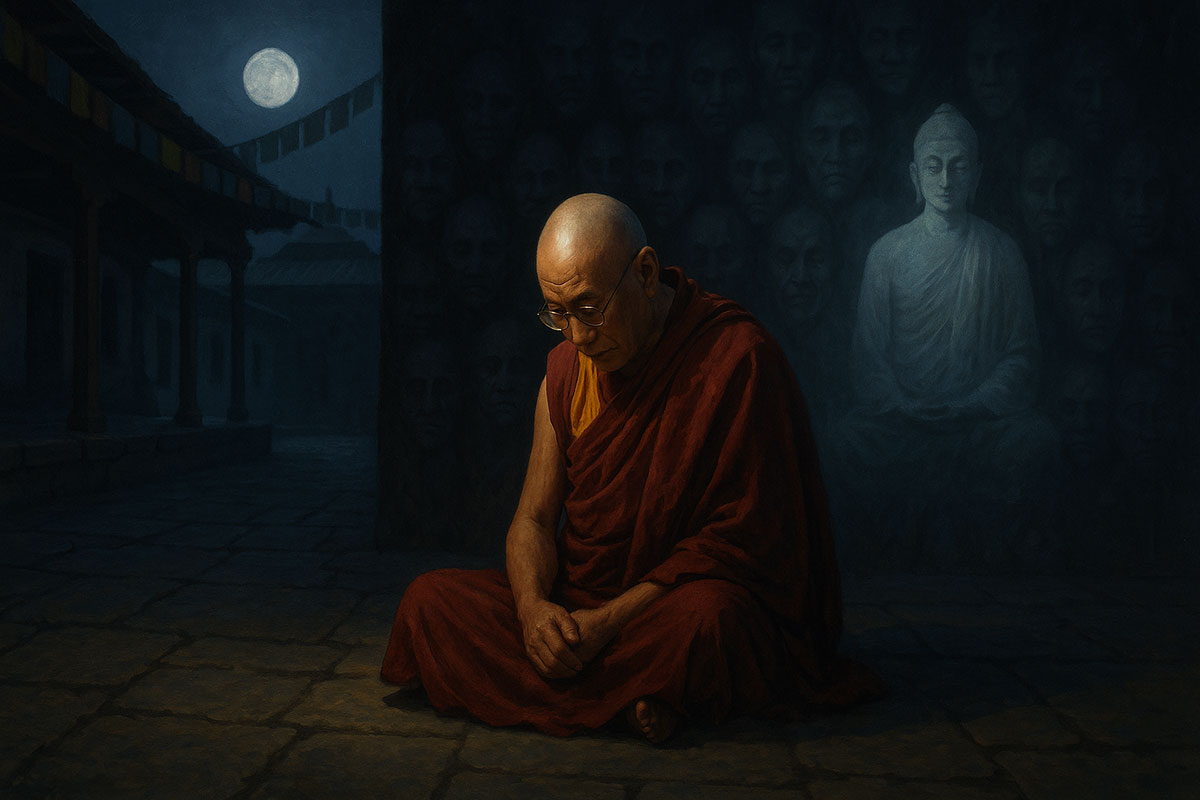
The evening was still. A quiet monastery courtyard lay beneath the moonlight, the prayer flags stirring in the breeze. The Dalai Lama sat in meditation, his back straight, his mind calm yet burdened. For decades he had been the face of Tibetan Buddhism to the world, a symbol of resilience in exile, a teacher of compassion to millions. Yet deep within, he carried the silent grief of displacement, the sorrow of his people, and the weight of always needing to be strong.

As he breathed, a presence stirred. Gentle, luminous, steady as the mountains — Siddhartha Gautama, the Buddha, appeared before him.

The Dalai Lama gasped, his hands trembling. “Master…?”

The Buddha nodded, his eyes alight with compassion. “Tenzin Gyatso, child of the Dharma, you have called me all your life through your devotion. Tonight, I come.”

The Dalai Lama’s throat tightened. He had prayed countless times before the Buddha’s statues, repeated his words, lived in his shadow. But never had he expected this: to see him face to face.

The Buddha spoke softly. “Tell me, why do you carry so much suffering in your heart?”

The Dalai Lama blinked back tears. “Because my people suffer. Because my country suffers. Because the world suffers. I thought if I did not carry it, who would? If I falter, perhaps hope will vanish.”

The Buddha shook his head gently. “Compassion is not the taking of all burdens, Tenzin. It is the seeing of suffering and responding with love — but without losing yourself in the sorrow. You have confused compassion with possession. The suffering of the world is not yours to hold alone.”

The Dalai Lama’s lips trembled. For decades, he had smiled, laughed, spoken words of hope, even as his chest ached with the pain of exile and loss. Now the one he revered told him he had carried it wrongly. His composure cracked, and tears welled.

“I only wanted to honor you,” he whispered. “To embody your teachings.”

The Buddha placed a hand on his shoulder. “And you have. But child, even I could not end all suffering. I only showed the path. You are not asked to be the savior of the world, but a lamp along the way. Let go of what was never yours to hold.”

The Dalai Lama broke. He bent forward, sobs shaking his body, tears spilling freely. For the first time in decades, he allowed himself to collapse, not as the Fourteenth Dalai Lama, not as Tibet’s leader, but as a son before his master.

And the Buddha simply held him.

Topic 2: The True Nature of Compassion — Beyond Teaching, Into Being
When his sobs subsided, the Dalai Lama lifted his gaze, eyes red, voice hoarse. “Master, I have spoken your teachings my whole life. Compassion, nonviolence, the interdependence of all beings. But sometimes I fear I am only words. Do I truly embody compassion, or am I just a messenger repeating what I do not yet fully know?”

The Buddha smiled softly. “Tenzin, you misunderstand compassion if you measure it by perfection. Compassion is not a mask, nor is it flawless. It is a heart that opens again and again, even after breaking. Tell me — have you loved even when it cost you? Have you forgiven when bitterness beckoned?”

The Dalai Lama’s lips trembled. He thought of the Chinese authorities who had taken his homeland, the endless negotiations, the betrayals, the pain of exile. “I have tried. I have prayed for them, even when my people cursed them. But sometimes, deep down, I still feel anger. Does that mean I have failed compassion?”

The Buddha’s eyes glowed with gentleness. “No. It means you are human. Compassion is not the absence of anger. It is the choice, again and again, to return to love even when anger rises. It is the movement of the heart, not the perfection of it.”

The Dalai Lama’s chest heaved. “Then I am not unworthy of your path?”

The Buddha shook his head. “You are not unworthy. You are my continuation. Compassion flows through you not because you are flawless, but because you are willing. Even in your laughter, even in your tears, even in your doubt — compassion lives.”

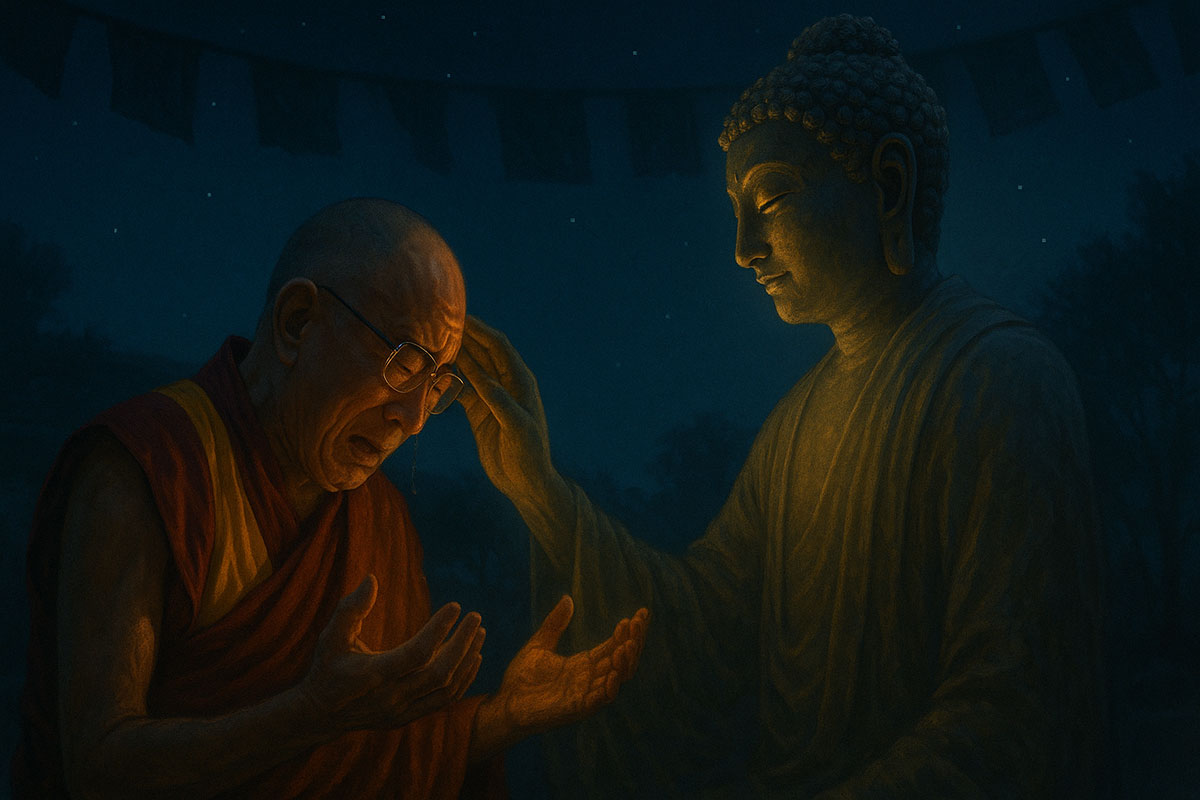
At these words, the Dalai Lama’s composure shattered once more. He had carried for so long the fear that he was a poor reflection of the Buddha’s greatness, that history would judge him as inadequate. Now his master himself told him: he was enough. His body shook with sobs, tears running down his face, not of despair but of relief.

The Buddha touched his forehead gently. “You do not need to prove compassion, Tenzin. You are compassion.”

The Dalai Lama wept uncontrollably, unable to contain the release of decades of silent striving.

Topic 3: The Illusion of Self — Meeting the Master Beyond Form
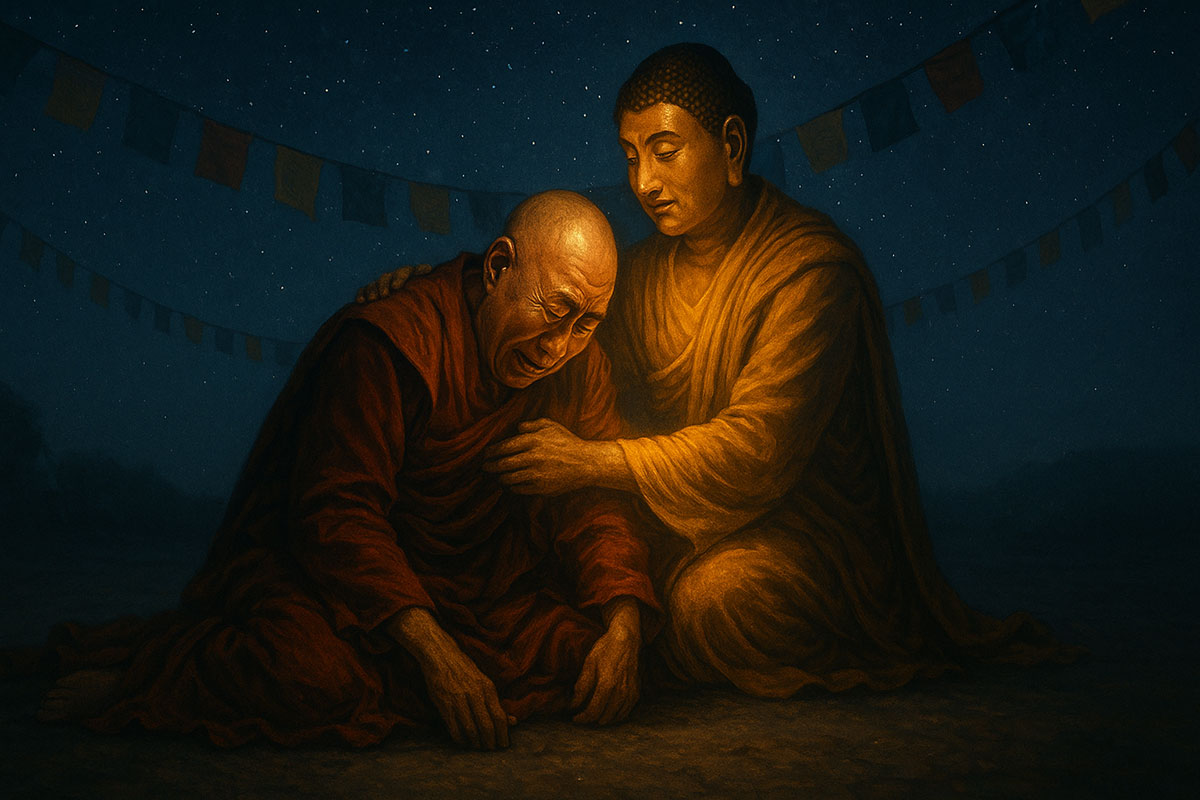
The night deepened, the stars bright above. The Dalai Lama sat close to the Buddha now, his heart raw, his spirit undone.

He whispered, “Master, I have taught that the self is illusion, that clinging is the root of suffering. Yet I have clung to being the Dalai Lama. I have clung to being your servant. Have I failed your teaching by holding to my own identity so tightly?”

The Buddha looked into his eyes, his gaze vast as the sky. “Tenzin, the self is illusion when it imprisons. But the self can also be a vehicle of compassion. You did not cling to being the Dalai Lama out of vanity. You accepted the role so that others might see the Dharma alive in you. That is not bondage. That is service.”

The Dalai Lama’s tears spilled again. “But what if I die and it is not enough? What if my people remain scattered, my homeland never free?”

The Buddha’s voice was deep, steady, like the earth itself. “Then you will have still fulfilled your purpose. The measure of a life is not in outcomes, but in presence. You gave compassion to the world. That is freedom, whether or not Tibet is free.”

The Dalai Lama’s body shook with sobs, more intense than before. He had lived with the secret fear that all his efforts might end in failure. Now the Buddha himself declared it did not matter. His life had already been enough.

The Buddha leaned close, his voice tender. “Do not fear being forgotten, child. Compassion cannot be erased. You are not the Fourteenth Dalai Lama. You are not even Tenzin Gyatso. You are the echo of awakening, as I was. And one day, others will carry it forward. This is the wheel. You are part of it, not the whole.”

The Dalai Lama collapsed, tears pouring down his face, sobbing uncontrollably like a child. His robes, his titles, his composure — all dissolved. What remained was only a heart laid bare before his master, trembling in love and release.

And the Buddha embraced him, not as a leader, not as a teacher, but as a son returned home.

That night, the Dalai Lama met the one whose name he had spoken every day of his life. And in that meeting, the burdens he had carried for decades crumbled. The suffering of his people, the fear of failure, the doubt of worthiness — all dissolved in the compassion of the Buddha.

And when the Buddha whispered that he was enough, the Dalai Lama wept as he had never wept before — not out of despair, but out of the shattering relief of finally being seen, embraced, and freed.

For the world, he was the Fourteenth Dalai Lama. But in that night, he was simply Tenzin, a child in his master’s arms.

Closing Reflection by Dalai Lama

In that encounter, I was undone. The Buddha did not give me more teachings to memorize, nor did he demand that I prove myself worthy. He reminded me that compassion is not something to achieve, but something to remember—that it already flows through us when we open our hearts.

For the first time, I allowed myself to break. I wept with a freedom I had never known, because I realized I did not have to carry everything alone. My worth was not measured by the fate of my country or the success of my words, but by the willingness of my heart to love.

What I received that night was release. Release from the burden of being more than I am. Release from the fear of not being enough. In the arms of the Buddha, I rediscovered the truth that even in imperfection, compassion lives. And that is enough.

Short Bios:

The Dalai Lama
The 14th Dalai Lama, Tenzin Gyatso, is the spiritual leader of Tibetan Buddhism and a global voice for peace, compassion, and nonviolence. Born in 1935, he was recognized as the reincarnation of his predecessor at a young age and later forced into exile when Tibet was occupied. Despite hardship, he has dedicated his life to preserving Tibetan culture, teaching compassion across all faiths, and advocating for harmony among nations and peoples.

The Buddha (Siddhartha Gautama)
Siddhartha Gautama, known as the Buddha, was a spiritual teacher who lived in India over 2,500 years ago. After years of seeking truth, he attained enlightenment beneath the Bodhi tree and spent the rest of his life teaching the path to liberation from suffering. His teachings on mindfulness, compassion, and the middle way continue to guide millions worldwide, shaping one of the most enduring spiritual traditions in history.

Related Posts:

  • Karma Exchanger: A Novel of Pain, Rebirth, and Mercy
  • Eternal Wisdom for the Modern Age: Imaginary Talks…
  • Siddhartha Explained Through Its Characters: Love,…
  • The House With the Black Stone: A Korean Family Saga
  • Could Japanese Culture Succeed Where Religion Has Failed?
  • 100 Geniuses on Humanity’s Future

Filed Under: Buddhism, Compassion, Healing, Spirituality Tagged With: Buddha compassion teaching, Buddha conversation, Buddha Dalai Lama dialogue, Buddha wisdom dialogue, Dalai Lama broken, Dalai Lama burden, Dalai Lama Compassion, Dalai Lama conversation, Dalai Lama crying, Dalai Lama emotional, Dalai Lama exile, Dalai Lama freedom, Dalai Lama hope, Dalai Lama Love, Dalai Lama meets Buddha, Dalai Lama spiritual experience, Dalai Lama suffering, Dalai Lama teaching, Dalai Lama tears, Dalai Lama worthiness

Reader Interactions

Leave a Reply Cancel reply

Your email address will not be published. Required fields are marked *

Primary Sidebar

RECENT POSTS

  • The Great Gatsby in 7 Minutes: Why Gatsby’s Dream Failed
  • a new earthIs Humanity Entering a New Earth? Spiritual Awakening Explained
  • great gatsby modern storiesThe Great Gatsby: 5 Modern Stories About Dreams We Chase
  • the great gatsby analysisThe Great Gatsby Experts Explain Gatsby’s Dream and Tragedy
  • the Great Gatsby explainedThe Great Gatsby: Did Gatsby Love Daisy or His Dream?
  • After Of Mice and Men: What Happened to George After Lennie?
  • Of Mice and Men in 7 Minutes: When Love Is Not Enough
  • of mice and men modern day storiesOf Mice and Men: 5 Modern Stories About Love, Care and Responsibility
  • of mice and men analysisOf Mice and Men: Was George Right to Kill Lennie?
  • of mice and men 5Of Mice and Men: Was George’s Final Choice an Act of Love?
  • grapes of wrath modern storiesThe Grapes of Wrath Today: 5 Modern Stories About “I” and “We”
  • grapes of wrath questionsThe Grapes of Wrath Explained: 5 Questions Readers Still Ask
  • the grapes of wrath john steinbeckThe Grapes of Wrath: When Does “Me” Become “We”?
  • Stand With Jesus: What If People Tried to Stop the Crucifixion?
  • East of Eden Today: 5 Stories About Breaking Family Cycles
  • john steinbeck east of edenEast of Eden: Does Timshel Still Make Sense Today?
  • East of Eden: Are We Born Bad or Free to Choose?
  • Convenience Store Woman: 5 American Stories About Marriage and Freedom
  • convenience-store-women-analysis-Convenience Store Woman: Is the New Normal Really Normal?
  • convenience store womenConvenience Store Woman: Who Decides What Is Normal?
  • sayaka murata imaginary friendsSayaka Murata Imaginary Friends: The Mystery Behind Her Inner World
  • Social Health Stories: 5 Ways We Lost Our Sense of Belonging
  • Social Health: Why Modern Life Is Making Us Lonely
  • nickel-boys-modern-stories-The Nickel Boys: 5 Modern Stories About Truth, Trauma and Hope
  • coloson whitehead the nickel boys discussionThe Nickel Boys: What Kind of Hope Survives Injustice?
  • the nickel boys colson whiteheadThe Nickel Boys: Elwood and Turner on Justice, Survival and Truth
  • AI Resource Consumption: Can AI Give More Than It Takes?
  • madeline-miller-circe-modern-stories-5 Modern Stories Inspired by Circe by Madeline Miller
  • Circle-Madeline-Miller-analysis-Circe Explained: Myth, Meaning, and Madeline Miller
  • Madeline Miller Circle CharactersMadeline Miller Circe: What If No One Ever Chose You?
  • 5 Modern Stories Inspired by Keigo Higashino’s Silent Parade
  • could japanese culture succeed where religion has failedCould Japanese Culture Succeed Where Religion Has Failed?
  • keigo-Higashino-when-love-becomes-too-much-5 Modern Stories Inspired by The Devotion of Suspect X
  • The Devotion of Suspect X Explained by Psychologists: Is Ishigami’s Love Really Love?
  • the devotion of suspect xThe Devotion of Suspect X Explained: Was Ishigami’s Sacrifice Really Love?
  • 5 Modern Midnight Library Stories About Regret, AI, and Choice
  • Matt Haig The Midnight LibraryThe Midnight Library Explained by Scholars and Matt Haig
  • The-Midnight-Library-explainedThe Midnight Library Explained Through Its Characters
  • 5 Modern Siddhartha Stories About Wisdom, Love, AI, and Choice
  • Siddhartha explained by leading scholarsSiddhartha Explained by Leading Hermann Hesse Scholars
  • Siddhartha explainedSiddhartha Explained Through Its Characters: Love, Loss, and Enlightenment
  • before-the-names-are-carved-Before the Names Are Carved: Five Connected Stories
  • The Scholars and the Unworn ShoesHan Kang Human Acts Explained by Leading Scholars
  • Han Kang Human Acts: An Imaginary Conversation with the Dead
  • The Years We Thought We Had: A Story of Love and Waiting in Japan
  • snow-country-analysis-Snow Country Analysis: Kawabata Scholars Explain It
  • snow-country-was-their-love-realSnow Country Explained Through Its Characters
  • the-man-who-never-took-the-day-off-The Man Who Never Took the Day Off: A Modern Ishiguro Story
  • The Remains of the Day Explained by Leading Ishiguro Scholars
  • the-remains-of-the-day-imaginary-talks-The Remains of the Day Explained Through Its Characters
  • the-pastor-who-couldnt-be-forgiven-The Pastor Who Couldn’t Be Forgiven: A Modern Story of Grace
  • disgrace-j-m-coetzee-Disgrace Explained Through Its Characters
  • disgrace-explained-leading-jm-coetzee-scholarsDisgrace Explained by Leading J. M. Coetzee Scholars
  • Forty-One Could Live. Nine Had to Die.
  • The Gospel According to Jesus Christ explainedThe Gospel According to Jesus Christ Explained Through Its Characters
  • SARAMAGO’S GOSPEL EXPLAINEDThe Gospel According to Jesus Christ Explained by Top Scholars
  • the last safe floorThe Last Safe Floor: A Modern Lord of the Flies Story for 2026
  • william golding explained by top scholarsWilliam Golding Explained by Top Scholars: Evil, Faith, and Redemption
  • lord-of-flies-character-conversation-Lord of the Flies Explained Through Its Characters: Is the Beast Inside Us?
  • never complain never explainNever Complain Never Explain: Henry Ford & Disraeli
  • The Empty Chair: A Modern Brothers Karamazov Story
  • the brothers karamazov explained top dostoevsky scholarsThe Brothers Karamazov Explained by Top Dostoevsky Scholars
  • Brothers Karamazov explainedThe Brothers Karamazov Explained Through Its Characters
  • before yesBefore Yes: A Modern American Story Inspired by Albert Camus
  • The Stranger Explained by Top Albert Camus Scholars
  • the stranger explainedAlbert Camus’s The Stranger Explained Through Its Characters
  • What is Worth Saving?The Last Store on Main Street: Inspired by The Sound and the Fury
  • The Sound and the Fury Scholar discussionThe Sound and the Fury Explained by Top William Faulkner Scholars
  • The Sound and the Fury Family SpokenThe Sound and the Fury Explained by Its Characters
  • The Building That Stopped Seeing | Modern Camus Story
  • The Plague Explained by Top Albert Camus Scholars
  • albert camus the plague explainedThe Plague explained by its characters
  • the last good sentenceThe Last Good Sentence: A Story About Fame and Loneliness
  • hemingway scholars debateThe Old Man and the Sea Explained by Top Scholars
  • The Old Man and the Sea Explained by Its Characters
  • the new meaning of survivalThe New Meaning of Survival: Top Scholars on Human Flourishing
  • true meanig of survivalThe True Meaning of Survival: Living, Not Just Existing
  • the last affordable roadThe Last Affordable Road: A Modern Grapes of Wrath Story
  • the-grapes-of-wrath-explained-by-top-scholars-The Grapes of Wrath Explained: Top Steinbeck Scholars
  • the grapes of wrath conversationThe Grapes of Wrath Explained Through Its Characters
  • the white silenceThe White Silence: A Japanese Novel of Loneliness
  • jose-saramago-blindness-explained-Blindness Explained by Top Scholars | José Saramago’s Greatest Warning
  • José-Saramago-Blindness-Explained-Blindness Explained Through Its Characters and José Saramago
  • Can the Bhagavad Gita Still Guide Humanity in 2026?
  • The Crown of AshesThe Crown of Ashes: A Modern Shakespearean Tragedy
  • the-fourth-bowl-If Toni Morrison Wrote a Japanese Family Novel: The Fourth Bowl
  • Beloved Ending Explained: 25 Questions Answered by Morrison Scholars
  • Toni-Morrison-Beloved-Explained-Beloved Explained Through Its Characters and Toni Morrison
  • house with the black stoneThe House With the Black Stone: A Korean Family Saga
  • Be Kind to Your Mother Before It’s Too LateBe Kind to Your Mother Before It’s Too Late
  • Gabriel-García-Márquez-one-hundred-years-of-solitude-explained-One Hundred Years of Solitude Explained by Top Scholars
  • one-hundred-years-of-solitude-explained-One Hundred Years of Solitude Explained
  • are-any-lives-truly-ordinary-Hateship Friendship Courtship Loveship Marriage explained
  • The Overstory explainedThe Overstory Explained: Themes, Ending, and Meaning
  • Demon Copperhead Explained: Barbara Kingsolver’s Pulitzer-Winning Novel
  • can you judge trump by his enemiesCan You Judge Donald Trump by His Enemies?
  • The Warmth of Other Suns Explained
  • America Iran strategyCan America Prevent a Wider Middle East War?
  • Lincol in the BardoLincoln in the Bardo Ending Explained:
  • God-as-Original-Parent-If God Created Man and Woman, Is God Our Original Parent?

Footer

Recent Posts

  • The Great Gatsby in 7 Minutes: Why Gatsby’s Dream Failed September 2, 2026
  • Is Humanity Entering a New Earth? Spiritual Awakening Explained September 2, 2026
  • The Great Gatsby: 5 Modern Stories About Dreams We Chase September 2, 2026
  • The Great Gatsby Experts Explain Gatsby’s Dream and Tragedy September 1, 2026
  • The Great Gatsby: Did Gatsby Love Daisy or His Dream? September 1, 2026
  • After Of Mice and Men: What Happened to George After Lennie? September 1, 2026

Pages

  • About Us
  • Contact Us
  • Disclaimer
  • Earnings Disclaimer
  • Privacy Policy
  • Terms and Conditions

Categories

Copyright © 2026 Imaginarytalks.com