


Virginia Woolf:
There are spirits who never enter the drawing room of public approval, and yet their presence haunts the world more intimately than those who do. Emily Brontë was one such spirit. She did not seek our eyes. She barely sought our understanding. And still, she wrote a book that shook the walls of the English novel, as if the moors themselves had risen up and set language alight.
In these final memories—fragile, fierce, and unspoken—we do not observe her from afar. We sit beside her. We walk with her across the wild hills. We feel the winds she did not resist. These are not merely episodes of her life—they are the tremors of a soul too wild to be tamed, too quiet to be ignored.
(Note: This is an imaginary conversation, a creative exploration of an idea, and not a real speech or event.)
Chapter 1: The Silent Child Among Storms

(Emily Brontë, age 6 – Haworth Parsonage, Yorkshire Moors)
The wind moaned through the narrow windowpanes of the parsonage like a voice too old to remember its name.
In the upstairs nursery, a small girl stood beside the hearth, not crying. Grief had passed through like winter through bare trees—too cold for tears, too vast for comfort. Her black dress hung stiffly from her shoulders, and her boots were muddy from slipping into the chapel yard when no one was watching.
Emily did not cry when her mother died. Nor when Maria and Elizabeth, her two elder sisters, vanished from the world like frost from a window. Instead, she watched. She listened to the wind. And in her quiet, something bloomed that did not know how to speak.
The world did not know how to speak to her either. Servants whispered, "That one’s strange." Her father, shattered and blinking behind books, left long silences in place of bedtime prayers. Charlotte scribbled furiously. Branwell painted battle flags. Anne held Emily’s hand but never tightly enough to anchor her.
You found her like that, one gray morning, crouched behind the kitchen door. A pencil in one hand, a leaf in the other.
"Do you draw storms too?" you asked softly.
She didn’t look up, but the page curled slightly with her breath. A moor with no horizon. Crows in the margins. A single child standing beneath a thundercloud shaped like a woman’s face.
"I think," you said gently, kneeling beside her, "your silence is saying something louder than words ever could."
She turned then—slowly. Her eyes were not tearful, but they were endless.
You didn’t try to explain death. You didn’t ask about the funerals. Instead, you pulled a piece of charcoal from your coat and offered it. "Want to show me more?"
She did not smile. But she took the charcoal.
And with that quiet, her first friend was born—not in laughter or games, but in the shared acceptance of sorrow without needing to name it.
Later that week, as the others played their imaginary kingdoms, you found her standing on the hill behind the parsonage, hair tangled, coat too large. She whispered—not to you—but to the wind.
"She sang to the clouds," she said softly. "Before she left."
You nodded, not needing to know who "she" was.
"Do you think," she asked, eyes still on the sky, "they become wind when they go?"
"I think they become whatever we most need them to be," you said.
She was quiet again. But this time, her silence was not the absence of language. It was reverence.
That night, Emily wrote her first poem. Not one she would show, not one she would even keep. But it carried inside it the sound of boots in snow, the tremble of a candle when someone leaves a room, and the breathless hush of a child learning that even sorrow can be sacred.
You left her that evening with a blanket and a book of stars.
And the girl who would someday give the world Wuthering Heights whispered her first storm onto paper—not for the world, not for family, but for the sky that had not abandoned her.
Chapter 2: The Exile at Roe Head
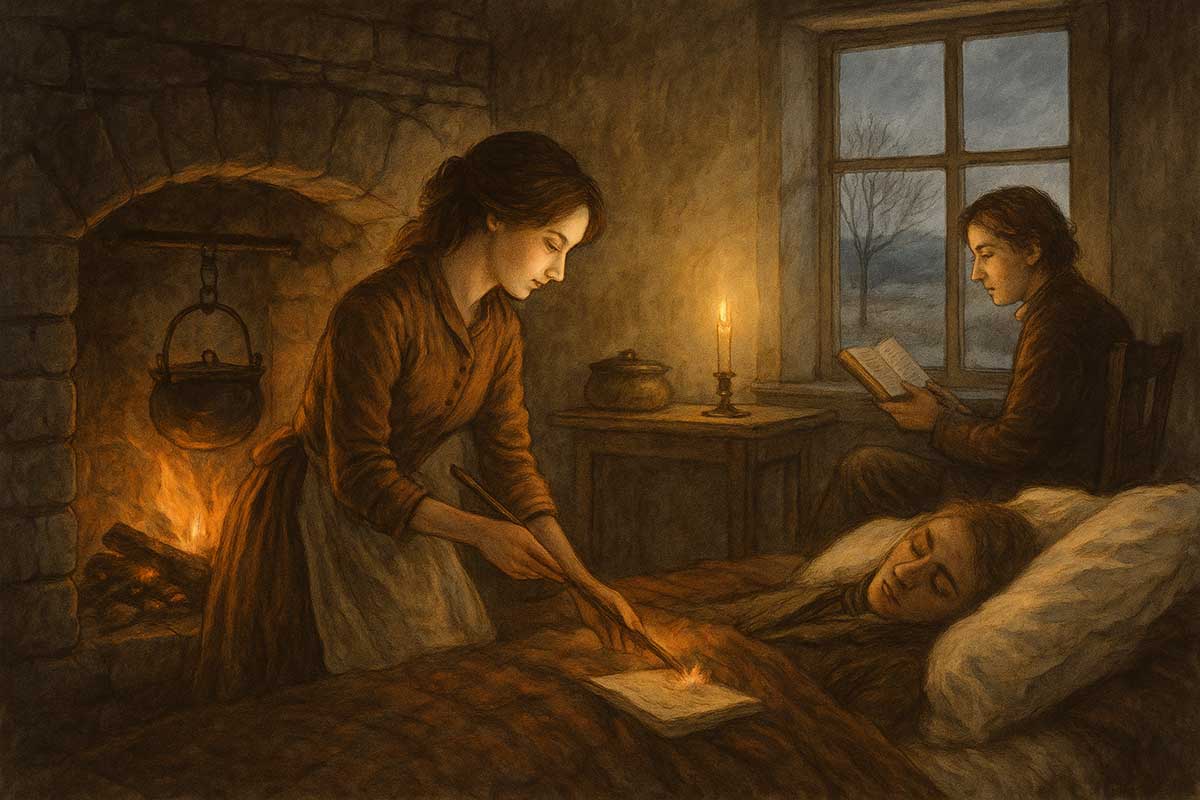
(Emily Brontë, age 17 – Boarding School, Mirfield)
The air in the dormitory was full of starch, chalk dust, and other girls’ laughter. But not hers.
Emily sat at the far edge of the long wooden table, her back slightly hunched, her hands trembling as they folded a letter she would never send. Her eyes flicked toward the window, the only opening to the wind and moors she had left behind.
Even her breathing seemed to betray her here—too deep, too private, like a foreigner caught speaking her own tongue in a city that didn’t want to hear it.
She had been sent here with Anne. Charlotte had already braved these walls, adapting herself like a vine to a wall. But Emily couldn’t pretend to be what she wasn’t. She ate too little. She spoke too seldom. And when she did, her Yorkshire vowels spilled out like rain against the clean white pages of recitation books.
Her teachers mistook her silence for pride. Her classmates mistook it for judgment.
Only you knew it was homesickness—feral and raw, the kind that doesn’t pine for people but for fields, winds, and solitude.
You found her on a Thursday, curled against the stone wall at the edge of the school garden, her fingers buried in the cold soil.
“It’s not that I hate them,” she whispered as you sat beside her. “I just… I can’t breathe here.”
You didn’t offer advice. You offered a flat stone you’d found near the stream that morning—one with moss still clinging to it.
She touched it like a memory.
“They don’t understand,” she added. “I love things too much that don’t speak. Wind. Dogs. Firelight. I think my heart is shaped wrong for this place.”
“No,” you said. “It’s shaped for a place no map can find.”
That night, when you snuck a candle into her room, you saw her rereading old poems she’d scribbled in the folds of her Bible. She had drawn tiny creatures in the margins—foxes, ghosts, hooded women with hair made of smoke.
“You know,” you whispered, “you can carry home inside you.”
She shook her head.
“I need to touch it,” she said. “To feel the cold in my bones. To hear the heather crack when I walk. Here it’s just… emptiness with rules.”
The next day, she collapsed. Pale. Breathless. A sickness no one named aloud, but everyone feared would take her like it had Maria and Elizabeth.
But she didn’t die.
She left instead.
Sent back to Haworth, as if her soul had rejected this exile and called her body home.
When she saw you again—back on the moors, bootlaces undone, wind tearing at her shawl—she didn’t smile. But her color was better. Her voice firmer.
“They tried to civilize me,” she said, “but I was born too wild.”
And you knew then what she had known all along: the world would never understand her… but the earth would.
Chapter 3: Keeper of the House of Death
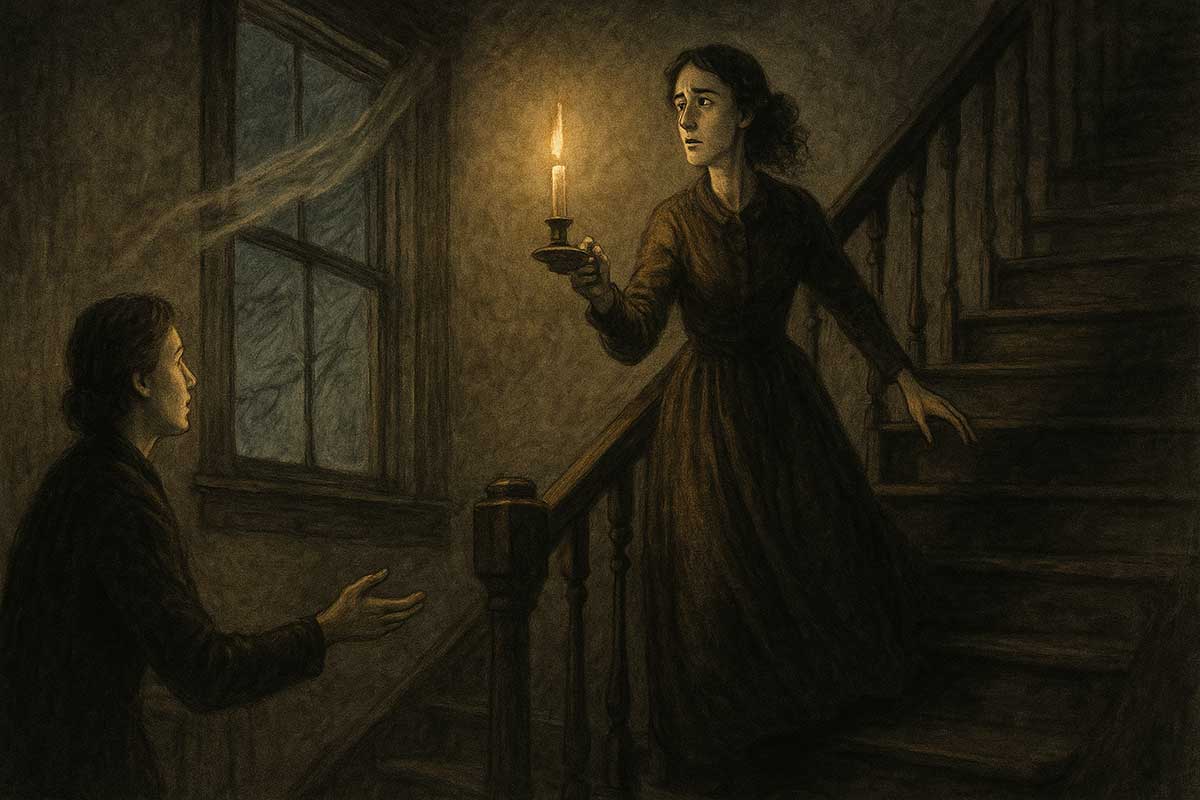
(Emily Brontë, age 24 – After Branwell’s Collapse)
The parlor had not been silent in days.
Footsteps, slurred words, coughing fits, and the crash of something breaking yet again filled the house like storm winds.
Branwell had once been a golden flame. Now he was a candle burned low, guttering in whiskey and regret. His eyes no longer saw the room; they searched for ghosts.
And Emily stood guard.
She fed the fire. She stood between her brother and the worst of himself. When he raged, she did not flinch. When he wept, she turned her back so he could keep his dignity.
You found her in the kitchen one night, alone, slicing bread so slowly it seemed the knife weighed a hundred pounds.
“Are you all right?” you asked gently.
She didn’t answer for a long time. Then, without looking at you:
“I would rather stand watch with the dead than abandon the dying.”
The floor creaked overhead. A muffled voice cried out Branwell’s fevered nonsense.
“Charlotte says I must not ruin myself for him,” she said, as if to the air. “But if I do not hold the door shut, the dark will come in.”
You made her tea. She didn’t drink it.
Instead, she stood at the back door of the kitchen, the wind tousling her hair, her eyes fixed on the graveyard behind the parsonage.
“They lie more peacefully than we live,” she whispered.
That night, she wrote again—not poetry this time, but something fierce, wild, full of lightning. You read the ink-stained pages over her shoulder as she described a land of doomed passion, unrepentant spirits, and howls in the night.
“I don’t know what it is yet,” she murmured, “but it rises when I sit near pain.”
And you understood.
Wuthering Heights was not being written from imagination. It was being exorcised.
Later that week, Branwell broke a window in a fit of delirium. Glass in his hand, blood on the floor.
Emily stitched him up with silent hands. Then she stood by the fire, her own sleeve torn, chest heaving.
“I am not kind,” she told you. “But I am loyal.”
You took her hand, trembling but steady.
“No,” you said. “You are kind in the way mountains are. And just as necessary.”
That night, she left her candle burning long into the dawn, sitting by the hearth with Keeper—her dog—at her feet. Her eyes burned, not with tears, but with purpose.
Pain had given her voice.
And her voice had begun to sing.
Chapter 4: The Wind No One Heard

(Emily Brontë, age 28 – After the success of Wuthering Heights, but no recognition)
The world had received her story with silence.
Wuthering Heights was out there now, breathing its ghost-winds through bookshops and drawing rooms. But no one seemed to understand it. Not really.
The critics said it was strange, brutal, unnatural. They thought the author was Ellis Bell—a man. A stormy, uncouth man with no sense of propriety.
You found her sitting on the moor, knees drawn up, eyes distant.
“The wind knows what I meant,” she murmured. “But men do not listen to wind.”
You sat beside her. For once, she let her head rest on your shoulder.
“It’s not them,” you said. “It’s the world—they haven’t learned how to read the weather.”
She smiled faintly. “Then I’ll go on speaking it.”
There were no congratulations, no invitations to literary salons. Charlotte’s novel had been better received, more “understandable,” more lady-like. Anne was quietly praised. But Emily? Emily had written something people wanted to turn away from.
“I didn’t write it for them,” she said flatly, when you mentioned it. “I wrote it for the ones who have never been spoken to.”
She no longer read the reviews. She returned to her routine—walking the moors, feeding the dogs, baking her unsweetened bread. But something in her gaze had changed. A quiet ache. A refusal to let herself hope again.
“I thought I would feel something,” she said once, tracing frost on the windowpane. “When it was done. When it was born.”
You squeezed her hand. “It was never about them, was it?”
“No,” she said. “It was about freeing something.”
You brought her a clipping one day—a strange review, tucked in the corner of a lesser-known journal. It didn’t praise the novel, not directly. But it noticed it. Called it soul-wrung and elemental. The reviewer said:
“The voice in these pages is not human alone. It is wind, earth, fire, and something we have forgotten how to name.”
She read it twice. Then folded it carefully and tucked it into her copy of the manuscript.
“I’ll keep that,” she said.
That evening, as the wind howled around the parsonage, you found her standing in the garden. Her hair whipped about her like storm-clouds. She held her arms out wide.
“I am not unread,” she said to the sky. “I am simply unreadable.”
You didn’t answer. You knew better than to.
You just stood with her, in the wind, letting the world be as wild and untranslatable as she was.
Chapter 5: The Final Door She Would Not Lock

(Emily Brontë, age 30 – The last weeks of her life, refusing a doctor)
The cold came early that winter.
Not the kind that bit at your skin, but the kind that seeped into walls, into lungs, into silence. Emily began coughing more. Quietly, at first. Then with a rasp that echoed even through the stone parsonage walls.
She refused to stay in bed.
Every morning, she was at the hearth feeding the fire, or walking Branwell’s dog along the moor path with a scarf pulled too loosely around her neck.
“She’s dying,” Charlotte whispered to you. “And she won’t let us help.”
You knew. You saw it too. The thinness in her cheeks, the way she gripped the bannister when she thought no one was watching. Still, her eyes hadn’t dimmed. Not once.
She refused to see a doctor. “I’ll not have strange men poking at what they can’t fix,” she said. “They’ll try to stitch me shut, but I’m already open.”
She knew it was consumption.
One night, when the fire had burned down to a soft glow, you found her at her desk—thin, breath short, yet writing still. She was copying out a poem in delicate strokes, as if every word was a leaf pressed flat between the pages of her soul.
“I will not leave it unfinished,” she said.
You placed a blanket on her shoulders. “You are not a duty,” you whispered. “You’re a person. You’re loved.”
She looked at you then, really looked.
“You believe that?”
“Yes.”
She turned to the page and wrote one last line. “Then it’s true.”
She handed you the page.
It read:
“No coward soul is mine,
No trembler in the world’s storm-troubled sphere.”
When the coughing grew worse, she would still come downstairs. Sit by the fire with the dog’s head on her lap. When she coughed blood, she wiped it away and said, “Don’t you dare pity me.”
You never did.
You just sat with her—quiet as snowfall—while the clock ticked like a heartbeat.
One morning, the fire was out. The dog whimpered. You climbed the stairs and found her lying peacefully, her hair fanned out over the pillow, a small notebook at her side.
She had written one last thing—barely legible, but unmistakably her.
“I am in the wind. I am in the moor.
I will not be locked out of living.”
You didn’t cry. You opened the window.
And let the wind in.
Final Thoughts by Virginia Woolf
Emily Brontë died young, but her voice did not quiet. It rustles through heather. It flickers by candlelight. It lives not in declarations but in glances, in wind-blown pages, in the things we feel and cannot name.
She never asked to be understood. And perhaps that is why we understand her still—not through logic, but through longing. Through the ache of solitude. Through the stubborn dignity of silence. She was not a woman of many words. But when she spoke, the world changed its shape to listen.
Now, as we close the final door she left open, may we walk away not with conclusions, but with companionship—for Emily does not end. She simply disappears into the moor, where she always belonged.
Short Bios:
Emily Brontë: English novelist and poet best known for Wuthering Heights. Reclusive and fiercely independent, she poured her intense inner world into haunting prose and poetry shaped by the wild Yorkshire moors.
Charlotte Brontë: Elder sister of Emily and author of Jane Eyre. Passionate and protective, she championed her sisters' work and preserved Emily’s legacy after her death.
Anne Brontë: Youngest Brontë sibling and author of The Tenant of Wildfell Hall. Quietly defiant, she offered a progressive voice on women’s independence and moral strength.
Branwell Brontë: The only Brontë brother, a gifted but troubled painter and poet whose decline mirrored the family’s private tragedies.
Tabby Aykroyd: The Brontës’ longtime servant and family companion. Her stories and presence deeply influenced the siblings’ imagination and emotional grounding.
Leave a Reply