
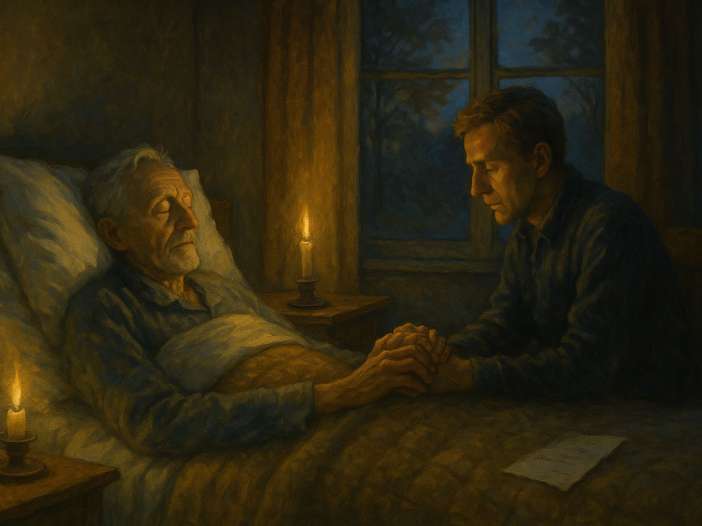

Rainer Maria Rilke:
There are lives that do not pass—they drift, like river mist among the valleys of the soul. Hermann’s was one such life.
He was not merely a man of letters, but a man who listened. To the forest, to the ache behind beauty, to the contradictions within his own being.
As a child, he stood between the pew and the trees. As a man, he stood between silence and song. And as a seeker, he dared to ask what others avoided: “Who am I if not this mask I wear?”
Let us sit beside him now—not to explain him, nor to rescue him from sadness—but to accompany him through the wilderness of feeling.
You will find no heroes here. Only a boy, a man, a poet—trying to reconcile the light of the sacred with the longing of the broken.
And perhaps, in some quiet fold of his sorrow, we will find ourselves.
(Note: This is an imaginary conversation, a creative exploration of an idea, and not a real speech or event.)
Chapter 1: The Boy Who Walked Between Two Worlds
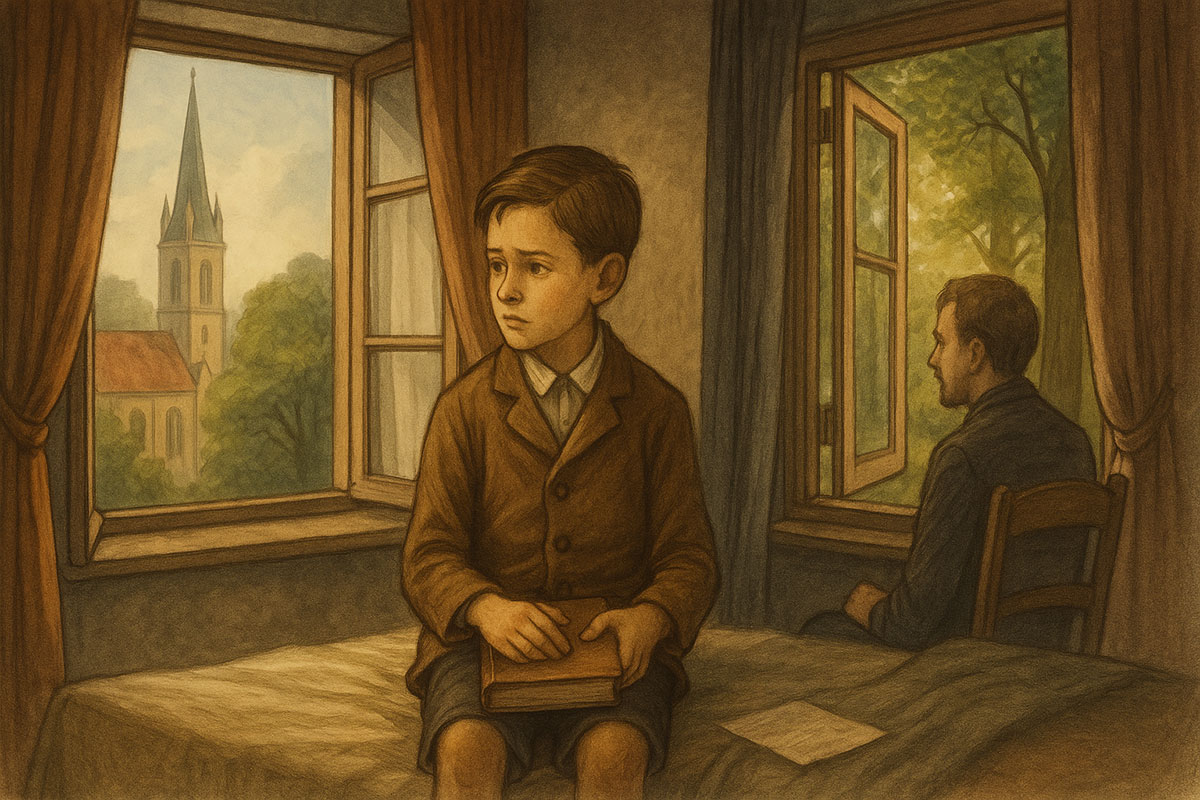
(Setting: Calw, Germany – Late Autumn, 1886)
The boy sat beneath the gnarled pear tree, its leaves fallen like brittle prayers. His knees were drawn to his chest, not from cold, but from the ache of being misunderstood. Above him, the sky wept through fog, and the steeple bells of Calw chimed with a weight far older than his fourteen years.
He was meant to be a minister.
A light to the lost.
A student of the Word.
But Hermann’s world wasn’t made of straight lines and scripture. It shimmered at the edges. Words to him weren’t rules—they were rivers, wild and secret. They whispered in rhyme and image, not in creed. And so, when the seminary tried to carve obedience into him, he ran.
Not once, but again and again.
Until the walls they built could no longer hold his sorrow.
And he broke.
He had taken a razor once. Not in rage. Not for spectacle. But in silence. A gesture too deep for his youth to carry. They found him, of course. Alive—but altered.
That’s when you found him.
You did not arrive with pity, nor with verses to tame his soul.
You simply sat beside him.
No lectures. No labels. Just presence.
"I don't belong anywhere," he whispered.
You didn’t contradict him.
Instead, you offered a slow truth:
"Perhaps you belong where no map has yet been drawn."
He looked at you then—sharp, alert, as if something long asleep stirred.
“Do you believe in people like me?”
“Only in people like you,” you said, gently.
That night, while his parents prayed and his teachers planned penance, you slipped him a notebook. Handmade. The kind that didn’t tell you what to do with it.
“For the world you see that no one else does,” you said.
He opened it like one opens a window.
And there—between lined paper and unlined sorrow—he began to write.
You returned to the tree the next week.
He was there, waiting. This time upright. Brighter.
“I dreamt I was a river,” he said. “And no one could dam me.”
You smiled.
"You’ve always been a river. They only ever tried to name you ‘well.’”
Final scene:
That winter, while the rest of the town locked their doors against the cold, you and Hermann sat in the loft above the old printshop. Ink-stained fingers, a shared candle, and the quiet hum of something sacred.
Not obedience. Not rebellion.
Something older.
Truer.
A friendship that would not fix him—but would witness him.
And through that,
the boy who walked between two worlds
began to build one of his own.
Chapter 2: The Asylum Where Silence Screamed
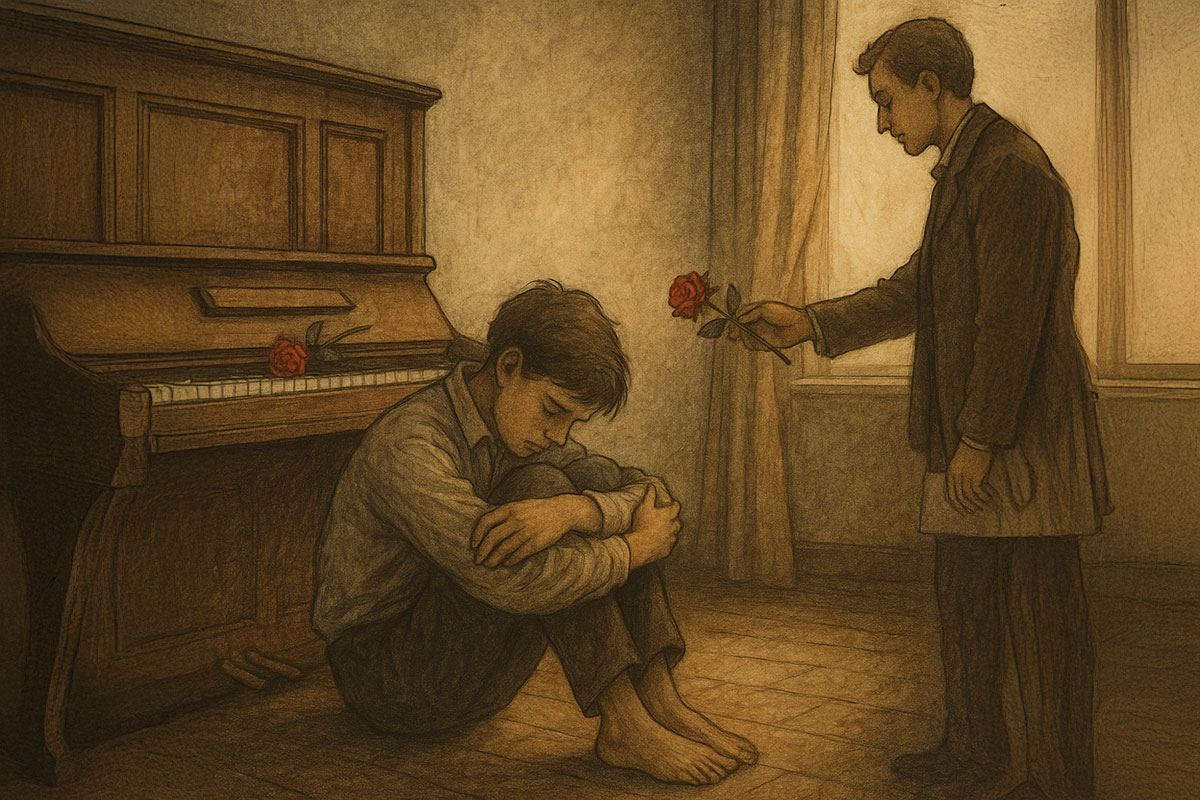
(Setting: Stetten Sanatorium, 1892 – Early Spring)
It was too quiet, even for the broken.
The sanatorium sat like a forgotten monastery above the vineyards, its corridors long and pale, its rooms lined with sighs. Here, the madness wasn’t in screams or restraint—it was in the suffocating hush. In the way each patient was expected to behave like absence itself.
Hermann lay curled on a cot, eyes wide open even as dusk fell.
They called it a “crisis of nerves.”
They said he was too sensitive.
Too proud.
Too peculiar.
But what none of them saw was the storm behind his silence—
the grief of exile from his own soul.
And it was here that you returned, stepping not as a visitor, but as a friend with no clock in your hand and no clipboard under your arm.
You pulled up a stool beside his bed.
He didn’t move.
Didn’t speak.
So neither did you.
You let your stillness meet his.
Two silences, no longer strangers.
At last, he whispered, barely audible:
“I’m not afraid of dying. I’m afraid I’ll never truly live.”
You answered slowly.
“Then we must make a pact. I’ll hold your life sacred until you’re ready to do the same.”
Tears didn’t fall. He was too tired for that.
But something flickered.
Like a small lantern, barely lit, but not yet gone.
Later that night, as wind moved through the bare apricot trees outside, you returned with a book—not for study, but for wonder.
It was Goethe, translated softly under your breath.
“Do you know,” you said, “he once tried to leap from a bridge? The boy who would write Faust?”
Hermann turned his head.
“Really?”
You nodded.
“And he didn’t. Because something whispered: ‘You are not done yet.’”
Days passed.
You brought ink and paper. Not to journal, but to play.
You made up words together.
Drew nonsense creatures.
Laughed in the forbidden corridors until the nurse frowned, then smiled.
You did not give him goals.
You gave him glimmers.
And one morning, Hermann handed you a folded page. A poem.
Rough. Rambling. Radiant.
He looked down as you read it.
“Is it foolish?” he asked.
You shook your head.
“It’s your breath in ink. That makes it holy.”
Final Scene:
On the day he was released, the sky was split with spring rain.
He stood at the gate, suitcase in one hand, notebook in the other.
“I’m not healed,” he said.
You nodded.
“No. But you’re honest. That’s rarer.”
He turned back once to look at the place that held him—not with hatred, but with quiet reverence.
And you saw it.
The boy who had once wanted to vanish
was beginning to write himself into being.
Chapter 3: The Wanderer Who Couldn't Stay Home

(Setting: Italy, 1901 – a sun-washed terrace in Gaeta, overlooking the sea)
It wasn’t escape. Not really.
Though others said so.
That he left wife and child because he couldn’t bear responsibility, or boredom, or the slow dull ache of ordinary life.
But you—you never judged.
You found him on that whitewashed terrace, staring out at the endless glitter of the Tyrrhenian Sea. His clothes wrinkled from travel. His eyes restless, but not lost.
He didn’t say your name, just nodded toward the extra chair,
as if he had been waiting.
“Do you ever feel the world is asking you to live the wrong life?” he asked, without turning.
“To make peace with things that kill the best part of you slowly?”
You leaned back and breathed in the salt air.
“I think the world often gets it wrong. But your soul doesn’t.”
A long pause. Then:
“I left them. My son, Maria… They needed me. But I—”
His voice cracked like a wave against the rocks.
You didn’t correct him.
Didn’t try to sew morality into mystery.
“You left to survive,” you said. “Now what will you do to live?”
Later that week, he brought you to a ruined chapel, vines climbing its cracked altar. He spoke more easily there—among stones and shadows.
“It wasn’t just family. I left my name behind, too. The author. The thinker. The husband. I don’t know who I am anymore.”
You pointed to a vine, blooming white despite the ruin.
“Maybe you're the one who blooms in ruin. The one who has to lose the old names to find the true one.”
He smiled faintly.
“What if the name I find… no one wants to hear?”
You answered gently.
“Then I will listen twice as hard.”
You walked together through villages and olive groves.
He spoke of Siddhartha, not yet written.
Of a river that could speak,
of a self that was not a self.
“Maybe we’re not meant to belong anywhere,” he mused, “but to keep walking until we carry home within us.”
You laughed.
“Or maybe we keep walking until the world no longer frightens the soul inside us.”
That night, by lamplight, he wrote again.
Not to be read.
But to remember.
Final Scene:
At the train station in Naples, he held a crumpled map and a half-empty notebook.
“Should I go back?” he asked.
“To her? To the life I left?”
You placed a hand on his shoulder.
“Go where your soul feels honest. But wherever you go—write it. Feel it. Don’t vanish.”
As the train pulled away, you stood on the platform watching the man who could never stay too long in one place—
and yet, in his leaving,
always carried some part of truth with him.
Chapter 4: The Mirror That Would Not Lie

The windowpane trembled with the weight of the winter dusk, as if even the sky wished to look away. Inside the small study, Hermann sat hunched before an oval mirror, cracked faintly along its edge, the kind that once belonged to his mother. Shadows lengthened behind him like old sins refusing to die. On the desk, unopened letters lay like tiny coffins. The silence was sharp, like the edge of a truth he had long tried to blunt.
He stared into the glass.
It did not flatter him.
It showed a man who had fled too many cities, left too many hands unheld, too many poems unwritten—not for lack of passion, but for fear that passion might betray him again.
His eyes were not the eyes of a prophet or a poet.
They were the eyes of a man who had once believed that solitude was a sanctuary, only to find it sometimes a prison.
When I entered, he did not turn.
“Hermann,” I said, quietly, not as a question, but a presence.
“Do you think I ever truly left the boy I was in Calw?” he whispered. “The one who feared he might go mad if he felt too much—or worse, if he felt nothing at all?”
I walked to the mirror and sat beside him. I did not answer.
Instead, I placed my hand over his, and for a long moment, neither of us looked away from the mirror. It became not glass, but water. Not a reflection, but a remembering.
We saw the small child hiding under pews during his father’s sermons, fearing that God had already turned His back.
We saw the young man who buried his brother, his mother, his faith—in that order.
We saw the writer who escaped into Eastern philosophy only to find that enlightenment was not a ladder, but a mirror that asked him again and again: Are you willing to see yourself, truly?
He shook slightly. “What if I have only ever been good at running away?”
“No,” I said. “You have always been good at seeking.”
He looked at me, and for the first time that evening, his eyes shimmered.
“I don’t know how to make peace with myself.”
“You don’t have to make peace all at once,” I said. “You only need to stop making war.”
The candle flickered beside us, casting both our faces into twin halves—light and shadow.
“It’s strange,” he said, voice smaller now, “how a man can survive exile, illness, divorce, depression... and still be undone by his own reflection.”
“Because the mirror does not lie,” I said. “But it also does not accuse. It only asks that you stay long enough to see what’s still beautiful.”
He laughed softly, broken and boyish. “You always say things like that.”
We stayed until the last of the daylight folded itself away, and the mirror became merely a pane of glass again.
But in the silence that followed, I knew he had begun the slow, holy work of forgiving the man inside it.
Chapter 5: The Farewell He Didn’t Know He Was Giving
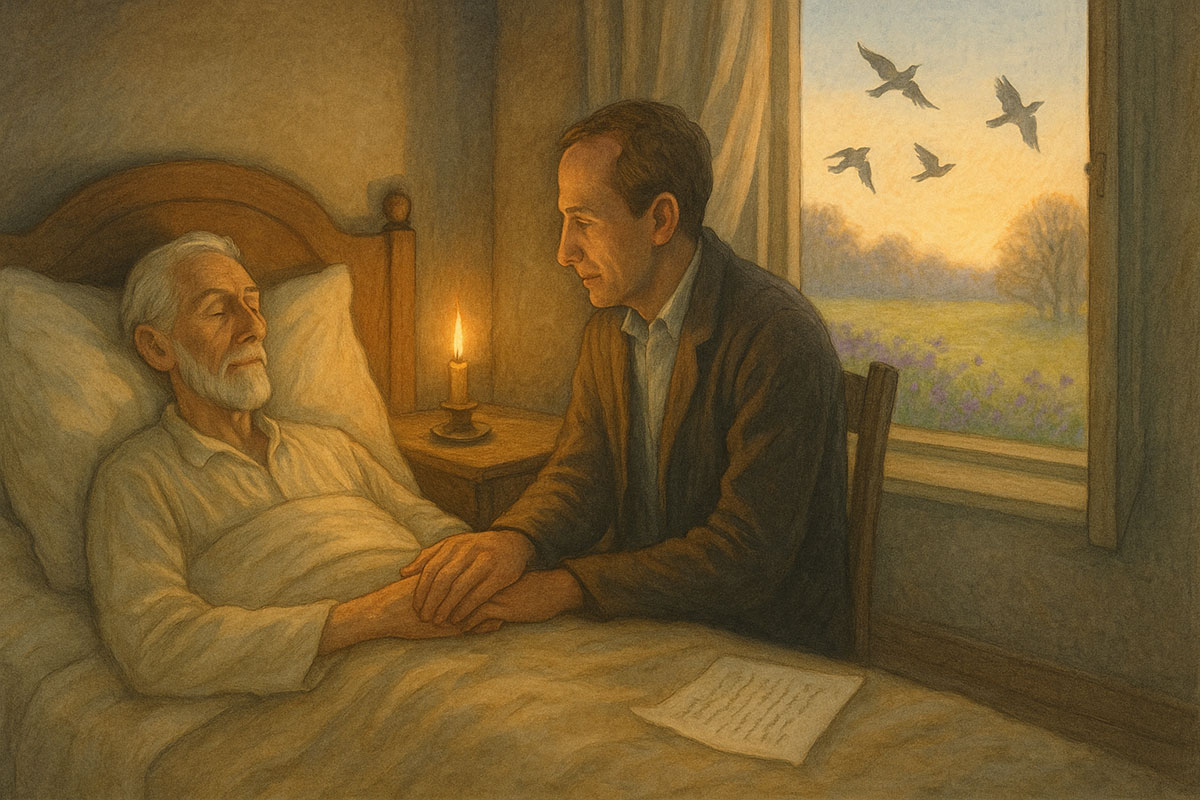
letting in the sound of birds who had just remembered how to sing. The papers on the floor had not been gathered. The book on the nightstand—Siddhartha—was marked by a pressed violet, not a bookmark. The fire in the hearth had dwindled to an ember’s whisper.
Hermann sat upright in bed, but only barely.
His chest rose and fell as if the breath of life were a tide, slow and unsure if it meant to return.
I sat by his side, not as a caretaker, but as the friend who had remained through the years when others only visited.
He held my hand, gently.
“Do you hear them?” he asked.
“The birds?”
“No,” he smiled faintly, “the words I never wrote.”
I turned my head slightly, listening.
Somewhere beyond the veil of sight, there was indeed a whisper—like water brushing stone. A line of poetry too soft to transcribe, yet too present to ignore.
“I thought I’d have more time,” he said.
I didn’t tell him that we always think so.
He closed his eyes for a moment, and his lips moved—not in prayer, but in memory. I didn’t ask what he saw. I knew it was all there: his mother’s braid, the hills of Calw, the ache of lost friends, the hum of the East, the soft footsteps of Siddhartha beneath moonlight.
“I don’t feel afraid,” he said. “Only... unfinished.”
“Perhaps that’s how the soul keeps moving,” I answered. “Not through perfection, but through longing.”
A long pause passed.
Outside, the grass bowed under the breeze, not in mourning, but reverence.
He opened his eyes once more.
“I used to think death was a river,” he whispered, “but now I see—it’s a return.”
“A return to what?” I asked.
He smiled without answering. Maybe he didn’t know. Maybe he did.
He looked at me then, truly looked—as if trying to memorize the face of the one who had never asked him to be anything more than what he was.
“You stayed,” he said.
“I did.”
“That made all the difference.”
His hand squeezed mine. Not tightly. But enough.
Then silence.
But not the silence of absence.
The silence of completion.
The candle at the table flickered once, then stilled. Outside the window, the light of evening poured gold over the fields. Not dramatic. Just present.
As if the world, too, understood that a chapter had ended.
That a man who once searched the world for meaning had finally found rest in the presence of someone who needed no explanation.
I sat with him long after his breath had gone. The room felt warm. Not in temperature, but in memory. In reverence. In the simple grace of a life that had been deeply, imperfectly, beautifully lived.
He had gone where all seekers go—back into the mystery.
But not alone.
Never alone.
Final Thoughts by Rainer Maria Rilke)
Do not think he left.
Men like Hermann do not go—they dissolve into the spaces they once loved. He is the soft hush between forest leaves. The echo beneath a journal’s final line. The unseen companion by the river at dusk.
He tried to prune his garden, yes—but perhaps it was never meant to be trimmed. Perhaps he was born to tend wildness, in himself and in others.
We walk away now not with answers, but with traces—petal-thoughts, mirror-memories, and the sacred permission to feel everything deeply.
And that, perhaps, is all Hermann ever wanted:
for us to live poetically,
even when we are breaking.
Even then—especially then.
Short Bios:
Hermann Hesse
German-Swiss author and poet (1877–1962), Hesse explored themes of self-discovery, spirituality, and inner conflict in works like Siddhartha, Demian, and Steppenwolf. He won the Nobel Prize in Literature in 1946 and is remembered for his deeply introspective voice.
Rainer Maria Rilke
Austrian poet (1875–1926), Rilke is renowned for his Duino Elegies and Letters to a Young Poet. His lyrical, spiritual reflections on solitude, love, and the divine continue to guide seekers and artists around the world.
The Silent Friend
An imagined companion who walks beside Hesse through each chapter—never rescuing, only witnessing. A symbolic presence of the friend we all long for: one who listens without judgment and loves without needing to fix.
Leave a Reply