
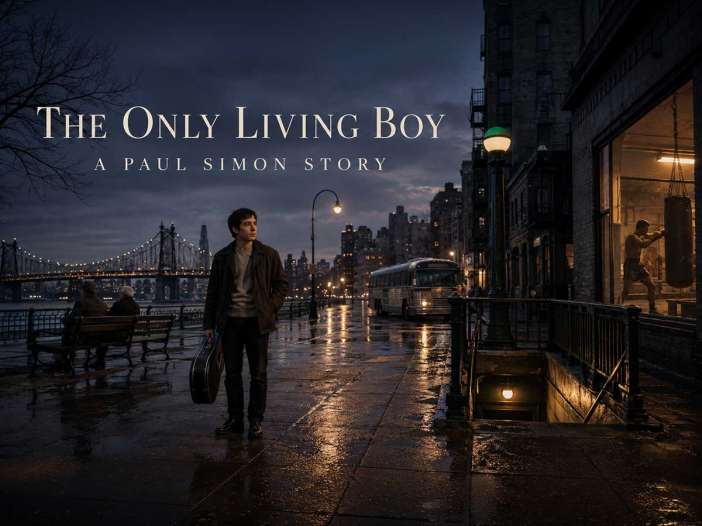
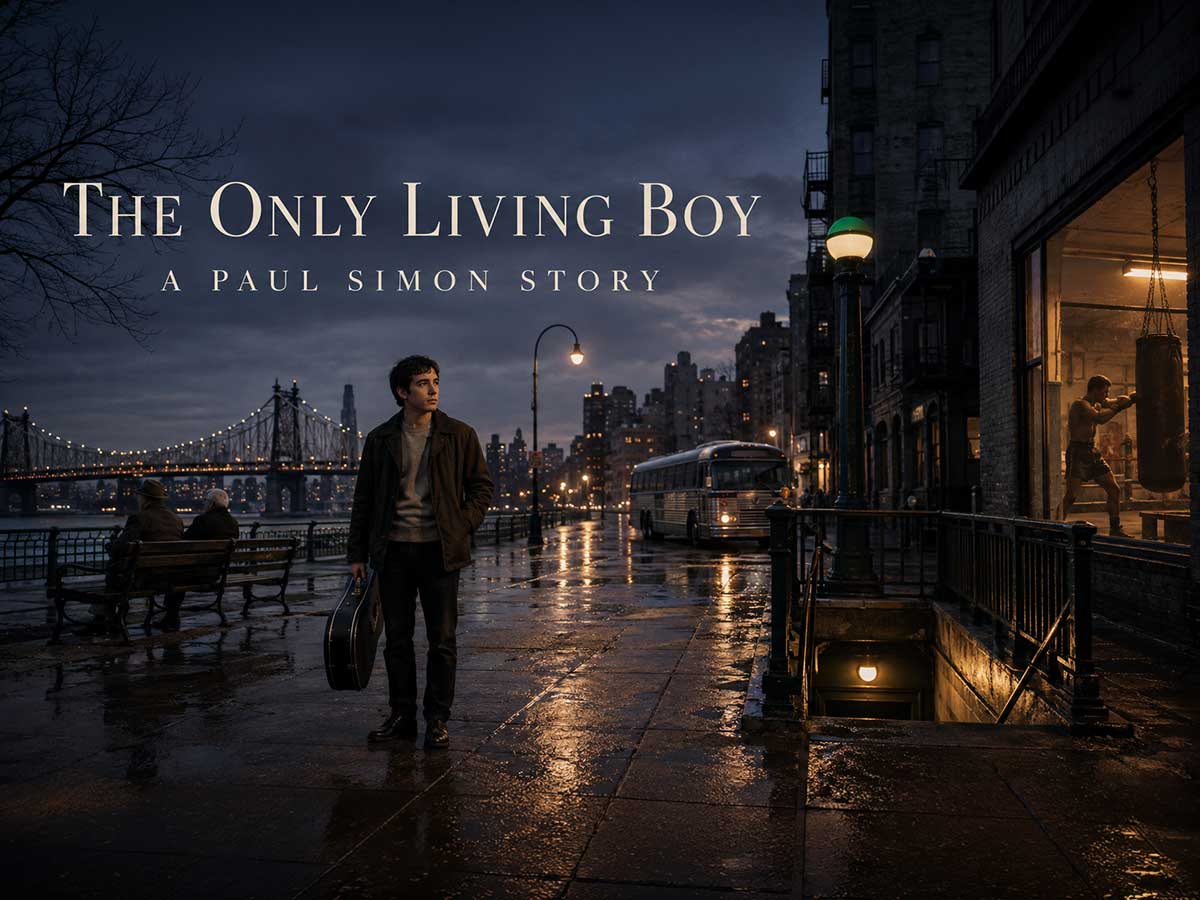
Introduction
Paul Simon and Art Garfunkel created songs that have followed people through love, loneliness, travel, failure, friendship, and growing older.
This fictional story asks a simple question:
What if Paul Simon slowly realized that the songs he wrote as a young man were describing parts of his own future?
“The Sound of Silence” becomes a story about people who cannot quite reach one another. “America” becomes the search for a place, a purpose, and a sense of belonging. “The Boxer” becomes endurance after disappointment. “The Only Living Boy in New York” carries the loneliness of watching a lifelong friend move into another life. Then “Bridge Over Troubled Water” arrives at the moment when Paul and Art themselves are beginning to separate.
The Only Living Boy is not intended as a literal biography. It is an imaginary literary story inspired by real songs, public history, and the emotional questions running through Paul Simon’s writing.
At its center is one question:
What happens when a man who has spent his life writing about human connection finally has to decide whether to reach out himself?
(Note: This is an imaginary conversation, a creative exploration of an idea, and not a real speech or event.)
Chapter One: Hello Darkness
Queens, New York, 1963.
Paul Simon liked rooms after midnight.
During the day, every object seemed assigned a purpose. A chair was for sitting. A table was for eating. A guitar was for playing.
At night, the objects seemed to loosen from those definitions.
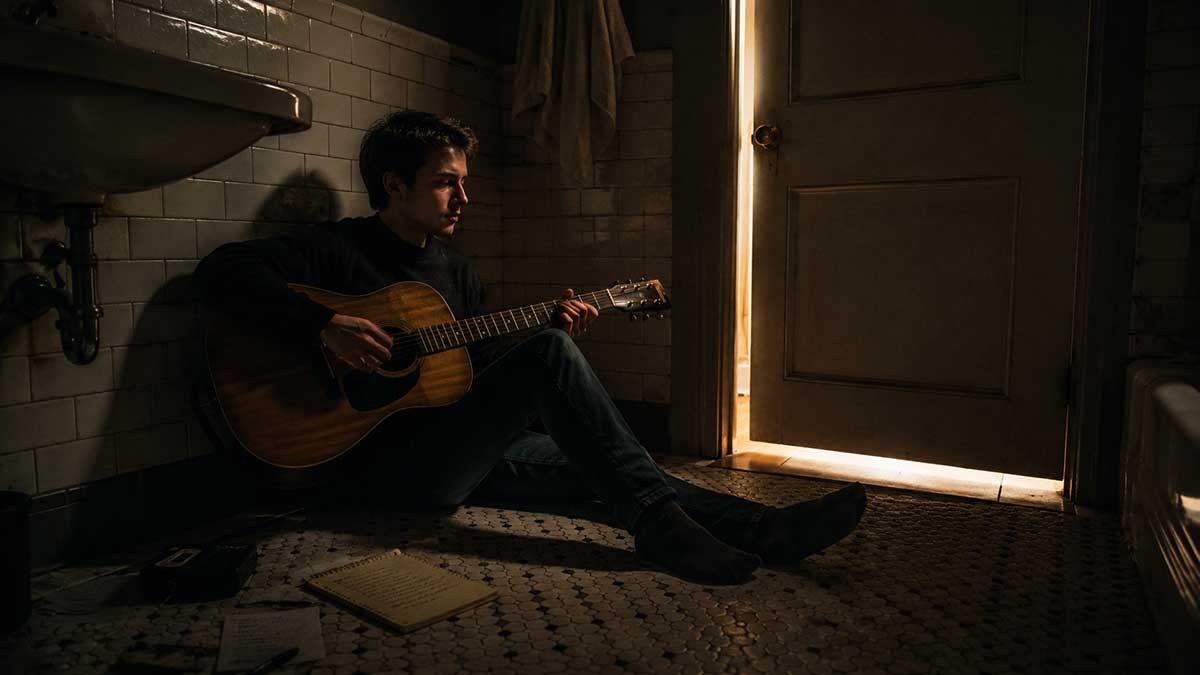
Paul sometimes took his guitar into the bathroom and switched off the light.
The tiles made the notes return to him.
A chord would leave the guitar, strike the walls, then come back changed.
He liked that.
He was twenty-one and already suspicious of easy answers.
Popular songs often sounded certain about love. They knew who belonged with whom. They knew how the story would end.
Paul did not trust that certainty.
People seemed far stranger.
Two people could eat breakfast together every morning for twenty years and never speak about what frightened them.
Friends could laugh for hours and go home lonely.
A hundred people could stand shoulder to shoulder on a subway platform and seem separated by entire countries.
Paul noticed such things.
He wrote them down.
A man asleep beneath a newspaper.
A woman crying on a train.
A boy staring through the glass of a bus window.
A couple sharing coffee without looking at one another.
He was not sure these observations were songs yet.
He knew they felt true.
Art Garfunkel had known Paul since childhood.
Art possessed the voice people remembered.
Paul possessed the restlessness.
When Art sang, rooms became quiet.
Paul respected that gift.
Sometimes he envied it.
Art respected Paul's writing.
Sometimes he envied that.
Neither man said much about envy.
Their friendship had already taught them one rule:
You can know exactly where another person is vulnerable and still choose not to strike.
One evening they rehearsed in a cramped room.
Art finished singing.
"Too soft?" he asked.
Paul shook his head.
"Too pretty?"
Paul hesitated.
"Maybe."
Art laughed.
"Since when is pretty a problem?"
Paul looked at his guitar.
"When pretty hides something."
Art stared at him.
"You hear problems other people don't hear."
"That might be the job."
"You ever think your job is making your life harder?"
Paul smiled.
"Frequently."
Paul left for England.
He told people it was for music.
That was true.
It was not the entire truth.
New York already carried too many versions of him.
The schoolboy.
The son.
The friend.
The ambitious young songwriter.
England gave him anonymity.
Small clubs.
Coffeehouses.
Old folk songs.
Rain.
Cheap rooms.
Listeners who did not care where he had gone to high school.
Then he met Kathy.
She had a way of seeing him that made him uneasy.
One afternoon rain touched the window beside them.
Kathy watched him scribbling in a notebook.
"What are you writing?"
"Nothing."
"That's never true."
Paul closed the book.
"You think too much," she said.
"What does that mean?"
"It means you're thinking about what I mean right now."
He laughed.
She did not.
"You watch yourself living."
Paul stopped smiling.
"What?"
"You stand outside yourself and take notes."
"That's how songs happen."
"Maybe."
She turned back to the window.
"Maybe that's how life gets missed."
Paul remembered that sentence for years.
Kathy became part of his songs.
Sometimes directly.
Sometimes only in atmosphere.
Rain.
Distance.
Warm rooms.
Train stations.
The fear that happiness creates its own future sorrow.
Paul wrote a song whose narrator insists he needs no one.
Kathy listened.
"You don't mean that."
"It's a song."
"You don't mean it."
"The person in the song does."
She smiled.
"The person in the song is always you."
"No."
"Yes."
Paul laughed.
"You think every novelist is every criminal he writes about?"
"You're not writing criminals."
"What am I writing?"
Kathy looked at him.
"Escape routes."
News came from America.
One of Paul and Art's old recordings had changed.
Electric instruments had been added.
Radio stations were playing it.
Then more stations.
Then more.
The song about silence had become loud.
Paul stared at the news.
His life had divided into before and after without asking permission.
A hit record.
His song.
Their record.
He walked through London that night.
Nobody recognized him.
He wondered how long that might remain true.
For years he had wanted people to hear the songs.
Now they were listening.
He expected triumph.
Instead he felt grief.
Kathy found him quiet later.
"What happened?"
"The record."
"What about it?"
"It's happening."
She understood immediately.
"You're going back."
Paul said nothing.
She sat beside him.
He thought of every song he had written about leaving.
Write about departure long enough and life eventually gives you somewhere to go.
Kathy took his hand.
Paul held hers.
Two people can love each other and still reach the end of what they know how to say.
Paul had written about silence.
Now he was living inside it.
Chapter Two: Looking for America
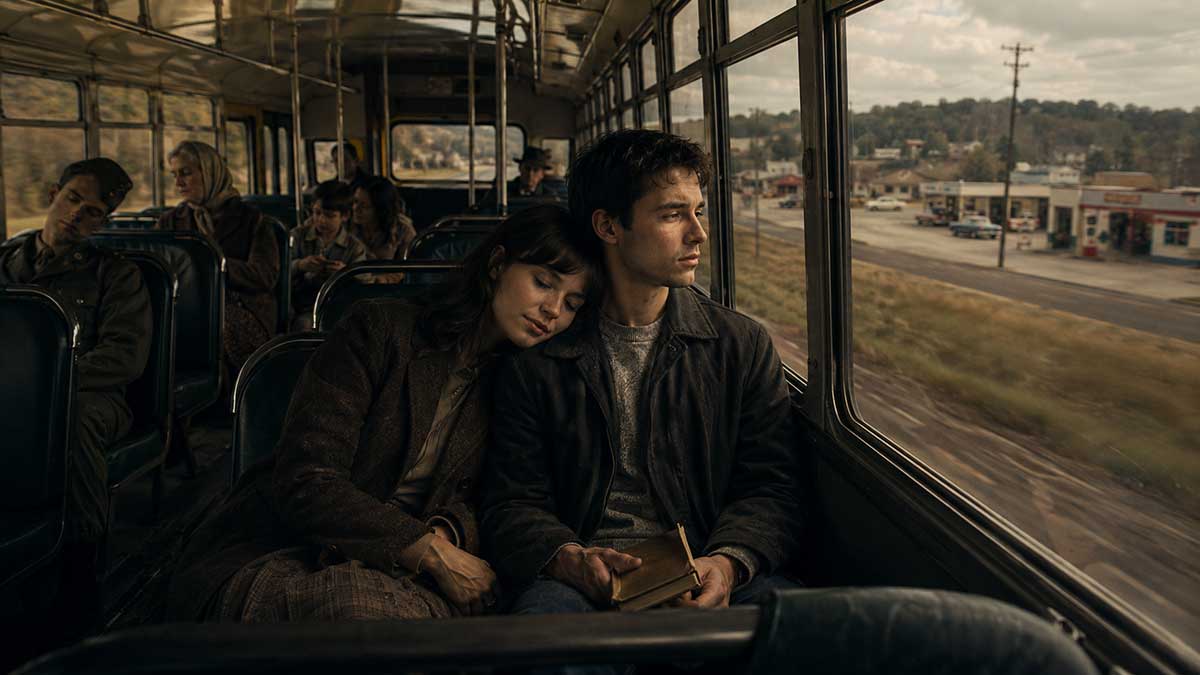
Paul and Kathy traveled across America before fame swallowed his schedule.
Bus stations.
Cheap meals.
Highways.
Small towns.
Farm fields.
Motels.
Gas stations glowing late at night.
Paul watched everything.
Kathy watched him watching everything.
"You’re doing it again."
"What?"
"Leaving."
"I'm right here."
"Your body is."
He looked at his notebook.
"I haven't written anything."
"Not yet."
She tapped his forehead.
Paul closed the notebook.
"Better?"
"Much."
They sat together.
A soldier slept near the back.
An old woman offered candy to a child.
A young couple argued quietly two rows ahead.
For several minutes Paul did not turn any of it into material.
He simply sat beside Kathy.
This was harder than writing.
They made up stories about strangers.
They argued about food.
They missed buses.
They got bored.
They laughed.
Paul began to suspect real love contained far more boredom than songs admitted.
Songs preferred departures, storms, kisses, reunions.
They rarely described waiting forty minutes for transportation with someone whose company you had chosen.
Perhaps that ordinary waiting was the larger test.
One afternoon Paul felt an unexpected sadness.
Nothing had happened.
Kathy was beside him.
They had enough money.
The road was open.
Yet he felt lost.
Kathy noticed.
"What?"
"Nothing."
"Try again."
Paul looked through the window.
"We're going somewhere."
"Yes."
"But I don't know where."
"The bus knows."
Paul smiled.
"I don't mean the bus."
Kathy went quiet.
Cars moved beside them.
Every car held people moving through their own lives.
Every house belonged to someone carrying private hopes.
Every town held births, funerals, marriages, failures, secrets.
America was enormous.
Yet no one looked finished.
Everyone seemed to be searching.
Paul wondered whether a country could be an idea its own citizens were still trying to reach.
He wrote that down later.
Fame arrived fast.
Photographs.
Concerts.
Television.
Interviews.
Questions.
People wanted explanations.
What does this song mean?
Who is that song about?
What were you trying to say?
Paul found explanation difficult.
A song could hold several meanings.
An interview wanted one.
He learned to answer.
Some answers were true.
Some were partly true.
Some became true through repetition.
One night in a hotel he stared at his own face in the mirror.
He recognized the face.
The person wearing it felt less familiar.
Art entered.
"You ready?"
"For what?"
"Interview downstairs."
"Oh."
Art studied him.
"You okay?"
"Fine."
"You don't look fine."
Paul sat down.
"Do you ever feel like people are talking about somebody else?"
"Who?"
"Us."
Art shrugged.
"We're two guys from Queens."
"That's what I mean."
Art sat across from him.
"What do you want them to say?"
"I don't know."
"Then maybe stop trying to control it."
Paul stared.
Art had a gift for making Paul's philosophical problems sound like loose buttons.
Kathy became distant.
Not through one argument.
That might have been easier.
Distance arrived through schedules.
Calls missed.
Letters delayed.
Plans postponed.
Stories the other person had not witnessed.
At first they tried to preserve the relationship.
Then they tried to preserve the idea that they were trying.
One day Paul found an old photograph.
He and Kathy looked impossibly young.
The picture hurt more than the ending.
It proved the happiness had existed.
Photographs could be cruel that way.
They turned vanished moments into evidence.
Paul put it away.
Years later he still remembered her laugh.
Her rain-dark hair.
Her habit of accusing him of writing during life instead of living it.
Perhaps nobody ever saw him quite the same way again.
He wrote about America.
Not patriotic America.
Not cynical America.
Searching America.
Bus-window America.
People moving from one place to another under the hope that somewhere else might contain what seemed missing here.
When he finished the song, he had not answered the question.
He liked that.
The best songs did not answer.
They left a listener standing beside the question.
He played it for Art.
Art listened.
"That's one," Art said.
"One what?"
"One of the ones you're going to carry for a long time."
Paul looked down at the guitar.
"What do you think everybody's looking for?"
Art smiled.
"The same thing."
"Which is?"
"You wrote it."
"That doesn't mean I know."
Art laughed.
"Maybe that's why it's good."
Chapter Three: Fakin' It
Success changed time.
Before success, a day lasted forever.
After success, months vanished.
Studio.
Tour.
Interview.
Airport.
Hotel.
Concert.
Repeat.
Paul began writing about age.
People found that odd.
He was still young.
Why write about old friends?
Why photographs?
Why winter?
Why endings?
Paul could not explain it.
He had felt time leaving since his twenties.
Perhaps writers lived each moment twice.
Once as experience.
Then again as memory forming.
He and Art became famous enough that strangers developed theories about their friendship.
People heard their voices blending and assumed the men themselves blended just as easily.
Sometimes they did.
Sometimes they did not.
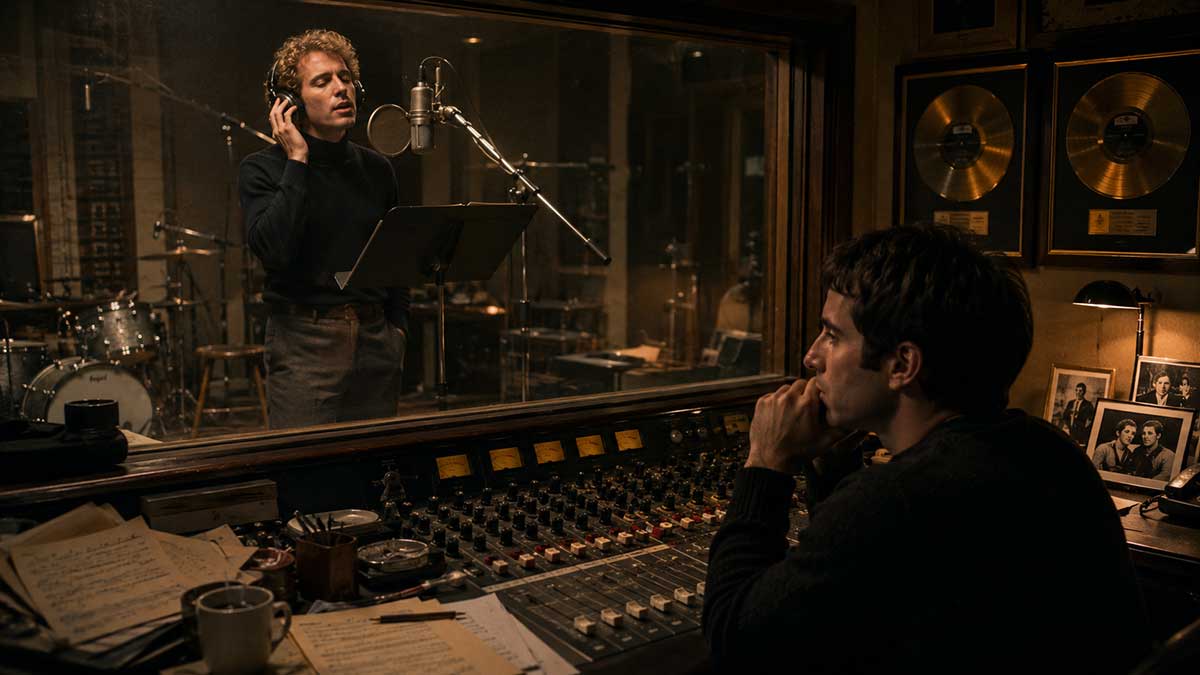
In the studio Paul became exacting.
Art heard things Paul missed.
Paul heard flaws Art considered microscopic.
That made the records extraordinary.
It made the relationship difficult.
"Again," Paul said.
Art removed one headphone.
"That was good."
"Again."
"What was wrong?"
"The entrance."
"It was fine."
"It was late."
"By what? Half a breath?"
Paul looked at him.
"Yes."
Art stared.
"Normal people cannot hear half a breath."
"I can."
"Congratulations."
The engineer studied the console with sudden deep interest.
Art put the headphones back on.
"Again."
They did another take.
It was better.
Neither man apologized.
Fame created a new kind of loneliness.
Before fame, Paul worried nobody would hear him.
After fame, he worried nobody could hear him through the version of him they already carried.
Fans approached with affection.
They told him what his songs meant.
At times their interpretation seemed better than his.
That bothered him.
Then it fascinated him.
Perhaps a song left the writer the moment somebody else needed it.
Still, at parties Paul sometimes watched himself from across the room.
Paul Simon laughing.
Paul Simon talking to famous people.
Paul Simon being recognized.
Kathy's voice returned.
You watch yourself living.
She had been right.
He had become very good at it.
The success of "Mrs. Robinson" made the strange situation larger.
People heard satire.
Hypocrisy.
Lost innocence.
American confusion.
Paul heard fragments that had somehow gathered into meaning.
He started to think songs might know more than their writers.
That idea unsettled him.
If a song could reveal truths he had not consciously intended, what else was he telling people without knowing it?
Art came by one afternoon.
Paul was working.
"What is that?"
"Nothing yet."
"Play it."
"No."
"Why?"
"It isn't ready."
"Your unfinished songs usually become work for me."
Paul laughed.
For a moment they were boys again.
Then Art mentioned Mexico.
A film.
Acting.
Catch-22.
Paul's expression changed.
"How long?"
"I don't know."
"We're making an album."
"We can still make it."
"From Mexico?"
"I'll come back."
Paul nodded.
Art watched him.
"Say it."
"Say what?"
"Whatever you're not saying."
"I'm not saying anything."
Art gave him a tired look.
"Exactly."
The old problem returned.
Paul had written about failed communication years earlier.
Now he was living inside his own subject.
Paul wrote "Old Friends."
Two elderly men.
A bench.
Memory.
Time.
He could see them clearly.
Then one man became Art.
The other became himself.
Paul pushed the thought away.
They were young.
They had years ahead.
Still, the image remained.
Two old men who had once known everything about each other.
Would they still speak?
Would old arguments matter?
Would fame look absurd from that distance?
Would either remember who had been right?
Probably not.
That frightened Paul more than being wrong.
The Bookends period deepened his fixation on time.
Photographs.
Age.
Memory.
Passing years.
Paul began to feel he was writing his future before reaching it.
Kathy was gone.
Youth was going.
Art had begun building a life that did not always include him.
America felt restless.
War.
Protest.
Assassination.
Television.
Advertising.
Old heroes losing their shine.
Paul wondered whether a country could become more truthful and less innocent at the same time.
One evening he walked through Manhattan.
A young couple argued near a corner.
A cab driver shouted.
Someone laughed from an apartment window.
A newspaper spoke of war.
A store radio played one of Paul's songs.
He stopped.
Hearing himself unexpectedly in public always felt strange.
For three blocks nobody recognized him.
He felt almost happy.
Then he noticed himself feeling happy.
The moment disappeared.
Chapter Four: The Boxer
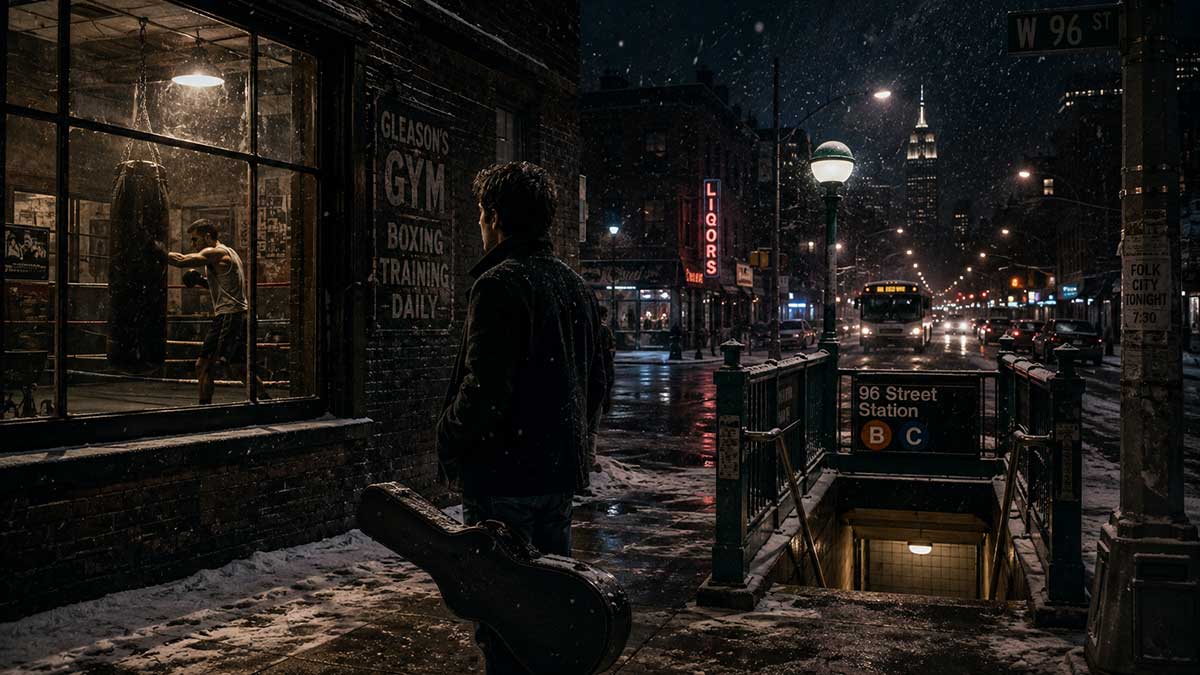
Criticism hurt Paul more than he admitted.
Artists were supposed to ignore reviews.
Trust the work.
Ignore the noise.
Paul read the noise.
Praise disappeared quickly.
Insults stayed.
He could receive twenty favorable reviews and spend an entire night mentally arguing with the twenty-first.
Art thought this was foolish.
"Stop reading them."
"Easy for you."
"Why?"
"They criticize the songs."
"They criticize us."
"The songs are mine."
Silence.
Paul heard the sentence too late.
Art stared at him.
"Right."
"That's not what I meant."
"It sounded exactly like what you meant."
"No."
"Then explain."
Paul had no good explanation.
Art left.
Paul stayed behind.
Some arguments contain far older wounds than the sentence that starts them.
That was one.
Paul began writing about a fighter.
A man who absorbs punishment.
A man judged by strangers.
A man carrying humiliation.
A man who keeps standing.
Paul knew better than to write himself literally.
Literal confession embarrassed him.
He preferred characters.
Cities.
Weather.
Metaphor.
A fighter could say what a songwriter could not.
The boxer had taken blows.
Paul felt he had taken some too.
Not fists.
Not hunger.
Public judgment had its own violence.
Success gave little protection.
At times success invited harder blows.
The higher a person stood, the more satisfying others found the fall.
Paul realized something.
Strength did not mean remaining untouched.
The boxer remained a boxer after being hit.
That was the point.
Art went to Mexico.
Paul remained in New York.
He disliked how much that hurt.
He told himself he was an adult.
A successful songwriter.
He could work alone.
He did not need Art.
Then he wrote one of his loneliest songs.
He used an old nickname connected to their early years.
Before Simon & Garfunkel.
Before managers.
Before money.
Before every disagreement had professional consequences.
He wrote toward the boy he had known.
Go.
Fly.
Live your life.
I'm still here.
New York became enormous around him.
Millions of people.
One lonely boy.
Paul understood the irony.
He kept the song.
Truth did not stop being true when it became obvious.
Art returned.
Paul played the song.
Art listened.
"That's me."
Paul looked down.
"It's a song."
"Paul."
Paul smiled faintly.
"Parts."
"What parts?"
"The parts you think."
Art looked at him for a long moment.
"That's almost nice."
"Almost?"
"You could try talking sometime."
"I talk."
Art shook his head.
"No. You write."
Kathy's accusation again.
Years apart.
Different person.
Same message.
Paul wondered whether songs had become his safest form of intimacy.
A song allowed revision.
Conversation did not.
A song could hide confession inside another character.
Conversation required the naked sentence.
Stay.
I'm hurt.
I'm jealous.
I'm afraid you're leaving me.
Paul could write a hundred songs before saying those things directly.
Then came "So Long, Frank Lloyd Wright."
Architecture.
Art's studies.
Farewell.
Affection.
Distance.
Enough disguise to survive.
Art understood.
He did not need explanation.
That was the gift of knowing someone since childhood.
It was the curse too.
They often understood each other without speaking.
At times that made speaking unnecessary.
At times it made speaking impossible.
The album grew.
The friendship weakened.
The music grew richer.
Paul found this disturbing.
Pain was producing extraordinary work.
He did not want to romanticize that.
A broken friendship did not become good simply since beautiful music emerged from it.
Then one night a melody came.
Simple.
Hymn-like.
A promise of support.
A person offering himself to another person during suffering.
Paul felt the song was different.
It asked for generosity without cleverness.
No irony.
No mask.
No escape route.
He thought of gospel voices.
He thought of Art.
Then he knew.
Art should sing it.
That knowledge contained tenderness.
Pride.
Surrender.
Fear.
Paul had written the song.
Art's voice might make the world believe it.
Paul chose Art.
Chapter Five: The Bridge
The first full performance changed the room.
Art stood at the microphone.
Paul listened from the control room.
The voice rose.
The song seemed to expand beyond the studio walls.
Paul expected pride.
He felt loss.
The song was leaving him.
Perhaps that was what a great performance did.
The writer built the door.
The singer walked through first.
Art finished.
Silence filled the room.
"Well?" Art asked.
Paul nodded.
"That's it."
"You sure?"
"Yes."
"You don't want to sing it?"
"No."
The answer was true.
It was not completely true.
Art seemed to understand.
He usually did.
The record became enormous.
People used the song at weddings.
Funerals.
Hospitals.
Churches.
Public ceremonies.
Private moments.
Strangers used it to speak when their own words failed.
Paul found that moving.
He found it painful too.
He and Art were struggling to stay connected.
Their song was teaching strangers how to stand beside each other.
Paul began to see art differently.
A song might express the person you hoped to become.
It did not prove you lived that way every day.
Maybe art was not a photograph of the artist.
Maybe it was a letter from his better self.
That thought gave Paul some peace.
The partnership ended.
No single door slammed.
No grand farewell occurred.
Real endings were rarely that neat.
Calls became less frequent.
Separate plans became normal.
New projects appeared.
Then one day people began talking about what "was."
Simon & Garfunkel was.
Paul continued.
Art continued.
Years passed.
Reunions came.
Arguments returned.
Affection returned.
Old injuries came back.
New injuries formed.
Time changed every category.
What once looked permanent became one chapter.
What once seemed temporary survived for decades.
The songs outlived the circumstances that created them.
Young listeners discovered them without knowing anything about the rooms where they were written.
Paul aged.
His face changed.
His voice changed.
New York changed.
America changed.
The songs stayed.
People approached him with stories.
A father played "America" in the car.
A mother loved "The Boxer."
A couple had used "Bridge Over Troubled Water" at their wedding.
Someone had survived a terrible year with one of the songs close by.
Paul listened.
At times he wondered whether the songs belonged more to those people now.
He had written them once.
They had lived inside them for decades.
Many years later Paul walked through New York wearing a cap.
People mostly passed without noticing him.
He liked that.
Near a subway entrance a young man sat beside a guitar case.
Twenty, perhaps.
Maybe younger.
He studied his phone with growing frustration.
Paul stopped.
"You lost?"
The young man looked up.
"Kind of."
"Where are you going?"
He named a neighborhood.
Paul pointed across the street.
"Wrong entrance."
The young man laughed.
"I've been standing here ten minutes."
"Only ten? You're doing very well."
The young man smiled.
Paul started to walk away.
"Excuse me."
Paul turned.
The young man looked closely.
"Are you Paul Simon?"
Paul paused.
"Sometimes."
The young man laughed.
"I knew it."
Paul nodded at the guitar case.
"You play?"
"Trying."
"That's different from playing?"
"Very."
Paul smiled.
"Fair."
The young man became nervous.
"I love 'America.'"
Paul waited.
"My dad used to play it."
There it was.
Not simply a fan.
Inheritance.
"My parents came here from Korea," the young man said. "My dad said that song made sense to him before his English was good."
Paul looked at him.
"He said everybody was looking for something."
Paul looked past him.
People rushed into the subway.
People climbed out.
A woman pulled a child by the hand.
A delivery rider balanced a bicycle.
A man ran down the steps.
A tourist turned a map upside down.
Still moving.
Still searching.
The young man asked, "Did you ever figure out what America meant?"
Paul had answered questions about songs for most of his life.
He knew how to give polished answers.
This time he did not want one.
"I used to think America was something you found."
"And now?"
Paul watched the crowd.
"Now I think the looking is part of it."
The young man nodded.
Then he asked, "Which song means the most to you?"
Paul saw Art as a boy.
Kathy beside a rainy window.
His parents in Queens.
A road across America.
A boxer absorbing another blow.
Two old friends on a bench.
A lonely boy in New York.
A bridge.
"It depends what day you ask me."
The young man looked disappointed.
Paul smiled.
"That's the truth."
The young man accepted it.
"Fair."
He went down the subway stairs.
Paul remained above.
That evening Paul walked farther than planned.
New York entered twilight.
Windows lit one by one.
People hurried home.
People left home.
People waited for someone.
People avoided someone.
People sent messages they regretted.
People failed to send messages they should have sent.
Paul thought about the young man he had been.
Sitting in darkness.
Trying to write about silence.
He once believed loneliness was something people defeated.
Age had taught him something else.
Loneliness belonged to human life.
So did connection.
One did not cancel the other.
Connection mattered since separation was possible.
Love mattered since people could leave.
Friendship mattered since people changed.
Home mattered since one could wander.
Memory mattered since time erased.
The bridge mattered since water could become difficult to cross.
Across the street an elderly couple waited for the light.
The man reached for the woman's hand without looking.
She took it without looking.
Paul watched.
A tiny gesture.
For most of his life he had searched for meaning in enormous questions.
America.
Art.
Love.
Time.
Fame.
Death.
Maybe the answer was embarrassingly small.
Take the hand.
Stay in the room.
Listen.
Help someone cross.
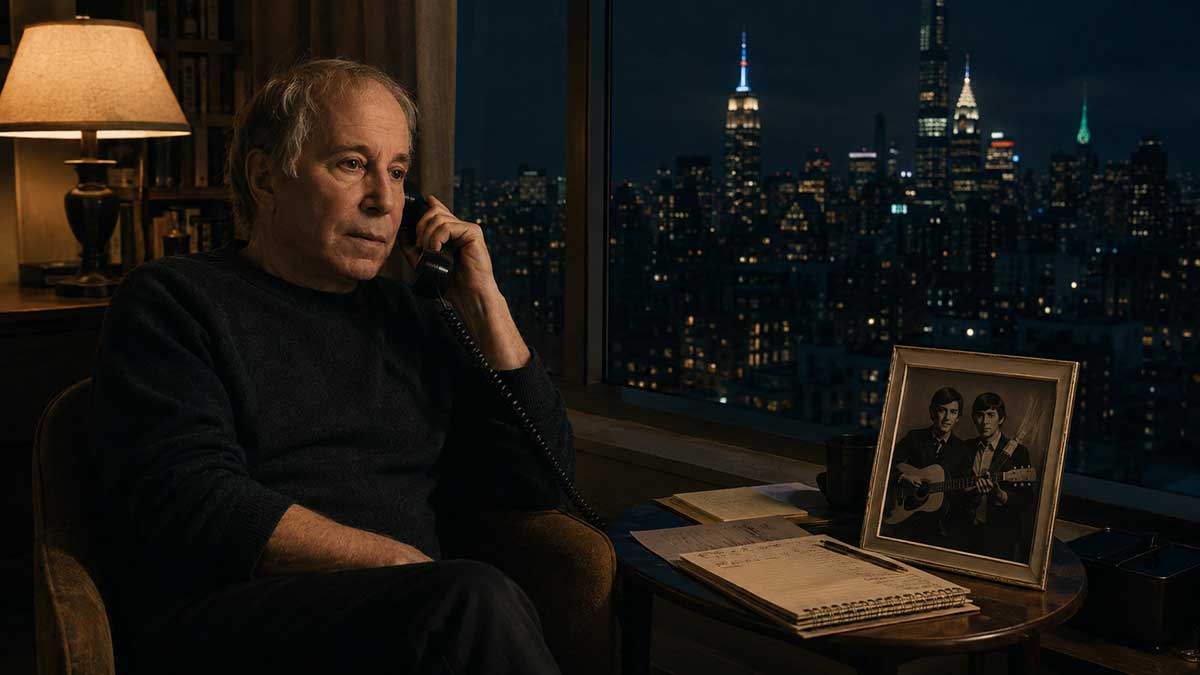
At home Paul found an old photograph.
Two young men.
Queens boys.
Before the world knew them.
He studied Art's face.
Then his own.
When he wrote "Old Friends," old age had been fiction.
Now youth was fiction.
Paul laughed softly.
There had been anger.
Competition.
Love.
Jealousy.
Pride.
Misunderstanding.
Forgiveness.
Then more misunderstanding.
A friendship did not become false simply because it became difficult.
Perhaps deep relationships were difficult precisely since so much mattered inside them.
Paul put the photograph beside him.
He thought about calling Art.
He sat in silence for a long time.
Years earlier, darkness had been where he went to hear echoes.
Now he knew what came back.
Kathy telling him he watched himself living.
Art telling him he wrote instead of speaking.
A young stranger telling him his father had crossed an ocean carrying "America."
Paul smiled.
Perhaps all three had been telling him the same thing.
A life cannot be lived from outside.
It has to be entered.
Risked.
Shared.
Paul picked up the phone.
He dialed.
The line rang.
Once.
Twice.
Three times.
Someone answered.
Paul looked through the window at New York.
Still noisy.
Still lonely.
Still filled with people trying to reach one another.
Paul smiled.
"Art?"
For once, there was no song between them.
Final Thoughts
Paul Simon's songs often return to people searching for one another.
A lonely young man speaks into darkness.
A traveler crosses America without quite finding what he seeks.
A fighter keeps standing.
Two old friends sit together as time passes.
A man left behind in New York tries to let his friend go.
Then a songwriter creates a bridge for someone else to cross.
Perhaps that is why these songs have survived so long.
They do not tell us that loneliness disappears.
They tell us that somebody may still sit beside us inside it.
And perhaps the final lesson Paul discovers in this story is something his songs had been trying to tell him from the beginning:
Sometimes the greatest bridge between two people is not a song.
It is simply reaching for the phone and saying the other person's name.
Short Bios:
Paul Simon
Paul Simon is an American singer-songwriter whose work with Simon & Garfunkel produced enduring songs including “The Sound of Silence,” “America,” “The Boxer,” and “Bridge Over Troubled Water.” His later solo career continued exploring identity, relationships, spirituality, culture, aging, and the mysteries of ordinary life.
Art Garfunkel
Art Garfunkel is an American singer and actor celebrated for the distinctive tenor voice that became central to the sound of Simon & Garfunkel. His musical partnership with Paul Simon began when they were young in Queens and continued through periods of extraordinary success, separation, reunion, friendship, and tension.
Kathy Chitty
Kathy Chitty was Paul Simon's girlfriend during his years in England in the 1960s and became associated with several songs from that period. She represents an important part of Simon's early artistic life before international fame transformed his career.
Leave a Reply