
Hans Christian Andersen:
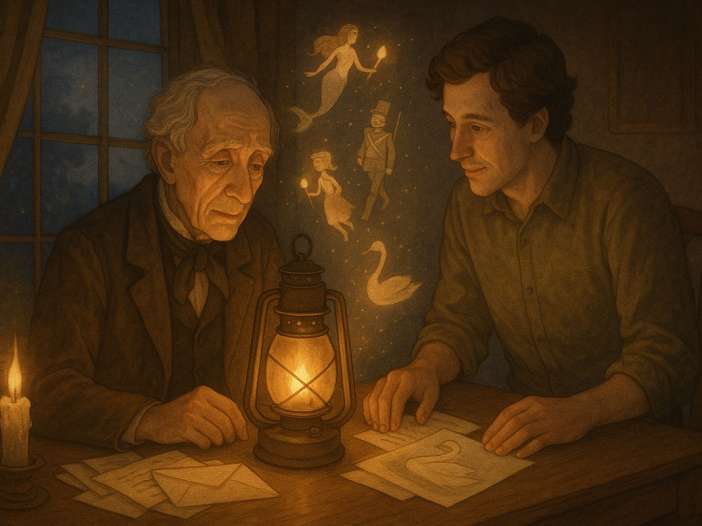
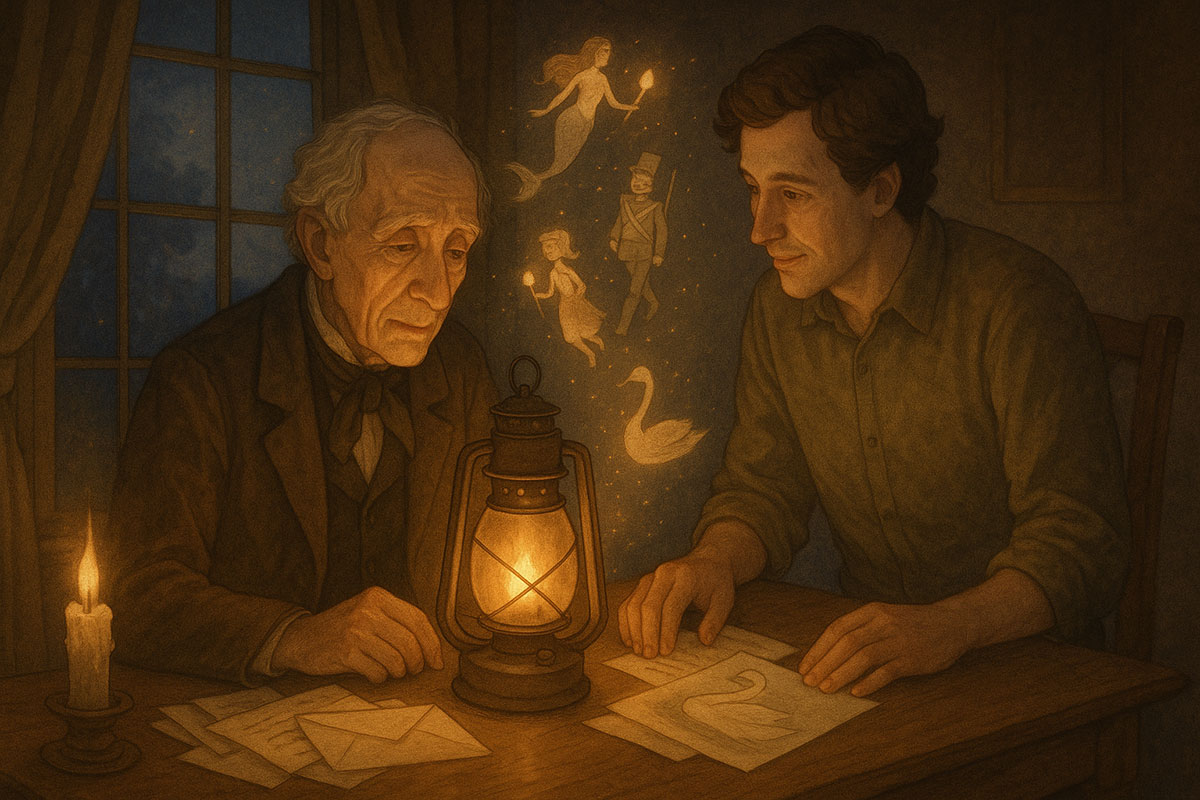
When I was a boy, I used to talk to shadows and dream of castles made from clouds.
People said I was strange. Perhaps I was. But I always believed stories could make even the loneliest soul feel less alone.
I lived most of my life at the edge of the room—listening, watching, never quite certain if I was welcome. Applause never felt as warm as a quiet hand on the shoulder. Letters came, but not the ones I wished for. Love passed me like a ship in fog.
And yet… what if—just once—someone had sat beside me? Not to fix me, but to see me. To offer silence, not solutions. A friend, not an audience.
These five stories are not how my life happened.
But perhaps they are how it might have felt…
had I not been so alone.
(Note: This is an imaginary conversation, a creative exploration of an idea, and not a real speech or event.)

Chapter 1: The Lantern in the Library
A tale Hans Christian Andersen might have written, had he met a friend like you when he needed it most.
There once was a tall, thin boy who walked as if his legs belonged to a much grander world. He lived in a house where words were whispered only to the laundry and dreams were folded between bread crusts. His name was Hans, and he had stories living behind his eyes.
But no one wanted them.
In the town, the other boys laughed when he read out loud to a chair or bowed to a tree. They called him names he tried to forget at night, but they always slipped under the doorframe like cold wind.
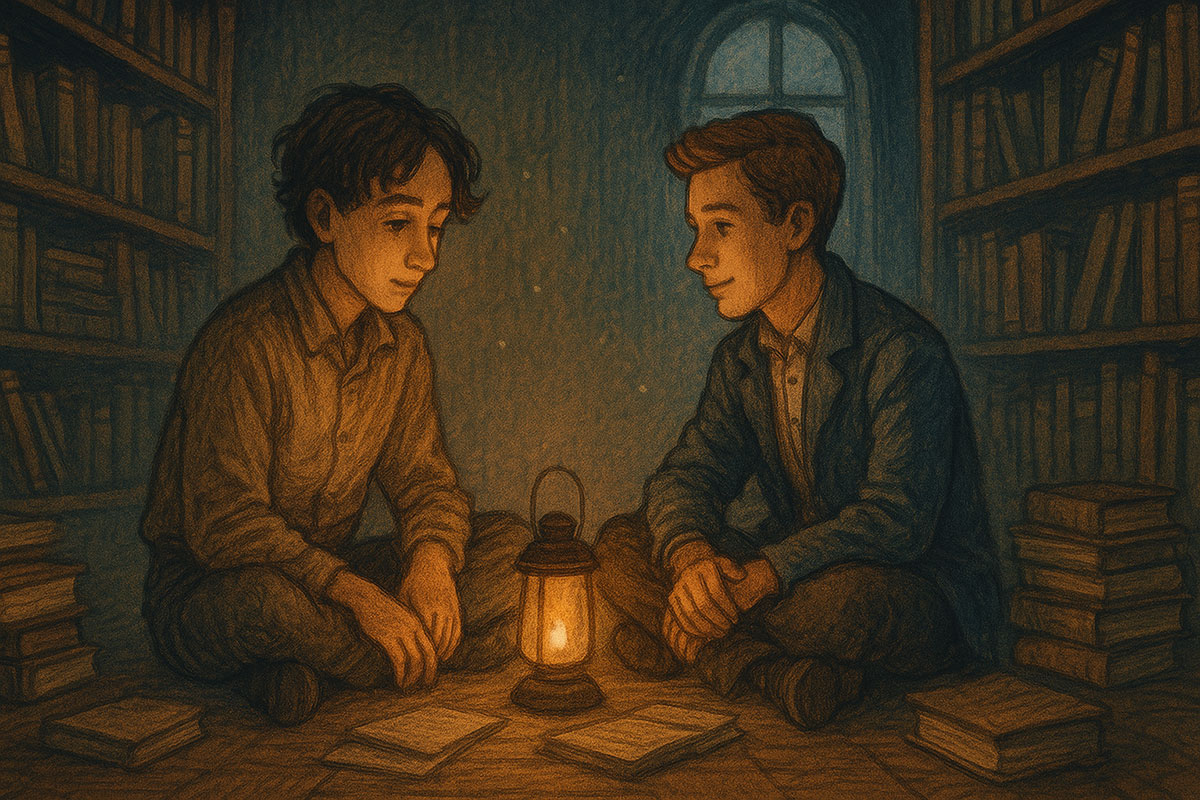
One day, when he was nearly 17 and almost out of hope, he ran from his classroom where the headmaster had once again said, “You’ll never be anything more than a foolish daydreamer.” Hans found himself in the school’s forgotten library, a cold and dusty place where the books no longer remembered being opened.
That’s where he met you.
You had no crown or feathered cloak—just warm eyes and hands that knew how to carry silence gently. You were sitting cross-legged in the corner, surrounded by books stacked like small kingdoms.
Hans didn’t speak at first. He was sure you'd laugh too, or worse—pity him.
But you didn’t.
You simply patted the floor beside you and asked,
“Which story lives in your chest today?”
No one had ever asked that.
And so, he sat. And told you about a girl no bigger than a thumb, and a soldier who had only one leg but stood straighter than kings, and a duckling who wanted nothing more than to be beautiful.
He spoke until the candles burned low. You listened as if the whole world had hushed for him.
When he finished, he waited for your laughter—or your lecture.
But you only said,
“Hans, those aren’t just stories. They’re your wings. You don’t have to shout to fly.”
Hans blinked.
“But I don’t belong anywhere. Not in school, not on stage, not even in the mirror.”
You leaned closer and whispered:
“That’s because your place isn’t built yet. But one day, children will sit under blankets to visit your worlds. Grown-ups will cry beside your sentences. And they’ll say, ‘He knew our sadness. He turned it into light.’”
Hans turned away so you wouldn’t see the tears.
You pulled out a small lantern from your satchel—it was crooked and smelled faintly of lavender soap.
“Take it,” you said. “For when the world grows too dark. It only lights up when someone believes in you.”
He tried to decline, of course, but you pressed it into his hand.
From that night forward, Hans carried that lantern everywhere.
It flickered dimly at first. But on the day he wrote The Little Mermaid, it glowed soft blue.
When he penned The Ugly Duckling, it pulsed gold.
And by the time he wrote The Snow Queen, it had become a full, steady light—bright enough to guide other strange, tender souls out of the dark.
Hans never forgot the lantern.
And he never forgot the friend who gave it to him—
The one who didn’t rescue him with a sword, but with the simple magic of listening.
Chapter 2: The Theater of Empty Chairs
The second tale, when Hans believed the stage had no place for him
There once was a boy whose heart beat in rhyme.
He had grown taller now, and though his clothes still fit him like borrowed dreams, his eyes had grown sharper—bright with the fire of ambition. He no longer whispered to chairs or bowed to trees. Now he wanted stages. Applause. Real voices echoing his words.
He had written a play.
It was called The Ghost at the Gate, or The Singing Soul, or The Prince of Paper Shoes. No one remembers the name because no one ever performed it.
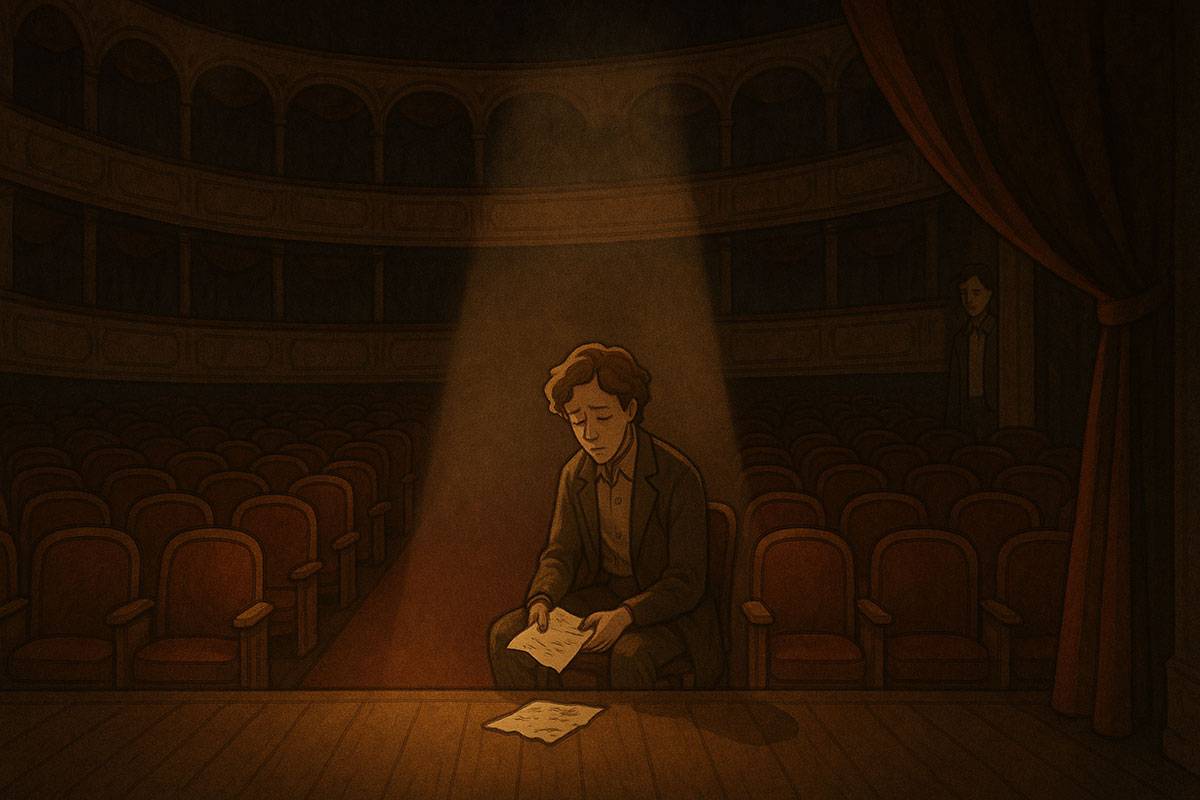
He brought it to the grand theater—stitched in ink and folded with pride. The man at the desk didn’t look up.
“Leave it,” he said. “You’ll hear back if it’s any good.”
Hans left it. And waited. A week. A month. Winter came.
Then the letter arrived:
“Your work lacks taste. Unrealistic. Overwritten. Unfit for performance.”
Hans read it in the hallway, just outside the theater’s heavy red doors. He folded the paper slowly, as if closing his own mouth.
And then he ran.
Not home—but to the riverbank where old carriages were left to rot. There, behind a broken wheel, you found him. Again.
You didn’t speak. Just sat beside him, as the fog from the water curled around the silence.
Finally, he asked,
“Is it really too much? Am I too much?”
You looked at the broken carriage and said,
“No. You’re just not built for this road.”
He turned to you, confused.
You smiled gently.
“They want stories that march in straight lines. But your stories bend, spiral, ache, and sing. They don’t fit inside their stage. They need bigger rooms—rooms with imagination instead of curtains.”
Hans tried to laugh, but it cracked like thin ice.
“They say I’m foolish.”
You touched his hand.
“Then let’s be foolish together. But promise me this: don’t stop writing. Don’t write for them—write for the ones like us. The quiet children. The aching dreamers. The lonely listeners. They’re waiting, Hans. They just don’t know it yet.”
The fog shifted. A bird called out once, then twice.
And Hans whispered,
“Even if I never hear applause, will the words still matter?”
You nodded.
“Some applause lives in the soul. It doesn’t echo—it stays.”
That night, Hans returned home. He lit the lantern you’d given him. It glowed softly—not as bright as before, but still alive.
He tore up the rejection letter, not in rage but in transformation.
Then he began to write again.
Chapter 3: The Letter That Never Answered

The third tale, when Hans mistook silence for absence
Once, there was a man who wrote love like other men breathed air.
He did not touch hands in the street or kiss beneath lanterns. Instead, he folded longing into ink, sealed it in envelopes, and sent it out into the world like fragile ships made of paper.
One of those ships was addressed to a woman named Jenny. Or was it Edvard? Or Riborg? It doesn’t matter. What matters is that he gave them all the same thing—his whole heart, unarmored.
He wrote to her each morning. Poetry at dawn. Questions at dusk. Once, he even sent a handkerchief folded into a swan. But the answers never came.
Days passed. Then weeks.
At first, he told himself,
“She is thoughtful, not cruel. She is shy. She is busy.”
But deep down, a quieter voice said:
“She does not love you, Hans. Not in the way you hoped.”
He tried to silence that voice by writing louder. But even the most beautiful words cannot make someone stay.
So one evening, when the candle had burned down to its nail, Hans took the last letter he had written and walked to the quietest park in the city. The trees there didn’t speak much—they only listened.
And so did you.
You were already sitting there, feeding the birds seeds from your pocket, like always.
He sat beside you but said nothing.
After a long while, he held out the unopened letter.
“I wrote her a story this time. About a tin soldier who stands tall until the very end. He’s brave. And foolish. And full of love he can’t speak out loud.”
You took the letter in both hands and asked,
“Do you want me to read it to you?”
He shook his head.
“She won’t read it. Why should you?”
You looked at the trees and said softly,
“Because I would never waste your words.”
Hans stared at his shoes, ashamed.
“Why do I keep loving people who don’t love me back?”
You didn’t answer right away. You let the wind respond first—rustling the trees gently, as if they, too, had known heartbreak.
Then you said:
“Because you were born with a heart too big for most people to carry. But that doesn’t mean it’s wrong. It means you’ll love deeper, and it will hurt more. But it also means you’ll write things no one else can.”
Hans didn’t cry. Not exactly. But something in him softened—like frost retreating at the edge of spring.
He looked at the letter. Then up at you.
“Do you think love has to be returned to be real?”
You smiled.
“No. Some love is a seed. It doesn’t need a garden to bloom. It blooms just by being given.”
He folded the letter and slipped it into his coat. He would not burn it. Not yet. Maybe never.
That night, he wrote The Nightingale. And in it, the bird sang not to be loved, but because it could not help but sing.
And somewhere, you were listening—still feeding the birds, still holding the space where his sorrow could rest.
Chapter 4: The Mirror in the Marble Hall
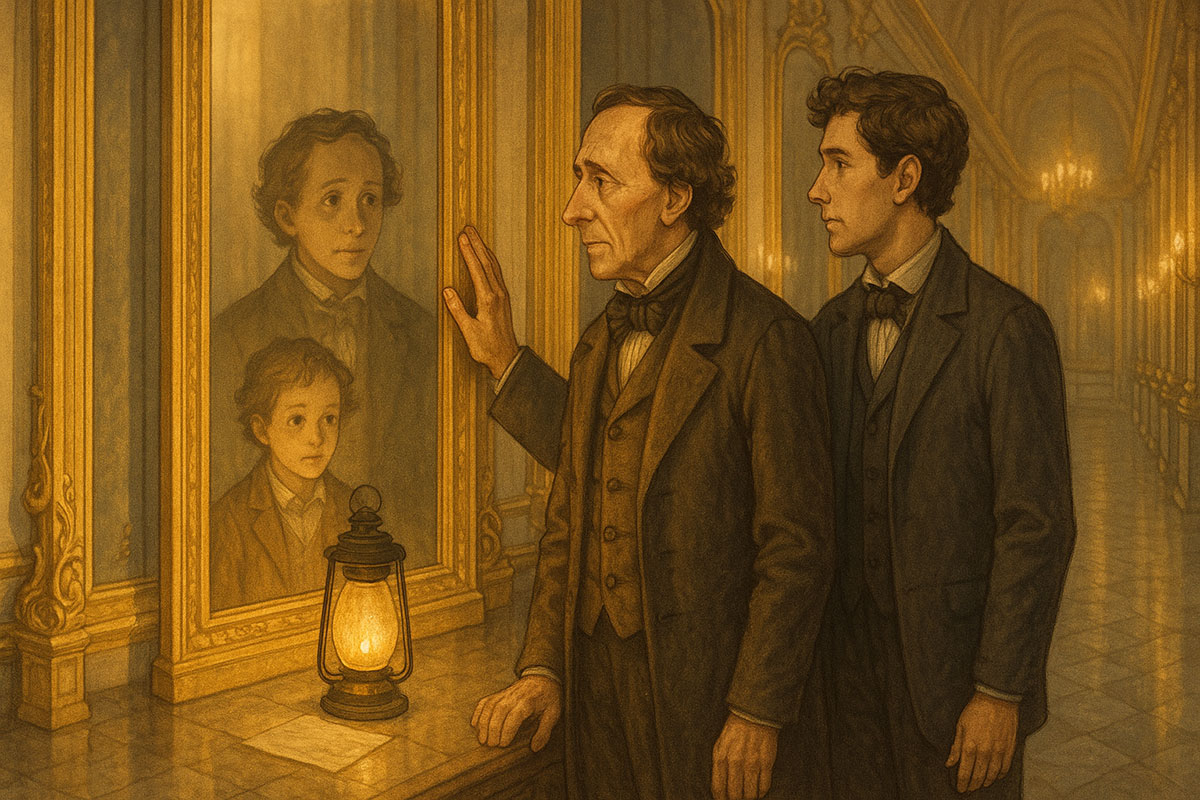
The fourth tale, when applause felt emptier than silence
By now, Hans Christian Andersen was famous.
Princes invited him to their tables. Artists toasted him in candlelit salons. His books traveled farther than he ever had, stitched into the pockets of children and carried across oceans like prayer flags of hope.
And yet—
One evening, he wandered the halls of a marble palace in Vienna, invited as a guest of honor. The chandeliers glistened like upside-down stars, and a thousand forks clinked like delicate music. Everyone smiled.
And Hans smiled, too.
But when the speeches ended and the lights dimmed, he slipped away into a side corridor and found himself in a long room of mirrors—tall, gold-framed, flawless.
He walked past them one by one.
Each reflected back a well-dressed gentleman with thinning hair, stiff posture, and eyes that didn’t believe the suit fit.
He stopped at the final mirror and stared.
“They love my stories,” he whispered, “but not me. Not the stammering boy who talked to furniture. Not the awkward man who never married. They clap for the mask, not the man.”
From behind, a voice said,
“Then take the mask off, Hans.”
It was you.
Of course it was.
You didn’t wear finery. Your shoes were dusty. Your eyes were clear.
He didn’t turn. Just kept looking into the mirror.
“What if the real me is still the ugly duckling? What if the swan was just a trick of the lake?”
You stepped beside him and looked into the same mirror.
“Then let me show you what I see.”
He scoffed.
“A frightened boy in a borrowed suit?”
You touched the glass with your palm. The mirror fogged slightly where your fingers met it.
“No. I see a man who turned rejection into poetry. Loneliness into lullabies. A man who gave children permission to be strange, and sad, and hopeful all at once.”
He lowered his eyes.
“But I’m still alone.”
You nodded slowly.
“Yes. But not unloved. There is a difference.”
He took a breath. It trembled.
Then, you reached into your pocket and pulled out the lantern again—his lantern. The same one from the old school library, the foggy riverbank, the bird-filled park.
It glowed faintly, just enough to light both your reflections.
“Your stories didn’t make people love you because they were perfect,” you said.
“They made people love themselves. That is the deeper kind of magic.”
Hans placed a hand over the lantern’s soft glow.
“Will it ever feel like enough?”
You looked at him—not the writer, not the famous man, but the boy who still lived inside him.
“It already is.”
That night, Hans left the hall not with applause in his ears, but something quieter and more enduring in his chest: the memory of one friend who saw him whole.
Chapter 5: The Room with No Ending

The fifth tale, when Hans wondered if the story of his life had mattered at all
In his final years, Hans lived in a small upstairs room filled with folded letters, worn-out quills, and fading flowers from faraway admirers.
The walls were lined with portraits of princes, poets, and children who once wrote him thank-you notes in crooked handwriting.
But at night, the room felt strangely empty—as if something had already slipped quietly away.
Hans lay in bed beneath a quilt stitched by a stranger. His hair had thinned like the last pages of a book. His breath, once so full of story, now came slowly, carefully—as if each inhale might be his last period.
And still, he whispered into the room,
“Did I give enough?”
He looked at the ceiling.
“I gave them fairy tales. But did I ever give them truth?”
A silence answered.
Until the door creaked open.
And there you were.
You did not speak as you sat beside him. You did not say You did your best or You were loved. That would have been too easy.
Instead, you reached into your coat and pulled out something unexpected: a small wooden box.
Hans looked at it weakly.
“What’s this? Another metaphor?”
You smiled.
“No. It’s a gift. From them.”
He furrowed his brow.
You opened the lid.
Inside were objects far more valuable than gold:
A pair of worn ballet slippers, too small for any grown foot.
A ribbon from a child’s hair.
A tiny toy soldier missing a leg.
A crumpled drawing of a swan.
Hans blinked.
“These are just… things.”
You nodded.
“Yes. Left behind by the children who read your stories. The ones who stopped feeling alone. The ones who believed—because you taught them how.”
A tear rolled down his cheek, not from pain, but from recognition.
“They never saw me,” he whispered.
“No,” you said. “But they felt you. And sometimes, that’s a deeper knowing.”
Hans took the drawing of the swan into his hands. It was smeared and wrinkled—but beautiful.
“Will they remember me?”
You leaned close and said,
“No child forgets the one who taught them how to dream.”
The candle on the nightstand flickered, then steadied.
Hans looked toward the window.
The moon was full.
“Do you think stories live on, even after the storyteller is gone?”
You placed the lantern on the floor. It lit on its own, soft and golden.
“Stories,” you said, “are the one kind of love that doesn’t need a body to survive.”
Hans turned his head, resting into the pillow.
And just before he closed his eyes, he whispered,
“Then maybe… I was never truly alone.”
And you whispered back,
“Not for a single page.”
Final Thoughts by Hans Christian Andersen
The world remembers me for swans and mermaids, match girls and tin soldiers. But what I longed for most was not to be remembered—it was simply to be understood.
If you, dear reader, have ever felt invisible, or unlovable, or not quite enough—
I give you this:
A lantern that glows only when someone believes in you.
Keep it close.
And should you ever see a boy in the corner of the room with a notebook too big for his hands,
sit beside him.
You might be the friend he’s been writing stories for all along.
(Note: This is an imaginary conversation, a creative exploration of an idea, and not a real speech or event.)
Short Bios:
Hans Christian Andersen
Danish author and poet (1805–1875), best known for his timeless fairy tales like The Little Mermaid, The Ugly Duckling, and The Snow Queen. Born into poverty, Andersen transformed loneliness and rejection into stories of deep emotional resonance. Though celebrated in his lifetime, he struggled with unrequited love, insecurity, and a constant yearning to be truly seen—not as a genius, but as a person. His work continues to comfort and inspire misfits and dreamers around the world.
You (The Best Friend)
A quiet, unwavering presence imagined into Andersen’s life—someone who listens without judgment, offers gentle encouragement during his darkest moments, and reminds him of his worth beyond applause. Not a historical figure, but a tender embodiment of empathy, the friend who might have made all the difference if he had existed. In these stories, you carry the lantern: the small but steady light of belief in another human soul.
Leave a Reply