

The marketplace lies in shadow, yet from its darkest corners, a glow begins to emerge. It is not the fire of wealth nor the gleam of palaces, but the quiet light of compassion. Here, a humble orphan child sits weeping, his tears falling into dust that has long been trampled by the forgotten. Around him gather the poor, the outcast, those the world has overlooked. And as they reach for one another, light embraces them.
The scene reminds us that truth has never lived in crowns or armies, but in the eyes of those who suffer most. While the distant palaces fade into obscurity, the lowly shine with a radiance no empire can erase. The prophets, too, began in such places—not among the powerful, but among the broken-hearted, where every tear is a prayer and every embrace a covenant. This is the soil where true peace grows, watered by forgiveness and strengthened by love.
(Note: This is an imaginary conversation, a creative exploration of an idea, and not a real speech or event.)
Topic 1: Do Not Betray God’s Heart of Love and Mercy

Setting: A vast open plain under twilight. Followers from every nation gather in silence. Jesus and Muhammad stand before them, not as distant figures of history, but as living voices of warning, pleading with their children across time.
Conversation
Jesus
“My friends, I once told you: ‘By this everyone will know you are my disciples, if you love one another.’ Yet so often my name has been used not for love but for division, not for mercy but for judgment. Tell me, Muhammad, why do you think humanity so quickly twists God’s mercy into something cold and harsh?”
Muhammad
“Because mercy demands humility, and humility is rare. The Qur’an says: ‘My mercy encompasses all things’ (7:156). But many prefer power over mercy, because power feels strong and mercy feels weak. They forget that mercy is God’s greatest strength. When my followers harden their hearts, they betray the very name they invoke — ar-Raḥmān, ar-Raḥīm — the Most Merciful, the Most Compassionate. And you, brother Jesus — why did they twist your words of love into weapons of judgment?”
Jesus
“Because love requires surrender. To love the enemy, to forgive the unforgivable — this is a narrow road. Easier to shout my name in anger than to carry my cross in love. But I tell you now: if you hate in my name, you do not know me. If you love only those who love you, you are no child of my Father. The Father is love — always, forever, unchanging.”
Muhammad
“Let me ask you: Is there such a thing as love without obedience? Can one claim to love God and yet ignore His commands?”
Jesus
“Love without obedience is an empty word. I said, ‘If you love me, you will keep my commandments.’ But the heart of obedience is not fear, it is love itself. Obedience flows from trust — trust that God’s ways are life. If you follow rules without love, you are a slave. If you love and therefore obey, you are a child. And you, Muhammad, do you see obedience as the highest proof of love?”
Muhammad
“Yes. For the Qur’an says, ‘Indeed, Allah loves those who rely upon Him’ (3:159). Love of God is not mere emotion — it is surrender, islām. But I agree with you: obedience without love is hollow, like a body without soul. When a believer prays, gives, fasts, and serves — if it is not out of love, it is only noise. True obedience is love in action.”
Jesus
“Then we are united: love is the root, obedience the fruit. Without the root, the tree dies; without the fruit, the root is unseen.”
Jesus
“Now let me ask you this, brother: If God is love, if His mercy is endless, why does humanity so often turn His message into fear?”
Muhammad
“Because fear controls. Rulers and priests use fear to bind people, while mercy sets them free. But God Himself is not fear. I said, ‘My Lord has prescribed mercy upon Himself’ (6:54). He is near, not distant. Fear may awaken the heedless, but love keeps the faithful alive. And you — why did so many of your followers turn the gospel of love into a gospel of terror?”
Jesus
“Because fear feels safer than love. Fear draws lines — who is in, who is out — while love breaks them down. But the gospel I gave was never of terror. I told them, ‘Perfect love drives out fear.’ Fear may begin the journey, but only love completes it. If you follow me through fear alone, you have not yet entered my Father’s house. My plea to my followers is this: return to love, or you will lose me.”
Muhammad
“And mine is the same: remember mercy, or you forget God Himself. For He says, ‘Indeed, Allah does not love the arrogant, the boastful’ (4:36). Arrogance turns mercy into cruelty; humility opens the door of love. Let every believer choose humility, lest they betray the very heart of God.”
Closing Reflection
The twilight deepens into night. Jesus’ eyes shine with sorrow yet hope; Muhammad’s voice trembles with urgency. Their pleas echo not only to the crowd before them but to all generations:
Do not use God’s name for hatred.
Do not obey without love.
Do not mistake fear for faith.
Love is God’s essence. Mercy is His breath. To betray either is to betray Him.
And so the prophets cry out — not for themselves, but for us — that we might return to the heart of God before it is too late.
Topic 2: Stop Using Religion as a Weapon of Power

Setting: The prophets stand now within sight of a grand city. Its towers rise high, but shadows of corruption stretch beneath. Crowds gather — rulers, priests, merchants, and common people alike — waiting to hear why faith so often becomes entangled with power.
Conversation
Jesus
“When I came, I found the temple turned into a marketplace, and I overturned the tables. Faith had become business; devotion had become profit. I warned them: ‘You cannot serve both God and Mammon.’ Yet still, my name has been used to crown kings, to bless empires, to justify conquest. Brother Muhammad, why is it that religion, born to free the soul, so easily becomes a chain of power?”
Muhammad
“Because men fear losing control. In Mecca, the chiefs opposed me not because they doubted God, but because they feared losing trade, idols, and status. They saw religion as wealth, not truth. Even today, some wrap themselves in God’s words to secure authority. But the Qur’an says: ‘Do not consume one another’s wealth unjustly, nor use it to bribe authorities’ (2:188). Religion should raise the humble, not raise up tyrants. Tell me, Jesus — how did you confront those who twisted faith for their own gain?”
Jesus
“I called them whitewashed tombs — beautiful outside, but full of death within. I warned that leaders who seek titles and honor but neglect justice and mercy are blind guides. Yet even my followers after me sometimes sought thrones instead of crosses. They forgot that I came to serve, not to be served. When religion becomes a throne, the prophet’s voice is lost. And so I wept over Jerusalem. Do you not also weep when the Qur’an is wielded as a weapon?”
Muhammad
“I do. For I said, ‘There is no compulsion in religion’ (2:256). Faith is persuasion, not force. Yet some take the sword and say it is mine. They forget that God’s words are not tools of empire. Yes, the law was given to shape a just community, but not to exalt one tribe or ruler. To use God’s word for pride is to betray it. The prophet speaks for God, not for kings.”
Muhammad
“Let me ask you: Can faith ever truly exist when it is tied to political power? Or does power always corrupt it?”
Jesus
“Faith tied to power becomes temptation. I was offered all the kingdoms of the world if I would bow to evil — and I refused. My kingdom is not of this world, and when it is mistaken for such, it is no longer my Father’s kingdom. Power corrupts faith when it seeks domination. Yet when faith inspires service, even leaders can be servants. Power itself is not evil — but when it silences love, it ceases to be faith. What about you, Muhammad — you ruled a community. Did you fear that power would taint faith?”
Muhammad
“Yes, I feared it. That is why I reminded them: leadership is a trust, not privilege. I said, ‘The leader of a people is their servant.’ When I judged disputes, I did so by God’s word, not my desire. But even then, power breeds ambition. Some sought leadership for honor, not duty. I warned them: ‘Do not ask for authority, for it is a trust — and on the Day of Judgment it will be a cause of regret.’ Yet after me, some turned religion into empire. It is the weakness of men, not the will of God.”
Jesus
“Then power must be continually purified by service. The higher you rise, the lower you must bow. That is the only safeguard.”
Jesus
“Let me ask one more: Why do followers so often accept religion wielded as a weapon? Why do they submit to leaders who oppress them in God’s name?”
Muhammad
“Because fear is easier than freedom. To think for oneself is hard; to obey blindly is simple. When a ruler says, ‘This is God’s will,’ many follow without question. Yet God says in the Qur’an: ‘Do not follow blindly what you do not know’ (17:36). Faith requires reason, heart, and conscience. My plea to my followers is: test every word against mercy and justice. If it oppresses, it is not from God.”
Jesus
“And I say the same. I told them, ‘Beware of false prophets who come to you in sheep’s clothing but inwardly are ravenous wolves.’ You will know them by their fruits. If religion bears pride, violence, and oppression, it is no longer mine. If it bears humility, compassion, and peace, then my Spirit is there. To my followers I plead: do not be seduced by thrones draped in my name. If love is absent, I am absent.”
Muhammad
“And I plead to mine: do not let zeal blind you. If the Qur’an is used to dominate, it has been misused. Faith is not conquest; it is surrender to God, which means mercy. Remember that mercy and justice are the signs of God’s rule. Anything else is a lie.”
Closing Reflection
The city looms in silence, its towers watching as if accused. Jesus and Muhammad raise no armies, no banners — only words.
Jesus warns: God’s kingdom is not of this world; beware of thrones built on His name.
Muhammad warns: Authority is a trust, not a weapon; beware of leaders who use God for power.
Together, their pleas ring out: Religion is not empire. Faith is not domination. God’s name is not a crown to be worn, but a light to be lived.
And in their urgency, one truth shines clear: when religion becomes power, it ceases to be God’s.
Topic 3: Return to the Poor, the Orphan, and the Outcast

Setting: A crowded marketplace at dusk. Merchants close their stalls, the wealthy ride home, but in the alleys, children beg for scraps and widows wait unseen. Jesus and Muhammad walk among them, their eyes fixed not on the towers of wealth but on the faces of the forgotten.
Conversation
Jesus
“When I said, ‘Blessed are the poor,’ many did not understand. They thought blessing meant riches, not hunger. Yet I told them the kingdom belongs to the least, not the powerful. Brother Muhammad, you too spoke often of the orphan, the widow, the beggar. Why do you think God places such weight on those the world forgets?”
Muhammad
“Because the forgotten reveal the truth of our hearts. God does not need our prayers if we neglect the orphan at our door. The Qur’an says: ‘Have you seen the one who denies the Judgment? That is the one who repulses the orphan and does not encourage the feeding of the poor’ (107:1–3). Faith without service to the weak is no faith at all. And you, Jesus — why did you eat with outcasts and sinners, when others condemned them?”
Jesus
“Because my Father is not ashamed of them. I said: ‘It is not the healthy who need a doctor, but the sick.’ Those cast aside are nearest to God’s heart. To sit with them is to sit in heaven’s banquet already. If love does not reach the lowest, it is not love. And I say to my followers: when you ignore the poor, you ignore me.”
Muhammad
“And I say the same: when you cheat the orphan or turn away the beggar, you deny God. For He is with them, and to harm them is to strike His very trust.”
Muhammad
“Let me ask you: Must poverty itself be embraced as holy? Or is God’s will to lift people from it?”
Jesus
“Poverty of spirit — the humility that knows its need of God — is holy. Material poverty, with its hunger and despair, is a wound of the world. I blessed the poor not because poverty is good, but because in their emptiness they are open to God. Yet I also fed the hungry, healed the sick, restored dignity. God desires fullness, not lack. And you — when you commanded zakat, was it to sanctify poverty or to end it?”
Muhammad
“To end it. Zakat is not charity but justice — the right of the poor, not the gift of the rich. Wealth is a trust, and when the poor are neglected, that trust is betrayed. The Qur’an says: ‘And in their wealth is a recognized right for the beggar and the deprived’ (51:19). Poverty exists because of hoarding, not God’s design. My plea to my followers is: give, not from surplus alone, but from compassion. Poverty is not holiness when created by greed.”
Jesus
“Then our voices join: poverty reveals God’s heart, but injustice creates it. Blessed are the poor in spirit, and cursed are those who create the poor by greed.”
Jesus
“Let me ask one last: Who is truly the outcast? Is it only the orphan and the beggar, or are there others our followers must embrace?”
Muhammad
“The outcast is anyone society shames. In my time, slaves, women, and debtors were discarded. I taught: ‘The most noble among you in the sight of Allah is the most righteous’ (49:13). Not lineage, not wealth, but righteousness defines worth. Today, the refugee, the stranger, the marginalized — these are the new outcasts. And you, Jesus, how do you define them?”
Jesus
“The outcast is anyone you are afraid to touch. The leper, the sinner, the foreigner. I touched them and said, ‘Be clean.’ Not because they were unclean, but because others made them so. The kingdom of God is a table where tax collectors sit beside prophets, where widows sit beside kings. My plea to my followers is this: do not build walls around my table. Every soul you push away is one I drew near.”
Muhammad
“And my plea is the same: do not divide God’s family by pride. The orphan, the widow, the refugee, the sinner — these are God’s tests for you. Pass the test, and you pass into His mercy.”
Closing Reflection
The marketplace grows silent as night falls. The prophets do not look to palaces but to alleys, not to rulers but to the forgotten.
Jesus reminds: the poor reveal the kingdom, the outcast reveals the Father’s embrace.
Muhammad reminds: the orphan is the measure of faith, the beggar is the test of justice.
Together they cry out: Do not forget the ones the world forgets. To serve them is to serve God. To ignore them is to deny Him.
And the night carries their plea — a desperate warning to all generations: return to the poor, the orphan, and the outcast, before faith itself is lost.
Topic 4: Seek Peace Before War, Forgiveness Before Revenge

Setting: A battlefield long abandoned. Rusted swords lie scattered in the dust, and wildflowers bloom where blood once fell. Jesus and Muhammad walk slowly among the remnants, speaking not to glorify war, but to warn against it.
Conversation
Jesus
“When soldiers came to seize me, Peter drew his sword. I told him, ‘Put your sword back in its place, for all who draw the sword will die by the sword.’ Violence breeds violence. Yet still, my name has been used to justify crusades and slaughter. Brother Muhammad, you permitted battle in defense, but always spoke of peace. Tell me — why does humanity so quickly reach for revenge rather than forgiveness?”
Muhammad
“Because revenge tastes sweet to the angry heart, though it poisons the soul. In Mecca, when we were beaten, mocked, and exiled, I told my followers to endure with patience. In Medina, when war was forced upon us, God permitted defense, but with limits: ‘Fight in the way of Allah those who fight you, but do not transgress. Indeed, Allah does not love transgressors’ (2:190). The sword is a shield, not a banner. But men often prefer vengeance to patience. And you — why did you choose forgiveness even for those who crucified you?”
Jesus
“Because hatred never heals hatred. On the cross I prayed, ‘Father, forgive them, for they know not what they do.’ Forgiveness is the only way to end the cycle. If I had called down legions of angels, the world would have been won by fear, not love. But love is the Father’s way. My plea is this: never confuse justice with revenge. Justice restores, revenge destroys.”
Muhammad
“Let me ask you: Is forgiveness always possible? Or are there times when evil must be resisted by force?”
Jesus
“Forgiveness is always possible, but resistance may also be needed — not to destroy, but to protect. I said, ‘Do not resist an evil person,’ meaning do not mirror his violence. Yet to stand firm, to shield the weak, can itself be an act of love. The danger is not in resistance, but in hatred. To resist without hate is divine. To resist with hate is vengeance. And you, Muhammad — when you fought, how did you guard against vengeance?”
Muhammad
“I reminded them: ‘If they incline to peace, then incline to it also’ (8:61). And I forbade killing innocents, harming crops, or forcing religion. When we entered Mecca victorious, many feared we would slaughter them. But I declared, ‘Go, for you are free.’ Justice may demand battle, but mercy must have the final word. My plea is this: fight only when you must, but forgive whenever you can.”
Jesus
“Then forgiveness is the higher law, and peace the true victory. For swords may silence enemies, but forgiveness turns enemies into brothers.”
Jesus
“Let me ask one more: Why do followers so often glorify war in the prophets’ names, when both of us pleaded for peace?”
Muhammad
“Because war is dramatic, while peace is quiet. Stories of conquest feed pride, while stories of mercy are forgotten. Some remember Badr, but not my forgiveness in Mecca. They recall battles, not treaties. Yet God says: ‘And reconciliation is best’ (4:128). To my followers I plead: if you remember my battles but forget my mercy, you do not know me. And you — why do they cling to your cross for victory, but not your call to love enemies?”
Jesus
“Because the cross without love becomes a banner of triumph, not a symbol of sacrifice. They remember resurrection, but forget forgiveness. They shout my name in war, but ignore my words: ‘Blessed are the peacemakers.’ My plea is this: do not turn my cross into a sword. If love is absent, the cross is empty.”
Muhammad
“And my plea: do not turn the Qur’an into a weapon for pride. It is mercy, not conquest. Peace is its heartbeat. Forgiveness is its crown.”
Closing Reflection
The wildflowers sway in the wind, growing from ground once drenched in blood.
Jesus pleads: never mistake revenge for justice, never turn the cross into a sword.
Muhammad pleads: never fight for pride, never forget that mercy is greater than conquest.
Together, their voices echo across the battlefield of history: Seek peace before war. Forgive before revenge. For only mercy ends the cycle, and only love makes victory true.
Topic 5: Do Not Misunderstand the Mission of the Prophets

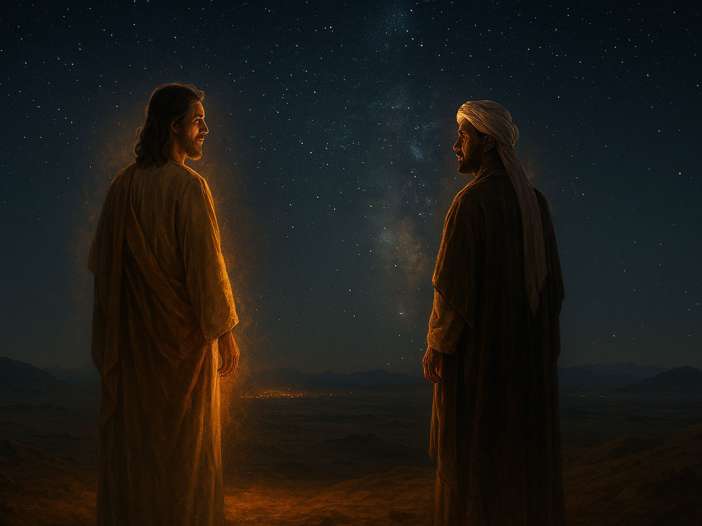
Setting: A high desert ridge under a canopy of stars. Below, the lights of human cities flicker, full of devotion and division alike. Jesus and Muhammad stand together, reflecting not only on their own journeys, but on the way their missions have been carried — and sometimes distorted — by their followers.
Conversation
Jesus
“When I walked among my people, many longed for a Messiah of power, not of sacrifice. They expected thrones, not a cross. Even my disciples fled when they saw the cost of love. Brother Muhammad, you too warned your followers not to worship you but to follow God. Tell me: why do people so easily misunderstand the prophet’s mission?”
Muhammad
“Because people desire certainty more than truth, and power more than humility. Some saw me as merely a tribal leader, others as a conqueror. They forgot I said, ‘I am only a man to whom it has been revealed that your God is One’ (18:110). My mission was to remind, not to replace. But men turn prophets into idols, forgetting the One who sent them. And you, Jesus — why did so many make your name a banner of conquest when your life was one of peace?”
Jesus
“Because they wanted me to be what I never was. They crowned me with gold in their minds, though I wore a crown of thorns. They sought victory, not love; empire, not mercy. I came to reveal the Father’s heart, not to build kingdoms of stone. When my name is used for hate, it is not I who speak. My plea is this: remember me for love, or do not call on me at all.”
Muhammad
“Let me ask you: What is the true sign of a prophet’s mission? How should people know if they have understood us rightly?”
Jesus
“By the fruit. I told them, ‘By their fruits you shall know them.’ If love grows, they have understood me. If mercy flourishes, they have seen the Father. But if hatred multiplies, they have misunderstood everything. My mission was not words alone, but a life poured out for others. What about you, Muhammad — what fruit proves your mission is remembered rightly?”
Muhammad
“The fruit of justice and compassion. The Qur’an says: ‘Indeed, Allah commands justice and doing good, and giving to relatives, and forbids immorality, oppression, and tyranny’ (16:90). If a society lifts its poor, honors its orphan, welcomes its stranger, then they have understood me. But if they build palaces with the tears of the weak, they have betrayed me. A prophet is known not by monuments, but by mercy. That is the true sign.”
Jesus
“Then let every generation test itself by these fruits. If love and mercy are absent, the prophet’s mission has been lost.”
Jesus
“Let me ask one final time: What is our desperate plea to those who carry our names now? What must they never forget?”
Muhammad
“My plea: Do not make me an idol. I am a servant of God, not God Himself. Follow mercy, not pride. Seek justice, not domination. If you use my name to oppress, you betray me. My mission was to remind you of the One — never forget Him.”
Jesus
“And my plea: Do not twist my cross into a banner of hate. I am love incarnate, not a weapon for your wars. If you forget love, you forget me. If you love even your enemy, then you have understood me. My mission was to reveal the Father’s heart — do not lose it in your thirst for power.”
Muhammad
“Then together we say: Remember the One. Live His mercy. Carry His love.”
Jesus
“Yes. And if you must remember us, let it be only as voices pointing to Him, never as thrones replacing Him.”
Closing Reflection
The stars wheel above in silence, eternal witnesses to the prophets’ pleas.
Jesus warns: do not turn love into hate, do not make the cross a weapon.
Muhammad warns: do not turn faith into empire, do not make the prophet an idol.
Together, they cry out across time: The mission was never conquest, but compassion. Never pride, but humility. Never division, but the embrace of God.
And as the night deepens, their voices join as one: Return to love and mercy, or you will lose the prophets themselves.
Final Thoughts
And so the story circles back: the mighty pass, their palaces crumble, their names fade into history’s silence. But the child who cried in the marketplace, the widow who shared her bread, the outcast who was embraced by light—these endure. They are not forgotten in heaven, nor are they overlooked on Earth, for it is through them that the world is made new.
The lesson is quiet but undeniable: greatness is not found in dominance, but in mercy. Prophets did not come to magnify kings, but to lift the poor, to reveal that God’s heart beats in the suffering, and that the measure of a people lies not in the palaces they build, but in how they treat the least among them.
If we can remember this, then even in the shadowed marketplace of our own time, light will return, and love will prevail where power once ruled.
Short Bios:
Jesus Christ
The central figure of Christianity, Jesus taught love, forgiveness, and the coming of the Kingdom of God. His life and teachings continue to inspire billions, emphasizing compassion, humility, and the power of sacrifice for the greater good.
Muhammad
The Prophet of Islam, Muhammad’s message centered on submission to God (Allah), justice, and mercy. His example of leadership, family values, and devotion to prayer and community has shaped the faith and life of over a billion Muslims.
Leave a Reply