

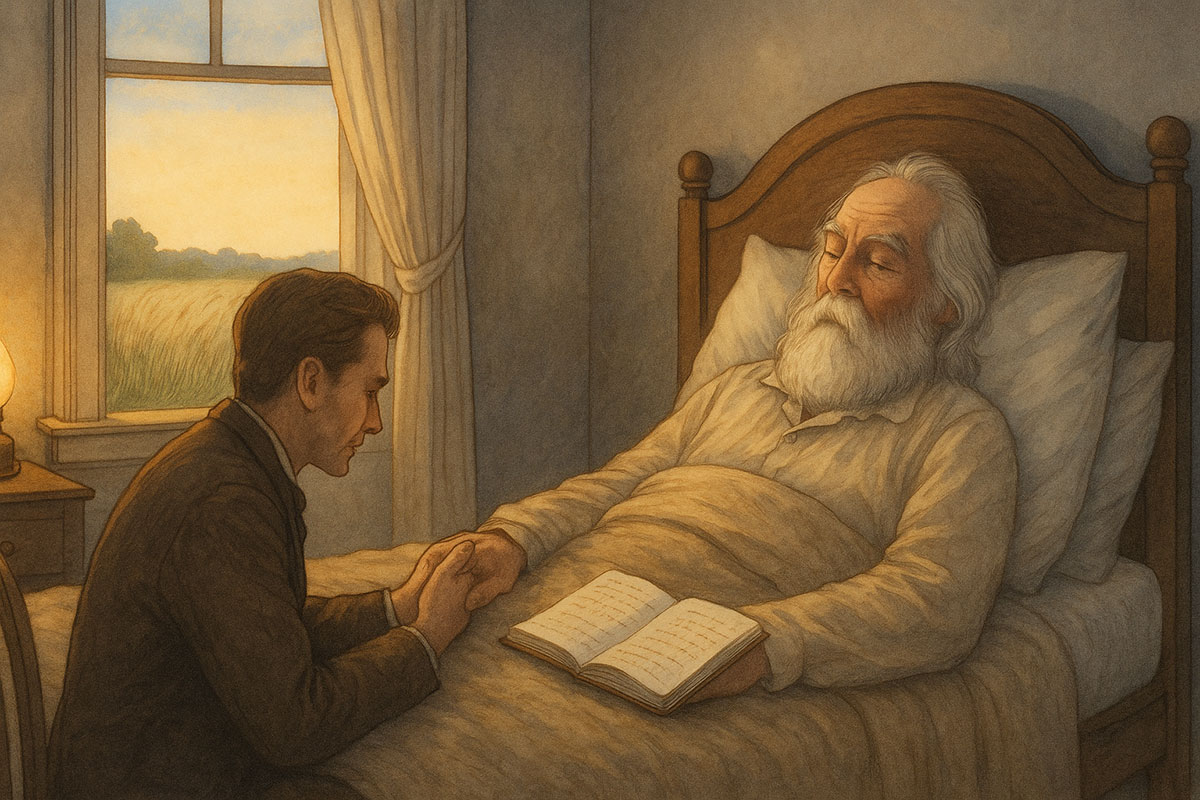
John Burroughs:
I have walked beside Walt through sunlit meadows and battlefield wards, through stanzas and silences alike. He was not merely my friend — he was a continent of feeling, a human cathedral open to all. In these quiet recollections, drawn as if in soft charcoal against the candlelit walls of memory, I sit once more beside him. You will find here not the myth, nor the marble bust, but the man — barefoot boy, tireless nurse, wandering bard, and fading elder. And beside him, always, a hand of compassion. Let us walk with Walt now, not to analyze, but to accompany.
(Note: This is an imaginary conversation, a creative exploration of an idea, and not a real speech or event.)
hapter 1: The Wound Dresser of War
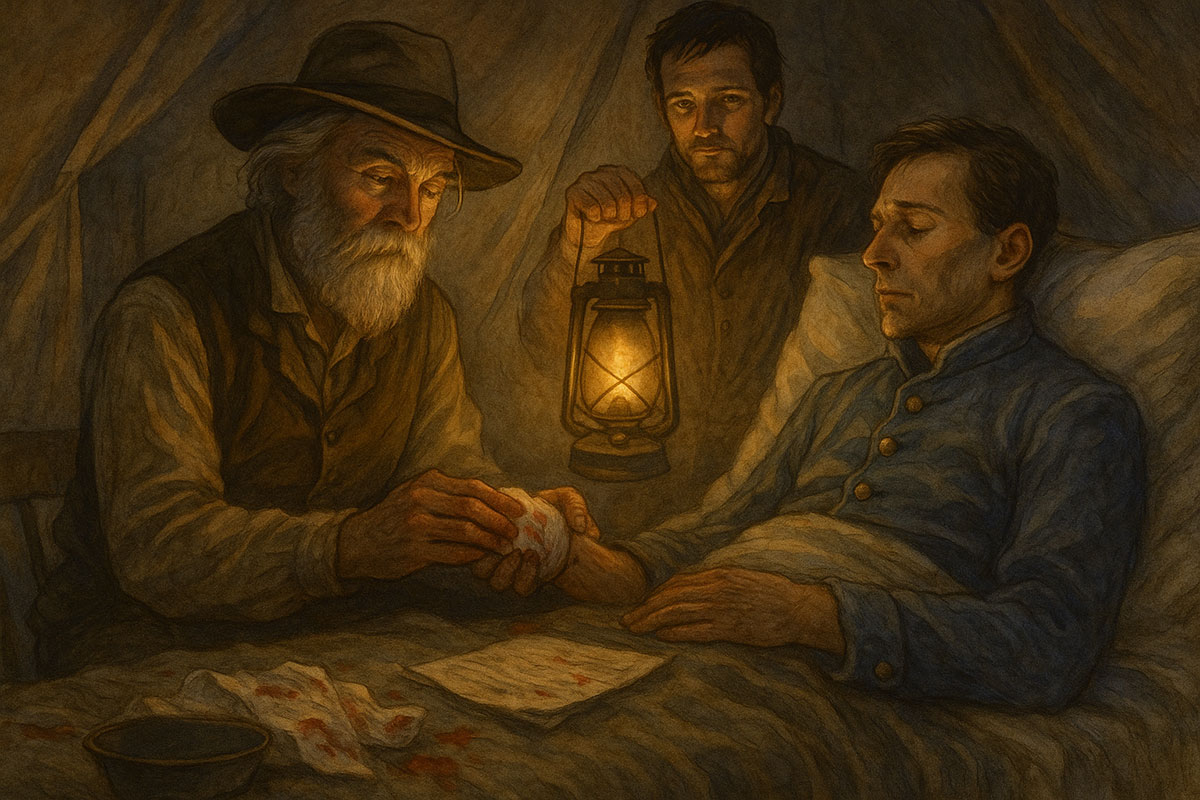
“The hurt men came in long file, and the blood followed.”
The air was rank with iodine and candle wax, but he had long stopped noticing. Walt’s hands moved as if on their own, slow and deliberate, binding a footless stump, placing a cup of water against lips that trembled but drank. The boy was seventeen — maybe eighteen — and called for his mother in his sleep. Walt had written the name down gently, adding it to a folded list in his coat pocket, just beneath his own hand-stitched poem.
“Do you ever feel like you’re stealing something, being alive while they go under?” he asked quietly, not looking up.
I was sitting across from him, folding linen strips into triangles. “You’re not stealing, Walt,” I said. “You’re carrying. There’s a difference.”
He didn’t answer at first. His eyes followed the candlelight dancing on the peeling plaster walls, then settled on a soldier’s boots—blood-crusted, half-torn, abandoned beneath a cot. “Sometimes I think I should have taken a bullet just to deserve this mercy.”
The thought had roots, I knew. Roots that wound through hospital corridors and battlefield letters, down to his tender, untouchable core. The one that broke each time he wrote, I sit with the dying—oh, what shall I do for the dead?
“Walt,” I said gently, “you gave them something no surgeon could. You gave them words. Presence. Your hand on theirs.”
He looked at me then, and the candle caught in his eyes — not just fatigue, but something else. “And when I’m gone?” he whispered. “Who will hold the wound dresser?”
We were quiet for a long time.
I reached into his coat and pulled the folded poem, stained and softened by weeks of war. It smelled faintly of rose water and antiseptic. “You left this beside a soldier last week. He couldn’t read it. But I did. It helped me more than I can say.”
His eyes widened. “I thought it was lost.”
“No,” I said. “You’re never lost. You’re only... very quiet when it hurts.”
That night, I helped him wash the dried blood from his knuckles. We didn’t speak. He stared out the makeshift window toward the stars and whispered to himself a line I couldn’t hear, as if setting it free before it hardened inside.
Chapter 2: The Brother in the Asylum
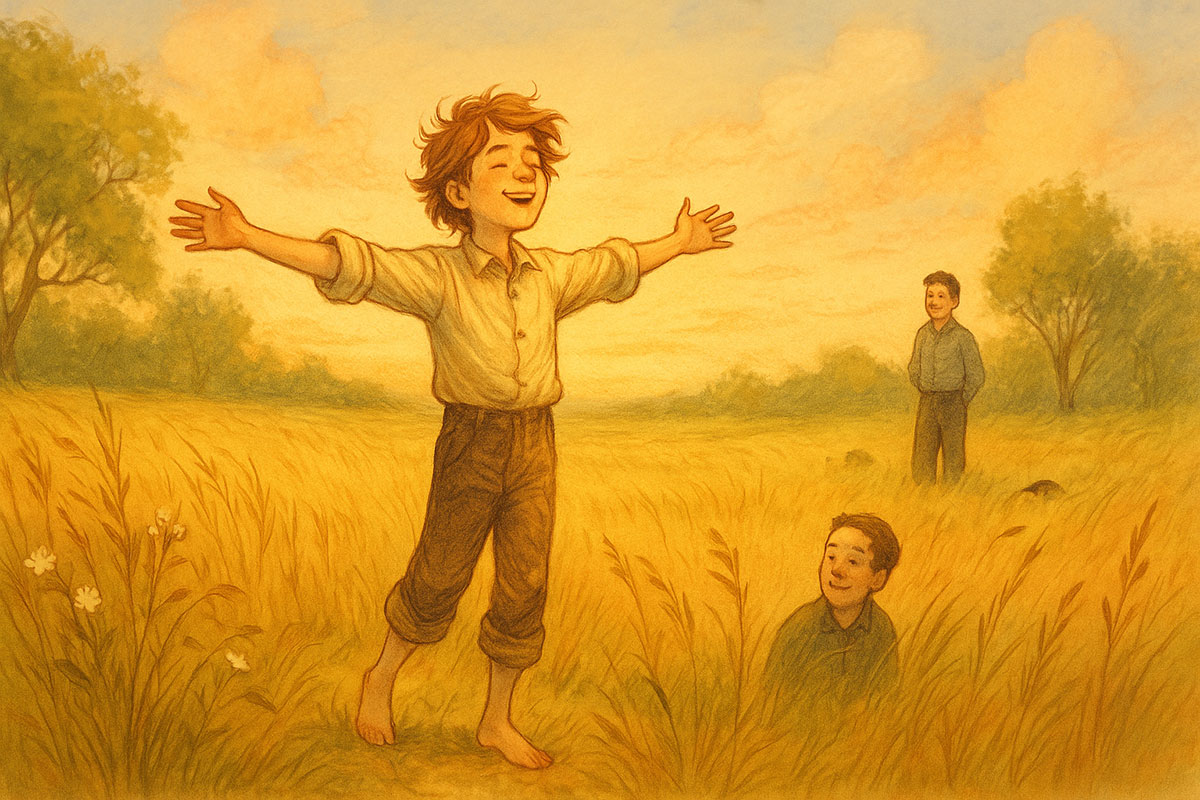
“There is something in personal love, O man, which, if it be not addressed to you, it will never be addressed to anyone.”
The grounds of the asylum were unusually green that day, with early sunlight laying gentle fingers on the dew-soaked grass. Birds whistled as if unaware of the walls meant to keep songs in—or out. Walt stood beside a low wrought-iron fence, his hat pressed to his chest. His brother Jesse had not spoken in days.
“I used to believe the soul was boundless,” Walt murmured. “Now I wonder if it can be caged.”
I walked beside him slowly, letting the silence settle. Inside, Jesse rocked back and forth in a straight-backed chair, his face vacant, his body folded like an origami of ache. The doctor’s words still echoed in our ears: “He’s not violent, Mr. Whitman. But he’s unreachable.”
Walt’s voice was lower now, thick with guilt. “I wrote about the world’s great sorrows. The Civil War. The death of Lincoln. But never this. Never my own blood, unraveling before me.”
“You wrote the truth,” I said. “But not all truths come in language. Some arrive in quiet, in sitting with someone until they remember they’re not alone.”
He blinked. “Do you think Jesse knows I come every week?”
I paused, then nodded. “Even if he doesn’t know, something in him feels it. Familiarity is a kind of balm, even when memory is absent.”
Walt looked toward the building. “He used to paint. Did I ever tell you? Terrible paintings—garish and bold. But he painted joy. He painted light.” His voice caught. “And now he just rocks.”
We stepped into the visiting room. Jesse was still. His eyes flicked toward Walt for the briefest moment. No recognition. But he stopped rocking.
Walt sat. “Hello, brother,” he said, voice like honey over a wound.
I stood by the door and watched as Walt took out a small leather-bound notebook. “I brought you a line,” he said, not expecting an answer. “Tell me if it suits you.” He flipped a page, then read aloud:
“I dream in my sleep of the brothers I knew—
of what’s gone, and of what is ever true.
In your silence, Jesse, there is song—
a chord that says I still belong.”
Walt’s voice faltered on the last line. Jesse didn’t move. But something soft passed through the room, like breath across a mirror.
Later, as we left, I touched Walt’s arm. “That poem—was that new?”
He smiled faintly. “No. He wrote it when he was sixteen. I just gave it back.”
Chapter 3: The Poet in Exile

“I am larger, better than I thought; I did not know I held so much goodness.”
The sky above Brooklyn was washed in copper, and the wind smelled faintly of salt. Walt’s footsteps echoed against the stone of the ferry landing. He had been away too long—from his readers, from his home, from himself.
When I found him that evening, he was sitting on a bench facing the East River, watching ships vanish into the horizon as if each one carried away a part of him.
“You’re not writing,” I said gently.
He didn’t look at me. “No. The well’s dried up. Or maybe... I stopped drawing from it.”
“You’ve been ill. And they rejected Leaves of Grass—again.”
He nodded, weariness in his eyes. “They called it obscene. As if passion were a poison. As if loving too freely were a crime against God.”
“Or against convention,” I added. “But not against truth.”
Walt chuckled, bitterly. “Do you know what it feels like to pour yourself into the world, and have the world send you back in a brown envelope marked ‘Unfit’?”
I sat beside him, letting silence stretch like the tide. “You once told me the body is a sacred vessel. That every hair on a man’s arm carries divinity.”
“I believed that,” he whispered.
“You still do,” I said. “Or you wouldn’t ache so much.”
The wind picked up, rattling dry leaves across the stone. A tugboat moaned in the distance.
“Sometimes I think I should’ve stayed a printer,” he muttered. “Set other people’s words in type. Not bleed my own onto the page.”
I turned toward him. “Walt—do you know how many young men hold your book under their pillow? How many whisper your poems when they think no one can hear? You didn’t fail. You gave them permission to exist.”
He looked down at his hands, ink-stained even now. “But I am alone.”
“You are not unloved,” I said. “Even if the world whispers behind curtains, you’ve made a temple out of truth. You’ve sung the song of the unspoken. That’s not exile—it’s pilgrimage.”
For the first time that evening, he looked at me. “Do you really believe that?”
“I do,” I said. “And you will again.”
He stood slowly, the ferry bell ringing in the distance. “Then maybe I’ll write tomorrow,” he said. “Something small. Just to remember I’m still breathing.”
I smiled. “That’s all a poem needs.”
Chapter 4: The Last Waltz of the Body

“If anything is sacred, the human body is sacred.”
It was spring again, but Walt’s body had turned against him.
The vibrancy that once rolled off his limbs like river tides had dwindled to the tremble in his hands and the ghost of his stride. The poet of muscles, of sinew and skin, of sweat and open laughter—was now learning to walk again, inch by painful inch.
The room in Camden was quiet, a single oil lamp casting long shadows across the books lining the walls. I found him beside the mirror, trying to fasten his collar, the buttons fumbling beneath stiff fingers.
“I never thought the body would forget me,” he said without turning. “But it has. Like a lover who’s had enough.”
“It hasn’t forgotten you,” I said gently. “It’s just tired from carrying so much soul.”
He chuckled, the sound hoarse and half-bitter. “I used to believe the body was the greatest poem. Every wrinkle, a line. Every vein, a verse. But now, I wonder if this old vessel deserves to keep singing.”
I stepped beside him and helped with the collar. “Walt, you taught the world that to be human was holy. You showed us the grandeur in the ordinary. That never stopped being true.”
“But now I drool in my sleep,” he said. “My legs refuse to listen. My bowels revolt like ungrateful children. Where is the glory in that?”
I reached for his hand. “It’s still here. In your breath. In your fight to rise. In the fact that despite everything—despite the war in your bones—you still want to be seen.”
He sat down slowly, as if folding into gravity itself. “I miss dancing,” he said softly. “Not at parties. I mean the dance of walking under moonlight, of lifting a child, of swimming naked where no one’s watching.”
I nodded. “You danced for all of us.”
He looked toward the window, where the last light was fading. “There was a time I believed I’d die in the woods, surrounded by birdsong. Not in a chair by a bedpan.”
“And yet,” I said, “you are surrounded by something just as sacred now—your own endurance. This is still part of the poem.”
He looked at me then, eyes damp. “Do you think anyone will remember?”
“They already do,” I said. “And long after this body rests, your words will dance in theirs.”
He closed his eyes for a long time. Then whispered, “That’s enough, I think. For one more night.”
And we sat in stillness, the room full of breath and grace.
Chapter 5: The River in His Voice

“I sound my barbaric yawp over the roofs of the world.”
He couldn’t speak above a whisper now.
The voice that once surged like a river through the veins of America—chanting, praising, awakening—was reduced to fragile breath, thin as paper and just as easily torn. Yet when I arrived that morning, he greeted me not with sorrow, but with eyes alive, as if somewhere inside, the poem still thundered.
“I dreamed I was singing again,” he murmured. “On a hill, under stars. I think I startled the moon.”
I smiled. “Did it sing back?”
“No,” he said, lips curling. “But it listened.”
The window was open, and from beyond came the rustle of leaves—summer trying on her green dress. His bed was lined with folded blankets and well-loved pages. And by his bedside sat his notebook. Empty.
“I haven’t written in weeks,” he said. “The words swim too fast for me to catch now. It’s like trying to scoop minnows with trembling hands.”
“Then speak them,” I said. “And I’ll write them for you.”
He looked at me, eyes wide. “You’d do that?”
“Walt,” I said, sitting beside him. “I would bottle your voice if I could. I’d carry it across every rooftop, every railcar, every open field.”
He nodded, then closed his eyes, as if tuning into the pulse of the world. And then—softly, with breath more than tone—he spoke:
“Let me say one more thing,
Not as a prophet, nor a poet,
But as a man who dared to love this earth
In every blade and bone.”
I wrote each word slowly, not just onto the page, but into my being.
“Tell them I saw God
In dockworkers and mothers,
In soldiers and schoolteachers,
In naked swimmers and unshaven preachers.”
His voice cracked. I waited.
Then came the last lines:
“Let my voice be a raft.
If you ever feel lost,
Climb on it.
And remember:
You were never truly alone.”
He opened his eyes, tears waiting patiently at the edges.
“I’m not afraid,” he said. “But I don’t want to vanish.”
“You won’t,” I told him. “Your yawp echoes still. And not just over rooftops—but inside hearts.”
He nodded, his head tilting back slightly against the pillow. A long breath left his chest, like wind slipping into silence.
And in that hush, I heard the river again—carrying him home.
Final Thoughts John Burroughs
Now the grass bends, the journal closes, and the room falls still. But do not think the poem has ended. No, Walt Whitman was never about endings. His breath lingers in leaves, his pulse in every free soul who dares to speak plainly and love wildly. What you have witnessed is not a eulogy but a conversation, not a monument but a moment — a man who believed that the lowliest blade of grass was worth a verse. And if, in these final scenes, you felt your own heart stirred, perhaps that was Walt whispering: “I am large, I contain you, too.”
Short Bios:
Walt Whitman
An American poet, essayist, and humanist (1819–1892), Walt Whitman is considered one of the most influential voices in American literature. Best known for his groundbreaking collection Leaves of Grass, Whitman celebrated the body, the soul, democracy, and the divine found in everyday life. His poetry embraced a radical openness, offering compassion during the Civil War as a nurse and invoking unity in the American spirit through transcendent verse.
John Burroughs
A naturalist, essayist, and literary critic (1837–1921), John Burroughs was a close friend and devoted admirer of Whitman. Through his nature writings and reflective essays, Burroughs helped shape America’s appreciation of wilderness and simplicity. He defended and illuminated Whitman’s work at a time when it was controversial, becoming one of his earliest and most articulate champions.
Leave a Reply