

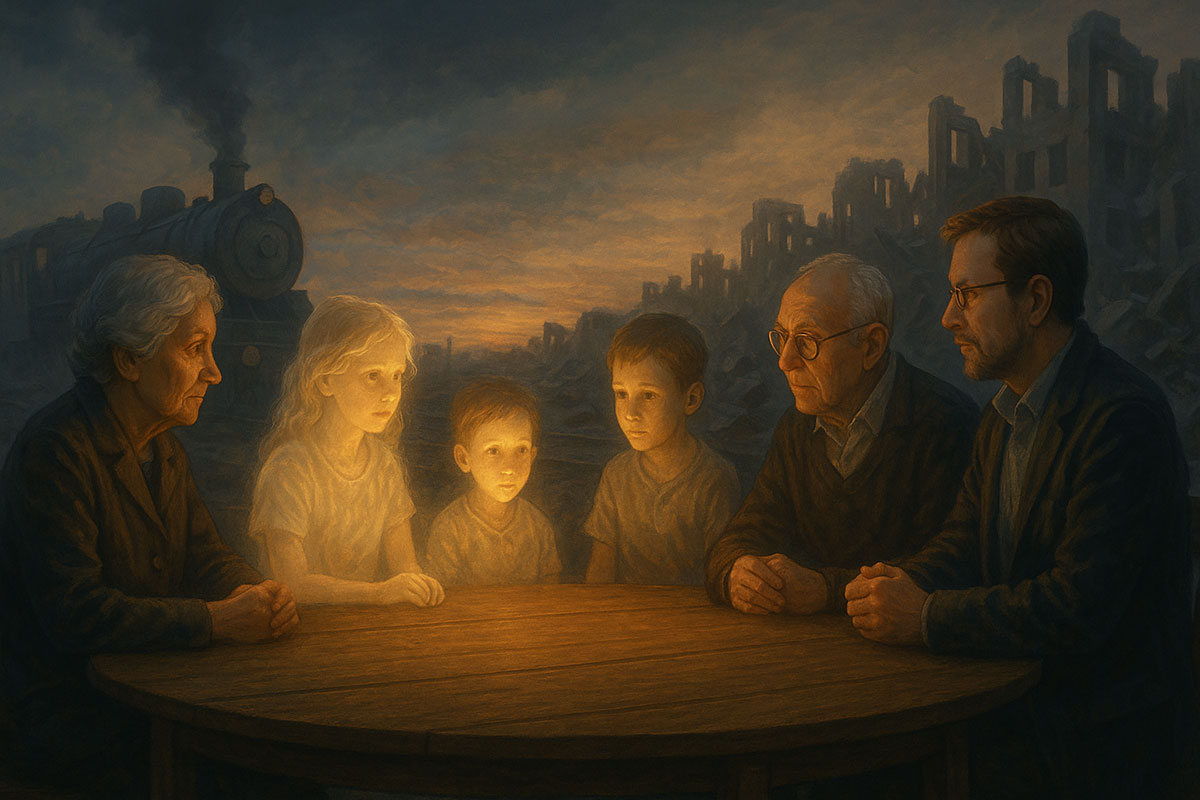
(Nick Sasaki steps forward into a quiet room, his voice calm, steady, and reverent.)
Tonight, we gather across time, across tragedy, across what we think of as impossible divides.
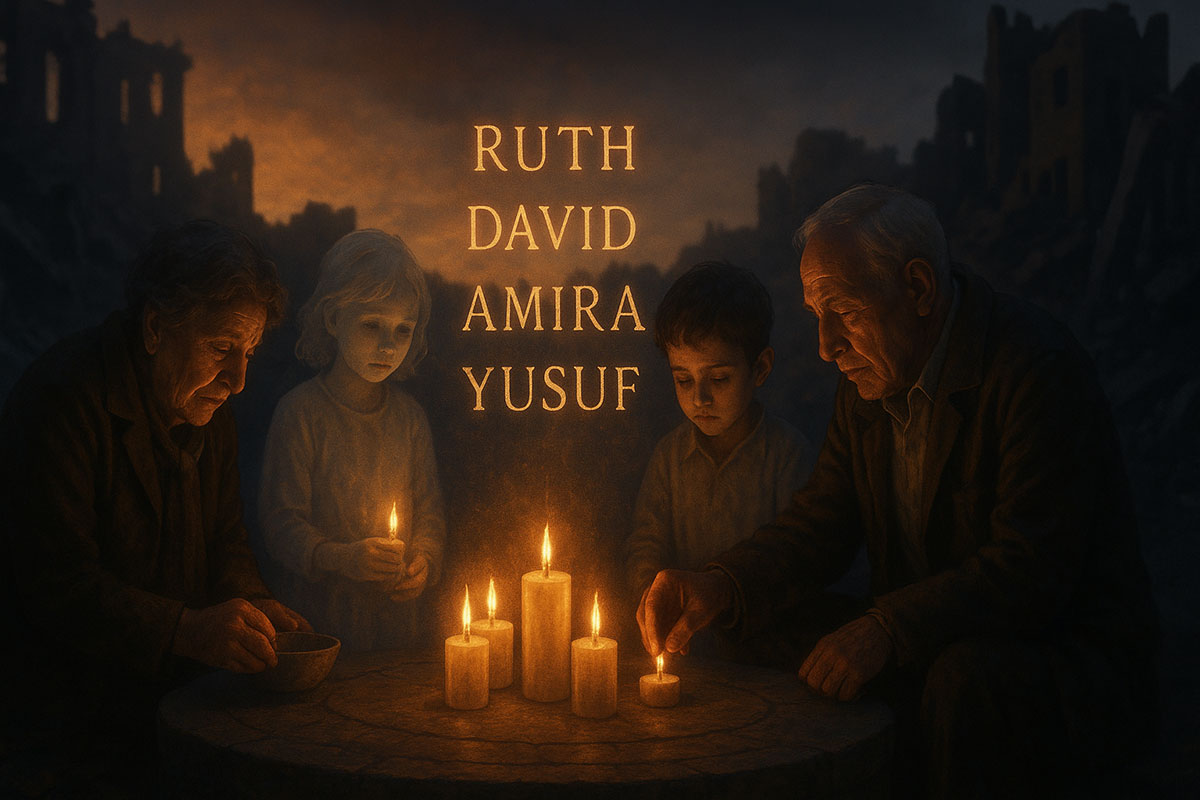
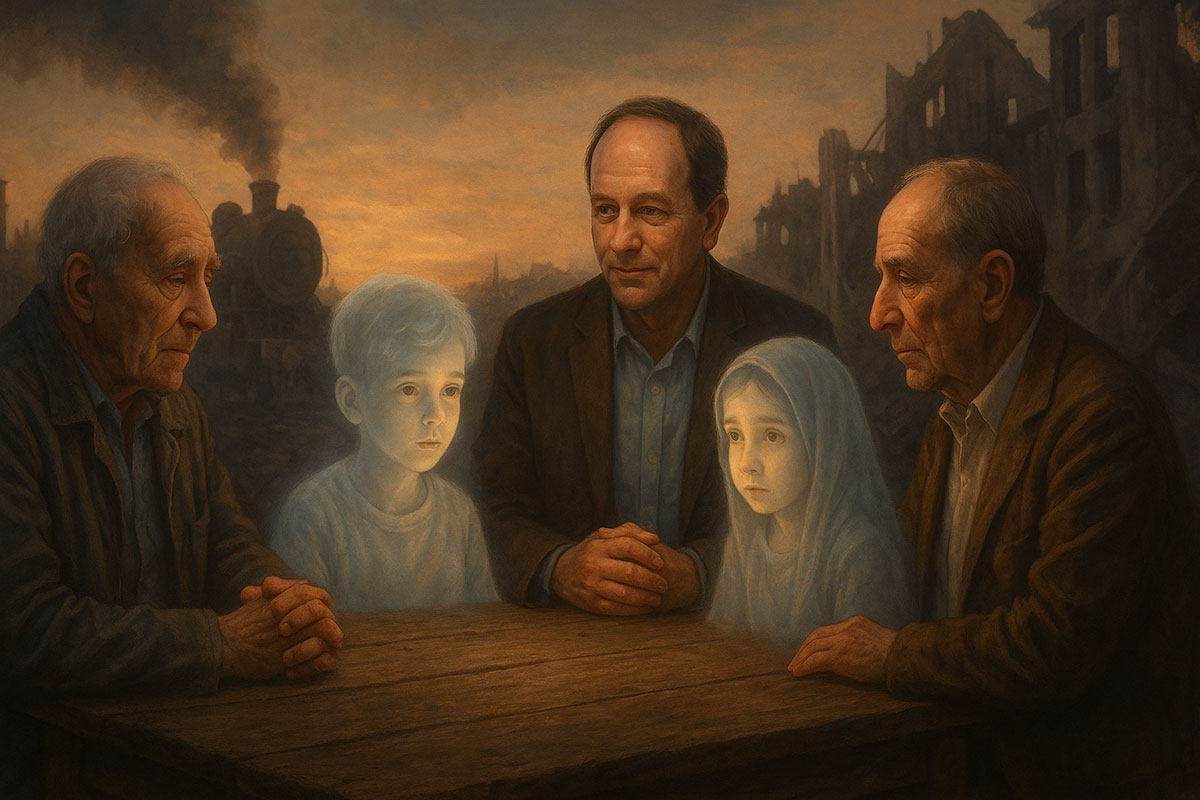
Before us are two Holocaust survivors — Ruth and David — who, as children, were torn from their families and placed on a train bound for death. In April 1945, they were liberated near Magdeburg, Germany, and their lives were spared. They carry the voices of those who did not survive, the names of mothers, fathers, brothers, and sisters who never came home.
Beside them sit two children from Gaza — Amira and Yusuf. They did not survive. Their voices come to us as whispers of memory, echoes of lives that ended too soon. Yet here, they speak — not in anger, but in longing, in innocence, in the universal language of children who only ever wanted to live, to laugh, to grow.
And guiding us in this space is Matthew Rozell, the teacher and author who uncovered the forgotten story of the train near Magdeburg. Through his work, he reunited survivors with their liberators, carried their testimonies into classrooms, and helped new generations see what it means to witness. Tonight, he helps us hold a fragile bridge between past and present, between the living and the departed.
(Nick pauses, allowing the weight of these introductions to settle.)
This is not a political conversation. This is not about sides or borders. This is about children. This is about humanity.
Over the next moments, you will hear voices speak of what it means to be seen, of hunger that clawed at the body and fear that gnawed at the soul, of freedom remembered in chocolate and lullabies, of memories that refuse erasure, and of peace imagined in oranges, laughter, and kites.
I ask you to listen not only with your ears, but with your heart.
Because tonight, we are reminded of something simple, something eternal: when children suffer, the world itself is broken. And when we honor their voices, even across time, we begin the work of healing.
(Nick bows his head briefly before looking up with quiet resolve.)
Let us begin.
(Note: This is an imaginary conversation, a creative exploration of an idea, and not a real speech or event)

Topic 1: Being Seen as Human
Matthew Rozell (Moderator):
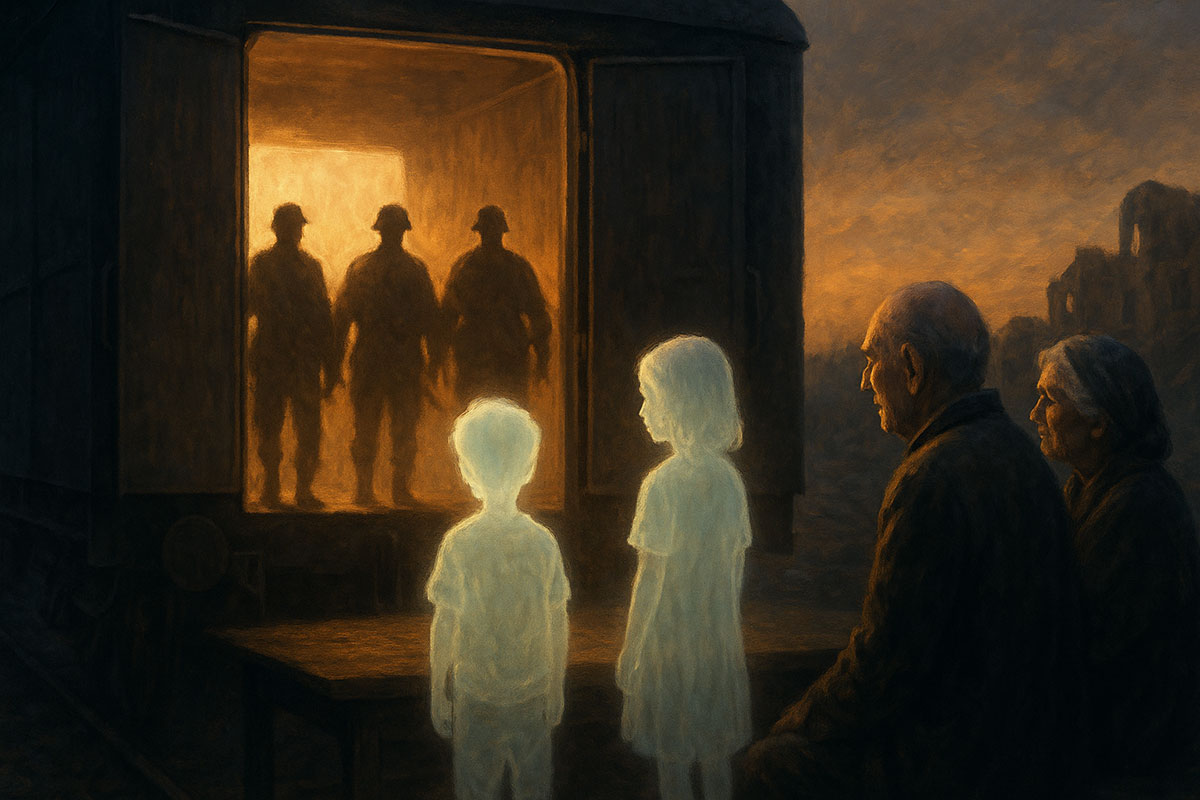
“When I interviewed survivors of the train near Magdeburg, many told me the first thing they remembered was not bread or safety, but a look — the way a soldier’s eyes fell on them with recognition. One man said, ‘For the first time, I knew I was no longer invisible.’ In my classroom, students always ask: How could a single glance matter so much? Let me ask you: what was it like when someone looked at you with kindness?”
David:
“The soldier bent down and pressed a canteen into my hands. The metal was warm, the water tasted of iron, but to me it was sweeter than honey. He didn’t flinch at my sores, didn’t turn his head away. In his eyes, I saw concern, not disgust. For the first time in years, I was not a burden, not cargo — I was a thirsty boy, and he saw me.”
Amira:
“I carried my little brother through streets of dust, humming songs to quiet his fear. My arms ached, but my greater ache was this: no one saw me as a sister, only as part of the rubble. If someone had looked at me and said, ‘You are doing something brave, you are protecting him,’ I would have felt whole again, even in ruins.”
Ruth:
“When the soldier lifted my chin, I braced for the blow. But his eyes held no cruelty. He did not ask for my number. He saw my face. In that gaze, I felt my name return to me. I was not 11-something — I was Ruth. That look was a mirror that gave me back myself.”
Yusuf:
“After the explosion, I dreamed of a gentle hand brushing dust from my cheek. No shouting, no orders — just touch. In that dream, I was not rubble or silence. I was a boy again. Being seen, even in a dream, was freedom.”
Rozell (reflection):
“When I show liberation photographs to my students, they see thin faces staring back into the camera. I tell them, ‘The camera itself was an act of seeing.’ But hearing you now, I realize it was more than evidence — it was dignity restored. A glance, a touch, a name spoken aloud. These are not small things; they are salvation.”
Rozell (Moderator):
“Why does it hurt so much when nobody notices you?”
Ruth:
“A blow was painful, yes, but it told me I was still there. Being ignored was worse. When people passed by without a glance, it was as if I had already died in their eyes. Indifference killed more deeply than hunger.”
Yusuf:
“My fear wasn’t just the bombs. It was that no one would whisper my name when I was gone. Without that, it felt as if I had never lived. To be unseen is to vanish twice — in life and in memory.”
Amira:
“When nobody sees you, your songs, your games, your love — all of it disappears. I was a sister, I was a child, but when eyes slid past me, it was like none of that ever existed. That is a pain worse than fear itself.”
David:
“In the camp, guards never looked at us. We were not children to them. We were things. To be unseen in that way hollowed me more than starvation. Hunger shrank my body; invisibility shrank my soul.”
Rozell (reflection):
“Once, a survivor told me: ‘The opposite of death was not life — it was being noticed.’ My students often struggle to understand that. But here, in your voices, I hear it clearly: neglect is its own form of violence. To turn away is to erase.”
Rozell (Moderator):
“If people look at you now, what do you want them to see and remember?”
Yusuf:
“Remember me as a boy who once dreamed of oranges, who laughed with his father. Don’t let me be reduced to rubble. See me as joy, not just loss.”
Ruth:
“See me as a woman who lived, not just a girl who suffered. I laughed again, I created, I loved. My life stretched beyond the fences, and I want that to be remembered.”
Amira:
“See me as a sister who sang, who tried to shield her brother, who carried love heavier than fear. Don’t remember me only as dust.”
David:
“See the boy who believed in kindness because of one soldier’s glance. That belief carried me through. If you remember that, you remember my life.”
Rozell (closing reflection):
“My students often ask, ‘Why did a glance matter so much?’ Today I have the answer: because it returned names, restored stories, rescued humanity. To be seen is not a small mercy — it is the first act of salvation.”
Topic 2: Hunger and Fear
Rozell (Moderator):
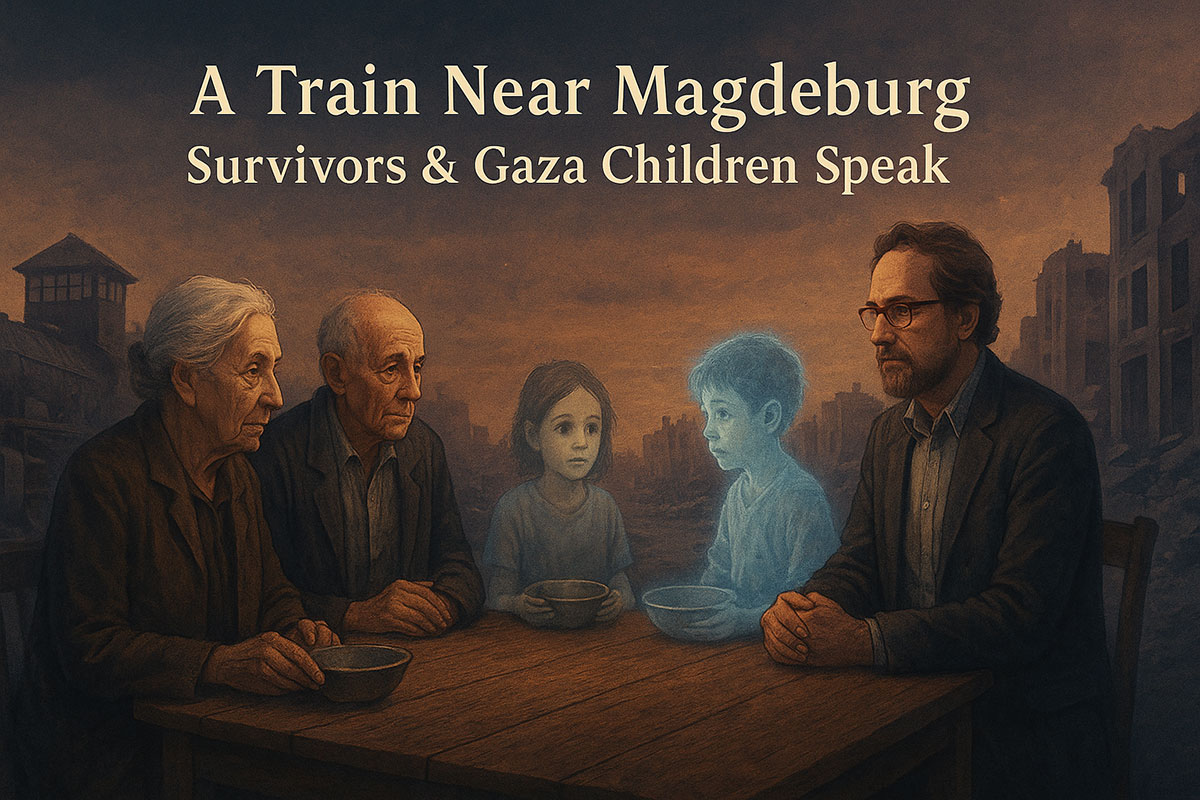
“I remember survivors telling me they could describe hunger more vividly than anything else — sharper than whips, deeper than fear. And yet, when I shared these stories in classrooms, students always asked: How did children endure both hunger and terror at once? Let me ask you the same.”
David:
“Hunger was not just emptiness. It was like an animal scratching inside my stomach, day and night. I felt older than my years because it never let me rest.”
Amira:
“I felt my brother’s hunger more than mine. I would tell him stories at night, hoping he’d forget his stomach’s cries. His emptiness became mine to carry.”
Ruth:
“Hunger slowed even my thoughts. It was as if my mind was starved too. Some days I could hardly remember my own voice.”
Yusuf:
“My father once promised me oranges. After the blockade, I dreamed of holding one, peeling it slowly. The dream itself became my food.”
Amira:
“The bombs above us shook the walls, but what scared me most was the silence after. Would the next sound be my brother’s last breath?”
Ruth:
“I feared the sudden shout of a guard more than the beatings. Cruelty could arrive in a single word, and that terror never left me.”
Yusuf:
“I was afraid no one would remember me. Not the falling buildings, not the planes — but the thought of my name being lost forever.”
David:
“My greatest fear was tomorrow. Today I could endure. But what would tomorrow take from me? That question haunted me more than hunger itself.”
Yusuf:
“In dreams I held an orange in my hands, peeled it slowly, shared it with my father. The sweetness was not real, but it filled me more than bread ever could.”
Ruth:
“I carried the memory of my mother’s embrace. Though she was gone, that memory filled the emptiness more than bread could.”
David:
“One sip of water from a soldier’s canteen. The metal was warm, but it told me I was still human, still worth saving. That memory became my food.”
Amira:
“My brother’s small hand in mine. His grip was fragile, yet it anchored me. As long as he held on, I could not let go.”
Rozell (closing reflection):
“One veteran I spoke with remembered handing a piece of candy to a child from the train. Decades later, he wept as he recalled the look in her eyes. That small act was remembered as survival itself. Even in hunger and fear, love left a mark deeper than cruelty.”
Topic 3: What Freedom Means
Rozell (Moderator):
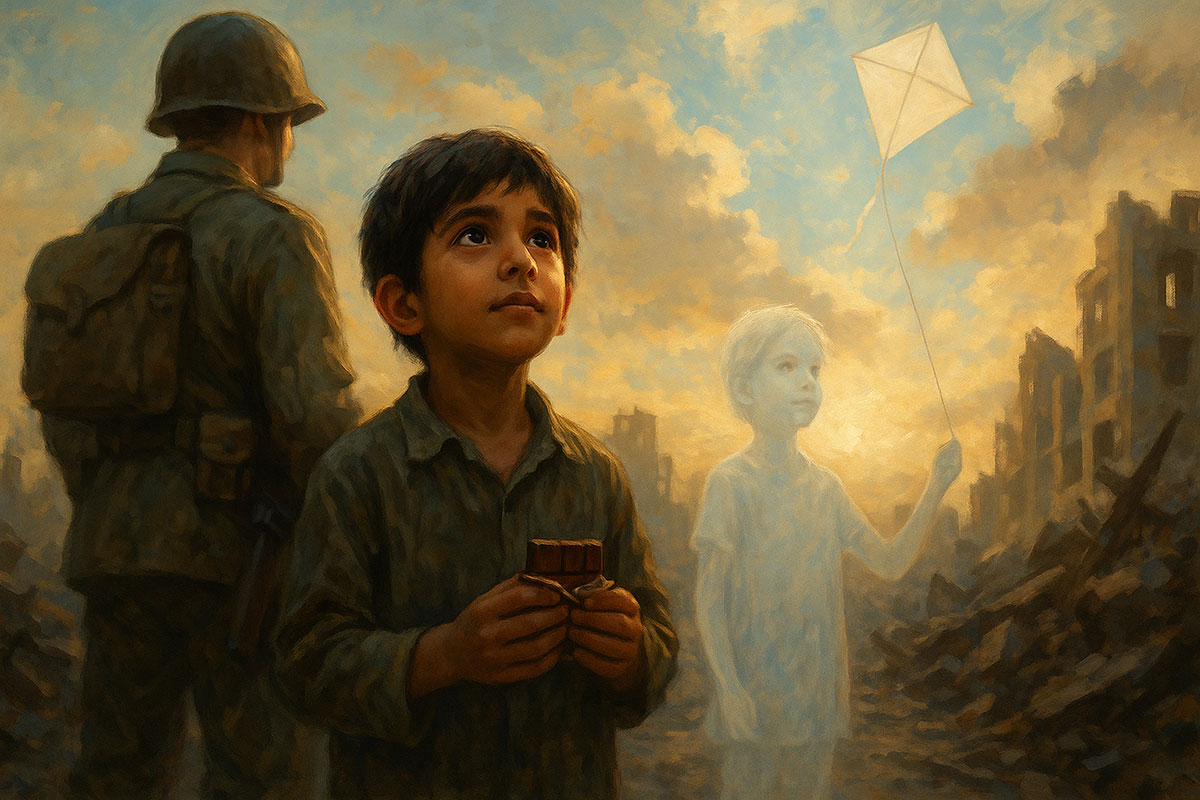
“When the train was liberated, children later said freedom was not a speech or a flag — it was chocolate melting on the tongue, or a sip of milk. When I teach this moment, students are startled by how ordinary those first tastes of freedom were. Let me ask: what did freedom mean to you?”
Ruth:
“I dreamed of walking without being chased. Just tying my hair in peace, no one shouting, no one pulling me down. That was my freedom.”
Yusuf:
“For me, freedom was a door that opened without breaking. In my dream, I stepped through it into a room that stayed safe. No walls falling, no smoke, just safety.”
David:
“My freedom was silence. No boots, no dogs, no orders. Silence that didn’t mean death, but life beginning again.”
Amira:
“I imagined one night where my brother could sleep all the way through, without waking to the hum of planes above us. That was freedom to me.”
David:
“Yes. Chocolate from a soldier. It melted in my mouth, not just as sugar, but as proof I would not be punished for living.”
Ruth:
“When the gates opened, I breathed air that wasn’t rationed. My lungs filled and I wept. The taste of air was freedom.”
Amira:
“I never lived it. But I imagined my mother’s voice calling us home for supper, instead of shouting for us to hide. That sound would have been freedom.”
Yusuf:
“I didn’t reach it. But I dreamed of walking beside my father, holding his hand, with no rubble beneath our feet and no fear above our heads. That was my freedom.”
Amira:
“Freedom is a child safe at school, not looking up at the sky in fear.”
David:
“Freedom is belonging to tomorrow — waking up without wondering what it will steal.”
Ruth:
“Freedom is laughter that isn’t silenced, prayers that aren’t broken, steps taken without dread.”
Yusuf:
“Freedom is walking into the sunlight without being afraid it will end.”
Rozell (closing reflection):
“I’ve held letters from soldiers who said that giving a piece of chocolate or a blanket to a child felt like the greatest act of their lives. Freedom, they wrote, was ordinary life returned. Your words echo theirs — reminding us that ordinary is holy.”
Topic 4: The Weight of Memory
Rozell (Moderator):
“When I began collecting these testimonies, I thought memory was just about recording facts. But every survivor taught me memory is sacred — it carries the dead, it guards dignity, it refuses silence. What memories do you carry, and what should the world hold for you?”
Amira:
“The sound of my brother’s laughter when I made up silly songs. Even in the darkest nights, that sound echoed inside me. I carry it still.”
David:
“I will never forget the moment a soldier bent down with water. That memory was proof that not everyone turned away. It kept me alive when I wanted to give up.”
Ruth:
“I remember my mother’s hands, thin and trembling, still trying to protect me. Her touch is with me always, even more than her face.”
Yusuf:
“My strongest memory is of chasing oranges rolling across the floor of our kitchen. My father laughed, I laughed — the world felt safe for a moment. That memory is my safe place.”
Ruth:
“Because without memory, those who died would vanish twice. To remember is to keep them alive, even when it breaks my heart.”
Yusuf:
“Memories are the only way I still exist. If no one speaks my name or imagines my orange, then I am gone forever.”
David:
“Memories matter because they remind us of kindness. Without them, cruelty would feel endless. With them, there is proof of another way.”
Amira:
“Memories hold love. My songs, my laughter, my brother’s small arms around me — they live on only if someone remembers. That is stronger than rubble.”
David:
“Remember me as the boy who held on because of one act of compassion. Let that moment remind the world that kindness saves lives.”
Amira:
“Remember me as the sister who sang, who tried to protect, who loved. Do not let me be reduced to numbers.”
Yusuf:
“Remember me as the child who dreamed of sunlight and oranges. That dream is who I really was.”
Ruth:
“Remember me not only as a survivor of cruelty, but as someone who lived fully afterward — who laughed, who created, who loved. That is my true story.”
Rozell (closing reflection):
“In my classroom, I have seen teenagers cry hearing Ruth’s story, or seeing David’s photograph as a boy. That is memory doing its work — not history in a textbook, but a living bridge. Today you remind me: memory is rebellion against forgetting.”
Topic 5: Imagining Peace
Rozell (Moderator):
“When I ask my students to imagine peace, they often speak of treaties or leaders. But when survivors spoke, peace was always smaller: a meal shared, a child’s laughter, a door that stayed open. Let me ask you: when you dreamed of peace, what did it look like?”
Amira:
“I saw my brother playing in the street without looking at the sky. I saw myself bringing him home for supper, not hiding him in the dark.”
David:
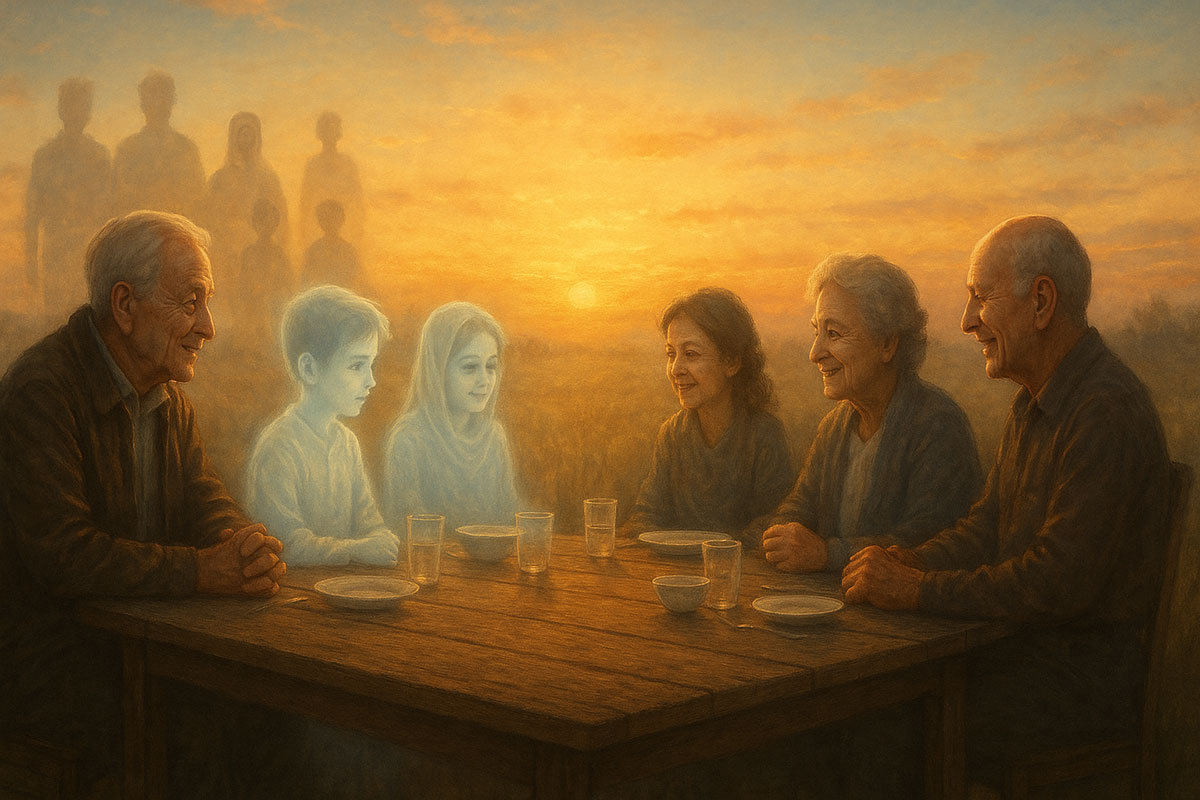
“I saw a table with every chair filled, no one missing, no one taken away. Peace was a family whole again.”
Yusuf:
“I saw kites in the air, their strings strong, not cut by smoke. The sky was wide, and it belonged to children again.”
Ruth:
“I saw people walking freely, no boots, no fences, no numbers. Just footsteps that went where they wished.”
Ruth:
“It would feel like breathing without fear tightening my chest. Each breath deep, unhurried, mine alone.”
Amira:
“Peace would feel like holding my brother and not trembling, like my arms were finally strong enough to keep him safe.”
David:
“Peace would feel like laughter shaking through my whole body. Laughter not muffled, not silenced — laughter free.”
Yusuf:
“Peace would feel like warm sunlight on my face, no shadows of planes above. Just light, gentle and endless.”
Yusuf:
“A father and son sharing an orange under a wide blue sky. That is peace to me.”
Amira:
“Children walking home from school, their hands full of books, not rubble. That is the picture I want remembered.”
David:
“A mother setting bread on the table, everyone present, no one missing. That is what peace must mean.”
Ruth:
“A child’s name spoken with love, never erased, never forgotten. That is peace — dignity kept safe forever.”
Rozell (closing reflection):
“I once showed a veteran’s photo of children liberated from the train — their faces stunned, then breaking into cautious smiles. That picture has stayed with me, because it proves peace is not abstract. It is bread, a safe table, a kite string held unbroken. And your voices tell us it must be protected like the most fragile treasure.”
Final Thoughts By Nick Sasaki
(Nick Sasaki steps forward slowly, voice steady but carrying emotion. He pauses, looking at the audience before speaking.)
Tonight, we have heard voices that should never have needed to plead with us.
Ruth and David — you carried hunger, fear, and the aching loss of family through one of history’s darkest hours.
Amira and Yusuf — your voices reached us from beyond, not with anger, but with longing… with the simple wish to be remembered as children.
(Nick pauses, his hand over his heart.)
What I take from you is this: children are the measure of our humanity.
When children are hungry… when they tremble in fear… when they reach for their parents and find only silence — that is when the world has failed.
(Nick looks upward briefly, then back to the audience.)
And yet — you’ve given us more than sorrow. You’ve given us images of peace that pierce the heart.
Not politics. Not grand promises. But the simple, ordinary miracles of life:
— A soldier bending to hand a boy water.
— A sister humming songs in the rubble.
— A father’s hand held tightly, walking without fear.
— A mother’s embrace carried in memory.
— A kite rising into a sky no longer cut by smoke.
(Nick’s voice cracks slightly, he lets the silence linger before continuing softly.)
This is peace. Not an idea, but a life. A life every child deserves.
(Nick extends his hands outward, palms open as if offering something invisible.)
You have taught us that memory is not only remembrance… it is resistance.
It is love refusing to be erased.
It is the flame that says: Never again. Not to you. Not to any child.
(Nick lowers his voice, almost to a whisper.)
Ruth. David. Amira. Yusuf.
We call your names tonight — and in calling them, we promise that you will live on.
We promise to see the children the world overlooks.
We promise to protect their laughter.
(Nick lifts his head, eyes wet but voice firm now.)
So let us carry these voices forward.
Let us build a peace not written in treaties, but written in lullabies, in shared meals, in the safety of children who wake tomorrow without fear.
That is the peace we owe them.
That is the peace we owe ourselves.
(Nick bows his head. Long pause. Then he whispers one final line, almost like a prayer.)
“See us. Remember us. Protect the children.”
Short Bios:
Ruth
A Holocaust survivor who was a young girl aboard the train near Magdeburg in April 1945. Liberated by American soldiers, she carries the memory of her lost parents and sister, and speaks for children whose voices were silenced.
David
A Holocaust survivor who was a boy on the same train near Magdeburg. He endured hunger, fear, and separation from his family, yet survived to witness liberation. His life became a testament to resilience and remembrance.
Amira
A symbolic voice representing a young girl from Gaza whose life was cut short by war. She embodies the longing of children for safety, family, and simple joys. Though gone, her spirit speaks of innocence, loss, and the universal right to be remembered.
Yusuf
A symbolic voice of a boy from Gaza who perished in conflict. He represents countless children who dreamed of learning, playing, and growing with their families. His voice, though from beyond, reminds us that every child’s life is sacred.
Matthew Rozell
An American teacher and author of A Train Near Magdeburg. Through oral history projects with his students, he uncovered the story of the 1945 liberation of 2,500 Jews from a death train. His work reunited survivors with their liberators and preserved a vital chapter of Holocaust history.
Nick Sasaki
A writer and creator of Imaginary Talks, Nick brings together voices across time, history, and spirit to explore themes of compassion, justice, and peace. In this dialogue, he serves as a witness and closing voice, carrying forward the lessons of survivors and children alike.
Leave a Reply